Latest Developments in Open Access Matthew Cockerill Managing Director, BioMed Central
What’s new in Open Access Peter Suber’s SPARC Open Access newsletter includes a roundup of the 137 most important OA developments  - in November… I will focus just on OA publishing
More, more, more… More open access mandates More open access publishers More central open access funds More impact factors for OA journals More evidence that open access is a viable business model
Traditional research publishing The research community transfers rights to the publisher The publisher covers costs by selling access to the content Open Access research publishing No barriers to access The publisher does not acquire exclusive rights Typically the publisher is paid for the service of publication A quick refresher on the open access publishing model
About BioMed Central Largest publisher of peer-reviewed open access journals Launched first open access journal in 2000 Now publishes >190 OA titles >44,000 peer reviewed OA articles published  All research articles published under Creative Commons licence Costs covered by 'article processing charge' (APC)
Revenue streams for OA publishers like BioMed Central Publication fees Subscriptions to non-research content (e.g. reviews)  Advertising/sponsorship Services
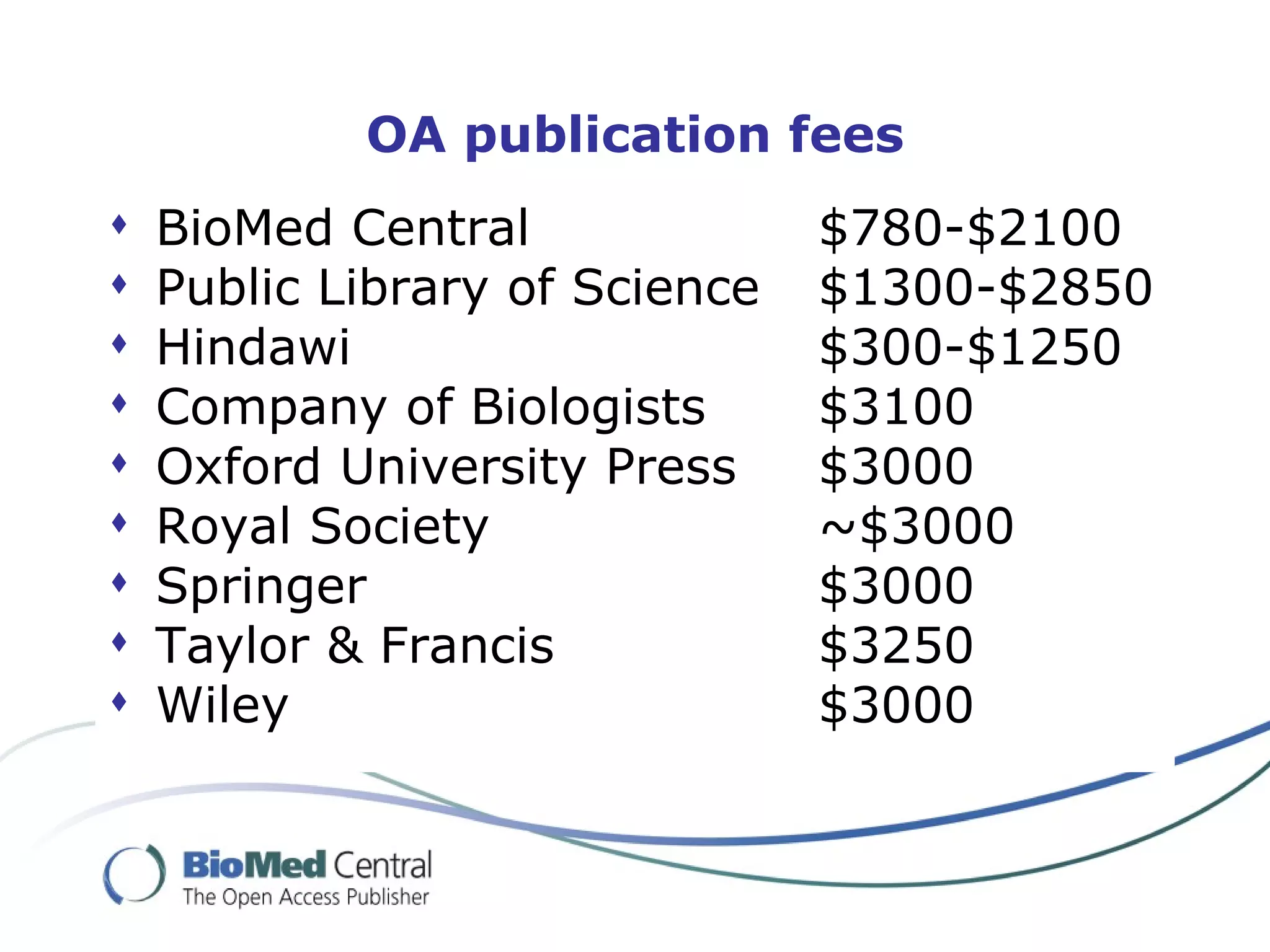
OA publication fees BioMed Central  $780-$2100 Public Library of Science  $1300-$2850 Hindawi $300-$1250 Company of Biologists  $3100 Oxford University Press  $3000 Royal Society ~$3000 Springer $3000 Taylor & Francis $3250 Wiley $3000
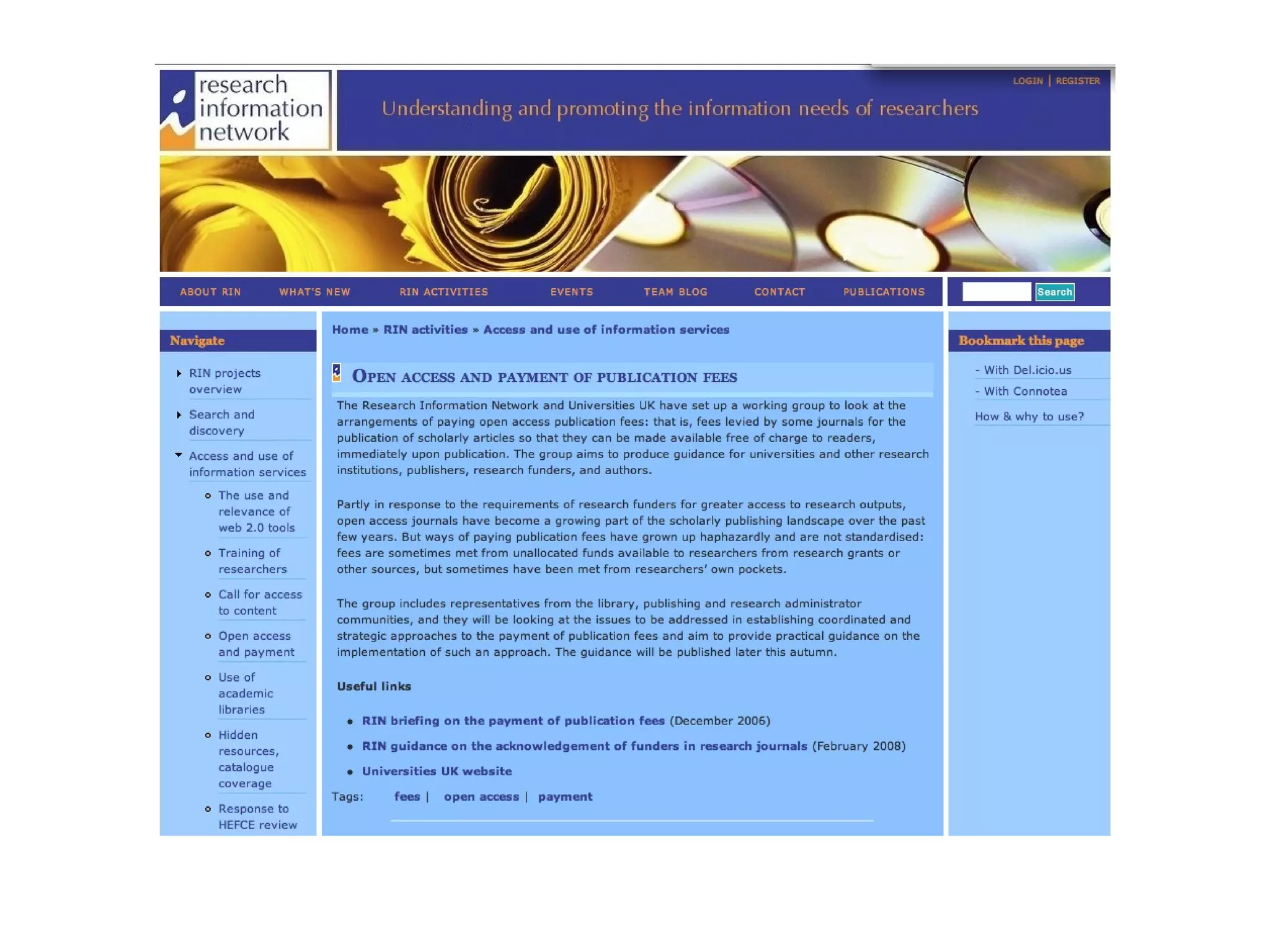
How do OA publication fees get paid? Many authors pay out of grant funds Some funders provide dedicated funds Some institutions cover costs for their researchers centrally Some OA journals are centrally supported and have no author-facing fees
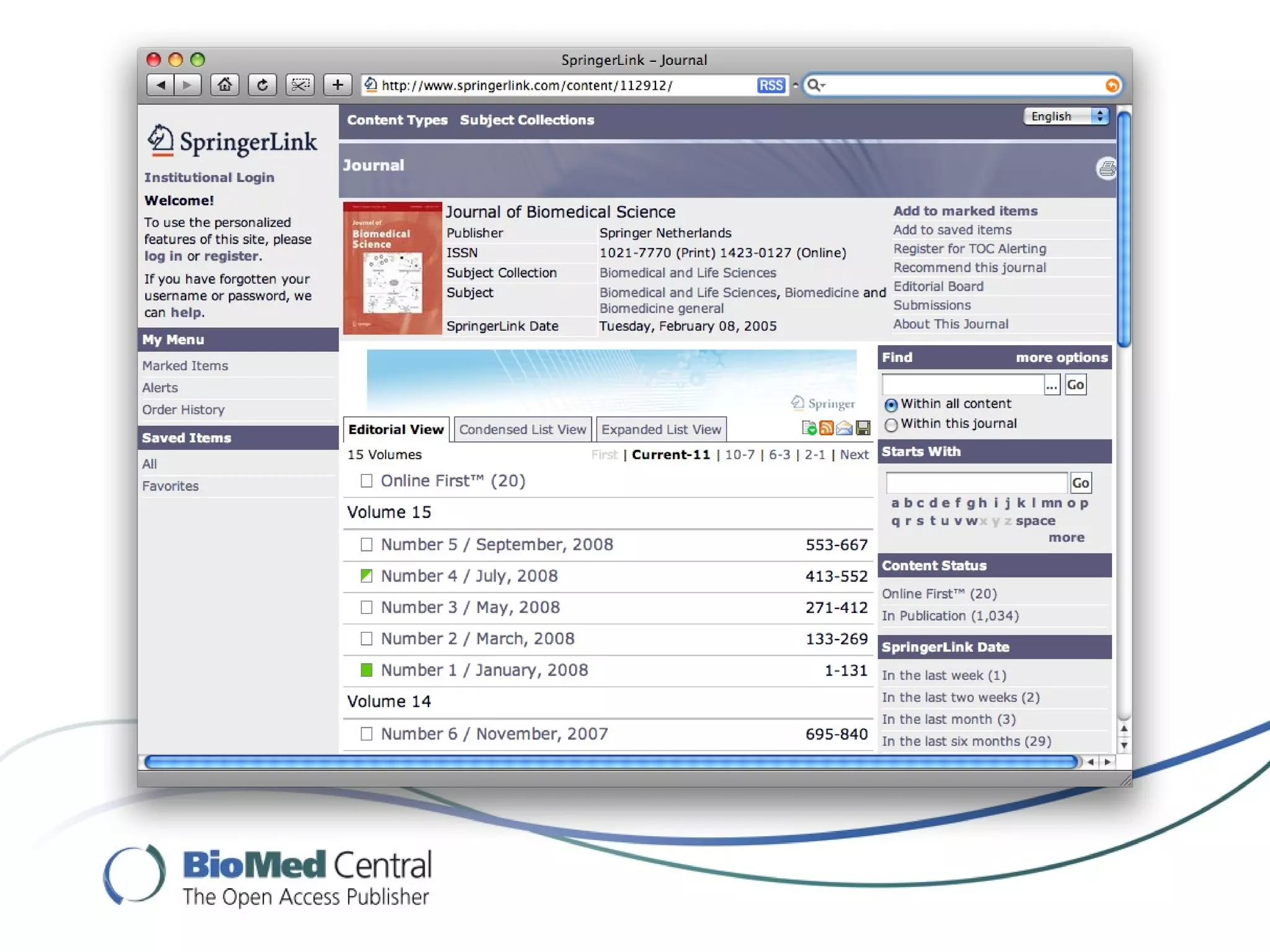
BioMed Central journals which do not charge author fees Chinese Medicine Chiropractic & Osteopathy Italian Journal of Pediatrics Journal of Biomedical Science Journal of Brachial Plexus and Peripheral Nerve Injury Journal of Orthopaedic Surgery and Research Journal of the International AIDS Society Scandinavian Journal of Trauma, Resuscitation and Emergency Medicine Sports Medicine, Arthroscopy, Rehabilitation, Therapy & Technology
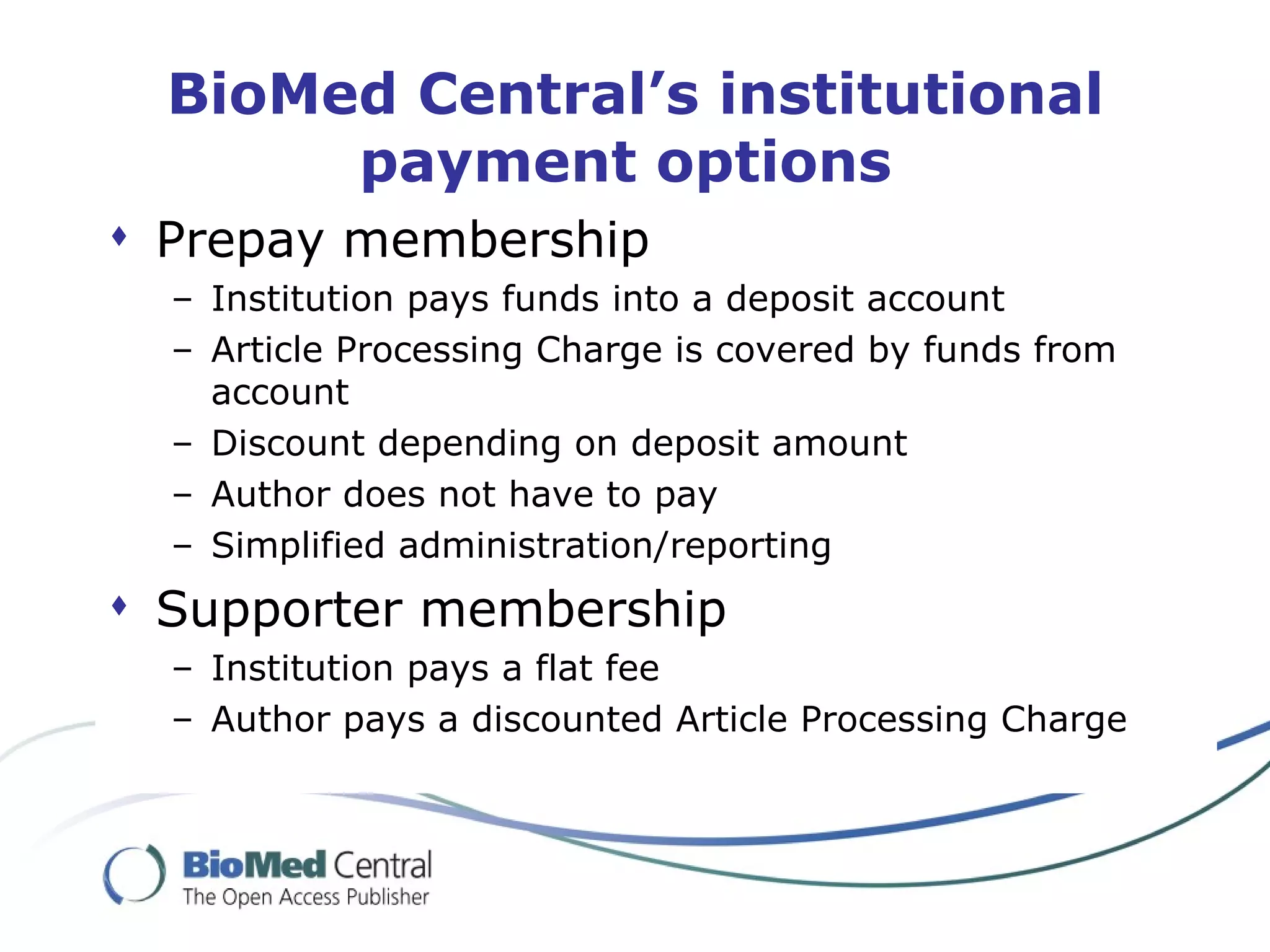
BioMed Central’s institutional payment options  Prepay membership Institution pays funds into a deposit account Article Processing Charge is covered by funds from account Discount depending on deposit amount Author does not have to pay Simplified administration/reporting Supporter membership Institution pays a flat fee Author pays a discounted Article Processing Charge
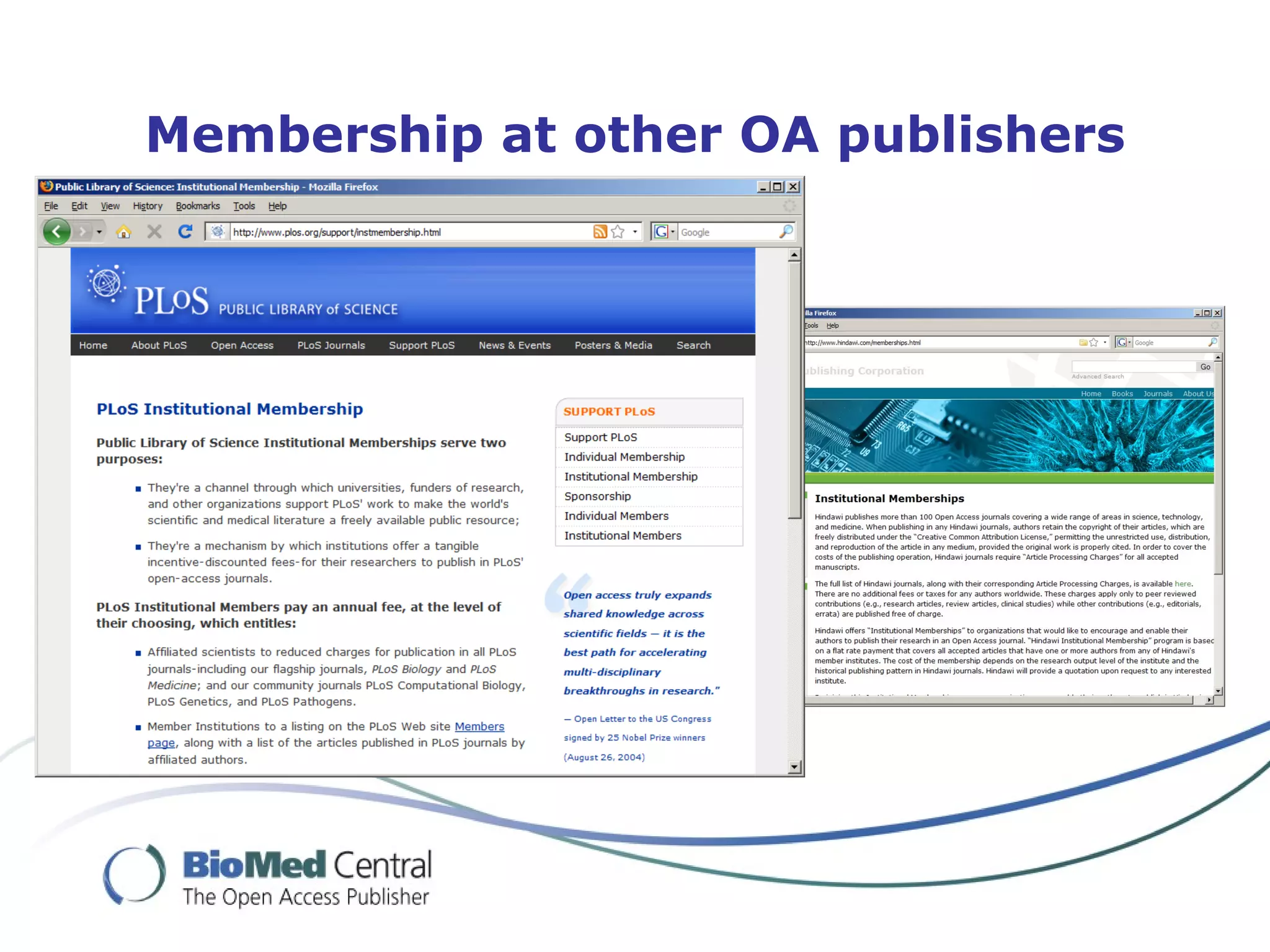
Membership at other OA publishers
How are BioMed Central OA fees being paid? 30% Prepay members 15% Individual APCs  (Supporter members)  50% Individual APCs  (Non-members) 5% Waivers
Funders and OA
NIH policy became mandatory in January 2008 Compliance has increased from 4% to more than 60% About 28,000 author manuscripts have already been made available under the policy
 
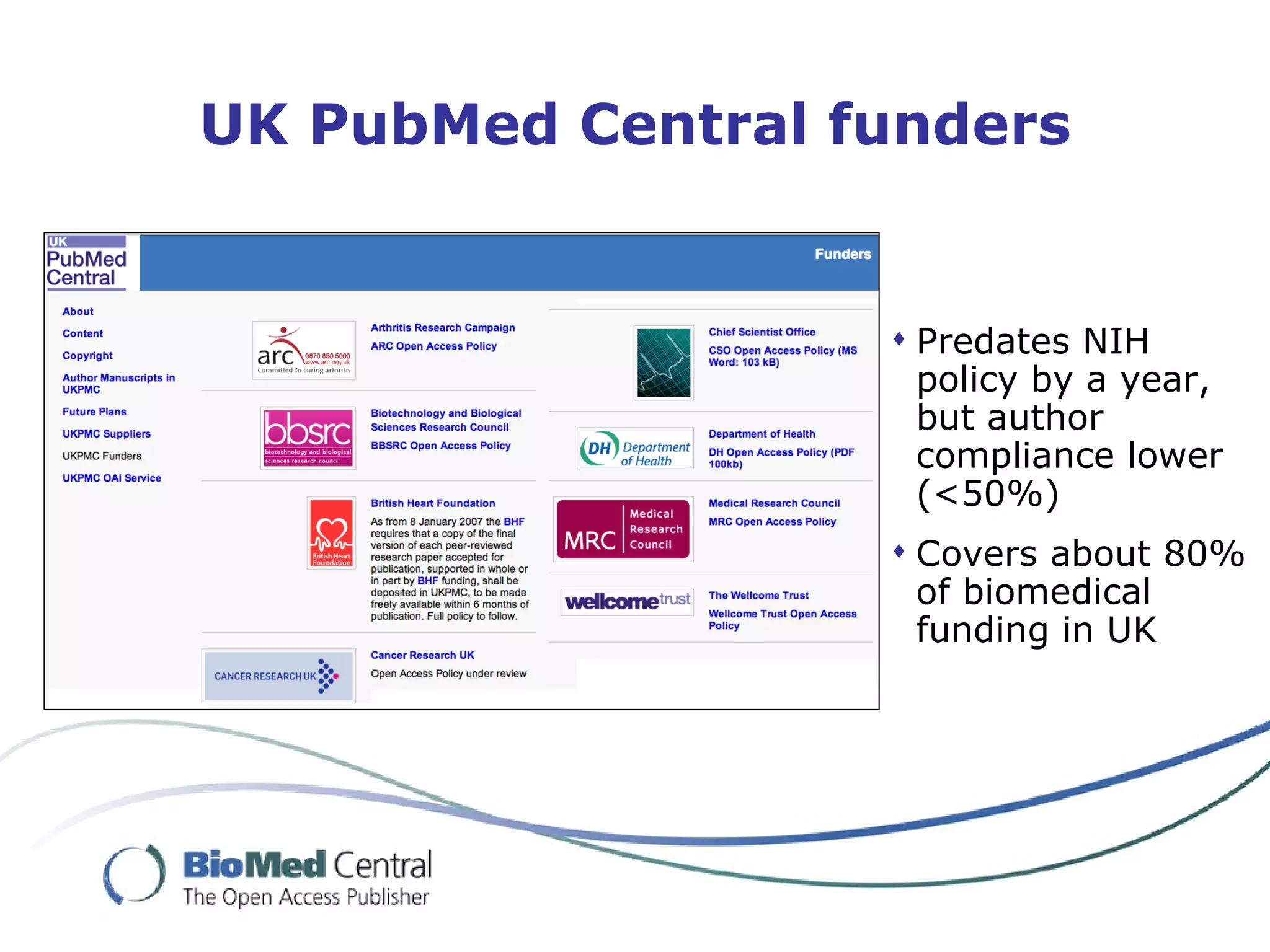
UK PubMed Central funders Predates NIH policy by a year, but author compliance lower (<50%) Covers about 80% of biomedical funding in UK
Europe European Research Council FP7 Open Access Pilot SOAP – a research project on OA business models funded as part of FP7
High Energy Physics - SCOAP3
Institutions and OA
Harvard: Office of Scholarly Communications
Examples of central institutional funds for Open Access publication fees Aarhus Berkeley Calgary Harvard (part of plan for Office of Scholarly Communication) Max Planck Nottingham
 
Impact Factors
Which have been Biomed Central’s most rapidly growing journals
What do these journals have in common?
Official Impact Factors
Impact Factors increasingly help Open Access journals Impact Factors initially made things tough for new OA journals But 45 BioMed Central journals now have official Impact Factors A major driver of growth
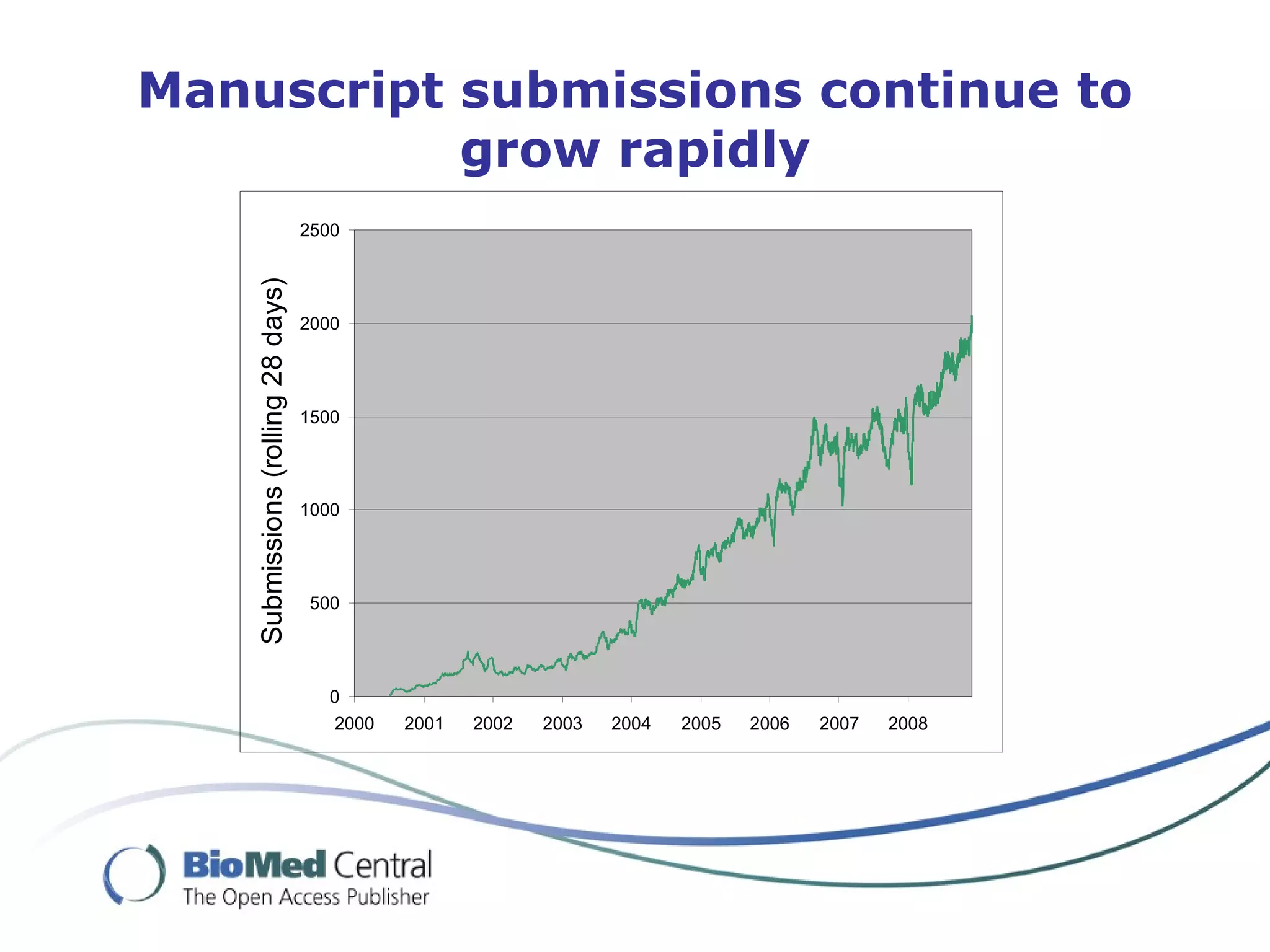
Manuscript submissions continue to grow rapidly
Breakdown of submission growth by journal type
Established journals are switching to open access


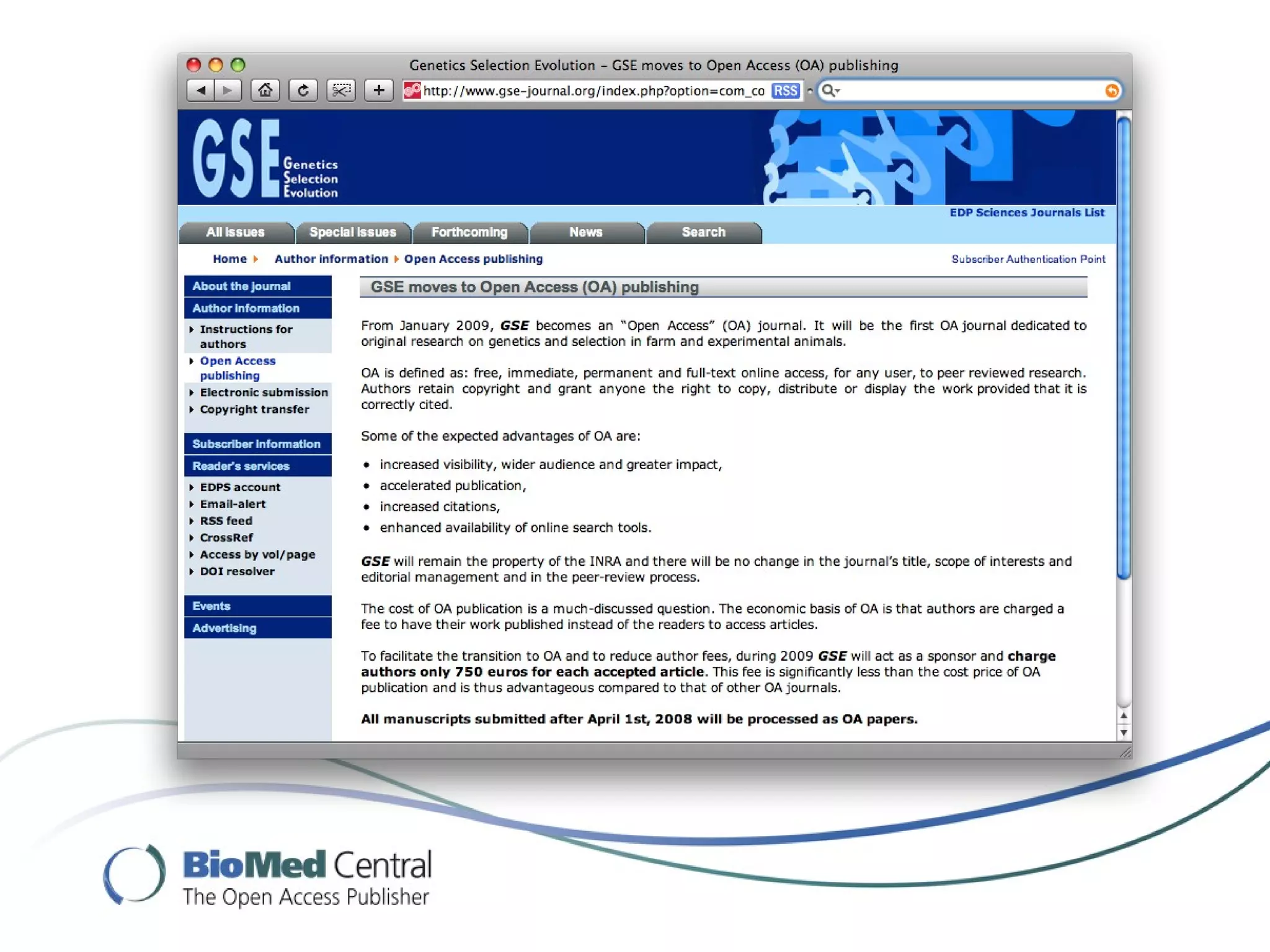
Open Access publishing, then and now… 2008 2000 And more…
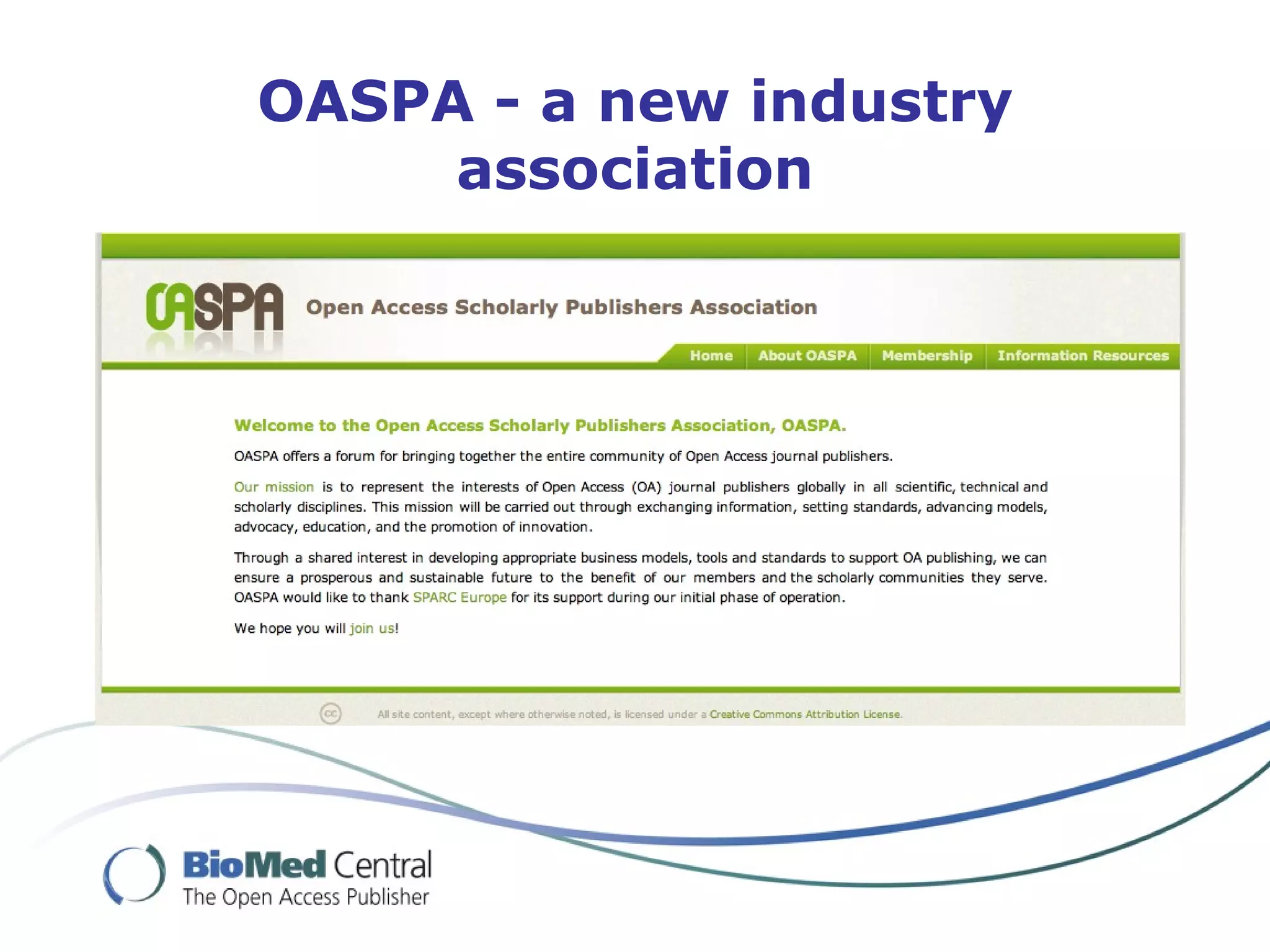
OASPA - a new industry association
Goals of OASPA Represent interests of Open Access publishers as a group Agree common definition of Open Access Enforce high standards of editorial and business practice amongst members Establish guidelines for how publishers and institutions can best manage Open Access publication fees
Springer’s acquisition  of BioMed Central +
Springer acquisition FAQs Will BioMed Central’s policy of open access to all research continue? Yes – this was an obligatory condition for the deal to gain approval by BioMed Central’s Board of Trustees Is BioMed Central profitable? Springer bought BioMed Central because it is a healthy publishing business, in a growing sector of the market Will BioMed Central APCs be increased to Springer Open Choice levels? There are no plans to change BioMed Central’s APC pricing policy as a result of the deal
Springer’s experimental institutional Open Access deals Several institutions now have licensing deals with Springer allow their authors to select the Open Choice option without additional payment Max Planck UKB  (Dutch consortium) Georg-August University of Goettingen The University of California says it is negotiating a similar deal with Springer
Conclusions OA publishing has gone from being an experiment to a proven alternative model Institutions, funders and existing journals are responding  It will be interesting to see how it all plays out!

Latest Developments in Open Access

  • 1.
    Latest Developments inOpen Access Matthew Cockerill Managing Director, BioMed Central
  • 2.
    What’s new inOpen Access Peter Suber’s SPARC Open Access newsletter includes a roundup of the 137 most important OA developments - in November… I will focus just on OA publishing
  • 3.
    More, more, more…More open access mandates More open access publishers More central open access funds More impact factors for OA journals More evidence that open access is a viable business model
  • 4.
    Traditional research publishingThe research community transfers rights to the publisher The publisher covers costs by selling access to the content Open Access research publishing No barriers to access The publisher does not acquire exclusive rights Typically the publisher is paid for the service of publication A quick refresher on the open access publishing model
  • 5.
    About BioMed CentralLargest publisher of peer-reviewed open access journals Launched first open access journal in 2000 Now publishes >190 OA titles >44,000 peer reviewed OA articles published All research articles published under Creative Commons licence Costs covered by 'article processing charge' (APC)
  • 6.
    Revenue streams forOA publishers like BioMed Central Publication fees Subscriptions to non-research content (e.g. reviews) Advertising/sponsorship Services
  • 7.
    Revenue streams forOA publishers like BioMed Central Publication fees Subscriptions to non-research content (e.g. reviews) Advertising/sponsorship Services
  • 8.
    OA publication feesBioMed Central $780-$2100 Public Library of Science $1300-$2850 Hindawi $300-$1250 Company of Biologists $3100 Oxford University Press $3000 Royal Society ~$3000 Springer $3000 Taylor & Francis $3250 Wiley $3000
  • 9.
    How do OApublication fees get paid? Many authors pay out of grant funds Some funders provide dedicated funds Some institutions cover costs for their researchers centrally Some OA journals are centrally supported and have no author-facing fees
  • 10.
    BioMed Central journalswhich do not charge author fees Chinese Medicine Chiropractic & Osteopathy Italian Journal of Pediatrics Journal of Biomedical Science Journal of Brachial Plexus and Peripheral Nerve Injury Journal of Orthopaedic Surgery and Research Journal of the International AIDS Society Scandinavian Journal of Trauma, Resuscitation and Emergency Medicine Sports Medicine, Arthroscopy, Rehabilitation, Therapy & Technology
  • 11.
    BioMed Central’s institutionalpayment options Prepay membership Institution pays funds into a deposit account Article Processing Charge is covered by funds from account Discount depending on deposit amount Author does not have to pay Simplified administration/reporting Supporter membership Institution pays a flat fee Author pays a discounted Article Processing Charge
  • 12.
    Membership at otherOA publishers
  • 13.
    Membership at otherOA publishers
  • 14.
    How are BioMedCentral OA fees being paid? 30% Prepay members 15% Individual APCs (Supporter members) 50% Individual APCs (Non-members) 5% Waivers
  • 15.
  • 16.
    NIH policy becamemandatory in January 2008 Compliance has increased from 4% to more than 60% About 28,000 author manuscripts have already been made available under the policy
  • 17.
  • 18.
    UK PubMed Centralfunders Predates NIH policy by a year, but author compliance lower (<50%) Covers about 80% of biomedical funding in UK
  • 19.
    Europe European ResearchCouncil FP7 Open Access Pilot SOAP – a research project on OA business models funded as part of FP7
  • 20.
  • 21.
  • 22.
    Harvard: Office ofScholarly Communications
  • 23.
    Examples of centralinstitutional funds for Open Access publication fees Aarhus Berkeley Calgary Harvard (part of plan for Office of Scholarly Communication) Max Planck Nottingham
  • 24.
  • 25.
  • 26.
    Which have beenBiomed Central’s most rapidly growing journals
  • 27.
    What do thesejournals have in common?
  • 28.
  • 29.
    Impact Factors increasinglyhelp Open Access journals Impact Factors initially made things tough for new OA journals But 45 BioMed Central journals now have official Impact Factors A major driver of growth
  • 30.
  • 31.
    Breakdown of submissiongrowth by journal type
  • 32.
    Established journals areswitching to open access
  • 33.
  • 34.
  • 35.
  • 36.
    Open Access publishing,then and now… 2008 2000 And more…
  • 37.
    OASPA - anew industry association
  • 38.
    Goals of OASPARepresent interests of Open Access publishers as a group Agree common definition of Open Access Enforce high standards of editorial and business practice amongst members Establish guidelines for how publishers and institutions can best manage Open Access publication fees
  • 39.
    Springer’s acquisition of BioMed Central +
  • 40.
    Springer acquisition FAQsWill BioMed Central’s policy of open access to all research continue? Yes – this was an obligatory condition for the deal to gain approval by BioMed Central’s Board of Trustees Is BioMed Central profitable? Springer bought BioMed Central because it is a healthy publishing business, in a growing sector of the market Will BioMed Central APCs be increased to Springer Open Choice levels? There are no plans to change BioMed Central’s APC pricing policy as a result of the deal
  • 41.
    Springer’s experimental institutionalOpen Access deals Several institutions now have licensing deals with Springer allow their authors to select the Open Choice option without additional payment Max Planck UKB (Dutch consortium) Georg-August University of Goettingen The University of California says it is negotiating a similar deal with Springer
  • 42.
    Conclusions OA publishinghas gone from being an experiment to a proven alternative model Institutions, funders and existing journals are responding It will be interesting to see how it all plays out!