Open Access Publishing –What 
You Need to Know 
The Great GigaScience and Galaxy (G3) Workshop 
September 19, 2014 
Dr Nicole Nogoy 
Commissioning Editor, GigaScience 
Nicole@gigasciencejournal.com
Summary 
•What is Open Access? 
•Challenges 
•Mandates & Current Issues 
•The Solution
What is Open Access?
What is Open Access (OA)? 
It is a step toward changing how we communicate science — from start 
to finish 
Defined by two fundamental criteria: 
• Price barriers (e.g., subscription fees) are removed 
• Permission barriers (e.g., copyright restrictions) are removed
What Does OA Mean For 
Scientific Research? 
• Universally available via the internet, no barriers to access 
• Licensed so as to allow for redistribution and reuse as long as 
attribution given 
• Permanently archived in an internationally recognized repository 
(e.g., PubMed Central)
Problems With the Current System? 
• Library budgets are shrinking - subscription-based access to research 
is a legacy of print-based economics and makes no sense in an online 
environment 
• The intellectual effort that goes into a research article comes from the 
research community (authors, peer reviewers, academic editors), but 
they lose control of it 
• Tax payers and double pay – the cost of doing research and the cost 
of subscribing to that research
Challenges
Biggest Challenge: Closed Access 
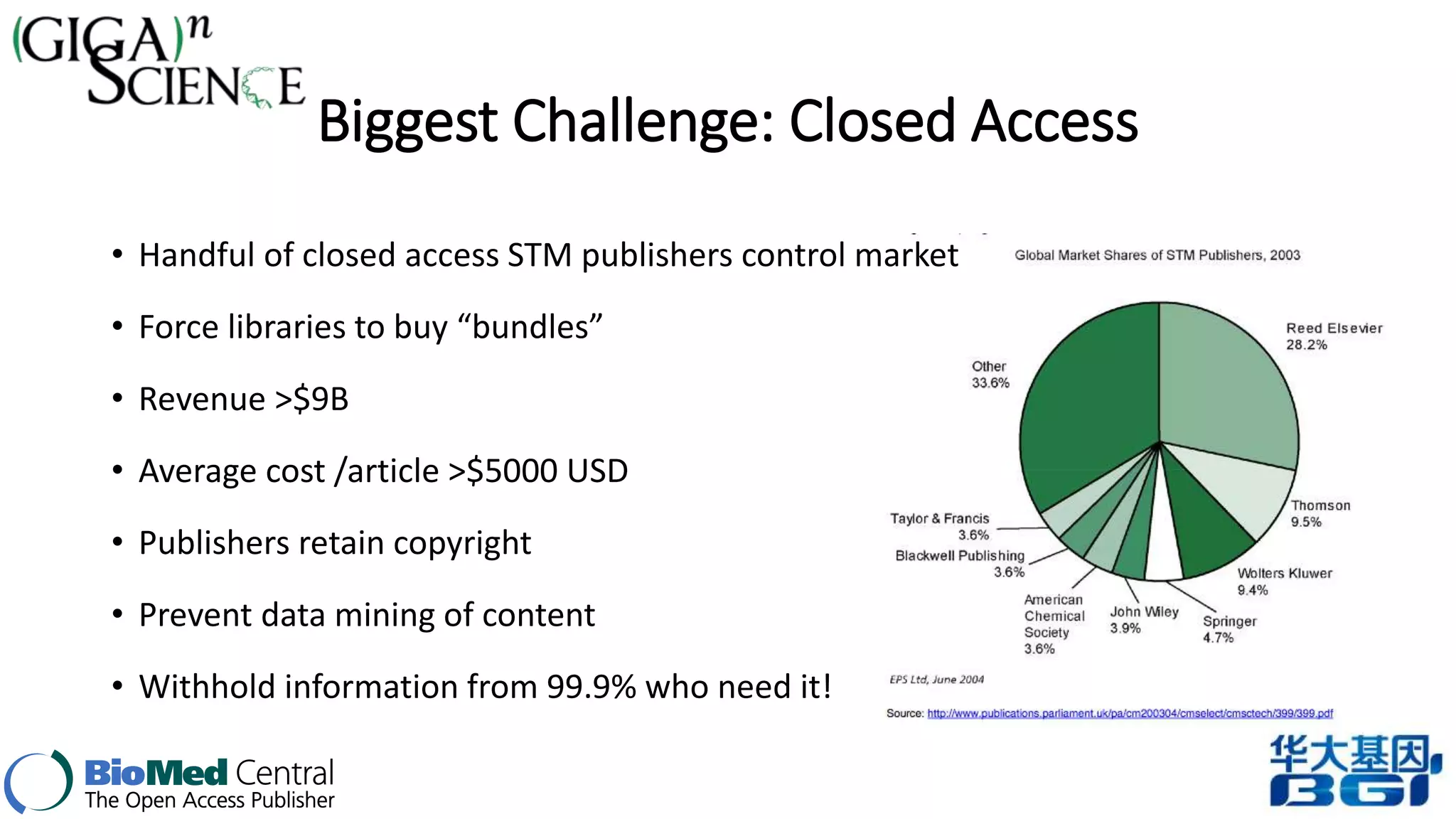
• Handful of closed access STM publishers control market 
• Force libraries to buy “bundles” 
• Revenue >$9B 
• Average cost /article >$5000 USD 
• Publishers retain copyright 
• Prevent data mining of content 
• Withhold information from 99.9% who need it!
Biggest Challenge: Closed Access
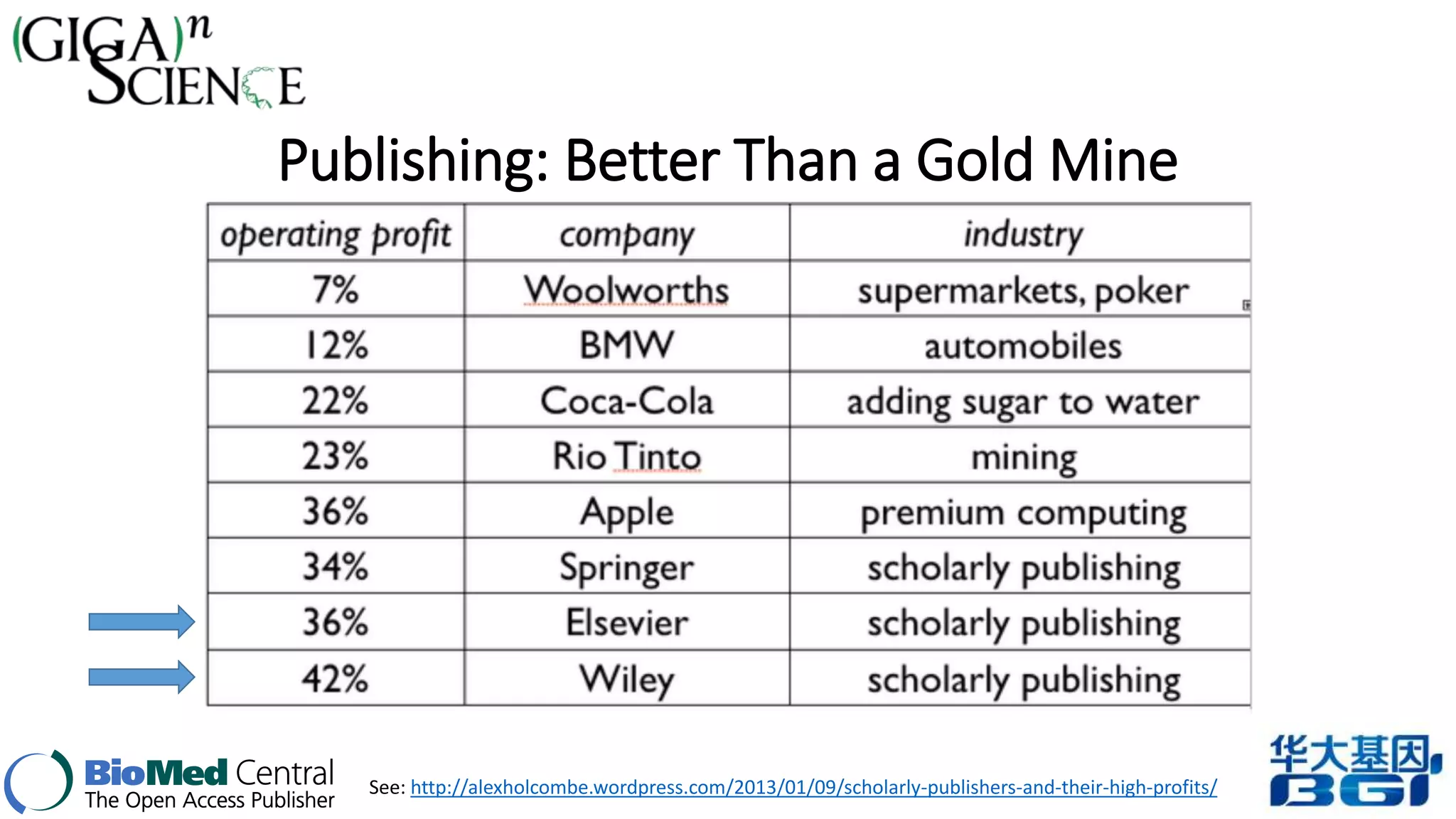
Publishing: Better Than a Gold Mine 
See: http://alexholcombe.wordpress.com/2013/01/09/scholarly-publishers-and-their-high-profits/
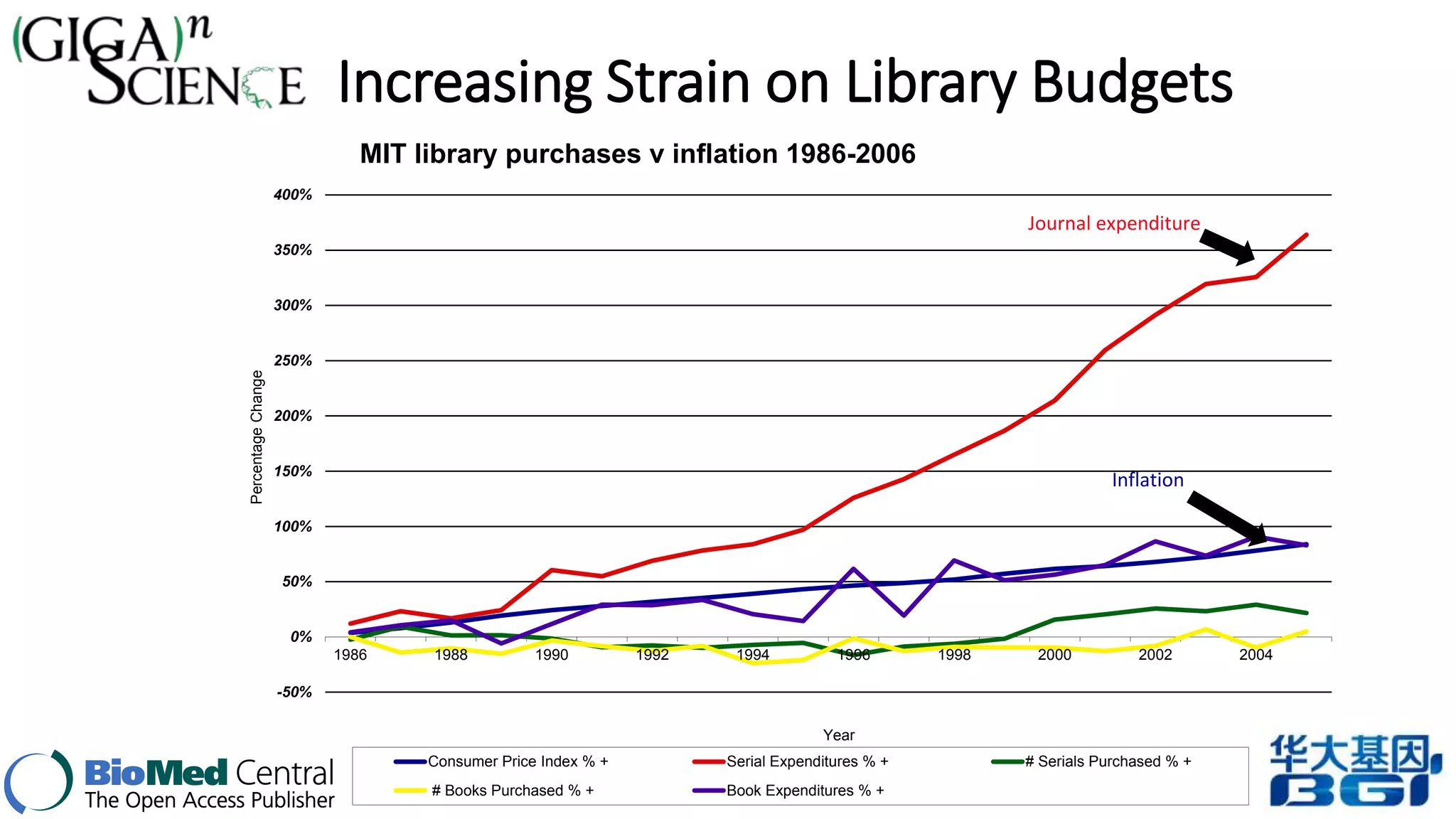
Increasing Strain on Library Budgets 
400% 
350% 
300% 
250% 
200% 
150% 
100% 
50% 
0% 
-50% 
MIT library purchases v inflation 1986-2006 
1986 1988 1990 1992 1994 1996 1998 2000 2002 2004 
Percentage Change 
Year 
Consumer Price Index % + Serial Expenditures % + # Serials Purchased % + 
# Books Purchased % + Book Expenditures % + 
Journal expenditure 
Inflation
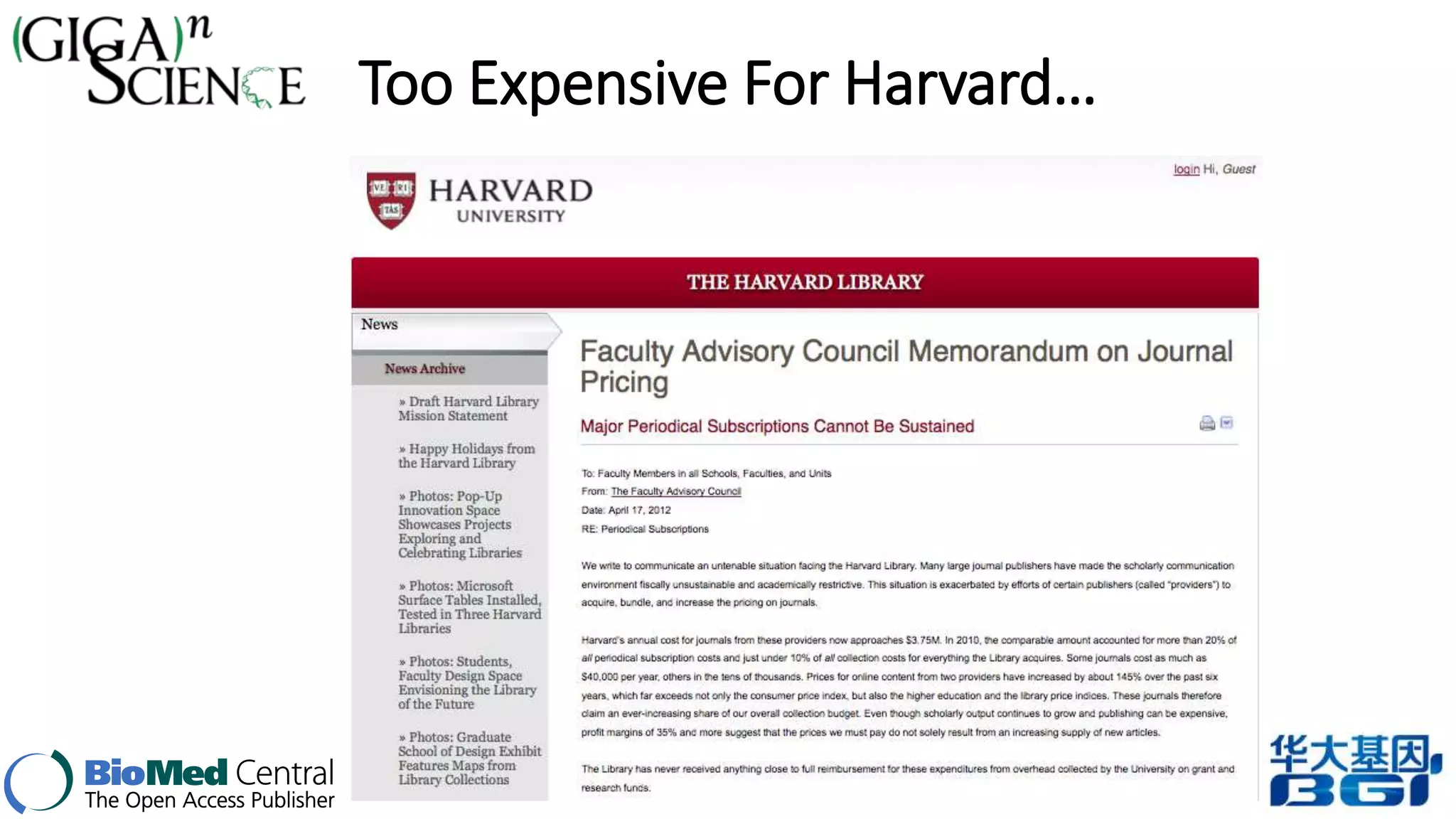
Too Expensive For Harvard…
Benefits of Publishing in an OA Journal 
Benefits for OA readers 
• Removal of subscription barriers 
allows immediate online access to 
peer-reviewed articles 
• Easy-to-search articles of interest – 
can you Google as well as traditional 
indexing services (e.g. PubMed) 
• Allow to copy, distribute an reuse 
content as long as original article is 
correctly attributed 
Benefits for OA authors 
• High visibility and maximum 
exposure of articles – increase 
chances of article being noticed, 
read or cited 
• No limits on article length or the 
number of figures and tables 
• No additional charges for inclusion of 
colour figures, videos or large 
datasets 
• Retain copyright of published 
content
Article-Processing Charges 
• Editorial: handling of manuscripts 
• Technical: development, maintenance and operation of online journal 
platforms and manuscript handling systems 
• Production: copy editing, formatting and mark up of articles, inclusion in 
indexing services 
• Marketing: making sure readers know about the journal 
• Customer service: responding to authors/readers 
No extra charge for inclusion of colour figures, videos/animations or large 
datasets (no limits on article length)
Who Pays? 
• Author may pay out of grant funds 
• Some funders provide a central fund for OA publishing costs 
• Institutions may cover costs centrally on behalf of their authors e.g., 
through membership schemes with OA publishers 
• Some titles cover costs themselves
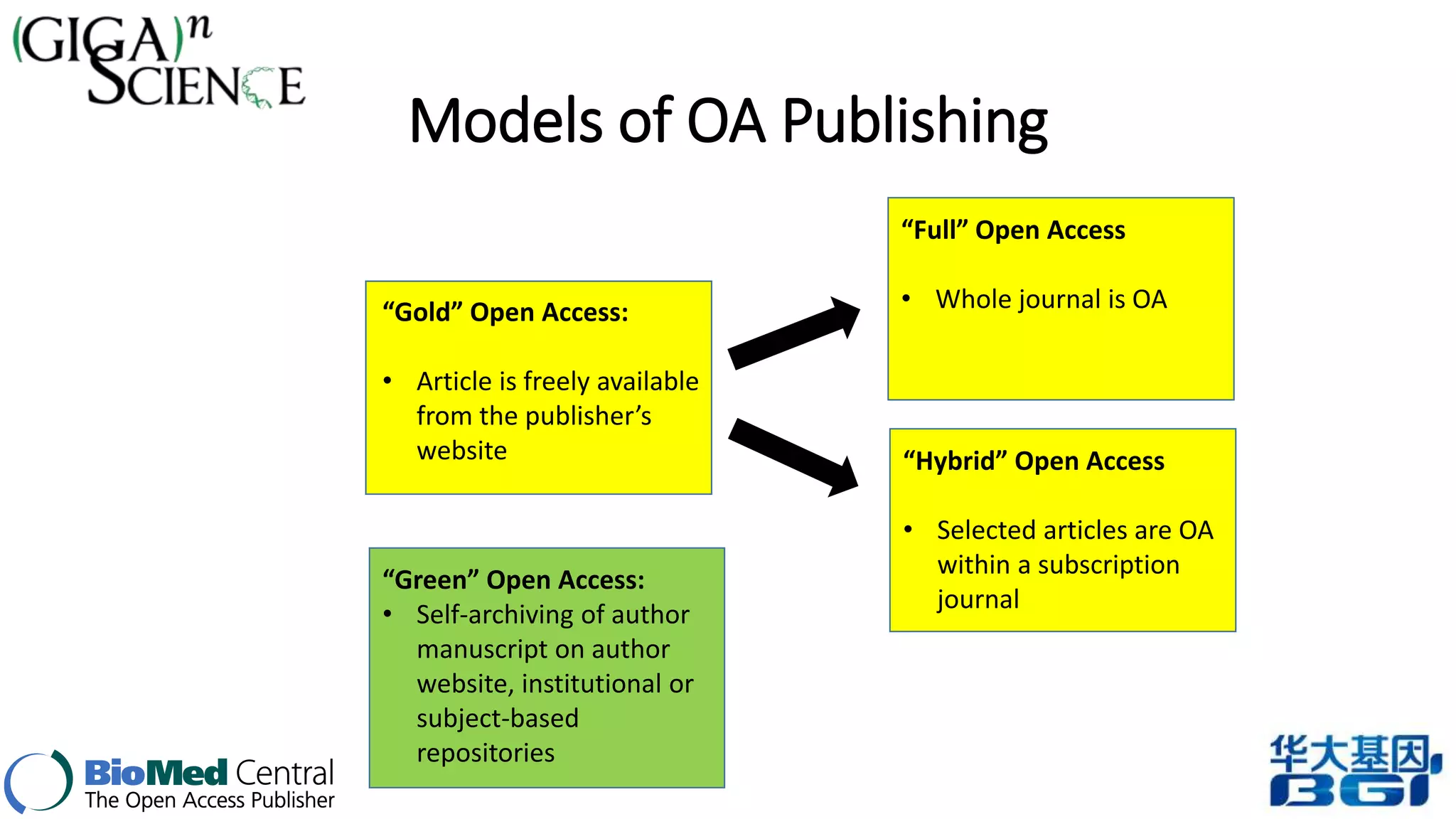
Models of OA Publishing 
“Gold” Open Access: 
• Article is freely available 
from the publisher’s 
website 
“Green” Open Access: 
• Self-archiving of author 
manuscript on author 
website, institutional or 
subject-based 
repositories 
“Full” Open Access 
• Whole journal is OA 
“Hybrid” Open Access 
• Selected articles are OA 
within a subscription 
journal
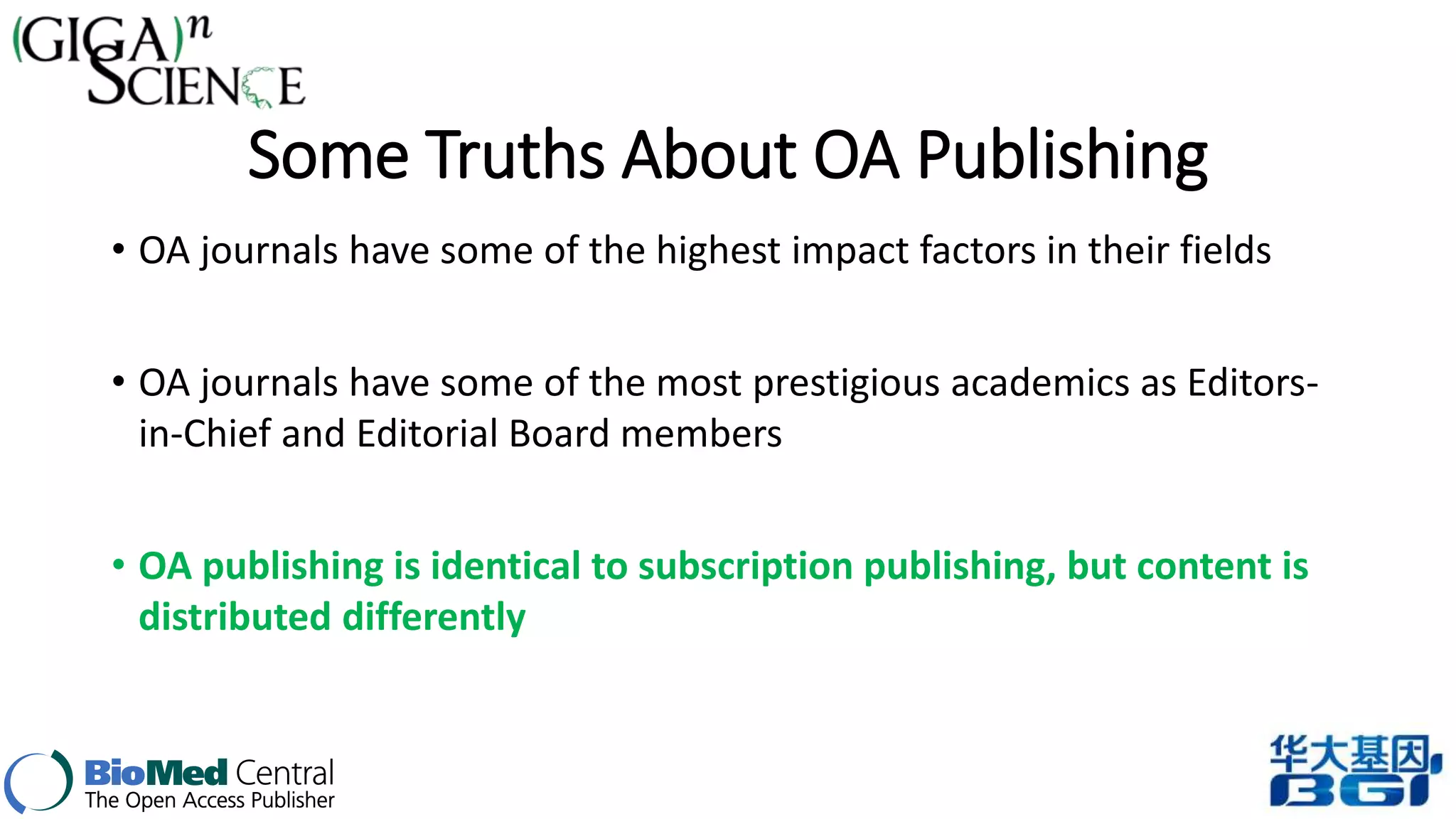
Some Truths About OA Publishing 
• OA journals have some of the highest impact factors in their fields 
• OA journals have some of the most prestigious academics as Editors-in- 
Chief and Editorial Board members 
• OA publishing is identical to subscription publishing, but content is 
distributed differently
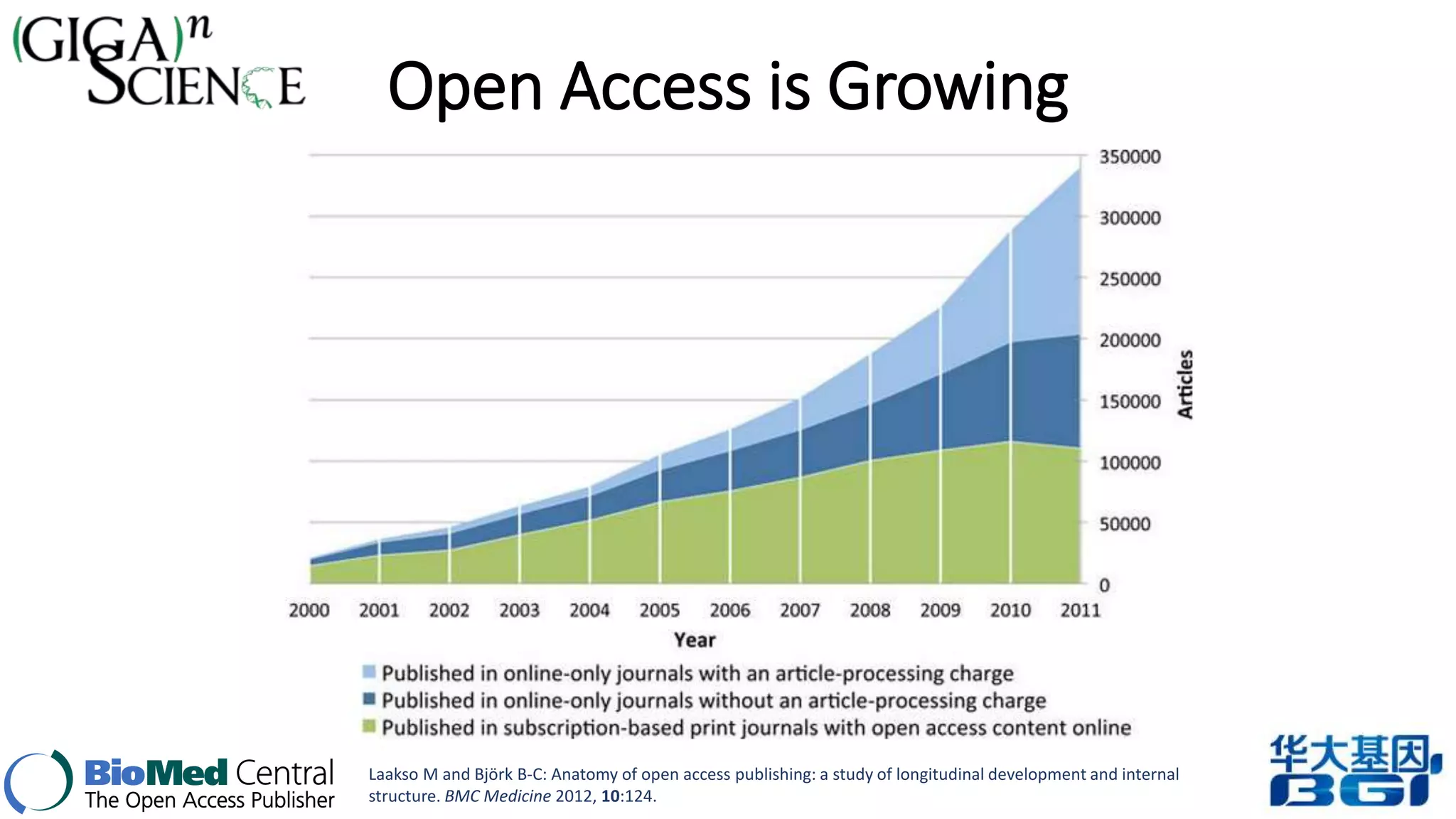
Open Access is Growing 
Laakso M and Björk B-C: Anatomy of open access publishing: a study of longitudinal development and internal 
structure. BMC Medicine 2012, 10:124.
Mandates
Mandates 
• University mandates: 
• Students and/or staff are required to… 
• Almost 150 mandatory institution-wide open access policies worldwide 
e.g., Harvard University (Compact for Open Access Publishing Equity) 
• Funder mandates: 
• Recipients of grants are required to publish under green, gold or both 
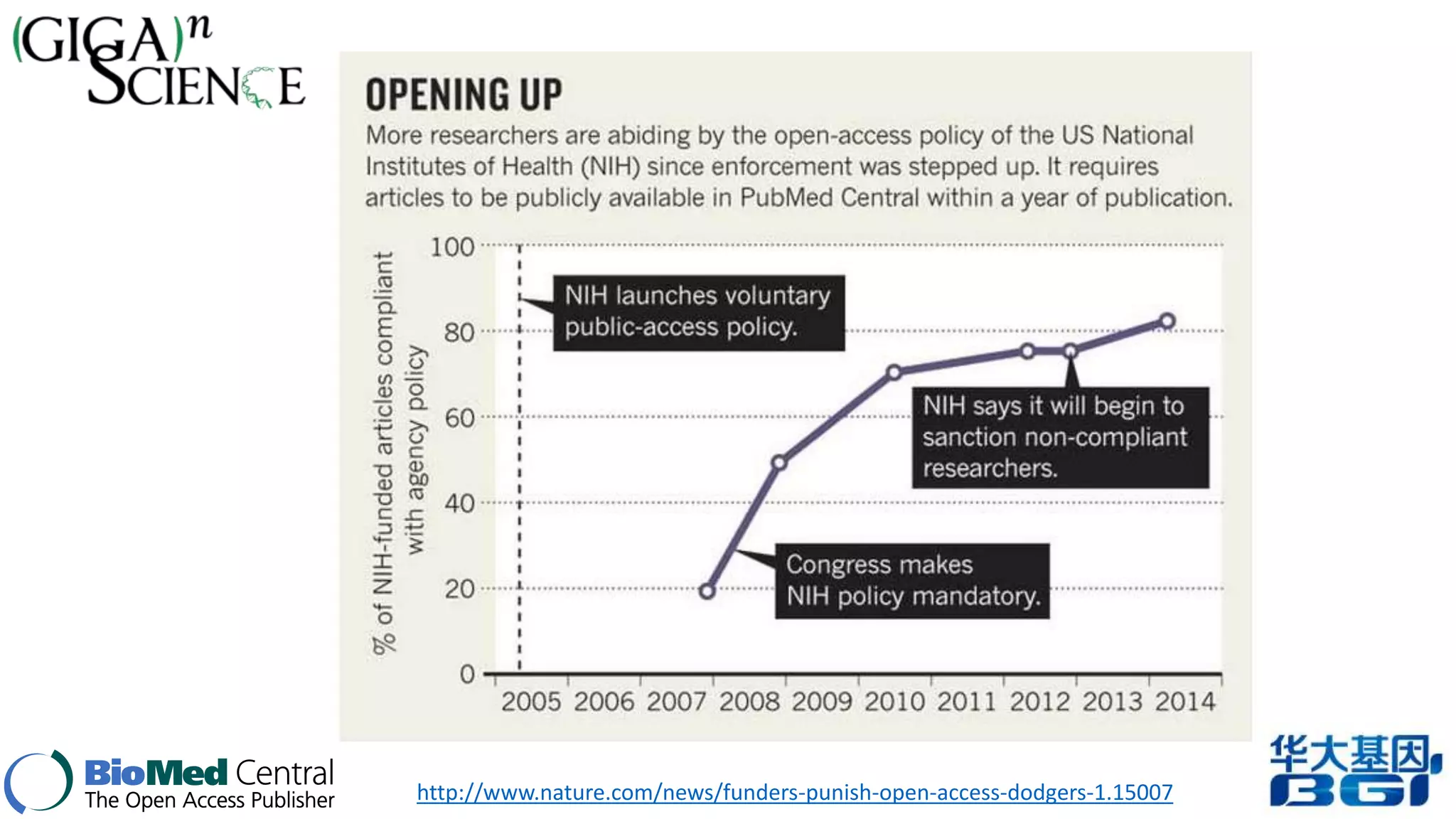
• Wellcome Trust, RCUK, US National Institutes of Health, Howard Hughes 
Medical Institute, and the European Research Council are just a few
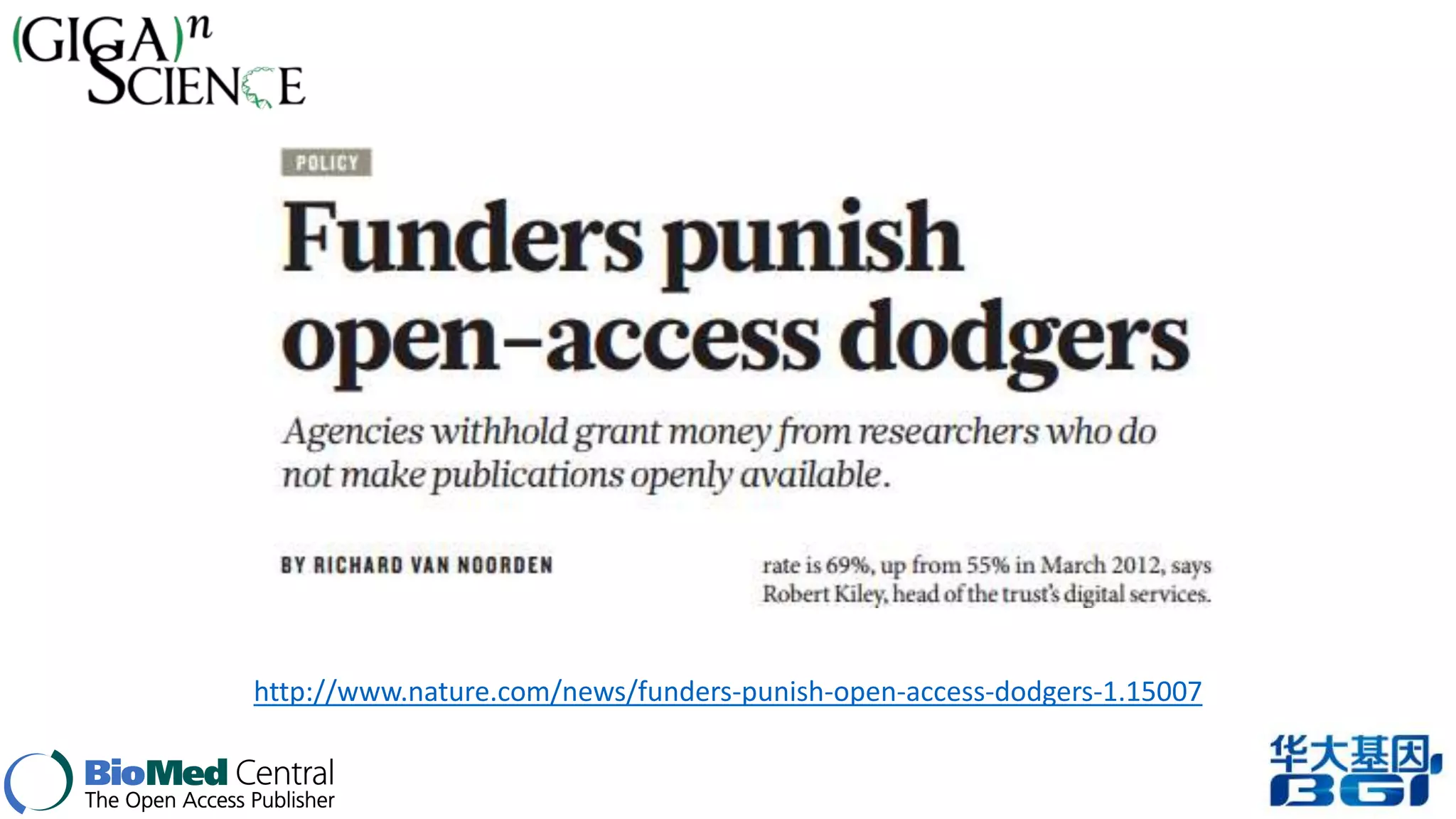
http://www.nature.com/news/funders-punish-open-access-dodgers-1.15007
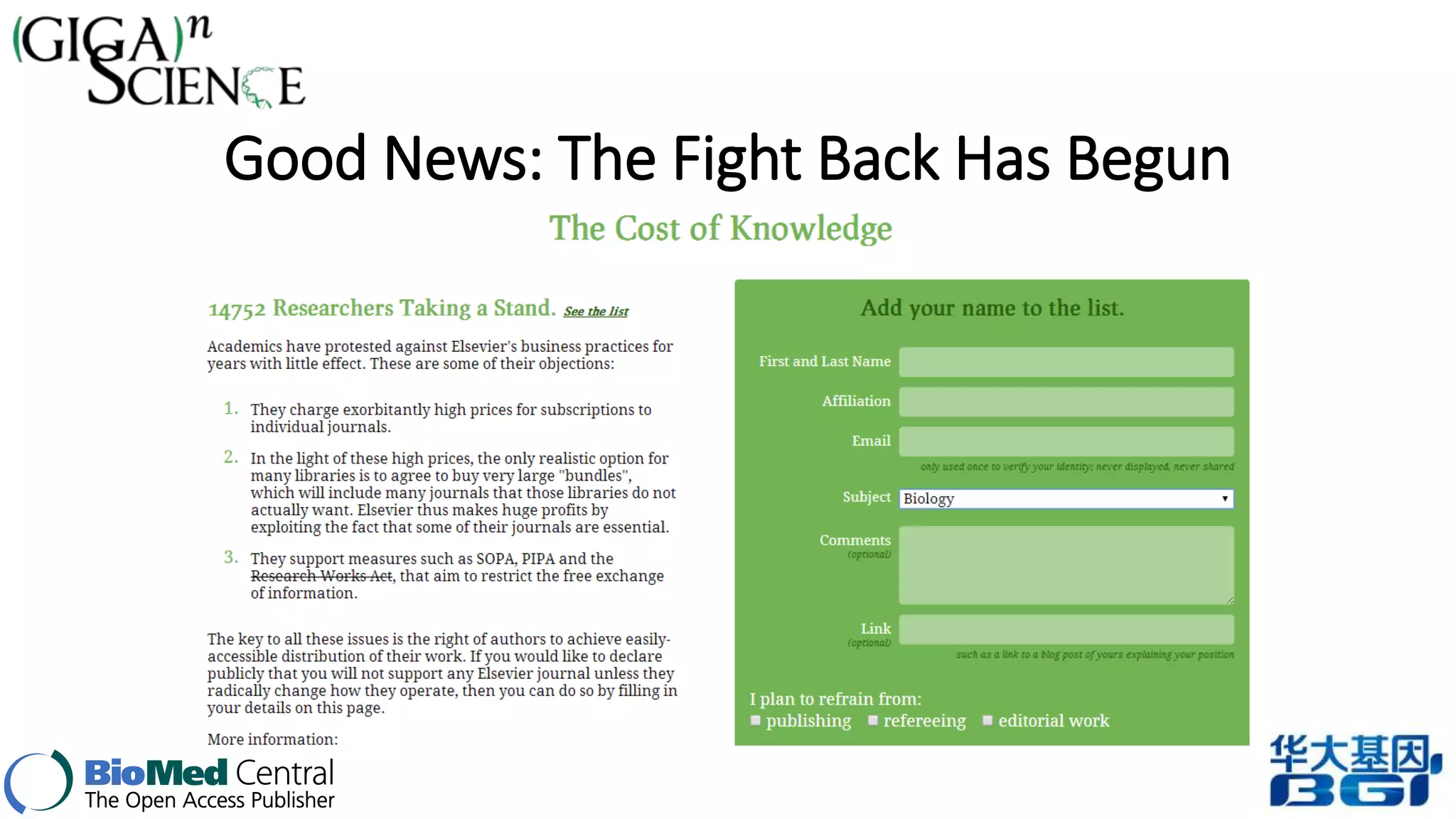
Good News: The Fight Back Has Begun
Follow-On Work: Freedom of Information Request 
1. How willing would researchers be to do without the services 
provided by Elsevier? 
2. How easy is it on average to find on the web copies of Elsevier 
articles that can be read legally and free of charge? 
3. To what extent are libraries actually suffering as a result of high 
journal prices? 
4. What effect are Elsevier’s Gold Open Access articles having on their 
subscription prices? 
5. How much are our universities paying for Elsevier journals? 
http://gowers.wordpress.com/2014/04/24/elsevier-journals-some-facts/
Subscribing Costs 
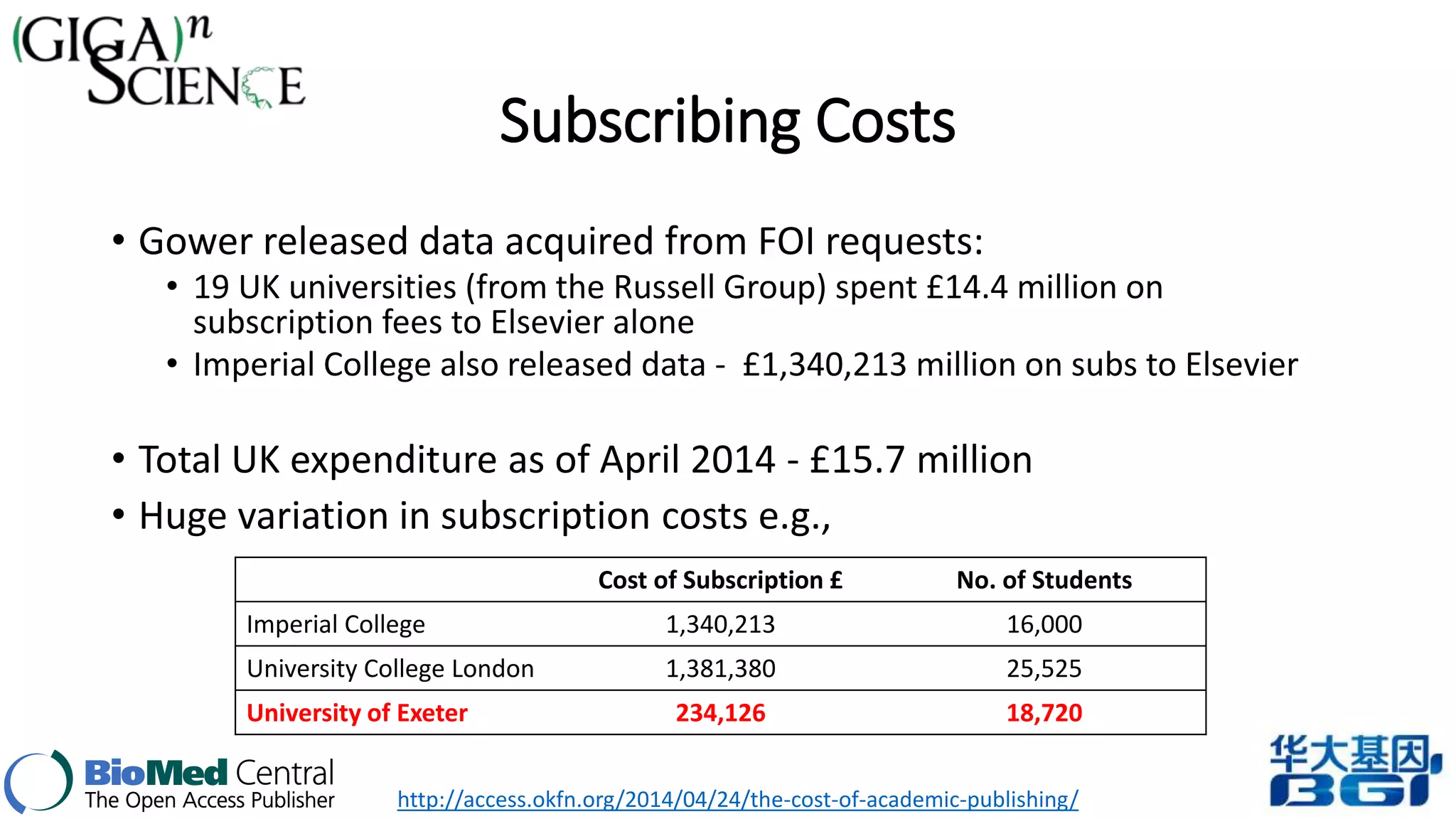
• Gower released data acquired from FOI requests: 
• 19 UK universities (from the Russell Group) spent £14.4 million on 
subscription fees to Elsevier alone 
• Imperial College also released data - £1,340,213 million on subs to Elsevier 
• Total UK expenditure as of April 2014 - £15.7 million 
• Huge variation in subscription costs e.g., 
Cost of Subscription £ No. of Students 
Imperial College 1,340,213 16,000 
University College London 1,381,380 25,525 
University of Exeter 234,126 18,720 
http://access.okfn.org/2014/04/24/the-cost-of-academic-publishing/
http://neurodojo.blogspot.hk/2014/04/cost-of-elsevier-journals-by-university.html
AU Efforts 
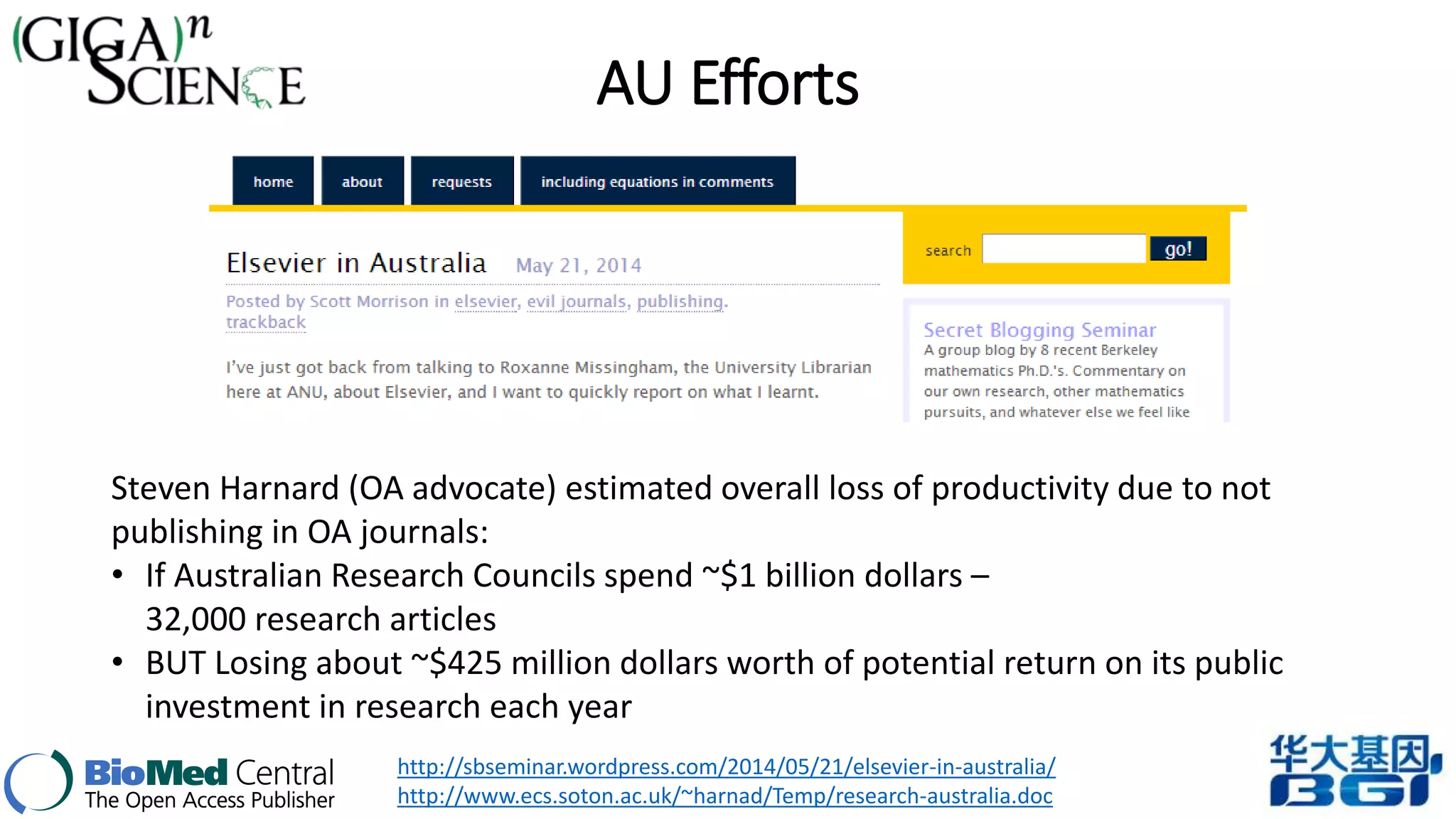
Steven Harnard (OA advocate) estimated overall loss of productivity due to not 
publishing in OA journals: 
• If Australian Research Councils spend ~$1 billion dollars – 
32,000 research articles 
• BUT Losing about ~$425 million dollars worth of potential return on its public 
investment in research each year 
http://sbseminar.wordpress.com/2014/05/21/elsevier-in-australia/ 
http://www.ecs.soton.ac.uk/~harnad/Temp/research-australia.doc
NZ Efforts 
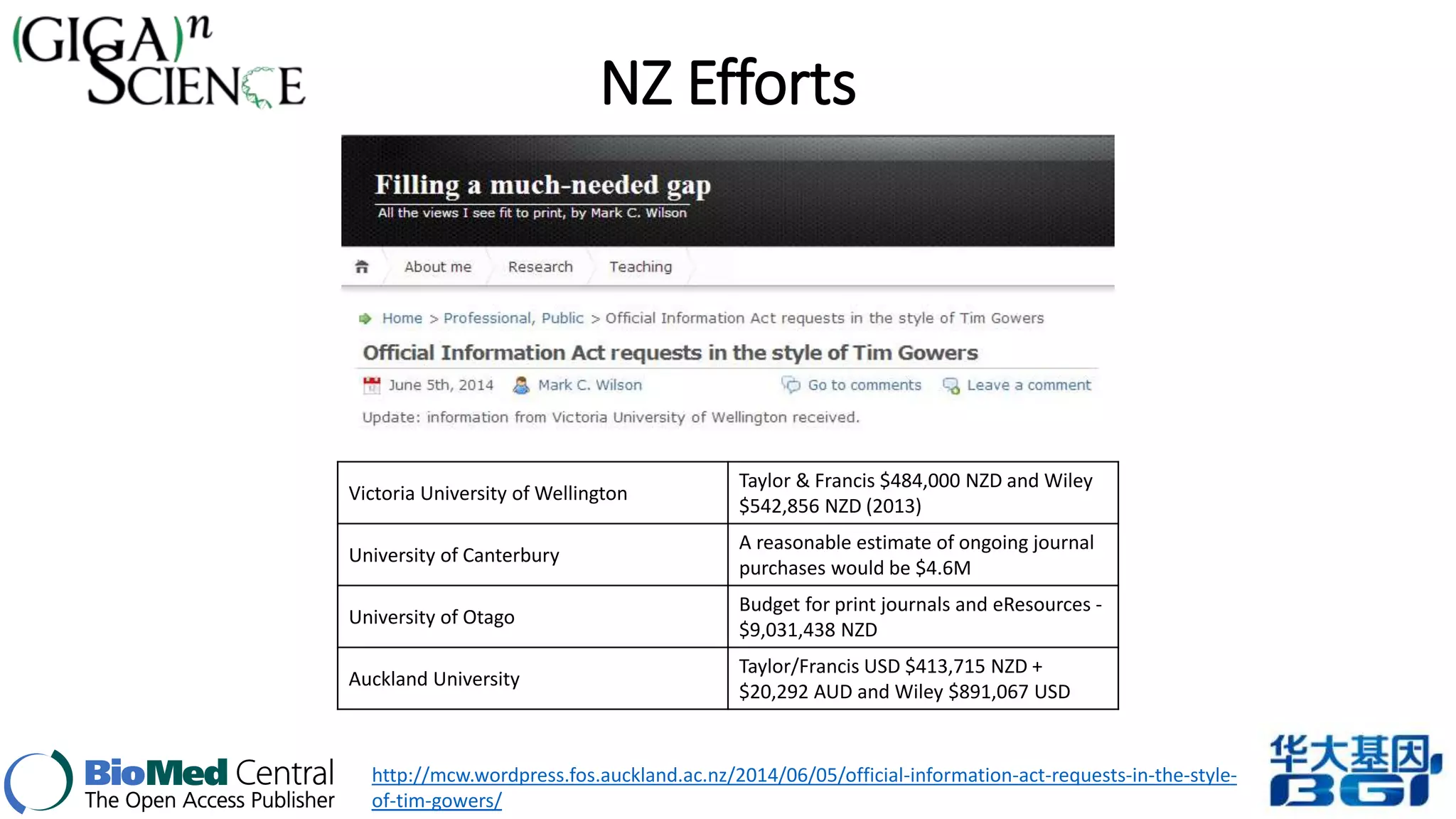
Victoria University of Wellington 
http://mcw.wordpress.fos.auckland.ac.nz/2014/06/05/official-information-act-requests-in-the-style-of- 
tim-gowers/ 
Taylor & Francis $484,000 NZD and Wiley 
$542,856 NZD (2013) 
University of Canterbury 
A reasonable estimate of ongoing journal 
purchases would be $4.6M 
University of Otago 
Budget for print journals and eResources - 
$9,031,438 NZD 
Auckland University 
Taylor/Francis USD $413,715 NZD + 
$20,292 AUD and Wiley $891,067 USD
The Solution
The Solution: Ability to Mine & Reuse Content 
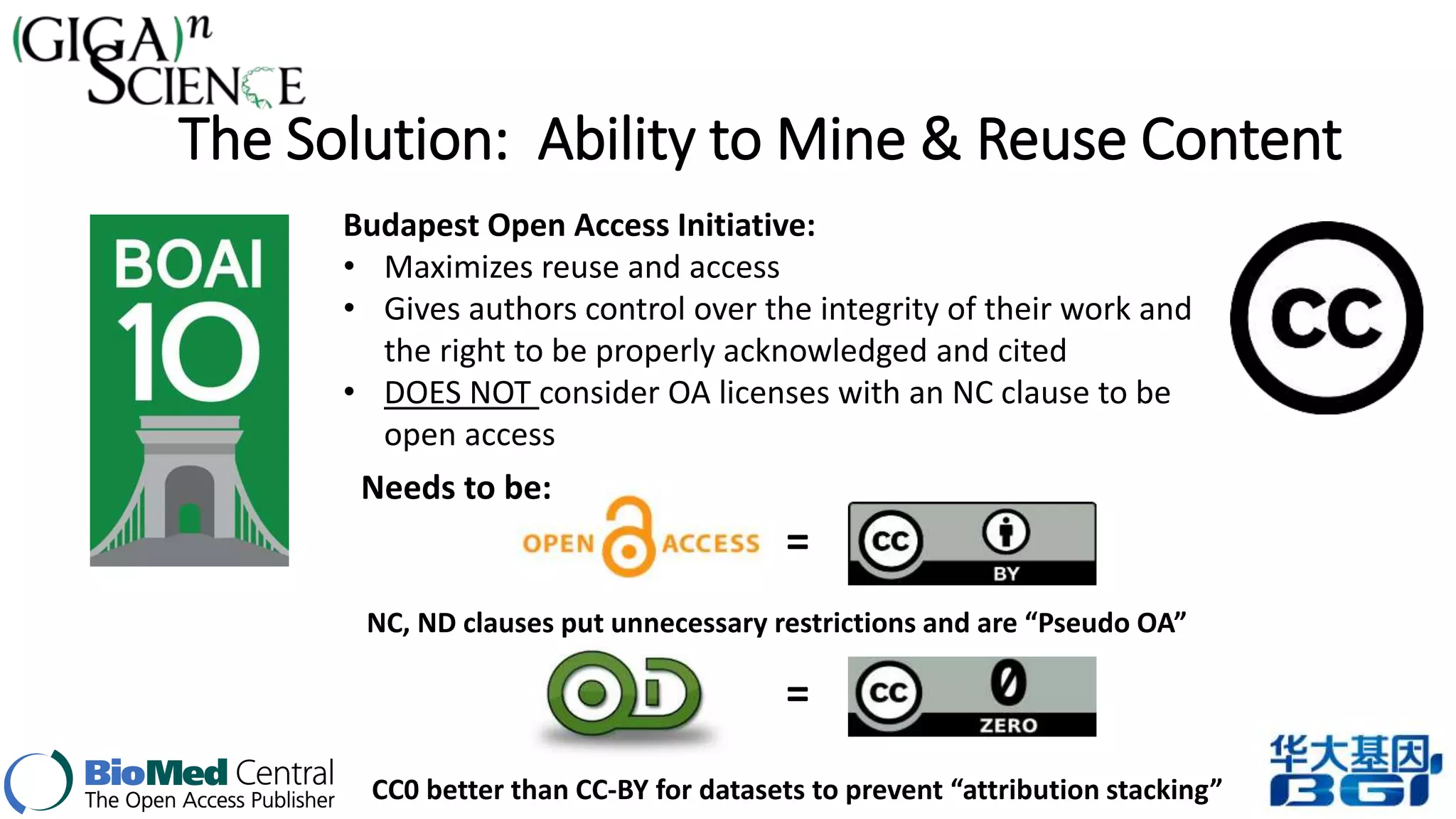
Budapest Open Access Initiative: 
• Maximizes reuse and access 
• Gives authors control over the integrity of their work and 
the right to be properly acknowledged and cited 
• DOES NOT consider OA licenses with an NC clause to be 
= 
= 
open access 
Needs to be: 
NC, ND clauses put unnecessary restrictions and are “Pseudo OA” 
CC0 better than CC-BY for datasets to prevent “attribution stacking”
= 
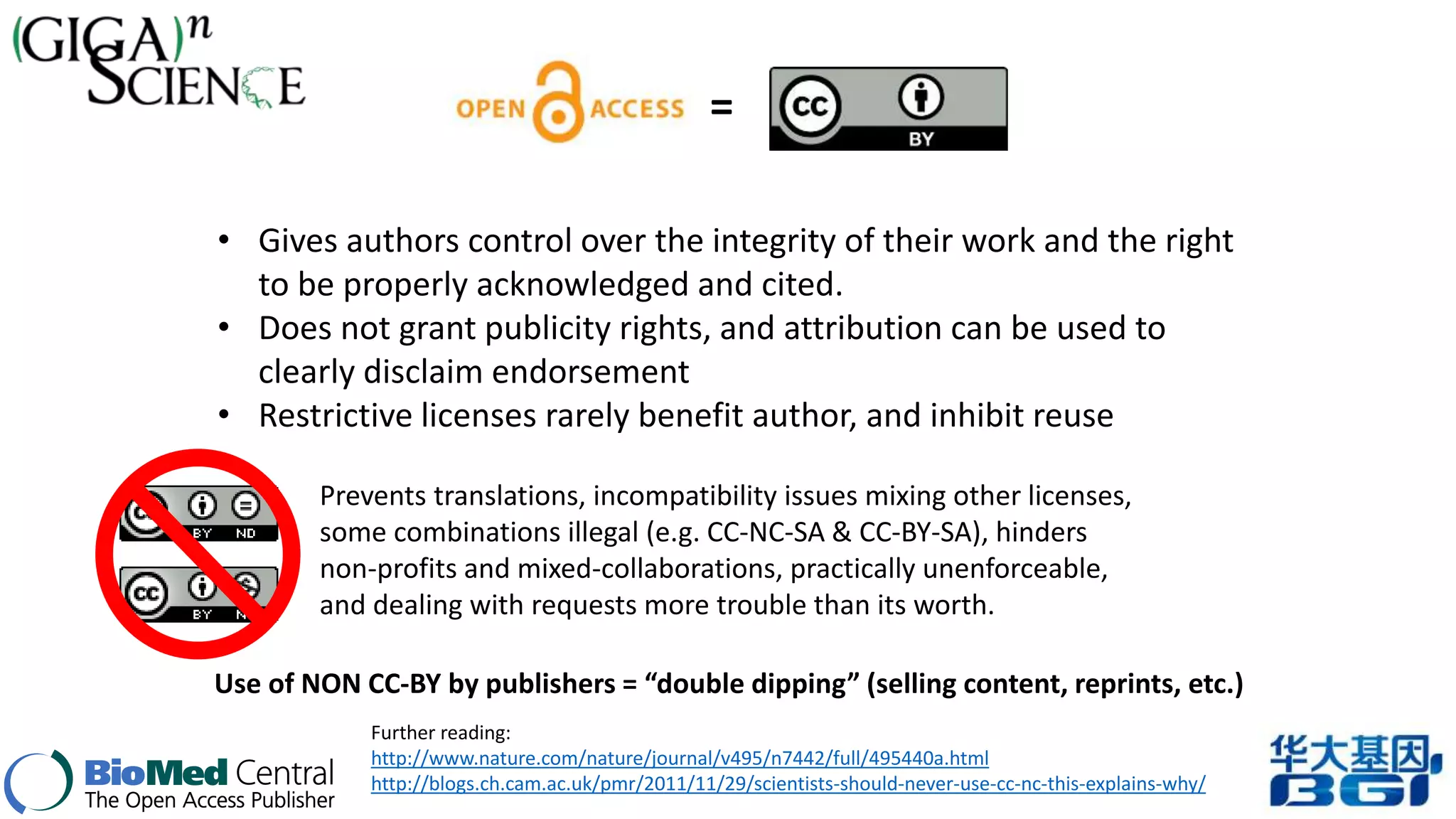
• Gives authors control over the integrity of their work and the right 
to be properly acknowledged and cited. 
• Does not grant publicity rights, and attribution can be used to 
clearly disclaim endorsement 
• Restrictive licenses rarely benefit author, and inhibit reuse 
Prevents translations, incompatibility issues mixing other licenses, 
some combinations illegal (e.g. CC-NC-SA & CC-BY-SA), hinders 
non-profits and mixed-collaborations, practically unenforceable, 
and dealing with requests more trouble than its worth. 
Use of NON CC-BY by publishers = “double dipping” (selling content, reprints, etc.) 
Further reading: 
http://www.nature.com/nature/journal/v495/n7442/full/495440a.html 
http://blogs.ch.cam.ac.uk/pmr/2011/11/29/scientists-should-never-use-cc-nc-this-explains-why/
Text Mining & The Commons 
Budapest Open Access Initiative: 
“By “open access” to [peer-reviewed research literature], we mean its free 
availability on the public internet, permitting any users to read, download, 
copy, distribute, print, search, or link to the full texts of these articles, 
crawl them for STM indexing, pass NEW them as MODEL 
data to software, or use them for 
any other lawful purpose, without financial, legal, or technical barriers 
other than those inseparable only constraint on reproduction LICENSES 
from gaining access to the internet itself. The 
and distribution, and the only role for 
copyright in this domain, should be to give authors control over the 
integrity of their work and the right to be properly acknowledged and 
cited.” 
Proposed Science, Technical & Medical (STM) Model Licenses will: 
• Reduce benefits of standardization  incompatible with CC licenses 
(impact on Flickr, YouTube, Wikipedia & OA publishing all using CC licenses) 
Further reading: 
http://www.authorsalliance.org/2014/08/18/stms-open-access-licenses-extend-embrace-and-extinguish/
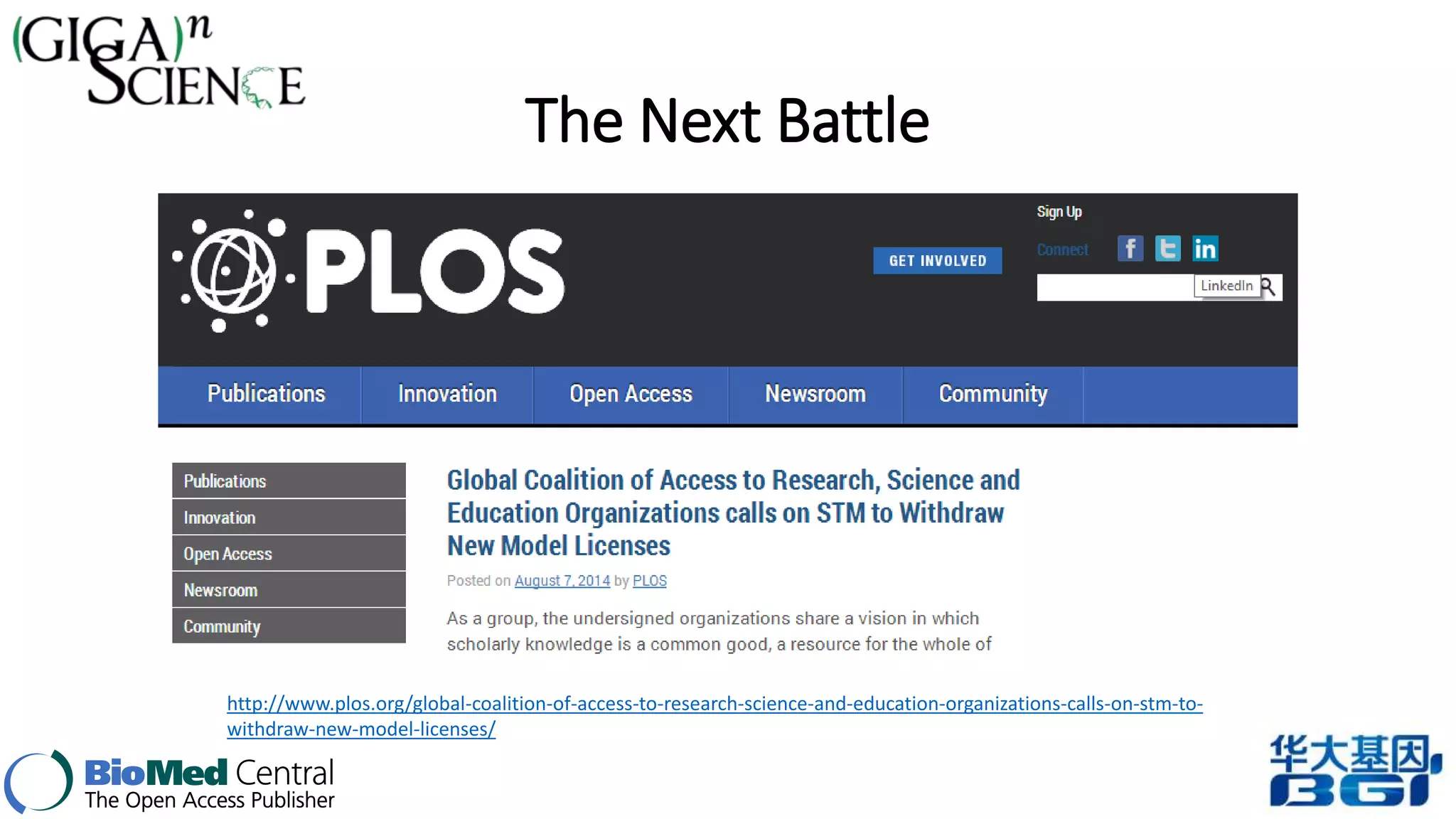
http://www.plos.org/global-coalition-of-access-to-research-science-and-education-organizations-calls-on-stm-to-withdraw- 
new-model-licenses/ 
The Next Battle
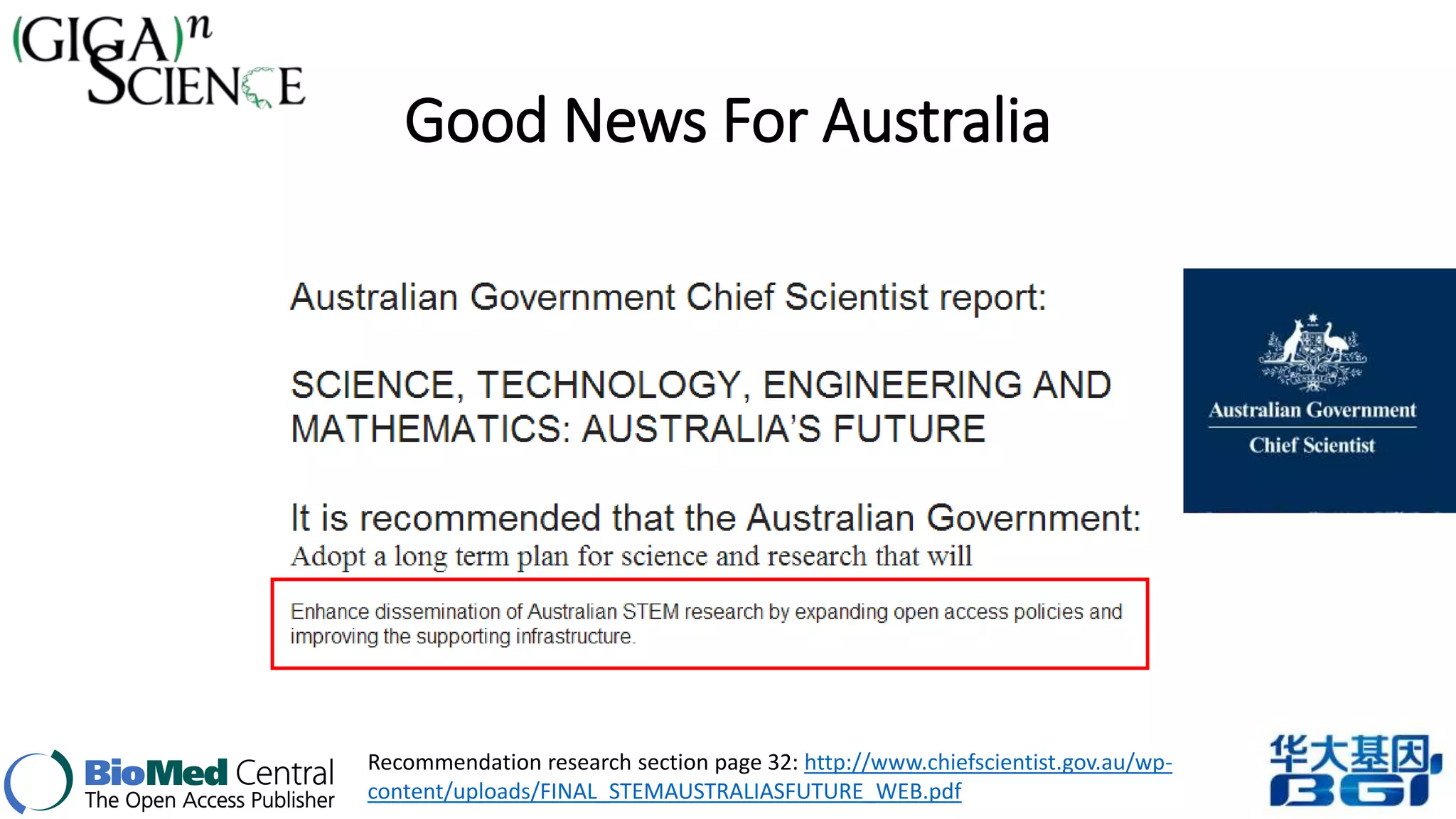
Good News For Australia 
Recommendation research section page 32: http://www.chiefscientist.gov.au/wp-content/ 
uploads/FINAL_STEMAUSTRALIASFUTURE_WEB.pdf
What Can You Do To Help? 
• Publish open access 
• Know your licenses 
• CHOOSE TO PUBLISH UNDER CC-BY
THANK YOU! 
Email: Nicole@gigasciencejournal.com
Thanks to team Giga 
Editor in Chief - Laurie Goodman PhD 
Executive Editor - Scott Edmunds PhD 
Lead Data Manager - Peter Li PhD 
Lead Biocurator - Chris Hunter PhD 
Data Scientist – Rob Davidson PhD 
Database Developer - Xiao Si Zhe 
Journal Development Manager - Amye Kenall (BMC)

Nicole Nogoy at the G3 Workshop: Open Access Publishing - What you need to Know

  • 1.
    Open Access Publishing–What You Need to Know The Great GigaScience and Galaxy (G3) Workshop September 19, 2014 Dr Nicole Nogoy Commissioning Editor, GigaScience Nicole@gigasciencejournal.com
  • 2.
    Summary •What isOpen Access? •Challenges •Mandates & Current Issues •The Solution
  • 3.
    What is OpenAccess?
  • 4.
    What is OpenAccess (OA)? It is a step toward changing how we communicate science — from start to finish Defined by two fundamental criteria: • Price barriers (e.g., subscription fees) are removed • Permission barriers (e.g., copyright restrictions) are removed
  • 5.
    What Does OAMean For Scientific Research? • Universally available via the internet, no barriers to access • Licensed so as to allow for redistribution and reuse as long as attribution given • Permanently archived in an internationally recognized repository (e.g., PubMed Central)
  • 6.
    Problems With theCurrent System? • Library budgets are shrinking - subscription-based access to research is a legacy of print-based economics and makes no sense in an online environment • The intellectual effort that goes into a research article comes from the research community (authors, peer reviewers, academic editors), but they lose control of it • Tax payers and double pay – the cost of doing research and the cost of subscribing to that research
  • 7.
  • 8.
    Biggest Challenge: ClosedAccess • Handful of closed access STM publishers control market • Force libraries to buy “bundles” • Revenue >$9B • Average cost /article >$5000 USD • Publishers retain copyright • Prevent data mining of content • Withhold information from 99.9% who need it!
  • 9.
  • 10.
    Publishing: Better Thana Gold Mine See: http://alexholcombe.wordpress.com/2013/01/09/scholarly-publishers-and-their-high-profits/
  • 11.
    Increasing Strain onLibrary Budgets 400% 350% 300% 250% 200% 150% 100% 50% 0% -50% MIT library purchases v inflation 1986-2006 1986 1988 1990 1992 1994 1996 1998 2000 2002 2004 Percentage Change Year Consumer Price Index % + Serial Expenditures % + # Serials Purchased % + # Books Purchased % + Book Expenditures % + Journal expenditure Inflation
  • 12.
  • 13.
    Benefits of Publishingin an OA Journal Benefits for OA readers • Removal of subscription barriers allows immediate online access to peer-reviewed articles • Easy-to-search articles of interest – can you Google as well as traditional indexing services (e.g. PubMed) • Allow to copy, distribute an reuse content as long as original article is correctly attributed Benefits for OA authors • High visibility and maximum exposure of articles – increase chances of article being noticed, read or cited • No limits on article length or the number of figures and tables • No additional charges for inclusion of colour figures, videos or large datasets • Retain copyright of published content
  • 14.
    Article-Processing Charges •Editorial: handling of manuscripts • Technical: development, maintenance and operation of online journal platforms and manuscript handling systems • Production: copy editing, formatting and mark up of articles, inclusion in indexing services • Marketing: making sure readers know about the journal • Customer service: responding to authors/readers No extra charge for inclusion of colour figures, videos/animations or large datasets (no limits on article length)
  • 15.
    Who Pays? •Author may pay out of grant funds • Some funders provide a central fund for OA publishing costs • Institutions may cover costs centrally on behalf of their authors e.g., through membership schemes with OA publishers • Some titles cover costs themselves
  • 16.
    Models of OAPublishing “Gold” Open Access: • Article is freely available from the publisher’s website “Green” Open Access: • Self-archiving of author manuscript on author website, institutional or subject-based repositories “Full” Open Access • Whole journal is OA “Hybrid” Open Access • Selected articles are OA within a subscription journal
  • 17.
    Some Truths AboutOA Publishing • OA journals have some of the highest impact factors in their fields • OA journals have some of the most prestigious academics as Editors-in- Chief and Editorial Board members • OA publishing is identical to subscription publishing, but content is distributed differently
  • 18.
    Open Access isGrowing Laakso M and Björk B-C: Anatomy of open access publishing: a study of longitudinal development and internal structure. BMC Medicine 2012, 10:124.
  • 19.
  • 20.
    Mandates • Universitymandates: • Students and/or staff are required to… • Almost 150 mandatory institution-wide open access policies worldwide e.g., Harvard University (Compact for Open Access Publishing Equity) • Funder mandates: • Recipients of grants are required to publish under green, gold or both • Wellcome Trust, RCUK, US National Institutes of Health, Howard Hughes Medical Institute, and the European Research Council are just a few
  • 21.
  • 22.
  • 23.
    Good News: TheFight Back Has Begun
  • 24.
    Follow-On Work: Freedomof Information Request 1. How willing would researchers be to do without the services provided by Elsevier? 2. How easy is it on average to find on the web copies of Elsevier articles that can be read legally and free of charge? 3. To what extent are libraries actually suffering as a result of high journal prices? 4. What effect are Elsevier’s Gold Open Access articles having on their subscription prices? 5. How much are our universities paying for Elsevier journals? http://gowers.wordpress.com/2014/04/24/elsevier-journals-some-facts/
  • 25.
    Subscribing Costs •Gower released data acquired from FOI requests: • 19 UK universities (from the Russell Group) spent £14.4 million on subscription fees to Elsevier alone • Imperial College also released data - £1,340,213 million on subs to Elsevier • Total UK expenditure as of April 2014 - £15.7 million • Huge variation in subscription costs e.g., Cost of Subscription £ No. of Students Imperial College 1,340,213 16,000 University College London 1,381,380 25,525 University of Exeter 234,126 18,720 http://access.okfn.org/2014/04/24/the-cost-of-academic-publishing/
  • 26.
  • 27.
  • 28.
    AU Efforts StevenHarnard (OA advocate) estimated overall loss of productivity due to not publishing in OA journals: • If Australian Research Councils spend ~$1 billion dollars – 32,000 research articles • BUT Losing about ~$425 million dollars worth of potential return on its public investment in research each year http://sbseminar.wordpress.com/2014/05/21/elsevier-in-australia/ http://www.ecs.soton.ac.uk/~harnad/Temp/research-australia.doc
  • 29.
    NZ Efforts VictoriaUniversity of Wellington http://mcw.wordpress.fos.auckland.ac.nz/2014/06/05/official-information-act-requests-in-the-style-of- tim-gowers/ Taylor & Francis $484,000 NZD and Wiley $542,856 NZD (2013) University of Canterbury A reasonable estimate of ongoing journal purchases would be $4.6M University of Otago Budget for print journals and eResources - $9,031,438 NZD Auckland University Taylor/Francis USD $413,715 NZD + $20,292 AUD and Wiley $891,067 USD
  • 30.
  • 31.
    The Solution: Abilityto Mine & Reuse Content Budapest Open Access Initiative: • Maximizes reuse and access • Gives authors control over the integrity of their work and the right to be properly acknowledged and cited • DOES NOT consider OA licenses with an NC clause to be = = open access Needs to be: NC, ND clauses put unnecessary restrictions and are “Pseudo OA” CC0 better than CC-BY for datasets to prevent “attribution stacking”
  • 32.
    = • Givesauthors control over the integrity of their work and the right to be properly acknowledged and cited. • Does not grant publicity rights, and attribution can be used to clearly disclaim endorsement • Restrictive licenses rarely benefit author, and inhibit reuse Prevents translations, incompatibility issues mixing other licenses, some combinations illegal (e.g. CC-NC-SA & CC-BY-SA), hinders non-profits and mixed-collaborations, practically unenforceable, and dealing with requests more trouble than its worth. Use of NON CC-BY by publishers = “double dipping” (selling content, reprints, etc.) Further reading: http://www.nature.com/nature/journal/v495/n7442/full/495440a.html http://blogs.ch.cam.ac.uk/pmr/2011/11/29/scientists-should-never-use-cc-nc-this-explains-why/
  • 33.
    Text Mining &The Commons Budapest Open Access Initiative: “By “open access” to [peer-reviewed research literature], we mean its free availability on the public internet, permitting any users to read, download, copy, distribute, print, search, or link to the full texts of these articles, crawl them for STM indexing, pass NEW them as MODEL data to software, or use them for any other lawful purpose, without financial, legal, or technical barriers other than those inseparable only constraint on reproduction LICENSES from gaining access to the internet itself. The and distribution, and the only role for copyright in this domain, should be to give authors control over the integrity of their work and the right to be properly acknowledged and cited.” Proposed Science, Technical & Medical (STM) Model Licenses will: • Reduce benefits of standardization  incompatible with CC licenses (impact on Flickr, YouTube, Wikipedia & OA publishing all using CC licenses) Further reading: http://www.authorsalliance.org/2014/08/18/stms-open-access-licenses-extend-embrace-and-extinguish/
  • 34.
  • 35.
    Good News ForAustralia Recommendation research section page 32: http://www.chiefscientist.gov.au/wp-content/ uploads/FINAL_STEMAUSTRALIASFUTURE_WEB.pdf
  • 36.
    What Can YouDo To Help? • Publish open access • Know your licenses • CHOOSE TO PUBLISH UNDER CC-BY
  • 37.
    THANK YOU! Email:Nicole@gigasciencejournal.com
  • 38.
    Thanks to teamGiga Editor in Chief - Laurie Goodman PhD Executive Editor - Scott Edmunds PhD Lead Data Manager - Peter Li PhD Lead Biocurator - Chris Hunter PhD Data Scientist – Rob Davidson PhD Database Developer - Xiao Si Zhe Journal Development Manager - Amye Kenall (BMC)

Editor's Notes

  • #5 Gold route to publishing and reverses traditional publishing business model Open Access serves as a foundation for a specific way of thinking about scientific communication and the role of journals and publishers It is actually a step toward complete transparency
  • #7 More and more journals published each year Massive increase in research output Traditional scholarly publishing model is broken
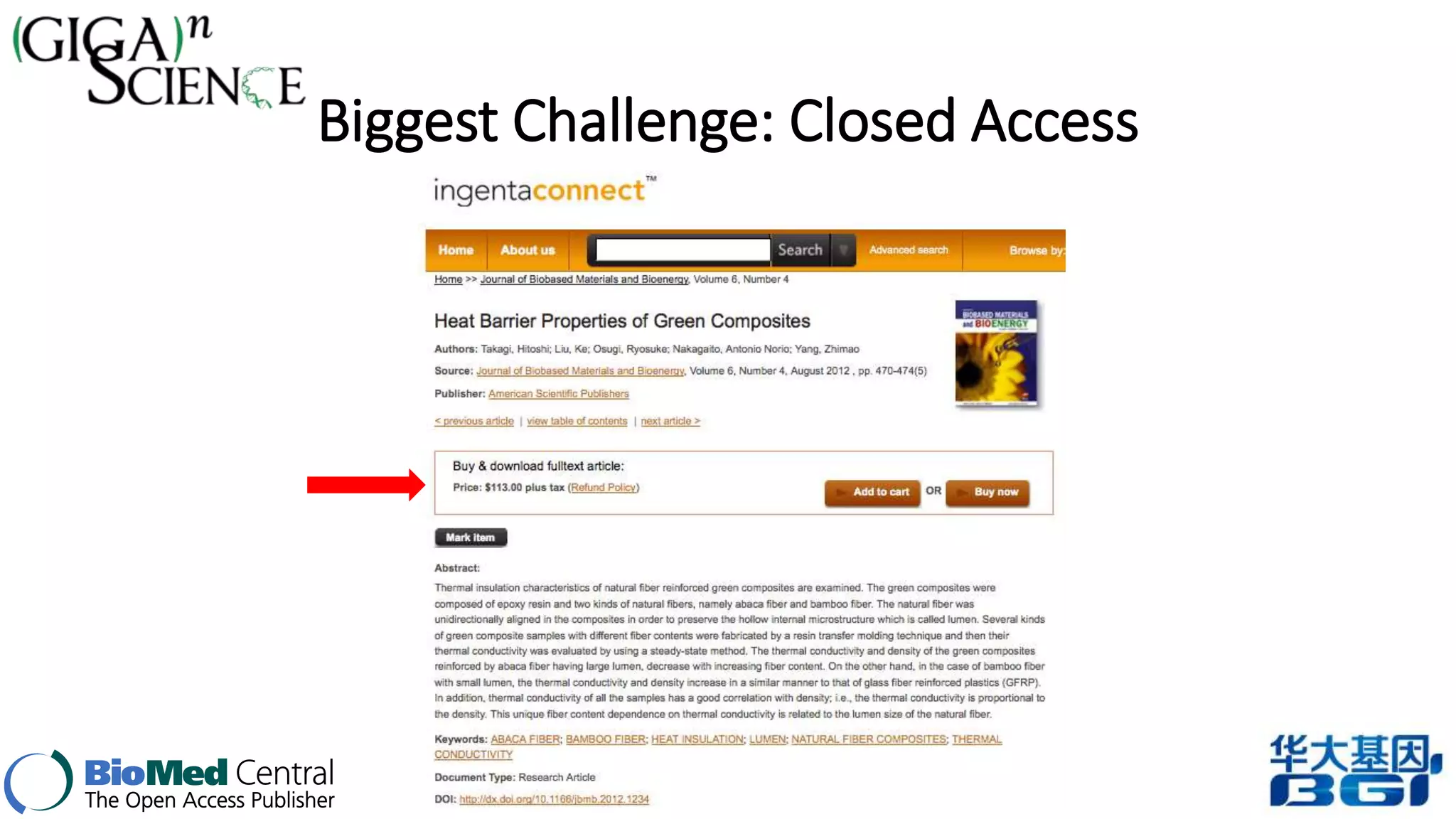
  • #10 Have to pay $113 just to read this paper.
  • #11 Both companies profit is up 2% since 2013 because of subscriptions.
  • #12 Image: MIT Library
  • #14 Accessible by everyone, including 3rd world countries and tax payers (who fund universities etc.)
  • #15 There is also transparency of costs
  • #16 So
  • #19 BMC Medicine paper - Annual volumes of articles in full immediate open access journals, split by type of open access journal.  OA Mandates are the major drivers on this.
  • #22 US National Institutes of Health (NIH) and the Wellcome Trust in the United Kingdom — have issued a steady stream of incentives to coax academics to abide by their open-access policies. BUT NOW…. They are cracking down on researchers who do not make their papers publicly available. Wellcome Trust has withheld grant payments on 63 occasions in the past year because resulting papers were not OA.
  • #23 Increase in compliance by researchers – the US is leading the way Where do you think Australia is on this graph? Percentage of papers placed in PubMed within 1 year of publication has jumped to 82% (up from 75% the last 2 years) Wellcome Trust (UK) began stricter enforcement in June 2012 – and compliance rate is 69% - up from 55% in March 2012.
  • #24 Boycott of Elsevier by Sir Timothy Gowers – started 2 years ago. Researchers who sign, commit to stop supporting Elsevier journals.
  • #25 The OA movement is unstoppable, but pace of convincing other communities like Maths and Humanities is slow…Gowers wants to know if there is anything more than can be done Idea of paying an APC is unpopular in the Mathematics and Humanities communities So if he can’t bring about rapid change, then the next best thing is gathering as much information about it as possible, so he can explain what is wrong with the current systems to the hard-to-reach communities… FOI requests to find out how much Elsevier is ripping off Universities
  • #26 No one knew exactly how much each uni was paying. Non-disclosure clauses, included by Elsevier within the contracts have previously prevented libraries from releasing this data
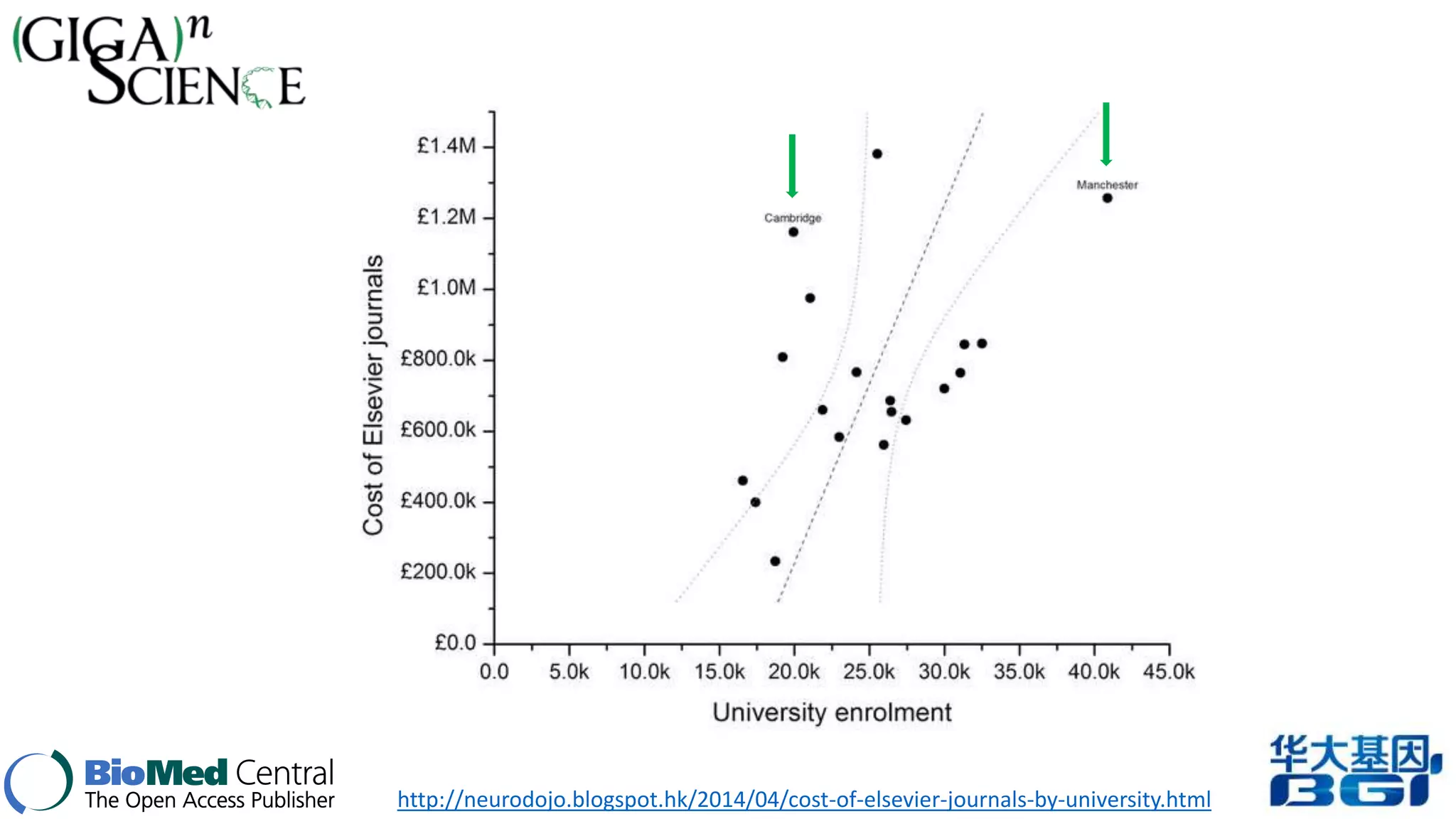
  • #27 Cambridge University pays roughly the same as Manchester University – even though Manchester has double the number of students enrolled (~40,000)
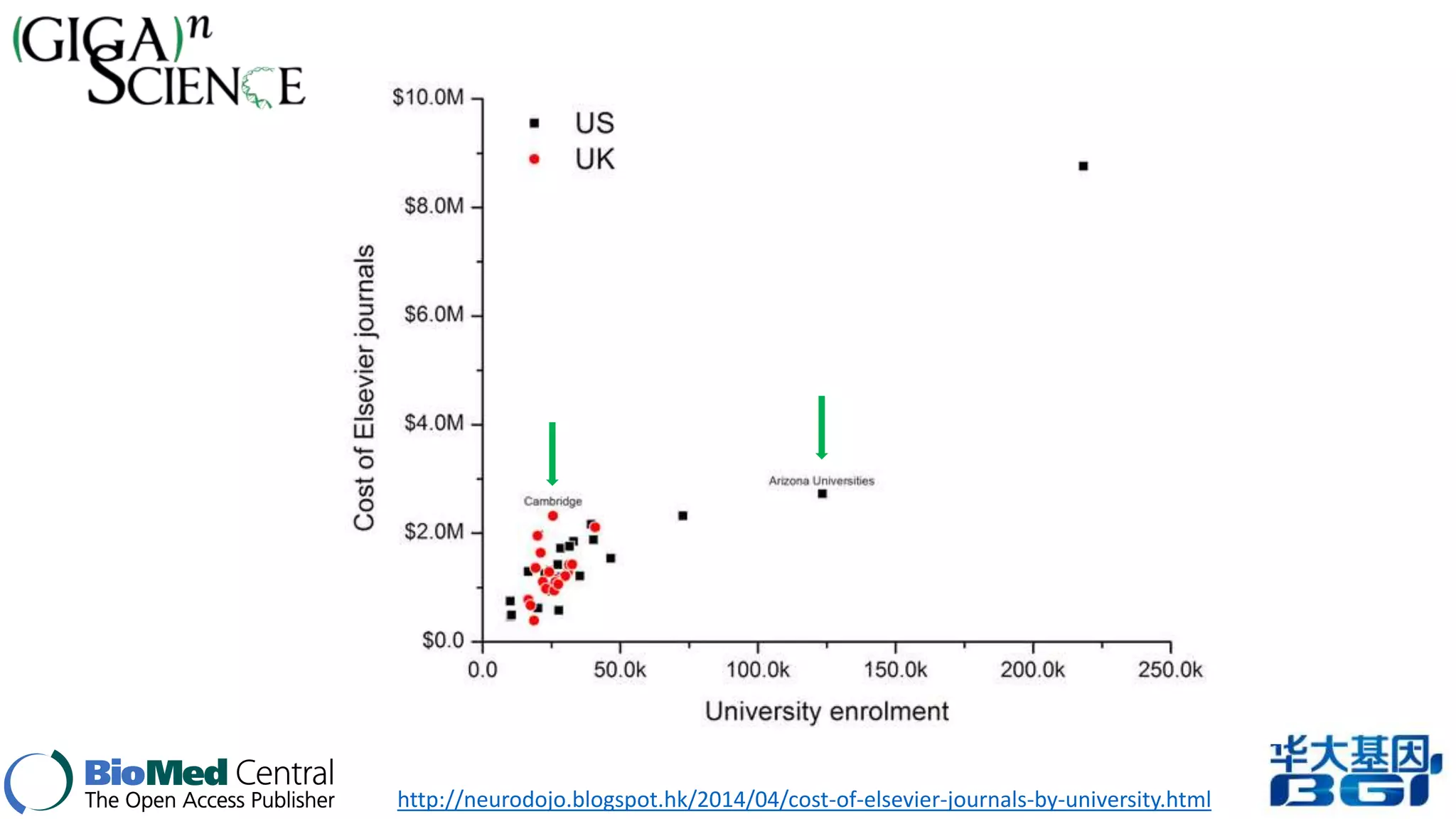
  • #28 From the FOI requests that Gower made and using information already available he found data on Elsevier subscription costs (bundles of journals) to university enrolment for UK and US universities Here is data from both plotted on the same graph (UK data was converted from Pound to USD$) – Despite huge differences in enrolment, the price being paid by Cambridge and Arizona for the bundle of Elsevier journals are... not that different.
  • #29 People in Aus are starting to do what Gower has done in the UK The ANU spent US$1,229,662.21 in 2013 on Elsevier subscriptions
  • #30 Most universities in NZ chose not to reveal such information and/or specifically withheld information on Elsevier subscriptions All NZ universities refused to give information on subscription costs to Elsevier specifically Scott did the FOI requests for Hong Kong universities – didn’t get any figures.
  • #32  1st defined over a decade ago. Traditional publishers often use NC and ND clauses – limited dissemination. CC-BY – attribution license CC0 is the MOST OPEN license of data CC0 gives those who want to give up copyright restrictions a way to do so, to prevent giant combined datasets being bogged down with impossible attribution requirements. Last dataset used only needs to be attributed. When working with individual datasets CC0 does not stop moral and scientific etiquette for attribution, but it’s scientific malpractice if you don’t attribute it.
  • #33 Standing on the shoulders of giants“ – metaphor (made famous by Isaac Newton - "discovering truth by building on previous discoveries” in the public domain) If you want people to be able to reuse your work then CC-BY is the “true OA” license to go for. NC restrictions allow you to look at their shoulders but not stand on them (i.e. Putting restrictions on your work only hurts yourself) Top Sci journals have OA options but offer pricing differentials, making CC-BY-NC cheaper than CC-BY, the only reason they do this is because they sneakily make more money from CC-BY-NC Main reasons the publishers want to keep CC-BY-NC is that selling commercial reprints in their business model. This "pseudo OA" means they charge APCs, while still getting revenue from other streams e.g., selling the reprints See this for example: http://enjoythedsruption.com/post/76944284192/neylon-highlights-another-misleading-survey-this-one
  • #34 Creative Commons: de facto global standard for reuse, mining and combining content Preferred option by OA publishers and approved by many governments The Association of STM Publishers has recently proposed new model licenses for research articles. These licenses would limit the use, reuse and exploitation of research and are NOT compatible - undermines the entire CC (global de facto standard for OA)
  • #35 "messing up the entire commons" (chance for combining with wikipedia/everything else in the world) purely to make a few measly pennies from reprint sales GigaScience – 1st people in Asia to sign this STM (inc Nature, AAAS, Elsevier etc)
  • #36 Just came published earlier this month….