Whose Property Is It Anyway?
Part 2: the challenges in supporting the UK’s main research
funder agendas which seek to ensure that the outputs from
publicly funded research are published Open Access
Chris Banks @chrisbanks
Director of Library Services
Imperial College London
POLICY ENVIRONMENT
Research Councils UK (RCUK) Policy
• From 2005 RCUK sought to encourage open access publishing
• Article Processing Charges could be paid from grants - low take up
Wellcome Trust and Open Access
• From 2007 the Wellcome Trust funded APCs
• Also mandated deposit in PubMedCentral
• Compliance is currently at 66% and costs the Trust around £4.5m a
year
• Wellcome are now implementing sanctions for non compliant
academics seeking further grants
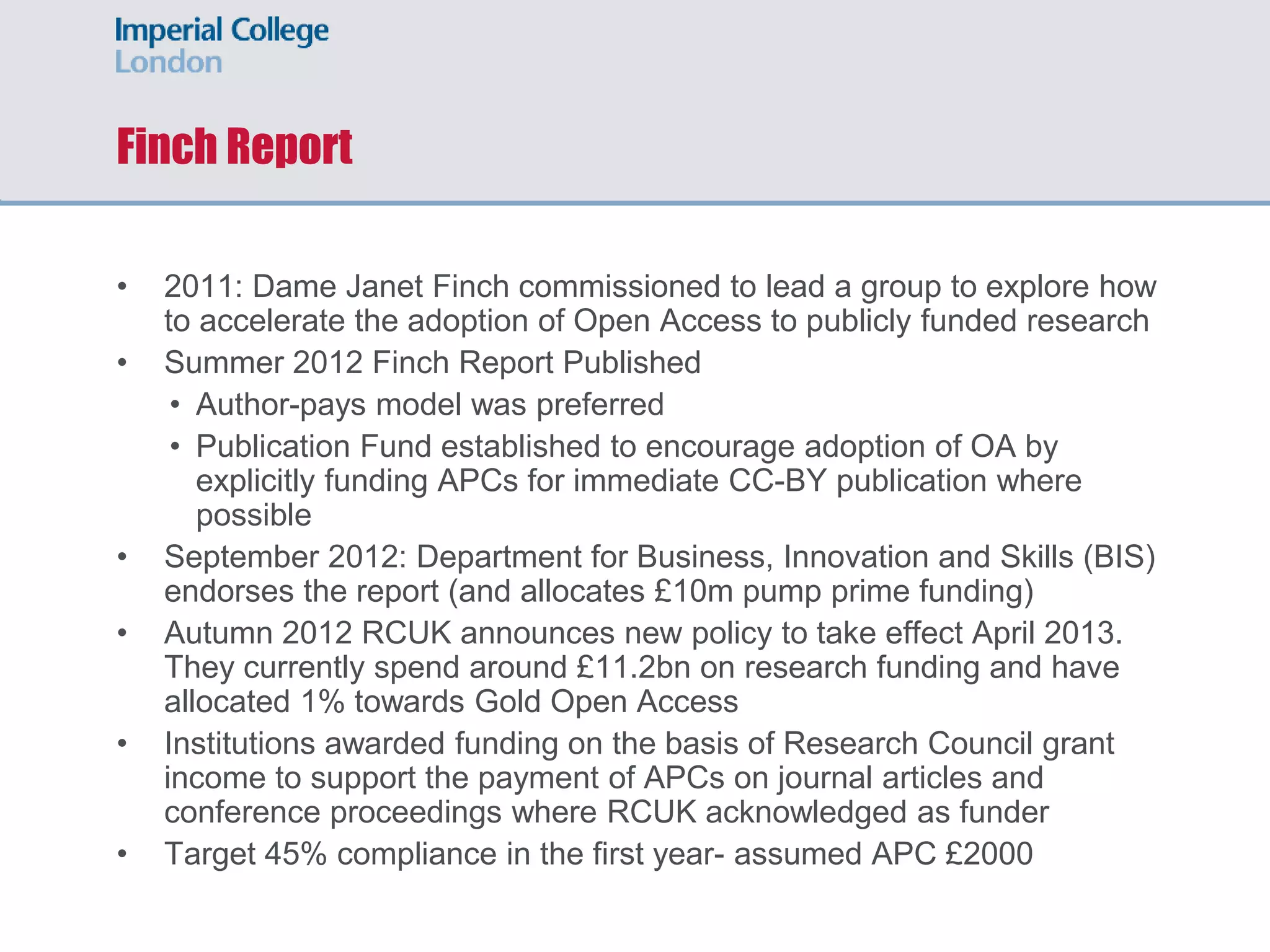
Finch Report
• 2011: Dame Janet Finch commissioned to lead a group to explore how
to accelerate the adoption of Open Access to publicly funded research
• Summer 2012 Finch Report Published
• Author-pays model was preferred
• Publication Fund established to encourage adoption of OA by
explicitly funding APCs for immediate CC-BY publication where
possible
• September 2012: Department for Business, Innovation and Skills (BIS)
endorses the report (and allocates £10m pump prime funding)
• Autumn 2012 RCUK announces new policy to take effect April 2013.
They currently spend around £11.2bn on research funding and have
allocated 1% towards Gold Open Access
• Institutions awarded funding on the basis of Research Council grant
income to support the payment of APCs on journal articles and
conference proceedings where RCUK acknowledged as funder
• Target 45% compliance in the first year- assumed APC £2000
HEFCE policy for post REF2014
• Higher Education Funding Council for England (HEFCE) REF policy
published on 31st March 2014 states that for any journal article or
conference proceeding accepted for publication in a volume with an
ISSN from 1 April 2016 to be eligible for the next REF [REF2020?] the
Final Author Version/Accepted Author Manuscript must have been
deposited in an institutional or subject repository and made
discoverable within three months of acceptance for publication.
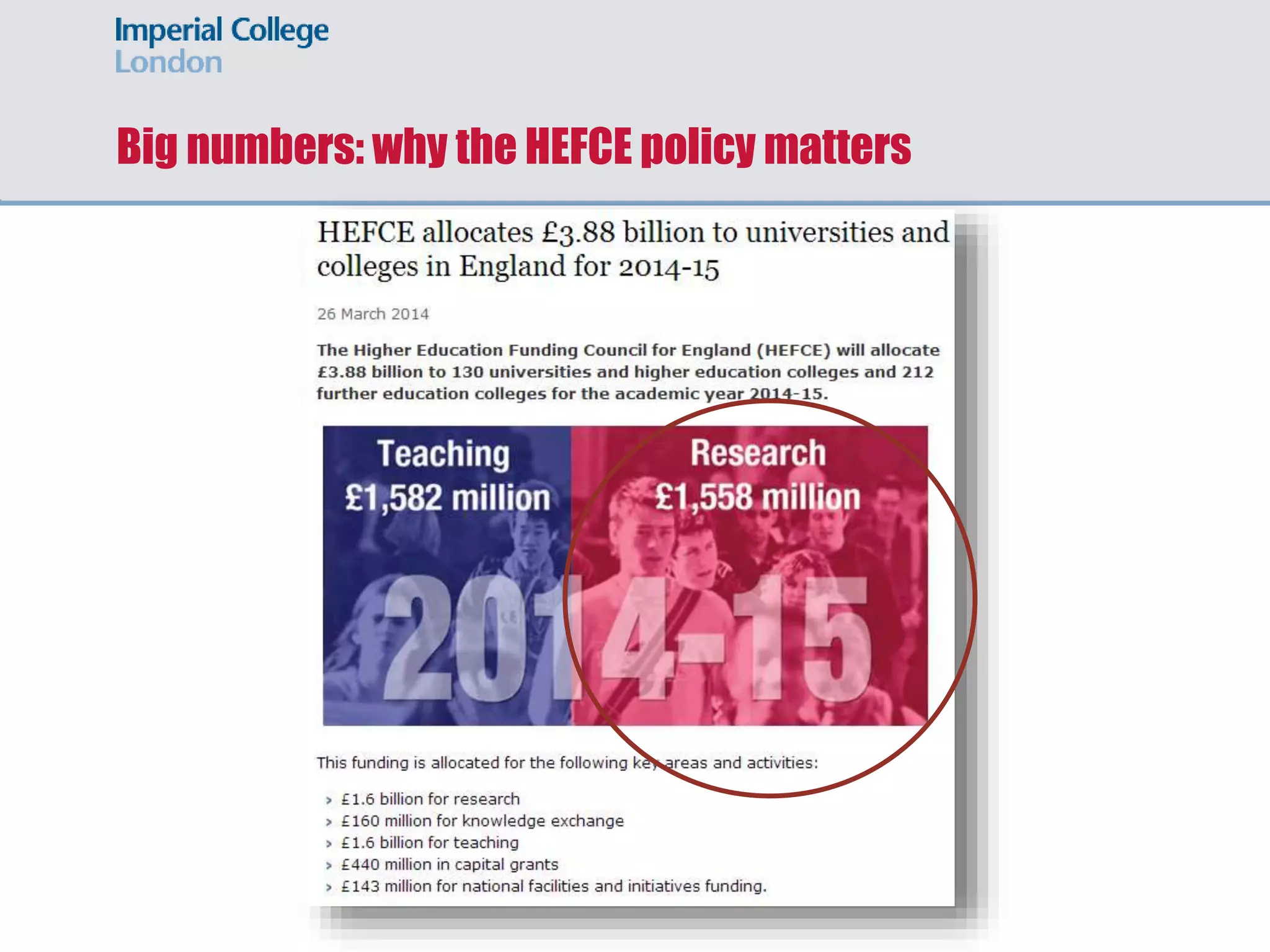
Big numbers: why the HEFCE policy matters
HEFCE and RCUK policies seen together
• From 2016, for a Journal/Conference proceeding publication to be
eligible for submission to the next REF it must meet the following
minimum criteria:
• Have a discoverable metadata record in a repository within 3 months
of acceptance for publication
• Have a closed deposit FAV/AAM in the repository within 3 months of
acceptance for publication
• BUT if the research was funded by RCUK/Wellcome/Horizon2020 then
the following criteria must also be met:
• Be available as an Open Access publication (either Gold or Green).
• If Gold: immediately upon publication, and with the relevant
license (e.g. CC-BY)
• If Green: be open access within the embargo period set by the
funder
The challenges of compliance
Author action RCUK /
Wellcome
compliant?
HEFCE
REF
compliant?
Additional
REF
credits?
APC paid for Gold OA?   
Repository deposit with
Green embargo
  
Immediate Deposit/Optional
Access
  ?
Immediate deposit /
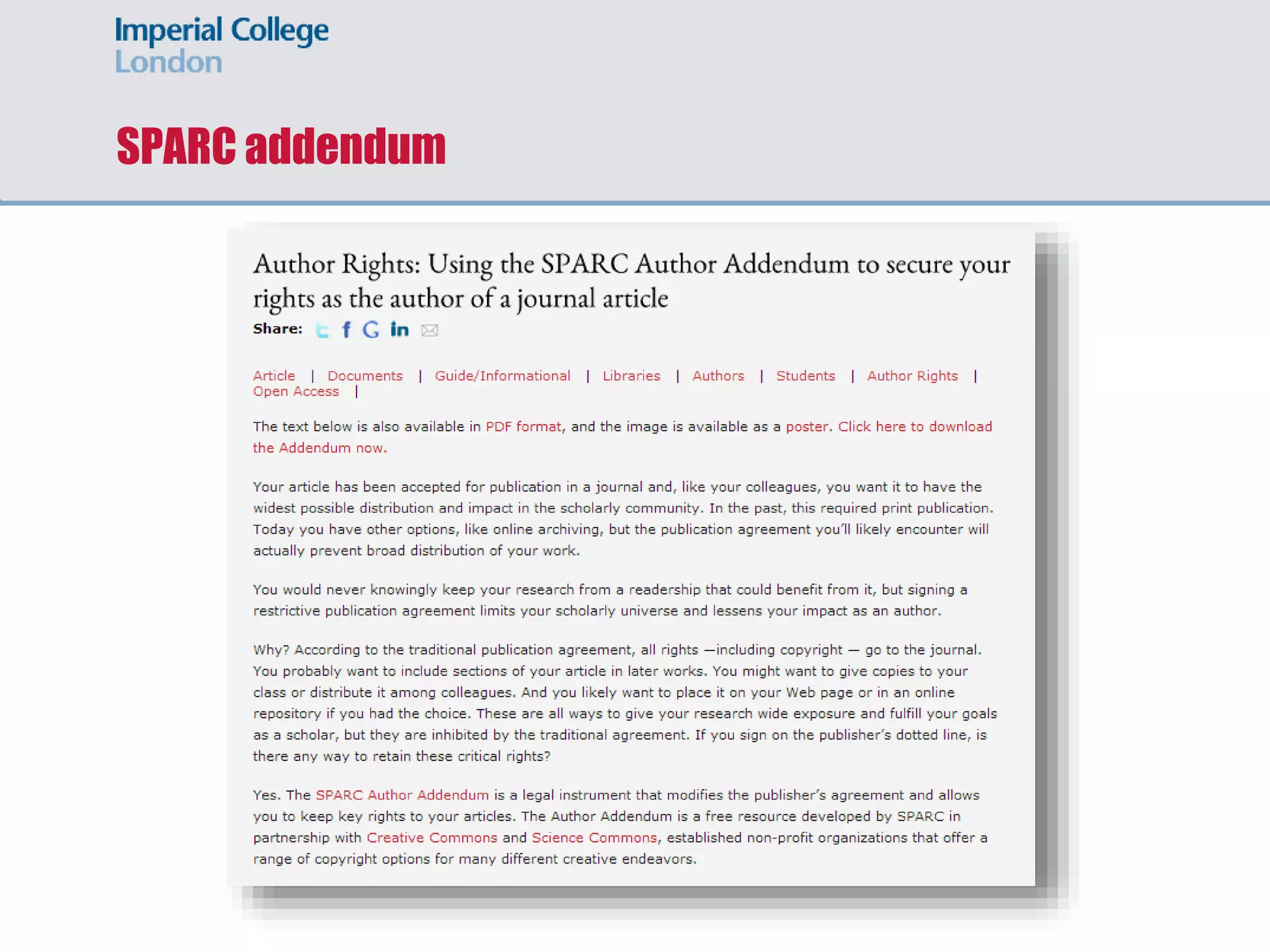
Immediate Access / SPARC
(or similar) Author Addendum
to Publication Agreement
  
It can be all too easy for academics to comply with one policy and fail to comply with others
INSTITUTIONAL RESPONSES
• Senior academic leadership is essential to effect behavioural change
• High level committees drawn from Research VP, Research Office,
Policy, Strategy, Library, ICT + relevant academic representation
• Advocacy, Advocacy, Advocacy – the message is still not widely
understood
• Challenges with multiple policies which are not wholly aligned,
particularly cross-border policies
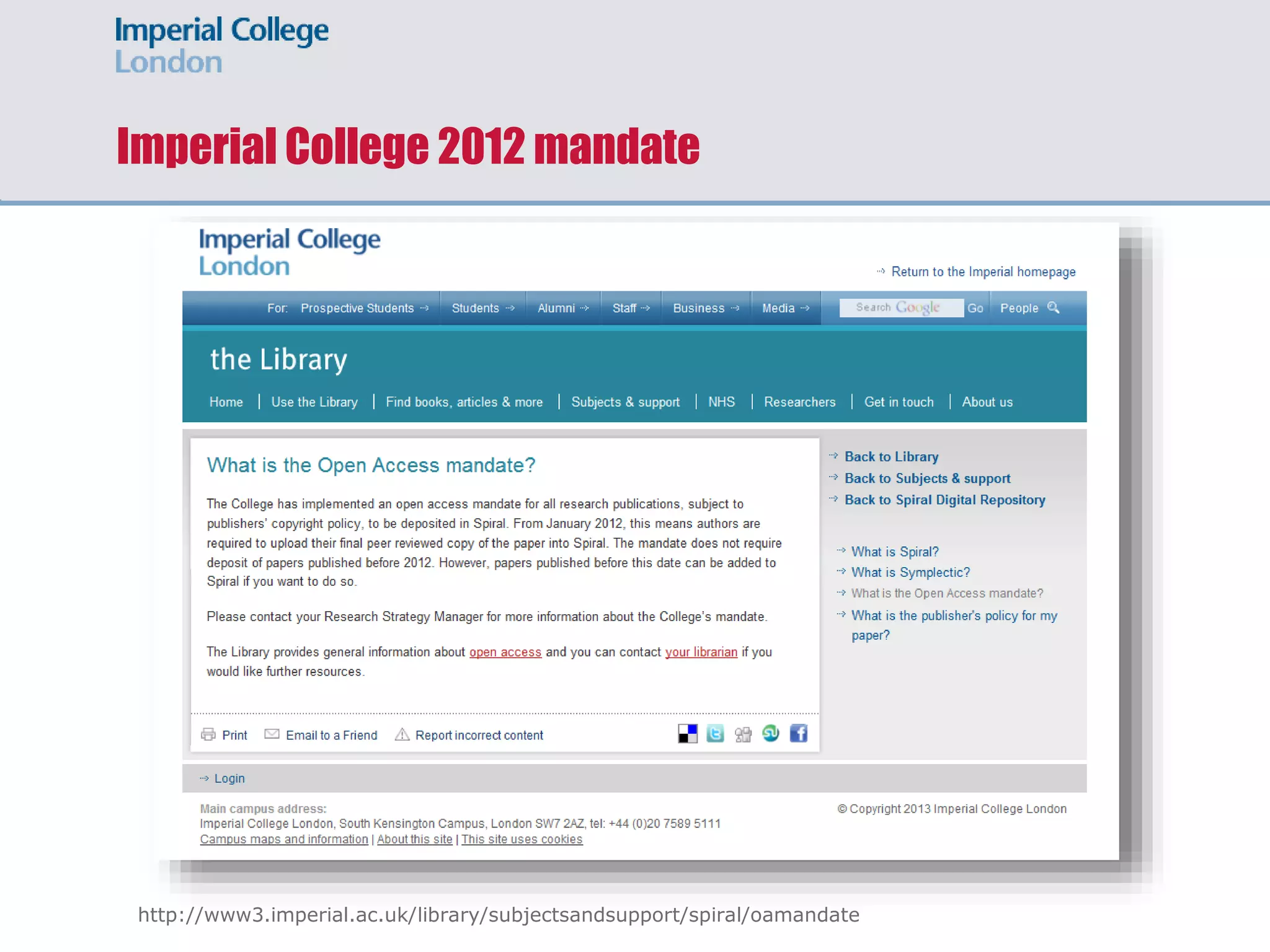
Imperial College 2012 mandate
http://www3.imperial.ac.uk/library/subjectsandsupport/spiral/oamandate
ACADEMIC RESPONSES
Responses vary by discipline
• Sciences & Medicine likely most engaged
• Engineering and Maths less so
• Arts, Humanities and Social Sciences – even less so
Individual responses
• On a spectrum between passionately engaged and
unaware/disinterested
• Still rewarded by publication in high impact journals, so minimal
motivation to change behaviours
• Like the elitism of publishing in high impact journals
• Beleaguered: yet more constraints, more reporting requirements,
perceived less time for research
• But: want to be eligible for submission to the REF
PUBLISHER RESPONSES
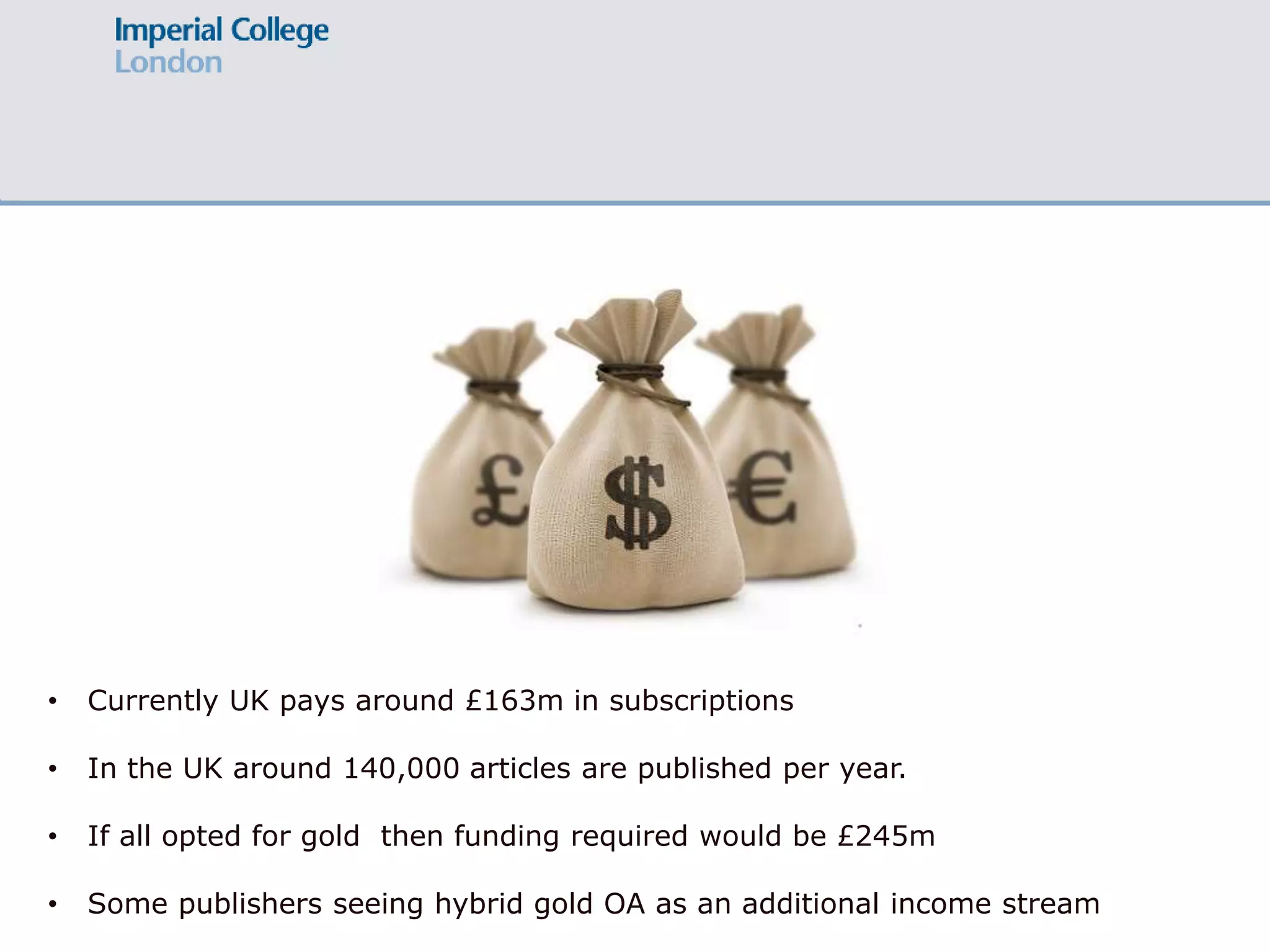
• Currently UK pays around £163m in subscriptions
• In the UK around 140,000 articles are published per year.
• If all opted for gold then funding required would be £245m
• Some publishers seeing hybrid gold OA as an additional income stream
• RCUK funding is “transitional” but some evidence suggests publishers
are welcoming a growth in hybrid gold
• Challenge with license applications: correct funder-compliant license
not always applied
• “Pure Gold” does not necessarily mean low impact factor (e.g. PLoS)
• New government-led research into monograph publishing
• New publishing business models are emerging
• Some quality monograph publishers actively engaging in OA schemes
(e.g. Knowledge Unlatched)
LIBRARY ACTIVITIES
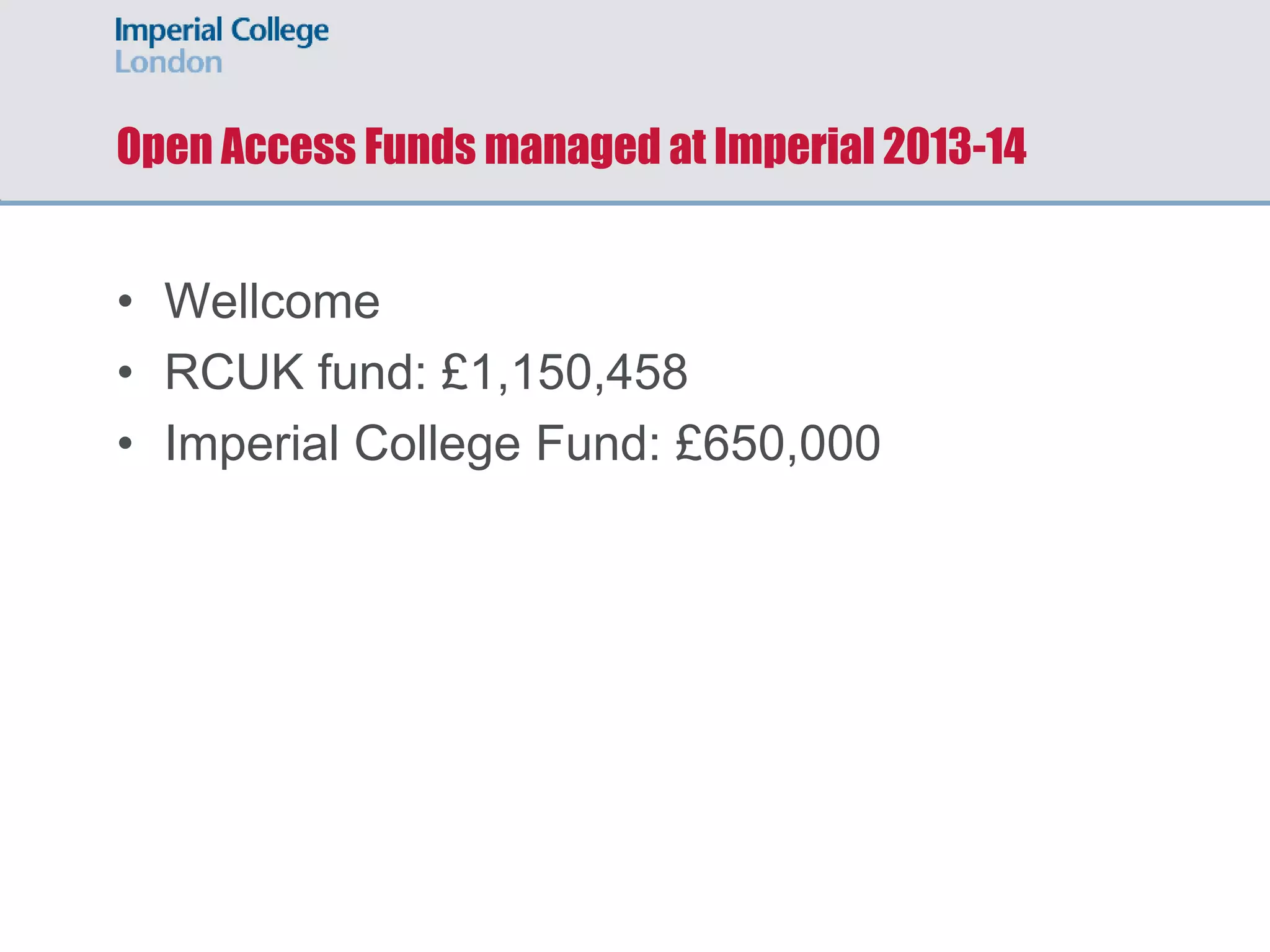
Library Activity
• Contributing to the work of institutional implementation groups
• Awareness raising amongst library colleagues, academics and
students
• Working with other departments, including ICT and Research Office,
on the requirements for management of the process
• Maintenance of web pages, FAQs and links
• Running the service to manage the payment of Article Processing
Charges (and learning from that process)
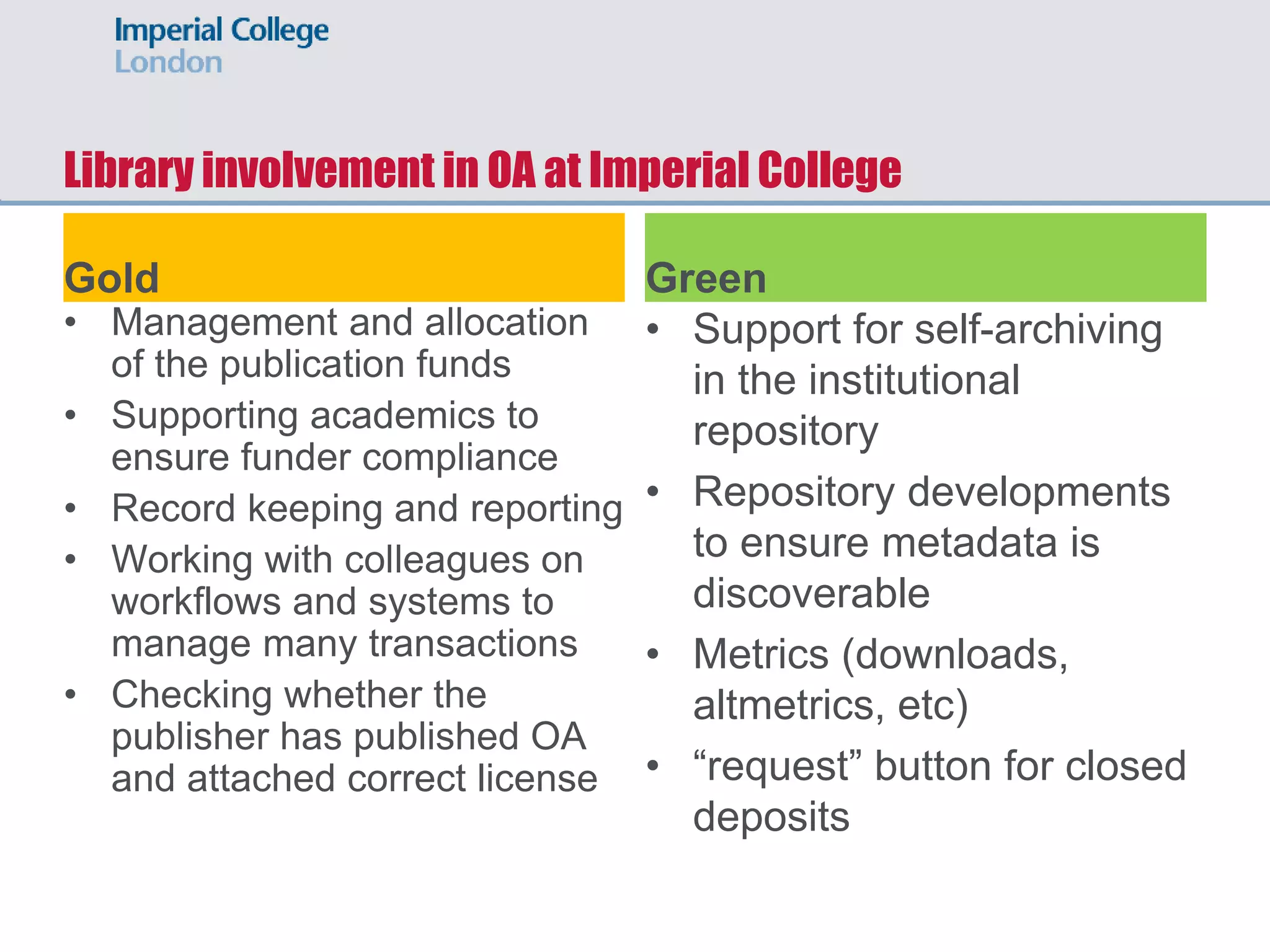
Open Access Funds managed at Imperial 2013-14
• Wellcome
• RCUK fund: £1,150,458
• Imperial College Fund: £650,000
Library involvement in OA at Imperial College
Gold
• Management and allocation
of the publication funds
• Supporting academics to
ensure funder compliance
• Record keeping and reporting
• Working with colleagues on
workflows and systems to
manage many transactions
• Checking whether the
publisher has published OA
and attached correct license
Green
• Support for self-archiving
in the institutional
repository
• Repository developments
to ensure metadata is
discoverable
• Metrics (downloads,
altmetrics, etc)
• “request” button for closed
deposits
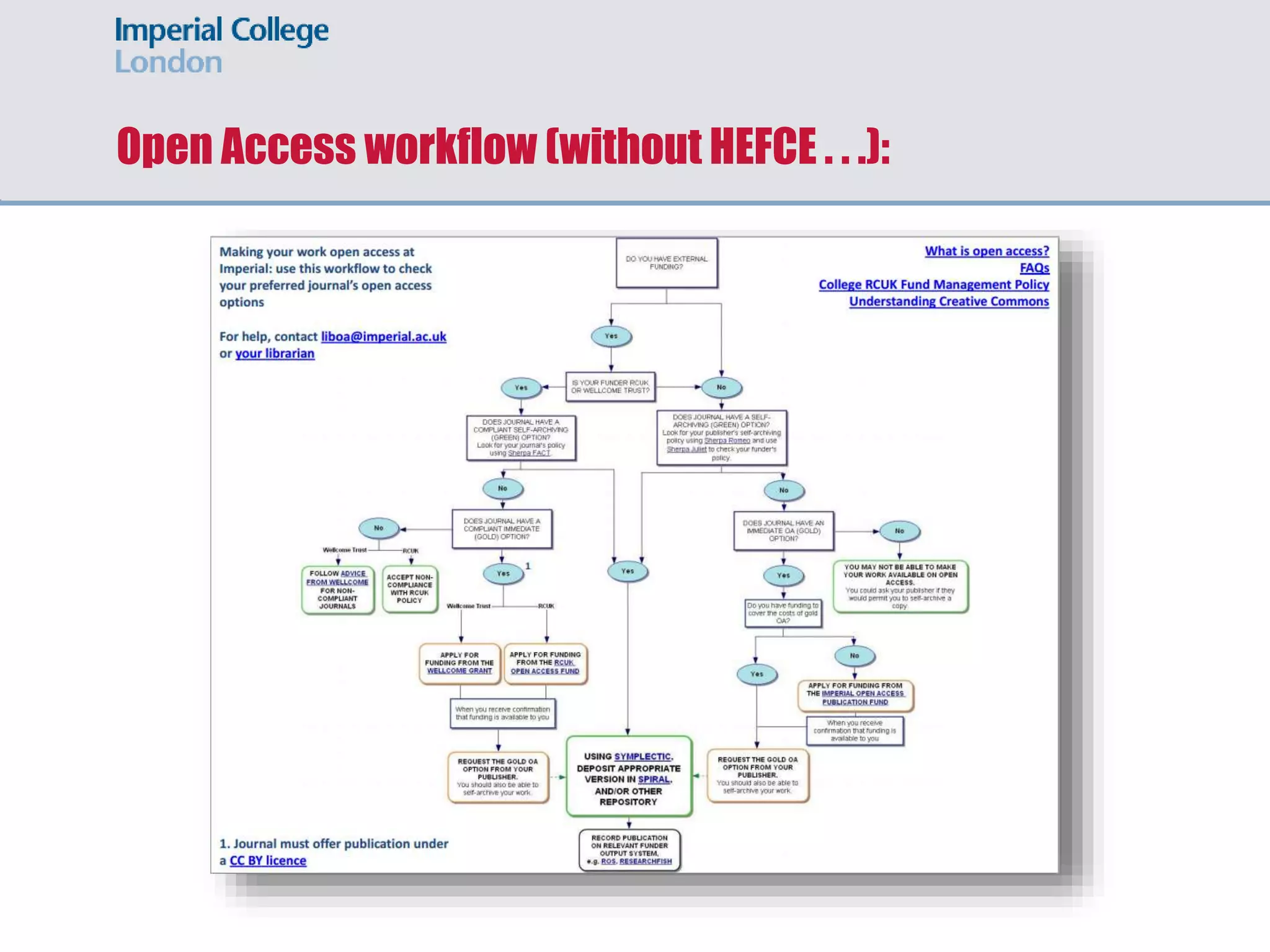
Open Access workflow (without HEFCE . . .):
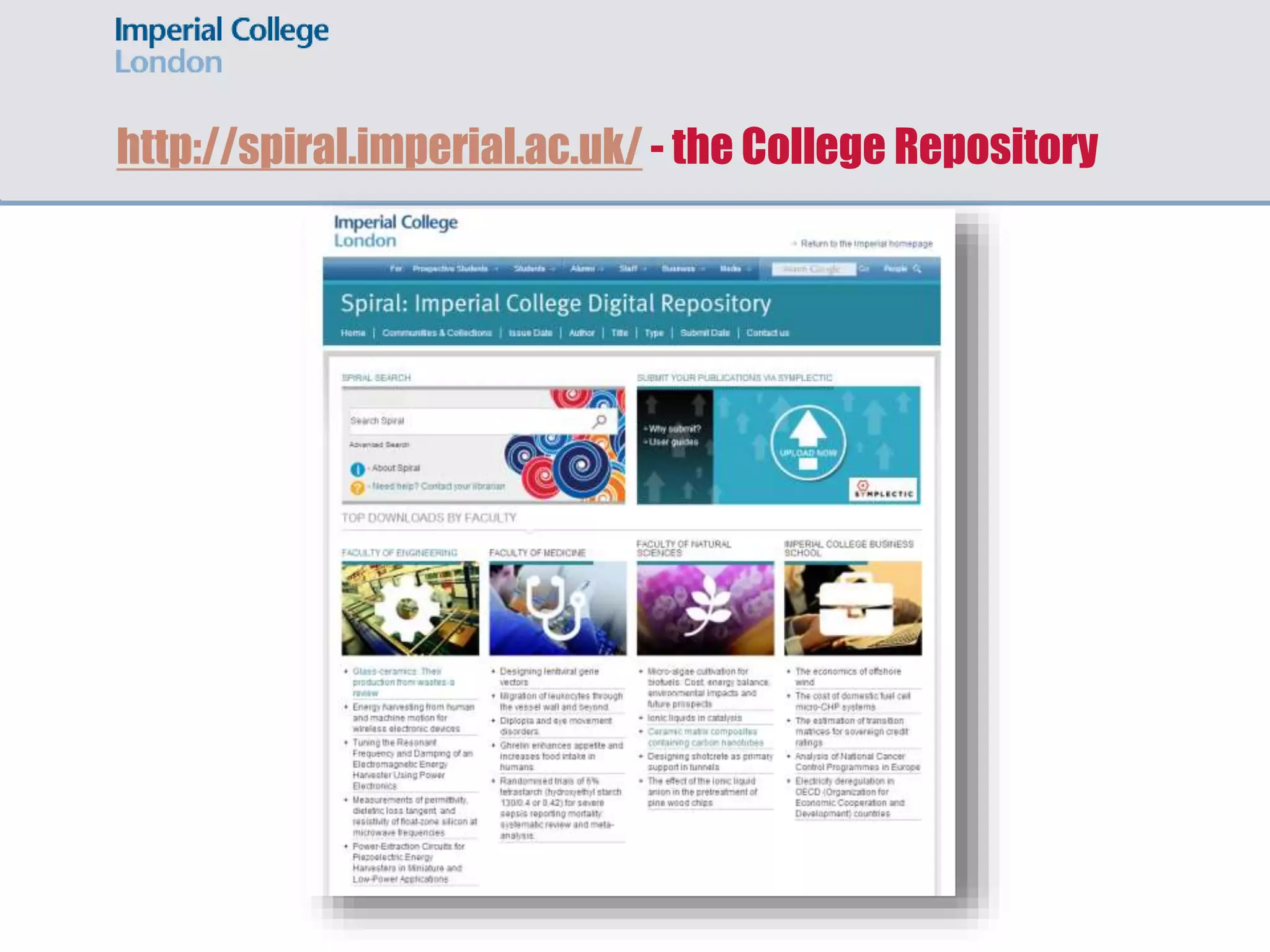
http://spiral.imperial.ac.uk/ - the College Repository
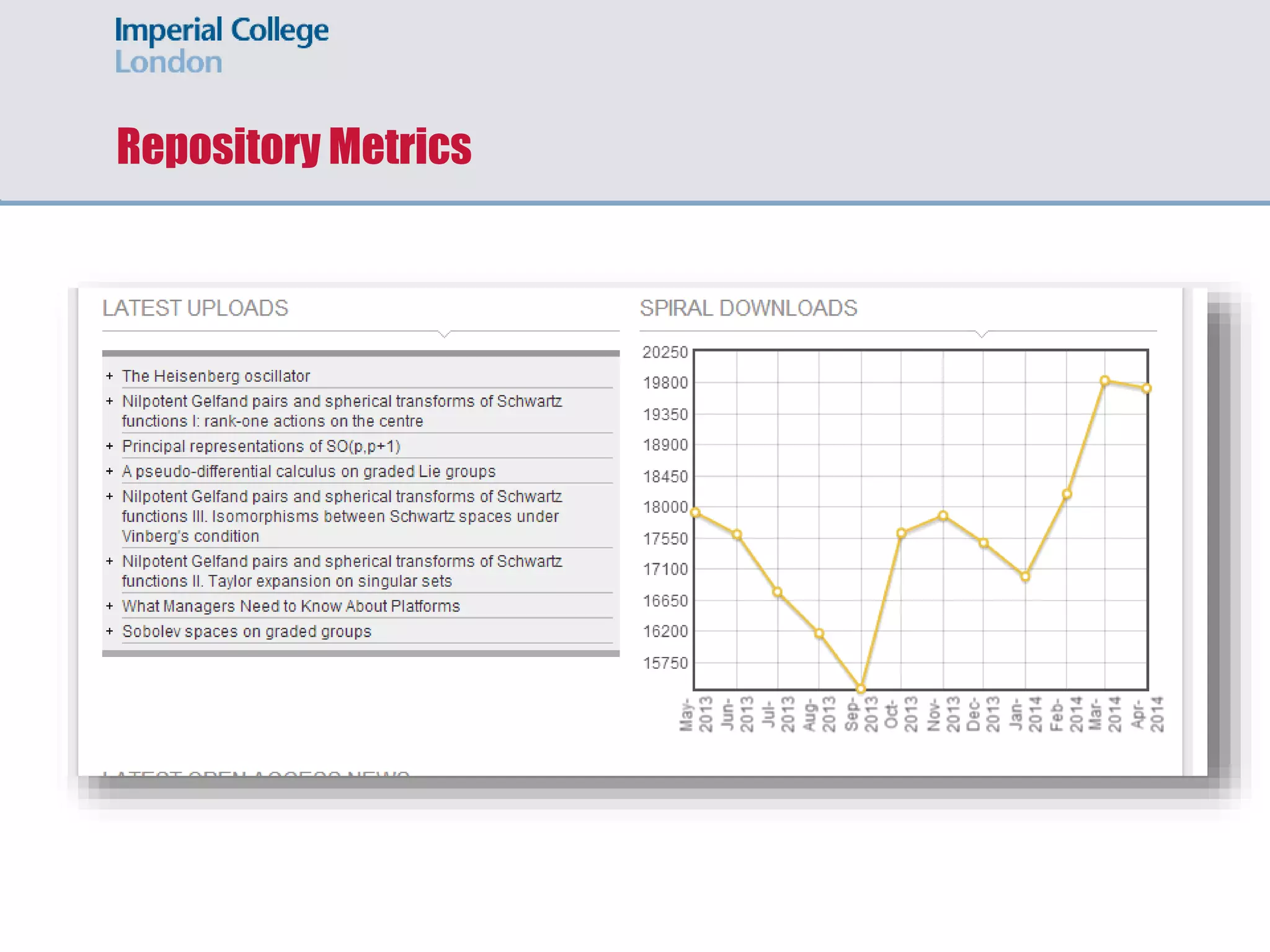
Repository Metrics
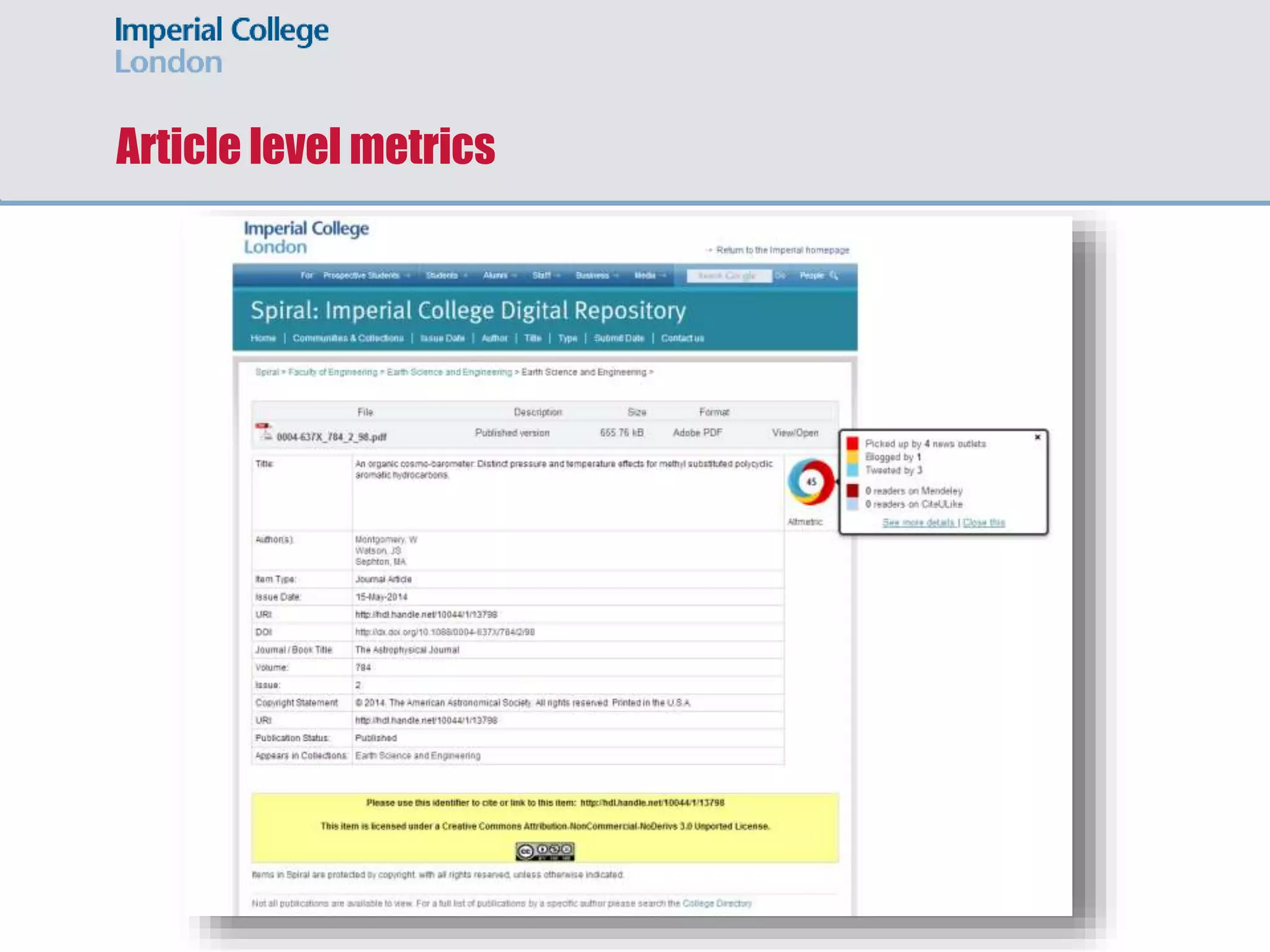
Article level metrics
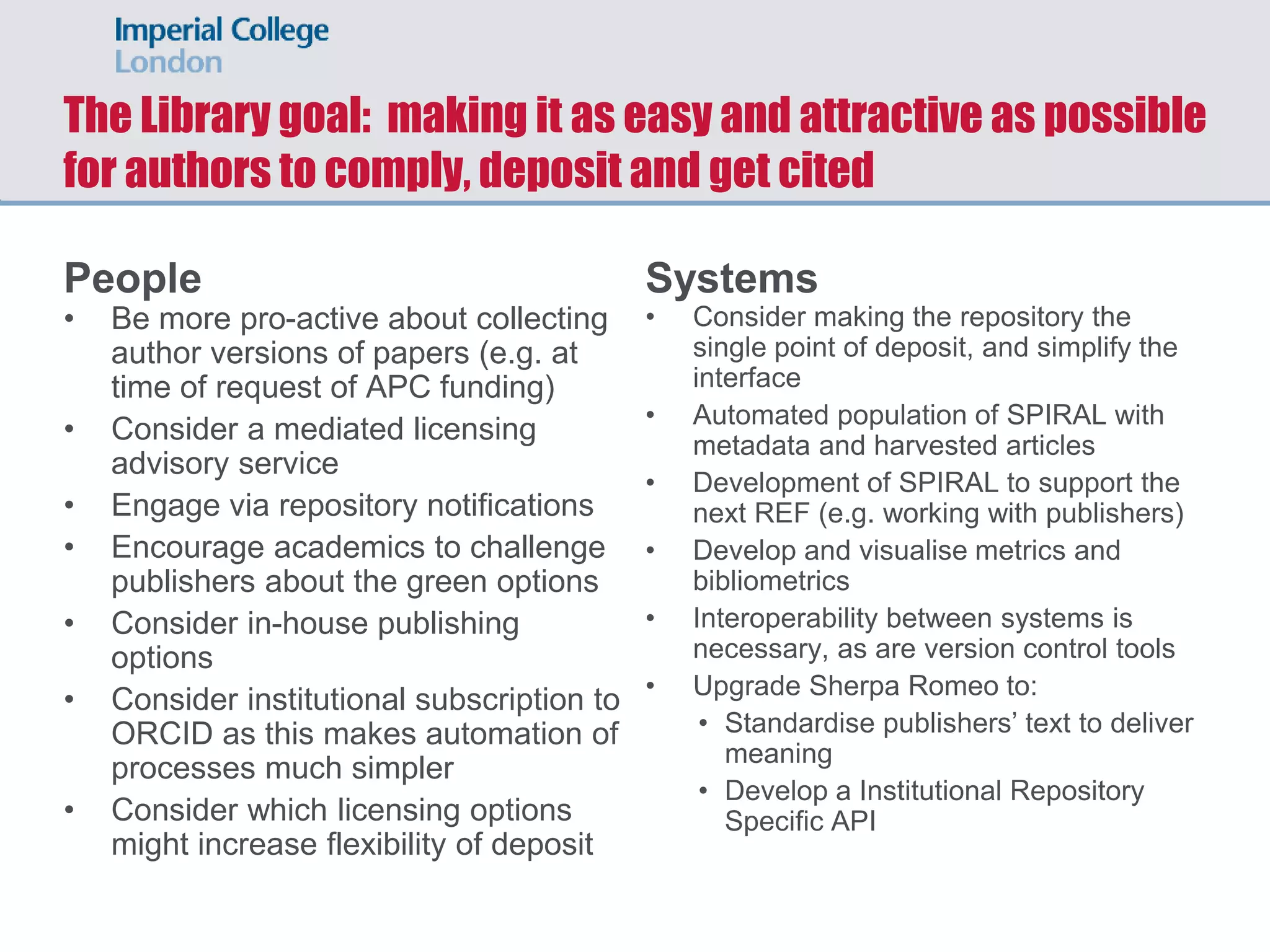
The Library goal: making it as easy and attractive as possible
for authors to comply, deposit and get cited
People
• Be more pro-active about collecting
author versions of papers (e.g. at
time of request of APC funding)
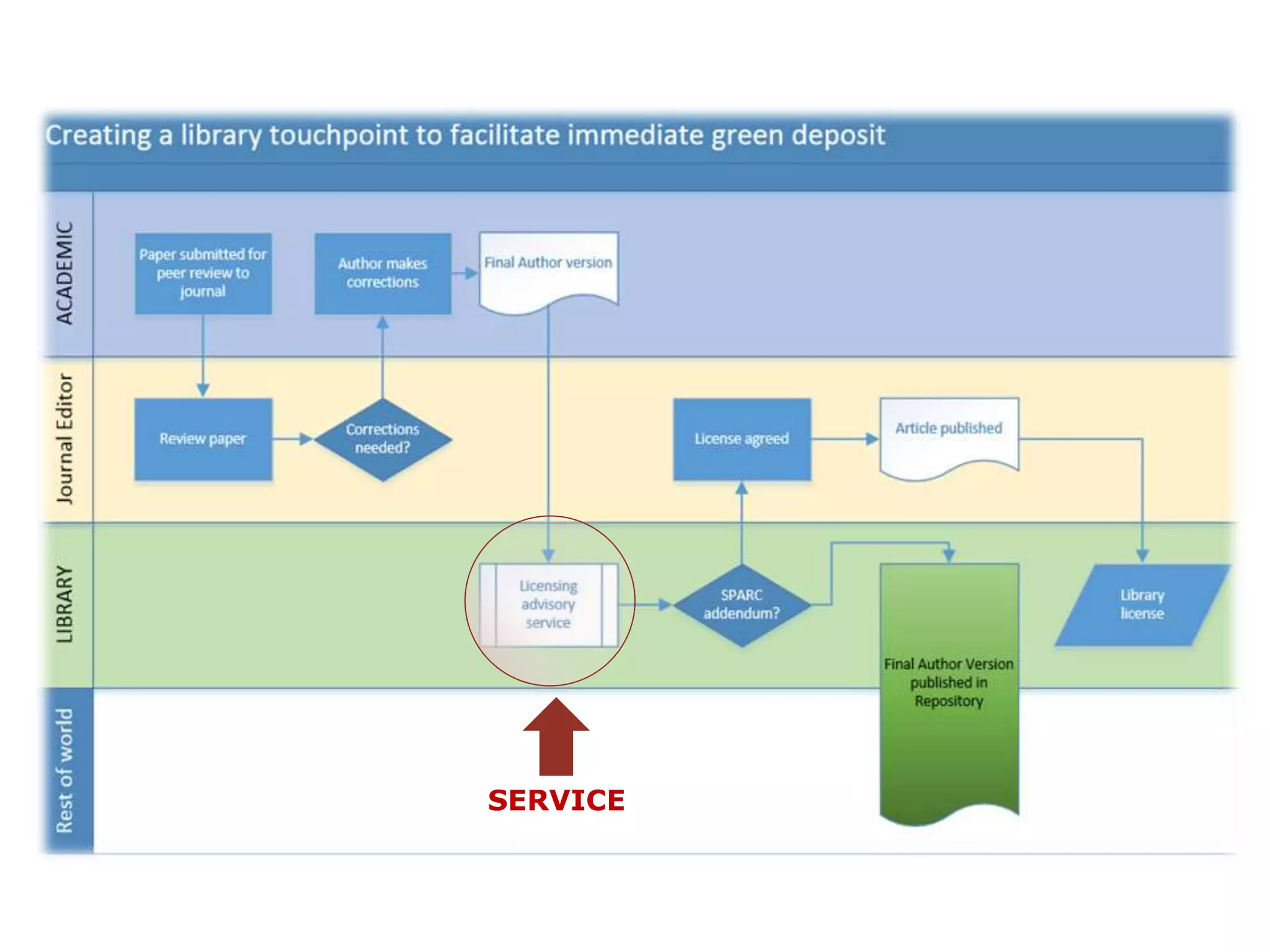
• Consider a mediated licensing
advisory service
• Engage via repository notifications
• Encourage academics to challenge
publishers about the green options
• Consider in-house publishing
options
• Consider institutional subscription to
ORCID as this makes automation of
processes much simpler
• Consider which licensing options
might increase flexibility of deposit
Systems
• Consider making the repository the
single point of deposit, and simplify the
interface
• Automated population of SPIRAL with
metadata and harvested articles
• Development of SPIRAL to support the
next REF (e.g. working with publishers)
• Develop and visualise metrics and
bibliometrics
• Interoperability between systems is
necessary, as are version control tools
• Upgrade Sherpa Romeo to:
• Standardise publishers’ text to deliver
meaning
• Develop a Institutional Repository
Specific API
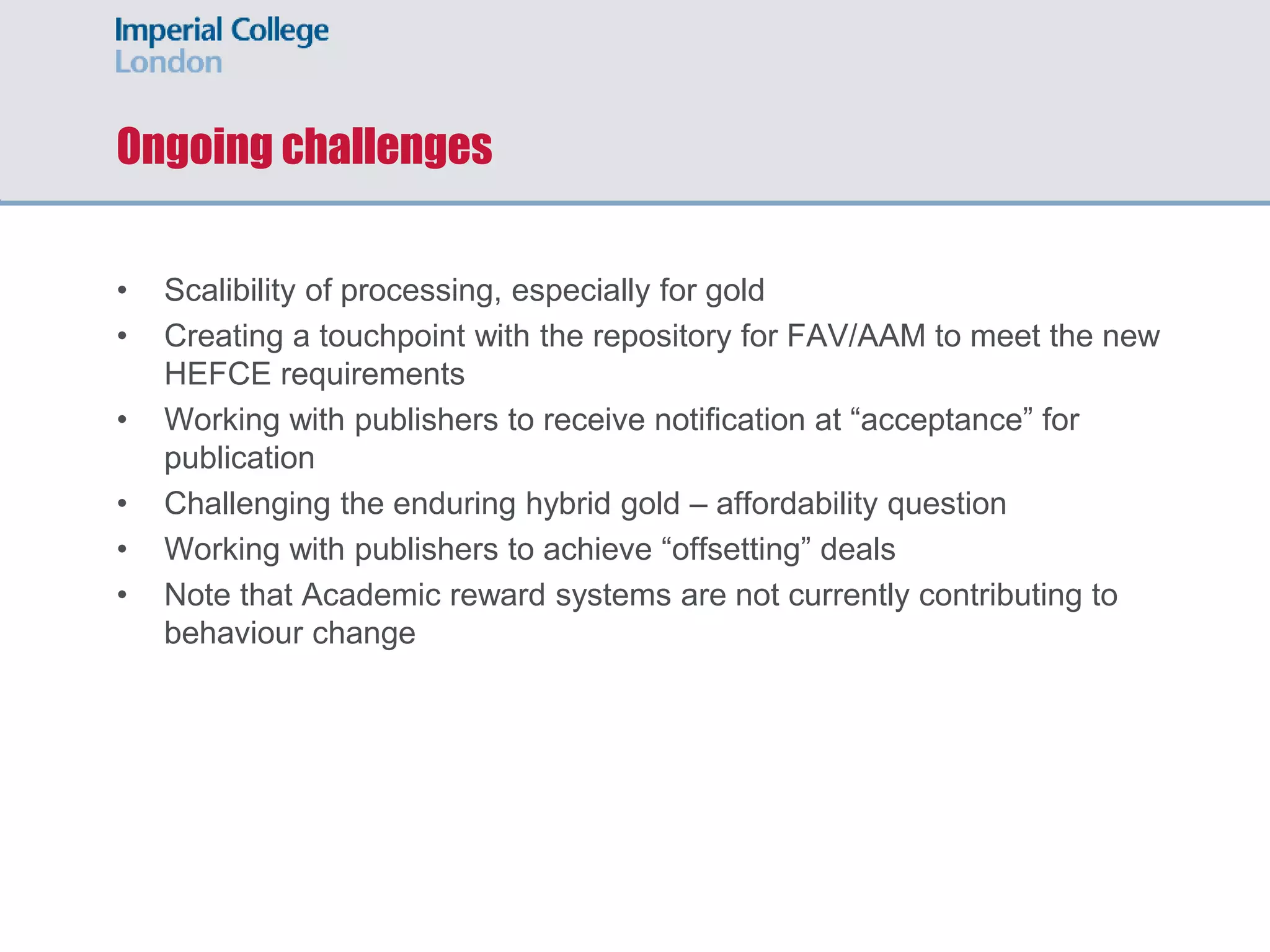
Ongoing challenges
• Scalibility of processing, especially for gold
• Creating a touchpoint with the repository for FAV/AAM to meet the new
HEFCE requirements
• Working with publishers to receive notification at “acceptance” for
publication
• Challenging the enduring hybrid gold – affordability question
• Working with publishers to achieve “offsetting” deals
• Note that Academic reward systems are not currently contributing to
behaviour change
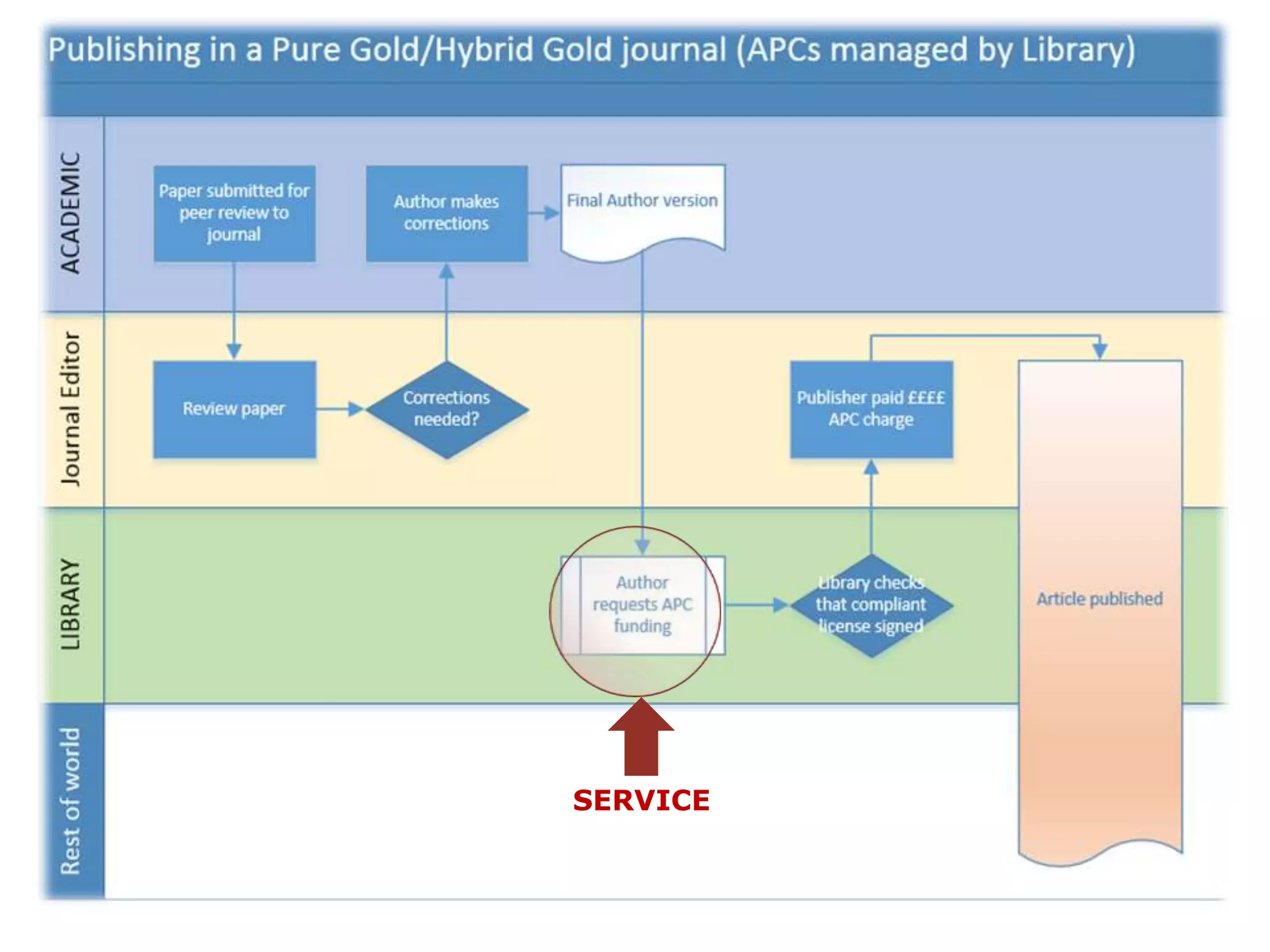
SERVICE
SERVICE
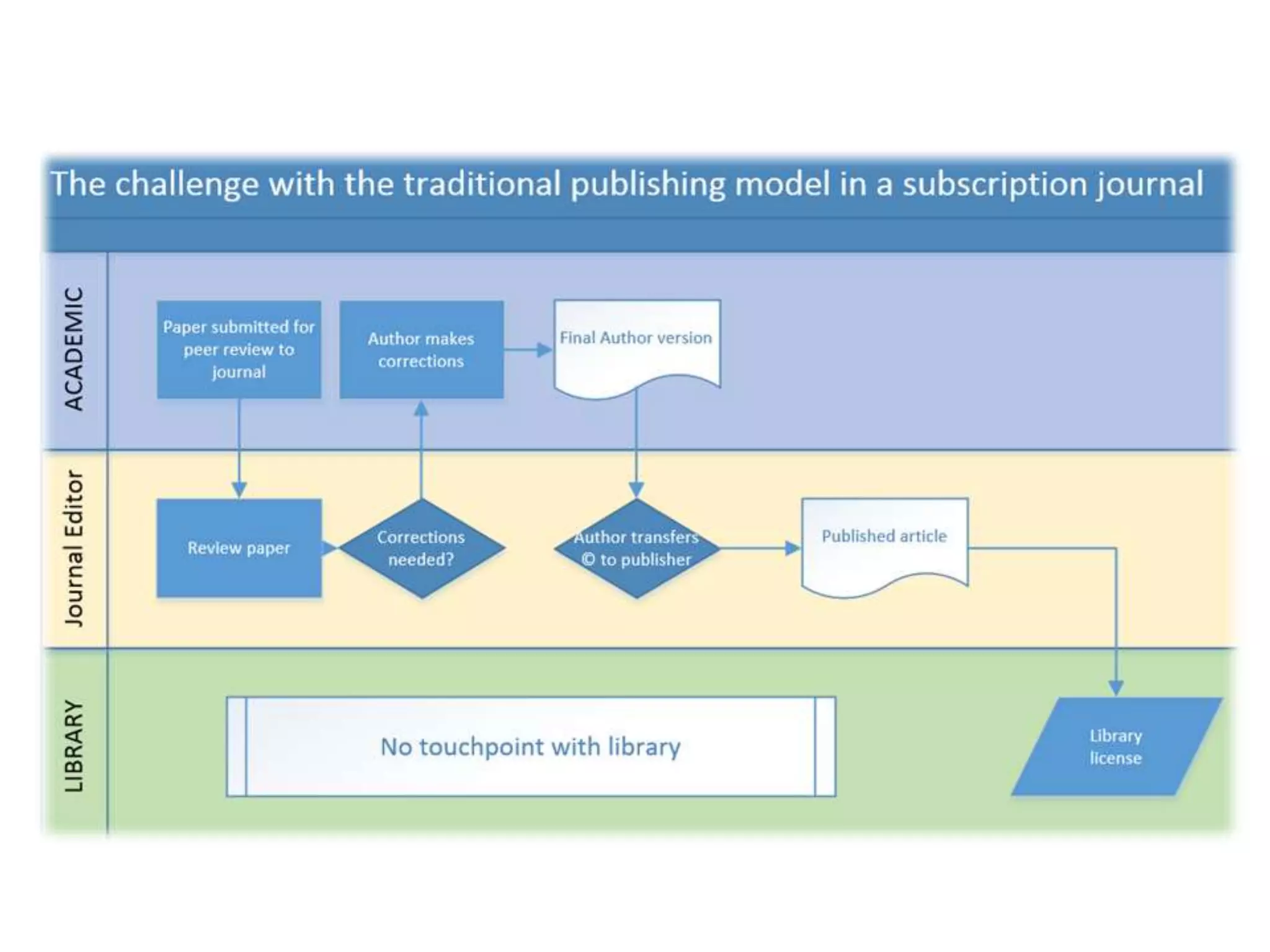
SPARC addendum
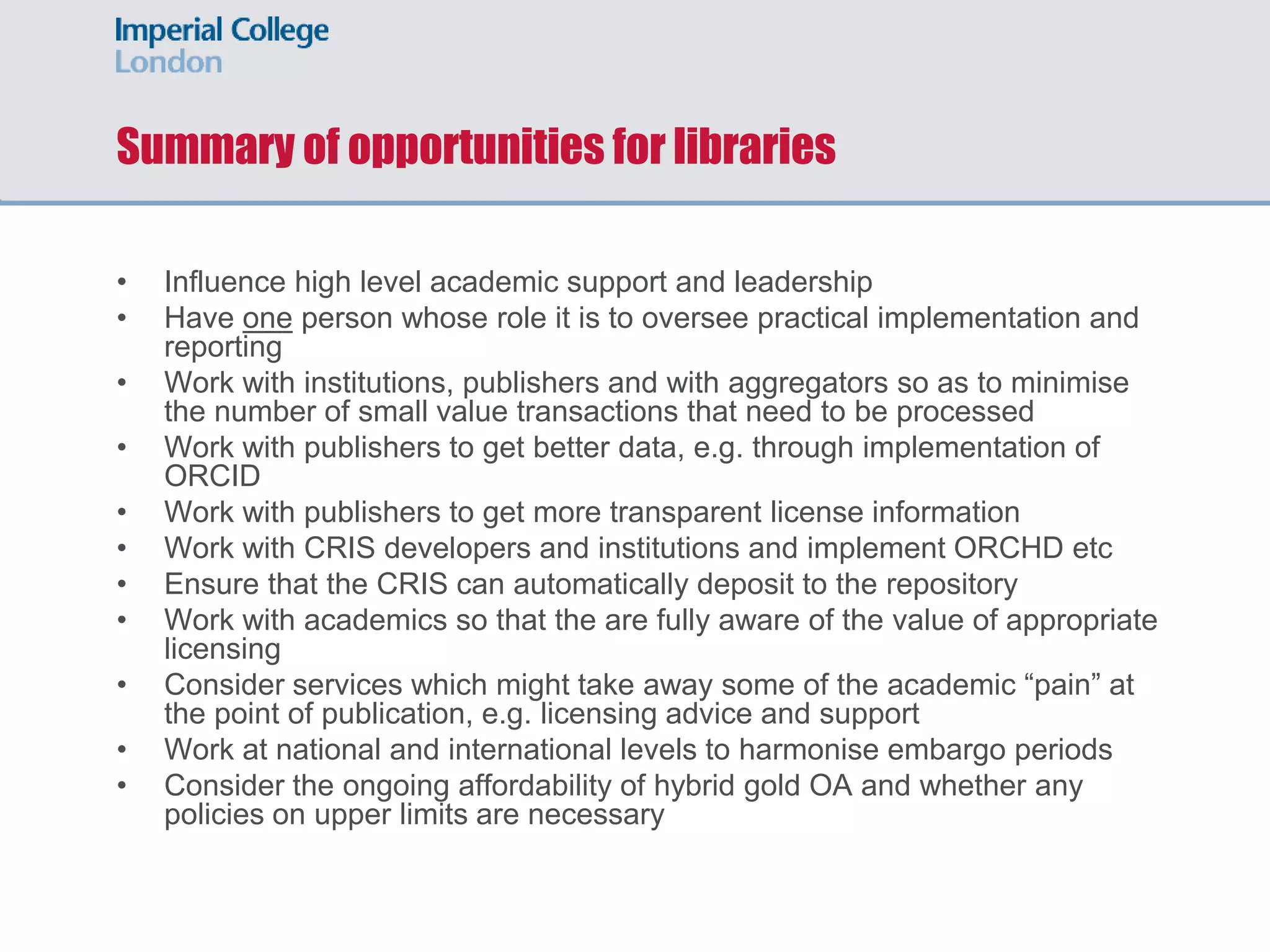
Summary of opportunities for libraries
• Influence high level academic support and leadership
• Have one person whose role it is to oversee practical implementation and
reporting
• Work with institutions, publishers and with aggregators so as to minimise
the number of small value transactions that need to be processed
• Work with publishers to get better data, e.g. through implementation of
ORCID
• Work with publishers to get more transparent license information
• Work with CRIS developers and institutions and implement ORCHD etc
• Ensure that the CRIS can automatically deposit to the repository
• Work with academics so that the are fully aware of the value of appropriate
licensing
• Consider services which might take away some of the academic “pain” at
the point of publication, e.g. licensing advice and support
• Work at national and international levels to harmonise embargo periods
• Consider the ongoing affordability of hybrid gold OA and whether any
policies on upper limits are necessary
Open Access in the UK - challenges of compliance with funder mandates

Open Access in the UK - challenges of compliance with funder mandates

  • 1.
    Whose Property IsIt Anyway? Part 2: the challenges in supporting the UK’s main research funder agendas which seek to ensure that the outputs from publicly funded research are published Open Access Chris Banks @chrisbanks Director of Library Services Imperial College London
  • 2.
  • 3.
    Research Councils UK(RCUK) Policy • From 2005 RCUK sought to encourage open access publishing • Article Processing Charges could be paid from grants - low take up
  • 4.
    Wellcome Trust andOpen Access • From 2007 the Wellcome Trust funded APCs • Also mandated deposit in PubMedCentral • Compliance is currently at 66% and costs the Trust around £4.5m a year • Wellcome are now implementing sanctions for non compliant academics seeking further grants
  • 5.
    Finch Report • 2011:Dame Janet Finch commissioned to lead a group to explore how to accelerate the adoption of Open Access to publicly funded research • Summer 2012 Finch Report Published • Author-pays model was preferred • Publication Fund established to encourage adoption of OA by explicitly funding APCs for immediate CC-BY publication where possible • September 2012: Department for Business, Innovation and Skills (BIS) endorses the report (and allocates £10m pump prime funding) • Autumn 2012 RCUK announces new policy to take effect April 2013. They currently spend around £11.2bn on research funding and have allocated 1% towards Gold Open Access • Institutions awarded funding on the basis of Research Council grant income to support the payment of APCs on journal articles and conference proceedings where RCUK acknowledged as funder • Target 45% compliance in the first year- assumed APC £2000
  • 6.
    HEFCE policy forpost REF2014 • Higher Education Funding Council for England (HEFCE) REF policy published on 31st March 2014 states that for any journal article or conference proceeding accepted for publication in a volume with an ISSN from 1 April 2016 to be eligible for the next REF [REF2020?] the Final Author Version/Accepted Author Manuscript must have been deposited in an institutional or subject repository and made discoverable within three months of acceptance for publication.
  • 7.
    Big numbers: whythe HEFCE policy matters
  • 8.
    HEFCE and RCUKpolicies seen together • From 2016, for a Journal/Conference proceeding publication to be eligible for submission to the next REF it must meet the following minimum criteria: • Have a discoverable metadata record in a repository within 3 months of acceptance for publication • Have a closed deposit FAV/AAM in the repository within 3 months of acceptance for publication • BUT if the research was funded by RCUK/Wellcome/Horizon2020 then the following criteria must also be met: • Be available as an Open Access publication (either Gold or Green). • If Gold: immediately upon publication, and with the relevant license (e.g. CC-BY) • If Green: be open access within the embargo period set by the funder
  • 9.
    The challenges ofcompliance Author action RCUK / Wellcome compliant? HEFCE REF compliant? Additional REF credits? APC paid for Gold OA?    Repository deposit with Green embargo    Immediate Deposit/Optional Access   ? Immediate deposit / Immediate Access / SPARC (or similar) Author Addendum to Publication Agreement    It can be all too easy for academics to comply with one policy and fail to comply with others
  • 10.
  • 11.
    • Senior academicleadership is essential to effect behavioural change • High level committees drawn from Research VP, Research Office, Policy, Strategy, Library, ICT + relevant academic representation • Advocacy, Advocacy, Advocacy – the message is still not widely understood • Challenges with multiple policies which are not wholly aligned, particularly cross-border policies
  • 12.
    Imperial College 2012mandate http://www3.imperial.ac.uk/library/subjectsandsupport/spiral/oamandate
  • 13.
  • 14.
    Responses vary bydiscipline • Sciences & Medicine likely most engaged • Engineering and Maths less so • Arts, Humanities and Social Sciences – even less so Individual responses • On a spectrum between passionately engaged and unaware/disinterested • Still rewarded by publication in high impact journals, so minimal motivation to change behaviours • Like the elitism of publishing in high impact journals • Beleaguered: yet more constraints, more reporting requirements, perceived less time for research • But: want to be eligible for submission to the REF
  • 15.
  • 16.
    • Currently UKpays around £163m in subscriptions • In the UK around 140,000 articles are published per year. • If all opted for gold then funding required would be £245m • Some publishers seeing hybrid gold OA as an additional income stream
  • 17.
    • RCUK fundingis “transitional” but some evidence suggests publishers are welcoming a growth in hybrid gold • Challenge with license applications: correct funder-compliant license not always applied • “Pure Gold” does not necessarily mean low impact factor (e.g. PLoS) • New government-led research into monograph publishing • New publishing business models are emerging • Some quality monograph publishers actively engaging in OA schemes (e.g. Knowledge Unlatched)
  • 18.
  • 19.
    Library Activity • Contributingto the work of institutional implementation groups • Awareness raising amongst library colleagues, academics and students • Working with other departments, including ICT and Research Office, on the requirements for management of the process • Maintenance of web pages, FAQs and links • Running the service to manage the payment of Article Processing Charges (and learning from that process)
  • 20.
    Open Access Fundsmanaged at Imperial 2013-14 • Wellcome • RCUK fund: £1,150,458 • Imperial College Fund: £650,000
  • 21.
    Library involvement inOA at Imperial College Gold • Management and allocation of the publication funds • Supporting academics to ensure funder compliance • Record keeping and reporting • Working with colleagues on workflows and systems to manage many transactions • Checking whether the publisher has published OA and attached correct license Green • Support for self-archiving in the institutional repository • Repository developments to ensure metadata is discoverable • Metrics (downloads, altmetrics, etc) • “request” button for closed deposits
  • 22.
    Open Access workflow(without HEFCE . . .):
  • 23.
  • 24.
  • 25.
  • 26.
    The Library goal:making it as easy and attractive as possible for authors to comply, deposit and get cited People • Be more pro-active about collecting author versions of papers (e.g. at time of request of APC funding) • Consider a mediated licensing advisory service • Engage via repository notifications • Encourage academics to challenge publishers about the green options • Consider in-house publishing options • Consider institutional subscription to ORCID as this makes automation of processes much simpler • Consider which licensing options might increase flexibility of deposit Systems • Consider making the repository the single point of deposit, and simplify the interface • Automated population of SPIRAL with metadata and harvested articles • Development of SPIRAL to support the next REF (e.g. working with publishers) • Develop and visualise metrics and bibliometrics • Interoperability between systems is necessary, as are version control tools • Upgrade Sherpa Romeo to: • Standardise publishers’ text to deliver meaning • Develop a Institutional Repository Specific API
  • 27.
    Ongoing challenges • Scalibilityof processing, especially for gold • Creating a touchpoint with the repository for FAV/AAM to meet the new HEFCE requirements • Working with publishers to receive notification at “acceptance” for publication • Challenging the enduring hybrid gold – affordability question • Working with publishers to achieve “offsetting” deals • Note that Academic reward systems are not currently contributing to behaviour change
  • 29.
  • 30.
  • 31.
  • 32.
    Summary of opportunitiesfor libraries • Influence high level academic support and leadership • Have one person whose role it is to oversee practical implementation and reporting • Work with institutions, publishers and with aggregators so as to minimise the number of small value transactions that need to be processed • Work with publishers to get better data, e.g. through implementation of ORCID • Work with publishers to get more transparent license information • Work with CRIS developers and institutions and implement ORCHD etc • Ensure that the CRIS can automatically deposit to the repository • Work with academics so that the are fully aware of the value of appropriate licensing • Consider services which might take away some of the academic “pain” at the point of publication, e.g. licensing advice and support • Work at national and international levels to harmonise embargo periods • Consider the ongoing affordability of hybrid gold OA and whether any policies on upper limits are necessary