SN22: Introduction to Open Access Publishing for Research Administrators and Managers
SN22: Introduction to Open Access Publishing for Research Administrators and Managers  Matthew Cockerill, Publisher, BioMed Central Neil Thakur, Special Assistant to the Deputy Director for Extramural Research, NIH Heather Joseph, Executive Director, SPARC   Ian Carter, Chair, Association of Research Managers and Administrators
A brief introduction to  Open Access Matthew Cockerill Publisher, BioMed Central
Why is Open Access important?
The internet makes it possible to share research results universally In an online environment, nearly all publishing costs are ‘first copy’ costs Cost of distribution is negligible Researchers want to share their research as widely as possible Eliminating access barriers is a natural way to achieve this
Two paths  towards Open Access Gold OA   Publishing in an open access journal   Fully OA journals e.g. BioMed Central, Public Library of Science  etc Optional OA in traditional journals (now offered by many major publishers) Green OA   Depositing articles in an OA repository Subject repositories PubMed Central UK PubMed Central ArXiV Institutional repositories DSpace Eprints Fedora Open Repository
The two forms of open access are complementary Deposit of  embargoed   manuscript  versions is a useful stepping stone Open access publishing  ensures  official  final version can be deposited  immediately addresses concern that OA deposit will lead to subscription cancellations / undermine peer review Funders are  requiring  OA archiving, and  taking active steps to  encourage  and facilitate OA publishing
How do the traditional and Open Access publishing models compare?
Traditional research publishing The research community transfers the rights to the research The publisher resells access rights to cover costs
Open Access research publishing The publisher is paid for the service of publication There are no barriers to access
Definition of Open Access (Bethesda Statement, 2003) Freely available via the internet Licensed to allow redistribution and reuse  Permanently archived in multiple international repositories
Benefits of OA for authors Maximizes potential readership  Articles are widely accessible via aggregators, indexing services, search engines  etc. Breaks down barriers between fields Promotes public understanding of scientific and medical research Allow literature and data to be mined
Open Access has grown rapidly to become part of the mainstream
Growth of OA publishing in BioMed Central’s journals
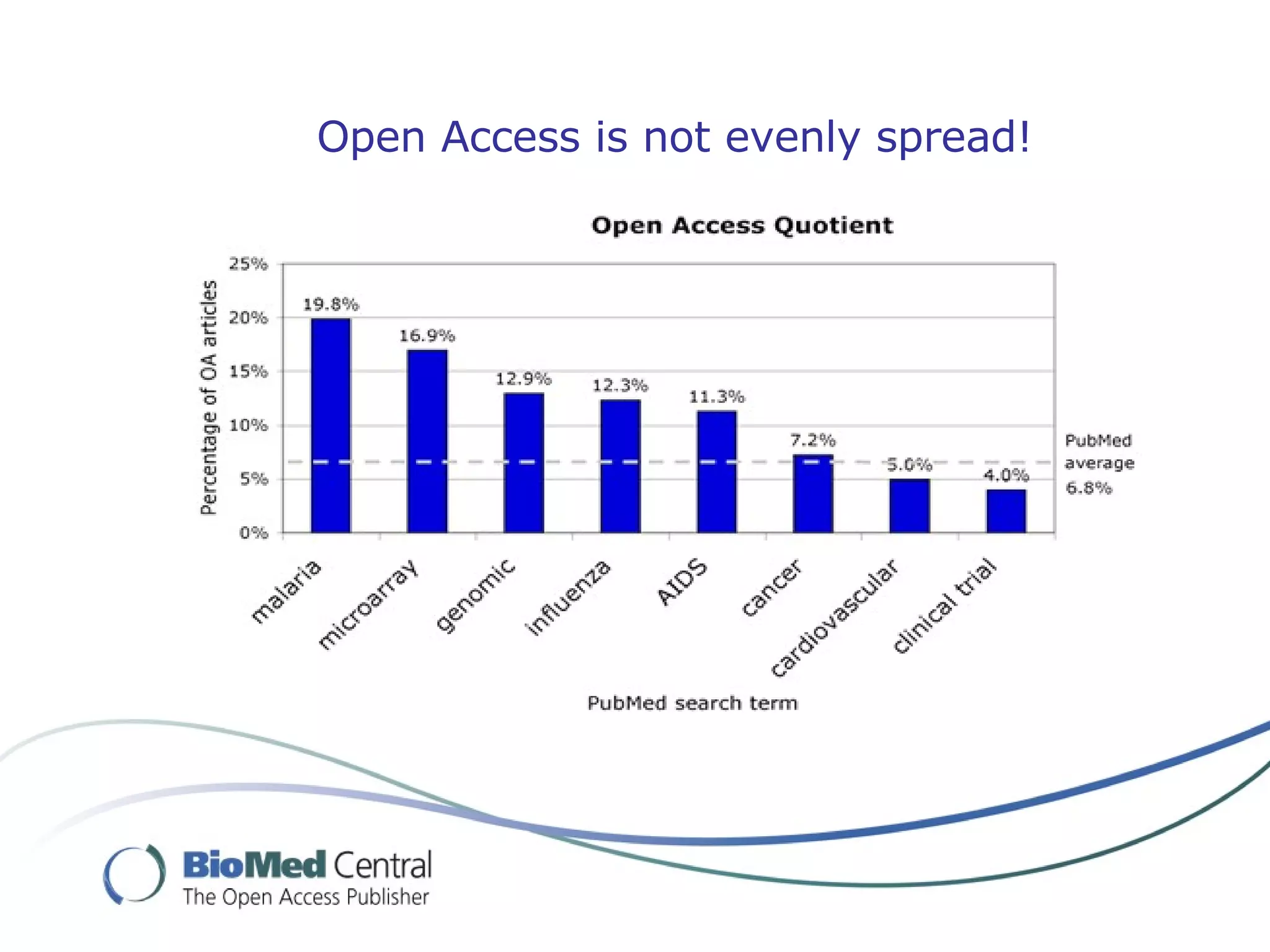
Open Access is not evenly spread!
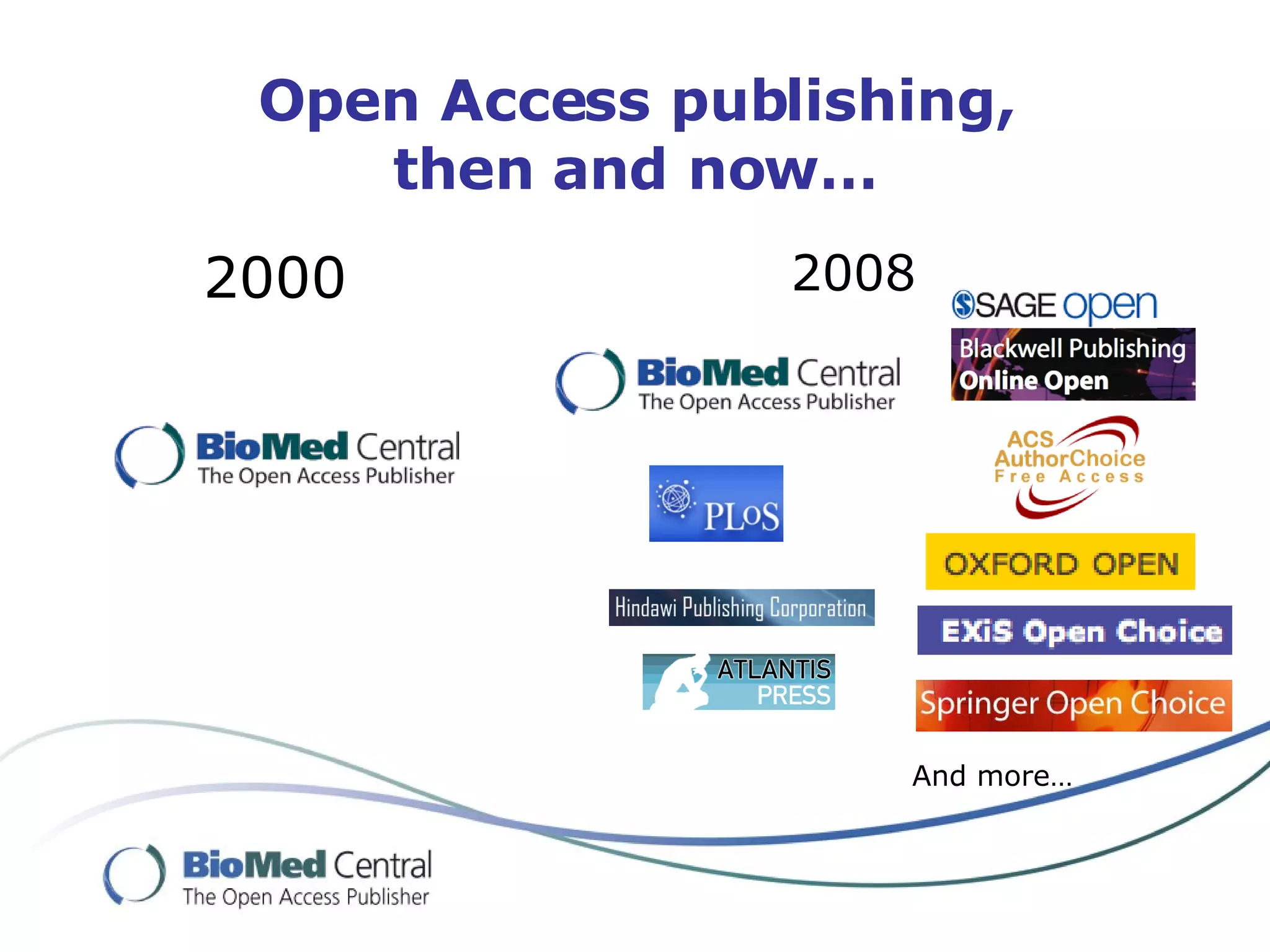
Open Access publishing, then and now… 2008 2000 And more…
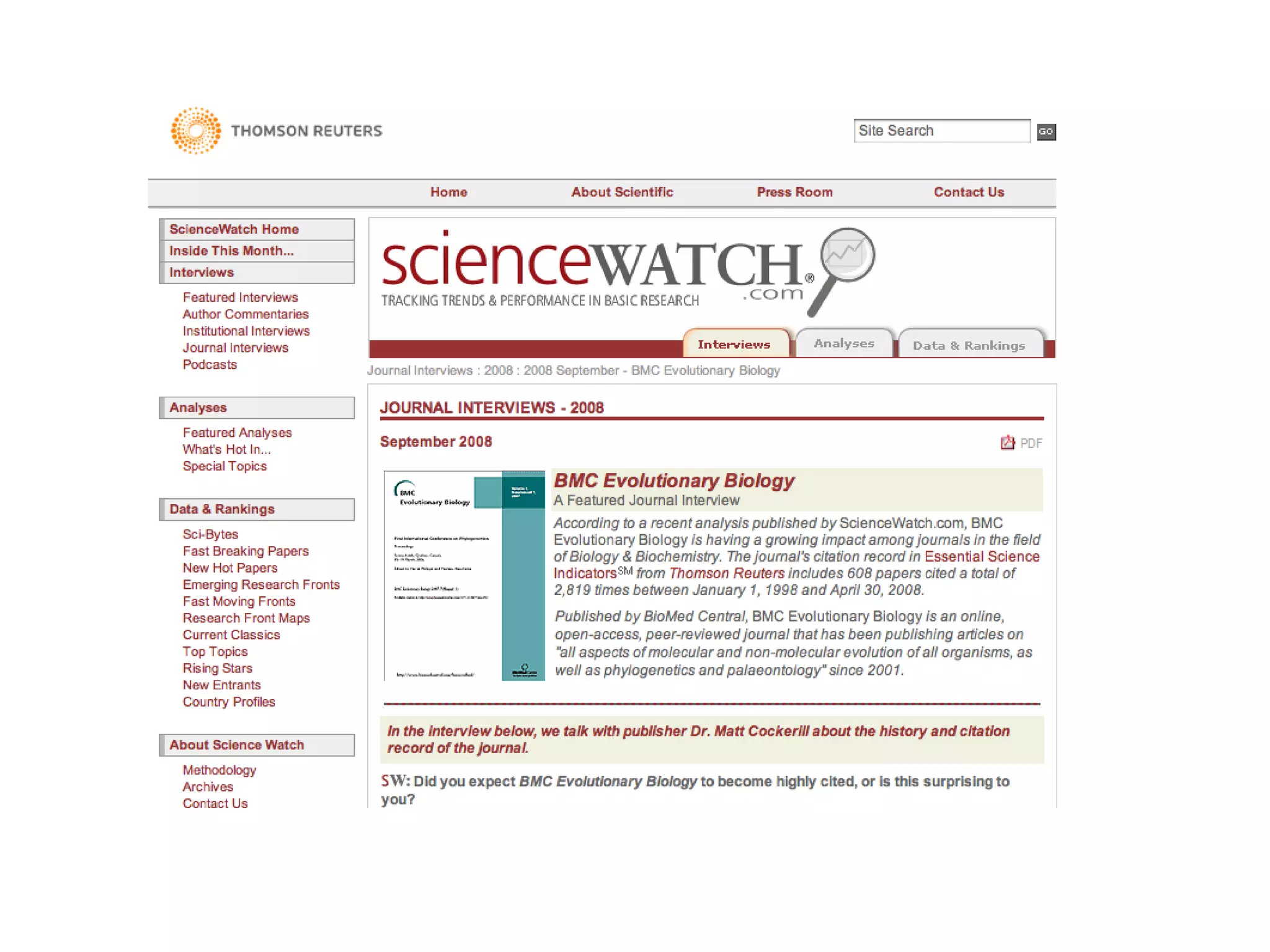
Open Access journals have already established excellent reputations
 
 
OA Publication Fees
What do OA publication fees cover? Open access publishing is not without costs Publication fees need to cover costs Editorial Technical Production Customer services Marketing ( e.g.  conference attendance)
Typical OA publication fees BioMed Central  $1700 Public Library of Science  $2100 Company of Biologists  $3100 Oxford University Press  $2700 Royal Society $3000 Springer $3000 Taylor & Francis $3250 Wiley $3000
Who pays OA publication fees? Authors may pay out of grant funds Some funders provide dedicated funds for open access publishing costs Institutions may cover costs centrally (via open access funds and/or membership arrangements with OA publishers) Some journals are run by organizations which cover costs themselves
Does Open Access offer good value compared to traditional publishing?
Oxford University Press data http://www. oxfordjournals .org/news/ oa _workshop.html   Nucleic Acids Research  received $3000-$4000 of subscription revenue per article published Comparable to the amount charged by traditional publishers for their OA options OA publishers like BMC charge substantially less OA publication fees make costs much more transparent, and authors can choose between alternative options This guards against over-pricing I. Cost per article published
II. Cost per article download Studies have shown that open access, unsurprisingly, leads to a significantly increased number of downloads compared to the traditional model This helps make open access a  much more cost-effective way to disseminate research results
Funder policies on Open Access
NIH Public Access Policy
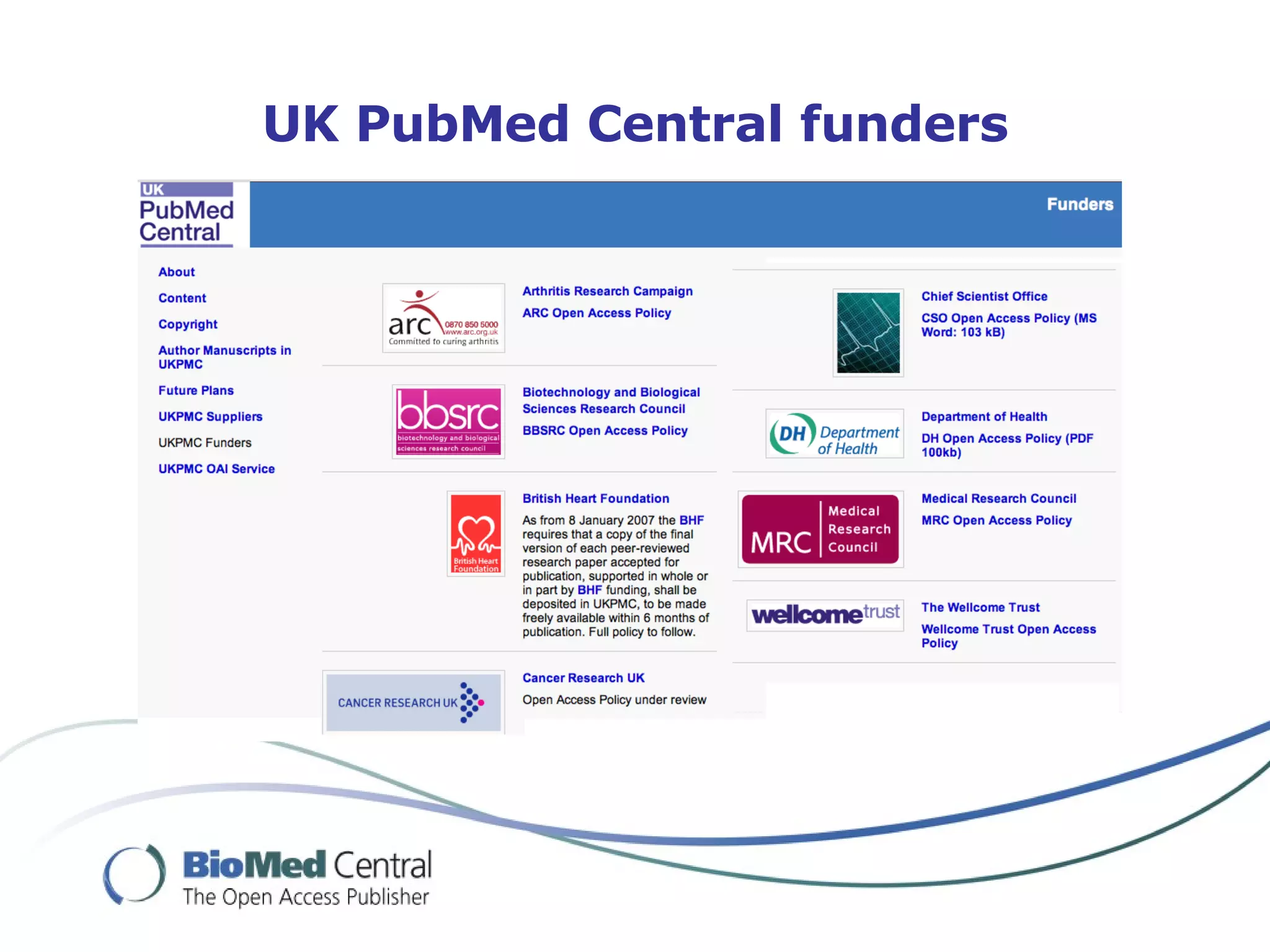
UK PubMed Central funders
HHMI Policy
 
Funders have a key role in the transition to open access A fully Open Access publication system is no more expensive than the traditional model But libraries can’t easily free up their budgets  Funders are breaking this stalemate In biomedical research areas, the cost of publication is estimated to be only around 1% of the cost of carrying out the research A tiny fraction of the indirect research costs from funders can cover the full cost of sharing the results of that work
Progress towards open access needs coordinated action Research Funders Research Administrators Librarians Faculty
Centrally managed funds for Open Access publication charges
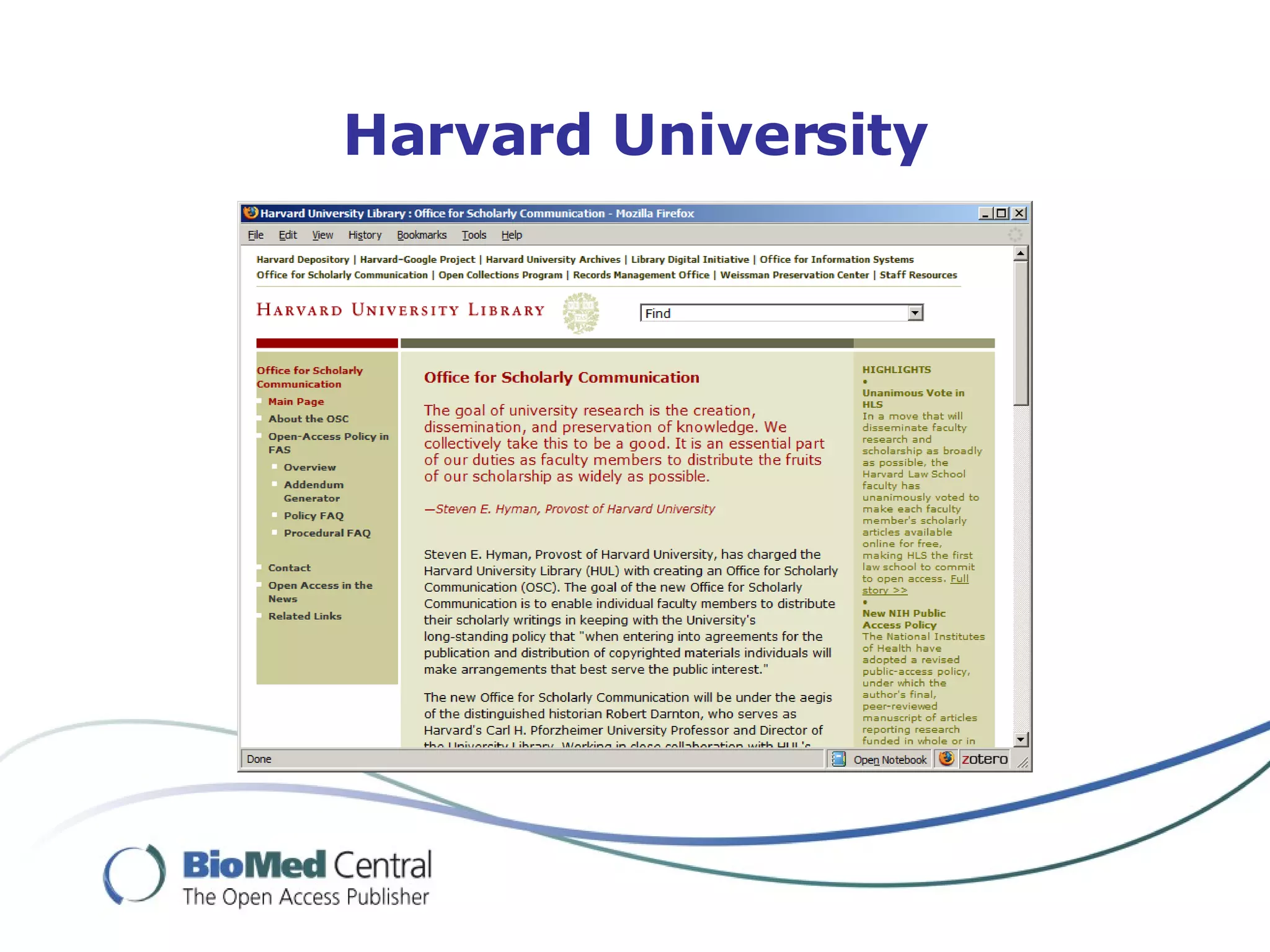
Harvard University
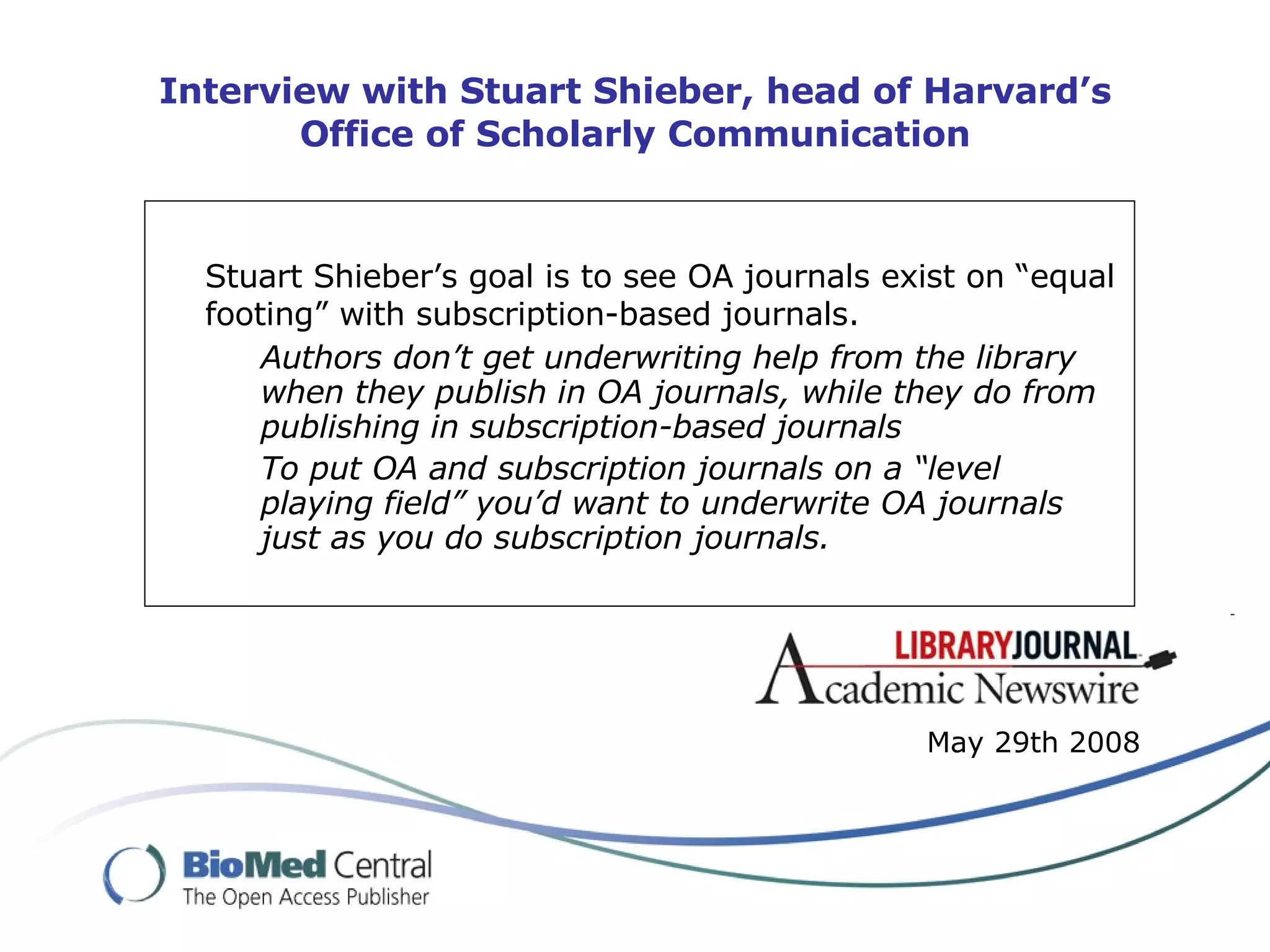
Interview with Stuart Shieber, head of Harvard’s Office of Scholarly Communication Stuart Shieber’s goal is to see OA journals exist on “equal footing” with subscription-based journals.   Authors don’t get underwriting help from the library when they publish in OA journals, while they do from publishing in subscription-based journals To put OA and subscription journals on a “level playing field” you’d want to underwrite OA journals just as you do subscription journals. May 29th 2008
BioMed Central membership Prepay membership Institution pays funds into a deposit account Article Processing Charge is covered by funds from account Discount depending on deposit amount Author does not have to pay Simplified administration/reporting Supporter membership Institutions pay a flat fee Authors pay a discounted Article Processing Charge
160+ Prepay Members
160+ Supporter Members

Sra Oa Bmc

  • 1.
    SN22: Introduction toOpen Access Publishing for Research Administrators and Managers
  • 2.
    SN22: Introduction toOpen Access Publishing for Research Administrators and Managers Matthew Cockerill, Publisher, BioMed Central Neil Thakur, Special Assistant to the Deputy Director for Extramural Research, NIH Heather Joseph, Executive Director, SPARC Ian Carter, Chair, Association of Research Managers and Administrators
  • 3.
    A brief introductionto Open Access Matthew Cockerill Publisher, BioMed Central
  • 4.
    Why is OpenAccess important?
  • 5.
    The internet makesit possible to share research results universally In an online environment, nearly all publishing costs are ‘first copy’ costs Cost of distribution is negligible Researchers want to share their research as widely as possible Eliminating access barriers is a natural way to achieve this
  • 6.
    Two paths towards Open Access Gold OA Publishing in an open access journal Fully OA journals e.g. BioMed Central, Public Library of Science etc Optional OA in traditional journals (now offered by many major publishers) Green OA Depositing articles in an OA repository Subject repositories PubMed Central UK PubMed Central ArXiV Institutional repositories DSpace Eprints Fedora Open Repository
  • 7.
    The two formsof open access are complementary Deposit of embargoed manuscript versions is a useful stepping stone Open access publishing ensures official final version can be deposited immediately addresses concern that OA deposit will lead to subscription cancellations / undermine peer review Funders are requiring OA archiving, and taking active steps to encourage and facilitate OA publishing
  • 8.
    How do thetraditional and Open Access publishing models compare?
  • 9.
    Traditional research publishingThe research community transfers the rights to the research The publisher resells access rights to cover costs
  • 10.
    Open Access researchpublishing The publisher is paid for the service of publication There are no barriers to access
  • 11.
    Definition of OpenAccess (Bethesda Statement, 2003) Freely available via the internet Licensed to allow redistribution and reuse Permanently archived in multiple international repositories
  • 12.
    Benefits of OAfor authors Maximizes potential readership Articles are widely accessible via aggregators, indexing services, search engines etc. Breaks down barriers between fields Promotes public understanding of scientific and medical research Allow literature and data to be mined
  • 13.
    Open Access hasgrown rapidly to become part of the mainstream
  • 14.
    Growth of OApublishing in BioMed Central’s journals
  • 15.
    Open Access isnot evenly spread!
  • 16.
    Open Access publishing,then and now… 2008 2000 And more…
  • 17.
    Open Access journalshave already established excellent reputations
  • 18.
  • 19.
  • 20.
  • 21.
    What do OApublication fees cover? Open access publishing is not without costs Publication fees need to cover costs Editorial Technical Production Customer services Marketing ( e.g. conference attendance)
  • 22.
    Typical OA publicationfees BioMed Central $1700 Public Library of Science $2100 Company of Biologists $3100 Oxford University Press $2700 Royal Society $3000 Springer $3000 Taylor & Francis $3250 Wiley $3000
  • 23.
    Who pays OApublication fees? Authors may pay out of grant funds Some funders provide dedicated funds for open access publishing costs Institutions may cover costs centrally (via open access funds and/or membership arrangements with OA publishers) Some journals are run by organizations which cover costs themselves
  • 24.
    Does Open Accessoffer good value compared to traditional publishing?
  • 25.
    Oxford University Pressdata http://www. oxfordjournals .org/news/ oa _workshop.html Nucleic Acids Research received $3000-$4000 of subscription revenue per article published Comparable to the amount charged by traditional publishers for their OA options OA publishers like BMC charge substantially less OA publication fees make costs much more transparent, and authors can choose between alternative options This guards against over-pricing I. Cost per article published
  • 26.
    II. Cost perarticle download Studies have shown that open access, unsurprisingly, leads to a significantly increased number of downloads compared to the traditional model This helps make open access a much more cost-effective way to disseminate research results
  • 27.
    Funder policies onOpen Access
  • 28.
  • 29.
  • 30.
  • 31.
  • 32.
    Funders have akey role in the transition to open access A fully Open Access publication system is no more expensive than the traditional model But libraries can’t easily free up their budgets Funders are breaking this stalemate In biomedical research areas, the cost of publication is estimated to be only around 1% of the cost of carrying out the research A tiny fraction of the indirect research costs from funders can cover the full cost of sharing the results of that work
  • 33.
    Progress towards openaccess needs coordinated action Research Funders Research Administrators Librarians Faculty
  • 34.
    Centrally managed fundsfor Open Access publication charges
  • 35.
  • 36.
    Interview with StuartShieber, head of Harvard’s Office of Scholarly Communication Stuart Shieber’s goal is to see OA journals exist on “equal footing” with subscription-based journals. Authors don’t get underwriting help from the library when they publish in OA journals, while they do from publishing in subscription-based journals To put OA and subscription journals on a “level playing field” you’d want to underwrite OA journals just as you do subscription journals. May 29th 2008
  • 37.
    BioMed Central membershipPrepay membership Institution pays funds into a deposit account Article Processing Charge is covered by funds from account Discount depending on deposit amount Author does not have to pay Simplified administration/reporting Supporter membership Institutions pay a flat fee Authors pay a discounted Article Processing Charge
  • 38.
  • 39.