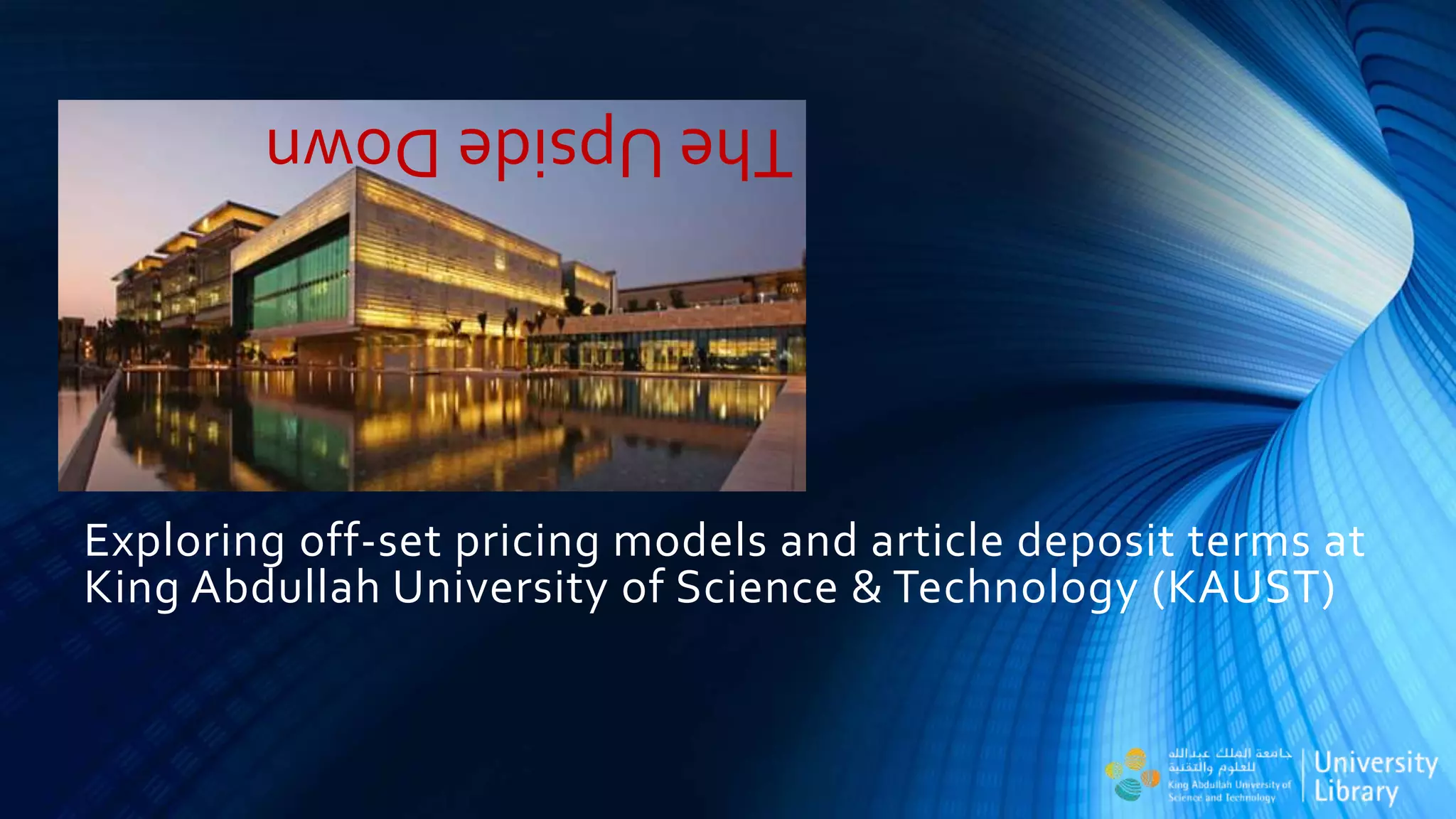
Exploring off-set pricing models and article deposit terms at
King Abdullah University of Science & Technology (KAUST)
TheUpsideDown
at KAUST
• What is KAUST?
• An overview of offset pricing models
• An offset model in detail (IOP)
• An attempt to get OA terms into our vendor licenses
• The OA roadmap
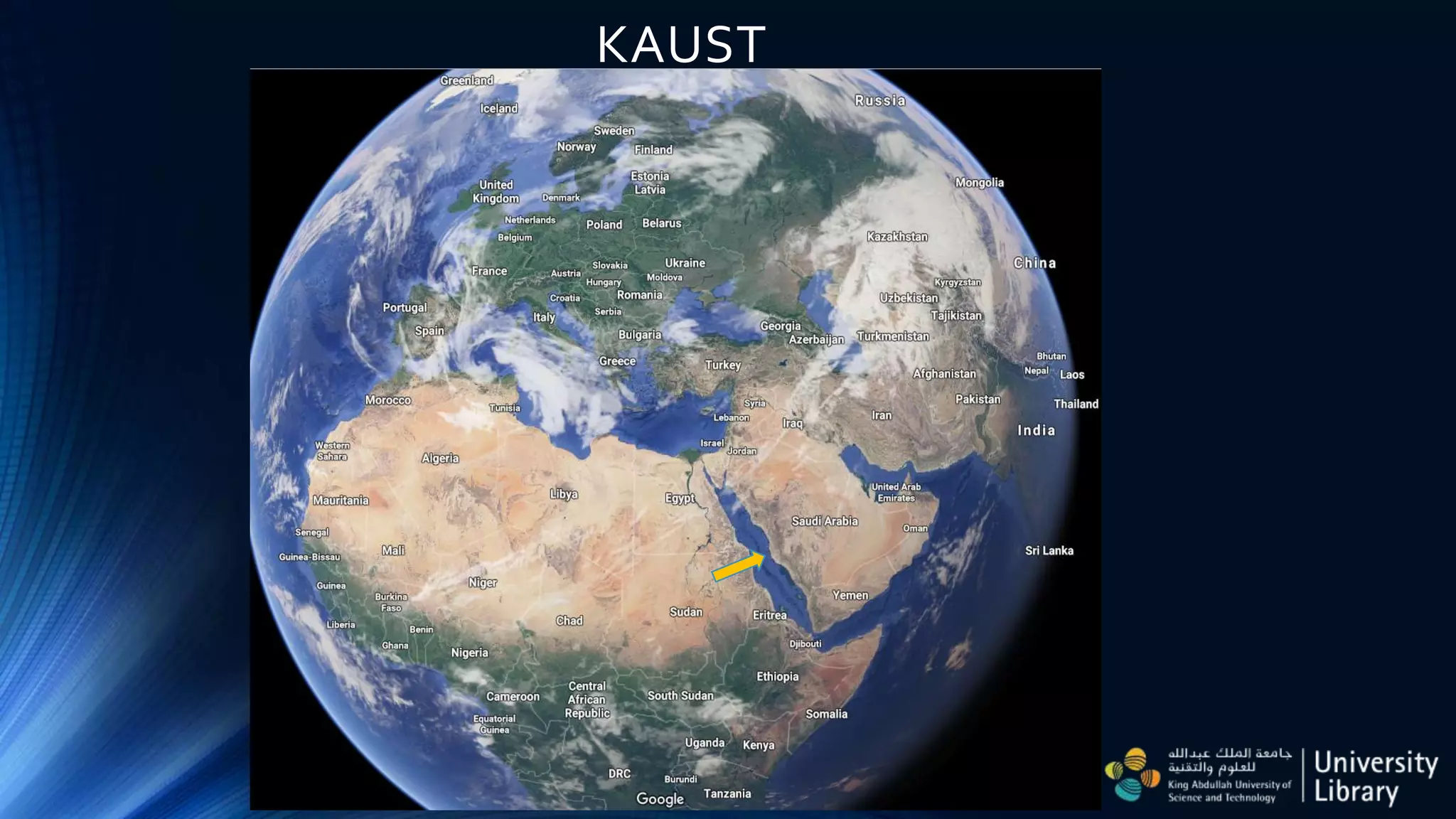
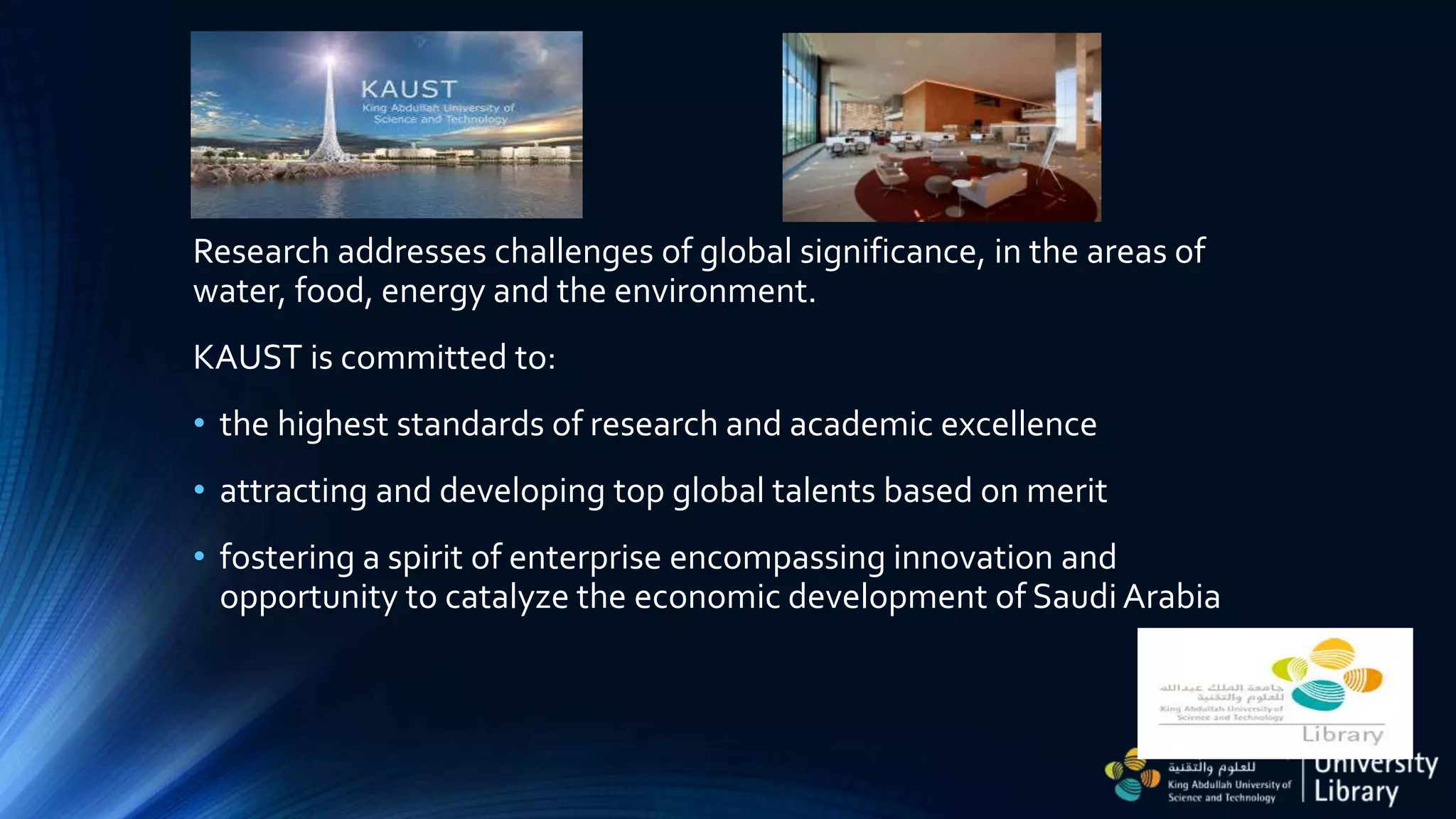
KAUST
International graduate research university dedicated to advancing
science and technology through:
• interdisciplinary research
• education
• innovation
KAUST seeks to advance scientific research and collaboration,
transcending disciplines and boundaries for the benefit of science.
Research addresses challenges of global significance, in the areas of
water, food, energy and the environment.
KAUST is committed to:
• the highest standards of research and academic excellence
• attracting and developing top global talents based on merit
• fostering a spirit of enterprise encompassing innovation and
opportunity to catalyze the economic development of Saudi Arabia
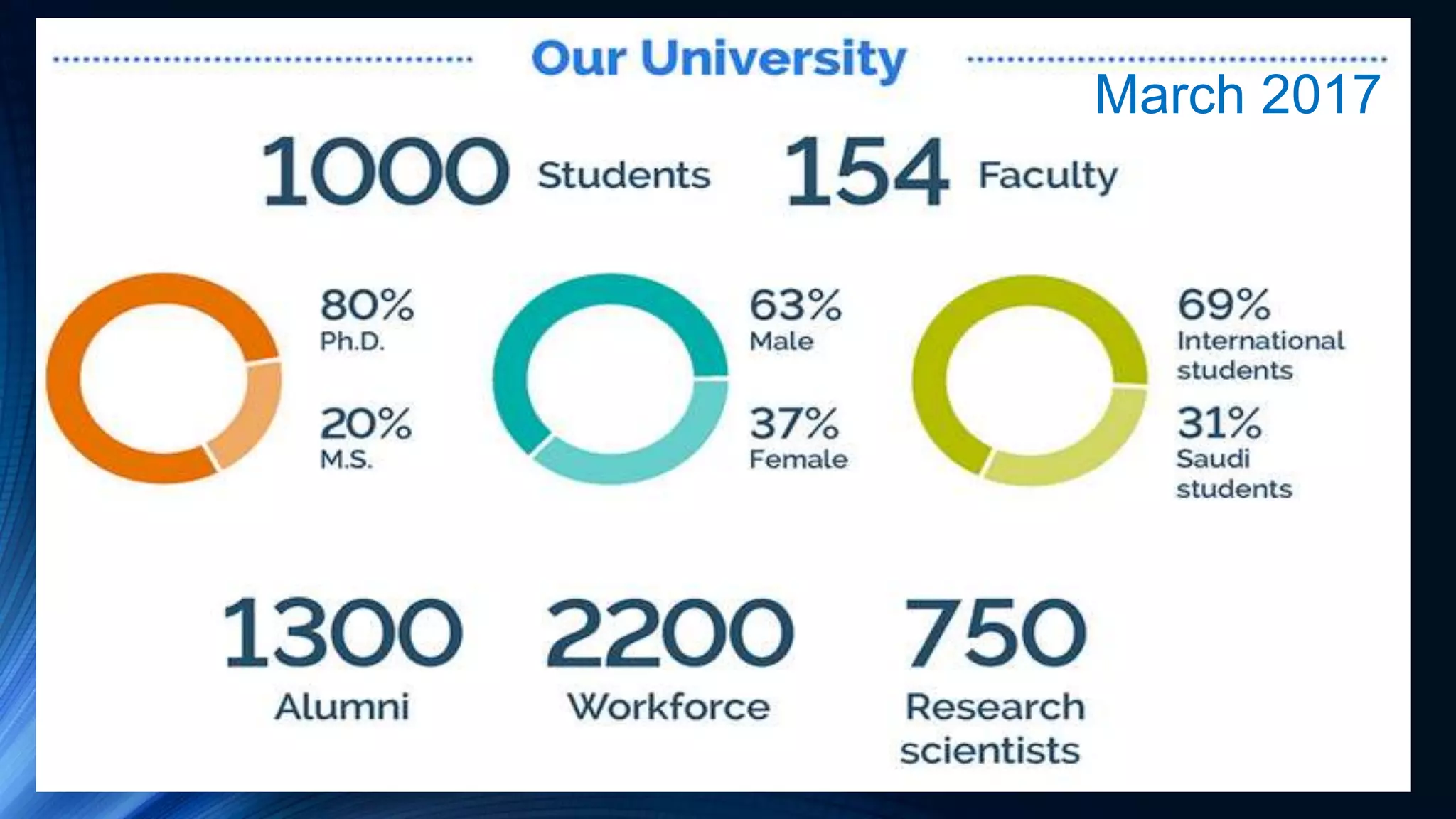
March 2017
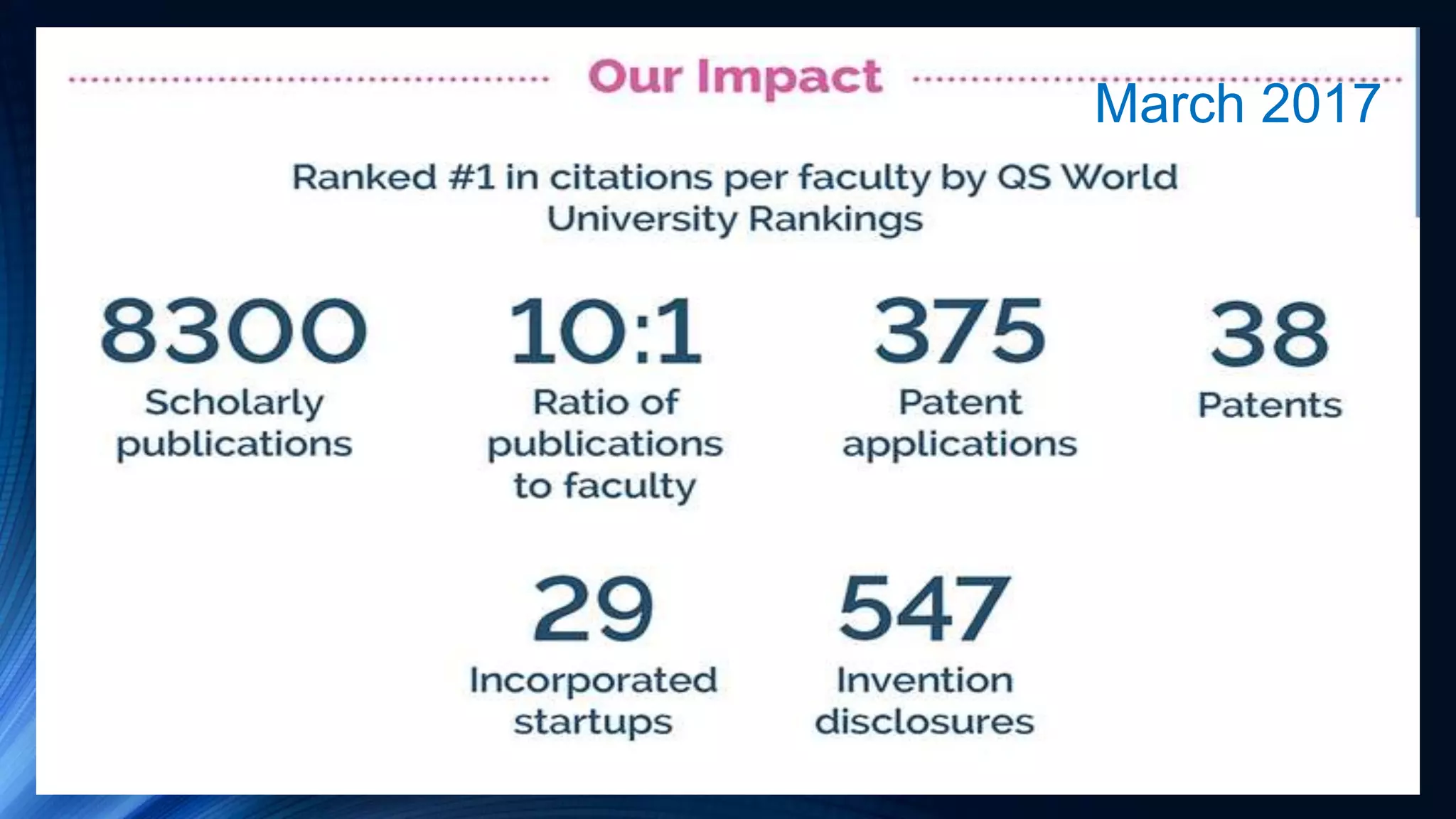
March 2017
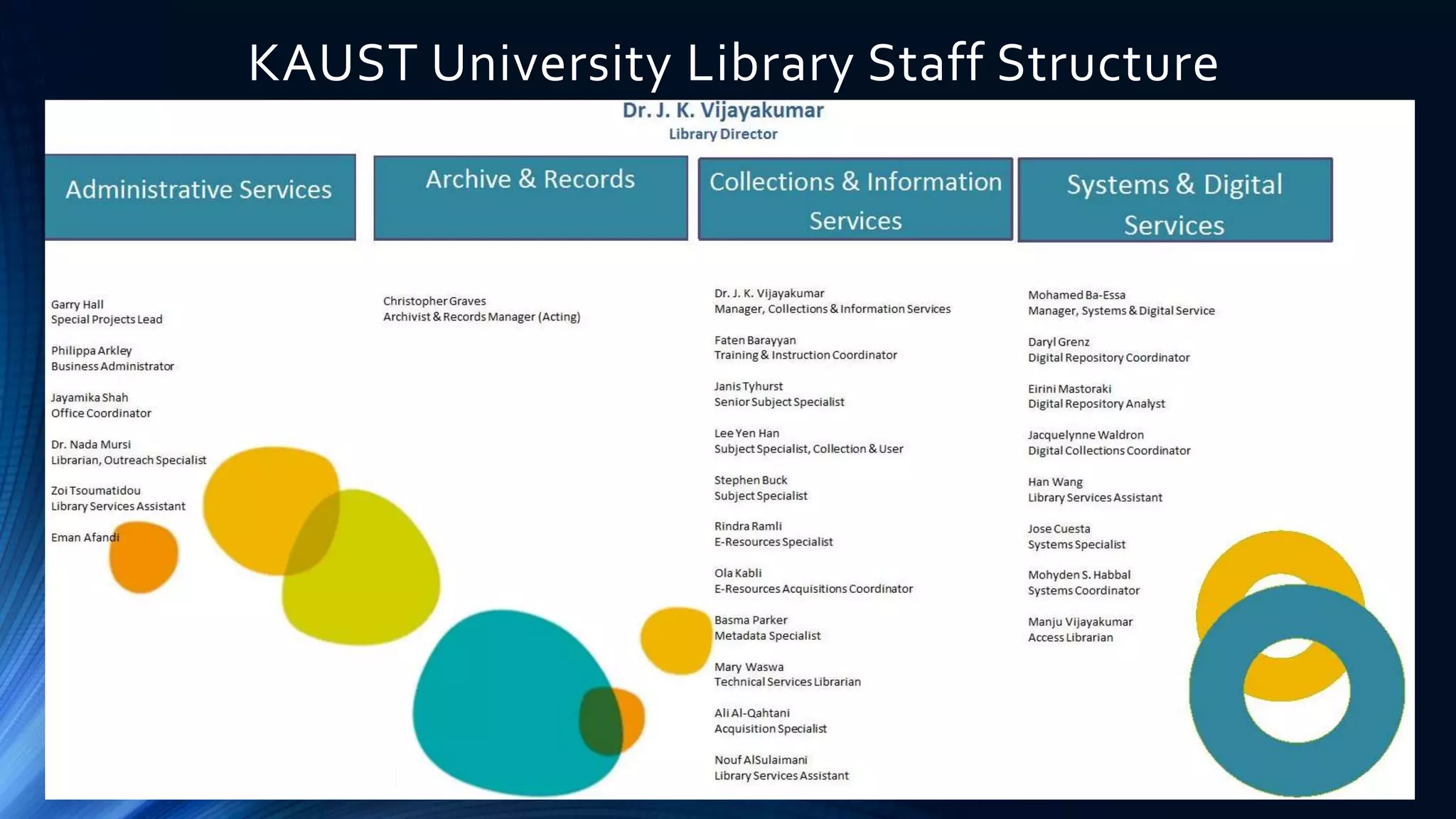
KAUST University Library Staff Structure
The pricing of library resources
Normal pricing
Library journal pricing
Offset Pricing
TheUpsideDown
Offset Pricing
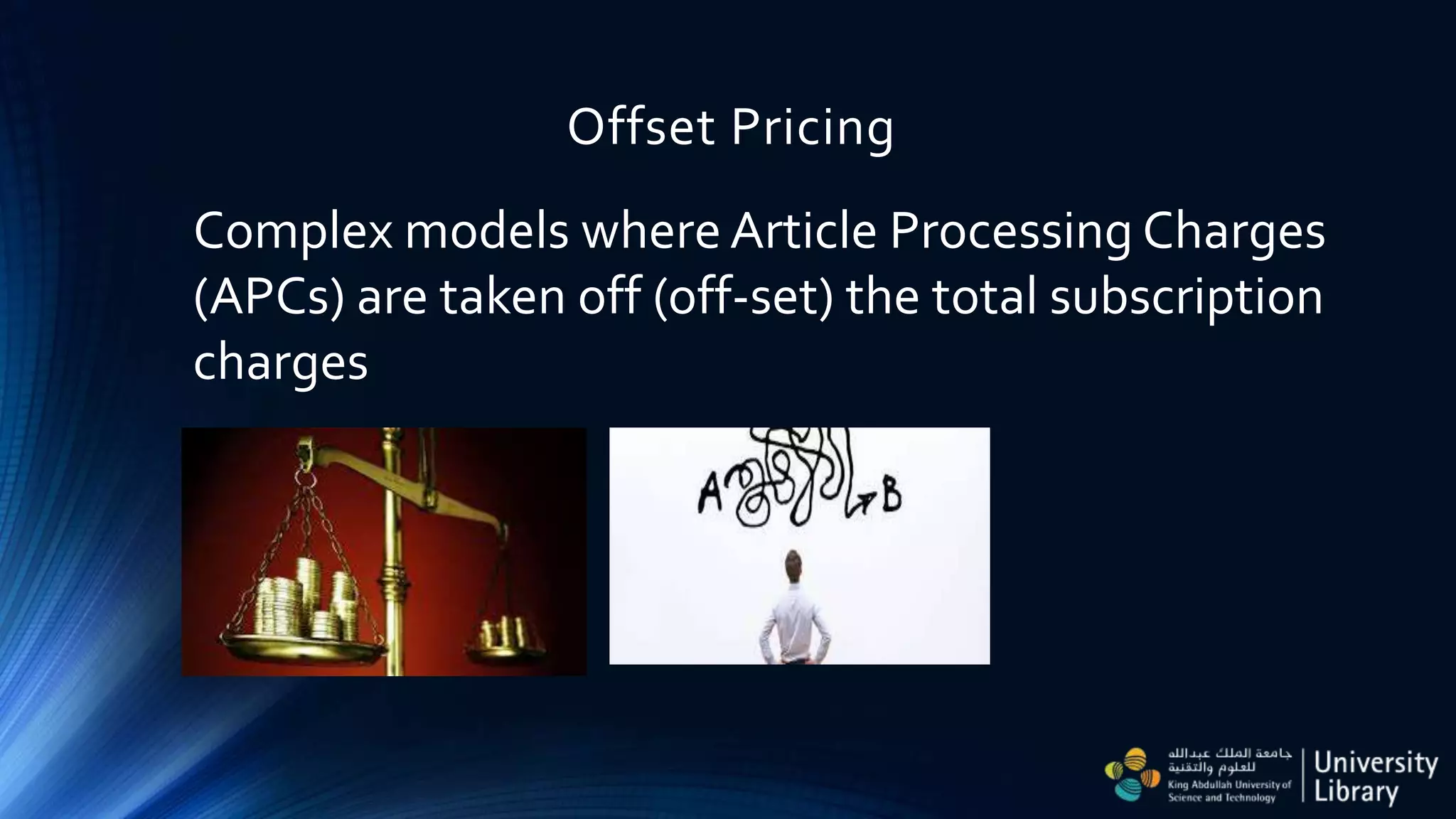
Complex models where Article Processing Charges
(APCs) are taken off (off-set) the total subscription
charges
Article Processing Charges
The author/university/corporation/institution pays a
charge per article (gold open access) for the author to
publish in a gold open access journal
Defining the Problem
University provides context:
Space, utilities, resources, equipment, technologies, information
Funding agencies provide funds:
Researchers provide ideas and skills:
Raw data, reports, processed data
Publishers provide access:
Editorial services, indexing, abstracting, metadata, marketing
Open Access Types
Green access funded by the university
Gold Access funded by
Articles Processing Charges (APCs)
Other means
How important are these terms?
More important to understand your options with publishers and your
negotiating strengths
What did it cost to produce these articles?
How much are we paying to get them back?
KAUST OA Policy for Scholarly Research Articles
Our policy applies to all University faculty, research scientists, post-doctoral fellows, students and
employees who author or co-author published, scholarly articles while working at or enrolled in the
University.
Each faculty member or researcher will provide an electronic copy of the author's final version of each
article no later than the date of its publication at no charge in accordance with the guidelines
published from time to time by the Office of the Vice President for Academic Affairs
72% compliance rate 1802 files (2017)
81% compliance rate 344 files (2018 to date)
Principles of offsetting systems (JISC 2015)
Systems should operate in the context of a transition to fully gold open access and
support that transition.
A system should be:
• inclusive,
• remove barriers (both to authors and their institutions) to OA
• and ensure that all the outputs of a subscribing institution are immediately open on
publication under licenses and other conditions which meet funders’ mandates and
other requirements.
These systems will be designed to enable the publisher’s journals to become fully OA as
soon a tipping point is reached
More principles of offsetting systems (JISC 2015)
Offset systems should not be restricted to institutions that subscribe to large collections of
journals (the big deal) but should also apply to all institutions that subscribe to individual
journals with a hybrid OA offering from a publisher.
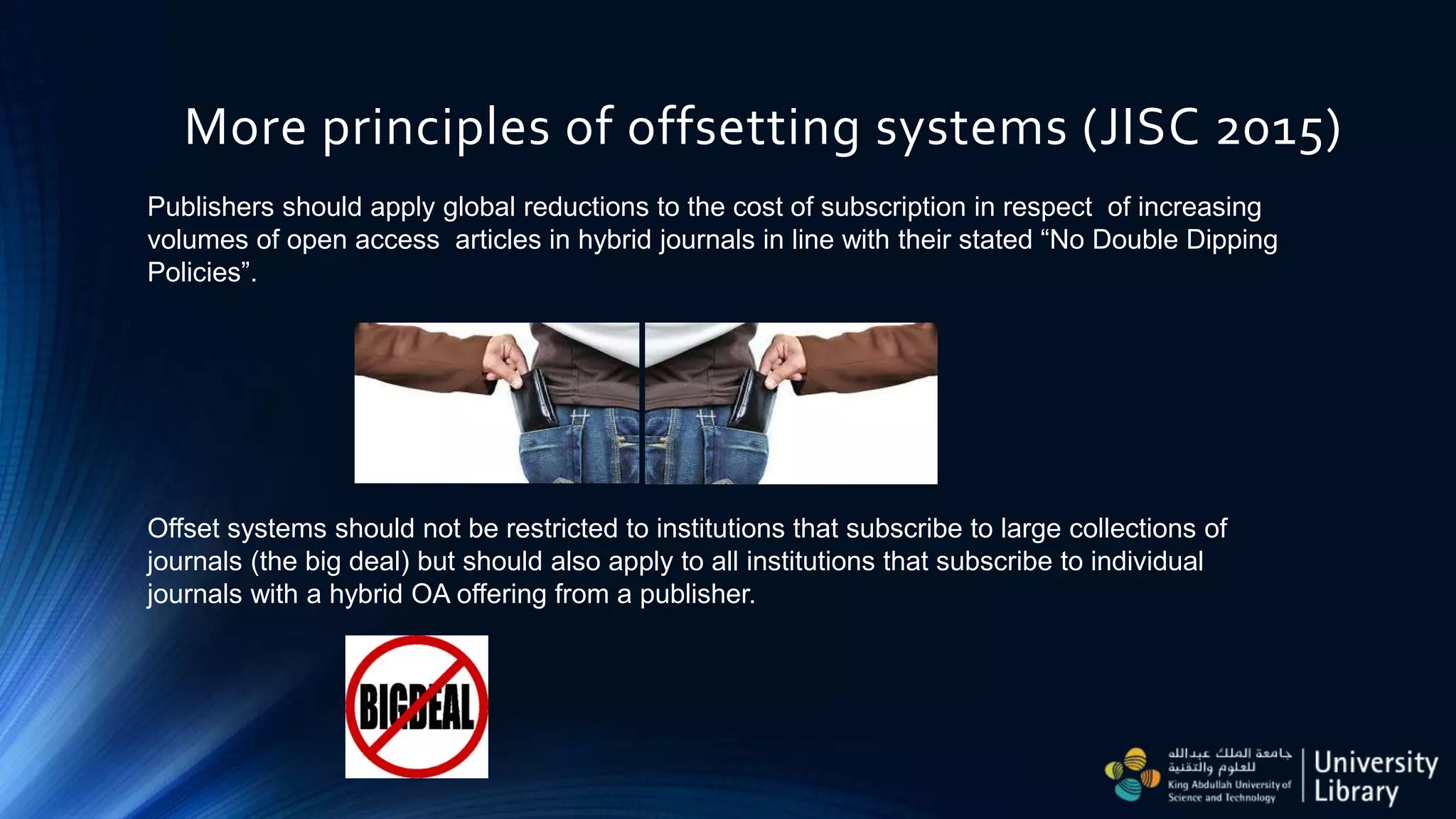
Publishers should apply global reductions to the cost of subscription in respect of increasing
volumes of open access articles in hybrid journals in line with their stated “No Double Dipping
Policies”.
Even more principles of offsetting systems (JISC 2015)
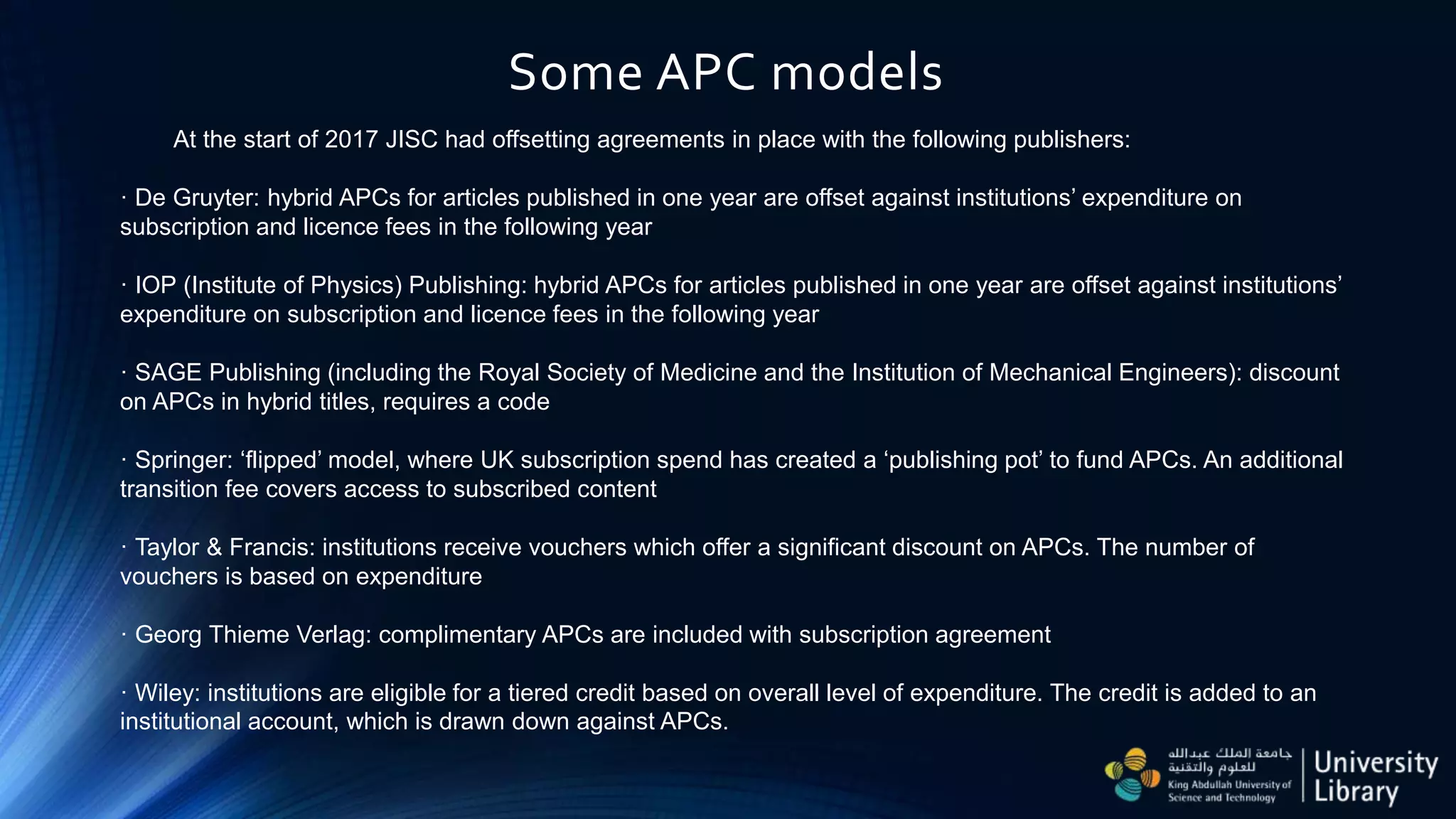
Systems should operate:
on a “cash basis”
and avoid the additional administration and work involved in handling vouchers (particularly
if those vouchers have an expiry date).
Where an offset system does operate on the basis of vouchers, they must be available to the
institution (which processes the transactions) rather than to individual
authors.
Some APC models
At the start of 2017 JISC had offsetting agreements in place with the following publishers:
· De Gruyter: hybrid APCs for articles published in one year are offset against institutions’ expenditure on
subscription and licence fees in the following year
· IOP (Institute of Physics) Publishing: hybrid APCs for articles published in one year are offset against institutions’
expenditure on subscription and licence fees in the following year
· SAGE Publishing (including the Royal Society of Medicine and the Institution of Mechanical Engineers): discount
on APCs in hybrid titles, requires a code
· Springer: ‘flipped’ model, where UK subscription spend has created a ‘publishing pot’ to fund APCs. An additional
transition fee covers access to subscribed content
· Taylor & Francis: institutions receive vouchers which offer a significant discount on APCs. The number of
vouchers is based on expenditure
· Georg Thieme Verlag: complimentary APCs are included with subscription agreement
· Wiley: institutions are eligible for a tiered credit based on overall level of expenditure. The credit is added to an
institutional account, which is drawn down against APCs.
Consequences of no offsetting
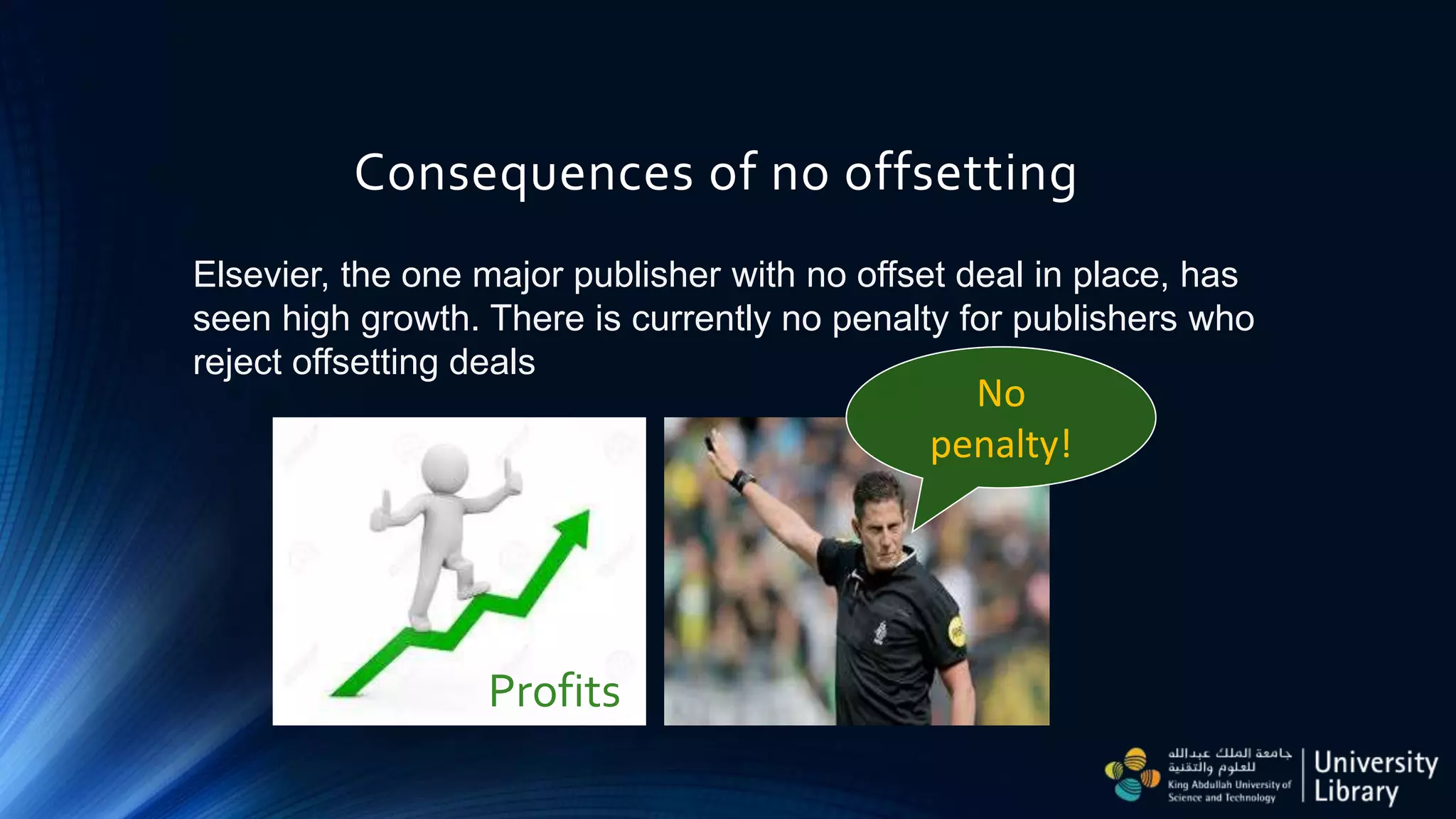
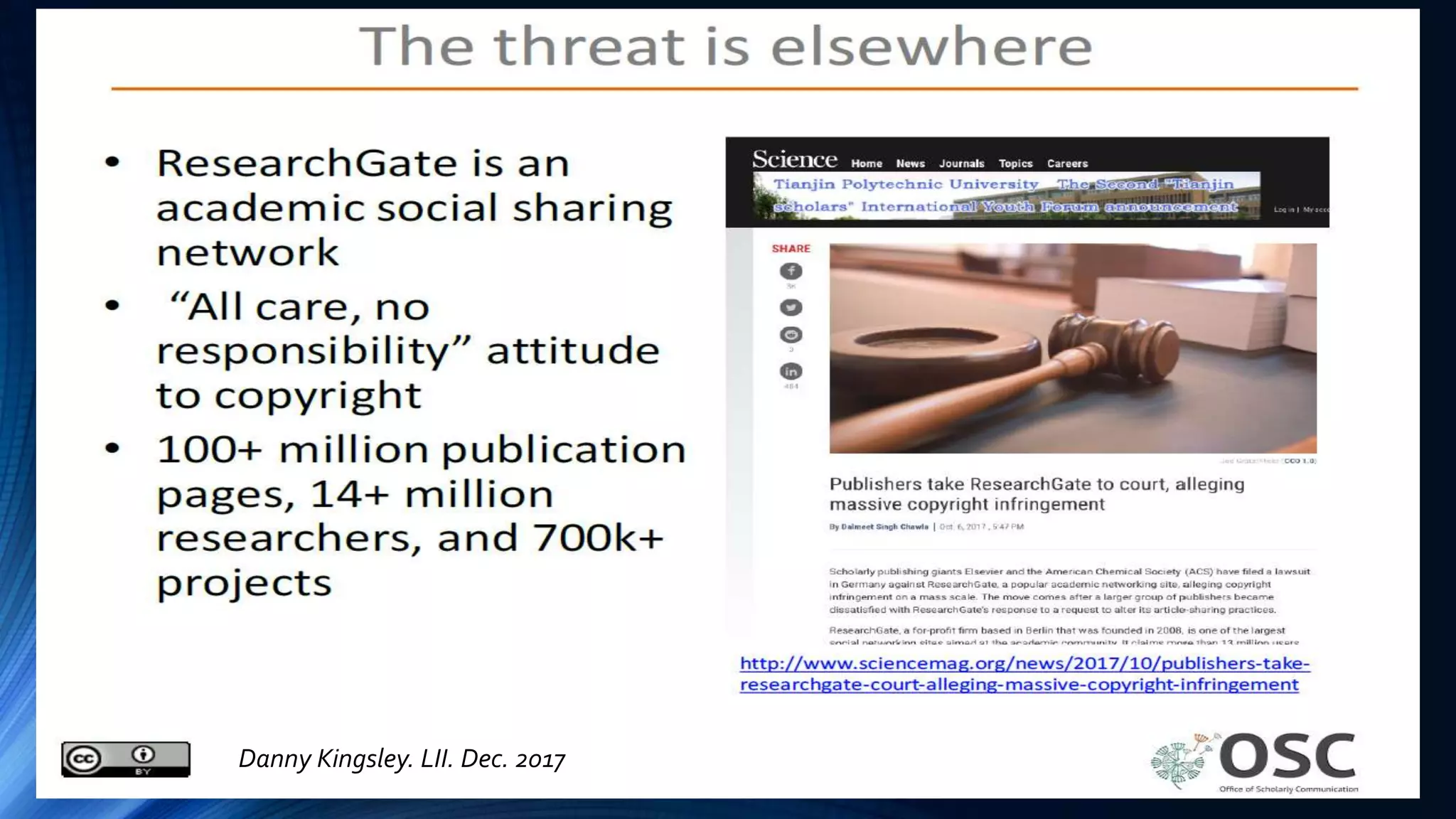
Elsevier, the one major publisher with no offset deal in place, has
seen high growth. There is currently no penalty for publishers who
reject offsetting deals
Profits
No
penalty!
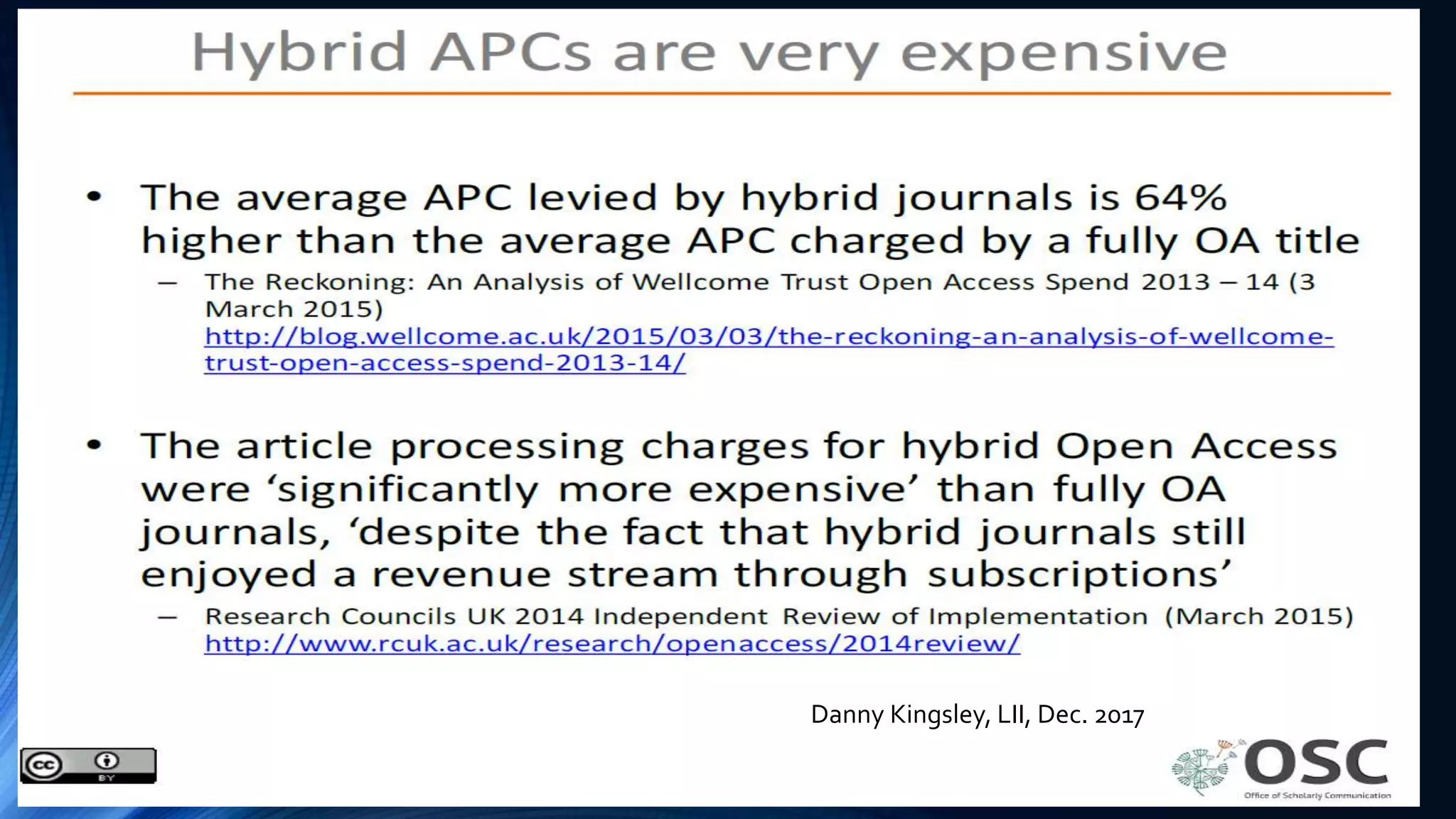
Danny Kingsley, LII, Dec. 2017
Intact (transparent infrastructure for article charges)aims at establishing
transparent and efficient procedures to manage APCs for OA publications
Joint understanding of offsetting (March 2016)
• Offset deals are pilot models (in transition)and should therefore lead to a
proper OA model (agreement between publishers and institutions)
• Opportunity to overcome DYSFUNCTIONALITIES experienced in the
current subscription system and to improve the business of scholarly
publishing
• Need mechanisms for offsetting agreements, reduce workloads etc.
• Tools and infrastructure should be in place
http://esac-initiative.org/joint-understanding-of-offsetting/
Rising prices
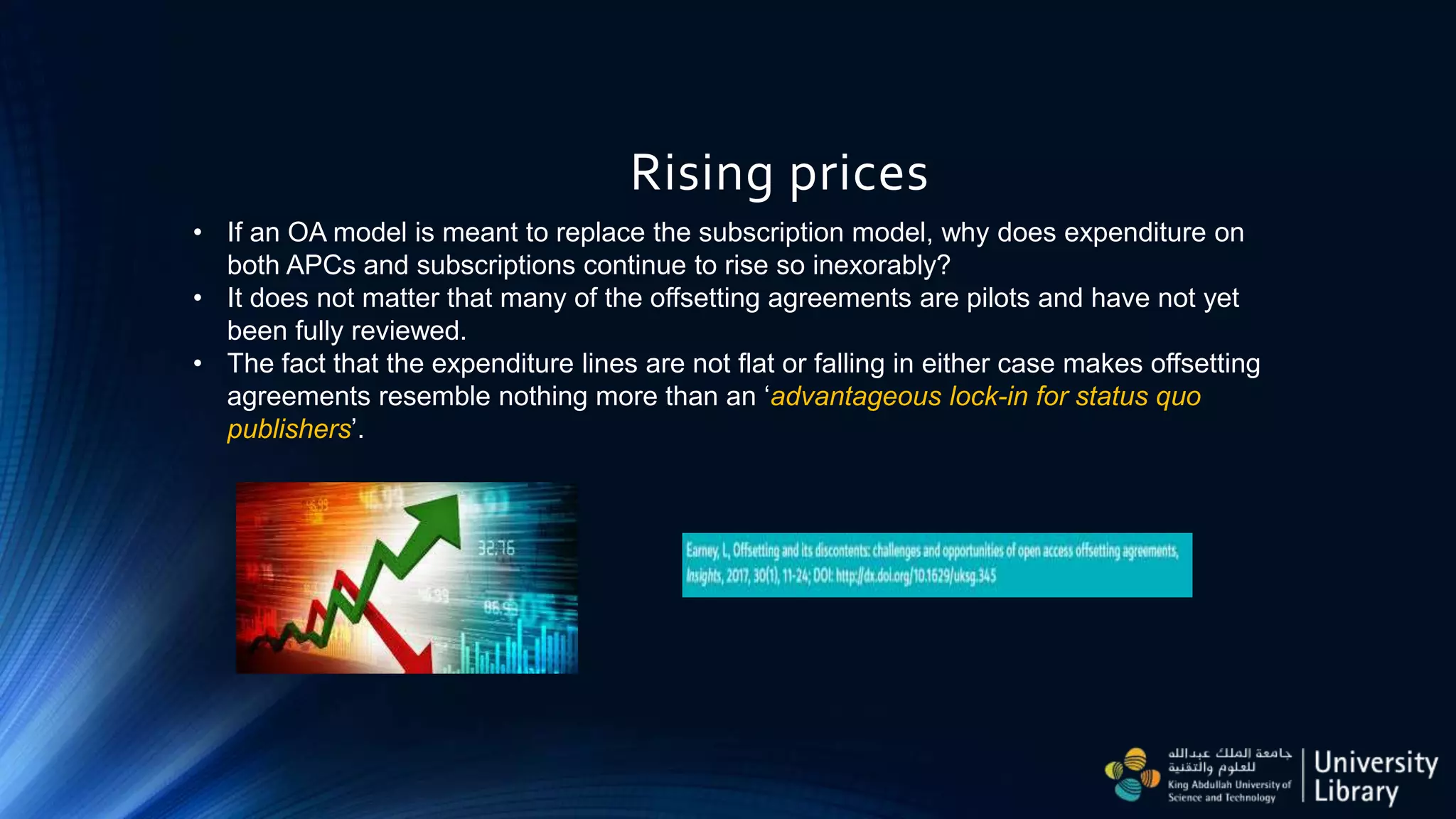
• If an OA model is meant to replace the subscription model, why does expenditure on
both APCs and subscriptions continue to rise so inexorably?
• It does not matter that many of the offsetting agreements are pilots and have not yet
been fully reviewed.
• The fact that the expenditure lines are not flat or falling in either case makes offsetting
agreements resemble nothing more than an ‘advantageous lock-in for status quo
publishers’.
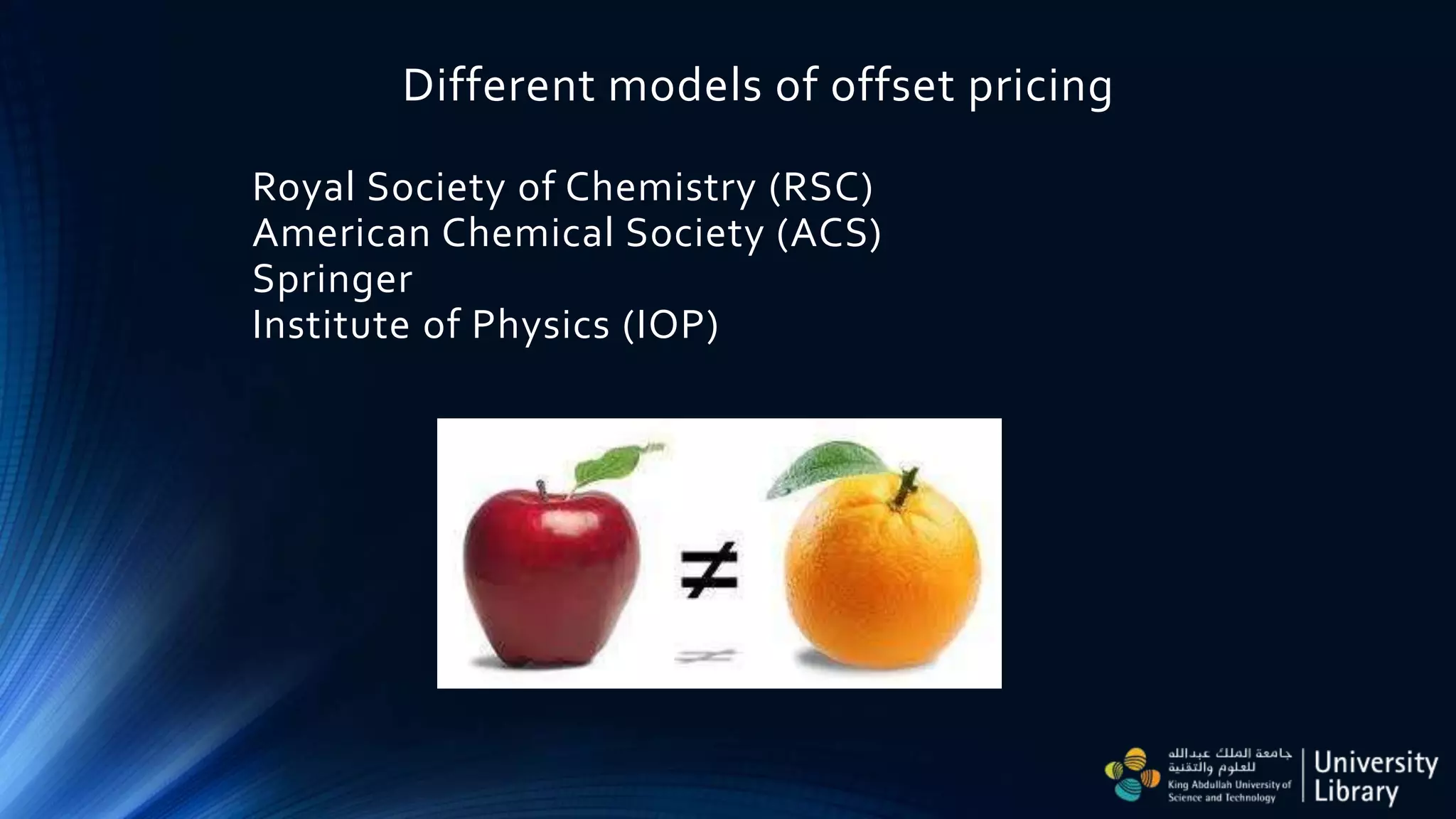
Different models of offset pricing
Royal Society of Chemistry (RSC)
American Chemical Society (ACS)
Springer
Institute of Physics (IOP)
Offset Models – Royal Society of Chemistry (RSC)
• Voucher codes to make papers available via OA free of charge
• Number of vouchers calculated by dividing the subscription the RSC
receives from an institution by 1,600 GBP (the APC of the RSC)
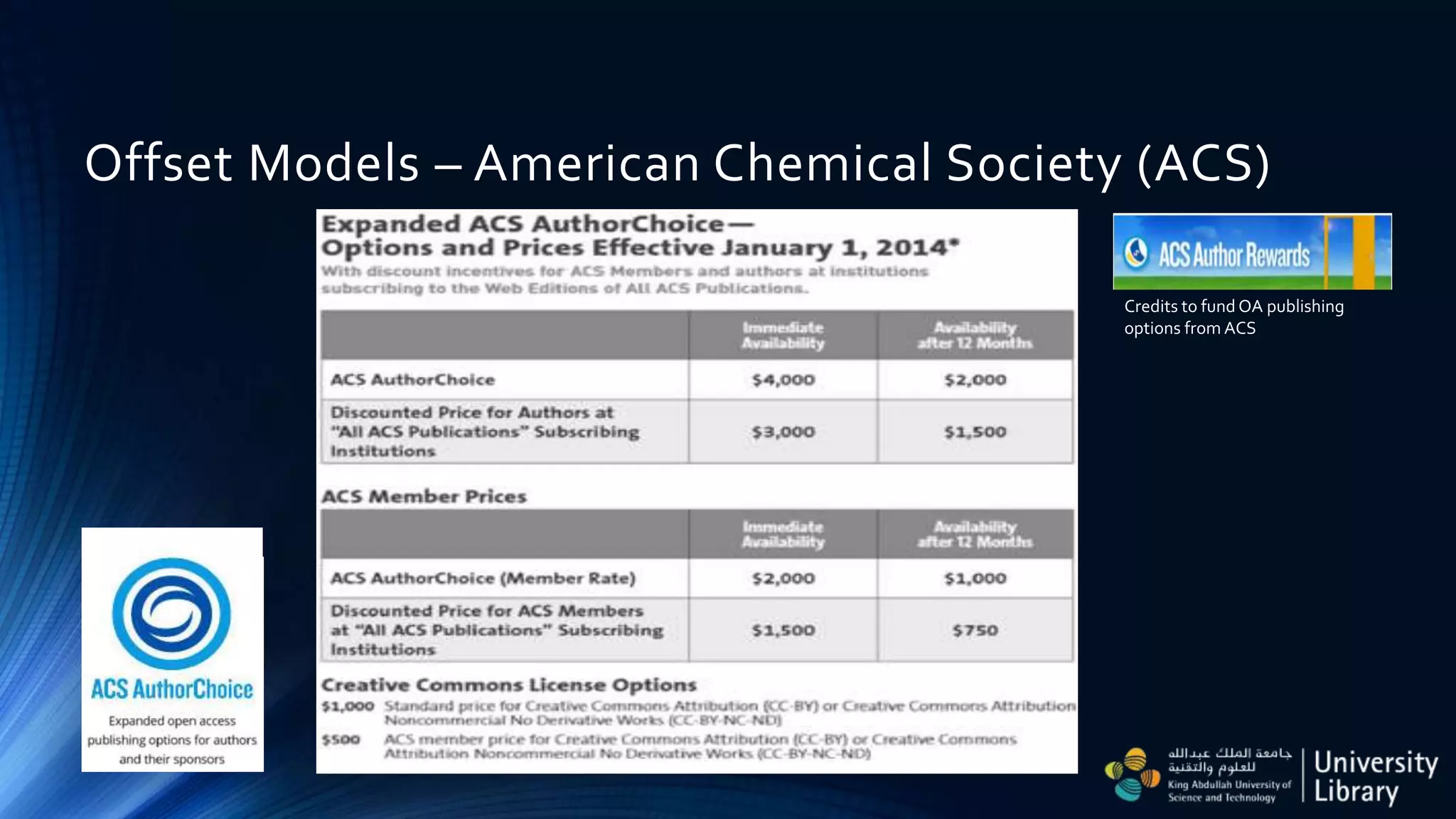
Offset Models – American Chemical Society (ACS)
Credits to fund OA publishing
options from ACS
Offset Models- MIT-Springer Author Rights Agreement
• Allows MIT authors to post article (or author’s departmental web
pages) after 9 months
• May be archived and/or deposited in any repository for
noncommercial purposes
• Applicable to articles published in a Springer journal subscribed
(2009-2017)
KAUST and
(the OA workflow)
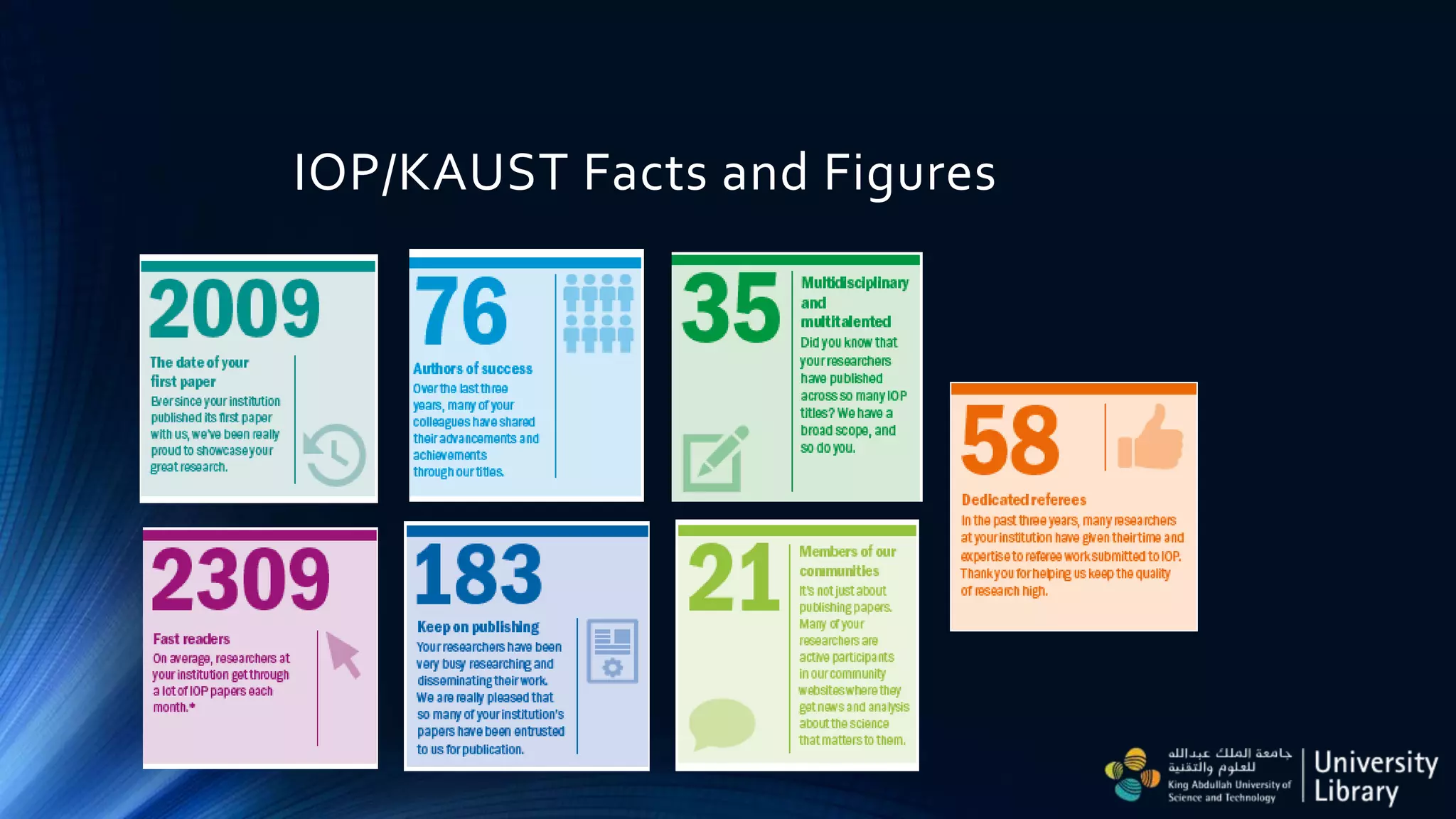
IOP/KAUST Facts and Figures
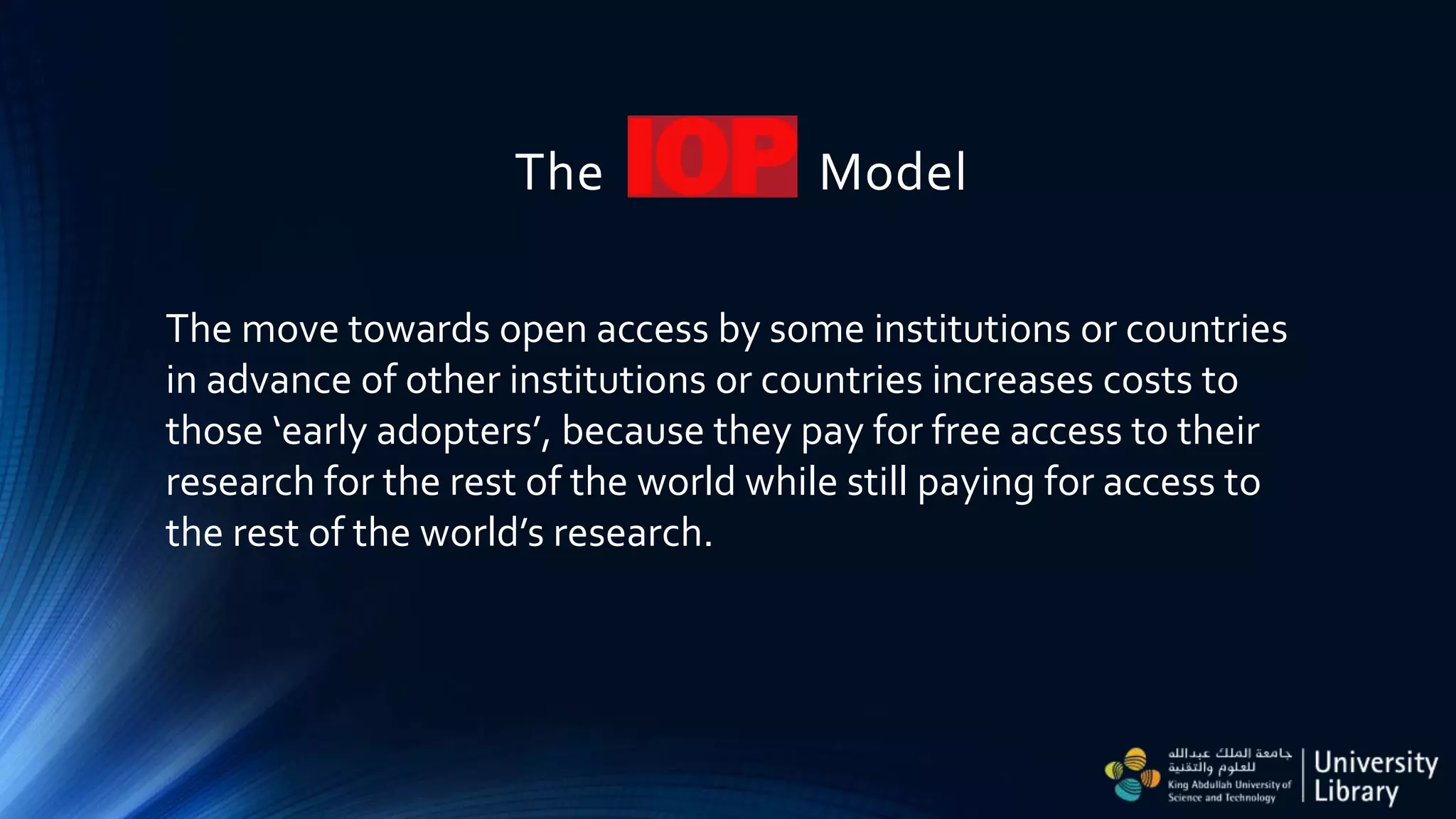
The Model
The move towards open access by some institutions or countries
in advance of other institutions or countries increases costs to
those ‘early adopters’, because they pay for free access to their
research for the rest of the world while still paying for access to
the rest of the world’s research.
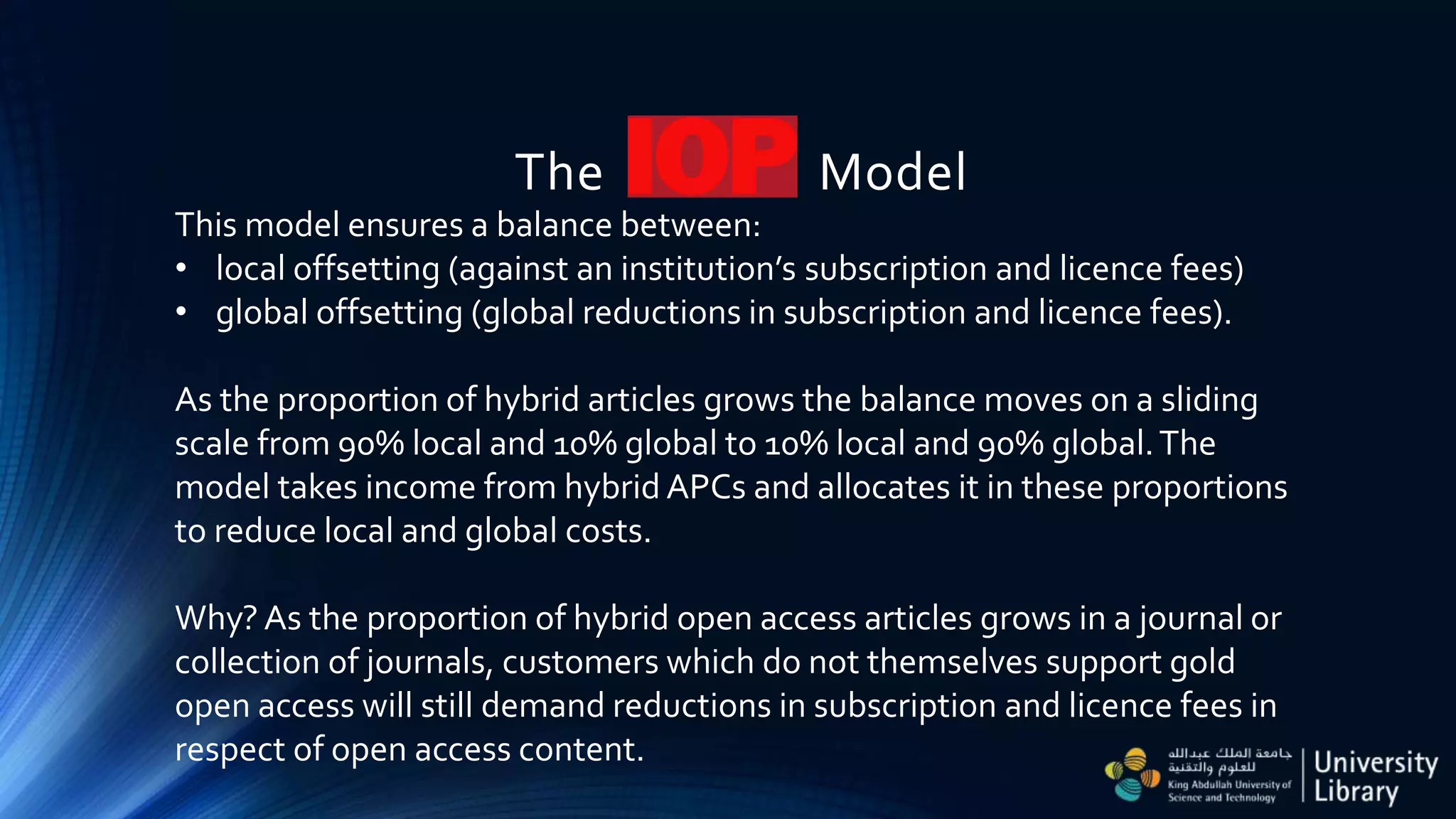
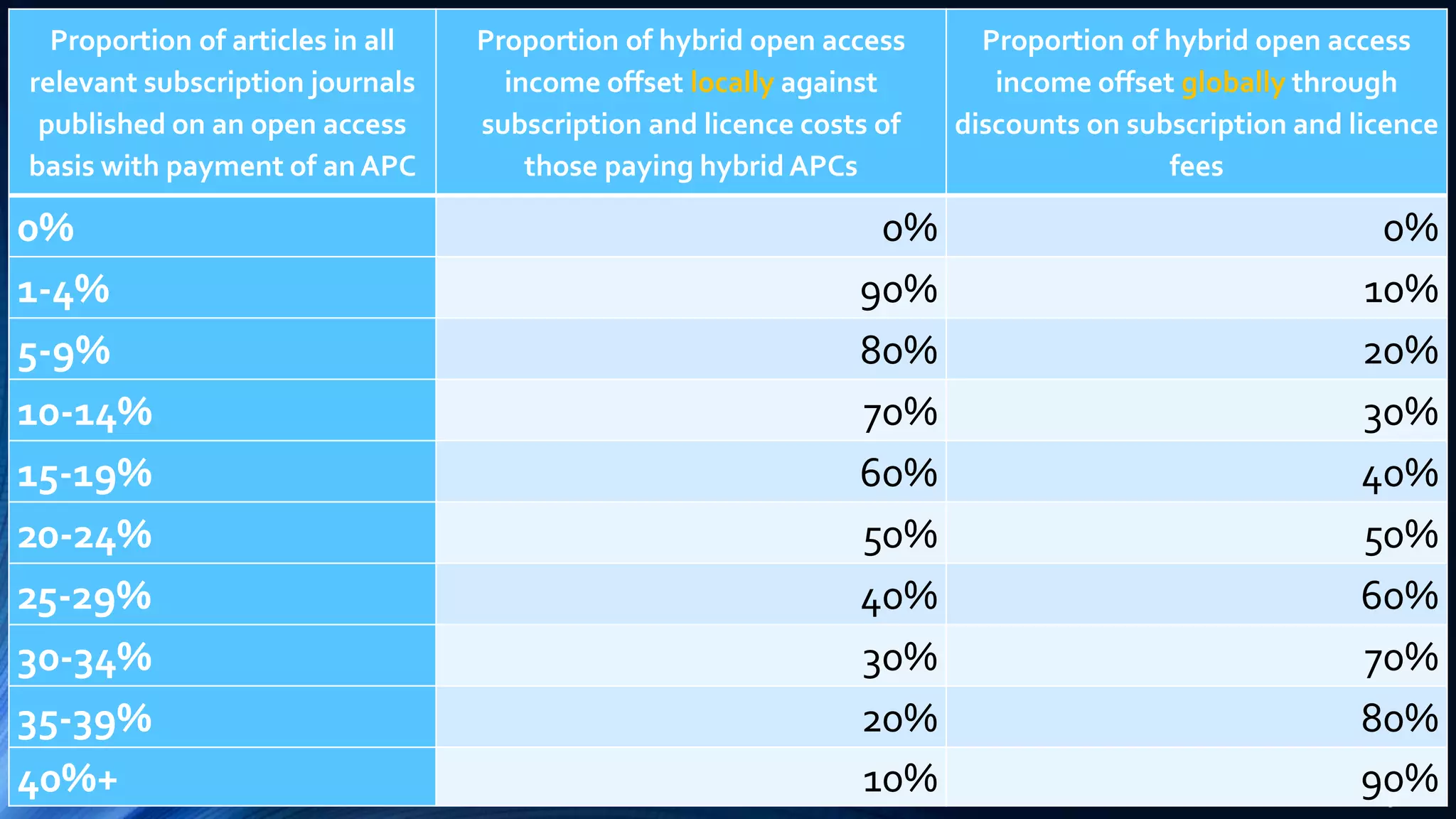
The Model
This model ensures a balance between:
• local offsetting (against an institution’s subscription and licence fees)
• global offsetting (global reductions in subscription and licence fees).
As the proportion of hybrid articles grows the balance moves on a sliding
scale from 90% local and 10% global to 10% local and 90% global.The
model takes income from hybrid APCs and allocates it in these proportions
to reduce local and global costs.
Why? As the proportion of hybrid open access articles grows in a journal or
collection of journals, customers which do not themselves support gold
open access will still demand reductions in subscription and licence fees in
respect of open access content.
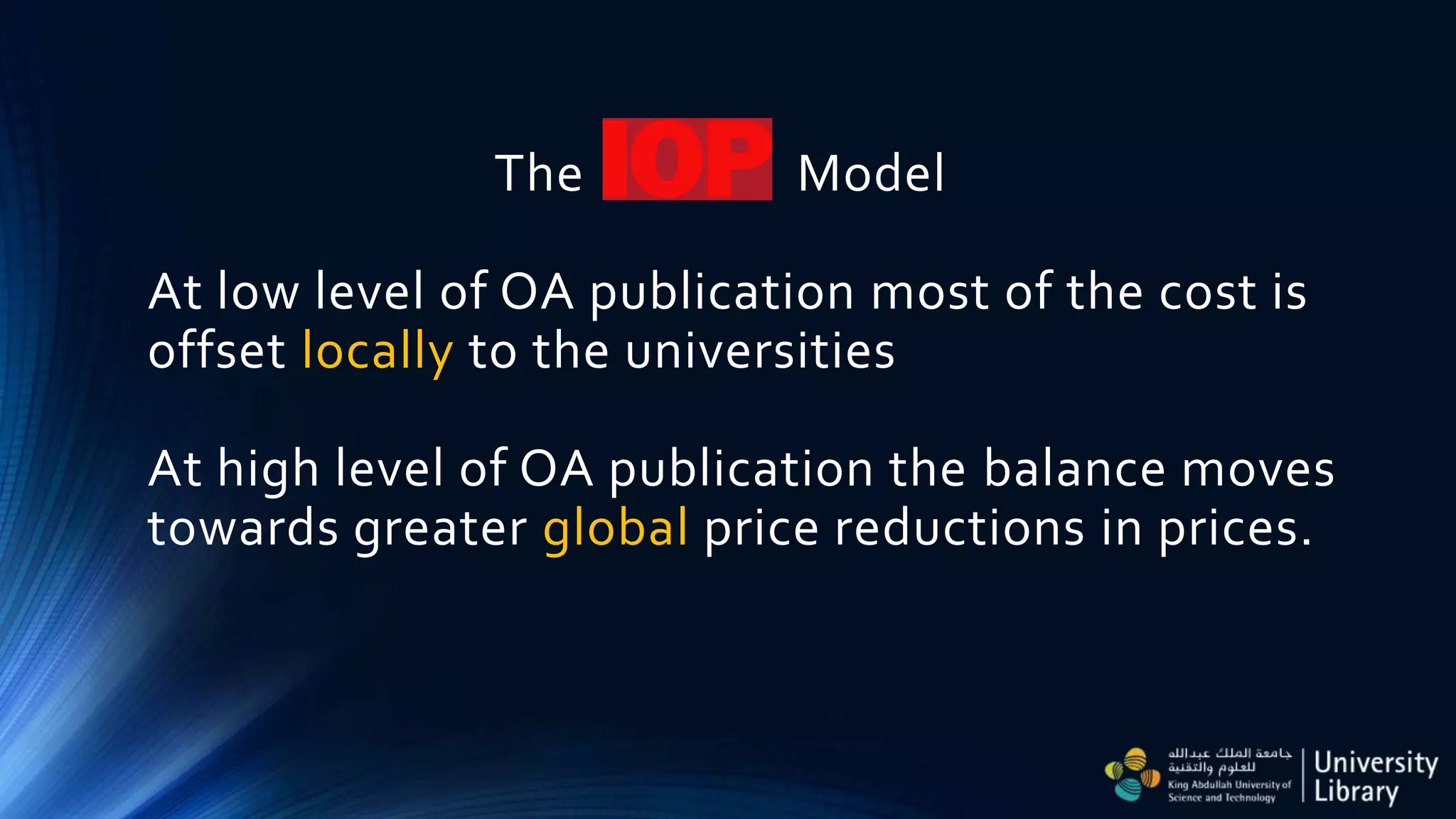
The Model
At low level of OA publication most of the cost is
offset locally to the universities
At high level of OA publication the balance moves
towards greater global price reductions in prices.
Proportion of articles in all
relevant subscription journals
published on an open access
basis with payment of an APC
Proportion of hybrid open access
income offset locally against
subscription and licence costs of
those paying hybrid APCs
Proportion of hybrid open access
income offset globally through
discounts on subscription and licence
fees
0% 0% 0%
1-4% 90% 10%
5-9% 80% 20%
10-14% 70% 30%
15-19% 60% 40%
20-24% 50% 50%
25-29% 40% 60%
30-34% 30% 70%
35-39% 20% 80%
40%+ 10% 90%
IOP Publishing offsetting and library-
funded APCs
IOP offer an hybrid open access publishing option on the majority of
their subscription titles as well as three Gold open access journals.
There are options to help institutions support their authors on the cost
of open access, while recognising the additional spend on top of their
license fee.
IOP identifies articles for institution validation for funding, and offset
funds spent on hybrid open access with the institution’s license fee.
Offset Support
IOP rebate a portion of the hybrid APCs spent with IOP over the
previous year, up to the value of the institution’s license fee.
The percentage rebate applied depends on the proportion of open
access articles in our subscription titles, as IOP offset a portion locally
(directly to the institution).
The remainder is offset globally (via a reduction to all customers).
This ensures a fair process and guarantees that no one is paying twice
for IOP content.
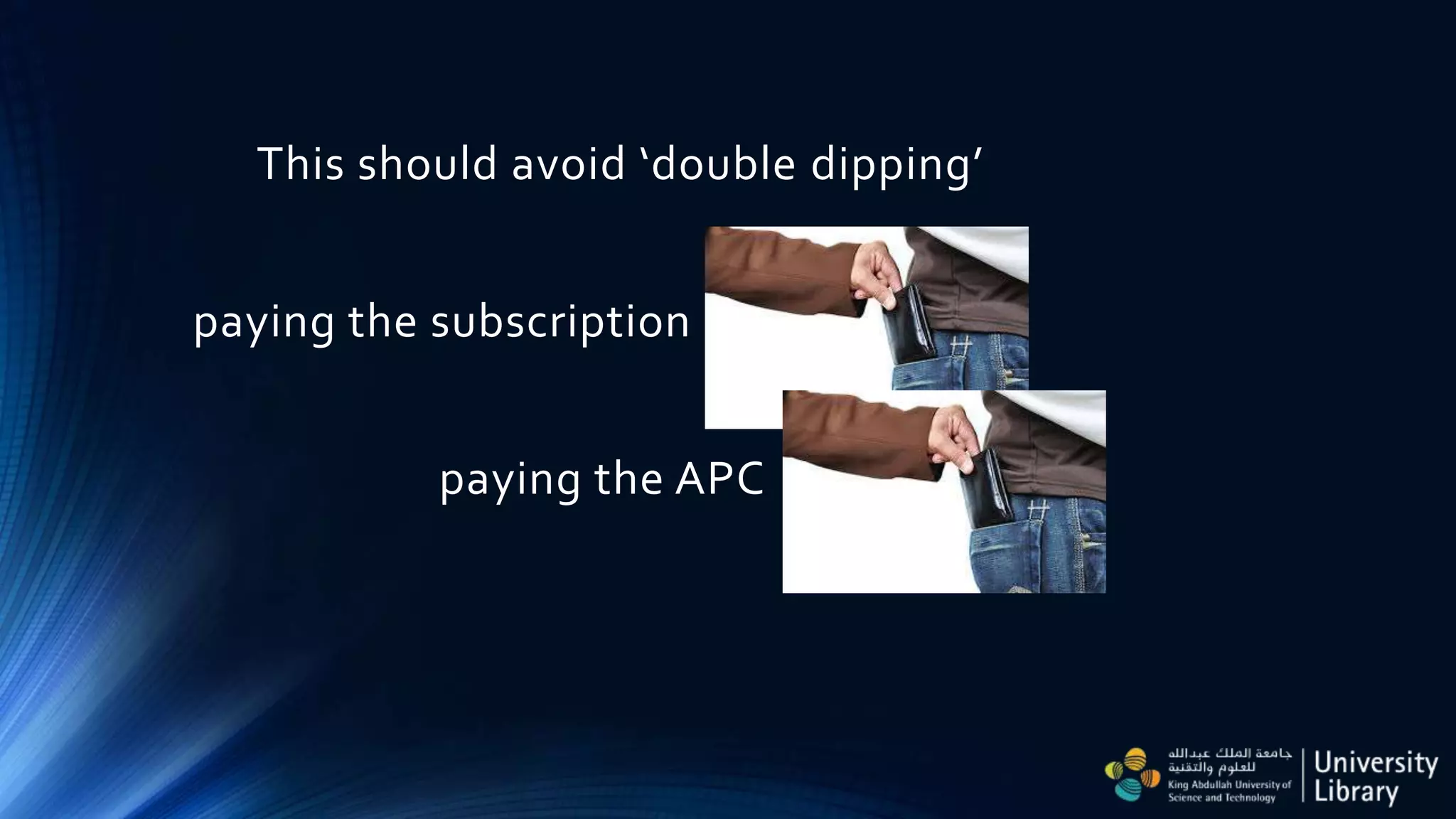
This should avoid ‘double dipping’
paying the subscription
paying the APC
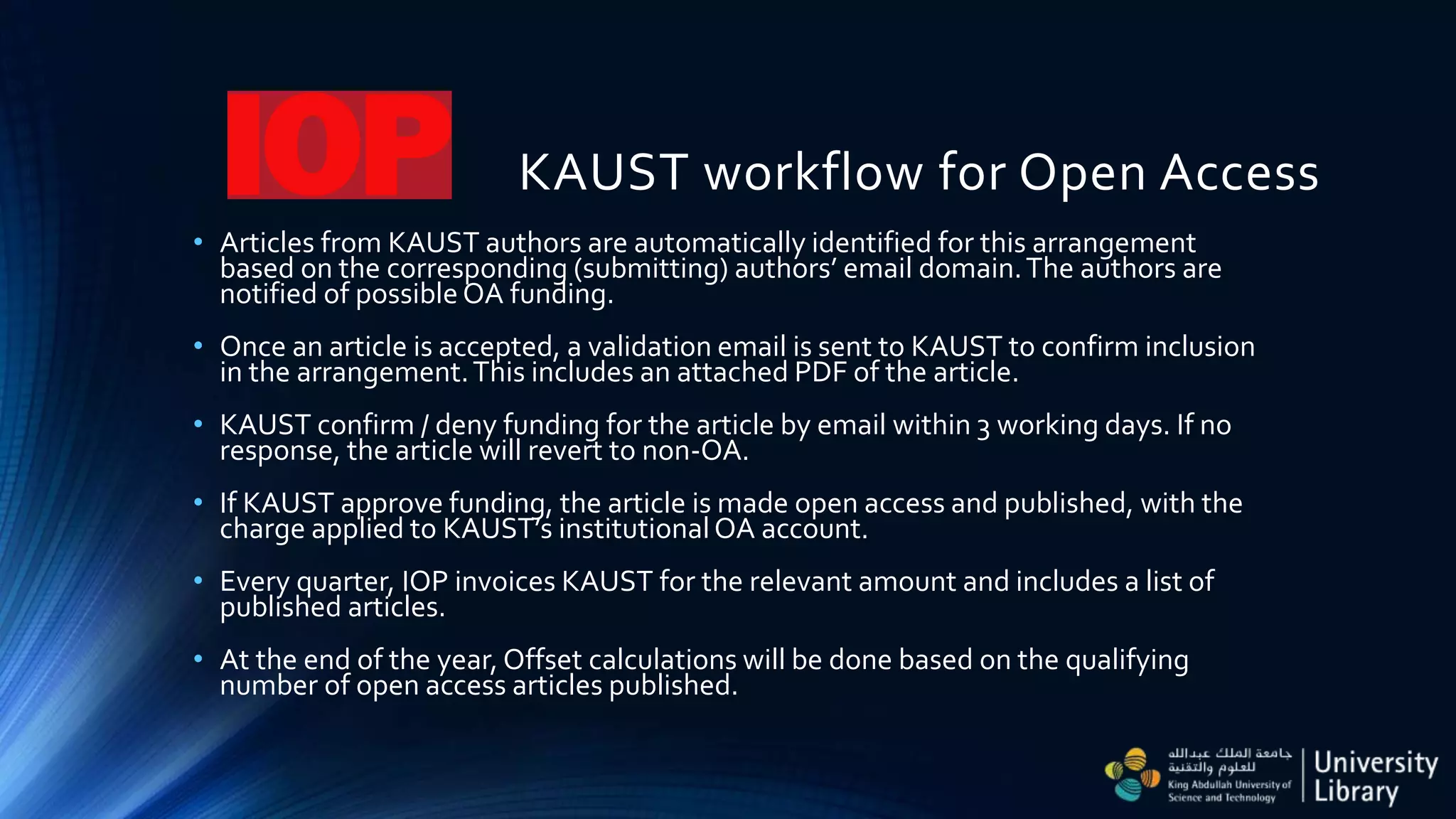
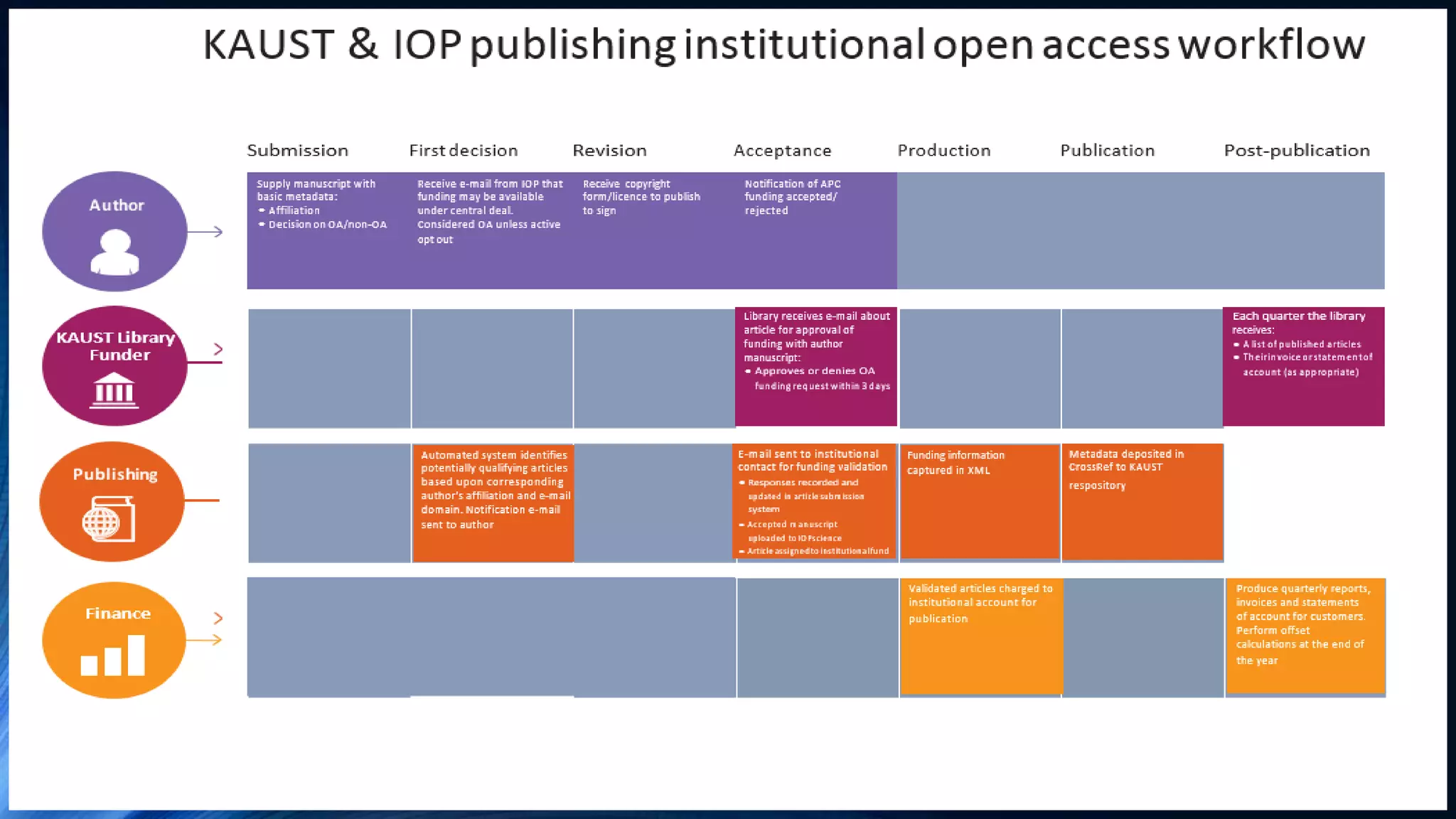
KAUST workflow for Open Access
• Articles from KAUST authors are automatically identified for this arrangement
based on the corresponding (submitting) authors’ email domain.The authors are
notified of possibleOA funding.
• Once an article is accepted, a validation email is sent to KAUST to confirm inclusion
in the arrangement.This includes an attached PDF of the article.
• KAUST confirm / deny funding for the article by email within 3 working days. If no
response, the article will revert to non-OA.
• If KAUST approve funding, the article is made open access and published, with the
charge applied to KAUST’s institutionalOA account.
• Every quarter, IOP invoices KAUST for the relevant amount and includes a list of
published articles.
• At the end of the year, Offset calculations will be done based on the qualifying
number of open access articles published.
What IOP needs from us
• Confirm email domain(s) and institution(s) that qualify for funding.
• Confirm contact address for validation emails, and ability to respond
within 3 working days.
• Pay quarterly invoices as appropriate.
• Provide any additional information for ourOpen Access web pages.
Where to publish?
The university library cannot and should not tell
researchers where to publish.
We are promoting this pilot model by IOP to offset the
costs of hybrid open access publishing.
Convincing Faculty
Not easy to convince faculty that this is important
Why change a ‘successful’ (from their viewpoint) model?
If publishing in Cell and Nature has been always been an
ambition it will be hard to change that for some concept of
the ‘greater good’ of OA.
We need compelling arguments and this means data.
The Future of Off Set Pricing
• It will not exist
• Nobody will remember what it is
• It will only be bad dream
This will be a good thing
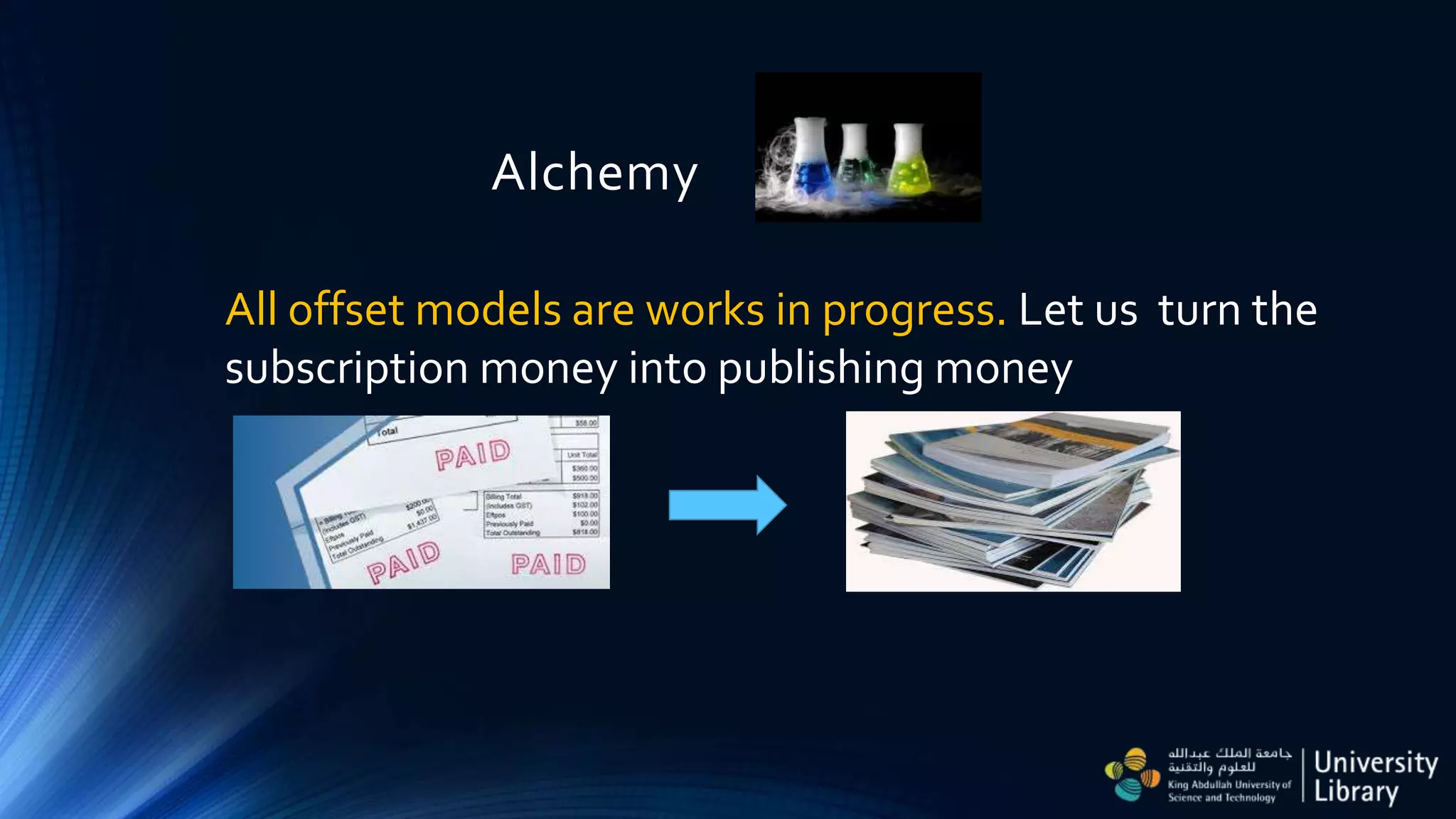
Alchemy
All offset models are works in progress. Let us turn the
subscription money into publishing money
Joint COAR-UNESCO Statement on OA
• There is no “one size fits all” solution to implementing OA
• Consider developing countries
• Consider institutions with small budgets
• Avoid large scale monopoly and concentration on the international
publishing industry
• Encourage non-APC based journals that support OA and enhance the
repositories with innovative systems
https://en.unesco.org/news/joint-coar-unesco-statement-open-access
Extra Costs of Open Access
Counting the Costs of Open Access:
http://www.researchconsulting.co.uk/wp-
content/uploads/2014/11/Research-Consulting-
Counting-the-Costs-of-OA-Final.pdf (accessed 20-03-
2018)
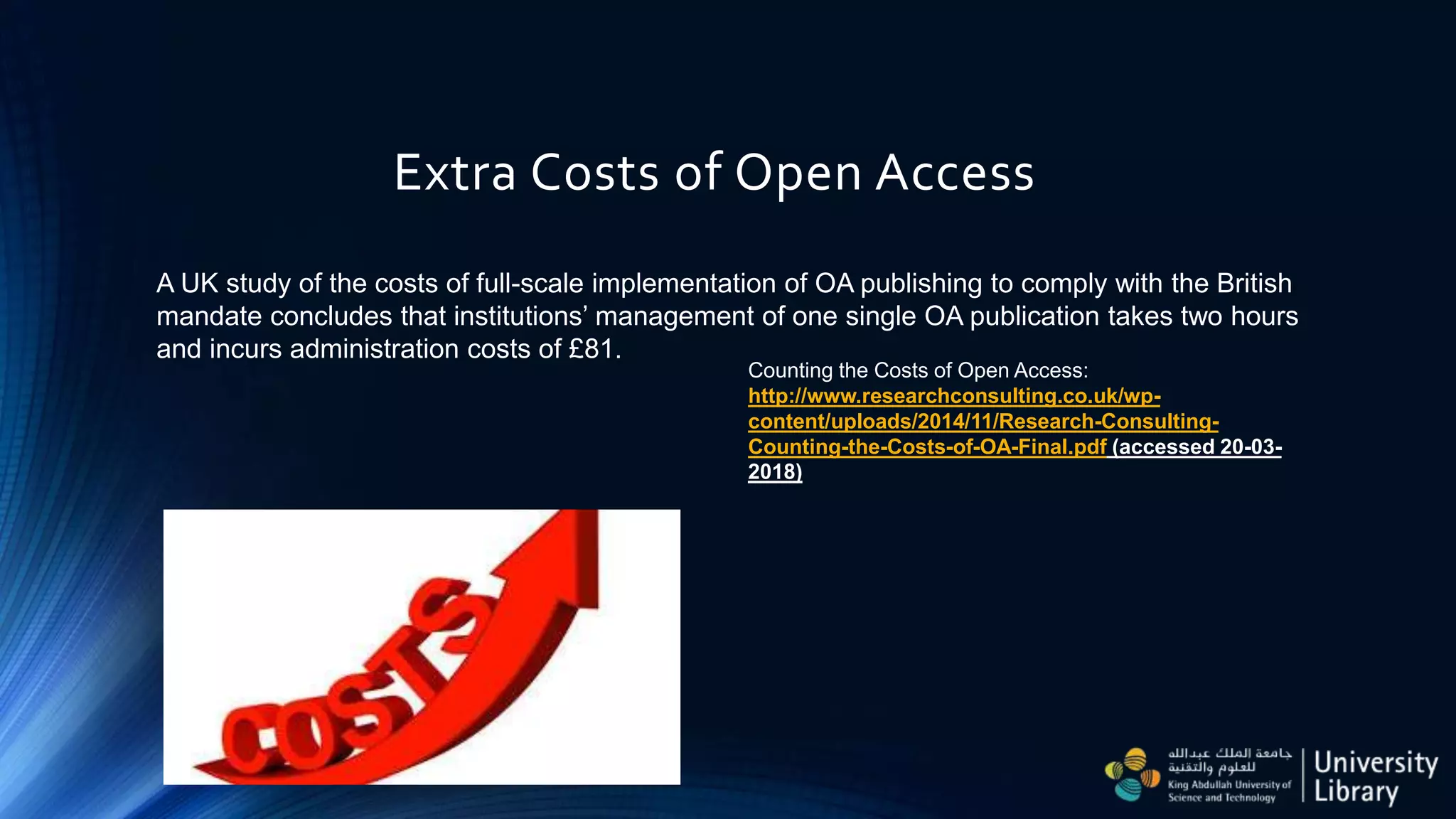
A UK study of the costs of full-scale implementation of OA publishing to comply with the British
mandate concludes that institutions’ management of one single OA publication takes two hours
and incurs administration costs of £81.
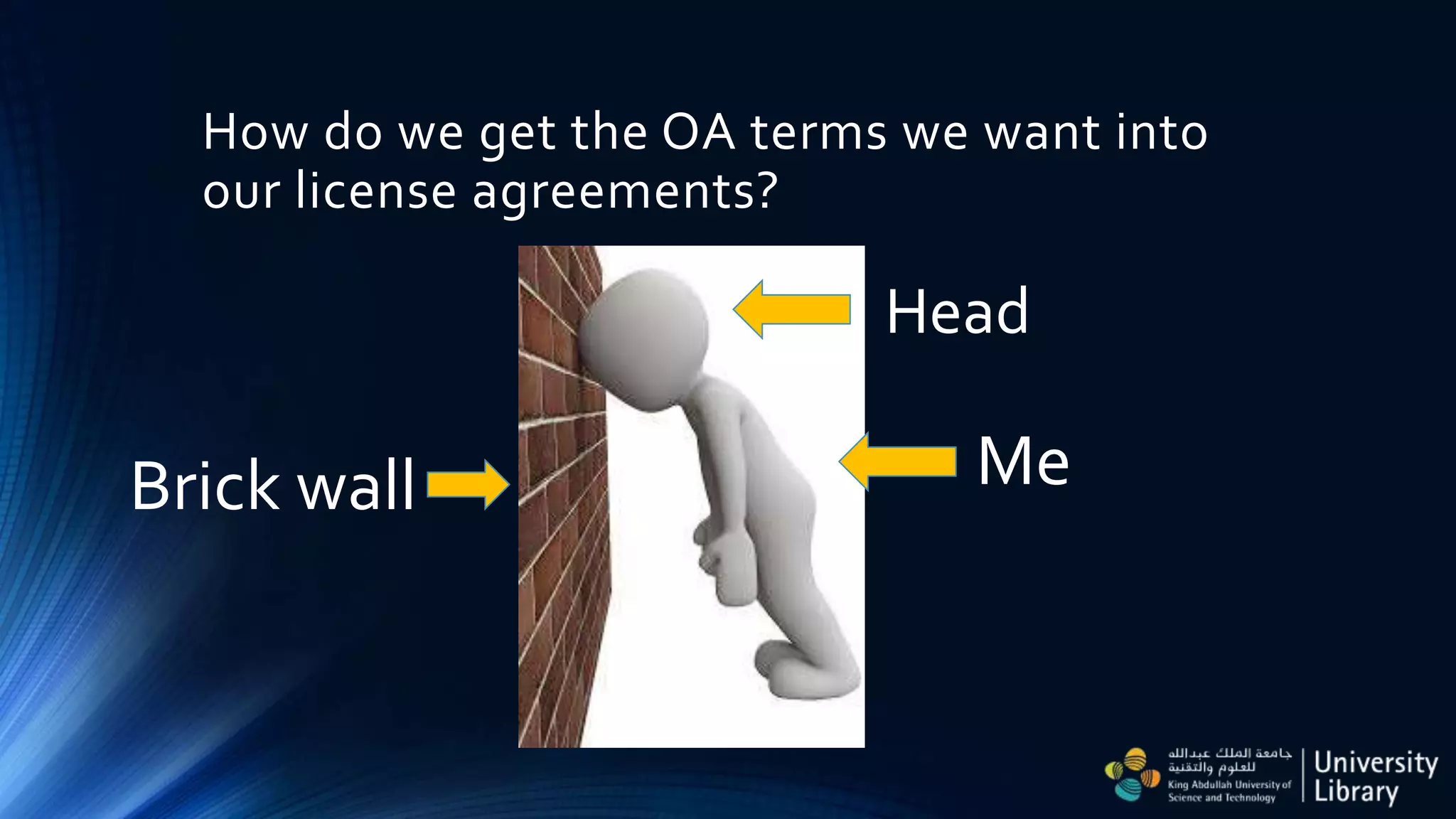
How do we get the OA terms we want into
our license agreements?
MeBrick wall
Head
How do we get the OA terms we want into
our license agreements?
Long drawn out difficult process
Long term vision necessary
Can take years – literally
No guarantee of ever reaching conclusion
Ambiguity
Frustration for staff involved
Publishers quite content to have OA andT&DM guidelines on their websites.These can be changed overnight
Publishers reluctant to shorten embargo periods
Publishers need to be convinced that their bottom line will not suffer
We need evidence to support our viewpoint.The OA for ‘a better world’ argument will not do.
New licence terms: The Wild West
In our experience:
• Offset agreements usually not disclosed
• Increased competition should reduce costs
• No individual institution models yet
• We started negotiating with others to have an institutional level off-
set model agreed and signed via subscription licences
• The RSC gold-for-gold model
Article Deposit Terms
KAUST University Library is contacting all its vendors/publishers as we attempt, through a process started last year, to
standardize processes in relation to Open Access (OA), Article Processing Charges (APCs) and Text and Data Mining
(TDM). Please can you fill in the fields below where relevant/possible?
Open Access:
Following on from last year’s discussions we would like to propose the text below (relating to Green Open Access) for
inclusion in all future licensing agreements.
The subscriber (KAUST) has adopted an open access policy pursuant to which its affiliated researchers,
faculty, students and staff grant to the University a non-exclusive permission to make available their scholarly
research articles for the purpose of open dissemination. In connection therewith, and with publisher name and
the partner publishers’committed support towards Green Open Access, the parties hereby agree that final
versions of articles authored by KAUST affiliated researchers, faculty, students and staff can be deposited in
KAUST research repository immediately after acceptance of the work (or 6 months after publication).
Article Deposit Terms
We do not believe that the inclusion of the above will compromise publisher name or place it at any
commercial disadvantage. Please can you:
a/ indicate acceptance of wording above for inclusion in future license agreements.
b/ propose alternative wording for inclusion on future license agreements
c/ offer alternative proposal
Article Processing Charges:
Do you have a system of APCs? Yes or No. If Yes please can you provide an explanation of:
a/ how your system works
b/ specifically what workflows are involved for the library?
The information above is of great importance to KAUST University Library as we attempt to provide
accurate, clear and concise information to our research community around issues of Scholarly
Communication.
No evidence of the need for embargos
“No persuasive evidence exists that greater public access as provided by the NIH policy has substantially harmed
subscription supported STM publishers over the last four years or threatens the sustainability of their journals.”
Committee for Economic Development DigitalConnections CouncilThe Future ofTaxpayer Funded
Research:WhoWill Control Access to the Results 2012
“We saw no evidence that short embargo periods harm subscription publishers.”
Business, Innovation and Skills Committee – Fifth Report: Open Access 2013
“The evidence fails to justify publishers’ demand for longer embargo periods on publicly funded research.”
Impact of Social Sciences. 2014
“But let’s get something straight.There is no evidence that permitting researchers to make a copy of their work
available in a repository results in journal subscriptions being cancelled. None.”
Half life is half the story,. 16th October 2015
Danny Kingsley. LII Dec 2017
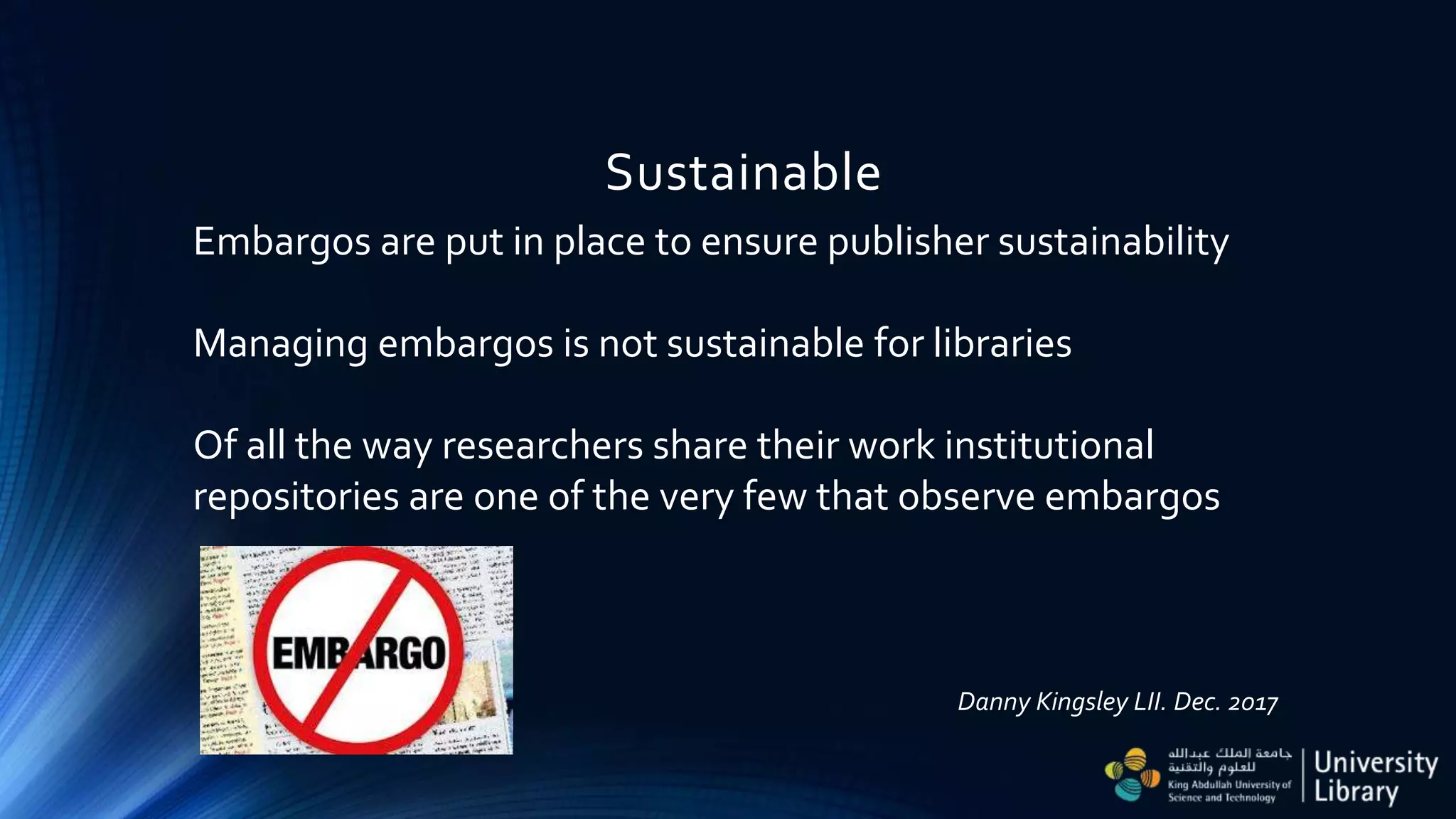
Sustainable
Embargos are put in place to ensure publisher sustainability
Managing embargos is not sustainable for libraries
Of all the way researchers share their work institutional
repositories are one of the very few that observe embargos
Danny Kingsley LII. Dec. 2017
Danny Kingsley. LII. Dec. 2017
OA2020 Transformation
A growing number of research organizations want to establish an
international initiative which aims to convert the majority of
today’s scholarly journals from subscription to (OA) publishing.
This is the result of the 12th Berlin Open Access Conference hosted
by the Max Planck Society (Dec. 2015)
An Expression of Interest invites all parties involved in scholarly
publishing to collaborate on a swift and efficient transition for the
benefit of scholarship and society at large.
By cooperating at international level we can affect change
What is the OA 2020 initiative?
• OA2020 is a global initiative endorsed by a growing number of researchers, libraries,
institutions and organizations committed to accelerating the transition to universal open
access by transforming today’s scholarly journals, currently locked behind paywalls, to
open access.
• The strategy is based on reallocating expenditures that are currently used for journal
subscriptions to cover the costs of open access publishing models.
• As a global alliance, OA2020 can meet the major scholarly publishers at eye-level and
foster OA business models that preserve the publishing services upon which
researchers currently rely while liberating the fruits of their research and the full potential
of a 21st century digital environment.
• OA2020 is the fastest path toward an open scholarly communications system in which
outputs are not only open but also re-usable and the costs behind their dissemination
are transparent and economically sustainable.
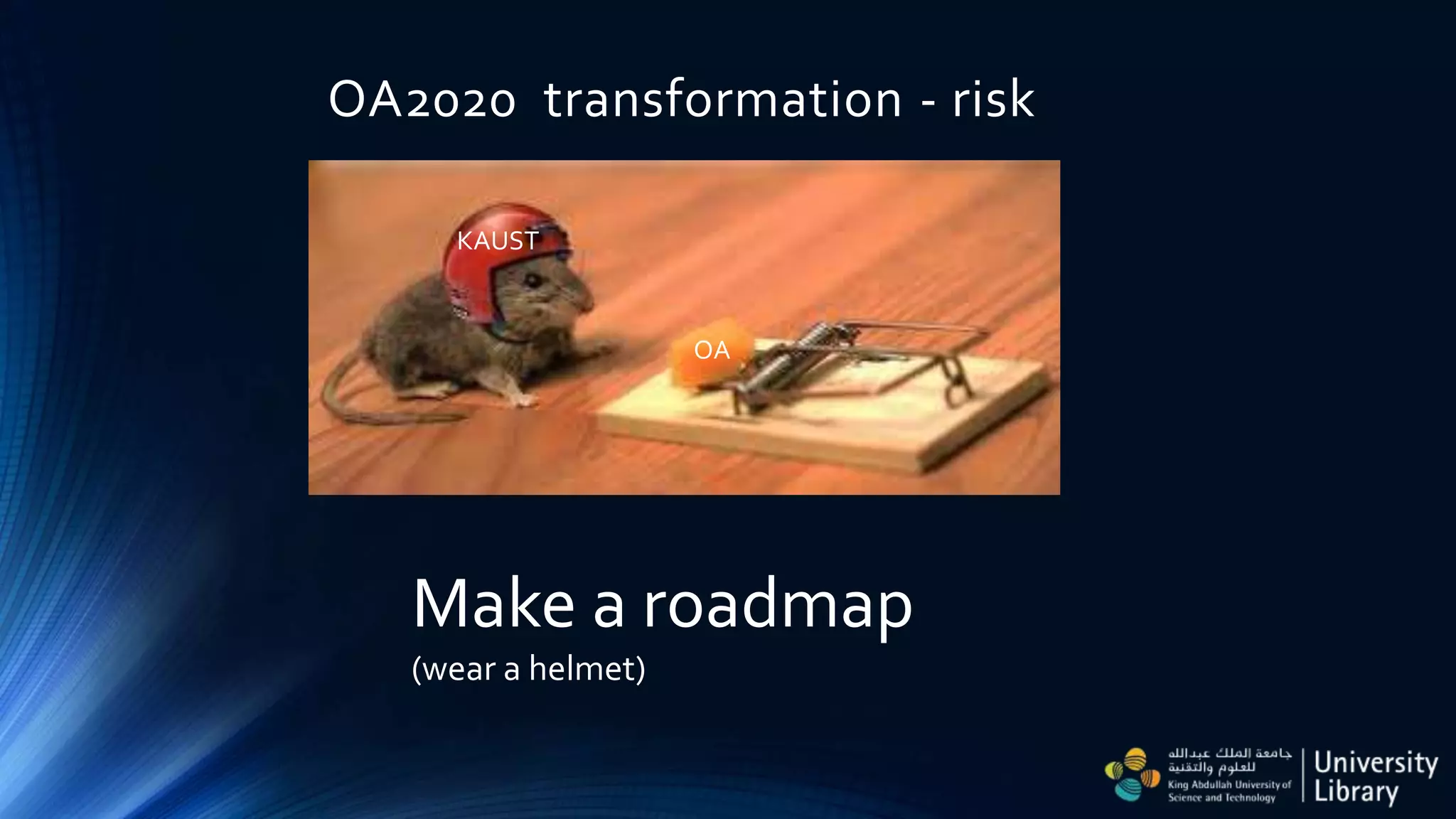
OA2020 transformation - risk
OA
KAUST
Make a roadmap
(wear a helmet)
1. Map your position
Policies, Infrastructure, Procedures, Stakeholders
Where are decisions regarding distribution of funds that cover subscriptions made and what steps
are necessary to reorganize their flow?
Are you part of a consortium that can coordinate and streamline processes and negotiations for
maximum impact?
Does your library have an acquisitions strategy that that aims to leverage opportunities for open
access?
Does your institution have an Open Access Policy that supports the transition of scholarly
communications to Open Access?
What channels can be used to achieve consensus with faculty and administration?
What steps, resources and authorizations are necessary to re-organize library support of new OA
workflows.
2. Analyze and Assess your leveraging power
Financial and Publication Data
• Gather data on the publishing trends of your institution’s researchers:
- Publisher and journal distribution,
- Share of OpenAccess publication vs paywalled publication,
- Share of corresponding authorship.
• Gather data on the financial transactions behind your researchers’ OA publications and your subscription
expenditures at the publisher and, if possible, journal level.
• Analyze and compare your subscription costs with OA publication costs.
• Establish more robust criteria for assessing the value of your current subscriptions by incorporating citation data (ie
what journals are your researchers citing in their own publications), publication data (in which journals do your
researchers publish) into COUNTER JR5 reports and other criteria relevant to your institution.
• Gain an understanding of how much of the content currently subscribed is available open access through alternative
sources.
• Build a business case to support your transformation plan (divesting of subscriptions and investing in open access)
based on the evidence gathered in your analysis and assessment exercises.
Fog of Data
• Web of Science
• Scopus
• Repository
• OneScience
• Others
Uncovering the relevance of OA in KAUST
Number of articles published in a given year:
 which publisher?
 which journals?
 behind paywall?
 in OA (hybrid journals)?
 in fully OA journal?
How much is being paid in APCs for OA publication with a given publisher?
How much is being spent on subscriptions?
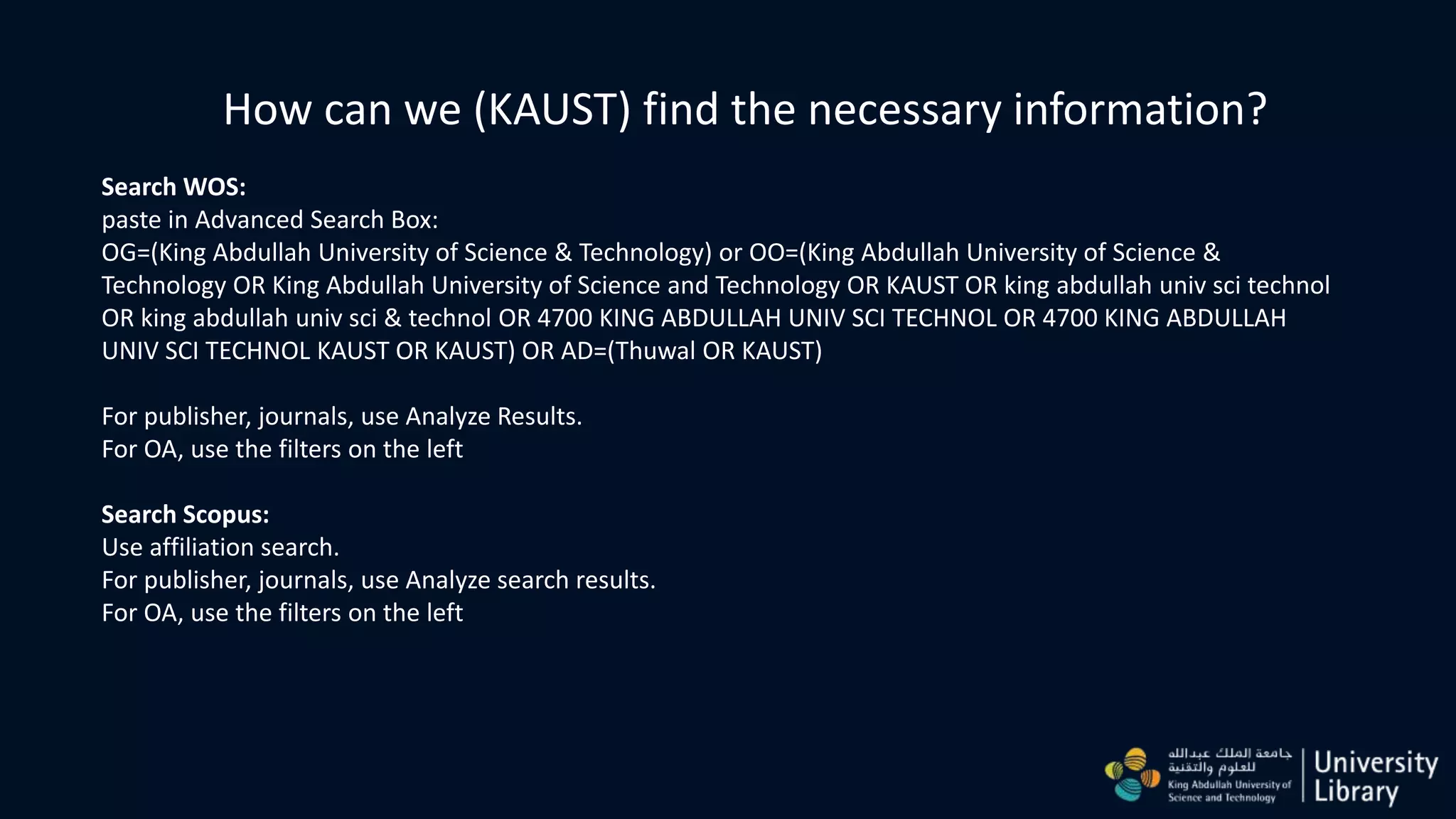
How can we (KAUST) find the necessary information?
Search WOS:
paste in Advanced Search Box:
OG=(King Abdullah University of Science & Technology) or OO=(King Abdullah University of Science &
Technology OR King Abdullah University of Science and Technology OR KAUST OR king abdullah univ sci technol
OR king abdullah univ sci & technol OR 4700 KING ABDULLAH UNIV SCI TECHNOL OR 4700 KING ABDULLAH
UNIV SCI TECHNOL KAUST OR KAUST) OR AD=(Thuwal OR KAUST)
For publisher, journals, use Analyze Results.
For OA, use the filters on the left
Search Scopus:
Use affiliation search.
For publisher, journals, use Analyze search results.
For OA, use the filters on the left
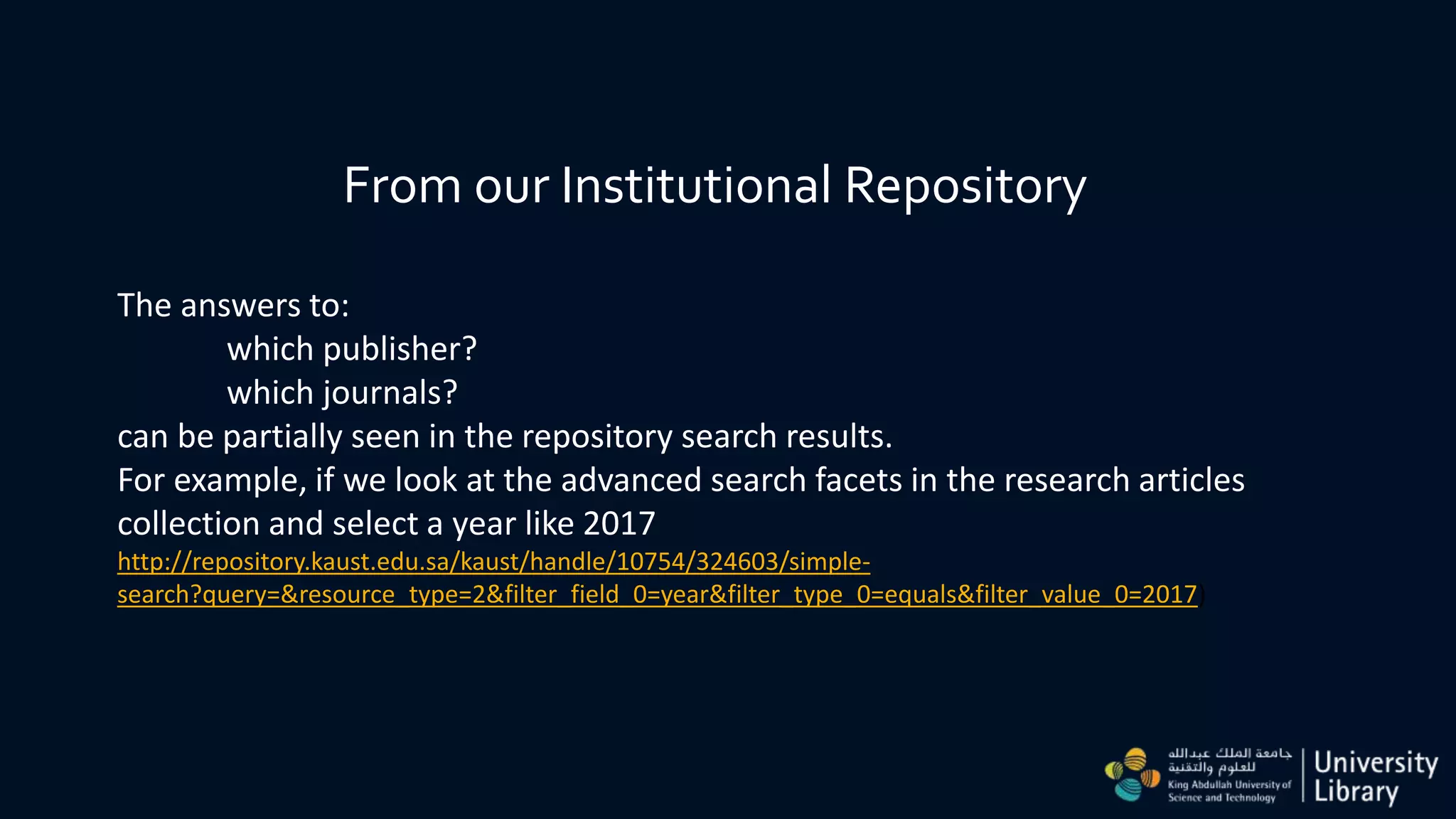
From our Institutional Repository
The answers to:
which publisher?
which journals?
can be partially seen in the repository search results.
For example, if we look at the advanced search facets in the research articles
collection and select a year like 2017
http://repository.kaust.edu.sa/kaust/handle/10754/324603/simple-
search?query=&resource_type=2&filter_field_0=year&filter_type_0=equals&filter_value_0=2017)
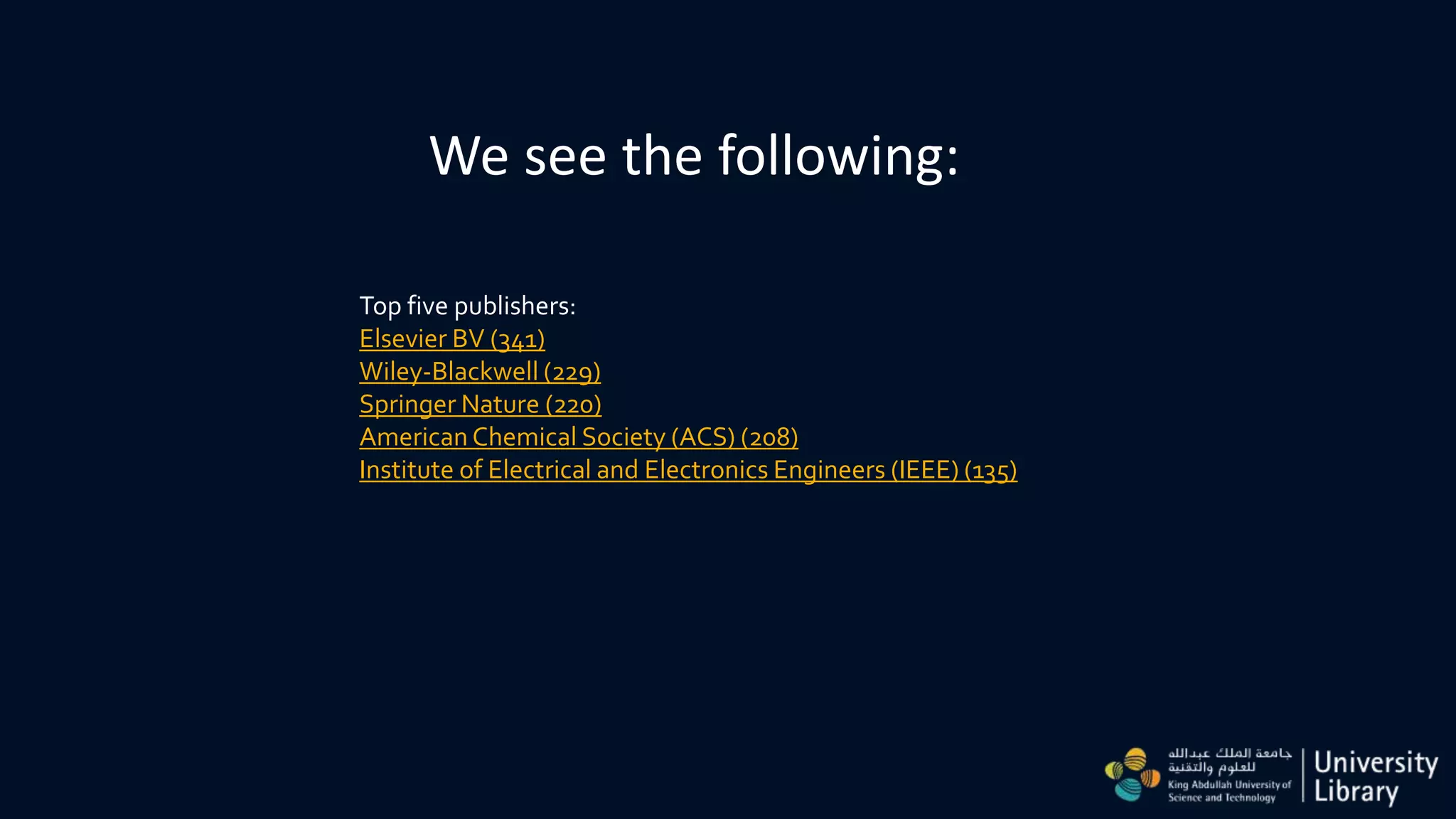
We see the following:
Top five publishers:
Elsevier BV (341)
Wiley-Blackwell (229)
Springer Nature (220)
American Chemical Society (ACS) (208)
Institute of Electrical and Electronics Engineers (IEEE) (135)
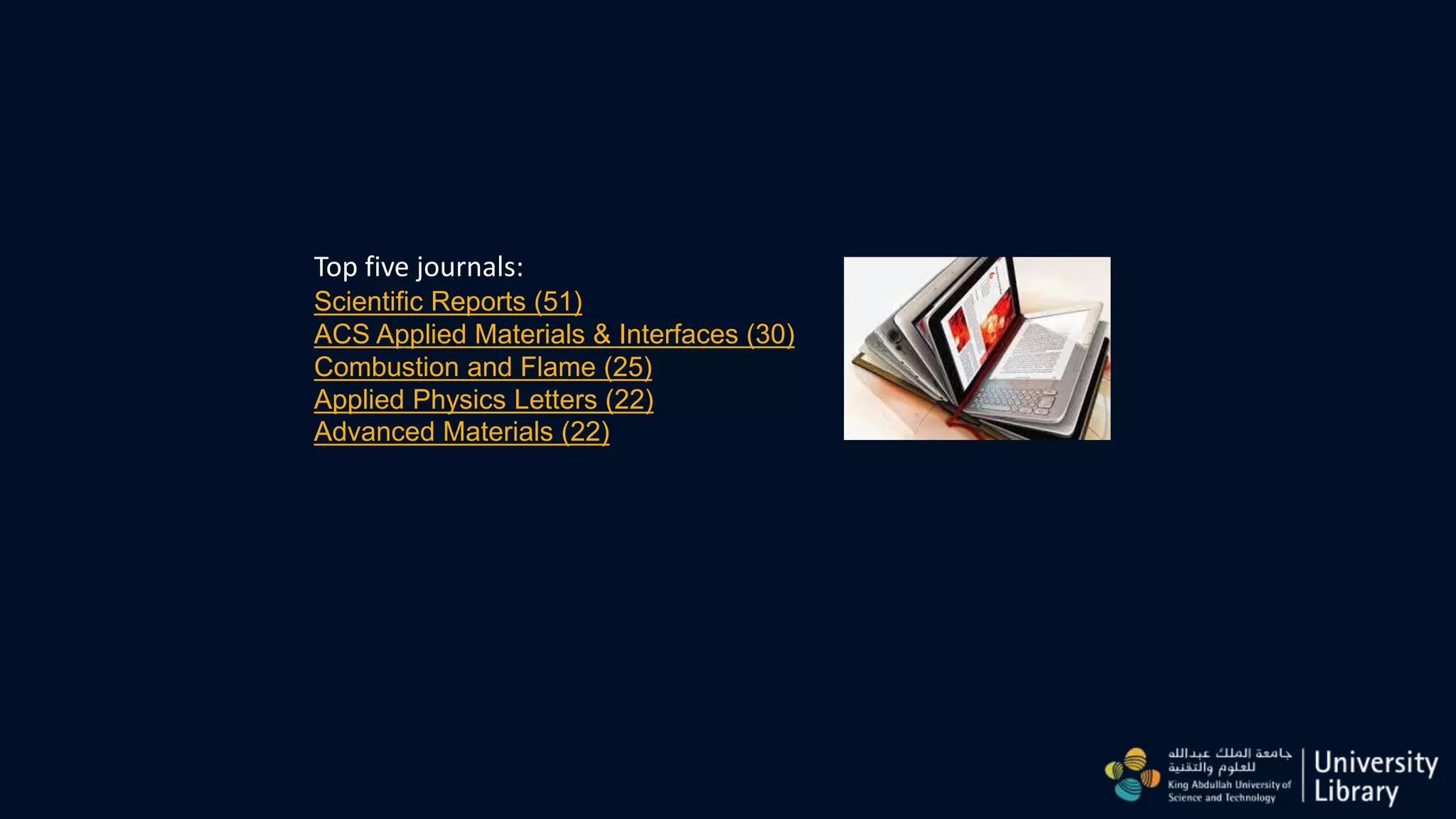
Top five journals:
Scientific Reports (51)
ACS Applied Materials & Interfaces (30)
Combustion and Flame (25)
Applied Physics Letters (22)
Advanced Materials (22)
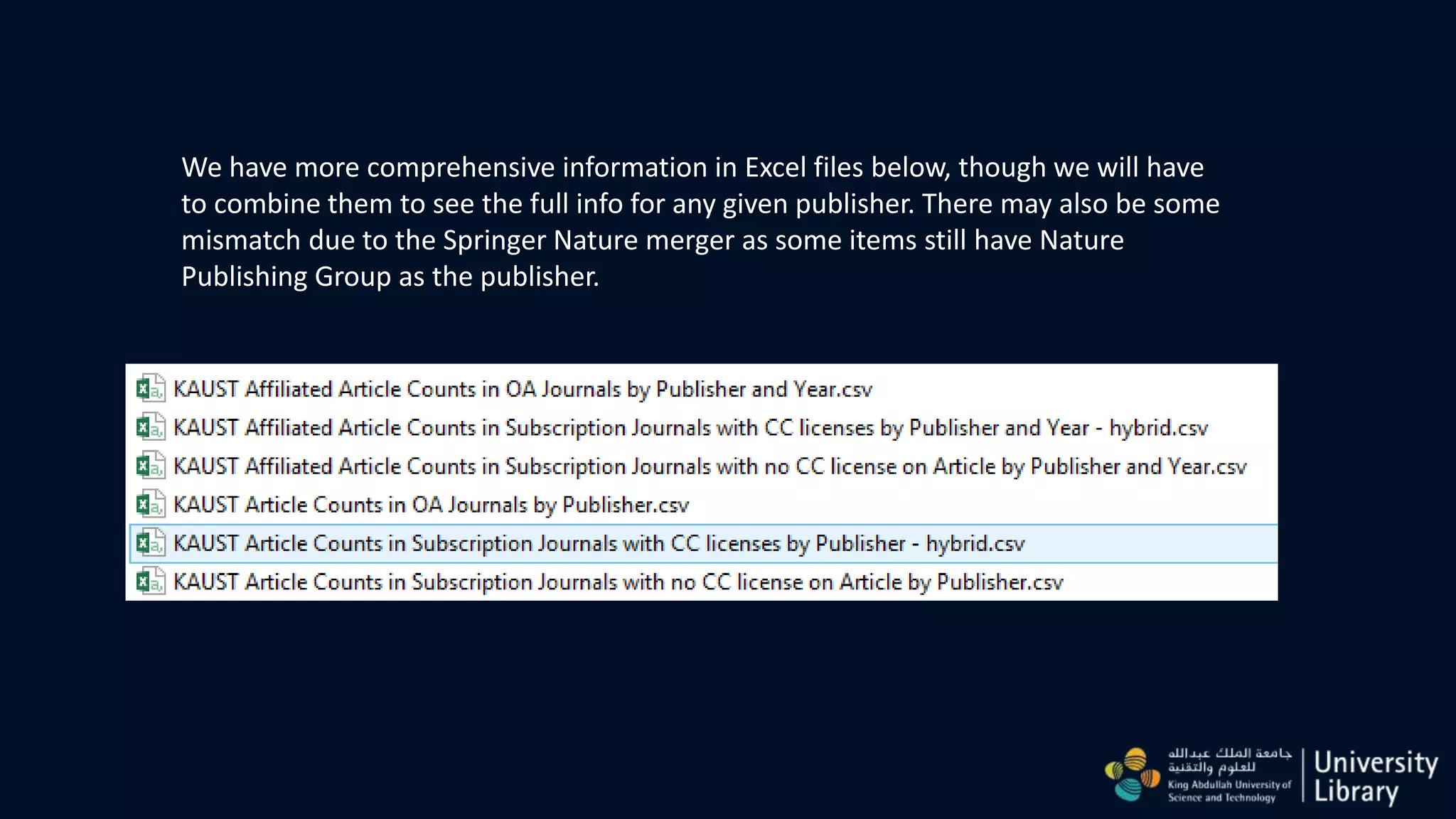
We have more comprehensive information in Excel files below, though we will have
to combine them to see the full info for any given publisher. There may also be some
mismatch due to the Springer Nature merger as some items still have Nature
Publishing Group as the publisher.
3.Engage your Author Communities
Survey your author communities to assess their understanding of the benefits of Open Access
publishing and gather insight into their discipline-specific and contextual publishing support needs.
Conduct outreach campaigns to advise faculty and researchers of their rights, options, impact
opportunities, local policies and the publishing support services available to them.
Present your business case to faculty and administration, consulting and advising with them as you
create your transformation plan.
4.Prepare and execute your transformation plan
• Introduce OA funds (where not already established) and merge subscription and publication
funds to a single budget.
• Determine criteria for “fair” publishing costs, develop discipline-based price caps and co-
funding schemes.
• Establish funds to support local and regional OA publishing initiatives.
• Set in place mechanisms to monitor costs and ensure transparency.
• Calculate and allocate (or secure) resources to cover transition costs.
Our recommendations
• Review ESAC recommendations
• Note joint COAR-UNESCO statement
• Collaborate with peers on license terms
• COLLECT & ANALYSE YOUR DATA
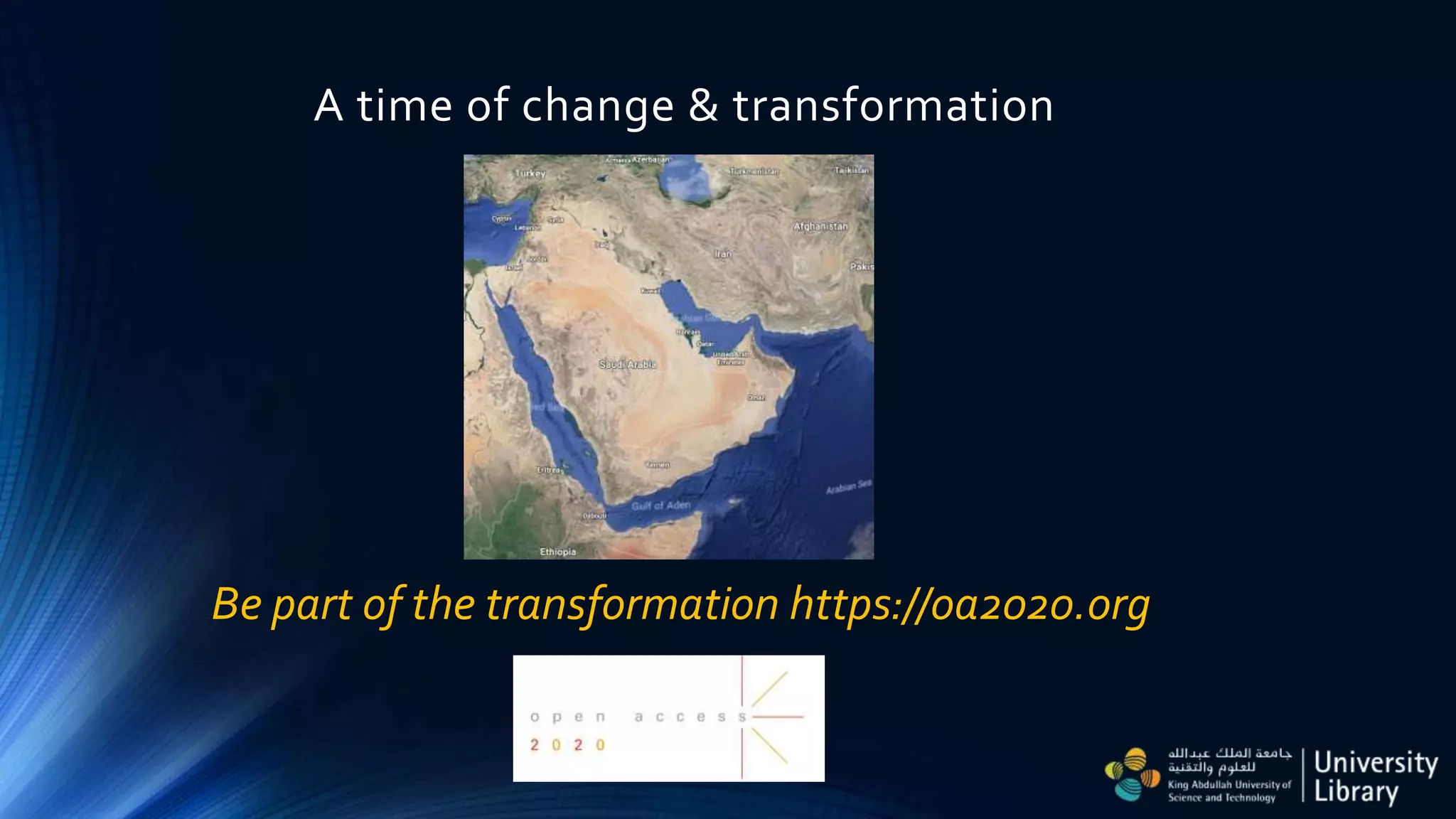
A time of change & transformation
Be part of the transformation https://oa2020.org
The future of academic publishing
References
Principles for OffsetAgreements. Jisc. https://www.jisc-
collections.ac.uk/Global/News%20files%20and%20docs/Principles-for-offset-agreements.pdf Earney, L (2017).
Offsetting and its discontents: challenges and opportunities of open access offsetting agreements. Insights 30(1):
11–24, DOI: https://doi.org/10.1629/uksg.345.
So did it work? Considering the impact of Finch 5 years on London Information International 6 December 2017
http://info-international.com/ Dr Danny Kingsley @dannykay68 Deputy Director, Scholarly Communication and
Research Services Cambridge University Library
OpenAccess, Library Subscriptions, and Article Processing Charges. Dear Publishers, we can’t afford to pay twice
thrice! QQML London 2016 J.K.Vijaykumar and MollyTamarkin
Take Action.The OA2020 Roadmap. OA2020 workshop, Munich 2018. Colleen Campbell, OA2020 Partner
Development. Max Planck Digital Library
Thank you
Dr. J. K. Vijayakumar (Library Director)
janardhanan.vijayakumar@kaust.edu.sa
Stephen Buck. PSE Subject Specialist
stephen.buck@kaust.edu.sa

UKSG 2018 Breakout - 'The Upside Down': exploring offset pricing models and article deposit terms at KAUST- Buck kaust

  • 1.
    Exploring off-set pricingmodels and article deposit terms at King Abdullah University of Science & Technology (KAUST) TheUpsideDown
  • 2.
    at KAUST • Whatis KAUST? • An overview of offset pricing models • An offset model in detail (IOP) • An attempt to get OA terms into our vendor licenses • The OA roadmap
  • 3.
  • 4.
    International graduate researchuniversity dedicated to advancing science and technology through: • interdisciplinary research • education • innovation KAUST seeks to advance scientific research and collaboration, transcending disciplines and boundaries for the benefit of science.
  • 5.
    Research addresses challengesof global significance, in the areas of water, food, energy and the environment. KAUST is committed to: • the highest standards of research and academic excellence • attracting and developing top global talents based on merit • fostering a spirit of enterprise encompassing innovation and opportunity to catalyze the economic development of Saudi Arabia
  • 6.
  • 7.
  • 8.
    KAUST University LibraryStaff Structure
  • 9.
    The pricing oflibrary resources Normal pricing Library journal pricing
  • 10.
  • 11.
    Offset Pricing Complex modelswhere Article Processing Charges (APCs) are taken off (off-set) the total subscription charges
  • 12.
    Article Processing Charges Theauthor/university/corporation/institution pays a charge per article (gold open access) for the author to publish in a gold open access journal
  • 13.
    Defining the Problem Universityprovides context: Space, utilities, resources, equipment, technologies, information Funding agencies provide funds: Researchers provide ideas and skills: Raw data, reports, processed data Publishers provide access: Editorial services, indexing, abstracting, metadata, marketing
  • 14.
    Open Access Types Greenaccess funded by the university Gold Access funded by Articles Processing Charges (APCs) Other means How important are these terms? More important to understand your options with publishers and your negotiating strengths What did it cost to produce these articles? How much are we paying to get them back?
  • 15.
    KAUST OA Policyfor Scholarly Research Articles Our policy applies to all University faculty, research scientists, post-doctoral fellows, students and employees who author or co-author published, scholarly articles while working at or enrolled in the University. Each faculty member or researcher will provide an electronic copy of the author's final version of each article no later than the date of its publication at no charge in accordance with the guidelines published from time to time by the Office of the Vice President for Academic Affairs 72% compliance rate 1802 files (2017) 81% compliance rate 344 files (2018 to date)
  • 16.
    Principles of offsettingsystems (JISC 2015) Systems should operate in the context of a transition to fully gold open access and support that transition. A system should be: • inclusive, • remove barriers (both to authors and their institutions) to OA • and ensure that all the outputs of a subscribing institution are immediately open on publication under licenses and other conditions which meet funders’ mandates and other requirements. These systems will be designed to enable the publisher’s journals to become fully OA as soon a tipping point is reached
  • 17.
    More principles ofoffsetting systems (JISC 2015) Offset systems should not be restricted to institutions that subscribe to large collections of journals (the big deal) but should also apply to all institutions that subscribe to individual journals with a hybrid OA offering from a publisher. Publishers should apply global reductions to the cost of subscription in respect of increasing volumes of open access articles in hybrid journals in line with their stated “No Double Dipping Policies”.
  • 18.
    Even more principlesof offsetting systems (JISC 2015) Systems should operate: on a “cash basis” and avoid the additional administration and work involved in handling vouchers (particularly if those vouchers have an expiry date). Where an offset system does operate on the basis of vouchers, they must be available to the institution (which processes the transactions) rather than to individual authors.
  • 19.
    Some APC models Atthe start of 2017 JISC had offsetting agreements in place with the following publishers: · De Gruyter: hybrid APCs for articles published in one year are offset against institutions’ expenditure on subscription and licence fees in the following year · IOP (Institute of Physics) Publishing: hybrid APCs for articles published in one year are offset against institutions’ expenditure on subscription and licence fees in the following year · SAGE Publishing (including the Royal Society of Medicine and the Institution of Mechanical Engineers): discount on APCs in hybrid titles, requires a code · Springer: ‘flipped’ model, where UK subscription spend has created a ‘publishing pot’ to fund APCs. An additional transition fee covers access to subscribed content · Taylor & Francis: institutions receive vouchers which offer a significant discount on APCs. The number of vouchers is based on expenditure · Georg Thieme Verlag: complimentary APCs are included with subscription agreement · Wiley: institutions are eligible for a tiered credit based on overall level of expenditure. The credit is added to an institutional account, which is drawn down against APCs.
  • 20.
    Consequences of nooffsetting Elsevier, the one major publisher with no offset deal in place, has seen high growth. There is currently no penalty for publishers who reject offsetting deals Profits No penalty!
  • 21.
  • 22.
    Intact (transparent infrastructurefor article charges)aims at establishing transparent and efficient procedures to manage APCs for OA publications Joint understanding of offsetting (March 2016) • Offset deals are pilot models (in transition)and should therefore lead to a proper OA model (agreement between publishers and institutions) • Opportunity to overcome DYSFUNCTIONALITIES experienced in the current subscription system and to improve the business of scholarly publishing • Need mechanisms for offsetting agreements, reduce workloads etc. • Tools and infrastructure should be in place http://esac-initiative.org/joint-understanding-of-offsetting/
  • 23.
    Rising prices • Ifan OA model is meant to replace the subscription model, why does expenditure on both APCs and subscriptions continue to rise so inexorably? • It does not matter that many of the offsetting agreements are pilots and have not yet been fully reviewed. • The fact that the expenditure lines are not flat or falling in either case makes offsetting agreements resemble nothing more than an ‘advantageous lock-in for status quo publishers’.
  • 24.
    Different models ofoffset pricing Royal Society of Chemistry (RSC) American Chemical Society (ACS) Springer Institute of Physics (IOP)
  • 25.
    Offset Models –Royal Society of Chemistry (RSC) • Voucher codes to make papers available via OA free of charge • Number of vouchers calculated by dividing the subscription the RSC receives from an institution by 1,600 GBP (the APC of the RSC)
  • 26.
    Offset Models –American Chemical Society (ACS) Credits to fund OA publishing options from ACS
  • 27.
    Offset Models- MIT-SpringerAuthor Rights Agreement • Allows MIT authors to post article (or author’s departmental web pages) after 9 months • May be archived and/or deposited in any repository for noncommercial purposes • Applicable to articles published in a Springer journal subscribed (2009-2017)
  • 28.
  • 29.
  • 30.
    The Model The movetowards open access by some institutions or countries in advance of other institutions or countries increases costs to those ‘early adopters’, because they pay for free access to their research for the rest of the world while still paying for access to the rest of the world’s research.
  • 31.
    The Model This modelensures a balance between: • local offsetting (against an institution’s subscription and licence fees) • global offsetting (global reductions in subscription and licence fees). As the proportion of hybrid articles grows the balance moves on a sliding scale from 90% local and 10% global to 10% local and 90% global.The model takes income from hybrid APCs and allocates it in these proportions to reduce local and global costs. Why? As the proportion of hybrid open access articles grows in a journal or collection of journals, customers which do not themselves support gold open access will still demand reductions in subscription and licence fees in respect of open access content.
  • 32.
    The Model At lowlevel of OA publication most of the cost is offset locally to the universities At high level of OA publication the balance moves towards greater global price reductions in prices.
  • 33.
    Proportion of articlesin all relevant subscription journals published on an open access basis with payment of an APC Proportion of hybrid open access income offset locally against subscription and licence costs of those paying hybrid APCs Proportion of hybrid open access income offset globally through discounts on subscription and licence fees 0% 0% 0% 1-4% 90% 10% 5-9% 80% 20% 10-14% 70% 30% 15-19% 60% 40% 20-24% 50% 50% 25-29% 40% 60% 30-34% 30% 70% 35-39% 20% 80% 40%+ 10% 90%
  • 34.
    IOP Publishing offsettingand library- funded APCs IOP offer an hybrid open access publishing option on the majority of their subscription titles as well as three Gold open access journals. There are options to help institutions support their authors on the cost of open access, while recognising the additional spend on top of their license fee. IOP identifies articles for institution validation for funding, and offset funds spent on hybrid open access with the institution’s license fee.
  • 35.
    Offset Support IOP rebatea portion of the hybrid APCs spent with IOP over the previous year, up to the value of the institution’s license fee. The percentage rebate applied depends on the proportion of open access articles in our subscription titles, as IOP offset a portion locally (directly to the institution). The remainder is offset globally (via a reduction to all customers). This ensures a fair process and guarantees that no one is paying twice for IOP content.
  • 36.
    This should avoid‘double dipping’ paying the subscription paying the APC
  • 37.
    KAUST workflow forOpen Access • Articles from KAUST authors are automatically identified for this arrangement based on the corresponding (submitting) authors’ email domain.The authors are notified of possibleOA funding. • Once an article is accepted, a validation email is sent to KAUST to confirm inclusion in the arrangement.This includes an attached PDF of the article. • KAUST confirm / deny funding for the article by email within 3 working days. If no response, the article will revert to non-OA. • If KAUST approve funding, the article is made open access and published, with the charge applied to KAUST’s institutionalOA account. • Every quarter, IOP invoices KAUST for the relevant amount and includes a list of published articles. • At the end of the year, Offset calculations will be done based on the qualifying number of open access articles published.
  • 39.
    What IOP needsfrom us • Confirm email domain(s) and institution(s) that qualify for funding. • Confirm contact address for validation emails, and ability to respond within 3 working days. • Pay quarterly invoices as appropriate. • Provide any additional information for ourOpen Access web pages.
  • 40.
    Where to publish? Theuniversity library cannot and should not tell researchers where to publish. We are promoting this pilot model by IOP to offset the costs of hybrid open access publishing.
  • 41.
    Convincing Faculty Not easyto convince faculty that this is important Why change a ‘successful’ (from their viewpoint) model? If publishing in Cell and Nature has been always been an ambition it will be hard to change that for some concept of the ‘greater good’ of OA. We need compelling arguments and this means data.
  • 42.
    The Future ofOff Set Pricing • It will not exist • Nobody will remember what it is • It will only be bad dream This will be a good thing
  • 43.
    Alchemy All offset modelsare works in progress. Let us turn the subscription money into publishing money
  • 44.
    Joint COAR-UNESCO Statementon OA • There is no “one size fits all” solution to implementing OA • Consider developing countries • Consider institutions with small budgets • Avoid large scale monopoly and concentration on the international publishing industry • Encourage non-APC based journals that support OA and enhance the repositories with innovative systems https://en.unesco.org/news/joint-coar-unesco-statement-open-access
  • 45.
    Extra Costs ofOpen Access Counting the Costs of Open Access: http://www.researchconsulting.co.uk/wp- content/uploads/2014/11/Research-Consulting- Counting-the-Costs-of-OA-Final.pdf (accessed 20-03- 2018) A UK study of the costs of full-scale implementation of OA publishing to comply with the British mandate concludes that institutions’ management of one single OA publication takes two hours and incurs administration costs of £81.
  • 46.
    How do weget the OA terms we want into our license agreements? MeBrick wall Head
  • 47.
    How do weget the OA terms we want into our license agreements? Long drawn out difficult process Long term vision necessary Can take years – literally No guarantee of ever reaching conclusion Ambiguity Frustration for staff involved Publishers quite content to have OA andT&DM guidelines on their websites.These can be changed overnight Publishers reluctant to shorten embargo periods Publishers need to be convinced that their bottom line will not suffer We need evidence to support our viewpoint.The OA for ‘a better world’ argument will not do.
  • 48.
    New licence terms:The Wild West In our experience: • Offset agreements usually not disclosed • Increased competition should reduce costs • No individual institution models yet • We started negotiating with others to have an institutional level off- set model agreed and signed via subscription licences • The RSC gold-for-gold model
  • 49.
    Article Deposit Terms KAUSTUniversity Library is contacting all its vendors/publishers as we attempt, through a process started last year, to standardize processes in relation to Open Access (OA), Article Processing Charges (APCs) and Text and Data Mining (TDM). Please can you fill in the fields below where relevant/possible? Open Access: Following on from last year’s discussions we would like to propose the text below (relating to Green Open Access) for inclusion in all future licensing agreements. The subscriber (KAUST) has adopted an open access policy pursuant to which its affiliated researchers, faculty, students and staff grant to the University a non-exclusive permission to make available their scholarly research articles for the purpose of open dissemination. In connection therewith, and with publisher name and the partner publishers’committed support towards Green Open Access, the parties hereby agree that final versions of articles authored by KAUST affiliated researchers, faculty, students and staff can be deposited in KAUST research repository immediately after acceptance of the work (or 6 months after publication).
  • 50.
    Article Deposit Terms Wedo not believe that the inclusion of the above will compromise publisher name or place it at any commercial disadvantage. Please can you: a/ indicate acceptance of wording above for inclusion in future license agreements. b/ propose alternative wording for inclusion on future license agreements c/ offer alternative proposal Article Processing Charges: Do you have a system of APCs? Yes or No. If Yes please can you provide an explanation of: a/ how your system works b/ specifically what workflows are involved for the library? The information above is of great importance to KAUST University Library as we attempt to provide accurate, clear and concise information to our research community around issues of Scholarly Communication.
  • 51.
    No evidence ofthe need for embargos “No persuasive evidence exists that greater public access as provided by the NIH policy has substantially harmed subscription supported STM publishers over the last four years or threatens the sustainability of their journals.” Committee for Economic Development DigitalConnections CouncilThe Future ofTaxpayer Funded Research:WhoWill Control Access to the Results 2012 “We saw no evidence that short embargo periods harm subscription publishers.” Business, Innovation and Skills Committee – Fifth Report: Open Access 2013 “The evidence fails to justify publishers’ demand for longer embargo periods on publicly funded research.” Impact of Social Sciences. 2014 “But let’s get something straight.There is no evidence that permitting researchers to make a copy of their work available in a repository results in journal subscriptions being cancelled. None.” Half life is half the story,. 16th October 2015 Danny Kingsley. LII Dec 2017
  • 52.
    Sustainable Embargos are putin place to ensure publisher sustainability Managing embargos is not sustainable for libraries Of all the way researchers share their work institutional repositories are one of the very few that observe embargos Danny Kingsley LII. Dec. 2017
  • 53.
  • 54.
    OA2020 Transformation A growingnumber of research organizations want to establish an international initiative which aims to convert the majority of today’s scholarly journals from subscription to (OA) publishing. This is the result of the 12th Berlin Open Access Conference hosted by the Max Planck Society (Dec. 2015) An Expression of Interest invites all parties involved in scholarly publishing to collaborate on a swift and efficient transition for the benefit of scholarship and society at large. By cooperating at international level we can affect change
  • 55.
    What is theOA 2020 initiative? • OA2020 is a global initiative endorsed by a growing number of researchers, libraries, institutions and organizations committed to accelerating the transition to universal open access by transforming today’s scholarly journals, currently locked behind paywalls, to open access. • The strategy is based on reallocating expenditures that are currently used for journal subscriptions to cover the costs of open access publishing models. • As a global alliance, OA2020 can meet the major scholarly publishers at eye-level and foster OA business models that preserve the publishing services upon which researchers currently rely while liberating the fruits of their research and the full potential of a 21st century digital environment. • OA2020 is the fastest path toward an open scholarly communications system in which outputs are not only open but also re-usable and the costs behind their dissemination are transparent and economically sustainable.
  • 56.
    OA2020 transformation -risk OA KAUST Make a roadmap (wear a helmet)
  • 57.
    1. Map yourposition Policies, Infrastructure, Procedures, Stakeholders Where are decisions regarding distribution of funds that cover subscriptions made and what steps are necessary to reorganize their flow? Are you part of a consortium that can coordinate and streamline processes and negotiations for maximum impact? Does your library have an acquisitions strategy that that aims to leverage opportunities for open access? Does your institution have an Open Access Policy that supports the transition of scholarly communications to Open Access? What channels can be used to achieve consensus with faculty and administration? What steps, resources and authorizations are necessary to re-organize library support of new OA workflows.
  • 58.
    2. Analyze andAssess your leveraging power Financial and Publication Data • Gather data on the publishing trends of your institution’s researchers: - Publisher and journal distribution, - Share of OpenAccess publication vs paywalled publication, - Share of corresponding authorship. • Gather data on the financial transactions behind your researchers’ OA publications and your subscription expenditures at the publisher and, if possible, journal level. • Analyze and compare your subscription costs with OA publication costs. • Establish more robust criteria for assessing the value of your current subscriptions by incorporating citation data (ie what journals are your researchers citing in their own publications), publication data (in which journals do your researchers publish) into COUNTER JR5 reports and other criteria relevant to your institution. • Gain an understanding of how much of the content currently subscribed is available open access through alternative sources. • Build a business case to support your transformation plan (divesting of subscriptions and investing in open access) based on the evidence gathered in your analysis and assessment exercises.
  • 59.
    Fog of Data •Web of Science • Scopus • Repository • OneScience • Others
  • 60.
    Uncovering the relevanceof OA in KAUST Number of articles published in a given year:  which publisher?  which journals?  behind paywall?  in OA (hybrid journals)?  in fully OA journal? How much is being paid in APCs for OA publication with a given publisher? How much is being spent on subscriptions?
  • 61.
    How can we(KAUST) find the necessary information? Search WOS: paste in Advanced Search Box: OG=(King Abdullah University of Science & Technology) or OO=(King Abdullah University of Science & Technology OR King Abdullah University of Science and Technology OR KAUST OR king abdullah univ sci technol OR king abdullah univ sci & technol OR 4700 KING ABDULLAH UNIV SCI TECHNOL OR 4700 KING ABDULLAH UNIV SCI TECHNOL KAUST OR KAUST) OR AD=(Thuwal OR KAUST) For publisher, journals, use Analyze Results. For OA, use the filters on the left Search Scopus: Use affiliation search. For publisher, journals, use Analyze search results. For OA, use the filters on the left
  • 62.
    From our InstitutionalRepository The answers to: which publisher? which journals? can be partially seen in the repository search results. For example, if we look at the advanced search facets in the research articles collection and select a year like 2017 http://repository.kaust.edu.sa/kaust/handle/10754/324603/simple- search?query=&resource_type=2&filter_field_0=year&filter_type_0=equals&filter_value_0=2017)
  • 63.
    We see thefollowing: Top five publishers: Elsevier BV (341) Wiley-Blackwell (229) Springer Nature (220) American Chemical Society (ACS) (208) Institute of Electrical and Electronics Engineers (IEEE) (135)
  • 64.
    Top five journals: ScientificReports (51) ACS Applied Materials & Interfaces (30) Combustion and Flame (25) Applied Physics Letters (22) Advanced Materials (22)
  • 65.
    We have morecomprehensive information in Excel files below, though we will have to combine them to see the full info for any given publisher. There may also be some mismatch due to the Springer Nature merger as some items still have Nature Publishing Group as the publisher.
  • 66.
    3.Engage your AuthorCommunities Survey your author communities to assess their understanding of the benefits of Open Access publishing and gather insight into their discipline-specific and contextual publishing support needs. Conduct outreach campaigns to advise faculty and researchers of their rights, options, impact opportunities, local policies and the publishing support services available to them. Present your business case to faculty and administration, consulting and advising with them as you create your transformation plan.
  • 67.
    4.Prepare and executeyour transformation plan • Introduce OA funds (where not already established) and merge subscription and publication funds to a single budget. • Determine criteria for “fair” publishing costs, develop discipline-based price caps and co- funding schemes. • Establish funds to support local and regional OA publishing initiatives. • Set in place mechanisms to monitor costs and ensure transparency. • Calculate and allocate (or secure) resources to cover transition costs.
  • 68.
    Our recommendations • ReviewESAC recommendations • Note joint COAR-UNESCO statement • Collaborate with peers on license terms • COLLECT & ANALYSE YOUR DATA
  • 69.
    A time ofchange & transformation Be part of the transformation https://oa2020.org
  • 70.
    The future ofacademic publishing
  • 71.
    References Principles for OffsetAgreements.Jisc. https://www.jisc- collections.ac.uk/Global/News%20files%20and%20docs/Principles-for-offset-agreements.pdf Earney, L (2017). Offsetting and its discontents: challenges and opportunities of open access offsetting agreements. Insights 30(1): 11–24, DOI: https://doi.org/10.1629/uksg.345. So did it work? Considering the impact of Finch 5 years on London Information International 6 December 2017 http://info-international.com/ Dr Danny Kingsley @dannykay68 Deputy Director, Scholarly Communication and Research Services Cambridge University Library OpenAccess, Library Subscriptions, and Article Processing Charges. Dear Publishers, we can’t afford to pay twice thrice! QQML London 2016 J.K.Vijaykumar and MollyTamarkin Take Action.The OA2020 Roadmap. OA2020 workshop, Munich 2018. Colleen Campbell, OA2020 Partner Development. Max Planck Digital Library
  • 72.
    Thank you Dr. J.K. Vijayakumar (Library Director) janardhanan.vijayakumar@kaust.edu.sa Stephen Buck. PSE Subject Specialist stephen.buck@kaust.edu.sa

Editor's Notes

  • #4 Ireland or Germany not listed?
  • #9 No OA or RDM librarian
  • #13 Swings & roundabouts
  • #14 Viscous circle
  • #16 In parallel with our Gold OA aspirations
  • #52 My colleague told me there was a blog in the Scholarly Kitchen that said it is too soon to know this and that a longer time period is neeed