Dr Martin Turner
  policy officer
today’s talk


1.   AMRC
     Who we are and what we do
     Benefits of membership
2.   Our members
     Who are they?
     Research funding opportunities
3.   Peer review and the AMRC principles
about AMRC


• Association of Medical Research Charities

• Represent 125 member charities

• Support our members to enable them to
  be effective research funders
what we do


• Support
       Provide guidance and training to members
       Peer review audit
• Leadership
      Develop solutions to key challenges facing the sector
      Speak on behalf of the sector
• Influence
       Campaigning to help researchers
       Sitting on boards and committees
what we do
benefits of membership


• A united and strong public voice
       Working together to develop and push our positions
       Sector-wide data reinforces our arguments
• Opportunities for collaboration with public and private partners
       We act as a hub and offer guidance
       Spreading best practice
• Access to support and unique funding streams
       AcoRD and CRSF
       Grant-making trusts recognise AMRC membership as a
       quality-mark
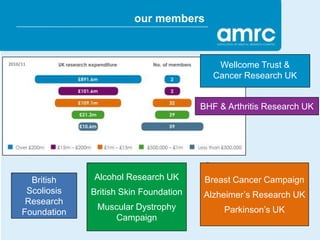
our members


2010/11                                         Wellcome Trust &
                                               Cancer Research UK


                                            BHF & Arthritis Research UK


       British    Alcohol Research UK        Breast Cancer Campaign
      Scoliosis   British Skin Foundation   Alzheimer’s Research UK
      Research
                   Muscular Dystrophy            Parkinson’s UK
     Foundation
                      Campaign
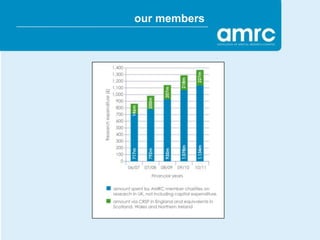
our members
our members


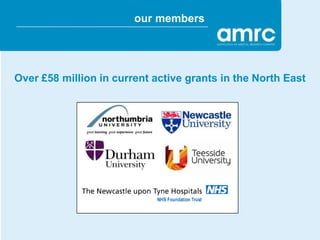
Over £58 million in current active grants in the North East
our members


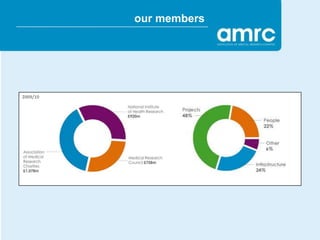
2009/10
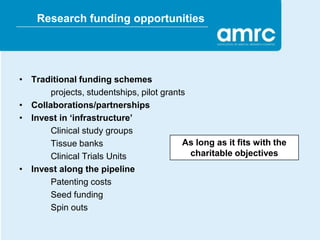
Research funding opportunities


• Traditional funding schemes
       projects, studentships, pilot grants
• Collaborations/partnerships
• Invest in ‘infrastructure’
       Clinical study groups
       Tissue banks                       As long as it fits with the
       Clinical Trials Units                charitable objectives
• Invest along the pipeline
       Patenting costs
       Seed funding
       Spin outs
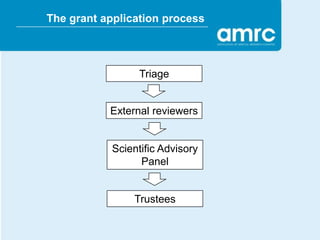
The grant application process


                  Triage


           External reviewers


            Scientific Advisory
                  Panel


                Trustees
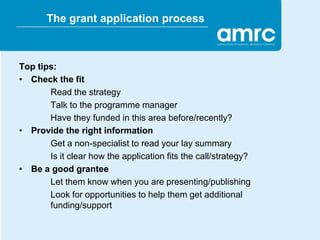
The grant application process


Top tips:
• Check the fit
       Read the strategy
       Talk to the programme manager
       Have they funded in this area before/recently?
• Provide the right information
       Get a non-specialist to read your lay summary
       Is it clear how the application fits the call/strategy?
• Be a good grantee
       Let them know when you are presenting/publishing
       Look for opportunities to help them get additional
       funding/support
AMRC’s principles of peer review


        Same standards for all AMRC charities
AMRC’s principles of peer review


Member charities developed five principles, based on agreed
good practice:

•    Accountability
•    Balance
•    Independence
•    Rotation
•    Impartiality
AMRC’s principles of peer review


Accountability:
• Have a research strategy and information about funded research
  available online
• Publish scientific advisory panel members’ names and details of
  the peer review process online
AMRC’s principles of peer review


Balance:
• Ensure scientific advisory panels reflect a fair balance of
  experience and scientific disciplines
• Use a variety of methods to select internal and external peer
  reviewers
AMRC’s principles of peer review


Independence:
• Charities’ staff do not make scientific judgment but can do
  “triage”
• Trustees may sit on the scientific advisory panel, but should
  generally act as observers with no voting rights
• The procedure for assigning reviewers to applications is fair
• There is a clear line of communication between the scientific
  advisory panel and the charity’s board of trustees
AMRC’s principles of peer review


Rotation:
• Appoint internal peer reviewers, including the committee chair,
  for a fixed term of office
• Scientific advisory panel members serve for a period of three
  years, with the option of renewing their term for a further two
  or three years
AMRC’s principles of peer review


Impartiality:
• A majority of the members of charities scientific advisory
  panels are not active grant holders (beneficiaries)
• A code of conduct and conflict of interest policy is in place
• Would-be beneficiaries are not present when their applications
  are discussed or when decisions are made
AMRC’s principles of peer review


Why do charities use peer review?

• Accepted by the research community

• Membership criteria for AMRC and other partnership schemes

• Provides relatively unbiased view for trustees

• Panels provide broad basis of advice and expertise drawn into
   the work of the charity
AMRC’s principles of peer review


Peer review aims to ensure that the research is:

• Scientifically valid, significant, original

• Timely and achievable

• Not unnecessarily duplicating other work

• Using appropriate methodologies – including animal work

• Done by researchers with the right skills and facilities

• Offering value for money

• Relevant to the charity’s aims and objectives

• Contributing to the charity’s strategy
AMRC’s principles of peer review


However, peer review is also:

• A risk to confidentiality

• Not a fraud detection system

• Incestuous in small communities

• Time consuming and costly to administer

• Subjective
final thoughts


• Charities are an important source of funding for universities

• Different funding models

• All high quality

• More than just research funders
Thank you

Email: m.turner@amrc.org.uk

Follow me on twitter: @amrc

Amrc

  • 1.
    Dr Martin Turner policy officer
  • 2.
    today’s talk 1. AMRC Who we are and what we do Benefits of membership 2. Our members Who are they? Research funding opportunities 3. Peer review and the AMRC principles
  • 3.
    about AMRC • Associationof Medical Research Charities • Represent 125 member charities • Support our members to enable them to be effective research funders
  • 4.
    what we do •Support Provide guidance and training to members Peer review audit • Leadership Develop solutions to key challenges facing the sector Speak on behalf of the sector • Influence Campaigning to help researchers Sitting on boards and committees
  • 5.
  • 7.
    benefits of membership •A united and strong public voice Working together to develop and push our positions Sector-wide data reinforces our arguments • Opportunities for collaboration with public and private partners We act as a hub and offer guidance Spreading best practice • Access to support and unique funding streams AcoRD and CRSF Grant-making trusts recognise AMRC membership as a quality-mark
  • 8.
    our members 2010/11 Wellcome Trust & Cancer Research UK BHF & Arthritis Research UK British Alcohol Research UK Breast Cancer Campaign Scoliosis British Skin Foundation Alzheimer’s Research UK Research Muscular Dystrophy Parkinson’s UK Foundation Campaign
  • 9.
  • 10.
    our members Over £58million in current active grants in the North East
  • 11.
  • 12.
    Research funding opportunities •Traditional funding schemes projects, studentships, pilot grants • Collaborations/partnerships • Invest in ‘infrastructure’ Clinical study groups Tissue banks As long as it fits with the Clinical Trials Units charitable objectives • Invest along the pipeline Patenting costs Seed funding Spin outs
  • 13.
    The grant applicationprocess Triage External reviewers Scientific Advisory Panel Trustees
  • 14.
    The grant applicationprocess Top tips: • Check the fit Read the strategy Talk to the programme manager Have they funded in this area before/recently? • Provide the right information Get a non-specialist to read your lay summary Is it clear how the application fits the call/strategy? • Be a good grantee Let them know when you are presenting/publishing Look for opportunities to help them get additional funding/support
  • 15.
    AMRC’s principles ofpeer review Same standards for all AMRC charities
  • 16.
    AMRC’s principles ofpeer review Member charities developed five principles, based on agreed good practice: • Accountability • Balance • Independence • Rotation • Impartiality
  • 17.
    AMRC’s principles ofpeer review Accountability: • Have a research strategy and information about funded research available online • Publish scientific advisory panel members’ names and details of the peer review process online
  • 18.
    AMRC’s principles ofpeer review Balance: • Ensure scientific advisory panels reflect a fair balance of experience and scientific disciplines • Use a variety of methods to select internal and external peer reviewers
  • 19.
    AMRC’s principles ofpeer review Independence: • Charities’ staff do not make scientific judgment but can do “triage” • Trustees may sit on the scientific advisory panel, but should generally act as observers with no voting rights • The procedure for assigning reviewers to applications is fair • There is a clear line of communication between the scientific advisory panel and the charity’s board of trustees
  • 20.
    AMRC’s principles ofpeer review Rotation: • Appoint internal peer reviewers, including the committee chair, for a fixed term of office • Scientific advisory panel members serve for a period of three years, with the option of renewing their term for a further two or three years
  • 21.
    AMRC’s principles ofpeer review Impartiality: • A majority of the members of charities scientific advisory panels are not active grant holders (beneficiaries) • A code of conduct and conflict of interest policy is in place • Would-be beneficiaries are not present when their applications are discussed or when decisions are made
  • 22.
    AMRC’s principles ofpeer review Why do charities use peer review? • Accepted by the research community • Membership criteria for AMRC and other partnership schemes • Provides relatively unbiased view for trustees • Panels provide broad basis of advice and expertise drawn into the work of the charity
  • 23.
    AMRC’s principles ofpeer review Peer review aims to ensure that the research is: • Scientifically valid, significant, original • Timely and achievable • Not unnecessarily duplicating other work • Using appropriate methodologies – including animal work • Done by researchers with the right skills and facilities • Offering value for money • Relevant to the charity’s aims and objectives • Contributing to the charity’s strategy
  • 24.
    AMRC’s principles ofpeer review However, peer review is also: • A risk to confidentiality • Not a fraud detection system • Incestuous in small communities • Time consuming and costly to administer • Subjective
  • 25.
    final thoughts • Charitiesare an important source of funding for universities • Different funding models • All high quality • More than just research funders
  • 26.

Editor's Notes

  • #3 I’m going to cover what AMRC is and how we benefit our member charities, then I’m going to tell you a bit about our members, what they do and why and also the opportunities they can present you with. Finally I hope to cast some light on the peer review process that our members use when deciding who to give grants to.
  • #5  3 defined functions Best practice in consultation with our members and the wider community – IP report and working with industry =confidence and consistency Capacity, positioning and authority more than individuals Sector data = monitoring the health and vitality of the sector and also to speak on behalf of it NHS reforms or university funding, or maybe industry – encouraging them to adopt working practices that benefit the sector for example. In all these areas there is strength in numbers and like any umbrella or trade body, that is where our power lies and how we benefit our members.
  • #8  Smaller members who may not get heard otherwise - response to mitochondria disease consultation with motor neurone disease Coordinated effort to ensure we are speaking with sound evidence and actually reflect the needs of the sector Community is important to charities - learn from each other Organisations wanting to work with the charity sector also use us as a route in. Negotiate with government on a range of issuesAttributing the costs of Research andDevelopment (AcoRD) Charity Research Support Fund Kite-mark also gives added reassurance to organisations or people who want to give money to charities.
  • #9  Although 70% of our members spend under £1 million per year, two members Diverse spend and approaches
  • #10 15% of research income at UK universities comes from UK-based charities 85% charity money goes to UniversitiesCRSF – england only – part of QR funding Support staff, heating, facilities etc… 26% £198 million – static – split between about 30 universites
  • #11 £5.8 million Wellcome Trust mitochondria centre
  • #12  11 million people donating to our members every month
  • #13  science and clinical research Breast Cancer Campaign cancer tissue bank - identified gap4 institutions - Dundee is probably the closest Patenting guide Seed – Action on Hearing Loss Translational Hearing research initiative (TRIH) Spin outs – YCR have I think 6 but would like more
  • #15  Bee a good grantee – being on panels – scicomm – policy help Promote co-funding – charity/industry
  • #26  Affect policy – fight for you Patient link – fight for public Education Innovative – constantly looking for gaps - all stages of research