COMMERCIAL IN CONFIDENCE
Copyright © 2018 QOREX Limited
Benefits and Risks Management – An Overview
COMMERCIAL IN CONFIDENCE
Copyright © 2018 QOREX Limited
www.qorex.co.uk
COMMERCIAL IN CONFIDENCE
Copyright © 2018 QOREX Limited Putting you in control of your business
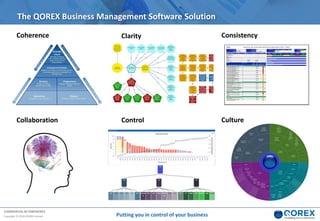
The QOREX Business Management Software Solution
Coherence Clarity Consistency
Collaboration Control Culture
COMMERCIAL IN CONFIDENCE
Copyright © 2018 QOREX Limited
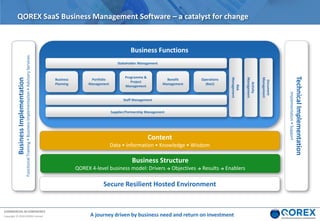
QOREX SaaS Business Management Software – a catalyst for change
A journey driven by business need and return on investment
BusinessImplementation
FunctionalTraining•BusinessImplementation•AdvisoryServices
Content
Data • Information • Knowledge • Wisdom
TechnicalImplementation
Implementation•Support
Business Structure
QOREX 4-level business model: Drivers → Objectives → Results → Enablers
Secure Resilient Hosted Environment
Business Functions
Staff Management
Supplier/Partnership Management
Stakeholder Management
Risk
Management
Activity
Management
Document
Management
Portfolio
Management
Business
Planning
Programme &
Project
Management
Benefit
Management
Operations
(BaU)
COMMERCIAL IN CONFIDENCE
Copyright © 2018 QOREX Limited
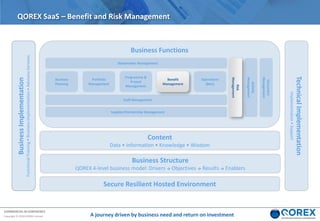
QOREX SaaS – Benefit and Risk Management
A journey driven by business need and return on investment
BusinessImplementation
FunctionalTraining•BusinessImplementation•AdvisoryServices
Content
Data • Information • Knowledge • Wisdom
TechnicalImplementation
Implementation•Support
Business Structure
QOREX 4-level business model: Drivers → Objectives → Results → Enablers
Secure Resilient Hosted Environment
Business Functions
Staff Management
Supplier/Partnership Management
Stakeholder Management
Risk
Management
Activity
Management
Document
Management
Portfolio
Management
Business
Planning
Programme &
Project
Management
Benefit
Management
Operations
(BaU)
COMMERCIAL IN CONFIDENCE
Copyright © 2018 QOREX Limited Delivering strategy while maximising the return on investment
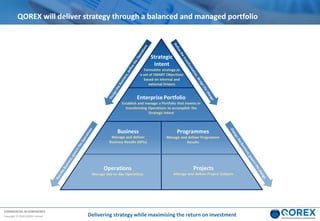
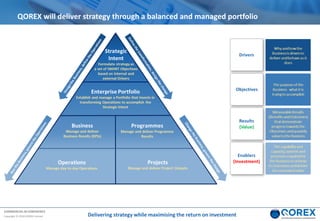
QOREX will deliver strategy through a balanced and managed portfolio
COMMERCIAL IN CONFIDENCE
Copyright © 2018 QOREX Limited Delivering strategy while maximising the return on investment
QOREX will deliver strategy through a balanced and managed portfolio
COMMERCIAL IN CONFIDENCE
Copyright © 2018 QOREX Limited Simplifying the Art of Business
Benefit Management
COMMERCIAL IN CONFIDENCE
Copyright © 2018 QOREX Limited Simplifying the Art of Business
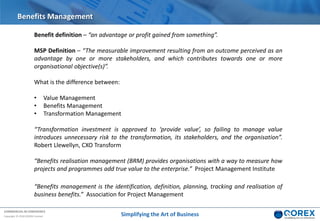
Benefits Management
Benefit definition – “an advantage or profit gained from something”.
MSP Definition – “The measurable improvement resulting from an outcome perceived as an
advantage by one or more stakeholders, and which contributes towards one or more
organisational objective(s)”.
What is the difference between:
• Value Management
• Benefits Management
• Transformation Management
“Transformation investment is approved to ‘provide value’, so failing to manage value
introduces unnecessary risk to the transformation, its stakeholders, and the organisation”.
Robert Llewellyn, CXO Transform
“Benefits realisation management (BRM) provides organisations with a way to measure how
projects and programmes add true value to the enterprise.” Project Management Institute
“Benefits management is the identification, definition, planning, tracking and realisation of
business benefits.” Association for Project Management
COMMERCIAL IN CONFIDENCE
Copyright © 2018 QOREX Limited
• BENEFITS: Value that is created for the project sponsor or beneficiary as a result of the successful completion of a
project.
• BUSINESS CASE: Documented economic feasibility study used to establish validity of the benefits to be delivered.
• BENEFITS REGISTER: Collection and list of the planned benefits used to measure and communicate the delivery
of benefits throughout the duration of the project or programme.
• BENEFITS BREAKDOWN STRUCTURES: Maps dependencies to achieve end goal benefits in a clear and easy to
understand fashion.
• BENEFITS REALISATION ROADMAP: Visual illustration that shows when and how benefits are expected to be
enabled for the business owner to then utilise for benefits realisation.
• BENEFITS REALISATION: A means to ensure that benefits are derived from outputs.
• BENEFITS REALISATION PLAN: A document outlining the activities necessary for achieving the planned benefits.
• BENEFITS REALISATION MANAGEMENT: Collective set of processes and practices for identifying benefits and
aligning them with formal strategy, ensuring benefits are realised as project implementation progresses and
finishes, and that the benefits are sustainable—and sustained—after project implementation is complete.
• BENEFITS SUSTAINMENT PLAN: A tool to identify risks, processes, measures, metrics, and tools necessary to
ensure the continued realisation of the benefits.
Benefits Management – Some PMI Definitions
Simplifying the Art of Business
COMMERCIAL IN CONFIDENCE
Copyright © 2018 QOREX Limited
Identify
Identify benefits to determine whether projects, programs, and portfolios can produce
the intended business results.
Execute
Execute benefits management to minimise risks to future benefits and maximise the
opportunity to gain additional benefits.
Sustain
Sustain benefits to ensure that whatever the project or program produces continues to
create value.
https://www.pmi.org/-/media/pmi/documents/public/pdf/learning/thought-
leadership/benefits-realization-management-framework.pdf
Benefits Management – PMI Approach
Courtesy of the Project Management Institute
Simplifying the Art of Business
COMMERCIAL IN CONFIDENCE
Copyright © 2018 QOREX Limited
BENEFITS REALISATION PLAN: A document outlining the activities necessary for achieving the planned
benefits. It identifies a timeline and the tools and resources necessary to ensure the benefits are fully
realised over time. It defines:
• Benefits and associated assumptions, and how each benefit will be achieved.
• Metrics, including KPIs, and procedures to measure progress against benefits.
• Roles and responsibilities required to manage benefits.
• How the resulting benefits and capabilities will be transitioned into an operational state to achieve
benefits.
• How the resulting capabilities will be transitioned to the individuals, groups, or organisations
responsible for sustaining the benefits.
• Processes for determining the extent to which each project or programme benefit is achieved prior to
formal closure.
Benefits Realisation Plan
Simplifying the Art of Business
COMMERCIAL IN CONFIDENCE
Copyright © 2018 QOREX Limited
Identify
• Are the benefits aligned with the organisation’s strategic goals?
• Are the benefits—tangible, intangible, short-term, and/or long-term—explicitly defined in the business case?
• Does the business case outline how the benefits will be measured and when benefits are forecasted to be delivered?
• Are all project or programme benefits documented in a benefits register and benefits realisation roadmap?
• Have key stakeholders signed off on the benefits realisation plan?
• Does governance take into account benefits management, including relevant acceptance criteria?
• Are project selection and/or funding decisions based on the impact to expected benefits?
• Have the benefits owners been consulted and confirmed?
Benefits Management – Identify
Simplifying the Art of Business
COMMERCIAL IN CONFIDENCE
Copyright © 2018 QOREX Limited
Execute
• Have the expected benefits been clearly communicated to key stakeholders involved with delivery?
• Does the project or programme team understand how project level outputs contribute to business benefits?
• Is progress regularly reviewed against the benefits realisation roadmap?
• Are benefits frequently modified to reflect the most current information regarding changing business conditions?
• Is effective change control being utilised to close gaps between expected benefits and actual benefits?
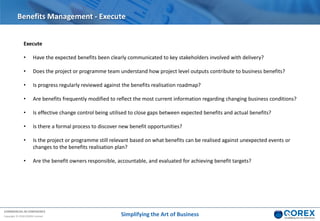
• Is there a formal process to discover new benefit opportunities?
• Is the project or programme still relevant based on what benefits can be realised against unexpected events or
changes to the benefits realisation plan?
• Are the benefit owners responsible, accountable, and evaluated for achieving benefit targets?
Benefits Management - Execute
Simplifying the Art of Business
COMMERCIAL IN CONFIDENCE
Copyright © 2018 QOREX Limited
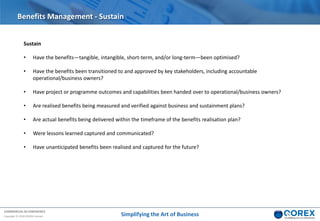
Sustain
• Have the benefits—tangible, intangible, short-term, and/or long-term—been optimised?
• Have the benefits been transitioned to and approved by key stakeholders, including accountable
operational/business owners?
• Have project or programme outcomes and capabilities been handed over to operational/business owners?
• Are realised benefits being measured and verified against business and sustainment plans?
• Are actual benefits being delivered within the timeframe of the benefits realisation plan?
• Were lessons learned captured and communicated?
• Have unanticipated benefits been realised and captured for the future?
Benefits Management - Sustain
Simplifying the Art of Business
COMMERCIAL IN CONFIDENCE
Copyright © 2018 QOREX Limited
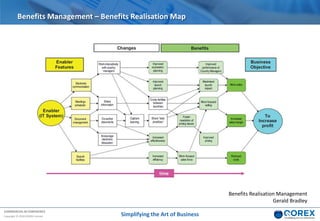
Benefits Management – Benefits Realisation Map
Benefits Realisation Management
Gerald Bradley
Simplifying the Art of Business
COMMERCIAL IN CONFIDENCE
Copyright © 2018 QOREX Limited
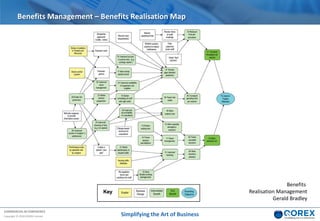
Benefits Management – Benefits Realisation Map
Benefits
Realisation Management
Gerald Bradley
Simplifying the Art of Business
COMMERCIAL IN CONFIDENCE
Copyright © 2018 QOREX Limited
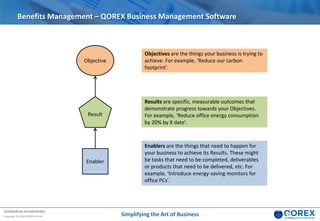
Enabler
Result
Objective
Objectives are the things your business is trying to
achieve. For example, ‘Reduce our carbon
footprint’.
Results are specific, measurable outcomes that
demonstrate progress towards your Objectives.
For example, ‘Reduce office energy consumption
by 20% by X date’.
Enablers are the things that need to happen for
your business to achieve its Results. These might
be tasks that need to be completed, deliverables
or products that need to be delivered, etc. For
example, ‘Introduce energy-saving monitors for
office PCs’.
Benefits Management – QOREX Business Management Software
Simplifying the Art of Business
COMMERCIAL IN CONFIDENCE
Copyright © 2018 QOREX Limited
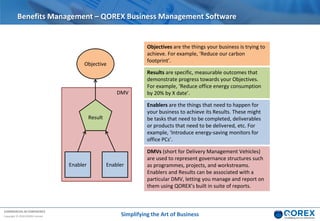
DMV
Enabler Enabler
Result
Objective
Objectives are the things your business is trying to
achieve. For example, ‘Reduce our carbon
footprint’.
Results are specific, measurable outcomes that
demonstrate progress towards your Objectives.
For example, ‘Reduce office energy consumption
by 20% by X date’.
Enablers are the things that need to happen for
your business to achieve its Results. These might
be tasks that need to be completed, deliverables
or products that need to be delivered, etc. For
example, ‘Introduce energy-saving monitors for
office PCs’.
DMVs (short for Delivery Management Vehicles)
are used to represent governance structures such
as programmes, projects, and workstreams.
Enablers and Results can be associated with a
particular DMV, letting you manage and report on
them using QOREX’s built in suite of reports.
Benefits Management – QOREX Business Management Software
Simplifying the Art of Business
COMMERCIAL IN CONFIDENCE
Copyright © 2018 QOREX Limited
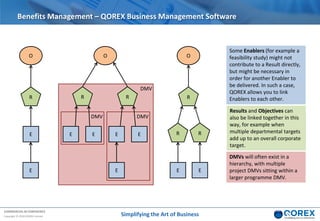
Some Enablers (for example a
feasibility study) might not
contribute to a Result directly,
but might be necessary in
order for another Enabler to
be delivered. In such a case,
QOREX allows you to link
Enablers to each other.
DMVs will often exist in a
hierarchy, with multiple
project DMVs sitting within a
larger programme DMV.
Results and Objectives can
also be linked together in this
way, for example when
multiple departmental targets
add up to an overall corporate
target.
DMV
DMV
E E E
R R
O O
E
DMV
E E
R
E
R
O
E
R
E
R
Benefits Management – QOREX Business Management Software
Simplifying the Art of Business
COMMERCIAL IN CONFIDENCE
Copyright © 2018 QOREX Limited
Benefits Management – QOREX Business Maps
Simplifying the Art of Business
COMMERCIAL IN CONFIDENCE
Copyright © 2018 QOREX Limited
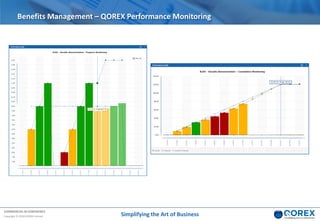
Benefits Management – QOREX Performance Monitoring
Simplifying the Art of Business
COMMERCIAL IN CONFIDENCE
Copyright © 2018 QOREX Limited
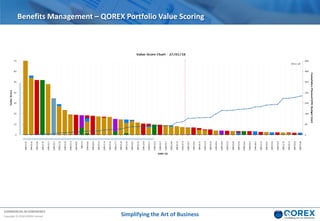
Benefits Management – QOREX Portfolio Value Scoring
Simplifying the Art of Business
COMMERCIAL IN CONFIDENCE
Copyright © 2018 QOREX Limited
Risk Management
Simplifying the Art of Business
COMMERCIAL IN CONFIDENCE
Copyright © 2018 QOREX Limited
Risk, dictionary definition – a situation involving exposure to danger
Risk, PRINCE 2 Definition - a set of events that, should they occur, will have an effect on
achieving the project objectives.
Risk, MSP Definition - uncertain event or set of events that, should it occur, will have an
effect on the achievement of objectives. A risk is measured by a combination of the
probability of a perceived threat or opportunity occurring and the magnitude of its impact
on objectives.
Risk Management, PRINCE 2 Definition - Risk Management is about the steps you take in
a systematic way that will enable you to identify, assess and control risk
But it isn’t just about project management. Risk management is about focusing on the
ability of the organisation to meet its objectives in the future by identifying risk and
making decisions to manage these risks.
Risk Management starts with the strategic planning process.
Risk Management - Definition
Simplifying the Art of Business
COMMERCIAL IN CONFIDENCE
Copyright © 2018 QOREX Limited
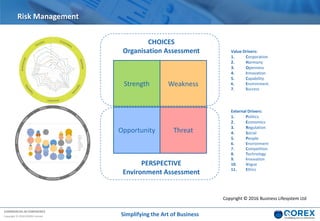
Structuring and integrating your information
Strength Weakness
ThreatOpportunity
PERSPECTIVE
Environment Assessment
CHOICES
Organisation Assessment
External Drivers:
1. Politics
2. Economics
3. Regulation
4. Social
5. People
6. Environment
7. Competition
8. Technology
9. Innovation
10. Vogue
11. Ethics
Value Drivers:
1. Corporation
2. Harmony
3. Openness
4. Innovation
5. Capability
6. Environment
7. Success
Risk Management
Copyright © 2016 Business Lifesystem Ltd
Simplifying the Art of Business
COMMERCIAL IN CONFIDENCE
Copyright © 2018 QOREX Limited
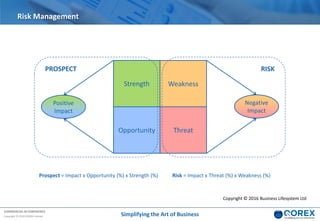
Managing risks and leveraging prospects
Strength Weakness
ThreatOpportunity
Negative
Impact
Positive
Impact
PROSPECT
Risk = Impact x Threat (%) x Weakness (%)Prospect = Impact x Opportunity (%) x Strength (%)
RISK
Risk Management
Copyright © 2016 Business Lifesystem Ltd
Simplifying the Art of Business
COMMERCIAL IN CONFIDENCE
Copyright © 2018 QOREX Limited
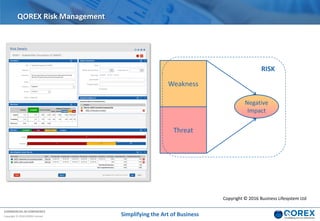
Weakness
Threat
RISK
Negative
Impact
QOREX Risk Management
Copyright © 2016 Business Lifesystem Ltd
Simplifying the Art of Business
COMMERCIAL IN CONFIDENCE
Copyright © 2018 QOREX Limited
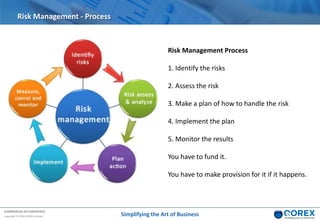
Risk Management Process
1. Identify the risks
2. Assess the risk
3. Make a plan of how to handle the risk
4. Implement the plan
5. Monitor the results
You have to fund it.
You have to make provision for it if it happens.
Risk Management - Process
Simplifying the Art of Business
COMMERCIAL IN CONFIDENCE
Copyright © 2018 QOREX Limited
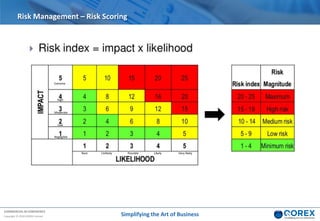
Risk Management – Risk Scoring
Negligible
LikelyPossible Very likelyRare
Low
Moderate
High
Extreme
Unlikely
Simplifying the Art of Business
COMMERCIAL IN CONFIDENCE
Copyright © 2018 QOREX Limited
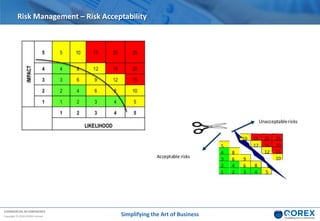
Risk Management – Risk Acceptability
Simplifying the Art of Business
COMMERCIAL IN CONFIDENCE
Copyright © 2018 QOREX Limited
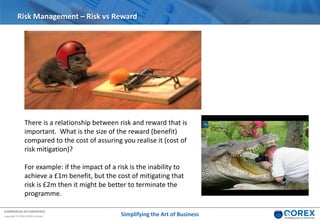
Risk Management – Risk vs Reward
There is a relationship between risk and reward that is
important. What is the size of the reward (benefit)
compared to the cost of assuring you realise it (cost of
risk mitigation)?
For example: if the impact of a risk is the inability to
achieve a £1m benefit, but the cost of mitigating that
risk is £2m then it might be better to terminate the
programme.
Simplifying the Art of Business
COMMERCIAL IN CONFIDENCE
Copyright © 2018 QOREX Limited
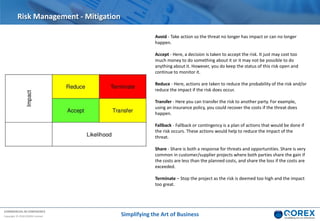
Risk Management - Mitigation
Avoid - Take action so the threat no longer has impact or can no longer
happen.
Accept - Here, a decision is taken to accept the risk. It just may cost too
much money to do something about it or it may not be possible to do
anything about it. However, you do keep the status of this risk open and
continue to monitor it.
Reduce - Here, actions are taken to reduce the probability of the risk and/or
reduce the impact if the risk does occur.
Transfer - Here you can transfer the risk to another party. For example,
using an insurance policy, you could recover the costs if the threat does
happen.
Fallback - Fallback or contingency is a plan of actions that would be done if
the risk occurs. These actions would help to reduce the impact of the
threat.
Share - Share is both a response for threats and opportunities. Share is very
common in customer/supplier projects where both parties share the gain if
the costs are less than the planned costs, and share the loss if the costs are
exceeded.
Terminate – Stop the project as the risk is deemed too high and the impact
too great.
Simplifying the Art of Business
COMMERCIAL IN CONFIDENCE
Copyright © 2018 QOREX Limited
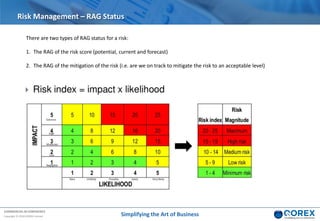
Risk Management – RAG Status
There are two types of RAG status for a risk:
1. The RAG of the risk score (potential, current and forecast)
2. The RAG of the mitigation of the risk (i.e. are we on track to mitigate the risk to an acceptable level)
Simplifying the Art of Business
COMMERCIAL IN CONFIDENCE
Copyright © 2018 QOREX Limited
Programme
Project 1 (DMV)
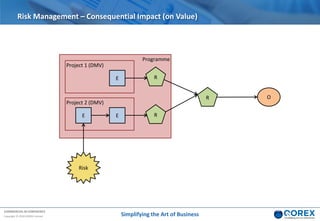
Risk Management – Consequential Impact (on Value)
Project 2 (DMV)
R O
E
RE
RE
Risk
Simplifying the Art of Business
COMMERCIAL IN CONFIDENCE
Copyright © 2018 QOREX Limited
Programme
Project 1 (DMV)
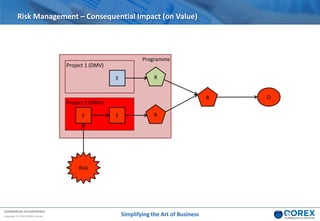
Risk Management – Consequential Impact (on Value)
Project 2 (DMV)
R O
E
RE
RE
Risk
Simplifying the Art of Business
COMMERCIAL IN CONFIDENCE
Copyright © 2018 QOREX Limited
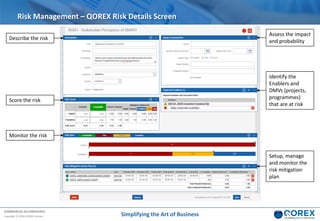
Risk Management – QOREX Risk Details Screen
Describe the risk
Assess the impact
and probability
Score the risk
Identify the
Enablers and
DMVs (projects,
programmes)
that are at risk
Monitor the risk
Setup, manage
and monitor the
risk mitigation
plan
Simplifying the Art of Business
COMMERCIAL IN CONFIDENCE
Copyright © 2018 QOREX Limited
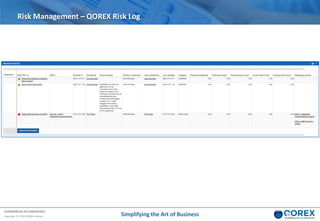
Risk Management – QOREX Risk Log
Simplifying the Art of Business
COMMERCIAL IN CONFIDENCE
Copyright © 2018 QOREX Limited Simplifying the Art of Business
QOREX BMS – Contact Details
For further information please contact:
Phil Trickey phil.trickey@qorex.co.uk
or
Nora Morrissey nora.morrissey@qorex.co.uk

Benefits and risks management - an overview from QOREX

  • 1.
    COMMERCIAL IN CONFIDENCE Copyright© 2018 QOREX Limited Benefits and Risks Management – An Overview COMMERCIAL IN CONFIDENCE Copyright © 2018 QOREX Limited www.qorex.co.uk
  • 2.
    COMMERCIAL IN CONFIDENCE Copyright© 2018 QOREX Limited Putting you in control of your business The QOREX Business Management Software Solution Coherence Clarity Consistency Collaboration Control Culture
  • 3.
    COMMERCIAL IN CONFIDENCE Copyright© 2018 QOREX Limited QOREX SaaS Business Management Software – a catalyst for change A journey driven by business need and return on investment BusinessImplementation FunctionalTraining•BusinessImplementation•AdvisoryServices Content Data • Information • Knowledge • Wisdom TechnicalImplementation Implementation•Support Business Structure QOREX 4-level business model: Drivers → Objectives → Results → Enablers Secure Resilient Hosted Environment Business Functions Staff Management Supplier/Partnership Management Stakeholder Management Risk Management Activity Management Document Management Portfolio Management Business Planning Programme & Project Management Benefit Management Operations (BaU)
  • 4.
    COMMERCIAL IN CONFIDENCE Copyright© 2018 QOREX Limited QOREX SaaS – Benefit and Risk Management A journey driven by business need and return on investment BusinessImplementation FunctionalTraining•BusinessImplementation•AdvisoryServices Content Data • Information • Knowledge • Wisdom TechnicalImplementation Implementation•Support Business Structure QOREX 4-level business model: Drivers → Objectives → Results → Enablers Secure Resilient Hosted Environment Business Functions Staff Management Supplier/Partnership Management Stakeholder Management Risk Management Activity Management Document Management Portfolio Management Business Planning Programme & Project Management Benefit Management Operations (BaU)
  • 5.
    COMMERCIAL IN CONFIDENCE Copyright© 2018 QOREX Limited Delivering strategy while maximising the return on investment QOREX will deliver strategy through a balanced and managed portfolio
  • 6.
    COMMERCIAL IN CONFIDENCE Copyright© 2018 QOREX Limited Delivering strategy while maximising the return on investment QOREX will deliver strategy through a balanced and managed portfolio
  • 7.
    COMMERCIAL IN CONFIDENCE Copyright© 2018 QOREX Limited Simplifying the Art of Business Benefit Management
  • 8.
    COMMERCIAL IN CONFIDENCE Copyright© 2018 QOREX Limited Simplifying the Art of Business Benefits Management Benefit definition – “an advantage or profit gained from something”. MSP Definition – “The measurable improvement resulting from an outcome perceived as an advantage by one or more stakeholders, and which contributes towards one or more organisational objective(s)”. What is the difference between: • Value Management • Benefits Management • Transformation Management “Transformation investment is approved to ‘provide value’, so failing to manage value introduces unnecessary risk to the transformation, its stakeholders, and the organisation”. Robert Llewellyn, CXO Transform “Benefits realisation management (BRM) provides organisations with a way to measure how projects and programmes add true value to the enterprise.” Project Management Institute “Benefits management is the identification, definition, planning, tracking and realisation of business benefits.” Association for Project Management
  • 9.
    COMMERCIAL IN CONFIDENCE Copyright© 2018 QOREX Limited • BENEFITS: Value that is created for the project sponsor or beneficiary as a result of the successful completion of a project. • BUSINESS CASE: Documented economic feasibility study used to establish validity of the benefits to be delivered. • BENEFITS REGISTER: Collection and list of the planned benefits used to measure and communicate the delivery of benefits throughout the duration of the project or programme. • BENEFITS BREAKDOWN STRUCTURES: Maps dependencies to achieve end goal benefits in a clear and easy to understand fashion. • BENEFITS REALISATION ROADMAP: Visual illustration that shows when and how benefits are expected to be enabled for the business owner to then utilise for benefits realisation. • BENEFITS REALISATION: A means to ensure that benefits are derived from outputs. • BENEFITS REALISATION PLAN: A document outlining the activities necessary for achieving the planned benefits. • BENEFITS REALISATION MANAGEMENT: Collective set of processes and practices for identifying benefits and aligning them with formal strategy, ensuring benefits are realised as project implementation progresses and finishes, and that the benefits are sustainable—and sustained—after project implementation is complete. • BENEFITS SUSTAINMENT PLAN: A tool to identify risks, processes, measures, metrics, and tools necessary to ensure the continued realisation of the benefits. Benefits Management – Some PMI Definitions Simplifying the Art of Business
  • 10.
    COMMERCIAL IN CONFIDENCE Copyright© 2018 QOREX Limited Identify Identify benefits to determine whether projects, programs, and portfolios can produce the intended business results. Execute Execute benefits management to minimise risks to future benefits and maximise the opportunity to gain additional benefits. Sustain Sustain benefits to ensure that whatever the project or program produces continues to create value. https://www.pmi.org/-/media/pmi/documents/public/pdf/learning/thought- leadership/benefits-realization-management-framework.pdf Benefits Management – PMI Approach Courtesy of the Project Management Institute Simplifying the Art of Business
  • 11.
    COMMERCIAL IN CONFIDENCE Copyright© 2018 QOREX Limited BENEFITS REALISATION PLAN: A document outlining the activities necessary for achieving the planned benefits. It identifies a timeline and the tools and resources necessary to ensure the benefits are fully realised over time. It defines: • Benefits and associated assumptions, and how each benefit will be achieved. • Metrics, including KPIs, and procedures to measure progress against benefits. • Roles and responsibilities required to manage benefits. • How the resulting benefits and capabilities will be transitioned into an operational state to achieve benefits. • How the resulting capabilities will be transitioned to the individuals, groups, or organisations responsible for sustaining the benefits. • Processes for determining the extent to which each project or programme benefit is achieved prior to formal closure. Benefits Realisation Plan Simplifying the Art of Business
  • 12.
    COMMERCIAL IN CONFIDENCE Copyright© 2018 QOREX Limited Identify • Are the benefits aligned with the organisation’s strategic goals? • Are the benefits—tangible, intangible, short-term, and/or long-term—explicitly defined in the business case? • Does the business case outline how the benefits will be measured and when benefits are forecasted to be delivered? • Are all project or programme benefits documented in a benefits register and benefits realisation roadmap? • Have key stakeholders signed off on the benefits realisation plan? • Does governance take into account benefits management, including relevant acceptance criteria? • Are project selection and/or funding decisions based on the impact to expected benefits? • Have the benefits owners been consulted and confirmed? Benefits Management – Identify Simplifying the Art of Business
  • 13.
    COMMERCIAL IN CONFIDENCE Copyright© 2018 QOREX Limited Execute • Have the expected benefits been clearly communicated to key stakeholders involved with delivery? • Does the project or programme team understand how project level outputs contribute to business benefits? • Is progress regularly reviewed against the benefits realisation roadmap? • Are benefits frequently modified to reflect the most current information regarding changing business conditions? • Is effective change control being utilised to close gaps between expected benefits and actual benefits? • Is there a formal process to discover new benefit opportunities? • Is the project or programme still relevant based on what benefits can be realised against unexpected events or changes to the benefits realisation plan? • Are the benefit owners responsible, accountable, and evaluated for achieving benefit targets? Benefits Management - Execute Simplifying the Art of Business
  • 14.
    COMMERCIAL IN CONFIDENCE Copyright© 2018 QOREX Limited Sustain • Have the benefits—tangible, intangible, short-term, and/or long-term—been optimised? • Have the benefits been transitioned to and approved by key stakeholders, including accountable operational/business owners? • Have project or programme outcomes and capabilities been handed over to operational/business owners? • Are realised benefits being measured and verified against business and sustainment plans? • Are actual benefits being delivered within the timeframe of the benefits realisation plan? • Were lessons learned captured and communicated? • Have unanticipated benefits been realised and captured for the future? Benefits Management - Sustain Simplifying the Art of Business
  • 15.
    COMMERCIAL IN CONFIDENCE Copyright© 2018 QOREX Limited Benefits Management – Benefits Realisation Map Benefits Realisation Management Gerald Bradley Simplifying the Art of Business
  • 16.
    COMMERCIAL IN CONFIDENCE Copyright© 2018 QOREX Limited Benefits Management – Benefits Realisation Map Benefits Realisation Management Gerald Bradley Simplifying the Art of Business
  • 17.
    COMMERCIAL IN CONFIDENCE Copyright© 2018 QOREX Limited Enabler Result Objective Objectives are the things your business is trying to achieve. For example, ‘Reduce our carbon footprint’. Results are specific, measurable outcomes that demonstrate progress towards your Objectives. For example, ‘Reduce office energy consumption by 20% by X date’. Enablers are the things that need to happen for your business to achieve its Results. These might be tasks that need to be completed, deliverables or products that need to be delivered, etc. For example, ‘Introduce energy-saving monitors for office PCs’. Benefits Management – QOREX Business Management Software Simplifying the Art of Business
  • 18.
    COMMERCIAL IN CONFIDENCE Copyright© 2018 QOREX Limited DMV Enabler Enabler Result Objective Objectives are the things your business is trying to achieve. For example, ‘Reduce our carbon footprint’. Results are specific, measurable outcomes that demonstrate progress towards your Objectives. For example, ‘Reduce office energy consumption by 20% by X date’. Enablers are the things that need to happen for your business to achieve its Results. These might be tasks that need to be completed, deliverables or products that need to be delivered, etc. For example, ‘Introduce energy-saving monitors for office PCs’. DMVs (short for Delivery Management Vehicles) are used to represent governance structures such as programmes, projects, and workstreams. Enablers and Results can be associated with a particular DMV, letting you manage and report on them using QOREX’s built in suite of reports. Benefits Management – QOREX Business Management Software Simplifying the Art of Business
  • 19.
    COMMERCIAL IN CONFIDENCE Copyright© 2018 QOREX Limited Some Enablers (for example a feasibility study) might not contribute to a Result directly, but might be necessary in order for another Enabler to be delivered. In such a case, QOREX allows you to link Enablers to each other. DMVs will often exist in a hierarchy, with multiple project DMVs sitting within a larger programme DMV. Results and Objectives can also be linked together in this way, for example when multiple departmental targets add up to an overall corporate target. DMV DMV E E E R R O O E DMV E E R E R O E R E R Benefits Management – QOREX Business Management Software Simplifying the Art of Business
  • 20.
    COMMERCIAL IN CONFIDENCE Copyright© 2018 QOREX Limited Benefits Management – QOREX Business Maps Simplifying the Art of Business
  • 21.
    COMMERCIAL IN CONFIDENCE Copyright© 2018 QOREX Limited Benefits Management – QOREX Performance Monitoring Simplifying the Art of Business
  • 22.
    COMMERCIAL IN CONFIDENCE Copyright© 2018 QOREX Limited Benefits Management – QOREX Portfolio Value Scoring Simplifying the Art of Business
  • 23.
    COMMERCIAL IN CONFIDENCE Copyright© 2018 QOREX Limited Risk Management Simplifying the Art of Business
  • 24.
    COMMERCIAL IN CONFIDENCE Copyright© 2018 QOREX Limited Risk, dictionary definition – a situation involving exposure to danger Risk, PRINCE 2 Definition - a set of events that, should they occur, will have an effect on achieving the project objectives. Risk, MSP Definition - uncertain event or set of events that, should it occur, will have an effect on the achievement of objectives. A risk is measured by a combination of the probability of a perceived threat or opportunity occurring and the magnitude of its impact on objectives. Risk Management, PRINCE 2 Definition - Risk Management is about the steps you take in a systematic way that will enable you to identify, assess and control risk But it isn’t just about project management. Risk management is about focusing on the ability of the organisation to meet its objectives in the future by identifying risk and making decisions to manage these risks. Risk Management starts with the strategic planning process. Risk Management - Definition Simplifying the Art of Business
  • 25.
    COMMERCIAL IN CONFIDENCE Copyright© 2018 QOREX Limited Structuring and integrating your information Strength Weakness ThreatOpportunity PERSPECTIVE Environment Assessment CHOICES Organisation Assessment External Drivers: 1. Politics 2. Economics 3. Regulation 4. Social 5. People 6. Environment 7. Competition 8. Technology 9. Innovation 10. Vogue 11. Ethics Value Drivers: 1. Corporation 2. Harmony 3. Openness 4. Innovation 5. Capability 6. Environment 7. Success Risk Management Copyright © 2016 Business Lifesystem Ltd Simplifying the Art of Business
  • 26.
    COMMERCIAL IN CONFIDENCE Copyright© 2018 QOREX Limited Managing risks and leveraging prospects Strength Weakness ThreatOpportunity Negative Impact Positive Impact PROSPECT Risk = Impact x Threat (%) x Weakness (%)Prospect = Impact x Opportunity (%) x Strength (%) RISK Risk Management Copyright © 2016 Business Lifesystem Ltd Simplifying the Art of Business
  • 27.
    COMMERCIAL IN CONFIDENCE Copyright© 2018 QOREX Limited Weakness Threat RISK Negative Impact QOREX Risk Management Copyright © 2016 Business Lifesystem Ltd Simplifying the Art of Business
  • 28.
    COMMERCIAL IN CONFIDENCE Copyright© 2018 QOREX Limited Risk Management Process 1. Identify the risks 2. Assess the risk 3. Make a plan of how to handle the risk 4. Implement the plan 5. Monitor the results You have to fund it. You have to make provision for it if it happens. Risk Management - Process Simplifying the Art of Business
  • 29.
    COMMERCIAL IN CONFIDENCE Copyright© 2018 QOREX Limited Risk Management – Risk Scoring Negligible LikelyPossible Very likelyRare Low Moderate High Extreme Unlikely Simplifying the Art of Business
  • 30.
    COMMERCIAL IN CONFIDENCE Copyright© 2018 QOREX Limited Risk Management – Risk Acceptability Simplifying the Art of Business
  • 31.
    COMMERCIAL IN CONFIDENCE Copyright© 2018 QOREX Limited Risk Management – Risk vs Reward There is a relationship between risk and reward that is important. What is the size of the reward (benefit) compared to the cost of assuring you realise it (cost of risk mitigation)? For example: if the impact of a risk is the inability to achieve a £1m benefit, but the cost of mitigating that risk is £2m then it might be better to terminate the programme. Simplifying the Art of Business
  • 32.
    COMMERCIAL IN CONFIDENCE Copyright© 2018 QOREX Limited Risk Management - Mitigation Avoid - Take action so the threat no longer has impact or can no longer happen. Accept - Here, a decision is taken to accept the risk. It just may cost too much money to do something about it or it may not be possible to do anything about it. However, you do keep the status of this risk open and continue to monitor it. Reduce - Here, actions are taken to reduce the probability of the risk and/or reduce the impact if the risk does occur. Transfer - Here you can transfer the risk to another party. For example, using an insurance policy, you could recover the costs if the threat does happen. Fallback - Fallback or contingency is a plan of actions that would be done if the risk occurs. These actions would help to reduce the impact of the threat. Share - Share is both a response for threats and opportunities. Share is very common in customer/supplier projects where both parties share the gain if the costs are less than the planned costs, and share the loss if the costs are exceeded. Terminate – Stop the project as the risk is deemed too high and the impact too great. Simplifying the Art of Business
  • 33.
    COMMERCIAL IN CONFIDENCE Copyright© 2018 QOREX Limited Risk Management – RAG Status There are two types of RAG status for a risk: 1. The RAG of the risk score (potential, current and forecast) 2. The RAG of the mitigation of the risk (i.e. are we on track to mitigate the risk to an acceptable level) Simplifying the Art of Business
  • 34.
    COMMERCIAL IN CONFIDENCE Copyright© 2018 QOREX Limited Programme Project 1 (DMV) Risk Management – Consequential Impact (on Value) Project 2 (DMV) R O E RE RE Risk Simplifying the Art of Business
  • 35.
    COMMERCIAL IN CONFIDENCE Copyright© 2018 QOREX Limited Programme Project 1 (DMV) Risk Management – Consequential Impact (on Value) Project 2 (DMV) R O E RE RE Risk Simplifying the Art of Business
  • 36.
    COMMERCIAL IN CONFIDENCE Copyright© 2018 QOREX Limited Risk Management – QOREX Risk Details Screen Describe the risk Assess the impact and probability Score the risk Identify the Enablers and DMVs (projects, programmes) that are at risk Monitor the risk Setup, manage and monitor the risk mitigation plan Simplifying the Art of Business
  • 37.
    COMMERCIAL IN CONFIDENCE Copyright© 2018 QOREX Limited Risk Management – QOREX Risk Log Simplifying the Art of Business
  • 38.
    COMMERCIAL IN CONFIDENCE Copyright© 2018 QOREX Limited Simplifying the Art of Business QOREX BMS – Contact Details For further information please contact: Phil Trickey phil.trickey@qorex.co.uk or Nora Morrissey nora.morrissey@qorex.co.uk