Submitted by :- 
Varun K V 
133040045 
1
FLY ASH 
Fly Ash – 
finely divided residue resulting from the combustion 
of the powdered coal and transported by the flue 
gases and collected by the electrostatic precipitator. 
Exhibits Pozzolanic behaviour 
2
WHAT IS HIGH VOLUME FLY ASH 
CONCRETE? 
High volume fly ash concrete is a concrete where 
a replacement of 50 to 60 percentage of cement is 
made with the usage of fly ash. 
But IS: 456 – 2000(Code of Practice for Plain and 
Reinforced Concrete) allows replacement of OPC by 
Fly ash up to 35% as binding material. 
3
Ways To Use Fly ash In Concrete 
Mixing fly ash with cement clinker at the factory 
to produce Portland Pozzolana Cement (PPC). 
Using fly ash as an admixture at the time of making 
concrete at work site 
4
Benefits of Using Fly Ash 
Low heat of hydration and thermal shrinkage 
Improved resistance to attack by sulfate soils and sea 
water 
5
Ash Production And Its Availability 
• Fly ash obtained from Electrostatic Precipitators (ESP) is 
stored in silos. 
• Electrostatic Precipitators (ESP) 
 6 to 8 rows 
 field(row) at the boiler end is called as first field & 
counted subsequently 2, 3 onwards 
 field at chimney end is called as last field 
 coarse particles of fly ash are collected in first fields of ESP 
 fineness of fly ash particles increases in subsequent fields of 
ESP. 
6
Characteristics Affecting Performance 
of Fly Ash Concrete 
Fineness - Finer the fly ash, the more the surface area 
available to react with lime and thus more will be the 
pozzolanic activity of fly ash. 
Calcium (CaO) content – Higher the CaO content, 
the greater will be the pozzolanic activity and greater 
the contribution to the strength in concrete. 
7
ASTM Classification 
Class F Fly ash : less than 5% CaO. 
Class C Fly ash : more than 15 % CaO. 
8
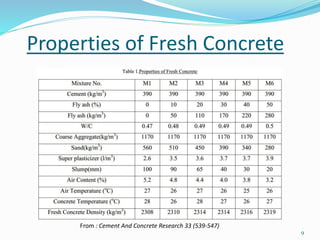
Properties of Fresh Concrete 
9 
From : Cement And Concrete Research 33 (539-547)
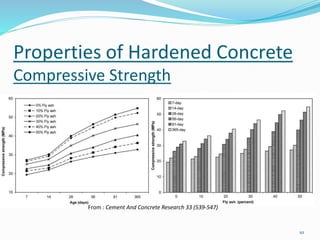
Compressive Strength 
10 
Properties of Hardened Concrete 
From : Cement And Concrete Research 33 (539-547)
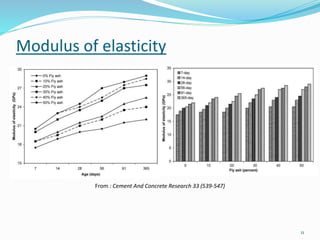
Modulus of elasticity 
11 
From : Cement And Concrete Research 33 (539-547)
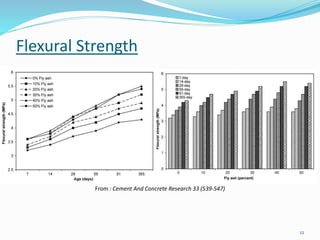
Flexural Strength 
12 
From : Cement And Concrete Research 33 (539-547)
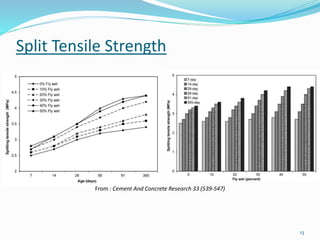
Split Tensile Strength 
13 
From : Cement And Concrete Research 33 (539-547)
WATER-TIGHTNESS AND DURABILITY 
Water Tightness ensures 
- Resistance to corrosion 
- Resistance to alkali aggregate reaction 
- Resistance to sulfate attack 
- Durability 
14
Construction Practices And Curing 
HVFAC takes longer time to set. Accelerating 
admixtures used based on compatibility 
HVFAC concrete mixtures do not suffer excessive 
slump loss in a short period 
With slabs, concrete surfaces must be membrane 
cured or by covering the surface with a heavy plastic 
sheet 
Minimum of 7 days of moist-curing mandatory 
15
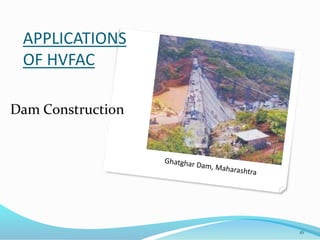
APPLICATIONS 
OF HVFAC 
Dam Construction 
16
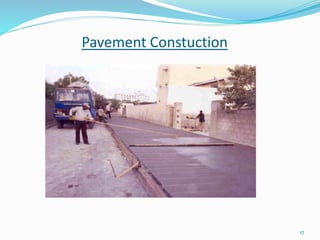
Pavement Constuction 
17
CONCLUSIONS 
HVFAC provides a good option for recycling of fly ash 
Characteristics such as resistance to corrosion, 
resistance to alkali aggregate reaction, resistance to 
sulfate attack, durability get incorporated 
Longer time required for proper curing 
Properties like compressive strength, flexural strength, 
modulus of elasticity and split tensile strength are 
improved. 
18
REFERENCES 
Rafat Siddique(2003), “Effect of fine aggregate 
replacement with Class F fly ash on the mechanical 
properties of concrete”, Cement and Concrete Research 
Vol.33, pp.539 – 547. 
19
THANK YOU 
20

High volume fly ash concrete

  • 1.
    Submitted by :- Varun K V 133040045 1
  • 2.
    FLY ASH FlyAsh – finely divided residue resulting from the combustion of the powdered coal and transported by the flue gases and collected by the electrostatic precipitator. Exhibits Pozzolanic behaviour 2
  • 3.
    WHAT IS HIGHVOLUME FLY ASH CONCRETE? High volume fly ash concrete is a concrete where a replacement of 50 to 60 percentage of cement is made with the usage of fly ash. But IS: 456 – 2000(Code of Practice for Plain and Reinforced Concrete) allows replacement of OPC by Fly ash up to 35% as binding material. 3
  • 4.
    Ways To UseFly ash In Concrete Mixing fly ash with cement clinker at the factory to produce Portland Pozzolana Cement (PPC). Using fly ash as an admixture at the time of making concrete at work site 4
  • 5.
    Benefits of UsingFly Ash Low heat of hydration and thermal shrinkage Improved resistance to attack by sulfate soils and sea water 5
  • 6.
    Ash Production AndIts Availability • Fly ash obtained from Electrostatic Precipitators (ESP) is stored in silos. • Electrostatic Precipitators (ESP)  6 to 8 rows  field(row) at the boiler end is called as first field & counted subsequently 2, 3 onwards  field at chimney end is called as last field  coarse particles of fly ash are collected in first fields of ESP  fineness of fly ash particles increases in subsequent fields of ESP. 6
  • 7.
    Characteristics Affecting Performance of Fly Ash Concrete Fineness - Finer the fly ash, the more the surface area available to react with lime and thus more will be the pozzolanic activity of fly ash. Calcium (CaO) content – Higher the CaO content, the greater will be the pozzolanic activity and greater the contribution to the strength in concrete. 7
  • 8.
    ASTM Classification ClassF Fly ash : less than 5% CaO. Class C Fly ash : more than 15 % CaO. 8
  • 9.
    Properties of FreshConcrete 9 From : Cement And Concrete Research 33 (539-547)
  • 10.
    Compressive Strength 10 Properties of Hardened Concrete From : Cement And Concrete Research 33 (539-547)
  • 11.
    Modulus of elasticity 11 From : Cement And Concrete Research 33 (539-547)
  • 12.
    Flexural Strength 12 From : Cement And Concrete Research 33 (539-547)
  • 13.
    Split Tensile Strength 13 From : Cement And Concrete Research 33 (539-547)
  • 14.
    WATER-TIGHTNESS AND DURABILITY Water Tightness ensures - Resistance to corrosion - Resistance to alkali aggregate reaction - Resistance to sulfate attack - Durability 14
  • 15.
    Construction Practices AndCuring HVFAC takes longer time to set. Accelerating admixtures used based on compatibility HVFAC concrete mixtures do not suffer excessive slump loss in a short period With slabs, concrete surfaces must be membrane cured or by covering the surface with a heavy plastic sheet Minimum of 7 days of moist-curing mandatory 15
  • 16.
    APPLICATIONS OF HVFAC Dam Construction 16
  • 17.
  • 18.
    CONCLUSIONS HVFAC providesa good option for recycling of fly ash Characteristics such as resistance to corrosion, resistance to alkali aggregate reaction, resistance to sulfate attack, durability get incorporated Longer time required for proper curing Properties like compressive strength, flexural strength, modulus of elasticity and split tensile strength are improved. 18
  • 19.
    REFERENCES Rafat Siddique(2003),“Effect of fine aggregate replacement with Class F fly ash on the mechanical properties of concrete”, Cement and Concrete Research Vol.33, pp.539 – 547. 19
  • 20.