TACH Solution present
Benchmarking For
Continuous Improvement
Facilitated by
YK Tang, Managing Consultant
CGSC Black Belt (USA), SMI (USA),
BSc (MY)
What is Benchmarking?
a highly structured strategy for acquiring, assessing, and
applying customer, competitor, and enterprise intelligence
for the purposes of product, system or enterprise
innovation and design.
What is Benchmarking?
Benchmarking is the process of continually searching for the best
methods, practices and processes, and either adopting or adapting their
good features and implementing them to become the “best of the best.”
How is benchmarking used?
• Compare performance of an existing process against other
companies’ best-in-class practices
• Determine how those companies achieve their performance levels
• Improve internal performance levels
Use benchmarking both for comparison of performance as
well as to understand the potential for improvement
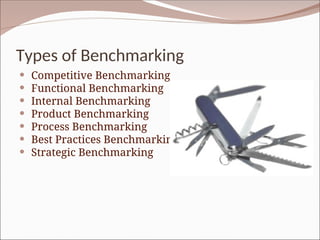
Types of Benchmarking
 Competitive Benchmarking
 Functional Benchmarking
 Internal Benchmarking
 Product Benchmarking
 Process Benchmarking
 Best Practices Benchmarking
 Strategic Benchmarking
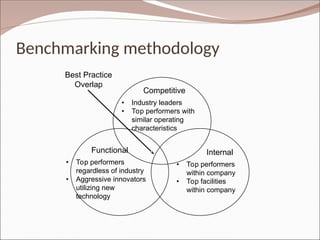
Benchmarking methodology
Competitive
• Industry leaders
• Top performers with
similar operating
characteristics
Functional
• Top performers
regardless of industry
• Aggressive innovators
utilizing new
technology
Internal
• Top performers
within company
• Top facilities
within company
Best Practice
Overlap
Benchmarking is…….
 A continuous process
 A process of investigation that provides valuable
information
 A process of learning from others; a pragmatic
search for ideas
 A time-consuming, labor-intensive process requiring
discipline
 A viable tool that provides useful information for
improving virtually any business process
•What do they want from us?
•How do we measure the quality
performance of our services to them?
•How are we being measured by our
customers?
Activity
 Quality Principles
 Who are our customers?
 How are we being measure by our customers?
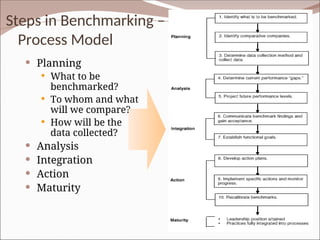
Steps in Benchmarking –
Process Model
 Planning
 What to be
benchmarked?
 To whom and what
will we compare?
 How will be the
data collected?
 Analysis
 Integration
 Action
 Maturity
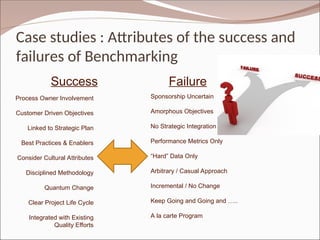
Case studies : Attributes of the success and
failures of Benchmarking
Success Failure
Process Owner Involvement
Customer Driven Objectives
Linked to Strategic Plan
Best Practices & Enablers
Consider Cultural Attributes
Disciplined Methodology
Quantum Change
Clear Project Life Cycle
Integrated with Existing
Quality Efforts
Sponsorship Uncertain
Amorphous Objectives
No Strategic Integration
Performance Metrics Only
“Hard” Data Only
Arbitrary / Casual Approach
Incremental / No Change
Keep Going and Going and …..
A la carte Program
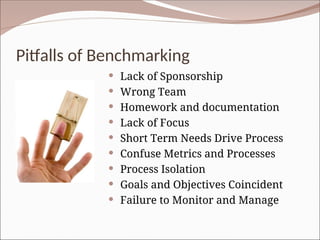
Pitfalls of Benchmarking
 Lack of Sponsorship
 Wrong Team
 Homework and documentation
 Lack of Focus
 Short Term Needs Drive Process
 Confuse Metrics and Processes
 Process Isolation
 Goals and Objectives Coincident
 Failure to Monitor and Manage
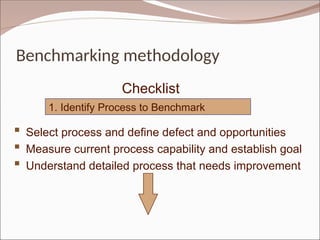
Benchmarking methodology
Checklist
1. Identify Process to Benchmark
 Select process and define defect and opportunities
 Measure current process capability and establish goal
 Understand detailed process that needs improvement
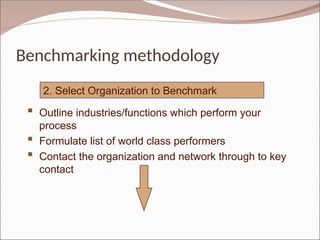
Benchmarking methodology
2. Select Organization to Benchmark
 Outline industries/functions which perform your
process
 Formulate list of world class performers
 Contact the organization and network through to key
contact
Benchmarking methodology
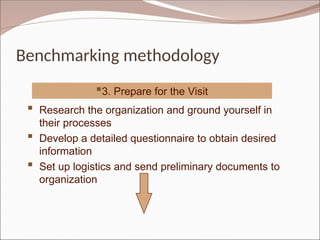
3. Prepare for the Visit
 Research the organization and ground yourself in
their processes
 Develop a detailed questionnaire to obtain desired
information
 Set up logistics and send preliminary documents to
organization
Benchmarking methodology
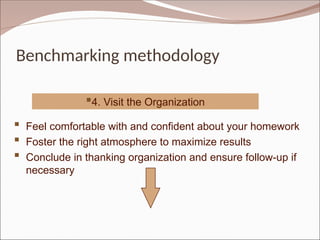
4. Visit the Organization
 Feel comfortable with and confident about your homework
 Foster the right atmosphere to maximize results
 Conclude in thanking organization and ensure follow-up if
necessary
Benchmarking methodology
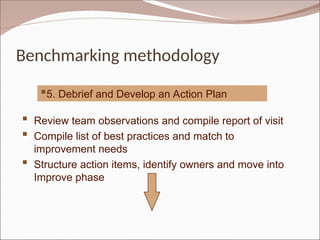
5. Debrief and Develop an Action Plan
 Review team observations and compile report of visit
 Compile list of best practices and match to
improvement needs
 Structure action items, identify owners and move into
Improve phase
Benchmarking methodology
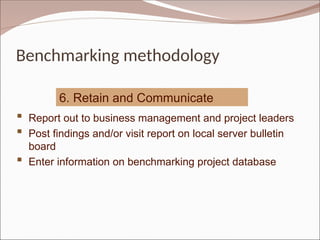
6. Retain and Communicate
 Report out to business management and project leaders
 Post findings and/or visit report on local server bulletin
board
 Enter information on benchmarking project database
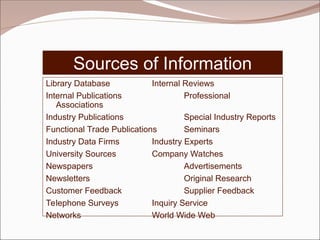
Library Database Internal Reviews
Internal Publications Professional
Associations
Industry Publications Special Industry Reports
Functional Trade Publications Seminars
Industry Data Firms Industry Experts
University Sources Company Watches
Newspapers Advertisements
Newsletters Original Research
Customer Feedback Supplier Feedback
Telephone Surveys Inquiry Service
Networks World Wide Web
Sources of Information
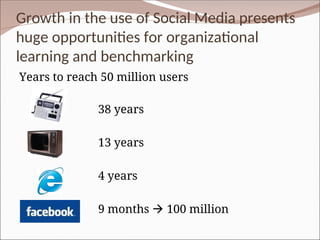
Growth in the use of Social Media presents
huge opportunities for organizational
learning and benchmarking
Years to reach 50 million users
38 years
13 years
4 years
9 months  100 million
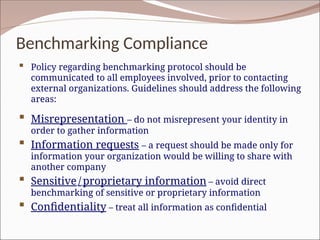
Benchmarking Compliance
 Policy regarding benchmarking protocol should be
communicated to all employees involved, prior to contacting
external organizations. Guidelines should address the following
areas:
 Misrepresentation – do not misrepresent your identity in
order to gather information
 Information requests – a request should be made only for
information your organization would be willing to share with
another company
 Sensitive / proprietary information – avoid direct
benchmarking of sensitive or proprietary information
 Confidentiality – treat all information as confidential
Benchmarking
Best Practices, Processes & Products
Client, Enterprise & Competitive Intelligence for Product, Process & Systems Innovation
Dr. Rick L. Edgeman, University of Idaho
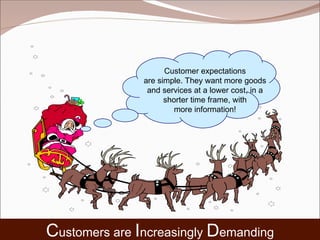
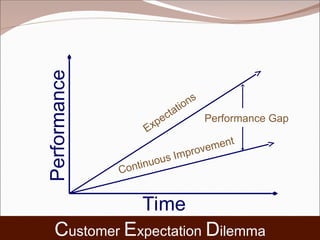
Customers are Increasingly Demanding
Customer expectations
are simple. They want more goods
and services at a lower cost, in a
shorter time frame, with
more information!
Client, Enterprise & Competitive Intelligence for Product, Process & Systems Innovation
Dr. Rick L. Edgeman, University of Idaho
Customer Expectation Dilemma
Time
Performance
Expectations
Continuous Improvement
Performance Gap
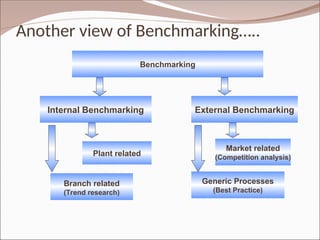
Another view of Benchmarking…..
Benchmarking
Market related
(Competition analysis)
Internal Benchmarking External Benchmarking
Generic Processes
(Best Practice)
Branch related
(Trend research)
Plant related
3 Basic Issues in Benchmarking
Where?
Basic issues:
Where are you now?
Why is your organization at
this position vs the other?
What can be improved?
112
10
30
90
Company max
min mean
Why?
What?
Waiting
Time
for
Admission
[minutes]
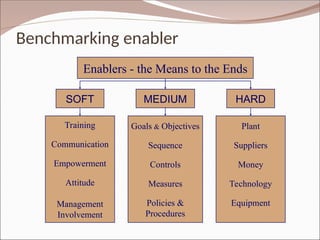
Benchmarking enabler
Enablers - the Means to the Ends
SOFT MEDIUM HARD
Training
Communication
Empowerment
Attitude
Management
Involvement
Goals & Objectives
Sequence
Controls
Measures
Policies &
Procedures
Plant
Suppliers
Money
Technology
Equipment
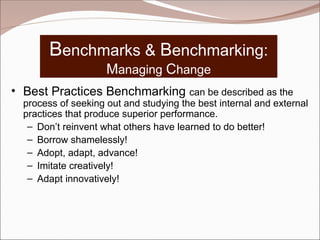
Benchmarks & Benchmarking:
Managing Change
• Best Practices Benchmarking can be described as the
process of seeking out and studying the best internal and external
practices that produce superior performance.
– Don’t reinvent what others have learned to do better!
– Borrow shamelessly!
– Adopt, adapt, advance!
– Imitate creatively!
– Adapt innovatively!
Process Benchmarking
• Process benchmarking focuses on discrete work processes
and operating systems, such as the customer complaint
process, the order-and-fulfillment process, or the strategic
planning process.
• Process benchmarking seeks to identify the most effective
operating practices from many companies that perform
similar work functions.
• Its power lies in its ability to produce bottom-line results. If an
organization improves a core process, for instance, it can
then quickly deliver process improvement
Performance Benchmarking
• Performance benchmarking enables managers to assess their
competitive positions through product and service
comparisons.
• Performance benchmarking usually focuses on elements of
price, technical quality, ancillary product or service features,
speed, reliability, and other performance characteristics.
• Reverse engineering, direct product or service comparisons,
and analysis of operating statistics are the primary techniques
applied during performance benchmarking.
Strategic Benchmarking
• Strategic benchmarking examines how companies compete
and is seldom industry-focused. It roves across industries
seeking to identify the winning strategies that have enable
high-performing companies to be successful in their
marketplaces.
• Strategic benchmarking influences the longer-term competitive
patterns of a company. Consequently, the benefits may accrue
slowly.
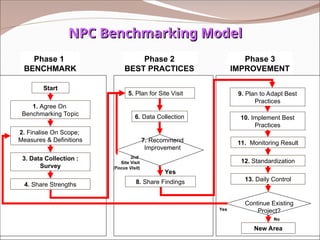
NPC Benchmarking Model
Phase 1
BENCHMARK
Start
1. Agree On
Benchmarking Topic
2. Finalise On Scope;
Measures & Definitions
3. Data Collection :
Survey
4. Share Strengths
Phase 3
IMPROVEMENT
New Area
9. Plan to Adapt Best
Practices
10. Implement Best
Practices
11. Monitoring Result
12. Standardization
13. Daily Control
Continue Existing
Project?
Yes
No
Phase 2
BEST PRACTICES
5. Plan for Site Visit
6. Data Collection
7. Recommend
Improvement
8. Share Findings
Yes
2nd
Site Visit
(Focus Visit)
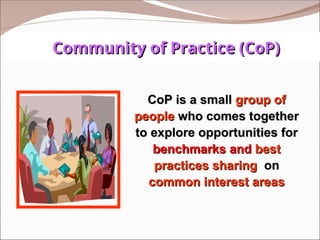
Community of Practice (CoP)
CoP is a small
CoP is a small group of
group of
people
people who comes together
who comes together
to explore opportunities for
benchmarks
benchmarks and
and best
best
practices sharing
practices sharing on
on
common interest areas
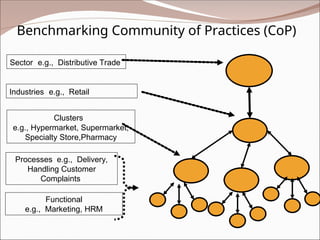
Benchmarking Community of Practices (CoP)
Clusters
e.g., Hypermarket, Supermarket,
Specialty Store,Pharmacy
Industries e.g., Retail
Sector e.g., Distributive Trade
Processes e.g., Delivery,
Handling Customer
Complaints
Functional
e.g., Marketing, HRM
You Cant Improve What You Don’t Measure !
(and you can’t prove it to your
customers either)
It’s all about Data!
Pitfalls of Benchmarking
 Failure to consider organizational cultures or circumstances leads to a
wrong direction
 Insufficient preparation usually results in MBWAA (management by
wandering around aimlessly!)
 What are you trying to learn about?
 Why do you want to learn it?
 What will you do with it to make your processes better once you
have it?
 Failure to measure and benchmark the right Key Result Areas
Lesson learned from top benchmark
companies
1. Base decisions on what the customer wants and expects
2. Think and act in terms of the entire customer experience
3. Continuously improve all parts of the customer experience
4. Hire and reward people who can effectively build
relationships with customers
5. Train employees in how to cope with their emotional labor
costs
6. Create and sustain a strong service culture
7. Avoid failing your customers twice
8. Empower customers to co-produce their own experience
9. Get managers to lead from the front, not the top
10. Treat all customers as if they were guests
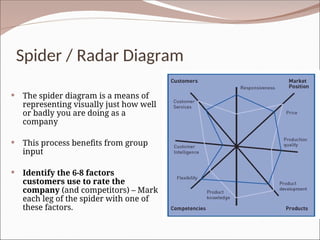
Spider / Radar Diagram
 The spider diagram is a means of
representing visually just how well
or badly you are doing as a
company
 This process benefits from group
input
 Identify the 6-8 factors
customers use to rate the
company (and competitors) – Mark
each leg of the spider with one of
these factors.
Preplan the Benchmarking initiatives
 Communication planning
 Management buy-in and commitment
 Team selection
 What to benchmark
 To whom and what we will compare?
 What and how the data are to be collected?
Brainstorming Process + Affinity
Diagram
Gap Analysis Phase
 Determine the current and ideal state
 Process Flow Analysis – understand how we
provide services to our customers (SIPOC
analysis)
Analysis Matrix and Prioritization
Matrix
Creative Benchmarking
 Thinking outside the box
 Innovative

generic Benchmarking for Continuous improvement

  • 1.
    TACH Solution present BenchmarkingFor Continuous Improvement Facilitated by YK Tang, Managing Consultant CGSC Black Belt (USA), SMI (USA), BSc (MY)
  • 3.
    What is Benchmarking? ahighly structured strategy for acquiring, assessing, and applying customer, competitor, and enterprise intelligence for the purposes of product, system or enterprise innovation and design.
  • 4.
    What is Benchmarking? Benchmarkingis the process of continually searching for the best methods, practices and processes, and either adopting or adapting their good features and implementing them to become the “best of the best.” How is benchmarking used? • Compare performance of an existing process against other companies’ best-in-class practices • Determine how those companies achieve their performance levels • Improve internal performance levels Use benchmarking both for comparison of performance as well as to understand the potential for improvement
  • 5.
    Types of Benchmarking Competitive Benchmarking  Functional Benchmarking  Internal Benchmarking  Product Benchmarking  Process Benchmarking  Best Practices Benchmarking  Strategic Benchmarking
  • 6.
    Benchmarking methodology Competitive • Industryleaders • Top performers with similar operating characteristics Functional • Top performers regardless of industry • Aggressive innovators utilizing new technology Internal • Top performers within company • Top facilities within company Best Practice Overlap
  • 7.
    Benchmarking is…….  Acontinuous process  A process of investigation that provides valuable information  A process of learning from others; a pragmatic search for ideas  A time-consuming, labor-intensive process requiring discipline  A viable tool that provides useful information for improving virtually any business process
  • 8.
    •What do theywant from us? •How do we measure the quality performance of our services to them? •How are we being measured by our customers?
  • 9.
    Activity  Quality Principles Who are our customers?  How are we being measure by our customers?
  • 10.
    Steps in Benchmarking– Process Model  Planning  What to be benchmarked?  To whom and what will we compare?  How will be the data collected?  Analysis  Integration  Action  Maturity
  • 11.
    Case studies :Attributes of the success and failures of Benchmarking Success Failure Process Owner Involvement Customer Driven Objectives Linked to Strategic Plan Best Practices & Enablers Consider Cultural Attributes Disciplined Methodology Quantum Change Clear Project Life Cycle Integrated with Existing Quality Efforts Sponsorship Uncertain Amorphous Objectives No Strategic Integration Performance Metrics Only “Hard” Data Only Arbitrary / Casual Approach Incremental / No Change Keep Going and Going and ….. A la carte Program
  • 12.
    Pitfalls of Benchmarking Lack of Sponsorship  Wrong Team  Homework and documentation  Lack of Focus  Short Term Needs Drive Process  Confuse Metrics and Processes  Process Isolation  Goals and Objectives Coincident  Failure to Monitor and Manage
  • 13.
    Benchmarking methodology Checklist 1. IdentifyProcess to Benchmark  Select process and define defect and opportunities  Measure current process capability and establish goal  Understand detailed process that needs improvement
  • 14.
    Benchmarking methodology 2. SelectOrganization to Benchmark  Outline industries/functions which perform your process  Formulate list of world class performers  Contact the organization and network through to key contact
  • 15.
    Benchmarking methodology 3. Preparefor the Visit  Research the organization and ground yourself in their processes  Develop a detailed questionnaire to obtain desired information  Set up logistics and send preliminary documents to organization
  • 16.
    Benchmarking methodology 4. Visitthe Organization  Feel comfortable with and confident about your homework  Foster the right atmosphere to maximize results  Conclude in thanking organization and ensure follow-up if necessary
  • 17.
    Benchmarking methodology 5. Debriefand Develop an Action Plan  Review team observations and compile report of visit  Compile list of best practices and match to improvement needs  Structure action items, identify owners and move into Improve phase
  • 18.
    Benchmarking methodology 6. Retainand Communicate  Report out to business management and project leaders  Post findings and/or visit report on local server bulletin board  Enter information on benchmarking project database
  • 19.
    Library Database InternalReviews Internal Publications Professional Associations Industry Publications Special Industry Reports Functional Trade Publications Seminars Industry Data Firms Industry Experts University Sources Company Watches Newspapers Advertisements Newsletters Original Research Customer Feedback Supplier Feedback Telephone Surveys Inquiry Service Networks World Wide Web Sources of Information
  • 20.
    Growth in theuse of Social Media presents huge opportunities for organizational learning and benchmarking Years to reach 50 million users 38 years 13 years 4 years 9 months  100 million
  • 21.
    Benchmarking Compliance  Policyregarding benchmarking protocol should be communicated to all employees involved, prior to contacting external organizations. Guidelines should address the following areas:  Misrepresentation – do not misrepresent your identity in order to gather information  Information requests – a request should be made only for information your organization would be willing to share with another company  Sensitive / proprietary information – avoid direct benchmarking of sensitive or proprietary information  Confidentiality – treat all information as confidential
  • 22.
  • 23.
    Client, Enterprise &Competitive Intelligence for Product, Process & Systems Innovation Dr. Rick L. Edgeman, University of Idaho Customers are Increasingly Demanding Customer expectations are simple. They want more goods and services at a lower cost, in a shorter time frame, with more information!
  • 24.
    Client, Enterprise &Competitive Intelligence for Product, Process & Systems Innovation Dr. Rick L. Edgeman, University of Idaho Customer Expectation Dilemma Time Performance Expectations Continuous Improvement Performance Gap
  • 25.
    Another view ofBenchmarking….. Benchmarking Market related (Competition analysis) Internal Benchmarking External Benchmarking Generic Processes (Best Practice) Branch related (Trend research) Plant related
  • 26.
    3 Basic Issuesin Benchmarking Where? Basic issues: Where are you now? Why is your organization at this position vs the other? What can be improved? 112 10 30 90 Company max min mean Why? What? Waiting Time for Admission [minutes]
  • 27.
    Benchmarking enabler Enablers -the Means to the Ends SOFT MEDIUM HARD Training Communication Empowerment Attitude Management Involvement Goals & Objectives Sequence Controls Measures Policies & Procedures Plant Suppliers Money Technology Equipment
  • 28.
    Benchmarks & Benchmarking: ManagingChange • Best Practices Benchmarking can be described as the process of seeking out and studying the best internal and external practices that produce superior performance. – Don’t reinvent what others have learned to do better! – Borrow shamelessly! – Adopt, adapt, advance! – Imitate creatively! – Adapt innovatively!
  • 29.
    Process Benchmarking • Processbenchmarking focuses on discrete work processes and operating systems, such as the customer complaint process, the order-and-fulfillment process, or the strategic planning process. • Process benchmarking seeks to identify the most effective operating practices from many companies that perform similar work functions. • Its power lies in its ability to produce bottom-line results. If an organization improves a core process, for instance, it can then quickly deliver process improvement
  • 30.
    Performance Benchmarking • Performancebenchmarking enables managers to assess their competitive positions through product and service comparisons. • Performance benchmarking usually focuses on elements of price, technical quality, ancillary product or service features, speed, reliability, and other performance characteristics. • Reverse engineering, direct product or service comparisons, and analysis of operating statistics are the primary techniques applied during performance benchmarking.
  • 31.
    Strategic Benchmarking • Strategicbenchmarking examines how companies compete and is seldom industry-focused. It roves across industries seeking to identify the winning strategies that have enable high-performing companies to be successful in their marketplaces. • Strategic benchmarking influences the longer-term competitive patterns of a company. Consequently, the benefits may accrue slowly.
  • 32.
    NPC Benchmarking Model NPCBenchmarking Model Phase 1 BENCHMARK Start 1. Agree On Benchmarking Topic 2. Finalise On Scope; Measures & Definitions 3. Data Collection : Survey 4. Share Strengths Phase 3 IMPROVEMENT New Area 9. Plan to Adapt Best Practices 10. Implement Best Practices 11. Monitoring Result 12. Standardization 13. Daily Control Continue Existing Project? Yes No Phase 2 BEST PRACTICES 5. Plan for Site Visit 6. Data Collection 7. Recommend Improvement 8. Share Findings Yes 2nd Site Visit (Focus Visit)
  • 33.
    Community of Practice(CoP) Community of Practice (CoP) CoP is a small CoP is a small group of group of people people who comes together who comes together to explore opportunities for to explore opportunities for benchmarks benchmarks and and best best practices sharing practices sharing on on common interest areas common interest areas
  • 34.
    Benchmarking Community ofPractices (CoP) Clusters e.g., Hypermarket, Supermarket, Specialty Store,Pharmacy Industries e.g., Retail Sector e.g., Distributive Trade Processes e.g., Delivery, Handling Customer Complaints Functional e.g., Marketing, HRM
  • 35.
    You Cant ImproveWhat You Don’t Measure ! (and you can’t prove it to your customers either)
  • 36.
  • 37.
    Pitfalls of Benchmarking Failure to consider organizational cultures or circumstances leads to a wrong direction  Insufficient preparation usually results in MBWAA (management by wandering around aimlessly!)  What are you trying to learn about?  Why do you want to learn it?  What will you do with it to make your processes better once you have it?  Failure to measure and benchmark the right Key Result Areas
  • 38.
    Lesson learned fromtop benchmark companies 1. Base decisions on what the customer wants and expects 2. Think and act in terms of the entire customer experience 3. Continuously improve all parts of the customer experience 4. Hire and reward people who can effectively build relationships with customers 5. Train employees in how to cope with their emotional labor costs 6. Create and sustain a strong service culture 7. Avoid failing your customers twice 8. Empower customers to co-produce their own experience 9. Get managers to lead from the front, not the top 10. Treat all customers as if they were guests
  • 39.
    Spider / RadarDiagram  The spider diagram is a means of representing visually just how well or badly you are doing as a company  This process benefits from group input  Identify the 6-8 factors customers use to rate the company (and competitors) – Mark each leg of the spider with one of these factors.
  • 40.
    Preplan the Benchmarkinginitiatives  Communication planning  Management buy-in and commitment  Team selection  What to benchmark  To whom and what we will compare?  What and how the data are to be collected?
  • 41.
    Brainstorming Process +Affinity Diagram
  • 42.
    Gap Analysis Phase Determine the current and ideal state  Process Flow Analysis – understand how we provide services to our customers (SIPOC analysis)
  • 43.
    Analysis Matrix andPrioritization Matrix
  • 44.
    Creative Benchmarking  Thinkingoutside the box  Innovative