
Impacts of Perceptions, Beliefs,
and Attitudes on Organizational
Behavior
Table of Contents

     Stereotyping, Entity/Incremental Theorists,
     Self-Fulfilling Prophecy, Halo Effect, Contrast
     Effect, Fundamental Attribution Error

• How evaluate our beliefs about others


     Self-Efficacy, Self-Esteem, Narcissisms,
     Self-Independence/Interdependence

                                                 2 from 20
Beliefs and Attitudes about Others


   – Judge someone on the basis of our perception of
     the group to which he or she belongs

                 :
      • “older employees can’t learn new skills”

      • “Overweight employees lack discipline”

      • “Asian employees are hardworking and conscientious”

                                                    3 from 20
Beliefs and Attitudes about Others
(cont.)


                     refers to a view that
          human characteristics are fixed and don’t
          change much with experience

                            refers to a view that
          human characteristics are malleable and can
          be changed with experience and can be
          developed


                                                 4 from 20
Beliefs and Attitudes about Others
(cont.)


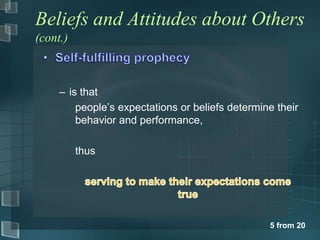
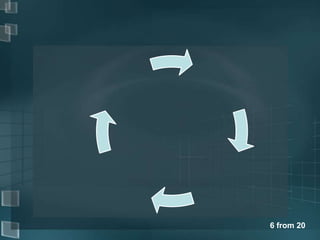
     – is that
         people’s expectations or beliefs determine their
         behavior and performance,

          thus


                                                  5 from 20
6 from 20
Beliefs and Attitudes about Others
(cont.)


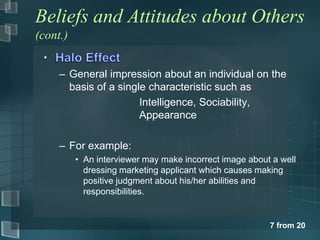
     – General impression about an individual on the
       basis of a single characteristic such as
                       Intelligence, Sociability,
                       Appearance

     – For example:
          • An interviewer may make incorrect image about a well
            dressing marketing applicant which causes making
            positive judgment about his/her abilities and
            responsibilities.


                                                         7 from 20
Beliefs and Attitudes about Others
(cont.)


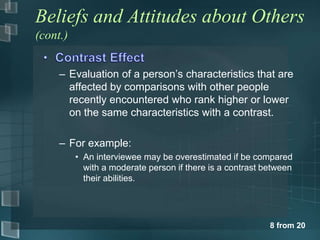
     – Evaluation of a person’s characteristics that are
       affected by comparisons with other people
       recently encountered who rank higher or lower
       on the same characteristics with a contrast.

     – For example:
          • An interviewee may be overestimated if be compared
            with a moderate person if there is a contrast between
            their abilities.


                                                           8 from 20
Beliefs and Attitudes about Others
(cont.)


     – The tendency to underestimate the influence of
       external factors and overestimate the influence
       of internal factors when making judgments about
       behavior of others

     – For example:
          • We may attribute the failures of others to their
            indiscipline while attribute our failure to system troubles
            and/or environmental problems


                                                              9 from 20
How Evaluate our Beliefs


                           10 from 20
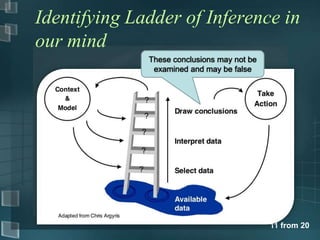
Identifying Ladder of Inference in
our mind
                 These conclusions may not be
                  examined and may be false


                 ?

                 ?
             ?

             ?

             ?


                                                11 from 20
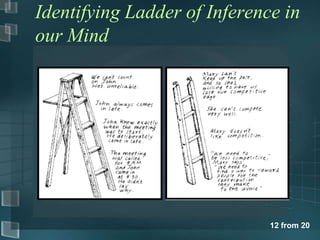
Identifying Ladder of Inference in
our Mind


                              12 from 20
Strengthen of Dialog Skills


                              13 from 20
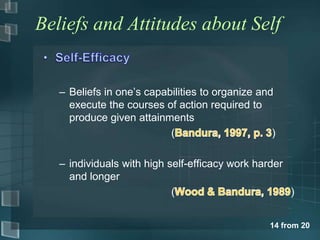
Beliefs and Attitudes about Self


   – Beliefs in one’s capabilities to organize and
     execute the courses of action required to
     produce given attainments
                           (                      )

   – individuals with high self-efficacy work harder
     and longer
                            (                        )


                                                 14 from 20
A self-efficacious cat!


                          15 from 20
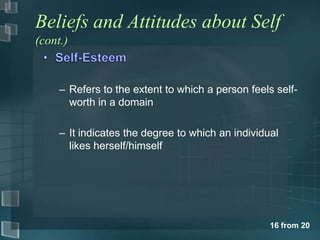
Beliefs and Attitudes about Self
(cont.)


     – Refers to the extent to which a person feels self-
       worth in a domain

     – It indicates the degree to which an individual
       likes herself/himself


                                                   16 from 20
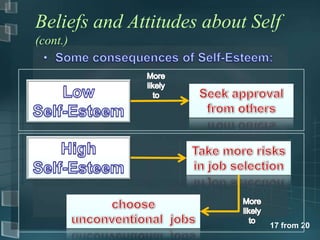
Beliefs and Attitudes about Self
(cont.)


                              17 from 20
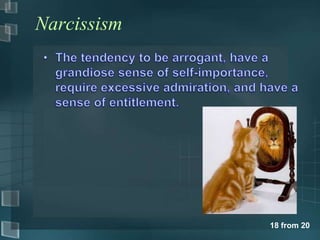
Narcissism


             18 from 20
Beliefs and Attitudes about Self
(cont.)

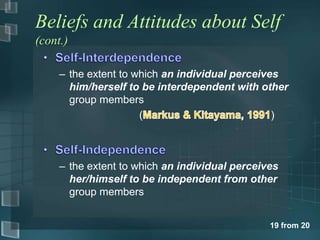
     – the extent to which an individual perceives
       him/herself to be interdependent with other
       group members
                      (                          )


     – the extent to which an individual perceives
       her/himself to be independent from other
       group members


                                                19 from 20
Beliefs and Attitudes about Self
(cont.)


                              20 from 20

Beliefs and assumptions

  • 1.
    Impacts of Perceptions,Beliefs, and Attitudes on Organizational Behavior
  • 2.
    Table of Contents Stereotyping, Entity/Incremental Theorists, Self-Fulfilling Prophecy, Halo Effect, Contrast Effect, Fundamental Attribution Error • How evaluate our beliefs about others Self-Efficacy, Self-Esteem, Narcissisms, Self-Independence/Interdependence 2 from 20
  • 3.
    Beliefs and Attitudesabout Others – Judge someone on the basis of our perception of the group to which he or she belongs : • “older employees can’t learn new skills” • “Overweight employees lack discipline” • “Asian employees are hardworking and conscientious” 3 from 20
  • 4.
    Beliefs and Attitudesabout Others (cont.) refers to a view that human characteristics are fixed and don’t change much with experience refers to a view that human characteristics are malleable and can be changed with experience and can be developed 4 from 20
  • 5.
    Beliefs and Attitudesabout Others (cont.) – is that people’s expectations or beliefs determine their behavior and performance, thus 5 from 20
  • 6.
  • 7.
    Beliefs and Attitudesabout Others (cont.) – General impression about an individual on the basis of a single characteristic such as Intelligence, Sociability, Appearance – For example: • An interviewer may make incorrect image about a well dressing marketing applicant which causes making positive judgment about his/her abilities and responsibilities. 7 from 20
  • 8.
    Beliefs and Attitudesabout Others (cont.) – Evaluation of a person’s characteristics that are affected by comparisons with other people recently encountered who rank higher or lower on the same characteristics with a contrast. – For example: • An interviewee may be overestimated if be compared with a moderate person if there is a contrast between their abilities. 8 from 20
  • 9.
    Beliefs and Attitudesabout Others (cont.) – The tendency to underestimate the influence of external factors and overestimate the influence of internal factors when making judgments about behavior of others – For example: • We may attribute the failures of others to their indiscipline while attribute our failure to system troubles and/or environmental problems 9 from 20
  • 10.
    How Evaluate ourBeliefs 10 from 20
  • 11.
    Identifying Ladder ofInference in our mind These conclusions may not be examined and may be false ? ? ? ? ? 11 from 20
  • 12.
    Identifying Ladder ofInference in our Mind 12 from 20
  • 13.
    Strengthen of DialogSkills 13 from 20
  • 14.
    Beliefs and Attitudesabout Self – Beliefs in one’s capabilities to organize and execute the courses of action required to produce given attainments ( ) – individuals with high self-efficacy work harder and longer ( ) 14 from 20
  • 15.
  • 16.
    Beliefs and Attitudesabout Self (cont.) – Refers to the extent to which a person feels self- worth in a domain – It indicates the degree to which an individual likes herself/himself 16 from 20
  • 17.
    Beliefs and Attitudesabout Self (cont.) 17 from 20
  • 18.
    Narcissism 18 from 20
  • 19.
    Beliefs and Attitudesabout Self (cont.) – the extent to which an individual perceives him/herself to be interdependent with other group members ( ) – the extent to which an individual perceives her/himself to be independent from other group members 19 from 20
  • 20.
    Beliefs and Attitudesabout Self (cont.) 20 from 20