District Roll Out on the
Orientation on the Utilization of
Lesson Scripts for NRP, NMP,
and CUFs
July 26, 2024
Monitoring Tools in the
Utilization of Lesson Scripts
Gilda G. Bancog
EPS-CLMD
Objectives
Participants will be able to effectively utilize
monitoring tools to track and analyze
lesson script utilization, ensuring
adherence to curriculum guidelines
and improving instructional practices.
●shall be used by the school
head/master teachers in
monitoring the delivery of lesson
scripts
Classroom Monitoring Tool for
Lesson Script Delivery
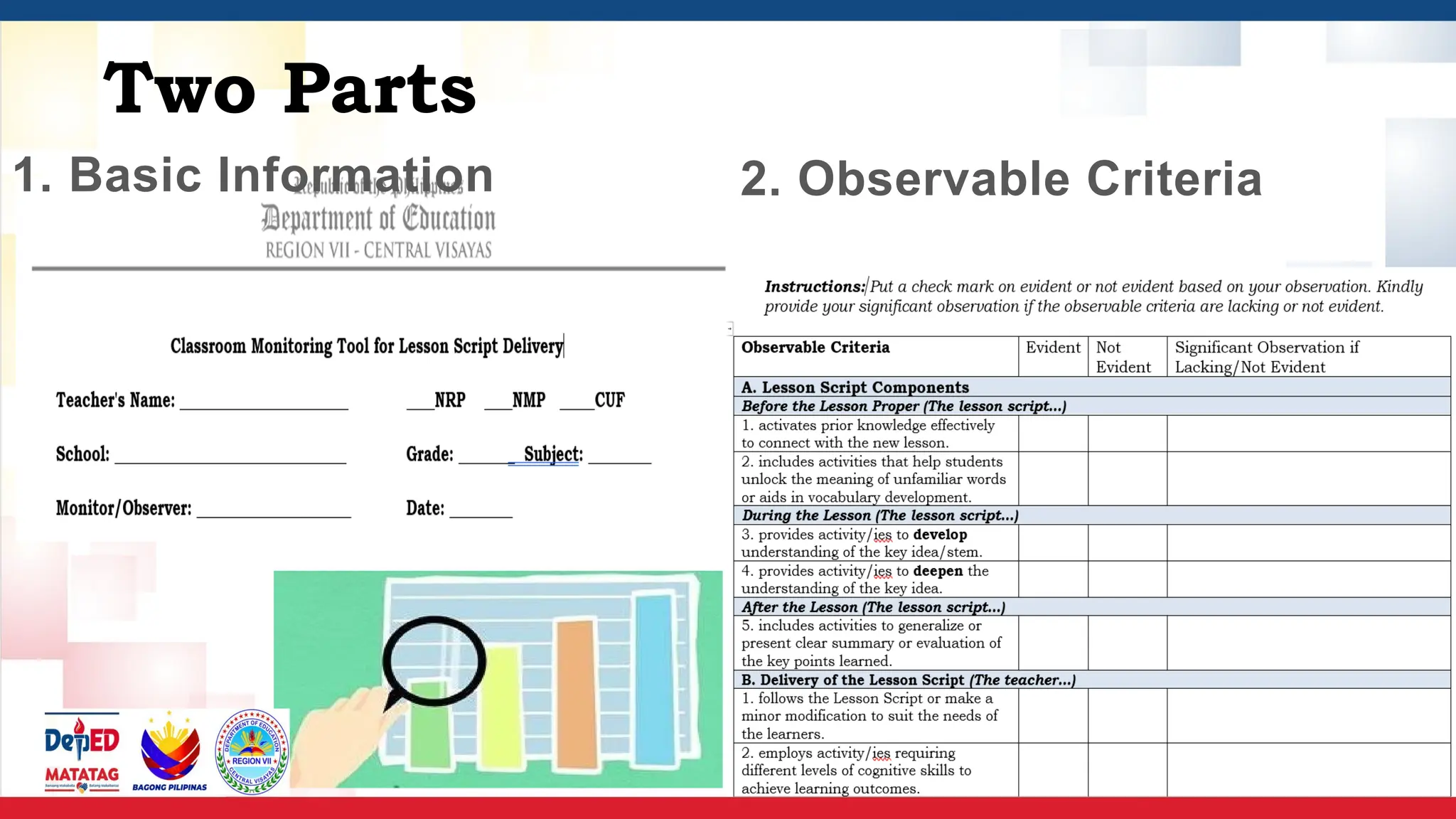
Two Parts
1. Basic Information 2. Observable Criteria
Parts of the Tool
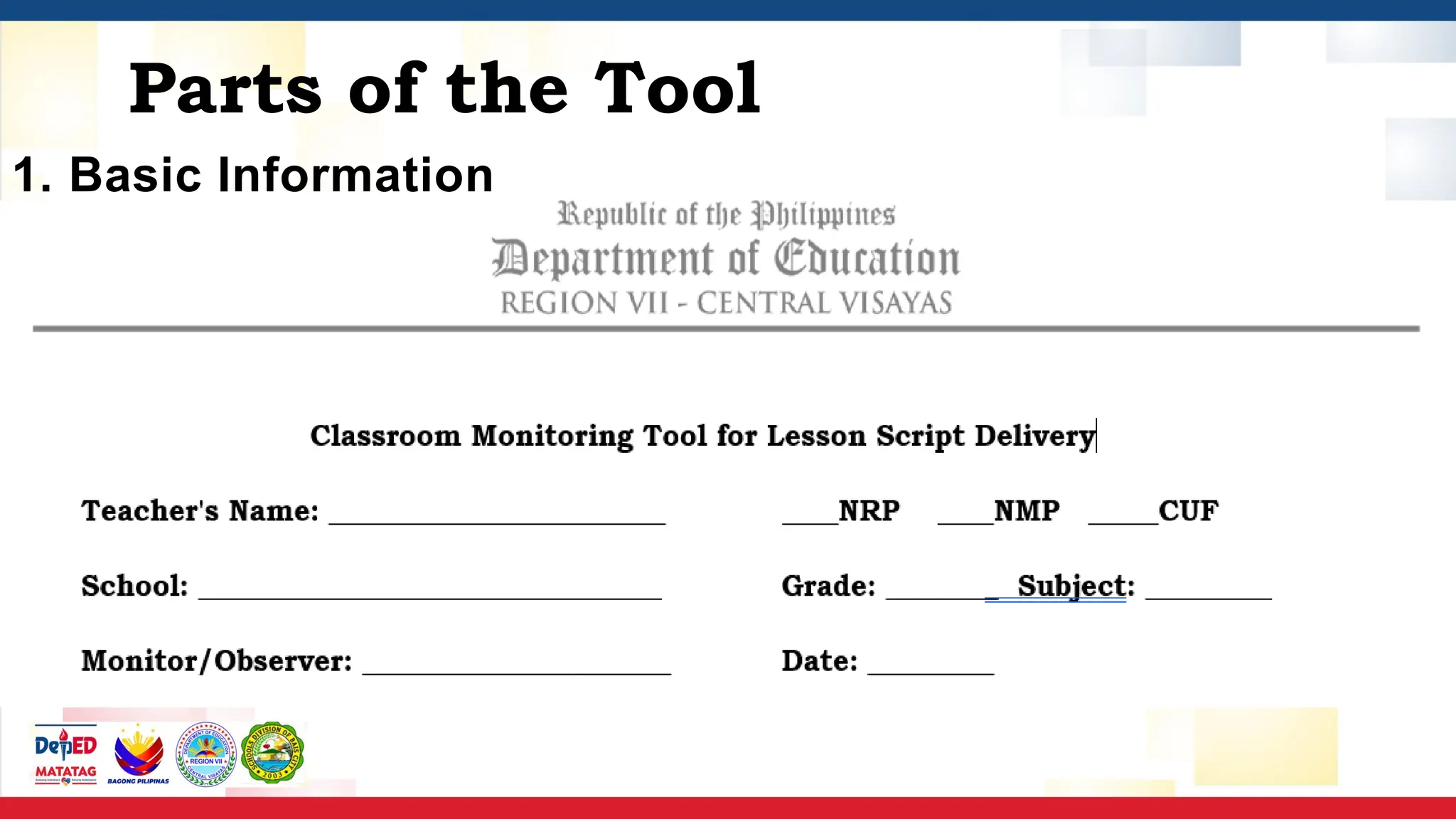
1. Basic Information
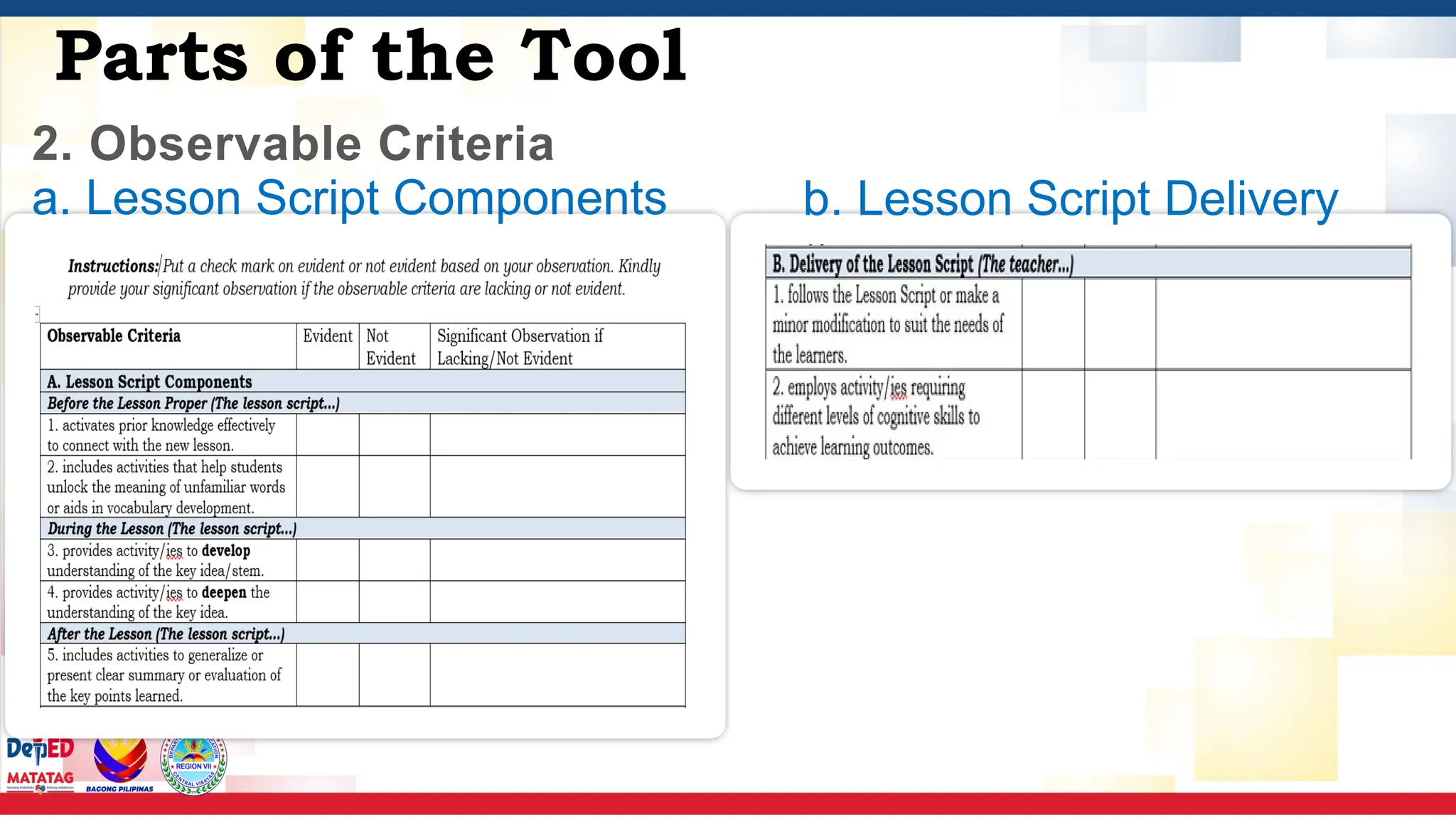
2. Observable Criteria
Parts of the Tool
a. Lesson Script Components b. Lesson Script Delivery
2. Observable Criteria
Parts of the Tool
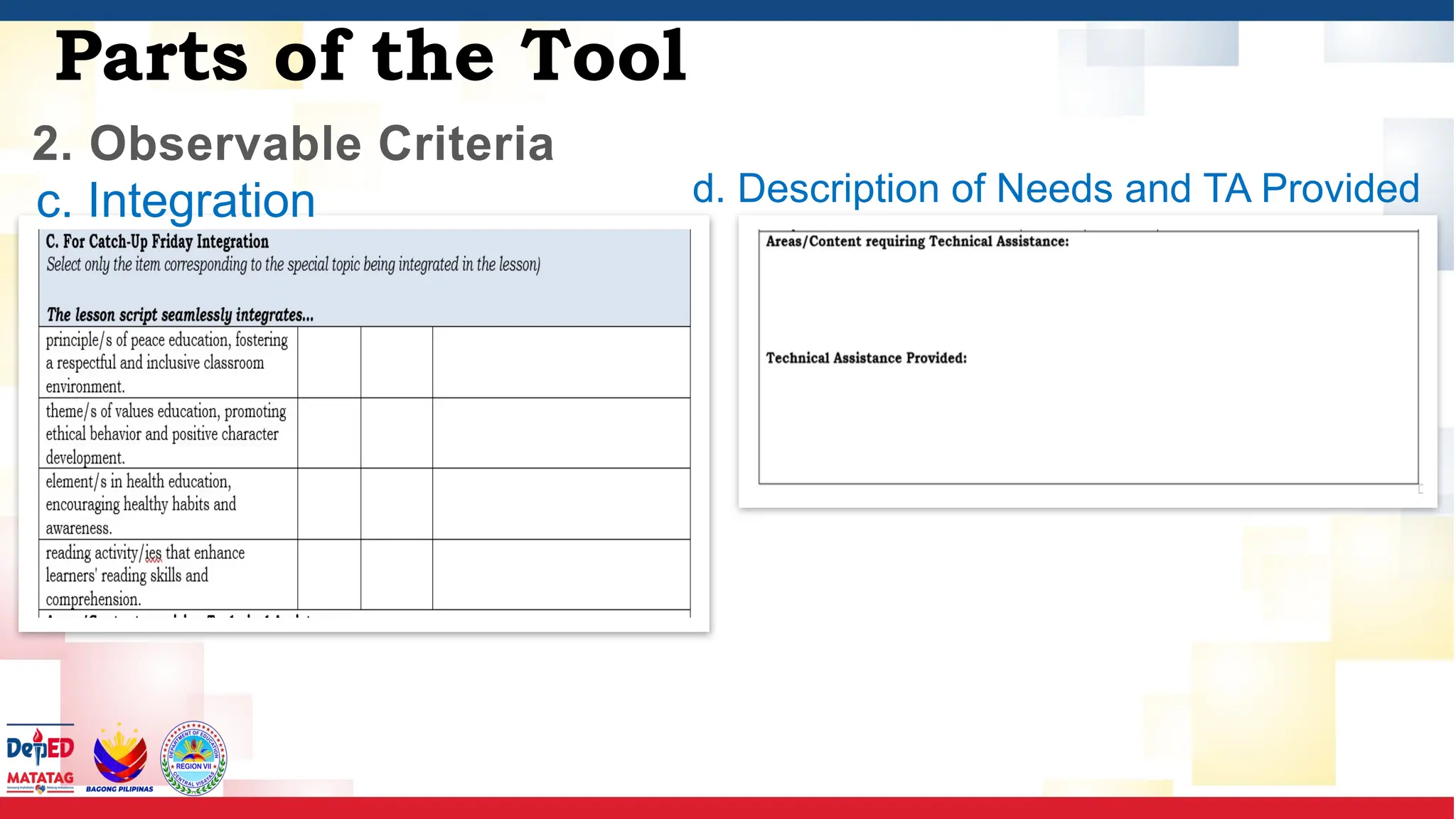
c. Integration d. Description of Needs and TA Provided
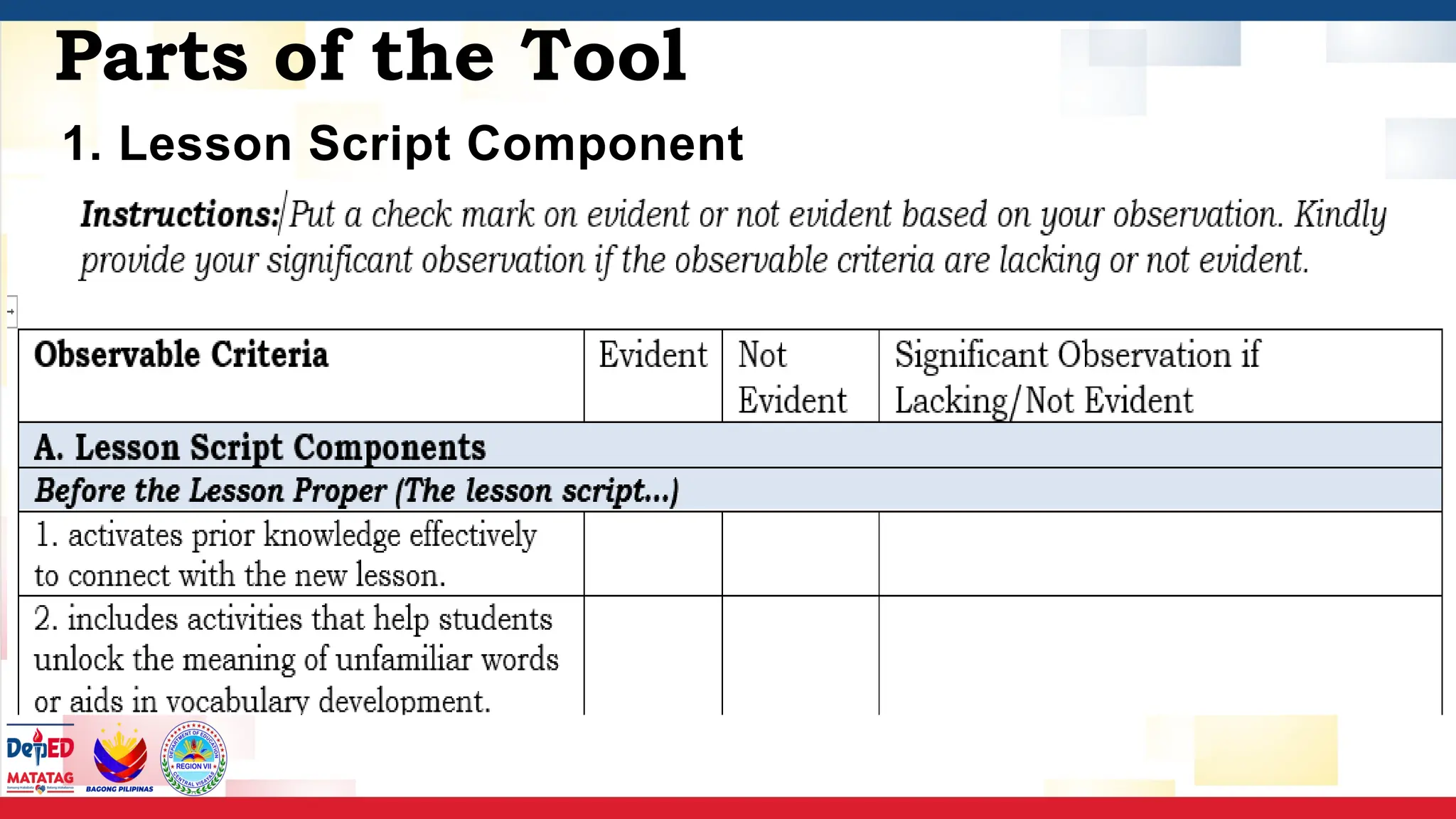
1. Lesson Script Component
Parts of the Tool
a. Lesson Script Component
Observable Criteria
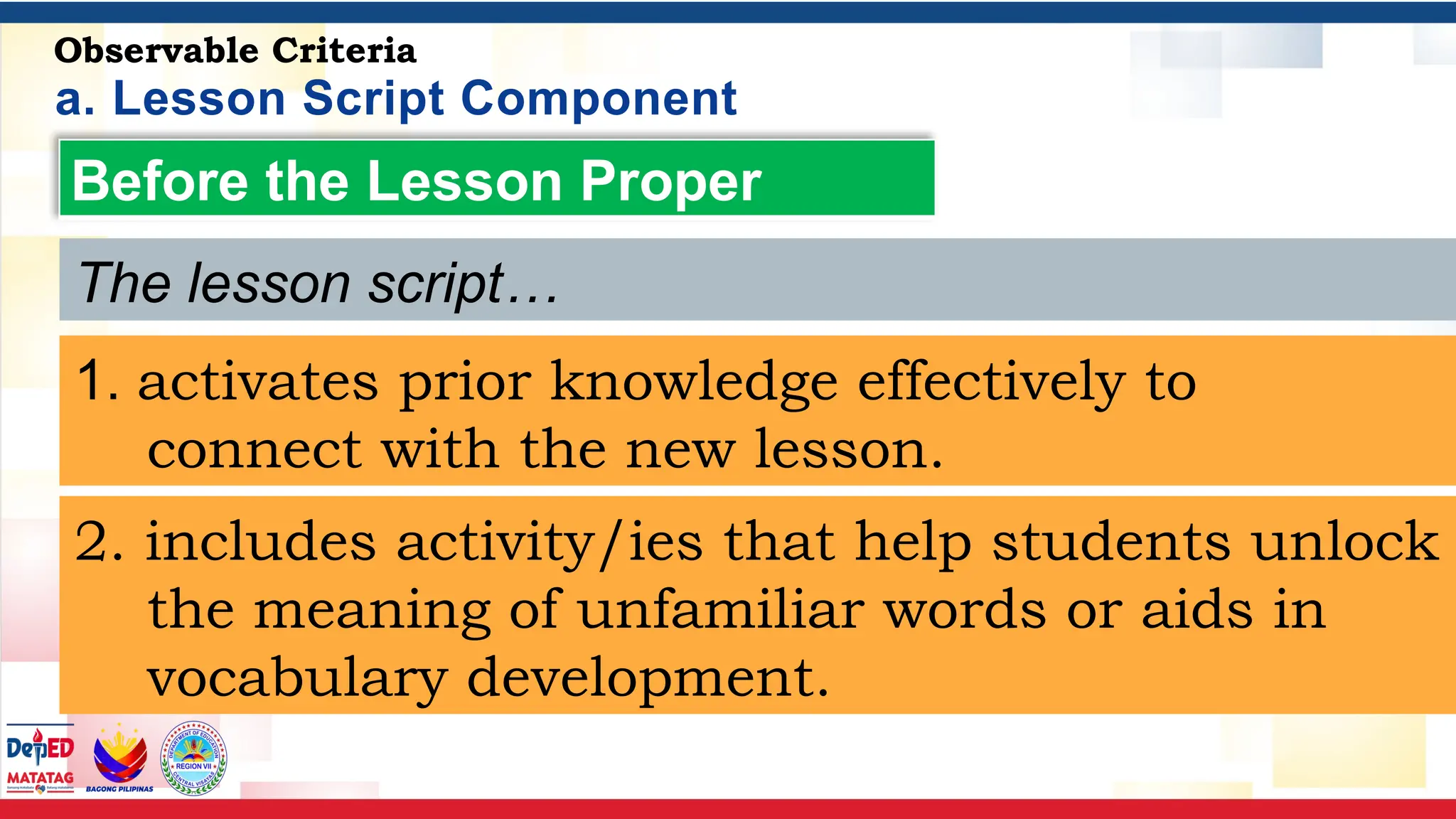
Before the Lesson Proper
1. activates prior knowledge effectively to
connect with the new lesson.
2. includes activity/ies that help students unlock
the meaning of unfamiliar words or aids in
vocabulary development.
The lesson script…
a. Lesson Script Component
Parts of the Tool
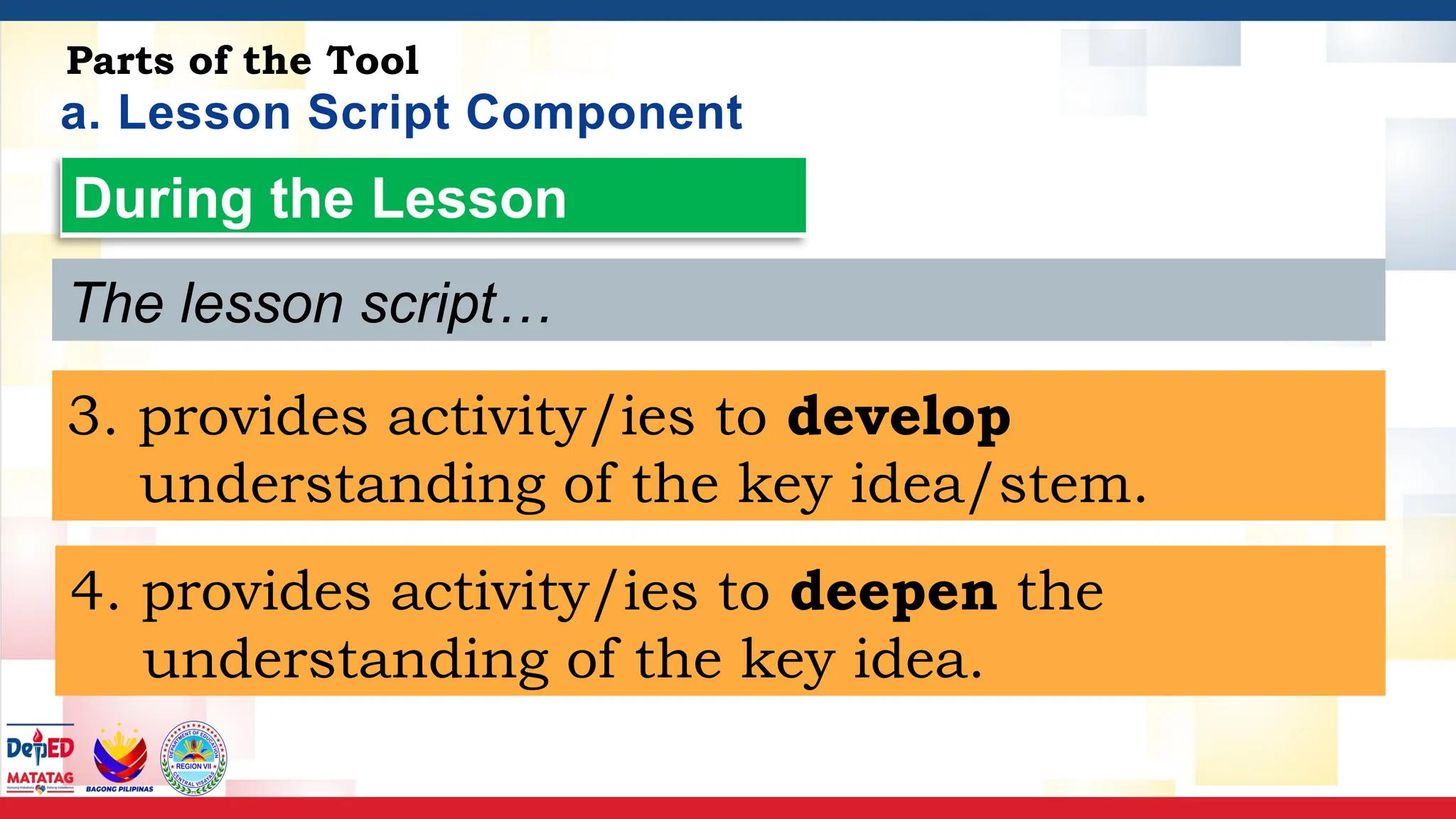
During the Lesson
The lesson script…
3. provides activity/ies to develop
understanding of the key idea/stem.
4. provides activity/ies to deepen the
understanding of the key idea.
a. Lesson Script Component
Parts of the Tool
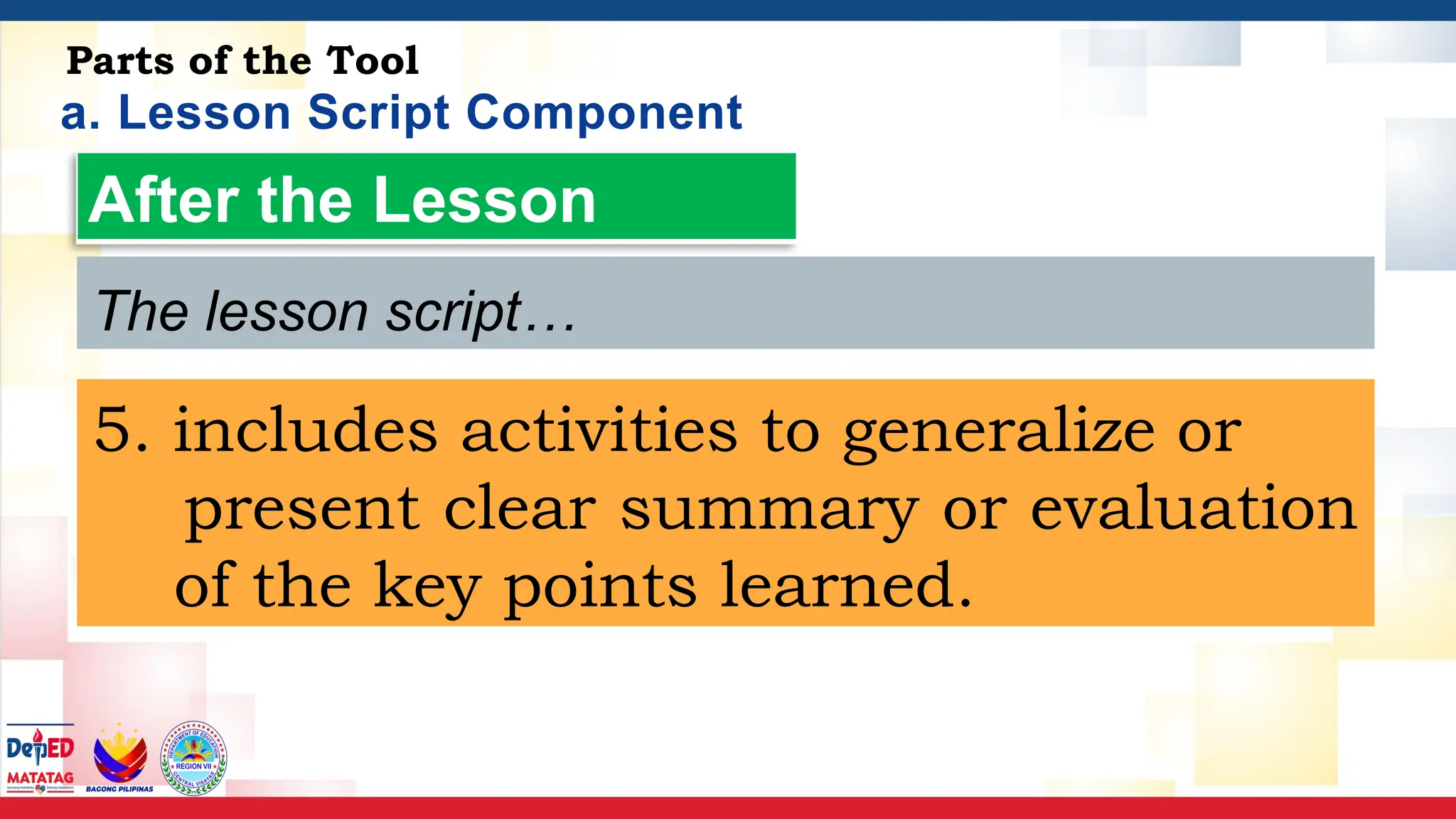
After the Lesson
5. includes activities to generalize or
present clear summary or evaluation
of the key points learned.
The lesson script…
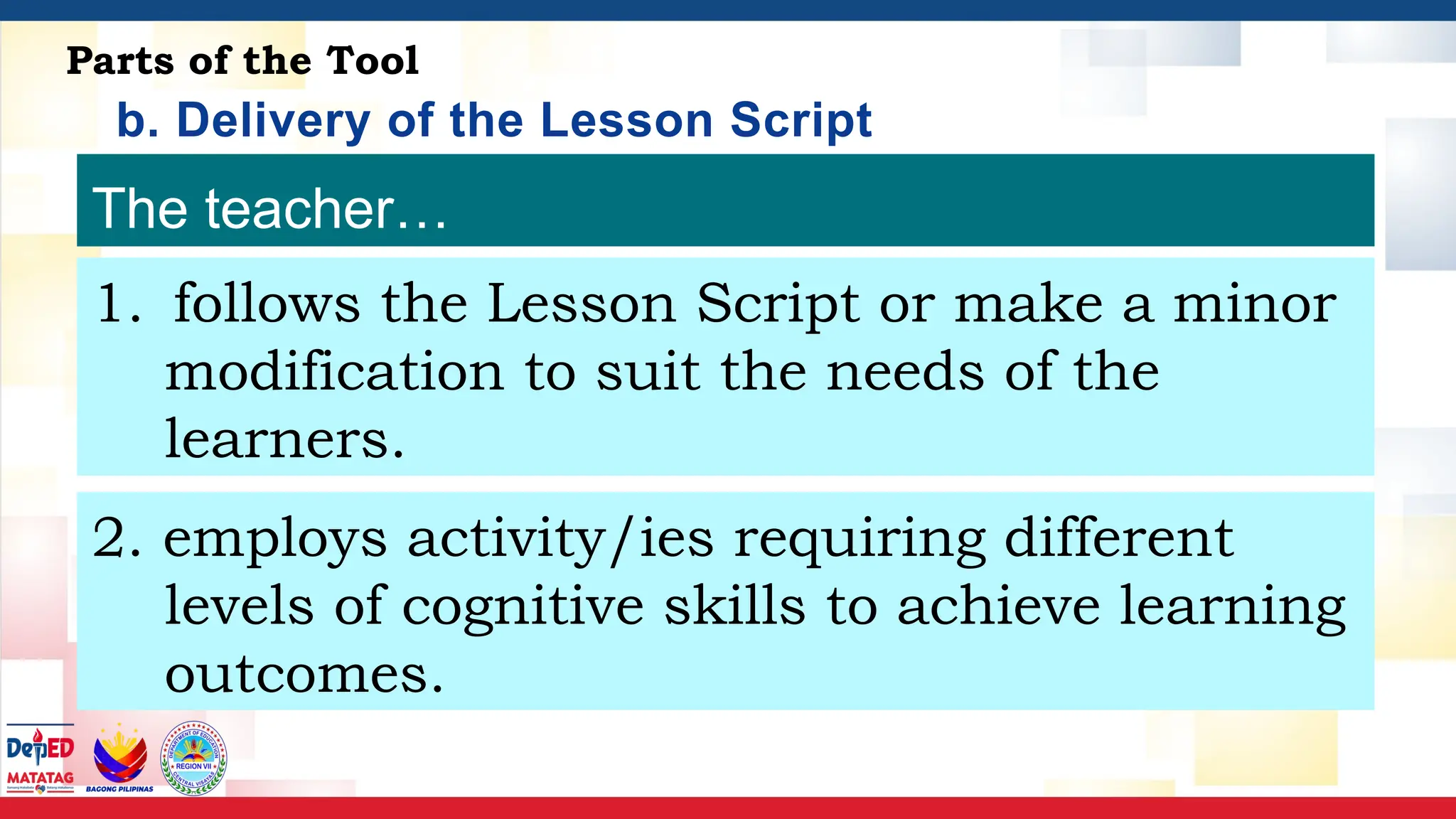
b. Delivery of the Lesson Script
Parts of the Tool
The teacher…
1. follows the Lesson Script or make a minor
modification to suit the needs of the
learners.
2. employs activity/ies requiring different
levels of cognitive skills to achieve learning
outcomes.
b. Delivery of the Lesson Script
Parts of the Tool
The teacher…
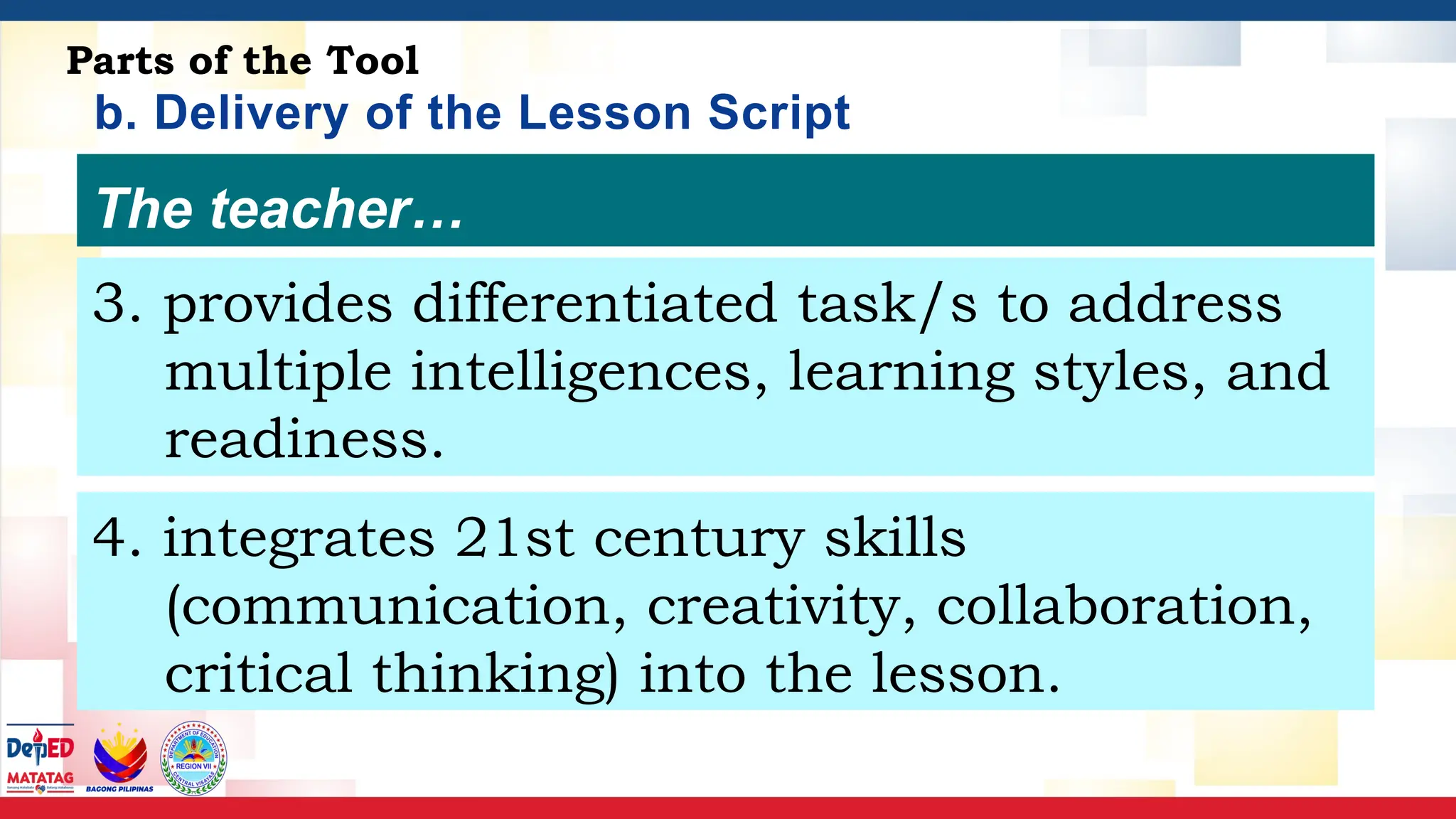
3. provides differentiated task/s to address
multiple intelligences, learning styles, and
readiness.
4. integrates 21st century skills
(communication, creativity, collaboration,
critical thinking) into the lesson.
b. Delivery of the Lesson Script
Parts of the Tool
The teacher…
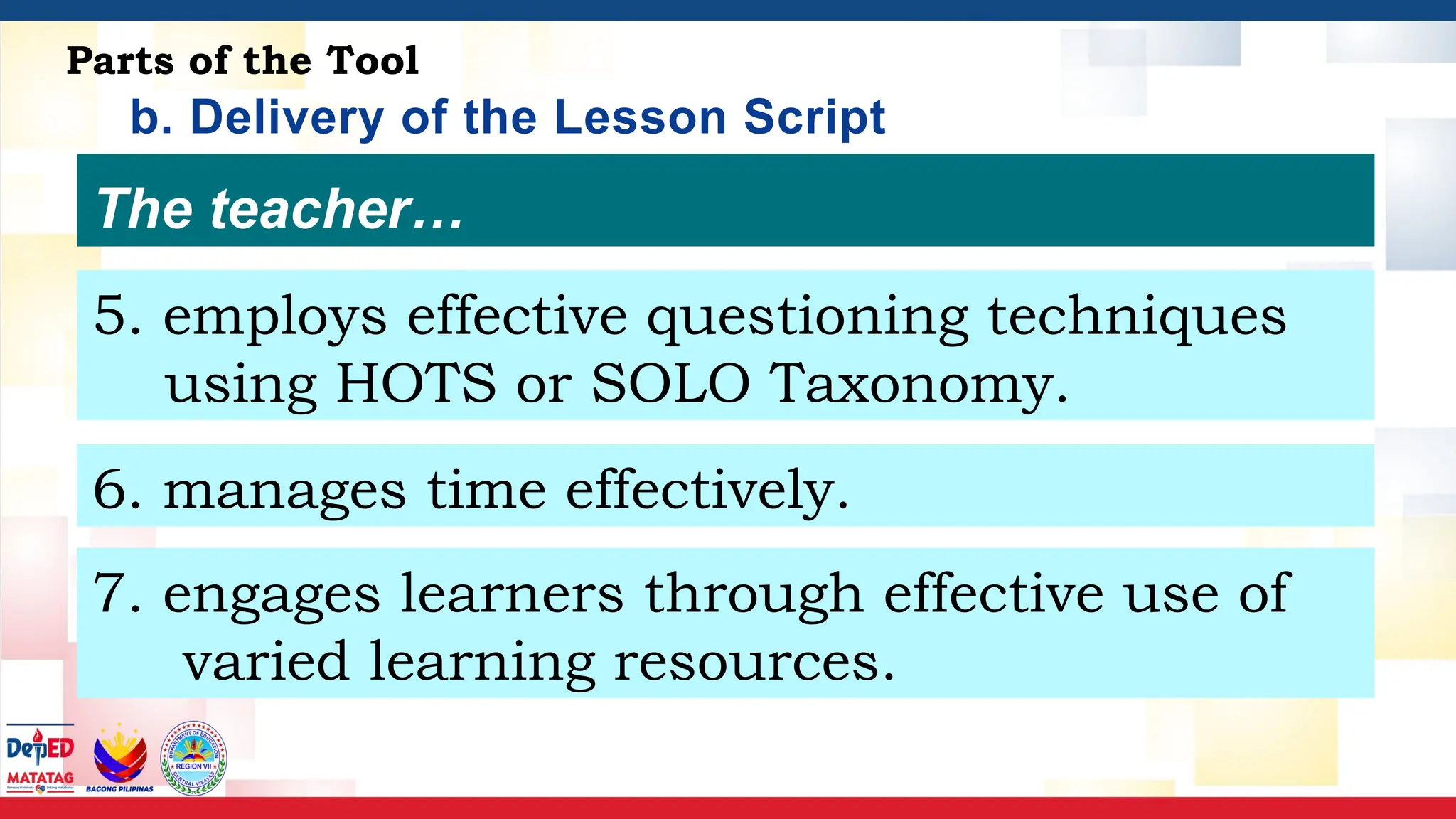
5. employs effective questioning techniques
using HOTS or SOLO Taxonomy.
6. manages time effectively.
7. engages learners through effective use of
varied learning resources.
b. Delivery of the Lesson
Script
Parts of the Tool
The teacher…
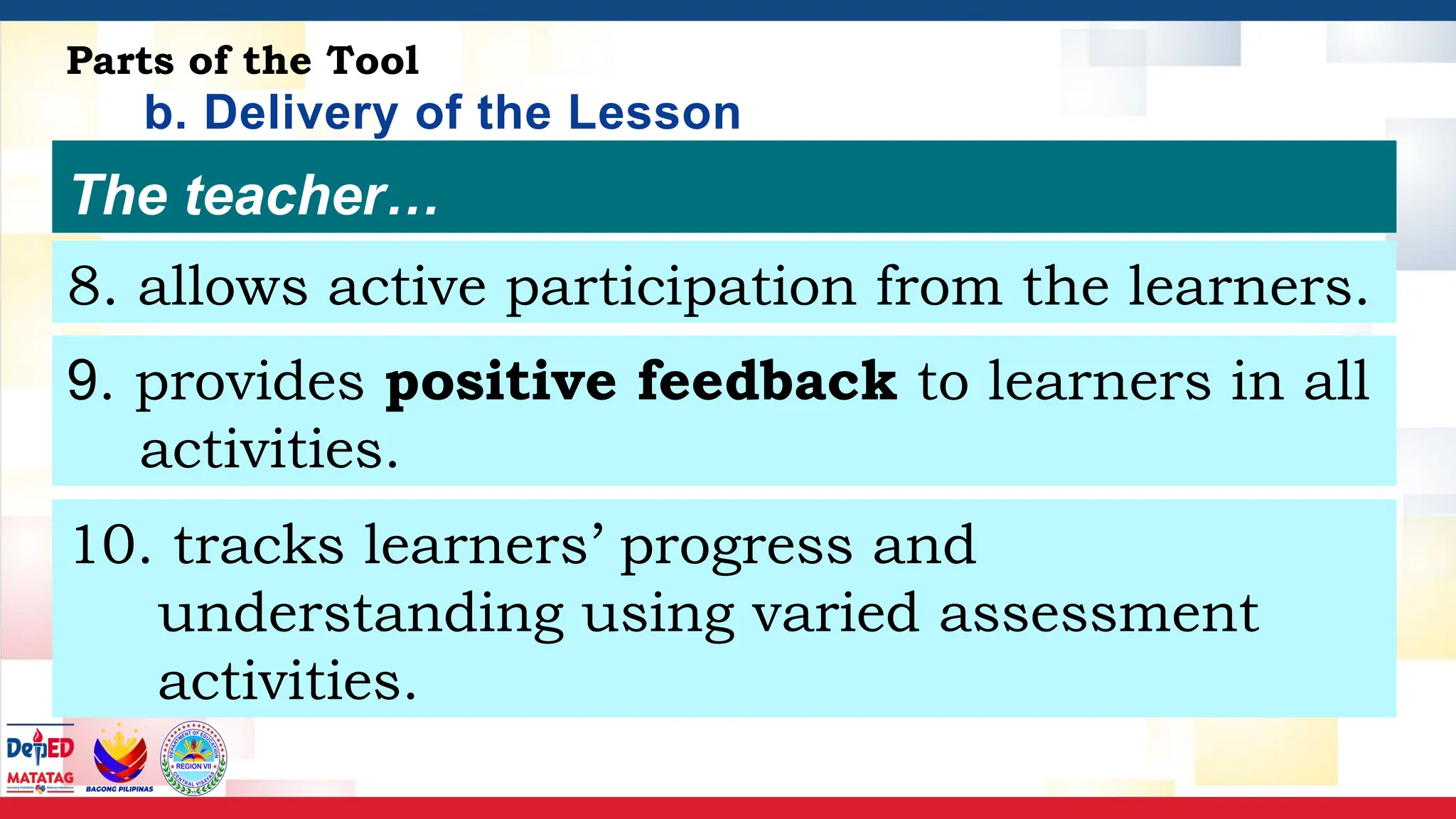
8. allows active participation from the learners.
9. provides positive feedback to learners in all
activities.
10. tracks learners’ progress and
understanding using varied assessment
activities.
c. Integration
Parts of the Tool
The lesson script seamlessly integrates…
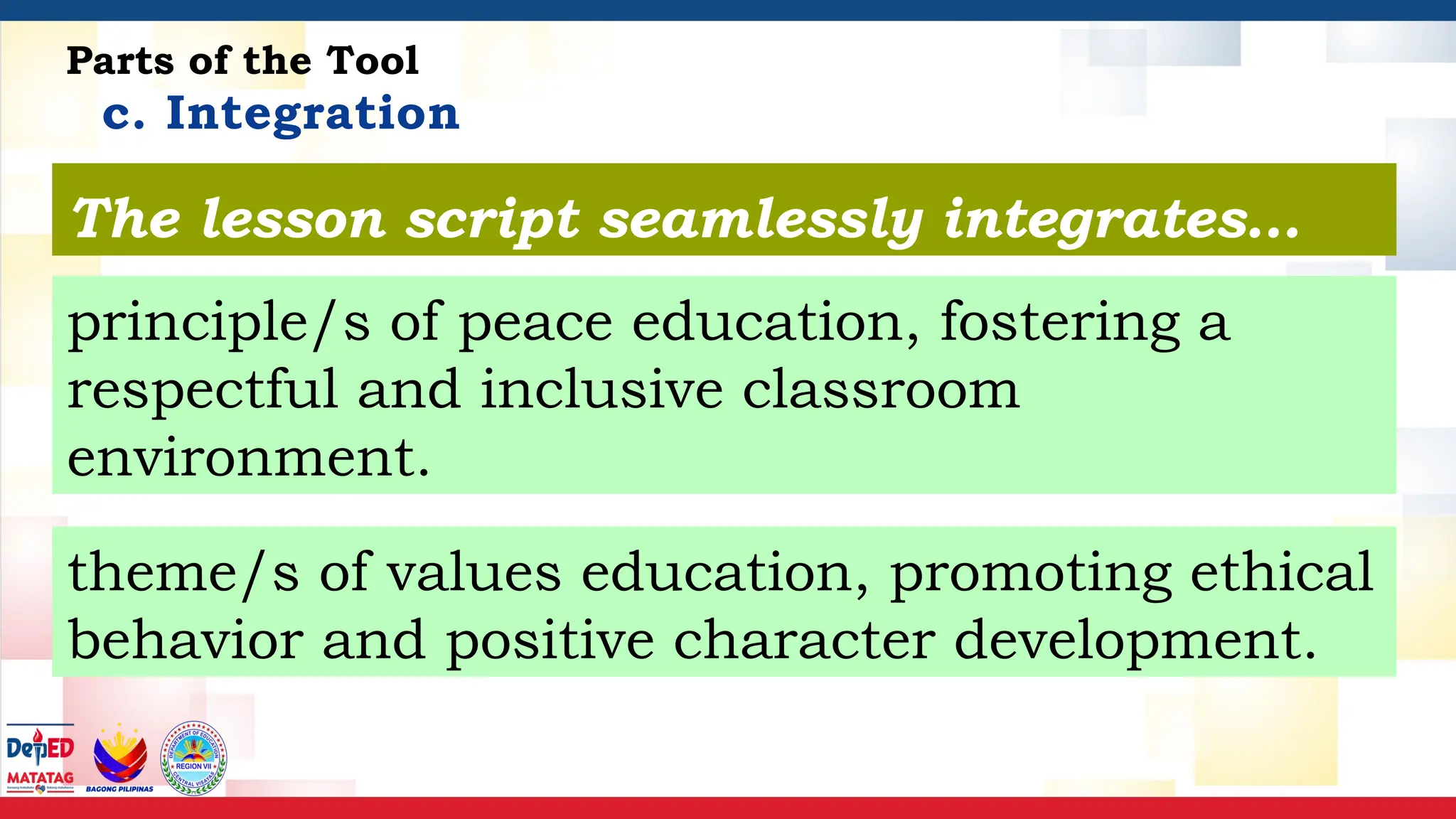
principle/s of peace education, fostering a
respectful and inclusive classroom
environment.
theme/s of values education, promoting ethical
behavior and positive character development.
c. Integration
Parts of the Tool
The lesson script seamlessly integrates…
element/s in health education, encouraging
healthy habits and awareness.
reading activity/ies that enhance learners'
reading skills and comprehension.
d. Brief Narrative Description
Parts of the Tool
Areas/Content Requiring Technical Assistance
_____________________________________________
_
Technical Assistance Provided
____________________________________________
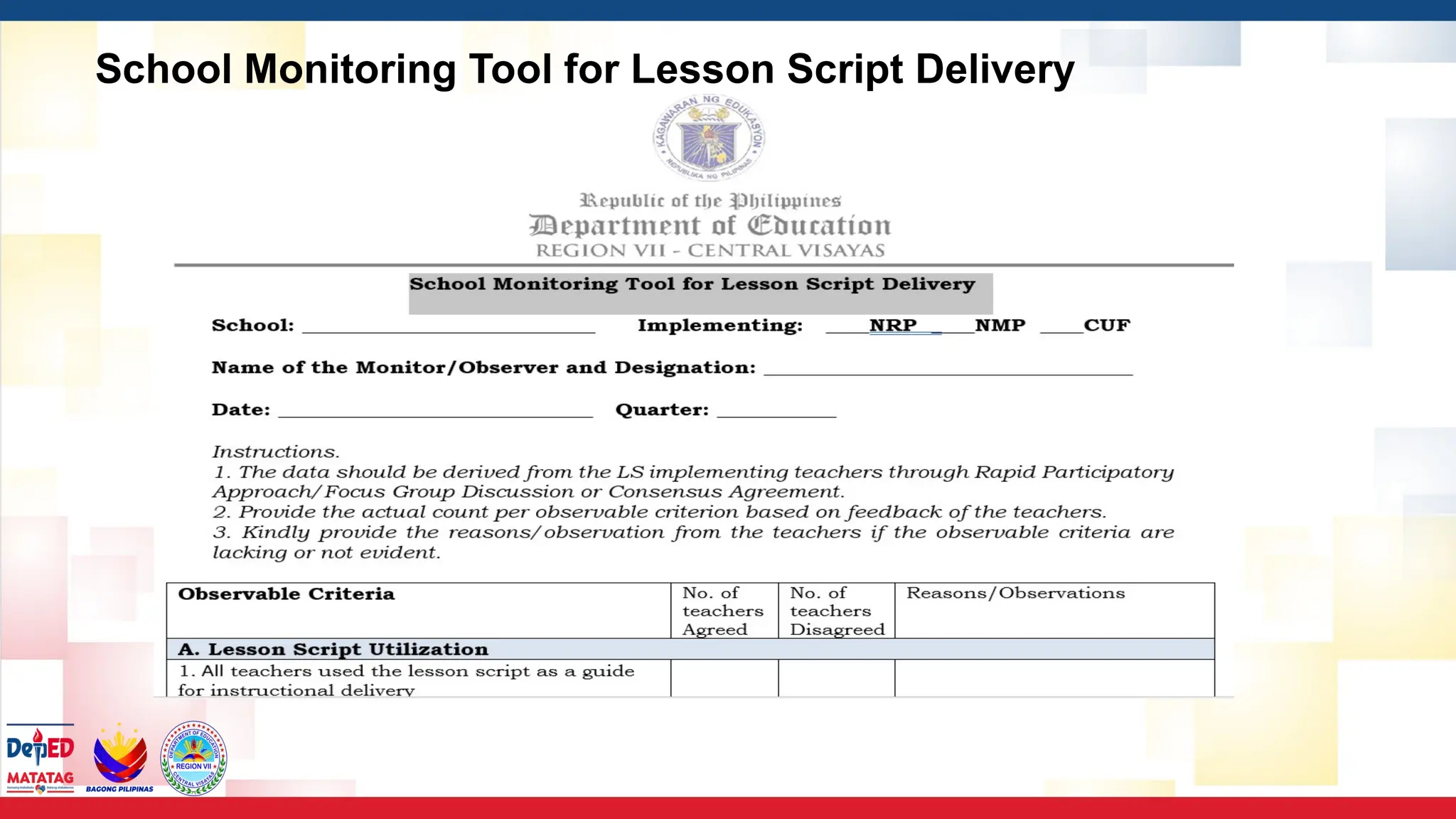
School Monitoring Tool for Lesson Script Delivery
This will be used by the instructional
supervisors and managers in monitoring the
implementation and delivery of CUF lessons.
School Monitoring Tool for Lesson Script Delivery
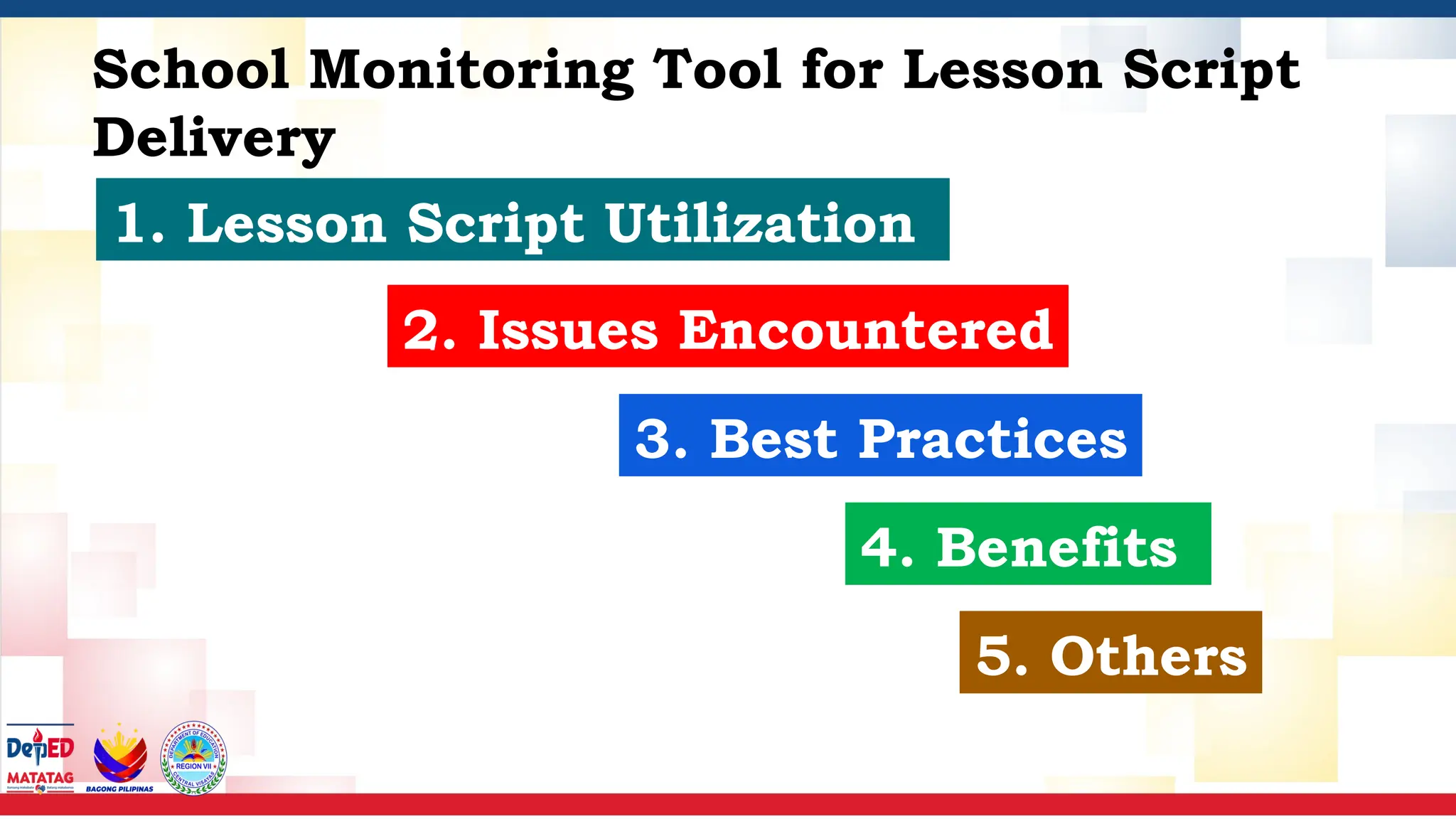
School Monitoring Tool for Lesson Script
Delivery
1. Lesson Script Utilization
2. Issues Encountered
3. Best Practices
4. Benefits
5. Others
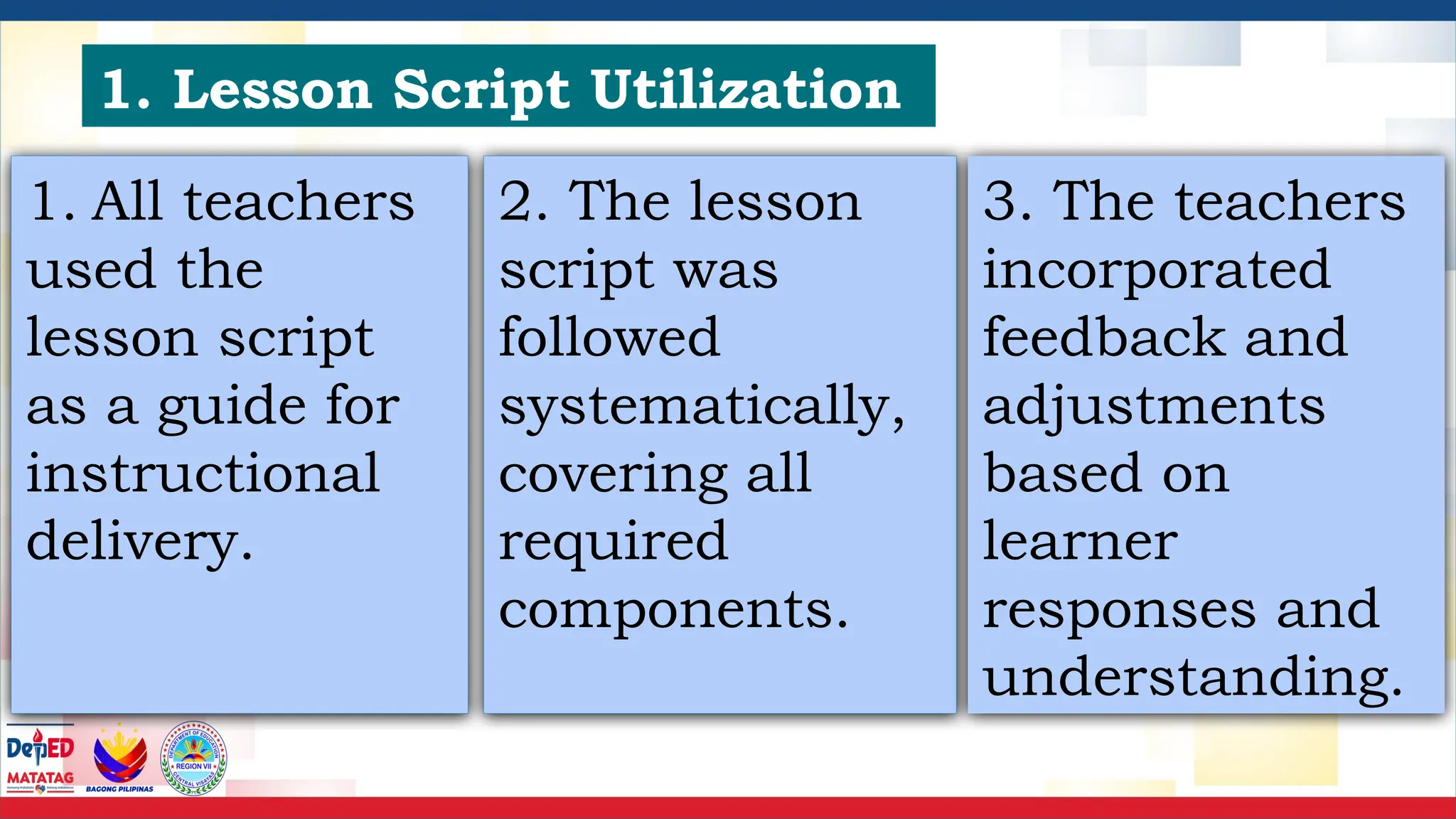
1. Lesson Script Utilization
1. All teachers
used the
lesson script
as a guide for
instructional
delivery.
2. The lesson
script was
followed
systematically,
covering all
required
components.
3. The teachers
incorporated
feedback and
adjustments
based on
learner
responses and
understanding.
2. Issues Encountered
1.There were challenges in
aligning the lesson script
with the actual classroom
dynamics.
3. There were insufficient
resources or materials
available to effectively
implement the lesson script.
2.The lesson script lacked
clarity or is difficult to
follow.
4. Learners had difficulty
engaging with the content
as presented in the lesson
script.
2. Issues Encountered
5. Time constraints hindered the
completion of all components of the
lesson script.
6. Other issues, please provide:
_________________________________
_________________________________
3. Best Practices
1.adjusts the schedule
based on learners’
understanding and
engagement levels
3. integrates Multimedia
technology (e.g., videos,
interactive presentations,
digital tools) to enhance
learning and engagement.
4. Other best practices,
please provide:
________________________
2. uses everyday items
or locally available
materials to create
engaging learning
activities.
4. Benefits
1.Provide a structured framework that ensures
consistency in instructional delivery across
different classes and teachers. This helps
maintain a uniform standard of teaching.
2. Help teachers stay focused on the key competencies
and outcomes they need to achieve, enhancing the
effectiveness of the teaching process.
4. Benefits
3. Keep learners motivated and actively involved
in the learning process.
4. Allow teacher to manage class time more
efficiently, ensuring that all essential
components of the lesson are covered within
the allotted period.
4. Benefits
5. Contribute to improved student learning
outcomes, as students receive clear, focused,
and well-organized instruction.
Other benefits, please provide:
______________
5. Other factors
E. State other factors contributing to
the effective implementation of the
NRP, NMP and CUF.
_________________________________
3.-LS_Monitoring-Tools on MATATAG Curriculum-ppt (1).pptx

3.-LS_Monitoring-Tools on MATATAG Curriculum-ppt (1).pptx

  • 2.
    District Roll Outon the Orientation on the Utilization of Lesson Scripts for NRP, NMP, and CUFs July 26, 2024
  • 3.
    Monitoring Tools inthe Utilization of Lesson Scripts Gilda G. Bancog EPS-CLMD
  • 4.
    Objectives Participants will beable to effectively utilize monitoring tools to track and analyze lesson script utilization, ensuring adherence to curriculum guidelines and improving instructional practices.
  • 5.
    ●shall be usedby the school head/master teachers in monitoring the delivery of lesson scripts Classroom Monitoring Tool for Lesson Script Delivery
  • 6.
    Two Parts 1. BasicInformation 2. Observable Criteria
  • 7.
    Parts of theTool 1. Basic Information
  • 8.
    2. Observable Criteria Partsof the Tool a. Lesson Script Components b. Lesson Script Delivery
  • 9.
    2. Observable Criteria Partsof the Tool c. Integration d. Description of Needs and TA Provided
  • 10.
    1. Lesson ScriptComponent Parts of the Tool
  • 11.
    a. Lesson ScriptComponent Observable Criteria Before the Lesson Proper 1. activates prior knowledge effectively to connect with the new lesson. 2. includes activity/ies that help students unlock the meaning of unfamiliar words or aids in vocabulary development. The lesson script…
  • 12.
    a. Lesson ScriptComponent Parts of the Tool During the Lesson The lesson script… 3. provides activity/ies to develop understanding of the key idea/stem. 4. provides activity/ies to deepen the understanding of the key idea.
  • 13.
    a. Lesson ScriptComponent Parts of the Tool After the Lesson 5. includes activities to generalize or present clear summary or evaluation of the key points learned. The lesson script…
  • 14.
    b. Delivery ofthe Lesson Script Parts of the Tool The teacher… 1. follows the Lesson Script or make a minor modification to suit the needs of the learners. 2. employs activity/ies requiring different levels of cognitive skills to achieve learning outcomes.
  • 15.
    b. Delivery ofthe Lesson Script Parts of the Tool The teacher… 3. provides differentiated task/s to address multiple intelligences, learning styles, and readiness. 4. integrates 21st century skills (communication, creativity, collaboration, critical thinking) into the lesson.
  • 16.
    b. Delivery ofthe Lesson Script Parts of the Tool The teacher… 5. employs effective questioning techniques using HOTS or SOLO Taxonomy. 6. manages time effectively. 7. engages learners through effective use of varied learning resources.
  • 17.
    b. Delivery ofthe Lesson Script Parts of the Tool The teacher… 8. allows active participation from the learners. 9. provides positive feedback to learners in all activities. 10. tracks learners’ progress and understanding using varied assessment activities.
  • 18.
    c. Integration Parts ofthe Tool The lesson script seamlessly integrates… principle/s of peace education, fostering a respectful and inclusive classroom environment. theme/s of values education, promoting ethical behavior and positive character development.
  • 19.
    c. Integration Parts ofthe Tool The lesson script seamlessly integrates… element/s in health education, encouraging healthy habits and awareness. reading activity/ies that enhance learners' reading skills and comprehension.
  • 20.
    d. Brief NarrativeDescription Parts of the Tool Areas/Content Requiring Technical Assistance _____________________________________________ _ Technical Assistance Provided ____________________________________________
  • 21.
    School Monitoring Toolfor Lesson Script Delivery This will be used by the instructional supervisors and managers in monitoring the implementation and delivery of CUF lessons.
  • 22.
    School Monitoring Toolfor Lesson Script Delivery
  • 23.
    School Monitoring Toolfor Lesson Script Delivery 1. Lesson Script Utilization 2. Issues Encountered 3. Best Practices 4. Benefits 5. Others
  • 24.
    1. Lesson ScriptUtilization 1. All teachers used the lesson script as a guide for instructional delivery. 2. The lesson script was followed systematically, covering all required components. 3. The teachers incorporated feedback and adjustments based on learner responses and understanding.
  • 25.
    2. Issues Encountered 1.Therewere challenges in aligning the lesson script with the actual classroom dynamics. 3. There were insufficient resources or materials available to effectively implement the lesson script. 2.The lesson script lacked clarity or is difficult to follow. 4. Learners had difficulty engaging with the content as presented in the lesson script.
  • 26.
    2. Issues Encountered 5.Time constraints hindered the completion of all components of the lesson script. 6. Other issues, please provide: _________________________________ _________________________________
  • 27.
    3. Best Practices 1.adjuststhe schedule based on learners’ understanding and engagement levels 3. integrates Multimedia technology (e.g., videos, interactive presentations, digital tools) to enhance learning and engagement. 4. Other best practices, please provide: ________________________ 2. uses everyday items or locally available materials to create engaging learning activities.
  • 28.
    4. Benefits 1.Provide astructured framework that ensures consistency in instructional delivery across different classes and teachers. This helps maintain a uniform standard of teaching. 2. Help teachers stay focused on the key competencies and outcomes they need to achieve, enhancing the effectiveness of the teaching process.
  • 29.
    4. Benefits 3. Keeplearners motivated and actively involved in the learning process. 4. Allow teacher to manage class time more efficiently, ensuring that all essential components of the lesson are covered within the allotted period.
  • 30.
    4. Benefits 5. Contributeto improved student learning outcomes, as students receive clear, focused, and well-organized instruction. Other benefits, please provide: ______________
  • 31.
    5. Other factors E.State other factors contributing to the effective implementation of the NRP, NMP and CUF. _________________________________

Editor's Notes

  • #19 SOLO (Structure of Observed Learning Outcomes) offers a structured outline for the learners to use to build their learning and thinking. It motivates students to ponder where they are presently in terms of their level of understanding, and what they must do to progress.
  • #36 When our crowd are overwhelmed by big emotions, it is our job to share our calm and not to join their chaos.