Writing for an Audience
PATRICIA A. PATRON
Lesson Objectives
Analyze audience needs and tailor written
content accordingly.
01
Identify different writing styles and formats
appropriate for a variety of audiences.
02
Create written content that appeals to the
target audience.
03
Group Activity
Form a group of three and assume that the group
works for a magazine company.
01
You are tasked with creating an article about celebrating
the diversity of the world.
02
Considering the topic given to your group, brainstorm
about the target audience and other considerations
before writing the article and present your article in front
of the class.
03
What is Audience?
In writing, an audience is an
intended group of readers or
listeners who the writer or speaker
has in mind when composing their
work.
Determine your
Audience
First, determine your audience type by
considering:
• Who they are (age, sex, education, economic status,
political/social/religious beliefs)
• What level of information they have about the subject
(novice, general reader, specialist or expert)
• The context in which they will be reading a piece of writing
(in a newspaper, textbook, popular magazine, specialized
journal, on the Internet, etc.)
Why consider?
It is important to consider audience in writing because
it will affect the tone, language, and structure of the
text.
The audience will have different needs, interests,
and backgrounds, so writing that is tailored to
them will be more effective and engaging.
Types of Audience
A secondary audience in writing is an
audience that is not the primary focus
of the written work. They are still
considered to be important as they may
have an impact on the effectiveness of
the writing.
Secondary Audience
Primary audience refers to the group of
people that the author intends to target
with their writing. This group can be a
specific demographic, such as a certain
age group, gender, or ethnicity, or it can
be a more general audience.
Primary Audience
The lay/general audience has no special or expert knowledge of what you’re
writing about. They need background information, definitions and descriptions
to help them understand your paper.
General/lay Audience
A professional audience is a group of
people who are knowledgeable and
experienced in a specific field or
profession. They typically have a high
level of understanding of the topic
being discussed.
Professional Audience
An academic audience is a group of
people who are expected to have an
advanced understanding of a particular
subject matter or field. When writing for
this audience, the writer should use
formal language and scholarly
references.
Academic Audience
Things to consider when writing for an
audience
Different cultures have different values, beliefs, and
communication styles, so by understanding these
differences, we can tailor our writing to be more effective
and engaging.
Culture
Knowing the demographics of the target audience allows
the writer to craft content that speaks to the audience in a
language they understand.
Demography
Language is an integral part of communication. Not
understanding the language of a target audience means
that the message may not be communicated effectively.
Language
The tone of a piece of writing can help communicate the
writer’s attitude or opinion on a particular topic, so it is
important to choose the right tone for the intended
audience.
Tone
Taking into account the level of education of the readers
helps to ensure that the material is appropriate for their
understanding, rather than too simplistic or advanced.
Education
When your writing is tailored to the interests of your
audience, it will be more likely to connect with them and
leave a positive impression.
Interest
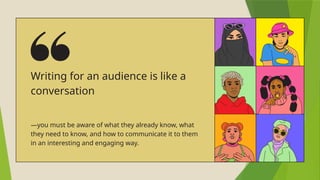
Writing for an audience is like a
conversation
Writing for an audience is like a
conversation
—you must be aware of what they already know, what
they need to know, and how to communicate it to them
in an interesting and engaging way.
Resources
 https://mailchimp.com/resources/second
ary-audience-vs-primary audience/#:~:tex
t=Consider%20students%20who%20want%2
0to,be%20made%20on%20their%20behalf
.
 https://pressbooks.nscc.ca/profcommuni
cation/chapter/chapter-2-audience-analy
sis-primary-secondary-and-hidden-audienc
es/#:~:text=Primary%20audiences%20are%
20those%20who,are%20still%20included%2
0as%20viewer
.
 https://rasmussen.libanswers.com/faq/4
3505#:~:text=The%20lay%2Fgeneral%20au
dience%20has,than%20any%20other%20in%
20college
.
 https://academicplagiarism.com/resourc
es/students/academic-writing-purpose-an
d-audience/#:~:text=In%20an%20academi
c%20setting%2C%20your,objective%20for%2
0that%20specific%20audience
.

Writing for an audience in learning language .pptx

  • 1.
    Writing for anAudience PATRICIA A. PATRON
  • 2.
    Lesson Objectives Analyze audienceneeds and tailor written content accordingly. 01 Identify different writing styles and formats appropriate for a variety of audiences. 02 Create written content that appeals to the target audience. 03
  • 3.
    Group Activity Form agroup of three and assume that the group works for a magazine company. 01 You are tasked with creating an article about celebrating the diversity of the world. 02 Considering the topic given to your group, brainstorm about the target audience and other considerations before writing the article and present your article in front of the class. 03
  • 4.
    What is Audience? Inwriting, an audience is an intended group of readers or listeners who the writer or speaker has in mind when composing their work.
  • 5.
    Determine your Audience First, determineyour audience type by considering: • Who they are (age, sex, education, economic status, political/social/religious beliefs) • What level of information they have about the subject (novice, general reader, specialist or expert) • The context in which they will be reading a piece of writing (in a newspaper, textbook, popular magazine, specialized journal, on the Internet, etc.)
  • 6.
    Why consider? It isimportant to consider audience in writing because it will affect the tone, language, and structure of the text. The audience will have different needs, interests, and backgrounds, so writing that is tailored to them will be more effective and engaging.
  • 7.
  • 8.
    A secondary audiencein writing is an audience that is not the primary focus of the written work. They are still considered to be important as they may have an impact on the effectiveness of the writing. Secondary Audience Primary audience refers to the group of people that the author intends to target with their writing. This group can be a specific demographic, such as a certain age group, gender, or ethnicity, or it can be a more general audience. Primary Audience
  • 9.
    The lay/general audiencehas no special or expert knowledge of what you’re writing about. They need background information, definitions and descriptions to help them understand your paper. General/lay Audience
  • 10.
    A professional audienceis a group of people who are knowledgeable and experienced in a specific field or profession. They typically have a high level of understanding of the topic being discussed. Professional Audience An academic audience is a group of people who are expected to have an advanced understanding of a particular subject matter or field. When writing for this audience, the writer should use formal language and scholarly references. Academic Audience
  • 11.
    Things to considerwhen writing for an audience
  • 12.
    Different cultures havedifferent values, beliefs, and communication styles, so by understanding these differences, we can tailor our writing to be more effective and engaging. Culture Knowing the demographics of the target audience allows the writer to craft content that speaks to the audience in a language they understand. Demography Language is an integral part of communication. Not understanding the language of a target audience means that the message may not be communicated effectively. Language
  • 13.
    The tone ofa piece of writing can help communicate the writer’s attitude or opinion on a particular topic, so it is important to choose the right tone for the intended audience. Tone Taking into account the level of education of the readers helps to ensure that the material is appropriate for their understanding, rather than too simplistic or advanced. Education When your writing is tailored to the interests of your audience, it will be more likely to connect with them and leave a positive impression. Interest
  • 14.
    Writing for anaudience is like a conversation
  • 15.
    Writing for anaudience is like a conversation —you must be aware of what they already know, what they need to know, and how to communicate it to them in an interesting and engaging way.
  • 16.
    Resources  https://mailchimp.com/resources/second ary-audience-vs-primary audience/#:~:tex t=Consider%20students%20who%20want%2 0to,be%20made%20on%20their%20behalf . https://pressbooks.nscc.ca/profcommuni cation/chapter/chapter-2-audience-analy sis-primary-secondary-and-hidden-audienc es/#:~:text=Primary%20audiences%20are% 20those%20who,are%20still%20included%2 0as%20viewer .  https://rasmussen.libanswers.com/faq/4 3505#:~:text=The%20lay%2Fgeneral%20au dience%20has,than%20any%20other%20in% 20college .  https://academicplagiarism.com/resourc es/students/academic-writing-purpose-an d-audience/#:~:text=In%20an%20academi c%20setting%2C%20your,objective%20for%2 0that%20specific%20audience .