Chinese Literature
Prepared by: RHEA MAE B. QUINICOT
Introduction
 China is the only country in the world
with a literature written in one
language for more than 3,000
consecutive years.
 This continuity results largely from the
nature of the written language itself. It
is the use of characters, not letters as in
Western languages, that is most
important in the Chinese language
 The dominance of the written
language has had significant
effects on the development of the
literature. In handwriting or in
print, a piece of literature has
visual appeal. This has given rise to
the great respect that calligraphy
enjoys in China, where it has been
regarded for at least 16 centuries
as a fine art comparable to
painting.
 The main disadvantage of written
Chinese is the great number of
characters it contains: Even basic
reading and writing require a
knowledge of more than 1,000
characters.
 But even with this disadvantage,
Chinese has been a potent factor in
shaping and maintaining a cultural
continuity for millions of people.
 China has a very old and rich tradition in
literature and the dramatic and visual
arts. Early writings generally derived
from philosophical or religious essays
such as the works of Confucius (551-
479 BC) and Lao-tzu (probably 4th
century BC).
 After the fall of a dynasty, for example,
a grand history of the late dynasty was
commissioned and written by scholars
in the next dynasty.
 To many Westerners, Chinese literature
remains a hidden seam in the rich
strata of Chinese culture. As a matter
of fact, it is a treasure of a very
considerable number of brilliant and
profound works as each dynasty, in the
long history of China, has passed down
its legacy of magnificent events and
works.
 For 3500 years, they have woven a
variety of genres and forms
encompassing poetry, essays, fiction
and drama;
 China also produced poetry, novels,
and dramatic writings from an early
date. Poetry, example became well
established as a literary form during the
T'ang Dynasty, from AD 618 to 907.
 Chinese literature has its own values
and tastes, its own reigning cultural
tradition and its own critical system of
theory.
 Drama is another old and important
literary form. Chinese drama usually
combines vernacular language with
music and song and thus has been
popular with the common people.
 A variety of popular and standard
themes are presented in Peking Opera,
which is probably the best known of
several operatic traditions that
developed in China. Chinese opera is a
favorite artistic and cultural medium
 Early Chinese novels often
stressed character development
and usually centered on an
adventure or supernatural
happening;
 "Dream of the Red Chamber',
probably China's most famous
novel.
 China's literary tradition continues to
the present, though much 20th-century
writing has concentrated on efforts to
reform or modernize China.
 To many Westerners, Chinese literature
remains a hidden seam in the rich
strata of Chinese culture.
 For 3500 years, they have woven a
variety of genres and forms
encompassing poetry, essays, fiction
and drama;
Four Main Periods:
 Classical literature,
 Contemporary literature,
 Modern literature; and
 Present day literature.
Classical Literature
 refers to the earliest period and covers
works from three thousands years ago
to the late Qing Dynasty (1644 - 1911),
and is a virtually unbroken strand
enduring dynastic changes.
 Written in an ancient form of language
that is very different from present day
Chinese, it needs to be carefully studied
to be understood.
 The most important poetic work
produced during the classical period
was the Shih Ching (Book of Poetry), an
anthology of ancient poems written in
four-word verses and composed mostly
between the 10th and the 7th centuries
bc.
 The Shih Ching is classified as the third
of the Five Classics; legend has it that
Confucius himself selected and edited
the 305 poems that constitute the
work.
 The other half of the Shih Ching is made
up of dynastic songs and court poems.
These songs and poems give a colorful
picture of the life and manners of the
Chinese feudal nobility, just as the folk
poems depict the simple and yet
bountiful life of the peasantry.
 The aristocratic, or court, style finds its
best expression, however, in a group of
poems known as the elegies of Ch'u.
 A feudal state in south-central China,
Ch'u was the home of Ch'ü Yüan (343–
277 bc), the first great Chinese poet.
 A noble by birth, Ch'ü Yüan wrote Li Sao
(Encountering Sorrow), a long,
autobiographical poem full of historical
allusions, allegories, and similes, lyrically
expressed and concerned with the
intimate revelation of a poetic soul
tormented because it has failed in its
search for a beautiful ideal.
Prose
 The seminal works of Chinese prose are those
that, with the Shih Ching, constitute the Five
Classics. These are the I Ching (Book of
Changes), a divination text; the Shu Ching
(Book of History), a miscellanea of ancient
state documents; the Li Chi (Book of Rites), a
collection of ritual and governmental codes;
and the Ch'un Ch'iu (Spring and Autumn
Annals), a history of the state of Lu from 722
to 481 bc.
 From the 6th to the 3d century bc, the first
great works of Chinese philosophy appeared.
Poetry
 In ancient China, people had profuse feelings
to express when historical events took place,
both joyful or of grief.
 Classical literature possesses a profound
culture, and is the epitome of the spirit,
morals and wisdom of the Chinese people.
 Classical poetry cares a great deal for rhythm.
Poetry is one of the earliest artistic forms as
well as the most fully developed in China.
Dynasties
 Shang (bea)
 Zhou
 Chin
Han
 Chu Ci, or The Songs of the South,
is another important poem
collection which appeared 300
years after The Classic of Odes.
 Chu Ci, as the book's name
indicates, is derived from the
songs of the southern state Chu
during the Warring States Period
(476 BC - 221 BC).
 Qu Yuan, who furthered the
development of the new poem style, is
famed as a great patriotic poet and
politician in the Chu state.
 This poetry book changed the simple
and brief style of The Classic of Odes,
and completely distinctive.
 The ancient poetry really enlightened
the poets that came after with its
romanticism.
 Yuefu in Han Dynasty (206 BC -
220) is a creation of the lower
class working people.
 The most prominent works are Mo
Shang Sang, Zhan Cheng Nan (War
in the South of Town), Orphan's
Song, and A Pair of Peacocks
Southeast Fly.
 The Han Dynasty Ode is another
popular style that originated in the
first unprecedented powerful
empire - Han. It is an artistic
reflection of the optimism and
self-reliance of that time.
 The Han Dynasty (206 BC to AD
220) actively promoted the
restoration and teaching of the
Classics.
 In 124 BC a national university was
opened for the purpose of
teaching Confucianism.
 It was also during the Han period
that the Classics became
established as the basis of Chinese
education.
 Literature flowered again during
the Han Dynasty.
 Traditional poetry and prose
forms, especially the Fu prose
poems, flourished. But the most
notable achievement came with
the reactivation of the Yueh Fu, or
Music Bureau, in 125 BC.
 The most outstanding folk ballad
of the period, about AD 200, was
`Southeast the Peacock Flies'.
 The major prose authors of the Han
Dynasty were Liu An, Ssu-ma Ch'ien,
and Pan Ku.
 Liu An was a prince of Huai-nan in the
2nd century BC.
 The work attributed to him, but
probably done under his patronage, is
`The Master of Huai-nan'.
 The masterpiece of the period was the
`Shih-chi', meaning "Historical
Records," of Ssu-ma Ch'ien.
 It was completed in about 85 BC
and took 18 years to produce. It
contains a record of events and
personalities for the previous
2,000 years.
 It was the first attempt at a
national history in China, and it set
the pattern for the histories of
dynasties in the following
centuries.
 In the next century Ssu-ma Ch'ien
was followed as historian by Pan
Ku, who was born about AD 32
and died about AD 92.
 He was also a poet, soldier, and
the author of `Han shu', meaning
"History of the Former Han
Dynasty."
Six Dynasties and the Sui
Dynasty (AD 221 to 618).
 Xin Dynasty Eastern HanThree
Kingdoms 220–280 Wei, Shu &
WuJin Dynasty 265–
420 Western Jin16 Kingdoms
304–439 Eastern JinSouthern
& Northern Dynasties
 Sui dynasty
Six Dynasties and the Sui
Dynasty (AD 221 to 618).
 The major poet of this era was
T'ao Ch'ien (365-427).
 He was a master of the five-
word line and has been called
the first of China's great
nature poets because most of
his writings deal with rural
activities.
 The 3rd and 4th centuries were,
for prose writers, a time of
individuality and partial rejection
of slavish imitation of past models.
 Lu Chi (261-303) was a renowned
poet and literary critic who
emphasized originality in creative
writing.
-ex. Wen Fu
 The revolt against imitative writing
was also expressed in a 5th-
century style called "pure
conversation," an intellectual
discussion on lofty matters.
 In the 6th century the first book of
literary criticism, `Carving of the
Literary Dragon', was published by
Liu Hsieh (465-522).
 Two other 6th-century prose
masters were Yang Hsien-chih,
author of `Record of Buddhist
Temples in Lo-yang', and Li
Tao-yuan, author of
`Commentary on the Water
Classic'.
Tang Dynasty
 Poetry in the Tang Dynasty (618 -
907) is an unparalleled system and
reaches the pinnacle in the
development of the poem.
 is considered China's golden age
of poetry.
 Its dazzling value consists of an
ideal combination of thoughts and
art.
 In later study of literature, it is
spoken of as being representative
of the whole classical literature
along with two other styles of
poetry –
 Tang Shi,
 Song Ci,
 Yuan Qu (Poetry in the Tang
Dynasty, Ci in the Song Dynasty,
and Qu in the Yuan Dynasty).
 As for quantity, a total of over
50,000 poems have been
collected and no one has any idea
how many more have been lost.
 Depending upon the period of its
development poetry dating from
the Tang Dynasty, can be
classified into four groups, namely
early Tang Dynasty, Flourishing
Tang, Mid-Tang and late Tang
Dynasty.
Early Tang
 In the early Tang Dynasty, most of
the poets followed the style of
their forebears and created a
blend of the characteristics of the
north and south.
 Eventually the field of literature
was refreshed and became more
vigorous as a result of those who
are known as The Four Talents -
Wang Bo, Yang Jiong, Luo
Binwang, and Lu Zhaolin,.
 Poems of the period known as
the flourishing Tang Dynasty
enjoyed a golden environment
owing to the wise reign,
prosperous economy, and the
prevailing strength of
diplomacy.
 The era endowed poets with
broad horizons, positive and
unrestrained emotion, and
innovative inspiration.
There are many representatives
we can enumerate:
 Li Bai enjoys the title of the
'Supernatural Being of Poem' .
 Even now his 'Jing Ye Si'
(Thoughts on the Silent Night)
is quite popular and nearly
everyone knows it even
children as young as two years
of age.
 Du Fu, known as the 'Saint
of Poem', was strict in his
use of metrical verses.
 His Deng Gao (Climbing Up)
achieved the perfection of
sheer professionalism.
 Wang Wei, the poet of landscape,
has written lots of elegant and
exquisite verses, such as 'bright
moon lighting on the pine forests,
clear water found running on the
stones'.
 Cui Hao created the best of the
seven-worded regulated poems -
The Yellow Crane Tower with the
verse 'yellow crane flies and never
back, white cloud floats away for
thousand years'.
 Cen Shen was skillful in his
descriptions of colorful scenes
in the then northwest China
and his famous sentence
conveying the delight with
snow 'just like the sudden
spring wind overnight blows,
thousands of pear trees come
to bloom' .
Mid-Tang
 In the Mid-Tang Dynasty,
numerous poets came to
prominence.
 The poets also subsequently
diverted the attention from state
affairs to the trivialities of daily life,
and from the glorification of
landscapes to the anchorage of
spirits and hopes.
 Poets like Liu Zongyuan and Wei
Yiwu expressed themselves
through the plain depiction of
sights around them.
 Another renowned literary figure is
Bai Juyi. His The Old Charcoal
Seller fully satirized the dark social
reality.
 And the Chang Hen Ge (Song of
Eternal Lament)
Late Tang dynasty
 In late Tang Dynasty, with the
deterioration of government,
the poems reflected more and
more the hopeless and
helpless feelings of the people
in a heavy way.
 The most talented poets were
Li Shang Yin and Du Mu.
Other Information about
Tang Dynasty
 Two of the greatest poets in all
Chinese literature lived during the
T'ang Dynasty: Li Po (701-762) and
Tu Fu (712-770).
 Li Po was a romantic who
celebrated such things as drinking,
friendship, and nature as well as
solitude and the passage of time.
 Tu Fu also celebrated the beauties
of nature and bemoaned the
passage of time, but he was also a
satirist and critic.
 Tu Fu's great reputation in
literature comes in part from his
expert use of all types of poetic
style.
 Chinese prose also underwent a
stylistic reform during the T'ang
period. The major change was
brought about by Han Yu (768-
824).
 He promoted classic Confucian
doctrines at a time when they had
begun to fall into neglect because
of the rising popularity of
Buddhism and Taoism.
 At his death he was honored with
the title "Prince of Letters."
Sung Dynasty
 Ci in the Song Dynasty (960 - 1279)
indicates another type of poetry at
that time. It came into being in the
Tang Dynasty and reached its summit
in the Song literature.
 This type of poem is akin to lyrics
created for musical accompaniment
as the meter varies in the way that the
words had to match the rhythm of the
music.
 Ci, depending upon its length, can
be divided into Xiao Ling (small-
sized, less than 58 characters),
Zhong Diao (middle-sized, 59 - 90
characters), and Chang Diao (long-
sized, more than 91 characters).
 Each Ci has a title as well as a Cipai
which is the name of the tonal
pattern and decides the rhythm
and form of a verse.
 Poets in the Song Dynasty
developed Ci that was deeper in
content and broader in form.
 Those who made a great
contribution were Liu Yong, Su
Shi, Yan Shu, Li Qingzhao, Xin Qiji,
etc.
 Generally speaking, Ci has two
main genres - Wanyue (graceful
and mild) and Haofang (bold and
unconstrained).
 Ci of Wanyue genre endows
delicate things with exquisite
feeling and elegance.
 The most famous verses are 'How
helpless I see the flowers falling,
the swallows seem to know winter
is coming again' by Yan Shu.
 Ci of Haofang genre began to be
popular since the creation by Su
Shi who changed Ci into a lyrical
art.
Other information about
Sung Dynasty
 During the Sung Dynasty,
especially in the 11th century, the
tz'u form of poetry and song was
brought to its greatest heights,
particularly through the efforts of
China's best woman poet, Li
Ch'ing-chao (1081-1141).
 Her early poems dealt with the
joys of love and were intensely
personal.
 The prose reform continued under
followers of Han Yu, and poetry of
the conventional type continued
to be written by members of rival
literary schools. The only real
innovation came with the use of
everyday speech in local dialects in
storytelling.
 This style opened new vistas in
prose fiction in later periods,
though its use was at first
despised by professional writers
Modern Chinese Literature
 The literary reform movement that
began with these and other “calls to
arms” was an important part of the
larger New Culture Movement for
cultural and sociopolitical reform,
which was greatly strengthened by a
student protest on May 4, 1919, against
the intellectual performance of the
Chinese delegates to the Paris Peace
Conference formally terminating World
War I.
The first fruits of this movement were
seen in 1918 and 1919 with the
appearance in Xinqingnian of such stories
as “Kuangren riji” (“The Diary of a
Madman”), a Gogol-inspired piece about
a “madman” who suspects that he alone
is sane and the rest of the world is mad,
and “Yao” (“Medicine”), both by Zhou
Shuren. Known by the pseudonym Lu
Xun, Zhou had studied in Japan and, with
his younger brother, the noted essayist
Zhou Zuoren, had become a leader of the
literary revolution soon after returning to
China. Lu Xun’s acerbic, somewhat
Westernized, and often satirical attacks
on China’s feudalistic traditions
established him as China’s foremost critic
and writer.
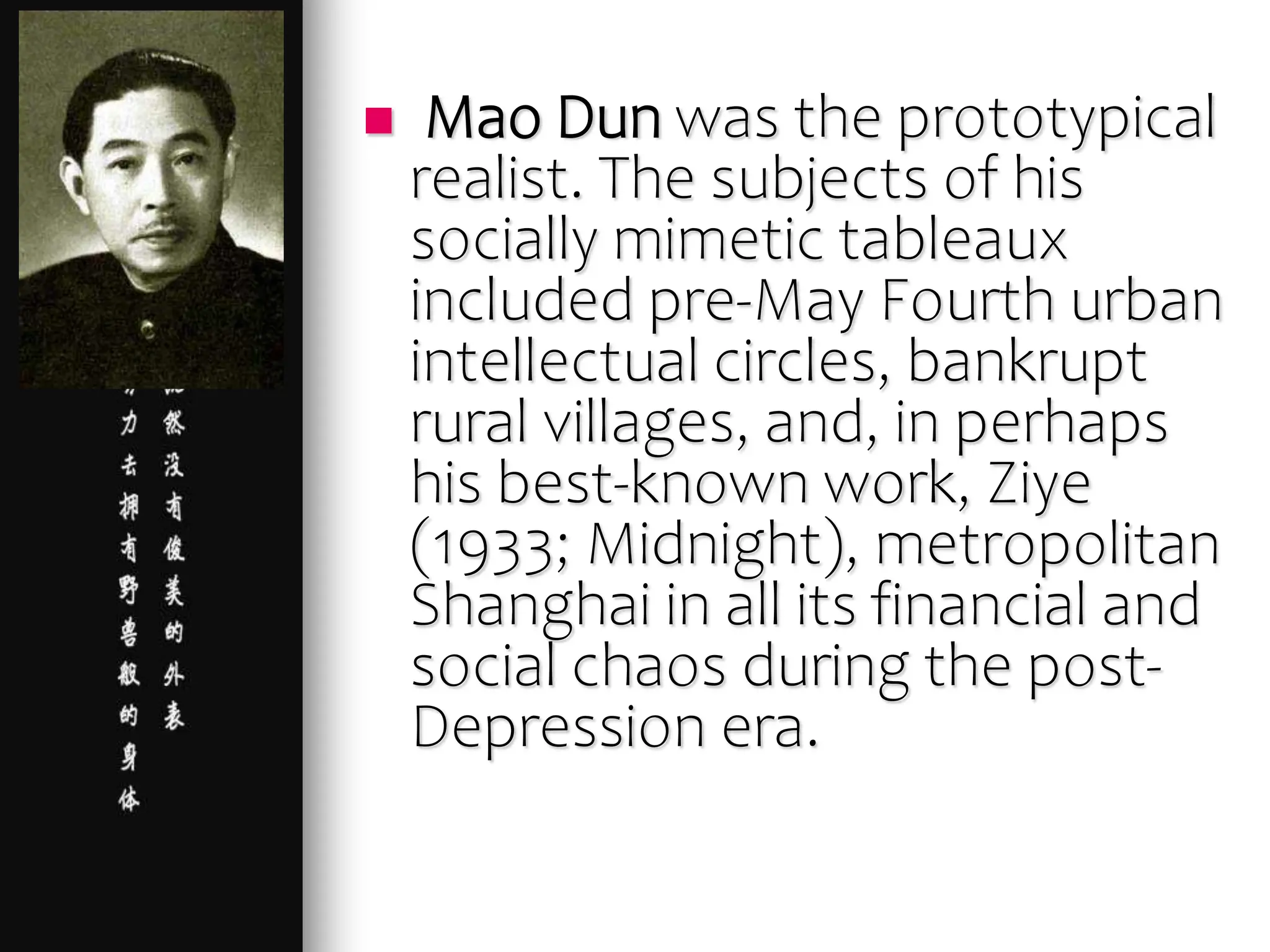
In 1920 Shen Yanbin,
better known later as Mao
Dun, and others established
the Wenxue Yanjiuhui
(“Literary Research
Association”), generally
referred to as the “realist” or
“art-for-life’s-sake” school,
which assumed the
editorship of the established
literary magazine Xiaoshuo
yuebao (Short Story
Monthly).
Political events of the mid-1920s,
in which Nationalist, communist,
and warlord forces clashed
frequently, initiated a shift to the
left in Chinese letters, culminating in
1930 in the founding of the Zuoyi
Zuojia Lianmeng (“League of Left-
Wing Writers”), whose membership
included many influential writers.
1927–37
 Mao Dun was the prototypical
realist. The subjects of his
socially mimetic tableaux
included pre-May Fourth urban
intellectual circles, bankrupt
rural villages, and, in perhaps
his best-known work, Ziye
(1933; Midnight), metropolitan
Shanghai in all its financial and
social chaos during the post-
Depression era.
 Poetry of the 1930s
underwent a similar
politicization, as more and
more students returned from
overseas to place their pens in
the service of the “people’s
resistance against feudalism
and imperialism.” The lyrical
verse of the early Crescent
Moon poets was replaced by a
more socially conscious poetry
by the likes of Ai Qing, Tian
Jian, and Zang Kejia that
appealed to the readers’
patriotic fervour.
 During the Sino-Japanese War
(1937–45), most writers fled to
the interior, where they
contributed to the war effort
by writing patriotic literature
under the banner of the
Zhonghua Quanguo Wenyijie
Kangdi Xiehui (“All-China Anti-
Japanese Federation of
Writers and Artists”), founded
in 1938 and directed by Lao
She.
The War Years: 1937–49
 Literature on the China mainland
from 1949 through much of the
1970s was largely a reflection of
political campaigns and ideological
battles. This state of affairs can be
traced to Mao Zedong’s 1942 “Zai
Yan’an wenyi zuotanhui shang de
jianghua” (“Talks at the Yan’an
Forum on Literature and Art”), in
which he articulated his position that
literature, which existed to serve
politics, was to be popularized while
the people’s level of literary
appreciation was gradually being
elevated.
1949–76
 The accusatory “scar literature,” a sort of
national catharsis that immediately
followed the 10-year “holocaust,” gave
way to more professional and more daring
writing, as exemplified in the stories of
Wang Meng, with their stylistic
experiments in stream of consciousness,
and of Bai Hua, with their sharp political
criticism of the previous 20 years; the
symbolic “obscure” poetry of Bei Dao and
others; the relatively bold dramas, both for
the stage and for the screen, of several
playwrights such as Gao Xingjian, who,
after becoming a French citizen in 1994,
won the Nobel Prize for Literature in 2000;
and the innovative investigative reportage
of Liu Binyan.
After the Cultural Revolution
Chinese literature has had a huge impact on
world literature due to its rich intellectual, lyrical,
and narrative traditions. Its emphasis on harmony,
balance, and profound emotional expression has
enhanced world literary traditions. Confucius and
Laozi's philosophical works influenced both
Eastern and Western thought. Chinese poetry,
notably from the Tang Dynasty, established high
standards for lyrical beauty and reflection.
Classical novels such as "Journey to the West"
and "Dream of the Red Chamber" include
intricate storylines and cultural perspectives. The
brief and evocative style of Chinese literature has
impacted various literary genres, like Japanese
haiku. Chinese literature's universal themes and
profound insights cross cultural borders. This
universality enables it to connect with readers all
across the world. Its translations and
modifications have enabled cultural interaction.
Conclusion
 Li, T., Goldblatt, H. C., Wilhelm, H., & Nienhauser, W. H. (1998,
July 20). Chinese literature | History, Authors, Classics, Books,
Characteristics, & Facts. Encyclopedia Britannica.
https://www.britannica.com/art/Chinese-literature
 Mark, E., & Bai, L. (2024). Chinese literature. World History
Encyclopedia.
https://www.worldhistory.org/Chinese_Literature/
 Meredith, A. (2023, December 13). Chinese Literature from
Ancient Times to the Present Day. CLI.
https://studycli.org/chinese-culture/chinese-literature/
 Pang, K. (2024, July 18). History of Chinese literature, China
Literature in Ancient Time. China Highlights - Since 1998!
https://www.chinahighlights.com/travelguide/culture/history-
of-chinese-literature.htm
References

101954186-Powerpoint-Presentation-for-Chinese-Lit.ppt

  • 1.
    Chinese Literature Prepared by:RHEA MAE B. QUINICOT
  • 2.
    Introduction  China isthe only country in the world with a literature written in one language for more than 3,000 consecutive years.  This continuity results largely from the nature of the written language itself. It is the use of characters, not letters as in Western languages, that is most important in the Chinese language
  • 3.
     The dominanceof the written language has had significant effects on the development of the literature. In handwriting or in print, a piece of literature has visual appeal. This has given rise to the great respect that calligraphy enjoys in China, where it has been regarded for at least 16 centuries as a fine art comparable to painting.
  • 4.
     The maindisadvantage of written Chinese is the great number of characters it contains: Even basic reading and writing require a knowledge of more than 1,000 characters.  But even with this disadvantage, Chinese has been a potent factor in shaping and maintaining a cultural continuity for millions of people.
  • 5.
     China hasa very old and rich tradition in literature and the dramatic and visual arts. Early writings generally derived from philosophical or religious essays such as the works of Confucius (551- 479 BC) and Lao-tzu (probably 4th century BC).  After the fall of a dynasty, for example, a grand history of the late dynasty was commissioned and written by scholars in the next dynasty.
  • 6.
     To manyWesterners, Chinese literature remains a hidden seam in the rich strata of Chinese culture. As a matter of fact, it is a treasure of a very considerable number of brilliant and profound works as each dynasty, in the long history of China, has passed down its legacy of magnificent events and works.  For 3500 years, they have woven a variety of genres and forms encompassing poetry, essays, fiction and drama;
  • 7.
     China alsoproduced poetry, novels, and dramatic writings from an early date. Poetry, example became well established as a literary form during the T'ang Dynasty, from AD 618 to 907.  Chinese literature has its own values and tastes, its own reigning cultural tradition and its own critical system of theory.
  • 8.
     Drama isanother old and important literary form. Chinese drama usually combines vernacular language with music and song and thus has been popular with the common people.  A variety of popular and standard themes are presented in Peking Opera, which is probably the best known of several operatic traditions that developed in China. Chinese opera is a favorite artistic and cultural medium
  • 9.
     Early Chinesenovels often stressed character development and usually centered on an adventure or supernatural happening;  "Dream of the Red Chamber', probably China's most famous novel.
  • 10.
     China's literarytradition continues to the present, though much 20th-century writing has concentrated on efforts to reform or modernize China.  To many Westerners, Chinese literature remains a hidden seam in the rich strata of Chinese culture.  For 3500 years, they have woven a variety of genres and forms encompassing poetry, essays, fiction and drama;
  • 11.
    Four Main Periods: Classical literature,  Contemporary literature,  Modern literature; and  Present day literature.
  • 12.
    Classical Literature  refersto the earliest period and covers works from three thousands years ago to the late Qing Dynasty (1644 - 1911), and is a virtually unbroken strand enduring dynastic changes.  Written in an ancient form of language that is very different from present day Chinese, it needs to be carefully studied to be understood.
  • 13.
     The mostimportant poetic work produced during the classical period was the Shih Ching (Book of Poetry), an anthology of ancient poems written in four-word verses and composed mostly between the 10th and the 7th centuries bc.  The Shih Ching is classified as the third of the Five Classics; legend has it that Confucius himself selected and edited the 305 poems that constitute the work.
  • 14.
     The otherhalf of the Shih Ching is made up of dynastic songs and court poems. These songs and poems give a colorful picture of the life and manners of the Chinese feudal nobility, just as the folk poems depict the simple and yet bountiful life of the peasantry.  The aristocratic, or court, style finds its best expression, however, in a group of poems known as the elegies of Ch'u.
  • 15.
     A feudalstate in south-central China, Ch'u was the home of Ch'ü Yüan (343– 277 bc), the first great Chinese poet.  A noble by birth, Ch'ü Yüan wrote Li Sao (Encountering Sorrow), a long, autobiographical poem full of historical allusions, allegories, and similes, lyrically expressed and concerned with the intimate revelation of a poetic soul tormented because it has failed in its search for a beautiful ideal.
  • 16.
    Prose  The seminalworks of Chinese prose are those that, with the Shih Ching, constitute the Five Classics. These are the I Ching (Book of Changes), a divination text; the Shu Ching (Book of History), a miscellanea of ancient state documents; the Li Chi (Book of Rites), a collection of ritual and governmental codes; and the Ch'un Ch'iu (Spring and Autumn Annals), a history of the state of Lu from 722 to 481 bc.  From the 6th to the 3d century bc, the first great works of Chinese philosophy appeared.
  • 17.
    Poetry  In ancientChina, people had profuse feelings to express when historical events took place, both joyful or of grief.  Classical literature possesses a profound culture, and is the epitome of the spirit, morals and wisdom of the Chinese people.  Classical poetry cares a great deal for rhythm. Poetry is one of the earliest artistic forms as well as the most fully developed in China.
  • 18.
  • 19.
    Han  Chu Ci,or The Songs of the South, is another important poem collection which appeared 300 years after The Classic of Odes.  Chu Ci, as the book's name indicates, is derived from the songs of the southern state Chu during the Warring States Period (476 BC - 221 BC).
  • 20.
     Qu Yuan,who furthered the development of the new poem style, is famed as a great patriotic poet and politician in the Chu state.  This poetry book changed the simple and brief style of The Classic of Odes, and completely distinctive.  The ancient poetry really enlightened the poets that came after with its romanticism.
  • 21.
     Yuefu inHan Dynasty (206 BC - 220) is a creation of the lower class working people.  The most prominent works are Mo Shang Sang, Zhan Cheng Nan (War in the South of Town), Orphan's Song, and A Pair of Peacocks Southeast Fly.
  • 22.
     The HanDynasty Ode is another popular style that originated in the first unprecedented powerful empire - Han. It is an artistic reflection of the optimism and self-reliance of that time.  The Han Dynasty (206 BC to AD 220) actively promoted the restoration and teaching of the Classics.
  • 23.
     In 124BC a national university was opened for the purpose of teaching Confucianism.  It was also during the Han period that the Classics became established as the basis of Chinese education.  Literature flowered again during the Han Dynasty.
  • 24.
     Traditional poetryand prose forms, especially the Fu prose poems, flourished. But the most notable achievement came with the reactivation of the Yueh Fu, or Music Bureau, in 125 BC.  The most outstanding folk ballad of the period, about AD 200, was `Southeast the Peacock Flies'.
  • 25.
     The majorprose authors of the Han Dynasty were Liu An, Ssu-ma Ch'ien, and Pan Ku.  Liu An was a prince of Huai-nan in the 2nd century BC.  The work attributed to him, but probably done under his patronage, is `The Master of Huai-nan'.  The masterpiece of the period was the `Shih-chi', meaning "Historical Records," of Ssu-ma Ch'ien.
  • 26.
     It wascompleted in about 85 BC and took 18 years to produce. It contains a record of events and personalities for the previous 2,000 years.  It was the first attempt at a national history in China, and it set the pattern for the histories of dynasties in the following centuries.
  • 27.
     In thenext century Ssu-ma Ch'ien was followed as historian by Pan Ku, who was born about AD 32 and died about AD 92.  He was also a poet, soldier, and the author of `Han shu', meaning "History of the Former Han Dynasty."
  • 28.
    Six Dynasties andthe Sui Dynasty (AD 221 to 618).  Xin Dynasty Eastern HanThree Kingdoms 220–280 Wei, Shu & WuJin Dynasty 265– 420 Western Jin16 Kingdoms 304–439 Eastern JinSouthern & Northern Dynasties  Sui dynasty
  • 29.
    Six Dynasties andthe Sui Dynasty (AD 221 to 618).  The major poet of this era was T'ao Ch'ien (365-427).  He was a master of the five- word line and has been called the first of China's great nature poets because most of his writings deal with rural activities.
  • 30.
     The 3rdand 4th centuries were, for prose writers, a time of individuality and partial rejection of slavish imitation of past models.  Lu Chi (261-303) was a renowned poet and literary critic who emphasized originality in creative writing. -ex. Wen Fu
  • 31.
     The revoltagainst imitative writing was also expressed in a 5th- century style called "pure conversation," an intellectual discussion on lofty matters.  In the 6th century the first book of literary criticism, `Carving of the Literary Dragon', was published by Liu Hsieh (465-522).
  • 32.
     Two other6th-century prose masters were Yang Hsien-chih, author of `Record of Buddhist Temples in Lo-yang', and Li Tao-yuan, author of `Commentary on the Water Classic'.
  • 33.
    Tang Dynasty  Poetryin the Tang Dynasty (618 - 907) is an unparalleled system and reaches the pinnacle in the development of the poem.  is considered China's golden age of poetry.  Its dazzling value consists of an ideal combination of thoughts and art.
  • 34.
     In laterstudy of literature, it is spoken of as being representative of the whole classical literature along with two other styles of poetry –  Tang Shi,  Song Ci,  Yuan Qu (Poetry in the Tang Dynasty, Ci in the Song Dynasty, and Qu in the Yuan Dynasty).
  • 35.
     As forquantity, a total of over 50,000 poems have been collected and no one has any idea how many more have been lost.  Depending upon the period of its development poetry dating from the Tang Dynasty, can be classified into four groups, namely early Tang Dynasty, Flourishing Tang, Mid-Tang and late Tang Dynasty.
  • 36.
    Early Tang  Inthe early Tang Dynasty, most of the poets followed the style of their forebears and created a blend of the characteristics of the north and south.  Eventually the field of literature was refreshed and became more vigorous as a result of those who are known as The Four Talents - Wang Bo, Yang Jiong, Luo Binwang, and Lu Zhaolin,.
  • 37.
     Poems ofthe period known as the flourishing Tang Dynasty enjoyed a golden environment owing to the wise reign, prosperous economy, and the prevailing strength of diplomacy.  The era endowed poets with broad horizons, positive and unrestrained emotion, and innovative inspiration.
  • 38.
    There are manyrepresentatives we can enumerate:  Li Bai enjoys the title of the 'Supernatural Being of Poem' .  Even now his 'Jing Ye Si' (Thoughts on the Silent Night) is quite popular and nearly everyone knows it even children as young as two years of age.
  • 39.
     Du Fu,known as the 'Saint of Poem', was strict in his use of metrical verses.  His Deng Gao (Climbing Up) achieved the perfection of sheer professionalism.
  • 40.
     Wang Wei,the poet of landscape, has written lots of elegant and exquisite verses, such as 'bright moon lighting on the pine forests, clear water found running on the stones'.  Cui Hao created the best of the seven-worded regulated poems - The Yellow Crane Tower with the verse 'yellow crane flies and never back, white cloud floats away for thousand years'.
  • 41.
     Cen Shenwas skillful in his descriptions of colorful scenes in the then northwest China and his famous sentence conveying the delight with snow 'just like the sudden spring wind overnight blows, thousands of pear trees come to bloom' .
  • 42.
    Mid-Tang  In theMid-Tang Dynasty, numerous poets came to prominence.  The poets also subsequently diverted the attention from state affairs to the trivialities of daily life, and from the glorification of landscapes to the anchorage of spirits and hopes.
  • 43.
     Poets likeLiu Zongyuan and Wei Yiwu expressed themselves through the plain depiction of sights around them.  Another renowned literary figure is Bai Juyi. His The Old Charcoal Seller fully satirized the dark social reality.  And the Chang Hen Ge (Song of Eternal Lament)
  • 44.
    Late Tang dynasty In late Tang Dynasty, with the deterioration of government, the poems reflected more and more the hopeless and helpless feelings of the people in a heavy way.  The most talented poets were Li Shang Yin and Du Mu.
  • 45.
    Other Information about TangDynasty  Two of the greatest poets in all Chinese literature lived during the T'ang Dynasty: Li Po (701-762) and Tu Fu (712-770).  Li Po was a romantic who celebrated such things as drinking, friendship, and nature as well as solitude and the passage of time.
  • 46.
     Tu Fualso celebrated the beauties of nature and bemoaned the passage of time, but he was also a satirist and critic.  Tu Fu's great reputation in literature comes in part from his expert use of all types of poetic style.
  • 47.
     Chinese prosealso underwent a stylistic reform during the T'ang period. The major change was brought about by Han Yu (768- 824).  He promoted classic Confucian doctrines at a time when they had begun to fall into neglect because of the rising popularity of Buddhism and Taoism.  At his death he was honored with the title "Prince of Letters."
  • 48.
    Sung Dynasty  Ciin the Song Dynasty (960 - 1279) indicates another type of poetry at that time. It came into being in the Tang Dynasty and reached its summit in the Song literature.  This type of poem is akin to lyrics created for musical accompaniment as the meter varies in the way that the words had to match the rhythm of the music.
  • 49.
     Ci, dependingupon its length, can be divided into Xiao Ling (small- sized, less than 58 characters), Zhong Diao (middle-sized, 59 - 90 characters), and Chang Diao (long- sized, more than 91 characters).  Each Ci has a title as well as a Cipai which is the name of the tonal pattern and decides the rhythm and form of a verse.
  • 50.
     Poets inthe Song Dynasty developed Ci that was deeper in content and broader in form.  Those who made a great contribution were Liu Yong, Su Shi, Yan Shu, Li Qingzhao, Xin Qiji, etc.  Generally speaking, Ci has two main genres - Wanyue (graceful and mild) and Haofang (bold and unconstrained).
  • 51.
     Ci ofWanyue genre endows delicate things with exquisite feeling and elegance.  The most famous verses are 'How helpless I see the flowers falling, the swallows seem to know winter is coming again' by Yan Shu.  Ci of Haofang genre began to be popular since the creation by Su Shi who changed Ci into a lyrical art.
  • 52.
    Other information about SungDynasty  During the Sung Dynasty, especially in the 11th century, the tz'u form of poetry and song was brought to its greatest heights, particularly through the efforts of China's best woman poet, Li Ch'ing-chao (1081-1141).  Her early poems dealt with the joys of love and were intensely personal.
  • 53.
     The prosereform continued under followers of Han Yu, and poetry of the conventional type continued to be written by members of rival literary schools. The only real innovation came with the use of everyday speech in local dialects in storytelling.  This style opened new vistas in prose fiction in later periods, though its use was at first despised by professional writers
  • 54.
    Modern Chinese Literature The literary reform movement that began with these and other “calls to arms” was an important part of the larger New Culture Movement for cultural and sociopolitical reform, which was greatly strengthened by a student protest on May 4, 1919, against the intellectual performance of the Chinese delegates to the Paris Peace Conference formally terminating World War I.
  • 55.
    The first fruitsof this movement were seen in 1918 and 1919 with the appearance in Xinqingnian of such stories as “Kuangren riji” (“The Diary of a Madman”), a Gogol-inspired piece about a “madman” who suspects that he alone is sane and the rest of the world is mad, and “Yao” (“Medicine”), both by Zhou Shuren. Known by the pseudonym Lu Xun, Zhou had studied in Japan and, with his younger brother, the noted essayist Zhou Zuoren, had become a leader of the literary revolution soon after returning to China. Lu Xun’s acerbic, somewhat Westernized, and often satirical attacks on China’s feudalistic traditions established him as China’s foremost critic and writer.
  • 56.
    In 1920 ShenYanbin, better known later as Mao Dun, and others established the Wenxue Yanjiuhui (“Literary Research Association”), generally referred to as the “realist” or “art-for-life’s-sake” school, which assumed the editorship of the established literary magazine Xiaoshuo yuebao (Short Story Monthly).
  • 57.
    Political events ofthe mid-1920s, in which Nationalist, communist, and warlord forces clashed frequently, initiated a shift to the left in Chinese letters, culminating in 1930 in the founding of the Zuoyi Zuojia Lianmeng (“League of Left- Wing Writers”), whose membership included many influential writers. 1927–37
  • 58.
     Mao Dunwas the prototypical realist. The subjects of his socially mimetic tableaux included pre-May Fourth urban intellectual circles, bankrupt rural villages, and, in perhaps his best-known work, Ziye (1933; Midnight), metropolitan Shanghai in all its financial and social chaos during the post- Depression era.
  • 59.
     Poetry ofthe 1930s underwent a similar politicization, as more and more students returned from overseas to place their pens in the service of the “people’s resistance against feudalism and imperialism.” The lyrical verse of the early Crescent Moon poets was replaced by a more socially conscious poetry by the likes of Ai Qing, Tian Jian, and Zang Kejia that appealed to the readers’ patriotic fervour.
  • 60.
     During theSino-Japanese War (1937–45), most writers fled to the interior, where they contributed to the war effort by writing patriotic literature under the banner of the Zhonghua Quanguo Wenyijie Kangdi Xiehui (“All-China Anti- Japanese Federation of Writers and Artists”), founded in 1938 and directed by Lao She. The War Years: 1937–49
  • 61.
     Literature onthe China mainland from 1949 through much of the 1970s was largely a reflection of political campaigns and ideological battles. This state of affairs can be traced to Mao Zedong’s 1942 “Zai Yan’an wenyi zuotanhui shang de jianghua” (“Talks at the Yan’an Forum on Literature and Art”), in which he articulated his position that literature, which existed to serve politics, was to be popularized while the people’s level of literary appreciation was gradually being elevated. 1949–76
  • 62.
     The accusatory“scar literature,” a sort of national catharsis that immediately followed the 10-year “holocaust,” gave way to more professional and more daring writing, as exemplified in the stories of Wang Meng, with their stylistic experiments in stream of consciousness, and of Bai Hua, with their sharp political criticism of the previous 20 years; the symbolic “obscure” poetry of Bei Dao and others; the relatively bold dramas, both for the stage and for the screen, of several playwrights such as Gao Xingjian, who, after becoming a French citizen in 1994, won the Nobel Prize for Literature in 2000; and the innovative investigative reportage of Liu Binyan. After the Cultural Revolution
  • 63.
    Chinese literature hashad a huge impact on world literature due to its rich intellectual, lyrical, and narrative traditions. Its emphasis on harmony, balance, and profound emotional expression has enhanced world literary traditions. Confucius and Laozi's philosophical works influenced both Eastern and Western thought. Chinese poetry, notably from the Tang Dynasty, established high standards for lyrical beauty and reflection. Classical novels such as "Journey to the West" and "Dream of the Red Chamber" include intricate storylines and cultural perspectives. The brief and evocative style of Chinese literature has impacted various literary genres, like Japanese haiku. Chinese literature's universal themes and profound insights cross cultural borders. This universality enables it to connect with readers all across the world. Its translations and modifications have enabled cultural interaction. Conclusion
  • 64.
     Li, T.,Goldblatt, H. C., Wilhelm, H., & Nienhauser, W. H. (1998, July 20). Chinese literature | History, Authors, Classics, Books, Characteristics, & Facts. Encyclopedia Britannica. https://www.britannica.com/art/Chinese-literature  Mark, E., & Bai, L. (2024). Chinese literature. World History Encyclopedia. https://www.worldhistory.org/Chinese_Literature/  Meredith, A. (2023, December 13). Chinese Literature from Ancient Times to the Present Day. CLI. https://studycli.org/chinese-culture/chinese-literature/  Pang, K. (2024, July 18). History of Chinese literature, China Literature in Ancient Time. China Highlights - Since 1998! https://www.chinahighlights.com/travelguide/culture/history- of-chinese-literature.htm References