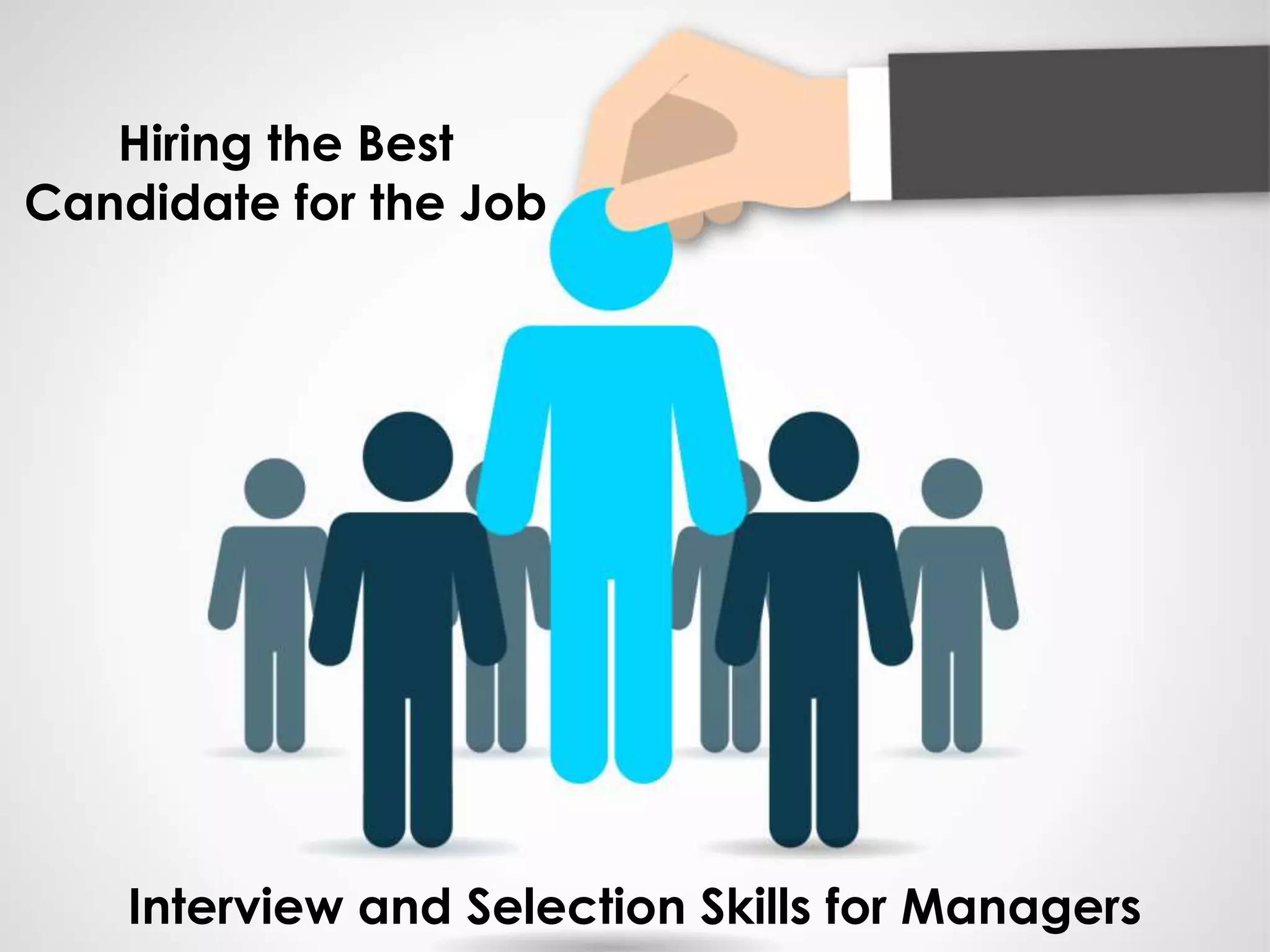
Hiring the Best
Candidate for the Job
Interview and Selection Skills for Managers
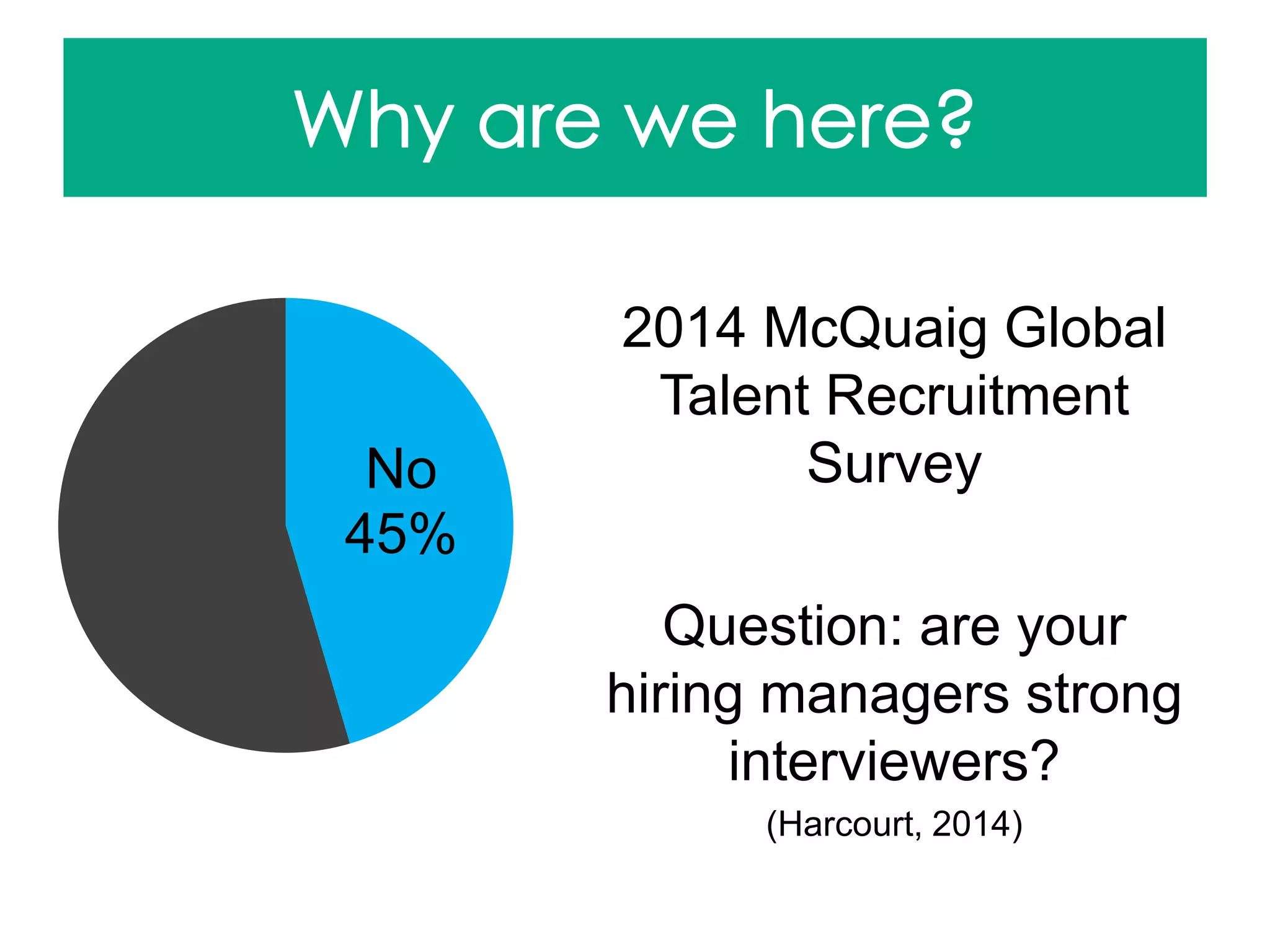
2014 McQuaig Global
Talent Recruitment
Survey
Question: are your
hiring managers strong
interviewers?
(Harcourt, 2014)
No
45%
“Retention begins with hiring”
(Clement, 2013, p. 102)
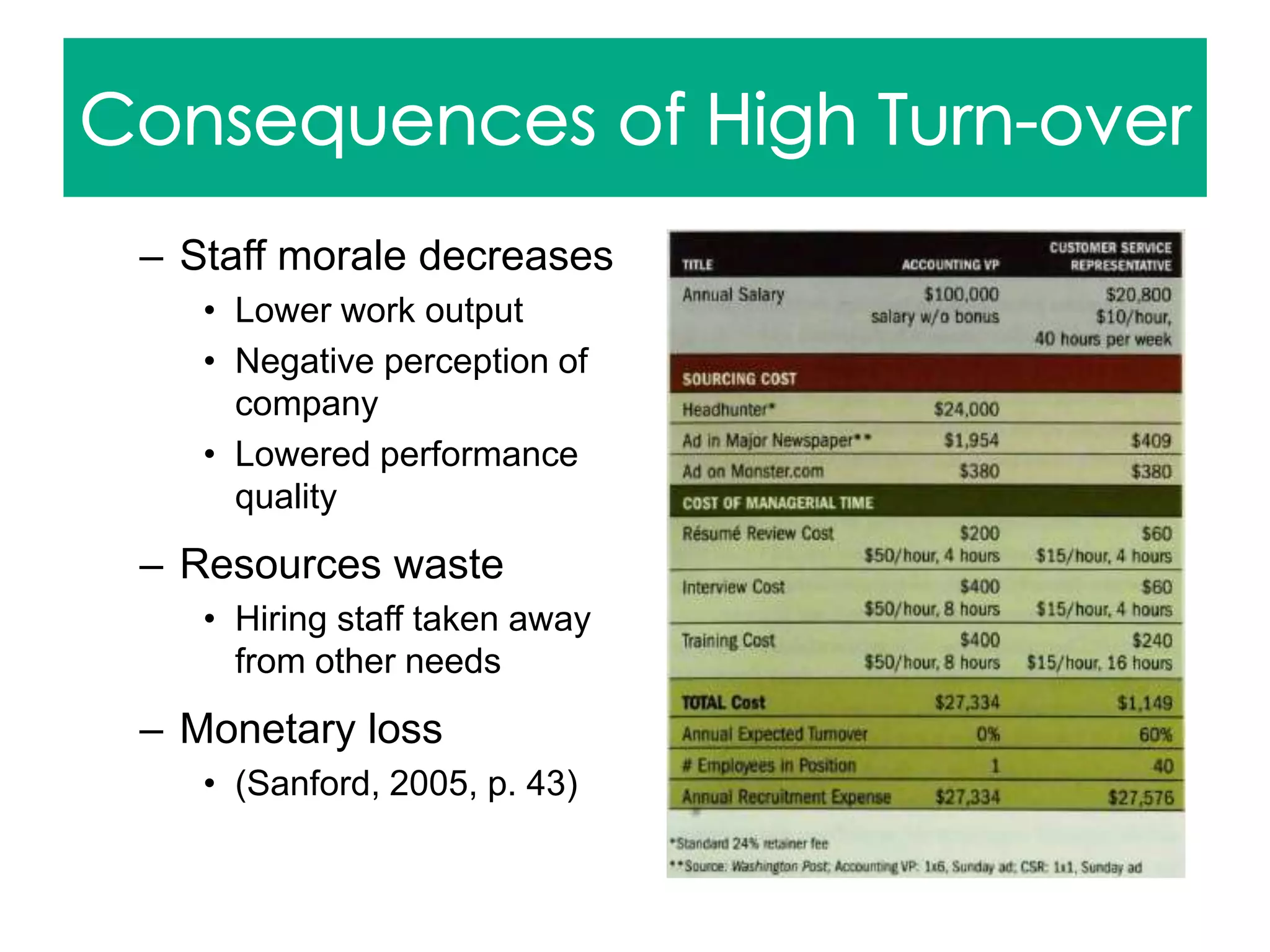
– Staff morale decreases
• Lower work output
• Negative perception of
company
• Lowered performance
quality
– Resources waste
• Hiring staff taken away
from other needs
– Monetary loss
• (Sanford, 2005, p. 43)
What are your questions or concerns?
Are you new to the selection process? Or
have you been on a committee?
What would you like to achieve through this
training?
• Articulate what you are looking for in a
candidate
• Compare and contrast the benefits and
drawbacks of internal and external
candidates
• Develop comprehensive and inclusive
interview questions
• Demonstrate awareness of how your
behavior can impact interview success
• Understand when to use dispositional
judgments in candidate consideration
Know you have the basic knowledge and
skills for interviewing and selecting the best
candidate for your position
Choose a job or position you are very familiar
with to use in our activities today. It could be:
• A position you are or will be hiring for
• Your current position
• A position you recently held
Write it down so you can refer back to it later.
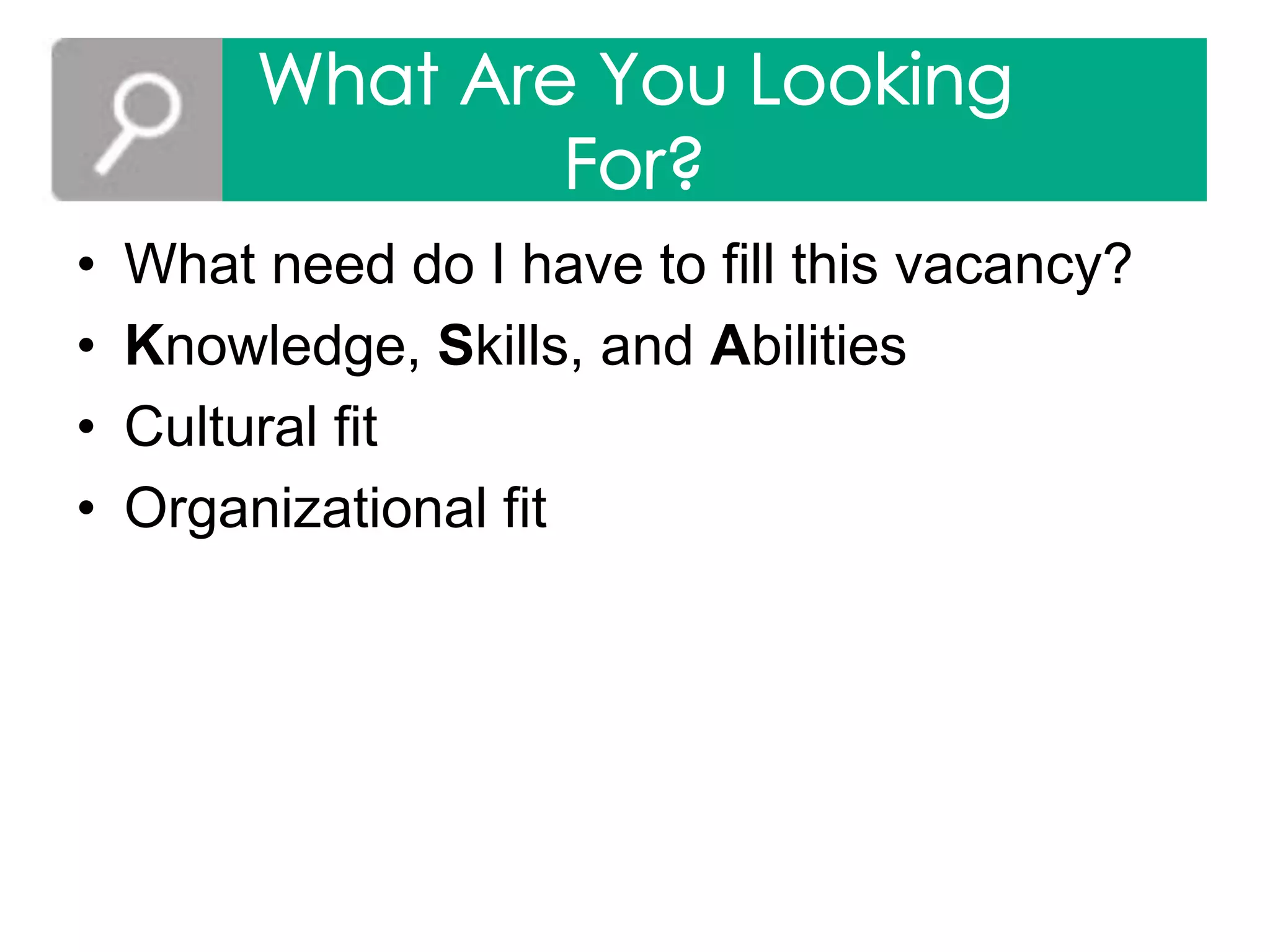
• What need do I have to fill this vacancy?
• Knowledge, Skills, and Abilities
• Cultural fit
• Organizational fit
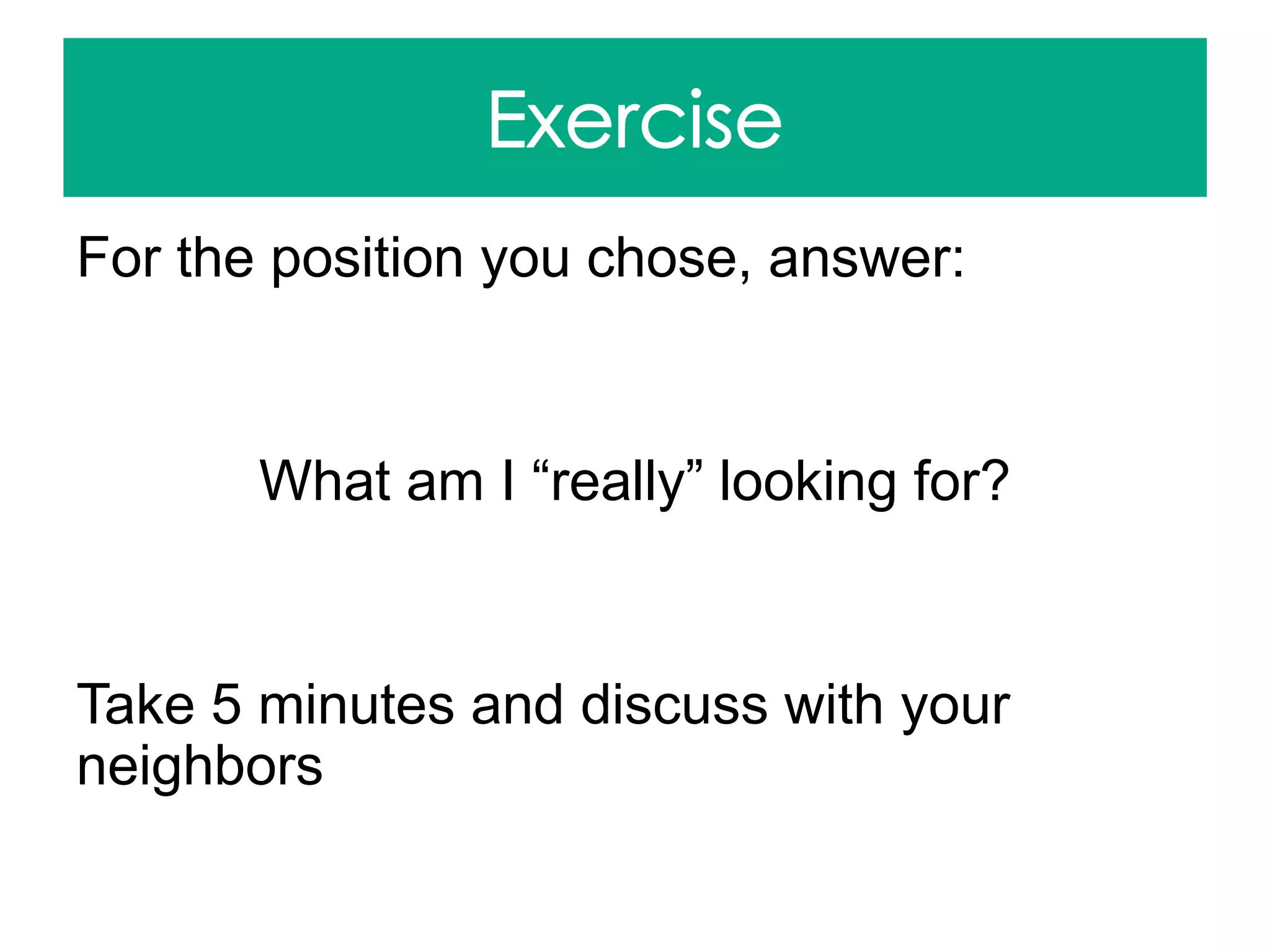
For the position you chose, answer:
What am I “really” looking for?
Take 5 minutes and discuss with your
neighbors
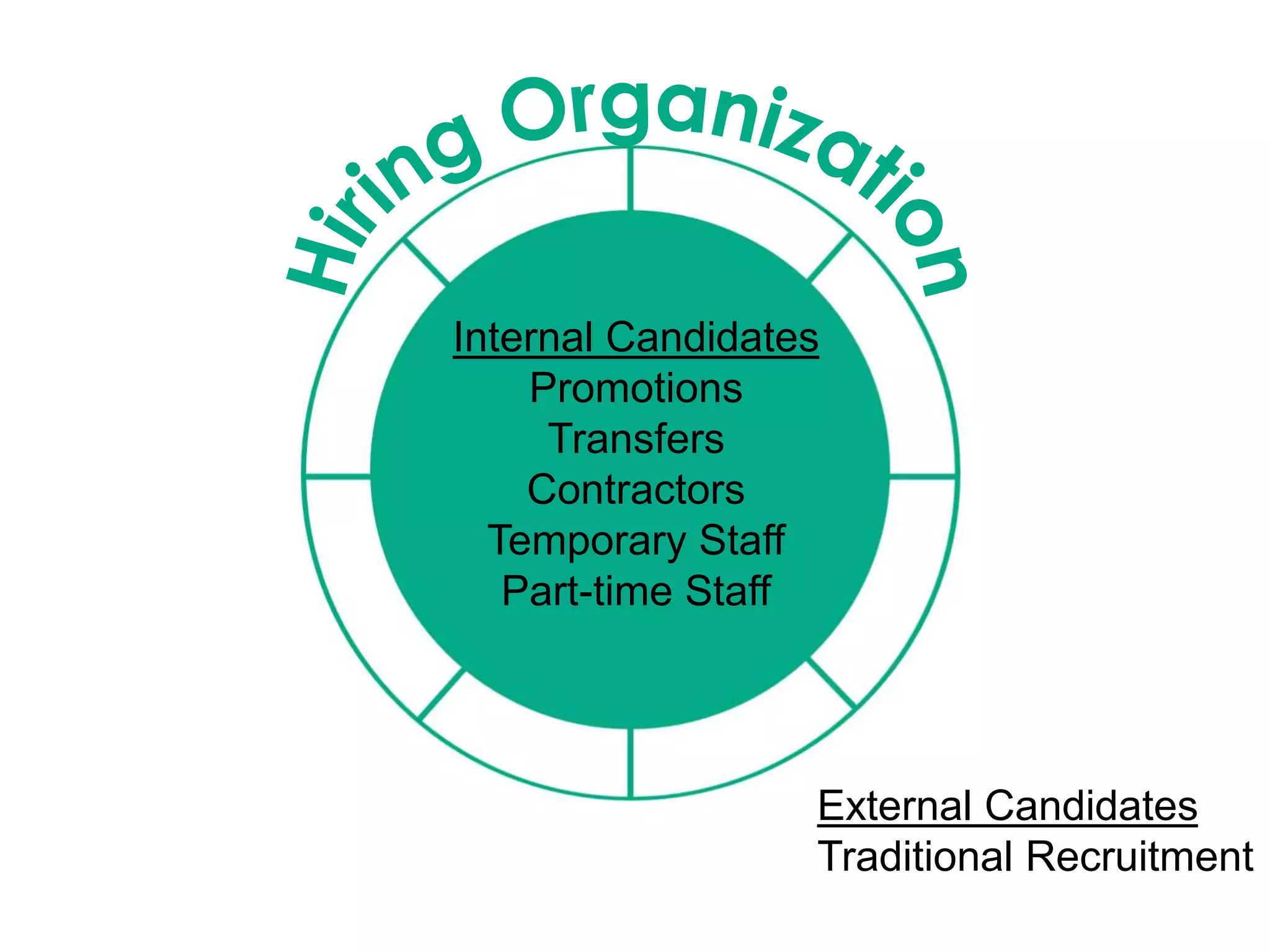
Internal Candidates
Promotions
Transfers
Contractors
Temporary Staff
Part-time Staff
External Candidates
Traditional Recruitment
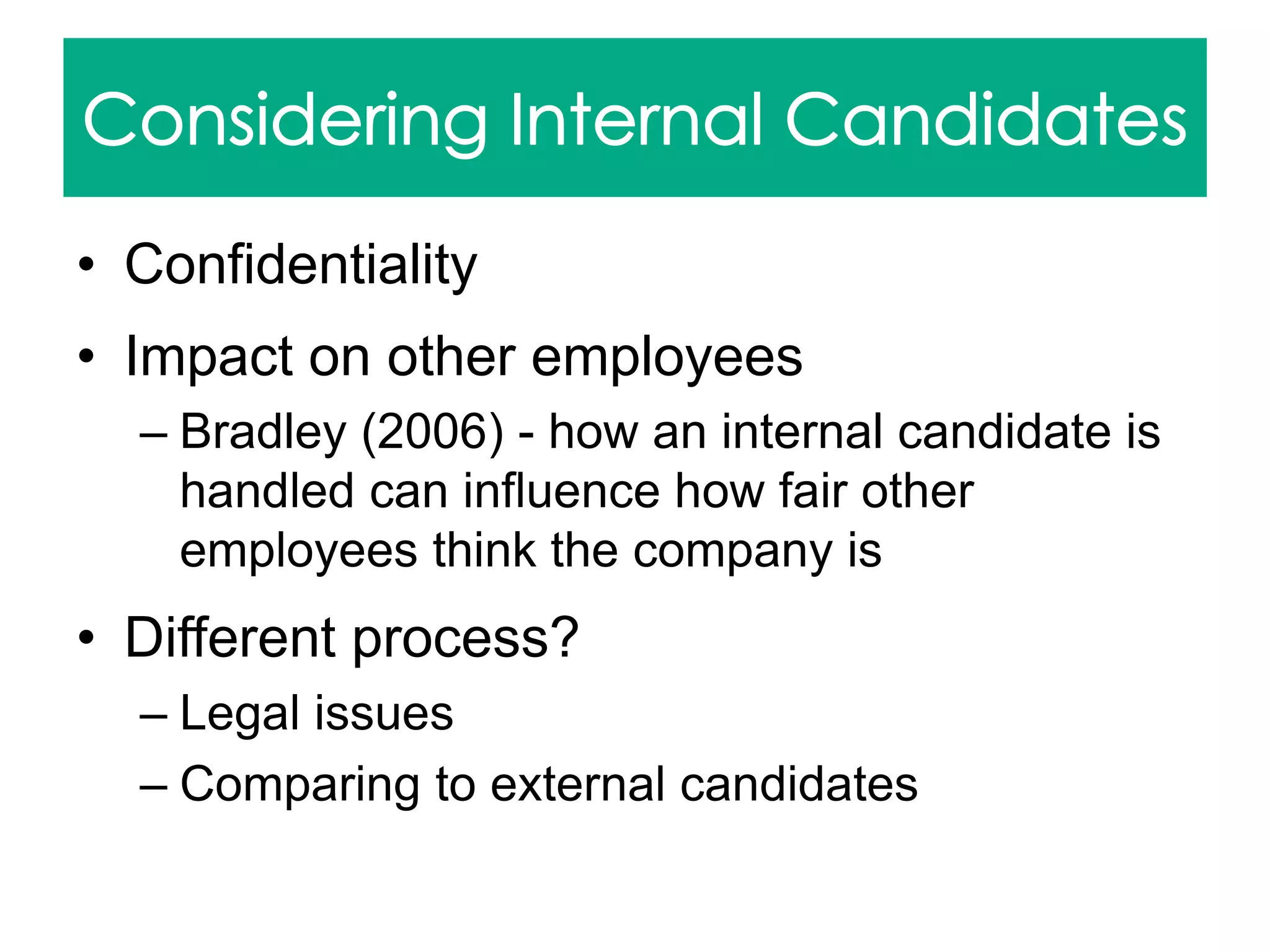
• Confidentiality
• Impact on other employees
– Bradley (2006) - how an internal candidate is
handled can influence how fair other
employees think the company is
• Different process?
– Legal issues
– Comparing to external candidates
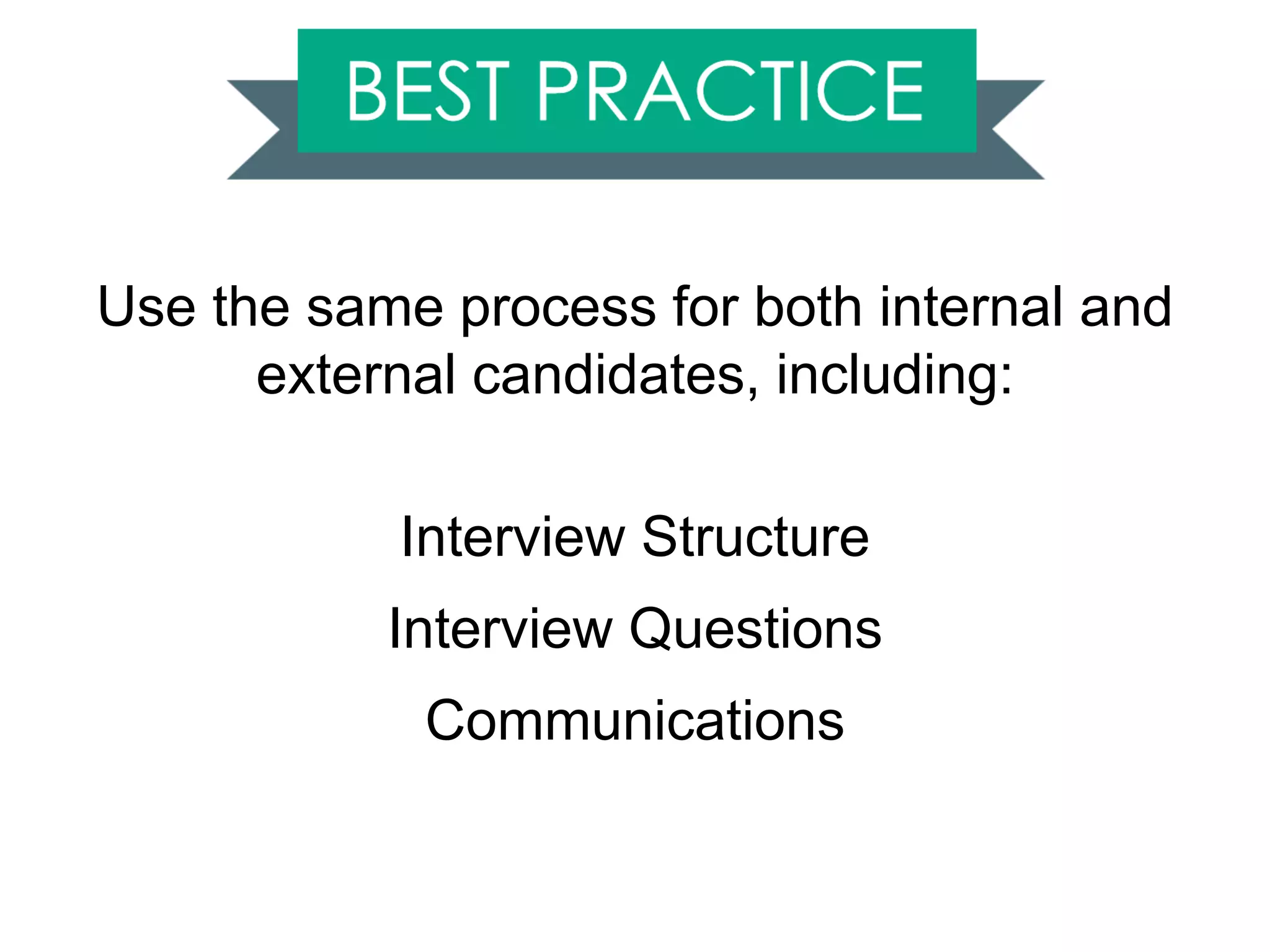
Use the same process for both internal and
external candidates, including:
Interview Structure
Interview Questions
Communications
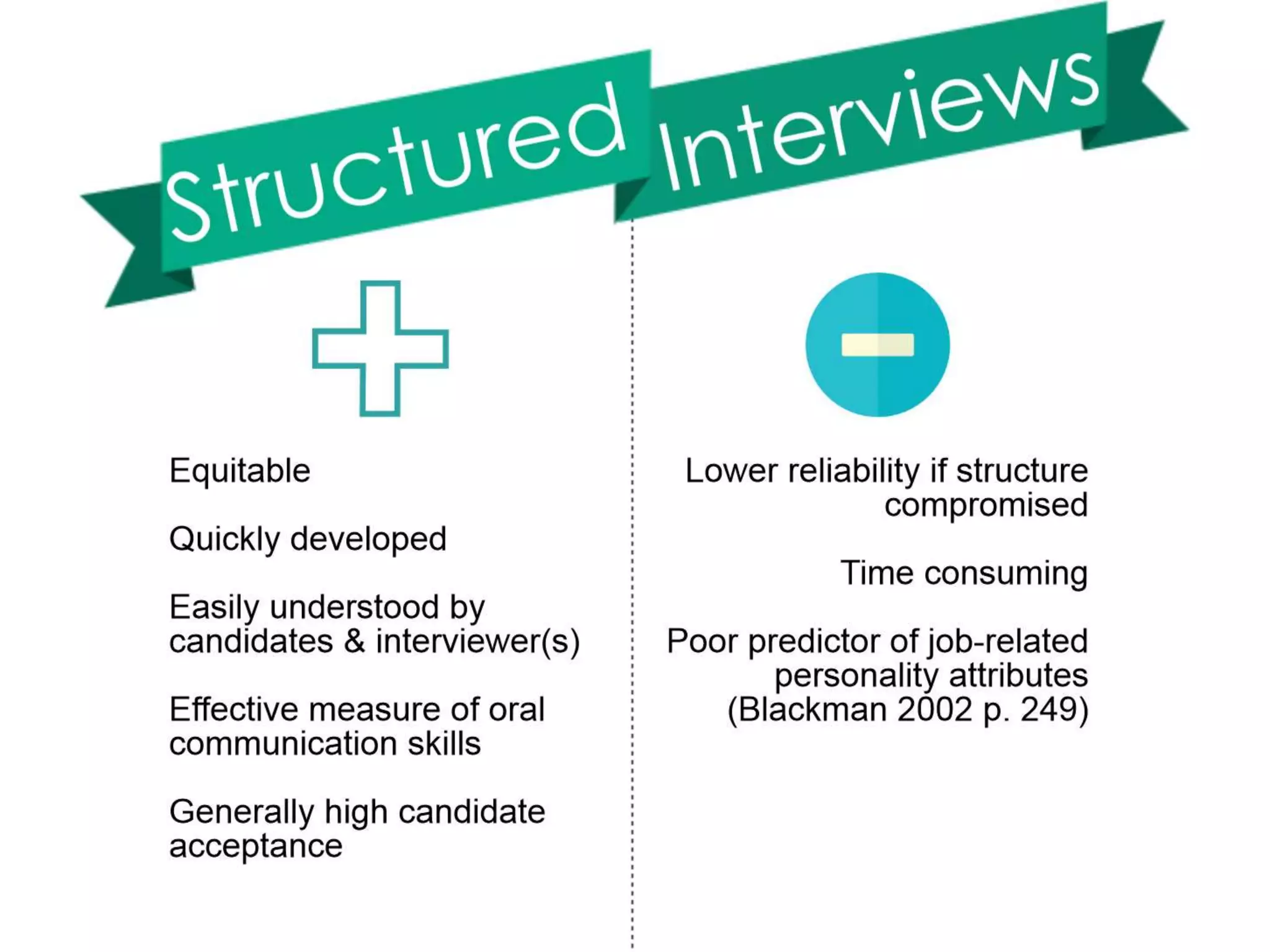
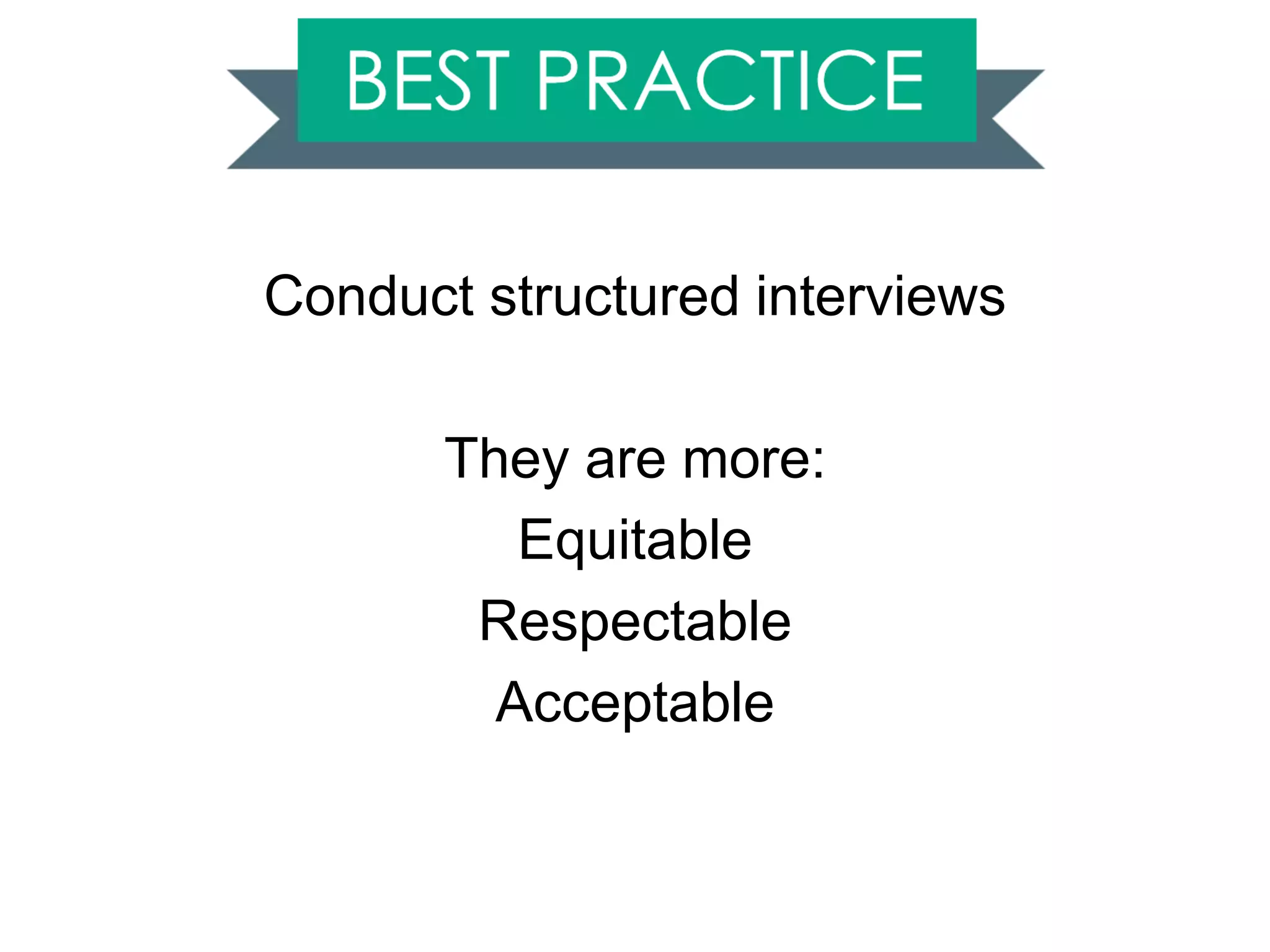
Conduct structured interviews
They are more:
Equitable
Respectable
Acceptable
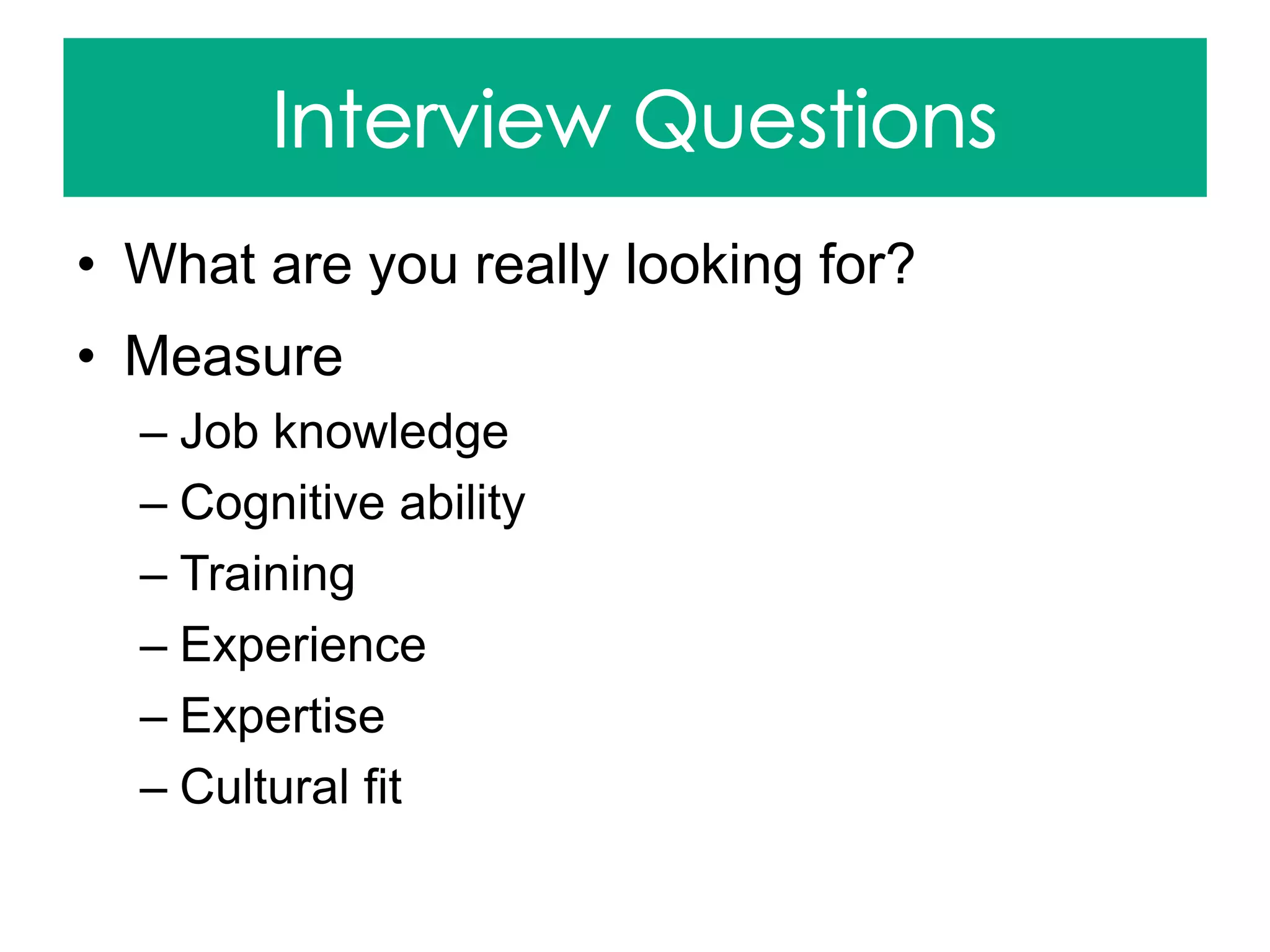
• What are you really looking for?
• Measure
– Job knowledge
– Cognitive ability
– Training
– Experience
– Expertise
– Cultural fit
From Langan (2014)
1. Experience/Background
2. Job Knowledge
3. Situational
4. Behavioral
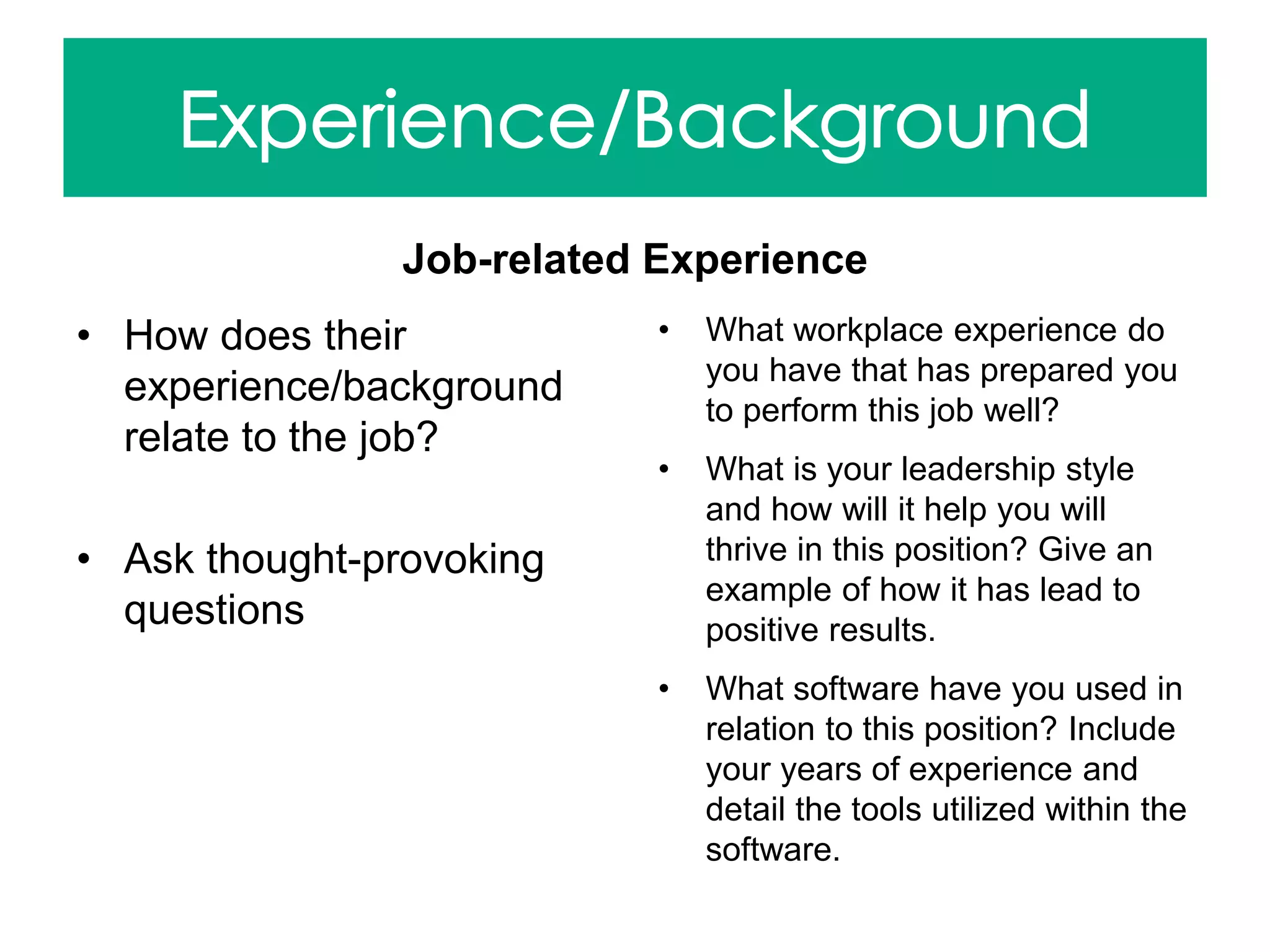
Job-related Experience
• How does their
experience/background
relate to the job?
• Ask thought-provoking
questions
• What workplace experience do
you have that has prepared you
to perform this job well?
• What is your leadership style
and how will it help you will
thrive in this position? Give an
example of how it has lead to
positive results.
• What software have you used in
relation to this position? Include
your years of experience and
detail the tools utilized within the
software.
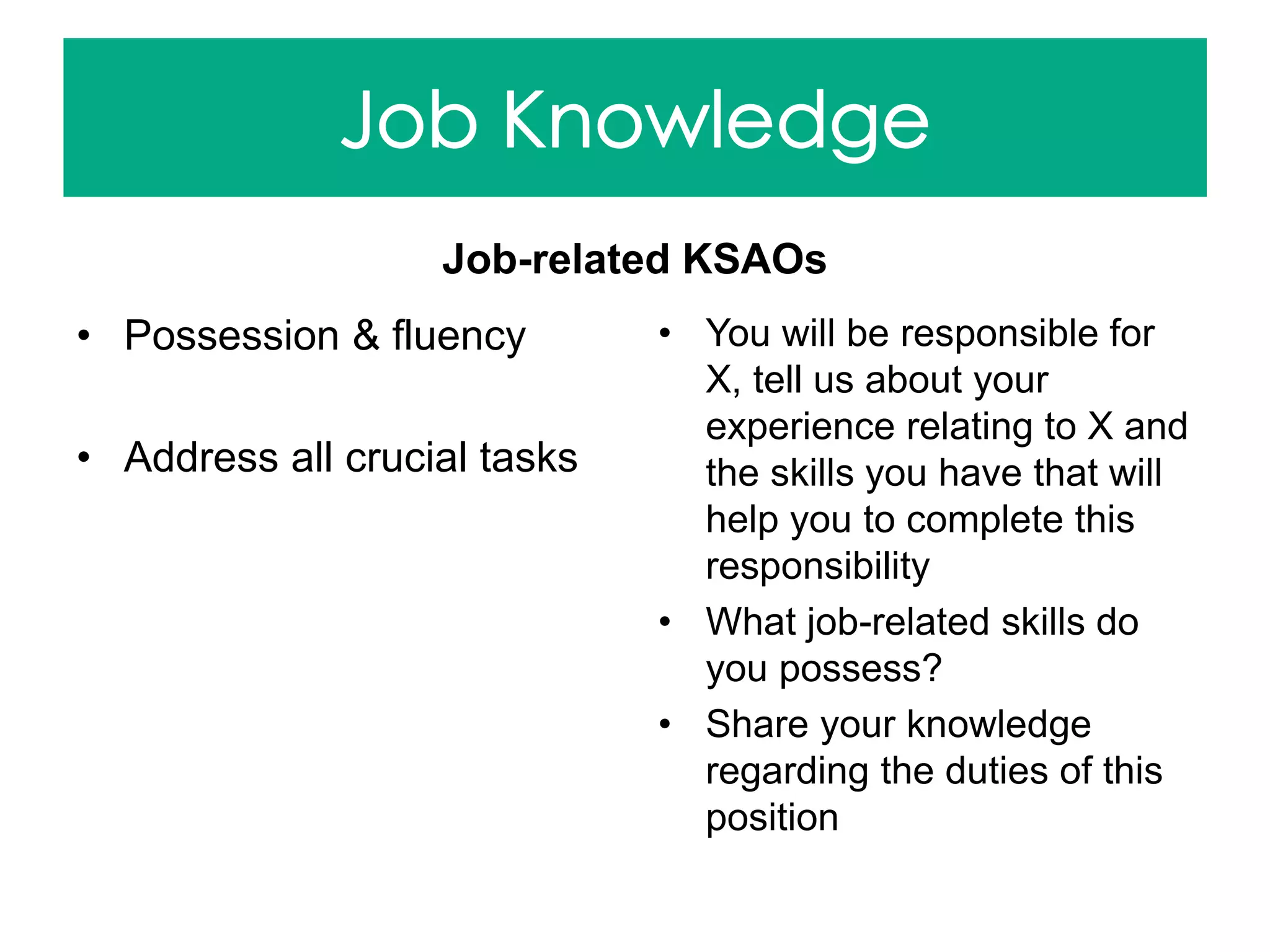
Job-related KSAOs
• Possession & fluency
• Address all crucial tasks
• You will be responsible for
X, tell us about your
experience relating to X and
the skills you have that will
help you to complete this
responsibility
• What job-related skills do
you possess?
• Share your knowledge
regarding the duties of this
position
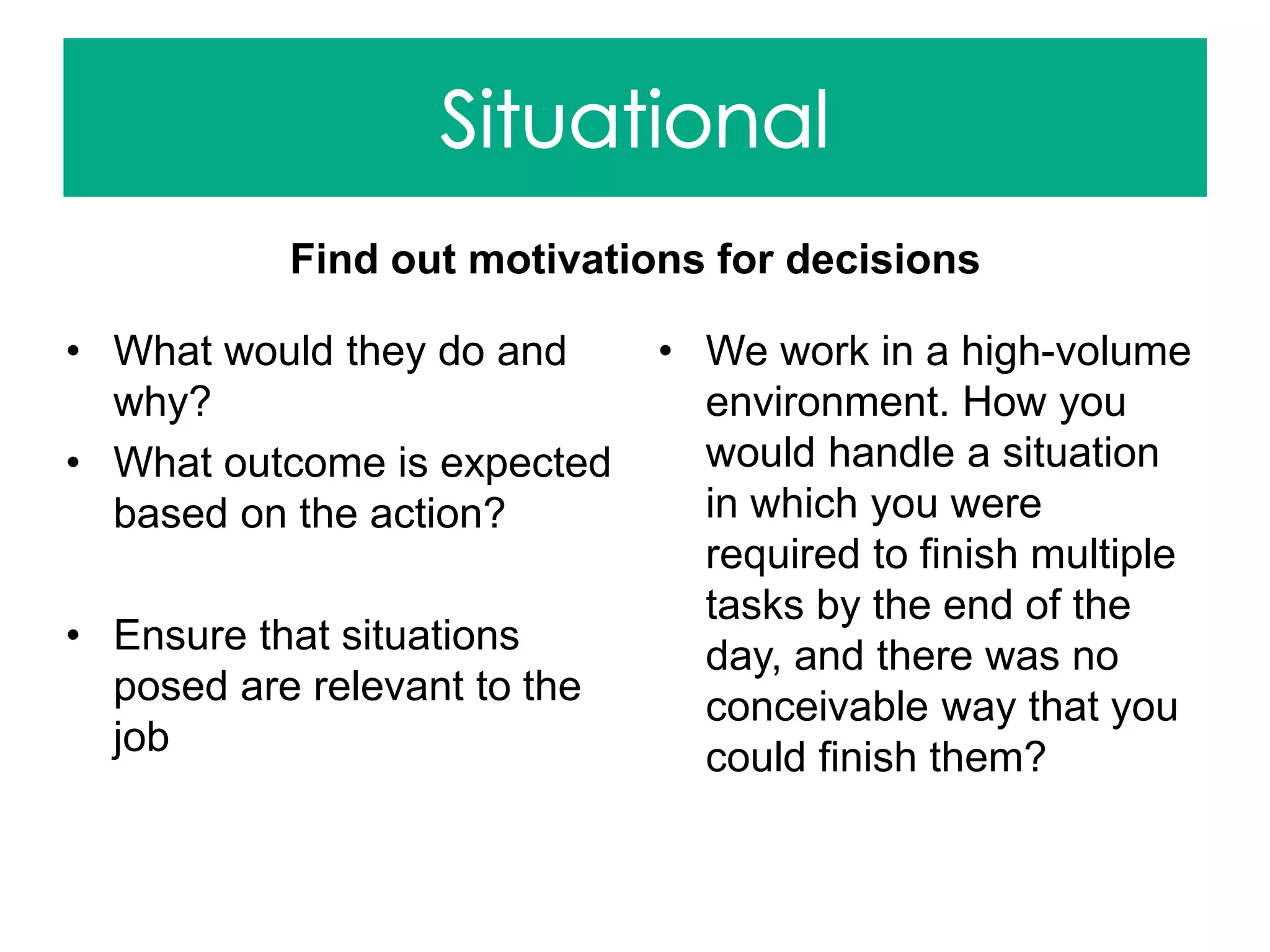
Find out motivations for decisions
• What would they do and
why?
• What outcome is expected
based on the action?
• Ensure that situations
posed are relevant to the
job
• We work in a high-volume
environment. How you
would handle a situation
in which you were
required to finish multiple
tasks by the end of the
day, and there was no
conceivable way that you
could finish them?
Action, Impact, and Result
• Ask what the impact of
the behavior was on the
candidate
• Describe a situation
where you…What was
the outcome?
• Tell us of a project in
which you encountered
major problems late in the
project, what did you do
and what was the
outcome?
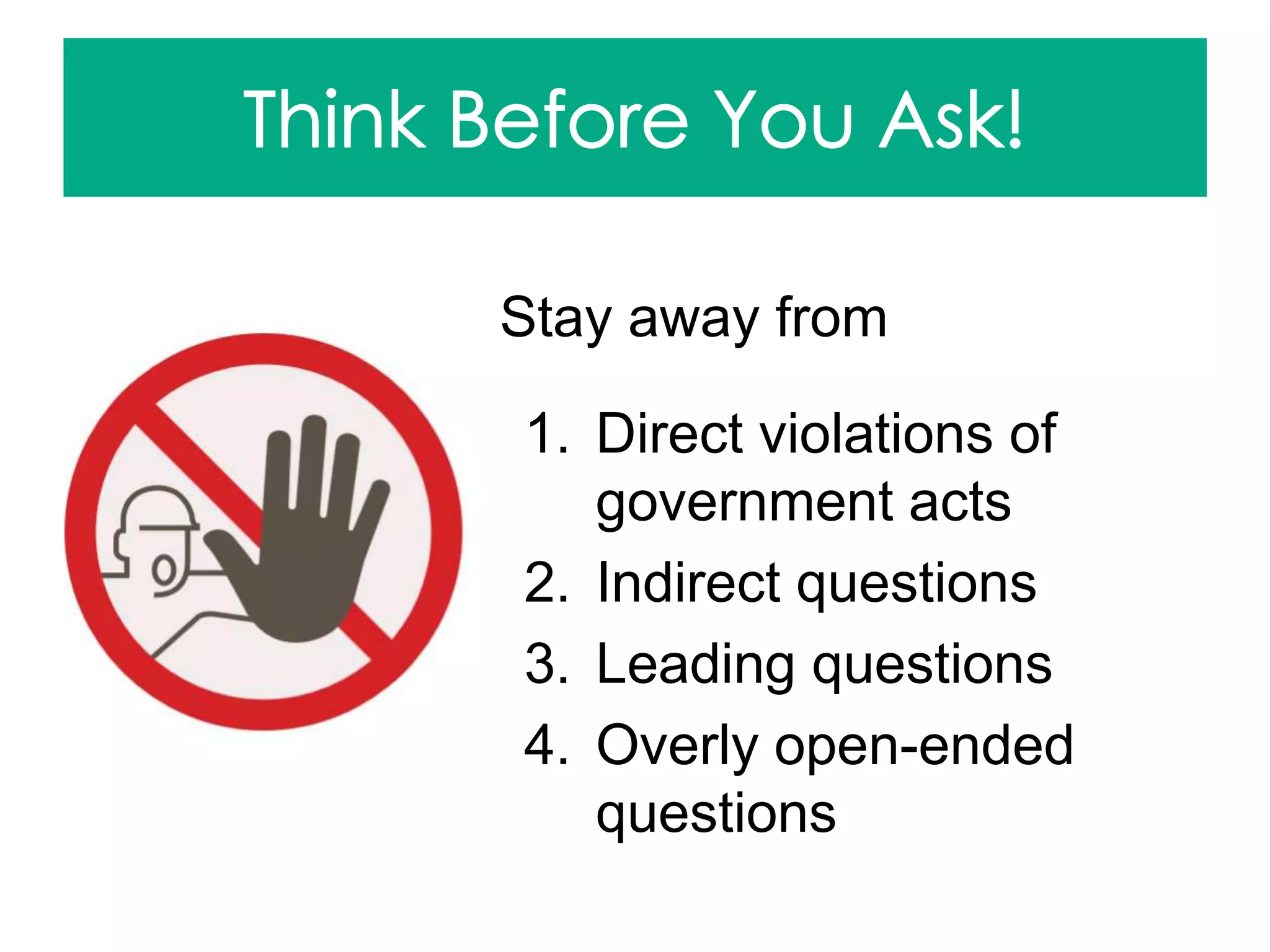
Stay away from
1. Direct violations of
government acts
2. Indirect questions
3. Leading questions
4. Overly open-ended
questions
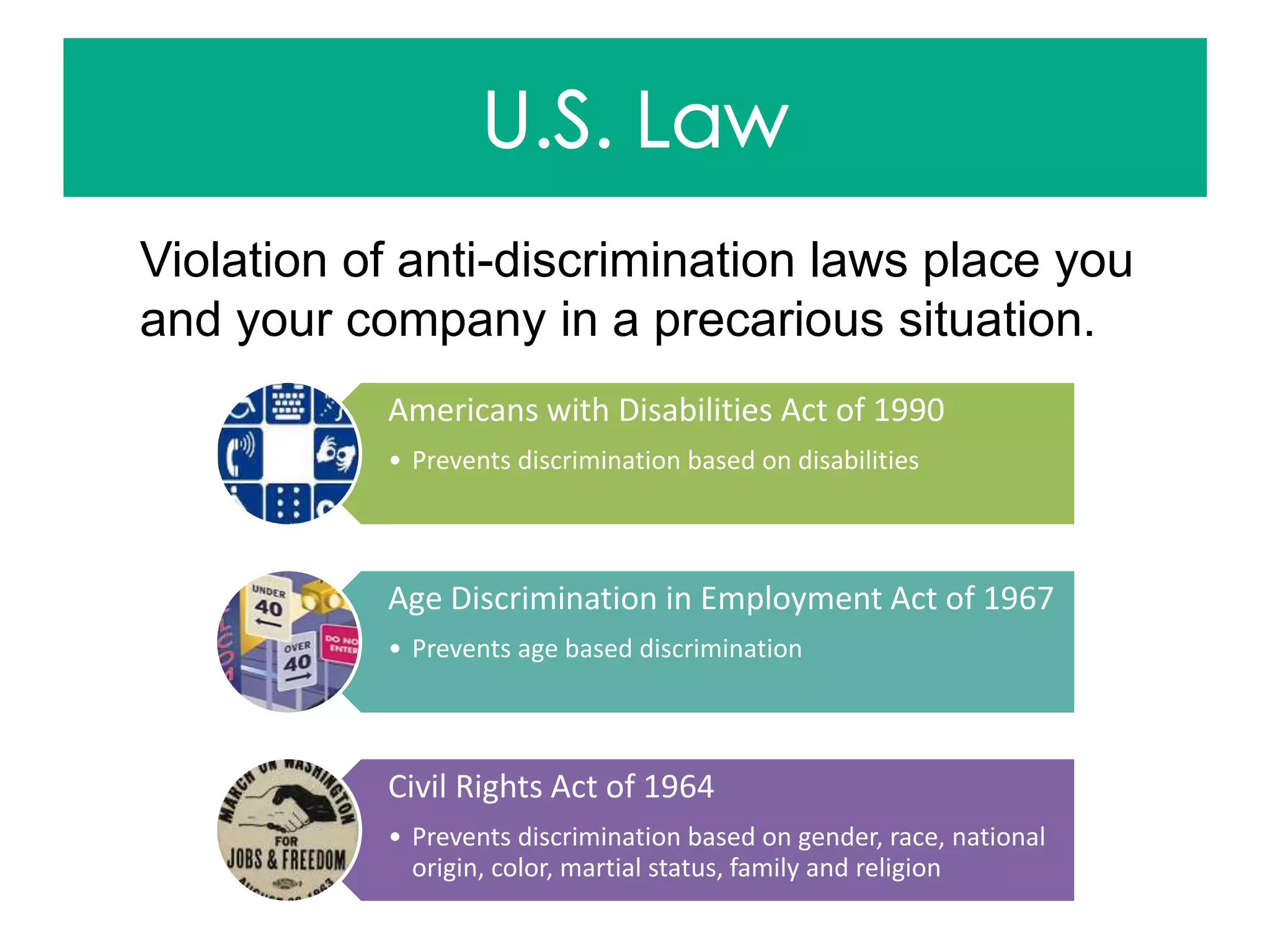
Violation of anti-discrimination laws place you
and your company in a precarious situation.
Americans with Disabilities Act of 1990
• Prevents discrimination based on disabilities
Age Discrimination in Employment Act of 1967
• Prevents age based discrimination
Civil Rights Act of 1964
• Prevents discrimination based on gender, race, national
origin, color, martial status, family and religion
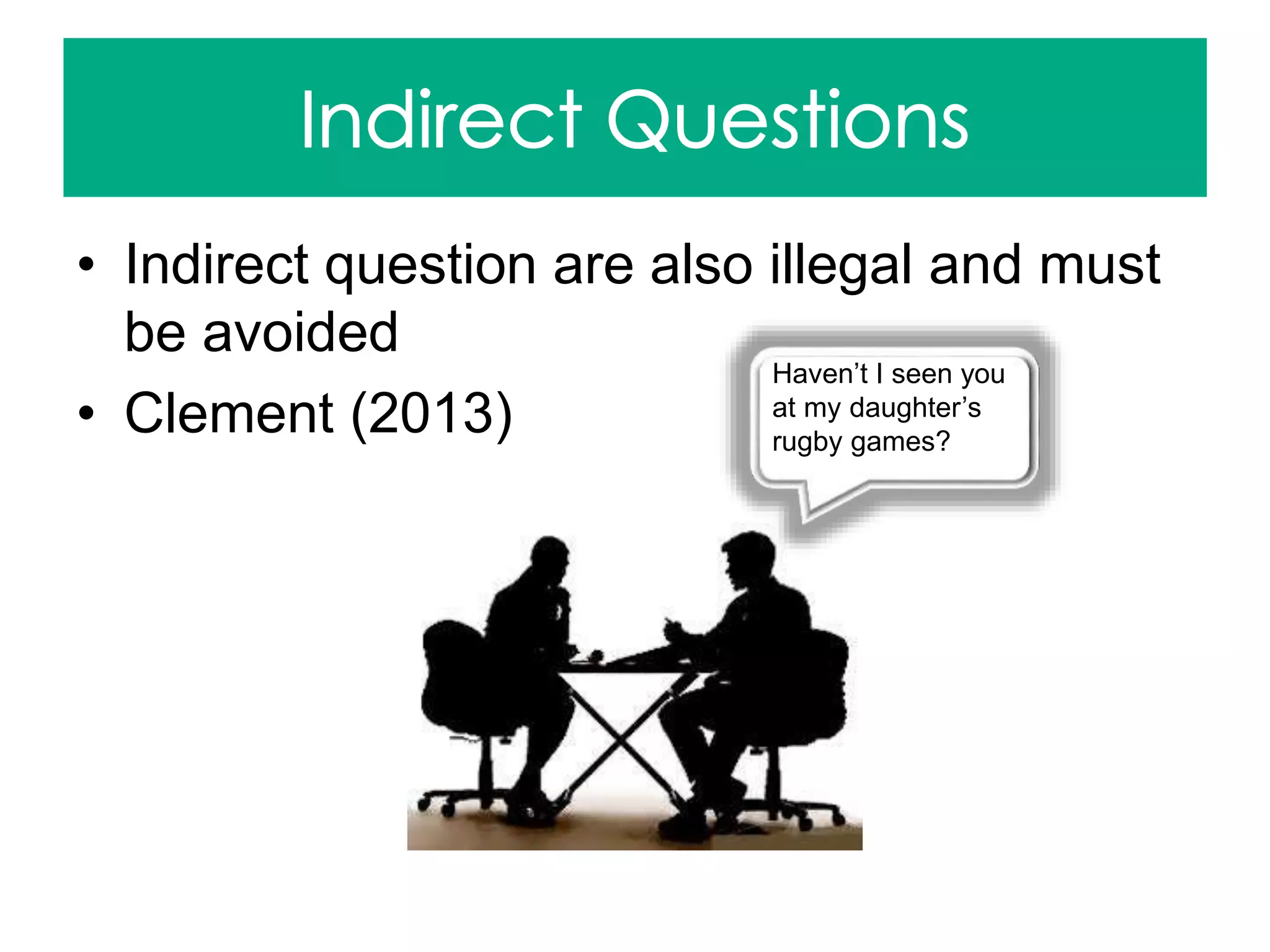
• Indirect question are also illegal and must
be avoided
• Clement (2013)
Haven’t I seen you
at my daughter’s
rugby games?
Imply there is one correct answer
Can limit responses to “Yes/No”
For the position you chose earlier, write one
of each of the following:
• Background/Experience
• Job Knowledge
• Situational
• Behavioral
Watch out for illegal and leading questions!
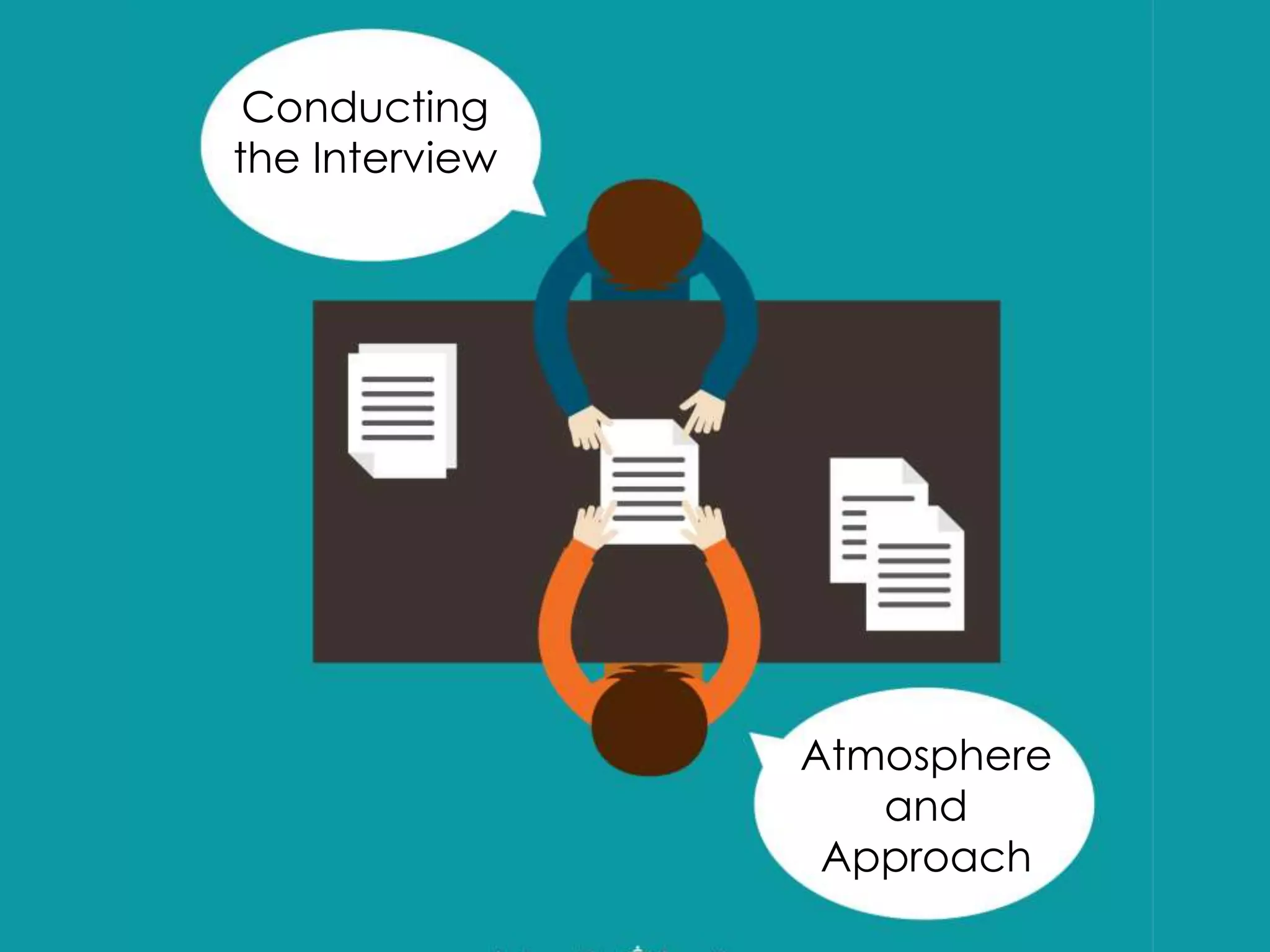
Conducting
the Interview
Atmosphere
and
Approach
Interviewers are responsible for:
1. Interview Climate
– Atmosphere
– Company Representation
2. Addressing Expectations
3. Nonverbal Communication
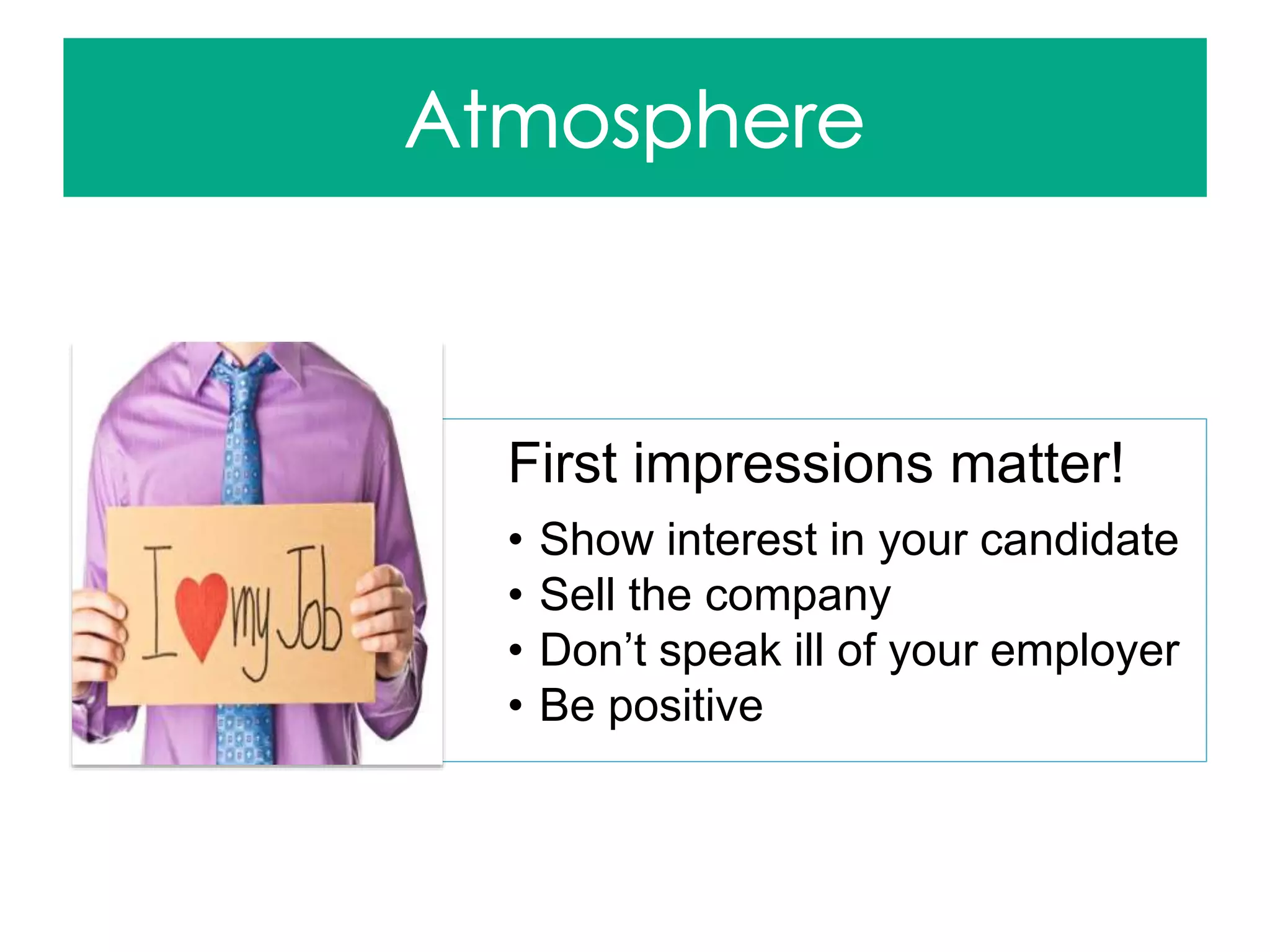
First impressions matter!
• Show interest in your candidate
• Sell the company
• Don’t speak ill of your employer
• Be positive
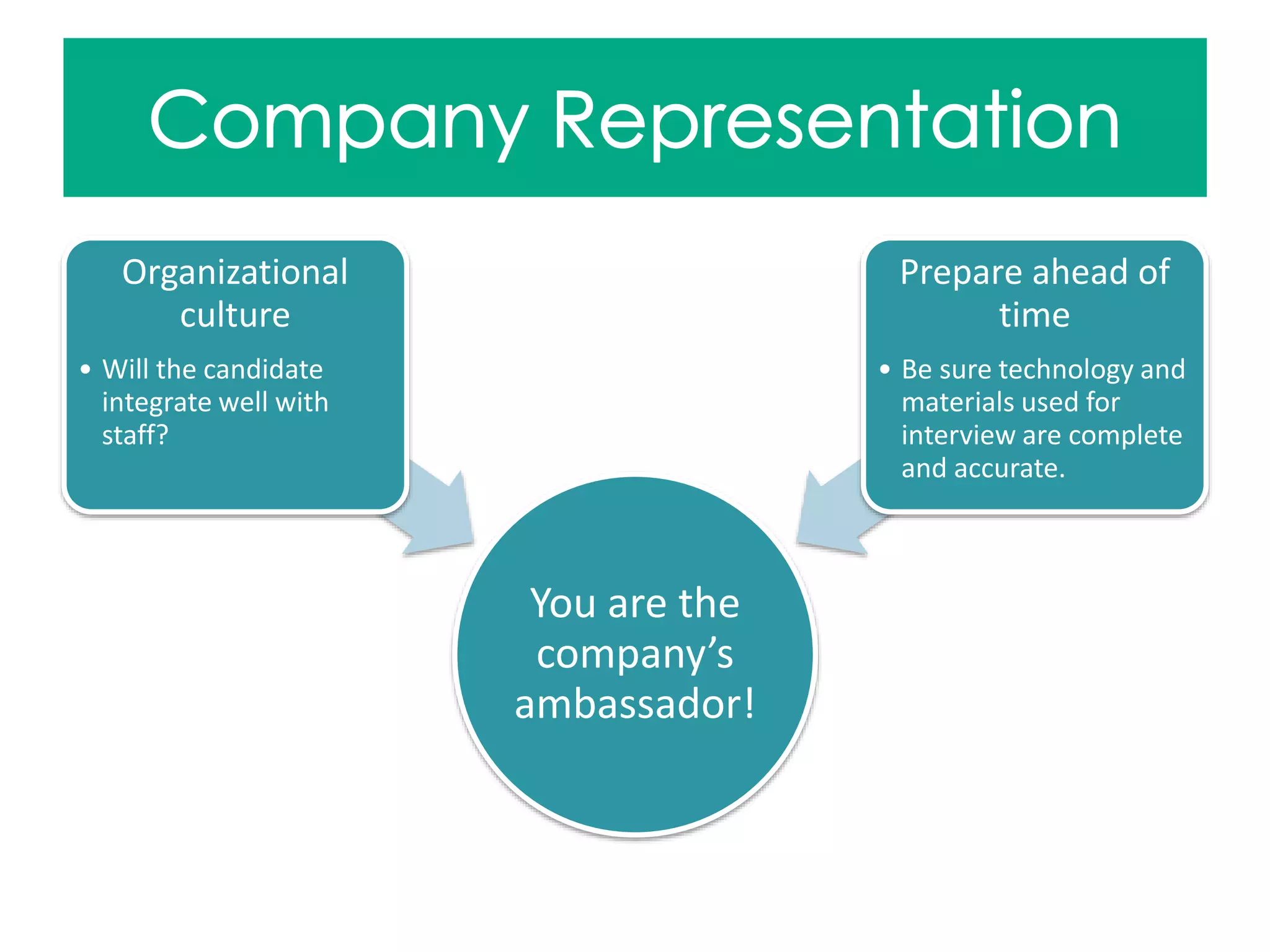
You are the
company’s
ambassador!
Organizational
culture
• Will the candidate
integrate well with
staff?
Prepare ahead of
time
• Be sure technology and
materials used for
interview are complete
and accurate.
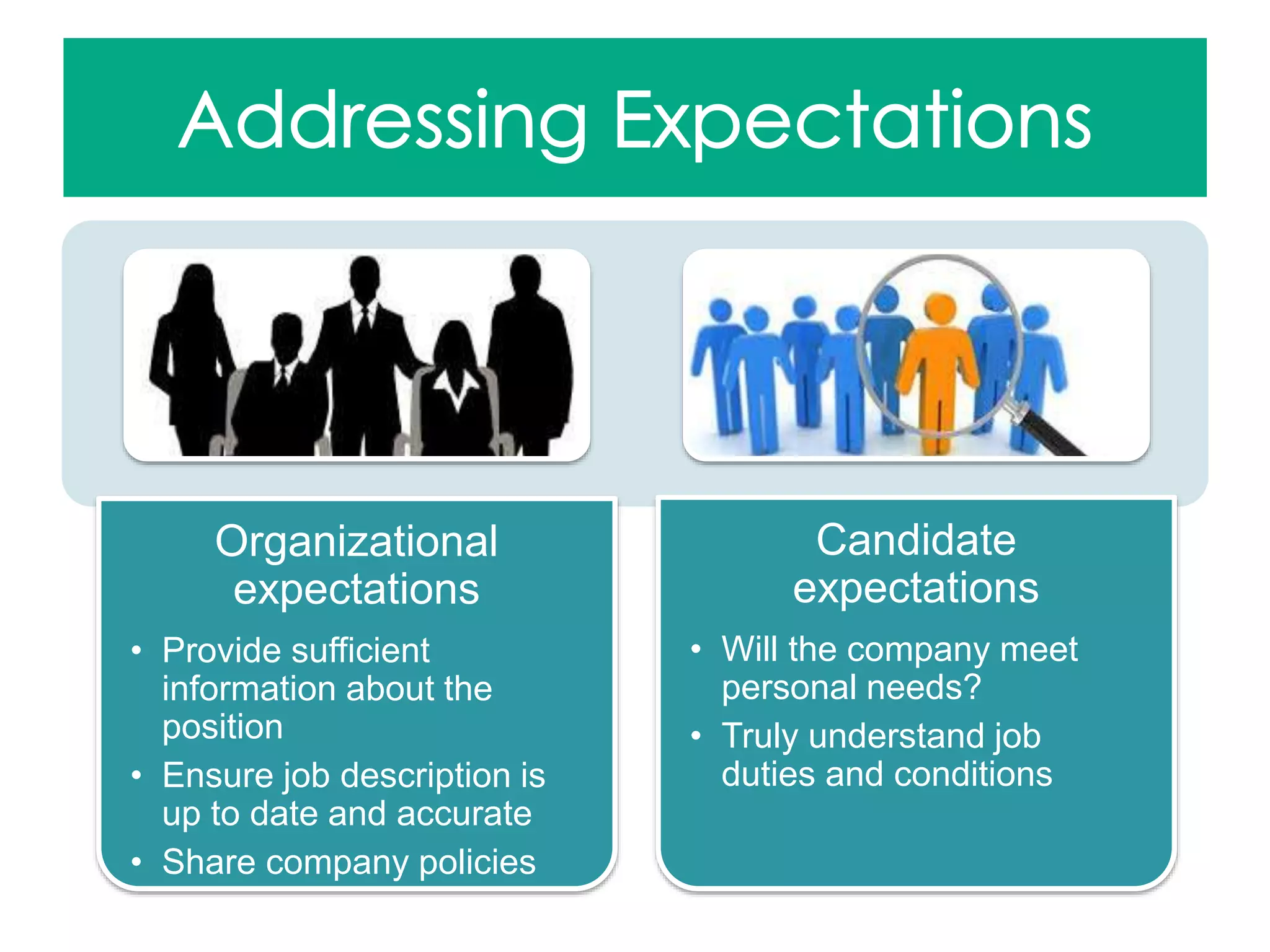
Organizational
expectations
• Provide sufficient
information about the
position
• Ensure job description is
up to date and accurate
• Share company policies
Candidate
expectations
• Will the company meet
personal needs?
• Truly understand job
duties and conditions
• Innate and can be unintentional
• Be conscious
• Uses of nonverbal communication
– Complement verbal communication
– Accent verbal communication
– Regulation of conversation
– Convey message
Create a comfortable, positive interview
environment
Be a “company ambassador” but be honest
and don’t oversell
REMINDER!
Use the same process for both internal and
external candidates, including:
Interview Structure
Interview Questions
Communications
• Different data?
– Statistical comparisons (Cashen, Cheramie, and
Sturman, 2002)
• Err on the side of internal candidates
– Past-performance data = “best predictor of
future performance” (Cashen, Cheramie, and Sturman,
2002, p. 38)
– Often “hit the ground running” faster
– Lower turnover rates
– Impact on other employees (Bradley, 2006)
• These judgments are made automatically
• “Making accurate dispositional judgments in
interpersonal first meetings…requires dedicated
cognitive attention” (Marr & Cable, 2014, p. 634).
• Focus on “core self-evaluations”
That “Gut” Feeling
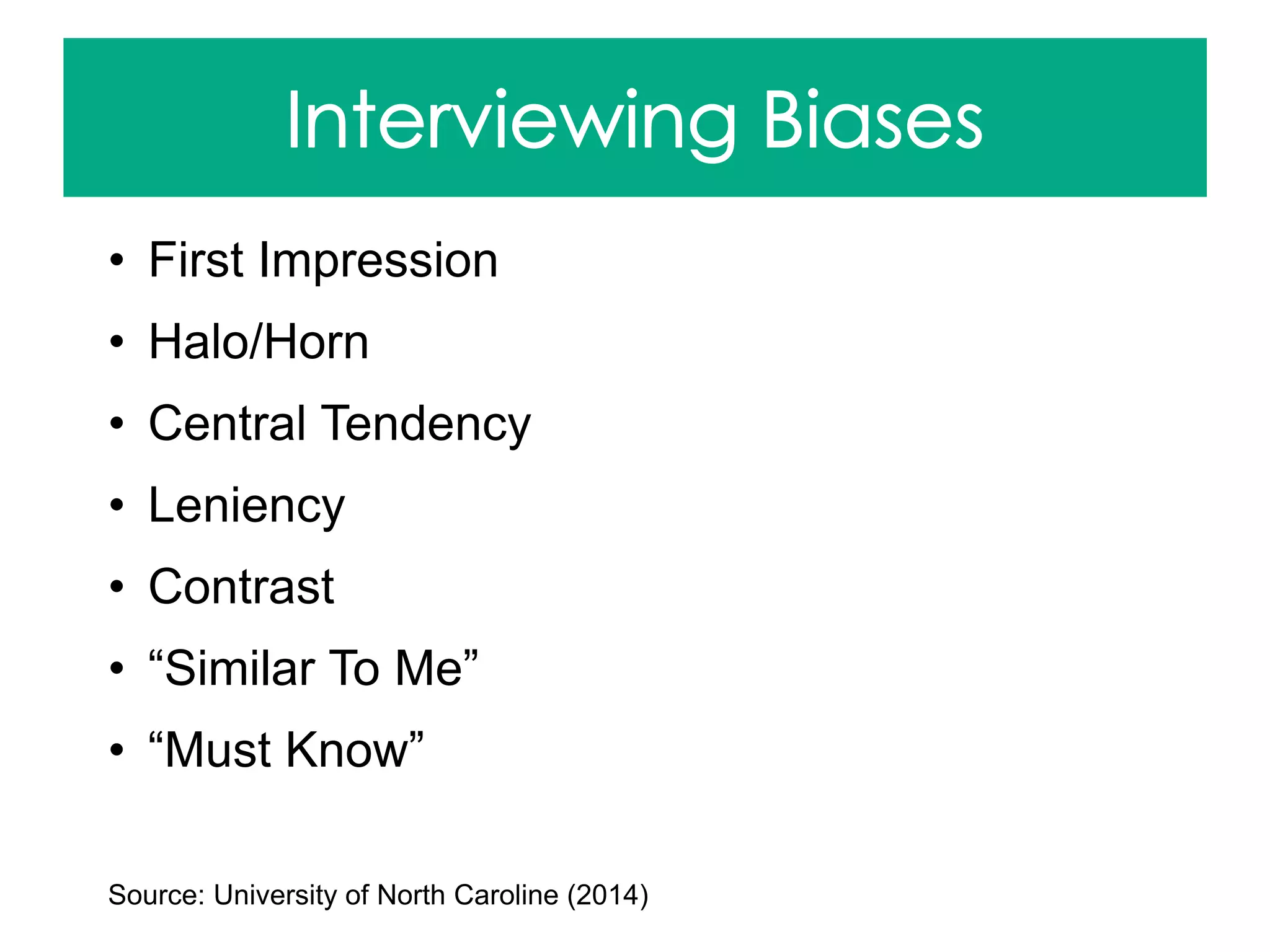
• First Impression
• Halo/Horn
• Central Tendency
• Leniency
• Contrast
• “Similar To Me”
• “Must Know”
Source: University of North Caroline (2014)
Interviewer, know thyself!
Be aware of potential biases
Acknowledge but process “gut feelings”
• Quick quiz!
– First step in the whole process?
– One reason you might want an internal
candidate instead of an external one? Vice
versa?
– What are the four categories of effective
interview questions?
– What’s one reason the interview climate is
important?
– What are “dispositional judgments”?
Bidwell, M. (2011). Paying more to get less: The effects of external hiring versus internal mobility. Administrative Science Quarterly 56(3), 369+.
doi: 10.1177/0001839211433562. Retrieved from Business Source Premier.
Bidwell, M. & Keller, JR. (2014) Within or without? How firms combine internal and external labor markets to fill jobs. Academy of Management
Journal 57(4), 1035+. doi 10.5465/amj.2012.0119. Retrieved from Business Source Premier.
Blackman, M.C. (2002, Sep). Personality judgment and the utility of the unstructured employment interview. Basic & Applied Social Psychology
24(3), 241+. Retrieved from: http://eds.a.ebscohost.com.libproxy.chapman.edu/eds/detail/detail?sid=38ae7fc7-5056-433d-b108-
9dee7b836e2c%40sessionmgr4003&vid=0&hid=4202&bdata=JkF1dGhUeXBlPWlwLHVpZCZzaXRlPWVkcy1saXZl#db=aph&AN=7105670
Bradley, L.M. (2006). Perceptions of justice when selecting internal and external job candidates. Personnel Review 35(1), 66+. doi:
10.1108/00483480610636795. Retrieved from ProQuest Psychology Journals.
Byrne, A., & Castellano, B. (1996). Hiring managers: promote or scout? Computer Reseller News (697), 201+. Retrieved from
http://go.galegroup.com.libproxy.chapman.edu/ps/i.do?id=GALE%7CA18622903&v=2.1&u=chap_main&it=r&p=AONE&sw=w&asid=3c046bb30
70b4700079ab308c4cf3407
Cable, D.M., & Marr, J.C. (2014). Do interviewers sell themselves short? The effects of selling orientation on interviewers’ judgments [PDF
Document]. Academy of Management Journal 57(3), 624+. Retrieved from: https://eds-b-ebscohost-
com.libproxy.chapman.edu/ehost/pdfviewer/pdfviewer?vid=10&sid=1a9375d1-0670-4bbd-aed7-ef185f3349ac%40sessionmgr115&hid=122
Cashen, L. H., Cheramie, R. A., & Sturman, M. C. (2002, August). How to compare apples to oranges: balancing internal candidates' job-
performance data with external candidates' selection-test results. (Human Resources). Cornell Hotel & Restaurant Administration Quarterly
43(4), 27+. Retrieved from
http://go.galegroup.com.libproxy.chapman.edu/ps/i.do?id=GALE%7CA92285349&v=2.1&u=chap_main&it=r&p=AONE&sw=w&asid=311f572c2
858c640b61058e77db27751
Clement, M. C. (2013). Hiring good colleagues: What you need to know about interviewing new teachers. Clearing House 86(3), 99+.
doi:10.1080/00098655.2013.769930
Cottrell, T. (2012). Interviewing efficiencies or interviewing efficiently?. Bottom Line: Managing Library Finances 25(3), 102+.
doi:10.1108/08880451211276548
DeSimone, R. L., & Werner, J. M. (2012). Human resource development (6th ed). Mason, OH: South-Western.
Engel, D., & Robbins, S. (2009). Telephone Interviewing Practices within Academic Libraries. Journal Of Academic Librarianship, 35(2), 143-
151.
Harcourt, K. (2014, July 31). 4 tips to help hiring managers develop interview skills. Talent Talk. Retrieved from http://blog.mcquaig.com/blog/4-
tips-to-help-hiring-managers-develop-interview-skills.
Keenan, A., & Wedderburn, A. (1975). Effects of the non-verbal behaviour of interviewers on candidates' impressions. Journal Of Occupational
Psychology, 48(2), 129+.
Kenyon College Office of the Provost. (n.d.) Protocol for Searches with Internal Candidates. Retrieved from
http://www.kenyon.edu/directories/offices-services/office-of-the-provost/faculty-resources-information/hiring/protocol-for-searches-with-internal-
candidates/
Langan, S. (2014, Feb 10). Selection planning: maximizing the testing process [PowerPoint]. IPMA Training Course.
Lee Flores, M. (2014). How to avoid the most common pitfalls when hiring employees: Nationally and in California. Employee Relations Law
Journal, 40(3), 34+.
Lewis, C. (1980). Investigating the employment interview: A consideration of counseling skills. Journal Of Occupational Psychology, 53(2),
111+.
Sanford, J. (2005). Making Cents Out of the Hiring Process. Strategic Finance 87(6), 41+.
Schement, J. R. (2002). Encyclopedia of Communication and Information. New York: Macmillan Reference USA.
The Bridgespan Group. (2010). Considering and evaluating internal candidates for senior-level nonprofit positions. Retrieved from
http://www.bridgespan.org/getdoc/78804d86-00bc-4e75-9563-95b9d7f80aa6/Considering-Evaluating-Internal-Candidates.aspx#.VN0Oc_WtvMI
University of North Carolina (Dec 2014). Interviewer biases [PDF Document]. Retrieved from:
http://www.uncsa.edu/humanresources/forms/InterviewerBiases.pdf
• Title, comparing candidates, conducting
the interview images from Freepic.com
• Compare/contrast, Think before you ask!,
and best practice slides created with
Piktochart.com

Hiring the Best Candidate

  • 1.
    Hiring the Best Candidatefor the Job Interview and Selection Skills for Managers
  • 2.
    2014 McQuaig Global TalentRecruitment Survey Question: are your hiring managers strong interviewers? (Harcourt, 2014) No 45%
  • 3.
    “Retention begins withhiring” (Clement, 2013, p. 102)
  • 4.
    – Staff moraledecreases • Lower work output • Negative perception of company • Lowered performance quality – Resources waste • Hiring staff taken away from other needs – Monetary loss • (Sanford, 2005, p. 43)
  • 5.
    What are yourquestions or concerns? Are you new to the selection process? Or have you been on a committee? What would you like to achieve through this training?
  • 6.
    • Articulate whatyou are looking for in a candidate • Compare and contrast the benefits and drawbacks of internal and external candidates • Develop comprehensive and inclusive interview questions
  • 7.
    • Demonstrate awarenessof how your behavior can impact interview success • Understand when to use dispositional judgments in candidate consideration Know you have the basic knowledge and skills for interviewing and selecting the best candidate for your position
  • 8.
    Choose a jobor position you are very familiar with to use in our activities today. It could be: • A position you are or will be hiring for • Your current position • A position you recently held Write it down so you can refer back to it later.
  • 9.
    • What needdo I have to fill this vacancy? • Knowledge, Skills, and Abilities • Cultural fit • Organizational fit
  • 10.
    For the positionyou chose, answer: What am I “really” looking for? Take 5 minutes and discuss with your neighbors
  • 11.
  • 13.
    • Confidentiality • Impacton other employees – Bradley (2006) - how an internal candidate is handled can influence how fair other employees think the company is • Different process? – Legal issues – Comparing to external candidates
  • 14.
    Use the sameprocess for both internal and external candidates, including: Interview Structure Interview Questions Communications
  • 18.
    Conduct structured interviews Theyare more: Equitable Respectable Acceptable
  • 19.
    • What areyou really looking for? • Measure – Job knowledge – Cognitive ability – Training – Experience – Expertise – Cultural fit
  • 21.
    From Langan (2014) 1.Experience/Background 2. Job Knowledge 3. Situational 4. Behavioral
  • 22.
    Job-related Experience • Howdoes their experience/background relate to the job? • Ask thought-provoking questions • What workplace experience do you have that has prepared you to perform this job well? • What is your leadership style and how will it help you will thrive in this position? Give an example of how it has lead to positive results. • What software have you used in relation to this position? Include your years of experience and detail the tools utilized within the software.
  • 23.
    Job-related KSAOs • Possession& fluency • Address all crucial tasks • You will be responsible for X, tell us about your experience relating to X and the skills you have that will help you to complete this responsibility • What job-related skills do you possess? • Share your knowledge regarding the duties of this position
  • 24.
    Find out motivationsfor decisions • What would they do and why? • What outcome is expected based on the action? • Ensure that situations posed are relevant to the job • We work in a high-volume environment. How you would handle a situation in which you were required to finish multiple tasks by the end of the day, and there was no conceivable way that you could finish them?
  • 25.
    Action, Impact, andResult • Ask what the impact of the behavior was on the candidate • Describe a situation where you…What was the outcome? • Tell us of a project in which you encountered major problems late in the project, what did you do and what was the outcome?
  • 26.
    Stay away from 1.Direct violations of government acts 2. Indirect questions 3. Leading questions 4. Overly open-ended questions
  • 27.
    Violation of anti-discriminationlaws place you and your company in a precarious situation. Americans with Disabilities Act of 1990 • Prevents discrimination based on disabilities Age Discrimination in Employment Act of 1967 • Prevents age based discrimination Civil Rights Act of 1964 • Prevents discrimination based on gender, race, national origin, color, martial status, family and religion
  • 28.
    • Indirect questionare also illegal and must be avoided • Clement (2013) Haven’t I seen you at my daughter’s rugby games?
  • 29.
    Imply there isone correct answer Can limit responses to “Yes/No”
  • 30.
    For the positionyou chose earlier, write one of each of the following: • Background/Experience • Job Knowledge • Situational • Behavioral Watch out for illegal and leading questions!
  • 31.
  • 32.
    Interviewers are responsiblefor: 1. Interview Climate – Atmosphere – Company Representation 2. Addressing Expectations 3. Nonverbal Communication
  • 33.
    First impressions matter! •Show interest in your candidate • Sell the company • Don’t speak ill of your employer • Be positive
  • 34.
    You are the company’s ambassador! Organizational culture •Will the candidate integrate well with staff? Prepare ahead of time • Be sure technology and materials used for interview are complete and accurate.
  • 35.
    Organizational expectations • Provide sufficient informationabout the position • Ensure job description is up to date and accurate • Share company policies Candidate expectations • Will the company meet personal needs? • Truly understand job duties and conditions
  • 36.
    • Innate andcan be unintentional • Be conscious • Uses of nonverbal communication – Complement verbal communication – Accent verbal communication – Regulation of conversation – Convey message
  • 37.
    Create a comfortable,positive interview environment Be a “company ambassador” but be honest and don’t oversell
  • 39.
    REMINDER! Use the sameprocess for both internal and external candidates, including: Interview Structure Interview Questions Communications
  • 40.
    • Different data? –Statistical comparisons (Cashen, Cheramie, and Sturman, 2002) • Err on the side of internal candidates – Past-performance data = “best predictor of future performance” (Cashen, Cheramie, and Sturman, 2002, p. 38) – Often “hit the ground running” faster – Lower turnover rates – Impact on other employees (Bradley, 2006)
  • 41.
    • These judgmentsare made automatically • “Making accurate dispositional judgments in interpersonal first meetings…requires dedicated cognitive attention” (Marr & Cable, 2014, p. 634). • Focus on “core self-evaluations” That “Gut” Feeling
  • 42.
    • First Impression •Halo/Horn • Central Tendency • Leniency • Contrast • “Similar To Me” • “Must Know” Source: University of North Caroline (2014)
  • 43.
    Interviewer, know thyself! Beaware of potential biases Acknowledge but process “gut feelings”
  • 44.
    • Quick quiz! –First step in the whole process? – One reason you might want an internal candidate instead of an external one? Vice versa? – What are the four categories of effective interview questions? – What’s one reason the interview climate is important? – What are “dispositional judgments”?
  • 46.
    Bidwell, M. (2011).Paying more to get less: The effects of external hiring versus internal mobility. Administrative Science Quarterly 56(3), 369+. doi: 10.1177/0001839211433562. Retrieved from Business Source Premier. Bidwell, M. & Keller, JR. (2014) Within or without? How firms combine internal and external labor markets to fill jobs. Academy of Management Journal 57(4), 1035+. doi 10.5465/amj.2012.0119. Retrieved from Business Source Premier. Blackman, M.C. (2002, Sep). Personality judgment and the utility of the unstructured employment interview. Basic & Applied Social Psychology 24(3), 241+. Retrieved from: http://eds.a.ebscohost.com.libproxy.chapman.edu/eds/detail/detail?sid=38ae7fc7-5056-433d-b108- 9dee7b836e2c%40sessionmgr4003&vid=0&hid=4202&bdata=JkF1dGhUeXBlPWlwLHVpZCZzaXRlPWVkcy1saXZl#db=aph&AN=7105670 Bradley, L.M. (2006). Perceptions of justice when selecting internal and external job candidates. Personnel Review 35(1), 66+. doi: 10.1108/00483480610636795. Retrieved from ProQuest Psychology Journals. Byrne, A., & Castellano, B. (1996). Hiring managers: promote or scout? Computer Reseller News (697), 201+. Retrieved from http://go.galegroup.com.libproxy.chapman.edu/ps/i.do?id=GALE%7CA18622903&v=2.1&u=chap_main&it=r&p=AONE&sw=w&asid=3c046bb30 70b4700079ab308c4cf3407 Cable, D.M., & Marr, J.C. (2014). Do interviewers sell themselves short? The effects of selling orientation on interviewers’ judgments [PDF Document]. Academy of Management Journal 57(3), 624+. Retrieved from: https://eds-b-ebscohost- com.libproxy.chapman.edu/ehost/pdfviewer/pdfviewer?vid=10&sid=1a9375d1-0670-4bbd-aed7-ef185f3349ac%40sessionmgr115&hid=122 Cashen, L. H., Cheramie, R. A., & Sturman, M. C. (2002, August). How to compare apples to oranges: balancing internal candidates' job- performance data with external candidates' selection-test results. (Human Resources). Cornell Hotel & Restaurant Administration Quarterly 43(4), 27+. Retrieved from http://go.galegroup.com.libproxy.chapman.edu/ps/i.do?id=GALE%7CA92285349&v=2.1&u=chap_main&it=r&p=AONE&sw=w&asid=311f572c2 858c640b61058e77db27751 Clement, M. C. (2013). Hiring good colleagues: What you need to know about interviewing new teachers. Clearing House 86(3), 99+. doi:10.1080/00098655.2013.769930 Cottrell, T. (2012). Interviewing efficiencies or interviewing efficiently?. Bottom Line: Managing Library Finances 25(3), 102+. doi:10.1108/08880451211276548
  • 47.
    DeSimone, R. L.,& Werner, J. M. (2012). Human resource development (6th ed). Mason, OH: South-Western. Engel, D., & Robbins, S. (2009). Telephone Interviewing Practices within Academic Libraries. Journal Of Academic Librarianship, 35(2), 143- 151. Harcourt, K. (2014, July 31). 4 tips to help hiring managers develop interview skills. Talent Talk. Retrieved from http://blog.mcquaig.com/blog/4- tips-to-help-hiring-managers-develop-interview-skills. Keenan, A., & Wedderburn, A. (1975). Effects of the non-verbal behaviour of interviewers on candidates' impressions. Journal Of Occupational Psychology, 48(2), 129+. Kenyon College Office of the Provost. (n.d.) Protocol for Searches with Internal Candidates. Retrieved from http://www.kenyon.edu/directories/offices-services/office-of-the-provost/faculty-resources-information/hiring/protocol-for-searches-with-internal- candidates/ Langan, S. (2014, Feb 10). Selection planning: maximizing the testing process [PowerPoint]. IPMA Training Course. Lee Flores, M. (2014). How to avoid the most common pitfalls when hiring employees: Nationally and in California. Employee Relations Law Journal, 40(3), 34+. Lewis, C. (1980). Investigating the employment interview: A consideration of counseling skills. Journal Of Occupational Psychology, 53(2), 111+. Sanford, J. (2005). Making Cents Out of the Hiring Process. Strategic Finance 87(6), 41+. Schement, J. R. (2002). Encyclopedia of Communication and Information. New York: Macmillan Reference USA. The Bridgespan Group. (2010). Considering and evaluating internal candidates for senior-level nonprofit positions. Retrieved from http://www.bridgespan.org/getdoc/78804d86-00bc-4e75-9563-95b9d7f80aa6/Considering-Evaluating-Internal-Candidates.aspx#.VN0Oc_WtvMI University of North Carolina (Dec 2014). Interviewer biases [PDF Document]. Retrieved from: http://www.uncsa.edu/humanresources/forms/InterviewerBiases.pdf
  • 48.
    • Title, comparingcandidates, conducting the interview images from Freepic.com • Compare/contrast, Think before you ask!, and best practice slides created with Piktochart.com