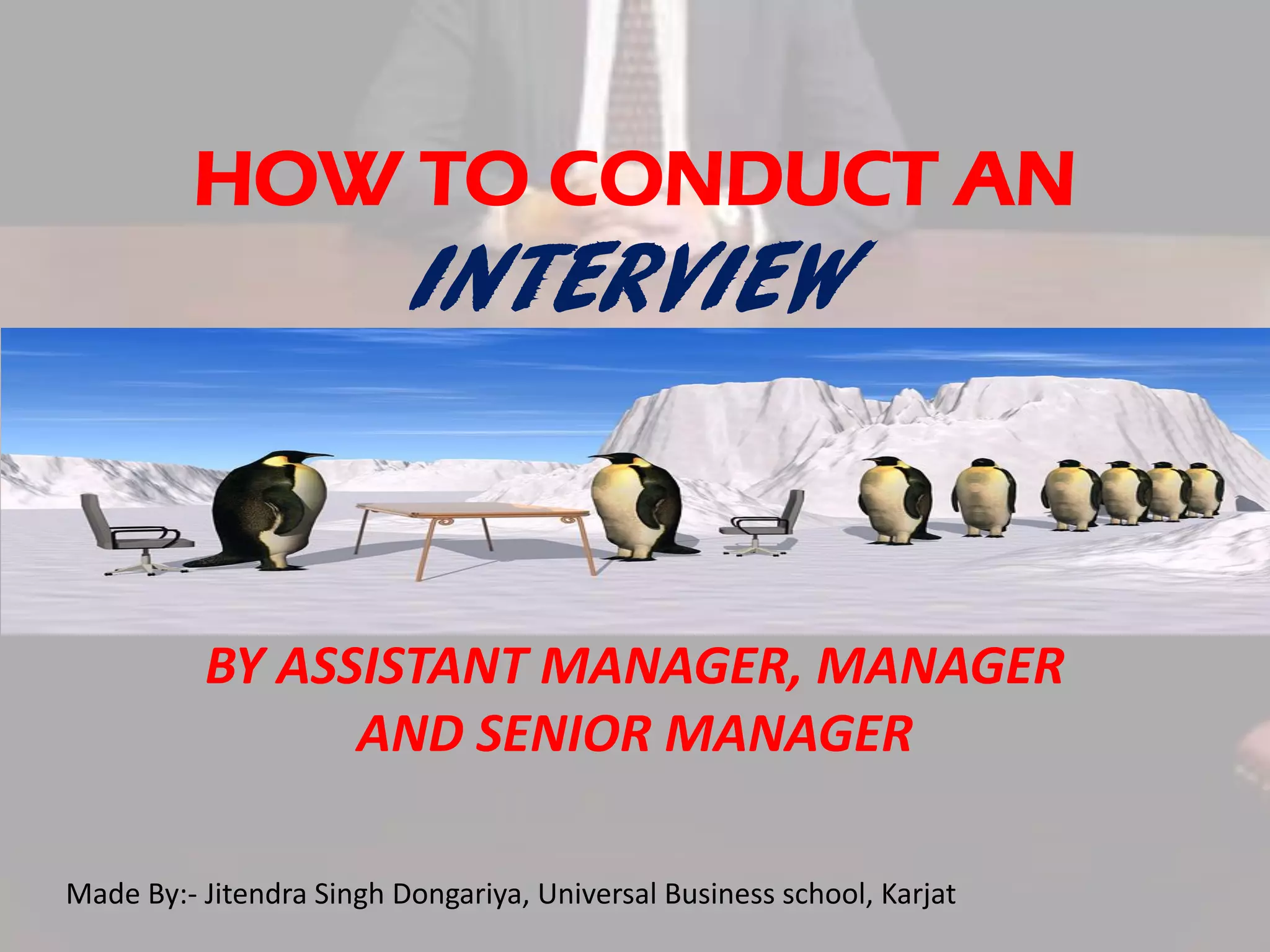
HOW TO CONDUCT AN

INTERVIEW

BY ASSISTANT MANAGER, MANAGER
AND SENIOR MANAGER
Made By:- Jitendra Singh Dongariya, Universal Business school, Karjat
OUTLINE OF PPT
1.
2.
3.
4.
5.
6.
7.
8.
9.
10.
11.
12.
13.
14.
15.
16.
17.
18.

Objectives of presentation………………………………………………………3
Introduction …………………………………………………………………………..4
Structured Vs Unstructured…………………………………………………….5
Interview process………………………………………………..………………...6
Steps in interview design………………………..……………………………..7
Types of interview……………………………………………………………….…8
Job analysis…………………………………………………………………………..9
Analysis of Required key competencies for job……………………..10
Interview format………………………………………………………………....11
If candidate are more then GD and Aptitude…………................12
Evaluation structure……………………….…………………………………….13
Rating scale structure…………………………………………………………..14
Interviewer’s approach………………………………………………………..15
Three phases of interview..……………………………….………..........20
Adjust yourself………………………………………………….………...........24
Define do’s…………………………………………………….…………...........25
Define don’ts………………………………. ………………….………………….26
Solutions……...…………………………......…………….........................28
Objective of presentation
• How to conduct a successful and effective
interview.
• Improve the overall interview process and to
get desired results.
• Target to improve the interviewing skills of:1. Assistant manager
2. Manager
3. Senior manager
Introduction
• Interviews are used as part of the formal
selection process in which candidates are
screened or ranked based on their scores.
Types of interview:Selection interview
Appraisal interview
Exit interview
A selection interview is a selection procedure designed to
predict future job performance on the basis of applicants’
oral responses to oral inquiries
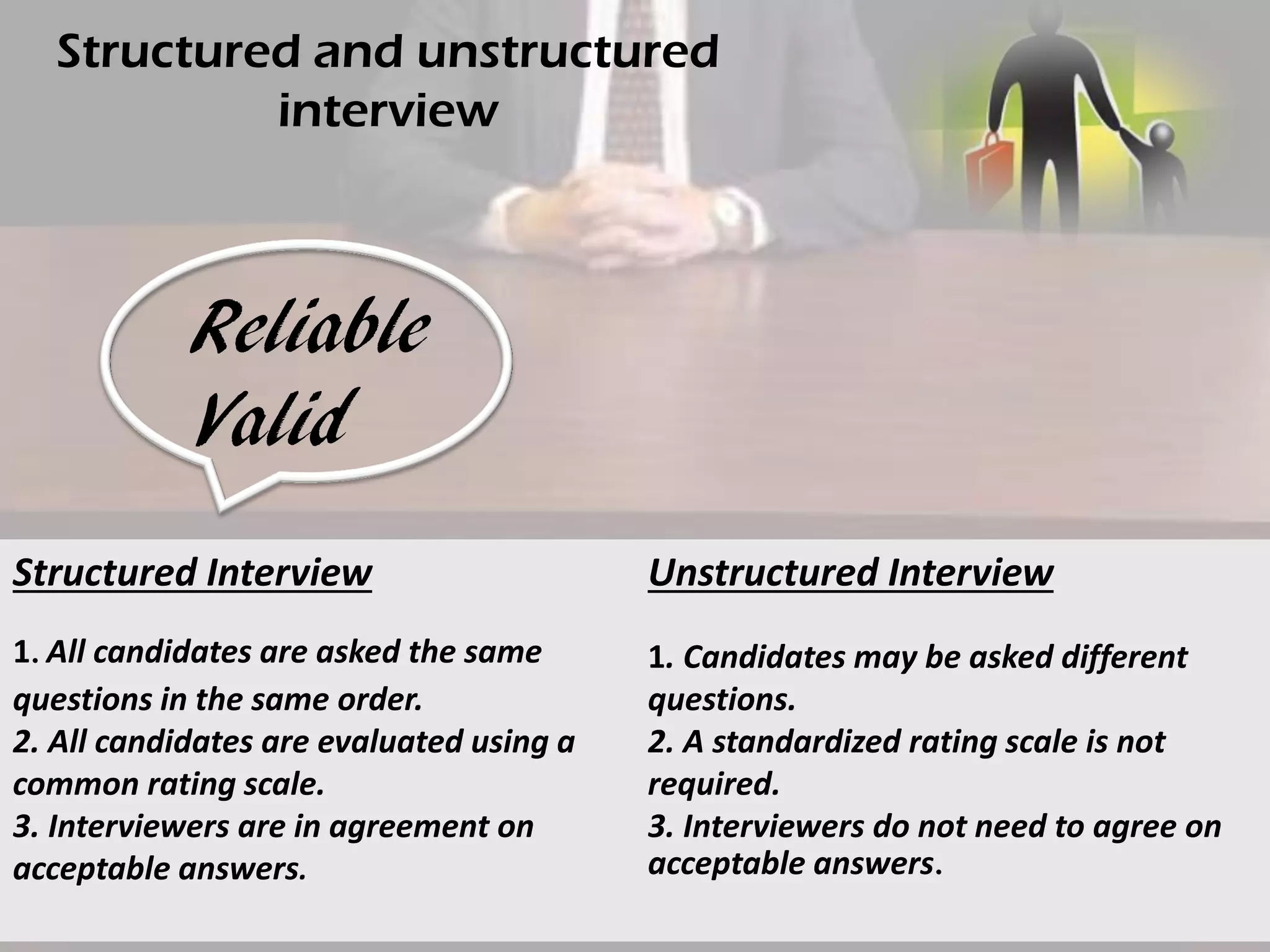
Structured and unstructured
interview

Reliable
Valid
Structured Interview

Unstructured Interview

1 All candidates are asked the same
questions in the same order.
2. All candidates are evaluated using a
common rating scale.
3. Interviewers are in agreement on
acceptable answers.

1. Candidates may be asked different
questions.
2. A standardized rating scale is not
required.
3. Interviewers do not need to agree on
acceptable answers
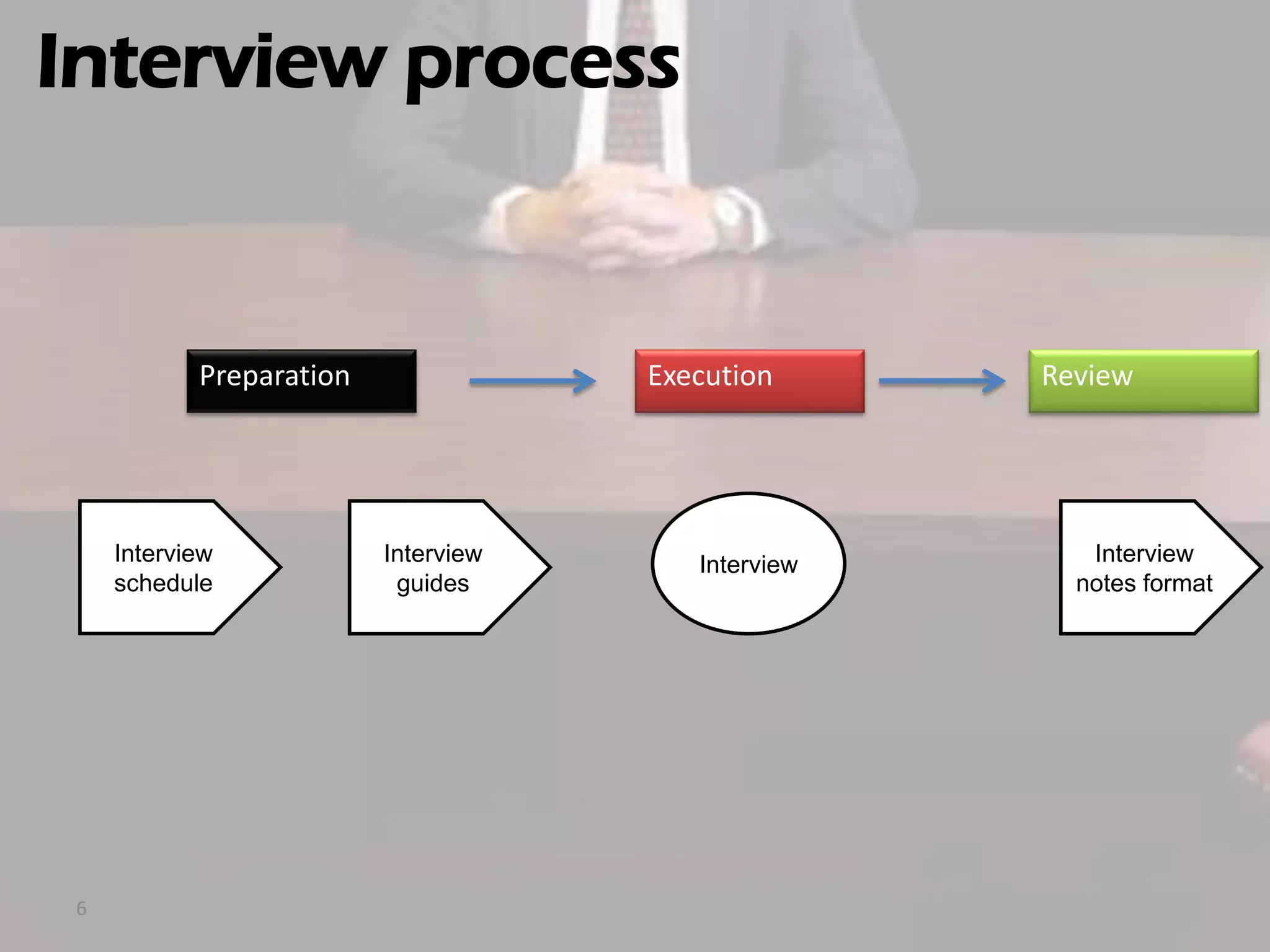
Interview process

Preparation

Interview
schedule

6

Execution

Interview
guides

Interview

Review

Interview
notes format
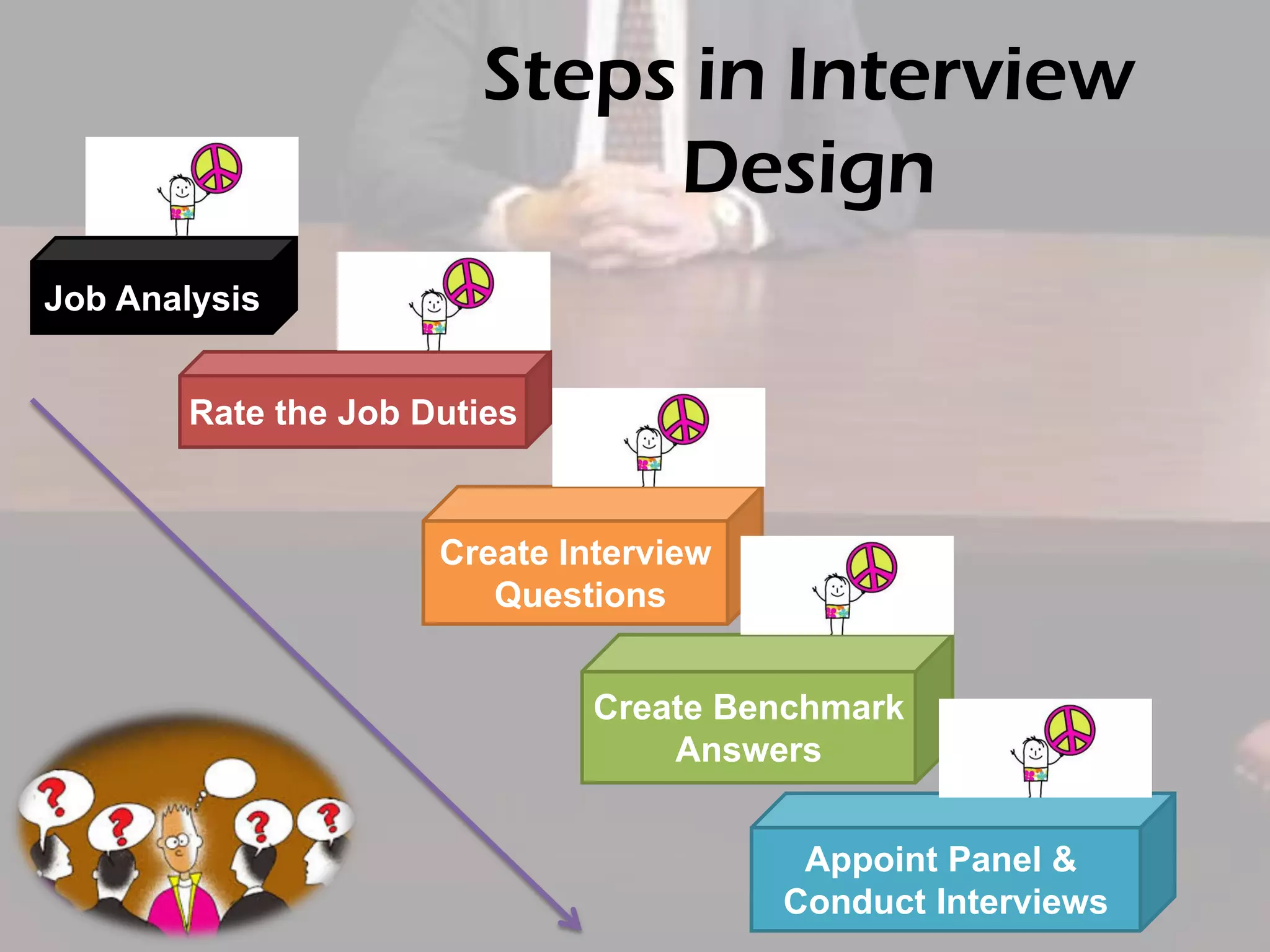
Steps in Interview
Design
Job Analysis
Rate the Job Duties

Create Interview
Questions
Create Benchmark
Answers
Appoint Panel &
Conduct Interviews
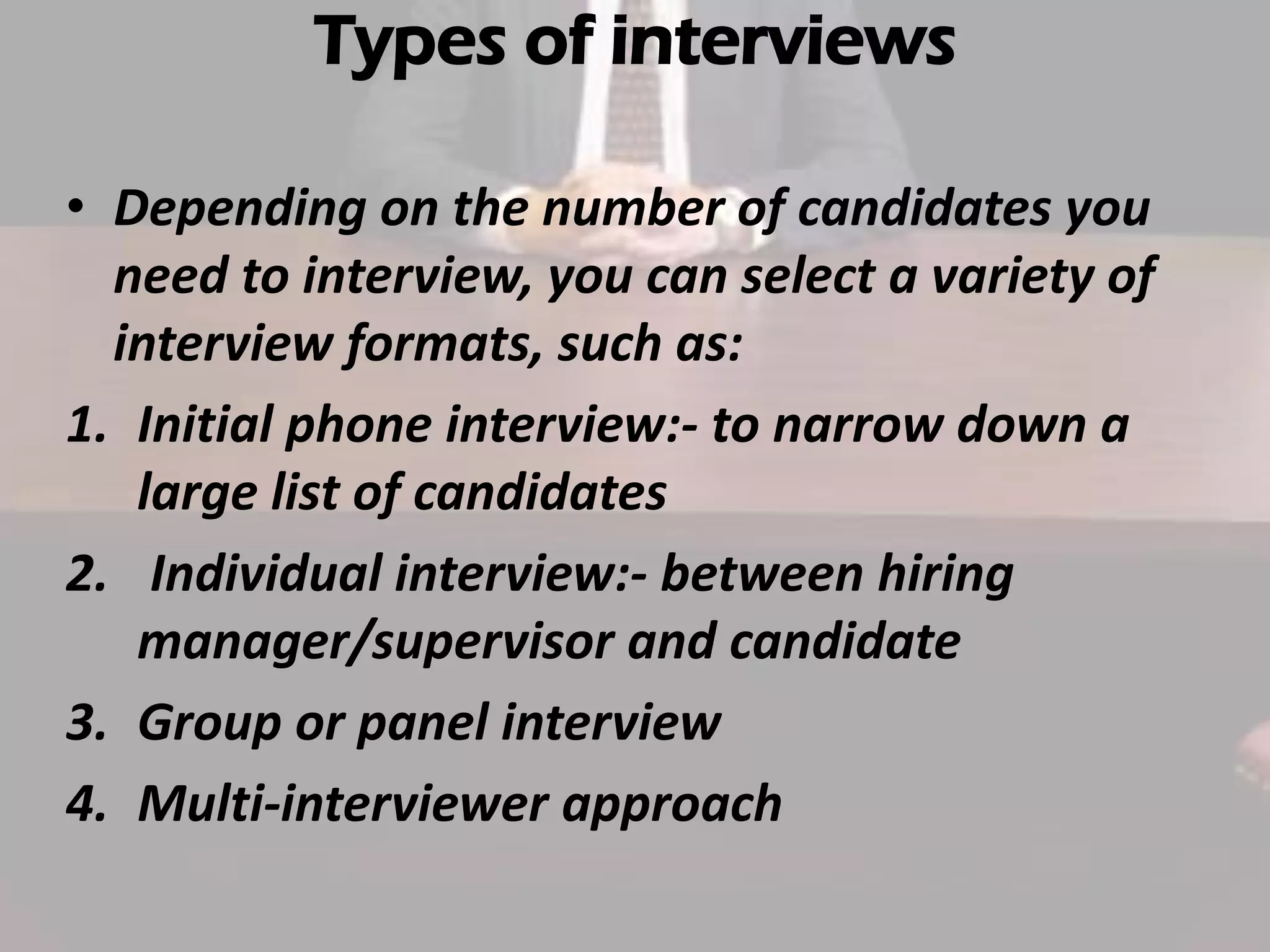
Types of interviews
• Depending on the number of candidates you
need to interview, you can select a variety of
interview formats, such as:
1. Initial phone interview:- to narrow down a
large list of candidates
2. Individual interview:- between hiring
manager/supervisor and candidate
3. Group or panel interview
4. Multi-interviewer approach
Job analysis
The purpose of a job
analysis is to identify the
requirements of the job
and the competencies
necessary to perform
them
Identify
job tasks
responsibilities
competencies
required
Position descriptions
Analysis of Required
key competencies for job
. Identifying the critical competencies

1

. Range of competencies

2

Examples

Behavioral competencies
Functional competencies
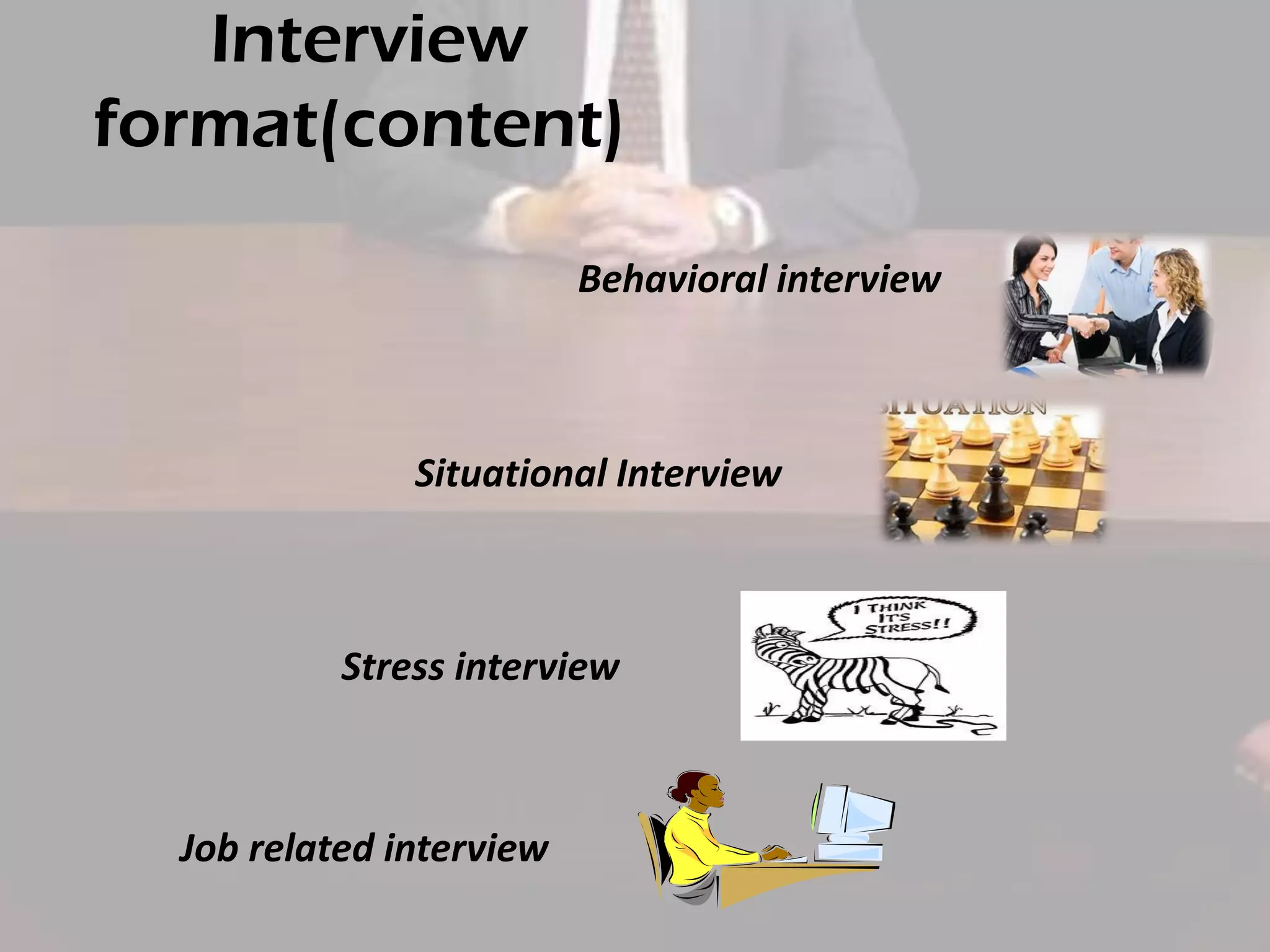
Interview
format(content)
Behavioral interview

Situational Interview

Stress interview

Job related interview
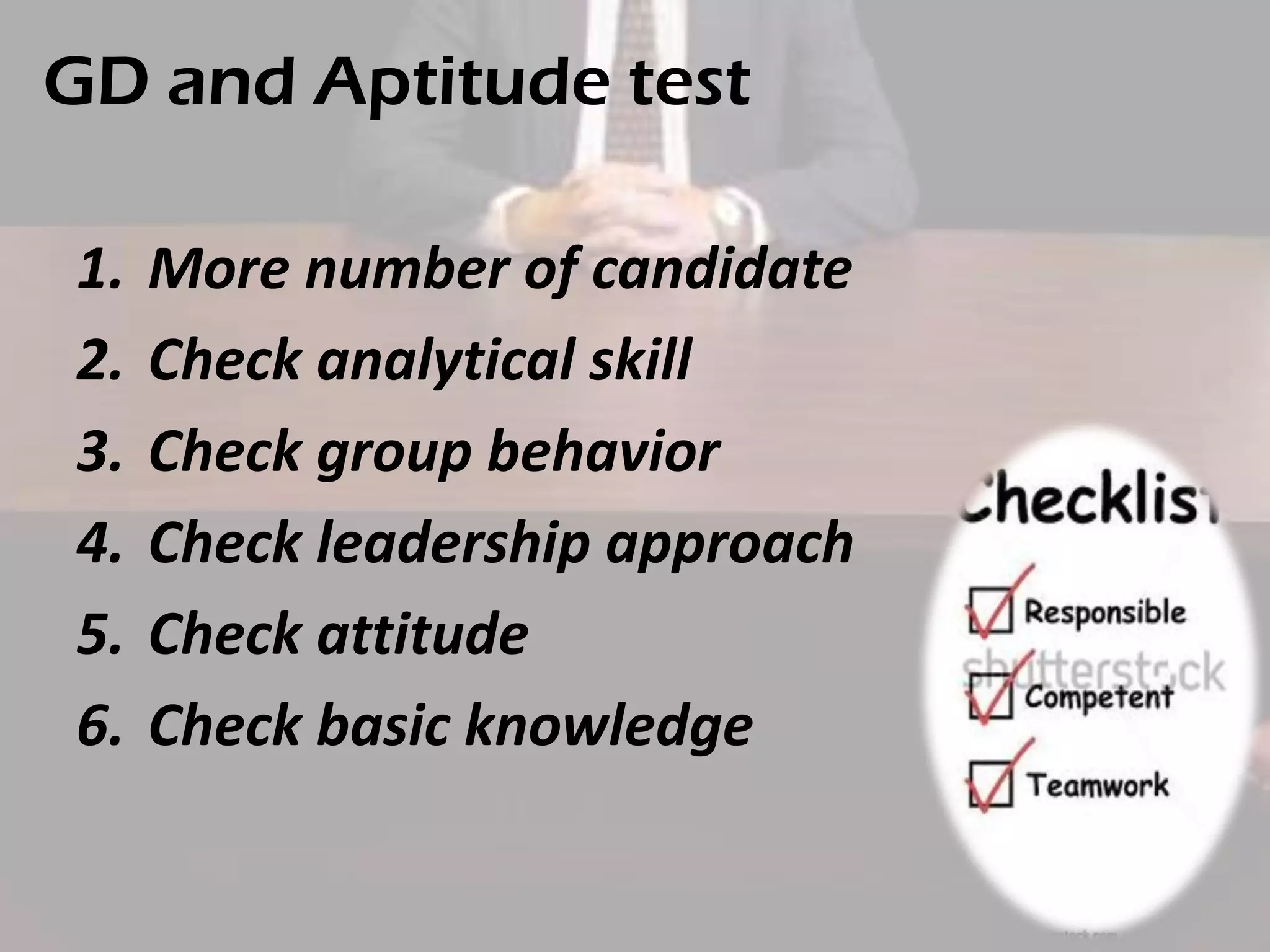
GD and Aptitude test
1.
2.
3.
4.
5.
6.

More number of candidate
Check analytical skill
Check group behavior
Check leadership approach
Check attitude
Check basic knowledge
Evaluation structure
• Determine a rating scale that you will use to
evaluate candidates’ responses.
• It can be as simple as a 1-5 scale
• (1= Low, 3=Average, 5= Outstanding),
• Adjectives such as Unacceptable, Acceptable,
and Excellent.
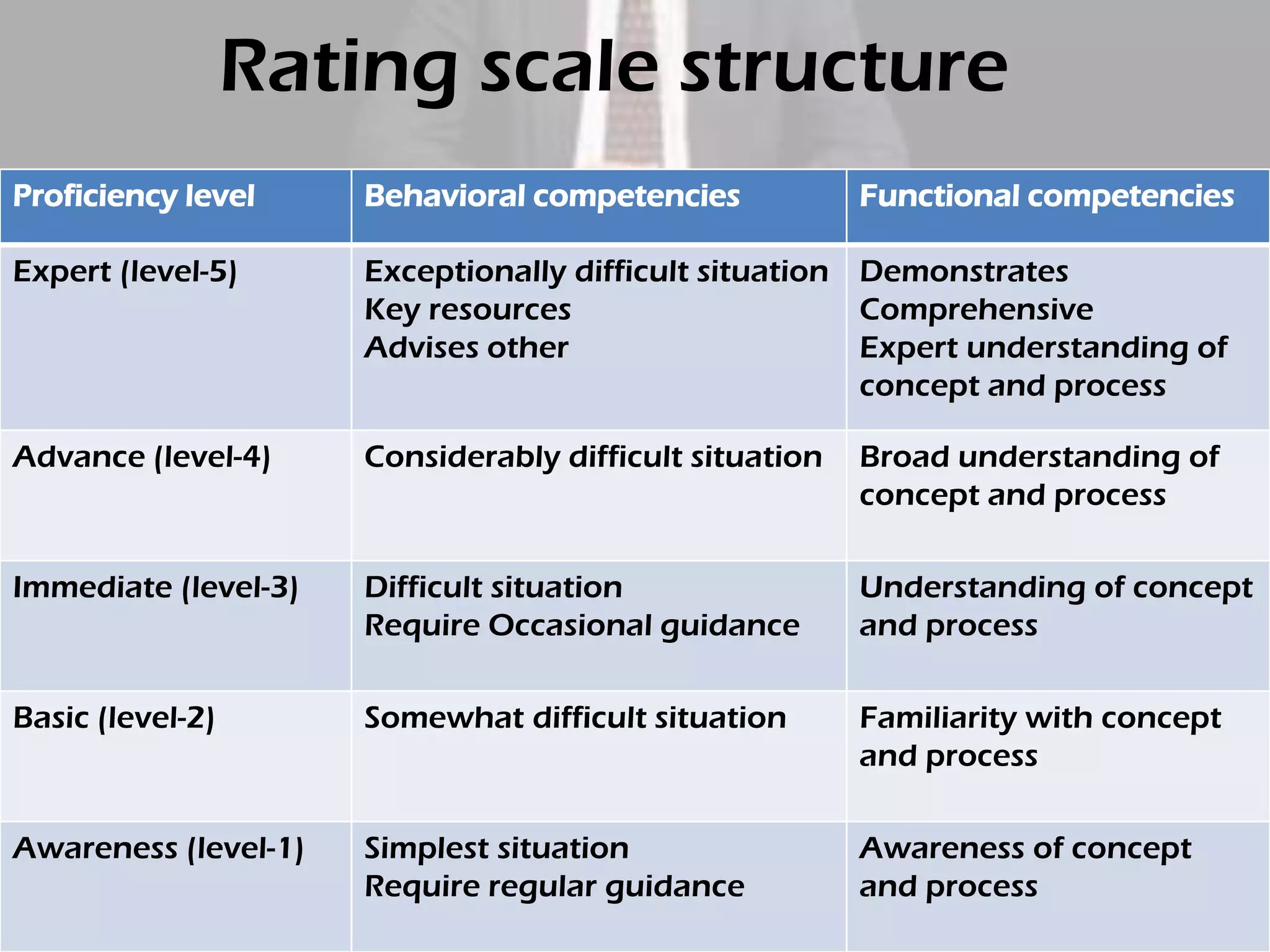
Rating scale structure
Proficiency level

Behavioral competencies

Functional competencies

Expert (level-5)

Exceptionally difficult situation Demonstrates
Key resources
Comprehensive
Advises other
Expert understanding of
concept and process

Advance (level-4)

Considerably difficult situation

Broad understanding of
concept and process

Immediate (level-3)

Difficult situation
Require Occasional guidance

Understanding of concept
and process

Basic (level-2)

Somewhat difficult situation

Familiarity with concept
and process

Awareness (level-1)

Simplest situation
Require regular guidance

Awareness of concept
and process
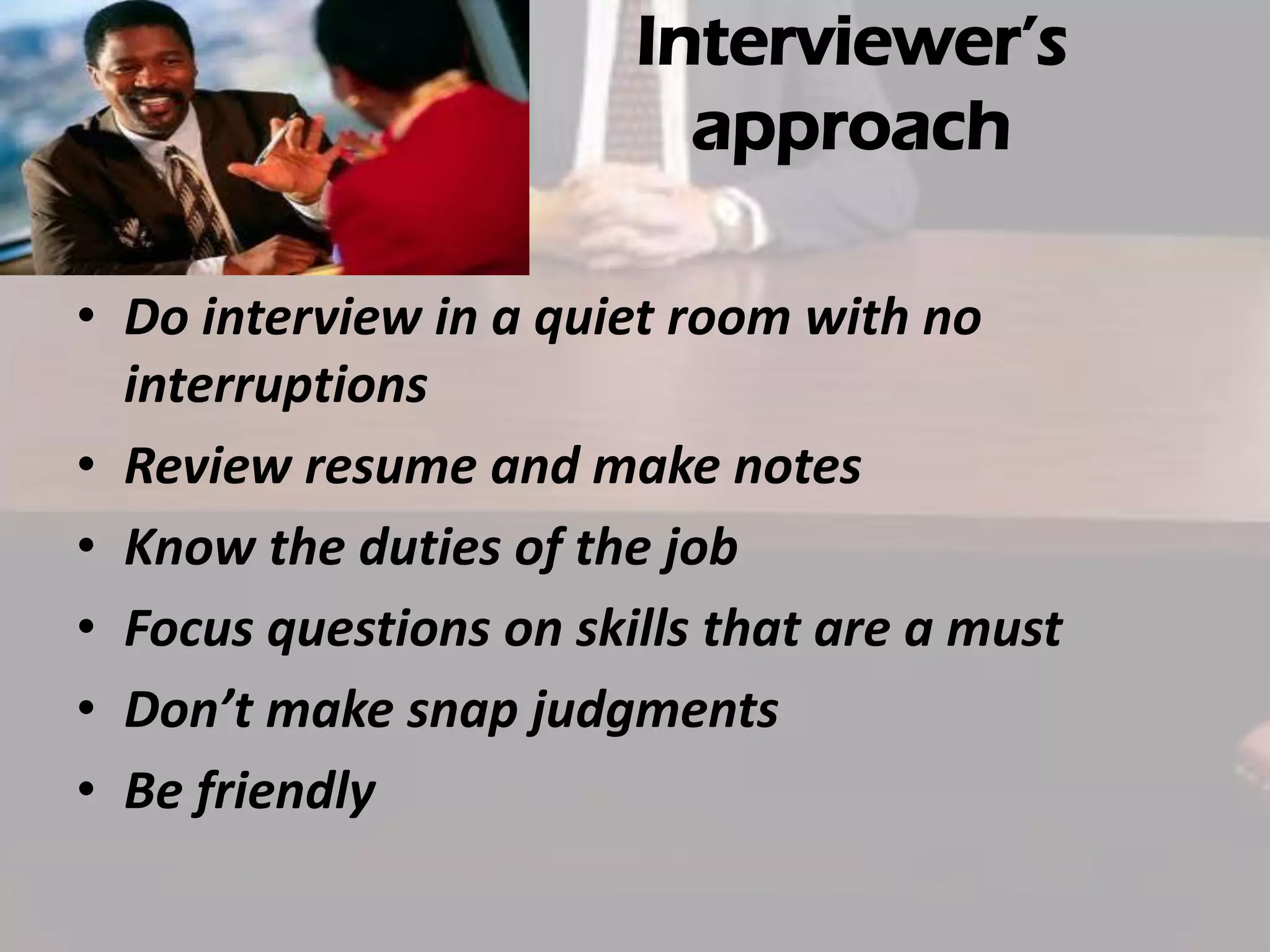
Interviewer’s
approach
• Do interview in a quiet room with no
interruptions
• Review resume and make notes
• Know the duties of the job
• Focus questions on skills that are a must
• Don’t make snap judgments
• Be friendly
Question yourself
• Remember: Ask yourself how good are your interview
techniques?
Do you know :1. what to Look for in a candidate
2. questions to ask to bring out the right information?
3. spot if someone is exaggerating or hiding the truth?
4. how to manage either overly talkative or less
communicative candidates?
5. Are you talking too much and not letting the
candidate speak?
Prepare your
self
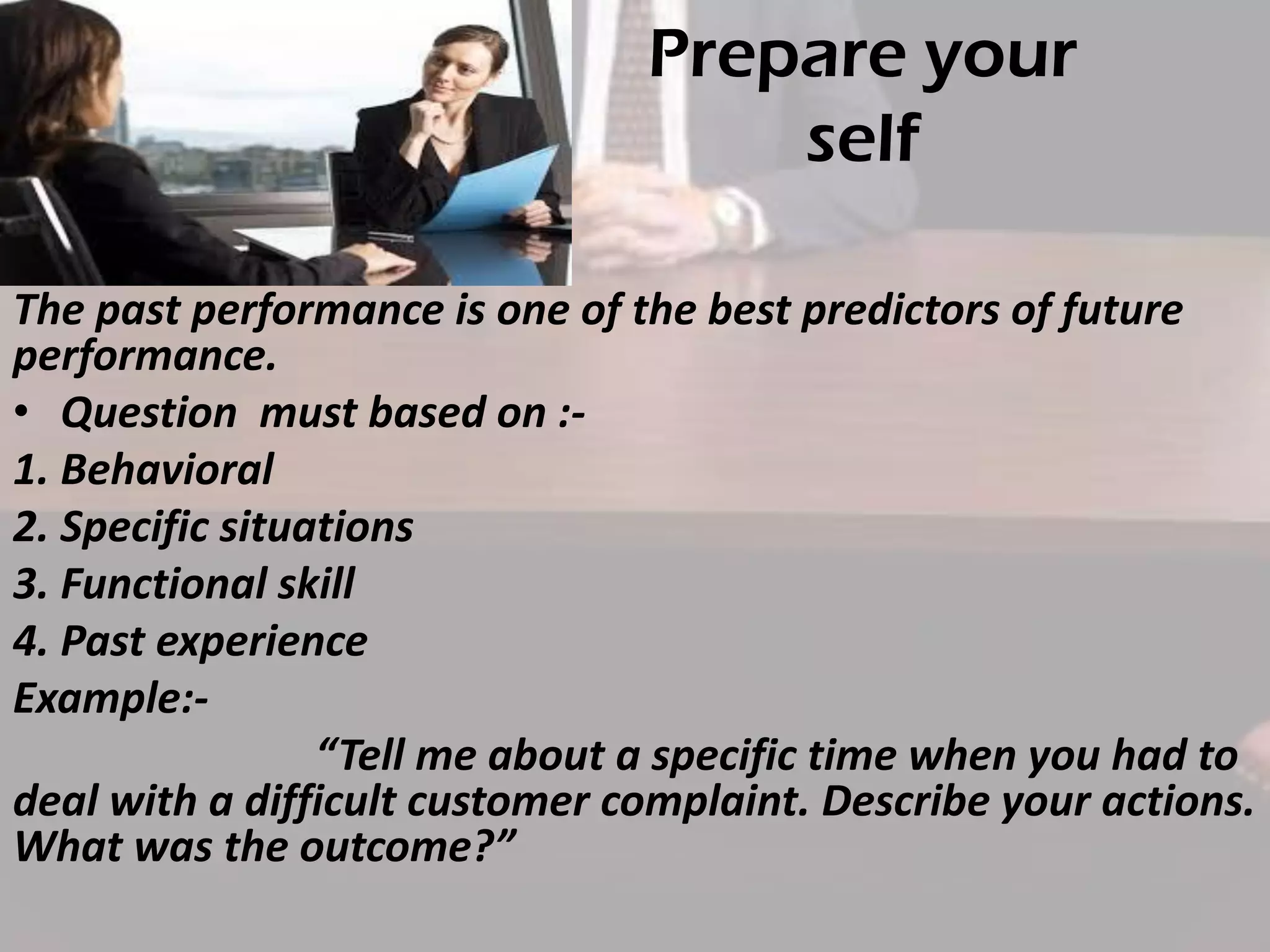
The past performance is one of the best predictors of future
performance.
• Question must based on :1. Behavioral
2. Specific situations
3. Functional skill
4. Past experience
Example:“Tell me about a specific time when you had to
deal with a difficult customer complaint. Describe your actions.
What was the outcome?”
Prepare a list of questions
1.knowledge, skills and abilities for the
position.
2. Prioritize the list of the most important job
qualities and prepare job-related questions
3. Focused on past behavior
4. Question should be open-ended.
5. Give some real/hypothetical case
6. Identify the topic
Questions.…
7. College experiences
8. Work experiences—summer, part time, full time
(one by one)
9. Goals and ambitions
10. Reactions to the job for which you are
interviewing
11. Self-assessments (by the candidate of
his or her strengths and weaknesses)
12. Present outside activities
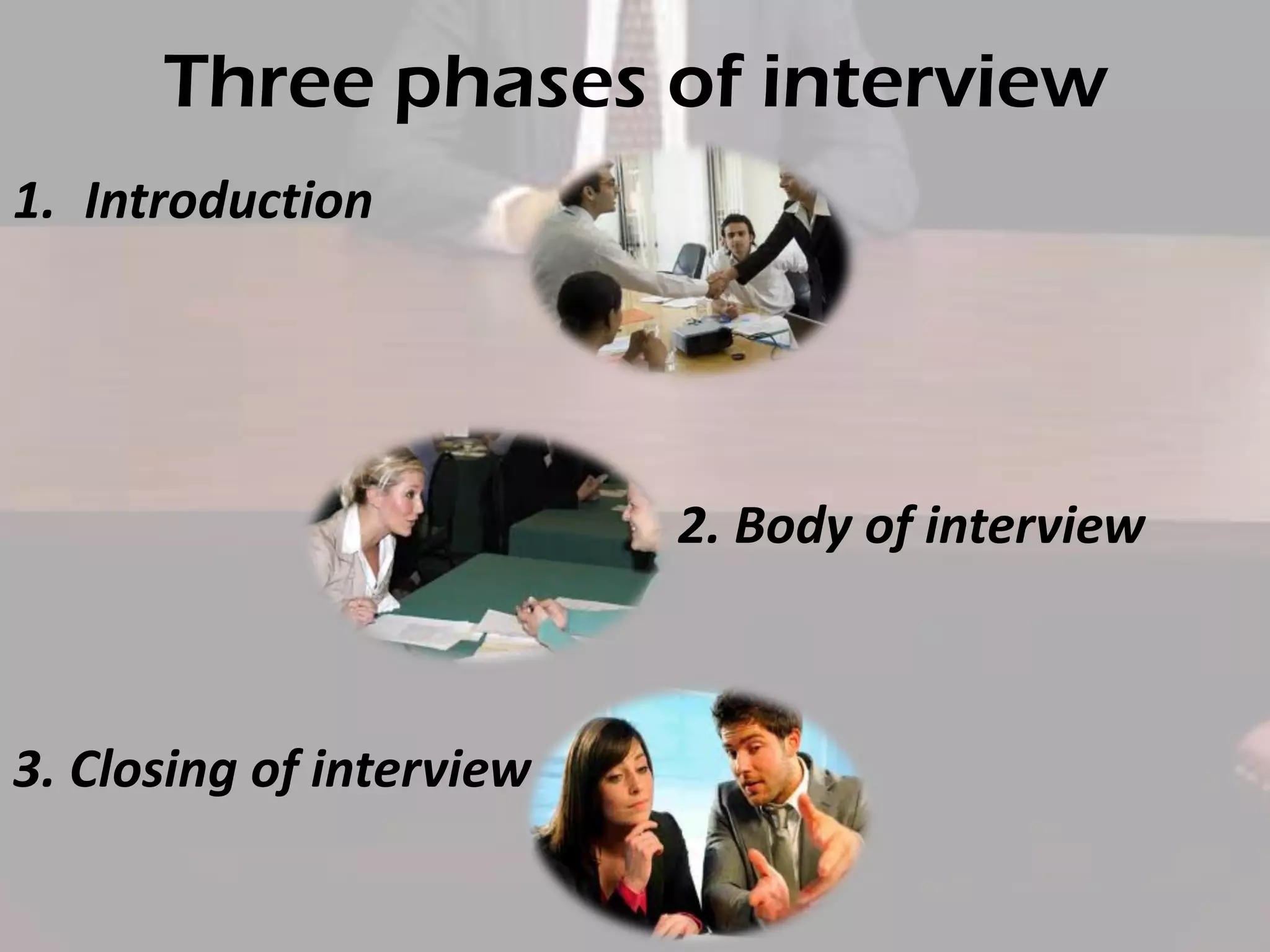
Three phases of interview
1. Introduction

2. Body of interview

3. Closing of interview
Introduction
1. Conduct at their place of work where
possible
2. Always state the reason for the interview
and how it will be conducted
3. Put the interviewee at ease
4. Ask the interviewee if they agree to you
taking notes
5. Ask for water & tea
Body of interview
1. Listen to the answers and request
clarification if necessary
2. Avoid making criticisms or taking sides
3. Keep control of the interview: refocus the
interviewee if they are rambling or clarify if
they misunderstood the question
4. Stay focused and follow your interview guide
5. Allow the interviewee to ask questions
Closing of interview
1. Thank the interviewee
2. Advise them what the next steps are and the
timeframe
3. Give feedback
Adjust yourself
Relaxed and confident
Avoid closed questions, use open questions to
draw them out

Do not tolerate threatening behaviour.
If anger is directed at you:
• admit your mistake if you are wrong
• stay calm, avoid getting angry in return
If anger is directed at others:
• do not get involved and do not taking sides
• correct misinformation tactfully
24
• do not challenge honestly held opinions
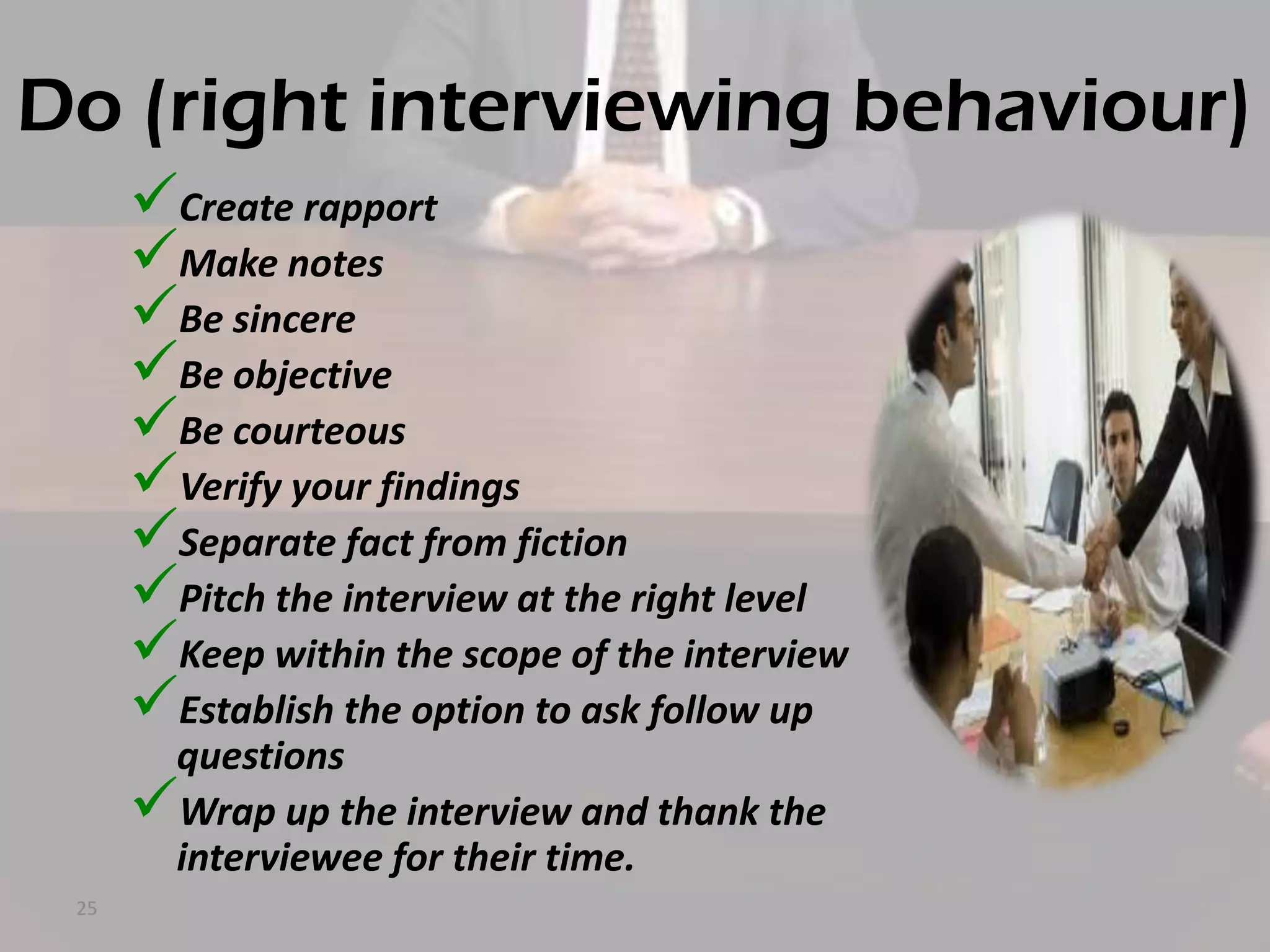
Do (right interviewing behaviour)
Create rapport
Make notes
Be sincere
Be objective
Be courteous
Verify your findings
Separate fact from fiction
Pitch the interview at the right level
Keep within the scope of the interview
Establish the option to ask follow up
questions
Wrap up the interview and thank the
interviewee for their time.
25
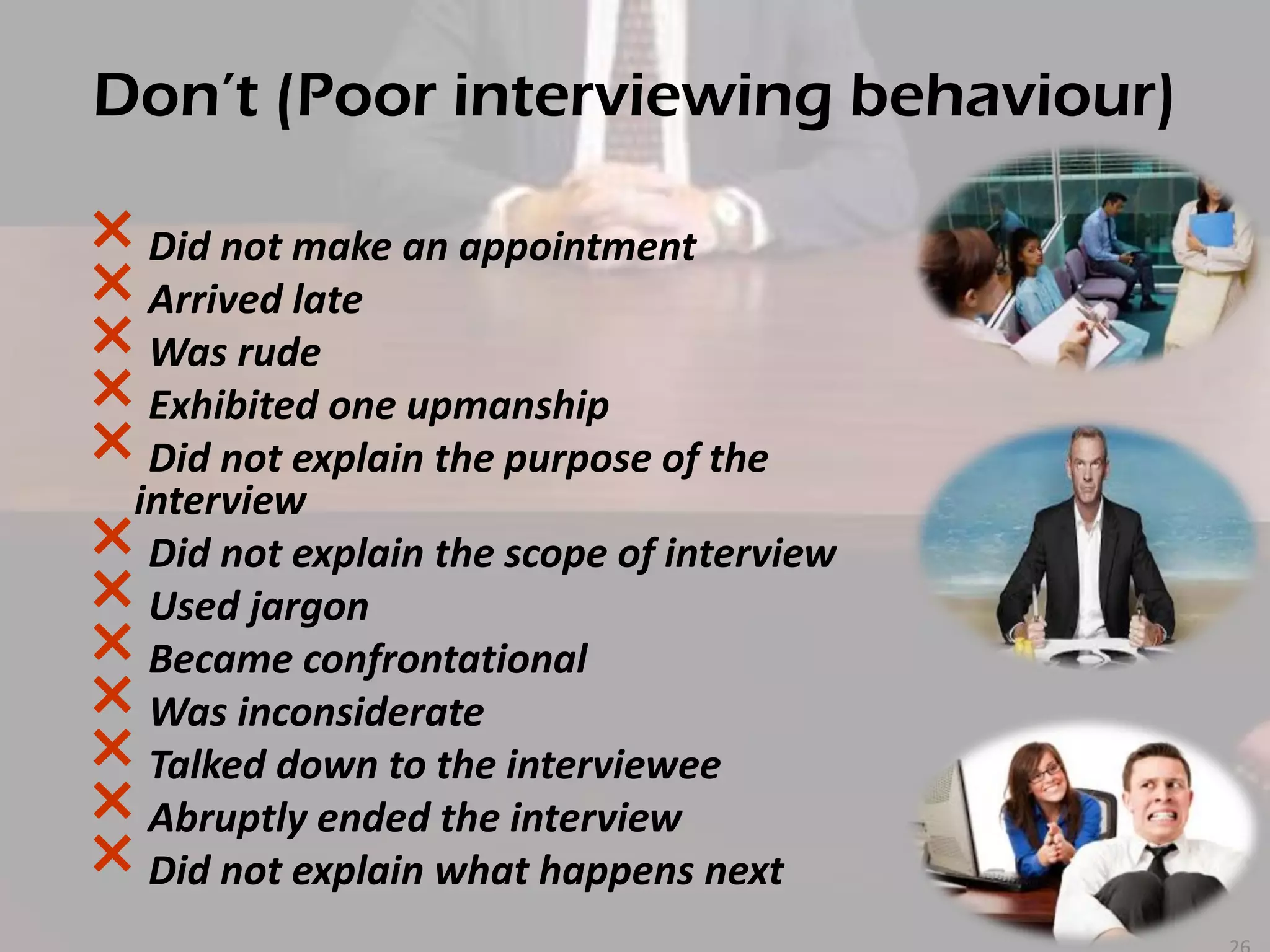
Don’t (Poor interviewing behaviour)

× Did not make an appointment
× Arrived late
× Was rude
× Exhibited one upmanship
×interviewexplain the purpose of the
Did not
× Did not explain the scope of interview
× Used jargon
× Became confrontational
× Was inconsiderate
× Talked down to the interviewee
× Abruptly ended the interview
× Did not explain what happens next
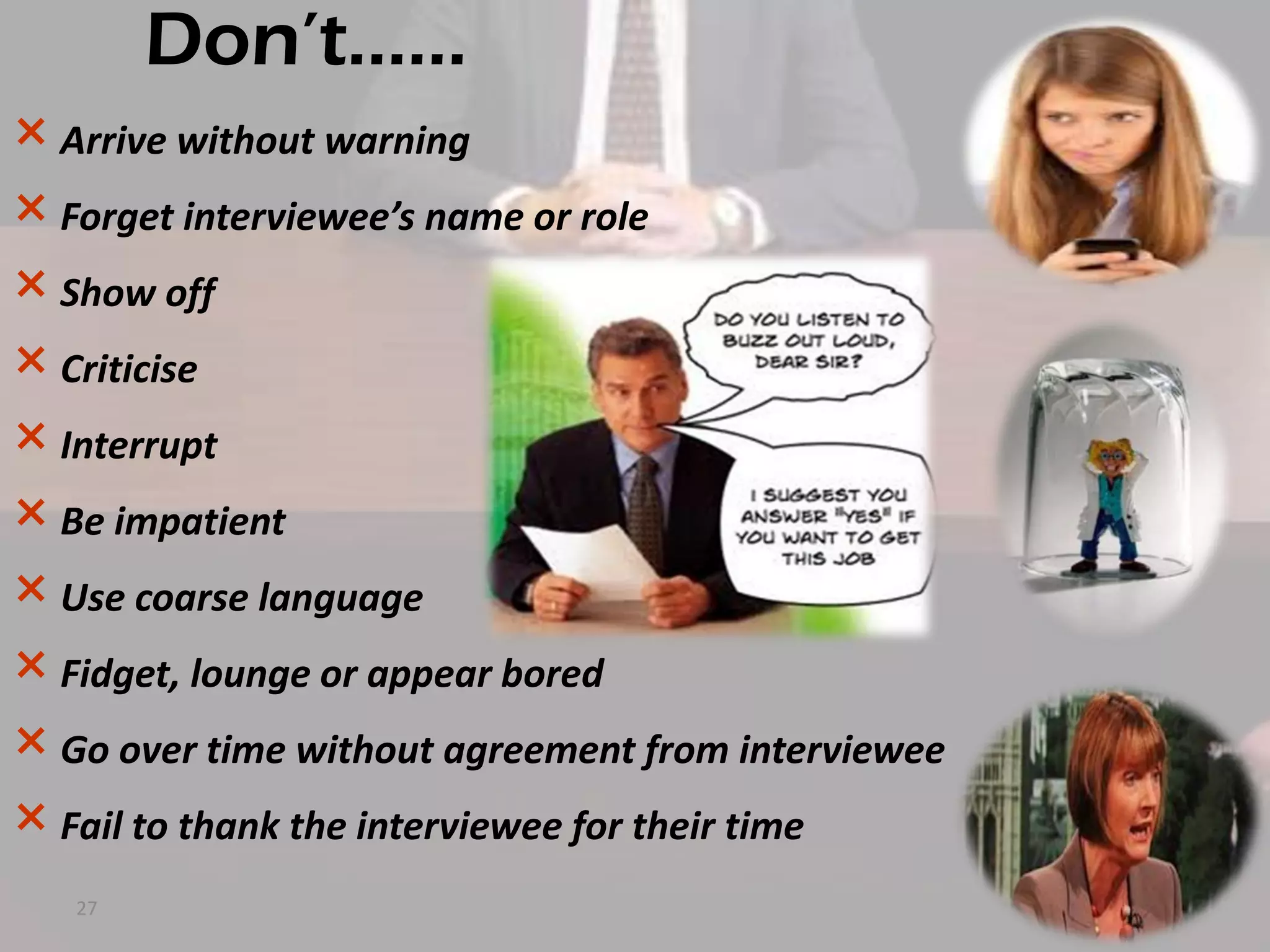
Don’t……
× Arrive without warning
× Forget interviewee’s name or role
× Show off
× Criticise
× Interrupt
× Be impatient
× Use coarse language
× Fidget, lounge or appear bored
× Go over time without agreement from interviewee
× Fail to thank the interviewee for their time
27
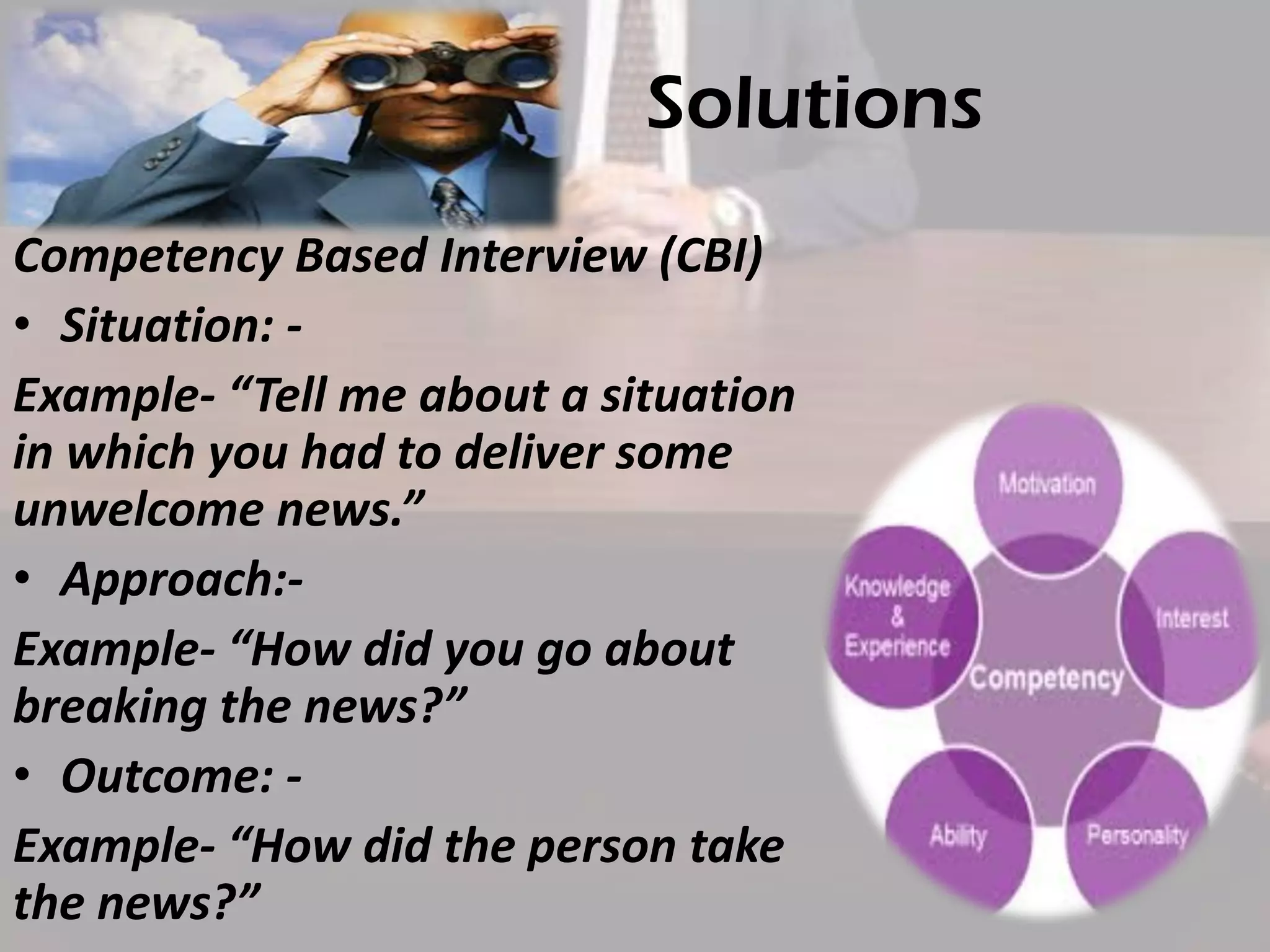
Solutions
Competency Based Interview (CBI)
• Situation: Example- “Tell me about a situation
in which you had to deliver some
unwelcome news.”
• Approach:Example- “How did you go about
breaking the news?”
• Outcome: Example- “How did the person take
the news?”
Thank you!

How to conduct an interview

  • 1.
    HOW TO CONDUCTAN INTERVIEW BY ASSISTANT MANAGER, MANAGER AND SENIOR MANAGER Made By:- Jitendra Singh Dongariya, Universal Business school, Karjat
  • 2.
    OUTLINE OF PPT 1. 2. 3. 4. 5. 6. 7. 8. 9. 10. 11. 12. 13. 14. 15. 16. 17. 18. Objectivesof presentation………………………………………………………3 Introduction …………………………………………………………………………..4 Structured Vs Unstructured…………………………………………………….5 Interview process………………………………………………..………………...6 Steps in interview design………………………..……………………………..7 Types of interview……………………………………………………………….…8 Job analysis…………………………………………………………………………..9 Analysis of Required key competencies for job……………………..10 Interview format………………………………………………………………....11 If candidate are more then GD and Aptitude…………................12 Evaluation structure……………………….…………………………………….13 Rating scale structure…………………………………………………………..14 Interviewer’s approach………………………………………………………..15 Three phases of interview..……………………………….………..........20 Adjust yourself………………………………………………….………...........24 Define do’s…………………………………………………….…………...........25 Define don’ts………………………………. ………………….………………….26 Solutions……...…………………………......…………….........................28
  • 3.
    Objective of presentation •How to conduct a successful and effective interview. • Improve the overall interview process and to get desired results. • Target to improve the interviewing skills of:1. Assistant manager 2. Manager 3. Senior manager
  • 4.
    Introduction • Interviews areused as part of the formal selection process in which candidates are screened or ranked based on their scores. Types of interview:Selection interview Appraisal interview Exit interview A selection interview is a selection procedure designed to predict future job performance on the basis of applicants’ oral responses to oral inquiries
  • 5.
    Structured and unstructured interview Reliable Valid StructuredInterview Unstructured Interview 1 All candidates are asked the same questions in the same order. 2. All candidates are evaluated using a common rating scale. 3. Interviewers are in agreement on acceptable answers. 1. Candidates may be asked different questions. 2. A standardized rating scale is not required. 3. Interviewers do not need to agree on acceptable answers
  • 6.
  • 7.
    Steps in Interview Design JobAnalysis Rate the Job Duties Create Interview Questions Create Benchmark Answers Appoint Panel & Conduct Interviews
  • 8.
    Types of interviews •Depending on the number of candidates you need to interview, you can select a variety of interview formats, such as: 1. Initial phone interview:- to narrow down a large list of candidates 2. Individual interview:- between hiring manager/supervisor and candidate 3. Group or panel interview 4. Multi-interviewer approach
  • 9.
    Job analysis The purposeof a job analysis is to identify the requirements of the job and the competencies necessary to perform them Identify job tasks responsibilities competencies required Position descriptions
  • 10.
    Analysis of Required keycompetencies for job . Identifying the critical competencies 1 . Range of competencies 2 Examples Behavioral competencies Functional competencies
  • 11.
  • 12.
    GD and Aptitudetest 1. 2. 3. 4. 5. 6. More number of candidate Check analytical skill Check group behavior Check leadership approach Check attitude Check basic knowledge
  • 13.
    Evaluation structure • Determinea rating scale that you will use to evaluate candidates’ responses. • It can be as simple as a 1-5 scale • (1= Low, 3=Average, 5= Outstanding), • Adjectives such as Unacceptable, Acceptable, and Excellent.
  • 14.
    Rating scale structure Proficiencylevel Behavioral competencies Functional competencies Expert (level-5) Exceptionally difficult situation Demonstrates Key resources Comprehensive Advises other Expert understanding of concept and process Advance (level-4) Considerably difficult situation Broad understanding of concept and process Immediate (level-3) Difficult situation Require Occasional guidance Understanding of concept and process Basic (level-2) Somewhat difficult situation Familiarity with concept and process Awareness (level-1) Simplest situation Require regular guidance Awareness of concept and process
  • 15.
    Interviewer’s approach • Do interviewin a quiet room with no interruptions • Review resume and make notes • Know the duties of the job • Focus questions on skills that are a must • Don’t make snap judgments • Be friendly
  • 16.
    Question yourself • Remember:Ask yourself how good are your interview techniques? Do you know :1. what to Look for in a candidate 2. questions to ask to bring out the right information? 3. spot if someone is exaggerating or hiding the truth? 4. how to manage either overly talkative or less communicative candidates? 5. Are you talking too much and not letting the candidate speak?
  • 17.
    Prepare your self The pastperformance is one of the best predictors of future performance. • Question must based on :1. Behavioral 2. Specific situations 3. Functional skill 4. Past experience Example:“Tell me about a specific time when you had to deal with a difficult customer complaint. Describe your actions. What was the outcome?”
  • 18.
    Prepare a listof questions 1.knowledge, skills and abilities for the position. 2. Prioritize the list of the most important job qualities and prepare job-related questions 3. Focused on past behavior 4. Question should be open-ended. 5. Give some real/hypothetical case 6. Identify the topic
  • 19.
    Questions.… 7. College experiences 8.Work experiences—summer, part time, full time (one by one) 9. Goals and ambitions 10. Reactions to the job for which you are interviewing 11. Self-assessments (by the candidate of his or her strengths and weaknesses) 12. Present outside activities
  • 20.
    Three phases ofinterview 1. Introduction 2. Body of interview 3. Closing of interview
  • 21.
    Introduction 1. Conduct attheir place of work where possible 2. Always state the reason for the interview and how it will be conducted 3. Put the interviewee at ease 4. Ask the interviewee if they agree to you taking notes 5. Ask for water & tea
  • 22.
    Body of interview 1.Listen to the answers and request clarification if necessary 2. Avoid making criticisms or taking sides 3. Keep control of the interview: refocus the interviewee if they are rambling or clarify if they misunderstood the question 4. Stay focused and follow your interview guide 5. Allow the interviewee to ask questions
  • 23.
    Closing of interview 1.Thank the interviewee 2. Advise them what the next steps are and the timeframe 3. Give feedback
  • 24.
    Adjust yourself Relaxed andconfident Avoid closed questions, use open questions to draw them out Do not tolerate threatening behaviour. If anger is directed at you: • admit your mistake if you are wrong • stay calm, avoid getting angry in return If anger is directed at others: • do not get involved and do not taking sides • correct misinformation tactfully 24 • do not challenge honestly held opinions
  • 25.
    Do (right interviewingbehaviour) Create rapport Make notes Be sincere Be objective Be courteous Verify your findings Separate fact from fiction Pitch the interview at the right level Keep within the scope of the interview Establish the option to ask follow up questions Wrap up the interview and thank the interviewee for their time. 25
  • 26.
    Don’t (Poor interviewingbehaviour) × Did not make an appointment × Arrived late × Was rude × Exhibited one upmanship ×interviewexplain the purpose of the Did not × Did not explain the scope of interview × Used jargon × Became confrontational × Was inconsiderate × Talked down to the interviewee × Abruptly ended the interview × Did not explain what happens next
  • 27.
    Don’t…… × Arrive withoutwarning × Forget interviewee’s name or role × Show off × Criticise × Interrupt × Be impatient × Use coarse language × Fidget, lounge or appear bored × Go over time without agreement from interviewee × Fail to thank the interviewee for their time 27
  • 28.
    Solutions Competency Based Interview(CBI) • Situation: Example- “Tell me about a situation in which you had to deliver some unwelcome news.” • Approach:Example- “How did you go about breaking the news?” • Outcome: Example- “How did the person take the news?”
  • 29.