1
HOW TO WOW THEM IN
AN INTERVIEW
Be The Star In Every Interview!
Effective Interviewing Strategies
2
Do I Have To Interview?
The interview is one of the most
important steps to getting a job. The
cover letter and resume can interest an
employer, but the interview will make
or break your chances of landing the
job.
It is normal to be nervous and
scared, but being prepared will help
you do your very best.
3
What Is Behavioral Interviewing?
It is demonstrated examples of behavior from past experiences
that concentrate on job related functions.
Open ended: These often begin with “Tell
Me…”, “Describe…”,”When”.
Close-ended: Used most often to verify or
confirm information.
Why questions: Used to reveal rationale for
decisions made or level of motivation
Behavioral interview questions can be…
4
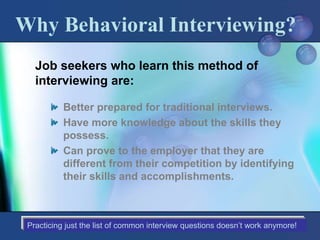
Why Behavioral Interviewing?
Better prepared for traditional interviews.
Have more knowledge about the skills they
possess.
Can prove to the employer that they are
different from their competition by identifying
their skills and accomplishments.
Practicing just the list of common interview questions doesn’t work anymore!
Job seekers who learn this method of
interviewing are:
5
Skills
6
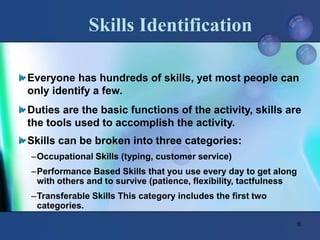
Everyone has hundreds of skills, yet most people can
only identify a few.
Duties are the basic functions of the activity, skills are
the tools used to accomplish the activity.
Skills can be broken into three categories:
–Occupational Skills (typing, customer service)
–Performance Based Skills that you use every day to get along
with others and to survive (patience, flexibility, tactfulness
–Transferable Skills This category includes the first two
categories.
Skills Identification
7
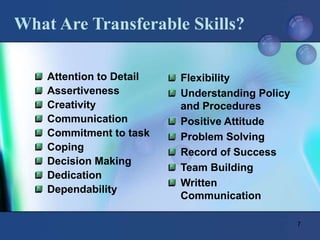
Flexibility
Understanding Policy
and Procedures
Positive Attitude
Problem Solving
Record of Success
Team Building
Written
Communication
Attention to Detail
Assertiveness
Creativity
Communication
Commitment to task
Coping
Decision Making
Dedication
Dependability
What Are Transferable Skills?
8
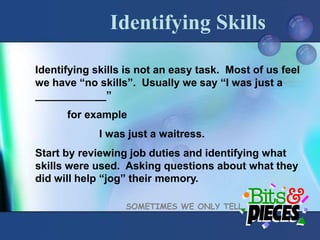
Identifying Skills
Identifying skills is not an easy task. Most of us feel
we have “no skills”. Usually we say “I was just a
____________”
for example
I was just a waitress.
Start by reviewing job duties and identifying what
skills were used. Asking questions about what they
did will help “jog” their memory.
SOMETIMES WE ONLY TELL
9
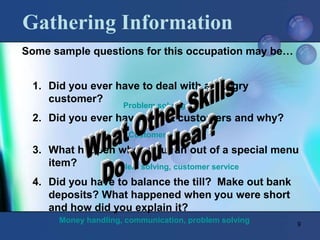
Gathering Information
1. Did you ever have to deal with an angry
customer?
2. Did you ever have repeat customers and why?
3. What happen when you ran out of a special menu
item?
4. Did you have to balance the till? Make out bank
deposits? What happened when you were short
and how did you explain it?
Problem solving
Customer service
problem solving, customer service
Money handling, communication, problem solving
Some sample questions for this occupation may be…
10
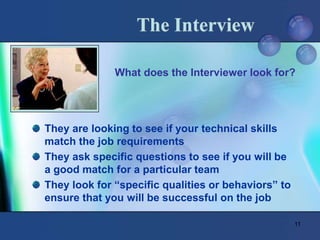
The Interview
11
The Interview
They are looking to see if your technical skills
match the job requirements
They ask specific questions to see if you will be
a good match for a particular team
They look for “specific qualities or behaviors” to
ensure that you will be successful on the job
What does the Interviewer look for?
12
Sample Interview Questions
What can you tell me about yourself?
Why are you interested in this job?
What are your strengths?
What are your weaknesses?
What skills do you bring to the job and to this
company?
13
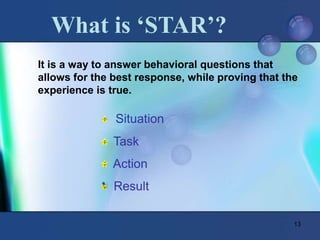
What is ‘STAR’?
Situation
Task
Action
Result
It is a way to answer behavioral questions that
allows for the best response, while proving that the
experience is true.
14
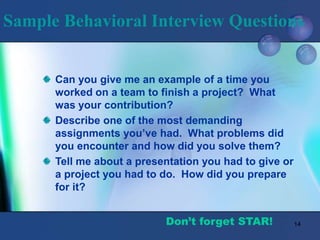
Sample Behavioral Interview Questions
Can you give me an example of a time you
worked on a team to finish a project? What
was your contribution?
Describe one of the most demanding
assignments you’ve had. What problems did
you encounter and how did you solve them?
Tell me about a presentation you had to give or
a project you had to do. How did you prepare
for it?
Don’t forget STAR!
15
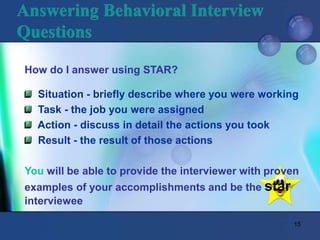
Answering Behavioral Interview
Questions
How do I answer using STAR?
Situation - briefly describe where you were working
Task - the job you were assigned
Action - discuss in detail the actions you took
Result - the result of those actions
You will be able to provide the interviewer with proven
examples of your accomplishments and be the star
interviewee
16
SITUATION
Describe the employer, location, or area where
you were working to give the interviewer the
“big picture.” You don’t need to be too detailed.
I worked at ABC Company as a Supervisor in the
Shipping and Receiving Department.
17
TASK
Describe the job or task you were
assigned.
Part of my job was to train newly hired
employees in using our highly technical
equipment as well as in company policies
and procedures.
18
ACTION
Describe the action you took. (Use “I”)
I showed Fred, our new employee, how to
safely set-up and operate the
computerized weighing equipment. I also
taught Fred how to inspect the packages
to ensure the weight and labels matched.
I continued to ask him questions to make
sure that he understood all the
instructions I had given him.
19
Tell the results of the action you took, be sure to
use numbers where applicable.
RESULT
I checked in with Fred on a regular basis
during his initial training and as a result
he became a well trained team member,
not only in the equipment he was to use,
but also in understanding how the
procedures we used affected our
department and the company.
20
PRACTICING
QUESTIONS
21
What kind of people bug you?
Do not name anyone! Talk about a specific
personality and what you do to assist your team
member to be successful.
On a team, I find it hard to work with people who don’t seem
to care and avoid the hard tasks. What I have found, is that
many times they aren’t aware of the teams expectations or
how to accomplish specific tasks. I take the time to check in
with team members and have offered my assistance with
their tasks. This results in the whole team reaching the
desired goal.
22
Tell Me About a Problem You Solved?
When I was at DDS Company we purchased a
telephone system for our office. It was computer-
ized. My co-worker was assigned as the
administrator. She had a car accident and was
going to be gone from work for several weeks.
My supervisor asked me to take over some of her
duties. I was not trained on the telephone system,
but found a video teaching tape and her book in a
file cabinet.
As it turned out, I needed to make some
administrative changes to the system.
23
Tell Me About a Problem You Solved?
I watched the video and read the book. I followed
the instructions and was able to make most of the
changes. There was a specific function I could not
program so I contacted the company who sold us
the system. Through their help line, I was able to
complete the changes.
I learned to set up mail boxes, groups, change and
forward messages, and set up a time manager.
These new skills made me a more valuable
employee.
24
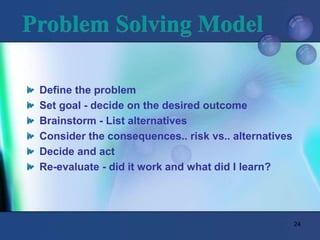
Problem Solving Model
Define the problem
Set goal - decide on the desired outcome
Brainstorm - List alternatives
Consider the consequences.. risk vs.. alternatives
Decide and act
Re-evaluate - did it work and what did I learn?
25
PREPARING TO
INTERVIEW
26
First Impression
Positive first impression
Dress appropriately and neatly
Be on time or a little early
Research the company
Be prepared with paper
Bring copies of the resume and references
Bring a pencil and a pad of paper for notes.
You never get a second chance to make a first impression!
27
Make A Good Impression
Speak up, don’t be afraid to talk about yourself!
Listen closely to the interviewer. Show a real
interest in the company and the job.
Sell yourself! Tell the employer about your abilities
and good qualities. Know what value you bring to
the company. Answer all questions carefully and
honestly.
Be as positive as you can.
28
Make A Good Impression
Be Professional
Greet your interviewer with eye contact and a
SMILE
Shake hands firmly
Sit up straight, look attentive, do not cross your
arms (crossing your arms tells the employer
you’re not interested)
29
Make A Good Impression
Before the interview, take a few deep breaths,
inhale through your nose and blow out through
your mouth. This will help you relax your
muscles and help you relax mentally too.
Do some self-talk about how you are the perfect
match for the job!
30
Why Ask Questions?
The questions the interviewer asks helps
them decide if you are the right person for
the job.
The questions you ask the interviewer
helps you decide if this is the right place
for you to be.
31
Ask The Interviewer
Write down at least three questions that you feel
are important to you and take these to the
interview.
Don’t ask questions that say “What’s in it for me?”
Such as; “when is my first day off?”.
Ask questions such as:
Why did you choose to work for this company?
How will my performance be evaluated?
What is the most difficult task I will be doing?
What is the process you use when training for
this position?
32
Make A Good Impression
Interview Don’ts
Don’t
Take a friend or a relative with you (unless you
need an interpreter )
Act either too shy or too aggressive (balance)
Say anything negative about other people
Be late. Call the employer as soon as possible
and explain why. Ask if you can arrange a
new interview time.
33
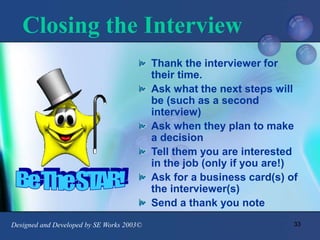
Closing the Interview
Thank the interviewer for
their time.
Ask what the next steps will
be (such as a second
interview)
Ask when they plan to make
a decision
Tell them you are interested
in the job (only if you are!)
Ask for a business card(s) of
the interviewer(s)
Send a thank you note
Designed and Developed by SE Works 2003©

behavioral_interviewing.ppt

  • 1.
    1 HOW TO WOWTHEM IN AN INTERVIEW Be The Star In Every Interview! Effective Interviewing Strategies
  • 2.
    2 Do I HaveTo Interview? The interview is one of the most important steps to getting a job. The cover letter and resume can interest an employer, but the interview will make or break your chances of landing the job. It is normal to be nervous and scared, but being prepared will help you do your very best.
  • 3.
    3 What Is BehavioralInterviewing? It is demonstrated examples of behavior from past experiences that concentrate on job related functions. Open ended: These often begin with “Tell Me…”, “Describe…”,”When”. Close-ended: Used most often to verify or confirm information. Why questions: Used to reveal rationale for decisions made or level of motivation Behavioral interview questions can be…
  • 4.
    4 Why Behavioral Interviewing? Betterprepared for traditional interviews. Have more knowledge about the skills they possess. Can prove to the employer that they are different from their competition by identifying their skills and accomplishments. Practicing just the list of common interview questions doesn’t work anymore! Job seekers who learn this method of interviewing are:
  • 5.
  • 6.
    6 Everyone has hundredsof skills, yet most people can only identify a few. Duties are the basic functions of the activity, skills are the tools used to accomplish the activity. Skills can be broken into three categories: –Occupational Skills (typing, customer service) –Performance Based Skills that you use every day to get along with others and to survive (patience, flexibility, tactfulness –Transferable Skills This category includes the first two categories. Skills Identification
  • 7.
    7 Flexibility Understanding Policy and Procedures PositiveAttitude Problem Solving Record of Success Team Building Written Communication Attention to Detail Assertiveness Creativity Communication Commitment to task Coping Decision Making Dedication Dependability What Are Transferable Skills?
  • 8.
    8 Identifying Skills Identifying skillsis not an easy task. Most of us feel we have “no skills”. Usually we say “I was just a ____________” for example I was just a waitress. Start by reviewing job duties and identifying what skills were used. Asking questions about what they did will help “jog” their memory. SOMETIMES WE ONLY TELL
  • 9.
    9 Gathering Information 1. Didyou ever have to deal with an angry customer? 2. Did you ever have repeat customers and why? 3. What happen when you ran out of a special menu item? 4. Did you have to balance the till? Make out bank deposits? What happened when you were short and how did you explain it? Problem solving Customer service problem solving, customer service Money handling, communication, problem solving Some sample questions for this occupation may be…
  • 10.
  • 11.
    11 The Interview They arelooking to see if your technical skills match the job requirements They ask specific questions to see if you will be a good match for a particular team They look for “specific qualities or behaviors” to ensure that you will be successful on the job What does the Interviewer look for?
  • 12.
    12 Sample Interview Questions Whatcan you tell me about yourself? Why are you interested in this job? What are your strengths? What are your weaknesses? What skills do you bring to the job and to this company?
  • 13.
    13 What is ‘STAR’? Situation Task Action Result Itis a way to answer behavioral questions that allows for the best response, while proving that the experience is true.
  • 14.
    14 Sample Behavioral InterviewQuestions Can you give me an example of a time you worked on a team to finish a project? What was your contribution? Describe one of the most demanding assignments you’ve had. What problems did you encounter and how did you solve them? Tell me about a presentation you had to give or a project you had to do. How did you prepare for it? Don’t forget STAR!
  • 15.
    15 Answering Behavioral Interview Questions Howdo I answer using STAR? Situation - briefly describe where you were working Task - the job you were assigned Action - discuss in detail the actions you took Result - the result of those actions You will be able to provide the interviewer with proven examples of your accomplishments and be the star interviewee
  • 16.
    16 SITUATION Describe the employer,location, or area where you were working to give the interviewer the “big picture.” You don’t need to be too detailed. I worked at ABC Company as a Supervisor in the Shipping and Receiving Department.
  • 17.
    17 TASK Describe the jobor task you were assigned. Part of my job was to train newly hired employees in using our highly technical equipment as well as in company policies and procedures.
  • 18.
    18 ACTION Describe the actionyou took. (Use “I”) I showed Fred, our new employee, how to safely set-up and operate the computerized weighing equipment. I also taught Fred how to inspect the packages to ensure the weight and labels matched. I continued to ask him questions to make sure that he understood all the instructions I had given him.
  • 19.
    19 Tell the resultsof the action you took, be sure to use numbers where applicable. RESULT I checked in with Fred on a regular basis during his initial training and as a result he became a well trained team member, not only in the equipment he was to use, but also in understanding how the procedures we used affected our department and the company.
  • 20.
  • 21.
    21 What kind ofpeople bug you? Do not name anyone! Talk about a specific personality and what you do to assist your team member to be successful. On a team, I find it hard to work with people who don’t seem to care and avoid the hard tasks. What I have found, is that many times they aren’t aware of the teams expectations or how to accomplish specific tasks. I take the time to check in with team members and have offered my assistance with their tasks. This results in the whole team reaching the desired goal.
  • 22.
    22 Tell Me Abouta Problem You Solved? When I was at DDS Company we purchased a telephone system for our office. It was computer- ized. My co-worker was assigned as the administrator. She had a car accident and was going to be gone from work for several weeks. My supervisor asked me to take over some of her duties. I was not trained on the telephone system, but found a video teaching tape and her book in a file cabinet. As it turned out, I needed to make some administrative changes to the system.
  • 23.
    23 Tell Me Abouta Problem You Solved? I watched the video and read the book. I followed the instructions and was able to make most of the changes. There was a specific function I could not program so I contacted the company who sold us the system. Through their help line, I was able to complete the changes. I learned to set up mail boxes, groups, change and forward messages, and set up a time manager. These new skills made me a more valuable employee.
  • 24.
    24 Problem Solving Model Definethe problem Set goal - decide on the desired outcome Brainstorm - List alternatives Consider the consequences.. risk vs.. alternatives Decide and act Re-evaluate - did it work and what did I learn?
  • 25.
  • 26.
    26 First Impression Positive firstimpression Dress appropriately and neatly Be on time or a little early Research the company Be prepared with paper Bring copies of the resume and references Bring a pencil and a pad of paper for notes. You never get a second chance to make a first impression!
  • 27.
    27 Make A GoodImpression Speak up, don’t be afraid to talk about yourself! Listen closely to the interviewer. Show a real interest in the company and the job. Sell yourself! Tell the employer about your abilities and good qualities. Know what value you bring to the company. Answer all questions carefully and honestly. Be as positive as you can.
  • 28.
    28 Make A GoodImpression Be Professional Greet your interviewer with eye contact and a SMILE Shake hands firmly Sit up straight, look attentive, do not cross your arms (crossing your arms tells the employer you’re not interested)
  • 29.
    29 Make A GoodImpression Before the interview, take a few deep breaths, inhale through your nose and blow out through your mouth. This will help you relax your muscles and help you relax mentally too. Do some self-talk about how you are the perfect match for the job!
  • 30.
    30 Why Ask Questions? Thequestions the interviewer asks helps them decide if you are the right person for the job. The questions you ask the interviewer helps you decide if this is the right place for you to be.
  • 31.
    31 Ask The Interviewer Writedown at least three questions that you feel are important to you and take these to the interview. Don’t ask questions that say “What’s in it for me?” Such as; “when is my first day off?”. Ask questions such as: Why did you choose to work for this company? How will my performance be evaluated? What is the most difficult task I will be doing? What is the process you use when training for this position?
  • 32.
    32 Make A GoodImpression Interview Don’ts Don’t Take a friend or a relative with you (unless you need an interpreter ) Act either too shy or too aggressive (balance) Say anything negative about other people Be late. Call the employer as soon as possible and explain why. Ask if you can arrange a new interview time.
  • 33.
    33 Closing the Interview Thankthe interviewer for their time. Ask what the next steps will be (such as a second interview) Ask when they plan to make a decision Tell them you are interested in the job (only if you are!) Ask for a business card(s) of the interviewer(s) Send a thank you note Designed and Developed by SE Works 2003©