Getting the Right People in the Right Seats on the Bus:Behavioral InterviewingKim Vitray, SPHR
Behavioral interviewingBased on the assumption that past performance is the best indicator of future performanceAsks probing questions about specific critical incidents in the candidate’s past that demonstrate behaviors necessary for job successFocuses on job, not personality
Why behavioral interviewing?Improves your chances of selecting the right candidate 2 to 5 times over the traditional processAccurate, cost effective, and defensibleIs a selling toolHas a validity (predictive ability) rate of 70%Reduces bias
Why not traditional interviewing?Candidates are vetted against each other instead of the jobDetermining that a candidates has the skills/knowledge doesn’t mean they can/will use themHas only 19% validity
Behavioral theoryA behavior exhibited in one circumstance will be exhibited in other circumstances as wellThe more recent the past behavior, the more likely it is to be repeatedThe more often the behavior was demonstrated over time, the higher the probability it will be repeated in the future
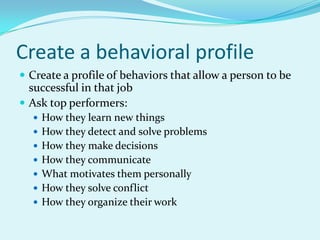
Create a behavioral profileCreate a profile of behaviors that allow a person to be successful in that jobAsk top performers:How they learn new thingsHow they detect and solve problemsHow they make decisionsHow they communicateWhat motivates them personallyHow they solve conflictHow they organize their work
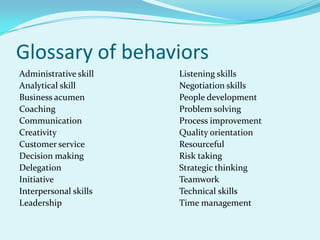
Glossary of behaviorsAdministrative skill	Listening skillsAnalytical skill	Negotiation skillsBusiness acumen	People developmentCoaching	Problem solvingCommunication	Process improvementCreativity	Quality orientationCustomer service	ResourcefulDecision making	Risk takingDelegation	Strategic thinkingInitiative	TeamworkInterpersonal skills	Technical skillsLeadership	Time management
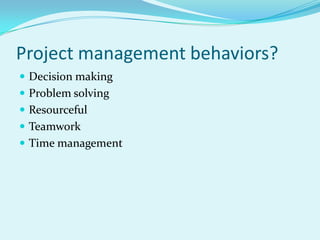
Project management behaviors?Decision makingProblem solvingResourcefulTeamworkTime management
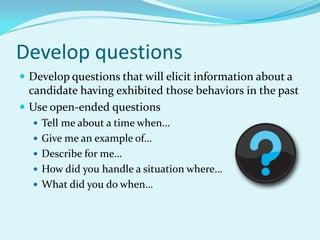
Develop questionsDevelop questions that will elicit information about a candidate having exhibited those behaviors in the pastUse open-ended questionsTell me about a time when…Give me an example of…Describe for me…How did you handle a situation where…What did you do when…
InterviewSelect only candidates whom you’ve already determined have the right skills, education, and experience (or almost!)Make arrangements to be undisturbedPut the candidate at easeAsk all candidates all of the same questionsTake notesProbe all responses until you can seethe critical incident play out likea movie in your mindBe comfortable with silence, patiently awaiting and encouraging responses
ProbingTell me about a time when you were under a great deal of pressure to deliver on time.What did you do to get the work done on time?What were the possible consequences you were concerned about?What was the outcome?If you were faced with a similar situation in the future, would you deal with it the same way or differently?Why?
More probingDescribe the most effective team that you were part of or led.What was your role exactly?Were there any extraneous circumstances?Did you have any other concerns?When did this occur?What did you find most challenging?How did you overcome those challenges?Why did you consider it the most effective team you’d ever been a part of?
Even more probingDescribe a time when you had to choose between product delivery and quality.What were some of the obstacles you encountered?How did you deal with those obstacles?What was the final outcome?What did you learn from the situation?What feedback did you get from others?What were the consequences?
What you may not askIf it’s not job related, don’t ask!Race, colorReligion, creedNational origin, citizenshipSex, marital status, child careName, age, birthplaceDisability/handicapPhotographCriminal historyMilitary serviceLanguage
You have a very unusual name. German ancestry?Can you think of anything that would prevent you from being to work on time?You’ve stated that you have three children. Since you brought it up, will your family obligations prevent you from overnight travel?Have you ever been arrested?Tell me about the advantages anddisadvantages of team assignments.Are these legal?
Other interviewing tipsDo far more listening (80%) than talking (20%)Ask all the questions, but let the discussion unfold naturallyAllow candidate to ask questions after you have finished asking yours“We’ll make an offer to the person we choose based on their skills and experience”Close by telling them what will happen next
Typical evasionClaims has either not had such an experience or can’t think of an exampleBe patient, encouragingRefuses to link answer to a concrete time and instead gives a theoretical response (doesn’t use past tense)Insist on a specific critical incidentMakes role in group effort unclear (uses “we” instead of “I”)Ask “What was your involvement?”
Take responsibilityReassure the candidateRestate the question using different wordsStress that you’re looking for a description of a specific situationBe sympathetic but persistent and patient
Why go to all this trouble?The cost of a wrong hire is 1 to 2-1/2 times that employee’s annual salary
Sample questions—decision makingDescribe an unpopular decision you had to make.Tell me about a decision you came to regret, and why.Give me an example of a time when you had to make an important decision with limited facts.
Sample questions—problem solvingTell me about a time when you had to analyze facts quickly, define key issues, and respond immediately.Describe for me a situation where you may have missed an obvious solution to a problem.Give me an example of when you anticipated potential problems and developed preventive measures.
Sample questions—resourcefulTell me about a time when you had to handle a kind of project that you hadn’t handled before.Give me an example of when you had to learn something new and produce results on your own.Describe a problem, issue, or concern that you handled in a unique, creative way.
Sample questions—teamworkTell me about your most successful team project, and the role you played in it.Give me an example of a project that did not go well and how you may have contributed to its problems.Describe your most recent team experience.
Sample questions—time managementGive me an example of when a project under your direction was late and how you dealt with the issue.Describe your current projects and how you keep them scheduled for on-time delivery.Tell me about a time when you had to balance competing priorities and did so successfully.
Sample questions—risk takingDescribe a situation where you heard of a new technology and implemented it.How do you determine if a plan is worth the risk of rocking the boat?Give me an example of when you weighed the pros and cons of a risk and decided to take it, and why.
Sample questions—technology skillsI see you have worked with X technology. Tell me about its features and benefits.Give me examples of how you adopted X technology into your process or your organization.How do you stay current in your field on new or evolving technologies?
Sample questions—customer serviceTell me about a time when you had to go the extra mile to support an internal customer.Describe a situation when you had to handle a customer complaint.Give me an example of when you made a lasting, positive impression on a customer.
A great resource!Society for Human Resource Managementwww.shrm.org
QUESTIONS?Kim Vitray, SPHR8609 Karling Dr.Austin, TX 78724 USA512-928-0859 (home)512-658-8587 (cell)kvitray@austin.rr.comwww.linkedin.com/in/kimvitray

Behavioral Interviewing

  • 1.
    Getting the RightPeople in the Right Seats on the Bus:Behavioral InterviewingKim Vitray, SPHR
  • 2.
    Behavioral interviewingBased onthe assumption that past performance is the best indicator of future performanceAsks probing questions about specific critical incidents in the candidate’s past that demonstrate behaviors necessary for job successFocuses on job, not personality
  • 3.
    Why behavioral interviewing?Improvesyour chances of selecting the right candidate 2 to 5 times over the traditional processAccurate, cost effective, and defensibleIs a selling toolHas a validity (predictive ability) rate of 70%Reduces bias
  • 4.
    Why not traditionalinterviewing?Candidates are vetted against each other instead of the jobDetermining that a candidates has the skills/knowledge doesn’t mean they can/will use themHas only 19% validity
  • 5.
    Behavioral theoryA behaviorexhibited in one circumstance will be exhibited in other circumstances as wellThe more recent the past behavior, the more likely it is to be repeatedThe more often the behavior was demonstrated over time, the higher the probability it will be repeated in the future
  • 6.
    Create a behavioralprofileCreate a profile of behaviors that allow a person to be successful in that jobAsk top performers:How they learn new thingsHow they detect and solve problemsHow they make decisionsHow they communicateWhat motivates them personallyHow they solve conflictHow they organize their work
  • 7.
    Glossary of behaviorsAdministrativeskill Listening skillsAnalytical skill Negotiation skillsBusiness acumen People developmentCoaching Problem solvingCommunication Process improvementCreativity Quality orientationCustomer service ResourcefulDecision making Risk takingDelegation Strategic thinkingInitiative TeamworkInterpersonal skills Technical skillsLeadership Time management
  • 8.
    Project management behaviors?DecisionmakingProblem solvingResourcefulTeamworkTime management
  • 9.
    Develop questionsDevelop questionsthat will elicit information about a candidate having exhibited those behaviors in the pastUse open-ended questionsTell me about a time when…Give me an example of…Describe for me…How did you handle a situation where…What did you do when…
  • 10.
    InterviewSelect only candidateswhom you’ve already determined have the right skills, education, and experience (or almost!)Make arrangements to be undisturbedPut the candidate at easeAsk all candidates all of the same questionsTake notesProbe all responses until you can seethe critical incident play out likea movie in your mindBe comfortable with silence, patiently awaiting and encouraging responses
  • 11.
    ProbingTell me abouta time when you were under a great deal of pressure to deliver on time.What did you do to get the work done on time?What were the possible consequences you were concerned about?What was the outcome?If you were faced with a similar situation in the future, would you deal with it the same way or differently?Why?
  • 12.
    More probingDescribe themost effective team that you were part of or led.What was your role exactly?Were there any extraneous circumstances?Did you have any other concerns?When did this occur?What did you find most challenging?How did you overcome those challenges?Why did you consider it the most effective team you’d ever been a part of?
  • 13.
    Even more probingDescribea time when you had to choose between product delivery and quality.What were some of the obstacles you encountered?How did you deal with those obstacles?What was the final outcome?What did you learn from the situation?What feedback did you get from others?What were the consequences?
  • 14.
    What you maynot askIf it’s not job related, don’t ask!Race, colorReligion, creedNational origin, citizenshipSex, marital status, child careName, age, birthplaceDisability/handicapPhotographCriminal historyMilitary serviceLanguage
  • 15.
    You have avery unusual name. German ancestry?Can you think of anything that would prevent you from being to work on time?You’ve stated that you have three children. Since you brought it up, will your family obligations prevent you from overnight travel?Have you ever been arrested?Tell me about the advantages anddisadvantages of team assignments.Are these legal?
  • 16.
    Other interviewing tipsDofar more listening (80%) than talking (20%)Ask all the questions, but let the discussion unfold naturallyAllow candidate to ask questions after you have finished asking yours“We’ll make an offer to the person we choose based on their skills and experience”Close by telling them what will happen next
  • 17.
    Typical evasionClaims haseither not had such an experience or can’t think of an exampleBe patient, encouragingRefuses to link answer to a concrete time and instead gives a theoretical response (doesn’t use past tense)Insist on a specific critical incidentMakes role in group effort unclear (uses “we” instead of “I”)Ask “What was your involvement?”
  • 18.
    Take responsibilityReassure thecandidateRestate the question using different wordsStress that you’re looking for a description of a specific situationBe sympathetic but persistent and patient
  • 19.
    Why go toall this trouble?The cost of a wrong hire is 1 to 2-1/2 times that employee’s annual salary
  • 20.
    Sample questions—decision makingDescribean unpopular decision you had to make.Tell me about a decision you came to regret, and why.Give me an example of a time when you had to make an important decision with limited facts.
  • 21.
    Sample questions—problem solvingTellme about a time when you had to analyze facts quickly, define key issues, and respond immediately.Describe for me a situation where you may have missed an obvious solution to a problem.Give me an example of when you anticipated potential problems and developed preventive measures.
  • 22.
    Sample questions—resourcefulTell meabout a time when you had to handle a kind of project that you hadn’t handled before.Give me an example of when you had to learn something new and produce results on your own.Describe a problem, issue, or concern that you handled in a unique, creative way.
  • 23.
    Sample questions—teamworkTell meabout your most successful team project, and the role you played in it.Give me an example of a project that did not go well and how you may have contributed to its problems.Describe your most recent team experience.
  • 24.
    Sample questions—time managementGiveme an example of when a project under your direction was late and how you dealt with the issue.Describe your current projects and how you keep them scheduled for on-time delivery.Tell me about a time when you had to balance competing priorities and did so successfully.
  • 25.
    Sample questions—risk takingDescribea situation where you heard of a new technology and implemented it.How do you determine if a plan is worth the risk of rocking the boat?Give me an example of when you weighed the pros and cons of a risk and decided to take it, and why.
  • 26.
    Sample questions—technology skillsIsee you have worked with X technology. Tell me about its features and benefits.Give me examples of how you adopted X technology into your process or your organization.How do you stay current in your field on new or evolving technologies?
  • 27.
    Sample questions—customer serviceTellme about a time when you had to go the extra mile to support an internal customer.Describe a situation when you had to handle a customer complaint.Give me an example of when you made a lasting, positive impression on a customer.
  • 28.
    A great resource!Societyfor Human Resource Managementwww.shrm.org
  • 29.
    QUESTIONS?Kim Vitray, SPHR8609Karling Dr.Austin, TX 78724 USA512-928-0859 (home)512-658-8587 (cell)kvitray@austin.rr.comwww.linkedin.com/in/kimvitray

Editor's Notes

  • #2 [Mention that I will email presentation to anyone who provides a business card.]This presentation is about a specific interviewing technique called behavioral interviewing, which is currently a best practice in the HR field. It is just one piece of the total hiring process, in addition to resume screening, checking references, other components, and even gut instinct/intuition.How many of you hire people?How many of you have made a bad hire?This technique isn’t going to keep you from ever making a bad hire again, but it will significantly improve your odds for making good hires, and the quality of your hires.Has anyone heard of this technique before?Is anyone currently using this technique?
  • #4 What does “defensible” mean?
  • #5 Do you want your chances of hiring the right person to be 70% or 20%?
  • #8 This is a small subset of any number of possible behaviors.
  • #9 This is a position that many organizations/industries seek to fill.These are five PM behaviors identified by a previous audience.
  • #10 What is an open-ended question?
  • #11 You’ve already determined they have the 3-5 years of PM experience you’re looking for; you’re trying to find out if they’ve done the things you need in those 3-5 years.What are you communicating to a candidate if you answer the phone during an interview?Be mindful of all the social graces.Why do you need to ask all the candidates all of the same questions?Pleasantly and positively insist - make notes, take a sip of water, smile encouragingly, but you must indicate that you won’t accept as an answer “Oh, I’ve never had that sort of problem.”
  • #14 Probing also helps you determine when a candidate is not telling the truth.
  • #15 You may ask if the person is legal to work in the U.S. You may also ask if the candidate has ever been convicted.
  • #17 If you find that you are doing most of the talking, you must examine your interview style, because you are not doing a good job and you won’t make an effective hire.Why allow the candidate to ask questions only after you have asked yours?
  • #18 Not “I would” but “I did.”
  • #19 You are a responsible for making this technique work. It is not easy and takes some practice.If a person struggles in this kind of interview, they may be nervous, but it also reflects on how they will handle difficult situations with their coworkers and your clients.
  • #20 Why are we going to go to all the trouble of identifying behaviors, preparing questions, and feeling uncomfortable?
  • #21 And “Tell me about a time you had to make a decision” won’t cut it! That’s certainly a place to start, but we’re looking for more creativity here!
  • #22 [If they suggest a yes-no question, be sure they rephrase as open ended.]
  • #23 [Be sure they alternate with the different ways to start a question.]
  • #25 [Encourage those who haven’t spoken yet. Be patient and encouraging!]
  • #27 Asking behavioral questions about technology is a bit more difficult, but can be done. Don’t just ask, “Have you used X?” because that tells you nothing.
  • #28 Final tip: balance the positive and negative in preparing your questions, and resist the tendency to lean too heavily on the negative.
  • #29 Many books and resources are also available on behavioral interviewing, with examples of behavioral questions.