Developing Effective
Interview Skills
Training Objective
 Task: Learn specific tool to apply, STAR
technique, to develop effective interview skills.
 Condition: Given a block of instruction by Career
Services and support staff.
 Standard: Practice and submit your personal
commercial using The InterviewStream tool.
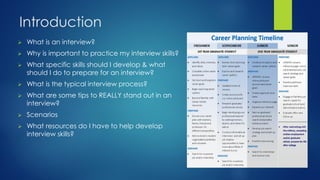
Introduction
 What is an interview?
 Why is important to practice my interview skills?
 What specific skills should I develop & what
should I do to prepare for an interview?
 What is the typical interview process?
 What are some tips to REALLY stand out in an
interview?
 Scenarios
 What resources do I have to help develop
interview skills?
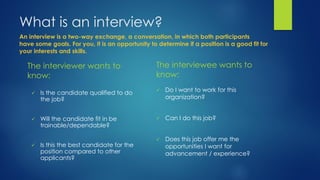
What is an interview?
The interviewer wants to
know:
 Is the candidate qualified to do
the job?
 Will the candidate fit in be
trainable/dependable?
 Is this the best candidate for the
position compared to other
applicants?
The interviewee wants to
know:
 Do I want to work for this
organization?
 Can I do this job?
 Does this job offer me the
opportunities I want for
advancement / experience?
An interview is a two-way exchange, a conversation, in which both participants
have some goals. For you, it is an opportunity to determine if a position is a good fit for
your interests and skills.
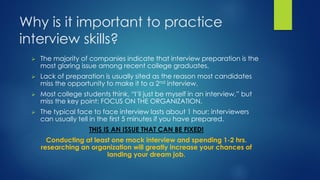
Why is it important to practice
interview skills?
 The majority of companies indicate that interview preparation is the
most glaring issue among recent college graduates.
 Lack of preparation is usually sited as the reason most candidates
miss the opportunity to make it to a 2nd interview.
 Most college students think, “I’ll just be myself in an interview,” but
miss the key point: FOCUS ON THE ORGANIZATION.
 The typical face to face interview lasts about 1 hour; interviewers
can usually tell in the first 5 minutes if you have prepared.
THIS IS AN ISSUE THAT CAN BE FIXED!
Conducting at least one mock interview and spending 1-2 hrs.
researching an organization will greatly increase your chances of
landing your dream job.
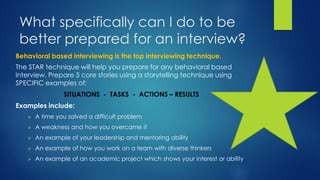
What specifically can I do to be
better prepared for an interview?
The STAR technique will help you prepare for any behavioral based
interview. Prepare 5 core stories using a storytelling technique using
SPECIFIC examples of:
SITUATIONS - TASKS - ACTIONS – RESULTS
Examples include:
 A time you solved a difficult problem
 A weakness and how you overcame it
 An example of your leadership and mentoring ability
 An example of how you work on a team with diverse thinkers
 An example of an academic project which shows your interest or ability
Behavioral based interviewing is the top interviewing technique.
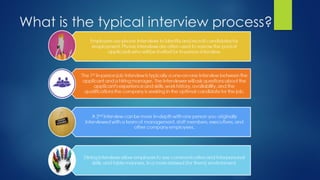
What is the typical interview process?
What are some tips to REALLY stand
out in an interview?
 Do more than an hour of research and TAKE NOTES ON THE FOLLOWING ITEMS (to take
with you to the interview in your professional binder):
 The history, locations, competitors
 Culture, products, challenges, social impact
 The specifics of the position and the interview team
 At least 5 STAR examples of your work ethic, leadership, academics, work experience, etc.
 5-10 intelligent, well-thought-out questions to ask, including, “What are the next steps?”
Follow up!
 Send an error free email and written note after the interview
 Follow up if it has been two weeks and you’ve heard nothing
 Never put all of your eggs in one basket (apply and interview for multiple positions)
Remember, no matter how comfortable you are, this
is a business relationship.
Scenario of Behavioral Based
Interviewing
An employer at ABC asks a student being interviewed, “Tell
me an example of a time you have been involved in a
situation where you have had to help improve a process?”
 The student is stumped by the question and cannot answer it. No
one told her to prepare for this question!
 She starts talking and hopes the answer comes while she is stumbling
through.
 She says she cannot think of an example.
Scenario - Rank Board Interviews
Citadel Cadet is at a Rank Board Interview. Col. Soandso wants
to know, “What is your definition of an effective leader and what
is the best and worst example of leadership he has experienced
in his time as a cadet?”
 S – My junior year as Squad Corporal, our Human Affairs Officer was relieved of duties
because of an honor violation. I was given that responsibility but didn’t really know
what to do.
 T – I immediately became responsible for 3 times the number of students I was used to
managing and I had to have a game plan. I did the following….
 A – I quickly learned the roles and responsibilities by working with my Company
Commander and the Battalion Human Affairs Officer in daily and weekly meetings.
We discussed issues like….
 R – I learned to adjust the way I communicate to be more effective. As a result, we
had a very cohesive company and very few issues as a result of our teamwork.
Scenario – Non Verbal Communication
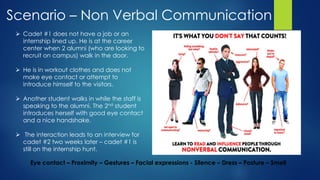
Eye contact – Proximity – Gestures – Facial expressions - Silence – Dress – Posture – Smell
 Cadet #1 does not have a job or an
internship lined up. He is at the career
center when 2 alumni (who are looking to
recruit on campus) walk in the door.
 He is in workout clothes and does not
make eye contact or attempt to
introduce himself to the visitors.
 Another student walks in while the staff is
speaking to the alumni. The 2nd student
introduces herself with good eye contact
and a nice handshake.
 The interaction leads to an interview for
cadet #2 two weeks later – cadet #1 is
still on the internship hunt.
Specific Tools to help develop
interview Skills
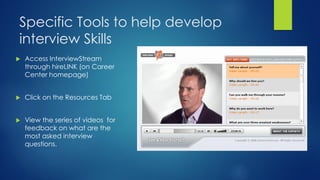
 Access InterviewStream
through hireLINK (on Career
Center homepage)
 Click on the Resources Tab
 View the series of videos for
feedback on what are the
most asked interview
questions.
Applicability to Cadet Life
Most students will apply for some type of position during their college
years:
 Internships & Summer Jobs
 Rank
 Club Leadership
 Volunteer Roles & Campus Outreach
 Work Study Position
 Graduate programs
AND FINALLY, A FULL TIME
OPPORTUNITY!
Action Items
Use C3 drop-in 1-3pm/Mon-.Thurs. & Resume Blitz 12:30-2:30 Mark Clark Hall for help
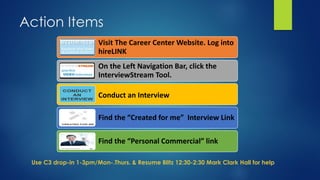
Visit The Career Center Website. Log into
hireLINK
On the Left Navigation Bar, click the
InterviewStream Tool.
Conduct an Interview
Find the “Created for me” Interview Link
Find the “Personal Commercial” link
Conclusion
 An interview is a two-way exchange, a conversation, in which both
participants have some goals. For you, it is an opportunity to
determine if a position is a good fit for your interests and skills.
 The STAR techniques will help you prepare for any behavioral based
interview. Prepare 5 core stories using a storytelling technique using
SPECIFIC examples of:
SITUATIONS - TASKS - ACTIONS - RESULTS
 Conducting at least one mock interview and spending 1-2 hrs.
researching an organization will greatly increase your chances of
landing your dream job.

STAR Interviews - Citadel Career Center

  • 1.
  • 2.
    Training Objective  Task:Learn specific tool to apply, STAR technique, to develop effective interview skills.  Condition: Given a block of instruction by Career Services and support staff.  Standard: Practice and submit your personal commercial using The InterviewStream tool.
  • 3.
    Introduction  What isan interview?  Why is important to practice my interview skills?  What specific skills should I develop & what should I do to prepare for an interview?  What is the typical interview process?  What are some tips to REALLY stand out in an interview?  Scenarios  What resources do I have to help develop interview skills?
  • 4.
    What is aninterview? The interviewer wants to know:  Is the candidate qualified to do the job?  Will the candidate fit in be trainable/dependable?  Is this the best candidate for the position compared to other applicants? The interviewee wants to know:  Do I want to work for this organization?  Can I do this job?  Does this job offer me the opportunities I want for advancement / experience? An interview is a two-way exchange, a conversation, in which both participants have some goals. For you, it is an opportunity to determine if a position is a good fit for your interests and skills.
  • 5.
    Why is itimportant to practice interview skills?  The majority of companies indicate that interview preparation is the most glaring issue among recent college graduates.  Lack of preparation is usually sited as the reason most candidates miss the opportunity to make it to a 2nd interview.  Most college students think, “I’ll just be myself in an interview,” but miss the key point: FOCUS ON THE ORGANIZATION.  The typical face to face interview lasts about 1 hour; interviewers can usually tell in the first 5 minutes if you have prepared. THIS IS AN ISSUE THAT CAN BE FIXED! Conducting at least one mock interview and spending 1-2 hrs. researching an organization will greatly increase your chances of landing your dream job.
  • 6.
    What specifically canI do to be better prepared for an interview? The STAR technique will help you prepare for any behavioral based interview. Prepare 5 core stories using a storytelling technique using SPECIFIC examples of: SITUATIONS - TASKS - ACTIONS – RESULTS Examples include:  A time you solved a difficult problem  A weakness and how you overcame it  An example of your leadership and mentoring ability  An example of how you work on a team with diverse thinkers  An example of an academic project which shows your interest or ability Behavioral based interviewing is the top interviewing technique.
  • 7.
    What is thetypical interview process?
  • 8.
    What are sometips to REALLY stand out in an interview?  Do more than an hour of research and TAKE NOTES ON THE FOLLOWING ITEMS (to take with you to the interview in your professional binder):  The history, locations, competitors  Culture, products, challenges, social impact  The specifics of the position and the interview team  At least 5 STAR examples of your work ethic, leadership, academics, work experience, etc.  5-10 intelligent, well-thought-out questions to ask, including, “What are the next steps?” Follow up!  Send an error free email and written note after the interview  Follow up if it has been two weeks and you’ve heard nothing  Never put all of your eggs in one basket (apply and interview for multiple positions) Remember, no matter how comfortable you are, this is a business relationship.
  • 9.
    Scenario of BehavioralBased Interviewing An employer at ABC asks a student being interviewed, “Tell me an example of a time you have been involved in a situation where you have had to help improve a process?”  The student is stumped by the question and cannot answer it. No one told her to prepare for this question!  She starts talking and hopes the answer comes while she is stumbling through.  She says she cannot think of an example.
  • 10.
    Scenario - RankBoard Interviews Citadel Cadet is at a Rank Board Interview. Col. Soandso wants to know, “What is your definition of an effective leader and what is the best and worst example of leadership he has experienced in his time as a cadet?”  S – My junior year as Squad Corporal, our Human Affairs Officer was relieved of duties because of an honor violation. I was given that responsibility but didn’t really know what to do.  T – I immediately became responsible for 3 times the number of students I was used to managing and I had to have a game plan. I did the following….  A – I quickly learned the roles and responsibilities by working with my Company Commander and the Battalion Human Affairs Officer in daily and weekly meetings. We discussed issues like….  R – I learned to adjust the way I communicate to be more effective. As a result, we had a very cohesive company and very few issues as a result of our teamwork.
  • 11.
    Scenario – NonVerbal Communication Eye contact – Proximity – Gestures – Facial expressions - Silence – Dress – Posture – Smell  Cadet #1 does not have a job or an internship lined up. He is at the career center when 2 alumni (who are looking to recruit on campus) walk in the door.  He is in workout clothes and does not make eye contact or attempt to introduce himself to the visitors.  Another student walks in while the staff is speaking to the alumni. The 2nd student introduces herself with good eye contact and a nice handshake.  The interaction leads to an interview for cadet #2 two weeks later – cadet #1 is still on the internship hunt.
  • 12.
    Specific Tools tohelp develop interview Skills  Access InterviewStream through hireLINK (on Career Center homepage)  Click on the Resources Tab  View the series of videos for feedback on what are the most asked interview questions.
  • 13.
    Applicability to CadetLife Most students will apply for some type of position during their college years:  Internships & Summer Jobs  Rank  Club Leadership  Volunteer Roles & Campus Outreach  Work Study Position  Graduate programs AND FINALLY, A FULL TIME OPPORTUNITY!
  • 14.
    Action Items Use C3drop-in 1-3pm/Mon-.Thurs. & Resume Blitz 12:30-2:30 Mark Clark Hall for help Visit The Career Center Website. Log into hireLINK On the Left Navigation Bar, click the InterviewStream Tool. Conduct an Interview Find the “Created for me” Interview Link Find the “Personal Commercial” link
  • 15.
    Conclusion  An interviewis a two-way exchange, a conversation, in which both participants have some goals. For you, it is an opportunity to determine if a position is a good fit for your interests and skills.  The STAR techniques will help you prepare for any behavioral based interview. Prepare 5 core stories using a storytelling technique using SPECIFIC examples of: SITUATIONS - TASKS - ACTIONS - RESULTS  Conducting at least one mock interview and spending 1-2 hrs. researching an organization will greatly increase your chances of landing your dream job.