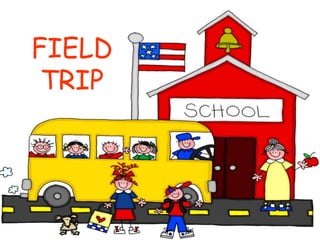



FIELD
 TRIP
FIELD TRIP
  is a journey by a group
of people to a place away
from their normal
environment.
PURPOSE:
   is usually observation
for education, non-
experimental research or to provide
students with experiences outside
their everyday activities.
TYPES OF FIELD
            TRIPS

• Self-guided
  Tour and
  Trails
• Hands-on
  Programs
• Wetlands
  Program
• Scout
  Program (girl
  and cub/boy
  scouts)
STRATEGIES
IN TEACHING
Constructivist teaching
   learning is more effective when a
 student is actively engaged in the
 learning process rather than
 attempting to receive knowledge
 passively.
One of the primary goals of
using constructivist teaching is
that students learn how to learn
by giving them the training to
take initiative for their own
learning experiences.
ROLE OF THE
 TEACHER
• Coaching
• Modeling
• Scaffolding
STEPS IN PLANNING
         A FIELD TRIP
1.) Preliminary Planning by the teacher
2.)Preplanning with others going on the
  trip
3.)Taking the Field Trip itself
4.) Post-field Trip follow up activities
PRELIMINARY PLANNING

• Make preliminary contacts, a tour on
  final arrangements with the place to
  be visited.
• Make final arrangements with the
  school principal about the details of
  the trip
• Make tentative route plan, subject to later
  alteration based on class planning and
  objectives
• Try to work out mutually satisfactory
  arrangements with other teachers if the
  trip will conflict to the other classes.
• Prepare preliminary lists of questions or
  other materials which will be helpful in
  planning with the students.
PREPLANNING WITH
           STUDENTS JOINING THE
                      TRIP:
• Discuss the objectives of the trip
  and write them down. The main
  objectives should be included in the
  permit slip given to parents and
  should be consulted later when the
  trip is evaluated.
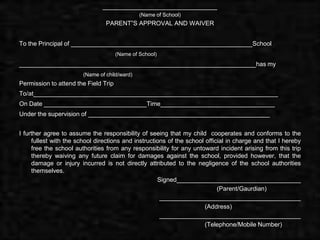
_____________________________
                                               (Name of School)
                                 PARENT”S APPROVAL AND WAIVER


To the Principal of ______________________________________________School
                                      (Name of School)
____________________________________________________________has my
                        (Name of child/ward)
Permission to attend the Field Trip
To/at______________________________________________________________
On Date __________________________Time_____________________________
Under the supervision of ______________________________________________


I further agree to assume the responsibility of seeing that my child cooperates and conforms to the
     fullest with the school directions and instructions of the school official in charge and that I hereby
     free the school authorities from any responsibility for any untoward incident arising from this trip
     thereby waiving any future claim for damages against the school, provided however, that the
     damage or injury incurred is not directly attributed to the negligence of the school authorities
     themselves.
                                                     Signed____________________________________
                                                                            (Parent/Gaurdian)
                                                      _________________________________________
                                                                       (Address)
                                                      _________________________________________
                                                                       (Telephone/Mobile Number)
• Prepare a list of questions to send ahead
  to the guide of the study trip
• Define safety and behavior standards for
  the journey there and for the field trip
  site itself.
• Discuss and decide on ways to document
  the trip. Everyone is expected to take
  notes.
• List specific objectives to be seen on
  their way to the site of the field trip and
  on their way home from the site.
• Discuss appropriate dress. Comfortable
  shoes for walking.
• Before the trip, use a variety of learning
  materials in order to give each students a
  background for the trip.
TAKING THE FIELD TRIP
Distribute route map of places to be observed
Upon arriving at the destination, teacher should
introduce the group and introduce the guide.
Special effort to be made to ensure that:
   The trip keeps to the time schedule
   The students have the opportunity to obtain answers
   to questions
   The group participates courteously in the entire trip
   The guide sticks closely to the list of questions.
These are the questions we can ask
after the field trip to evaluate the field
trip we just had.
Could the same benefits be achieved by other
materials? Was it worth the time, effort, and
perhaps, extra money?
Were there any unexpected problems which could be
foreseen another time? Were these due to guides,
students, poor planning, or unexpected trip
conditions?
Were new interests developed?
Should the trip be recommended to other classes
studying similar topics?
ADVANTAGES:

Fieldtrips are
opportunities for
rich and
memorable
experiences
Field trips bring
us to the world
beyond the
classroom
Field trips have
a wide range of
application
It can bring about
a lot of
realizations which
may lead to
changes in
attitudes and
insights.
DISADVANTAGES:
• Preparation
      Planning and
  preparation are
  often the
  biggest hurdles
  in setting up an
  educational trip.
• Student Behavior
        Most of the time,
  students will be excited
  to take part in any
  activity that gets them
  out of a classroom for
  the day. That
  excitement can
  contribute to the
  educational experience
  but may also limit the
  amount of education
  that actually occurs.
• Cost
        Cost can be a key
  hindrance in conducting a field
  trip. Schools will often have
  tight budgets for bus rental,
  gasoline allowance, food and
  drink purchase and fees for
  trips. Anything beyond the
  school's budget will need to
  come from another source,
  sometimes from the educator
  himself.
Becera & labastida

Becera & labastida

  • 1.
  • 2.
    FIELD TRIP is a journey by a group of people to a place away from their normal environment.
  • 3.
    PURPOSE: is usually observation for education, non- experimental research or to provide students with experiences outside their everyday activities.
  • 4.
    TYPES OF FIELD TRIPS • Self-guided Tour and Trails
  • 5.
    • Hands-on Programs
  • 6.
  • 7.
    • Scout Program (girl and cub/boy scouts)
  • 8.
  • 9.
    Constructivist teaching learning is more effective when a student is actively engaged in the learning process rather than attempting to receive knowledge passively.
  • 10.
    One of theprimary goals of using constructivist teaching is that students learn how to learn by giving them the training to take initiative for their own learning experiences.
  • 11.
    ROLE OF THE TEACHER
  • 12.
  • 13.
    STEPS IN PLANNING A FIELD TRIP 1.) Preliminary Planning by the teacher 2.)Preplanning with others going on the trip 3.)Taking the Field Trip itself 4.) Post-field Trip follow up activities
  • 14.
    PRELIMINARY PLANNING • Makepreliminary contacts, a tour on final arrangements with the place to be visited. • Make final arrangements with the school principal about the details of the trip
  • 15.
    • Make tentativeroute plan, subject to later alteration based on class planning and objectives • Try to work out mutually satisfactory arrangements with other teachers if the trip will conflict to the other classes. • Prepare preliminary lists of questions or other materials which will be helpful in planning with the students.
  • 16.
    PREPLANNING WITH STUDENTS JOINING THE TRIP: • Discuss the objectives of the trip and write them down. The main objectives should be included in the permit slip given to parents and should be consulted later when the trip is evaluated.
  • 17.
    _____________________________ (Name of School) PARENT”S APPROVAL AND WAIVER To the Principal of ______________________________________________School (Name of School) ____________________________________________________________has my (Name of child/ward) Permission to attend the Field Trip To/at______________________________________________________________ On Date __________________________Time_____________________________ Under the supervision of ______________________________________________ I further agree to assume the responsibility of seeing that my child cooperates and conforms to the fullest with the school directions and instructions of the school official in charge and that I hereby free the school authorities from any responsibility for any untoward incident arising from this trip thereby waiving any future claim for damages against the school, provided however, that the damage or injury incurred is not directly attributed to the negligence of the school authorities themselves. Signed____________________________________ (Parent/Gaurdian) _________________________________________ (Address) _________________________________________ (Telephone/Mobile Number)
  • 18.
    • Prepare alist of questions to send ahead to the guide of the study trip • Define safety and behavior standards for the journey there and for the field trip site itself. • Discuss and decide on ways to document the trip. Everyone is expected to take notes.
  • 19.
    • List specificobjectives to be seen on their way to the site of the field trip and on their way home from the site. • Discuss appropriate dress. Comfortable shoes for walking. • Before the trip, use a variety of learning materials in order to give each students a background for the trip.
  • 20.
    TAKING THE FIELDTRIP Distribute route map of places to be observed Upon arriving at the destination, teacher should introduce the group and introduce the guide. Special effort to be made to ensure that: The trip keeps to the time schedule The students have the opportunity to obtain answers to questions The group participates courteously in the entire trip The guide sticks closely to the list of questions.
  • 21.
    These are thequestions we can ask after the field trip to evaluate the field trip we just had. Could the same benefits be achieved by other materials? Was it worth the time, effort, and perhaps, extra money? Were there any unexpected problems which could be foreseen another time? Were these due to guides, students, poor planning, or unexpected trip conditions? Were new interests developed? Should the trip be recommended to other classes studying similar topics?
  • 22.
  • 23.
    Field trips bring usto the world beyond the classroom
  • 24.
    Field trips have awide range of application
  • 25.
    It can bringabout a lot of realizations which may lead to changes in attitudes and insights.
  • 26.
    DISADVANTAGES: • Preparation Planning and preparation are often the biggest hurdles in setting up an educational trip.
  • 27.
    • Student Behavior Most of the time, students will be excited to take part in any activity that gets them out of a classroom for the day. That excitement can contribute to the educational experience but may also limit the amount of education that actually occurs.
  • 28.
    • Cost Cost can be a key hindrance in conducting a field trip. Schools will often have tight budgets for bus rental, gasoline allowance, food and drink purchase and fees for trips. Anything beyond the school's budget will need to come from another source, sometimes from the educator himself.