Making the
Most of
Community
Resources
and
Field Trips
“Field Trips offer an excellent bridge between the
work of the school and the work of the world
outside.”
Focus Questions:
1. What procedures and criteria must be
observed in planning and conducting
field trips?
2. What educational benefits are derived
from a field trip?
3. What community resources can be
utilized for learning?
Field Trip
Why take Field Trips?
Field trip expands children’s learning.

It increases knowledge and understanding
of students on a subject.
It gives relevant experiences.
Teachers Field Trip Experiences
“I took a group of students to the
local museum. We just wandered from
corner to corner without anything
specific to look for. It was an experience
but it did not connect with any specific
lesson objectives.”
“The whole trip was a mess. Some lost
their way and arrived very late. Others
arrived at the place much earlier and
were inconvenienced waiting for the
arrival of the others.”
“The students enjoyed the field
trip. But when asked to relate what
they saw to our lesson, they were
not able to connect.”
Lack of:
P NINNAL G
Planning a Field Trip
A. Preliminary planning by the teacher
B. Preplanning with students joining the trip
C. Preplanning with others going on the trip
D. Taking the field trip itself
E. Post-field trip follow up activities
A. Preliminary planning
by the teacher
Make preliminary contacts
Make arrangements with
the school principal
Make a tentative route
plan
Make arrangements with
other teachers
Prepare materials helpful
with the students
B. Preplanning with
students joining the trip.
Discuss the objectives
Prepare a list of questions for
the guide
Define safety and behavior
standards
Discuss ways for documentation
Discuss appropriate dress
Use a variety of learning
materials.
Parents
Teachers
School
Administrators
C. Preplanning with
others joining the trip
D. Taking the field
trip
Teacher should check the
group and introduce the
guide
Ensure that:
1. The trip keeps to the
time schedule
2. The group participates
courteously in the entire
trip
3. Students obtain answers
to questions
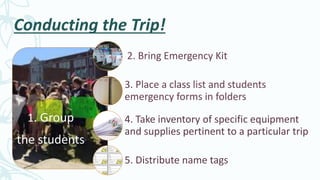
Conducting the Trip!
1. Group
the students
2. Bring Emergency Kit
3. Place a class list and students
emergency forms in folders
4. Take inventory of specific equipment
and supplies pertinent to a particular trip
5. Distribute name tags
Let students observe
Mysteries with clues
Hand drawn postcards
Adventure Game
Activities During
Field Trip!
1. Provide
students
time to share
what they
have learned
and
experienced
2. Create a
classroom
bulletin board
displaying
materials
developed or
collected while
on the field trip
3. Share
and evaluate
student’s
assignments/
activities
from their
Field Book
4. Create a
short news
report about
what
happened on
the field trip
D. Post-field trip follow-up activities!
Evaluating Field Trips
Could the same benefits be achieved
by other materials?
Where there any unexpected problem
which could be foreseen another time?
Were new interests developed?
Should the trip be recommended to
other classes studying similar topics?
What was of unique educational
value in this field trip?
Did the students meet the
objectives/expectations?
Was there adequate time?
Was there adequate staff and adult
supervision?
What might be done differently to make
this an even better experience in the future?
Educational Benefits
Field Trip
The acquisition of lasting concepts and
change in attitudes rooted from experience
It brings us to the world beyond the
classroom.
It has a wide range of application.
It can bring a lot of realization.
Disadvantages of
Field Trip
costly
involves logistics
extravagant with time, and
contains element of uncertainty
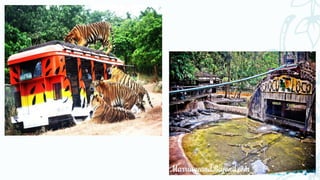
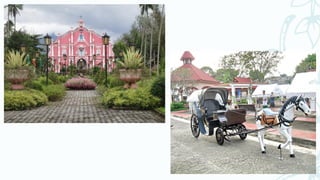
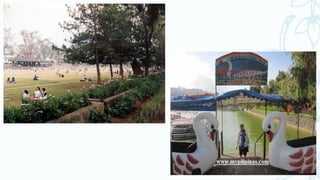
Zoobic
Safari
Nayong
Pilipino sa
Clark
Expo.
Burnham
Park
The
Mansion
National
Shrine of
Divine
Mercy
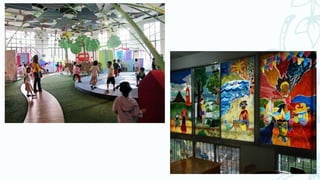
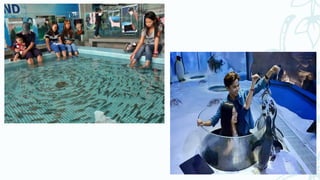
Museo
Pambata
Manila
Ocean Park
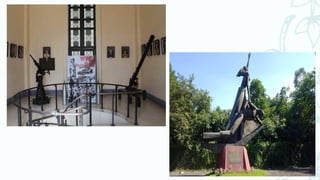
Bantayog
Kagitingan
Museum
Manila/
PAGASA
Planetarium
Rizal
Shrine
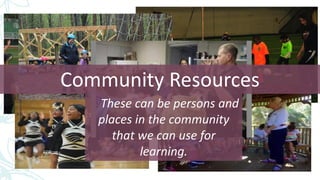
Community Resources
These can be persons and
places in the community
that we can use for
learning.
Persons
Places
“We lose nothing when we open our school doors to
parents, officials and other members of the community.
Instead, we gain this support and cooperation. They are
rich learning resources”
Group 5
Deraco, Mimie – Reporter
Masukat, Baijonie – Secretary
Aplal, HannahNor - Researcher
Sari, Rejie – Designer/Encoder
End…..
Questions?

Group5 field trip ! - copy

  • 1.
  • 2.
    “Field Trips offeran excellent bridge between the work of the school and the work of the world outside.”
  • 3.
    Focus Questions: 1. Whatprocedures and criteria must be observed in planning and conducting field trips? 2. What educational benefits are derived from a field trip? 3. What community resources can be utilized for learning?
  • 4.
  • 5.
    Why take FieldTrips? Field trip expands children’s learning. It increases knowledge and understanding of students on a subject. It gives relevant experiences.

  • 6.
    Teachers Field TripExperiences “I took a group of students to the local museum. We just wandered from corner to corner without anything specific to look for. It was an experience but it did not connect with any specific lesson objectives.” “The whole trip was a mess. Some lost their way and arrived very late. Others arrived at the place much earlier and were inconvenienced waiting for the arrival of the others.” “The students enjoyed the field trip. But when asked to relate what they saw to our lesson, they were not able to connect.”
  • 7.
  • 8.
    Planning a FieldTrip A. Preliminary planning by the teacher B. Preplanning with students joining the trip C. Preplanning with others going on the trip D. Taking the field trip itself E. Post-field trip follow up activities
  • 9.
    A. Preliminary planning bythe teacher Make preliminary contacts Make arrangements with the school principal Make a tentative route plan Make arrangements with other teachers Prepare materials helpful with the students
  • 10.
    B. Preplanning with studentsjoining the trip. Discuss the objectives Prepare a list of questions for the guide Define safety and behavior standards Discuss ways for documentation Discuss appropriate dress Use a variety of learning materials.
  • 11.
  • 12.
    D. Taking thefield trip Teacher should check the group and introduce the guide Ensure that: 1. The trip keeps to the time schedule 2. The group participates courteously in the entire trip 3. Students obtain answers to questions
  • 13.
    Conducting the Trip! 1.Group the students 2. Bring Emergency Kit 3. Place a class list and students emergency forms in folders 4. Take inventory of specific equipment and supplies pertinent to a particular trip 5. Distribute name tags
  • 14.
    Let students observe Mysterieswith clues Hand drawn postcards Adventure Game Activities During Field Trip!
  • 15.
    1. Provide students time toshare what they have learned and experienced 2. Create a classroom bulletin board displaying materials developed or collected while on the field trip 3. Share and evaluate student’s assignments/ activities from their Field Book 4. Create a short news report about what happened on the field trip D. Post-field trip follow-up activities!
  • 16.
  • 17.
    Could the samebenefits be achieved by other materials? Where there any unexpected problem which could be foreseen another time? Were new interests developed?
  • 18.
    Should the tripbe recommended to other classes studying similar topics? What was of unique educational value in this field trip? Did the students meet the objectives/expectations?
  • 19.
    Was there adequatetime? Was there adequate staff and adult supervision? What might be done differently to make this an even better experience in the future?
  • 20.
    Educational Benefits Field Trip Theacquisition of lasting concepts and change in attitudes rooted from experience It brings us to the world beyond the classroom. It has a wide range of application. It can bring a lot of realization.
  • 21.
    Disadvantages of Field Trip costly involveslogistics extravagant with time, and contains element of uncertainty
  • 24.
  • 26.
  • 28.
  • 30.
  • 32.
  • 34.
  • 36.
  • 38.
  • 40.
  • 42.
  • 44.
    Community Resources These canbe persons and places in the community that we can use for learning.

  • 45.
  • 46.
    “We lose nothingwhen we open our school doors to parents, officials and other members of the community. Instead, we gain this support and cooperation. They are rich learning resources”
  • 47.
    Group 5 Deraco, Mimie– Reporter Masukat, Baijonie – Secretary Aplal, HannahNor - Researcher Sari, Rejie – Designer/Encoder
  • 48.