MAKING THE MOST
OF COMMUNITY
RESOURCES AND
FIELD TRIPS
By: Angela R. Manlangit
Mary Joy D. Rapsing
HAVE YOU GONE THROUGH A
FIELD TRIP?
. .
What do you suggest to improve
a failed field trip?
OBJECTIVES:
Enumerate the procedures and criteria that
must be observed in planning and
conducting field trips.
Learn the educational benefits of having a
field trip.
Know the community resources that can be
utilized for learning.
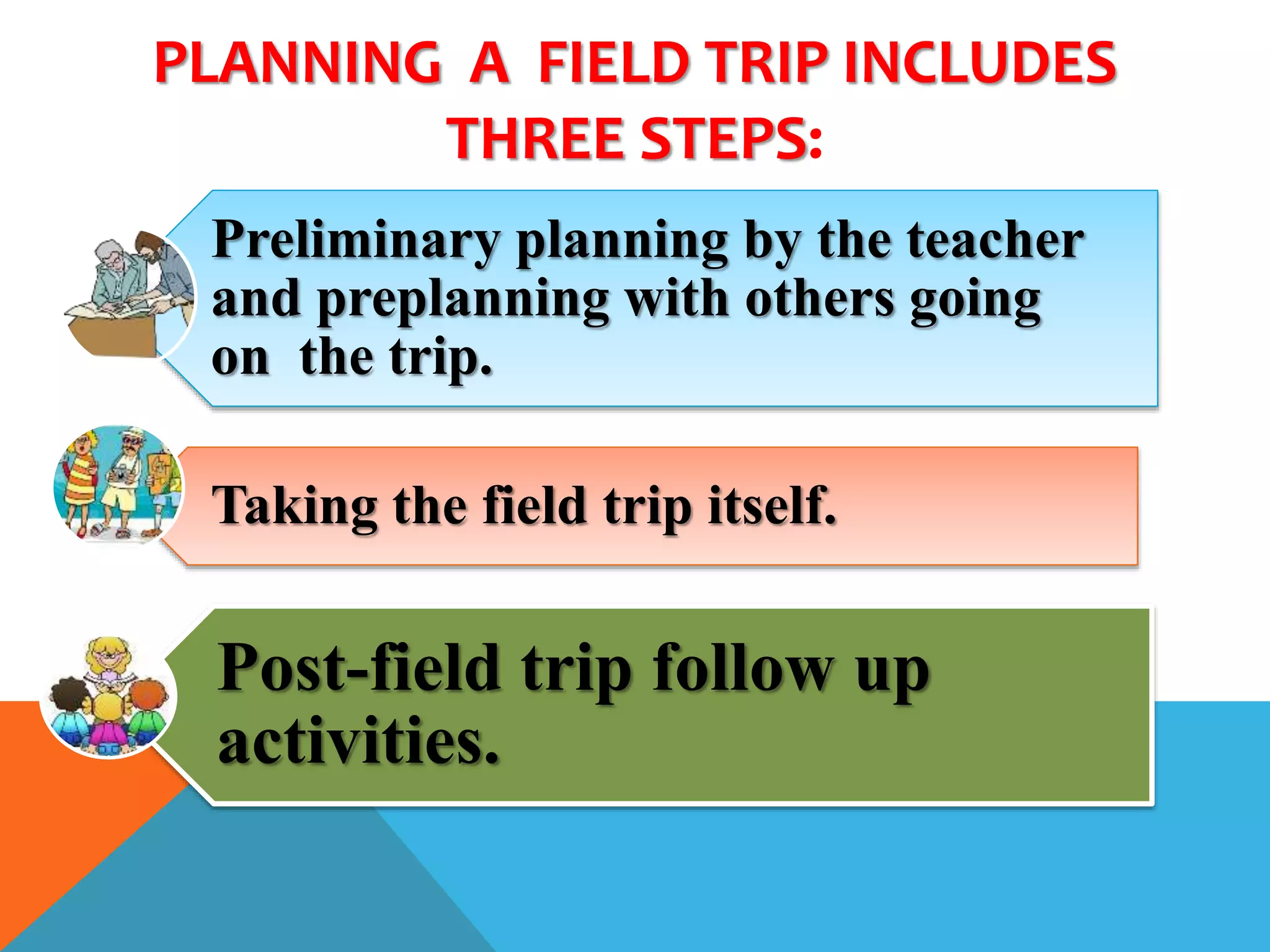
PLANNING A FIELD TRIP INCLUDES
THREE STEPS:
Preliminary planning by the teacher
and preplanning with others going
on the trip.
Taking the field trip itself.
Post-field trip follow up
activities.
PRELIMINARY PLANNING BY
THE TEACHER
PRELIMINARY PLANNING BY
THE TEACHER
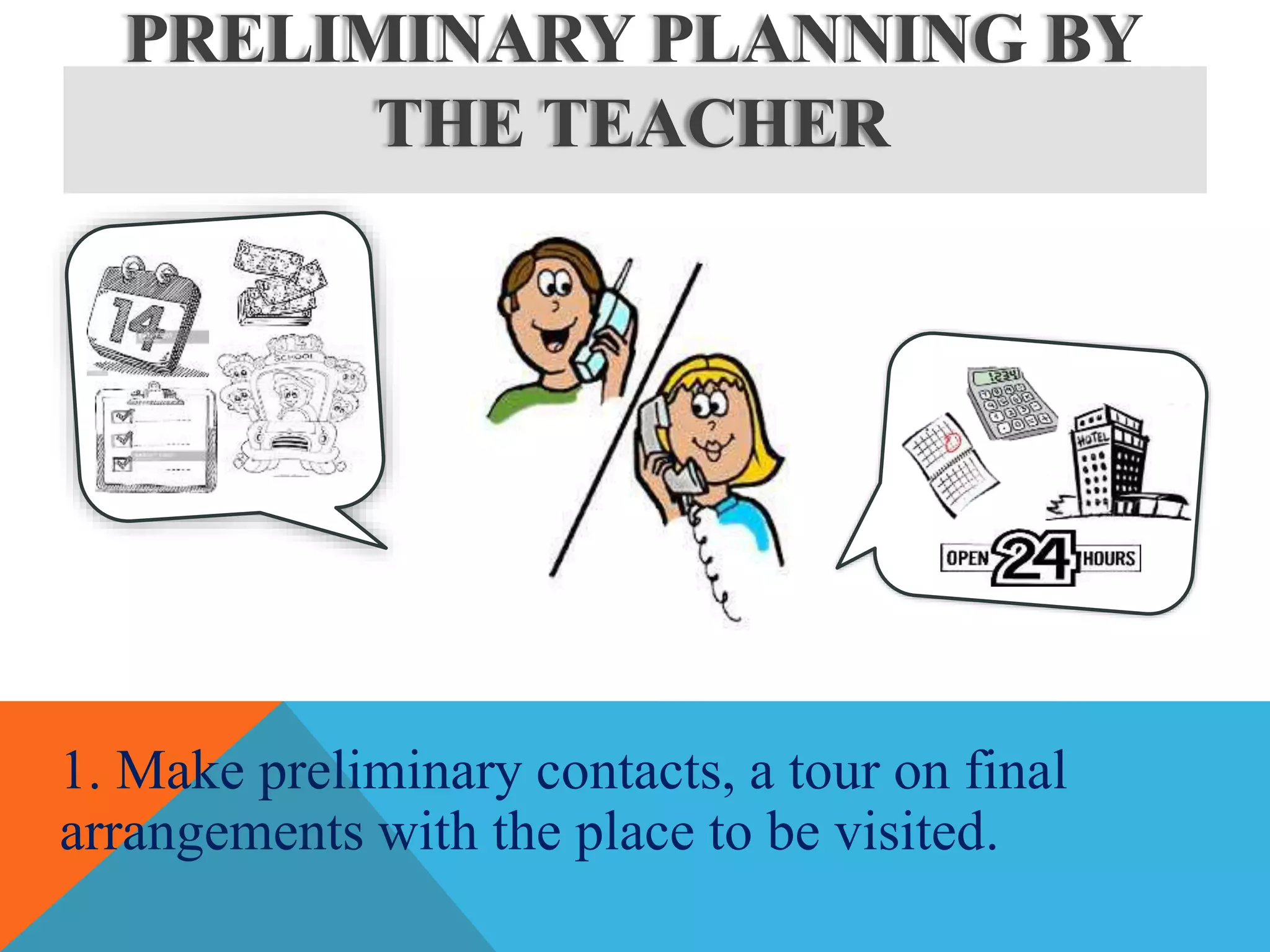
1. Make preliminary contacts, a tour on final
arrangements with the place to be visited.
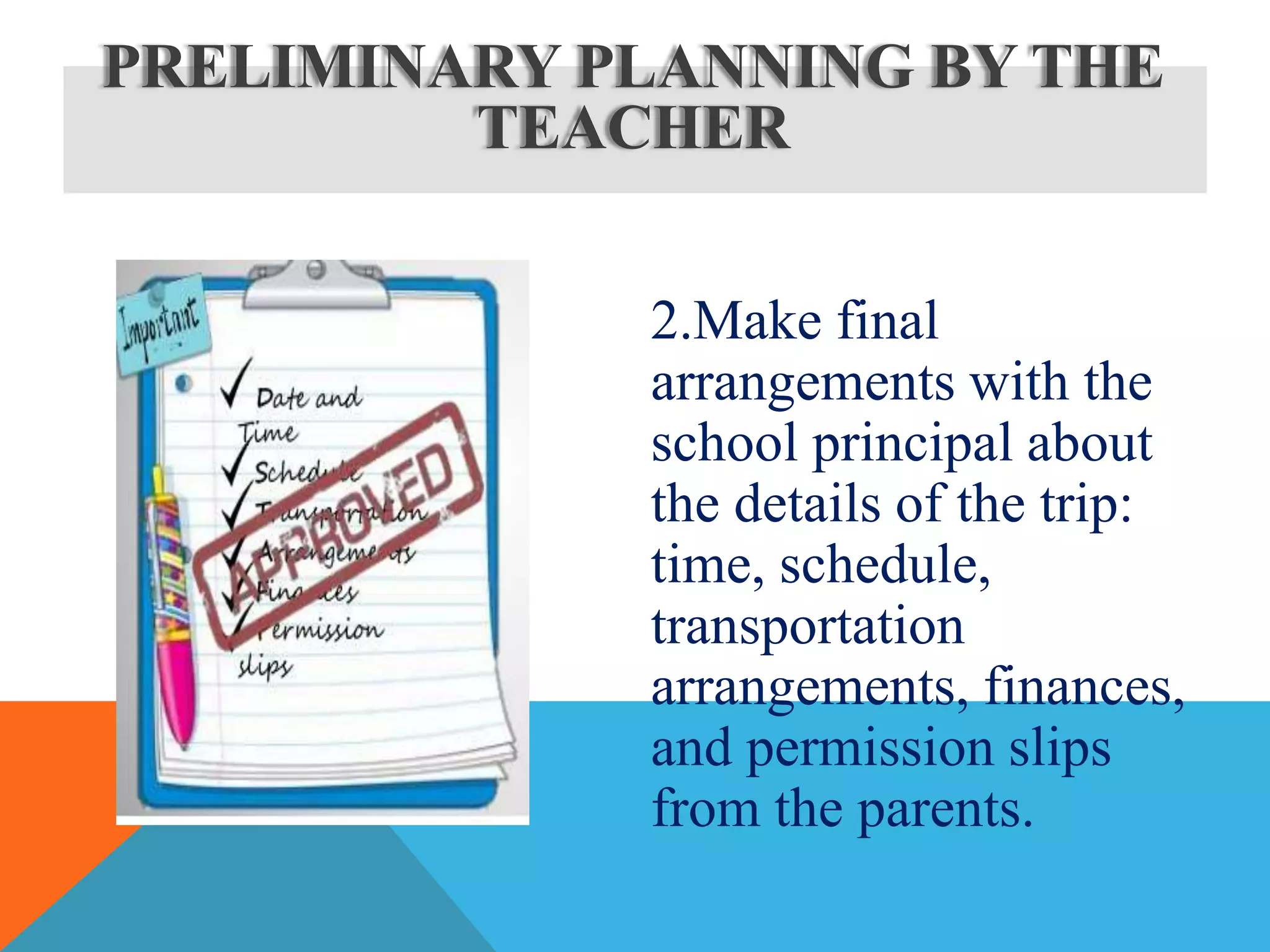
2.Make final
arrangements with the
school principal about
the details of the trip:
time, schedule,
transportation
arrangements, finances,
and permission slips
from the parents.
PRELIMINARY PLANNING BY THE
TEACHER
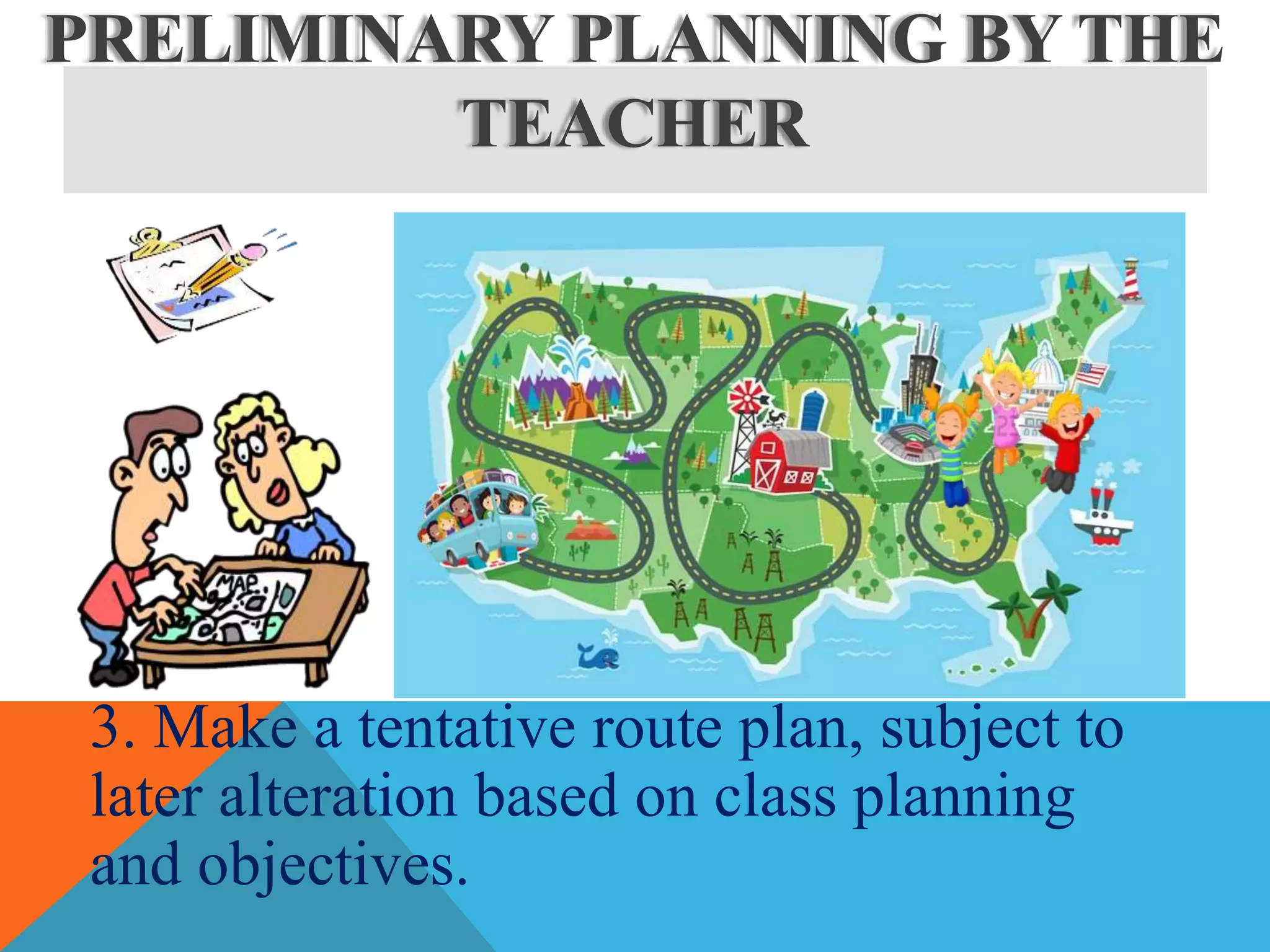
3. Make a tentative route plan, subject to
later alteration based on class planning
and objectives.
PRELIMINARY PLANNING BY THE
TEACHER
4. Try to wok out
mutually
satisfactory
arrangements with
other teachers if the
trip will conflict
with their classes.
PRELIMINARY PLANNING BY THE
TEACHER
5. Prepare preliminary
lists of questions or
other materials which
will be helpful in
planning with the
students.
PRELIMINARY PLANNING BY
THE TEACHER
PREPLANNING WITH OTHERS
GOING ON THE TRIP
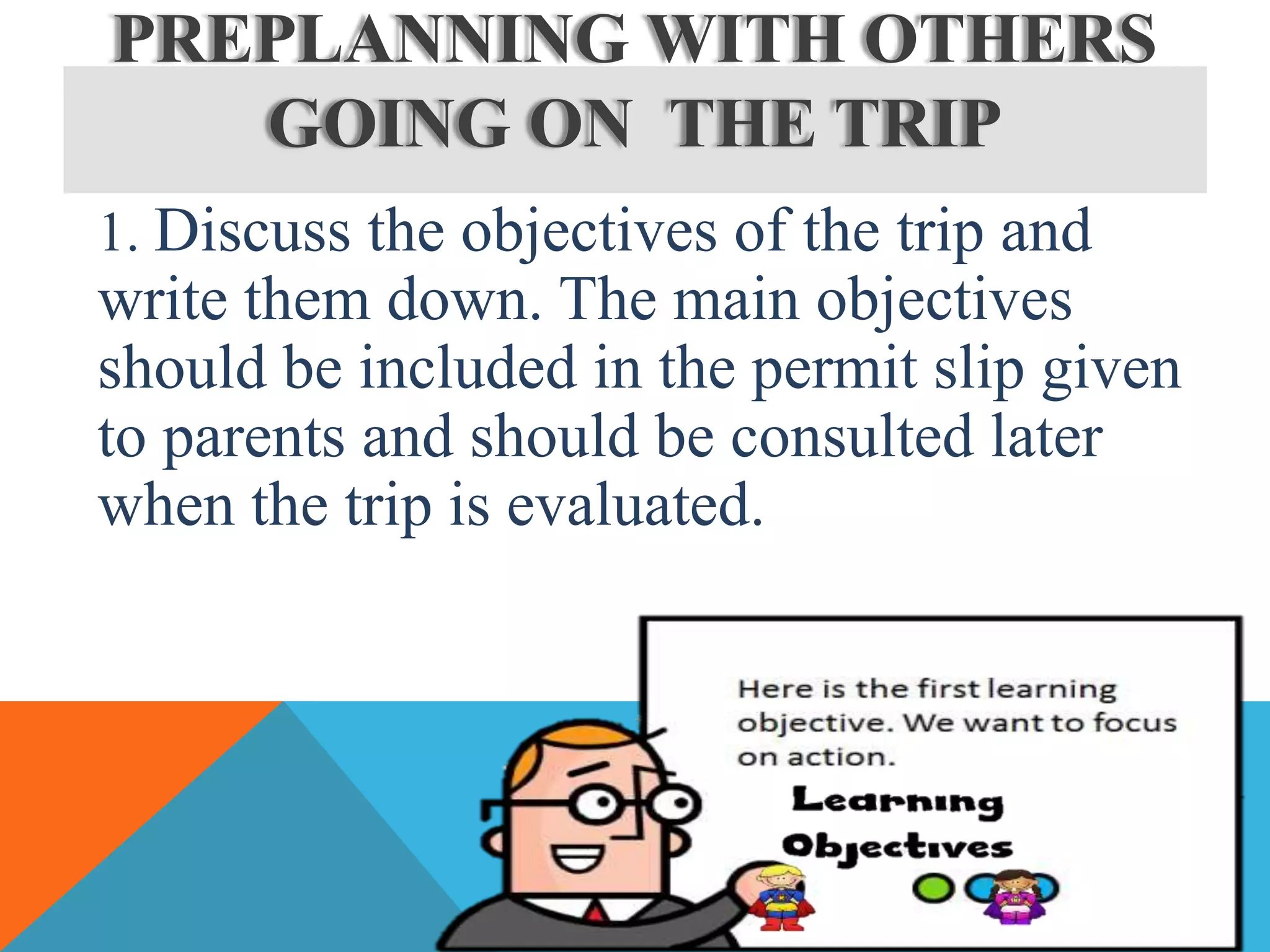
1. Discuss the objectives of the trip and
write them down. The main objectives
should be included in the permit slip given
to parents and should be consulted later
when the trip is evaluated.
PREPLANNING WITH OTHERS
GOING ON THE TRIP
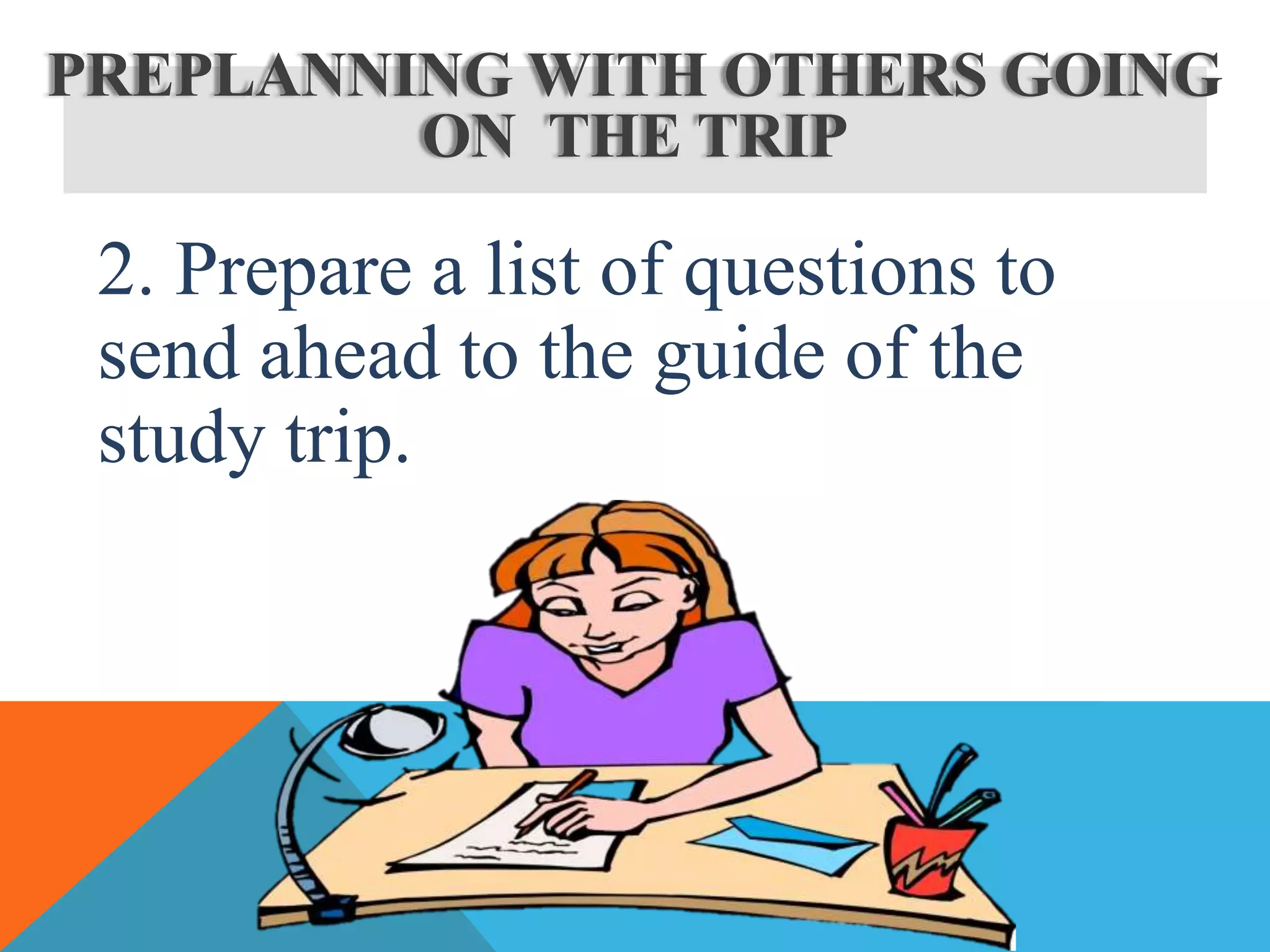
2. Prepare a list of questions to
send ahead to the guide of the
study trip.
PREPLANNING WITH OTHERS GOING
ON THE TRIP
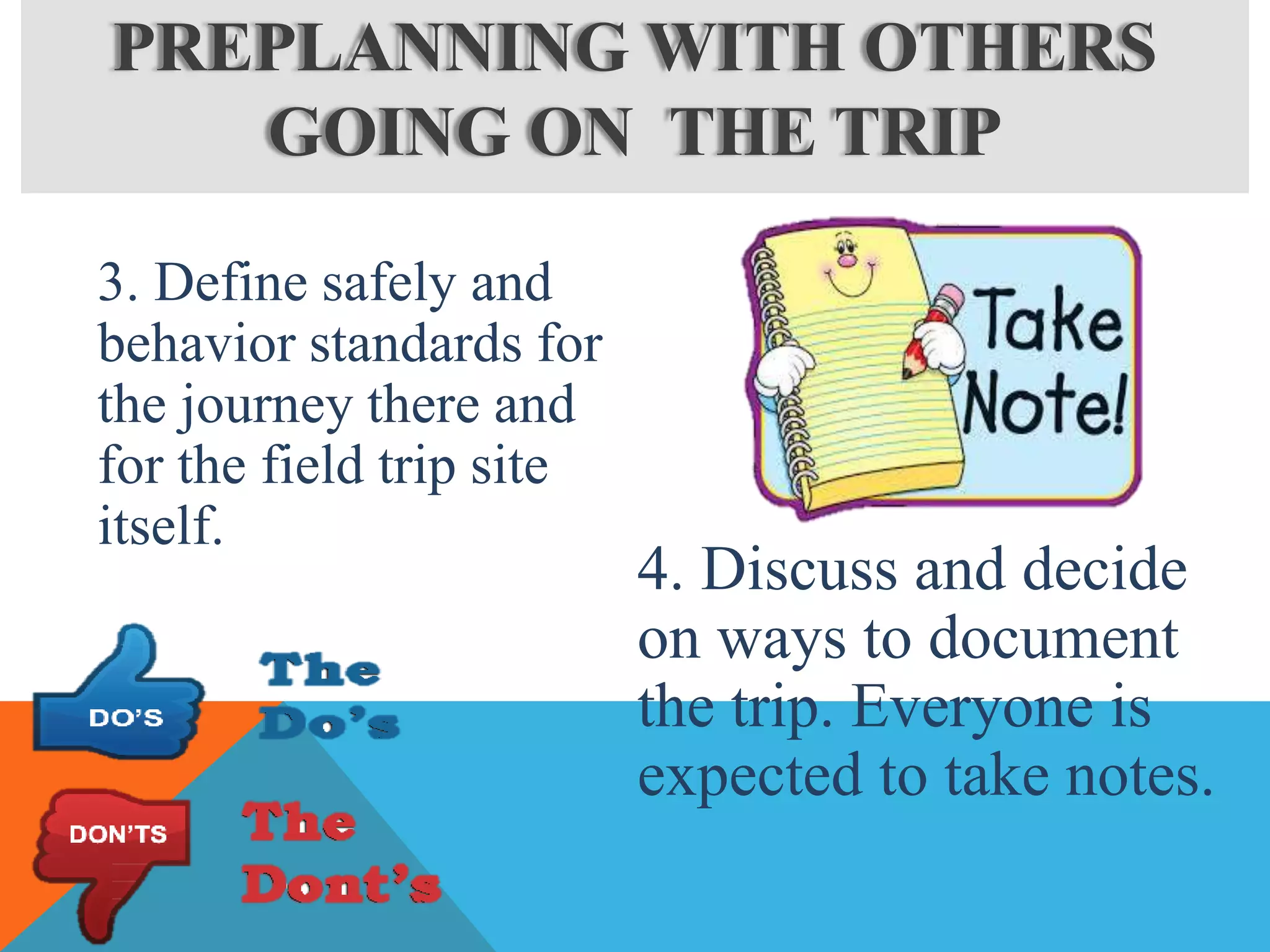
3. Define safely and
behavior standards for
the journey there and
for the field trip site
itself.
4. Discuss and decide
on ways to document
the trip. Everyone is
expected to take notes.
PREPLANNING WITH OTHERS
GOING ON THE TRIP
5. List specific
objects to be seen on
their way to the site,
on the site of the
field trip and on their
way home from the
field trip.
PREPLANNING WITH OTHERS
GOING ON THE TRIP
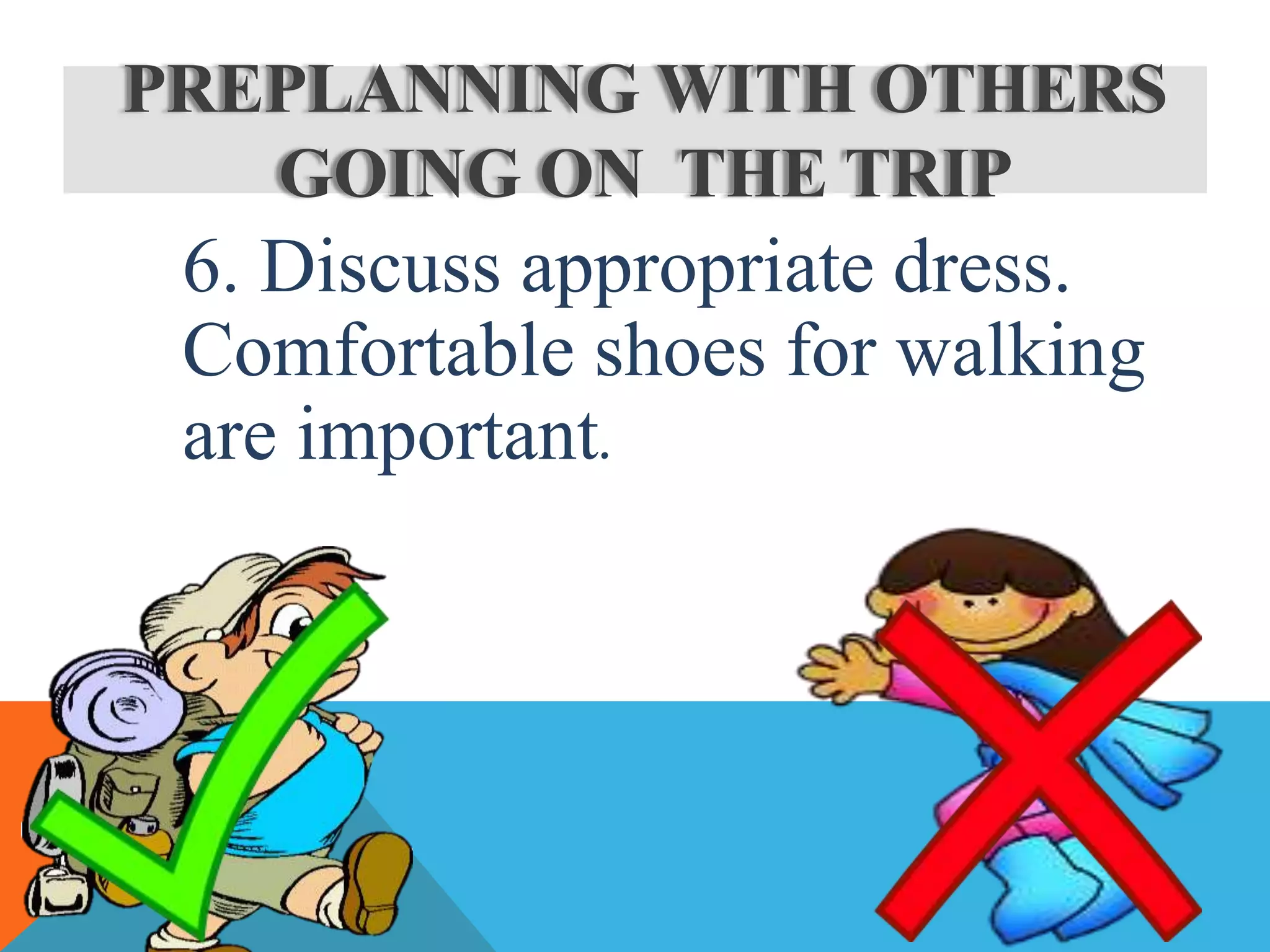
6. Discuss appropriate dress.
Comfortable shoes for walking
are important.
PREPLANNING WITH OTHERS
GOING ON THE TRIP
7. Before the trip, use a variety of learning
materials in order to give each student a
background for the trip. For example, by
viewing a film, a slide set, or a still picture
unit dealing with housing standards and
conditions, a class maybe better prepared to
learn through a visit to an actual slum area.
PREPLANNING WITH OTHERS GOING
ON THE TRIP
Other people accompanying the group
need to be oriented on the objectives,
route, behavior standards required of
everyone so they can help enforce these
standards. These may be parents who will
assist teachers, other teachers and/or
school administrator staff.
PREPLANNING WITH OTHERS
GOING ON THE TRIP
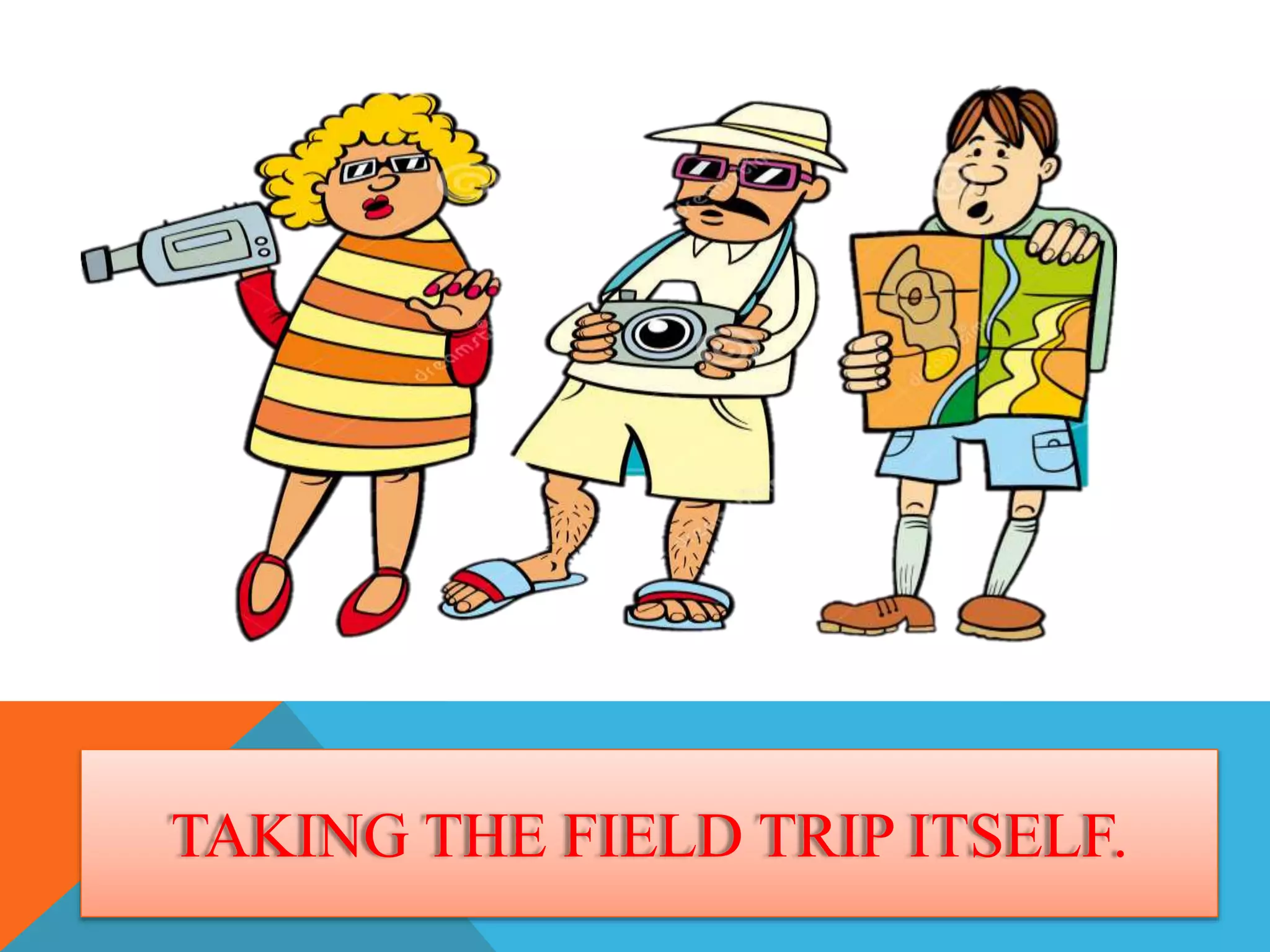
TAKING THE FIELD TRIP ITSELF.
1. Discuss route map of places to be
observed.
2. Upon arriving at the destination, teacher
should check the group and introduce the
guide.
TAKING THE FIELD TRIP
ITSELF.
3. Special effort should be made to ensure
that:
-thetripkeepsonthetimeschedule
-thestudentshavetheopportunitytoobtain
answerstoquestions
-thegroupparticipatescourteouslyintheentiretrip
-theguidestickscloselytothelistofquestions
POST-FIELD TRIP FOLLOW UP
ACTIVITIES.
POST-FIELD TRIP FOLLOW UP
ACTIVITIES.
EVALUATING FIELD TRIP
Could the same benefits be achieved by other materials? Was it worth
the time, effort, and perhaps extra money?
Were there any unexpected problems which could be foreseen
another time? Were these due to guides, students, poor planning, or
unexpected trip conditions?
Were new interests developed?
Should the trip be recommended to other classes studying similar
topics?
These are questions we can ask after the field trip to
evaluate the field trip we just had:
Disadvantages of FieldTrips
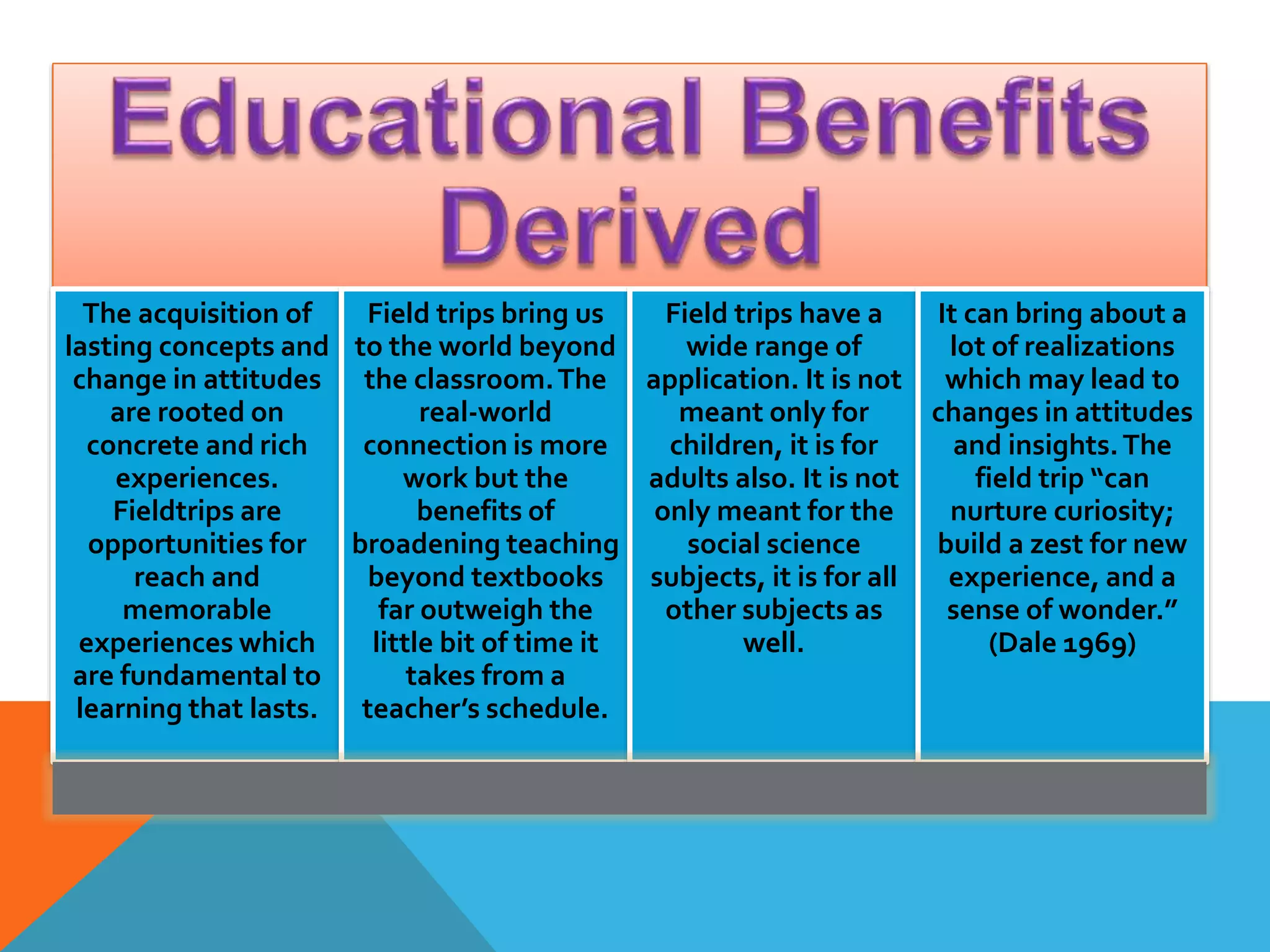
The acquisition of
lasting concepts and
change in attitudes
are rooted on
concrete and rich
experiences.
Fieldtrips are
opportunities for
reach and
memorable
experiences which
are fundamental to
learning that lasts.
Field trips bring us
to the world beyond
the classroom.The
real-world
connection is more
work but the
benefits of
broadening teaching
beyond textbooks
far outweigh the
little bit of time it
takes from a
teacher’s schedule.
Field trips have a
wide range of
application. It is not
meant only for
children, it is for
adults also. It is not
only meant for the
social science
subjects, it is for all
other subjects as
well.
It can bring about a
lot of realizations
which may lead to
changes in attitudes
and insights.The
field trip “can
nurture curiosity;
build a zest for new
experience, and a
sense of wonder.”
(Dale 1969)
DISADVANTAGES OF FIELD
TRIPS
It is costly.
It involves logistics
It is extravagant with time
Contain an elements of uncertainty.
THE FIELD TRIP: A BRIDGE OF THE
SCHOOL AND THE COMMUNITY
THANK
YOU!!

Lesson 11

  • 1.
    MAKING THE MOST OFCOMMUNITY RESOURCES AND FIELD TRIPS By: Angela R. Manlangit Mary Joy D. Rapsing
  • 2.
    HAVE YOU GONETHROUGH A FIELD TRIP? . . What do you suggest to improve a failed field trip?
  • 3.
    OBJECTIVES: Enumerate the proceduresand criteria that must be observed in planning and conducting field trips. Learn the educational benefits of having a field trip. Know the community resources that can be utilized for learning.
  • 4.
    PLANNING A FIELDTRIP INCLUDES THREE STEPS: Preliminary planning by the teacher and preplanning with others going on the trip. Taking the field trip itself. Post-field trip follow up activities.
  • 5.
  • 6.
    PRELIMINARY PLANNING BY THETEACHER 1. Make preliminary contacts, a tour on final arrangements with the place to be visited.
  • 7.
    2.Make final arrangements withthe school principal about the details of the trip: time, schedule, transportation arrangements, finances, and permission slips from the parents. PRELIMINARY PLANNING BY THE TEACHER
  • 8.
    3. Make atentative route plan, subject to later alteration based on class planning and objectives. PRELIMINARY PLANNING BY THE TEACHER
  • 9.
    4. Try towok out mutually satisfactory arrangements with other teachers if the trip will conflict with their classes. PRELIMINARY PLANNING BY THE TEACHER
  • 10.
    5. Prepare preliminary listsof questions or other materials which will be helpful in planning with the students. PRELIMINARY PLANNING BY THE TEACHER
  • 11.
  • 12.
    1. Discuss theobjectives of the trip and write them down. The main objectives should be included in the permit slip given to parents and should be consulted later when the trip is evaluated. PREPLANNING WITH OTHERS GOING ON THE TRIP
  • 13.
    2. Prepare alist of questions to send ahead to the guide of the study trip. PREPLANNING WITH OTHERS GOING ON THE TRIP
  • 14.
    3. Define safelyand behavior standards for the journey there and for the field trip site itself. 4. Discuss and decide on ways to document the trip. Everyone is expected to take notes. PREPLANNING WITH OTHERS GOING ON THE TRIP
  • 15.
    5. List specific objectsto be seen on their way to the site, on the site of the field trip and on their way home from the field trip. PREPLANNING WITH OTHERS GOING ON THE TRIP
  • 16.
    6. Discuss appropriatedress. Comfortable shoes for walking are important. PREPLANNING WITH OTHERS GOING ON THE TRIP
  • 17.
    7. Before thetrip, use a variety of learning materials in order to give each student a background for the trip. For example, by viewing a film, a slide set, or a still picture unit dealing with housing standards and conditions, a class maybe better prepared to learn through a visit to an actual slum area. PREPLANNING WITH OTHERS GOING ON THE TRIP
  • 18.
    Other people accompanyingthe group need to be oriented on the objectives, route, behavior standards required of everyone so they can help enforce these standards. These may be parents who will assist teachers, other teachers and/or school administrator staff. PREPLANNING WITH OTHERS GOING ON THE TRIP
  • 19.
    TAKING THE FIELDTRIP ITSELF.
  • 20.
    TAKING THE FIELDTRIP ITSELF. 1. Discuss route map of places to be observed. 2. Upon arriving at the destination, teacher should check the group and introduce the guide.
  • 21.
    TAKING THE FIELDTRIP ITSELF. 3. Special effort should be made to ensure that: -thetripkeepsonthetimeschedule -thestudentshavetheopportunitytoobtain answerstoquestions -thegroupparticipatescourteouslyintheentiretrip -theguidestickscloselytothelistofquestions
  • 22.
    POST-FIELD TRIP FOLLOWUP ACTIVITIES.
  • 23.
    POST-FIELD TRIP FOLLOWUP ACTIVITIES. EVALUATING FIELD TRIP Could the same benefits be achieved by other materials? Was it worth the time, effort, and perhaps extra money? Were there any unexpected problems which could be foreseen another time? Were these due to guides, students, poor planning, or unexpected trip conditions? Were new interests developed? Should the trip be recommended to other classes studying similar topics? These are questions we can ask after the field trip to evaluate the field trip we just had:
  • 24.
  • 25.
    The acquisition of lastingconcepts and change in attitudes are rooted on concrete and rich experiences. Fieldtrips are opportunities for reach and memorable experiences which are fundamental to learning that lasts. Field trips bring us to the world beyond the classroom.The real-world connection is more work but the benefits of broadening teaching beyond textbooks far outweigh the little bit of time it takes from a teacher’s schedule. Field trips have a wide range of application. It is not meant only for children, it is for adults also. It is not only meant for the social science subjects, it is for all other subjects as well. It can bring about a lot of realizations which may lead to changes in attitudes and insights.The field trip “can nurture curiosity; build a zest for new experience, and a sense of wonder.” (Dale 1969)
  • 26.
    DISADVANTAGES OF FIELD TRIPS Itis costly. It involves logistics It is extravagant with time Contain an elements of uncertainty.
  • 27.
    THE FIELD TRIP:A BRIDGE OF THE SCHOOL AND THE COMMUNITY
  • 28.