
Beans and Eco-efficiency in a Changing Environment Any real change?  Or old wine in new bottles?
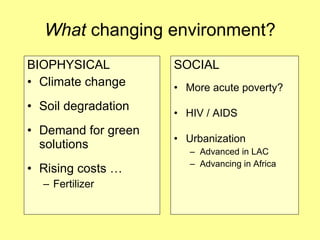
What  changing environment? BIOPHYSICAL Climate change Soil degradation Demand for green solutions Rising costs … Fertilizer SOCIAL More acute poverty? HIV / AIDS Urbanization  Advanced in LAC Advancing in Africa
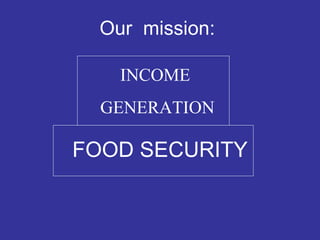
Our  mission:   FOOD SECURITY INCOME  GENERATION
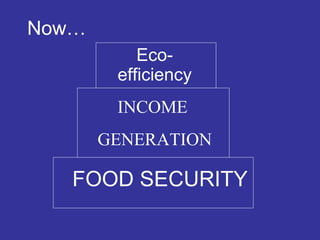
Now… FOOD SECURITY INCOME  GENERATION Eco- efficiency
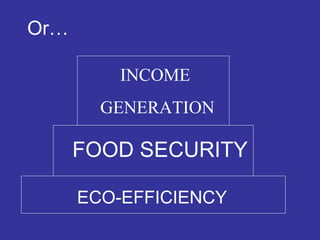
Or…   FOOD SECURITY INCOME  GENERATION ECO-EFFICIENCY
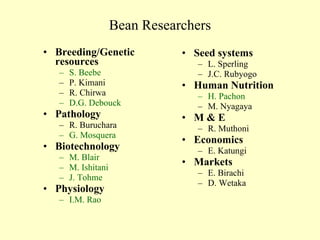
Bean Researchers Breeding/Genetic resources S. Beebe P. Kimani R. Chirwa D.G. Debouck Pathology R. Buruchara G. Mosquera Biotechnology M. Blair  M. Ishitani J. Tohme Physiology I.M. Rao Seed systems L. Sperling J.C. Rubyogo Human Nutrition H. Pachon M. Nyagaya M & E   R. Muthoni Economics E. Katungi Markets E. Birachi D. Wetaka
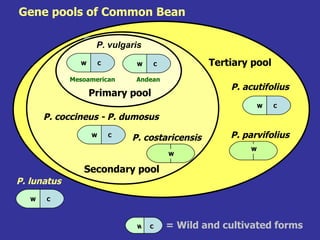
Gene pools of Common Bean Tertiary pool P. lunatus P. acutifolius = Wild and cultivated forms P. parvifolius Secondary   pool P. coccineus - P.   dumosus W C P. vulgaris W C Primary pool Mesoamerican Andean P. costaricensis W W P. vulgaris W C W C W C W C W C W C
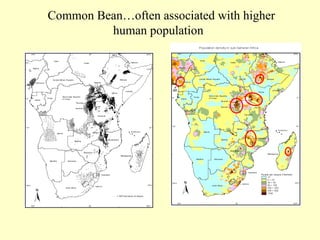
Common Bean…often associated with higher human population
Outputs in the MTP Output 1:  Beans with improved  micronutrient  concentration that have a positive impact on  human health   Output 2:  Beans and technologies that improve  productivity  under  low input agriculture  of poor farmers  Output 3:  Innovative approaches for  Reaching End Users  with eco-efficient technologies
Output 1:  Nutrition  Biofortification – economically viable Conventional breeding Gene discovery Goals for Beans 90-100% more iron  40% more zinc Targets Rwanda and DRC under HarvestPlus Other PABRA countries  Central America, Caribbean, Brazil
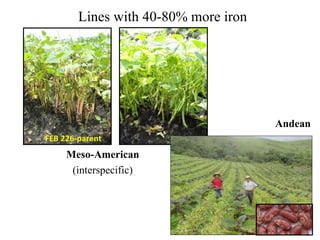
Lines with 40-80% more iron Meso-American (interspecific) Andean FEB 226-parent
PABRA: Support to PLWHA Nutrition! Beans that are less labor intensive,  and  high yielding Semi-climbers!  (race Durango) Rustic  Weed competition High yield Not commercial but food security item
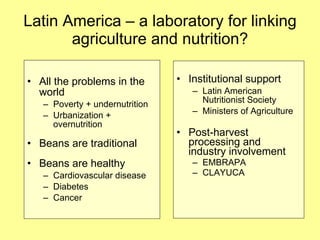
Latin America – a laboratory for linking agriculture and nutrition? All the problems in the world Poverty + undernutrition Urbanization + overnutrition Beans are traditional  Beans are healthy Cardiovascular disease Diabetes Cancer  Institutional support  Latin American Nutritionist Society Ministers of Agriculture Post-harvest processing and industry involvement  EMBRAPA CLAYUCA
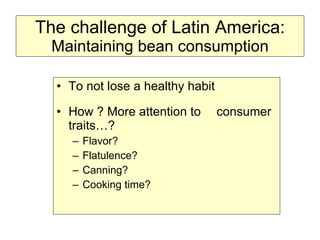
The challenge of Latin America: Maintaining bean consumption To not lose a healthy habit How ? More attention to  consumer traits…? Flavor? Flatulence? Canning? Cooking time?
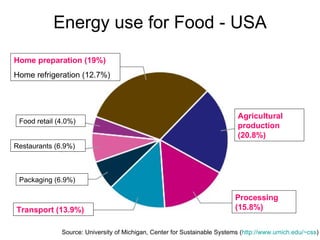
Energy use for Food - USA Source: University of Michigan, Center for Sustainable Systems ( http://www.umich.edu/~css )   Processing (15.8%) Agricultural production (20.8%)   Home preparation (19%) Home refrigeration (12.7%) Transport (13.9%) Food retail (4.0%) Restaurants (6.9%) Packaging (6.9%)
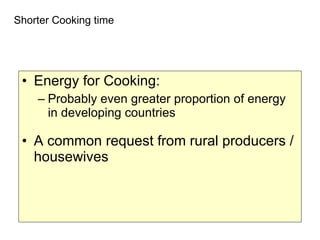
Shorter Cooking time Energy for Cooking:  Probably even greater proportion of energy in developing countries  A common request from rural producers / housewives
Output 2:  Beans and technologies that improve  productivity  under  low input agriculture  of poor farmers
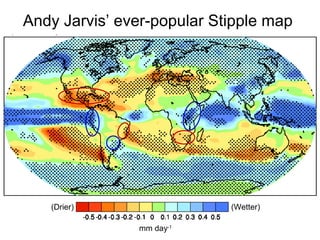
Andy Jarvis’ ever-popular Stipple map  (Drier) mm day -1 (Wetter)
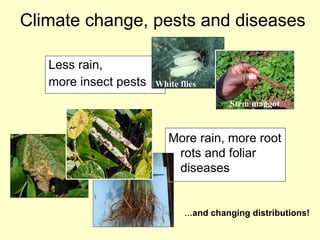
Less rain, more insect pests Climate change, pests and diseases More rain, more root rots and foliar diseases  … and changing distributions!   Stem maggot White flies
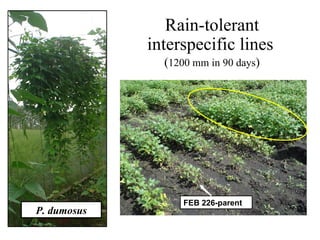
P. dumosus Rain-tolerant interspecific lines   ( 1200 mm in 90 days ) FEB 226-parent
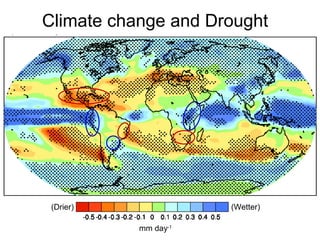
Climate change and Drought  (Drier) mm day -1 (Wetter)
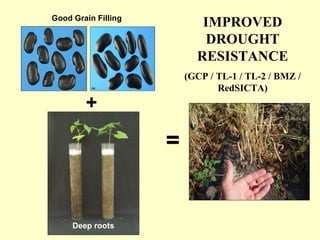
IMPROVED DROUGHT RESISTANCE (GCP / TL-1 / TL-2 / BMZ / RedSICTA) = + Good Grain Filling Deep roots
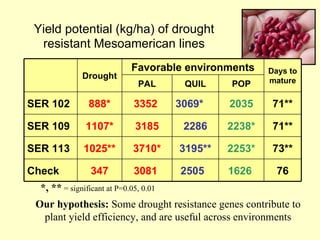
Yield potential (kg/ha) of drought resistant Mesoamerican lines *, **  = significant at P=0.05, 0.01 Our hypothesis:  Some drought resistance genes contribute to plant yield efficiency, and are useful across environments Drought Favorable environments Days to mature PAL QUIL POP SER 102 888* 3352  3069*  2035 71** SER 109 1107* 3185 2286 2238* 71** SER 113 1025** 3710* 3195** 2253* 73** Check 347 3081  2505  1626  76
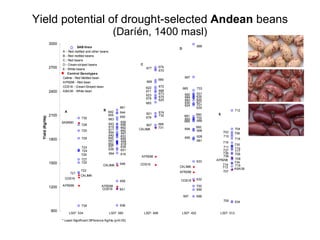
Yield potential of drought-selected  Andean  beans (Daríén, 1400 masl)
The Germplasm in Bernard’s  ISFM Equation A dynamic component!  Dealing with poor soils:
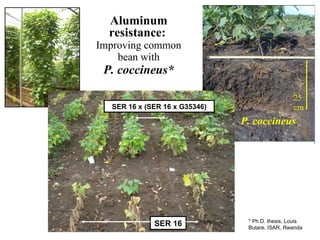
Aluminum resistance:   Improving common bean with  P. coccineus* * Ph.D. thesis, Louis Butare, ISAR, Rwanda 25 cm P. coccineus SER 16 SER 16 x (SER 16 x G35346)
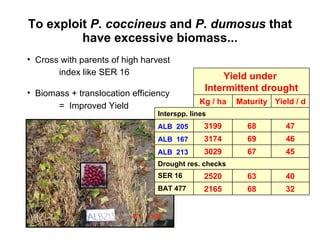
To exploit  P. coccineus  and  P. dumosus  that have excessive biomass... Cross with parents of high harvest  index like SER 16 Biomass + translocation efficiency  =  Improved Yield   Yield under  Intermittent drought Kg / ha Maturity Yield / d Interspp. lines ALB  205 3199 68 47 ALB  167 3174 69 46 ALB  213 3029 67 45 Drought res. checks SER 16 2520 63 40 BAT 477 2165 68 32
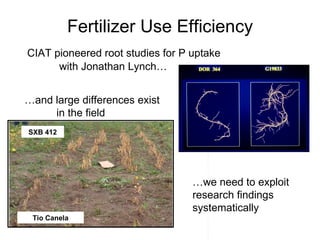
Fertilizer Use Efficiency CIAT pioneered root studies for P uptake  with Jonathan Lynch… SXB 412 … and large differences exist  in the field … we need to exploit research findings systematically Tio Canela
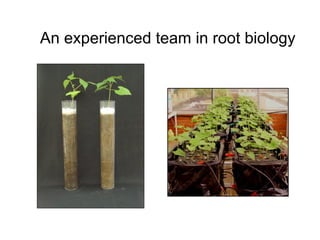
An experienced team in root biology
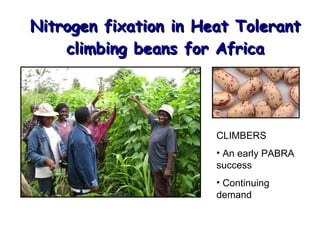
Nitrogen fixation in Heat Tolerant climbing beans for Africa CLIMBERS An early PABRA success Continuing demand
Options for Nitrogen Fixation  Climbers  Sometimes limited by stakes, labor Semi-climbers?  (Type 3) Source of high SNF (Puebla 152) Rustic
Output 3: Innovative approaches for Reaching End Users PABRA - Wider Impact  Estimated 8 M families in 4 years Marshalling partnerships in new organizational models ( e.g., public-private ) Research at the output-outcome interface Novel seed marketing Reaching the HARD to reach Central America and Colombia   Surprising interest Especially in biofortified crops
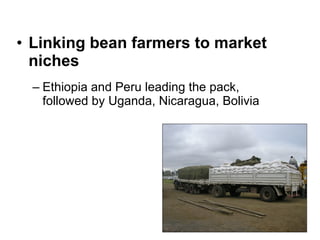
Linking bean farmers to market niches Ethiopia and Peru leading the pack, followed by Uganda, Nicaragua, Bolivia
The other side of the coin:  Energy use and production close to consumption 4 largest exporting countries move > 1.6 M tons annually, for >US$ 250M in transport Does it make sense to ship beans from China to Africa?   Can we increase production closer to consumption? Mexico City Kinshasa Nairobi We won’t convince anyone not to export…  but we need to understand relative competitiveness of exporting / importing countries, and what we can contribute
Conclusion  So is anything new?… Efficient exploitation of interspecific  crosses  Working energy considerations into  research prioritization Renewed focus on efficient plant  nutrition (N and P)  More consumer traits  New approaches for reaching end users
Conclusion  But you don’t necessarily need to do  something different to change… As important as WHAT you do, is… Where you target In what social context For whom
Muchas gracias Bio-fortified Beans

Beans and Eco-efficiency in a Changing Environment

  • 1.
    Beans and Eco-efficiencyin a Changing Environment Any real change? Or old wine in new bottles?
  • 2.
    What changingenvironment? BIOPHYSICAL Climate change Soil degradation Demand for green solutions Rising costs … Fertilizer SOCIAL More acute poverty? HIV / AIDS Urbanization Advanced in LAC Advancing in Africa
  • 3.
    Our mission: FOOD SECURITY INCOME GENERATION
  • 4.
    Now… FOOD SECURITYINCOME GENERATION Eco- efficiency
  • 5.
    Or… FOOD SECURITY INCOME GENERATION ECO-EFFICIENCY
  • 6.
    Bean Researchers Breeding/Geneticresources S. Beebe P. Kimani R. Chirwa D.G. Debouck Pathology R. Buruchara G. Mosquera Biotechnology M. Blair M. Ishitani J. Tohme Physiology I.M. Rao Seed systems L. Sperling J.C. Rubyogo Human Nutrition H. Pachon M. Nyagaya M & E R. Muthoni Economics E. Katungi Markets E. Birachi D. Wetaka
  • 7.
    Gene pools ofCommon Bean Tertiary pool P. lunatus P. acutifolius = Wild and cultivated forms P. parvifolius Secondary pool P. coccineus - P. dumosus W C P. vulgaris W C Primary pool Mesoamerican Andean P. costaricensis W W P. vulgaris W C W C W C W C W C W C
  • 8.
    Common Bean…often associatedwith higher human population
  • 9.
    Outputs in theMTP Output 1: Beans with improved micronutrient concentration that have a positive impact on human health Output 2: Beans and technologies that improve productivity under low input agriculture of poor farmers Output 3: Innovative approaches for Reaching End Users with eco-efficient technologies
  • 10.
    Output 1: Nutrition Biofortification – economically viable Conventional breeding Gene discovery Goals for Beans 90-100% more iron 40% more zinc Targets Rwanda and DRC under HarvestPlus Other PABRA countries Central America, Caribbean, Brazil
  • 11.
    Lines with 40-80%more iron Meso-American (interspecific) Andean FEB 226-parent
  • 12.
    PABRA: Support toPLWHA Nutrition! Beans that are less labor intensive, and high yielding Semi-climbers! (race Durango) Rustic Weed competition High yield Not commercial but food security item
  • 13.
    Latin America –a laboratory for linking agriculture and nutrition? All the problems in the world Poverty + undernutrition Urbanization + overnutrition Beans are traditional Beans are healthy Cardiovascular disease Diabetes Cancer Institutional support Latin American Nutritionist Society Ministers of Agriculture Post-harvest processing and industry involvement EMBRAPA CLAYUCA
  • 14.
    The challenge ofLatin America: Maintaining bean consumption To not lose a healthy habit How ? More attention to consumer traits…? Flavor? Flatulence? Canning? Cooking time?
  • 15.
    Energy use forFood - USA Source: University of Michigan, Center for Sustainable Systems ( http://www.umich.edu/~css ) Processing (15.8%) Agricultural production (20.8%) Home preparation (19%) Home refrigeration (12.7%) Transport (13.9%) Food retail (4.0%) Restaurants (6.9%) Packaging (6.9%)
  • 16.
    Shorter Cooking timeEnergy for Cooking: Probably even greater proportion of energy in developing countries A common request from rural producers / housewives
  • 17.
    Output 2: Beans and technologies that improve productivity under low input agriculture of poor farmers
  • 18.
    Andy Jarvis’ ever-popularStipple map (Drier) mm day -1 (Wetter)
  • 19.
    Less rain, moreinsect pests Climate change, pests and diseases More rain, more root rots and foliar diseases … and changing distributions! Stem maggot White flies
  • 20.
    P. dumosus Rain-tolerantinterspecific lines ( 1200 mm in 90 days ) FEB 226-parent
  • 21.
    Climate change andDrought (Drier) mm day -1 (Wetter)
  • 22.
    IMPROVED DROUGHT RESISTANCE(GCP / TL-1 / TL-2 / BMZ / RedSICTA) = + Good Grain Filling Deep roots
  • 23.
    Yield potential (kg/ha)of drought resistant Mesoamerican lines *, ** = significant at P=0.05, 0.01 Our hypothesis: Some drought resistance genes contribute to plant yield efficiency, and are useful across environments Drought Favorable environments Days to mature PAL QUIL POP SER 102 888* 3352 3069* 2035 71** SER 109 1107* 3185 2286 2238* 71** SER 113 1025** 3710* 3195** 2253* 73** Check 347 3081 2505 1626 76
  • 24.
    Yield potential ofdrought-selected Andean beans (Daríén, 1400 masl)
  • 25.
    The Germplasm inBernard’s ISFM Equation A dynamic component! Dealing with poor soils:
  • 26.
    Aluminum resistance: Improving common bean with P. coccineus* * Ph.D. thesis, Louis Butare, ISAR, Rwanda 25 cm P. coccineus SER 16 SER 16 x (SER 16 x G35346)
  • 27.
    To exploit P. coccineus and P. dumosus that have excessive biomass... Cross with parents of high harvest index like SER 16 Biomass + translocation efficiency = Improved Yield Yield under Intermittent drought Kg / ha Maturity Yield / d Interspp. lines ALB 205 3199 68 47 ALB 167 3174 69 46 ALB 213 3029 67 45 Drought res. checks SER 16 2520 63 40 BAT 477 2165 68 32
  • 28.
    Fertilizer Use EfficiencyCIAT pioneered root studies for P uptake with Jonathan Lynch… SXB 412 … and large differences exist in the field … we need to exploit research findings systematically Tio Canela
  • 29.
    An experienced teamin root biology
  • 30.
    Nitrogen fixation inHeat Tolerant climbing beans for Africa CLIMBERS An early PABRA success Continuing demand
  • 31.
    Options for NitrogenFixation Climbers Sometimes limited by stakes, labor Semi-climbers? (Type 3) Source of high SNF (Puebla 152) Rustic
  • 32.
    Output 3: Innovativeapproaches for Reaching End Users PABRA - Wider Impact Estimated 8 M families in 4 years Marshalling partnerships in new organizational models ( e.g., public-private ) Research at the output-outcome interface Novel seed marketing Reaching the HARD to reach Central America and Colombia Surprising interest Especially in biofortified crops
  • 33.
    Linking bean farmersto market niches Ethiopia and Peru leading the pack, followed by Uganda, Nicaragua, Bolivia
  • 34.
    The other sideof the coin: Energy use and production close to consumption 4 largest exporting countries move > 1.6 M tons annually, for >US$ 250M in transport Does it make sense to ship beans from China to Africa? Can we increase production closer to consumption? Mexico City Kinshasa Nairobi We won’t convince anyone not to export… but we need to understand relative competitiveness of exporting / importing countries, and what we can contribute
  • 35.
    Conclusion Sois anything new?… Efficient exploitation of interspecific crosses Working energy considerations into research prioritization Renewed focus on efficient plant nutrition (N and P) More consumer traits New approaches for reaching end users
  • 36.
    Conclusion Butyou don’t necessarily need to do something different to change… As important as WHAT you do, is… Where you target In what social context For whom
  • 37.

Editor's Notes