Livestock policy paradoxes: 
Promulgating a crisis? 
Or providing a solution? 
16th Asian Australasian Animal Production Congress 
Sustainable Livestock Production in the Perspective of Food Security, 
Policy, Genetic Resources and Climate Change 
Yogyakarta, Indonesia 10–14 November 2014 
Jimmy Smith  Director General  ILRI
How to feed 10 billion people?
Food price crisis 2007/08: 
What can we learn?
Abundant food: 
Dealing with excess
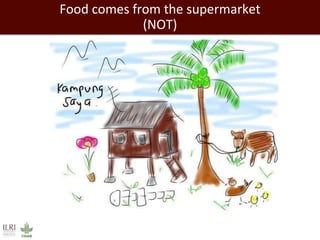
Food comes from the supermarket 
(NOT)
Agricultural investment as portion of ODA 
fell from >15% in mid 80’s to <2.5% by early 2000
A ‘perfect storm’?
8 
0 
50 
100 
150 
200 
250 
2000 
2001 
2002 
2003 
2004 
2005 
2006 
2007 
2008 
2009 
2010 
2011 
2012 
2013 
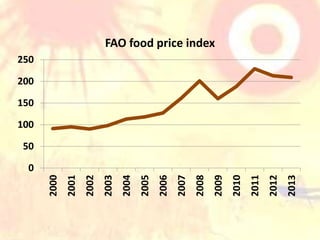
FAO food price index
The crisis: 
The doubling of food prices
Mixed benefits: 
The poor lost out
Global aggregate food balance is not a good indicator 
of food security--Distribution matters as much
Trade matters: but its not a perfect system as the 
food price crisis showed –local markets matter too
Secret or privileged information: 
in a ‘black box -food stockpiles
The rush for resources to produce food –land grab or 
foreign direct investment?
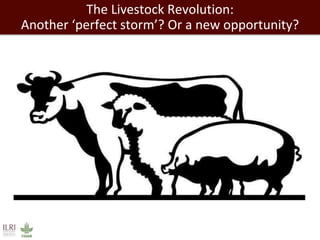
The Livestock Revolution: 
Another ‘perfect storm’? Or a new opportunity?
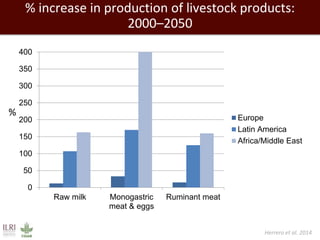
% increase in production of livestock products: 
2000–2050 
400 
350 
300 
250 
200 
150 
100 
50 
0 
Raw milk Monogastric 
meat & eggs 
Ruminant meat 
Europe 
Latin America 
Africa/Middle East 
% 
Herrero et al. 2014
17 
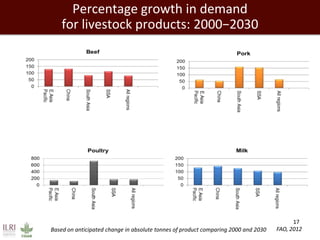
Percentage growth in demand 
for livestock products: 2000−2030 
Based on anticipated change in absolute tonnes of product comparing 2000 and 2030 FAO, 2012
16 
14 
12 
10 
8 
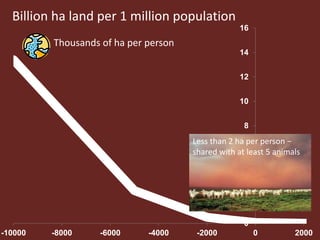
Less than 2 ha per person − 
shared with at 6 
least 5 animals 
4 
2 
0 
Billion ha land per 1 million population 
Thousands of ha per person 
-10000 -8000 -6000 -4000 -2000 0 2000
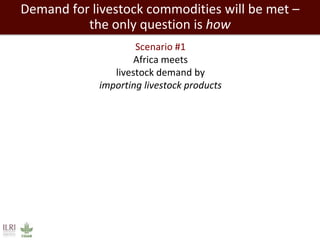
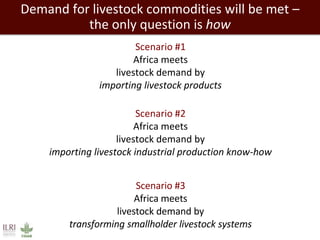
Demand for livestock commodities will be met – 
the only question is how 
Scenario #1 
Africa meets 
livestock demand by 
importing livestock products
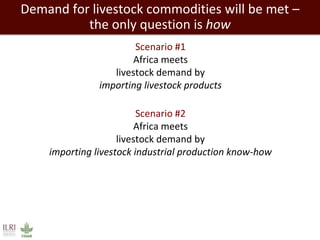
Demand for livestock commodities will be met – 
the only question is how 
Scenario #1 
Africa meets 
livestock demand by 
importing livestock products 
Scenario #2 
Africa meets 
livestock demand by 
importing livestock industrial production know-how
Demand for livestock commodities will be met – 
the only question is how 
Scenario #1 
Africa meets 
livestock demand by 
importing livestock products 
Scenario #2 
Africa meets 
livestock demand by 
importing livestock industrial production know-how 
Scenario #3 
Africa meets 
livestock demand by 
transforming smallholder livestock systems
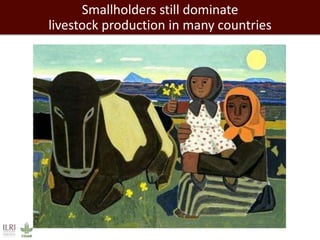
Smallholders still dominate 
livestock production in many countries
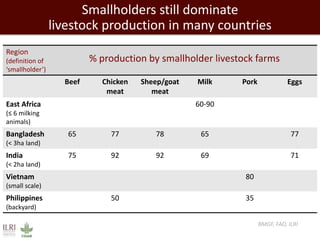
BMGF, FAO, ILRI 
Smallholders still dominate 
livestock production in many countries 
Region 
(definition of 
‘smallholder’) 
% production by smallholder livestock farms 
Beef Chicken 
meat 
Sheep/goat 
meat 
Milk Pork Eggs 
East Africa 
(≤ 6 milking 
animals) 
60-90 
Bangladesh 
(< 3ha land) 
65 77 78 65 77 
India 
(< 2ha land) 
75 92 92 69 71 
Vietnam 
(small scale) 
80 
Philippines 
(backyard) 
50 35
What policies can make the biggest difference?
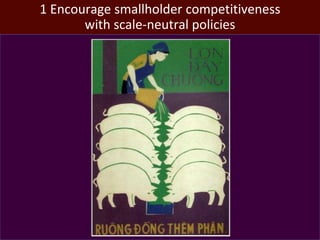
1 Encourage smallholder competitiveness 
with scale-neutral policies
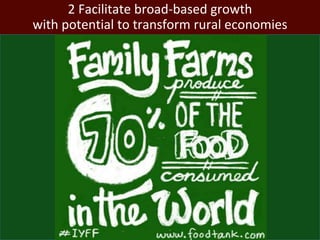
2 Facilitate broad-based growth 
with potential to transform rural economies
3 Enhance local markets and market access
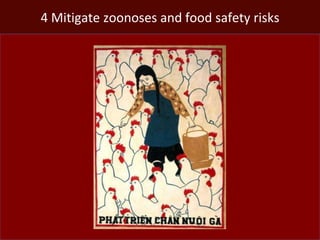
4 Mitigate zoonoses and food safety risks
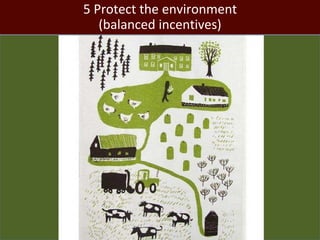
5 Protect the environment 
(balanced incentives)
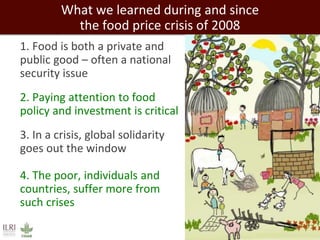
What we learned during and since 
the food price crisis of 2008 
1. Food is both a private and 
public good – often a national 
security issue
What we learned during and since 
the food price crisis of 2008 
1. Food is both a private and 
public good – often a national 
security issue 
2. Paying attention to food 
policy and investment is critical
What we learned during and since 
the food price crisis of 2008 
1. Food is both a private and 
public good – often a national 
security issue 
2. Paying attention to food 
policy and investment is critical 
3. In a crisis, global solidarity 
goes out the window
What we learned during and since 
the food price crisis of 2008 
1. Food is both a private and 
public good – often a national 
security issue 
2. Paying attention to food 
policy and investment is critical 
3. In a crisis, global solidarity 
goes out the window 
4. The poor, individuals and 
countries, suffer more from 
such crises
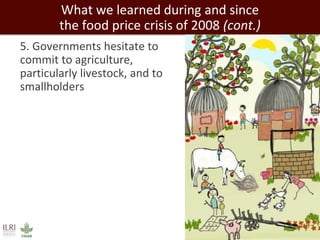
What we learned during and since 
the food price crisis of 2008 (cont.) 
5. Governments hesitate to 
commit to agriculture, 
particularly livestock, and to 
smallholders
What we learned during and since 
the food price crisis of 2008 (cont.) 
5. Governments hesitate to 
commit to agriculture, 
particularly livestock, and to 
smallholders 
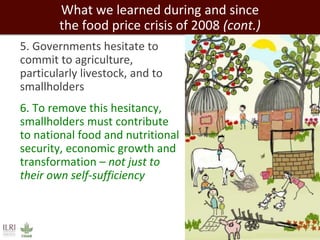
6. To remove this hesitancy, 
smallholders must contribute 
to national food and nutritional 
security, economic growth and 
transformation – not just to 
their own self-sufficiency
What we learned during and since 
the food price crisis of 2008 (cont.) 
5. Governments hesitate to 
commit to agriculture, 
particularly livestock, and to 
smallholders 
6. To remove this hesitancy, 
smallholders must contribute 
to national food and nutritional 
security, economic growth and 
transformation – not just to 
their own self-sufficiency 
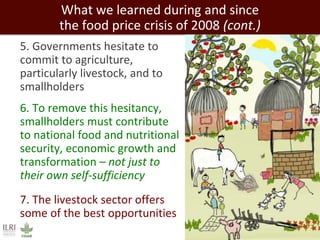
7. The livestock sector offers 
some of the best opportunities
Thank you!
Artworks 
SLIDES 1, 2: Paul Klee, ‘Colourful Group’, 1939 
SLIDE 3: James and Michael Fitzgerald, ‘Leptosome’ (via theprojecttwins.com) 
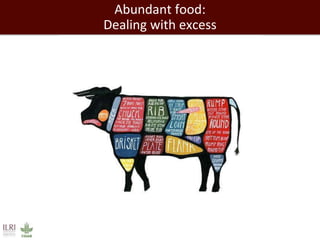
SLIDE 4: Cow Butcher Diagram – ‘Use Every Part of the Cow’ cuts of beef poster (via Etsy) 
SLIDE 5: Azzaharahman (via Instagram) 
SLIDES 1, 6: Martin Devine, ‘Irish Farm’ (via ebsqart.com) 
SLIDE 7: Ancient Australian aboriginal art (via lancelot47.livejournal.com) 
SLIDE 8: Marc Chagall, ‘A Wheatfield on a Summer's Afternoon’, 1942 (via Wikiart) 
SLIDE 9: Brian Cairns, ‘Eggs’ (via briancairns.com) 
SLIDE 10: ‘La vaquita parda’ (via tierradehojas.blogspot.com.es) 
SLIDE 11: Fabio Sironi illustration, printed in the 2010 calendar of Italian NGO Amani (via 
AFRONLINE) 
SLIDES 1, 12: Yuki Sasameya: ‘Untitled’ (via en.tis-home.com)
Artworks (cont.) 
SLIDE 13: Nguyen Phan Chanh, 'La Marchand de Riz' ('The Rice Seller'), 1932 
SLIDE 14: Abner Graboff illustration, ‘The Hungry Goat’ (via stickersandstuff.blogspot.com.es) 
SLIDE 15: Animal silhouettes (via Twitter.com) 
SLIDE 20: Gunnlaugur Scheving (via http://samuel.is) 
SLIDE 22: ‘Keep Calm and Milk a Cow’ poster (via Etsy) 
SLIDE 23: ‘More Livestock, More Manure’ poster, Que Binh, Vietnam, 1972 
SLIDE 24: ‘Family Farms Produce 70% of the Food Consumed in the World’ poster (via 
www.foodtank.com) 
SLIDES 25, 30: Olivia Fraser, ‘Blue Dawn’, 2012 (via bbc.co.uk) 
SLIDE 26: Artist unknown, Vietnam poster (via animalsvietnam.wordpress.com) 
SLIDE 27: Kauniste Maatila, ‘Green Farm’; handprinted kitchen linens inspired by 60s & 70s 
Finnish textiles (via store.mjolk.ca) 
SLIDES 28, 29: Simi Gauba, ‘Tell-a-tale’ (via tigerprint.typepad.com)
better lives through livestock 
ilri.org 
The presentation has a Creative Commons licence. You are free to re-use or distribute this work, provided credit is 
given to ILRI.

Livestock policy paradoxes: Promulgating a crisis? Or providing a solution?

  • 1.
    Livestock policy paradoxes: Promulgating a crisis? Or providing a solution? 16th Asian Australasian Animal Production Congress Sustainable Livestock Production in the Perspective of Food Security, Policy, Genetic Resources and Climate Change Yogyakarta, Indonesia 10–14 November 2014 Jimmy Smith  Director General  ILRI
  • 2.
    How to feed10 billion people?
  • 3.
    Food price crisis2007/08: What can we learn?
  • 4.
  • 5.
    Food comes fromthe supermarket (NOT)
  • 6.
    Agricultural investment asportion of ODA fell from >15% in mid 80’s to <2.5% by early 2000
  • 7.
  • 8.
    8 0 50 100 150 200 250 2000 2001 2002 2003 2004 2005 2006 2007 2008 2009 2010 2011 2012 2013 FAO food price index
  • 9.
    The crisis: Thedoubling of food prices
  • 10.
    Mixed benefits: Thepoor lost out
  • 11.
    Global aggregate foodbalance is not a good indicator of food security--Distribution matters as much
  • 12.
    Trade matters: butits not a perfect system as the food price crisis showed –local markets matter too
  • 13.
    Secret or privilegedinformation: in a ‘black box -food stockpiles
  • 14.
    The rush forresources to produce food –land grab or foreign direct investment?
  • 15.
    The Livestock Revolution: Another ‘perfect storm’? Or a new opportunity?
  • 16.
    % increase inproduction of livestock products: 2000–2050 400 350 300 250 200 150 100 50 0 Raw milk Monogastric meat & eggs Ruminant meat Europe Latin America Africa/Middle East % Herrero et al. 2014
  • 17.
    17 Percentage growthin demand for livestock products: 2000−2030 Based on anticipated change in absolute tonnes of product comparing 2000 and 2030 FAO, 2012
  • 18.
    16 14 12 10 8 Less than 2 ha per person − shared with at 6 least 5 animals 4 2 0 Billion ha land per 1 million population Thousands of ha per person -10000 -8000 -6000 -4000 -2000 0 2000
  • 19.
    Demand for livestockcommodities will be met – the only question is how Scenario #1 Africa meets livestock demand by importing livestock products
  • 20.
    Demand for livestockcommodities will be met – the only question is how Scenario #1 Africa meets livestock demand by importing livestock products Scenario #2 Africa meets livestock demand by importing livestock industrial production know-how
  • 21.
    Demand for livestockcommodities will be met – the only question is how Scenario #1 Africa meets livestock demand by importing livestock products Scenario #2 Africa meets livestock demand by importing livestock industrial production know-how Scenario #3 Africa meets livestock demand by transforming smallholder livestock systems
  • 22.
    Smallholders still dominate livestock production in many countries
  • 23.
    BMGF, FAO, ILRI Smallholders still dominate livestock production in many countries Region (definition of ‘smallholder’) % production by smallholder livestock farms Beef Chicken meat Sheep/goat meat Milk Pork Eggs East Africa (≤ 6 milking animals) 60-90 Bangladesh (< 3ha land) 65 77 78 65 77 India (< 2ha land) 75 92 92 69 71 Vietnam (small scale) 80 Philippines (backyard) 50 35
  • 24.
    What policies canmake the biggest difference?
  • 25.
    1 Encourage smallholdercompetitiveness with scale-neutral policies
  • 26.
    2 Facilitate broad-basedgrowth with potential to transform rural economies
  • 27.
    3 Enhance localmarkets and market access
  • 28.
    4 Mitigate zoonosesand food safety risks
  • 29.
    5 Protect theenvironment (balanced incentives)
  • 30.
    What we learnedduring and since the food price crisis of 2008 1. Food is both a private and public good – often a national security issue
  • 31.
    What we learnedduring and since the food price crisis of 2008 1. Food is both a private and public good – often a national security issue 2. Paying attention to food policy and investment is critical
  • 32.
    What we learnedduring and since the food price crisis of 2008 1. Food is both a private and public good – often a national security issue 2. Paying attention to food policy and investment is critical 3. In a crisis, global solidarity goes out the window
  • 33.
    What we learnedduring and since the food price crisis of 2008 1. Food is both a private and public good – often a national security issue 2. Paying attention to food policy and investment is critical 3. In a crisis, global solidarity goes out the window 4. The poor, individuals and countries, suffer more from such crises
  • 34.
    What we learnedduring and since the food price crisis of 2008 (cont.) 5. Governments hesitate to commit to agriculture, particularly livestock, and to smallholders
  • 35.
    What we learnedduring and since the food price crisis of 2008 (cont.) 5. Governments hesitate to commit to agriculture, particularly livestock, and to smallholders 6. To remove this hesitancy, smallholders must contribute to national food and nutritional security, economic growth and transformation – not just to their own self-sufficiency
  • 36.
    What we learnedduring and since the food price crisis of 2008 (cont.) 5. Governments hesitate to commit to agriculture, particularly livestock, and to smallholders 6. To remove this hesitancy, smallholders must contribute to national food and nutritional security, economic growth and transformation – not just to their own self-sufficiency 7. The livestock sector offers some of the best opportunities
  • 37.
  • 38.
    Artworks SLIDES 1,2: Paul Klee, ‘Colourful Group’, 1939 SLIDE 3: James and Michael Fitzgerald, ‘Leptosome’ (via theprojecttwins.com) SLIDE 4: Cow Butcher Diagram – ‘Use Every Part of the Cow’ cuts of beef poster (via Etsy) SLIDE 5: Azzaharahman (via Instagram) SLIDES 1, 6: Martin Devine, ‘Irish Farm’ (via ebsqart.com) SLIDE 7: Ancient Australian aboriginal art (via lancelot47.livejournal.com) SLIDE 8: Marc Chagall, ‘A Wheatfield on a Summer's Afternoon’, 1942 (via Wikiart) SLIDE 9: Brian Cairns, ‘Eggs’ (via briancairns.com) SLIDE 10: ‘La vaquita parda’ (via tierradehojas.blogspot.com.es) SLIDE 11: Fabio Sironi illustration, printed in the 2010 calendar of Italian NGO Amani (via AFRONLINE) SLIDES 1, 12: Yuki Sasameya: ‘Untitled’ (via en.tis-home.com)
  • 39.
    Artworks (cont.) SLIDE13: Nguyen Phan Chanh, 'La Marchand de Riz' ('The Rice Seller'), 1932 SLIDE 14: Abner Graboff illustration, ‘The Hungry Goat’ (via stickersandstuff.blogspot.com.es) SLIDE 15: Animal silhouettes (via Twitter.com) SLIDE 20: Gunnlaugur Scheving (via http://samuel.is) SLIDE 22: ‘Keep Calm and Milk a Cow’ poster (via Etsy) SLIDE 23: ‘More Livestock, More Manure’ poster, Que Binh, Vietnam, 1972 SLIDE 24: ‘Family Farms Produce 70% of the Food Consumed in the World’ poster (via www.foodtank.com) SLIDES 25, 30: Olivia Fraser, ‘Blue Dawn’, 2012 (via bbc.co.uk) SLIDE 26: Artist unknown, Vietnam poster (via animalsvietnam.wordpress.com) SLIDE 27: Kauniste Maatila, ‘Green Farm’; handprinted kitchen linens inspired by 60s & 70s Finnish textiles (via store.mjolk.ca) SLIDES 28, 29: Simi Gauba, ‘Tell-a-tale’ (via tigerprint.typepad.com)
  • 40.
    better lives throughlivestock ilri.org The presentation has a Creative Commons licence. You are free to re-use or distribute this work, provided credit is given to ILRI.

Editor's Notes

  • #10 Demand and supply remain asynchronous The prices have never stabilized since
  • #11 20 million people benefited from high prices for the food they produced and sold But because the poor use the highest portion of their income on food – 60 million fell into poverty Meaning some 40 million people were negatively impacted by this one shock
  • #16 There remains a paradoxical low investment in the livestock sector in the midst of steeply rising demand. And the smallholder sector --- where much of the meat and milk are currently being produced --- remains marginalized.
  • #19 This is not arable land but total land surface – 13.4 billion ha. Only 11% of this is estimated to be arable land, with a further 2.7 billion ha possible for crop production. A total of 4.2 billion ha is suitable for rainfed agriculture. Such gross figures serve to illustrative the demands on natural resources, with land as an example in this case.
  • #23 Vietnam Small Scale Farming with Low Biosecurity                              1-2 sows, <20 pigs Small Scale Farming with Minimum Biosecurity                   50-20 sow, <100 pigs   Philippines Backyard  - any farm or household raising at least one head of animal and does not qualify as a commercial farm. Commercial - if it satisfies at least one of the following conditions: a) at least 21 heads of adults and zero young b) at least 41 heads of young animals c) at least 10 heads of adults and 22 heads of young.
  • #24 Vietnam Small Scale Farming with Low Biosecurity                              1-2 sows, <20 pigs Small Scale Farming with Minimum Biosecurity                   50-20 sow, <100 pigs   Philippines Backyard  - any farm or household raising at least one head of animal and does not qualify as a commercial farm. Commercial - if it satisfies at least one of the following conditions: a) at least 21 heads of adults and zero young b) at least 41 heads of young animals c) at least 10 heads of adults and 22 heads of young.
  • #26 Promote neutral-scale policies that don’t discriminate against local markets and allow smallholder livestock farmers to be more competitive
  • #27 Find ways smallholder livestock farmers can position their production systems to meet the rising demand for animal-source foods and thereby help transform rural economies
  • #28 Address the needs of informal markets, which will continue to matter most to the poor, while providing incentives for supermarkets to source more meat, milk and eggs from smallholder farmers and herders.
  • #29 Encourage multi-disciplinary and multi-sector learning and programs to better prevent and control emerging and re-emerging zoonotic diseases (transmitted from livestock to people) that become more common when people and animals live closer together.
  • #30 Take appropriate steps to ensure that environmental threats are reduced in this livestock transition period Smallholders can intensify and become more efficient without concentration – less environmental harm
  • #39 SLIDES 1, 2: Paul Klee, ‘Colourful Group’, 1939   SLIDE 3: James and Michael Fitzgerald, ‘Leptosome’ (via theprojecttwins.com)   SLIDE 4: Detailed Cow Butcher Diagram – ‘Use Every Part of the Cow’ cuts of beef poster (via Etsy)   SLIDE 5: Azzaharahman (via Instagram)   SLIDES 1, 6: Martin Devine, ‘Irish Farm’ (via ebsqart.com)   SLIDE 7: Ancient Australian aboriginal art (via lancelot47.livejournal.com)   SLIDE 8: Marc Chagall, ‘A Wheatfield on a Summer's Afternoon’, 1942 (via Wikiart)   SLIDE 9: Brian Cairns, ‘Eggs’ ( via briancairns.com)   SLIDE 10: ‘La vaquita parda’ (via tierradehojas.blogspot.com.es)   SLIDE 11: Fabio Sironi illustration, printed in the 2010 calendar of Italian NGO Amani (via AFRONLINE)   SLIDES 1, 12: Yuki Sasameya: ‘Untitled’ (via en.tis-home.com)   SLIDE 13: Nguyen Phan Chanh, 'La Marchand de Riz' ('The Rice Seller'), 1932   SLIDE 14: Abner Graboff illustration, ‘The Hungry Goat’ (via stickersandstuff.blogspot.com.es)   SLIDE 15: Animal silhouettes (via Twitter.com)   SLIDE 20: Gunnlaugur Scheving (via http://samuel.is)   SLIDE 22: ‘Keep Calm and Milk a Cow’ poster (via Etsy)   SLIDE 23: ‘More Livestock, More Manure’ poster, Que Binh, Vietnam, 1972   SLIDE 24: ‘Family Farms Produce 70% of the Food Consumed in the World’ poster (via www.foodtank.com)   SLIDES 25 AND 30: Olivia Fraser, ‘Blue Dawn’, 2012 (via bbc.co.uk)   SLIDE 26: Vietnam poster. Unknown artist (via animalsvietnam.wordpress.com)   SLIDE 27: Kauniste Maatila, Tea Towel, Green Farm; handprinted kitchen linens inspired by 60s & 70s Finnish textiles (via store.mjolk.ca)   SLIDES 28-29: Simi Gauba, ‘Tell-a-tale’ (via tigerprint.typepad.com)
  • #40 SLIDES 1, 2: Paul Klee, ‘Colourful Group’, 1939   SLIDE 3: James and Michael Fitzgerald, ‘Leptosome’ (via theprojecttwins.com)   SLIDE 4: Detailed Cow Butcher Diagram – ‘Use Every Part of the Cow’ cuts of beef poster (via Etsy)   SLIDE 5: Azzaharahman (via Instagram)   SLIDES 1, 6: Martin Devine, ‘Irish Farm’ (via ebsqart.com)   SLIDE 7: Ancient Australian aboriginal art (via lancelot47.livejournal.com)   SLIDE 8: Marc Chagall, ‘A Wheatfield on a Summer's Afternoon’, 1942 (via Wikiart)   SLIDE 9: Brian Cairns, ‘Eggs’ ( via briancairns.com)   SLIDE 10: ‘La vaquita parda’ (via tierradehojas.blogspot.com.es)   SLIDE 11: Fabio Sironi illustration, printed in the 2010 calendar of Italian NGO Amani (via AFRONLINE)   SLIDES 1, 12: Yuki Sasameya: ‘Untitled’ (via en.tis-home.com)   SLIDE 13: Nguyen Phan Chanh, 'La Marchand de Riz' ('The Rice Seller'), 1932   SLIDE 14: Abner Graboff illustration, ‘The Hungry Goat’ (via stickersandstuff.blogspot.com.es)   SLIDE 15: Animal silhouettes (via Twitter.com)   SLIDE 20: Gunnlaugur Scheving (via http://samuel.is)   SLIDE 22: ‘Keep Calm and Milk a Cow’ poster (via Etsy)   SLIDE 23: ‘More Livestock, More Manure’ poster, Que Binh, Vietnam, 1972   SLIDE 24: ‘Family Farms Produce 70% of the Food Consumed in the World’ poster (via www.foodtank.com)   SLIDES 25 AND 30: Olivia Fraser, ‘Blue Dawn’, 2012 (via bbc.co.uk)   SLIDE 26: Vietnam poster. Unknown artist (via animalsvietnam.wordpress.com)   SLIDE 27: Kauniste Maatila, Tea Towel, Green Farm; handprinted kitchen linens inspired by 60s & 70s Finnish textiles (via store.mjolk.ca)   SLIDES 28-29: Simi Gauba, ‘Tell-a-tale’ (via tigerprint.typepad.com)