ME3491 – THEORY OF MACHINES
BY
Mr.M.DHANENTHIRAN
ASSISTANT PROFESSOR
DEPARTMENT OF MECHANICAL ENGINEERING
UNIT-1 - KINEMATICS OF MECHANISMS
Mechanisms – Terminology and definitions – kinematics inversions of 4 bar
and slide crank chain – kinematics analysis in simple mechanisms – velocity
and acceleration polygons– Analytical methods – computer approach – cams
– classifications – displacement diagrams - layout of plate cam profiles –
derivatives of followers motion – circular arc and tangent cams.
THEORY OF MACHINES
• It’s an applied science that is used to understand the various relative motion
between various parts of the machine or mechanism and force which acts on
them.
• Aspects of mechanical system
1. Analysis: Relative motion that takes place in that mechanism
2. Synthesis: Come up with the design of mechanism (determine the
acceleration of the link)
• Thus the scientific analysis that deals with Motion, Time and Force is called
as “Mechanics”
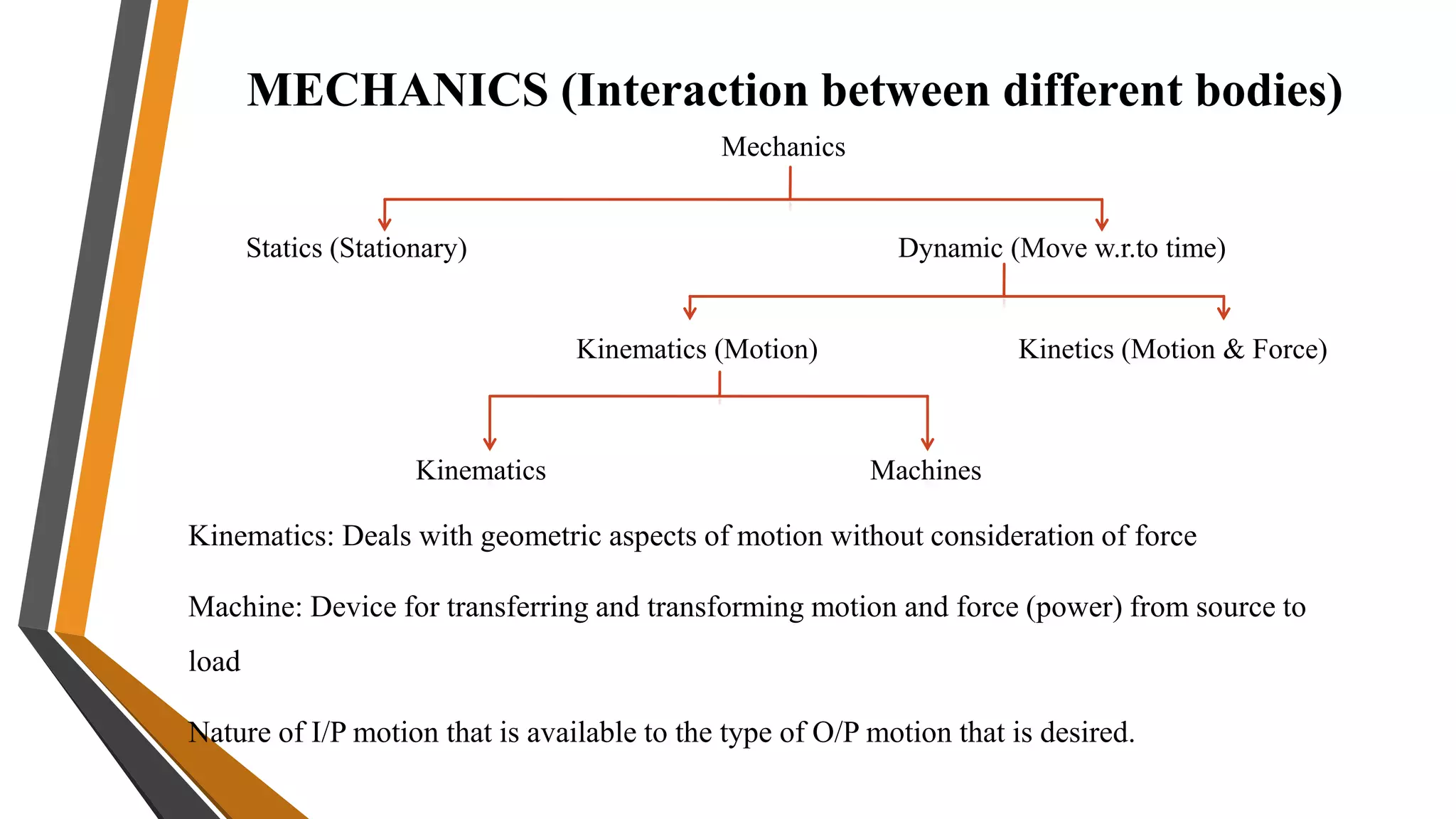
MECHANICS (Interaction between different bodies)
Mechanics
Statics (Stationary) Dynamic (Move w.r.to time)
Kinematics (Motion) Kinetics (Motion & Force)
Kinematics Machines
Kinematics: Deals with geometric aspects of motion without consideration of force
Machine: Device for transferring and transforming motion and force (power) from source to
load
Nature of I/P motion that is available to the type of O/P motion that is desired.
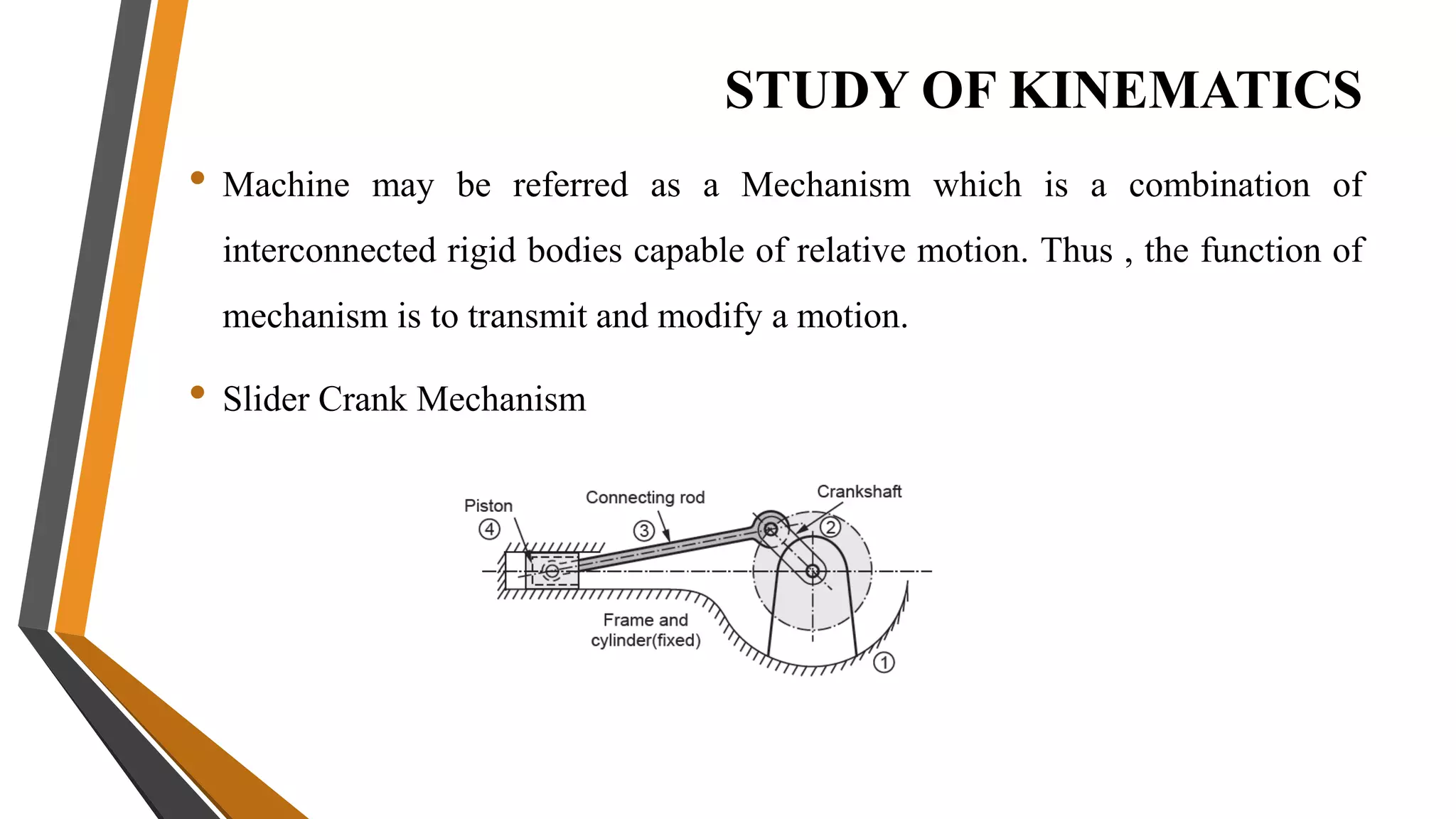
STUDY OF KINEMATICS
• Machine may be referred as a Mechanism which is a combination of
interconnected rigid bodies capable of relative motion. Thus , the function of
mechanism is to transmit and modify a motion.
• Slider Crank Mechanism
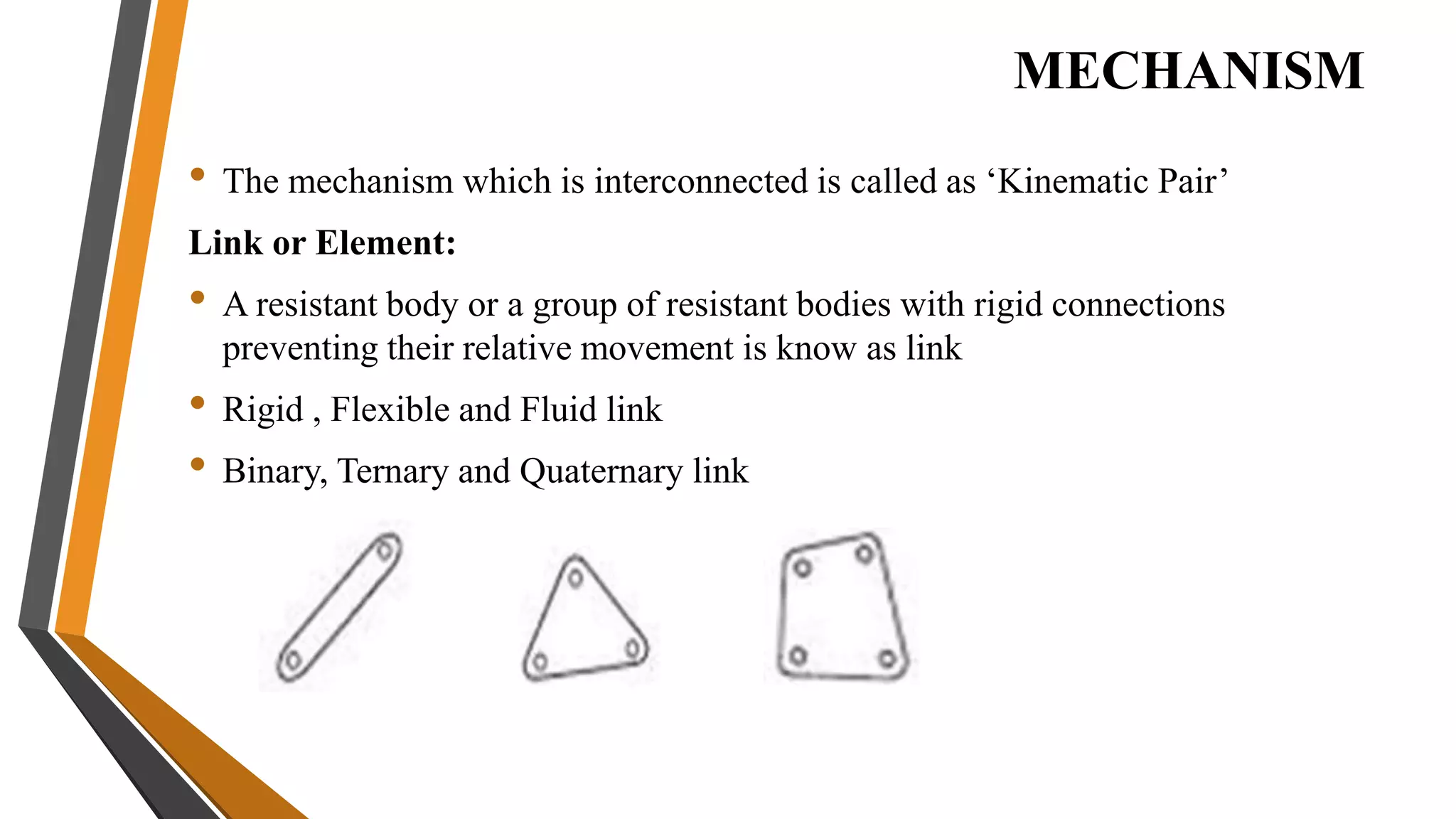
MECHANISM
• The mechanism which is interconnected is called as ‘Kinematic Pair’
Link or Element:
• A resistant body or a group of resistant bodies with rigid connections
preventing their relative movement is know as link
• Rigid , Flexible and Fluid link
• Binary, Ternary and Quaternary link
KINEMATIC PAIR
• It’s a joint of two links having relative motion between them.
Its Classified according to
• Nature of Contact
• Nature of Mechanical Constraint
• Nature of relative motion
• Degrees of Freedom(DOF)
JOINTS
• Two or more links at the nodes which allow some motion between the connected links
(Kinematic Pair)
• Binary joint, Ternary joint, Quaternary Joint.
Cont.….
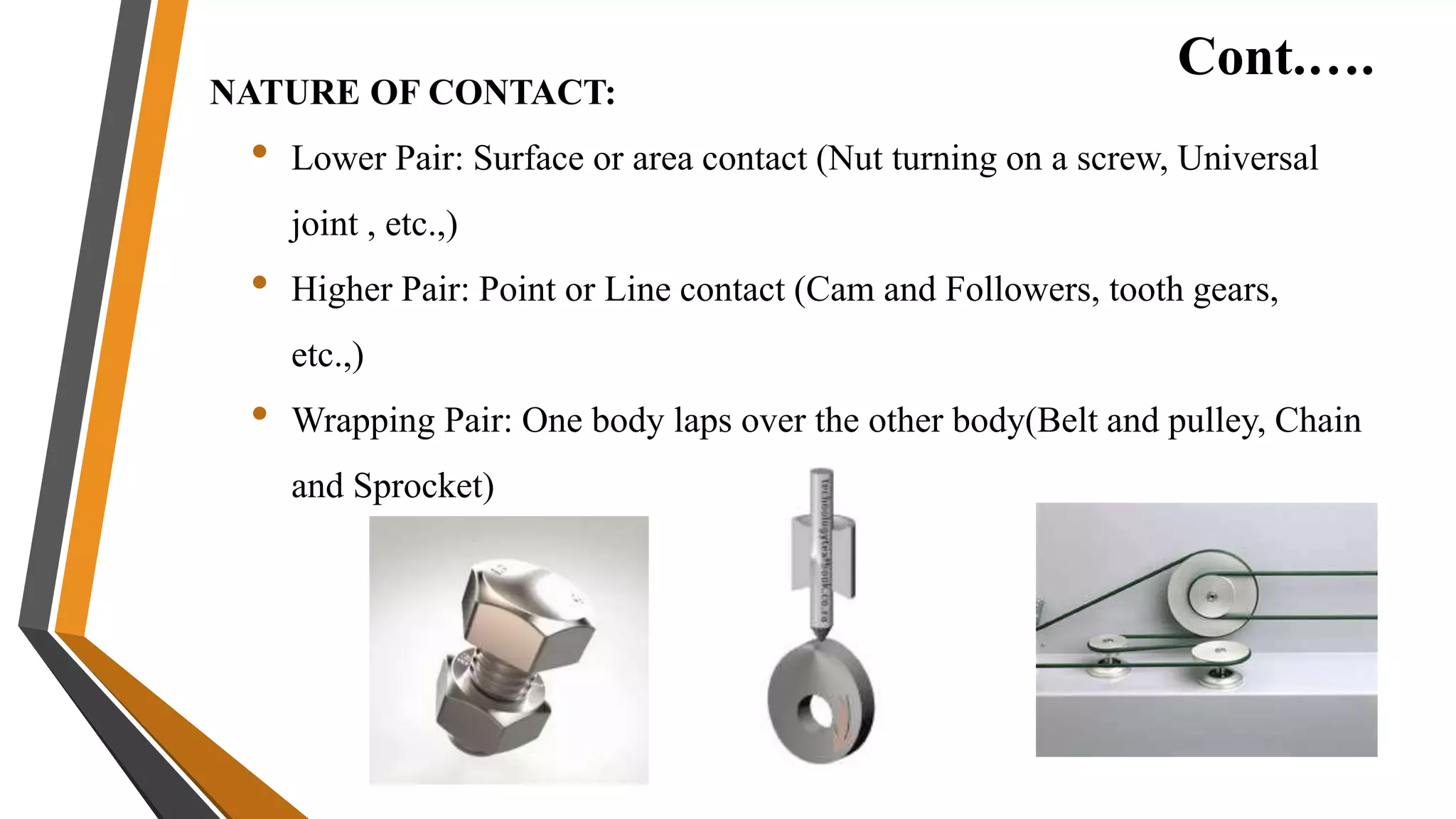
NATURE OF CONTACT:
• Lower Pair: Surface or area contact (Nut turning on a screw, Universal
joint , etc.,)
• Higher Pair: Point or Line contact (Cam and Followers, tooth gears,
etc.,)
• Wrapping Pair: One body laps over the other body(Belt and pulley, Chain
and Sprocket)
Cont.….
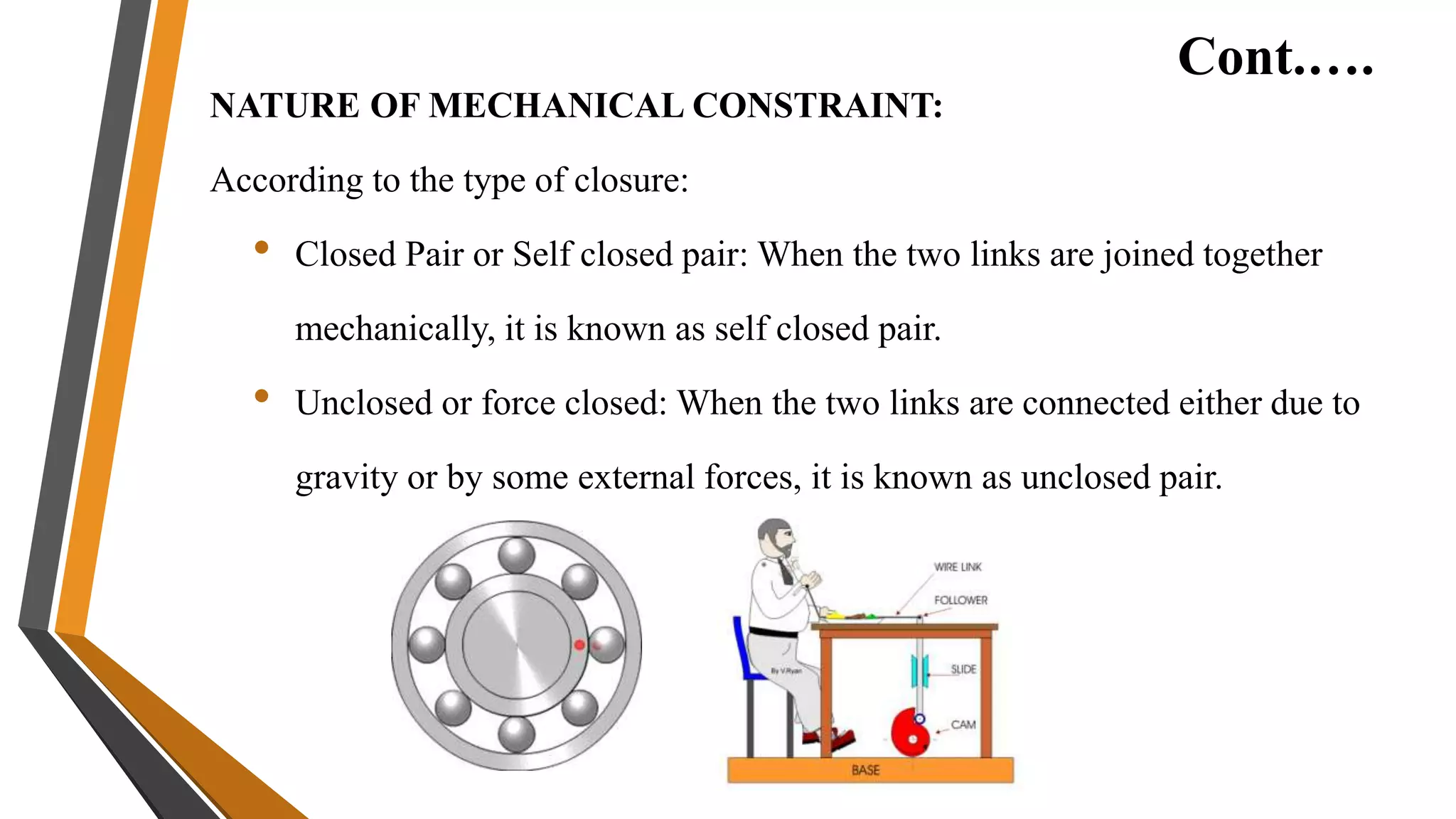
NATURE OF MECHANICAL CONSTRAINT:
According to the type of closure:
• Closed Pair or Self closed pair: When the two links are joined together
mechanically, it is known as self closed pair.
• Unclosed or force closed: When the two links are connected either due to
gravity or by some external forces, it is known as unclosed pair.
Cont.….
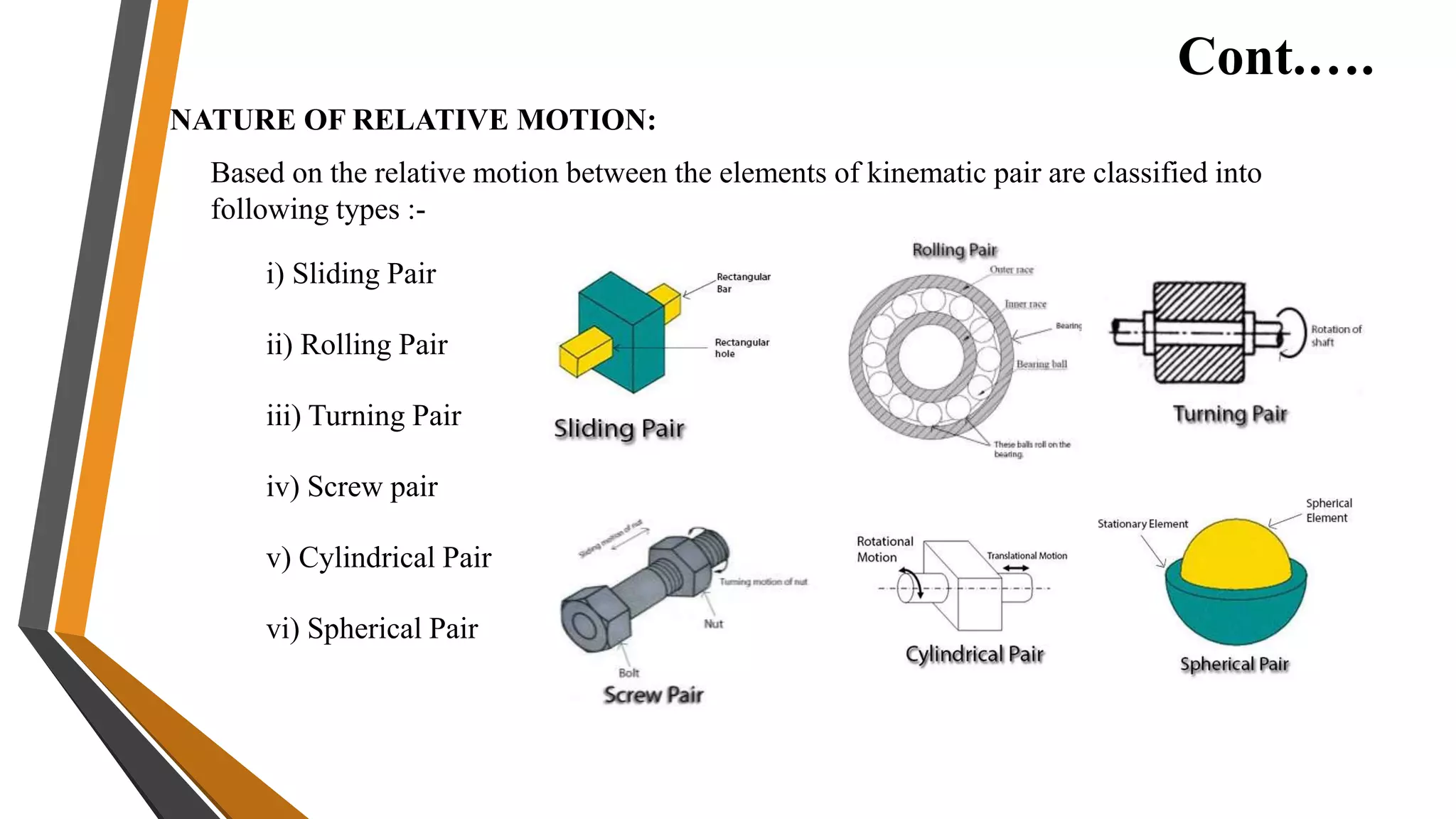
NATURE OF RELATIVE MOTION:
Based on the relative motion between the elements of kinematic pair are classified into
following types :-
i) Sliding Pair
ii) Rolling Pair
iii) Turning Pair
iv) Screw pair
v) Cylindrical Pair
vi) Spherical Pair
Cont.….
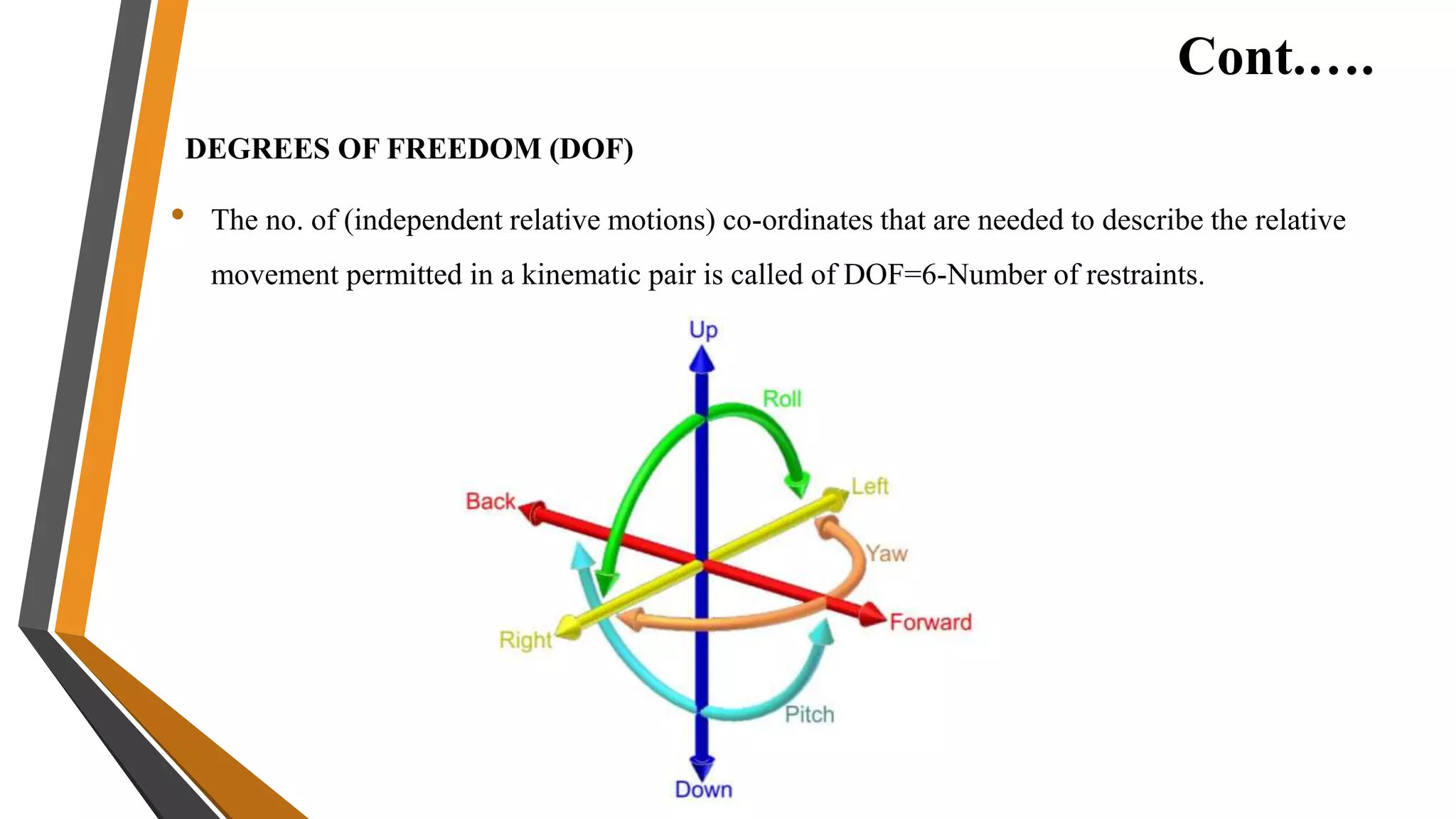
DEGREES OF FREEDOM (DOF)
• The no. of (independent relative motions) co-ordinates that are needed to describe the relative
movement permitted in a kinematic pair is called of DOF=6-Number of restraints.
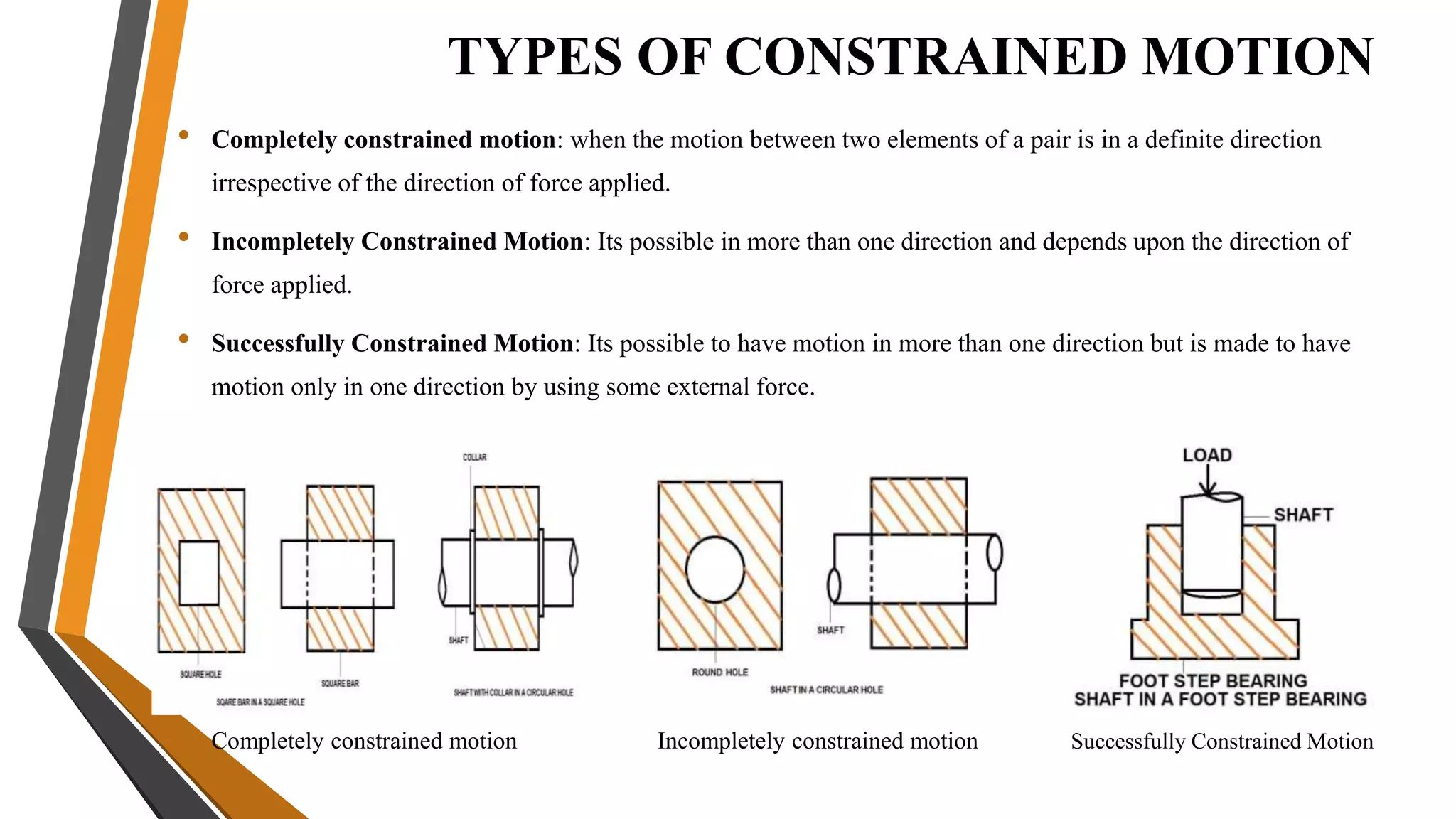
TYPES OF CONSTRAINED MOTION
• Completely constrained motion: when the motion between two elements of a pair is in a definite direction
irrespective of the direction of force applied.
• Incompletely Constrained Motion: Its possible in more than one direction and depends upon the direction of
force applied.
• Successfully Constrained Motion: Its possible to have motion in more than one direction but is made to have
motion only in one direction by using some external force.
• Completely constrained motion Incompletely constrained motion Successfully Constrained Motion
KINEMATIC CHAIN
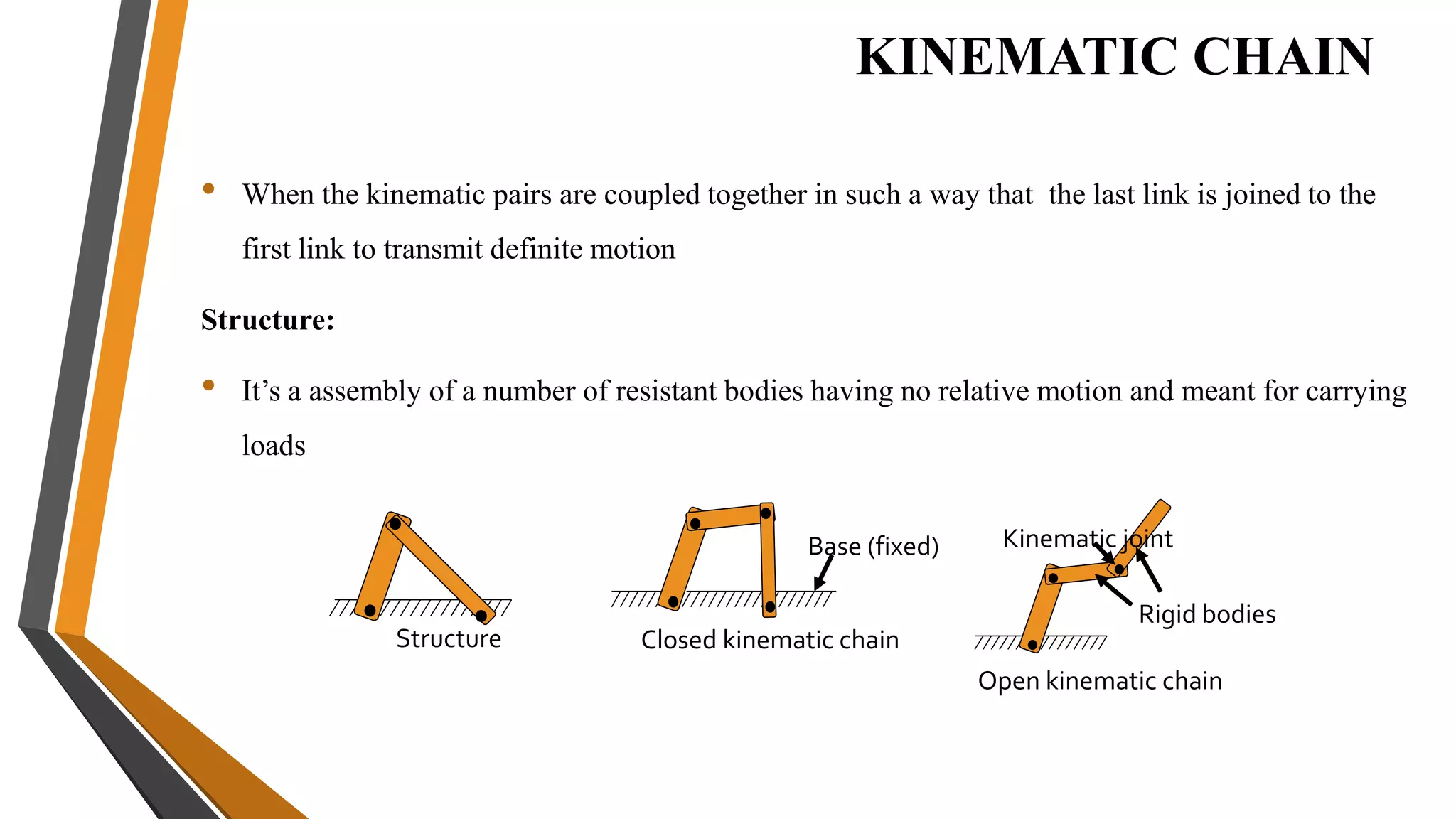
• When the kinematic pairs are coupled together in such a way that the last link is joined to the
first link to transmit definite motion
Structure:
• It’s a assembly of a number of resistant bodies having no relative motion and meant for carrying
loads
Closed kinematic chain
Base (fixed)
Structure
Open kinematic chain
Kinematic joint
Rigid bodies
MECHANISM
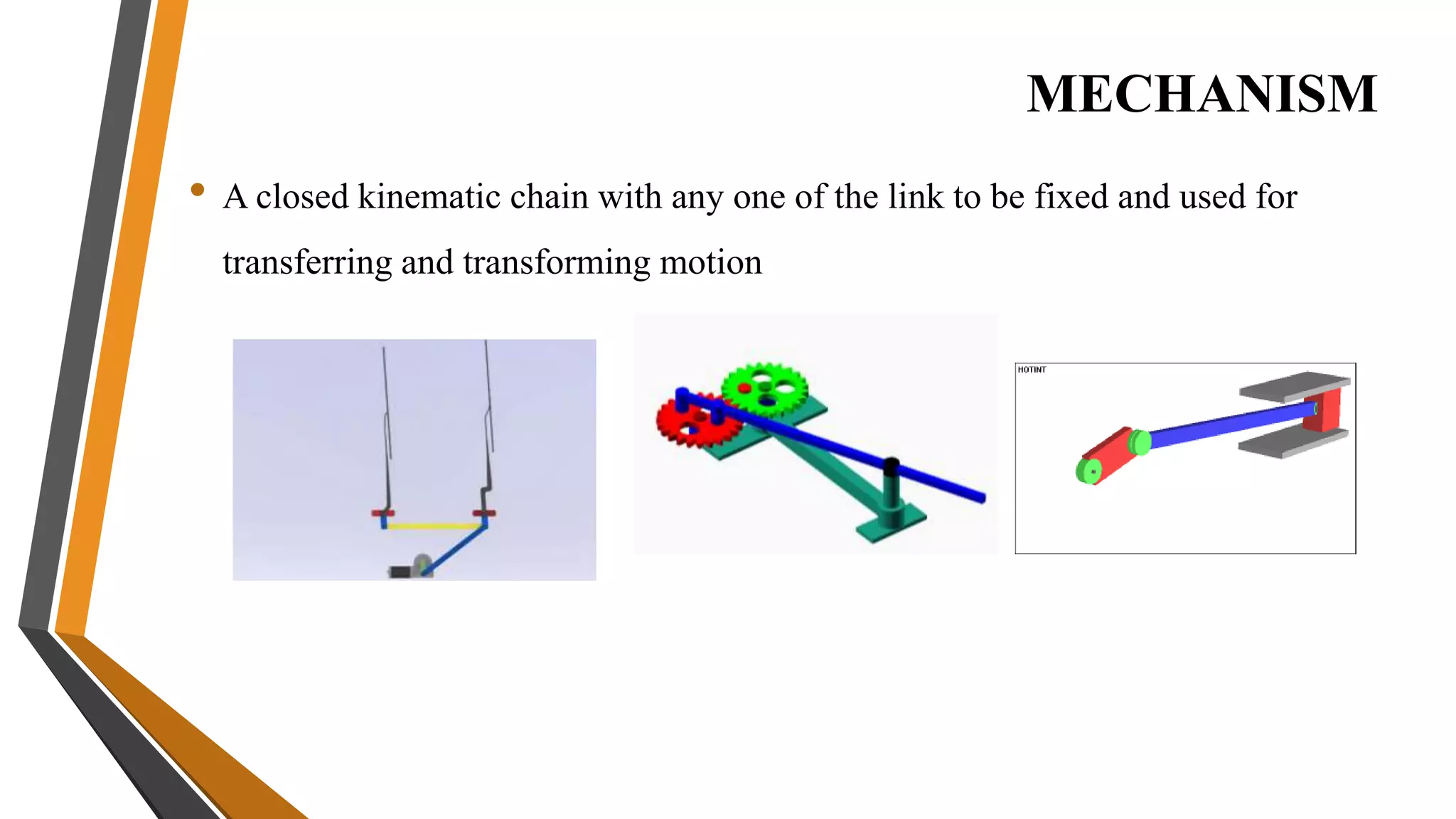
• A closed kinematic chain with any one of the link to be fixed and used for
transferring and transforming motion
KUTZBACH CRITERION
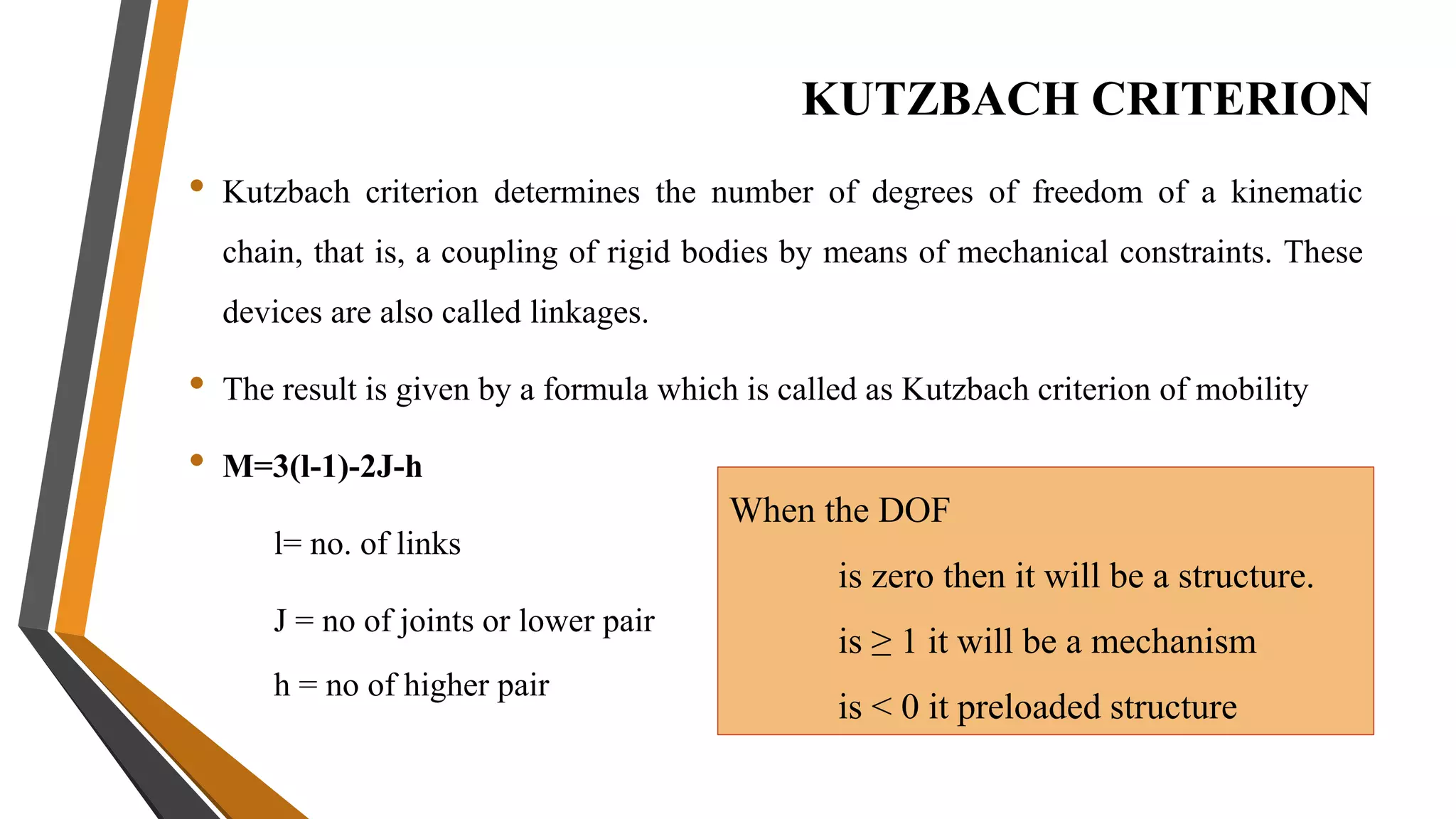
• Kutzbach criterion determines the number of degrees of freedom of a kinematic
chain, that is, a coupling of rigid bodies by means of mechanical constraints. These
devices are also called linkages.
• The result is given by a formula which is called as Kutzbach criterion of mobility
• M=3(l-1)-2J-h
l= no. of links
J = no of joints or lower pair
h = no of higher pair
When the DOF
is zero then it will be a structure.
is ≥ 1 it will be a mechanism
is < 0 it preloaded structure
ACTIVITY
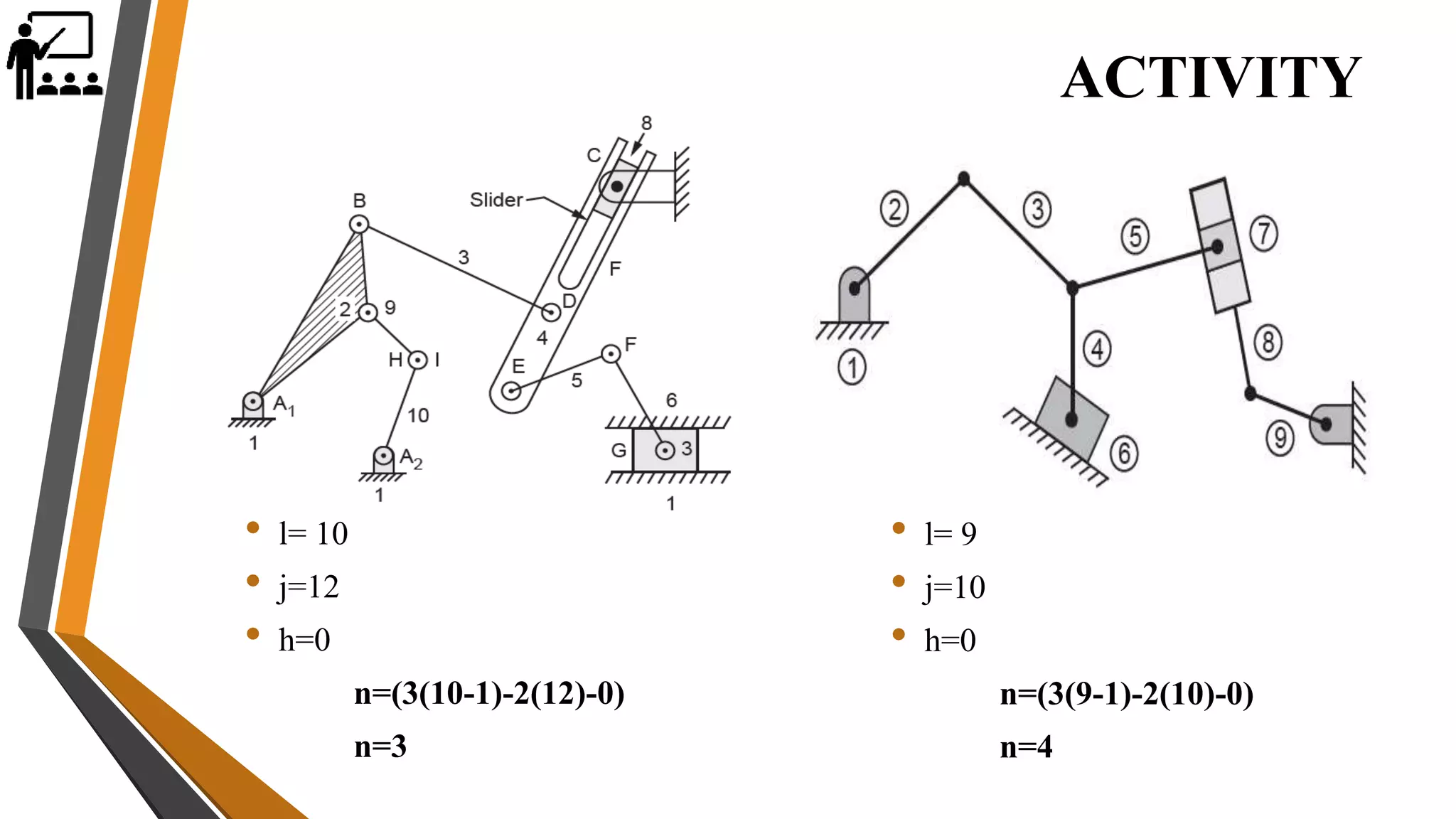
• l= 10
• j=12
• h=0
n=(3(10-1)-2(12)-0)
n=3
• l= 9
• j=10
• h=0
n=(3(9-1)-2(10)-0)
n=4
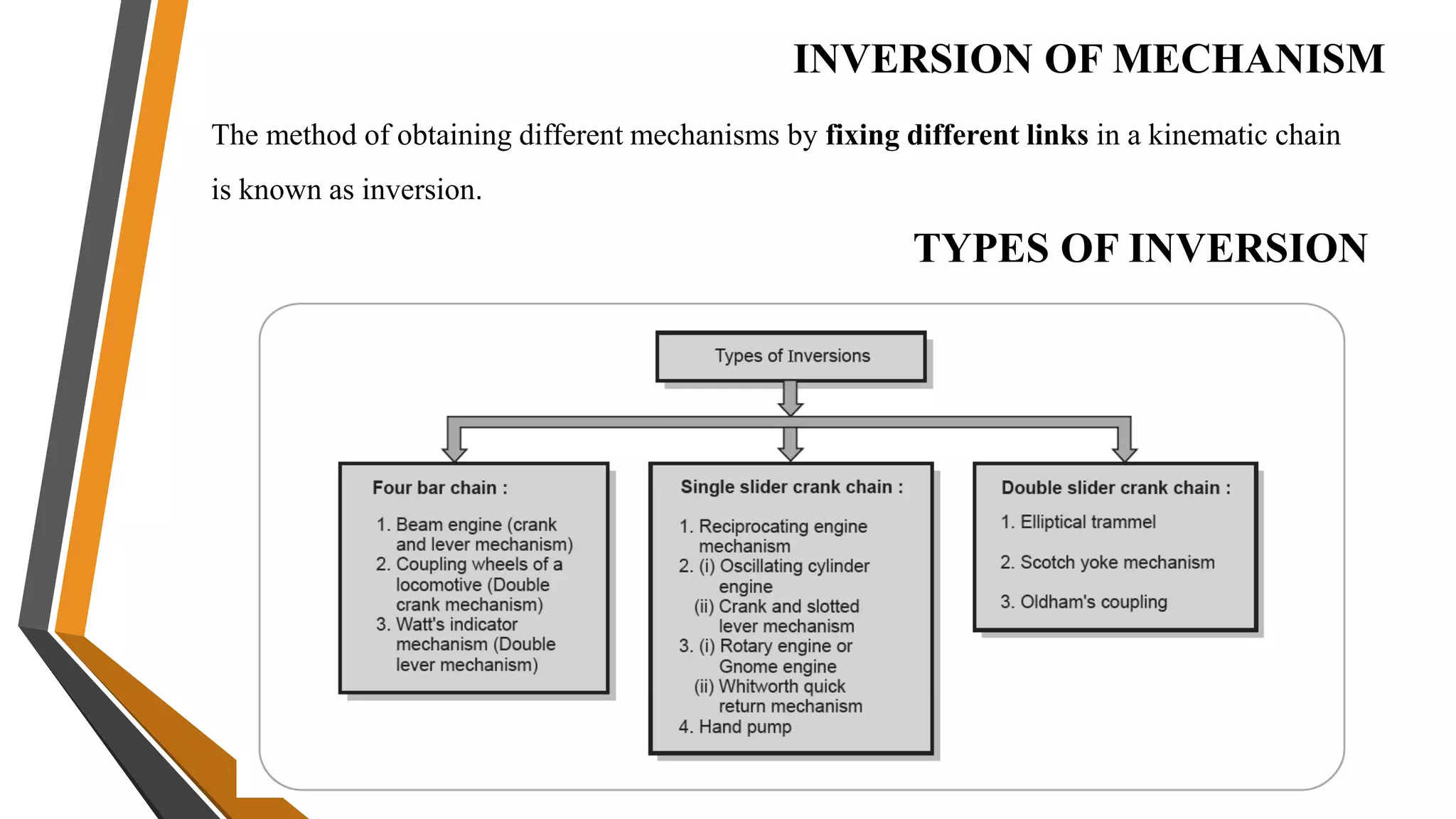
TYPES OF INVERSION
INVERSION OF MECHANISM
The method of obtaining different mechanisms by fixing different links in a kinematic chain
is known as inversion.
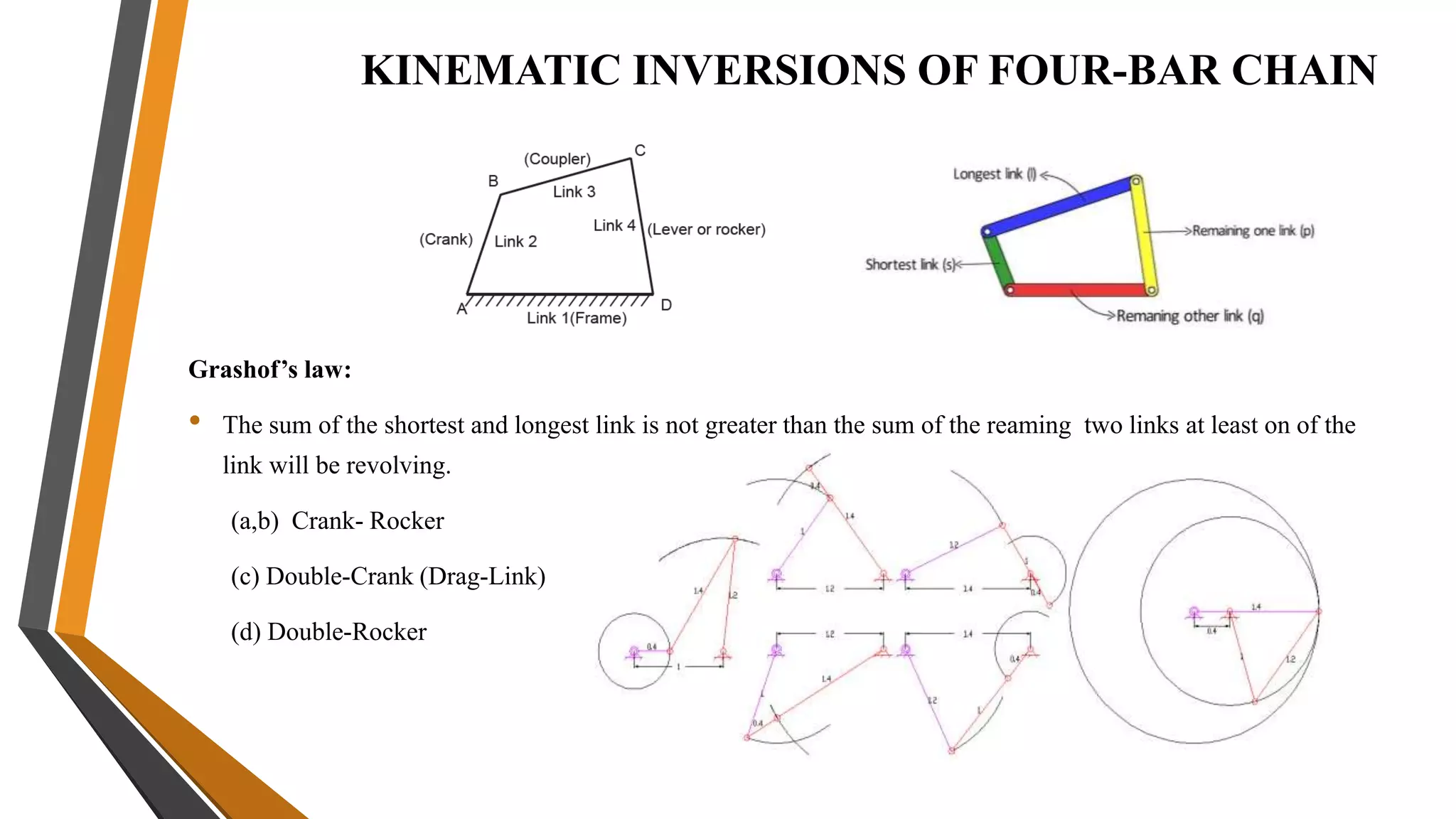
KINEMATIC INVERSIONS OF FOUR-BAR CHAIN
Grashof’s law:
• The sum of the shortest and longest link is not greater than the sum of the reaming two links at least on of the
link will be revolving.
(a,b) Crank- Rocker
(c) Double-Crank (Drag-Link)
(d) Double-Rocker
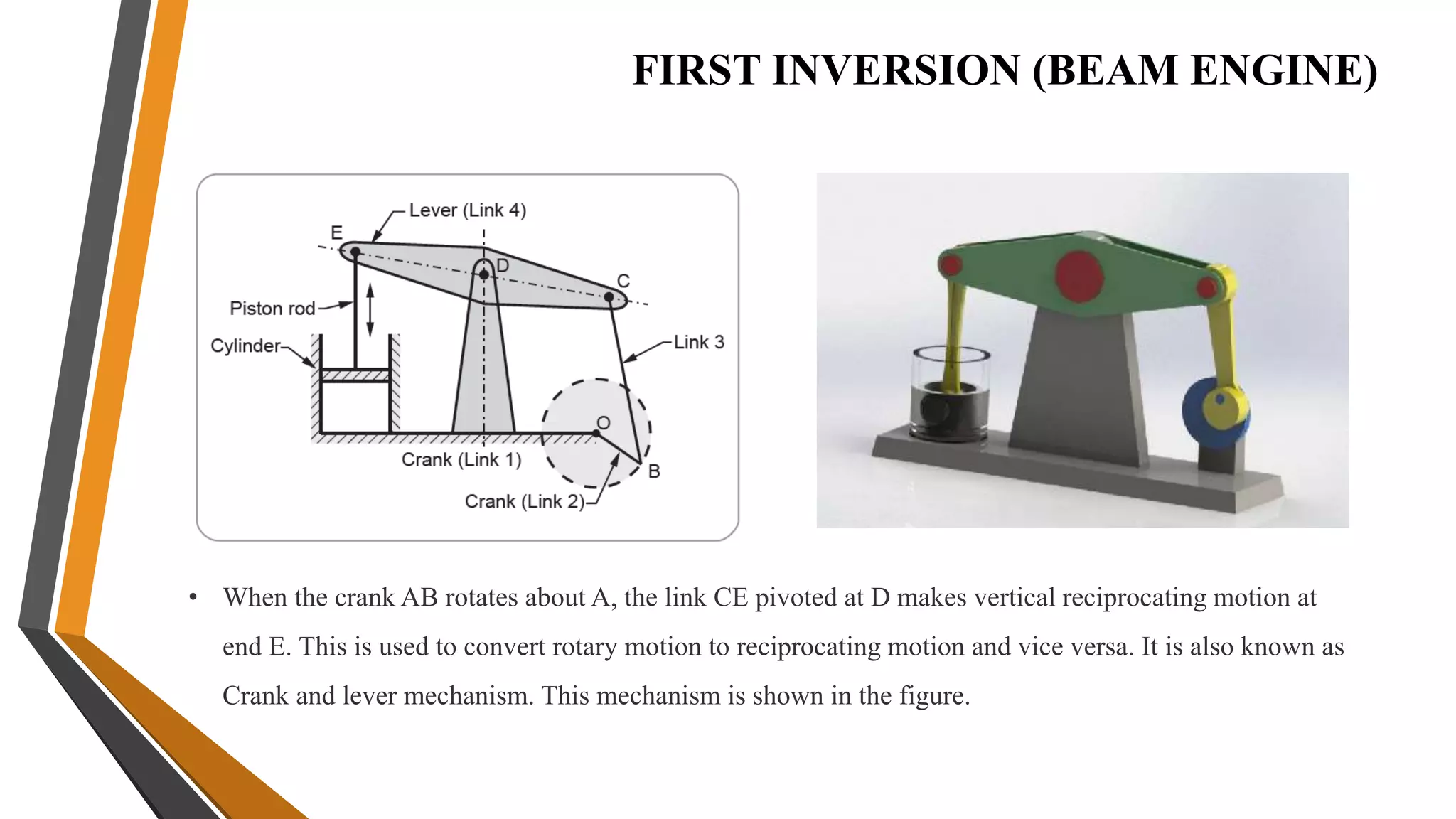
FIRST INVERSION (BEAM ENGINE)
• When the crank AB rotates about A, the link CE pivoted at D makes vertical reciprocating motion at
end E. This is used to convert rotary motion to reciprocating motion and vice versa. It is also known as
Crank and lever mechanism. This mechanism is shown in the figure.
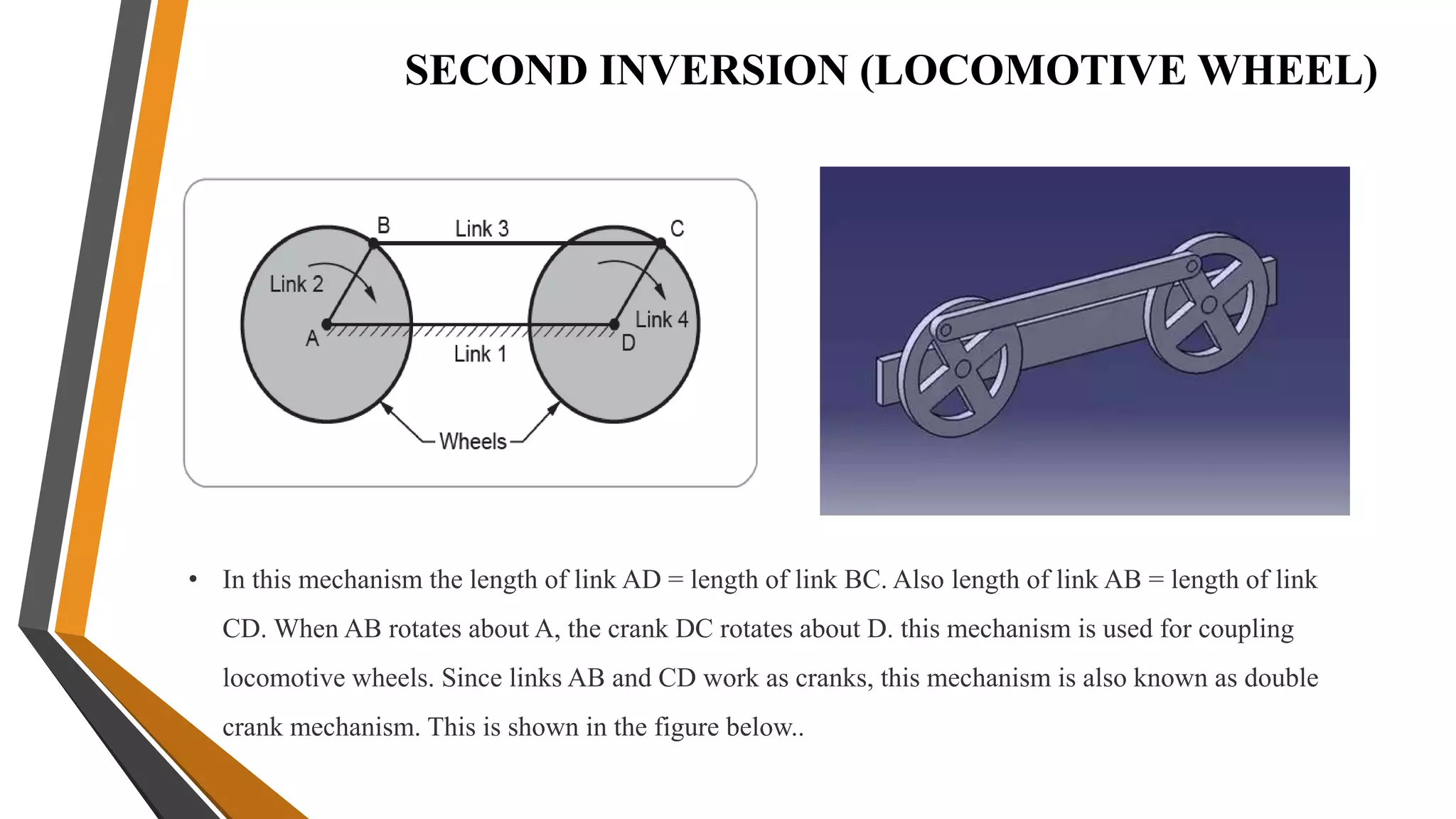
SECOND INVERSION (LOCOMOTIVE WHEEL)
• In this mechanism the length of link AD = length of link BC. Also length of link AB = length of link
CD. When AB rotates about A, the crank DC rotates about D. this mechanism is used for coupling
locomotive wheels. Since links AB and CD work as cranks, this mechanism is also known as double
crank mechanism. This is shown in the figure below..
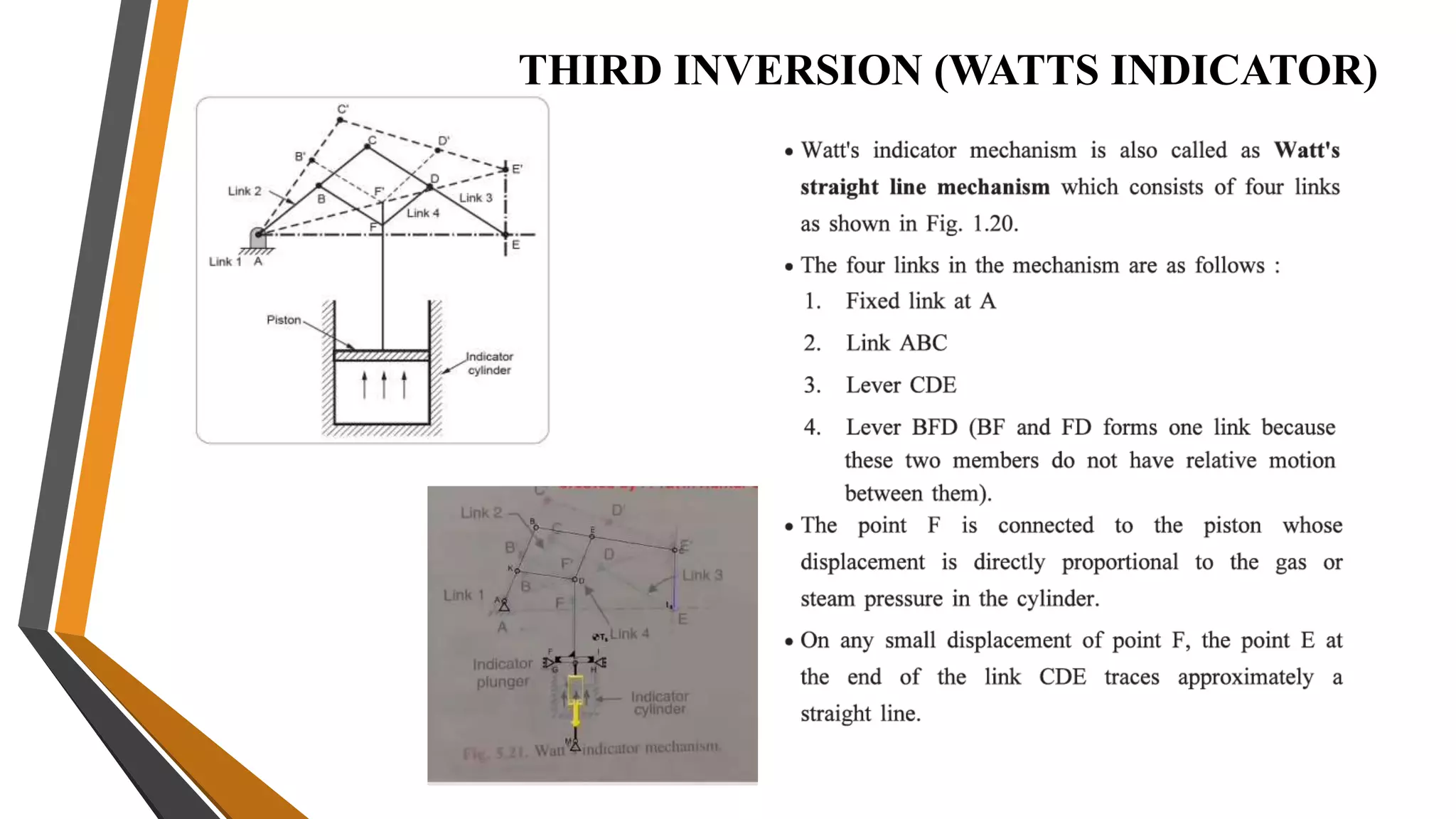
THIRD INVERSION (WATTS INDICATOR)
INVERSION OF SINGLE SLIDER CRANK CHAIN
PENDULUM PUMP
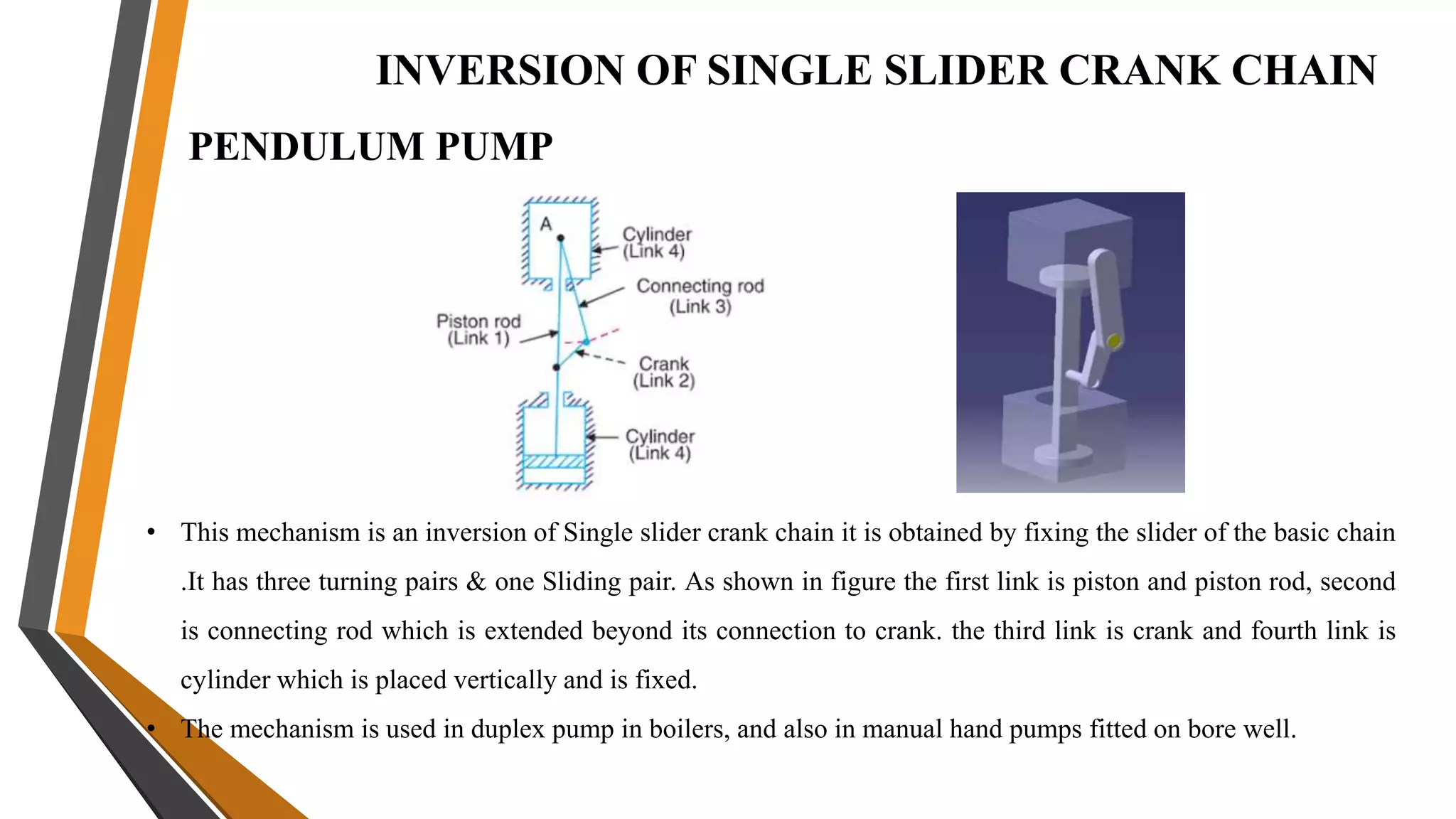
• This mechanism is an inversion of Single slider crank chain it is obtained by fixing the slider of the basic chain
.It has three turning pairs & one Sliding pair. As shown in figure the first link is piston and piston rod, second
is connecting rod which is extended beyond its connection to crank. the third link is crank and fourth link is
cylinder which is placed vertically and is fixed.
• The mechanism is used in duplex pump in boilers, and also in manual hand pumps fitted on bore well.
INVERSION OF SINGLE SLIDER CRANK CHAIN
OSCILLATING CYLINDER ENGINE
• This mechanism is an inversion of Single slider crank chain , which is obtained by fixing connecting rod. It
has three turning pairs & one Sliding pair. As shown in figure. both rod & piston form one link . There is no
relative motion between rod & Piston . The cylinder is pivoted to frame, due to which whole cylinder is free to
oscillate about the frame.
• The mechanism is used where rotary transmitted into oscillating motion. It is used in printing press m/c.
INVERSION OF SINGLE SLIDER CRANK CHAIN
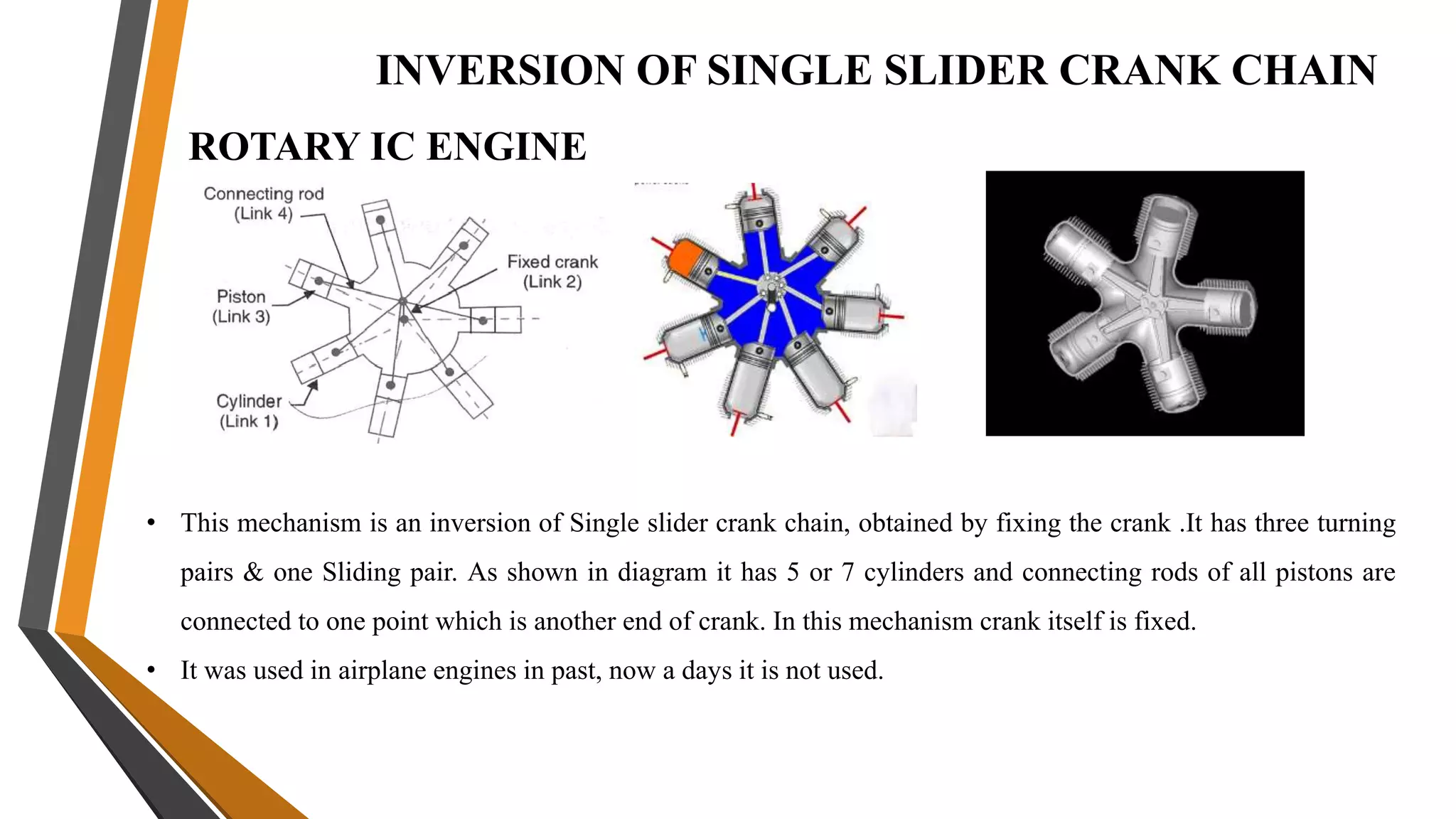
ROTARY IC ENGINE
• This mechanism is an inversion of Single slider crank chain, obtained by fixing the crank .It has three turning
pairs & one Sliding pair. As shown in diagram it has 5 or 7 cylinders and connecting rods of all pistons are
connected to one point which is another end of crank. In this mechanism crank itself is fixed.
• It was used in airplane engines in past, now a days it is not used.
INVERSION OF SINGLE SLIDER CRANK CHAIN
CRANK AND SLOTTED LEVER MECHANISM
https://youtu.be/creu2Nxl8Jo
INVERSION OF SINGLE SLIDER CRANK CHAIN
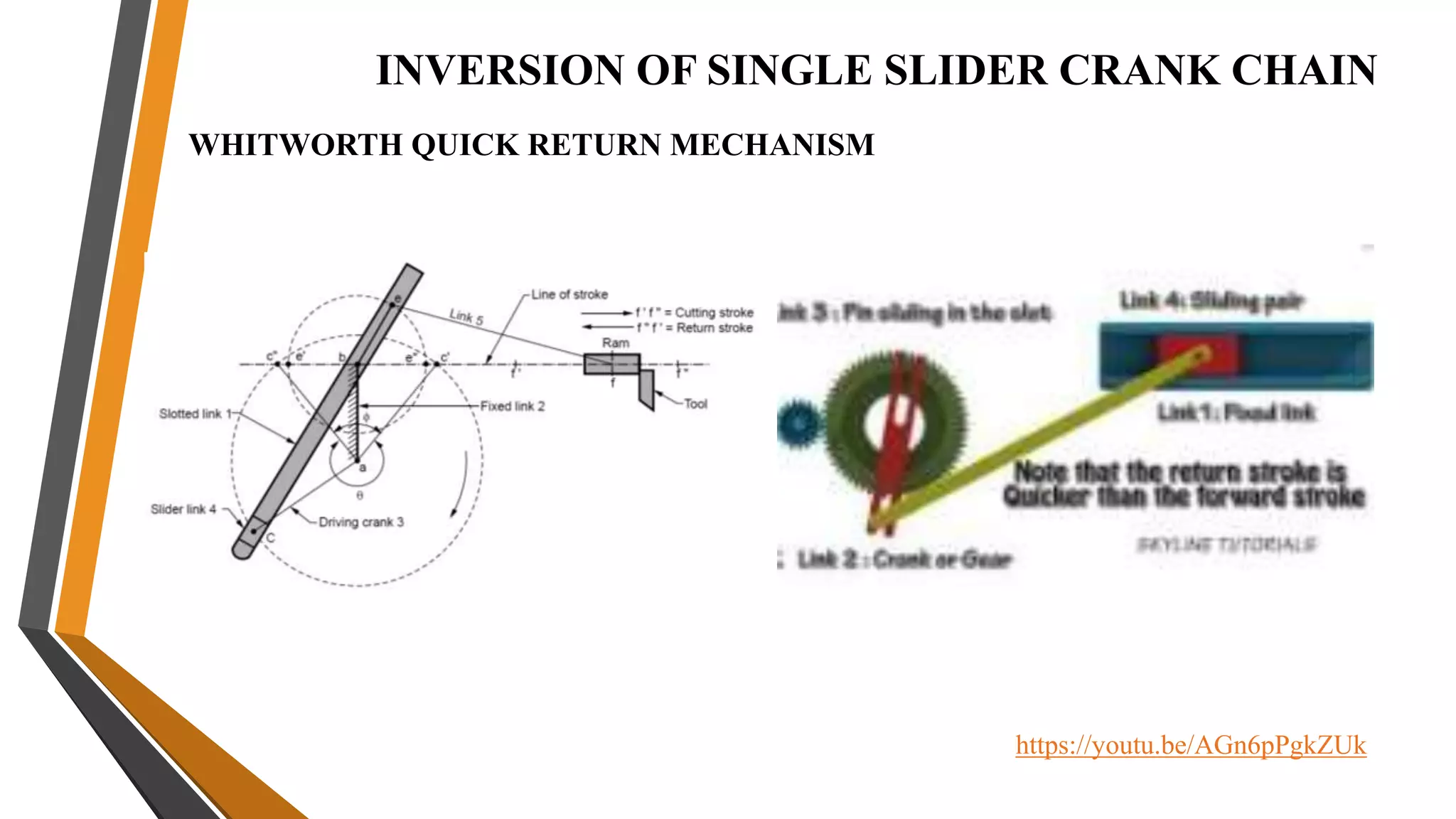
WHITWORTH QUICK RETURN MECHANISM
https://youtu.be/AGn6pPgkZUk
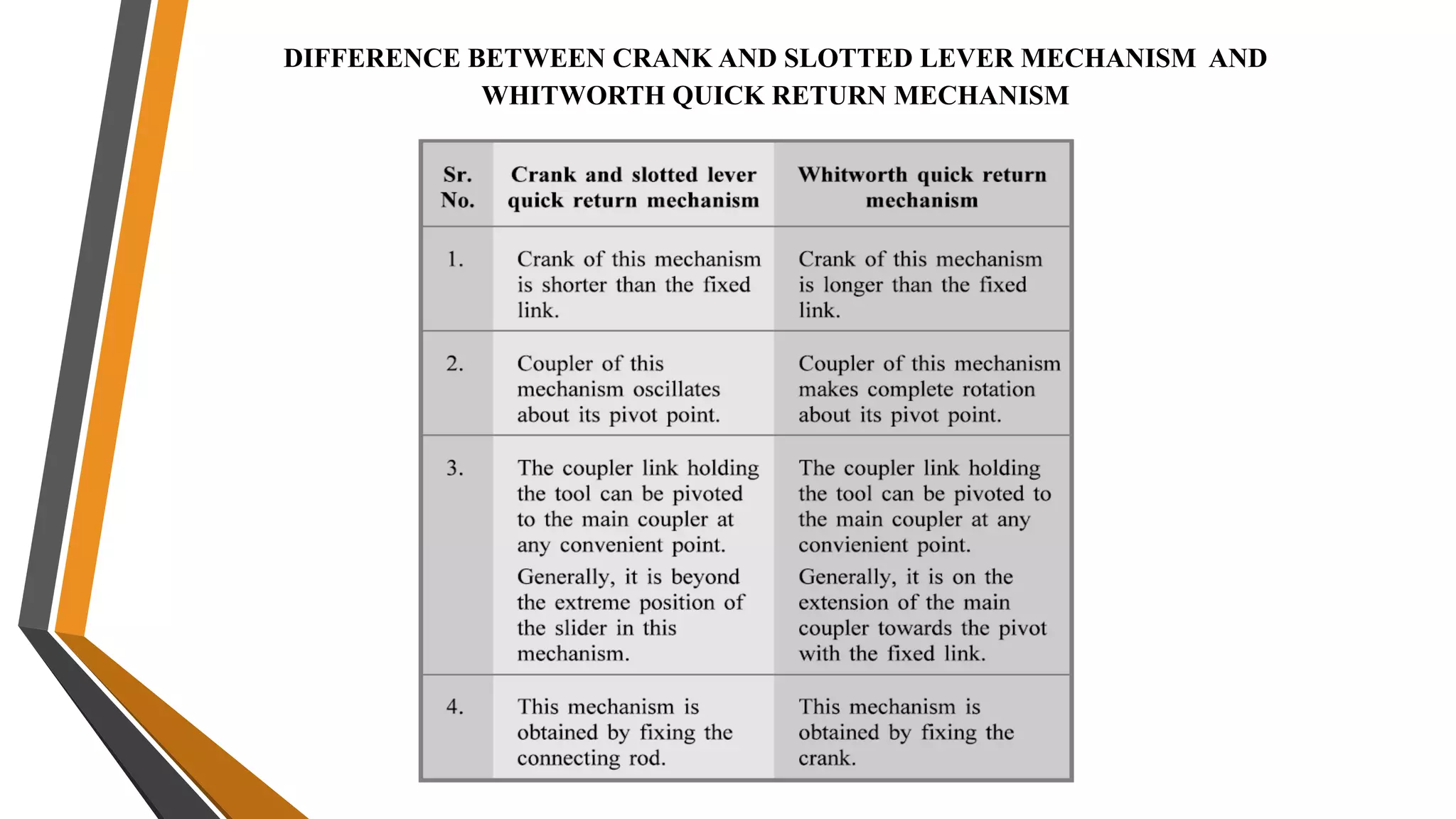
DIFFERENCE BETWEEN CRANK AND SLOTTED LEVER MECHANISM AND
WHITWORTH QUICK RETURN MECHANISM
INVERSION OF DOUBLE SLIDER CRANK CHAIN
ELLIPTICAL TRAMMEL
• This type of inverse is used to draw the ellipse. It is also known as the trend
of Archimedes. It can be used to draw ellipses of different sizes.
INVERSION OF DOUBLE SLIDER CRANK CHAIN
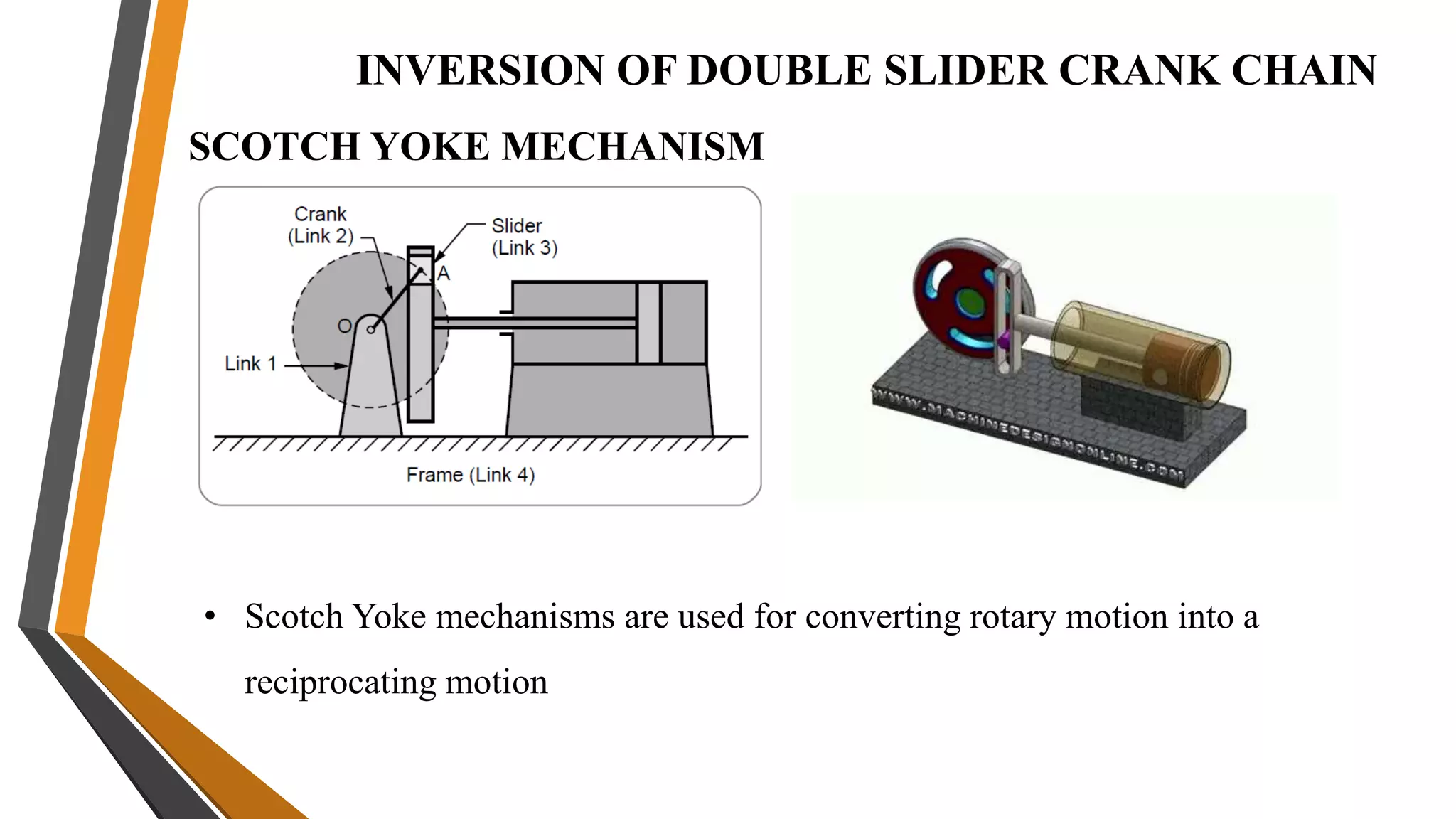
SCOTCH YOKE MECHANISM
• Scotch Yoke mechanisms are used for converting rotary motion into a
reciprocating motion
INVERSION OF DOUBLE SLIDER CRANK CHAIN
OLDHAMS COUPLING MECHANISM
• An Oldham coupling mechanism is used to connect two parallel shafts whose
axes are separated at short distances. The shaft is coupled in such a way that
if one shaft rotates, the other shaft also rotates at the same speed.
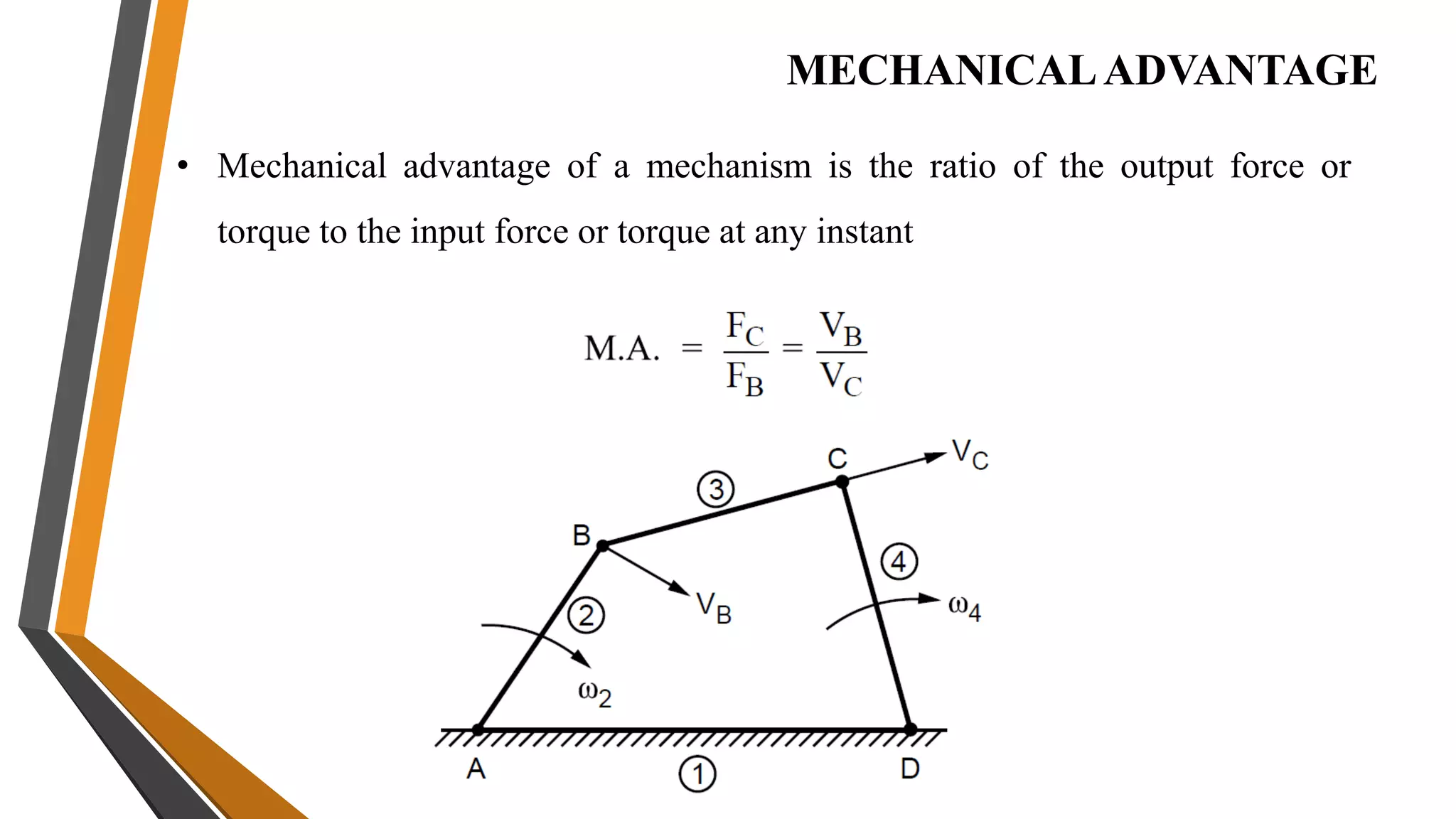
MECHANICALADVANTAGE
• Mechanical advantage of a mechanism is the ratio of the output force or
torque to the input force or torque at any instant
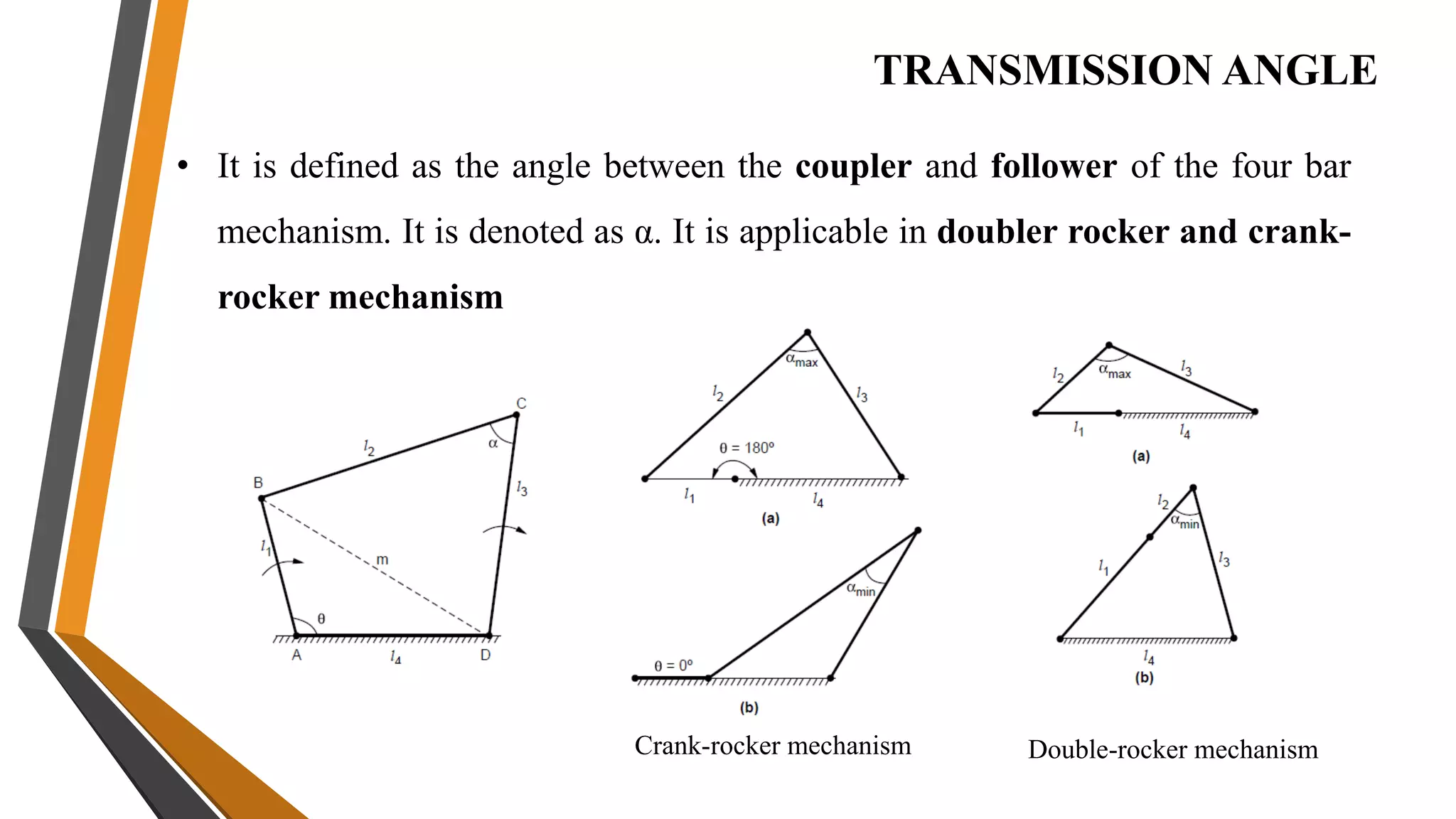
TRANSMISSION ANGLE
• It is defined as the angle between the coupler and follower of the four bar
mechanism. It is denoted as α. It is applicable in doubler rocker and crank-
rocker mechanism
Crank-rocker mechanism Double-rocker mechanism
CAM
Definition :A cam may be defined as a rotating, reciprocating or oscillating
machine part, designed to impart reciprocating and oscillating motion to another
mechanical part, called a follower. (line contact between them and as such they
constitute a higher pair )
THEORY OF MACHINES
THEORY OF MACHINES

THEORY OF MACHINES

  • 1.
    ME3491 – THEORYOF MACHINES BY Mr.M.DHANENTHIRAN ASSISTANT PROFESSOR DEPARTMENT OF MECHANICAL ENGINEERING DEPARTMENT OF MECHANICAL ENGINEERING
  • 2.
    UNIT-1 - KINEMATICSOF MECHANISMS Mechanisms – Terminology and definitions – kinematics inversions of 4 bar and slide crank chain – kinematics analysis in simple mechanisms – velocity and acceleration polygons– Analytical methods – computer approach – cams – classifications – displacement diagrams - layout of plate cam profiles – derivatives of followers motion – circular arc and tangent cams.
  • 3.
    THEORY OF MACHINES •It’s an applied science that is used to understand the various relative motion between various parts of the machine or mechanism and force which acts on them. • Aspects of mechanical system 1. Analysis: Relative motion that takes place in that mechanism 2. Synthesis: Come up with the design of mechanism (determine the acceleration of the link) • Thus the scientific analysis that deals with Motion, Time and Force is called as “Mechanics”
  • 4.
    MECHANICS (Interaction betweendifferent bodies) Mechanics Statics (Stationary) Dynamic (Move w.r.to time) Kinematics (Motion) Kinetics (Motion & Force) Kinematics Machines Kinematics: Deals with geometric aspects of motion without consideration of force Machine: Device for transferring and transforming motion and force (power) from source to load Nature of I/P motion that is available to the type of O/P motion that is desired.
  • 5.
    STUDY OF KINEMATICS •Machine may be referred as a Mechanism which is a combination of interconnected rigid bodies capable of relative motion. Thus , the function of mechanism is to transmit and modify a motion. • Slider Crank Mechanism
  • 6.
    MECHANISM • The mechanismwhich is interconnected is called as ‘Kinematic Pair’ Link or Element: • A resistant body or a group of resistant bodies with rigid connections preventing their relative movement is know as link • Rigid , Flexible and Fluid link • Binary, Ternary and Quaternary link
  • 7.
    KINEMATIC PAIR • It’sa joint of two links having relative motion between them. Its Classified according to • Nature of Contact • Nature of Mechanical Constraint • Nature of relative motion • Degrees of Freedom(DOF) JOINTS • Two or more links at the nodes which allow some motion between the connected links (Kinematic Pair) • Binary joint, Ternary joint, Quaternary Joint.
  • 8.
    Cont.…. NATURE OF CONTACT: •Lower Pair: Surface or area contact (Nut turning on a screw, Universal joint , etc.,) • Higher Pair: Point or Line contact (Cam and Followers, tooth gears, etc.,) • Wrapping Pair: One body laps over the other body(Belt and pulley, Chain and Sprocket)
  • 9.
    Cont.…. NATURE OF MECHANICALCONSTRAINT: According to the type of closure: • Closed Pair or Self closed pair: When the two links are joined together mechanically, it is known as self closed pair. • Unclosed or force closed: When the two links are connected either due to gravity or by some external forces, it is known as unclosed pair.
  • 10.
    Cont.…. NATURE OF RELATIVEMOTION: Based on the relative motion between the elements of kinematic pair are classified into following types :- i) Sliding Pair ii) Rolling Pair iii) Turning Pair iv) Screw pair v) Cylindrical Pair vi) Spherical Pair
  • 11.
    Cont.…. DEGREES OF FREEDOM(DOF) • The no. of (independent relative motions) co-ordinates that are needed to describe the relative movement permitted in a kinematic pair is called of DOF=6-Number of restraints.
  • 12.
    TYPES OF CONSTRAINEDMOTION • Completely constrained motion: when the motion between two elements of a pair is in a definite direction irrespective of the direction of force applied. • Incompletely Constrained Motion: Its possible in more than one direction and depends upon the direction of force applied. • Successfully Constrained Motion: Its possible to have motion in more than one direction but is made to have motion only in one direction by using some external force. • Completely constrained motion Incompletely constrained motion Successfully Constrained Motion
  • 13.
    KINEMATIC CHAIN • Whenthe kinematic pairs are coupled together in such a way that the last link is joined to the first link to transmit definite motion Structure: • It’s a assembly of a number of resistant bodies having no relative motion and meant for carrying loads Closed kinematic chain Base (fixed) Structure Open kinematic chain Kinematic joint Rigid bodies
  • 14.
    MECHANISM • A closedkinematic chain with any one of the link to be fixed and used for transferring and transforming motion
  • 15.
    KUTZBACH CRITERION • Kutzbachcriterion determines the number of degrees of freedom of a kinematic chain, that is, a coupling of rigid bodies by means of mechanical constraints. These devices are also called linkages. • The result is given by a formula which is called as Kutzbach criterion of mobility • M=3(l-1)-2J-h l= no. of links J = no of joints or lower pair h = no of higher pair When the DOF is zero then it will be a structure. is ≥ 1 it will be a mechanism is < 0 it preloaded structure
  • 16.
    ACTIVITY • l= 10 •j=12 • h=0 n=(3(10-1)-2(12)-0) n=3 • l= 9 • j=10 • h=0 n=(3(9-1)-2(10)-0) n=4
  • 17.
    TYPES OF INVERSION INVERSIONOF MECHANISM The method of obtaining different mechanisms by fixing different links in a kinematic chain is known as inversion.
  • 18.
    KINEMATIC INVERSIONS OFFOUR-BAR CHAIN Grashof’s law: • The sum of the shortest and longest link is not greater than the sum of the reaming two links at least on of the link will be revolving. (a,b) Crank- Rocker (c) Double-Crank (Drag-Link) (d) Double-Rocker
  • 19.
    FIRST INVERSION (BEAMENGINE) • When the crank AB rotates about A, the link CE pivoted at D makes vertical reciprocating motion at end E. This is used to convert rotary motion to reciprocating motion and vice versa. It is also known as Crank and lever mechanism. This mechanism is shown in the figure.
  • 20.
    SECOND INVERSION (LOCOMOTIVEWHEEL) • In this mechanism the length of link AD = length of link BC. Also length of link AB = length of link CD. When AB rotates about A, the crank DC rotates about D. this mechanism is used for coupling locomotive wheels. Since links AB and CD work as cranks, this mechanism is also known as double crank mechanism. This is shown in the figure below..
  • 21.
  • 22.
    INVERSION OF SINGLESLIDER CRANK CHAIN PENDULUM PUMP • This mechanism is an inversion of Single slider crank chain it is obtained by fixing the slider of the basic chain .It has three turning pairs & one Sliding pair. As shown in figure the first link is piston and piston rod, second is connecting rod which is extended beyond its connection to crank. the third link is crank and fourth link is cylinder which is placed vertically and is fixed. • The mechanism is used in duplex pump in boilers, and also in manual hand pumps fitted on bore well.
  • 23.
    INVERSION OF SINGLESLIDER CRANK CHAIN OSCILLATING CYLINDER ENGINE • This mechanism is an inversion of Single slider crank chain , which is obtained by fixing connecting rod. It has three turning pairs & one Sliding pair. As shown in figure. both rod & piston form one link . There is no relative motion between rod & Piston . The cylinder is pivoted to frame, due to which whole cylinder is free to oscillate about the frame. • The mechanism is used where rotary transmitted into oscillating motion. It is used in printing press m/c.
  • 24.
    INVERSION OF SINGLESLIDER CRANK CHAIN ROTARY IC ENGINE • This mechanism is an inversion of Single slider crank chain, obtained by fixing the crank .It has three turning pairs & one Sliding pair. As shown in diagram it has 5 or 7 cylinders and connecting rods of all pistons are connected to one point which is another end of crank. In this mechanism crank itself is fixed. • It was used in airplane engines in past, now a days it is not used.
  • 25.
    INVERSION OF SINGLESLIDER CRANK CHAIN CRANK AND SLOTTED LEVER MECHANISM https://youtu.be/creu2Nxl8Jo
  • 26.
    INVERSION OF SINGLESLIDER CRANK CHAIN WHITWORTH QUICK RETURN MECHANISM https://youtu.be/AGn6pPgkZUk
  • 27.
    DIFFERENCE BETWEEN CRANKAND SLOTTED LEVER MECHANISM AND WHITWORTH QUICK RETURN MECHANISM
  • 28.
    INVERSION OF DOUBLESLIDER CRANK CHAIN ELLIPTICAL TRAMMEL • This type of inverse is used to draw the ellipse. It is also known as the trend of Archimedes. It can be used to draw ellipses of different sizes.
  • 29.
    INVERSION OF DOUBLESLIDER CRANK CHAIN SCOTCH YOKE MECHANISM • Scotch Yoke mechanisms are used for converting rotary motion into a reciprocating motion
  • 30.
    INVERSION OF DOUBLESLIDER CRANK CHAIN OLDHAMS COUPLING MECHANISM • An Oldham coupling mechanism is used to connect two parallel shafts whose axes are separated at short distances. The shaft is coupled in such a way that if one shaft rotates, the other shaft also rotates at the same speed.
  • 31.
    MECHANICALADVANTAGE • Mechanical advantageof a mechanism is the ratio of the output force or torque to the input force or torque at any instant
  • 32.
    TRANSMISSION ANGLE • Itis defined as the angle between the coupler and follower of the four bar mechanism. It is denoted as α. It is applicable in doubler rocker and crank- rocker mechanism Crank-rocker mechanism Double-rocker mechanism
  • 33.
    CAM Definition :A cammay be defined as a rotating, reciprocating or oscillating machine part, designed to impart reciprocating and oscillating motion to another mechanical part, called a follower. (line contact between them and as such they constitute a higher pair )