SHRI RAWATPURA SARKAR INSTITUTE OF TECHNOLOGY-II,
NEW RAIPUR
BASIC ELECTRONICS LAB Page 1
EXPERIMENT NO. 01
AIM:To study the operation of CRO and DSO (Digital oscilloscope).
APPRATUS REQUIRED:
CRO( Cathode Ray Oscilloscope) , DSO( Digital Storage Oscilloscope) , probes, power
supply.
THEORY:
Cathode Ray Oscilloscope: The oscilloscope counts among the important measuring
instruments in experimental physics. It makes itpossible to observe and to measure
quantitatively the course of an electric voltage UY as a function of timet or as a function of
voltage UX in „real-time“. The temporal course of all physical quantities that can beconverted
to an electrical voltage using a suitable measurement device can be displayed with
anoscilloscope1. There are few restrictions regarding the amplitude and frequency of the
measurable signals: if you are prepared to spend enough money, you will certainly find an
oscilloscope which meets the requirements.
During the introductory laboratory course, too, the oscilloscope is a frequently used
measuring
Instrument. In some experiments it is a fundamental component of the experimental set-up
and yields the quantitative data required for the analysis. In other experiments it is used for
qualitative control, i.e., whether a circuit has been correctly set up and is operative, if a sensor
is providing the correct signal, ... .In order to perform the following experiments successfully,
a thorough knowledge of the oscilloscope is imperative. . The experiments described in this
document are divided into two laboratory sessions.
XY- and XT-operation:
The oscilloscope can operate in different modes depending on the setting of the switch of the
MODE function group: In XY operation the signal course will be displayed in Y(X). To
produce this, the signal from inputCH1 (X) passes an output amplifier and arrives as voltage
UX on the X deflection plate, and the signalfrom input CH2 (Y) passes an output amplifier
and arrives as voltage UY on the Y deflection plate.
The XT operational mode displays signals as a function of time t: Y1(t), Y2(t), or Y1(t) +
Y2(t). To produce this, the signals CH1 (Y1(t)) and CH2 (Y2(t)), respectively arrive at the Y
deflection plateafter amplification, while a sweep generator produces a saw tooth voltage
SHRI RAWATPURA SARKAR INSTITUTE OF TECHNOLOGY-II,
NEW RAIPUR
BASIC ELECTRONICS LAB Page 2
which serves as adeflection voltage UX for the horizontal deflection of the cathode ray (s.
Fig. 5).
Two channel operation:
In the alternating (ALT) or in chopped (CHOP) mode it is possible to have an apparently
instantaneousdisplay of Y1(t) and Y2(t)in XT operation:
In the ALT mode, the cathode ray shows in the first pass one of the signals (e.g. Y1(t)), and
in the nextpass the other signal (Y2(t)), then again the first one and so on. Due to the time of
persistence of thephosphorus on the screen the observer has the impression that both signals
are present simultaneouslyin case of short time periods td.
In the CHOP mode, a high-frequency periodic alternating switch-over between the signals
is
achieved during one pass of the cathode ray (s. Fig. 6).
In ADD mode, the sum of signals Y1(t) + Y2(t) is displayed.
Digital storage oscilloscope:
In practice it is often necessary to present and measure single impulse courses
instead of continuous orperiodic signals. For example, it may be necessary to
measure the temporal course of the light intensity ofa laser impulse using a
photo detector, which converts light intensity into voltage. In such cases
oscilloscopesare required which can store a signal once it has been recorded.
Previously, cathode ray oscilloscopeswere used, first storing the signal on a
special storage layer as a charged image and then continuouslytransmitting it to
the luminous layer. Such instruments are being superseded by digital
storageoscilloscopes nowadays in nearly all applications.
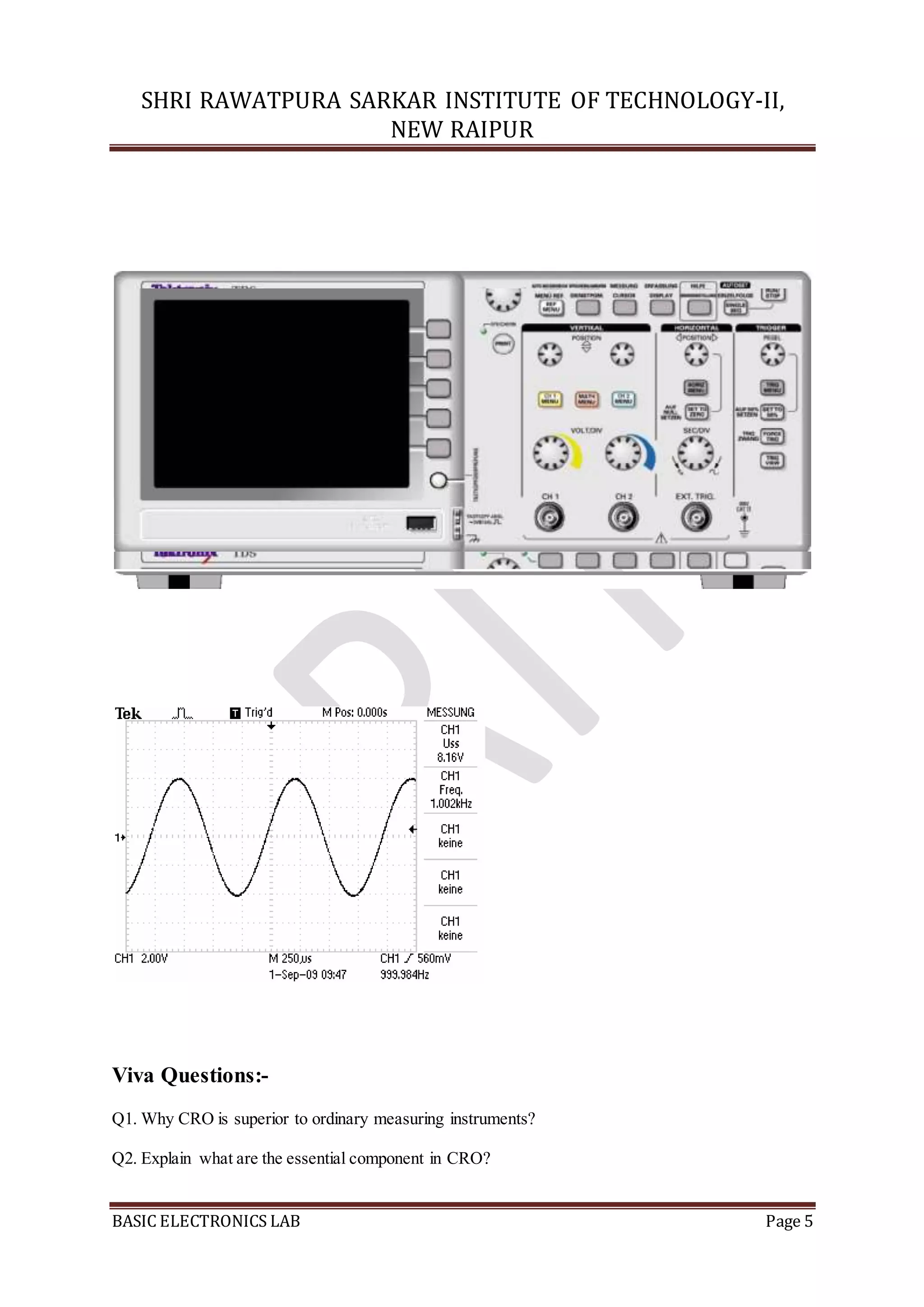
In a digital storage oscilloscope (briefly: digital oscilloscope), the analogue
input signals are first convertedinto digital signals by means of an
analogue/digital converter (A/D converter). Details of thisconversion process
will be treated in the experiment „Data Acquisition and processing with the
PC”. Forthis reason, only some basic terminology will be explained in the
following.
SHRI RAWATPURA SARKAR INSTITUTE OF TECHNOLOGY-II,
NEW RAIPUR
BASIC ELECTRONICS LAB Page 3
Experiments with the cathode ray oscilloscope:
The experiments are performed using the function generator TOELLNER 7401. The function
generatorAGILENT 33120A is used only in the experiment 3.1.7.
Producing a luminous point:
A well focused (knob FOCUS), stationary luminous point of a low intensity (knob
INTENSITY) shouldbe generated in the centre of the oscilloscope screen. For this purpose,
the oscilloscope must be set to XYmode (knob SEC/DIV), which switches the internal X
deflector unit (briefly: time base) off. – Whichoperational elements are used to change the
vertical and horizontal position of the luminous point?
Producing a horizontal line:
Now, the luminous point is to travel across the screen at different rates. This is achieved by
switching onthe XY mode that means by switching on the time base (TRIGGER in AUTO-
mode). At which positionof the SEC/DIV switch of the time base does a horizontal line
appear and why?
Producing a verticalline:
A vertical line is produced on the screen by supplying an appropriate signal from the function
generator tothe Y channel with the time base switched off (XY-mode). Which operational
elements of the oscilloscopeand function generator can be used to influence the length and
the position of the line (try allpossibilities)? What must the shape of the function generator
signal be (sine, triangle, and rectangle) to yield aline with an equal degree of brightness over
its total length? Why?
Output signals of a function generator
Represent the different output signals of the function generator (FG) TOELLNER 7401 on
the oscilloscopeone after the other (sine, triangle, rectangle signal at OUTPUT socket). Vary
the frequency, amplitudeand offset voltage (DC-OFFSET) at the FG and observe the related
signal changes on the oscilloscope.To observe changes when varying the offset voltage, the
oscilloscope has to be adjusted to DC coupling.Together with the output signal of the FG,
represent the signal at the socket TTL OUT6. Sketch the TTLsignaland state its voltage levels
and phase relation relative to the output signal.
SHRI RAWATPURA SARKAR INSTITUTE OF TECHNOLOGY-II,
NEW RAIPUR
BASIC ELECTRONICS LAB Page 4
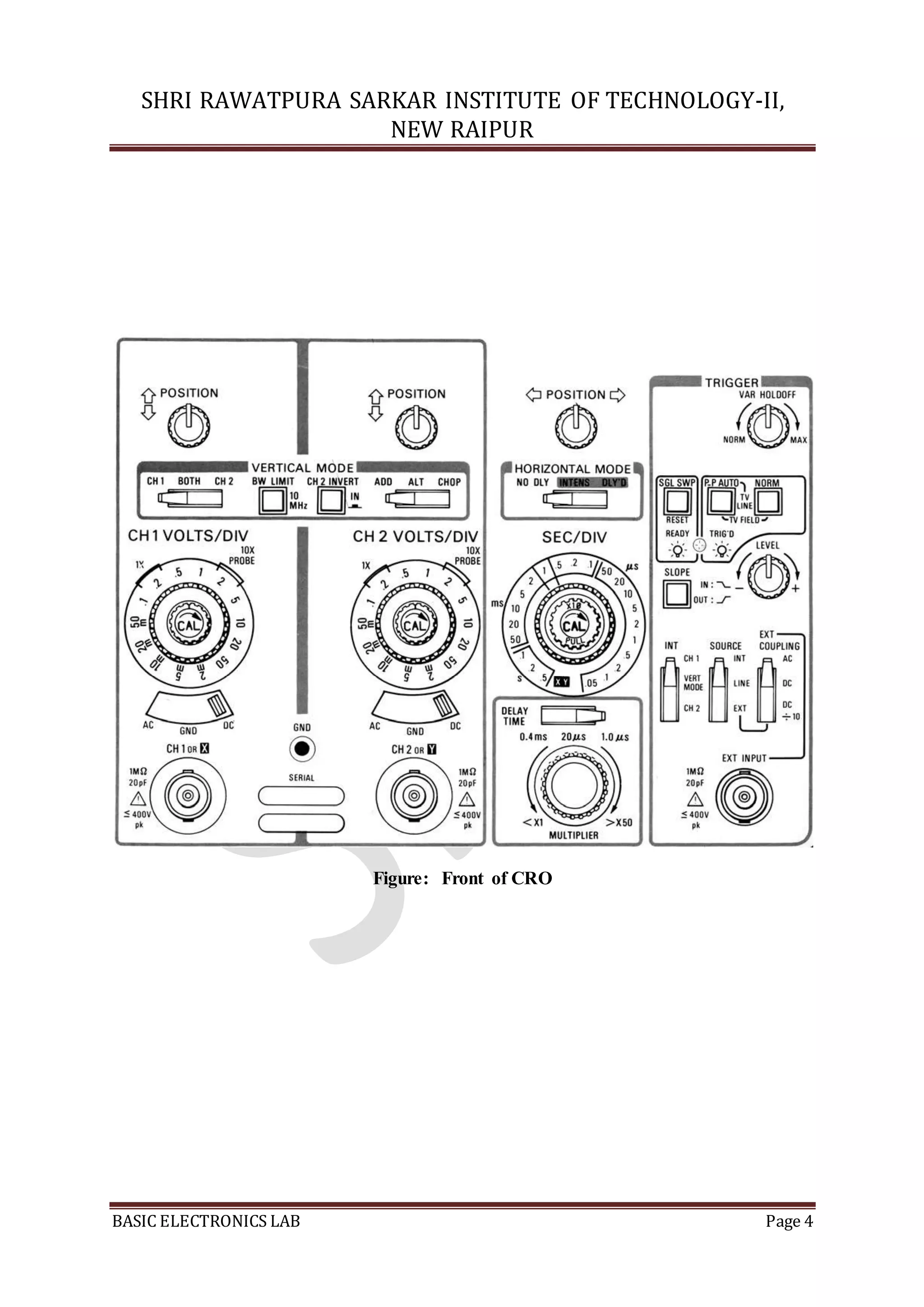
Figure: Front of CRO
SHRI RAWATPURA SARKAR INSTITUTE OF TECHNOLOGY-II,
NEW RAIPUR
BASIC ELECTRONICS LAB Page 5
Viva Questions:-
Q1. Why CRO is superior to ordinary measuring instruments?
Q2. Explain what are the essential component in CRO?
SHRI RAWATPURA SARKAR INSTITUTE OF TECHNOLOGY-II,
NEW RAIPUR
BASIC ELECTRONICS LAB Page 6
Q3. Explain what is meant by Deflection sensitivity of CRO?
Q4. Explain what is sweep time?
Q5. What is input impedance of CRO?
EXPERIMENT NO. 02
AIM:To draw the characteristics of a semi-conductor diode and to find cut-in voltage,
reverse resistance, staticresistance and dynamic resistance.
APPRATUS REQUIRED:
PN Junction Diode(IN4001), Regulated power supply(0-30 V), Resistance(1 kΩ), Ammeter,
Voltmeter, Bread board and connecting wires.
THEORY:
Donor impurities (pentavalent) are introduced into one-side and acceptorimpurities into the
other side of a single crystal of an intrinsic semiconductor to forma p-n diode with a junction
called depletion region (this region is depleted off thecharge carriers). This region gives rise
to a potential barrier Vγ called Cut- inVoltage. This is the voltage across the diode at which
it starts conducting. The P-Njunction can conduct beyond this Potential.
The P-N junction supports uni-directional current flow. If +ve terminal of theinput supply is
connected to anode (P-side) and –ve terminal of the input supply isconnected to cathode (N-
side), then diode is said to be forward biased. In thiscondition the height of the potential
barrier at the junction is lowered by an amountequal to given forward biasing voltage. Both
the holes from p-side and electrons fromn-side cross the junction simultaneously and
constitute a forward current ( injectedminority current – due to holes crossing the junction
and entering N-side of thediode, due to electrons crossing the junction and entering P-side of
the diode).Assuming current flowing through the diode to be very large, the diode can be
approximated as short-circuited switch. If –ve terminal of the input supply is, 2 connected to
anode (p-side) and +ve terminal of the input supply is connected tocathode (n-side) then the
diode is said to be reverse biased. In this condition anamount equal to reverse biasing voltage
increases the height of the potential barrier atthe junction. Both the holes on p-side and
electrons on n-side tend to move away fromthe junction thereby increasing the depleted
region. However the process cannotcontinue indefinitely, thus a small current called reverse
saturation currentcontinues to flow in the diode. This small current is due to thermally
generatedcarriers. Assuming current flowing through the diode to be negligible, the diode
canbe approximated as an open circuited switch.
SHRI RAWATPURA SARKAR INSTITUTE OF TECHNOLOGY-II,
NEW RAIPUR
BASIC ELECTRONICS LAB Page 7
The volt-ampere characteristics of a diode explained by following equation:
I = Io(Exp(V/ ηVT)-1)
I=current flowing in the diode
Io=reverse saturation current
V=voltage applied to the diode
VT=volt-equivalent of temperature=kT/q=T/11,600=26mV(@ room temp).
η=1 (for Ge) and 2 (for Si)
It is observed that Ge diode has smaller cut-in-voltage when compared to Sidiode. The
reverse saturation current in Ge diode is larger in magnitude whencompared to silicon diode.
ForwardBiasedCondition:
1. Connect the PN Junction diode in forward bias i.eAnode is connected topositive of the
power supply and cathode is connected to negative of thepower supply .
2. Use a Regulated power supply of range (0-30)V and a series resistance of1kΏ.
3. For various values of forward voltage (Vf) note down the correspondingvalues of forward
current(If) .
Reverse biasedcondition:
1. Connect the PN Junction diode in Reverse bias i.e; anode is connected tonegative of the
power supply and cathode is connected to positive of thepower supply.
2. For various values of reverse voltage (Vr ) note down the correspondingvalues of reverse
current ( Ir ).
Circuit diagram:
Forward Bias
SHRI RAWATPURA SARKAR INSTITUTE OF TECHNOLOGY-II,
NEW RAIPUR
BASIC ELECTRONICS LAB Page 8
Reverse Bias
Table:
Forward Bias:
Reverse Bias:
SHRI RAWATPURA SARKAR INSTITUTE OF TECHNOLOGY-II,
NEW RAIPUR
BASIC ELECTRONICS LAB Page 9
Graph:
Calculations from Graph:
Static forward Resistance Rdc= Vf/If Ω
Dynamic forward Resistance rac= ΔVf/ΔIfΩ
Static Reverse Resistance Rdc=Vr/IrΩ
Dynamic Reverse Resistance rac= ΔVr/ΔIrΩ
Result:
Thus the VI characteristics of PN junction diode is verified.
1. Cut in voltage = ……… V
2. Static forward resistance = ………. Ω
3. Dynamic forward resistance = ………. Ω
Viva Questions:
Q1. Define diode resistance?
An ideal diode offers zero resistance when forward bias and infinite resistance when it is reverse
biased. But practical or realdiode does not behave ideally.
Q2. What is diode capacitance?
Diode as offer two type of capacitance,one in forward bias and other in reverse bias. They are:
1. Diffusion or storage capacitance &
2. Depletion or transition capacitance.
Q3. What is a P-N junction?
The contact surface between the layer of P-Type and N-type semiconductor pieces placed together so
as to form a P-N junction is called the P-N junction.
Q4. What is the effect of the reverse bias on the width of a P-N junction?
When the P-N junction is reverse biased, the width of the depletion region is increased.
Q5. What types of carrier are present in the space charge region?
No mobile carriers are present in the space charge region.
Q6.What is cut in voltage in semiconductors?
SHRI RAWATPURA SARKAR INSTITUTE OF TECHNOLOGY-II,
NEW RAIPUR
BASIC ELECTRONICS LAB Page 10
The forward voltage at which the current through the P-N junction start increasing rapidly is called
the cut in voltage.
Q7.What is the effect of temperature on the reverse current of a P-N junction?
Reverse current of P-N junction increases with the increase in junction temperature.
EXPERIMENT NO-04
AIM:To draw the characteristics of a zener diode.
APPRATUS REQUIRED:Zener Diode (IZ 6.2), Regulated power supply(0-30 V),
Resistance(1 kΩ), Ammeter, Voltmeter, Bread board and connecting wires.
THEORY:An ideal P-N Junction diode does not conduct in reverse biased condition. A zener
diode conducts excellently even in reverse biased condition. These diodes operate at a precise
value of voltage called break down voltage. A zener diode when forward biased behaves like an
ordinary P-N junction diode.
A zener diode when reverse biased can either undergo avalanche break down or zener break
down.
Avalanche break down:-If both p-side and n-side of the diode are lightly doped, depletion
region at the junction widens. Application of a very large electric field at the junction may rupture
covalent bonding between electrons. Such rupture leads to the generation of a large number of
charge carriers resulting in avalanche multiplication.
Zener break down:-If both p-side and n-side of the diode are heavily doped, depletion region at
the junction reduces. Application of even a small voltage at the junction ruptures covalent
bonding and generates large number of charge carriers. Such sudden increase in the number of
charge carriers results in zener mechanism.
Forward Biased Condition:
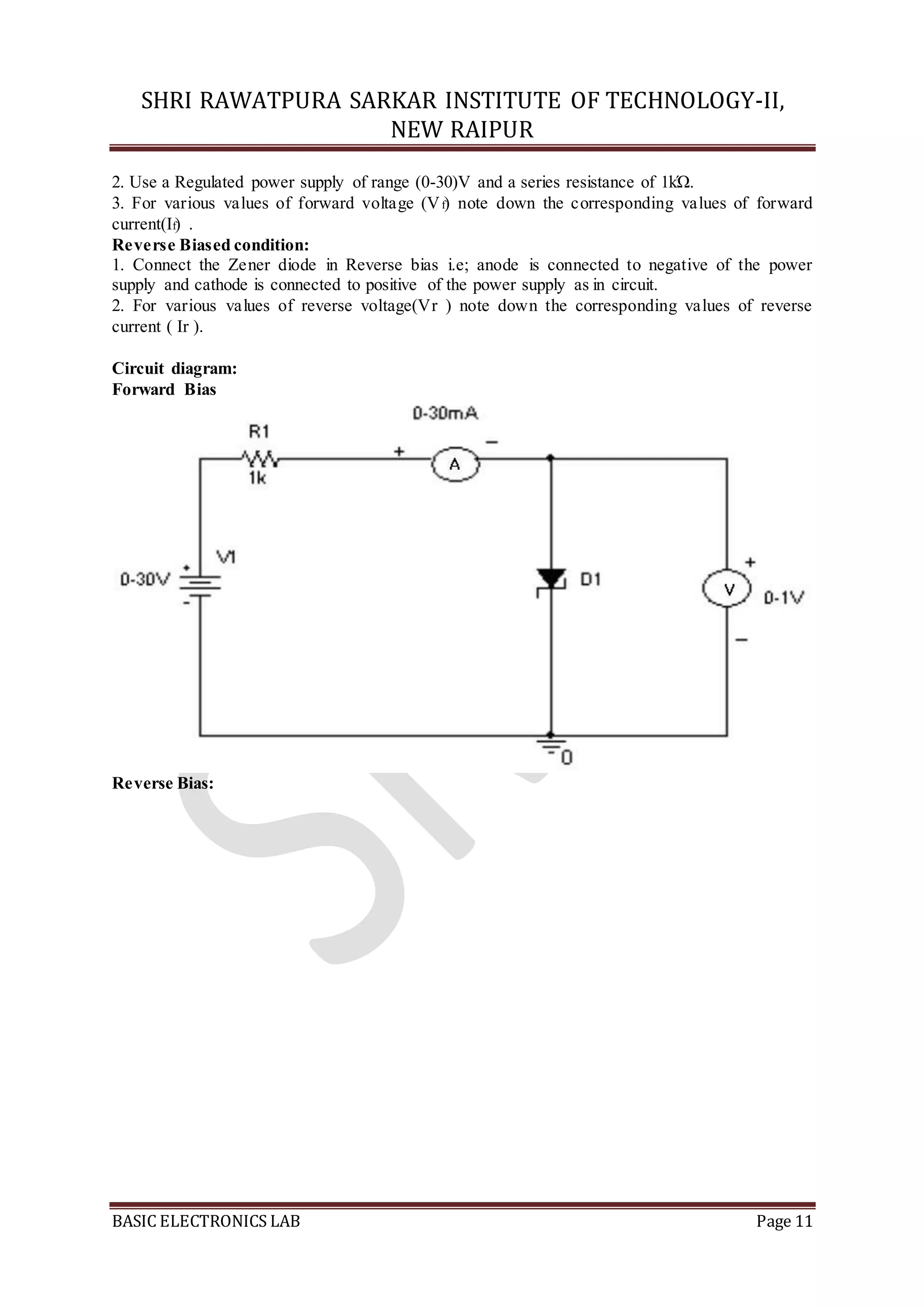
1. Connect the Zener diode in forward bias i.e; anode is connected to positive of the supply and
cathode is connected to negative of the power supply as in circuit
SHRI RAWATPURA SARKAR INSTITUTE OF TECHNOLOGY-II,
NEW RAIPUR
BASIC ELECTRONICS LAB Page 11
2. Use a Regulated power supply of range (0-30)V and a series resistance of 1kΏ.
3. For various values of forward voltage (Vf) note down the corresponding values of forward
current(If) .
Reverse Biased condition:
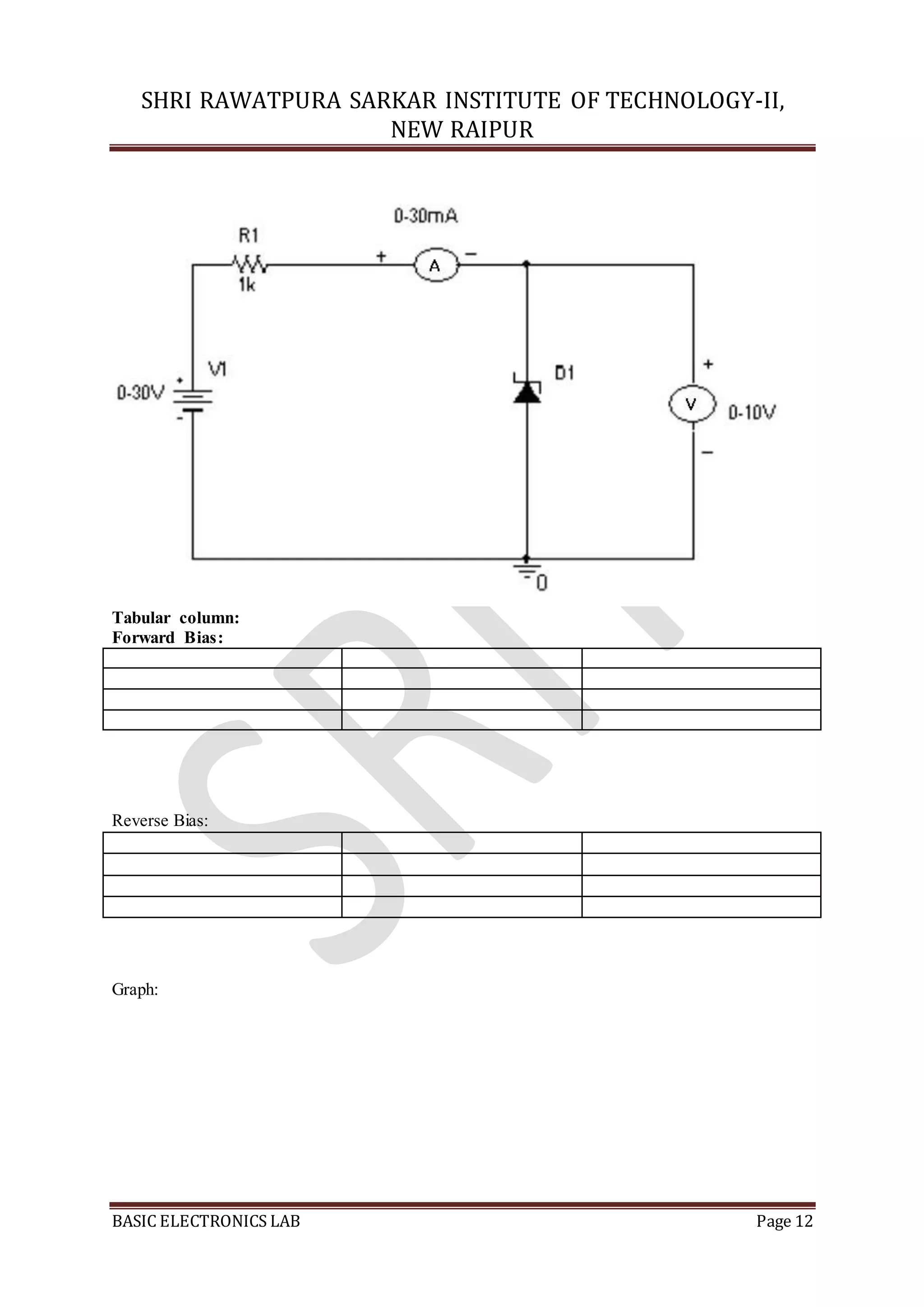
1. Connect the Zener diode in Reverse bias i.e; anode is connected to negative of the power
supply and cathode is connected to positive of the power supply as in circuit.
2. For various values of reverse voltage(Vr ) note down the corresponding values of reverse
current ( Ir ).
Circuit diagram:
Forward Bias
Reverse Bias:
SHRI RAWATPURA SARKAR INSTITUTE OF TECHNOLOGY-II,
NEW RAIPUR
BASIC ELECTRONICS LAB Page 12
Tabular column:
Forward Bias:
Reverse Bias:
Graph:
SHRI RAWATPURA SARKAR INSTITUTE OF TECHNOLOGY-II,
NEW RAIPUR
BASIC ELECTRONICS LAB Page 13
Calculations from Graph:
Cut in voltage = ---------- (v)
Break down voltage = ------------(v)
Result:
The zener diode characteristics have been plotted.
1. Cut in voltage = ……… V
2 Break down voltage = ------------(v)
Viva Questions:-
Q1. What do you mean by breakdown mechanism? Explain?
If the reverse bias applied to a P-N junction is increased, a point will reach when the junction breaks
down and reverse current rises sharply to a value limited only by the external resistance connected in
series. This specific value of the reverse bias voltage is called breakdown voltage (VB).the breakdown
voltage depend upon the width of the depletion layer. this width depend upon the doping level. The
following two processes cause junction breakdown due to increase in reverse bias voltage:
i). Zener Breakdown & ii) Avalanche Breakdown
Q2.what is zener voltage?
The voltage at which zener diode breaks down is called the zener voltage.
Q3. What happens to the series current, load current and zener current when dc input voltage of a
zener regulator increases?
Zener current and series current increases while the load current remains unchanged.
Q4. What is zener diode?
Zener diode is a P-N junction diode especially designed for operation in its breakdown region.
Q5. What do you mean by tunneling?
The phenomenon of penetrating the charge carriers, directly through the potential barrier, instead of
climbing over it, is called tunneling.
SHRI RAWATPURA SARKAR INSTITUTE OF TECHNOLOGY-II,
NEW RAIPUR
BASIC ELECTRONICS LAB Page 14
EXPERIMENT NO-04
AIM:To design a half wave rectifier and to determine its efficiency and ripple factor.
APPRATUS REQUIRED:Tranformer (6-0-6 V), Resistance (470 Ω), Capacitor (470 µF),
Diode (N4001) , Bread board and connecting wires.
SHRI RAWATPURA SARKAR INSTITUTE OF TECHNOLOGY-II,
NEW RAIPUR
BASIC ELECTRONICS LAB Page 15
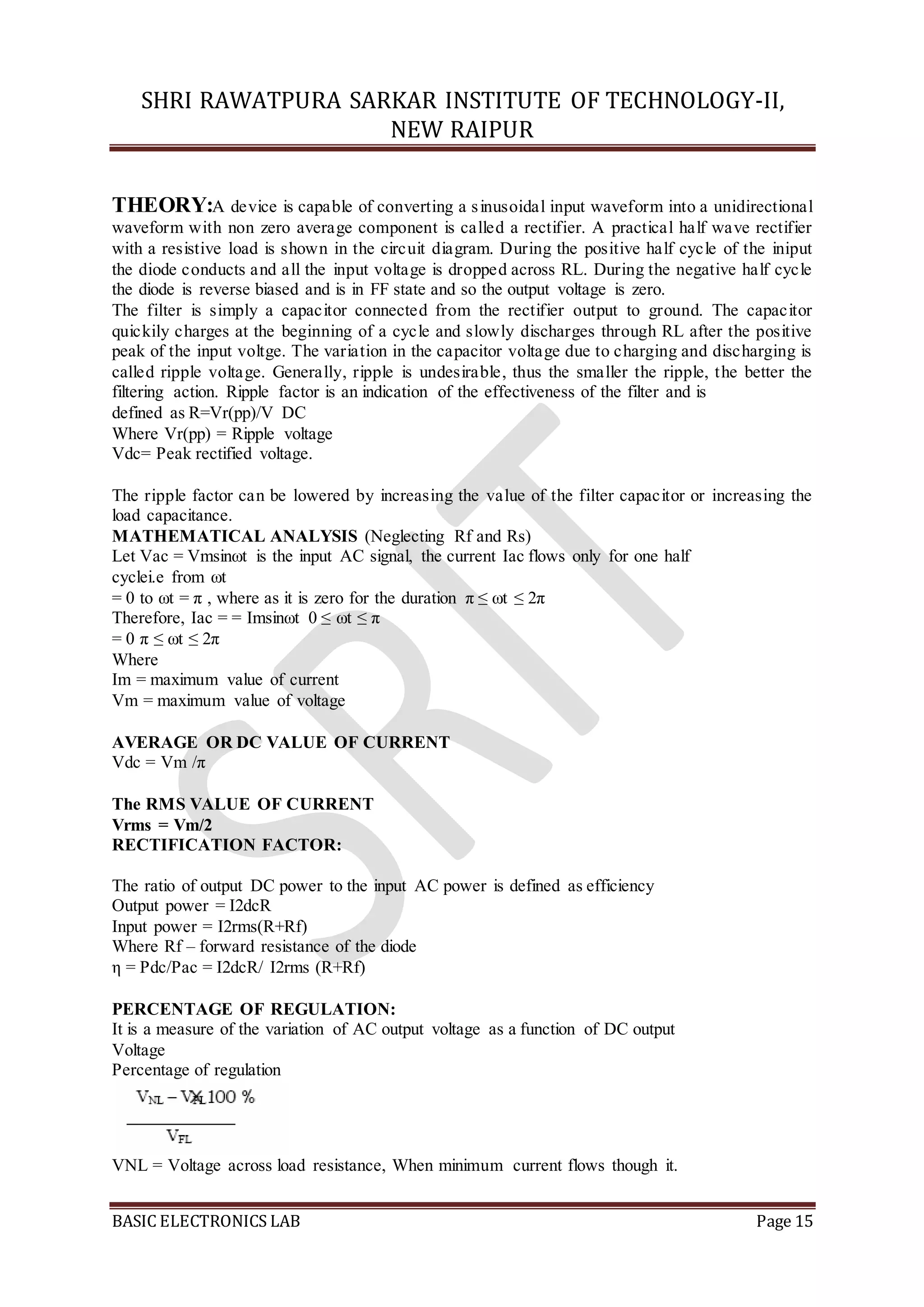
THEORY:A device is capable of converting a sinusoidal input waveform into a unidirectional
waveform with non zero average component is called a rectifier. A practical half wave rectifier
with a resistive load is shown in the circuit diagram. During the positive half cycle of the iniput
the diode conducts and all the input voltage is dropped across RL. During the negative half cycle
the diode is reverse biased and is in FF state and so the output voltage is zero.
The filter is simply a capacitor connected from the rectifier output to ground. The capacitor
quickily charges at the beginning of a cycle and slowly discharges through RL after the positive
peak of the input voltge. The variation in the capacitor voltage due to charging and discharging is
called ripple voltage. Generally, ripple is undesirable, thus the smaller the ripple, the better the
filtering action. Ripple factor is an indication of the effectiveness of the filter and is
defined as R=Vr(pp)/V DC
Where Vr(pp) = Ripple voltage
Vdc= Peak rectified voltage.
The ripple factor can be lowered by increasing the value of the filter capacitor or increasing the
load capacitance.
MATHEMATICAL ANALYSIS (Neglecting Rf and Rs)
Let Vac = Vmsinωt is the input AC signal, the current Iac flows only for one half
cyclei.e from ωt
= 0 to ωt = π , where as it is zero for the duration π ≤ ωt ≤ 2π
Therefore, Iac = = Imsinωt 0 ≤ ωt ≤ π
= 0 π ≤ ωt ≤ 2π
Where
Im = maximum value of current
Vm = maximum value of voltage
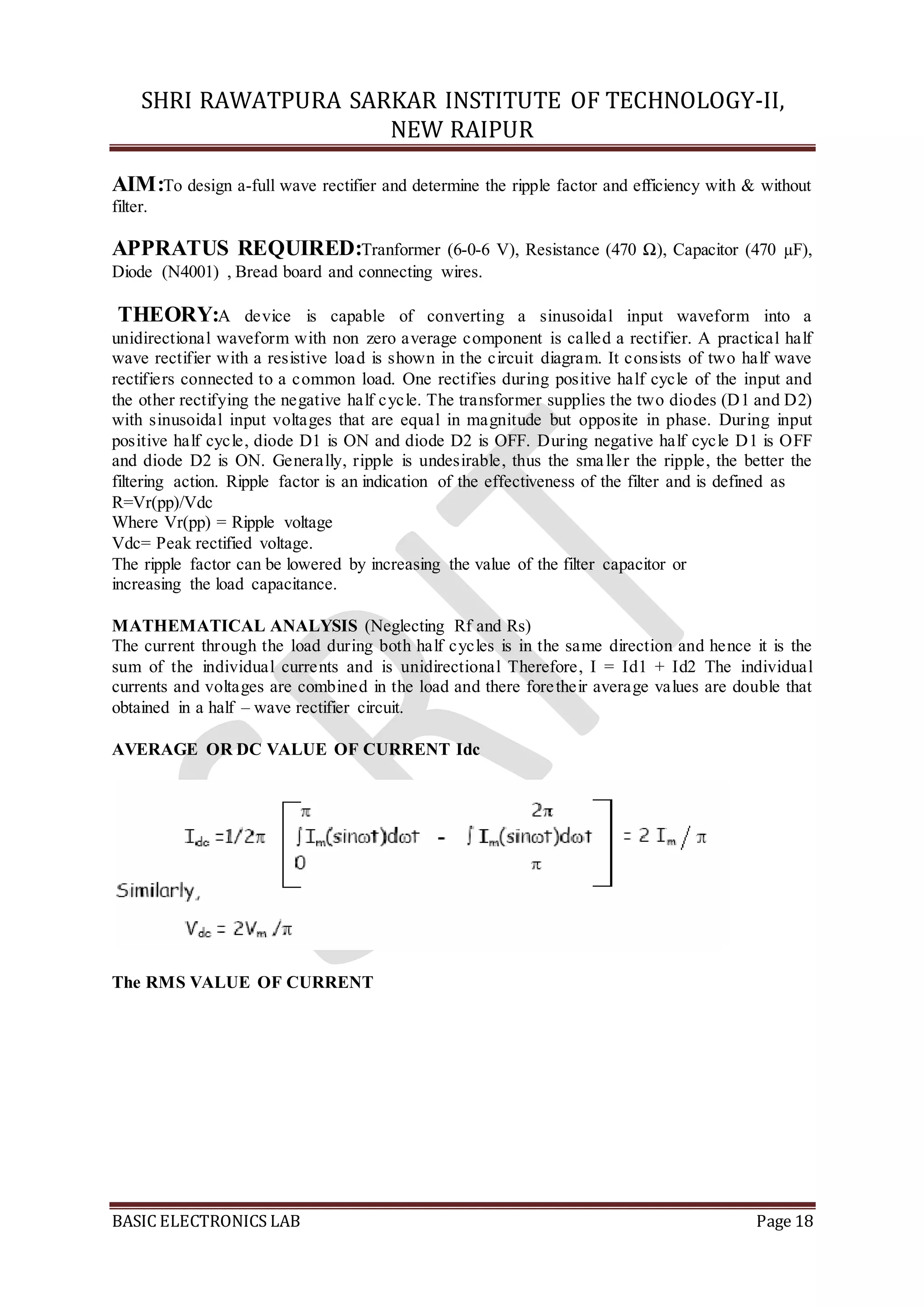
AVERAGE OR DC VALUE OF CURRENT
Vdc = Vm /π
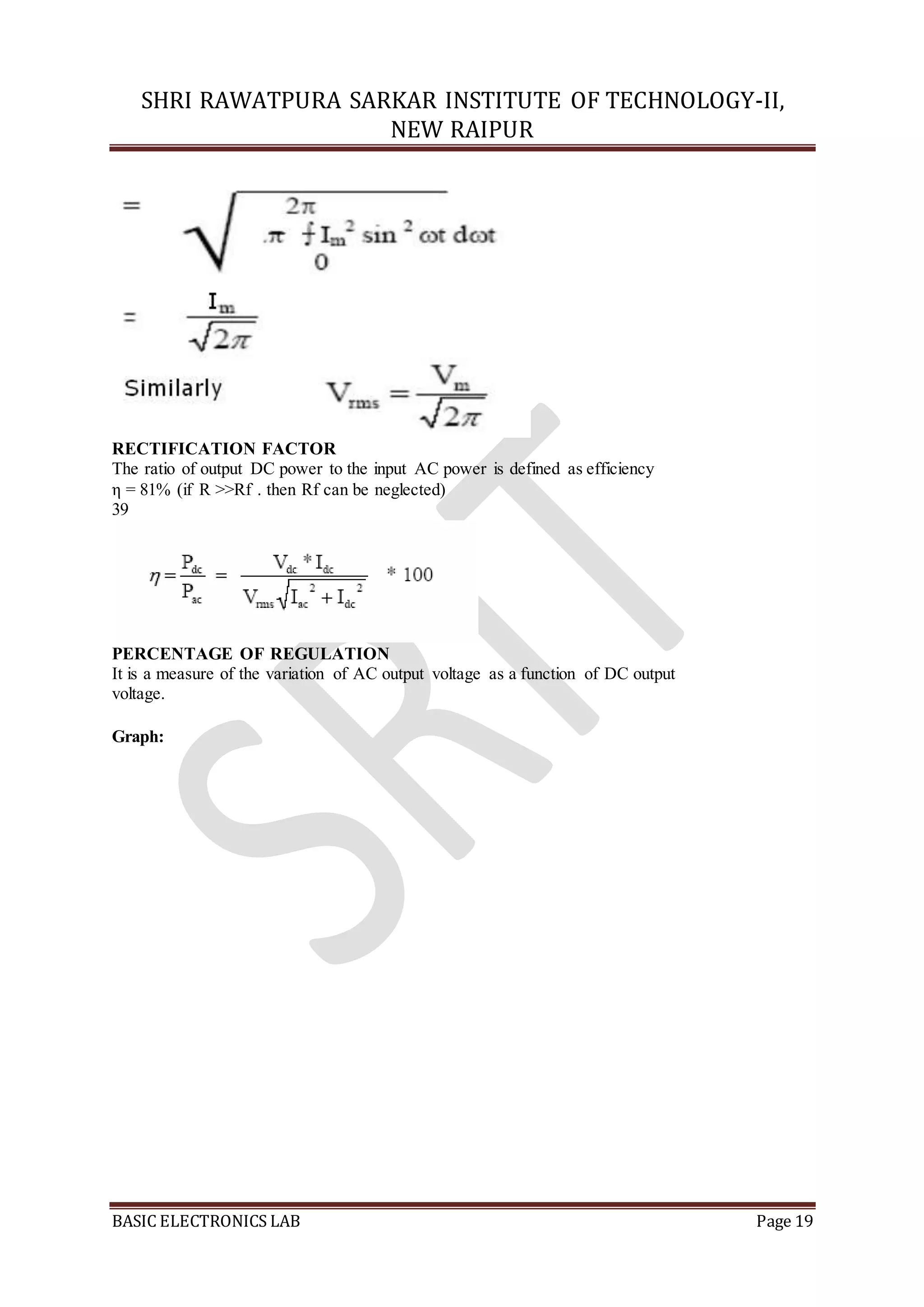
The RMS VALUE OF CURRENT
Vrms = Vm/2
RECTIFICATION FACTOR:
The ratio of output DC power to the input AC power is defined as efficiency
Output power = I2dcR
Input power = I2rms(R+Rf)
Where Rf – forward resistance of the diode
η = Pdc/Pac = I2dcR/ I2rms (R+Rf)
PERCENTAGE OF REGULATION:
It is a measure of the variation of AC output voltage as a function of DC output
Voltage
Percentage of regulation
VNL = Voltage across load resistance, When minimum current flows though it.
SHRI RAWATPURA SARKAR INSTITUTE OF TECHNOLOGY-II,
NEW RAIPUR
BASIC ELECTRONICS LAB Page 16
VFL = Voltage across load resistance, When maximum current flows through.
Graph:
Observation Table:
Calculation:
RESULT:
The Rectified output Voltage of Half Wave Rectifier Circuit is observed and
the calculated value of ripple factor is _______________
Viva Questions:-
Q1. What is a rectifier circuit?
A rectifier circuit is a circuit which is used to convert a.c voltage in to pulsating d.c voltage. Broadly
rectifiers are of two types:
a. Half wave rectifier
b. Full wave rectifier
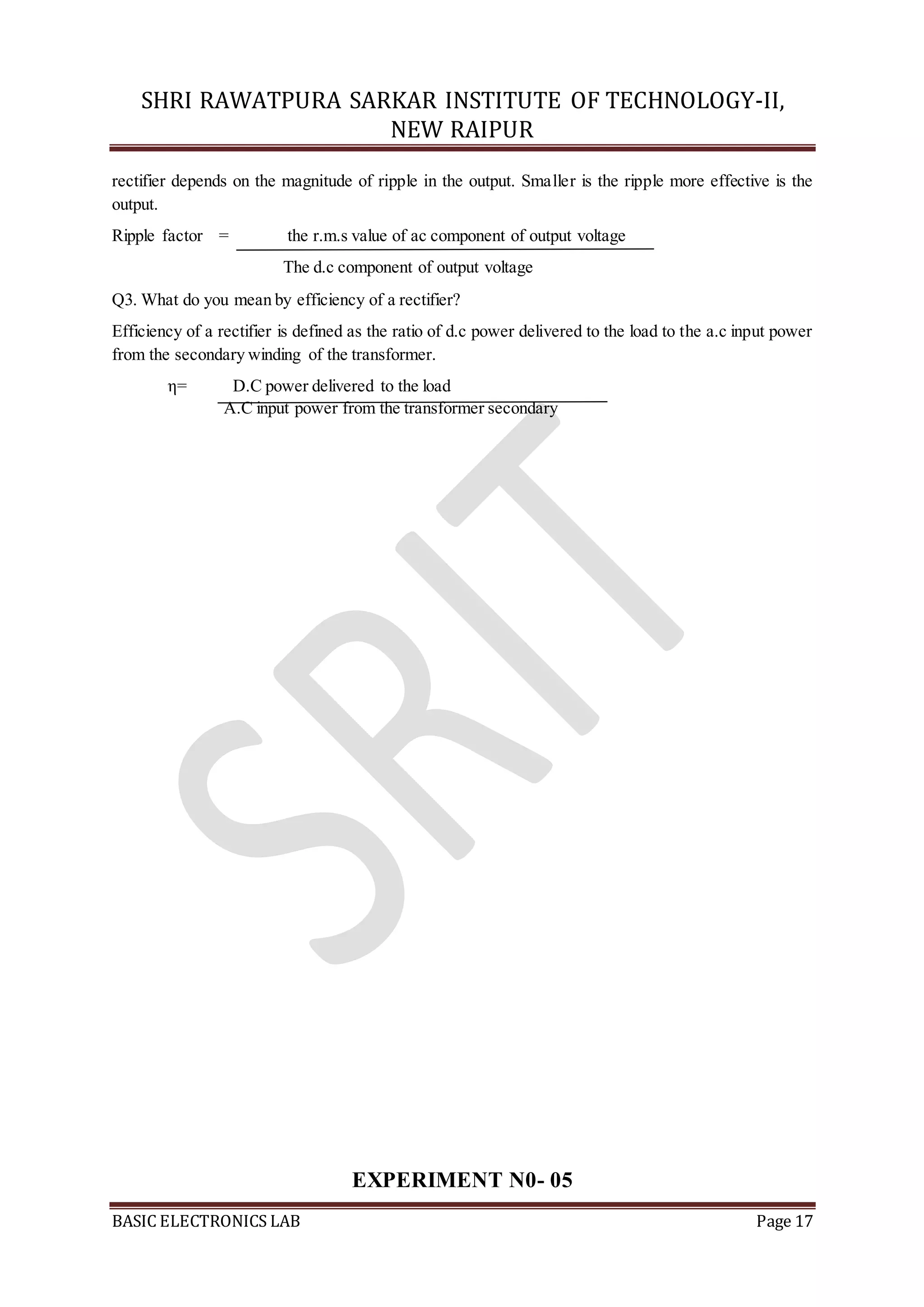
Q2. What is ripple factor?
The output voltage or load current of a rectifier contains two components namely d.c component and
a.c component. The a.c component present in the output is called a ripple. The effectiveness of a
SHRI RAWATPURA SARKAR INSTITUTE OF TECHNOLOGY-II,
NEW RAIPUR
BASIC ELECTRONICS LAB Page 17
rectifier depends on the magnitude of ripple in the output. Smaller is the ripple more effective is the
output.
Ripple factor = the r.m.s value of ac component of output voltage
The d.c component of output voltage
Q3. What do you mean by efficiency of a rectifier?
Efficiency of a rectifier is defined as the ratio of d.c power delivered to the load to the a.c input power
from the secondary winding of the transformer.
η= D.C power delivered to the load
A.C input power from the transformer secondary
EXPERIMENT N0- 05
SHRI RAWATPURA SARKAR INSTITUTE OF TECHNOLOGY-II,
NEW RAIPUR
BASIC ELECTRONICS LAB Page 18
AIM:To design a-full wave rectifier and determine the ripple factor and efficiency with & without
filter.
APPRATUS REQUIRED:Tranformer (6-0-6 V), Resistance (470 Ω), Capacitor (470 µF),
Diode (N4001) , Bread board and connecting wires.
THEORY:A device is capable of converting a sinusoidal input waveform into a
unidirectional waveform with non zero average component is called a rectifier. A practical half
wave rectifier with a resistive load is shown in the circuit diagram. It consists of two half wave
rectifiers connected to a common load. One rectifies during positive half cycle of the input and
the other rectifying the negative half cycle. The transformer supplies the two diodes (D1 and D2)
with sinusoidal input voltages that are equal in magnitude but opposite in phase. During input
positive half cycle, diode D1 is ON and diode D2 is OFF. During negative half cycle D1 is OFF
and diode D2 is ON. Generally, ripple is undesirable, thus the smaller the ripple, the better the
filtering action. Ripple factor is an indication of the effectiveness of the filter and is defined as
R=Vr(pp)/Vdc
Where Vr(pp) = Ripple voltage
Vdc= Peak rectified voltage.
The ripple factor can be lowered by increasing the value of the filter capacitor or
increasing the load capacitance.
MATHEMATICAL ANALYSIS (Neglecting Rf and Rs)
The current through the load during both half cycles is in the same direction and hence it is the
sum of the individual currents and is unidirectional Therefore, I = Id1 + Id2 The individual
currents and voltages are combined in the load and there foretheir average values are double that
obtained in a half – wave rectifier circuit.
AVERAGE OR DC VALUE OF CURRENT Idc
The RMS VALUE OF CURRENT
SHRI RAWATPURA SARKAR INSTITUTE OF TECHNOLOGY-II,
NEW RAIPUR
BASIC ELECTRONICS LAB Page 19
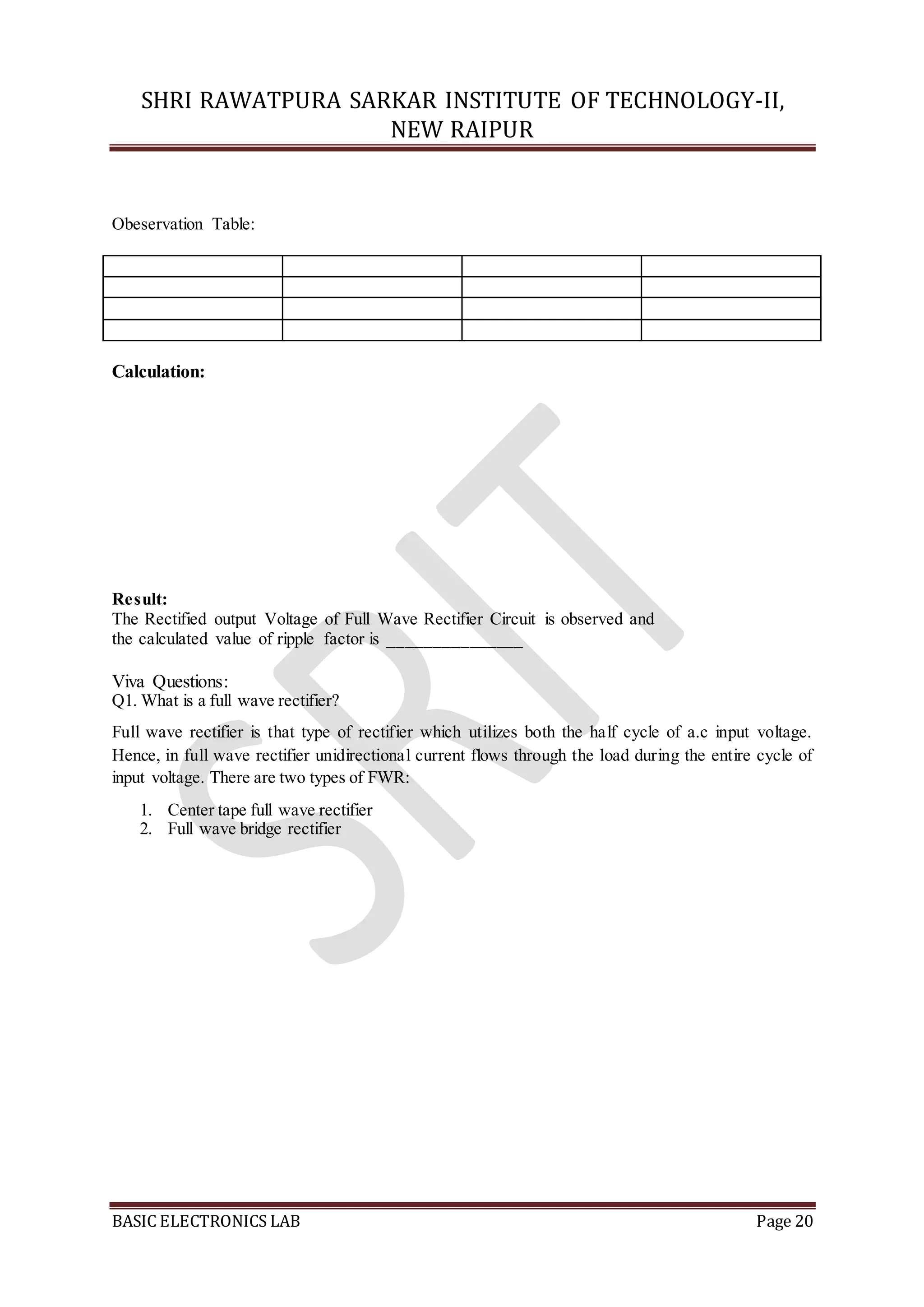
RECTIFICATION FACTOR
The ratio of output DC power to the input AC power is defined as efficiency
η = 81% (if R >>Rf . then Rf can be neglected)
39
PERCENTAGE OF REGULATION
It is a measure of the variation of AC output voltage as a function of DC output
voltage.
Graph:
SHRI RAWATPURA SARKAR INSTITUTE OF TECHNOLOGY-II,
NEW RAIPUR
BASIC ELECTRONICS LAB Page 20
Obeservation Table:
Calculation:
Result:
The Rectified output Voltage of Full Wave Rectifier Circuit is observed and
the calculated value of ripple factor is _______________
Viva Questions:
Q1. What is a full wave rectifier?
Full wave rectifier is that type of rectifier which utilizes both the half cycle of a.c input voltage.
Hence, in full wave rectifier unidirectional current flows through the load during the entire cycle of
input voltage. There are two types of FWR:
1. Center tape full wave rectifier
2. Full wave bridge rectifier
SHRI RAWATPURA SARKAR INSTITUTE OF TECHNOLOGY-II,
NEW RAIPUR
BASIC ELECTRONICS LAB Page 21
EXPERIMENT-06
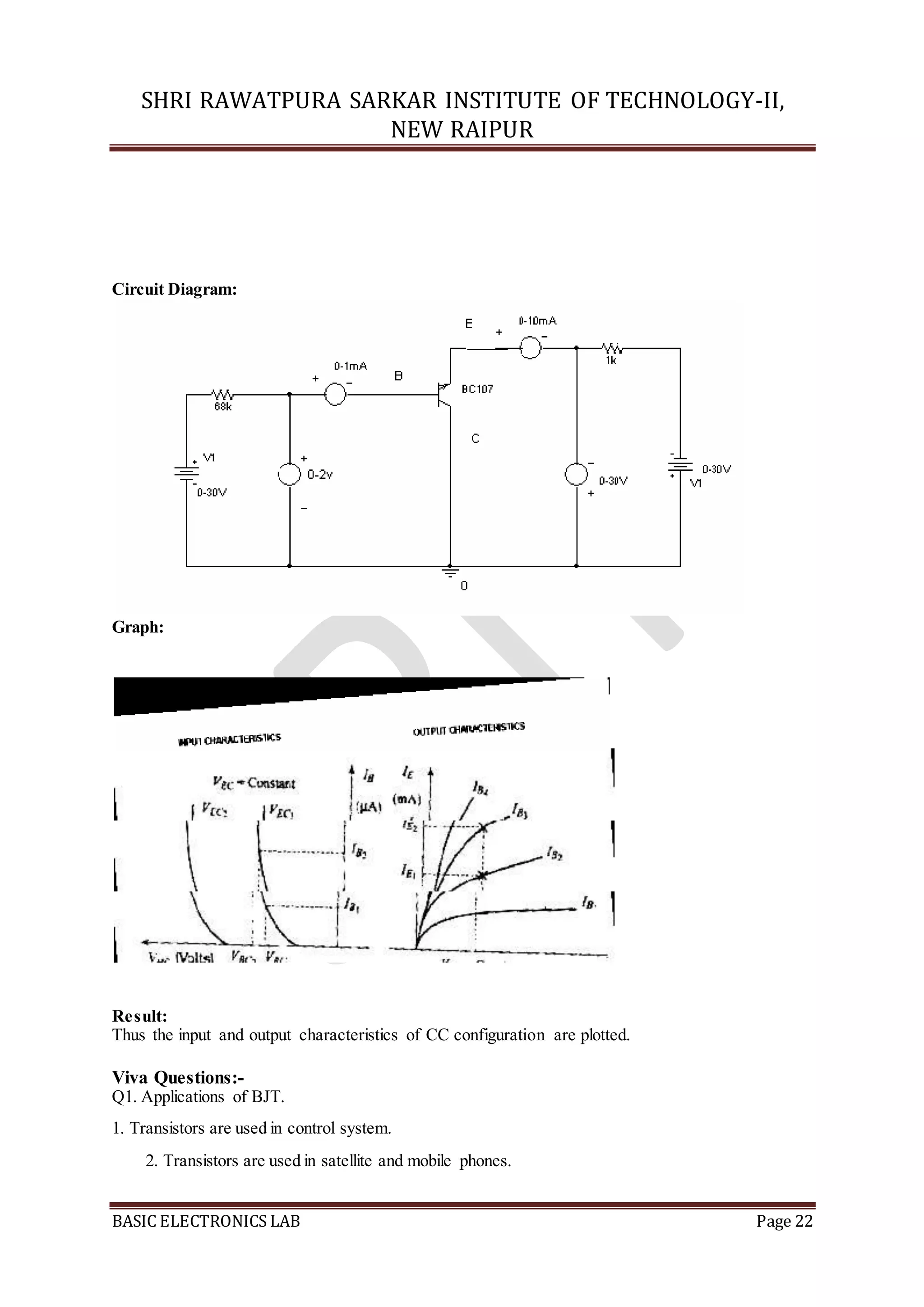
AIM:To draw the characteristics of CC configuration of a transistor amplifier.
APPRATUS REQUIRED:Transistor ( BC 147), Resistance ( 68 k, 1 k), Regulated power
supply(0-30 V),Ammeter, Voltmeter, Bread board and connecting wires.
THEORY:Bipolar junction transistor (BJT) is a 3 terminal (emitter, base, collector)
semiconductor device. There are two types of transistors namely NPN and PNP. It consists of two
P-N junctions namely emitter junction and collector junction. In Common collector configuration
the input is applied between base and collector terminals and the output is taken from collector
and emitter. Here collector is common to both input and output and hence the name common
collector configuration.
Input characteristics are obtained between the input current and input voltage taking output
voltage as parameter. It is plotted between VBC and IB at constant VCE in
CCconfiguration.
Output characteristics are obtained between the output voltage and output current
taking input current as parameter. It is plotted between VCE and IE at constant IB in
CC configuration.
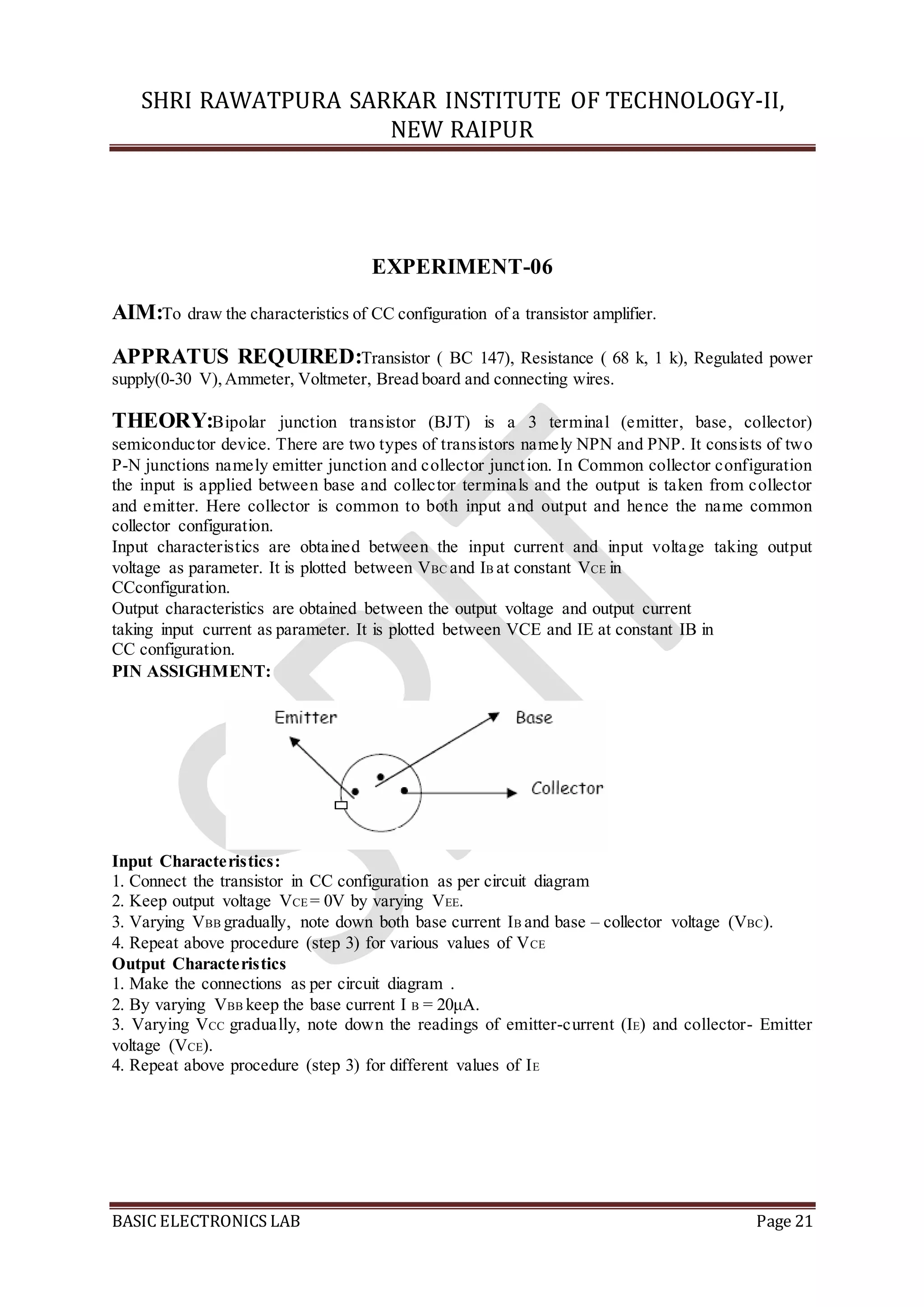
PIN ASSIGHMENT:
Input Characteristics:
1. Connect the transistor in CC configuration as per circuit diagram
2. Keep output voltage VCE = 0V by varying VEE.
3. Varying VBB gradually, note down both base current IB and base – collector voltage (VBC).
4. Repeat above procedure (step 3) for various values of VCE
Output Characteristics
1. Make the connections as per circuit diagram .
2. By varying VBB keep the base current I B = 20μA.
3. Varying VCC gradually, note down the readings of emitter-current (IE) and collector- Emitter
voltage (VCE).
4. Repeat above procedure (step 3) for different values of IE
SHRI RAWATPURA SARKAR INSTITUTE OF TECHNOLOGY-II,
NEW RAIPUR
BASIC ELECTRONICS LAB Page 22
Circuit Diagram:
Graph:
Result:
Thus the input and output characteristics of CC configuration are plotted.
Viva Questions:-
Q1. Applications of BJT.
1. Transistors are used in control system.
2. Transistors are used in satellite and mobile phones.
SHRI RAWATPURA SARKAR INSTITUTE OF TECHNOLOGY-II,
NEW RAIPUR
BASIC ELECTRONICS LAB Page 23
3. In digital electronics transistor is used as a high speed electronic switch.
Q2 what do you mean by operating point?
The zero signal values (no a.c signal is applied) of the collector current Ic and collector-to-emitter
voltage VCE are known as the operating point.
Q3. What are the methods of transistor biasing?
Four methods are commonly used:
1. Fixed bias
2. Collector to base bias
3. Self bias or voltage divider bias.
4. Emitter bias.
Q4. Explain why an ordinary transistor is called bipolar?
Because the transistor operation is carried out by two types of charge carriers (majority and minority
carriers),an ordinary transistor is called bipolar.
Q5. Why transistor is called current controlled device?
The output voltage, current or power is controlled by the input current in a transistor so it is called
current controlled device.
SHRI RAWATPURA SARKAR INSTITUTE OF TECHNOLOGY-II,
NEW RAIPUR
BASIC ELECTRONICS LAB Page 24
EXPERIMENT-07
AIM:To draw the characteristics of CE configuration of a transistor amplifier
APPRATUS REQUIRED:Transistor ( BC 147), Resistance ( 68 k, 1 k), Regulated power
supply(0-30 V),Ammeter, Voltmeter, Bread board and connecting wires.
THEORY:Bipolar junction transistor (BJT) is a 3 terminal (emitter, base, collector)
semiconductor device. There are two types of transistors namely NPN and PNP. It consists of two
P-N junctions namely emitter junction and collector junction. In Common Emitter configuration
the input is applied between base and emitter and the output is taken from collector and emitter.
Here emitter is common to both input and output and hence the name common emitter
configuration. Input characteristics are obtained between the input current and input voltage
taking output voltage as parameter. It is plotted between VBE and IB at constant VCE in CE
configuration. Output characteristics are obtained between the output voltage and output current
taking input current as parameter. It is plotted between VCE and IC at constant IB in CE
configuration.
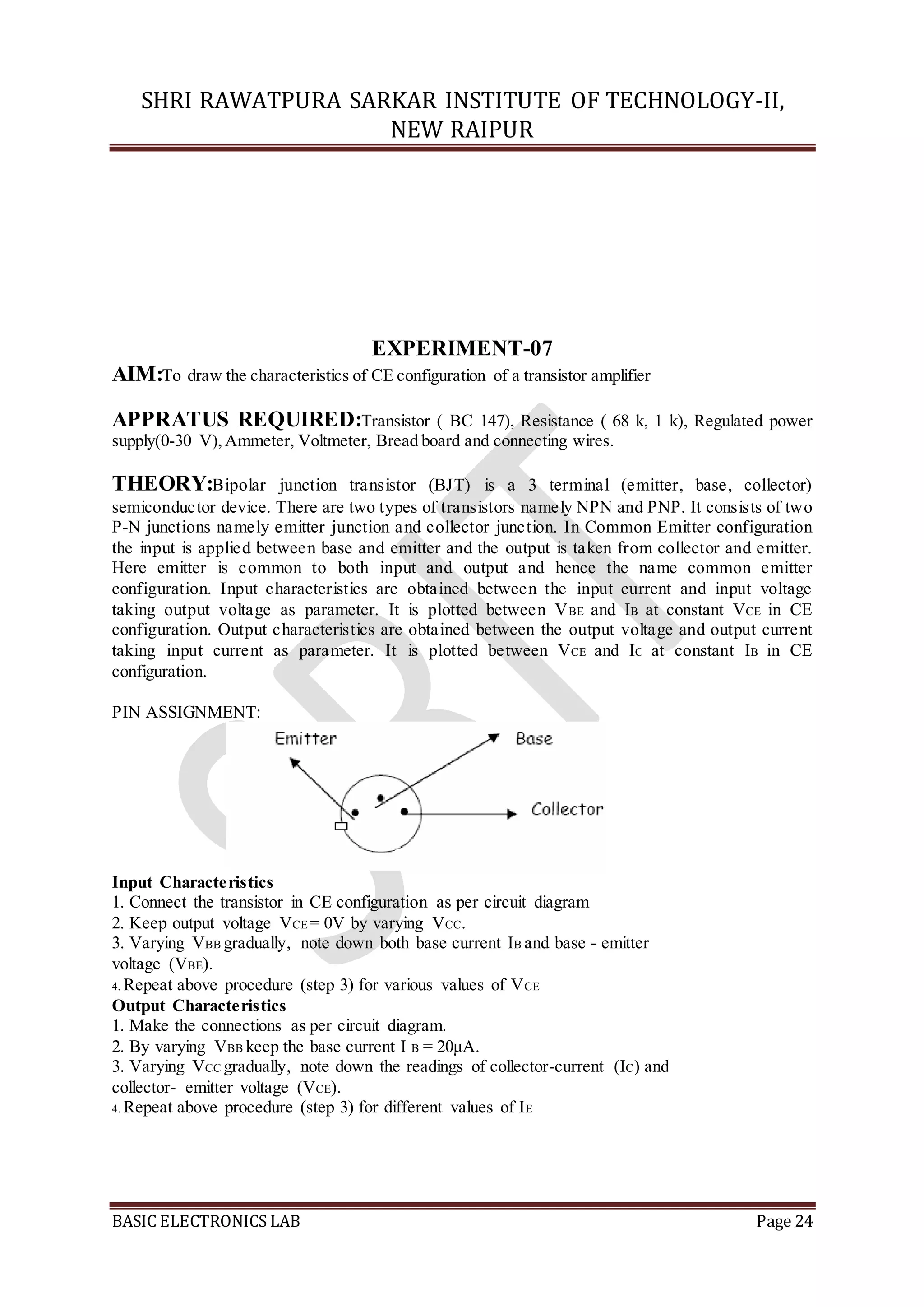
PIN ASSIGNMENT:
Input Characteristics
1. Connect the transistor in CE configuration as per circuit diagram
2. Keep output voltage VCE = 0V by varying VCC.
3. Varying VBB gradually, note down both base current IB and base - emitter
voltage (VBE).
4. Repeat above procedure (step 3) for various values of VCE
Output Characteristics
1. Make the connections as per circuit diagram.
2. By varying VBB keep the base current I B = 20μA.
3. Varying VCC gradually, note down the readings of collector-current (IC) and
collector- emitter voltage (VCE).
4. Repeat above procedure (step 3) for different values of IE
SHRI RAWATPURA SARKAR INSTITUTE OF TECHNOLOGY-II,
NEW RAIPUR
BASIC ELECTRONICS LAB Page 25
Circuit Diagram:
Graph:
Viva Questions:-
Q1. What is done to the base region of a transistor to improve its operation?
Base is made thin and very lightly doped in comparison to either emitter or collector so that it may
pass most of the injected charge carriers to the collector.
Q2. Why silicon type transistors are more often used than germanium type?
Because, silicon has smaller cut-off current ICBO, small variation in temperature as compared to those
in case of germanium.
Q3. Why CE configuration is most popular in amplifier circuits?
SHRI RAWATPURA SARKAR INSTITUTE OF TECHNOLOGY-II,
NEW RAIPUR
BASIC ELECTRONICS LAB Page 26
CE configuration is mainly used because its current , voltage and power gains are quite high and the
ratio of the output impedance and input impedance are quite moderate.
Q4. Why cc configuration seldom used?
CC configuration is seldom used because its voltage gain is always less than unity.
Q5. What is meant by small signal amplifier?
When the input signal is quite weak and produces small fluctuations in the output current in
comparison to its quiescent value, the amplifier is called the small signal or voltage amplifier.
Q6. What is the effect of removal of emitter bypass capacitor in a CE amplifier circuit?
. Removal of emitter bypass capacitor in a CE amplifier circuit causes excess degeneration in the
amplifier circuit.
Q7. What is the effect of source resistance on voltage gain of a common base transistor amplifier?
The voltage gain of a CB transistor amplifier will decrease if the source resistance is considered
because in such a case there will be a voltage drop across the source resistance and output voltage will
decrease.
SHRI RAWATPURA SARKAR INSTITUTE OF TECHNOLOGY-II,
NEW RAIPUR
BASIC ELECTRONICS LAB Page 27
EXPERIMENT N0-08
AIM:To draw the characteristics of FET
APPRATUS REQUIRED:JFET (BFW11), Resistance ( 1 k), Regulated power supply(0-30
V), Ammeter, Voltmeter, Bread board and connecting wires.
THEORY:
The field effect transistor (FET) is made of a bar of N type material called the SUBSTRATE with
a P type junction (the gate) diffused into it. With a positive voltage on the drain, with respect to
the source, electron current flows from source to drain through the Channel the gate is made
negative with respect to the source, an electrostatic field is created, which squeezes the channel
and reduces the current. If the gate voltage is high enough the channel will be "pinched off" and
the current will be zero. The FET is voltage controlled, unlike the transistor which is current
controlled. This device is sometimes called the junction FET or IGFET or JFET. If the FET is
accidentally forward biased, gate current will flow and the FET will be destroyed. To avoid this,
an extremely thin insulating layer of silicon oxide is placed between the gate and the channel.
The device is then known as an insulated gate FET, or IGFET or metal oxide semiconductor
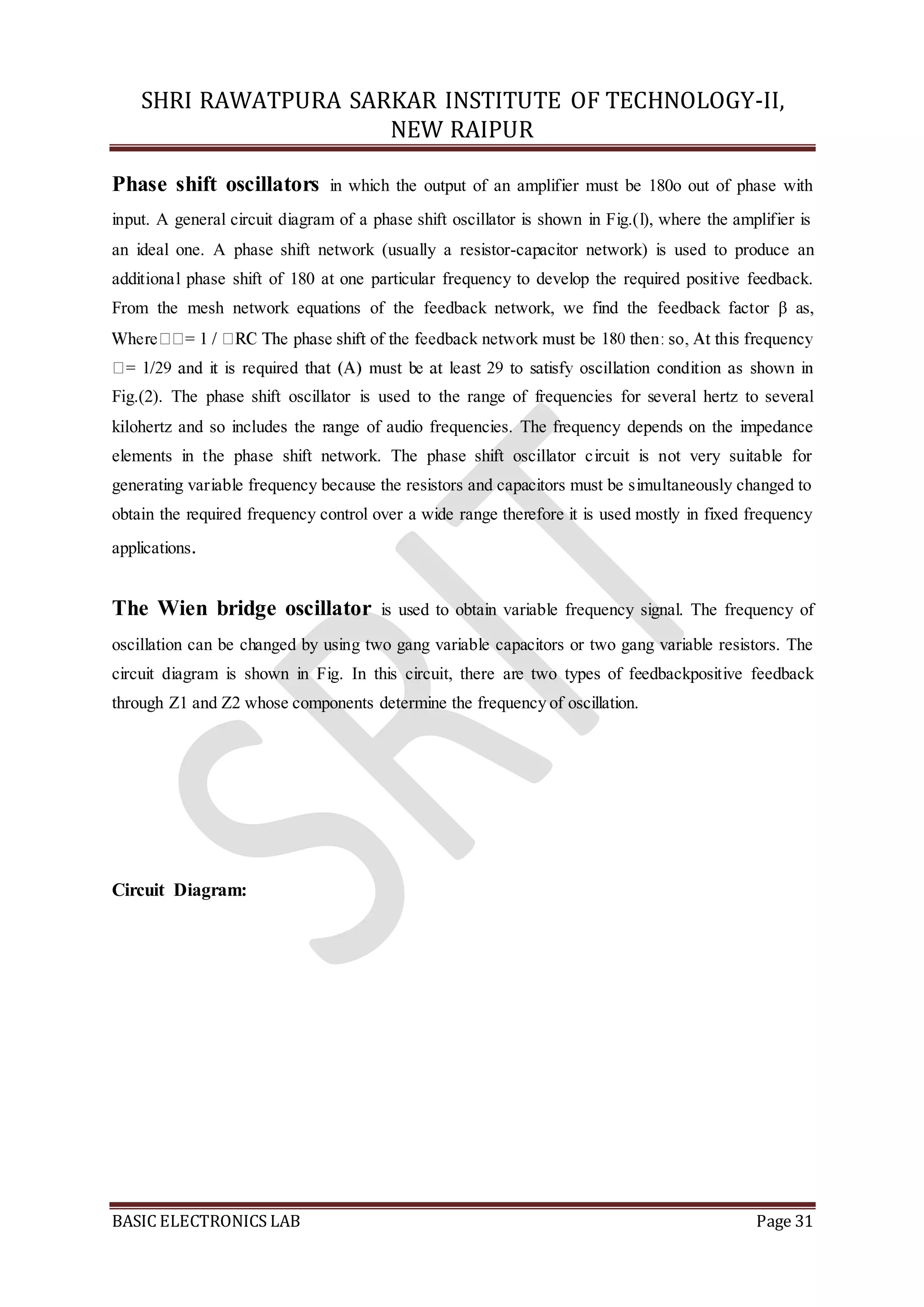
FET(MOSTFET) Drain characteristics are obtained between the drain to source voltage (VDS)
and drain current (ID) taking gate to source voltage (VGS) as the parameter. Transfer
characteristics are obtained between the gate to source voltage (VGS) and Drain current (ID)
taking drain to source voltage (VDS) as parameter.
DRAIN CHARACTERISTICS
Determine the drain characteristics of FET by keeping VGS = 0v.
Plot its characteristics with respect to VDS versus ID
TRANSFER CHARACTERISTICS:
Determine the transfer characteristics of FET for constant value of VDS.
Plot its characteristics with respect to VGS versus ID
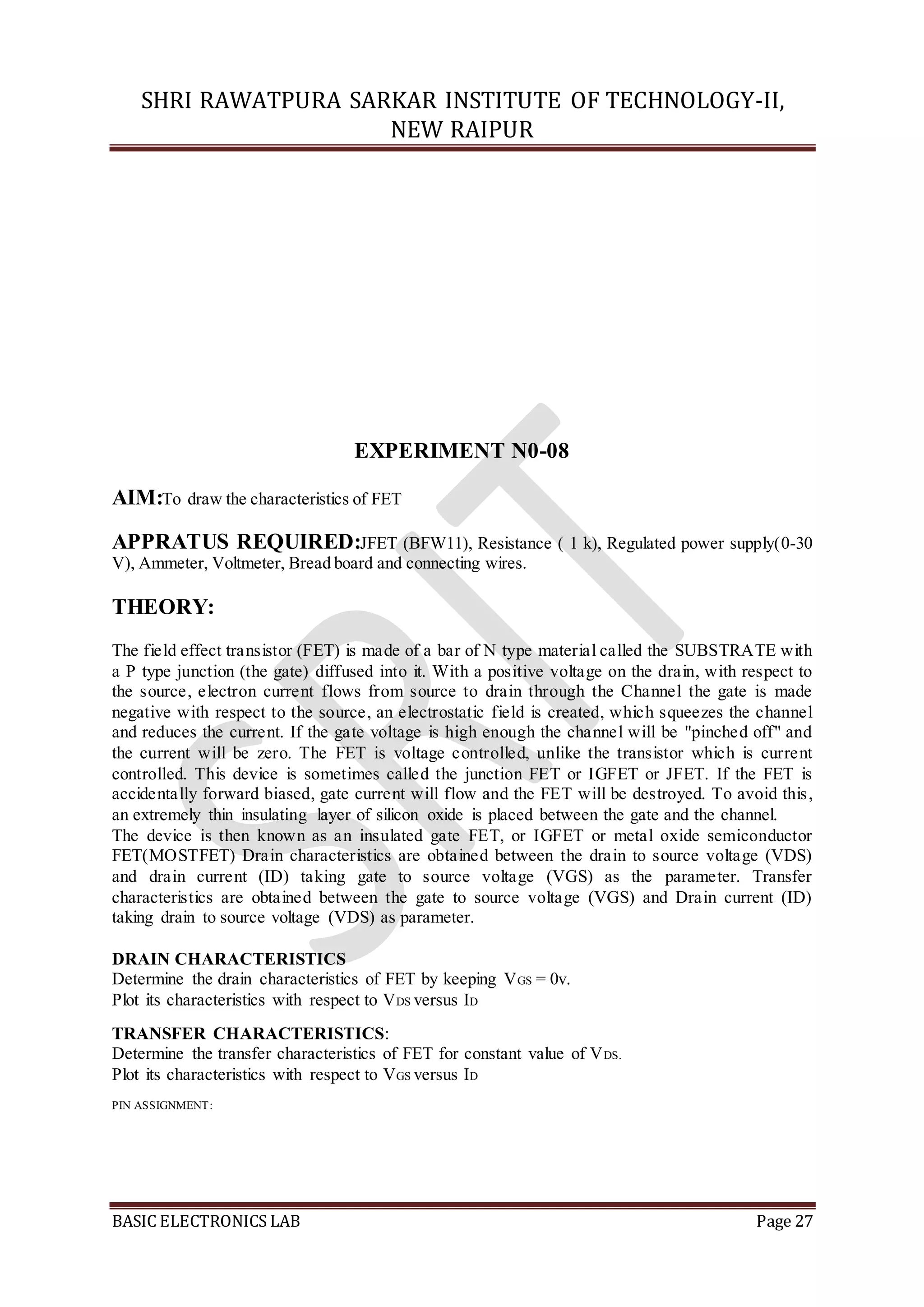
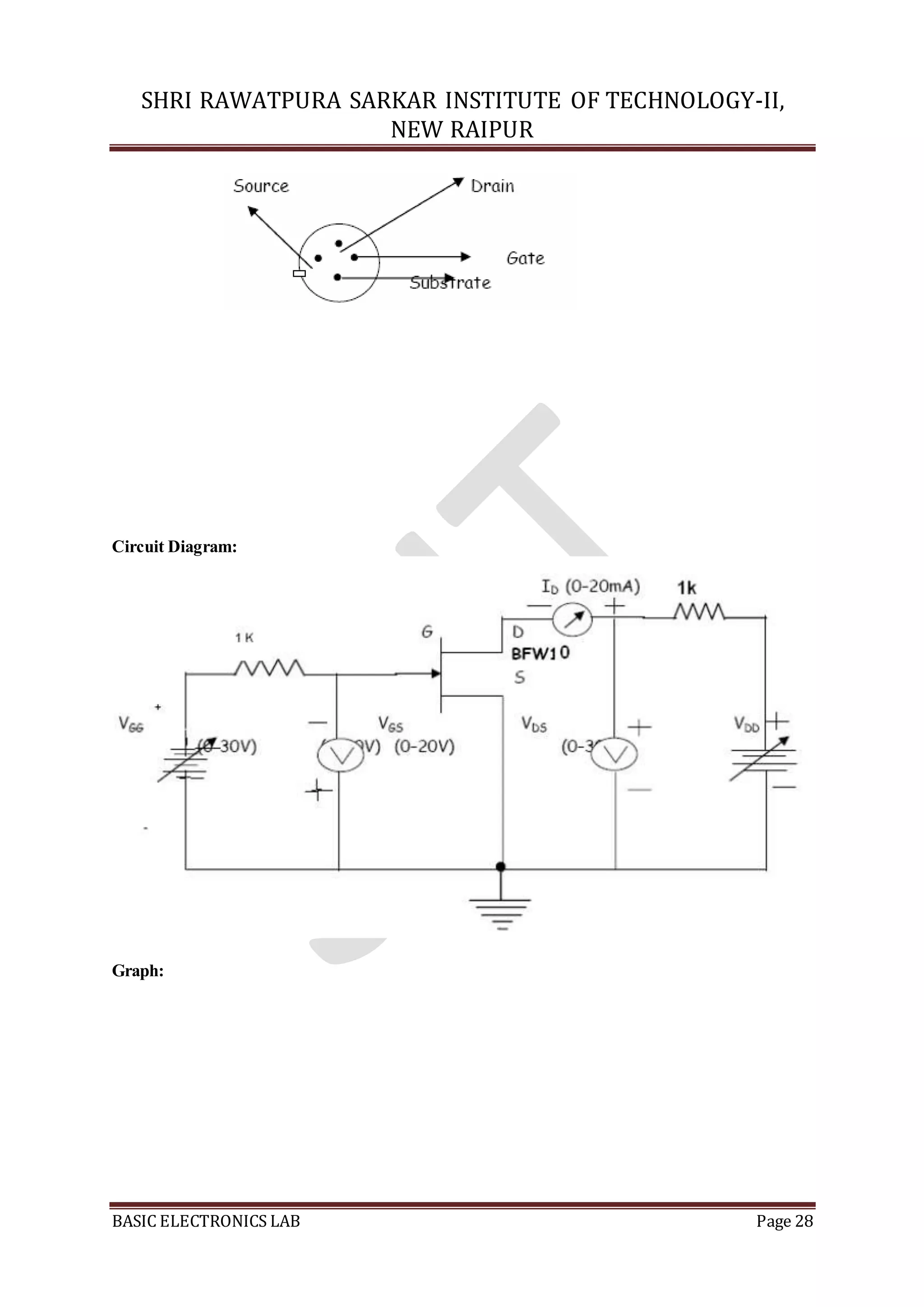
PIN ASSIGNMENT:
SHRI RAWATPURA SARKAR INSTITUTE OF TECHNOLOGY-II,
NEW RAIPUR
BASIC ELECTRONICS LAB Page 28
Circuit Diagram:
Graph:
SHRI RAWATPURA SARKAR INSTITUTE OF TECHNOLOGY-II,
NEW RAIPUR
BASIC ELECTRONICS LAB Page 29
Viva Questions:-
Q1. What is pinch off region?
In this region the drain current remains constant at its maximum value (i.e IDSS). The drain current in
pinch off region depends on the gate to source voltage.The pinch off region is the normal operating
region in JFET, when used as an amplifier.
Q2. How MOSFET act as a resistor?
The MOSFET have an important property that they can be used as a resistor, capacitor and a switch.
This makes the design of the circuit very simple, since the entire circuit consists of only MOSFET and
no other component.
Q3. Why are FET called unipolar transistors?
In FETs the current conduction is by only one type of majority carriers(either by electrons or by
holes) and, therefore they are called unipolar transistor.
Q4. How is drain current controlled in JFET?
The drain current is controlled by controlling the reverse bias given to its gate.
Q5. What is meant by drain characteristic of FETs?
The curve drawn between the drain current and drain-source voltage with gate-to-source voltage as
the parameter is called the drain characteristic.
Q6. What is meant by transfer characteristic of FETs?
The curve drawn between the drain current and gate-to-source voltage for a given value of drain-
source voltage is called the transfer characteristic.
Q7. What is meant by saturation region?
The region of drain characteristic of a FET in which drain current remains fairly constant is called the
saturation region or pinch off region.
SHRI RAWATPURA SARKAR INSTITUTE OF TECHNOLOGY-II,
NEW RAIPUR
BASIC ELECTRONICS LAB Page 30
Q8. Why E-MOSFET is called sometimes normally off-MOSFET?
E-MOSFET operates with large positive gate voltages only and does not conduct when gate source
voltage VGS=0, so it is called normally-off MOSFET.
Q9. Name the factors which make the JFET superior to BJT?
The high input impedance, low output impedance and low noise level make JFET far superior to the
BJT.
Q10. Tell the Disadvantage of JFET?
The main disadvantage of JFET is that it has a relatively small gain bandwidth product as compared
with that of a conventional transistor (i.e. BJT)
EXPERIMENT N0-09
AIM:To study Wein Bridge Oscillator & R-C phase shift oscillator.
APPRATUS REQUIRED:
1-Dual Power supply 2- Oscilloscope 3- Operational amplifier 4- Transistors 5- Resistance and
Capacitor of different values 6- Function generator.
THEORY:
The oscillator is an amplifier with positive feedback that generates a number of waveforms
usually used in instrumentation and test equipment’s. An oscillator that generates a sinusoidal
output is called a harmonic oscillator; the transistor is usually acts in the active region. The
output of the relaxation oscillator is not sinusoidal depending on the transient rise and decay
of voltage in RC or RL circuits. There are two types of RC oscillators:
SHRI RAWATPURA SARKAR INSTITUTE OF TECHNOLOGY-II,
NEW RAIPUR
BASIC ELECTRONICS LAB Page 31
Phase shift oscillators in which the output of an amplifier must be 180o out of phase with
input. A general circuit diagram of a phase shift oscillator is shown in Fig.(l), where the amplifier is
an ideal one. A phase shift network (usually a resistor-capacitor network) is used to produce an
additional phase shift of 180 at one particular frequency to develop the required positive feedback.
From the mesh network equations of the feedback network, we find the feedback factor β as,
Fig.(2). The phase shift oscillator is used to the range of frequencies for several hertz to several
kilohertz and so includes the range of audio frequencies. The frequency depends on the impedance
elements in the phase shift network. The phase shift oscillator circuit is not very suitable for
generating variable frequency because the resistors and capacitors must be simultaneously changed to
obtain the required frequency control over a wide range therefore it is used mostly in fixed frequency
applications.
The Wien bridge oscillator is used to obtain variable frequency signal. The frequency of
oscillation can be changed by using two gang variable capacitors or two gang variable resistors. The
circuit diagram is shown in Fig. In this circuit, there are two types of feedbackpositive feedback
through Z1 and Z2 whose components determine the frequency of oscillation.
Circuit Diagram:
SHRI RAWATPURA SARKAR INSTITUTE OF TECHNOLOGY-II,
NEW RAIPUR
BASIC ELECTRONICS LAB Page 32
Viva Questions:-
Q1. Define Oscillator.
Q2. Explain Barkhausen Criterion.
Q3. Which type of feedback is used in oscillator circuit?
Q4. Why RC oscillators cannot generate high frequency oscillations?
Ans. At high frequencies, resistors look like inductors or capacitors so the equations that govern
oscillation in RC oscillators no longer apply. In other words, because of those parasitic components, it
gets more and more difficult to make a stable RC oscillator as frequencies go up. At some point it
becomes easier and more stable to use other types of oscillators.
Q5. What are the applications of RC phase shift oscillators?
Ans. RC phase shift oscillators are mostly used at audio frequencies. Other than this, electronic organs
makes use of this oscillator such as electronic musical instruments like pianos. Also used in
equipment that emits beeps. Example, many GPS units beeps when they performs an action. Also
used in voice synthesis.
EXPERIMENT NO-10
AIM:To design a Zener regulator circuit and to find the regulation characteristics.
APPRATUS REQUIRED:Zener diode, Resistance,Voltage Regulator Power Supply.
THEORY:Zener Diodes can be used to produce a stabilised voltage output with low
ripple under varying load current conditions. By passing a small current through the diode
from a voltage source, via a suitable current limiting resistor (RS), the zener diode will
conduct sufficient current to maintain a voltage drop of Vout.
We remember from the previous tutorials that the DC output voltage from the half or full-
wave rectifiers contains ripple superimposed onto the DC voltage and that as the load value
SHRI RAWATPURA SARKAR INSTITUTE OF TECHNOLOGY-II,
NEW RAIPUR
BASIC ELECTRONICS LAB Page 33
changes so to does the average output voltage. By connecting a simple zenerstabiliser circuit
as shown below across the output of the rectifier, a more stable output voltage can be
produced
The resistor, RS is connected in series with the zener diode to limit the current flow through
the diode with the voltage source, VS being connected across the combination. The stabilised
output voltage Vout is taken from across the zener diode. The zener diode is connected with its
cathode terminal connected to the positive rail of the DC supply so it is reverse biased and
will be operating in its breakdown condition. Resistor RS is selected so to limit the maximum
current flowing in the circuit.
With no load connected to the circuit, the load current will be zero, ( IL = 0 ), and all the
circuit current passes through the zener diode which in turn dissipates its maximum power.
Also a small value of the series resistor RS will result in a greater diode current when the load
resistance RL is connected and large as this will increase the power dissipation requirement of
the diode so care must be taken when selecting the appropriate value of series resistance so
that the zener’s maximum power rating is not exceeded under this no-load or high-impedance
condition.
The load is connected in parallel with the zener diode, so the voltage across RL is always the
same as the zener voltage, ( VR = VZ ). There is a minimum zener current for which the
stabilization of the voltage is effective and the zener current must stay above this value
operating under load within its breakdown region at all times. The upper limit of current is of
course dependant upon the power rating of the device. The supply voltage VS must be greater
than VZ.
One small problem with zener diode stabiliser circuits is that the diode can sometimes
generate electrical noise on top of the DC supply as it tries to stabilise the voltage. Normally
this is not a problem for most applications but the addition of a large value decoupling
capacitor across the zener’s output may be required to give additional smoothing.
Then to summarise a little. A zener diode is always operated in its reverse biased condition. A
voltage regulator circuit can be designed using a zener diode to maintain a constant DC
output voltage across the load in spite of variations in the input voltage or changes in the load
current. The zener voltage regulator consists of a current limiting resistor RS connected in
series with the input voltage VS with the zener diode connected in parallel with the load RL in
this reverse biased condition. The stabilized output voltage is always selected to be the same
as the breakdown voltage VZ of the diode.
Circuit Diagram:
SHRI RAWATPURA SARKAR INSTITUTE OF TECHNOLOGY-II,
NEW RAIPUR
BASIC ELECTRONICS LAB Page 34
Viva Questions:-
Q1. What are the applications of Zener diode?
Q2. What is cut-in-voltage ?
Q3. What is voltage regulator?
Q4. What is the doping concentration in Zener diodes?
Q5. Can we use Zener diode as a switch?
Q6. What is PIV of Zener?
Q7. What will happen if P-N regions are heavily doped in Zener diode?
Q8. List the other Zener diodes with different breakdown voltages.
Q9. Is the breakdown region in Zener really destructible?

Be lab manual csvtu

  • 1.
    SHRI RAWATPURA SARKARINSTITUTE OF TECHNOLOGY-II, NEW RAIPUR BASIC ELECTRONICS LAB Page 1 EXPERIMENT NO. 01 AIM:To study the operation of CRO and DSO (Digital oscilloscope). APPRATUS REQUIRED: CRO( Cathode Ray Oscilloscope) , DSO( Digital Storage Oscilloscope) , probes, power supply. THEORY: Cathode Ray Oscilloscope: The oscilloscope counts among the important measuring instruments in experimental physics. It makes itpossible to observe and to measure quantitatively the course of an electric voltage UY as a function of timet or as a function of voltage UX in „real-time“. The temporal course of all physical quantities that can beconverted to an electrical voltage using a suitable measurement device can be displayed with anoscilloscope1. There are few restrictions regarding the amplitude and frequency of the measurable signals: if you are prepared to spend enough money, you will certainly find an oscilloscope which meets the requirements. During the introductory laboratory course, too, the oscilloscope is a frequently used measuring Instrument. In some experiments it is a fundamental component of the experimental set-up and yields the quantitative data required for the analysis. In other experiments it is used for qualitative control, i.e., whether a circuit has been correctly set up and is operative, if a sensor is providing the correct signal, ... .In order to perform the following experiments successfully, a thorough knowledge of the oscilloscope is imperative. . The experiments described in this document are divided into two laboratory sessions. XY- and XT-operation: The oscilloscope can operate in different modes depending on the setting of the switch of the MODE function group: In XY operation the signal course will be displayed in Y(X). To produce this, the signal from inputCH1 (X) passes an output amplifier and arrives as voltage UX on the X deflection plate, and the signalfrom input CH2 (Y) passes an output amplifier and arrives as voltage UY on the Y deflection plate. The XT operational mode displays signals as a function of time t: Y1(t), Y2(t), or Y1(t) + Y2(t). To produce this, the signals CH1 (Y1(t)) and CH2 (Y2(t)), respectively arrive at the Y deflection plateafter amplification, while a sweep generator produces a saw tooth voltage
  • 2.
    SHRI RAWATPURA SARKARINSTITUTE OF TECHNOLOGY-II, NEW RAIPUR BASIC ELECTRONICS LAB Page 2 which serves as adeflection voltage UX for the horizontal deflection of the cathode ray (s. Fig. 5). Two channel operation: In the alternating (ALT) or in chopped (CHOP) mode it is possible to have an apparently instantaneousdisplay of Y1(t) and Y2(t)in XT operation: In the ALT mode, the cathode ray shows in the first pass one of the signals (e.g. Y1(t)), and in the nextpass the other signal (Y2(t)), then again the first one and so on. Due to the time of persistence of thephosphorus on the screen the observer has the impression that both signals are present simultaneouslyin case of short time periods td. In the CHOP mode, a high-frequency periodic alternating switch-over between the signals is achieved during one pass of the cathode ray (s. Fig. 6). In ADD mode, the sum of signals Y1(t) + Y2(t) is displayed. Digital storage oscilloscope: In practice it is often necessary to present and measure single impulse courses instead of continuous orperiodic signals. For example, it may be necessary to measure the temporal course of the light intensity ofa laser impulse using a photo detector, which converts light intensity into voltage. In such cases oscilloscopesare required which can store a signal once it has been recorded. Previously, cathode ray oscilloscopeswere used, first storing the signal on a special storage layer as a charged image and then continuouslytransmitting it to the luminous layer. Such instruments are being superseded by digital storageoscilloscopes nowadays in nearly all applications. In a digital storage oscilloscope (briefly: digital oscilloscope), the analogue input signals are first convertedinto digital signals by means of an analogue/digital converter (A/D converter). Details of thisconversion process will be treated in the experiment „Data Acquisition and processing with the PC”. Forthis reason, only some basic terminology will be explained in the following.
  • 3.
    SHRI RAWATPURA SARKARINSTITUTE OF TECHNOLOGY-II, NEW RAIPUR BASIC ELECTRONICS LAB Page 3 Experiments with the cathode ray oscilloscope: The experiments are performed using the function generator TOELLNER 7401. The function generatorAGILENT 33120A is used only in the experiment 3.1.7. Producing a luminous point: A well focused (knob FOCUS), stationary luminous point of a low intensity (knob INTENSITY) shouldbe generated in the centre of the oscilloscope screen. For this purpose, the oscilloscope must be set to XYmode (knob SEC/DIV), which switches the internal X deflector unit (briefly: time base) off. – Whichoperational elements are used to change the vertical and horizontal position of the luminous point? Producing a horizontal line: Now, the luminous point is to travel across the screen at different rates. This is achieved by switching onthe XY mode that means by switching on the time base (TRIGGER in AUTO- mode). At which positionof the SEC/DIV switch of the time base does a horizontal line appear and why? Producing a verticalline: A vertical line is produced on the screen by supplying an appropriate signal from the function generator tothe Y channel with the time base switched off (XY-mode). Which operational elements of the oscilloscopeand function generator can be used to influence the length and the position of the line (try allpossibilities)? What must the shape of the function generator signal be (sine, triangle, and rectangle) to yield aline with an equal degree of brightness over its total length? Why? Output signals of a function generator Represent the different output signals of the function generator (FG) TOELLNER 7401 on the oscilloscopeone after the other (sine, triangle, rectangle signal at OUTPUT socket). Vary the frequency, amplitudeand offset voltage (DC-OFFSET) at the FG and observe the related signal changes on the oscilloscope.To observe changes when varying the offset voltage, the oscilloscope has to be adjusted to DC coupling.Together with the output signal of the FG, represent the signal at the socket TTL OUT6. Sketch the TTLsignaland state its voltage levels and phase relation relative to the output signal.
  • 4.
    SHRI RAWATPURA SARKARINSTITUTE OF TECHNOLOGY-II, NEW RAIPUR BASIC ELECTRONICS LAB Page 4 Figure: Front of CRO
  • 5.
    SHRI RAWATPURA SARKARINSTITUTE OF TECHNOLOGY-II, NEW RAIPUR BASIC ELECTRONICS LAB Page 5 Viva Questions:- Q1. Why CRO is superior to ordinary measuring instruments? Q2. Explain what are the essential component in CRO?
  • 6.
    SHRI RAWATPURA SARKARINSTITUTE OF TECHNOLOGY-II, NEW RAIPUR BASIC ELECTRONICS LAB Page 6 Q3. Explain what is meant by Deflection sensitivity of CRO? Q4. Explain what is sweep time? Q5. What is input impedance of CRO? EXPERIMENT NO. 02 AIM:To draw the characteristics of a semi-conductor diode and to find cut-in voltage, reverse resistance, staticresistance and dynamic resistance. APPRATUS REQUIRED: PN Junction Diode(IN4001), Regulated power supply(0-30 V), Resistance(1 kΩ), Ammeter, Voltmeter, Bread board and connecting wires. THEORY: Donor impurities (pentavalent) are introduced into one-side and acceptorimpurities into the other side of a single crystal of an intrinsic semiconductor to forma p-n diode with a junction called depletion region (this region is depleted off thecharge carriers). This region gives rise to a potential barrier Vγ called Cut- inVoltage. This is the voltage across the diode at which it starts conducting. The P-Njunction can conduct beyond this Potential. The P-N junction supports uni-directional current flow. If +ve terminal of theinput supply is connected to anode (P-side) and –ve terminal of the input supply isconnected to cathode (N- side), then diode is said to be forward biased. In thiscondition the height of the potential barrier at the junction is lowered by an amountequal to given forward biasing voltage. Both the holes from p-side and electrons fromn-side cross the junction simultaneously and constitute a forward current ( injectedminority current – due to holes crossing the junction and entering N-side of thediode, due to electrons crossing the junction and entering P-side of the diode).Assuming current flowing through the diode to be very large, the diode can be approximated as short-circuited switch. If –ve terminal of the input supply is, 2 connected to anode (p-side) and +ve terminal of the input supply is connected tocathode (n-side) then the diode is said to be reverse biased. In this condition anamount equal to reverse biasing voltage increases the height of the potential barrier atthe junction. Both the holes on p-side and electrons on n-side tend to move away fromthe junction thereby increasing the depleted region. However the process cannotcontinue indefinitely, thus a small current called reverse saturation currentcontinues to flow in the diode. This small current is due to thermally generatedcarriers. Assuming current flowing through the diode to be negligible, the diode canbe approximated as an open circuited switch.
  • 7.
    SHRI RAWATPURA SARKARINSTITUTE OF TECHNOLOGY-II, NEW RAIPUR BASIC ELECTRONICS LAB Page 7 The volt-ampere characteristics of a diode explained by following equation: I = Io(Exp(V/ ηVT)-1) I=current flowing in the diode Io=reverse saturation current V=voltage applied to the diode VT=volt-equivalent of temperature=kT/q=T/11,600=26mV(@ room temp). η=1 (for Ge) and 2 (for Si) It is observed that Ge diode has smaller cut-in-voltage when compared to Sidiode. The reverse saturation current in Ge diode is larger in magnitude whencompared to silicon diode. ForwardBiasedCondition: 1. Connect the PN Junction diode in forward bias i.eAnode is connected topositive of the power supply and cathode is connected to negative of thepower supply . 2. Use a Regulated power supply of range (0-30)V and a series resistance of1kΏ. 3. For various values of forward voltage (Vf) note down the correspondingvalues of forward current(If) . Reverse biasedcondition: 1. Connect the PN Junction diode in Reverse bias i.e; anode is connected tonegative of the power supply and cathode is connected to positive of thepower supply. 2. For various values of reverse voltage (Vr ) note down the correspondingvalues of reverse current ( Ir ). Circuit diagram: Forward Bias
  • 8.
    SHRI RAWATPURA SARKARINSTITUTE OF TECHNOLOGY-II, NEW RAIPUR BASIC ELECTRONICS LAB Page 8 Reverse Bias Table: Forward Bias: Reverse Bias:
  • 9.
    SHRI RAWATPURA SARKARINSTITUTE OF TECHNOLOGY-II, NEW RAIPUR BASIC ELECTRONICS LAB Page 9 Graph: Calculations from Graph: Static forward Resistance Rdc= Vf/If Ω Dynamic forward Resistance rac= ΔVf/ΔIfΩ Static Reverse Resistance Rdc=Vr/IrΩ Dynamic Reverse Resistance rac= ΔVr/ΔIrΩ Result: Thus the VI characteristics of PN junction diode is verified. 1. Cut in voltage = ……… V 2. Static forward resistance = ………. Ω 3. Dynamic forward resistance = ………. Ω Viva Questions: Q1. Define diode resistance? An ideal diode offers zero resistance when forward bias and infinite resistance when it is reverse biased. But practical or realdiode does not behave ideally. Q2. What is diode capacitance? Diode as offer two type of capacitance,one in forward bias and other in reverse bias. They are: 1. Diffusion or storage capacitance & 2. Depletion or transition capacitance. Q3. What is a P-N junction? The contact surface between the layer of P-Type and N-type semiconductor pieces placed together so as to form a P-N junction is called the P-N junction. Q4. What is the effect of the reverse bias on the width of a P-N junction? When the P-N junction is reverse biased, the width of the depletion region is increased. Q5. What types of carrier are present in the space charge region? No mobile carriers are present in the space charge region. Q6.What is cut in voltage in semiconductors?
  • 10.
    SHRI RAWATPURA SARKARINSTITUTE OF TECHNOLOGY-II, NEW RAIPUR BASIC ELECTRONICS LAB Page 10 The forward voltage at which the current through the P-N junction start increasing rapidly is called the cut in voltage. Q7.What is the effect of temperature on the reverse current of a P-N junction? Reverse current of P-N junction increases with the increase in junction temperature. EXPERIMENT NO-04 AIM:To draw the characteristics of a zener diode. APPRATUS REQUIRED:Zener Diode (IZ 6.2), Regulated power supply(0-30 V), Resistance(1 kΩ), Ammeter, Voltmeter, Bread board and connecting wires. THEORY:An ideal P-N Junction diode does not conduct in reverse biased condition. A zener diode conducts excellently even in reverse biased condition. These diodes operate at a precise value of voltage called break down voltage. A zener diode when forward biased behaves like an ordinary P-N junction diode. A zener diode when reverse biased can either undergo avalanche break down or zener break down. Avalanche break down:-If both p-side and n-side of the diode are lightly doped, depletion region at the junction widens. Application of a very large electric field at the junction may rupture covalent bonding between electrons. Such rupture leads to the generation of a large number of charge carriers resulting in avalanche multiplication. Zener break down:-If both p-side and n-side of the diode are heavily doped, depletion region at the junction reduces. Application of even a small voltage at the junction ruptures covalent bonding and generates large number of charge carriers. Such sudden increase in the number of charge carriers results in zener mechanism. Forward Biased Condition: 1. Connect the Zener diode in forward bias i.e; anode is connected to positive of the supply and cathode is connected to negative of the power supply as in circuit
  • 11.
    SHRI RAWATPURA SARKARINSTITUTE OF TECHNOLOGY-II, NEW RAIPUR BASIC ELECTRONICS LAB Page 11 2. Use a Regulated power supply of range (0-30)V and a series resistance of 1kΏ. 3. For various values of forward voltage (Vf) note down the corresponding values of forward current(If) . Reverse Biased condition: 1. Connect the Zener diode in Reverse bias i.e; anode is connected to negative of the power supply and cathode is connected to positive of the power supply as in circuit. 2. For various values of reverse voltage(Vr ) note down the corresponding values of reverse current ( Ir ). Circuit diagram: Forward Bias Reverse Bias:
  • 12.
    SHRI RAWATPURA SARKARINSTITUTE OF TECHNOLOGY-II, NEW RAIPUR BASIC ELECTRONICS LAB Page 12 Tabular column: Forward Bias: Reverse Bias: Graph:
  • 13.
    SHRI RAWATPURA SARKARINSTITUTE OF TECHNOLOGY-II, NEW RAIPUR BASIC ELECTRONICS LAB Page 13 Calculations from Graph: Cut in voltage = ---------- (v) Break down voltage = ------------(v) Result: The zener diode characteristics have been plotted. 1. Cut in voltage = ……… V 2 Break down voltage = ------------(v) Viva Questions:- Q1. What do you mean by breakdown mechanism? Explain? If the reverse bias applied to a P-N junction is increased, a point will reach when the junction breaks down and reverse current rises sharply to a value limited only by the external resistance connected in series. This specific value of the reverse bias voltage is called breakdown voltage (VB).the breakdown voltage depend upon the width of the depletion layer. this width depend upon the doping level. The following two processes cause junction breakdown due to increase in reverse bias voltage: i). Zener Breakdown & ii) Avalanche Breakdown Q2.what is zener voltage? The voltage at which zener diode breaks down is called the zener voltage. Q3. What happens to the series current, load current and zener current when dc input voltage of a zener regulator increases? Zener current and series current increases while the load current remains unchanged. Q4. What is zener diode? Zener diode is a P-N junction diode especially designed for operation in its breakdown region. Q5. What do you mean by tunneling? The phenomenon of penetrating the charge carriers, directly through the potential barrier, instead of climbing over it, is called tunneling.
  • 14.
    SHRI RAWATPURA SARKARINSTITUTE OF TECHNOLOGY-II, NEW RAIPUR BASIC ELECTRONICS LAB Page 14 EXPERIMENT NO-04 AIM:To design a half wave rectifier and to determine its efficiency and ripple factor. APPRATUS REQUIRED:Tranformer (6-0-6 V), Resistance (470 Ω), Capacitor (470 µF), Diode (N4001) , Bread board and connecting wires.
  • 15.
    SHRI RAWATPURA SARKARINSTITUTE OF TECHNOLOGY-II, NEW RAIPUR BASIC ELECTRONICS LAB Page 15 THEORY:A device is capable of converting a sinusoidal input waveform into a unidirectional waveform with non zero average component is called a rectifier. A practical half wave rectifier with a resistive load is shown in the circuit diagram. During the positive half cycle of the iniput the diode conducts and all the input voltage is dropped across RL. During the negative half cycle the diode is reverse biased and is in FF state and so the output voltage is zero. The filter is simply a capacitor connected from the rectifier output to ground. The capacitor quickily charges at the beginning of a cycle and slowly discharges through RL after the positive peak of the input voltge. The variation in the capacitor voltage due to charging and discharging is called ripple voltage. Generally, ripple is undesirable, thus the smaller the ripple, the better the filtering action. Ripple factor is an indication of the effectiveness of the filter and is defined as R=Vr(pp)/V DC Where Vr(pp) = Ripple voltage Vdc= Peak rectified voltage. The ripple factor can be lowered by increasing the value of the filter capacitor or increasing the load capacitance. MATHEMATICAL ANALYSIS (Neglecting Rf and Rs) Let Vac = Vmsinωt is the input AC signal, the current Iac flows only for one half cyclei.e from ωt = 0 to ωt = π , where as it is zero for the duration π ≤ ωt ≤ 2π Therefore, Iac = = Imsinωt 0 ≤ ωt ≤ π = 0 π ≤ ωt ≤ 2π Where Im = maximum value of current Vm = maximum value of voltage AVERAGE OR DC VALUE OF CURRENT Vdc = Vm /π The RMS VALUE OF CURRENT Vrms = Vm/2 RECTIFICATION FACTOR: The ratio of output DC power to the input AC power is defined as efficiency Output power = I2dcR Input power = I2rms(R+Rf) Where Rf – forward resistance of the diode η = Pdc/Pac = I2dcR/ I2rms (R+Rf) PERCENTAGE OF REGULATION: It is a measure of the variation of AC output voltage as a function of DC output Voltage Percentage of regulation VNL = Voltage across load resistance, When minimum current flows though it.
  • 16.
    SHRI RAWATPURA SARKARINSTITUTE OF TECHNOLOGY-II, NEW RAIPUR BASIC ELECTRONICS LAB Page 16 VFL = Voltage across load resistance, When maximum current flows through. Graph: Observation Table: Calculation: RESULT: The Rectified output Voltage of Half Wave Rectifier Circuit is observed and the calculated value of ripple factor is _______________ Viva Questions:- Q1. What is a rectifier circuit? A rectifier circuit is a circuit which is used to convert a.c voltage in to pulsating d.c voltage. Broadly rectifiers are of two types: a. Half wave rectifier b. Full wave rectifier Q2. What is ripple factor? The output voltage or load current of a rectifier contains two components namely d.c component and a.c component. The a.c component present in the output is called a ripple. The effectiveness of a
  • 17.
    SHRI RAWATPURA SARKARINSTITUTE OF TECHNOLOGY-II, NEW RAIPUR BASIC ELECTRONICS LAB Page 17 rectifier depends on the magnitude of ripple in the output. Smaller is the ripple more effective is the output. Ripple factor = the r.m.s value of ac component of output voltage The d.c component of output voltage Q3. What do you mean by efficiency of a rectifier? Efficiency of a rectifier is defined as the ratio of d.c power delivered to the load to the a.c input power from the secondary winding of the transformer. η= D.C power delivered to the load A.C input power from the transformer secondary EXPERIMENT N0- 05
  • 18.
    SHRI RAWATPURA SARKARINSTITUTE OF TECHNOLOGY-II, NEW RAIPUR BASIC ELECTRONICS LAB Page 18 AIM:To design a-full wave rectifier and determine the ripple factor and efficiency with & without filter. APPRATUS REQUIRED:Tranformer (6-0-6 V), Resistance (470 Ω), Capacitor (470 µF), Diode (N4001) , Bread board and connecting wires. THEORY:A device is capable of converting a sinusoidal input waveform into a unidirectional waveform with non zero average component is called a rectifier. A practical half wave rectifier with a resistive load is shown in the circuit diagram. It consists of two half wave rectifiers connected to a common load. One rectifies during positive half cycle of the input and the other rectifying the negative half cycle. The transformer supplies the two diodes (D1 and D2) with sinusoidal input voltages that are equal in magnitude but opposite in phase. During input positive half cycle, diode D1 is ON and diode D2 is OFF. During negative half cycle D1 is OFF and diode D2 is ON. Generally, ripple is undesirable, thus the smaller the ripple, the better the filtering action. Ripple factor is an indication of the effectiveness of the filter and is defined as R=Vr(pp)/Vdc Where Vr(pp) = Ripple voltage Vdc= Peak rectified voltage. The ripple factor can be lowered by increasing the value of the filter capacitor or increasing the load capacitance. MATHEMATICAL ANALYSIS (Neglecting Rf and Rs) The current through the load during both half cycles is in the same direction and hence it is the sum of the individual currents and is unidirectional Therefore, I = Id1 + Id2 The individual currents and voltages are combined in the load and there foretheir average values are double that obtained in a half – wave rectifier circuit. AVERAGE OR DC VALUE OF CURRENT Idc The RMS VALUE OF CURRENT
  • 19.
    SHRI RAWATPURA SARKARINSTITUTE OF TECHNOLOGY-II, NEW RAIPUR BASIC ELECTRONICS LAB Page 19 RECTIFICATION FACTOR The ratio of output DC power to the input AC power is defined as efficiency η = 81% (if R >>Rf . then Rf can be neglected) 39 PERCENTAGE OF REGULATION It is a measure of the variation of AC output voltage as a function of DC output voltage. Graph:
  • 20.
    SHRI RAWATPURA SARKARINSTITUTE OF TECHNOLOGY-II, NEW RAIPUR BASIC ELECTRONICS LAB Page 20 Obeservation Table: Calculation: Result: The Rectified output Voltage of Full Wave Rectifier Circuit is observed and the calculated value of ripple factor is _______________ Viva Questions: Q1. What is a full wave rectifier? Full wave rectifier is that type of rectifier which utilizes both the half cycle of a.c input voltage. Hence, in full wave rectifier unidirectional current flows through the load during the entire cycle of input voltage. There are two types of FWR: 1. Center tape full wave rectifier 2. Full wave bridge rectifier
  • 21.
    SHRI RAWATPURA SARKARINSTITUTE OF TECHNOLOGY-II, NEW RAIPUR BASIC ELECTRONICS LAB Page 21 EXPERIMENT-06 AIM:To draw the characteristics of CC configuration of a transistor amplifier. APPRATUS REQUIRED:Transistor ( BC 147), Resistance ( 68 k, 1 k), Regulated power supply(0-30 V),Ammeter, Voltmeter, Bread board and connecting wires. THEORY:Bipolar junction transistor (BJT) is a 3 terminal (emitter, base, collector) semiconductor device. There are two types of transistors namely NPN and PNP. It consists of two P-N junctions namely emitter junction and collector junction. In Common collector configuration the input is applied between base and collector terminals and the output is taken from collector and emitter. Here collector is common to both input and output and hence the name common collector configuration. Input characteristics are obtained between the input current and input voltage taking output voltage as parameter. It is plotted between VBC and IB at constant VCE in CCconfiguration. Output characteristics are obtained between the output voltage and output current taking input current as parameter. It is plotted between VCE and IE at constant IB in CC configuration. PIN ASSIGHMENT: Input Characteristics: 1. Connect the transistor in CC configuration as per circuit diagram 2. Keep output voltage VCE = 0V by varying VEE. 3. Varying VBB gradually, note down both base current IB and base – collector voltage (VBC). 4. Repeat above procedure (step 3) for various values of VCE Output Characteristics 1. Make the connections as per circuit diagram . 2. By varying VBB keep the base current I B = 20μA. 3. Varying VCC gradually, note down the readings of emitter-current (IE) and collector- Emitter voltage (VCE). 4. Repeat above procedure (step 3) for different values of IE
  • 22.
    SHRI RAWATPURA SARKARINSTITUTE OF TECHNOLOGY-II, NEW RAIPUR BASIC ELECTRONICS LAB Page 22 Circuit Diagram: Graph: Result: Thus the input and output characteristics of CC configuration are plotted. Viva Questions:- Q1. Applications of BJT. 1. Transistors are used in control system. 2. Transistors are used in satellite and mobile phones.
  • 23.
    SHRI RAWATPURA SARKARINSTITUTE OF TECHNOLOGY-II, NEW RAIPUR BASIC ELECTRONICS LAB Page 23 3. In digital electronics transistor is used as a high speed electronic switch. Q2 what do you mean by operating point? The zero signal values (no a.c signal is applied) of the collector current Ic and collector-to-emitter voltage VCE are known as the operating point. Q3. What are the methods of transistor biasing? Four methods are commonly used: 1. Fixed bias 2. Collector to base bias 3. Self bias or voltage divider bias. 4. Emitter bias. Q4. Explain why an ordinary transistor is called bipolar? Because the transistor operation is carried out by two types of charge carriers (majority and minority carriers),an ordinary transistor is called bipolar. Q5. Why transistor is called current controlled device? The output voltage, current or power is controlled by the input current in a transistor so it is called current controlled device.
  • 24.
    SHRI RAWATPURA SARKARINSTITUTE OF TECHNOLOGY-II, NEW RAIPUR BASIC ELECTRONICS LAB Page 24 EXPERIMENT-07 AIM:To draw the characteristics of CE configuration of a transistor amplifier APPRATUS REQUIRED:Transistor ( BC 147), Resistance ( 68 k, 1 k), Regulated power supply(0-30 V),Ammeter, Voltmeter, Bread board and connecting wires. THEORY:Bipolar junction transistor (BJT) is a 3 terminal (emitter, base, collector) semiconductor device. There are two types of transistors namely NPN and PNP. It consists of two P-N junctions namely emitter junction and collector junction. In Common Emitter configuration the input is applied between base and emitter and the output is taken from collector and emitter. Here emitter is common to both input and output and hence the name common emitter configuration. Input characteristics are obtained between the input current and input voltage taking output voltage as parameter. It is plotted between VBE and IB at constant VCE in CE configuration. Output characteristics are obtained between the output voltage and output current taking input current as parameter. It is plotted between VCE and IC at constant IB in CE configuration. PIN ASSIGNMENT: Input Characteristics 1. Connect the transistor in CE configuration as per circuit diagram 2. Keep output voltage VCE = 0V by varying VCC. 3. Varying VBB gradually, note down both base current IB and base - emitter voltage (VBE). 4. Repeat above procedure (step 3) for various values of VCE Output Characteristics 1. Make the connections as per circuit diagram. 2. By varying VBB keep the base current I B = 20μA. 3. Varying VCC gradually, note down the readings of collector-current (IC) and collector- emitter voltage (VCE). 4. Repeat above procedure (step 3) for different values of IE
  • 25.
    SHRI RAWATPURA SARKARINSTITUTE OF TECHNOLOGY-II, NEW RAIPUR BASIC ELECTRONICS LAB Page 25 Circuit Diagram: Graph: Viva Questions:- Q1. What is done to the base region of a transistor to improve its operation? Base is made thin and very lightly doped in comparison to either emitter or collector so that it may pass most of the injected charge carriers to the collector. Q2. Why silicon type transistors are more often used than germanium type? Because, silicon has smaller cut-off current ICBO, small variation in temperature as compared to those in case of germanium. Q3. Why CE configuration is most popular in amplifier circuits?
  • 26.
    SHRI RAWATPURA SARKARINSTITUTE OF TECHNOLOGY-II, NEW RAIPUR BASIC ELECTRONICS LAB Page 26 CE configuration is mainly used because its current , voltage and power gains are quite high and the ratio of the output impedance and input impedance are quite moderate. Q4. Why cc configuration seldom used? CC configuration is seldom used because its voltage gain is always less than unity. Q5. What is meant by small signal amplifier? When the input signal is quite weak and produces small fluctuations in the output current in comparison to its quiescent value, the amplifier is called the small signal or voltage amplifier. Q6. What is the effect of removal of emitter bypass capacitor in a CE amplifier circuit? . Removal of emitter bypass capacitor in a CE amplifier circuit causes excess degeneration in the amplifier circuit. Q7. What is the effect of source resistance on voltage gain of a common base transistor amplifier? The voltage gain of a CB transistor amplifier will decrease if the source resistance is considered because in such a case there will be a voltage drop across the source resistance and output voltage will decrease.
  • 27.
    SHRI RAWATPURA SARKARINSTITUTE OF TECHNOLOGY-II, NEW RAIPUR BASIC ELECTRONICS LAB Page 27 EXPERIMENT N0-08 AIM:To draw the characteristics of FET APPRATUS REQUIRED:JFET (BFW11), Resistance ( 1 k), Regulated power supply(0-30 V), Ammeter, Voltmeter, Bread board and connecting wires. THEORY: The field effect transistor (FET) is made of a bar of N type material called the SUBSTRATE with a P type junction (the gate) diffused into it. With a positive voltage on the drain, with respect to the source, electron current flows from source to drain through the Channel the gate is made negative with respect to the source, an electrostatic field is created, which squeezes the channel and reduces the current. If the gate voltage is high enough the channel will be "pinched off" and the current will be zero. The FET is voltage controlled, unlike the transistor which is current controlled. This device is sometimes called the junction FET or IGFET or JFET. If the FET is accidentally forward biased, gate current will flow and the FET will be destroyed. To avoid this, an extremely thin insulating layer of silicon oxide is placed between the gate and the channel. The device is then known as an insulated gate FET, or IGFET or metal oxide semiconductor FET(MOSTFET) Drain characteristics are obtained between the drain to source voltage (VDS) and drain current (ID) taking gate to source voltage (VGS) as the parameter. Transfer characteristics are obtained between the gate to source voltage (VGS) and Drain current (ID) taking drain to source voltage (VDS) as parameter. DRAIN CHARACTERISTICS Determine the drain characteristics of FET by keeping VGS = 0v. Plot its characteristics with respect to VDS versus ID TRANSFER CHARACTERISTICS: Determine the transfer characteristics of FET for constant value of VDS. Plot its characteristics with respect to VGS versus ID PIN ASSIGNMENT:
  • 28.
    SHRI RAWATPURA SARKARINSTITUTE OF TECHNOLOGY-II, NEW RAIPUR BASIC ELECTRONICS LAB Page 28 Circuit Diagram: Graph:
  • 29.
    SHRI RAWATPURA SARKARINSTITUTE OF TECHNOLOGY-II, NEW RAIPUR BASIC ELECTRONICS LAB Page 29 Viva Questions:- Q1. What is pinch off region? In this region the drain current remains constant at its maximum value (i.e IDSS). The drain current in pinch off region depends on the gate to source voltage.The pinch off region is the normal operating region in JFET, when used as an amplifier. Q2. How MOSFET act as a resistor? The MOSFET have an important property that they can be used as a resistor, capacitor and a switch. This makes the design of the circuit very simple, since the entire circuit consists of only MOSFET and no other component. Q3. Why are FET called unipolar transistors? In FETs the current conduction is by only one type of majority carriers(either by electrons or by holes) and, therefore they are called unipolar transistor. Q4. How is drain current controlled in JFET? The drain current is controlled by controlling the reverse bias given to its gate. Q5. What is meant by drain characteristic of FETs? The curve drawn between the drain current and drain-source voltage with gate-to-source voltage as the parameter is called the drain characteristic. Q6. What is meant by transfer characteristic of FETs? The curve drawn between the drain current and gate-to-source voltage for a given value of drain- source voltage is called the transfer characteristic. Q7. What is meant by saturation region? The region of drain characteristic of a FET in which drain current remains fairly constant is called the saturation region or pinch off region.
  • 30.
    SHRI RAWATPURA SARKARINSTITUTE OF TECHNOLOGY-II, NEW RAIPUR BASIC ELECTRONICS LAB Page 30 Q8. Why E-MOSFET is called sometimes normally off-MOSFET? E-MOSFET operates with large positive gate voltages only and does not conduct when gate source voltage VGS=0, so it is called normally-off MOSFET. Q9. Name the factors which make the JFET superior to BJT? The high input impedance, low output impedance and low noise level make JFET far superior to the BJT. Q10. Tell the Disadvantage of JFET? The main disadvantage of JFET is that it has a relatively small gain bandwidth product as compared with that of a conventional transistor (i.e. BJT) EXPERIMENT N0-09 AIM:To study Wein Bridge Oscillator & R-C phase shift oscillator. APPRATUS REQUIRED: 1-Dual Power supply 2- Oscilloscope 3- Operational amplifier 4- Transistors 5- Resistance and Capacitor of different values 6- Function generator. THEORY: The oscillator is an amplifier with positive feedback that generates a number of waveforms usually used in instrumentation and test equipment’s. An oscillator that generates a sinusoidal output is called a harmonic oscillator; the transistor is usually acts in the active region. The output of the relaxation oscillator is not sinusoidal depending on the transient rise and decay of voltage in RC or RL circuits. There are two types of RC oscillators:
  • 31.
    SHRI RAWATPURA SARKARINSTITUTE OF TECHNOLOGY-II, NEW RAIPUR BASIC ELECTRONICS LAB Page 31 Phase shift oscillators in which the output of an amplifier must be 180o out of phase with input. A general circuit diagram of a phase shift oscillator is shown in Fig.(l), where the amplifier is an ideal one. A phase shift network (usually a resistor-capacitor network) is used to produce an additional phase shift of 180 at one particular frequency to develop the required positive feedback. From the mesh network equations of the feedback network, we find the feedback factor β as, Fig.(2). The phase shift oscillator is used to the range of frequencies for several hertz to several kilohertz and so includes the range of audio frequencies. The frequency depends on the impedance elements in the phase shift network. The phase shift oscillator circuit is not very suitable for generating variable frequency because the resistors and capacitors must be simultaneously changed to obtain the required frequency control over a wide range therefore it is used mostly in fixed frequency applications. The Wien bridge oscillator is used to obtain variable frequency signal. The frequency of oscillation can be changed by using two gang variable capacitors or two gang variable resistors. The circuit diagram is shown in Fig. In this circuit, there are two types of feedbackpositive feedback through Z1 and Z2 whose components determine the frequency of oscillation. Circuit Diagram:
  • 32.
    SHRI RAWATPURA SARKARINSTITUTE OF TECHNOLOGY-II, NEW RAIPUR BASIC ELECTRONICS LAB Page 32 Viva Questions:- Q1. Define Oscillator. Q2. Explain Barkhausen Criterion. Q3. Which type of feedback is used in oscillator circuit? Q4. Why RC oscillators cannot generate high frequency oscillations? Ans. At high frequencies, resistors look like inductors or capacitors so the equations that govern oscillation in RC oscillators no longer apply. In other words, because of those parasitic components, it gets more and more difficult to make a stable RC oscillator as frequencies go up. At some point it becomes easier and more stable to use other types of oscillators. Q5. What are the applications of RC phase shift oscillators? Ans. RC phase shift oscillators are mostly used at audio frequencies. Other than this, electronic organs makes use of this oscillator such as electronic musical instruments like pianos. Also used in equipment that emits beeps. Example, many GPS units beeps when they performs an action. Also used in voice synthesis. EXPERIMENT NO-10 AIM:To design a Zener regulator circuit and to find the regulation characteristics. APPRATUS REQUIRED:Zener diode, Resistance,Voltage Regulator Power Supply. THEORY:Zener Diodes can be used to produce a stabilised voltage output with low ripple under varying load current conditions. By passing a small current through the diode from a voltage source, via a suitable current limiting resistor (RS), the zener diode will conduct sufficient current to maintain a voltage drop of Vout. We remember from the previous tutorials that the DC output voltage from the half or full- wave rectifiers contains ripple superimposed onto the DC voltage and that as the load value
  • 33.
    SHRI RAWATPURA SARKARINSTITUTE OF TECHNOLOGY-II, NEW RAIPUR BASIC ELECTRONICS LAB Page 33 changes so to does the average output voltage. By connecting a simple zenerstabiliser circuit as shown below across the output of the rectifier, a more stable output voltage can be produced The resistor, RS is connected in series with the zener diode to limit the current flow through the diode with the voltage source, VS being connected across the combination. The stabilised output voltage Vout is taken from across the zener diode. The zener diode is connected with its cathode terminal connected to the positive rail of the DC supply so it is reverse biased and will be operating in its breakdown condition. Resistor RS is selected so to limit the maximum current flowing in the circuit. With no load connected to the circuit, the load current will be zero, ( IL = 0 ), and all the circuit current passes through the zener diode which in turn dissipates its maximum power. Also a small value of the series resistor RS will result in a greater diode current when the load resistance RL is connected and large as this will increase the power dissipation requirement of the diode so care must be taken when selecting the appropriate value of series resistance so that the zener’s maximum power rating is not exceeded under this no-load or high-impedance condition. The load is connected in parallel with the zener diode, so the voltage across RL is always the same as the zener voltage, ( VR = VZ ). There is a minimum zener current for which the stabilization of the voltage is effective and the zener current must stay above this value operating under load within its breakdown region at all times. The upper limit of current is of course dependant upon the power rating of the device. The supply voltage VS must be greater than VZ. One small problem with zener diode stabiliser circuits is that the diode can sometimes generate electrical noise on top of the DC supply as it tries to stabilise the voltage. Normally this is not a problem for most applications but the addition of a large value decoupling capacitor across the zener’s output may be required to give additional smoothing. Then to summarise a little. A zener diode is always operated in its reverse biased condition. A voltage regulator circuit can be designed using a zener diode to maintain a constant DC output voltage across the load in spite of variations in the input voltage or changes in the load current. The zener voltage regulator consists of a current limiting resistor RS connected in series with the input voltage VS with the zener diode connected in parallel with the load RL in this reverse biased condition. The stabilized output voltage is always selected to be the same as the breakdown voltage VZ of the diode. Circuit Diagram:
  • 34.
    SHRI RAWATPURA SARKARINSTITUTE OF TECHNOLOGY-II, NEW RAIPUR BASIC ELECTRONICS LAB Page 34 Viva Questions:- Q1. What are the applications of Zener diode? Q2. What is cut-in-voltage ? Q3. What is voltage regulator? Q4. What is the doping concentration in Zener diodes? Q5. Can we use Zener diode as a switch? Q6. What is PIV of Zener? Q7. What will happen if P-N regions are heavily doped in Zener diode? Q8. List the other Zener diodes with different breakdown voltages. Q9. Is the breakdown region in Zener really destructible?