Harcourt, Inc. items and derived items copyright © 2001 by Harcourt, Inc.
Oligopoly
Chapter 16
Copyright © 2001 by Harcourt, Inc.
All rights reserved. Requests for permission to make copies of any part of the
work should be mailed to:
Permissions Department, Harcourt College Publishers,
6277 Sea Harbor Drive, Orlando, Florida 32887-6777.
Harcourt, Inc. items and derived items copyright © 2001 by Harcourt, Inc.
Imperfect Competition
Imperfect competition includes
industries in which firms have
competitors but do not face so
much competition that they are
price takers.
Harcourt, Inc. items and derived items copyright © 2001 by Harcourt, Inc.
Types of Imperfectly
Competitive Markets
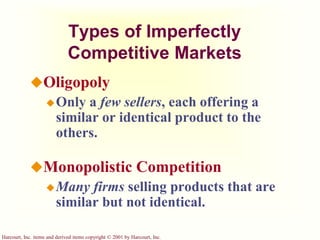
Oligopoly
Only a few sellers, each offering a
similar or identical product to the
others.
Monopolistic Competition
Many firms selling products that are
similar but not identical.
Harcourt, Inc. items and derived items copyright © 2001 by Harcourt, Inc.
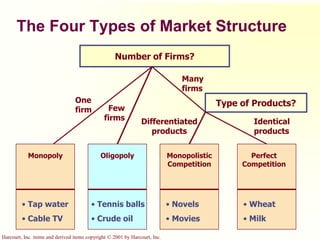
The Four Types of Market Structure
Monopoly Oligopoly Monopolistic
Competition
Perfect
Competition
• Tap water
• Cable TV
• Tennis balls
• Crude oil
• Novels
• Movies
• Wheat
• Milk
Number of Firms?
Type of Products?
Many
firms
One
firm Few
firms Differentiated
products
Identical
products
Harcourt, Inc. items and derived items copyright © 2001 by Harcourt, Inc.
Characteristics of an Oligopoly
Market
 Few sellers offering similar or identical
products
 Interdependent firms
 Best off cooperating and acting like a
monopolist by producing a small quantity of
output and charging a price above marginal
cost
 There is a tension between cooperation and
self-interest.
Harcourt, Inc. items and derived items copyright © 2001 by Harcourt, Inc.
A Duopoly Example
A duopoly is an oligopoly with
only two members. It is the
simplest type of oligopoly.
Harcourt, Inc. items and derived items copyright © 2001 by Harcourt, Inc.
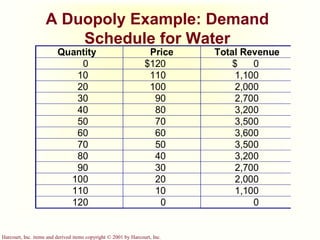
A Duopoly Example: Demand
Schedule for Water
Quantity Price Total Revenue
0 $120 $ 0
10 110 1,100
20 100 2,000
30 90 2,700
40 80 3,200
50 70 3,500
60 60 3,600
70 50 3,500
80 40 3,200
90 30 2,700
100 20 2,000
110 10 1,100
120 0 0
Harcourt, Inc. items and derived items copyright © 2001 by Harcourt, Inc.
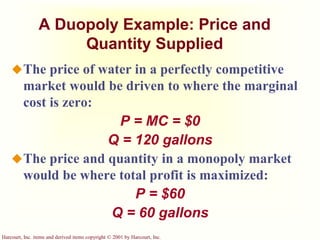
A Duopoly Example: Price and
Quantity Supplied
The price of water in a perfectly competitive
market would be driven to where the marginal
cost is zero:
P = MC = $0
Q = 120 gallons
The price and quantity in a monopoly market
would be where total profit is maximized:
P = $60
Q = 60 gallons
Harcourt, Inc. items and derived items copyright © 2001 by Harcourt, Inc.
A Duopoly Example: Price and
Quantity Supplied
The socially efficient quantity of water is
120 gallons, but a monopolist would
produce only 60 gallons of water.
So what outcome then could be expected
from duopolists?
Harcourt, Inc. items and derived items copyright © 2001 by Harcourt, Inc.
Competition, Monopolies, and
Cartels
The duopolists may agree on a
monopoly outcome.
Collusion
The two firms may agree on the
quantity to produce and the price to
charge.
Cartel
The two firms may join together and act
in unison.
 However, both outcomes are illegal in the United States due to
Antitrust laws.
Harcourt, Inc. items and derived items copyright © 2001 by Harcourt, Inc.
Summary of Equilibrium for an
Oligopoly
 Possible outcome if oligopoly firms
pursue their own self-interests:
 Joint output is greater than the monopoly
quantity but less than the competitive
industry quantity.
 Market prices are lower than monopoly
price but greater than competitive price.
 Total profits are less than the monopoly
profit.
Harcourt, Inc. items and derived items copyright © 2001 by Harcourt, Inc.
How the Size of an Oligopoly
Affects the Market Outcome
 How increasing the number of sellers
affects the price and quantity:
 The output effect: Because price is above
marginal cost, selling more at the going price
raises profits.
 The price effect: Raising production lowers
the price and the profit per unit on all units
sold.
Harcourt, Inc. items and derived items copyright © 2001 by Harcourt, Inc.
How the Size of an Oligopoly
Affects the Market Outcome
As the number of sellers in an oligopoly
grows larger, an oligopolistic market looks
more and more like a competitive market.
The price approaches marginal cost, and
the quantity produced approaches the
socially efficient level.
Harcourt, Inc. items and derived items copyright © 2001 by Harcourt, Inc.
Game Theory and the
Economics of Cooperation
Game theory is the study of how people
behave in strategic situations.
Strategic decisions are those in which each
person, in deciding what actions to take, must
consider how others might respond to that
action.
Show it’s a Beautiful Mind at this point!-The
bar scene
Harcourt, Inc. items and derived items copyright © 2001 by Harcourt, Inc.
Game Theory and the
Economics of Cooperation
Because the number of firms in an
oligopolistic market is small, each firm
must act strategically.
Each firm knows that its profit depends
not only on how much it produced but
also on how much the other firms
produce.
Harcourt, Inc. items and derived items copyright © 2001 by Harcourt, Inc.
The Prisoners’ Dilemma
The prisoners’ dilemma provides
insight into the difficulty in
maintaining cooperation.
Often people (firms) fail to cooperate
with one another even when cooperation
would make them better off.
Harcourt, Inc. items and derived items copyright © 2001 by Harcourt, Inc.
The Equilibrium for an Oligopoly
A Nash equilibrium is a situation in
which economic actors interacting with
one another each choose their best
strategy given the strategies that all the
others have chosen (I.e. Dominant
Strategy)
Harcourt, Inc. items and derived items copyright © 2001 by Harcourt, Inc.
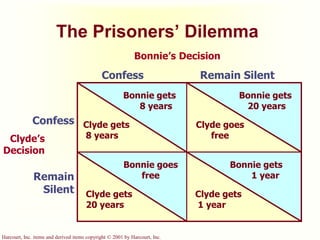
The Prisoners’ Dilemma
Bonnie’s Decision
Confess Remain Silent
Confess
Remain
Silent
Clyde’s
Decision
Clyde gets
8 years
Bonnie gets
8 years
Bonnie gets
20 years
Bonnie gets
1 year
Bonnie goes
free
Clyde gets
20 years
Clyde gets
1 year
Clyde goes
free
Harcourt, Inc. items and derived items copyright © 2001 by Harcourt, Inc.
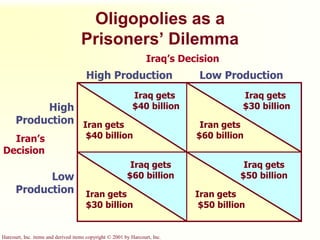
Oligopolies as a
Prisoners’ Dilemma
Iraq’s Decision
High Production Low Production
High
Production
Low
Production
Iran’s
Decision
Iran gets
$40 billion
Iraq gets
$40 billion
Iraq gets
$30 billion
Iraq gets
$50 billion
Iraq gets
$60 billion
Iran gets
$30 billion
Iran gets
$50 billion
Iran gets
$60 billion
Harcourt, Inc. items and derived items copyright © 2001 by Harcourt, Inc.
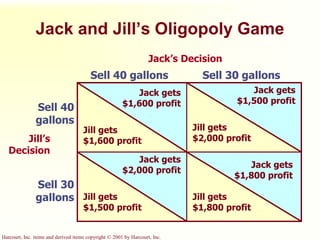
Jack and Jill’s Oligopoly Game
Jack’s Decision
Sell 40 gallons Sell 30 gallons
Sell 40
gallons
Sell 30
gallons
Jill’s
Decision
Jill gets
$1,600 profit
Jack gets
$1,600 profit
Jack gets
$1,500 profit
Jack gets
$1,800 profit
Jack gets
$2,000 profit
Jill gets
$1,500 profit
Jill gets
$1,800 profit
Jill gets
$2,000 profit
Harcourt, Inc. items and derived items copyright © 2001 by Harcourt, Inc.
Why People Sometimes
Cooperate
Firms that care about future profits
will cooperate in repeated games
rather than cheating in a single game
to achieve a one-time gain.

Oligopoly

  • 1.
    Harcourt, Inc. itemsand derived items copyright © 2001 by Harcourt, Inc. Oligopoly Chapter 16 Copyright © 2001 by Harcourt, Inc. All rights reserved. Requests for permission to make copies of any part of the work should be mailed to: Permissions Department, Harcourt College Publishers, 6277 Sea Harbor Drive, Orlando, Florida 32887-6777.
  • 2.
    Harcourt, Inc. itemsand derived items copyright © 2001 by Harcourt, Inc. Imperfect Competition Imperfect competition includes industries in which firms have competitors but do not face so much competition that they are price takers.
  • 3.
    Harcourt, Inc. itemsand derived items copyright © 2001 by Harcourt, Inc. Types of Imperfectly Competitive Markets Oligopoly Only a few sellers, each offering a similar or identical product to the others. Monopolistic Competition Many firms selling products that are similar but not identical.
  • 4.
    Harcourt, Inc. itemsand derived items copyright © 2001 by Harcourt, Inc. The Four Types of Market Structure Monopoly Oligopoly Monopolistic Competition Perfect Competition • Tap water • Cable TV • Tennis balls • Crude oil • Novels • Movies • Wheat • Milk Number of Firms? Type of Products? Many firms One firm Few firms Differentiated products Identical products
  • 5.
    Harcourt, Inc. itemsand derived items copyright © 2001 by Harcourt, Inc. Characteristics of an Oligopoly Market  Few sellers offering similar or identical products  Interdependent firms  Best off cooperating and acting like a monopolist by producing a small quantity of output and charging a price above marginal cost  There is a tension between cooperation and self-interest.
  • 6.
    Harcourt, Inc. itemsand derived items copyright © 2001 by Harcourt, Inc. A Duopoly Example A duopoly is an oligopoly with only two members. It is the simplest type of oligopoly.
  • 7.
    Harcourt, Inc. itemsand derived items copyright © 2001 by Harcourt, Inc. A Duopoly Example: Demand Schedule for Water Quantity Price Total Revenue 0 $120 $ 0 10 110 1,100 20 100 2,000 30 90 2,700 40 80 3,200 50 70 3,500 60 60 3,600 70 50 3,500 80 40 3,200 90 30 2,700 100 20 2,000 110 10 1,100 120 0 0
  • 8.
    Harcourt, Inc. itemsand derived items copyright © 2001 by Harcourt, Inc. A Duopoly Example: Price and Quantity Supplied The price of water in a perfectly competitive market would be driven to where the marginal cost is zero: P = MC = $0 Q = 120 gallons The price and quantity in a monopoly market would be where total profit is maximized: P = $60 Q = 60 gallons
  • 9.
    Harcourt, Inc. itemsand derived items copyright © 2001 by Harcourt, Inc. A Duopoly Example: Price and Quantity Supplied The socially efficient quantity of water is 120 gallons, but a monopolist would produce only 60 gallons of water. So what outcome then could be expected from duopolists?
  • 10.
    Harcourt, Inc. itemsand derived items copyright © 2001 by Harcourt, Inc. Competition, Monopolies, and Cartels The duopolists may agree on a monopoly outcome. Collusion The two firms may agree on the quantity to produce and the price to charge. Cartel The two firms may join together and act in unison.  However, both outcomes are illegal in the United States due to Antitrust laws.
  • 11.
    Harcourt, Inc. itemsand derived items copyright © 2001 by Harcourt, Inc. Summary of Equilibrium for an Oligopoly  Possible outcome if oligopoly firms pursue their own self-interests:  Joint output is greater than the monopoly quantity but less than the competitive industry quantity.  Market prices are lower than monopoly price but greater than competitive price.  Total profits are less than the monopoly profit.
  • 12.
    Harcourt, Inc. itemsand derived items copyright © 2001 by Harcourt, Inc. How the Size of an Oligopoly Affects the Market Outcome  How increasing the number of sellers affects the price and quantity:  The output effect: Because price is above marginal cost, selling more at the going price raises profits.  The price effect: Raising production lowers the price and the profit per unit on all units sold.
  • 13.
    Harcourt, Inc. itemsand derived items copyright © 2001 by Harcourt, Inc. How the Size of an Oligopoly Affects the Market Outcome As the number of sellers in an oligopoly grows larger, an oligopolistic market looks more and more like a competitive market. The price approaches marginal cost, and the quantity produced approaches the socially efficient level.
  • 14.
    Harcourt, Inc. itemsand derived items copyright © 2001 by Harcourt, Inc. Game Theory and the Economics of Cooperation Game theory is the study of how people behave in strategic situations. Strategic decisions are those in which each person, in deciding what actions to take, must consider how others might respond to that action. Show it’s a Beautiful Mind at this point!-The bar scene
  • 15.
    Harcourt, Inc. itemsand derived items copyright © 2001 by Harcourt, Inc. Game Theory and the Economics of Cooperation Because the number of firms in an oligopolistic market is small, each firm must act strategically. Each firm knows that its profit depends not only on how much it produced but also on how much the other firms produce.
  • 16.
    Harcourt, Inc. itemsand derived items copyright © 2001 by Harcourt, Inc. The Prisoners’ Dilemma The prisoners’ dilemma provides insight into the difficulty in maintaining cooperation. Often people (firms) fail to cooperate with one another even when cooperation would make them better off.
  • 17.
    Harcourt, Inc. itemsand derived items copyright © 2001 by Harcourt, Inc. The Equilibrium for an Oligopoly A Nash equilibrium is a situation in which economic actors interacting with one another each choose their best strategy given the strategies that all the others have chosen (I.e. Dominant Strategy)
  • 18.
    Harcourt, Inc. itemsand derived items copyright © 2001 by Harcourt, Inc. The Prisoners’ Dilemma Bonnie’s Decision Confess Remain Silent Confess Remain Silent Clyde’s Decision Clyde gets 8 years Bonnie gets 8 years Bonnie gets 20 years Bonnie gets 1 year Bonnie goes free Clyde gets 20 years Clyde gets 1 year Clyde goes free
  • 19.
    Harcourt, Inc. itemsand derived items copyright © 2001 by Harcourt, Inc. Oligopolies as a Prisoners’ Dilemma Iraq’s Decision High Production Low Production High Production Low Production Iran’s Decision Iran gets $40 billion Iraq gets $40 billion Iraq gets $30 billion Iraq gets $50 billion Iraq gets $60 billion Iran gets $30 billion Iran gets $50 billion Iran gets $60 billion
  • 20.
    Harcourt, Inc. itemsand derived items copyright © 2001 by Harcourt, Inc. Jack and Jill’s Oligopoly Game Jack’s Decision Sell 40 gallons Sell 30 gallons Sell 40 gallons Sell 30 gallons Jill’s Decision Jill gets $1,600 profit Jack gets $1,600 profit Jack gets $1,500 profit Jack gets $1,800 profit Jack gets $2,000 profit Jill gets $1,500 profit Jill gets $1,800 profit Jill gets $2,000 profit
  • 21.
    Harcourt, Inc. itemsand derived items copyright © 2001 by Harcourt, Inc. Why People Sometimes Cooperate Firms that care about future profits will cooperate in repeated games rather than cheating in a single game to achieve a one-time gain.