Socio Economic Stratification  Welcome Class  BBA-L05-  /  /
Today’s Objectives To Clarify the Concept of Social Stratification and Discus its other relevant aspects. To Discus Related Theories and Consequences of Social Stratification.
Definitions of Social Stratification What is Social Stratification? “ Social Stratification is the division of society in permanent groups or categories linked with each other by the relationship of superior and subordination.” (Gisbert) “ Stratification is a Horizontal division of society into higher and lower social units.” (Raymond W.Murray)
Conclusion of definition  S ocial stratification is “ the division of society levels, steps or positions.” S tratification is, in essence, the structured inequality of entire categories of  People.” S tratification is different than mere inequality, which refer to the uneven distribution of opportunities and rewards to individuals and groups.” W hen these inequalities becomes structured into society and passed on from generation to generation, we have social Stratification.”
Dimensions of Social Stratification Wealth:-  T he economic assets of an individual, including income, monetary assets and other holdings.  Power:-   The ability to attain goals and maintain influence over others, even in the absence of their consent. Prestige:-  The approval and respect received from other members of society.
Consequences of Social Stratification  L ongevity  H ealth and illness  C hildbearing and Rearing  C rime and Criminal Justice Contacts
Theories of Social Stratification  Functionalist Theory   Y ou will remember that functionalist theory understands society as a “System” or “Organism” A s functionalists, Kingsley Davis and Wilbert Moore contended that stratification was a necessity for society because: S ociety has numerous positions that must be fulfilled if it is to function properly.
( Continue)  Functionalist Theory S ome positions, however are more important for the maintenance of society ( e.g., physicians )  F inally, some positions require special talents that are not generally prevalent in the population. H ence, functionally important positions and/or positions requiring rare talent are rewarded most highly.
Criticisms of Functional Theory Ex Post Facto Judgment of Functional Importance of Positions Critics question the functional importance of certain highly rewarded positions such as actors and sports figures, in contrast to positions such as school teachers or social workers.  The stratification system itself Inhibits Talent and Abilities  Many barriers are placed in the way of individuals from lower classes to keep them from competing effectively.
Marxist Conflict Theory S uggest that social stratification is determined by the Relations of  Production. B ourgeoisie- capitalists who own the means of production. P roletariat- wage laborers who sell their labor to bourgeoisie. I nterests of these two classes are intrinsically opposed.  P ower of the capitalists allows them to impose their will and realize their interests. A ccording to Marx, the proletariat will eventually develop a class consciousness, and ultimately overthrow the capitalists.
Comparing Functional and Conflict Theories What is Caste? Definition of Caste “ When a class is somewhat strictly hereditary, we may call it a Caste.” (Cooly, C.H) “ When status is wholly predetermined, so that men are born to their lot in life without any hope of changing it, then Class takes the form of Class.” (Maclver) “ A Caste is an aggregate of persons whose share of obligations and privileges is fixed by birth, sanctioned and supported by magic and religion. “( Martindale and Monachesi) .
( Continue )   Comparing Functional and Conflict Theories What is Class? Definition of Class   “ A Social Class is any portion of community marked off from the rest by Social Status.” ( Maclver ) It is the sense of status, sustained by the Economic, Political or ecclesiastical Power and by the distinctive modes of life and cultural Expressions Corresponding to them, that draws Class apart. From class, gives Cohesion to Each class and Stratifies a whole society.” ( Ibid ). A Social Class is the aggregate of persons having essentially the same social status in a given Society.” ( Ogburn and Nimkoff ).
Distinction between Class and Caste
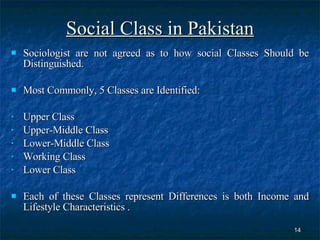
Social Class in Pakistan Sociologist are not agreed as to how social Classes Should be Distinguished. Most Commonly, 5 Classes are Identified: Upper Class  Upper-Middle Class  Lower-Middle Class  Working Class  Lower Class  Each of these Classes represent Differences is both Income and Lifestyle Characteristics .
Thank you and Goodbye,  Till next Class

Bba L05 Dt Socio Economic Stratification

  • 1.
    Socio Economic Stratification Welcome Class BBA-L05- / /
  • 2.
    Today’s Objectives ToClarify the Concept of Social Stratification and Discus its other relevant aspects. To Discus Related Theories and Consequences of Social Stratification.
  • 3.
    Definitions of SocialStratification What is Social Stratification? “ Social Stratification is the division of society in permanent groups or categories linked with each other by the relationship of superior and subordination.” (Gisbert) “ Stratification is a Horizontal division of society into higher and lower social units.” (Raymond W.Murray)
  • 4.
    Conclusion of definition S ocial stratification is “ the division of society levels, steps or positions.” S tratification is, in essence, the structured inequality of entire categories of People.” S tratification is different than mere inequality, which refer to the uneven distribution of opportunities and rewards to individuals and groups.” W hen these inequalities becomes structured into society and passed on from generation to generation, we have social Stratification.”
  • 5.
    Dimensions of SocialStratification Wealth:- T he economic assets of an individual, including income, monetary assets and other holdings. Power:- The ability to attain goals and maintain influence over others, even in the absence of their consent. Prestige:- The approval and respect received from other members of society.
  • 6.
    Consequences of SocialStratification L ongevity H ealth and illness C hildbearing and Rearing C rime and Criminal Justice Contacts
  • 7.
    Theories of SocialStratification Functionalist Theory Y ou will remember that functionalist theory understands society as a “System” or “Organism” A s functionalists, Kingsley Davis and Wilbert Moore contended that stratification was a necessity for society because: S ociety has numerous positions that must be fulfilled if it is to function properly.
  • 8.
    ( Continue) Functionalist Theory S ome positions, however are more important for the maintenance of society ( e.g., physicians ) F inally, some positions require special talents that are not generally prevalent in the population. H ence, functionally important positions and/or positions requiring rare talent are rewarded most highly.
  • 9.
    Criticisms of FunctionalTheory Ex Post Facto Judgment of Functional Importance of Positions Critics question the functional importance of certain highly rewarded positions such as actors and sports figures, in contrast to positions such as school teachers or social workers. The stratification system itself Inhibits Talent and Abilities Many barriers are placed in the way of individuals from lower classes to keep them from competing effectively.
  • 10.
    Marxist Conflict TheoryS uggest that social stratification is determined by the Relations of Production. B ourgeoisie- capitalists who own the means of production. P roletariat- wage laborers who sell their labor to bourgeoisie. I nterests of these two classes are intrinsically opposed. P ower of the capitalists allows them to impose their will and realize their interests. A ccording to Marx, the proletariat will eventually develop a class consciousness, and ultimately overthrow the capitalists.
  • 11.
    Comparing Functional andConflict Theories What is Caste? Definition of Caste “ When a class is somewhat strictly hereditary, we may call it a Caste.” (Cooly, C.H) “ When status is wholly predetermined, so that men are born to their lot in life without any hope of changing it, then Class takes the form of Class.” (Maclver) “ A Caste is an aggregate of persons whose share of obligations and privileges is fixed by birth, sanctioned and supported by magic and religion. “( Martindale and Monachesi) .
  • 12.
    ( Continue ) Comparing Functional and Conflict Theories What is Class? Definition of Class “ A Social Class is any portion of community marked off from the rest by Social Status.” ( Maclver ) It is the sense of status, sustained by the Economic, Political or ecclesiastical Power and by the distinctive modes of life and cultural Expressions Corresponding to them, that draws Class apart. From class, gives Cohesion to Each class and Stratifies a whole society.” ( Ibid ). A Social Class is the aggregate of persons having essentially the same social status in a given Society.” ( Ogburn and Nimkoff ).
  • 13.
  • 14.
    Social Class inPakistan Sociologist are not agreed as to how social Classes Should be Distinguished. Most Commonly, 5 Classes are Identified: Upper Class Upper-Middle Class Lower-Middle Class Working Class Lower Class Each of these Classes represent Differences is both Income and Lifestyle Characteristics .
  • 15.
    Thank you andGoodbye, Till next Class