MY COMMUNITY MY COMMITMENT
1
ENVIRONMENTAL SUSTAINABLE DESIGN
[ARC 1413]
MY COMMUNITY MY COMMITMENT
PROJECT REPORT
GROUP MEMBERS
NAME STUDENT ID
PRESTON LIEW RU PING (L) 0313822
LEE JO YEE 0314880
CHUNG WEI JIN 0313789
LING HUI SIM 0313855
YUAN KAI SHIEN 0314818
WOO WEN JIAN 0315123
CHAN PIN QI 0314676
BENNY TAN SHIOWEE 0315447
SHIRLEY LIEW QIAO LI 0315671
NICOLAS WONG XIAO EN 0314377
MY COMMUNITY MY COMMITMENT
2
TABLE OF CONTENTS
NO. CONTENTS PAGES
STAGE I: PREPARATION & PROPOSAL
1.1 INTRODUCTION
-PROJECT CONTACTS
-PROJECT OBJECTIVES
1.2 ISSUES IDENTIFICATION
1.3 SOLUTIONS
1.4 PREPARATION & PROCEDURES
- MATERIALS LIFE CYCLE ANALYSIS DIGRAMS
- WORK DISTRIBUTION
- GANT CHART
1.5 FINAL PROPOSAL
STAGE II: WORK EXECUTION
2.1 WORK PROGRESS
- BREAD SELLING
- BOOKSHELVES, BENCHES AND BROOMS HOOKER MAKING
- FLOOR FURNISHING
2.2 BUDGET & EXPENSES
2.3 COMMUNITY CONTRIBUTIONS
STAGE III: FINISHING AND FINALIZATION
3.1 OUTCOMES & RESULTS 37-48
3.2 REFLECTION 46-47
3.3 REFERENCES 48-49
3.4 ATTACHMENT 50-74
MY COMMUNITY MY COMMITMENT
3

INTRODUCTION
 1.1
INTRODUCTION
MY COMMUNITY MY COMMITMENT
4
i
“MY COMMUNITY MY COMMITMENT” Project Proposal
Environmental community service is a type of service in which the public reach
out towards environmental-community-based organizations such as social-service
organizations, non-profit organizations and faith-based organizations. It is one of the
many ways for people to contribute back to the society while taking into concern, the
environmental issues as well.
Paying It Forward is a project that brings the aim to further develop students’
community and team-working skills. These skills are crucial in developing the students’
good professional design practice in the future. As an active member of the community,
students are encouraged to deepen their understanding towards their environment and
realize their responsibility towards it. By identifying community related issues around
them, students are required to come up with solutions using the most of their creativity
which may be of tremendous help in solving real-world challenges in the future.
PROJECT CONTACTS
1. Organization name: Refuge For The Refugees (RFTR)
MY COMMUNITY MY COMMITMENT
5
2. Contact person:
 Andrea Prisha (Co Founder & Secretary of RFTR) +6 012 254 7853
 Heidy Quah Gaik Li (Founder & Director of RFTR) +6 012 307 3714
3. Address: Chin Children's Education Centre (CCEC), Sungai Besi
4. Website: https://fb.com/refugefortherefugees
5. Email: refugefortherefugees@gmail.com
6. Case study for the background:
This education center is mainly a refuge for Myanmar children whose parents are
currently working in Malaysia. There are a total of 75 students and 5 teachers who
come from Chin, Myanmar. There are 6 classes carried out in this education center
ranging from kindergarten to primary 5. Occasionally, a volunteer would come over
to teach the students as there is one teacher short.
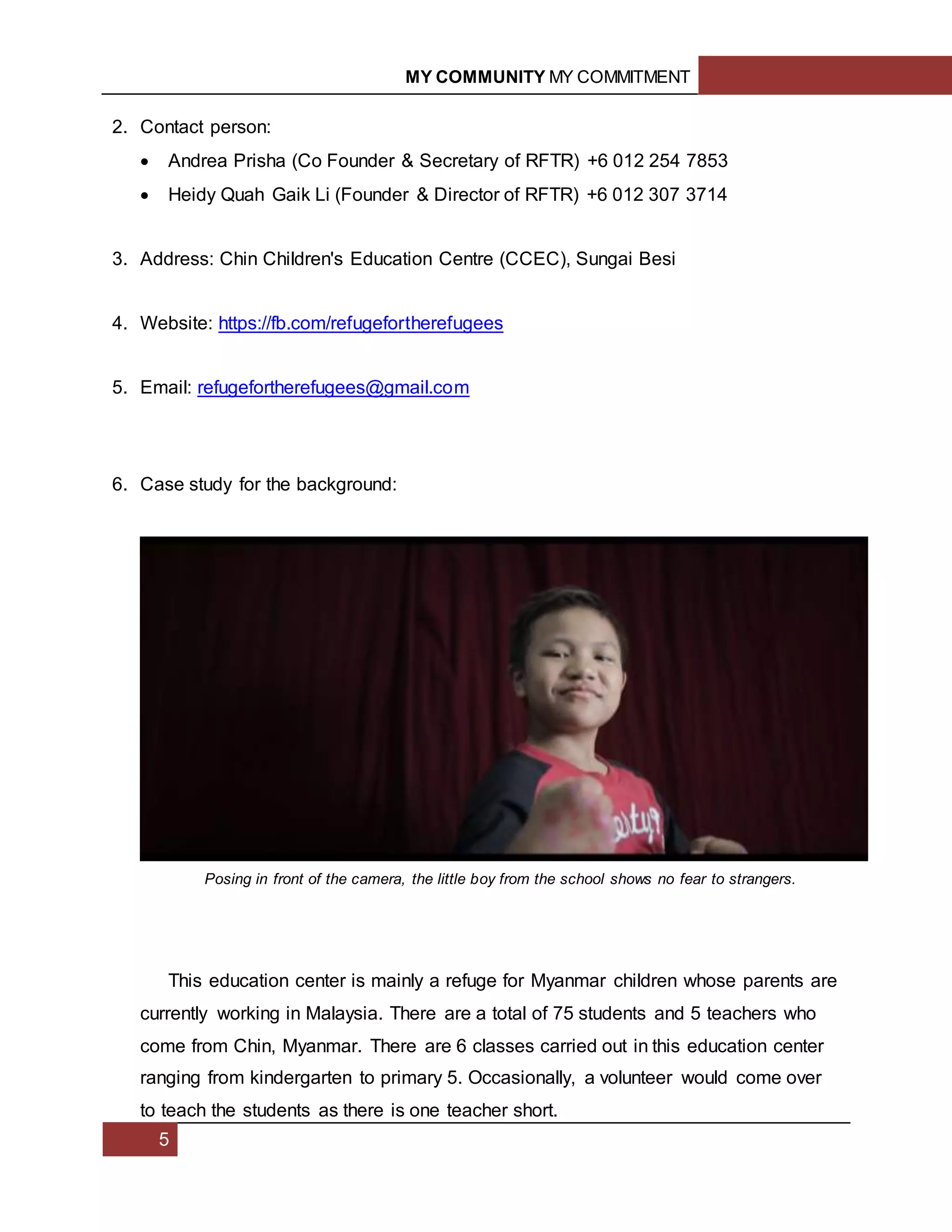
Posing in front of the camera, the little boy from the school shows no fear to strangers.
MY COMMUNITY MY COMMITMENT
6
The education center is located in a low cost flat with poor conditions. Attention
and awareness has to be raised from the authority to really look into their
environmental issues.
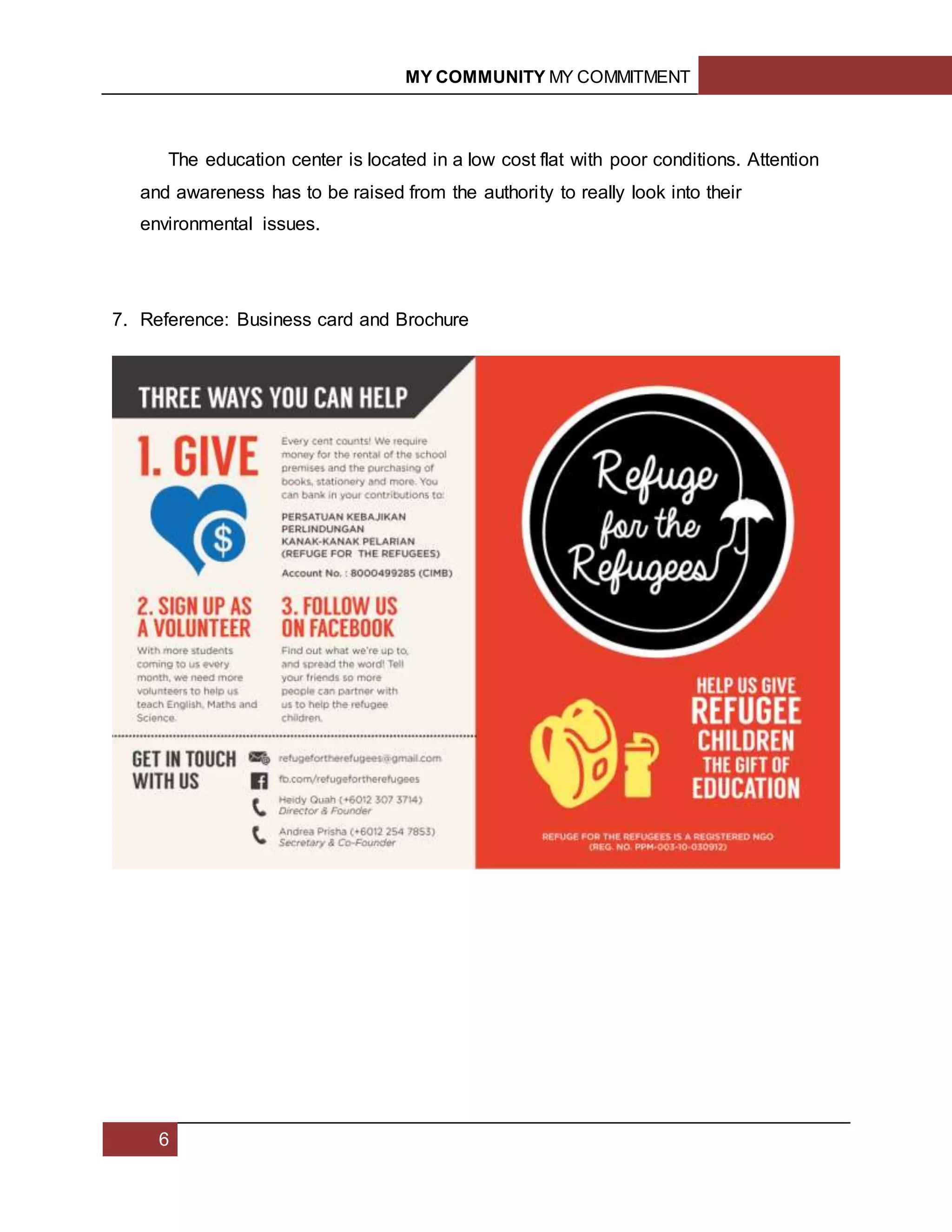
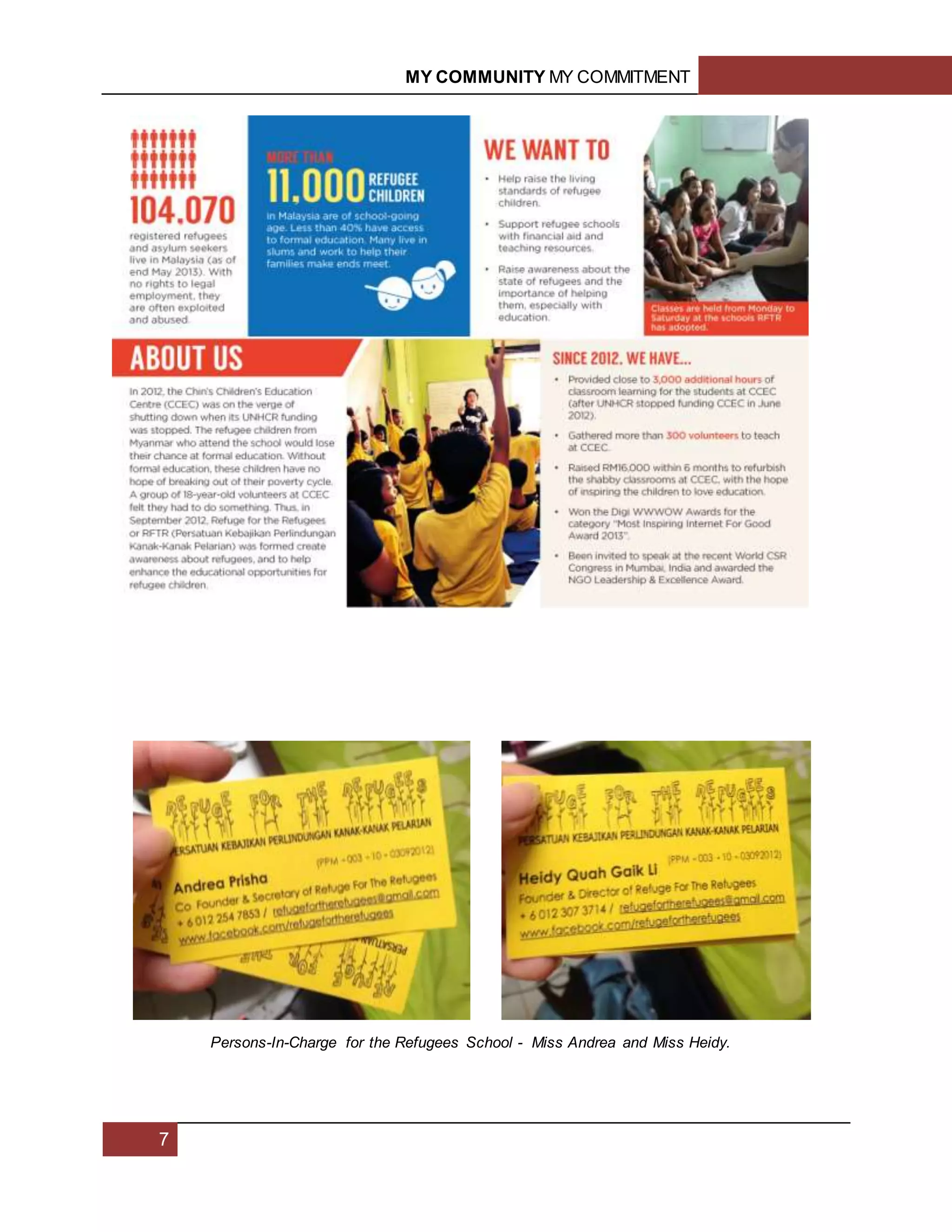
7. Reference: Business card and Brochure
MY COMMUNITY MY COMMITMENT
7
Persons-In-Charge for the Refugees School - Miss Andrea and Miss Heidy.
MY COMMUNITY MY COMMITMENT
8
PROJECT OBJECTIVES
I. To increase student’s awareness of current environmental issues locally.
II. To encourage creativity in attempting to solve the current environmental and
community circumstances.
III. To allow students to explore and discover the opportunity to work with the
community and for the community.
IV. To create awareness of the significance of creating environmentally sustainable
product to the public.
V. To be able to understand and explain the principles of sustainability from
environmental and also social perspectives.
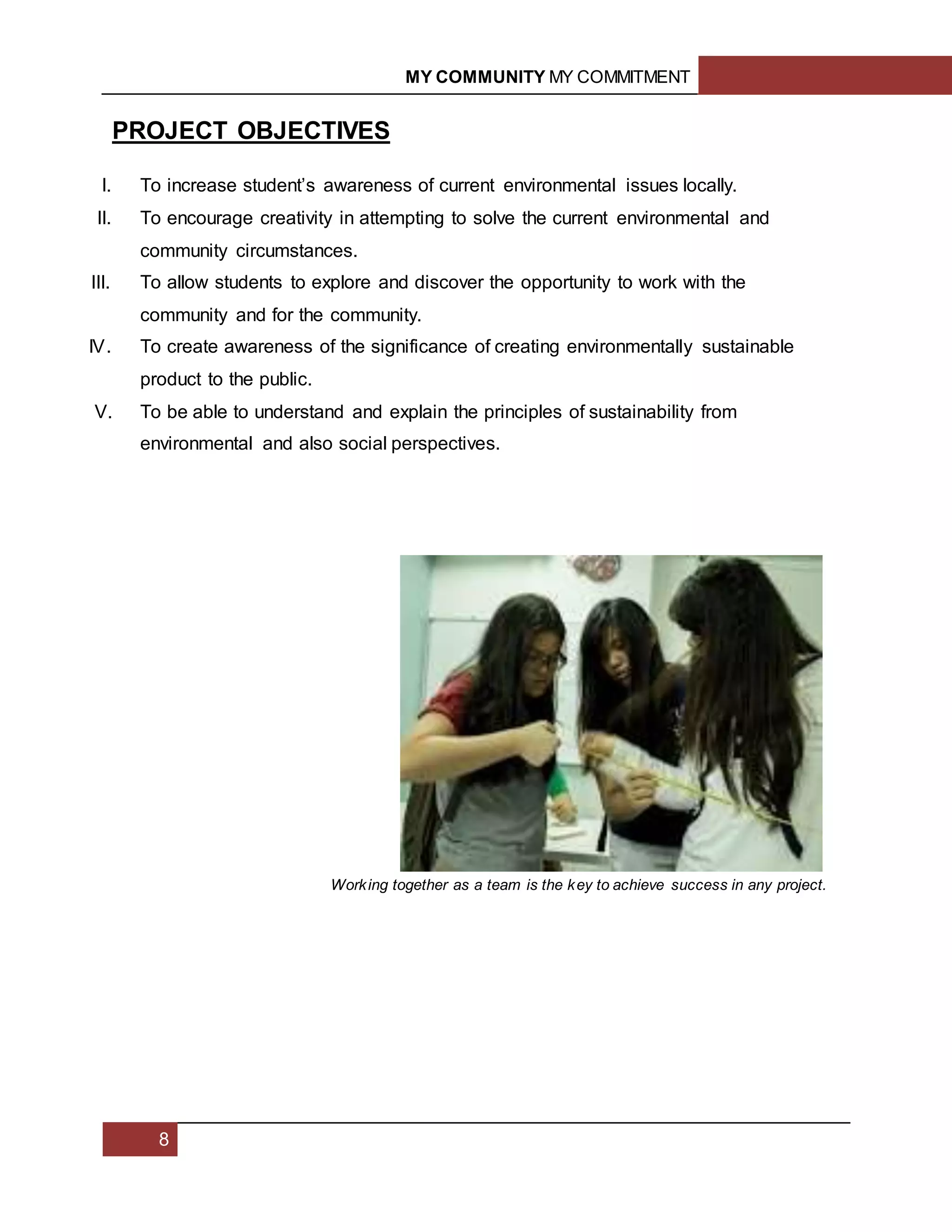
Working together as a team is the key to achieve success in any project.
MY COMMUNITY MY COMMITMENT
9
Reasons for choosing this particular community project :
The refugees are victims forced to leave their own country due to some
unforeseen reasons and stay in a foreign country for an unknown period of time. Most of
them do not have citizenships and even rights to study.
We believe that every human has equal rights and there is no reason that we
should treat someone badly because there are not Malaysians. Hence, as a bunch of
young architectural students, our aim is to make positive CHANGES to their
environment by applying what we have learnt. We wish to make them feel like they are
home, a better place to live and study even in foreign country.
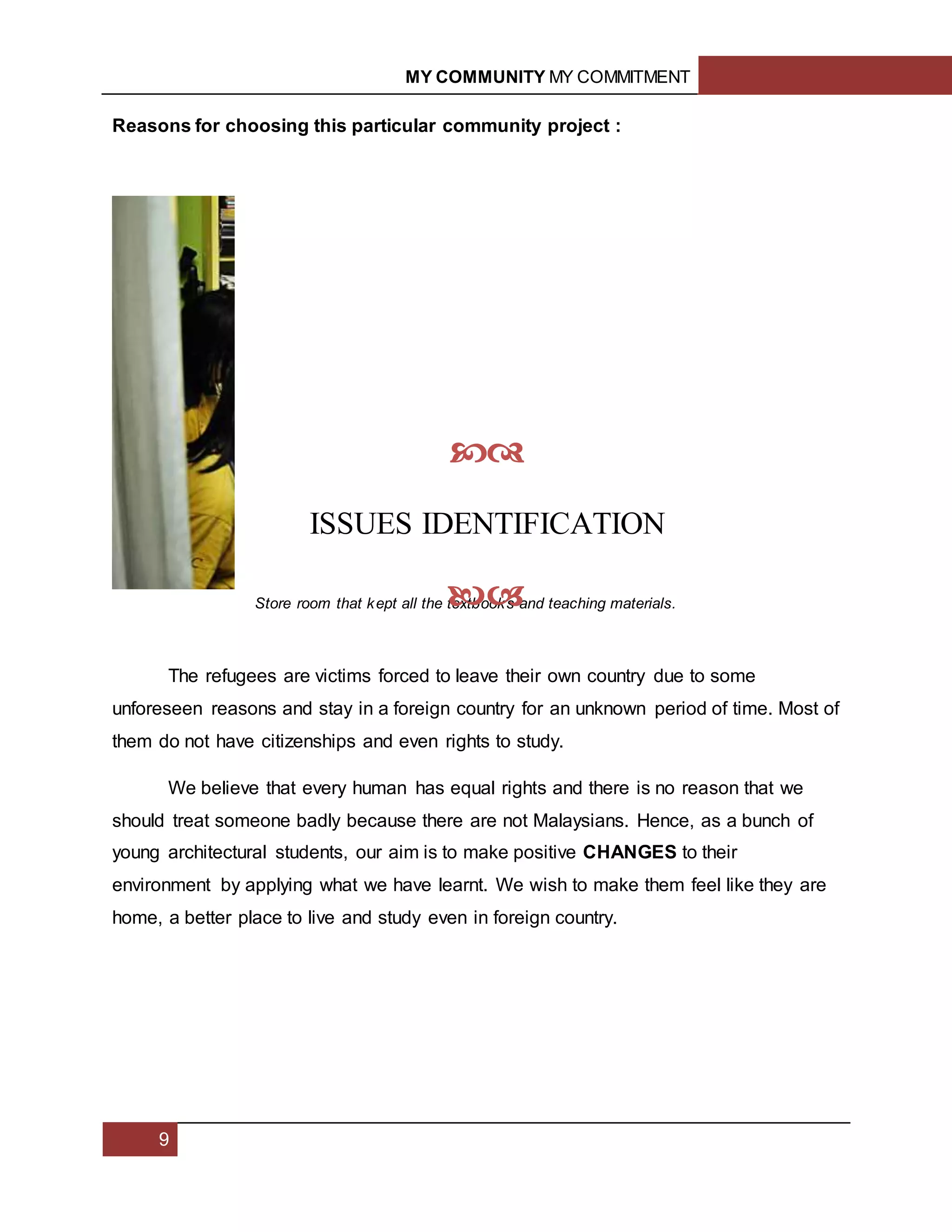
Store room that kept all the textbooks and teaching materials.

ISSUES IDENTIFICATION

1.2
MY COMMUNITY MY COMMITMENT
10
In this chapter, we are going to show the environmental and community issues
faced by our case study and our site visits to the center.
We had our very first site visit of our case study on 22th September 2014. The
aim of the visit was to find out the environment or community issues faced by the case
study meanwhile engage to the community.
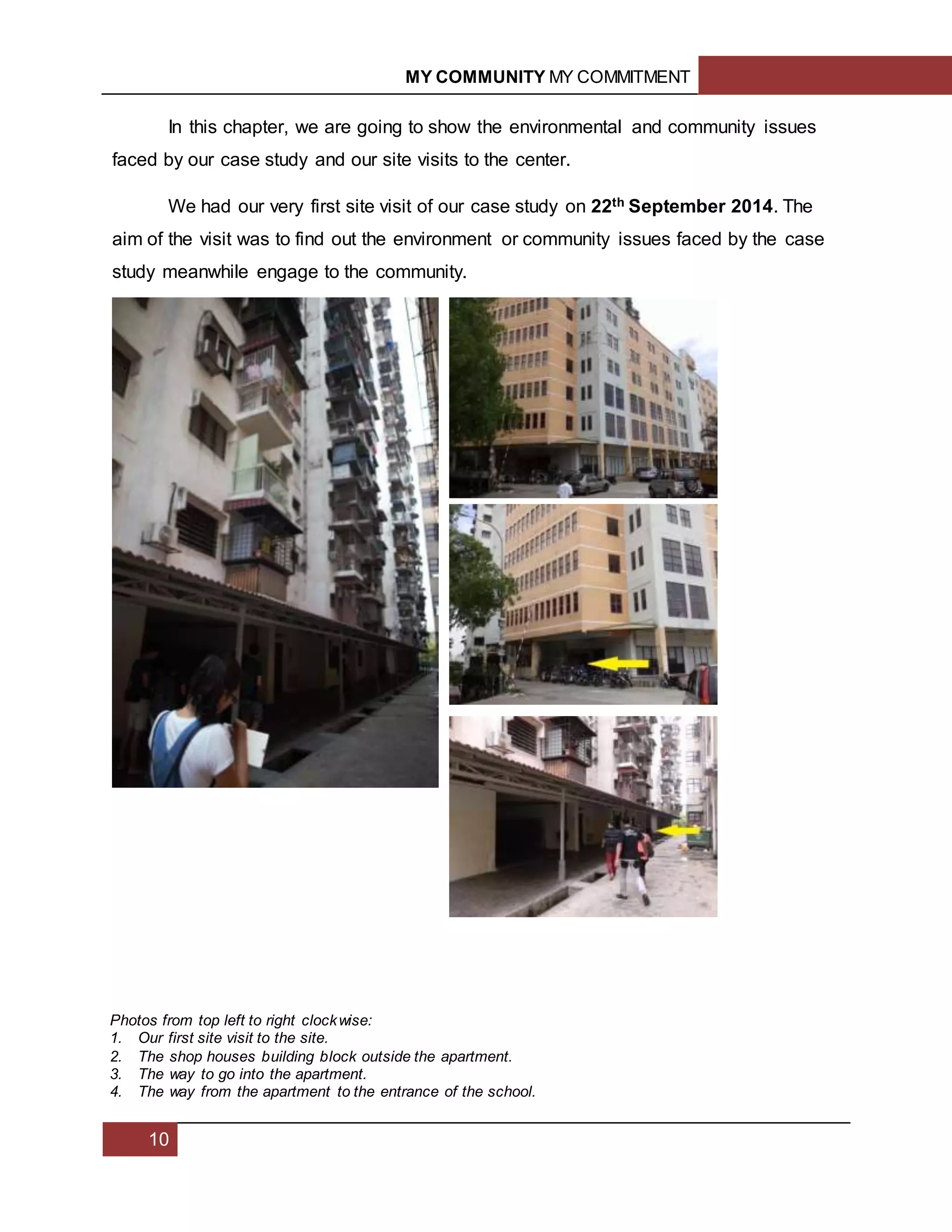
Photos from top left to right clockwise:
1. Our first site visit to the site.
2. The shop houses building block outside the apartment.
3. The way to go into the apartment.
4. The way from the apartment to the entrance of the school.
MY COMMUNITY MY COMMITMENT
11
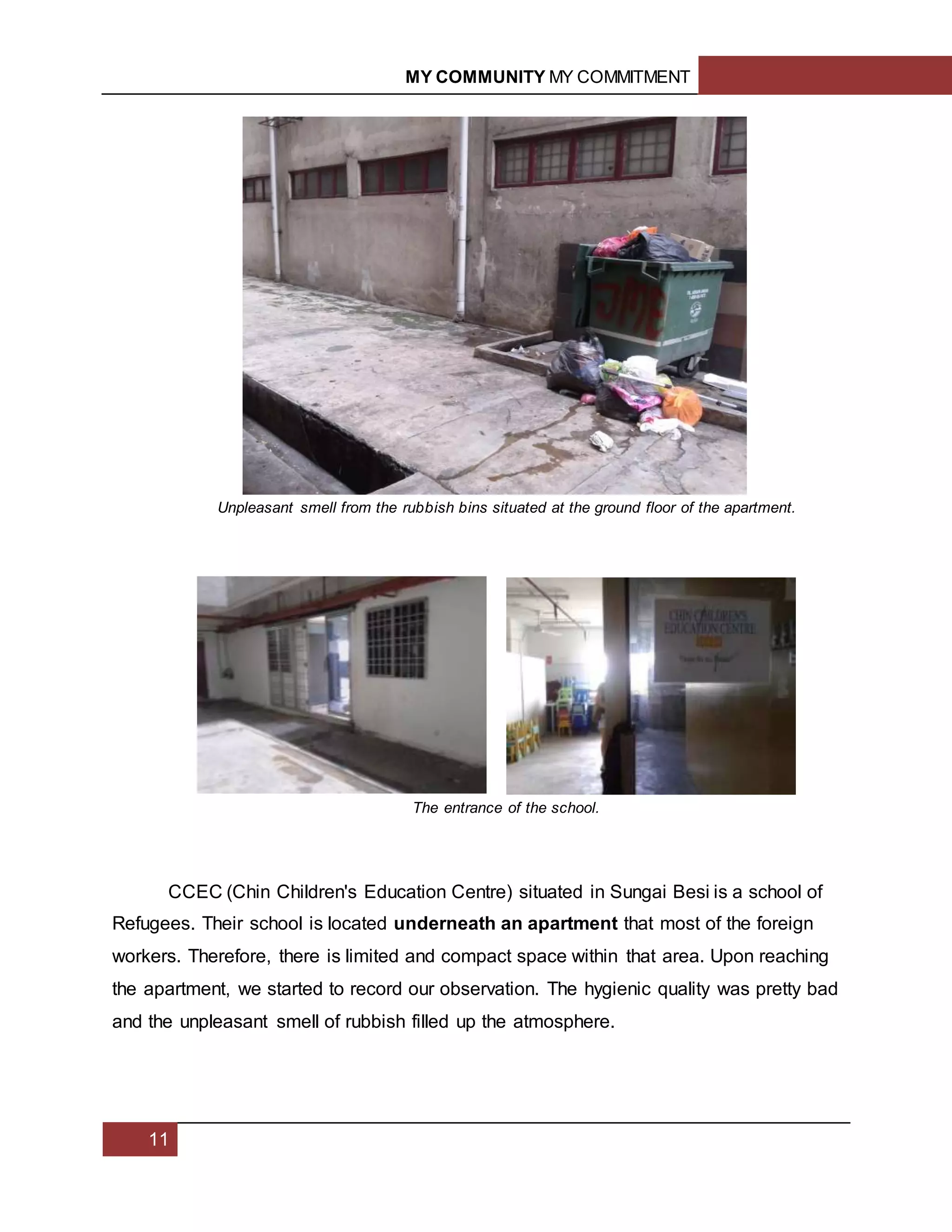
CCEC (Chin Children's Education Centre) situated in Sungai Besi is a school of
Refugees. Their school is located underneath an apartment that most of the foreign
workers. Therefore, there is limited and compact space within that area. Upon reaching
the apartment, we started to record our observation. The hygienic quality was pretty bad
and the unpleasant smell of rubbish filled up the atmosphere.
Unpleasant smell from the rubbish bins situated at the ground floor of the apartment.
The entrance of the school.
MY COMMUNITY MY COMMITMENT
12
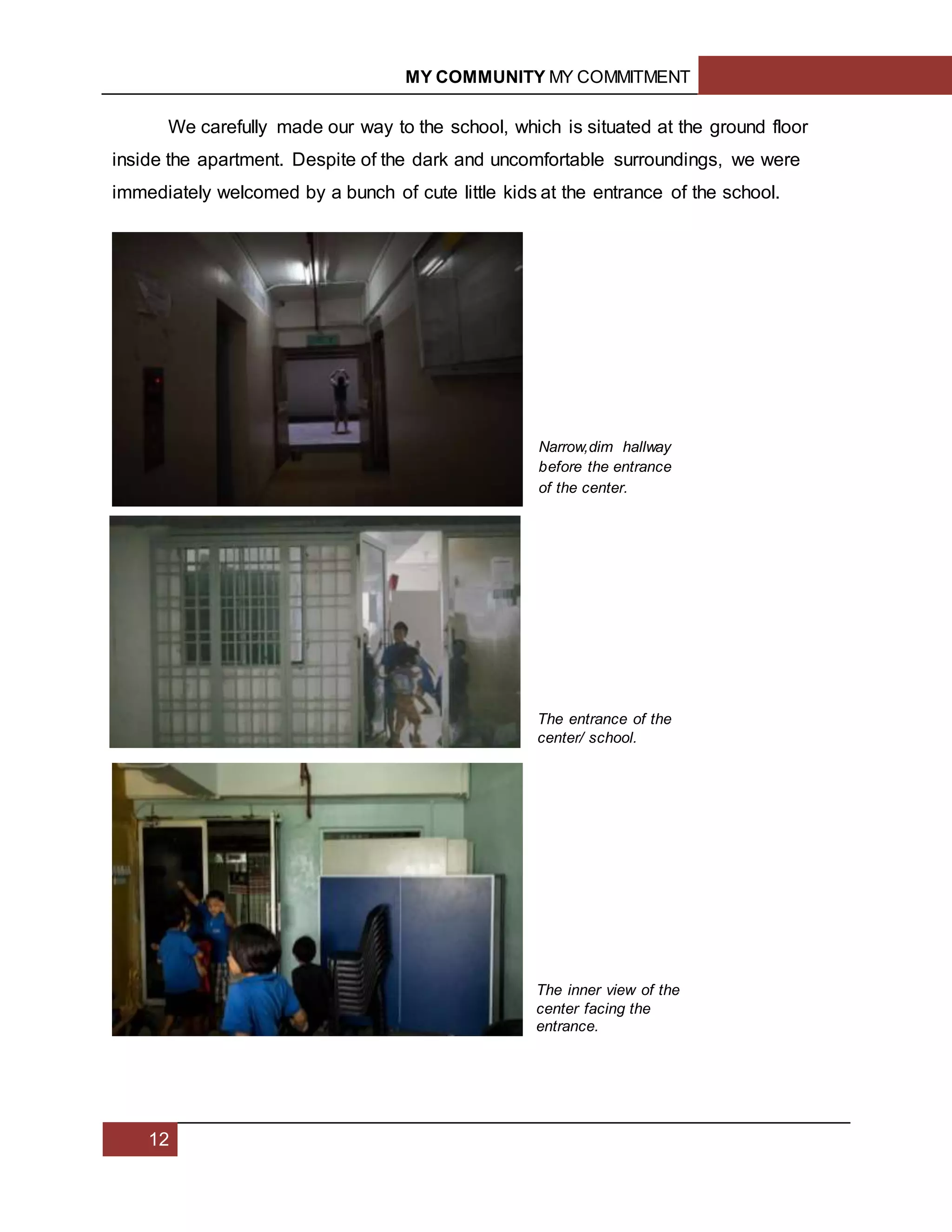
We carefully made our way to the school, which is situated at the ground floor
inside the apartment. Despite of the dark and uncomfortable surroundings, we were
immediately welcomed by a bunch of cute little kids at the entrance of the school.
Narrow,dim hallway
before the entrance
of the center.
The entrance of the
center/ school.
The inner view of the
center facing the
entrance.
MY COMMUNITY MY COMMITMENT
13
After a few rounds of observations and discussion with the principal of the school
Mr.Joseph, we have noticed some key environment issues and condition of the school.
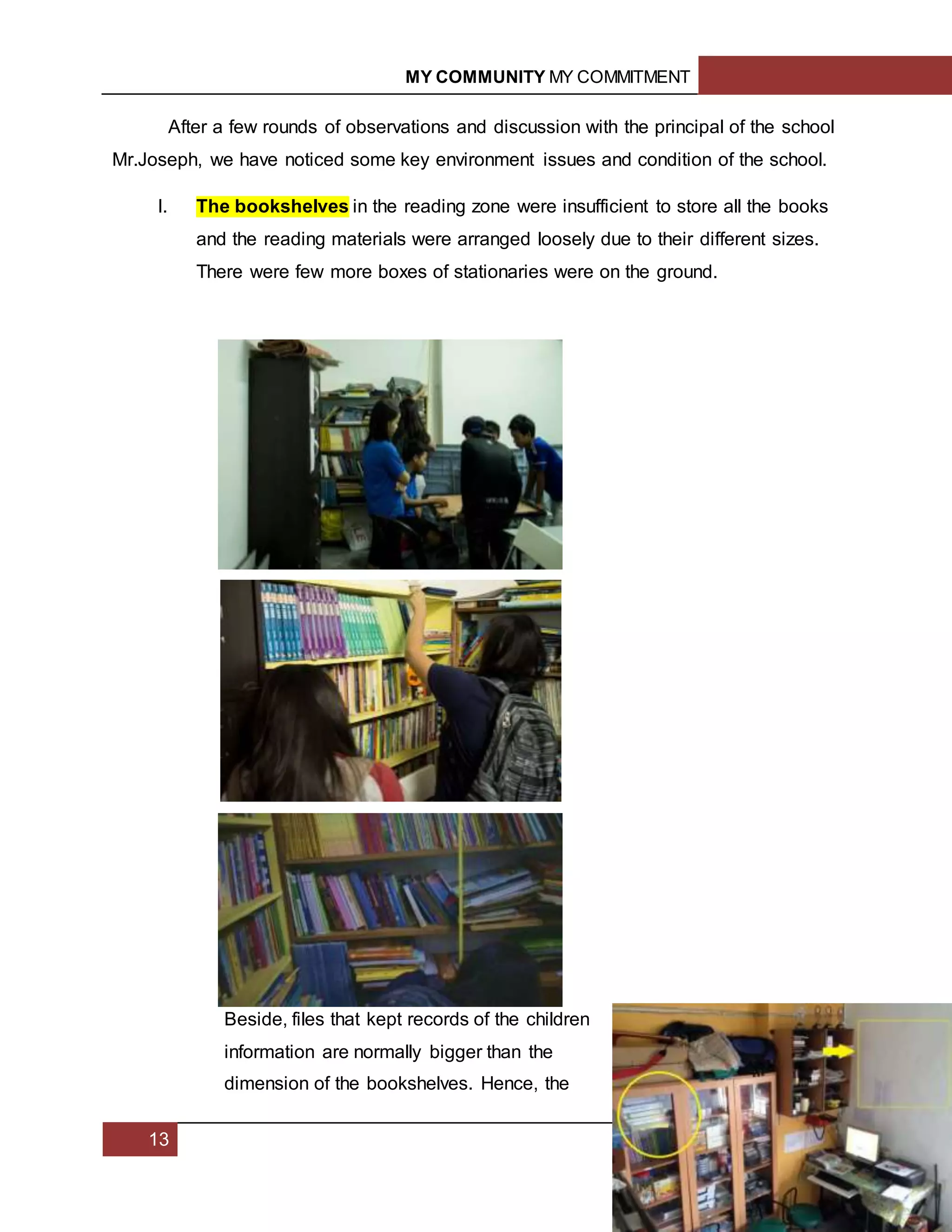
I. The bookshelves in the reading zone were insufficient to store all the books
and the reading materials were arranged loosely due to their different sizes.
There were few more boxes of stationaries were on the ground.
Beside, files that kept records of the children
information are normally bigger than the
dimension of the bookshelves. Hence, the
MY COMMUNITY MY COMMITMENT
14
files in the principal room were randomly arranged without a special
cabinet.
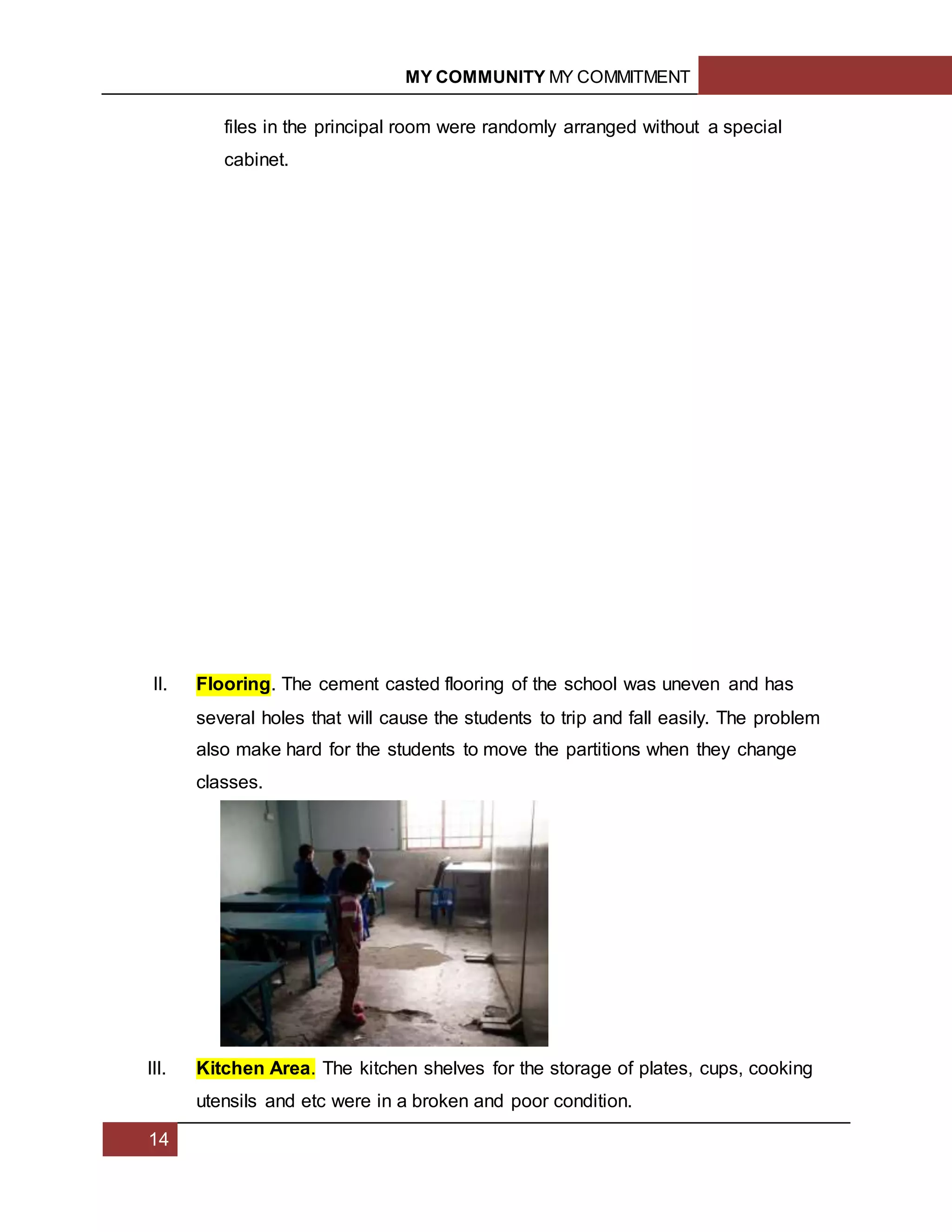
II. Flooring. The cement casted flooring of the school was uneven and has
several holes that will cause the students to trip and fall easily. The problem
also make hard for the students to move the partitions when they change
classes.
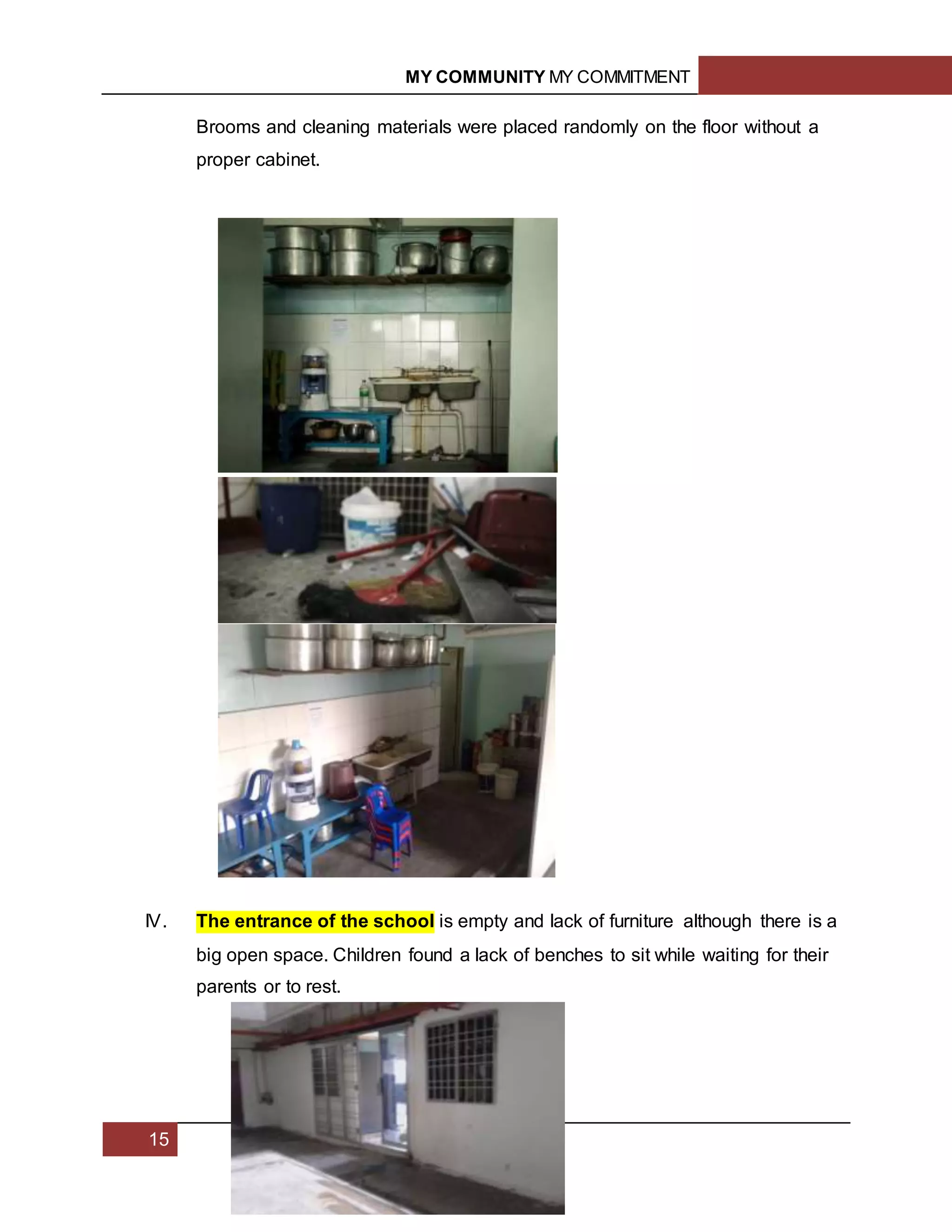
III. Kitchen Area. The kitchen shelves for the storage of plates, cups, cooking
utensils and etc were in a broken and poor condition.
MY COMMUNITY MY COMMITMENT
15
Brooms and cleaning materials were placed randomly on the floor without a
proper cabinet.
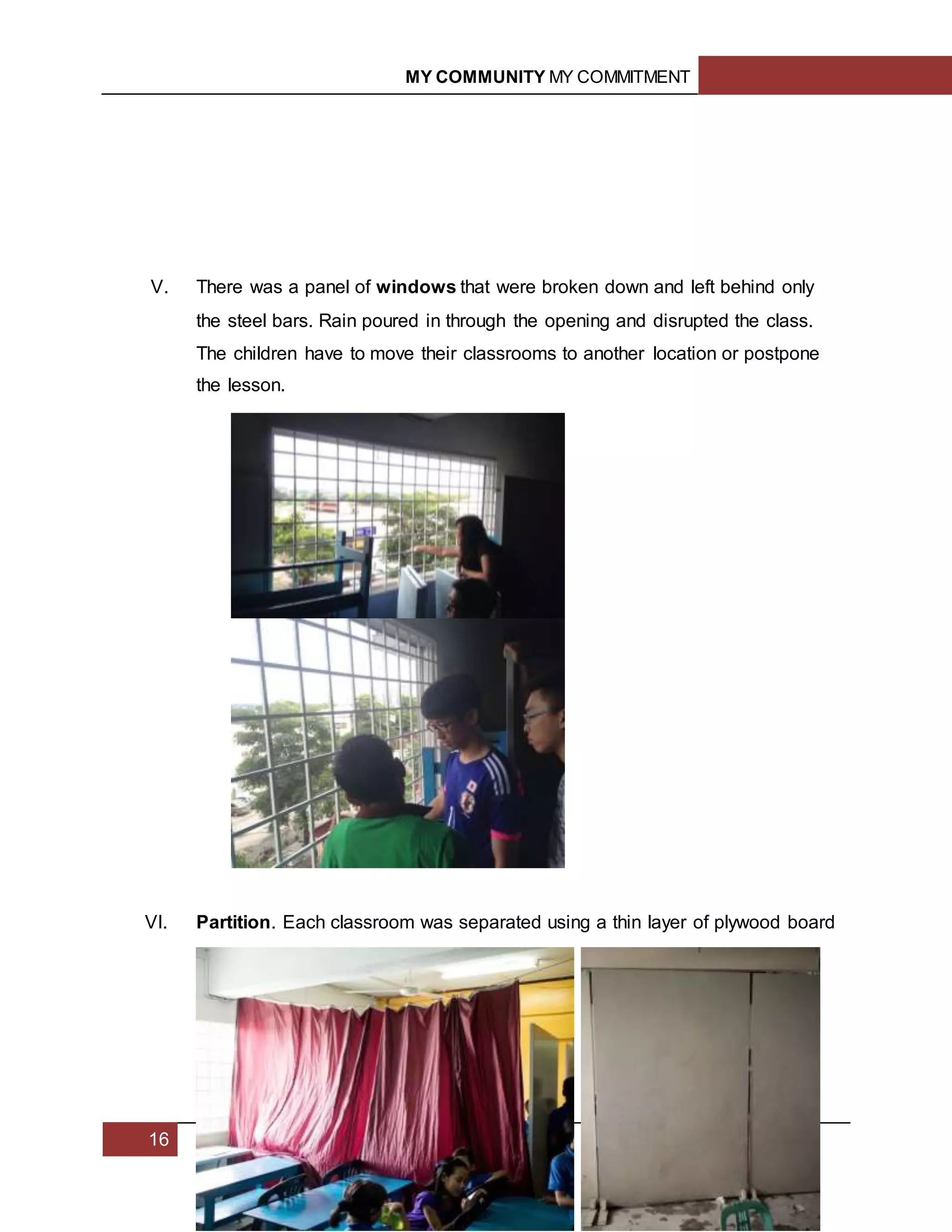
IV. The entrance of the school is empty and lack of furniture although there is a
big open space. Children found a lack of benches to sit while waiting for their
parents or to rest.
MY COMMUNITY MY COMMITMENT
16
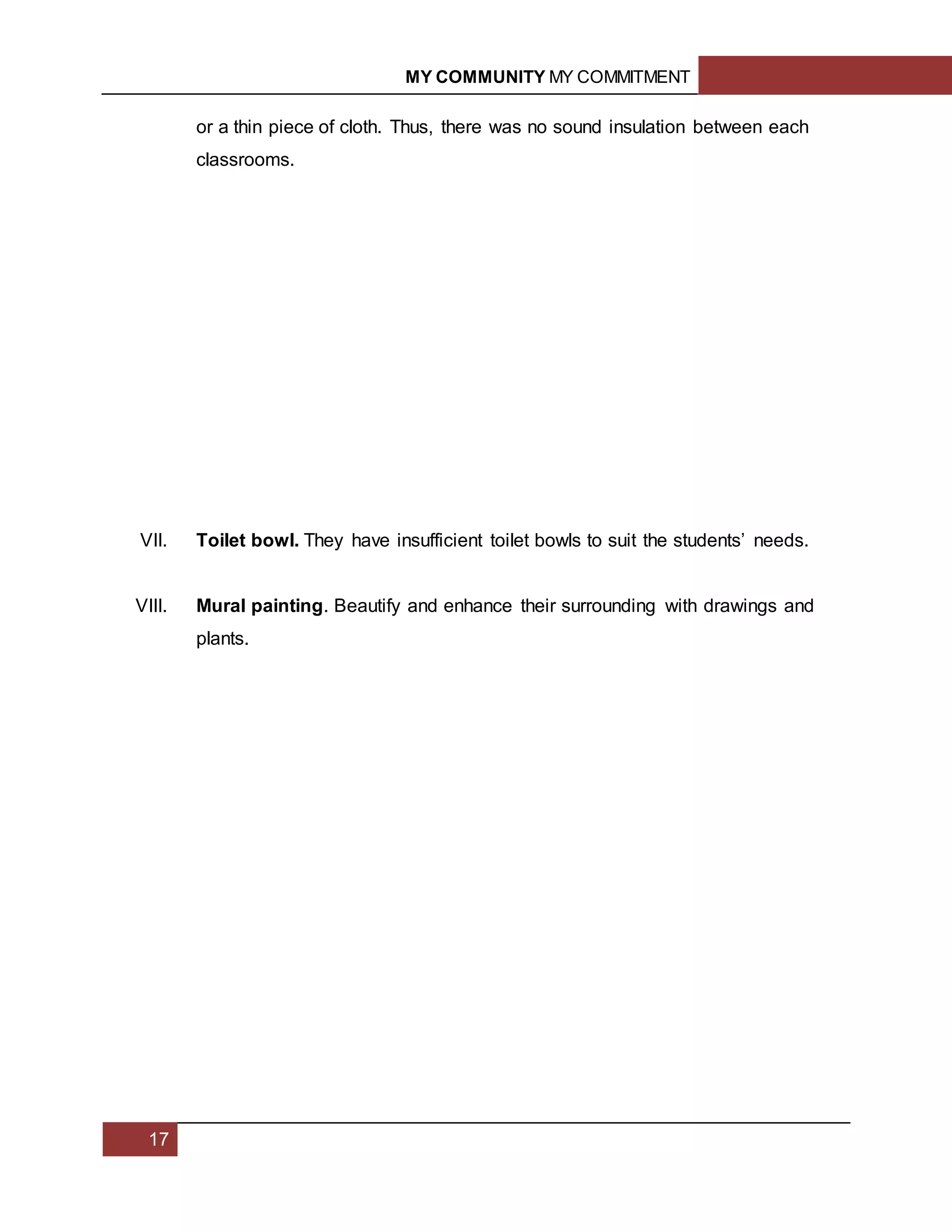
V. There was a panel of windows that were broken down and left behind only
the steel bars. Rain poured in through the opening and disrupted the class.
The children have to move their classrooms to another location or postpone
the lesson.
VI. Partition. Each classroom was separated using a thin layer of plywood board
MY COMMUNITY MY COMMITMENT
17
or a thin piece of cloth. Thus, there was no sound insulation between each
classrooms.
VII. Toilet bowl. They have insufficient toilet bowls to suit the students’ needs.
VIII. Mural painting. Beautify and enhance their surrounding with drawings and
plants.
1.3
MY COMMUNITY MY COMMITMENT
18

SOLUTIONS

MY COMMUNITY MY COMMITMENT
19
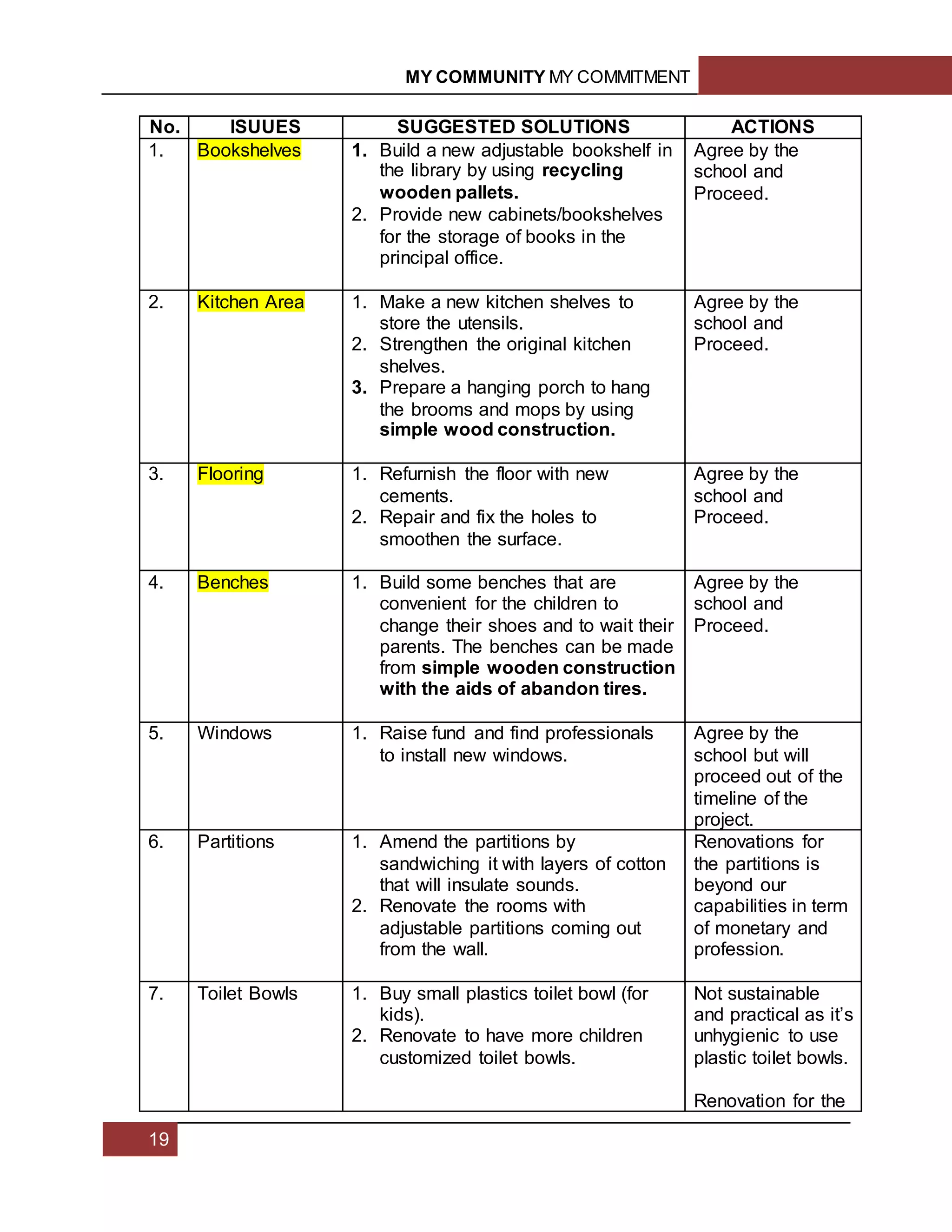
No. ISUUES SUGGESTED SOLUTIONS ACTIONS
1. Bookshelves 1. Build a new adjustable bookshelf in
the library by using recycling
wooden pallets.
2. Provide new cabinets/bookshelves
for the storage of books in the
principal office.
Agree by the
school and
Proceed.
2. Kitchen Area 1. Make a new kitchen shelves to
store the utensils.
2. Strengthen the original kitchen
shelves.
3. Prepare a hanging porch to hang
the brooms and mops by using
simple wood construction.
Agree by the
school and
Proceed.
3. Flooring 1. Refurnish the floor with new
cements.
2. Repair and fix the holes to
smoothen the surface.
Agree by the
school and
Proceed.
4. Benches 1. Build some benches that are
convenient for the children to
change their shoes and to wait their
parents. The benches can be made
from simple wooden construction
with the aids of abandon tires.
Agree by the
school and
Proceed.
5. Windows 1. Raise fund and find professionals
to install new windows.
Agree by the
school but will
proceed out of the
timeline of the
project.
6. Partitions 1. Amend the partitions by
sandwiching it with layers of cotton
that will insulate sounds.
2. Renovate the rooms with
adjustable partitions coming out
from the wall.
Renovations for
the partitions is
beyond our
capabilities in term
of monetary and
profession.
7. Toilet Bowls 1. Buy small plastics toilet bowl (for
kids).
2. Renovate to have more children
customized toilet bowls.
Not sustainable
and practical as it’s
unhygienic to use
plastic toilet bowls.
Renovation for the
MY COMMUNITY MY COMMITMENT
20
toilet is beyond our
capabilities in term
of monetary and
profession.
8. Mural Painting 1. Interactive and interesting paintings
on the wall for the children
Too distracting for
classes.
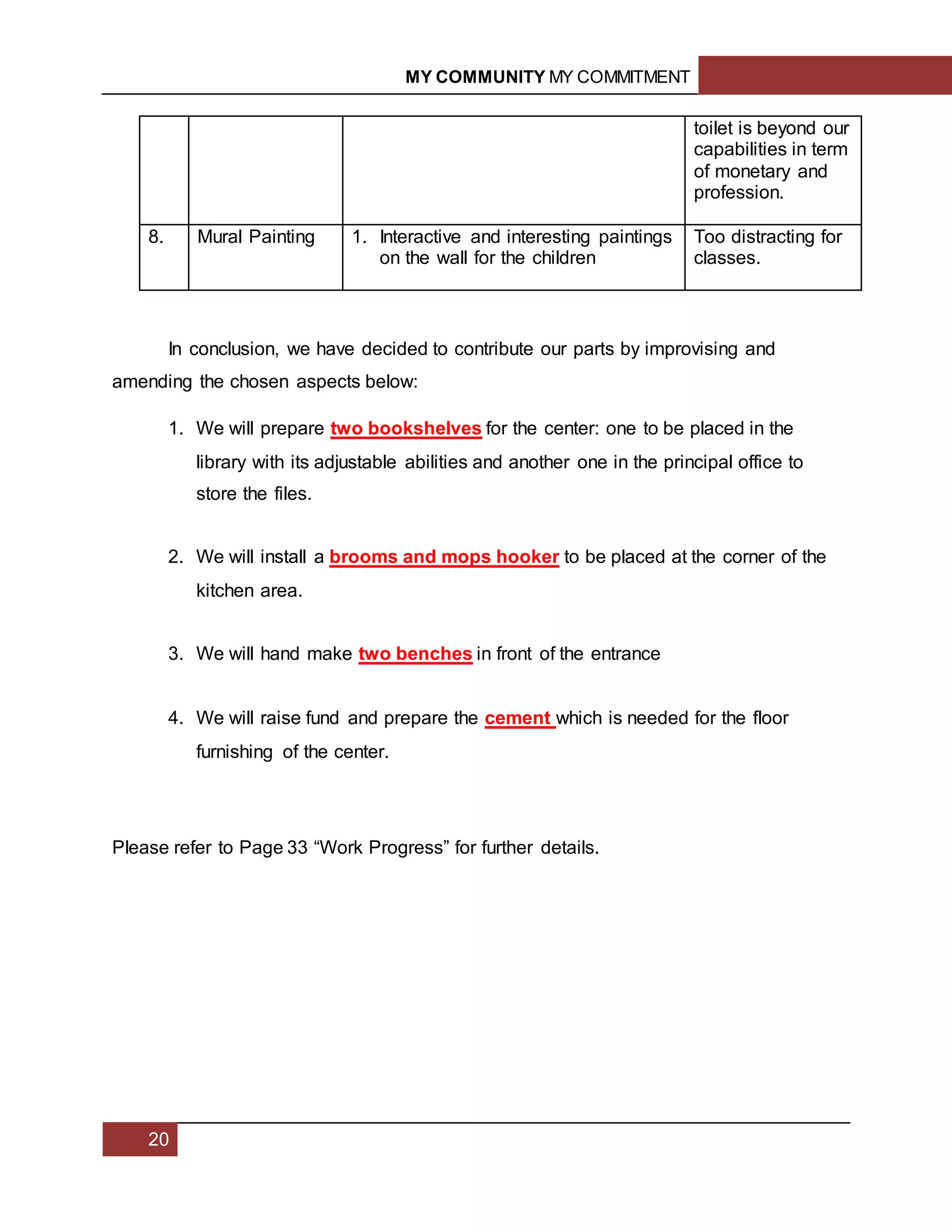
In conclusion, we have decided to contribute our parts by improvising and
amending the chosen aspects below:
1. We will prepare two bookshelves for the center: one to be placed in the
library with its adjustable abilities and another one in the principal office to
store the files.
2. We will install a brooms and mops hooker to be placed at the corner of the
kitchen area.
3. We will hand make two benches in front of the entrance
4. We will raise fund and prepare the cement which is needed for the floor
furnishing of the center.
Please refer to Page 33 “Work Progress” for further details.
MY COMMUNITY MY COMMITMENT
21

PREPARATION & PROCEDURES

MY COMMUNITY MY COMMITMENT
22
MATERIALS LIFE CYCLE ANALYSIS DIGRAMS
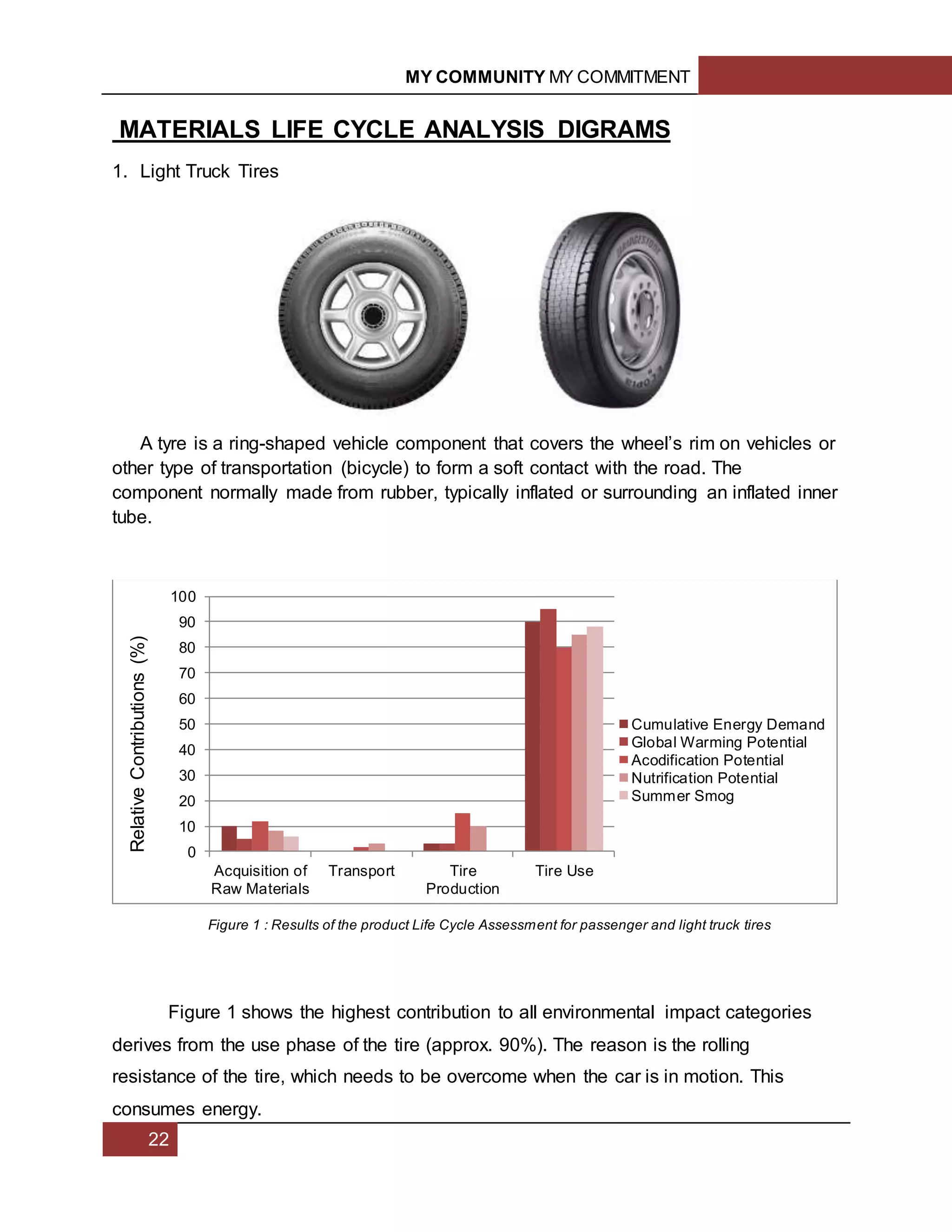
1. Light Truck Tires
A tyre is a ring-shaped vehicle component that covers the wheel’s rim on vehicles or
other type of transportation (bicycle) to form a soft contact with the road. The
component normally made from rubber, typically inflated or surrounding an inflated inner
tube.
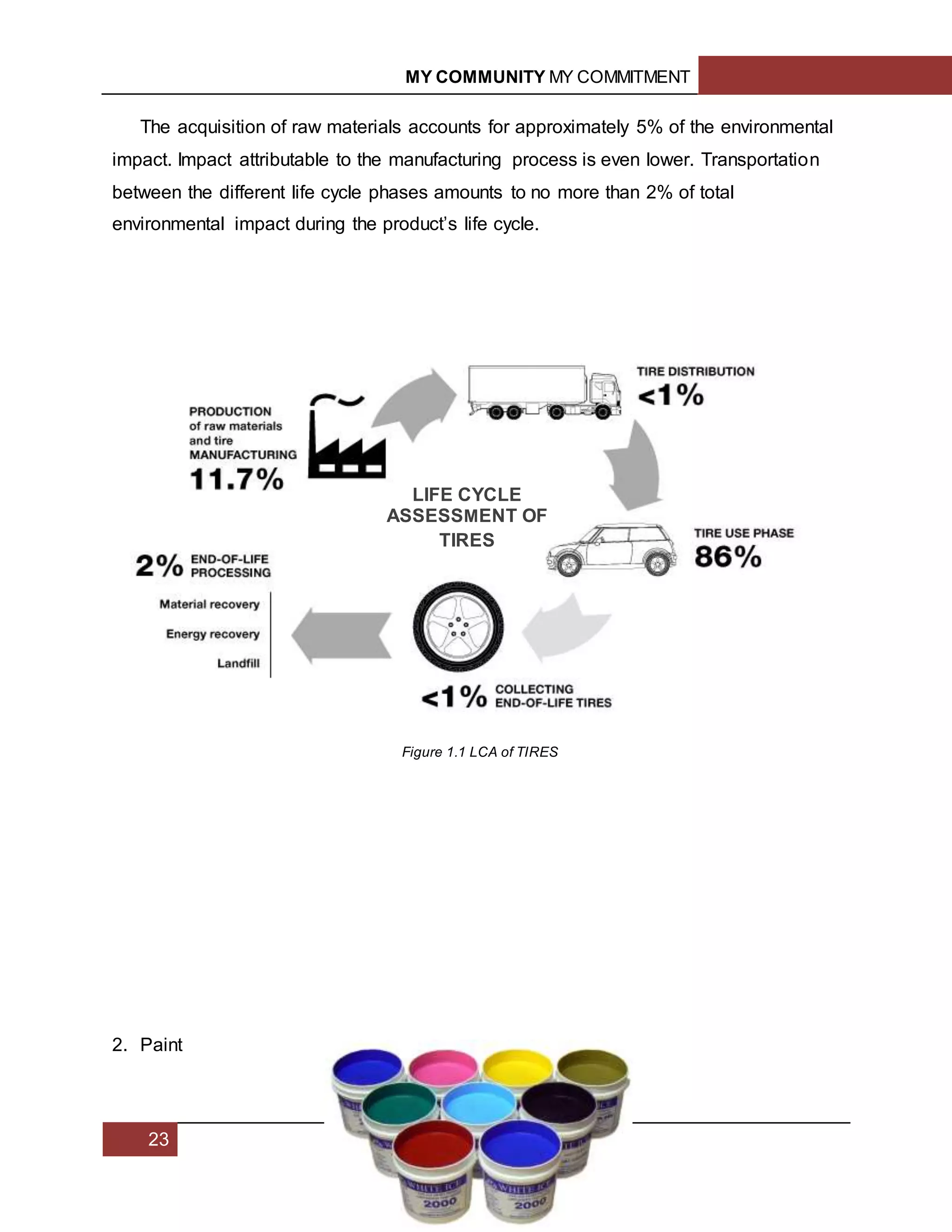
Figure 1 : Results of the product Life Cycle Assessment for passenger and light truck tires
Figure 1 shows the highest contribution to all environmental impact categories
derives from the use phase of the tire (approx. 90%). The reason is the rolling
resistance of the tire, which needs to be overcome when the car is in motion. This
consumes energy.
0
10
20
30
40
50
60
70
80
90
100
Acquisition of
Raw Materials
Transport Tire
Production
Tire Use
Cumulative Energy Demand
Global Warming Potential
Acodification Potential
Nutrification Potential
Summer Smog
RelativeContributions(%)
MY COMMUNITY MY COMMITMENT
23
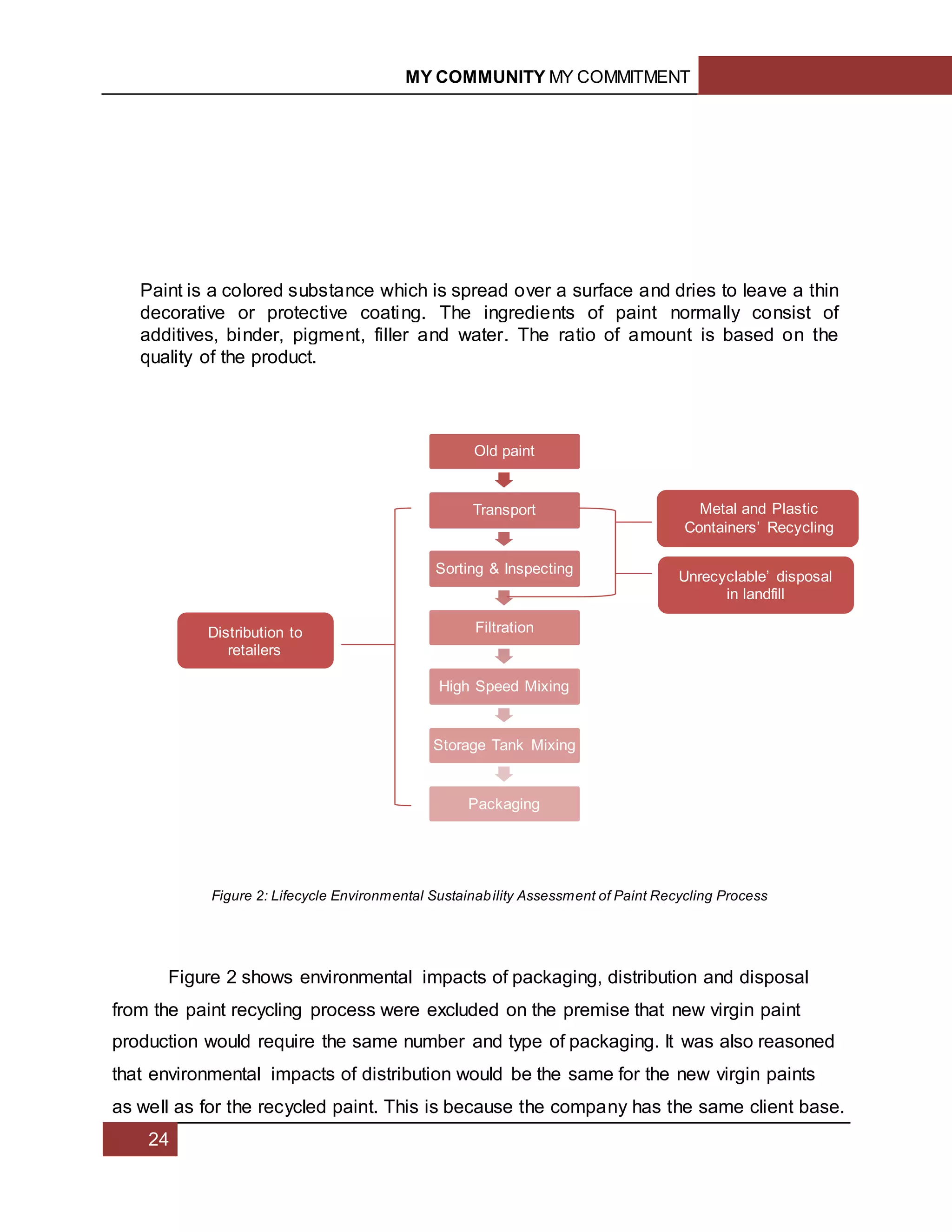
The acquisition of raw materials accounts for approximately 5% of the environmental
impact. Impact attributable to the manufacturing process is even lower. Transportation
between the different life cycle phases amounts to no more than 2% of total
environmental impact during the product’s life cycle.
2. Paint
Figure 1.1 LCA of TIRES
LIFE CYCLE
ASSESSMENT OF
TIRES
MY COMMUNITY MY COMMITMENT
24
Paint is a colored substance which is spread over a surface and dries to leave a thin
decorative or protective coating. The ingredients of paint normally consist of
additives, binder, pigment, filler and water. The ratio of amount is based on the
quality of the product.
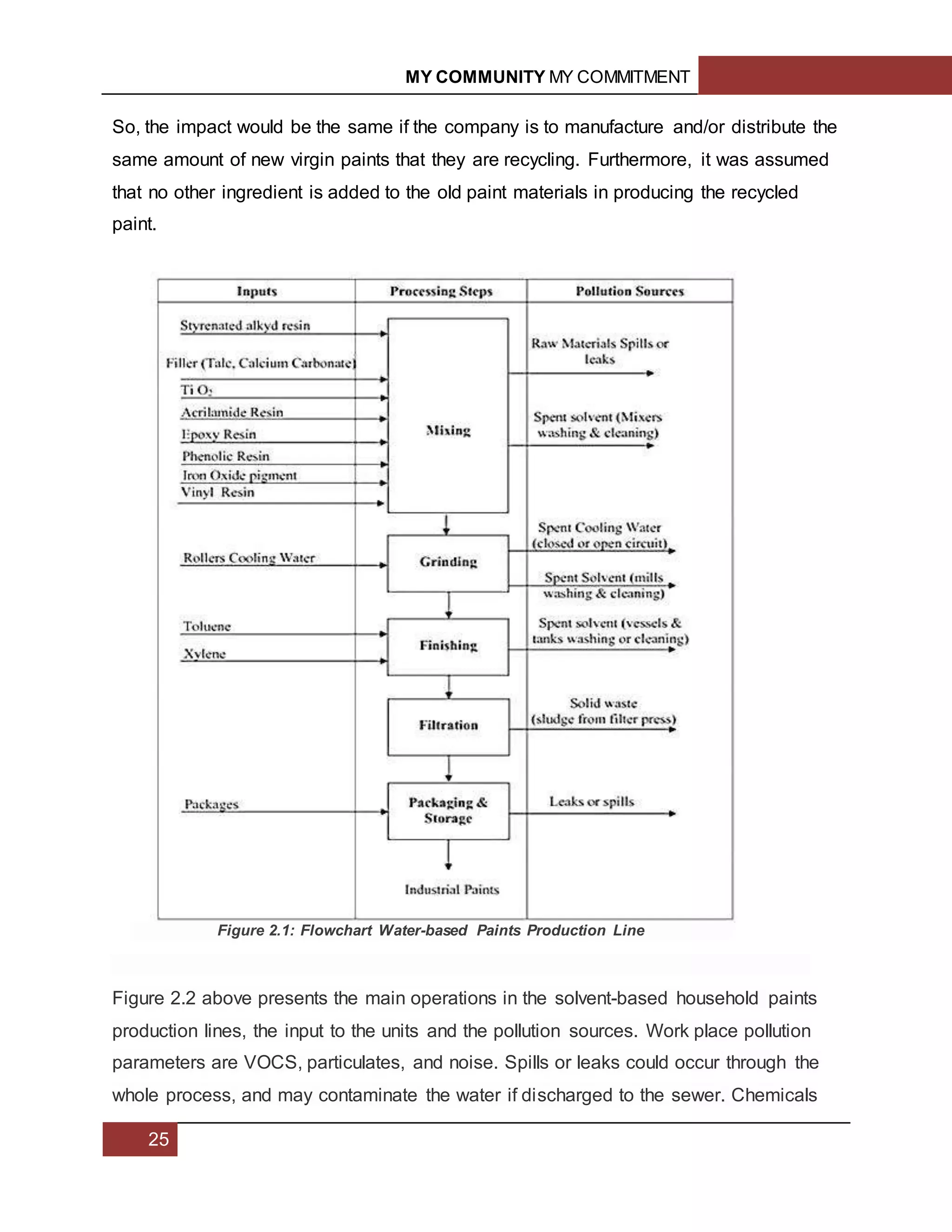
Figure 2 shows environmental impacts of packaging, distribution and disposal
from the paint recycling process were excluded on the premise that new virgin paint
production would require the same number and type of packaging. It was also reasoned
that environmental impacts of distribution would be the same for the new virgin paints
as well as for the recycled paint. This is because the company has the same client base.
Old paint
Transport
Sorting & Inspecting
Filtration
High Speed Mixing
Storage Tank Mixing
Packaging
Figure 2: Lifecycle Environmental Sustainability Assessment of Paint Recycling Process
Distribution to
retailers
Unrecyclable’ disposal
in landfill
Metal and Plastic
Containers’ Recycling
MY COMMUNITY MY COMMITMENT
25
So, the impact would be the same if the company is to manufacture and/or distribute the
same amount of new virgin paints that they are recycling. Furthermore, it was assumed
that no other ingredient is added to the old paint materials in producing the recycled
paint.
Figure 2.2 above presents the main operations in the solvent-based household paints
production lines, the input to the units and the pollution sources. Work place pollution
parameters are VOCS, particulates, and noise. Spills or leaks could occur through the
whole process, and may contaminate the water if discharged to the sewer. Chemicals
Figure 2.1: Flowchart Water-based Paints Production Line
MY COMMUNITY MY COMMITMENT
26
empty containers are generated, and considered hazardous. Those hazardous solid
wastes should be safely disposed into a landfill.
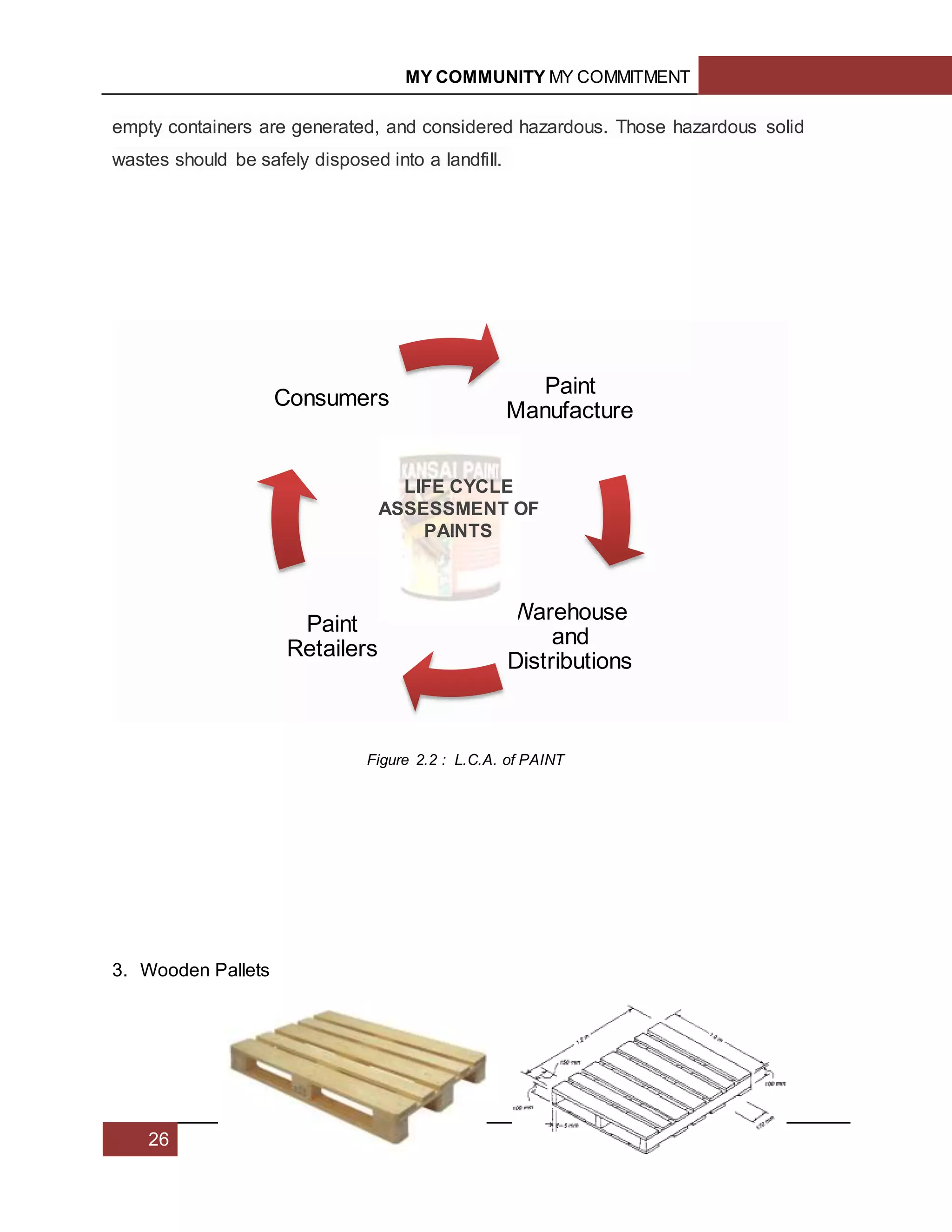
3. Wooden Pallets
Paint
Manufacture
Warehouse
and
Distributions
Paint
Retailers
Consumers
Figure 2.2 : L.C.A. of PAINT
LIFE CYCLE
ASSESSMENT OF
PAINTS
MY COMMUNITY MY COMMITMENT
27
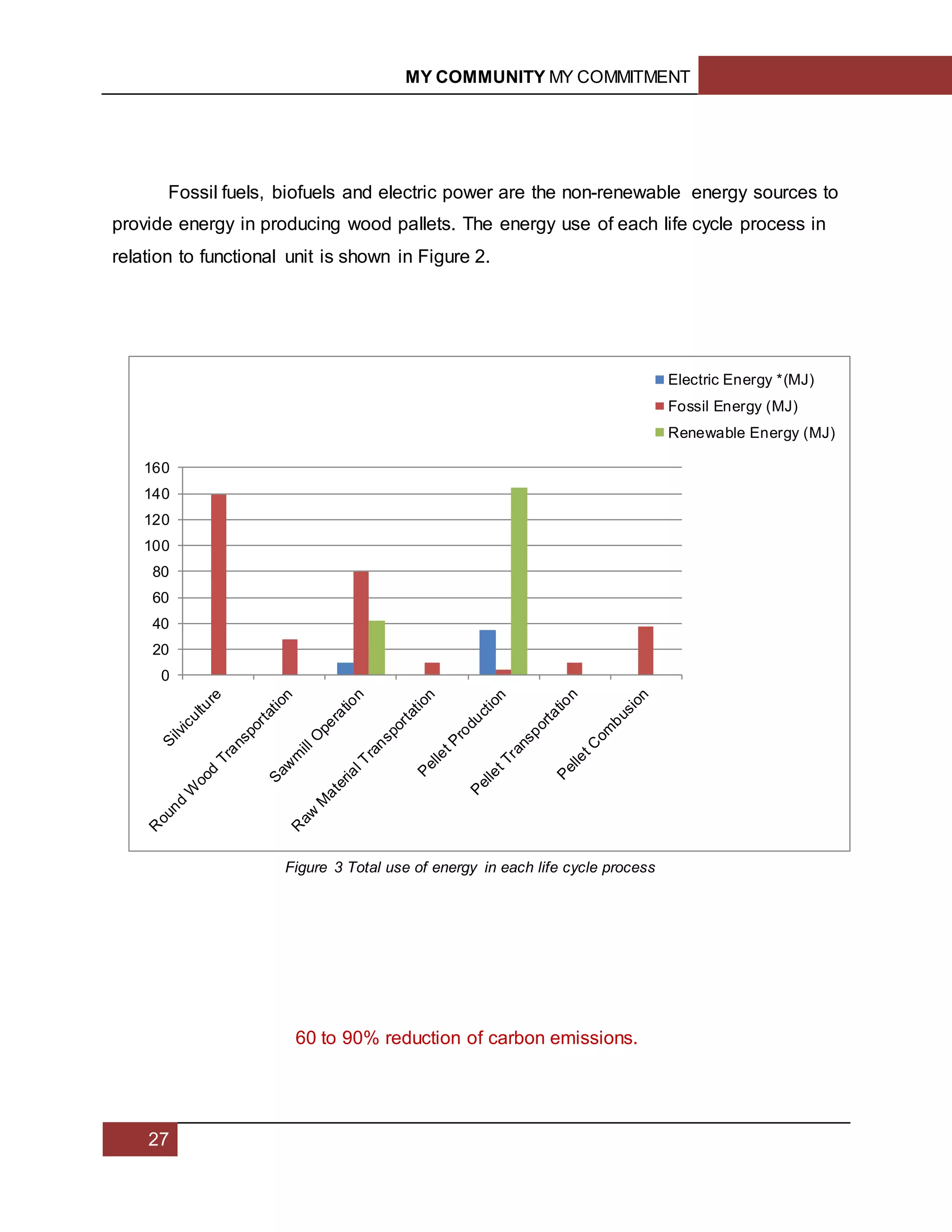
Fossil fuels, biofuels and electric power are the non-renewable energy sources to
provide energy in producing wood pallets. The energy use of each life cycle process in
relation to functional unit is shown in Figure 2.
60 to 90% reduction of carbon emissions.
0
20
40
60
80
100
120
140
160
Electric Energy *(MJ)
Fossil Energy (MJ)
Renewable Energy (MJ)
Figure 3 Total use of energy in each life cycle process
MY COMMUNITY MY COMMITMENT
28
WORK DISTRIBUTION
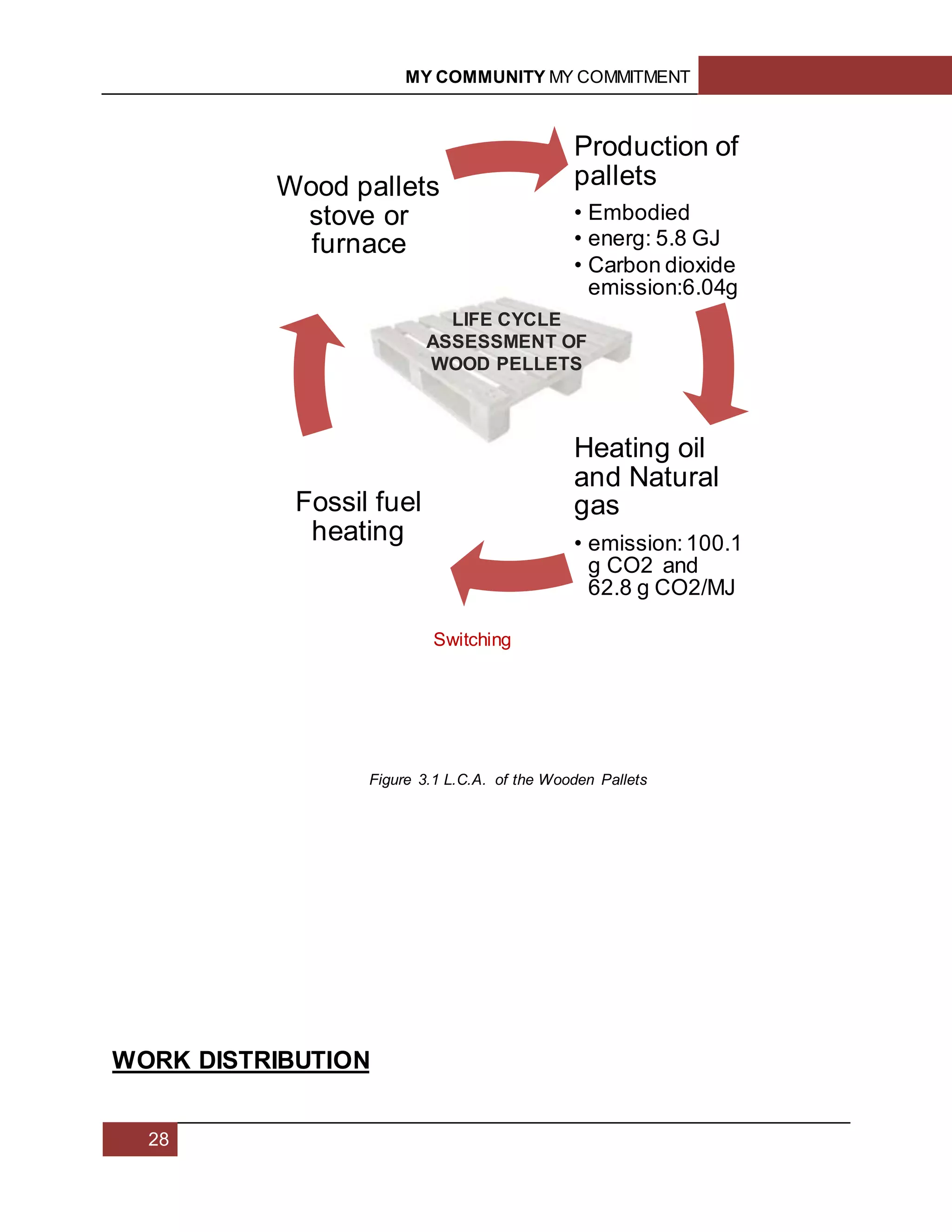
Production of
pallets
• Embodied
• energ: 5.8 GJ
• Carbon dioxide
emission:6.04g
Heating oil
and Natural
gas
• emission:100.1
g CO2 and
62.8 g CO2/MJ
Fossil fuel
heating
Wood pallets
stove or
furnace
LIFE CYCLE
ASSESSMENT OF
WOOD PELLETS
Figure 3.1 L.C.A. of the Wooden Pallets
Switching
MY COMMUNITY MY COMMITMENT
29
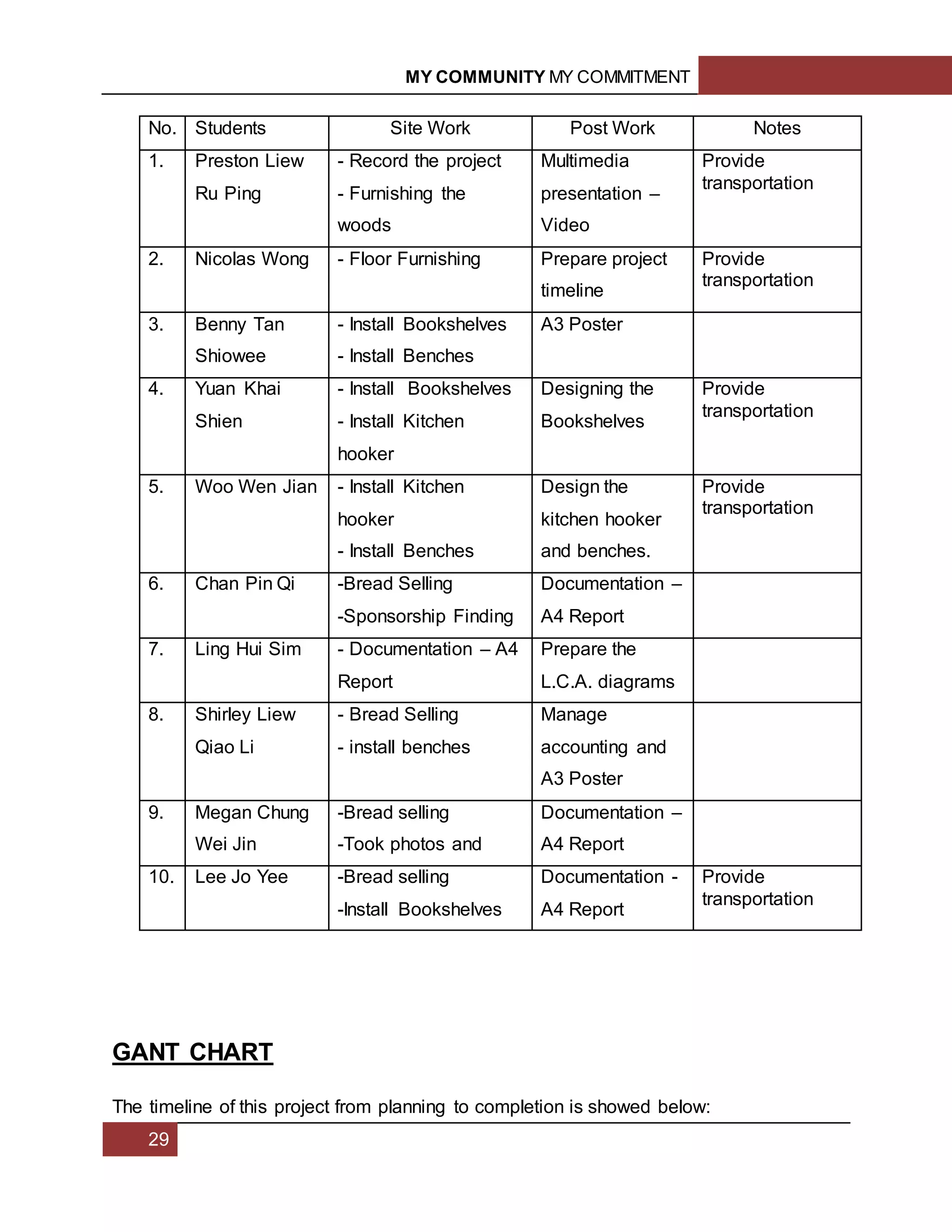
No. Students Site Work Post Work Notes
1. Preston Liew
Ru Ping
- Record the project
- Furnishing the
woods
Multimedia
presentation –
Video
Provide
transportation
2. Nicolas Wong - Floor Furnishing Prepare project
timeline
Provide
transportation
3. Benny Tan
Shiowee
- Install Bookshelves
- Install Benches
A3 Poster
4. Yuan Khai
Shien
- Install Bookshelves
- Install Kitchen
hooker
Designing the
Bookshelves
Provide
transportation
5. Woo Wen Jian - Install Kitchen
hooker
- Install Benches
Design the
kitchen hooker
and benches.
Provide
transportation
6. Chan Pin Qi -Bread Selling
-Sponsorship Finding
Documentation –
A4 Report
7. Ling Hui Sim - Documentation – A4
Report
Prepare the
L.C.A. diagrams
8. Shirley Liew
Qiao Li
- Bread Selling
- install benches
Manage
accounting and
A3 Poster
9. Megan Chung
Wei Jin
-Bread selling
-Took photos and
Documentation –
A4 Report
10. Lee Jo Yee -Bread selling
-Install Bookshelves
Documentation -
A4 Report
Provide
transportation
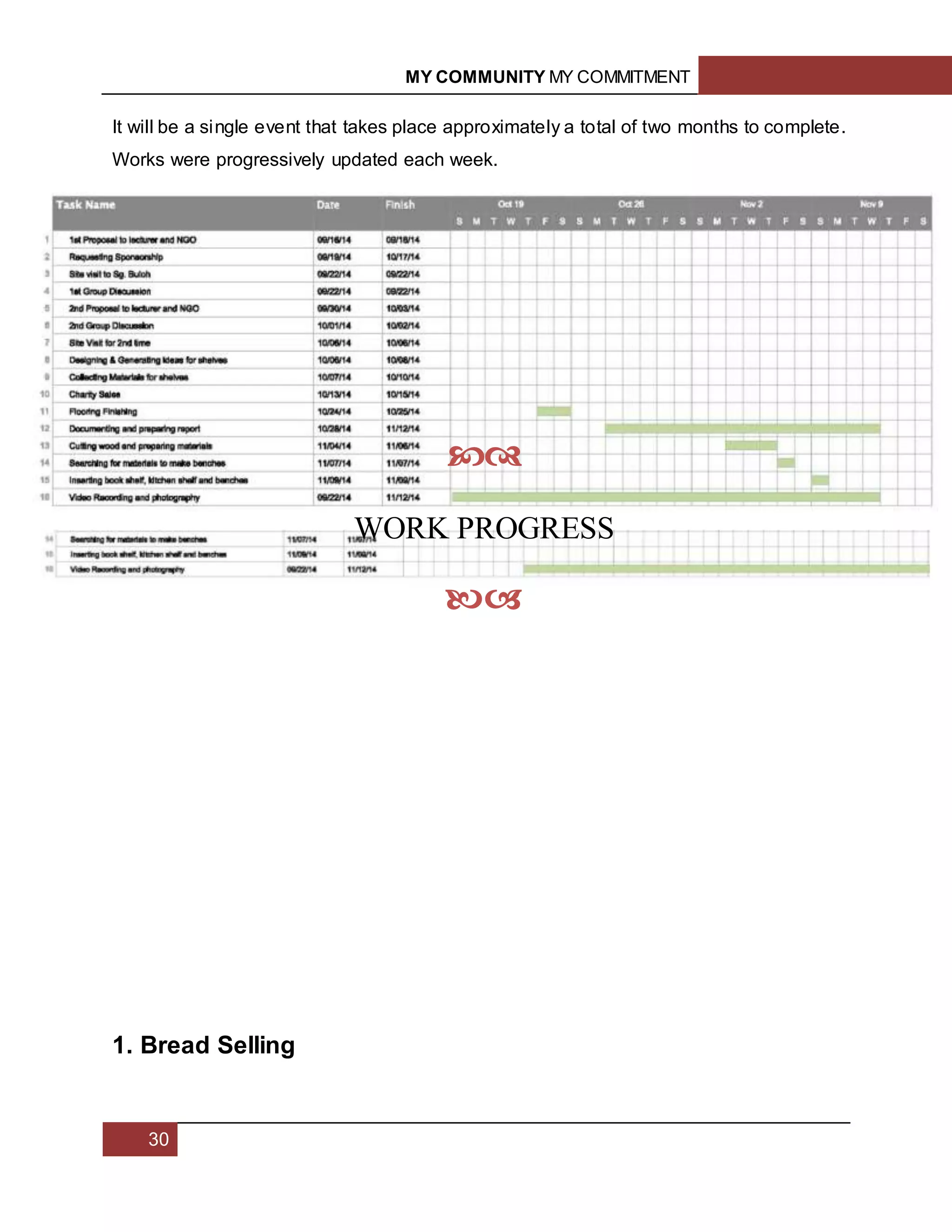
GANT CHART
The timeline of this project from planning to completion is showed below:
MY COMMUNITY MY COMMITMENT
30
It will be a single event that takes place approximately a total of two months to complete.
Works were progressively updated each week.
1. Bread Selling

WORK PROGRESS

MY COMMUNITY MY COMMITMENT
31
With the purpose of raising funds and also getting the public’s attention towards the
refugee, we decided to search for bakeries which are willing to provide us with breads
and pastries to be sold out to the public. We approached Free Mori Bakery and they
were willing to cooperate with us to give a helping hand to the children of the refugee
center
They provided us with a variety of pastries for example The Bun Family which consists
of
 Raisin Buns and Chocolate-filled Buns
 Butter-glazed Buns
 Marble Milk Buns
 Polo buns
 Mille Danish and
 even small packets of Chocolate Chip Cookies.
After obtaining and packing the stocks on a Tuesday morning, we divided
ourselves into small groups and went to different places to sell the pastries. The places
that we went to were Taylor’s College, Inti College, area around SS15, Sunway
University and of course, our very own Taylor’s University Lakeside Campus. While
selling the breads, we also asked for donations from the public while showing them
information flyers about this education center. This fund-raising sale went on for two
days and we collected a total amount of RM1320.75. Please refer to pagexx for the
financial report.
MY COMMUNITY MY COMMITMENT
32
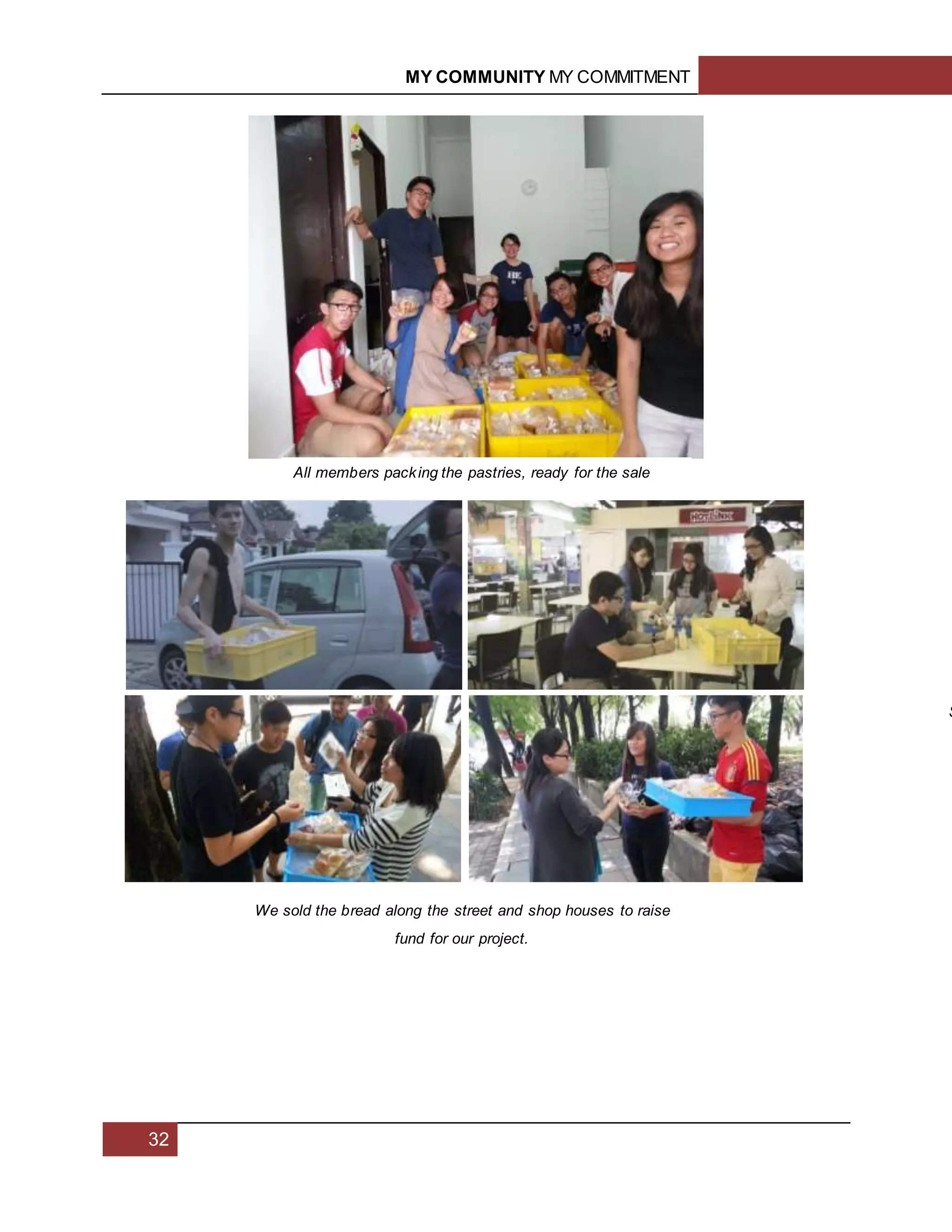
All members packing the pastries, ready for the sale
S
We sold the bread along the street and shop houses to raise
fund for our project.
MY COMMUNITY MY COMMITMENT
33
2. Bookshelves, benches and brooms holder making.
I. DESIGNING PHASE
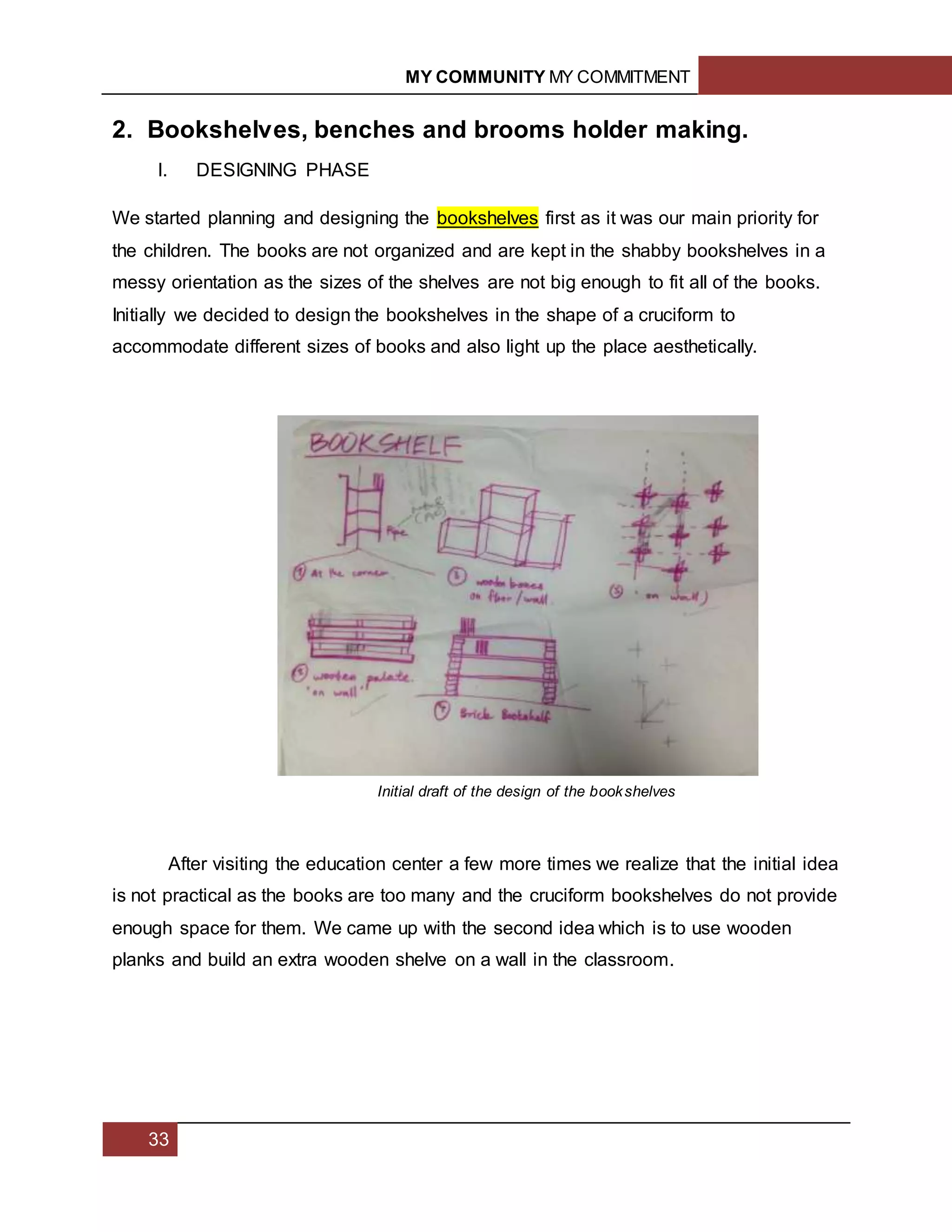
We started planning and designing the bookshelves first as it was our main priority for
the children. The books are not organized and are kept in the shabby bookshelves in a
messy orientation as the sizes of the shelves are not big enough to fit all of the books.
Initially we decided to design the bookshelves in the shape of a cruciform to
accommodate different sizes of books and also light up the place aesthetically.
After visiting the education center a few more times we realize that the initial idea
is not practical as the books are too many and the cruciform bookshelves do not provide
enough space for them. We came up with the second idea which is to use wooden
planks and build an extra wooden shelve on a wall in the classroom.
Initial draft of the design of the bookshelves
MY COMMUNITY MY COMMITMENT
34
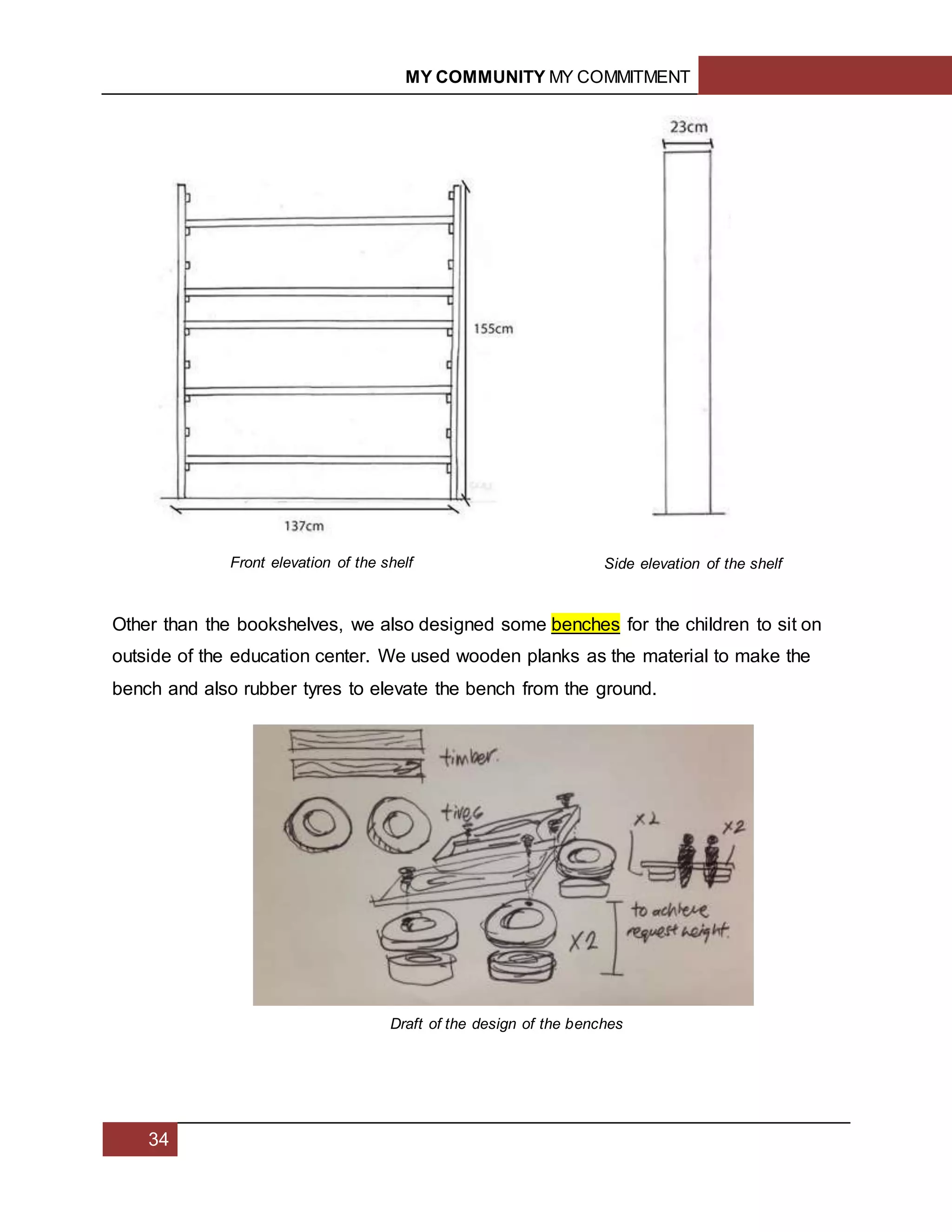
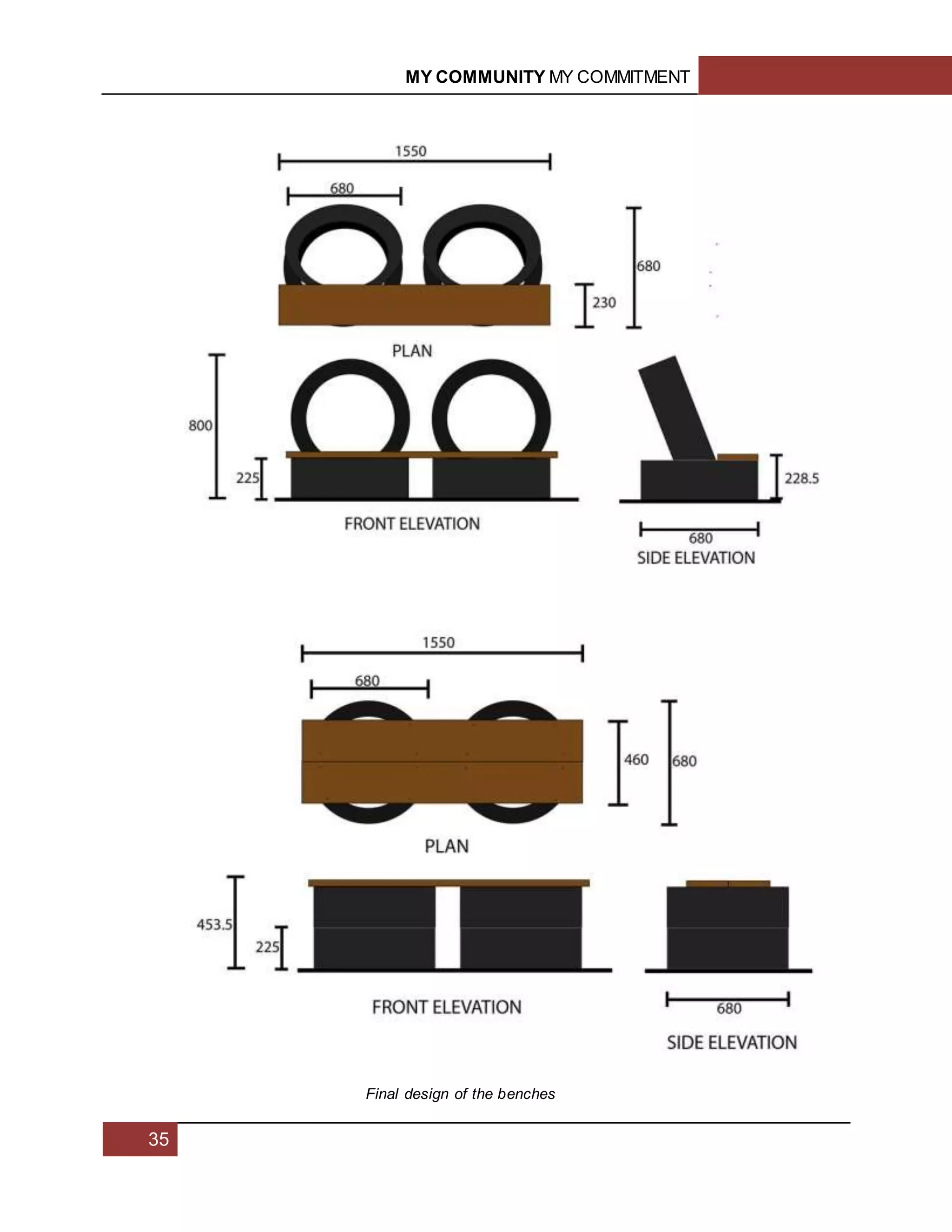
Other than the bookshelves, we also designed some benches for the children to sit on
outside of the education center. We used wooden planks as the material to make the
bench and also rubber tyres to elevate the bench from the ground.
Front elevation of the shelf Side elevation of the shelf
Draft of the design of the benches
MY COMMUNITY MY COMMITMENT
35
Final design of the benches
MY COMMUNITY MY COMMITMENT
36
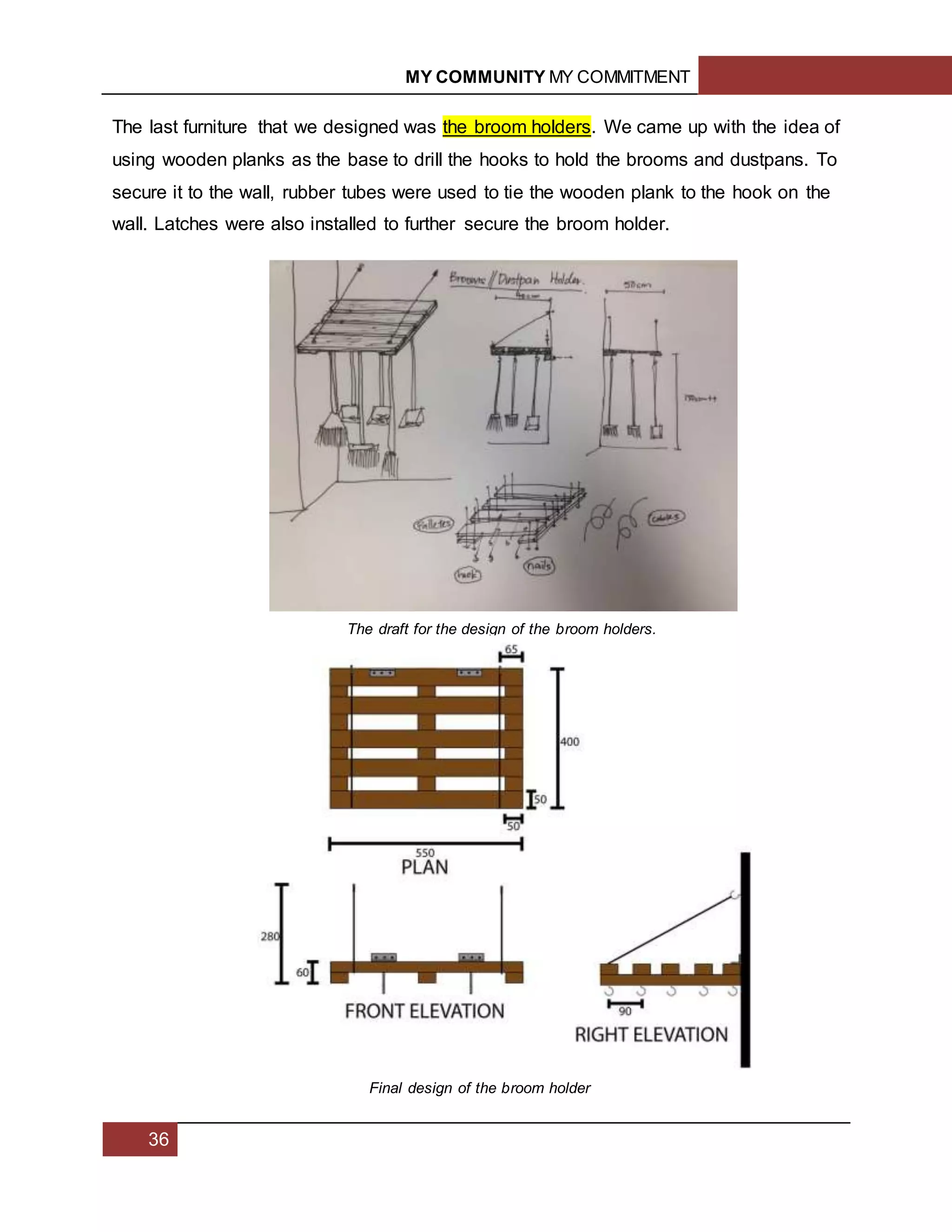
The last furniture that we designed was the broom holders. We came up with the idea of
using wooden planks as the base to drill the hooks to hold the brooms and dustpans. To
secure it to the wall, rubber tubes were used to tie the wooden plank to the hook on the
wall. Latches were also installed to further secure the broom holder.
The draft for the design of the broom holders.
Final design of the broom holder
MY COMMUNITY MY COMMITMENT
37
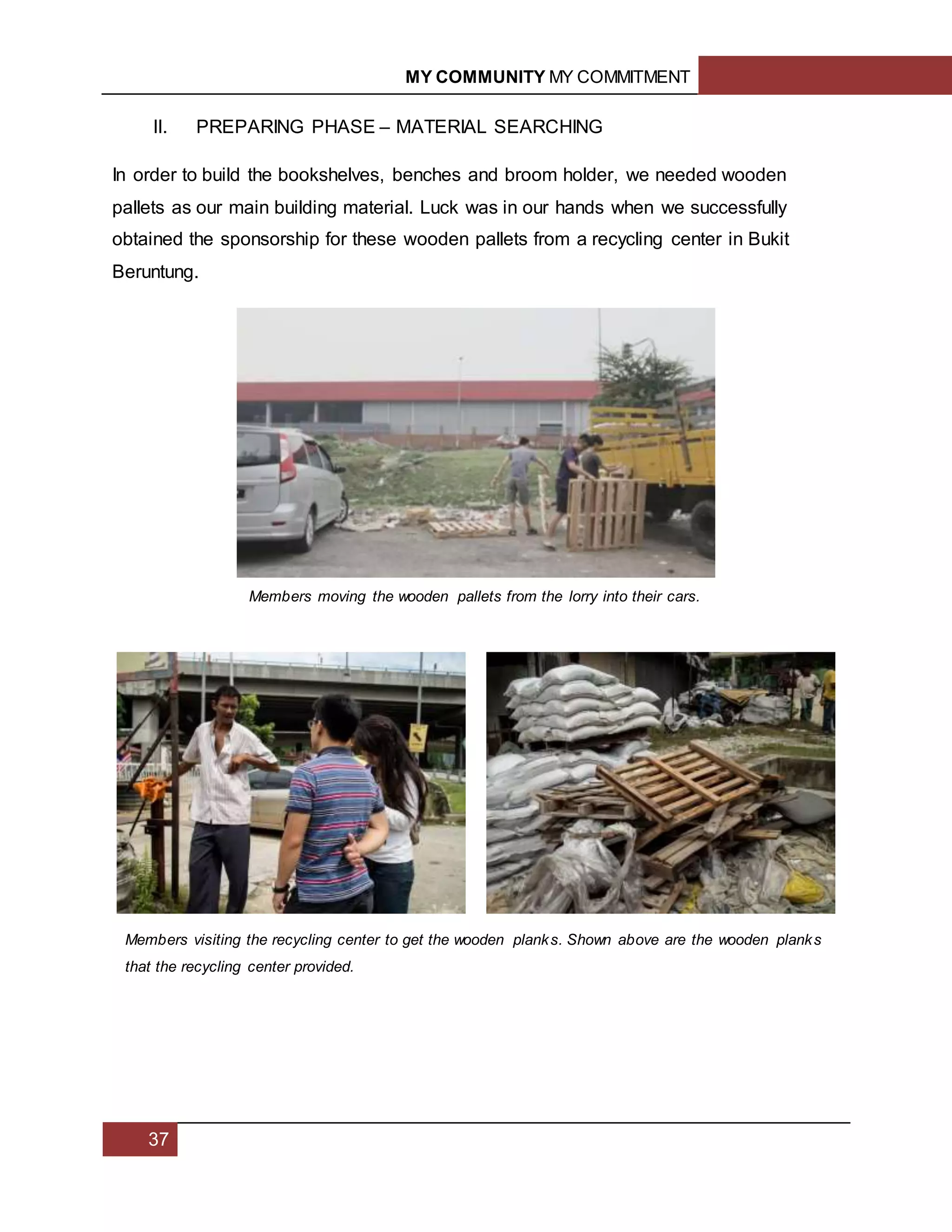
II. PREPARING PHASE – MATERIAL SEARCHING
In order to build the bookshelves, benches and broom holder, we needed wooden
pallets as our main building material. Luck was in our hands when we successfully
obtained the sponsorship for these wooden pallets from a recycling center in Bukit
Beruntung.
Members moving the wooden pallets from the lorry into their cars.
Members visiting the recycling center to get the wooden planks. Shown above are the wooden planks
that the recycling center provided.
MY COMMUNITY MY COMMITMENT
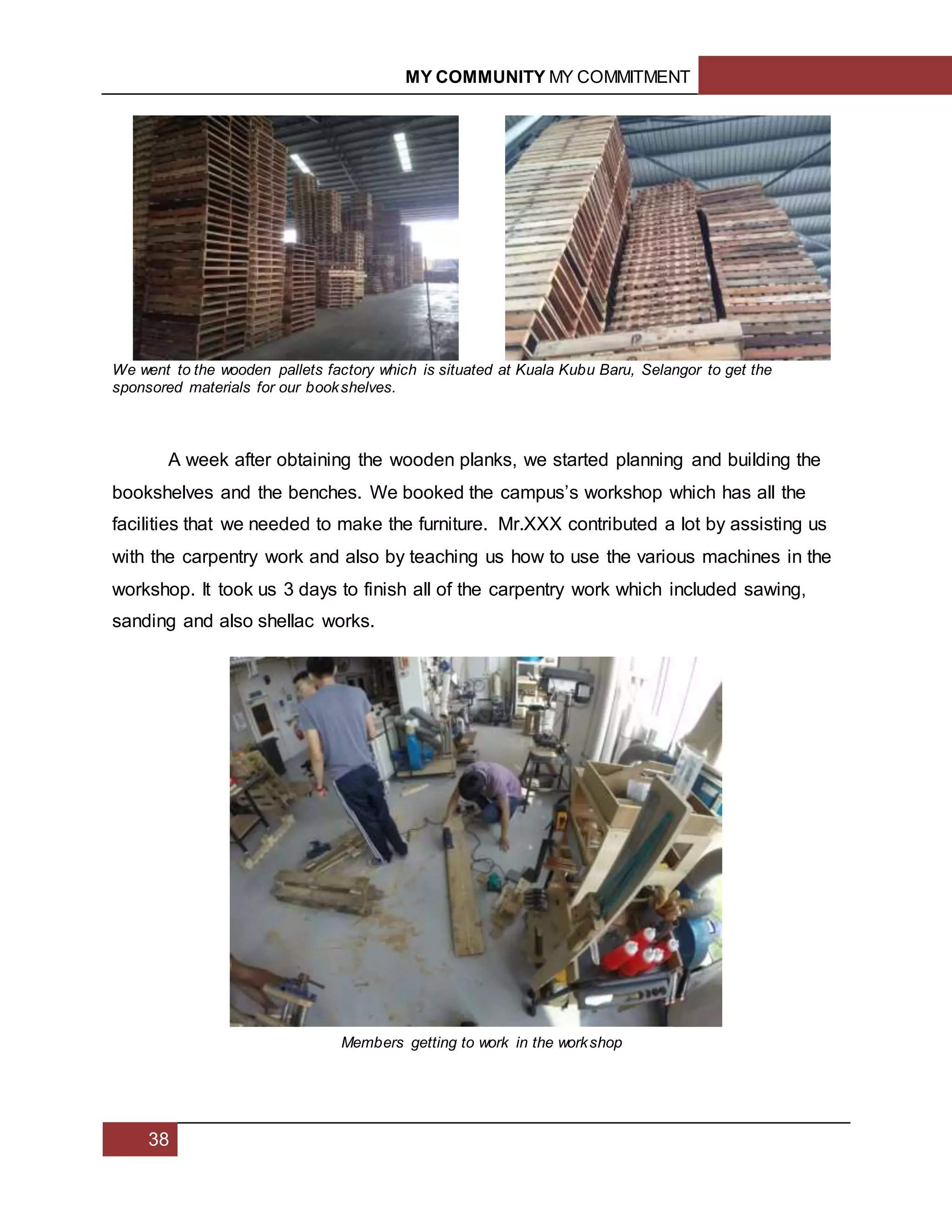
38
We went to the wooden pallets factory which is situated at Kuala Kubu Baru, Selangor to get the
sponsored materials for our bookshelves.
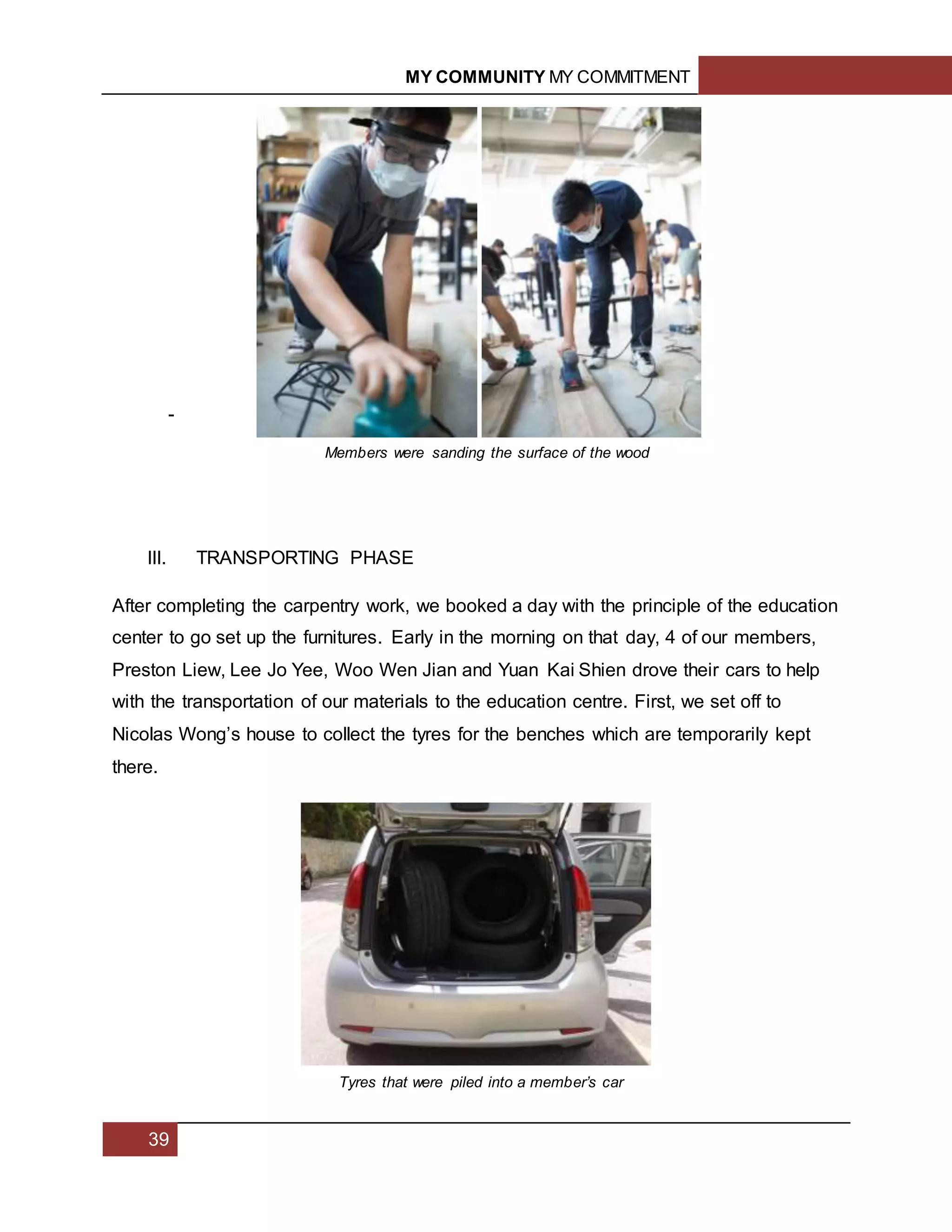
A week after obtaining the wooden planks, we started planning and building the
bookshelves and the benches. We booked the campus’s workshop which has all the
facilities that we needed to make the furniture. Mr.XXX contributed a lot by assisting us
with the carpentry work and also by teaching us how to use the various machines in the
workshop. It took us 3 days to finish all of the carpentry work which included sawing,
sanding and also shellac works.
Members getting to work in the workshop
MY COMMUNITY MY COMMITMENT
39
-
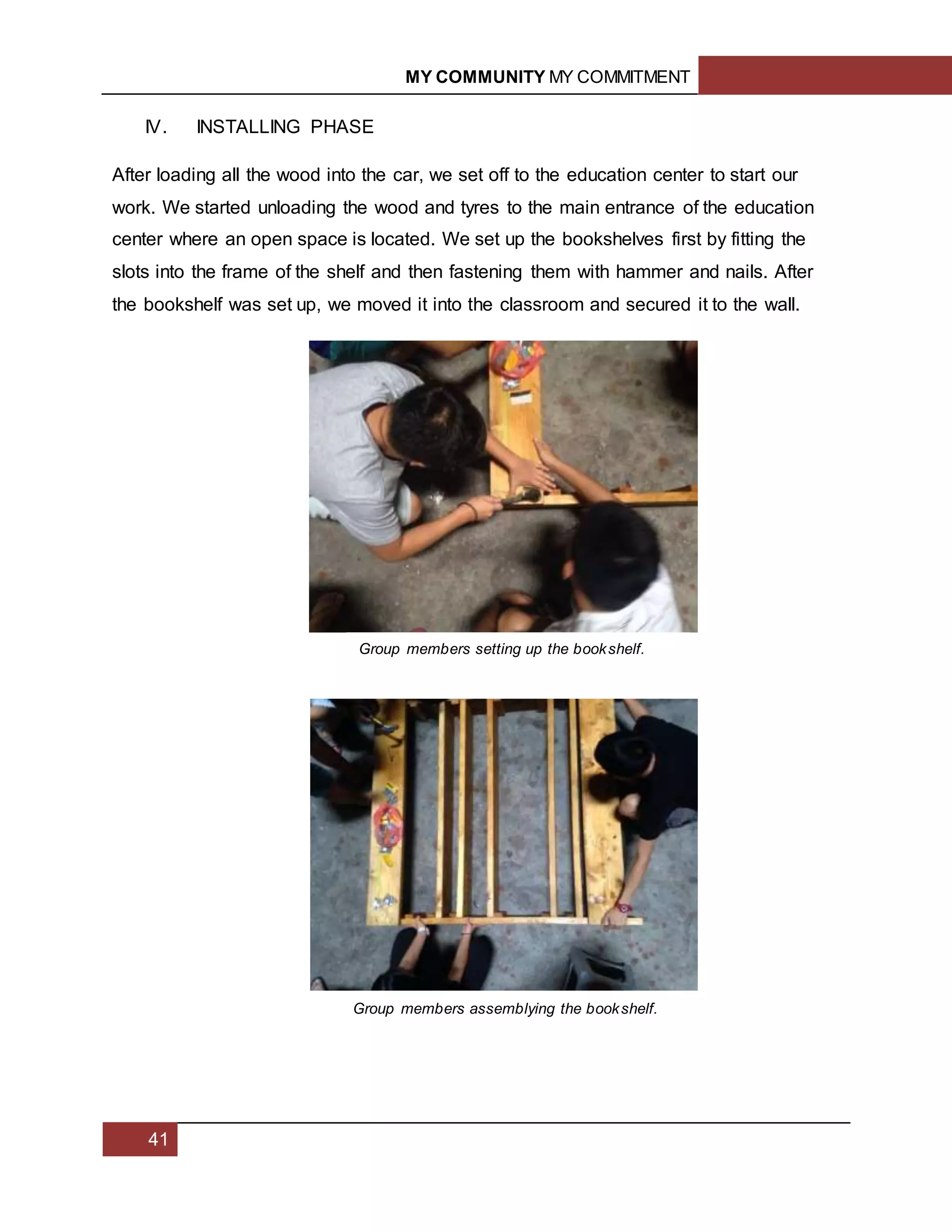
III. TRANSPORTING PHASE
After completing the carpentry work, we booked a day with the principle of the education
center to go set up the furnitures. Early in the morning on that day, 4 of our members,
Preston Liew, Lee Jo Yee, Woo Wen Jian and Yuan Kai Shien drove their cars to help
with the transportation of our materials to the education centre. First, we set off to
Nicolas Wong’s house to collect the tyres for the benches which are temporarily kept
there.
Members were sanding the surface of the wood
Tyres that were piled into a member’s car
MY COMMUNITY MY COMMITMENT
40
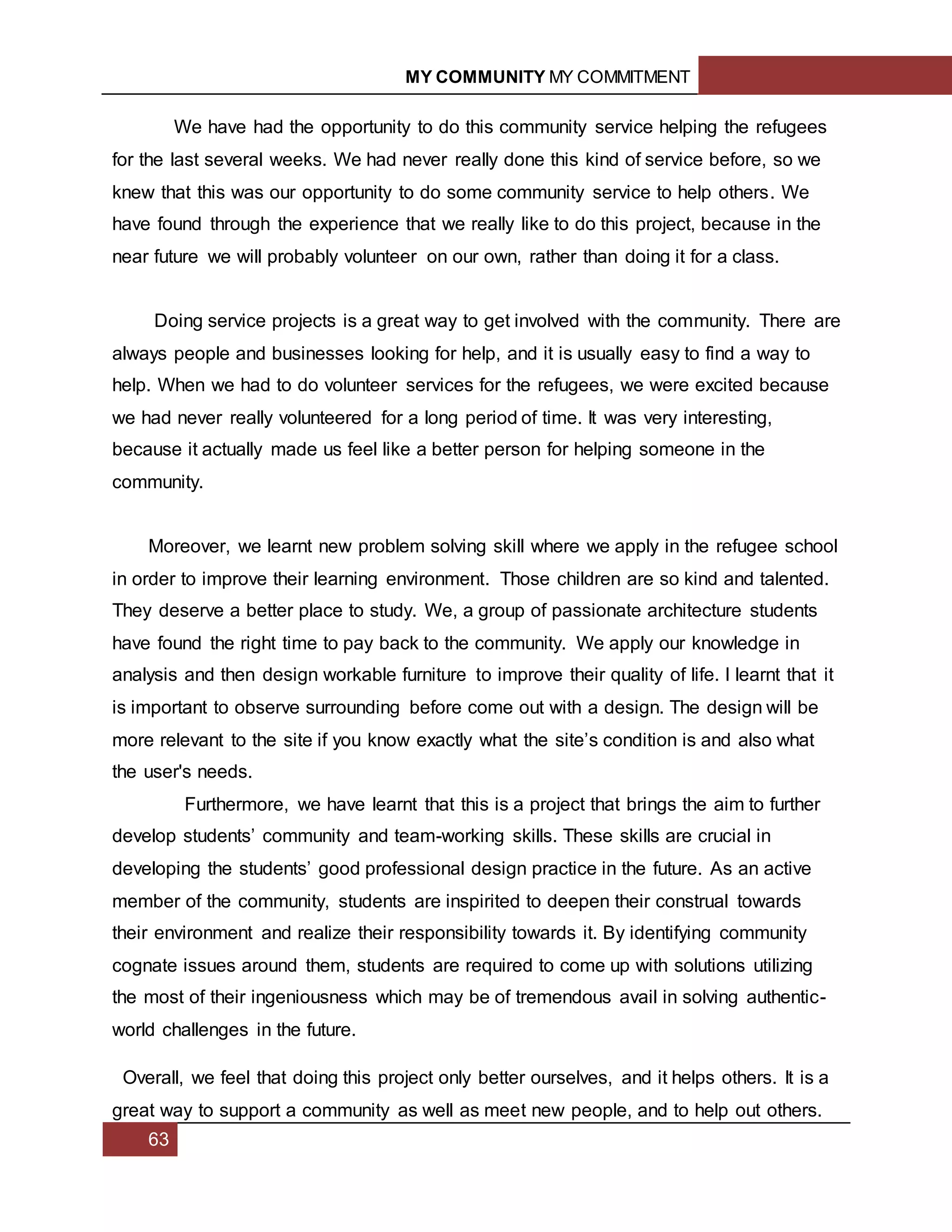
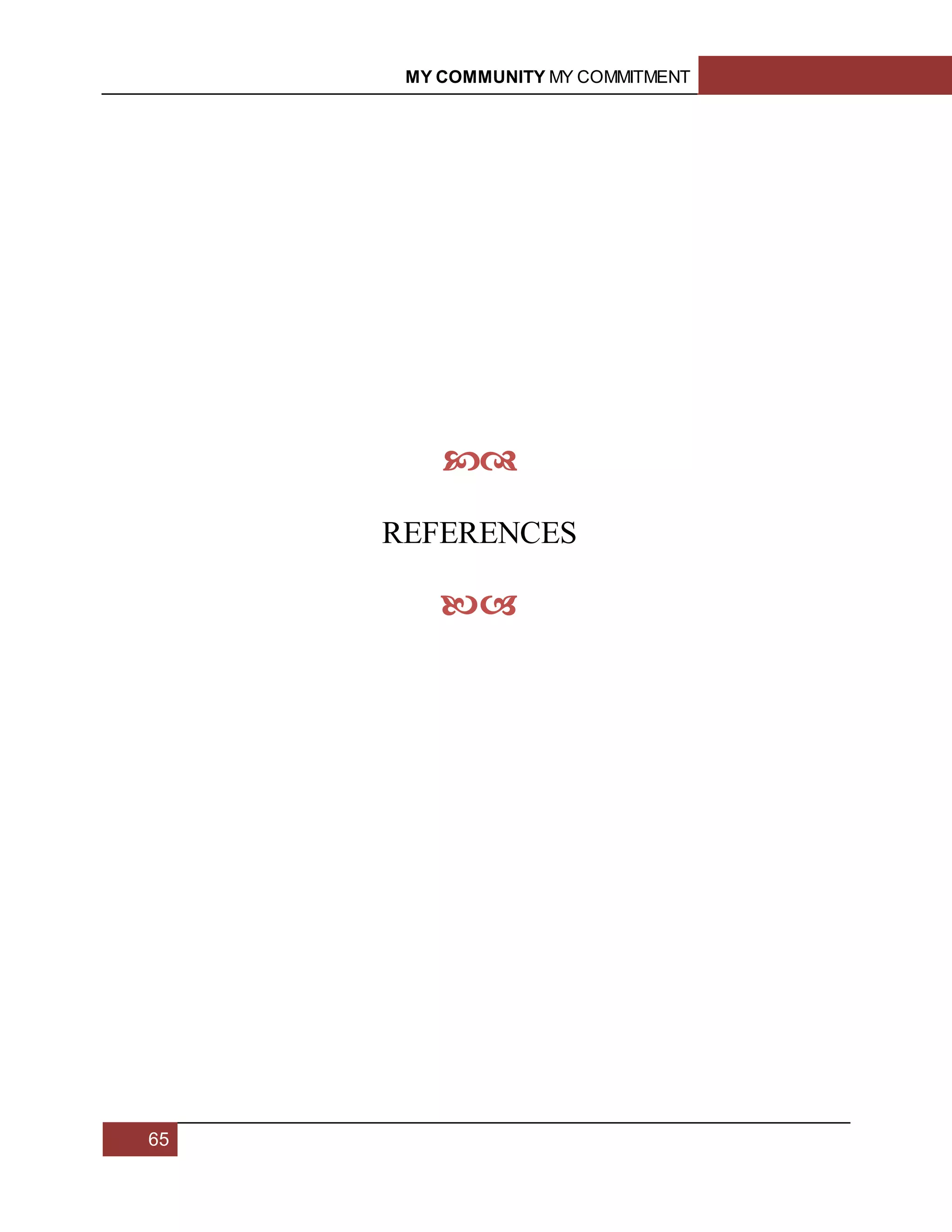
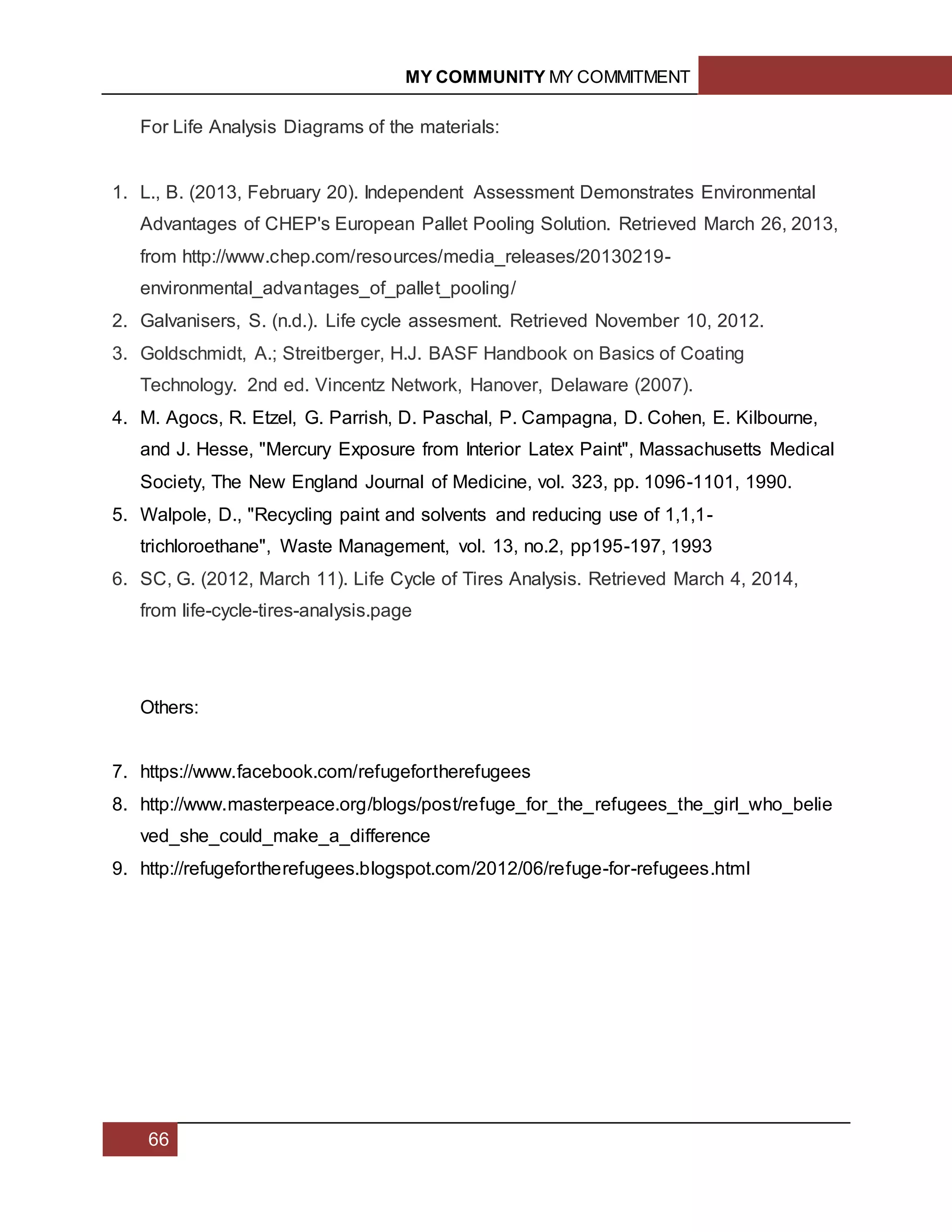
After loading the tyres into the car, we headed off to campus to collect the wooden
planks to set up the bookshelves.
Members were moving the wooden planks from the workshop into the cars.
MY COMMUNITY MY COMMITMENT
41
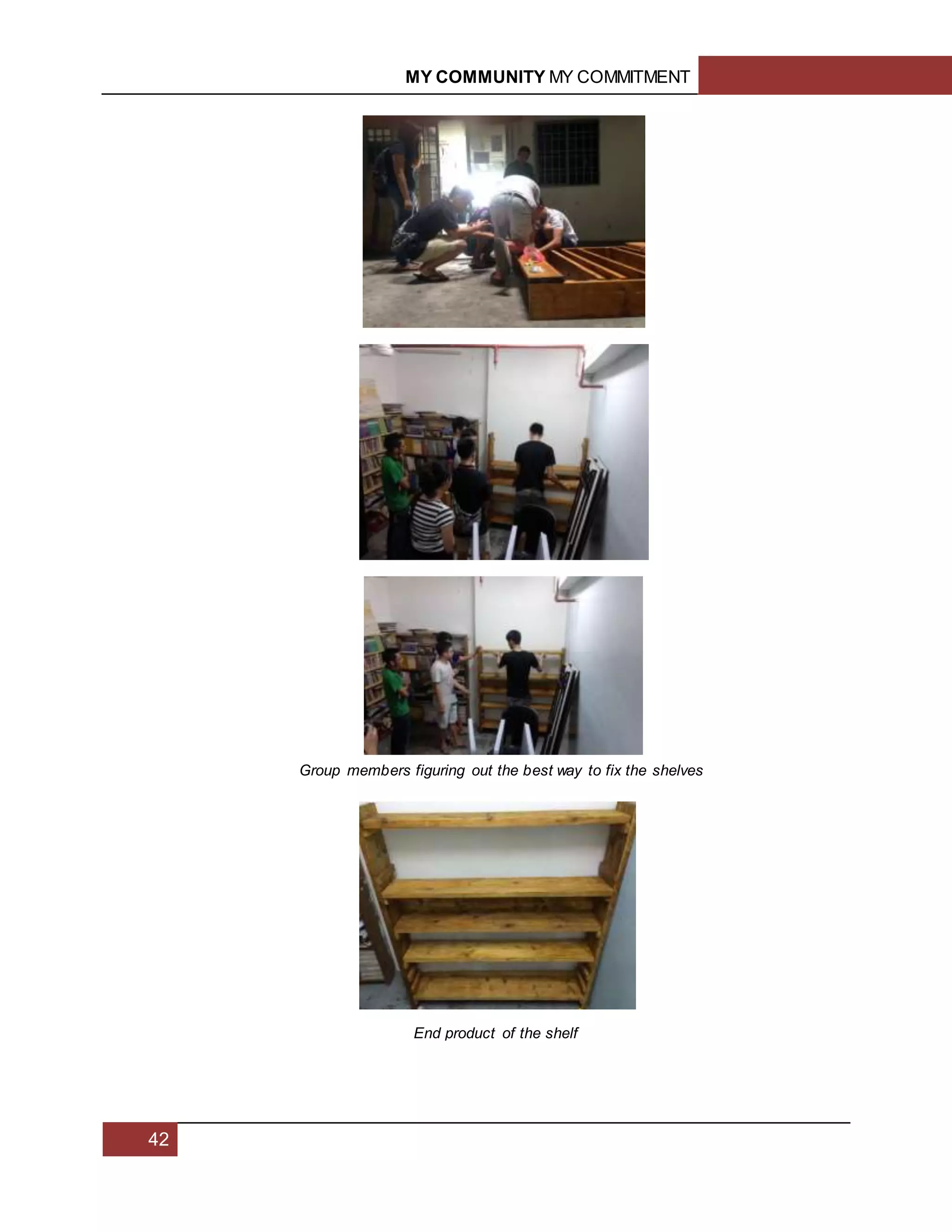
IV. INSTALLING PHASE
After loading all the wood into the car, we set off to the education center to start our
work. We started unloading the wood and tyres to the main entrance of the education
center where an open space is located. We set up the bookshelves first by fitting the
slots into the frame of the shelf and then fastening them with hammer and nails. After
the bookshelf was set up, we moved it into the classroom and secured it to the wall.
Group members setting up the bookshelf.
Group members assemblying the bookshelf.
MY COMMUNITY MY COMMITMENT
42
Group members figuring out the best way to fix the shelves
End product of the shelf
MY COMMUNITY MY COMMITMENT
43
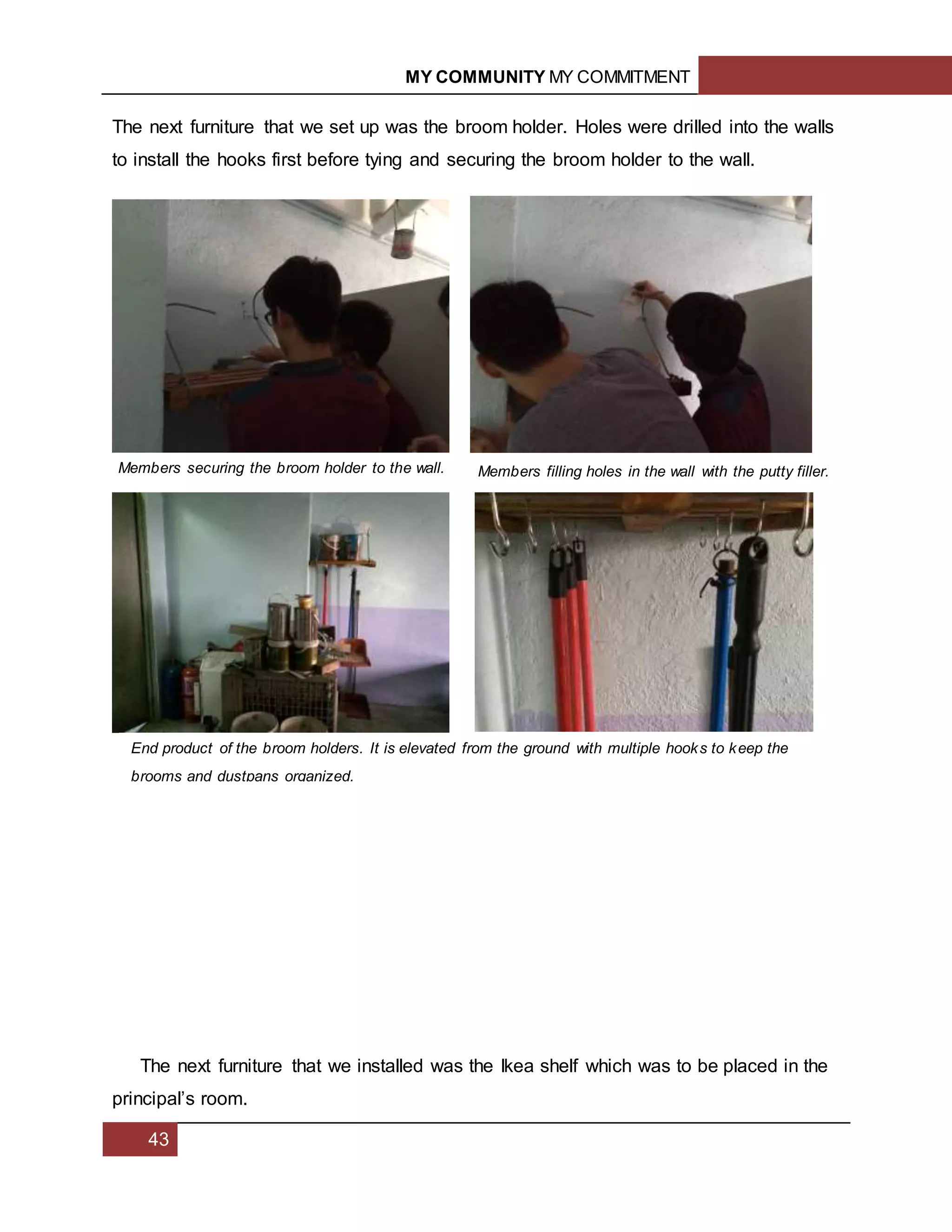
The next furniture that we set up was the broom holder. Holes were drilled into the walls
to install the hooks first before tying and securing the broom holder to the wall.
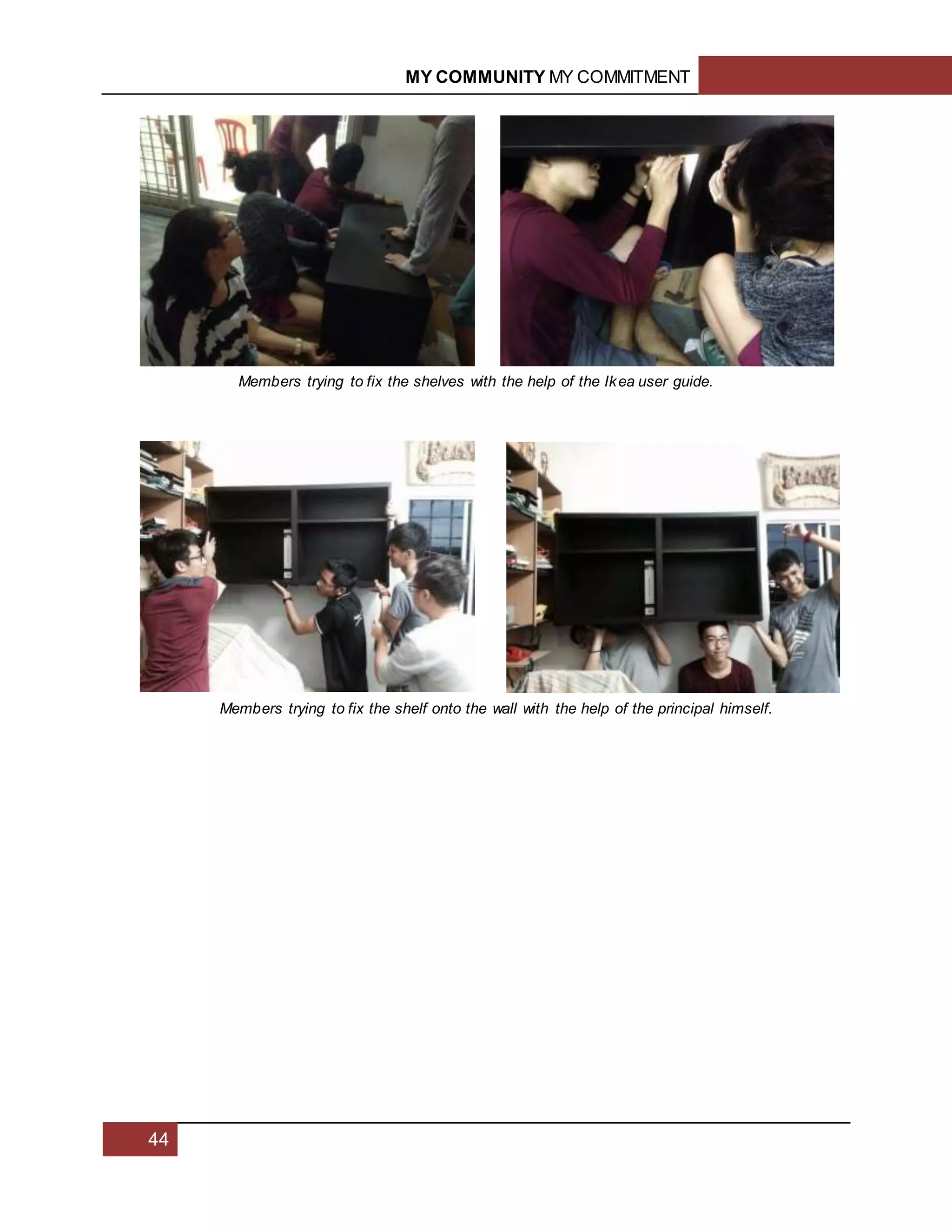
The next furniture that we installed was the Ikea shelf which was to be placed in the
principal’s room.
Members securing the broom holder to the wall. Members filling holes in the wall with the putty filler.
End product of the broom holders. It is elevated from the ground with multiple hooks to keep the
brooms and dustpans organized.
MY COMMUNITY MY COMMITMENT
44
Members trying to fix the shelves with the help of the Ikea user guide.
Members trying to fix the shelf onto the wall with the help of the principal himself.
MY COMMUNITY MY COMMITMENT
45
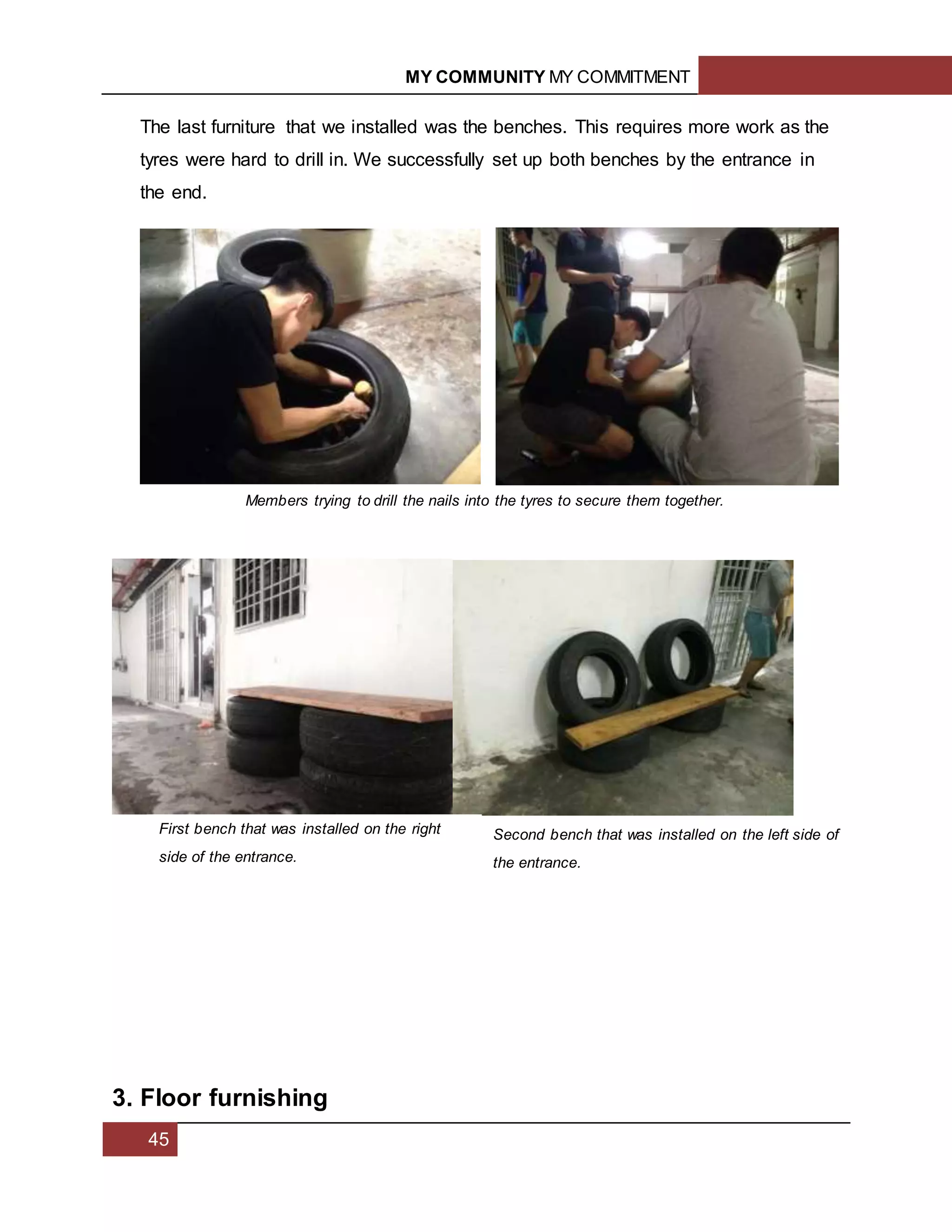
The last furniture that we installed was the benches. This requires more work as the
tyres were hard to drill in. We successfully set up both benches by the entrance in
the end.
3. Floor furnishing
Members trying to drill the nails into the tyres to secure them together.
First bench that was installed on the right
side of the entrance.
Second bench that was installed on the left side of
the entrance.
MY COMMUNITY MY COMMITMENT
46
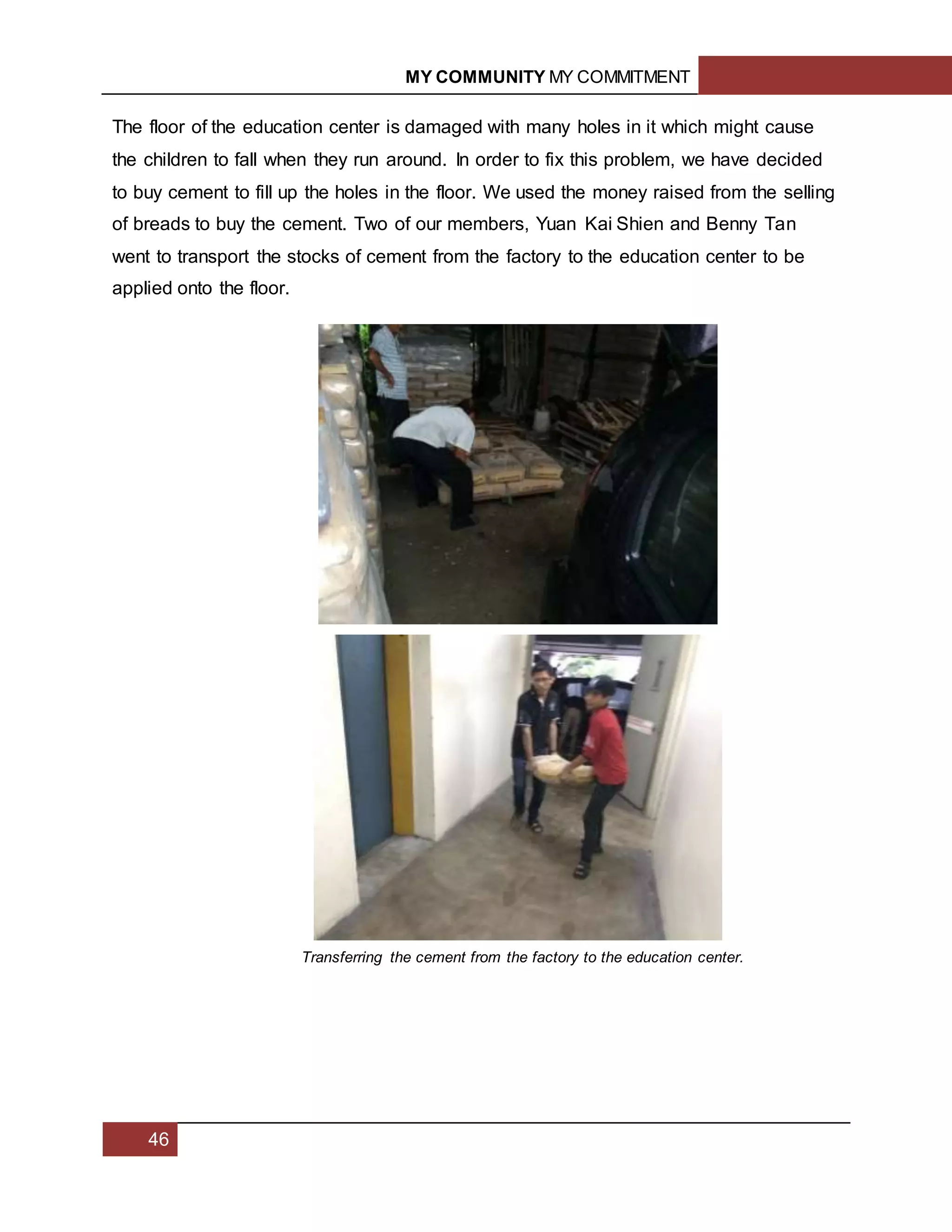
The floor of the education center is damaged with many holes in it which might cause
the children to fall when they run around. In order to fix this problem, we have decided
to buy cement to fill up the holes in the floor. We used the money raised from the selling
of breads to buy the cement. Two of our members, Yuan Kai Shien and Benny Tan
went to transport the stocks of cement from the factory to the education center to be
applied onto the floor.
Transferring the cement from the factory to the education center.
MY COMMUNITY MY COMMITMENT
47
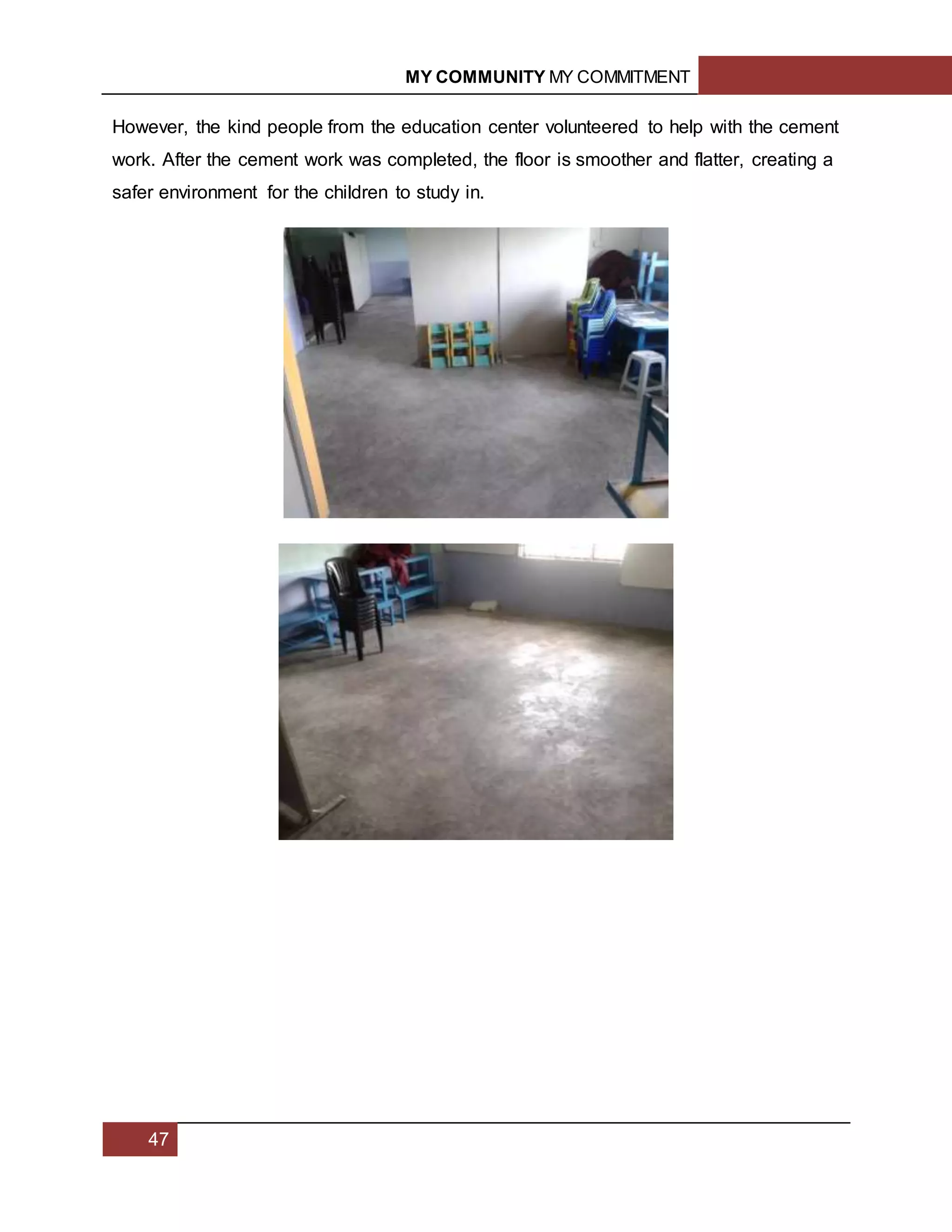
However, the kind people from the education center volunteered to help with the cement
work. After the cement work was completed, the floor is smoother and flatter, creating a
safer environment for the children to study in.
MY COMMUNITY MY COMMITMENT
48

BUDGET & EXPENSES

MY COMMUNITY MY COMMITMENT
49
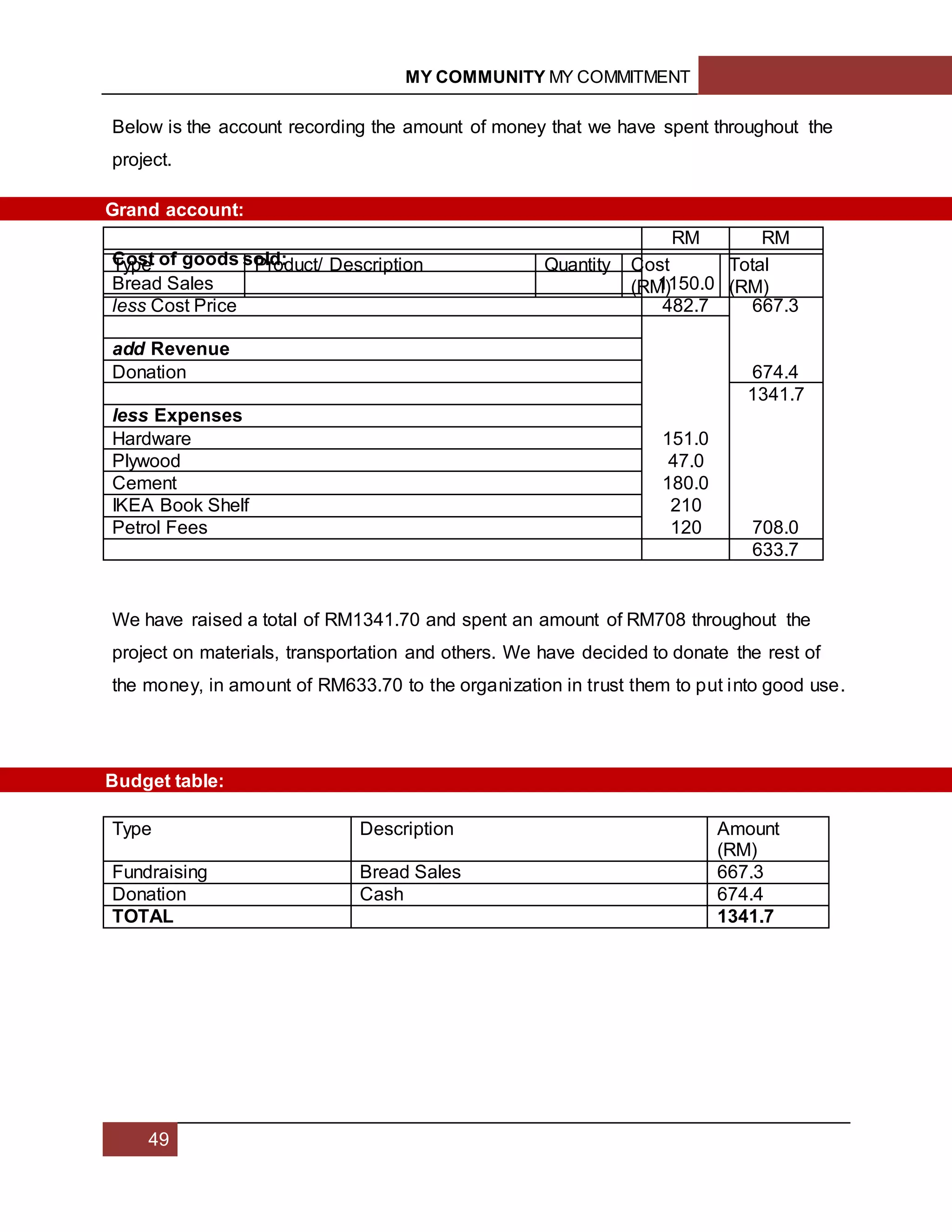
Below is the account recording the amount of money that we have spent throughout the
project.
We have raised a total of RM1341.70 and spent an amount of RM708 throughout the
project on materials, transportation and others. We have decided to donate the rest of
the money, in amount of RM633.70 to the organization in trust them to put into good use.
Type Description Amount
(RM)
Fundraising Bread Sales 667.3
Donation Cash 674.4
TOTAL 1341.7
RM RM
Cost of goods sold:
Bread Sales 1150.0
less Cost Price 482.7 667.3
add Revenue
Donation 674.4
1341.7
less Expenses
Hardware 151.0
Plywood 47.0
Cement 180.0
IKEA Book Shelf 210
Petrol Fees 120 708.0
633.7
Type Product/ Description Quantity Cost
(RM)
Total
(RM)
Grand account:
Budget table:
MY COMMUNITY MY COMMITMENT
50
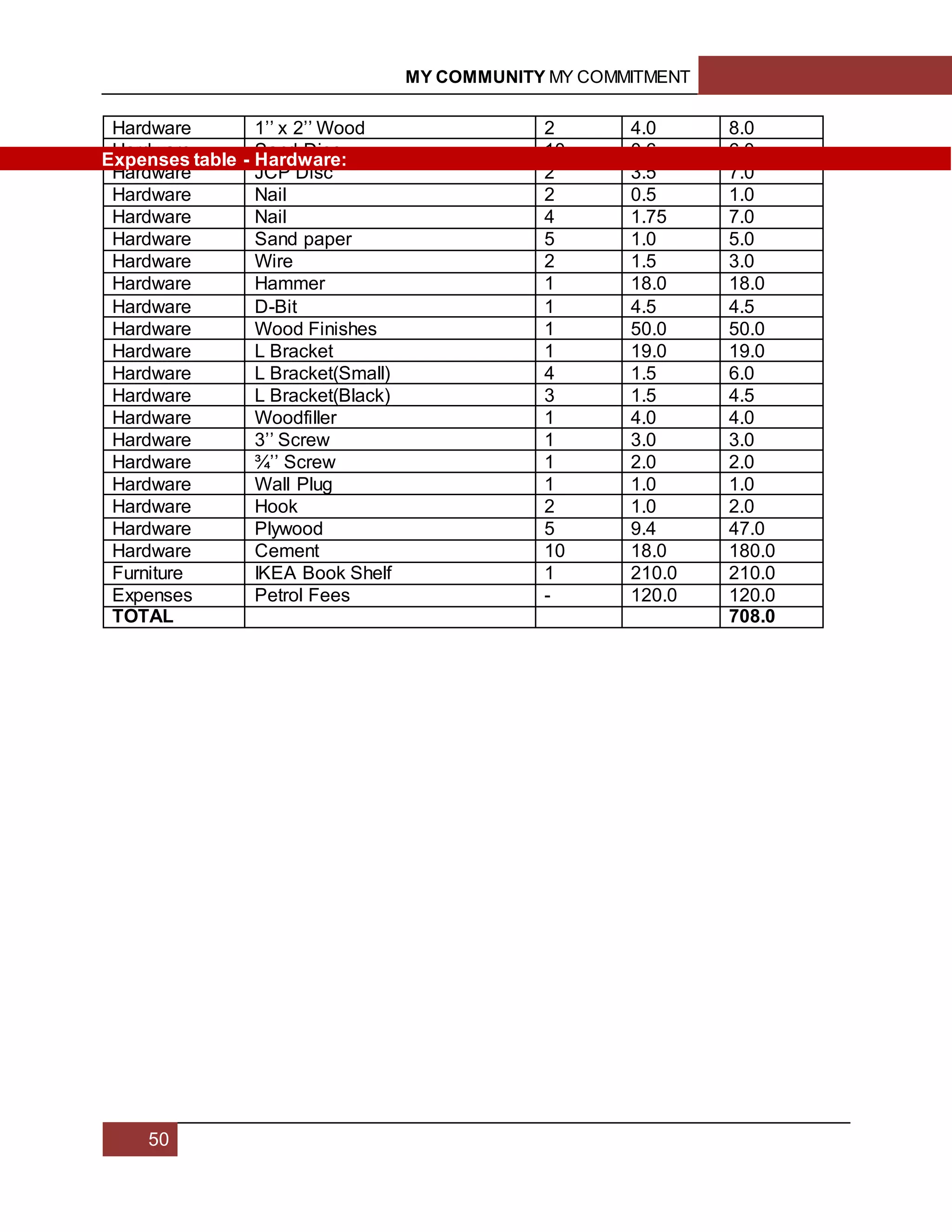
Hardware 1’’ x 2’’ Wood 2 4.0 8.0
Hardware Sand Disc 10 0.6 6.0
Hardware JCP Disc 2 3.5 7.0
Hardware Nail 2 0.5 1.0
Hardware Nail 4 1.75 7.0
Hardware Sand paper 5 1.0 5.0
Hardware Wire 2 1.5 3.0
Hardware Hammer 1 18.0 18.0
Hardware D-Bit 1 4.5 4.5
Hardware Wood Finishes 1 50.0 50.0
Hardware L Bracket 1 19.0 19.0
Hardware L Bracket(Small) 4 1.5 6.0
Hardware L Bracket(Black) 3 1.5 4.5
Hardware Woodfiller 1 4.0 4.0
Hardware 3’’ Screw 1 3.0 3.0
Hardware ¾’’ Screw 1 2.0 2.0
Hardware Wall Plug 1 1.0 1.0
Hardware Hook 2 1.0 2.0
Hardware Plywood 5 9.4 47.0
Hardware Cement 10 18.0 180.0
Furniture IKEA Book Shelf 1 210.0 210.0
Expenses Petrol Fees - 120.0 120.0
TOTAL 708.0
Expenses table - Hardware:
MY COMMUNITY MY COMMITMENT
51
Place Type Contribution
Free Mori Bakery House
Provide breads for charity
drive in cost price.

COMMUNITY CONTRIBUTION

MY COMMUNITY MY COMMITMENT
52
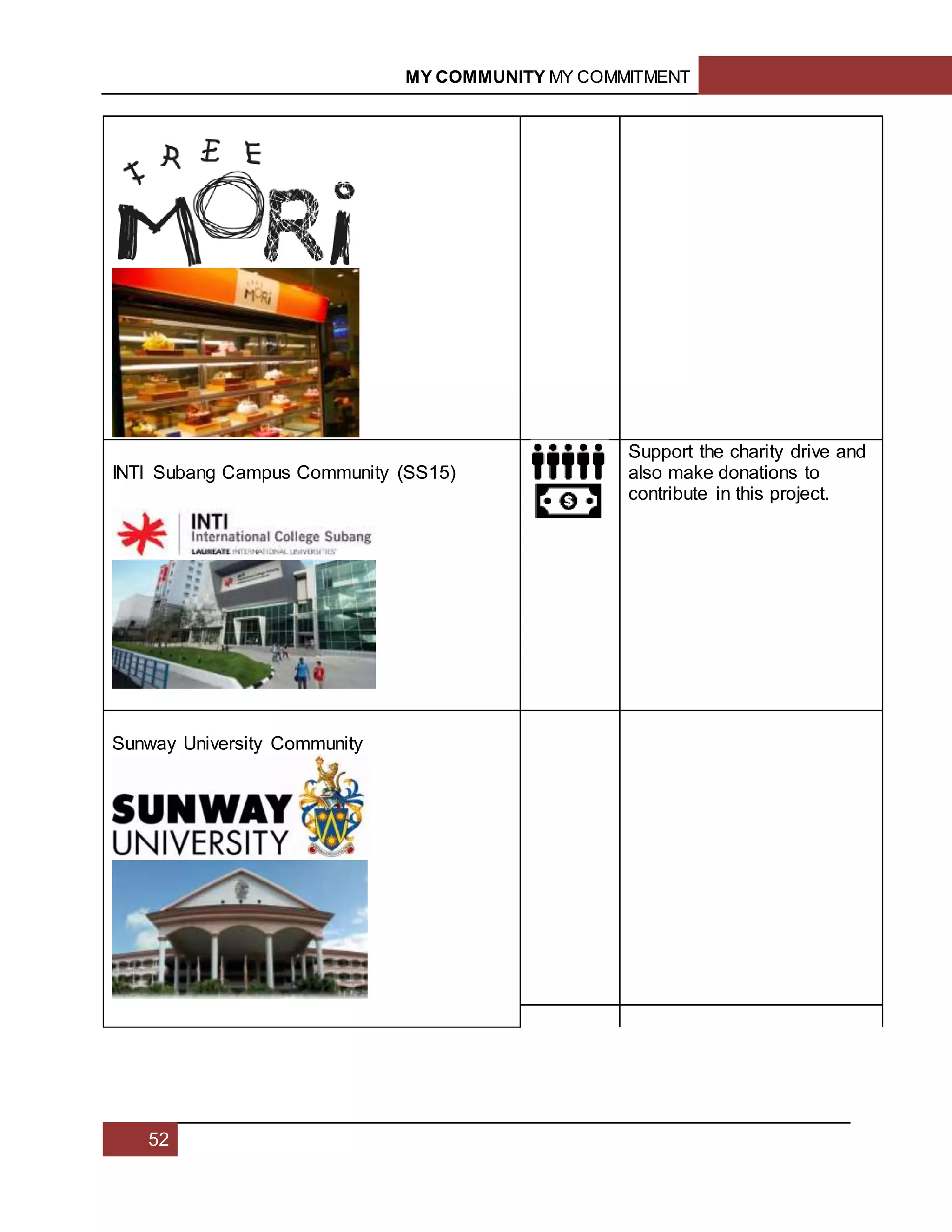
INTI Subang Campus Community (SS15)
Support the charity drive and
also make donations to
contribute in this project.
Sunway University Community
MY COMMUNITY MY COMMITMENT
53
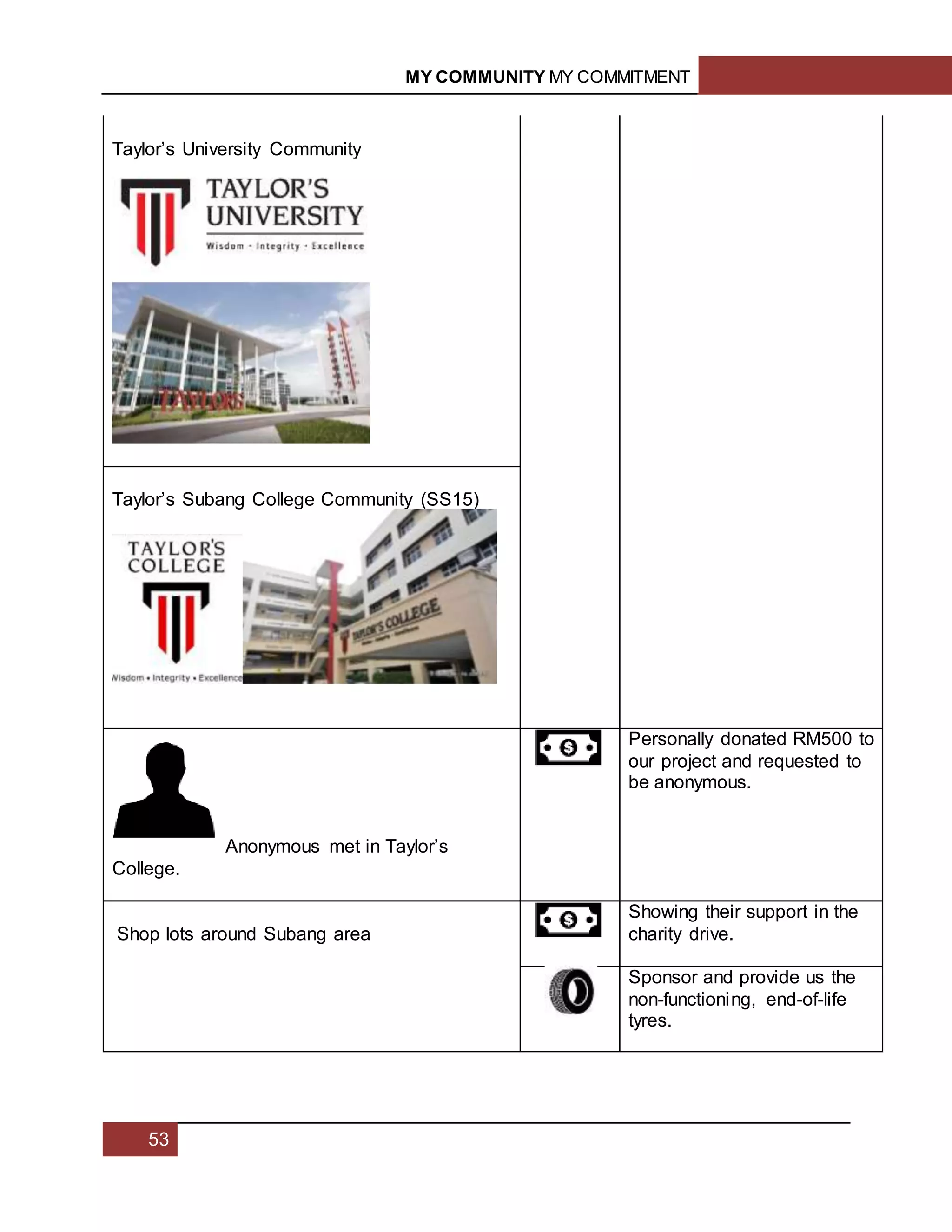
Taylor’s University Community
Taylor’s Subang College Community (SS15)
Anonymous met in Taylor’s
College.
Personally donated RM500 to
our project and requested to
be anonymous.
Shop lots around Subang area
Showing their support in the
charity drive.
Sponsor and provide us the
non-functioning, end-of-life
tyres.
MY COMMUNITY MY COMMITMENT
54
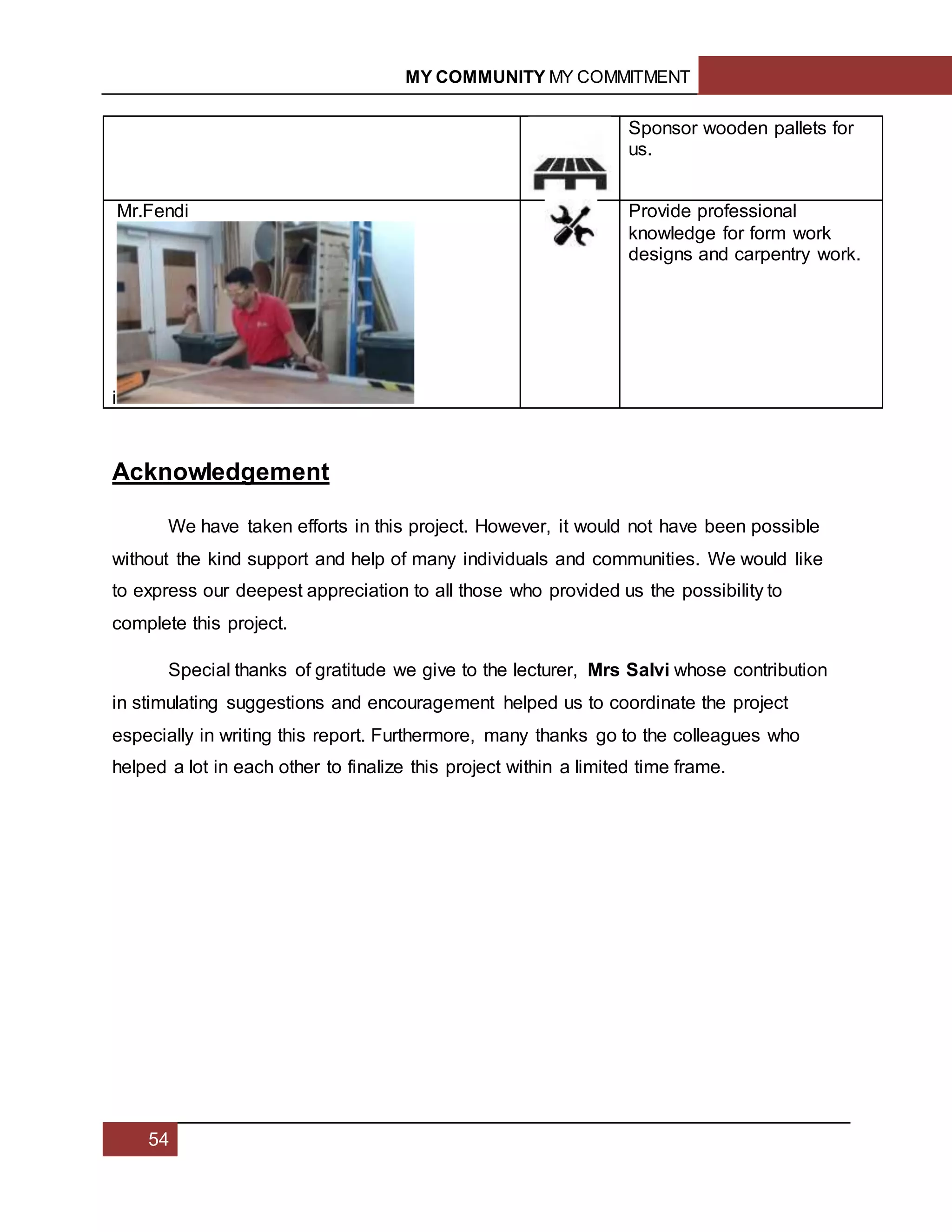
Sponsor wooden pallets for
us.
Mr.Fendi
i
Provide professional
knowledge for form work
designs and carpentry work.
Acknowledgement
We have taken efforts in this project. However, it would not have been possible
without the kind support and help of many individuals and communities. We would like
to express our deepest appreciation to all those who provided us the possibility to
complete this project.
Special thanks of gratitude we give to the lecturer, Mrs Salvi whose contribution
in stimulating suggestions and encouragement helped us to coordinate the project
especially in writing this report. Furthermore, many thanks go to the colleagues who
helped a lot in each other to finalize this project within a limited time frame.
MY COMMUNITY MY COMMITMENT
55

OUTCOME & RESULTS

MY COMMUNITY MY COMMITMENT
56
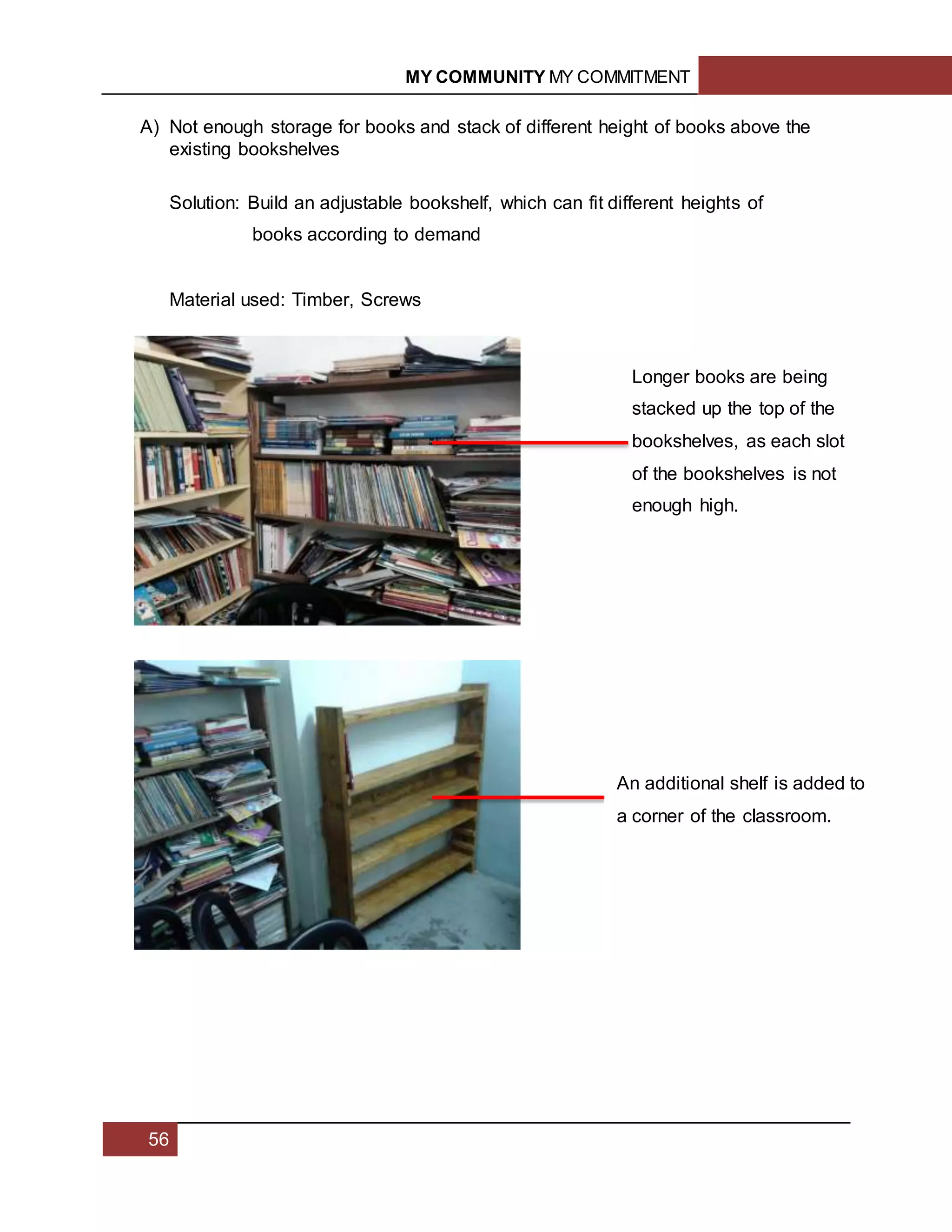
A) Not enough storage for books and stack of different height of books above the
existing bookshelves
Solution: Build an adjustable bookshelf, which can fit different heights of
books according to demand
Material used: Timber, Screws
Longer books are being
stacked up the top of the
bookshelves, as each slot
of the bookshelves is not
enough high.
An additional shelf is added to
a corner of the classroom.
MY COMMUNITY MY COMMITMENT
57
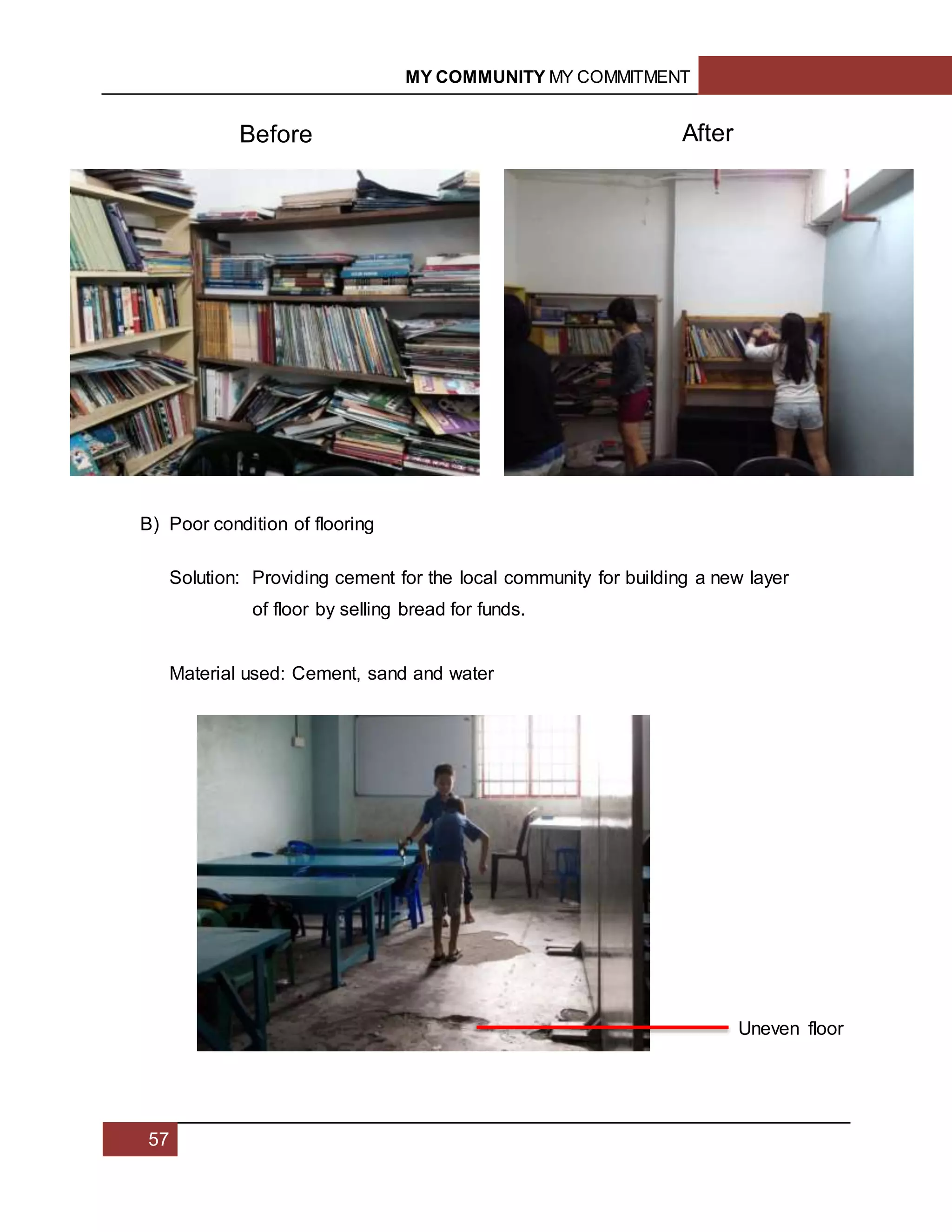
B) Poor condition of flooring
Solution: Providing cement for the local community for building a new layer
of floor by selling bread for funds.
Material used: Cement, sand and water
Uneven floor
Before After
MY COMMUNITY MY COMMITMENT
58
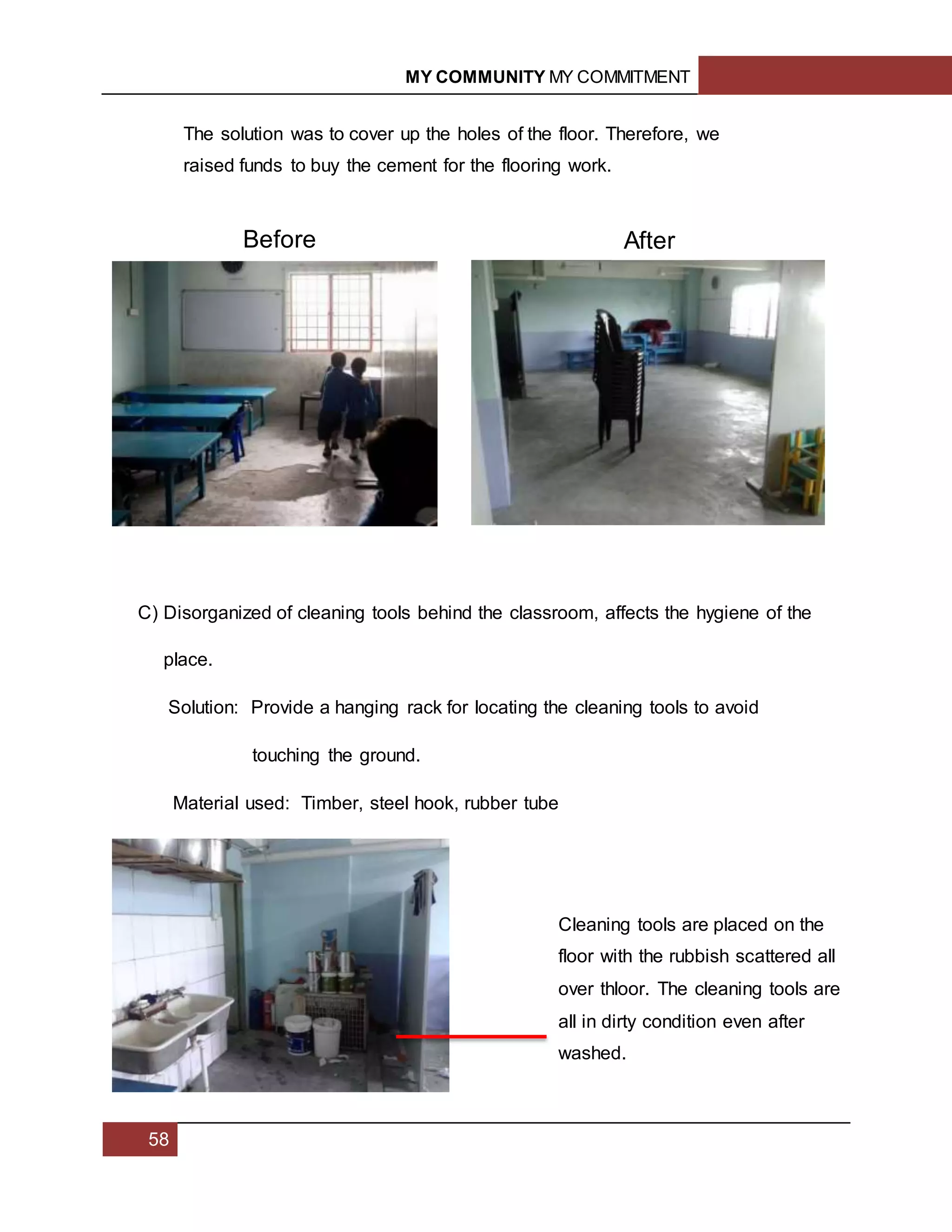
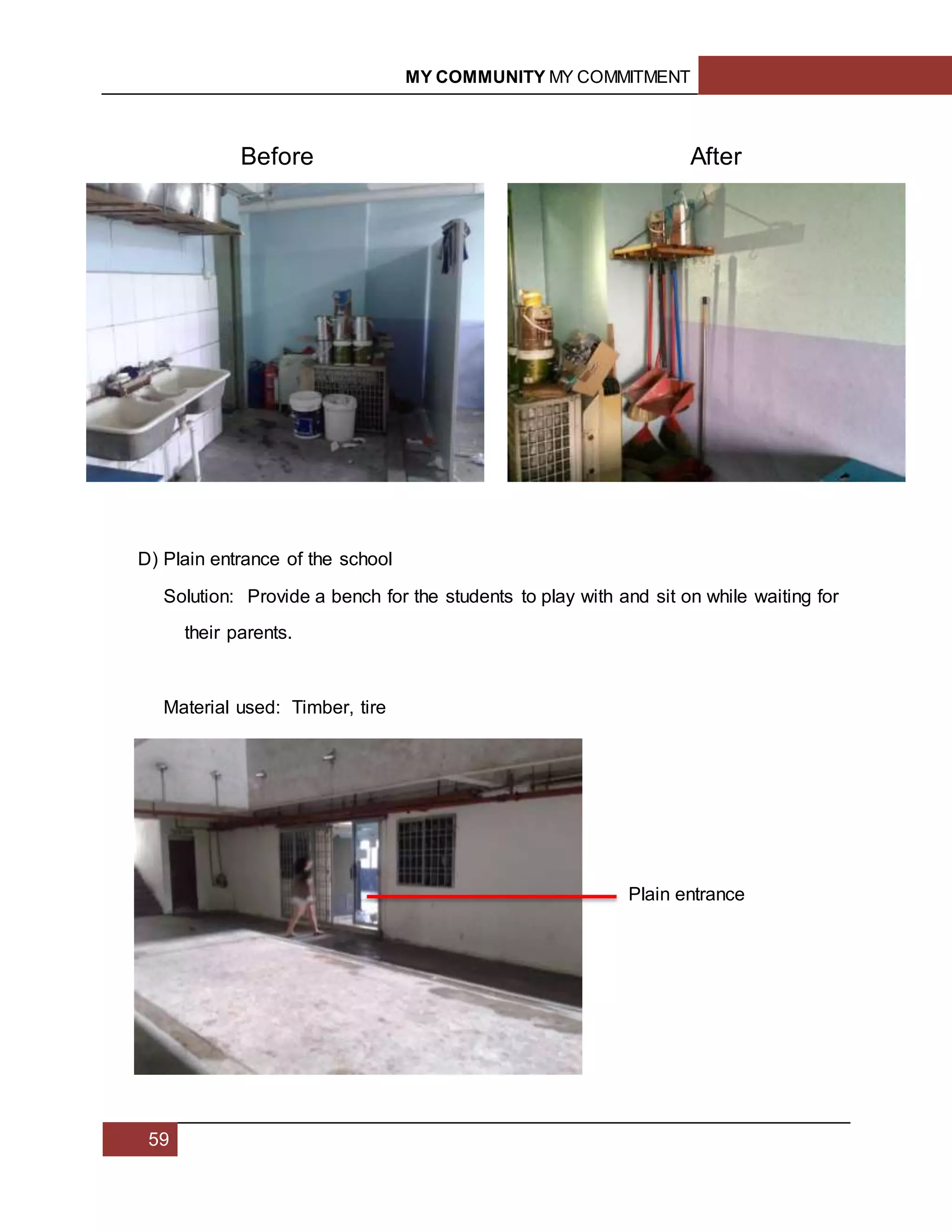
C) Disorganized of cleaning tools behind the classroom, affects the hygiene of the
place.
Solution: Provide a hanging rack for locating the cleaning tools to avoid
touching the ground.
Material used: Timber, steel hook, rubber tube
Cleaning tools are placed on the
floor with the rubbish scattered all
over thloor. The cleaning tools are
all in dirty condition even after
washed.
The solution was to cover up the holes of the floor. Therefore, we
raised funds to buy the cement for the flooring work.
Before After
MY COMMUNITY MY COMMITMENT
59
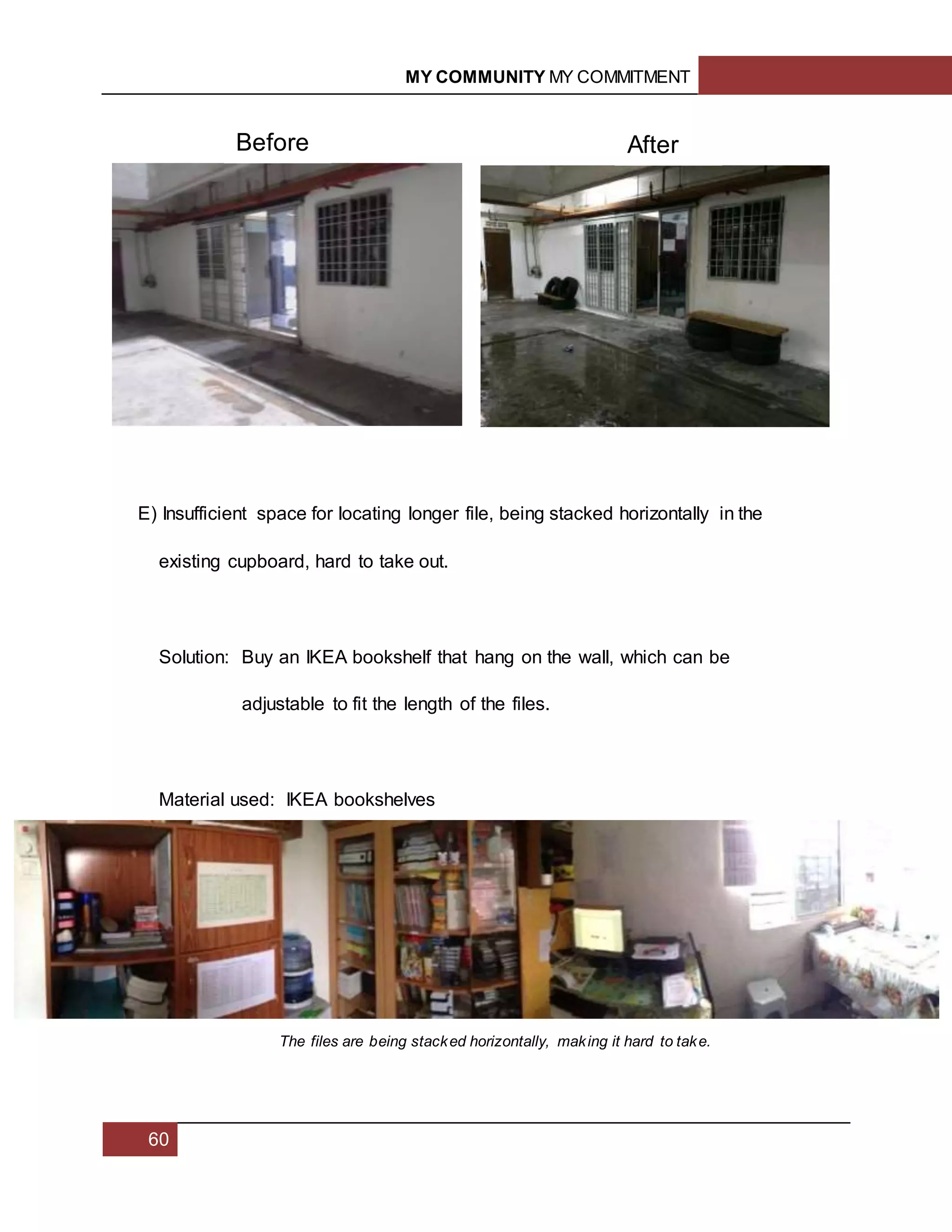
D) Plain entrance of the school
Solution: Provide a bench for the students to play with and sit on while waiting for
their parents.
Material used: Timber, tire
Before After
Plain entrance
MY COMMUNITY MY COMMITMENT
60
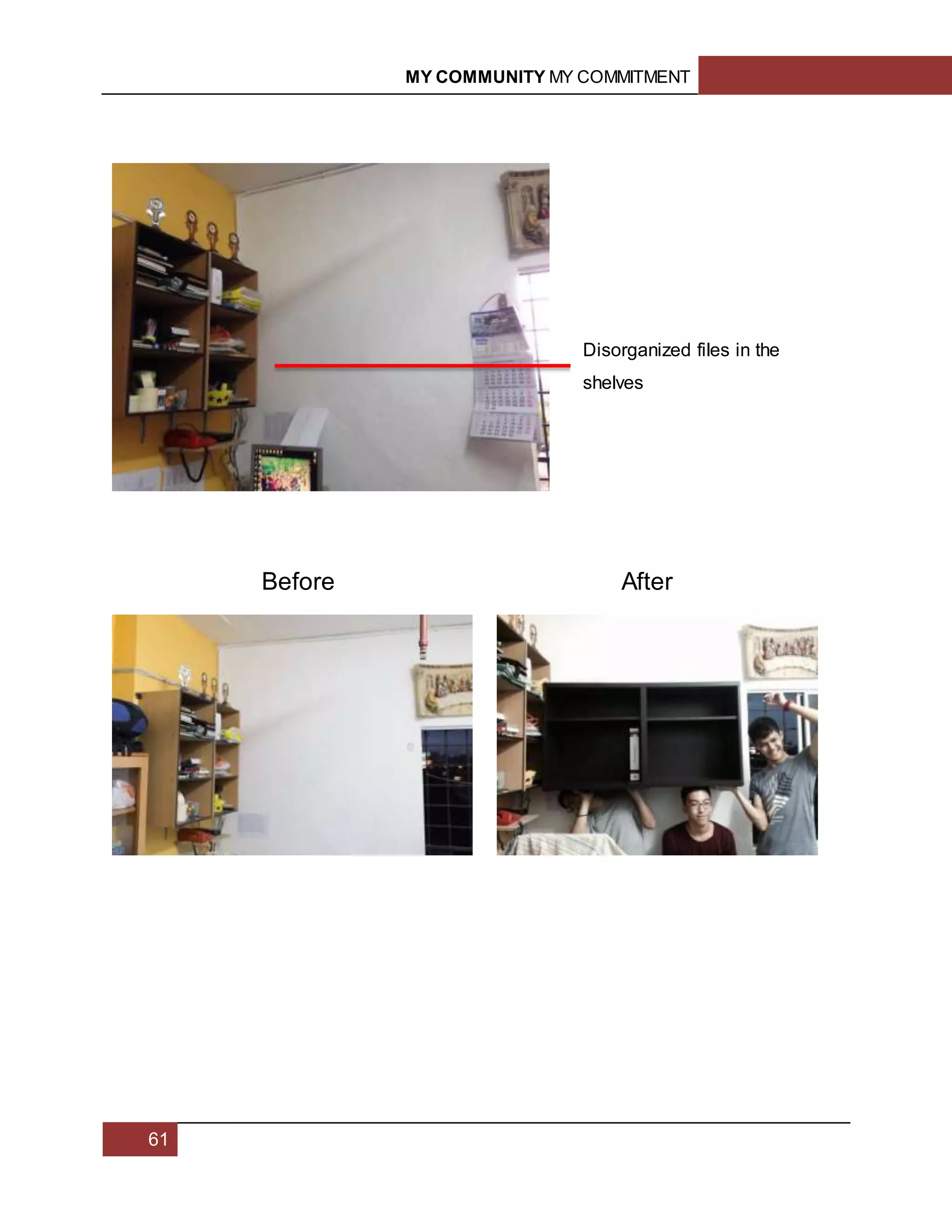
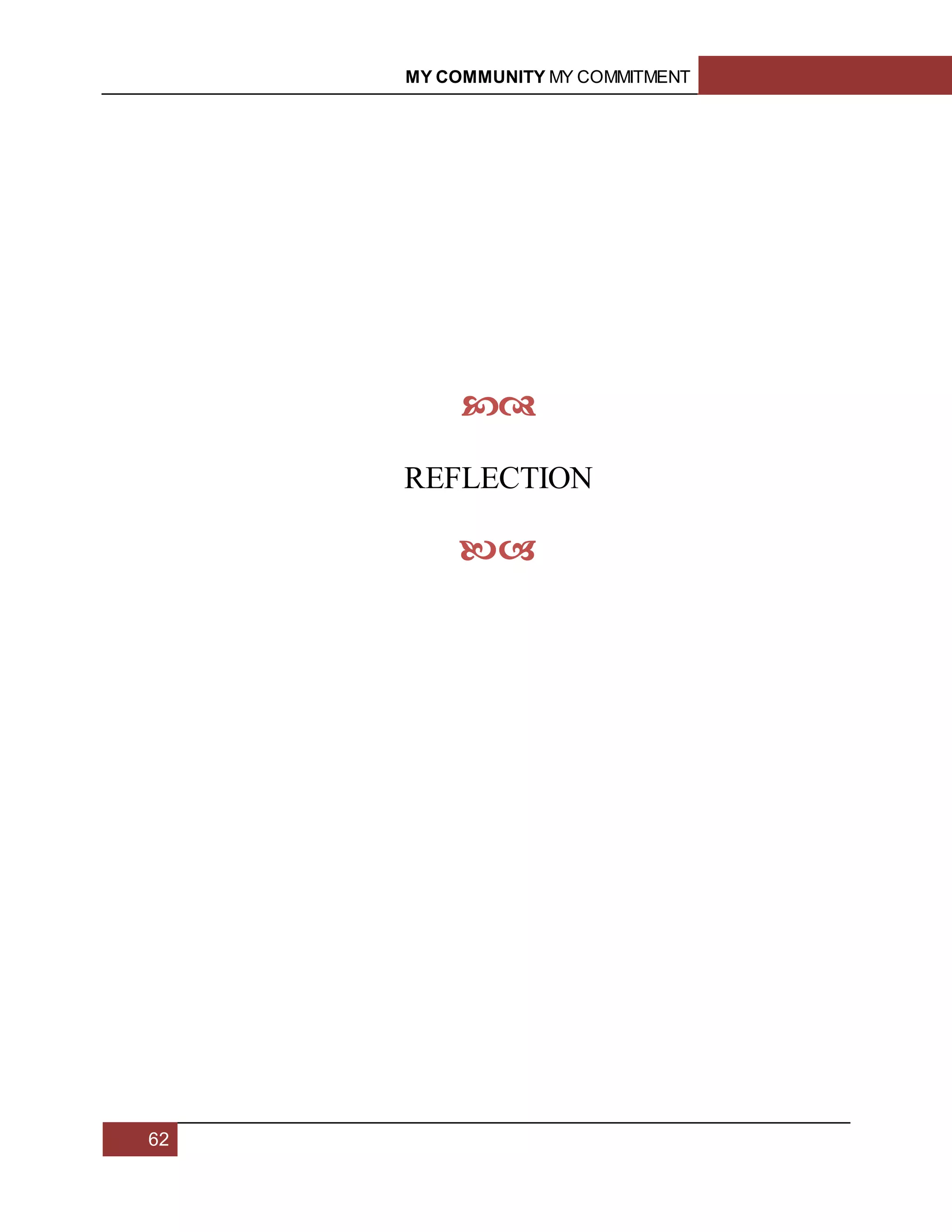
E) Insufficient space for locating longer file, being stacked horizontally in the
existing cupboard, hard to take out.
Solution: Buy an IKEA bookshelf that hang on the wall, which can be
adjustable to fit the length of the files.
Material used: IKEA bookshelves
The files are being stacked horizontally, making it hard to take.
Before After
MY COMMUNITY MY COMMITMENT
61
Before After
Disorganized files in the
shelves
MY COMMUNITY MY COMMITMENT
62

REFLECTION

MY COMMUNITY MY COMMITMENT
63
We have had the opportunity to do this community service helping the refugees
for the last several weeks. We had never really done this kind of service before, so we
knew that this was our opportunity to do some community service to help others. We
have found through the experience that we really like to do this project, because in the
near future we will probably volunteer on our own, rather than doing it for a class.
Doing service projects is a great way to get involved with the community. There are
always people and businesses looking for help, and it is usually easy to find a way to
help. When we had to do volunteer services for the refugees, we were excited because
we had never really volunteered for a long period of time. It was very interesting,
because it actually made us feel like a better person for helping someone in the
community.
Moreover, we learnt new problem solving skill where we apply in the refugee school
in order to improve their learning environment. Those children are so kind and talented.
They deserve a better place to study. We, a group of passionate architecture students
have found the right time to pay back to the community. We apply our knowledge in
analysis and then design workable furniture to improve their quality of life. I learnt that it
is important to observe surrounding before come out with a design. The design will be
more relevant to the site if you know exactly what the site’s condition is and also what
the user's needs.
Furthermore, we have learnt that this is a project that brings the aim to further
develop students’ community and team-working skills. These skills are crucial in
developing the students’ good professional design practice in the future. As an active
member of the community, students are inspirited to deepen their construal towards
their environment and realize their responsibility towards it. By identifying community
cognate issues around them, students are required to come up with solutions utilizing
the most of their ingeniousness which may be of tremendous avail in solving authentic-
world challenges in the future.
Overall, we feel that doing this project only better ourselves, and it helps others. It is a
great way to support a community as well as meet new people, and to help out others.
MY COMMUNITY MY COMMITMENT
64
We feel that everyone should do more community services, and for something that they
are passionate about. We were glad we got the chance to do this project, because we
feel better about ourselves knowing that we helped others, and we look forward to many
more opportunities like this.
MY COMMUNITY MY COMMITMENT
65

REFERENCES

MY COMMUNITY MY COMMITMENT
66
For Life Analysis Diagrams of the materials:
1. L., B. (2013, February 20). Independent Assessment Demonstrates Environmental
Advantages of CHEP's European Pallet Pooling Solution. Retrieved March 26, 2013,
from http://www.chep.com/resources/media_releases/20130219-
environmental_advantages_of_pallet_pooling/
2. Galvanisers, S. (n.d.). Life cycle assesment. Retrieved November 10, 2012.
3. Goldschmidt, A.; Streitberger, H.J. BASF Handbook on Basics of Coating
Technology. 2nd ed. Vincentz Network, Hanover, Delaware (2007).
4. M. Agocs, R. Etzel, G. Parrish, D. Paschal, P. Campagna, D. Cohen, E. Kilbourne,
and J. Hesse, "Mercury Exposure from Interior Latex Paint", Massachusetts Medical
Society, The New England Journal of Medicine, vol. 323, pp. 1096-1101, 1990.
5. Walpole, D., "Recycling paint and solvents and reducing use of 1,1,1-
trichloroethane", Waste Management, vol. 13, no.2, pp195-197, 1993
6. SC, G. (2012, March 11). Life Cycle of Tires Analysis. Retrieved March 4, 2014,
from life-cycle-tires-analysis.page
Others:
7. https://www.facebook.com/refugefortherefugees
8. http://www.masterpeace.org/blogs/post/refuge_for_the_refugees_the_girl_who_belie
ved_she_could_make_a_difference
9. http://refugefortherefugees.blogspot.com/2012/06/refuge-for-refugees.html

Macibai joyee (2) (1) (2)

  • 1.
    MY COMMUNITY MYCOMMITMENT 1 ENVIRONMENTAL SUSTAINABLE DESIGN [ARC 1413] MY COMMUNITY MY COMMITMENT PROJECT REPORT GROUP MEMBERS NAME STUDENT ID PRESTON LIEW RU PING (L) 0313822 LEE JO YEE 0314880 CHUNG WEI JIN 0313789 LING HUI SIM 0313855 YUAN KAI SHIEN 0314818 WOO WEN JIAN 0315123 CHAN PIN QI 0314676 BENNY TAN SHIOWEE 0315447 SHIRLEY LIEW QIAO LI 0315671 NICOLAS WONG XIAO EN 0314377
  • 2.
    MY COMMUNITY MYCOMMITMENT 2 TABLE OF CONTENTS NO. CONTENTS PAGES STAGE I: PREPARATION & PROPOSAL 1.1 INTRODUCTION -PROJECT CONTACTS -PROJECT OBJECTIVES 1.2 ISSUES IDENTIFICATION 1.3 SOLUTIONS 1.4 PREPARATION & PROCEDURES - MATERIALS LIFE CYCLE ANALYSIS DIGRAMS - WORK DISTRIBUTION - GANT CHART 1.5 FINAL PROPOSAL STAGE II: WORK EXECUTION 2.1 WORK PROGRESS - BREAD SELLING - BOOKSHELVES, BENCHES AND BROOMS HOOKER MAKING - FLOOR FURNISHING 2.2 BUDGET & EXPENSES 2.3 COMMUNITY CONTRIBUTIONS STAGE III: FINISHING AND FINALIZATION 3.1 OUTCOMES & RESULTS 37-48 3.2 REFLECTION 46-47 3.3 REFERENCES 48-49 3.4 ATTACHMENT 50-74
  • 3.
    MY COMMUNITY MYCOMMITMENT 3  INTRODUCTION  1.1 INTRODUCTION
  • 4.
    MY COMMUNITY MYCOMMITMENT 4 i “MY COMMUNITY MY COMMITMENT” Project Proposal Environmental community service is a type of service in which the public reach out towards environmental-community-based organizations such as social-service organizations, non-profit organizations and faith-based organizations. It is one of the many ways for people to contribute back to the society while taking into concern, the environmental issues as well. Paying It Forward is a project that brings the aim to further develop students’ community and team-working skills. These skills are crucial in developing the students’ good professional design practice in the future. As an active member of the community, students are encouraged to deepen their understanding towards their environment and realize their responsibility towards it. By identifying community related issues around them, students are required to come up with solutions using the most of their creativity which may be of tremendous help in solving real-world challenges in the future. PROJECT CONTACTS 1. Organization name: Refuge For The Refugees (RFTR)
  • 5.
    MY COMMUNITY MYCOMMITMENT 5 2. Contact person:  Andrea Prisha (Co Founder & Secretary of RFTR) +6 012 254 7853  Heidy Quah Gaik Li (Founder & Director of RFTR) +6 012 307 3714 3. Address: Chin Children's Education Centre (CCEC), Sungai Besi 4. Website: https://fb.com/refugefortherefugees 5. Email: refugefortherefugees@gmail.com 6. Case study for the background: This education center is mainly a refuge for Myanmar children whose parents are currently working in Malaysia. There are a total of 75 students and 5 teachers who come from Chin, Myanmar. There are 6 classes carried out in this education center ranging from kindergarten to primary 5. Occasionally, a volunteer would come over to teach the students as there is one teacher short. Posing in front of the camera, the little boy from the school shows no fear to strangers.
  • 6.
    MY COMMUNITY MYCOMMITMENT 6 The education center is located in a low cost flat with poor conditions. Attention and awareness has to be raised from the authority to really look into their environmental issues. 7. Reference: Business card and Brochure
  • 7.
    MY COMMUNITY MYCOMMITMENT 7 Persons-In-Charge for the Refugees School - Miss Andrea and Miss Heidy.
  • 8.
    MY COMMUNITY MYCOMMITMENT 8 PROJECT OBJECTIVES I. To increase student’s awareness of current environmental issues locally. II. To encourage creativity in attempting to solve the current environmental and community circumstances. III. To allow students to explore and discover the opportunity to work with the community and for the community. IV. To create awareness of the significance of creating environmentally sustainable product to the public. V. To be able to understand and explain the principles of sustainability from environmental and also social perspectives. Working together as a team is the key to achieve success in any project.
  • 9.
    MY COMMUNITY MYCOMMITMENT 9 Reasons for choosing this particular community project : The refugees are victims forced to leave their own country due to some unforeseen reasons and stay in a foreign country for an unknown period of time. Most of them do not have citizenships and even rights to study. We believe that every human has equal rights and there is no reason that we should treat someone badly because there are not Malaysians. Hence, as a bunch of young architectural students, our aim is to make positive CHANGES to their environment by applying what we have learnt. We wish to make them feel like they are home, a better place to live and study even in foreign country. Store room that kept all the textbooks and teaching materials.  ISSUES IDENTIFICATION  1.2
  • 10.
    MY COMMUNITY MYCOMMITMENT 10 In this chapter, we are going to show the environmental and community issues faced by our case study and our site visits to the center. We had our very first site visit of our case study on 22th September 2014. The aim of the visit was to find out the environment or community issues faced by the case study meanwhile engage to the community. Photos from top left to right clockwise: 1. Our first site visit to the site. 2. The shop houses building block outside the apartment. 3. The way to go into the apartment. 4. The way from the apartment to the entrance of the school.
  • 11.
    MY COMMUNITY MYCOMMITMENT 11 CCEC (Chin Children's Education Centre) situated in Sungai Besi is a school of Refugees. Their school is located underneath an apartment that most of the foreign workers. Therefore, there is limited and compact space within that area. Upon reaching the apartment, we started to record our observation. The hygienic quality was pretty bad and the unpleasant smell of rubbish filled up the atmosphere. Unpleasant smell from the rubbish bins situated at the ground floor of the apartment. The entrance of the school.
  • 12.
    MY COMMUNITY MYCOMMITMENT 12 We carefully made our way to the school, which is situated at the ground floor inside the apartment. Despite of the dark and uncomfortable surroundings, we were immediately welcomed by a bunch of cute little kids at the entrance of the school. Narrow,dim hallway before the entrance of the center. The entrance of the center/ school. The inner view of the center facing the entrance.
  • 13.
    MY COMMUNITY MYCOMMITMENT 13 After a few rounds of observations and discussion with the principal of the school Mr.Joseph, we have noticed some key environment issues and condition of the school. I. The bookshelves in the reading zone were insufficient to store all the books and the reading materials were arranged loosely due to their different sizes. There were few more boxes of stationaries were on the ground. Beside, files that kept records of the children information are normally bigger than the dimension of the bookshelves. Hence, the
  • 14.
    MY COMMUNITY MYCOMMITMENT 14 files in the principal room were randomly arranged without a special cabinet. II. Flooring. The cement casted flooring of the school was uneven and has several holes that will cause the students to trip and fall easily. The problem also make hard for the students to move the partitions when they change classes. III. Kitchen Area. The kitchen shelves for the storage of plates, cups, cooking utensils and etc were in a broken and poor condition.
  • 15.
    MY COMMUNITY MYCOMMITMENT 15 Brooms and cleaning materials were placed randomly on the floor without a proper cabinet. IV. The entrance of the school is empty and lack of furniture although there is a big open space. Children found a lack of benches to sit while waiting for their parents or to rest.
  • 16.
    MY COMMUNITY MYCOMMITMENT 16 V. There was a panel of windows that were broken down and left behind only the steel bars. Rain poured in through the opening and disrupted the class. The children have to move their classrooms to another location or postpone the lesson. VI. Partition. Each classroom was separated using a thin layer of plywood board
  • 17.
    MY COMMUNITY MYCOMMITMENT 17 or a thin piece of cloth. Thus, there was no sound insulation between each classrooms. VII. Toilet bowl. They have insufficient toilet bowls to suit the students’ needs. VIII. Mural painting. Beautify and enhance their surrounding with drawings and plants. 1.3
  • 18.
    MY COMMUNITY MYCOMMITMENT 18  SOLUTIONS 
  • 19.
    MY COMMUNITY MYCOMMITMENT 19 No. ISUUES SUGGESTED SOLUTIONS ACTIONS 1. Bookshelves 1. Build a new adjustable bookshelf in the library by using recycling wooden pallets. 2. Provide new cabinets/bookshelves for the storage of books in the principal office. Agree by the school and Proceed. 2. Kitchen Area 1. Make a new kitchen shelves to store the utensils. 2. Strengthen the original kitchen shelves. 3. Prepare a hanging porch to hang the brooms and mops by using simple wood construction. Agree by the school and Proceed. 3. Flooring 1. Refurnish the floor with new cements. 2. Repair and fix the holes to smoothen the surface. Agree by the school and Proceed. 4. Benches 1. Build some benches that are convenient for the children to change their shoes and to wait their parents. The benches can be made from simple wooden construction with the aids of abandon tires. Agree by the school and Proceed. 5. Windows 1. Raise fund and find professionals to install new windows. Agree by the school but will proceed out of the timeline of the project. 6. Partitions 1. Amend the partitions by sandwiching it with layers of cotton that will insulate sounds. 2. Renovate the rooms with adjustable partitions coming out from the wall. Renovations for the partitions is beyond our capabilities in term of monetary and profession. 7. Toilet Bowls 1. Buy small plastics toilet bowl (for kids). 2. Renovate to have more children customized toilet bowls. Not sustainable and practical as it’s unhygienic to use plastic toilet bowls. Renovation for the
  • 20.
    MY COMMUNITY MYCOMMITMENT 20 toilet is beyond our capabilities in term of monetary and profession. 8. Mural Painting 1. Interactive and interesting paintings on the wall for the children Too distracting for classes. In conclusion, we have decided to contribute our parts by improvising and amending the chosen aspects below: 1. We will prepare two bookshelves for the center: one to be placed in the library with its adjustable abilities and another one in the principal office to store the files. 2. We will install a brooms and mops hooker to be placed at the corner of the kitchen area. 3. We will hand make two benches in front of the entrance 4. We will raise fund and prepare the cement which is needed for the floor furnishing of the center. Please refer to Page 33 “Work Progress” for further details.
  • 21.
    MY COMMUNITY MYCOMMITMENT 21  PREPARATION & PROCEDURES 
  • 22.
    MY COMMUNITY MYCOMMITMENT 22 MATERIALS LIFE CYCLE ANALYSIS DIGRAMS 1. Light Truck Tires A tyre is a ring-shaped vehicle component that covers the wheel’s rim on vehicles or other type of transportation (bicycle) to form a soft contact with the road. The component normally made from rubber, typically inflated or surrounding an inflated inner tube. Figure 1 : Results of the product Life Cycle Assessment for passenger and light truck tires Figure 1 shows the highest contribution to all environmental impact categories derives from the use phase of the tire (approx. 90%). The reason is the rolling resistance of the tire, which needs to be overcome when the car is in motion. This consumes energy. 0 10 20 30 40 50 60 70 80 90 100 Acquisition of Raw Materials Transport Tire Production Tire Use Cumulative Energy Demand Global Warming Potential Acodification Potential Nutrification Potential Summer Smog RelativeContributions(%)
  • 23.
    MY COMMUNITY MYCOMMITMENT 23 The acquisition of raw materials accounts for approximately 5% of the environmental impact. Impact attributable to the manufacturing process is even lower. Transportation between the different life cycle phases amounts to no more than 2% of total environmental impact during the product’s life cycle. 2. Paint Figure 1.1 LCA of TIRES LIFE CYCLE ASSESSMENT OF TIRES
  • 24.
    MY COMMUNITY MYCOMMITMENT 24 Paint is a colored substance which is spread over a surface and dries to leave a thin decorative or protective coating. The ingredients of paint normally consist of additives, binder, pigment, filler and water. The ratio of amount is based on the quality of the product. Figure 2 shows environmental impacts of packaging, distribution and disposal from the paint recycling process were excluded on the premise that new virgin paint production would require the same number and type of packaging. It was also reasoned that environmental impacts of distribution would be the same for the new virgin paints as well as for the recycled paint. This is because the company has the same client base. Old paint Transport Sorting & Inspecting Filtration High Speed Mixing Storage Tank Mixing Packaging Figure 2: Lifecycle Environmental Sustainability Assessment of Paint Recycling Process Distribution to retailers Unrecyclable’ disposal in landfill Metal and Plastic Containers’ Recycling
  • 25.
    MY COMMUNITY MYCOMMITMENT 25 So, the impact would be the same if the company is to manufacture and/or distribute the same amount of new virgin paints that they are recycling. Furthermore, it was assumed that no other ingredient is added to the old paint materials in producing the recycled paint. Figure 2.2 above presents the main operations in the solvent-based household paints production lines, the input to the units and the pollution sources. Work place pollution parameters are VOCS, particulates, and noise. Spills or leaks could occur through the whole process, and may contaminate the water if discharged to the sewer. Chemicals Figure 2.1: Flowchart Water-based Paints Production Line
  • 26.
    MY COMMUNITY MYCOMMITMENT 26 empty containers are generated, and considered hazardous. Those hazardous solid wastes should be safely disposed into a landfill. 3. Wooden Pallets Paint Manufacture Warehouse and Distributions Paint Retailers Consumers Figure 2.2 : L.C.A. of PAINT LIFE CYCLE ASSESSMENT OF PAINTS
  • 27.
    MY COMMUNITY MYCOMMITMENT 27 Fossil fuels, biofuels and electric power are the non-renewable energy sources to provide energy in producing wood pallets. The energy use of each life cycle process in relation to functional unit is shown in Figure 2. 60 to 90% reduction of carbon emissions. 0 20 40 60 80 100 120 140 160 Electric Energy *(MJ) Fossil Energy (MJ) Renewable Energy (MJ) Figure 3 Total use of energy in each life cycle process
  • 28.
    MY COMMUNITY MYCOMMITMENT 28 WORK DISTRIBUTION Production of pallets • Embodied • energ: 5.8 GJ • Carbon dioxide emission:6.04g Heating oil and Natural gas • emission:100.1 g CO2 and 62.8 g CO2/MJ Fossil fuel heating Wood pallets stove or furnace LIFE CYCLE ASSESSMENT OF WOOD PELLETS Figure 3.1 L.C.A. of the Wooden Pallets Switching
  • 29.
    MY COMMUNITY MYCOMMITMENT 29 No. Students Site Work Post Work Notes 1. Preston Liew Ru Ping - Record the project - Furnishing the woods Multimedia presentation – Video Provide transportation 2. Nicolas Wong - Floor Furnishing Prepare project timeline Provide transportation 3. Benny Tan Shiowee - Install Bookshelves - Install Benches A3 Poster 4. Yuan Khai Shien - Install Bookshelves - Install Kitchen hooker Designing the Bookshelves Provide transportation 5. Woo Wen Jian - Install Kitchen hooker - Install Benches Design the kitchen hooker and benches. Provide transportation 6. Chan Pin Qi -Bread Selling -Sponsorship Finding Documentation – A4 Report 7. Ling Hui Sim - Documentation – A4 Report Prepare the L.C.A. diagrams 8. Shirley Liew Qiao Li - Bread Selling - install benches Manage accounting and A3 Poster 9. Megan Chung Wei Jin -Bread selling -Took photos and Documentation – A4 Report 10. Lee Jo Yee -Bread selling -Install Bookshelves Documentation - A4 Report Provide transportation GANT CHART The timeline of this project from planning to completion is showed below:
  • 30.
    MY COMMUNITY MYCOMMITMENT 30 It will be a single event that takes place approximately a total of two months to complete. Works were progressively updated each week. 1. Bread Selling  WORK PROGRESS 
  • 31.
    MY COMMUNITY MYCOMMITMENT 31 With the purpose of raising funds and also getting the public’s attention towards the refugee, we decided to search for bakeries which are willing to provide us with breads and pastries to be sold out to the public. We approached Free Mori Bakery and they were willing to cooperate with us to give a helping hand to the children of the refugee center They provided us with a variety of pastries for example The Bun Family which consists of  Raisin Buns and Chocolate-filled Buns  Butter-glazed Buns  Marble Milk Buns  Polo buns  Mille Danish and  even small packets of Chocolate Chip Cookies. After obtaining and packing the stocks on a Tuesday morning, we divided ourselves into small groups and went to different places to sell the pastries. The places that we went to were Taylor’s College, Inti College, area around SS15, Sunway University and of course, our very own Taylor’s University Lakeside Campus. While selling the breads, we also asked for donations from the public while showing them information flyers about this education center. This fund-raising sale went on for two days and we collected a total amount of RM1320.75. Please refer to pagexx for the financial report.
  • 32.
    MY COMMUNITY MYCOMMITMENT 32 All members packing the pastries, ready for the sale S We sold the bread along the street and shop houses to raise fund for our project.
  • 33.
    MY COMMUNITY MYCOMMITMENT 33 2. Bookshelves, benches and brooms holder making. I. DESIGNING PHASE We started planning and designing the bookshelves first as it was our main priority for the children. The books are not organized and are kept in the shabby bookshelves in a messy orientation as the sizes of the shelves are not big enough to fit all of the books. Initially we decided to design the bookshelves in the shape of a cruciform to accommodate different sizes of books and also light up the place aesthetically. After visiting the education center a few more times we realize that the initial idea is not practical as the books are too many and the cruciform bookshelves do not provide enough space for them. We came up with the second idea which is to use wooden planks and build an extra wooden shelve on a wall in the classroom. Initial draft of the design of the bookshelves
  • 34.
    MY COMMUNITY MYCOMMITMENT 34 Other than the bookshelves, we also designed some benches for the children to sit on outside of the education center. We used wooden planks as the material to make the bench and also rubber tyres to elevate the bench from the ground. Front elevation of the shelf Side elevation of the shelf Draft of the design of the benches
  • 35.
    MY COMMUNITY MYCOMMITMENT 35 Final design of the benches
  • 36.
    MY COMMUNITY MYCOMMITMENT 36 The last furniture that we designed was the broom holders. We came up with the idea of using wooden planks as the base to drill the hooks to hold the brooms and dustpans. To secure it to the wall, rubber tubes were used to tie the wooden plank to the hook on the wall. Latches were also installed to further secure the broom holder. The draft for the design of the broom holders. Final design of the broom holder
  • 37.
    MY COMMUNITY MYCOMMITMENT 37 II. PREPARING PHASE – MATERIAL SEARCHING In order to build the bookshelves, benches and broom holder, we needed wooden pallets as our main building material. Luck was in our hands when we successfully obtained the sponsorship for these wooden pallets from a recycling center in Bukit Beruntung. Members moving the wooden pallets from the lorry into their cars. Members visiting the recycling center to get the wooden planks. Shown above are the wooden planks that the recycling center provided.
  • 38.
    MY COMMUNITY MYCOMMITMENT 38 We went to the wooden pallets factory which is situated at Kuala Kubu Baru, Selangor to get the sponsored materials for our bookshelves. A week after obtaining the wooden planks, we started planning and building the bookshelves and the benches. We booked the campus’s workshop which has all the facilities that we needed to make the furniture. Mr.XXX contributed a lot by assisting us with the carpentry work and also by teaching us how to use the various machines in the workshop. It took us 3 days to finish all of the carpentry work which included sawing, sanding and also shellac works. Members getting to work in the workshop
  • 39.
    MY COMMUNITY MYCOMMITMENT 39 - III. TRANSPORTING PHASE After completing the carpentry work, we booked a day with the principle of the education center to go set up the furnitures. Early in the morning on that day, 4 of our members, Preston Liew, Lee Jo Yee, Woo Wen Jian and Yuan Kai Shien drove their cars to help with the transportation of our materials to the education centre. First, we set off to Nicolas Wong’s house to collect the tyres for the benches which are temporarily kept there. Members were sanding the surface of the wood Tyres that were piled into a member’s car
  • 40.
    MY COMMUNITY MYCOMMITMENT 40 After loading the tyres into the car, we headed off to campus to collect the wooden planks to set up the bookshelves. Members were moving the wooden planks from the workshop into the cars.
  • 41.
    MY COMMUNITY MYCOMMITMENT 41 IV. INSTALLING PHASE After loading all the wood into the car, we set off to the education center to start our work. We started unloading the wood and tyres to the main entrance of the education center where an open space is located. We set up the bookshelves first by fitting the slots into the frame of the shelf and then fastening them with hammer and nails. After the bookshelf was set up, we moved it into the classroom and secured it to the wall. Group members setting up the bookshelf. Group members assemblying the bookshelf.
  • 42.
    MY COMMUNITY MYCOMMITMENT 42 Group members figuring out the best way to fix the shelves End product of the shelf
  • 43.
    MY COMMUNITY MYCOMMITMENT 43 The next furniture that we set up was the broom holder. Holes were drilled into the walls to install the hooks first before tying and securing the broom holder to the wall. The next furniture that we installed was the Ikea shelf which was to be placed in the principal’s room. Members securing the broom holder to the wall. Members filling holes in the wall with the putty filler. End product of the broom holders. It is elevated from the ground with multiple hooks to keep the brooms and dustpans organized.
  • 44.
    MY COMMUNITY MYCOMMITMENT 44 Members trying to fix the shelves with the help of the Ikea user guide. Members trying to fix the shelf onto the wall with the help of the principal himself.
  • 45.
    MY COMMUNITY MYCOMMITMENT 45 The last furniture that we installed was the benches. This requires more work as the tyres were hard to drill in. We successfully set up both benches by the entrance in the end. 3. Floor furnishing Members trying to drill the nails into the tyres to secure them together. First bench that was installed on the right side of the entrance. Second bench that was installed on the left side of the entrance.
  • 46.
    MY COMMUNITY MYCOMMITMENT 46 The floor of the education center is damaged with many holes in it which might cause the children to fall when they run around. In order to fix this problem, we have decided to buy cement to fill up the holes in the floor. We used the money raised from the selling of breads to buy the cement. Two of our members, Yuan Kai Shien and Benny Tan went to transport the stocks of cement from the factory to the education center to be applied onto the floor. Transferring the cement from the factory to the education center.
  • 47.
    MY COMMUNITY MYCOMMITMENT 47 However, the kind people from the education center volunteered to help with the cement work. After the cement work was completed, the floor is smoother and flatter, creating a safer environment for the children to study in.
  • 48.
    MY COMMUNITY MYCOMMITMENT 48  BUDGET & EXPENSES 
  • 49.
    MY COMMUNITY MYCOMMITMENT 49 Below is the account recording the amount of money that we have spent throughout the project. We have raised a total of RM1341.70 and spent an amount of RM708 throughout the project on materials, transportation and others. We have decided to donate the rest of the money, in amount of RM633.70 to the organization in trust them to put into good use. Type Description Amount (RM) Fundraising Bread Sales 667.3 Donation Cash 674.4 TOTAL 1341.7 RM RM Cost of goods sold: Bread Sales 1150.0 less Cost Price 482.7 667.3 add Revenue Donation 674.4 1341.7 less Expenses Hardware 151.0 Plywood 47.0 Cement 180.0 IKEA Book Shelf 210 Petrol Fees 120 708.0 633.7 Type Product/ Description Quantity Cost (RM) Total (RM) Grand account: Budget table:
  • 50.
    MY COMMUNITY MYCOMMITMENT 50 Hardware 1’’ x 2’’ Wood 2 4.0 8.0 Hardware Sand Disc 10 0.6 6.0 Hardware JCP Disc 2 3.5 7.0 Hardware Nail 2 0.5 1.0 Hardware Nail 4 1.75 7.0 Hardware Sand paper 5 1.0 5.0 Hardware Wire 2 1.5 3.0 Hardware Hammer 1 18.0 18.0 Hardware D-Bit 1 4.5 4.5 Hardware Wood Finishes 1 50.0 50.0 Hardware L Bracket 1 19.0 19.0 Hardware L Bracket(Small) 4 1.5 6.0 Hardware L Bracket(Black) 3 1.5 4.5 Hardware Woodfiller 1 4.0 4.0 Hardware 3’’ Screw 1 3.0 3.0 Hardware ¾’’ Screw 1 2.0 2.0 Hardware Wall Plug 1 1.0 1.0 Hardware Hook 2 1.0 2.0 Hardware Plywood 5 9.4 47.0 Hardware Cement 10 18.0 180.0 Furniture IKEA Book Shelf 1 210.0 210.0 Expenses Petrol Fees - 120.0 120.0 TOTAL 708.0 Expenses table - Hardware:
  • 51.
    MY COMMUNITY MYCOMMITMENT 51 Place Type Contribution Free Mori Bakery House Provide breads for charity drive in cost price.  COMMUNITY CONTRIBUTION 
  • 52.
    MY COMMUNITY MYCOMMITMENT 52 INTI Subang Campus Community (SS15) Support the charity drive and also make donations to contribute in this project. Sunway University Community
  • 53.
    MY COMMUNITY MYCOMMITMENT 53 Taylor’s University Community Taylor’s Subang College Community (SS15) Anonymous met in Taylor’s College. Personally donated RM500 to our project and requested to be anonymous. Shop lots around Subang area Showing their support in the charity drive. Sponsor and provide us the non-functioning, end-of-life tyres.
  • 54.
    MY COMMUNITY MYCOMMITMENT 54 Sponsor wooden pallets for us. Mr.Fendi i Provide professional knowledge for form work designs and carpentry work. Acknowledgement We have taken efforts in this project. However, it would not have been possible without the kind support and help of many individuals and communities. We would like to express our deepest appreciation to all those who provided us the possibility to complete this project. Special thanks of gratitude we give to the lecturer, Mrs Salvi whose contribution in stimulating suggestions and encouragement helped us to coordinate the project especially in writing this report. Furthermore, many thanks go to the colleagues who helped a lot in each other to finalize this project within a limited time frame.
  • 55.
    MY COMMUNITY MYCOMMITMENT 55  OUTCOME & RESULTS 
  • 56.
    MY COMMUNITY MYCOMMITMENT 56 A) Not enough storage for books and stack of different height of books above the existing bookshelves Solution: Build an adjustable bookshelf, which can fit different heights of books according to demand Material used: Timber, Screws Longer books are being stacked up the top of the bookshelves, as each slot of the bookshelves is not enough high. An additional shelf is added to a corner of the classroom.
  • 57.
    MY COMMUNITY MYCOMMITMENT 57 B) Poor condition of flooring Solution: Providing cement for the local community for building a new layer of floor by selling bread for funds. Material used: Cement, sand and water Uneven floor Before After
  • 58.
    MY COMMUNITY MYCOMMITMENT 58 C) Disorganized of cleaning tools behind the classroom, affects the hygiene of the place. Solution: Provide a hanging rack for locating the cleaning tools to avoid touching the ground. Material used: Timber, steel hook, rubber tube Cleaning tools are placed on the floor with the rubbish scattered all over thloor. The cleaning tools are all in dirty condition even after washed. The solution was to cover up the holes of the floor. Therefore, we raised funds to buy the cement for the flooring work. Before After
  • 59.
    MY COMMUNITY MYCOMMITMENT 59 D) Plain entrance of the school Solution: Provide a bench for the students to play with and sit on while waiting for their parents. Material used: Timber, tire Before After Plain entrance
  • 60.
    MY COMMUNITY MYCOMMITMENT 60 E) Insufficient space for locating longer file, being stacked horizontally in the existing cupboard, hard to take out. Solution: Buy an IKEA bookshelf that hang on the wall, which can be adjustable to fit the length of the files. Material used: IKEA bookshelves The files are being stacked horizontally, making it hard to take. Before After
  • 61.
    MY COMMUNITY MYCOMMITMENT 61 Before After Disorganized files in the shelves
  • 62.
    MY COMMUNITY MYCOMMITMENT 62  REFLECTION 
  • 63.
    MY COMMUNITY MYCOMMITMENT 63 We have had the opportunity to do this community service helping the refugees for the last several weeks. We had never really done this kind of service before, so we knew that this was our opportunity to do some community service to help others. We have found through the experience that we really like to do this project, because in the near future we will probably volunteer on our own, rather than doing it for a class. Doing service projects is a great way to get involved with the community. There are always people and businesses looking for help, and it is usually easy to find a way to help. When we had to do volunteer services for the refugees, we were excited because we had never really volunteered for a long period of time. It was very interesting, because it actually made us feel like a better person for helping someone in the community. Moreover, we learnt new problem solving skill where we apply in the refugee school in order to improve their learning environment. Those children are so kind and talented. They deserve a better place to study. We, a group of passionate architecture students have found the right time to pay back to the community. We apply our knowledge in analysis and then design workable furniture to improve their quality of life. I learnt that it is important to observe surrounding before come out with a design. The design will be more relevant to the site if you know exactly what the site’s condition is and also what the user's needs. Furthermore, we have learnt that this is a project that brings the aim to further develop students’ community and team-working skills. These skills are crucial in developing the students’ good professional design practice in the future. As an active member of the community, students are inspirited to deepen their construal towards their environment and realize their responsibility towards it. By identifying community cognate issues around them, students are required to come up with solutions utilizing the most of their ingeniousness which may be of tremendous avail in solving authentic- world challenges in the future. Overall, we feel that doing this project only better ourselves, and it helps others. It is a great way to support a community as well as meet new people, and to help out others.
  • 64.
    MY COMMUNITY MYCOMMITMENT 64 We feel that everyone should do more community services, and for something that they are passionate about. We were glad we got the chance to do this project, because we feel better about ourselves knowing that we helped others, and we look forward to many more opportunities like this.
  • 65.
    MY COMMUNITY MYCOMMITMENT 65  REFERENCES 
  • 66.
    MY COMMUNITY MYCOMMITMENT 66 For Life Analysis Diagrams of the materials: 1. L., B. (2013, February 20). Independent Assessment Demonstrates Environmental Advantages of CHEP's European Pallet Pooling Solution. Retrieved March 26, 2013, from http://www.chep.com/resources/media_releases/20130219- environmental_advantages_of_pallet_pooling/ 2. Galvanisers, S. (n.d.). Life cycle assesment. Retrieved November 10, 2012. 3. Goldschmidt, A.; Streitberger, H.J. BASF Handbook on Basics of Coating Technology. 2nd ed. Vincentz Network, Hanover, Delaware (2007). 4. M. Agocs, R. Etzel, G. Parrish, D. Paschal, P. Campagna, D. Cohen, E. Kilbourne, and J. Hesse, "Mercury Exposure from Interior Latex Paint", Massachusetts Medical Society, The New England Journal of Medicine, vol. 323, pp. 1096-1101, 1990. 5. Walpole, D., "Recycling paint and solvents and reducing use of 1,1,1- trichloroethane", Waste Management, vol. 13, no.2, pp195-197, 1993 6. SC, G. (2012, March 11). Life Cycle of Tires Analysis. Retrieved March 4, 2014, from life-cycle-tires-analysis.page Others: 7. https://www.facebook.com/refugefortherefugees 8. http://www.masterpeace.org/blogs/post/refuge_for_the_refugees_the_girl_who_belie ved_she_could_make_a_difference 9. http://refugefortherefugees.blogspot.com/2012/06/refuge-for-refugees.html