BACHELOR OF SCIENCE (HONS) IN ARCHITECTURE
BUILDING SCIENCE
(BLD 61303 / ARC 3413)
INTEGRATION PROJECT WITH
COMMUNITY LIBRARY ARCHITECTURAL STUDIO PROJECT
NAME : YEOW JINN SHENG
STUDENT ID : 0318797
TUTOR : MR AZIM
TABLE OF CONTENT
1.0 LIGHTING DESIGN
1.1 CULTURAL WORKSHOP
1.11 DAYLIGHT ANALYSIS
1.12 ARTIFICIAL LIGHTING PROPOSAL
1.13 PSALI SCHEME
1.2 BOOK STORAGE
1.21 ARTIFICIAL LIGHTING PROPOSAL
2.0 REFERENCE
1.0 LIGHTING DESIGN
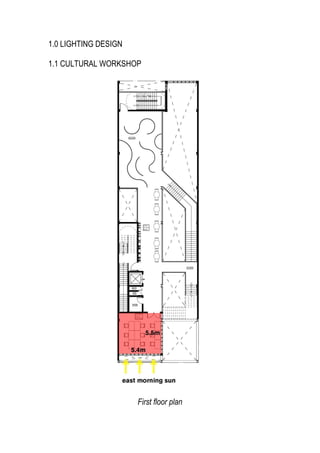
1.1 CULTURAL WORKSHOP
First floor plan
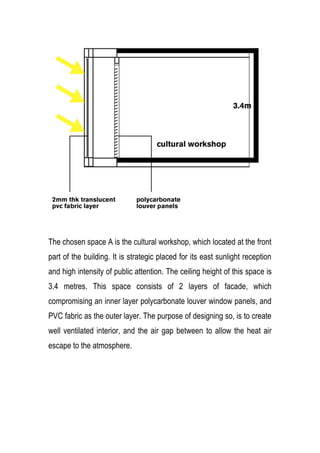
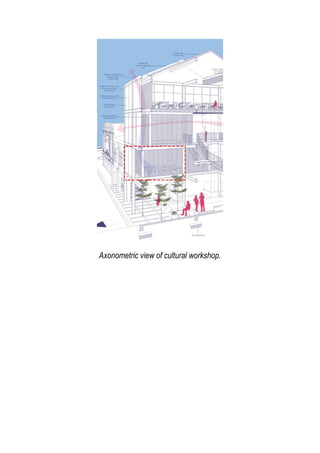
The chosen space A is the cultural workshop, which located at the front
part of the building. It is strategic placed for its east sunlight reception
and high intensity of public attention. The ceiling height of this space is
3.4 metres. This space consists of 2 layers of facade, which
compromising an inner layer polycarbonate louver window panels, and
PVC fabric as the outer layer. The purpose of designing so, is to create
well ventilated interior, and the air gap between to allow the heat air
escape to the atmosphere.
Axonometric view of cultural workshop.
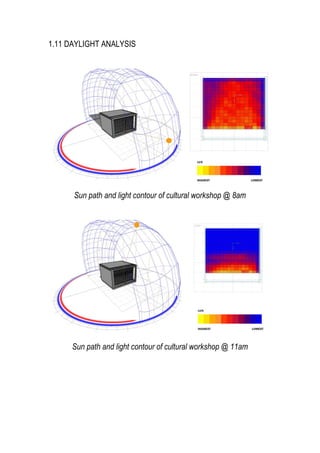
1.11 DAYLIGHT ANALYSIS
Sun path and light contour of cultural workshop @ 8am
Sun path and light contour of cultural workshop @ 11am
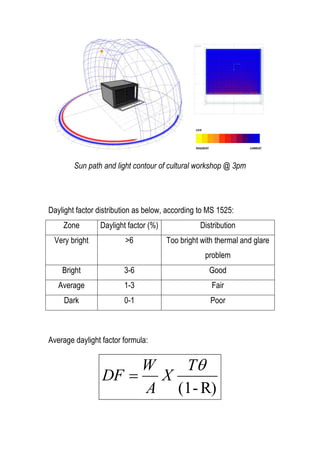
Sun path and light contour of cultural workshop @ 3pm
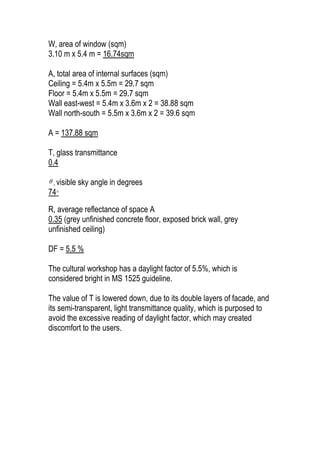
Daylight factor distribution as below, according to MS 1525:
Zone Daylight factor (%) Distribution
Very bright >6 Too bright with thermal and glare
problem
Bright 3-6 Good
Average 1-3 Fair
Dark 0-1 Poor
Average daylight factor formula:
R)-(1
T
X
A
W
DF 
W, area of window (sqm)
3.10 m x 5.4 m = 16.74sqm
A, total area of internal surfaces (sqm)
Ceiling = 5.4m x 5.5m = 29.7 sqm
Floor = 5.4m x 5.5m = 29.7 sqm
Wall east-west = 5.4m x 3.6m x 2 = 38.88 sqm
Wall north-south = 5.5m x 3.6m x 2 = 39.6 sqm
A = 137.88 sqm
T, glass transmittance
0.4
 , visible sky angle in degrees
74°
R, average reflectance of space A
0.35 (grey unfinished concrete floor, exposed brick wall, grey
unfinished ceiling)
DF = 5.5 %
The cultural workshop has a daylight factor of 5.5%, which is
considered bright in MS 1525 guideline.
The value of T is lowered down, due to its double layers of facade, and
its semi-transparent, light transmittance quality, which is purposed to
avoid the excessive reading of daylight factor, which may created
discomfort to the users.
1.12 ARTIFICIAL LIGHT PROPOSAL
However, there is a need for the usage of artificial light as it gets darker
over the time. The advantage of doing so, is that users are able to turn
it on or off when there is a necessity.
Plus, the site is behaved as shophouse typology, which it has a long
front-to-back stretched area, which the light hardly transmitted to the
middle. The only light can enters via roof or front and back facades.
The required lux level for the workshop in MS 1525 is around 400 lux.
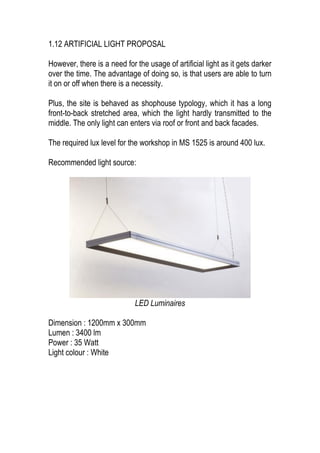
Recommended light source:
LED Luminaires
Dimension : 1200mm x 300mm
Lumen : 3400 lm
Power : 35 Watt
Light colour : White
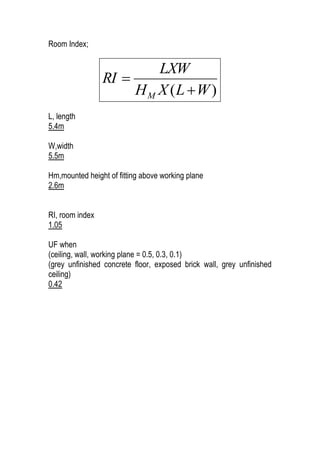
Room Index;
)( WLXH
LXW
RI
M 

L, length
5.4m
W,width
5.5m
Hm,mounted height of fitting above working plane
2.6m
RI, room index
1.05
UF when
(ceiling, wall, working plane = 0.5, 0.3, 0.1)
(grey unfinished concrete floor, exposed brick wall, grey unfinished
ceiling)
0.42
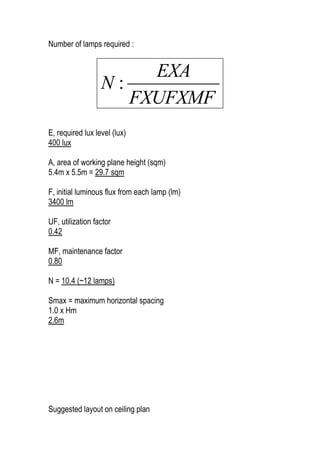
Number of lamps required :
FXUFXMF
EXA
N :
E, required lux level (lux)
400 lux
A, area of working plane height (sqm)
5.4m x 5.5m = 29.7 sqm
F, initial luminous flux from each lamp (lm)
3400 lm
UF, utilization factor
0.42
MF, maintenance factor
0.80
N = 10.4 (~12 lamps)
Smax = maximum horizontal spacing
1.0 x Hm
2.6m
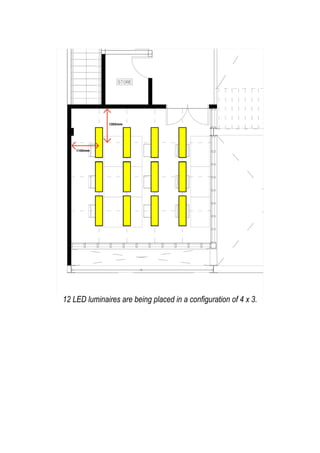
Suggested layout on ceiling plan
12 LED luminaires are being placed in a configuration of 4 x 3.
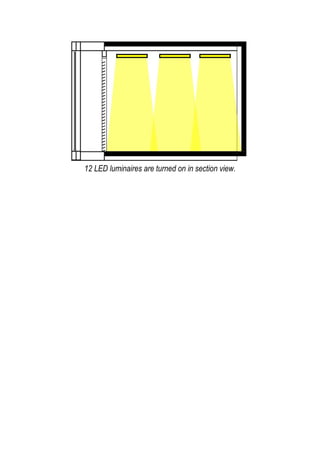
12 LED luminaires are turned on in section view.
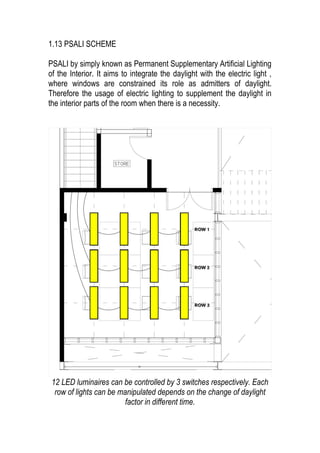
1.13 PSALI SCHEME
PSALI by simply known as Permanent Supplementary Artificial Lighting
of the Interior. It aims to integrate the daylight with the electric light ,
where windows are constrained its role as admitters of daylight.
Therefore the usage of electric lighting to supplement the daylight in
the interior parts of the room when there is a necessity.
12 LED luminaires can be controlled by 3 switches respectively. Each
row of lights can be manipulated depends on the change of daylight
factor in different time.
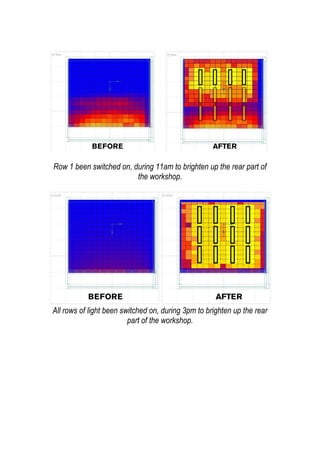
Row 1 been switched on, during 11am to brighten up the rear part of
the workshop.
All rows of light been switched on, during 3pm to brighten up the rear
part of the workshop.
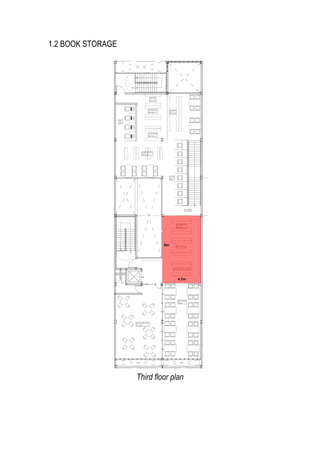
1.2 BOOK STORAGE
Third floor plan
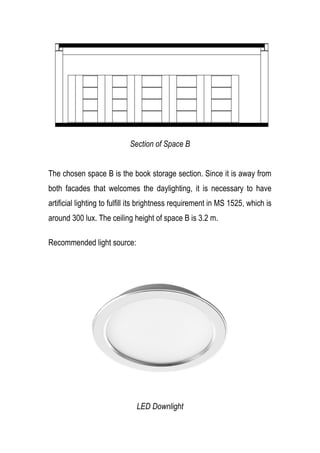
Section of Space B
The chosen space B is the book storage section. Since it is away from
both facades that welcomes the daylighting, it is necessary to have
artificial lighting to fulfill its brightness requirement in MS 1525, which is
around 300 lux. The ceiling height of space B is 3.2 m.
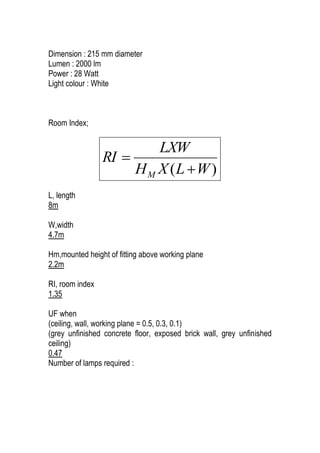
Recommended light source:
LED Downlight
Dimension : 215 mm diameter
Lumen : 2000 lm
Power : 28 Watt
Light colour : White
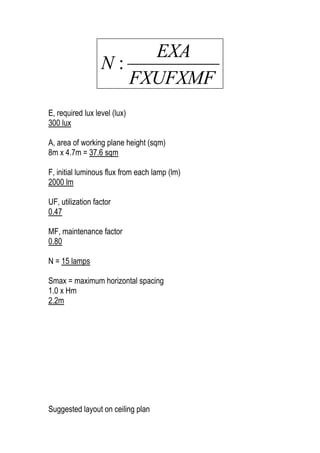
Room Index;
)( WLXH
LXW
RI
M 

L, length
8m
W,width
4.7m
Hm,mounted height of fitting above working plane
2.2m
RI, room index
1.35
UF when
(ceiling, wall, working plane = 0.5, 0.3, 0.1)
(grey unfinished concrete floor, exposed brick wall, grey unfinished
ceiling)
0.47
Number of lamps required :
FXUFXMF
EXA
N :
E, required lux level (lux)
300 lux
A, area of working plane height (sqm)
8m x 4.7m = 37.6 sqm
F, initial luminous flux from each lamp (lm)
2000 lm
UF, utilization factor
0.47
MF, maintenance factor
0.80
N = 15 lamps
Smax = maximum horizontal spacing
1.0 x Hm
2.2m
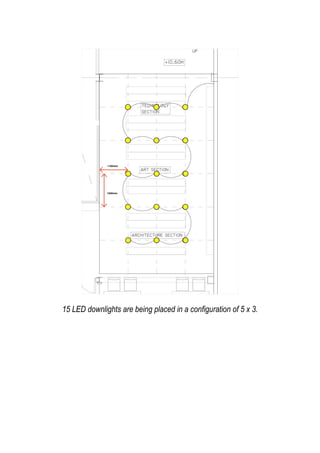
Suggested layout on ceiling plan
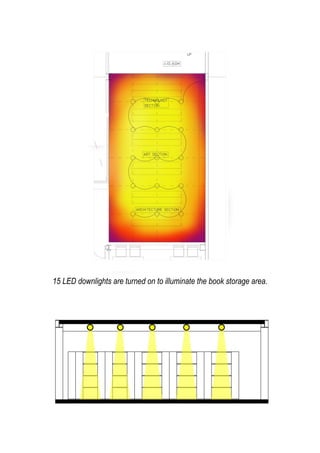
15 LED downlights are being placed in a configuration of 5 x 3.
15 LED downlights are turned on to illuminate the book storage area.
15 LED downlights are turned on to illuminate the book storage area in
section view.
2.0 REFERENCE
Stein, B. (2009). Mechanical and Electrical Equipment for Buildings.
New Jersey.
Buildings.com (n.a.) Daylight Design. Retrieved 10 July 2017, from
http://www.buildings.com/buzz/buildings-buzz/entryid/203/5-things-you-
may-not-know-about-daylight-design-.
Wbdg.org (n.a.) Daylighting. Retrieved 10 July 2017, from
https://www.wbdg.org/resources/daylighting.
ContinentialLighting. (n.a.) Artificial Lighting. Retrieved 10 July 2017,
from
http://www.continental-lighting.com/lighting-basics/artificial-light-source
s.php.

Bscience final 3

  • 1.
    BACHELOR OF SCIENCE(HONS) IN ARCHITECTURE BUILDING SCIENCE (BLD 61303 / ARC 3413) INTEGRATION PROJECT WITH COMMUNITY LIBRARY ARCHITECTURAL STUDIO PROJECT NAME : YEOW JINN SHENG STUDENT ID : 0318797 TUTOR : MR AZIM
  • 2.
    TABLE OF CONTENT 1.0LIGHTING DESIGN 1.1 CULTURAL WORKSHOP 1.11 DAYLIGHT ANALYSIS 1.12 ARTIFICIAL LIGHTING PROPOSAL 1.13 PSALI SCHEME 1.2 BOOK STORAGE 1.21 ARTIFICIAL LIGHTING PROPOSAL 2.0 REFERENCE
  • 3.
    1.0 LIGHTING DESIGN 1.1CULTURAL WORKSHOP First floor plan
  • 4.
    The chosen spaceA is the cultural workshop, which located at the front part of the building. It is strategic placed for its east sunlight reception and high intensity of public attention. The ceiling height of this space is 3.4 metres. This space consists of 2 layers of facade, which compromising an inner layer polycarbonate louver window panels, and PVC fabric as the outer layer. The purpose of designing so, is to create well ventilated interior, and the air gap between to allow the heat air escape to the atmosphere.
  • 5.
    Axonometric view ofcultural workshop.
  • 6.
    1.11 DAYLIGHT ANALYSIS Sunpath and light contour of cultural workshop @ 8am Sun path and light contour of cultural workshop @ 11am
  • 7.
    Sun path andlight contour of cultural workshop @ 3pm Daylight factor distribution as below, according to MS 1525: Zone Daylight factor (%) Distribution Very bright >6 Too bright with thermal and glare problem Bright 3-6 Good Average 1-3 Fair Dark 0-1 Poor Average daylight factor formula: R)-(1 T X A W DF 
  • 8.
    W, area ofwindow (sqm) 3.10 m x 5.4 m = 16.74sqm A, total area of internal surfaces (sqm) Ceiling = 5.4m x 5.5m = 29.7 sqm Floor = 5.4m x 5.5m = 29.7 sqm Wall east-west = 5.4m x 3.6m x 2 = 38.88 sqm Wall north-south = 5.5m x 3.6m x 2 = 39.6 sqm A = 137.88 sqm T, glass transmittance 0.4  , visible sky angle in degrees 74° R, average reflectance of space A 0.35 (grey unfinished concrete floor, exposed brick wall, grey unfinished ceiling) DF = 5.5 % The cultural workshop has a daylight factor of 5.5%, which is considered bright in MS 1525 guideline. The value of T is lowered down, due to its double layers of facade, and its semi-transparent, light transmittance quality, which is purposed to avoid the excessive reading of daylight factor, which may created discomfort to the users.
  • 9.
    1.12 ARTIFICIAL LIGHTPROPOSAL However, there is a need for the usage of artificial light as it gets darker over the time. The advantage of doing so, is that users are able to turn it on or off when there is a necessity. Plus, the site is behaved as shophouse typology, which it has a long front-to-back stretched area, which the light hardly transmitted to the middle. The only light can enters via roof or front and back facades. The required lux level for the workshop in MS 1525 is around 400 lux. Recommended light source: LED Luminaires Dimension : 1200mm x 300mm Lumen : 3400 lm Power : 35 Watt Light colour : White
  • 10.
    Room Index; )( WLXH LXW RI M  L, length 5.4m W,width 5.5m Hm,mounted height of fitting above working plane 2.6m RI, room index 1.05 UF when (ceiling, wall, working plane = 0.5, 0.3, 0.1) (grey unfinished concrete floor, exposed brick wall, grey unfinished ceiling) 0.42
  • 11.
    Number of lampsrequired : FXUFXMF EXA N : E, required lux level (lux) 400 lux A, area of working plane height (sqm) 5.4m x 5.5m = 29.7 sqm F, initial luminous flux from each lamp (lm) 3400 lm UF, utilization factor 0.42 MF, maintenance factor 0.80 N = 10.4 (~12 lamps) Smax = maximum horizontal spacing 1.0 x Hm 2.6m Suggested layout on ceiling plan
  • 12.
    12 LED luminairesare being placed in a configuration of 4 x 3.
  • 13.
    12 LED luminairesare turned on in section view.
  • 14.
    1.13 PSALI SCHEME PSALIby simply known as Permanent Supplementary Artificial Lighting of the Interior. It aims to integrate the daylight with the electric light , where windows are constrained its role as admitters of daylight. Therefore the usage of electric lighting to supplement the daylight in the interior parts of the room when there is a necessity. 12 LED luminaires can be controlled by 3 switches respectively. Each row of lights can be manipulated depends on the change of daylight factor in different time.
  • 15.
    Row 1 beenswitched on, during 11am to brighten up the rear part of the workshop. All rows of light been switched on, during 3pm to brighten up the rear part of the workshop.
  • 16.
  • 17.
    Section of SpaceB The chosen space B is the book storage section. Since it is away from both facades that welcomes the daylighting, it is necessary to have artificial lighting to fulfill its brightness requirement in MS 1525, which is around 300 lux. The ceiling height of space B is 3.2 m. Recommended light source: LED Downlight
  • 18.
    Dimension : 215mm diameter Lumen : 2000 lm Power : 28 Watt Light colour : White Room Index; )( WLXH LXW RI M   L, length 8m W,width 4.7m Hm,mounted height of fitting above working plane 2.2m RI, room index 1.35 UF when (ceiling, wall, working plane = 0.5, 0.3, 0.1) (grey unfinished concrete floor, exposed brick wall, grey unfinished ceiling) 0.47 Number of lamps required :
  • 19.
    FXUFXMF EXA N : E, requiredlux level (lux) 300 lux A, area of working plane height (sqm) 8m x 4.7m = 37.6 sqm F, initial luminous flux from each lamp (lm) 2000 lm UF, utilization factor 0.47 MF, maintenance factor 0.80 N = 15 lamps Smax = maximum horizontal spacing 1.0 x Hm 2.2m Suggested layout on ceiling plan
  • 20.
    15 LED downlightsare being placed in a configuration of 5 x 3.
  • 21.
    15 LED downlightsare turned on to illuminate the book storage area.
  • 22.
    15 LED downlightsare turned on to illuminate the book storage area in section view. 2.0 REFERENCE Stein, B. (2009). Mechanical and Electrical Equipment for Buildings. New Jersey. Buildings.com (n.a.) Daylight Design. Retrieved 10 July 2017, from http://www.buildings.com/buzz/buildings-buzz/entryid/203/5-things-you- may-not-know-about-daylight-design-.
  • 23.
    Wbdg.org (n.a.) Daylighting.Retrieved 10 July 2017, from https://www.wbdg.org/resources/daylighting. ContinentialLighting. (n.a.) Artificial Lighting. Retrieved 10 July 2017, from http://www.continental-lighting.com/lighting-basics/artificial-light-source s.php.