LECTURE FIVE SOCIAL CLASS Consumer Behaviour in Travel and Tourism Dr H. Ruhi Yaman
Social Class The division of members of a society into a hierarchy of distinct status classes, so that members of each class have either higher or lower status than members of other classes.
Status Consumption Consumers endeavor to increase their social standing through consumption Very important for luxury goods Is different from conspicuous consumption
Discussion Question Why is status consumption important for some consumers? How can marketers promote increased status consumption?
Social Class Is Hierarchal Status is frequently thought of as the relative rankings of members of each social class
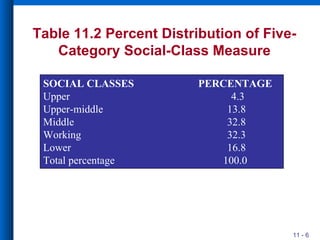
Table 11.2 Percent Distribution of Five-Category Social-Class Measure SOCIAL CLASSES PERCENTAGE Upper   4.3 Upper-middle  13.8 Middle  32.8 Working  32.3 Lower  16.8 Total percentage 100.0
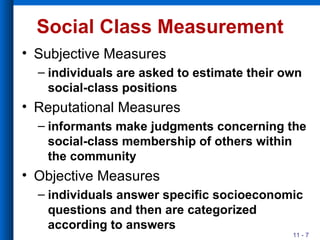
Social Class Measurement Subjective Measures individuals are asked to estimate their own social-class positions Reputational Measures informants make judgments concerning the social-class membership of others within the community Objective Measures individuals answer specific socioeconomic questions and then are categorized according to answers
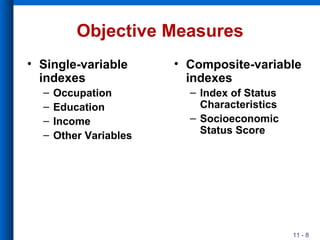
Objective Measures Single-variable indexes Occupation Education Income Other Variables Composite-variable indexes Index of Status Characteristics Socioeconomic Status Score
Index of Status Characteristics (ISC) A composite measure of social class that combines occupation, source of income (not amount), house type/dwelling area into a single weighted index of social class standing.
Socioeconomic Status Score (SES) A multivariable social class measure used by the United States Bureau of the Census that combines occupational status, family income, and educational attainment into a single measure of social class standing.
Geodemographic Clusters A composite segmentation strategy that uses both geographic variables (zip codes, neighborhoods) and demographic variables (e.g., income, occupation) to identify target markets.
PRIZM (Potential Rating Index by Zip Market) A composite index of geographic and socioeconomic factors expressed in residential zip code neighborhoods from which geodemographic consumer segments are formed.
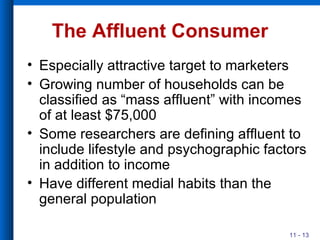
The Affluent Consumer Especially attractive target to marketers Growing number of households can be classified as “mass affluent” with incomes of at least $75,000 Some researchers are defining affluent to include lifestyle and psychographic factors in addition to income Have different medial habits than the general population
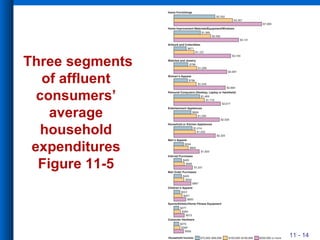
Three segments of affluent consumers’ average household expenditures  Figure 11-5
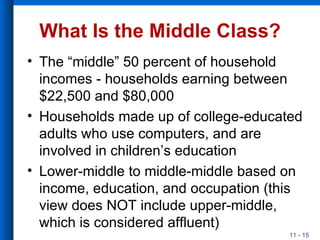
What Is the Middle Class? The “middle” 50 percent of household incomes - households earning between $22,500 and $80,000 Households made up of college-educated adults who use computers, and are involved in children’s education Lower-middle to middle-middle based on income, education, and occupation (this view does NOT include upper-middle, which is considered affluent)
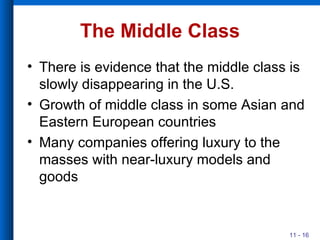
The Middle Class There is evidence that the middle class is slowly disappearing in the U.S. Growth of middle class in some Asian and Eastern European countries Many companies offering luxury to the masses with near-luxury models and goods
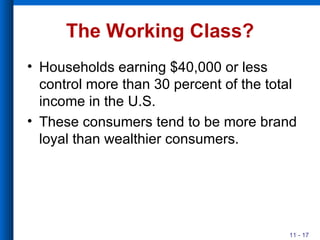
The Working Class? Households earning $40,000 or less control more than 30 percent of the total income in the U.S. These consumers tend to be more brand loyal than wealthier consumers.
Discussion Question What types of products are targeted to the working class? What issues must marketers consider when targeting their ads to the working class?
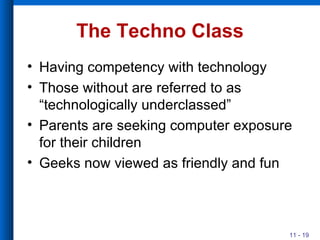
The Techno Class Having competency with technology Those without are referred to as “technologically underclassed” Parents are seeking computer exposure for their children Geeks now viewed as friendly and fun
Consumer Behavior and  Social Class Clothing, Fashion, and Shopping The Pursuit of Leisure Saving, Spending, and Credit Social Class and Communication
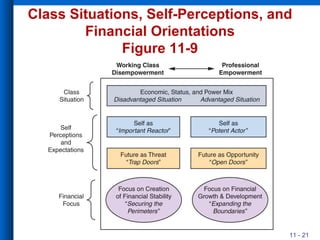
Class Situations, Self-Perceptions, and Financial Orientations Figure 11-9

3

  • 1.
    LECTURE FIVE SOCIALCLASS Consumer Behaviour in Travel and Tourism Dr H. Ruhi Yaman
  • 2.
    Social Class Thedivision of members of a society into a hierarchy of distinct status classes, so that members of each class have either higher or lower status than members of other classes.
  • 3.
    Status Consumption Consumersendeavor to increase their social standing through consumption Very important for luxury goods Is different from conspicuous consumption
  • 4.
    Discussion Question Whyis status consumption important for some consumers? How can marketers promote increased status consumption?
  • 5.
    Social Class IsHierarchal Status is frequently thought of as the relative rankings of members of each social class
  • 6.
    Table 11.2 PercentDistribution of Five-Category Social-Class Measure SOCIAL CLASSES PERCENTAGE Upper 4.3 Upper-middle 13.8 Middle 32.8 Working 32.3 Lower 16.8 Total percentage 100.0
  • 7.
    Social Class MeasurementSubjective Measures individuals are asked to estimate their own social-class positions Reputational Measures informants make judgments concerning the social-class membership of others within the community Objective Measures individuals answer specific socioeconomic questions and then are categorized according to answers
  • 8.
    Objective Measures Single-variableindexes Occupation Education Income Other Variables Composite-variable indexes Index of Status Characteristics Socioeconomic Status Score
  • 9.
    Index of StatusCharacteristics (ISC) A composite measure of social class that combines occupation, source of income (not amount), house type/dwelling area into a single weighted index of social class standing.
  • 10.
    Socioeconomic Status Score(SES) A multivariable social class measure used by the United States Bureau of the Census that combines occupational status, family income, and educational attainment into a single measure of social class standing.
  • 11.
    Geodemographic Clusters Acomposite segmentation strategy that uses both geographic variables (zip codes, neighborhoods) and demographic variables (e.g., income, occupation) to identify target markets.
  • 12.
    PRIZM (Potential RatingIndex by Zip Market) A composite index of geographic and socioeconomic factors expressed in residential zip code neighborhoods from which geodemographic consumer segments are formed.
  • 13.
    The Affluent ConsumerEspecially attractive target to marketers Growing number of households can be classified as “mass affluent” with incomes of at least $75,000 Some researchers are defining affluent to include lifestyle and psychographic factors in addition to income Have different medial habits than the general population
  • 14.
    Three segments ofaffluent consumers’ average household expenditures Figure 11-5
  • 15.
    What Is theMiddle Class? The “middle” 50 percent of household incomes - households earning between $22,500 and $80,000 Households made up of college-educated adults who use computers, and are involved in children’s education Lower-middle to middle-middle based on income, education, and occupation (this view does NOT include upper-middle, which is considered affluent)
  • 16.
    The Middle ClassThere is evidence that the middle class is slowly disappearing in the U.S. Growth of middle class in some Asian and Eastern European countries Many companies offering luxury to the masses with near-luxury models and goods
  • 17.
    The Working Class?Households earning $40,000 or less control more than 30 percent of the total income in the U.S. These consumers tend to be more brand loyal than wealthier consumers.
  • 18.
    Discussion Question Whattypes of products are targeted to the working class? What issues must marketers consider when targeting their ads to the working class?
  • 19.
    The Techno ClassHaving competency with technology Those without are referred to as “technologically underclassed” Parents are seeking computer exposure for their children Geeks now viewed as friendly and fun
  • 20.
    Consumer Behavior and Social Class Clothing, Fashion, and Shopping The Pursuit of Leisure Saving, Spending, and Credit Social Class and Communication
  • 21.
    Class Situations, Self-Perceptions,and Financial Orientations Figure 11-9