Bayesian Hilbert Maps
for Dynamic Continuous Occupancy Mapping
Ransalu Senanayake1
, Fabio Ramos2
1,2
School of Information Technologies, University of Sydney, Australia
1,2
Data61/CSIRO, Australia
2
Australian Centre for Field Robotics (ACFR), University of Sydney, Australia
1st Annual Conference on Robot Learning (CoRL 2017)
Mountain View, CA
Content
● Occupancy mapping
● Motivation
○ Parameter tuning
○ Long-term (non-instantaneous) occupancy maps
● Bayesian Hilbert Maps (BHMs)
● Experiments
● Conclusions
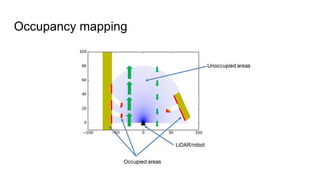
Occupancy mapping
Occupancy mapping
● Occupancy grid map [1]
○ Fixed size grid (predetermined)
Occupancy mapping
● Occupancy grid map [1]
○ Fixed size grid (predetermined)
Occupancy mapping
● Occupancy grid map [1]
○ Fixed size grid (predetermined)
○ Assume cells are independent
○ Occlusions
●
●
Continuous Occupancy mapping
Gaussian Process Occupancy Maps [2] and Hilbert Maps (HMs) [3]
The world is not pre-discretized
● Hence, any resolution
● Neighborhood information is considered
○ Hence, robust against occlusions
Objective
To conveniently build long-term occupancy maps for dynamic
environments in real-time.
Methodology: Bayesian Hilbert Maps (BHMs)
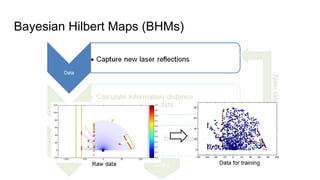
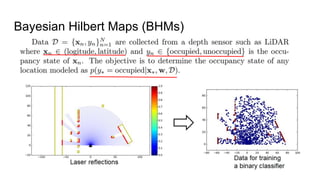
Bayesian Hilbert Maps (BHMs)
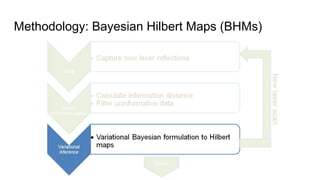
Methodology: Bayesian Hilbert Maps (BHMs)
Bayesian Hilbert Maps (BHMs)
[4]
Variational Inference
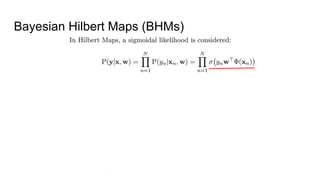
Bayesian Hilbert Maps (BHMs)
A lower bound of the variational lower bound derived from linearizing the sigmoidal
likelihood is maximized in an Expectation-Maximization-fashion.
[4]
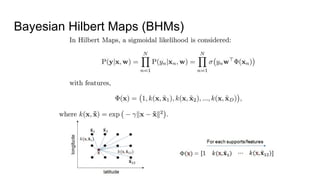
Bayesian Hilbert Maps (BHMs)
Compared to other continuous mapping techniques,
● Capture data Update the model Discard data
● “Almost” constant per-iteration update time
● No crucial hyper-parameter tuning
Python code: github.com/RansML/Bayesian_Hilbert_Maps
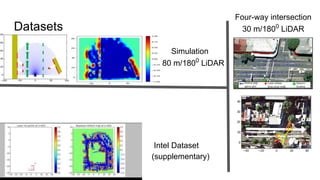
Datasets
Simulation
80 m/1800
LiDAR
Four-way intersection
30 m/1800
LiDAR
Intel Dataset
(supplementary)
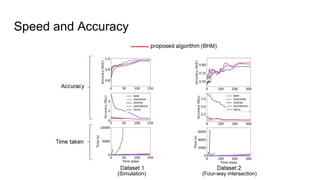
Speed and Accuracy
(Simulation) (Four-way intersection)
Why Bayesian Hilbert Maps?
1. The map is continuous
a. The world is not discretized
b. It can build maps of any resolution without relearning
2. It considers spatial dependencies
a. Higher accuracy
b. Less susceptible to occlusions
3. Builds long-term occupancy maps in large and dynamic environments with
thousands of data points within seconds
4. Sequentially updates the long-term occupancy map as new laser scans are
obtained
5. Does not require any underlying motion model or object trackers
6. It is fast to be used in real-time, yet accurate
Python code: github.com/
RansML/Bayesian_Hilbert_Maps
Other Applications
[1] A. Elfes, “Occupancy grids: a probabilistic framework for robot perception and navigation”, PhD dissertation, CMU, 1987
[2] S.T. O’Callaghan, F. Ramos, and H. Durrant-Whyte, “Contextual occupancy maps using Gaussian processes”, ICRA, 2009
[3] F. Ramos and L. Ott, “Hilbert maps: scalable continuous occupancy mapping with stochastic gradient descent”, RSS, 2015
[4] T. Jaakkola and M. Jordan. A variational approach to bayesian logistic regression models 296 and their extensions. AISTATS, 1997.
[5] C. M. Bishop. Pattern recognition. Machine Learning, 128:1–58, 2006.
[6] S. O’Callaghan, S. Singh, A. Alempijevic, and F. Ramos, “Learning Navigational Maps by Observing Human Motion Patterns”, ICRA, 2011
[7] Z. Marinho, A. Dragan, A. Byravan, B. Boots, S. Srinivasa, and G. Gordon “Functional Gradient Motion Planning in Reproducing Kernel Hilbert
Spaces”, RSS, 2016
[8] G. Francis, L. Ott, and F. Ramos, “Stochastic Functional Gradient Path Planning in Occupancy Maps”, ICRA, 2017
References
[7] [8][6]
Supplementary
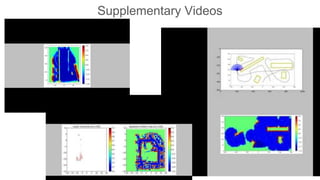
Supplementary Videos

Bayesian Hilbert Maps for Dynamic Continuous Occupancy Mapping

  • 1.
    Bayesian Hilbert Maps forDynamic Continuous Occupancy Mapping Ransalu Senanayake1 , Fabio Ramos2 1,2 School of Information Technologies, University of Sydney, Australia 1,2 Data61/CSIRO, Australia 2 Australian Centre for Field Robotics (ACFR), University of Sydney, Australia 1st Annual Conference on Robot Learning (CoRL 2017) Mountain View, CA
  • 2.
    Content ● Occupancy mapping ●Motivation ○ Parameter tuning ○ Long-term (non-instantaneous) occupancy maps ● Bayesian Hilbert Maps (BHMs) ● Experiments ● Conclusions
  • 3.
  • 4.
    Occupancy mapping ● Occupancygrid map [1] ○ Fixed size grid (predetermined)
  • 5.
    Occupancy mapping ● Occupancygrid map [1] ○ Fixed size grid (predetermined)
  • 6.
    Occupancy mapping ● Occupancygrid map [1] ○ Fixed size grid (predetermined) ○ Assume cells are independent ○ Occlusions ● ●
  • 7.
    Continuous Occupancy mapping GaussianProcess Occupancy Maps [2] and Hilbert Maps (HMs) [3] The world is not pre-discretized ● Hence, any resolution ● Neighborhood information is considered ○ Hence, robust against occlusions
  • 8.
    Objective To conveniently buildlong-term occupancy maps for dynamic environments in real-time.
  • 9.
  • 10.
  • 11.
  • 12.
  • 13.
  • 14.
  • 15.
  • 16.
  • 17.
    Bayesian Hilbert Maps(BHMs) [4] Variational Inference
  • 18.
    Bayesian Hilbert Maps(BHMs) A lower bound of the variational lower bound derived from linearizing the sigmoidal likelihood is maximized in an Expectation-Maximization-fashion. [4]
  • 19.
    Bayesian Hilbert Maps(BHMs) Compared to other continuous mapping techniques, ● Capture data Update the model Discard data ● “Almost” constant per-iteration update time ● No crucial hyper-parameter tuning Python code: github.com/RansML/Bayesian_Hilbert_Maps
  • 20.
    Datasets Simulation 80 m/1800 LiDAR Four-way intersection 30m/1800 LiDAR Intel Dataset (supplementary)
  • 21.
    Speed and Accuracy (Simulation)(Four-way intersection)
  • 22.
    Why Bayesian HilbertMaps? 1. The map is continuous a. The world is not discretized b. It can build maps of any resolution without relearning 2. It considers spatial dependencies a. Higher accuracy b. Less susceptible to occlusions 3. Builds long-term occupancy maps in large and dynamic environments with thousands of data points within seconds 4. Sequentially updates the long-term occupancy map as new laser scans are obtained 5. Does not require any underlying motion model or object trackers 6. It is fast to be used in real-time, yet accurate Python code: github.com/ RansML/Bayesian_Hilbert_Maps
  • 23.
    Other Applications [1] A.Elfes, “Occupancy grids: a probabilistic framework for robot perception and navigation”, PhD dissertation, CMU, 1987 [2] S.T. O’Callaghan, F. Ramos, and H. Durrant-Whyte, “Contextual occupancy maps using Gaussian processes”, ICRA, 2009 [3] F. Ramos and L. Ott, “Hilbert maps: scalable continuous occupancy mapping with stochastic gradient descent”, RSS, 2015 [4] T. Jaakkola and M. Jordan. A variational approach to bayesian logistic regression models 296 and their extensions. AISTATS, 1997. [5] C. M. Bishop. Pattern recognition. Machine Learning, 128:1–58, 2006. [6] S. O’Callaghan, S. Singh, A. Alempijevic, and F. Ramos, “Learning Navigational Maps by Observing Human Motion Patterns”, ICRA, 2011 [7] Z. Marinho, A. Dragan, A. Byravan, B. Boots, S. Srinivasa, and G. Gordon “Functional Gradient Motion Planning in Reproducing Kernel Hilbert Spaces”, RSS, 2016 [8] G. Francis, L. Ott, and F. Ramos, “Stochastic Functional Gradient Path Planning in Occupancy Maps”, ICRA, 2017 References [7] [8][6]
  • 24.
  • 25.