LASER
SPECTROSCOPY
Presented by
Arun raj
1st year m-pharmaceutics
1
INTRODUCTION
o Lasers: A highly useful source in analytical
instrumentation
high intensities
narrow band widths
coherent nature of their outputs
o Laser
Light Amplification by Stimulated Emission of
Radiation.
2
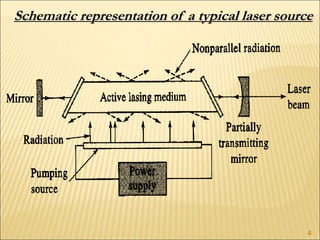
COMPONENTS OF LASER
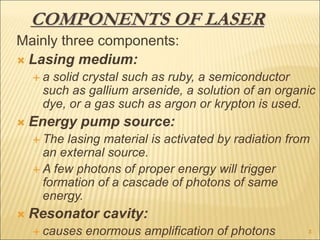
Mainly three components:
 Lasing medium:
 a solid crystal such as ruby, a semiconductor
such as gallium arsenide, a solution of an organic
dye, or a gas such as argon or krypton is used.
 Energy pump source:
 The lasing material is activated by radiation from
an external source.
 A few photons of proper energy will trigger
formation of a cascade of photons of same
energy.
 Resonator cavity:
 causes enormous amplification of photons 3
Schematic representation of a typical laser source
4
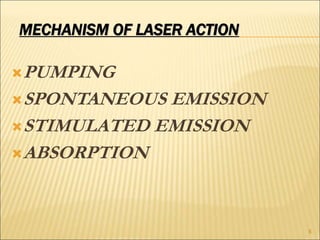
MECHANISM OF LASER ACTION
PUMPING
SPONTANEOUS EMISSION
STIMULATED EMISSION
ABSORPTION
5
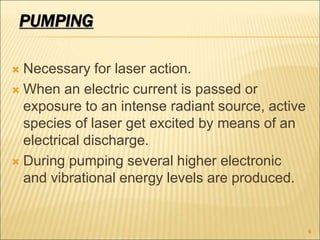
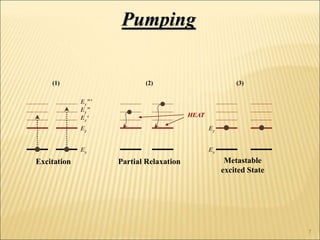
PUMPING
 Necessary for laser action.
 When an electric current is passed or
exposure to an intense radiant source, active
species of laser get excited by means of an
electrical discharge.
 During pumping several higher electronic
and vibrational energy levels are produced.
6
Ex
Ey
Ey‘
Ey”
Ey”’
Excitation
HEAT
Partial Relaxation
Ex
Ey
Metastable
excited State
Pumping
(1) (2) (3)
7
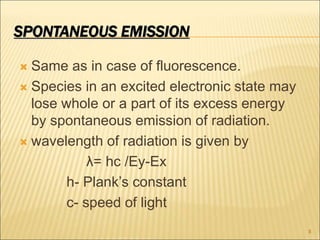
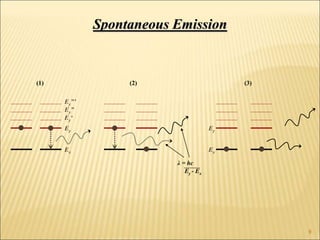
SPONTANEOUS EMISSION
 Same as in case of fluorescence.
 Species in an excited electronic state may
lose whole or a part of its excess energy
by spontaneous emission of radiation.
 wavelength of radiation is given by
λ= hc /Ey-Ex
h- Plank’s constant
c- speed of light
8
Ex
Ey
Ey‘
Ey”
Ey”’
Ex
Ey
Spontaneous Emission
(1) (2) (3)
λ = hc
Ey - Ex
9
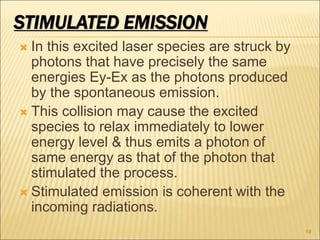
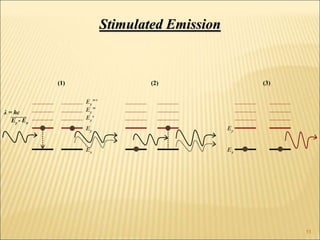
STIMULATED EMISSION
 In this excited laser species are struck by
photons that have precisely the same
energies Ey-Ex as the photons produced
by the spontaneous emission.
 This collision may cause the excited
species to relax immediately to lower
energy level & thus emits a photon of
same energy as that of the photon that
stimulated the process.
 Stimulated emission is coherent with the
incoming radiations.
10
Ex
Ey
Ey‘
Ey”
Ey”’
Ex
Ey
Stimulated Emission
(1) (2) (3)
λ = hc
Ey - Ex
11
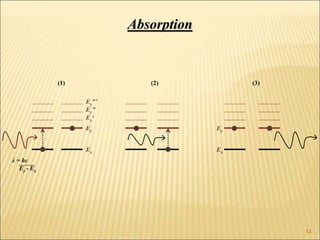
ABSORPTION
 The absorption process which completes
with stimulated emission.
 Here 2 photons with energies exactly
equal to (Ey-Ex) are absorbed to produce
the Metastable excited state
12
Ex
Ey
Ey‘
Ey”
Ey”’
Ex
Ey
Absorption
(1) (2) (3)
λ = hc
Ey - Ex
13
POPULATION INVERSION & LIGHT
AMPLIFICATION
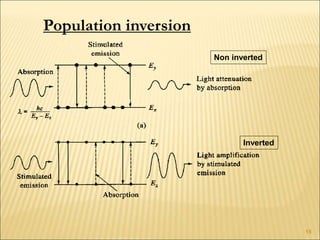
 For light amplification in a laser, it is
necessary that the number of photos
produced by stimulated emission exceed the
number lost by absorption.
 Therefore, number of particles in the higher
energy state exceeds the number in the
lower.
 In other words, there must be a population
inversion
14
Population inversion
Non inverted
Inverted
15
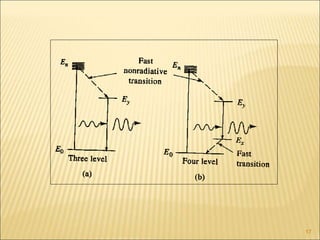
THREE & FOUR LEVEL SYSTEMS
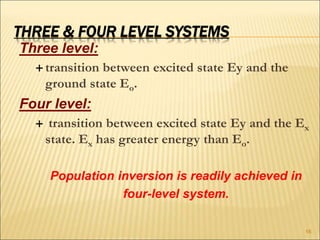
Three level:
 transition between excited state Ey and the
ground state Eo.
Four level:
 transition between excited state Ey and the Ex
state. Ex has greater energy than Eo.
Population inversion is readily achieved in
four-level system.
16
17
TYPES OF LASERS
Gas lasers
Dye lasers
Solid state lasers
Semiconductor lasers
18
Gas Lasers
 Gas lasers are typically excited by an
electrical discharge.
Four types:-
 Neutral atom lasers: He/Ne(632.8nm)
 Ion lasers in which active species is Ar+ or Kr+.
 Molecular lasers:
 lasing medium is CO2 OR N2.
 Excimer lasers:
 a gaseous mixture of He, F and one of the rare
gases Argon, Krypton or Xenon.
19
 He/Ne laser has low initial and maintenance
cost, greater reliability, low power consumption
 Ar ion laser is a four level device, input energy
is high since Ar has to be ionized then excited
from ground state
 InN2 laser excitation is caused by high voltage
spark source, excitation causes population
inversion, which decays quickly
 In excimer, rare gas is electronically excited by
a current followed by reaction with flourine to
form excited species ArF*, KrF*
20
 The active materials are solutions of organic
componds capable of fluorescing in UV,IR regions
The dye and solvent are circulated through a cell or
a jet, and the dye molecules are excited by flash
lamps or other lasers.
The organic dye molecules have broad fluorescence
bands and dye lasers are continuously tunable over
20 to 50 nm.
 Dyes exist to cover the near-u.v to near-infrared
spectral region: 330 - 1020 nm.
DYE LASERS
21
 LEDs within a resonator cavity that is
formed either on the surfaces of the diode
or externally connected.
 Electric current passing through the diode
produces light emission when electrons
and holes recombine at the p-n junction.
 The laser output is very divergent and
requires special optics to produce a good
beam shape.
SEMICONDUCTOR LASERS
22
DBR laser diode
used in optical-fiber communications, CD
players, and in high-resolution molecular
spectroscopy in the near-infrared.
can replace flash lamps to efficiently pump
solid-state lasers.
tunable over a narrow range and different
semiconductor materials are used to make
lasers at 680, 800, 1300, and 1500 nm.
SEMICONDUCTOR LASERS
23
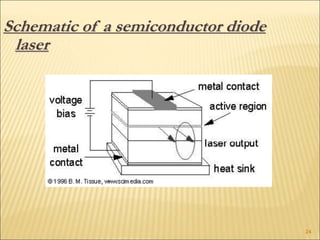
Schematic of a semiconductor diode
laser
24
SOLID STATE LASERS
Ruby crystal is the active medium.
earlier ruby was machined to rod of 4cm
long and .5 cm in diameter
a flash tube( xenon lamp) was cioled
around cylinder to produce intense flashes
of light
thus pulsed radiation was formed
Have very high radiation power at 1064
nm.
25
APPLICATIONS
26
IN CHEMISTRY
Analytical chemistry: for ultra sensitive
detection of small concentration of pollutants
Single molecular detection
Laser induced chemical reaction
Isotope separation with lasers
27
ENVIRONMENTAL RESEARCH
study the pollutants and their reactions with
natural components
Spectroscopic detection of water molecules.
Using photo acoustic spectroscopy with dye
lasers small con. of trans uranium elements
could be detected from ground waters.
28
IN BIOLOGY
Energy transfer in DNA complex
Time resolved measurement of biological
process.
Laser microscope.
29
MEDICAL APPLICATION
Cancer diagnostic therapy with HPD
(HematoPorphyrin Derivative) Technique
Laser lithotripsy
30
REFERENCES
 LASER SPECTROSCOPY- BASIC CONCEPTS
AND INSTRUMENTATION BY WOLFGANG
DEMTRODER.
 PRINCIPLES OF INSTRUMENTAL ANALYSIS-
SKOOG, HOLLER, NIEMAN.
31
32

LASER SPECTROSCOPY

  • 1.
  • 2.
    INTRODUCTION o Lasers: Ahighly useful source in analytical instrumentation high intensities narrow band widths coherent nature of their outputs o Laser Light Amplification by Stimulated Emission of Radiation. 2
  • 3.
    COMPONENTS OF LASER Mainlythree components:  Lasing medium:  a solid crystal such as ruby, a semiconductor such as gallium arsenide, a solution of an organic dye, or a gas such as argon or krypton is used.  Energy pump source:  The lasing material is activated by radiation from an external source.  A few photons of proper energy will trigger formation of a cascade of photons of same energy.  Resonator cavity:  causes enormous amplification of photons 3
  • 4.
    Schematic representation ofa typical laser source 4
  • 5.
    MECHANISM OF LASERACTION PUMPING SPONTANEOUS EMISSION STIMULATED EMISSION ABSORPTION 5
  • 6.
    PUMPING  Necessary forlaser action.  When an electric current is passed or exposure to an intense radiant source, active species of laser get excited by means of an electrical discharge.  During pumping several higher electronic and vibrational energy levels are produced. 6
  • 7.
  • 8.
    SPONTANEOUS EMISSION  Sameas in case of fluorescence.  Species in an excited electronic state may lose whole or a part of its excess energy by spontaneous emission of radiation.  wavelength of radiation is given by λ= hc /Ey-Ex h- Plank’s constant c- speed of light 8
  • 9.
  • 10.
    STIMULATED EMISSION  Inthis excited laser species are struck by photons that have precisely the same energies Ey-Ex as the photons produced by the spontaneous emission.  This collision may cause the excited species to relax immediately to lower energy level & thus emits a photon of same energy as that of the photon that stimulated the process.  Stimulated emission is coherent with the incoming radiations. 10
  • 11.
  • 12.
    ABSORPTION  The absorptionprocess which completes with stimulated emission.  Here 2 photons with energies exactly equal to (Ey-Ex) are absorbed to produce the Metastable excited state 12
  • 13.
  • 14.
    POPULATION INVERSION &LIGHT AMPLIFICATION  For light amplification in a laser, it is necessary that the number of photos produced by stimulated emission exceed the number lost by absorption.  Therefore, number of particles in the higher energy state exceeds the number in the lower.  In other words, there must be a population inversion 14
  • 15.
  • 16.
    THREE & FOURLEVEL SYSTEMS Three level:  transition between excited state Ey and the ground state Eo. Four level:  transition between excited state Ey and the Ex state. Ex has greater energy than Eo. Population inversion is readily achieved in four-level system. 16
  • 17.
  • 18.
    TYPES OF LASERS Gaslasers Dye lasers Solid state lasers Semiconductor lasers 18
  • 19.
    Gas Lasers  Gaslasers are typically excited by an electrical discharge. Four types:-  Neutral atom lasers: He/Ne(632.8nm)  Ion lasers in which active species is Ar+ or Kr+.  Molecular lasers:  lasing medium is CO2 OR N2.  Excimer lasers:  a gaseous mixture of He, F and one of the rare gases Argon, Krypton or Xenon. 19
  • 20.
     He/Ne laserhas low initial and maintenance cost, greater reliability, low power consumption  Ar ion laser is a four level device, input energy is high since Ar has to be ionized then excited from ground state  InN2 laser excitation is caused by high voltage spark source, excitation causes population inversion, which decays quickly  In excimer, rare gas is electronically excited by a current followed by reaction with flourine to form excited species ArF*, KrF* 20
  • 21.
     The activematerials are solutions of organic componds capable of fluorescing in UV,IR regions The dye and solvent are circulated through a cell or a jet, and the dye molecules are excited by flash lamps or other lasers. The organic dye molecules have broad fluorescence bands and dye lasers are continuously tunable over 20 to 50 nm.  Dyes exist to cover the near-u.v to near-infrared spectral region: 330 - 1020 nm. DYE LASERS 21
  • 22.
     LEDs withina resonator cavity that is formed either on the surfaces of the diode or externally connected.  Electric current passing through the diode produces light emission when electrons and holes recombine at the p-n junction.  The laser output is very divergent and requires special optics to produce a good beam shape. SEMICONDUCTOR LASERS 22
  • 23.
    DBR laser diode usedin optical-fiber communications, CD players, and in high-resolution molecular spectroscopy in the near-infrared. can replace flash lamps to efficiently pump solid-state lasers. tunable over a narrow range and different semiconductor materials are used to make lasers at 680, 800, 1300, and 1500 nm. SEMICONDUCTOR LASERS 23
  • 24.
    Schematic of asemiconductor diode laser 24
  • 25.
    SOLID STATE LASERS Rubycrystal is the active medium. earlier ruby was machined to rod of 4cm long and .5 cm in diameter a flash tube( xenon lamp) was cioled around cylinder to produce intense flashes of light thus pulsed radiation was formed Have very high radiation power at 1064 nm. 25
  • 26.
  • 27.
    IN CHEMISTRY Analytical chemistry:for ultra sensitive detection of small concentration of pollutants Single molecular detection Laser induced chemical reaction Isotope separation with lasers 27
  • 28.
    ENVIRONMENTAL RESEARCH study thepollutants and their reactions with natural components Spectroscopic detection of water molecules. Using photo acoustic spectroscopy with dye lasers small con. of trans uranium elements could be detected from ground waters. 28
  • 29.
    IN BIOLOGY Energy transferin DNA complex Time resolved measurement of biological process. Laser microscope. 29
  • 30.
    MEDICAL APPLICATION Cancer diagnostictherapy with HPD (HematoPorphyrin Derivative) Technique Laser lithotripsy 30
  • 31.
    REFERENCES  LASER SPECTROSCOPY-BASIC CONCEPTS AND INSTRUMENTATION BY WOLFGANG DEMTRODER.  PRINCIPLES OF INSTRUMENTAL ANALYSIS- SKOOG, HOLLER, NIEMAN. 31
  • 32.