

WELCOME TO
BATTERY
TRAINING
• Established in 1944
• ISO 9001 certified in 1994
• ISO 14001 certified in 1998
• 3 locations by 2000
• Received eco-friendly
certification in 2007
• Acquired by Hankook
Tyre Company Ltd.
in 1977
• Largest automotive battery producer in Korea
Map of
South Korea
ABOUT ATLAS BX
ALL ABOUT BATTERIES
BATTERY COMPONENTS
BATTERY COMPONENTS
BATTERY COMPONENTS
BATTERY COMPONENTS
THE ALTERNATOR
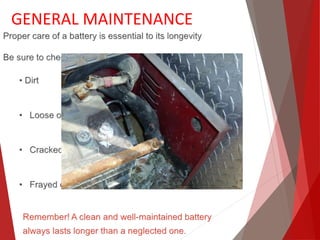
GENERAL MAINTENANCE
Batteries are very often damaged and destroyed
through constant vibration and severe impact.
Avoid this by checking for the following:
• Deteriorated battery cables
• Loose or slack connections between the
terminals and poles
• Cracked or broken battery tray
• Loose or defective battery hold-down clamp
• Corroded battery hold down clamp
• Misfit battery – too small or too large
Where applicable, make repairs immediately!
NEVER hammer or shove terminals onto poles – this is
sure to drastically decrease the life of the battery.
GENERAL MAINTENANCE
TYPES OF BATTERIES
Sealed
Cells
Magic Eye
Indicator
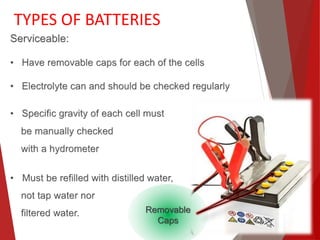
Removable
Caps
TYPES OF BATTERIES
AGM BATTERIES
Characteristics of an AGM Battery:
 Has a very low internal resistance and therefore is able to
deliver high currents on demand.
 Lighter than the flooded lead acid type battery
 Provides good electrical reliability
 Spill proof
 Maintenance free
Characteristics of an AGM Battery:
 Allows for extremely deep discharges, of up to 80%,
without being damaged.
 Has a charging rate that is five times faster than that of a
flooded lead acid battery!
 Extreme vibration protection resists vibration damage for
better performance and longer life.
 Tough, stainless steel terminals prevent corrosion for more
power and better performance.
AGM BATTERIES
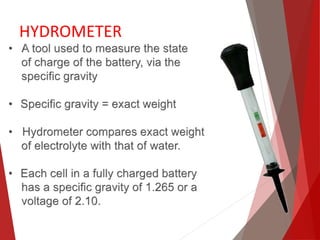
HYDROMETER
 Several Battery Capacity Ratings have been established
to determine the current capacity of a battery.
 The current capacity is an indication of the battery’s
ability to develop and deliver high amperage current to the
starter, and provide reserve power to the electrical system.
 Some commonly used ratings are:-
 Cold Cranking Amps
 Cranking Amps
 Hot Cranking Amps
 Reserve Capacity
 Ampere Hours
CA
Ah
HCA
CCA
RC
CAPACITY RATINGS
COLD CRANKING AMPS (CCA)
 This rating indicates the battery’s ability to deliver a specified current
at low temperature.
 It is determined by the amount of current a fully charged battery can
supply for thirty (30) seconds at 0° F without the voltage falling below
7.2V.
CA
Ah
HCA
CCA
RC
CAPACITY RATINGS
CRANKING AMPS (CA)
 This rating indicates the battery’s ability to deliver cranking current at
32° F.
 To convert CCA to CA, multiply the Cold Cranking Amps by 1.25.
 For example,
650 CCA x 1.25 = 812 CA
CA
Ah
HCA
CCA
RC
CAPACITY RATINGS
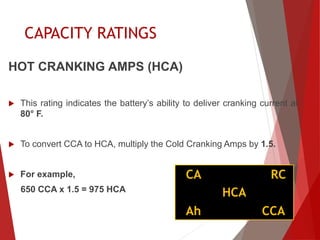
HOT CRANKING AMPS (HCA)
 This rating indicates the battery’s ability to deliver cranking current at
80° F.
 To convert CCA to HCA, multiply the Cold Cranking Amps by 1.5.
 For example,
650 CCA x 1.5 = 975 HCA
CA
Ah
HCA
CCA
RC
CAPACITY RATINGS
RESERVE CAPACITY (RC)
 This is the time in minutes that a vehicle can be driven after the
charging system fails.
 The assumed battery load is a constant discharge current of 25 Amps.
 The Reserve Capacity is the length
of time a fully charged battery at
80° F can supply 25 Amps before
the voltage falls below 10.5 V.
CA
Ah
HCA
CCA
RC
CAPACITY RATINGS
AMPERE HOURS (Ah)
 This is the amount of current a fully charged battery can supply for 20
hours without the voltage falling below 10.5 V at 80° F.
 For example, if a battery can deliver 4 Amps under these
conditions, it is an 80 Ah battery.
 4 Amps x 20 Hours = 80 Ah.
CA
Ah
HCA
CCA
RC
CAPACITY RATINGS
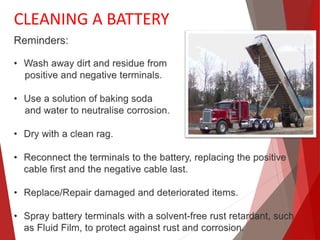
CLEANING A BATTERY
CLEANING A BATTERY
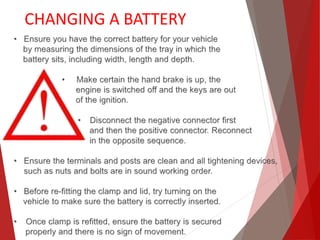
CHANGING A BATTERY
CHANGING A BATTERY
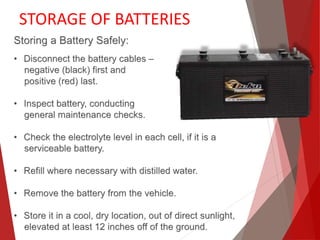
STORAGE OF BATTERIES
• Using the correct method of charging a battery is
essential to its longevity.
• Both too much or too
little charging can be
disastrous to the battery
and result in a shorter life.
• Batteries should be tested regularly to ensure they are
being correctly charged and are running at the proper
amount of voltage.
CHARGING A BATTERY
Batteries can easily be under-charged. Having to
frequently jump-start a battery signifies inferior charging.
This can be a result of any of the following:
• Damaged or Frayed Battery Cables
• Dirt or Corrosion on Battery Terminals and Poles
• Slack Terminals
• Cracked Battery Case
• Defective Alternator :
o Inspect the alternator or serpentine belts to be sure
they are properly tensioned.
o They should move less than an inch from
their resting place.
o If they are torn, cracked or frayed, they
should be replaced.
UNDER-CHARGING BATTERIES
Constant over-charging of a battery will rapidly destroy it.
Batteries that have been over-charged can be
identified by the following traits:
o Swollen case
o Strong odour
o Twisted or deformed shape
How to check your battery for overcharging:
o Start your vehicle.
o Ensure the engine is running at a fast idle.
o Measure the voltage that runs through the battery terminals.
o It should be between 12.8V and 14.7V. Anything higher than
14.7V indicates overcharging in the battery.
o Also measure the alternator voltage, which
should be between 12.8V and 14.7V as well.
OVER-CHARGING BATTERIES
Avoid over-charging by:
o Having your alternator checked regularly by a mechanic
to make sure it is operating efficiently. Malfunctioning
alternators often send too much voltage to the battery,
causing overcharging.
o Conducting a battery load test on your
battery every six months.
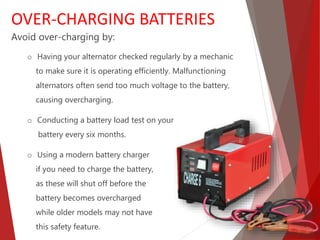
o Using a modern battery charger
if you need to charge the battery,
as these will shut off before the
battery becomes overcharged
while older models may not have
this safety feature.
OVER-CHARGING BATTERIES
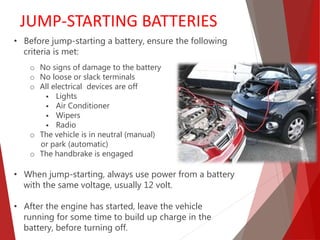
• Before jump-starting a battery, ensure the following
criteria is met:
o No signs of damage to the battery
o No loose or slack terminals
o All electrical devices are off
 Lights
 Air Conditioner
 Wipers
 Radio
o The vehicle is in neutral (manual)
or park (automatic)
o The handbrake is engaged
• When jump-starting, always use power from a battery
with the same voltage, usually 12 volt.
• After the engine has started, leave the vehicle
running for some time to build up charge in the
battery, before turning off.
JUMP-STARTING BATTERIES
DO:
 Regular inspection and maintenance, especially in
extremely hot and dusty conditions.
 Frequently clean battery of dirt and water
 Regularly neutralise and clean off corrosion, spraying
with an anti-corrosive substance.
 Recharge batteries immediately after discharge.
 Check charging rate of alternator frequently.
 Disconnect the battery whenever you work on it,
but be sure to shut the engine off first.
 Use gloves and goggles for protection when
working with a battery.
 Remove negative cables first and replace last when
maintaining, charging or testing a battery.
 Replace any cracked or damaged batteries immediately!
BATTERY DO’S
DON’T:
Disconnect battery cables while the engine is running.
Store a battery in a discharged state.
Place your vehicle into storage without some type of
device to keep the battery charged.
Add new acid to the electrolyte.
Add filtered or tap water to the electrolyte, as it may contain minerals that
will contaminate the electrolyte.
Discharge a battery any deeper than you possibly have to.
Mix sizes and types of batteries.
Allow slack connections.
Smoke around a battery.
Hammer or shove terminals onto battery poles.
BATTERY DON’TS
When do I need to replace my battery?
Battery replacement may be necessary if you experience any of
following:
• Loss of power in cold or extended starts
• Slow or interrupted turnover of the starting motor
• Battery discharge light on the vehicle instrument panel is lit
• Cracks or other obvious damage to battery case
If you are experiencing any of these symptoms, you should have
your battery and electrical system checked.
Why are slack or loose connections between terminals and poles so
destructive to a battery?
• Loose connections cause an electrical arching effect
• This destroys and damages battery poles and terminals
• Can also cause damage to the electrical system and
alternator.
FREQUENTLY-ASKED QUESTIONS
How does excessive heat affect my battery?
• Heat increases the rate of evaporation
• This causes a loss of water from the electrolyte
• Extreme heat also increases the rate of self-discharge and
promotes the corrosion of the positive plate grids.
• Heat is the number one killer of a battery
• It may increase performance in the short-term, but
battery life is drastically reduced over time.
What characteristics should I look for in a battery?
• Characteristics of a reliable battery:
o Maintenance Free
o Heat Resistant
o Vibration Resistant
o High Cranking Amps
o Warranty on both gas and diesel vehicles
FREQUENTLY-ASKED QUESTIONS
What causes a battery to explode?
• Batteries contain sulphuric acid electrolyte
• This is a highly corrosive substance that produces gases
• When ignited, it will explode.
• Explosions could result from the following:
• Metal objects, such as rings, watch straps or hand tools
brushing the battery and creating a spark
• Jump-starting a battery that is leaking
• Having smoke or naked flames near batteries which could
ignite the gases released.
THE END
Thank you for
attending!

Battery product knowledge

  • 1.
  • 3.
    • Established in1944 • ISO 9001 certified in 1994 • ISO 14001 certified in 1998 • 3 locations by 2000 • Received eco-friendly certification in 2007 • Acquired by Hankook Tyre Company Ltd. in 1977 • Largest automotive battery producer in Korea Map of South Korea ABOUT ATLAS BX
  • 5.
  • 6.
  • 7.
  • 8.
  • 9.
  • 10.
  • 11.
  • 12.
    Batteries are veryoften damaged and destroyed through constant vibration and severe impact. Avoid this by checking for the following: • Deteriorated battery cables • Loose or slack connections between the terminals and poles • Cracked or broken battery tray • Loose or defective battery hold-down clamp • Corroded battery hold down clamp • Misfit battery – too small or too large Where applicable, make repairs immediately! NEVER hammer or shove terminals onto poles – this is sure to drastically decrease the life of the battery. GENERAL MAINTENANCE
  • 13.
  • 14.
  • 15.
    AGM BATTERIES Characteristics ofan AGM Battery:  Has a very low internal resistance and therefore is able to deliver high currents on demand.  Lighter than the flooded lead acid type battery  Provides good electrical reliability  Spill proof  Maintenance free
  • 16.
    Characteristics of anAGM Battery:  Allows for extremely deep discharges, of up to 80%, without being damaged.  Has a charging rate that is five times faster than that of a flooded lead acid battery!  Extreme vibration protection resists vibration damage for better performance and longer life.  Tough, stainless steel terminals prevent corrosion for more power and better performance. AGM BATTERIES
  • 17.
  • 18.
     Several BatteryCapacity Ratings have been established to determine the current capacity of a battery.  The current capacity is an indication of the battery’s ability to develop and deliver high amperage current to the starter, and provide reserve power to the electrical system.  Some commonly used ratings are:-  Cold Cranking Amps  Cranking Amps  Hot Cranking Amps  Reserve Capacity  Ampere Hours CA Ah HCA CCA RC CAPACITY RATINGS
  • 19.
    COLD CRANKING AMPS(CCA)  This rating indicates the battery’s ability to deliver a specified current at low temperature.  It is determined by the amount of current a fully charged battery can supply for thirty (30) seconds at 0° F without the voltage falling below 7.2V. CA Ah HCA CCA RC CAPACITY RATINGS
  • 20.
    CRANKING AMPS (CA) This rating indicates the battery’s ability to deliver cranking current at 32° F.  To convert CCA to CA, multiply the Cold Cranking Amps by 1.25.  For example, 650 CCA x 1.25 = 812 CA CA Ah HCA CCA RC CAPACITY RATINGS
  • 21.
    HOT CRANKING AMPS(HCA)  This rating indicates the battery’s ability to deliver cranking current at 80° F.  To convert CCA to HCA, multiply the Cold Cranking Amps by 1.5.  For example, 650 CCA x 1.5 = 975 HCA CA Ah HCA CCA RC CAPACITY RATINGS
  • 22.
    RESERVE CAPACITY (RC) This is the time in minutes that a vehicle can be driven after the charging system fails.  The assumed battery load is a constant discharge current of 25 Amps.  The Reserve Capacity is the length of time a fully charged battery at 80° F can supply 25 Amps before the voltage falls below 10.5 V. CA Ah HCA CCA RC CAPACITY RATINGS
  • 23.
    AMPERE HOURS (Ah) This is the amount of current a fully charged battery can supply for 20 hours without the voltage falling below 10.5 V at 80° F.  For example, if a battery can deliver 4 Amps under these conditions, it is an 80 Ah battery.  4 Amps x 20 Hours = 80 Ah. CA Ah HCA CCA RC CAPACITY RATINGS
  • 24.
  • 25.
  • 26.
  • 27.
  • 28.
  • 29.
  • 30.
    • Using thecorrect method of charging a battery is essential to its longevity. • Both too much or too little charging can be disastrous to the battery and result in a shorter life. • Batteries should be tested regularly to ensure they are being correctly charged and are running at the proper amount of voltage. CHARGING A BATTERY
  • 31.
    Batteries can easilybe under-charged. Having to frequently jump-start a battery signifies inferior charging. This can be a result of any of the following: • Damaged or Frayed Battery Cables • Dirt or Corrosion on Battery Terminals and Poles • Slack Terminals • Cracked Battery Case • Defective Alternator : o Inspect the alternator or serpentine belts to be sure they are properly tensioned. o They should move less than an inch from their resting place. o If they are torn, cracked or frayed, they should be replaced. UNDER-CHARGING BATTERIES
  • 32.
    Constant over-charging ofa battery will rapidly destroy it. Batteries that have been over-charged can be identified by the following traits: o Swollen case o Strong odour o Twisted or deformed shape How to check your battery for overcharging: o Start your vehicle. o Ensure the engine is running at a fast idle. o Measure the voltage that runs through the battery terminals. o It should be between 12.8V and 14.7V. Anything higher than 14.7V indicates overcharging in the battery. o Also measure the alternator voltage, which should be between 12.8V and 14.7V as well. OVER-CHARGING BATTERIES
  • 33.
    Avoid over-charging by: oHaving your alternator checked regularly by a mechanic to make sure it is operating efficiently. Malfunctioning alternators often send too much voltage to the battery, causing overcharging. o Conducting a battery load test on your battery every six months. o Using a modern battery charger if you need to charge the battery, as these will shut off before the battery becomes overcharged while older models may not have this safety feature. OVER-CHARGING BATTERIES
  • 34.
    • Before jump-startinga battery, ensure the following criteria is met: o No signs of damage to the battery o No loose or slack terminals o All electrical devices are off  Lights  Air Conditioner  Wipers  Radio o The vehicle is in neutral (manual) or park (automatic) o The handbrake is engaged • When jump-starting, always use power from a battery with the same voltage, usually 12 volt. • After the engine has started, leave the vehicle running for some time to build up charge in the battery, before turning off. JUMP-STARTING BATTERIES
  • 35.
  • 36.
    DO:  Regular inspectionand maintenance, especially in extremely hot and dusty conditions.  Frequently clean battery of dirt and water  Regularly neutralise and clean off corrosion, spraying with an anti-corrosive substance.  Recharge batteries immediately after discharge.  Check charging rate of alternator frequently.  Disconnect the battery whenever you work on it, but be sure to shut the engine off first.  Use gloves and goggles for protection when working with a battery.  Remove negative cables first and replace last when maintaining, charging or testing a battery.  Replace any cracked or damaged batteries immediately! BATTERY DO’S
  • 37.
    DON’T: Disconnect battery cableswhile the engine is running. Store a battery in a discharged state. Place your vehicle into storage without some type of device to keep the battery charged. Add new acid to the electrolyte. Add filtered or tap water to the electrolyte, as it may contain minerals that will contaminate the electrolyte. Discharge a battery any deeper than you possibly have to. Mix sizes and types of batteries. Allow slack connections. Smoke around a battery. Hammer or shove terminals onto battery poles. BATTERY DON’TS
  • 38.
    When do Ineed to replace my battery? Battery replacement may be necessary if you experience any of following: • Loss of power in cold or extended starts • Slow or interrupted turnover of the starting motor • Battery discharge light on the vehicle instrument panel is lit • Cracks or other obvious damage to battery case If you are experiencing any of these symptoms, you should have your battery and electrical system checked. Why are slack or loose connections between terminals and poles so destructive to a battery? • Loose connections cause an electrical arching effect • This destroys and damages battery poles and terminals • Can also cause damage to the electrical system and alternator. FREQUENTLY-ASKED QUESTIONS
  • 39.
    How does excessiveheat affect my battery? • Heat increases the rate of evaporation • This causes a loss of water from the electrolyte • Extreme heat also increases the rate of self-discharge and promotes the corrosion of the positive plate grids. • Heat is the number one killer of a battery • It may increase performance in the short-term, but battery life is drastically reduced over time. What characteristics should I look for in a battery? • Characteristics of a reliable battery: o Maintenance Free o Heat Resistant o Vibration Resistant o High Cranking Amps o Warranty on both gas and diesel vehicles FREQUENTLY-ASKED QUESTIONS
  • 40.
    FREQUENTLY-ASKED QUESTIONS What causesa battery to explode? • Batteries contain sulphuric acid electrolyte • This is a highly corrosive substance that produces gases • When ignited, it will explode. • Explosions could result from the following: • Metal objects, such as rings, watch straps or hand tools brushing the battery and creating a spark • Jump-starting a battery that is leaking • Having smoke or naked flames near batteries which could ignite the gases released.
  • 41.
    THE END Thank youfor attending!