Energy Storage
• “Energystorages” are defined as the devices that
store energy, deliver energy outside (discharge),
and accept energy from outside (charge).
• There are several types of energy storages that have
been proposed for electric vehicle (EV) and hybrid
electric vehicle (HEV) applications.
• These energy storages, so far, mainly include
chemical batteries, ultra-capacitors or super-
capacitors, fuel cell and ultrahigh-speed flywheels.
4.
Energy Storage
• Thereare a number of requirements for energy storage
applied in an automotive application, such as specific energy,
specific power, efficiency, maintenance requirement,
management, cost, environmental adaptation and
friendliness, and safety.
• For allocation on an EV, specific energy is the first
consideration since it limits the vehicle range.
• On the other hand, for HEV applications, specific energy
becomes less important and specific power is the first
consideration, because all the energy is from the energy
source (engine or fuel cell) and sufficient power is needed to
ensure vehicle performance, particularly during acceleration,
hill climbing, and regenerative braking.
5.
Battery
• In nearlyall road vehicles the battery is a key
component. In the classical EV the battery is the only
energy store, and the component with the highest
cost, weight and volume.
• In hybrid vehicles the battery, which must continually
accept and give out electrical energy, is also a key
component of the highest importance.
• Some fuel cell (FC) vehicles have been made which
have batteries that are no larger than those normally
fitted to IC engine cars, but it is probably that most
early FC-powered vehicles will have quite large
batteries and work in hybrid FC/battery mode.
6.
Batteries
• A batteryconsists of two or more electric cells joined
together.
• The cells convert chemical energy to electrical energy.
• The cells consist of positive and negative electrodes
joined by an electrolyte.
• It is the chemical reaction between the electrodes and
the electrolyte which generates DC electricity.
• In the case of secondary or rechargeable batteries, the
chemical reaction can be reversed by reversing the
current and the battery returned to a charged state.
7.
Batteries
• The ‘leadacid’ battery is the most well known
rechargeable type.
• At present
– Lead acid,
– nickel iron,
– nickel cadmium,
– nickel metal hydride,
– lithium polymer and lithium iron, sodium sulphur and
sodium metal chloride.
8.
• Electric vehicles(EVs) primarily use lithium-ion batteries. These batteries
are favored for EVs because they offer a high energy density, long cycle life,
and relatively low self-discharge compared to other battery types. Lithium-
ion batteries also provide the necessary power output and efficiency
needed for the extended range and performance of modern EVs.
• There are several variations of lithium-ion batteries, each with different
chemistries to balance aspects like energy density, cost, safety, and lifespan:
• Nickel Cobalt Manganese (NCM or NMC): Commonly used in many EVs,
offering a balance of energy density, power, and longevity.
• Nickel Cobalt Aluminum (NCA): Known for high energy density and used in
some Tesla models.
• Lithium Iron Phosphate (LFP): Offers better thermal stability and safety,
with a longer lifespan but slightly lower energy density. It's becoming more
popular in EVs, especially for models that prioritize safety and longevity.
• Advancements in battery technology are ongoing, with research into solid-
state batteries, which promise even higher energy densities, faster
charging, and improved safety.
9.
Overview of Batteries
•From the electric vehicle designer’s point of view the battery
can be treated as a ‘black box’ which has a range of
performance criteria. These criteria will include:
– Specific energy
– Energy density
– Specific power
– Typical voltages
– Amp hour efficiency
– Energy efficiency
– Commercial availability
– Cost, operating temperatures
– Self-discharge rates
– Number of life cycles
– Recharge rates
10.
Overview of Batteries
•The designer also needs to understand how
energy availability varies with regard to:
– Ambient temperature
– Charge and discharge rates
– Battery geometry
– Optimum temperature
– Charging methods
– Cooling needs
11.
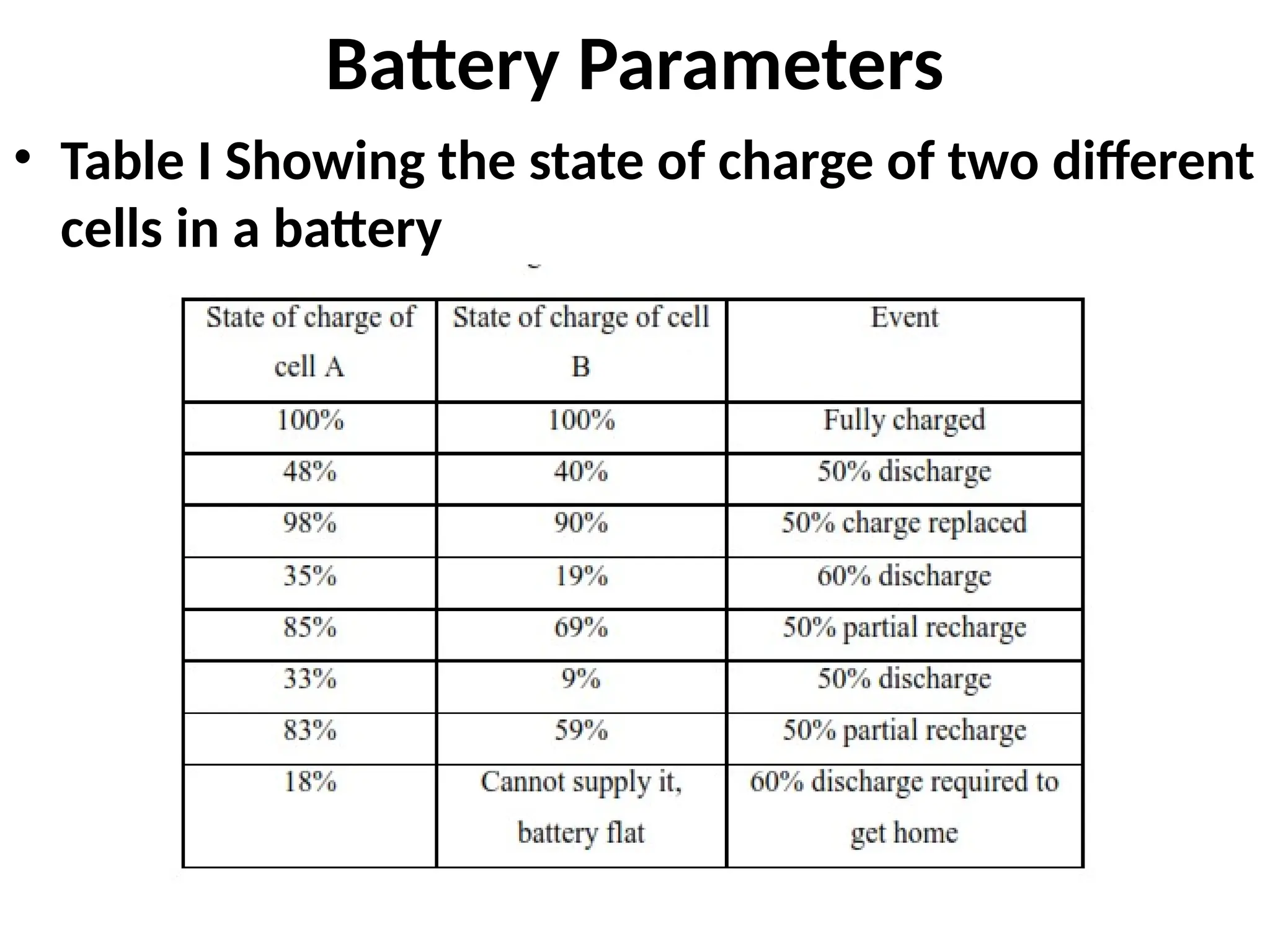
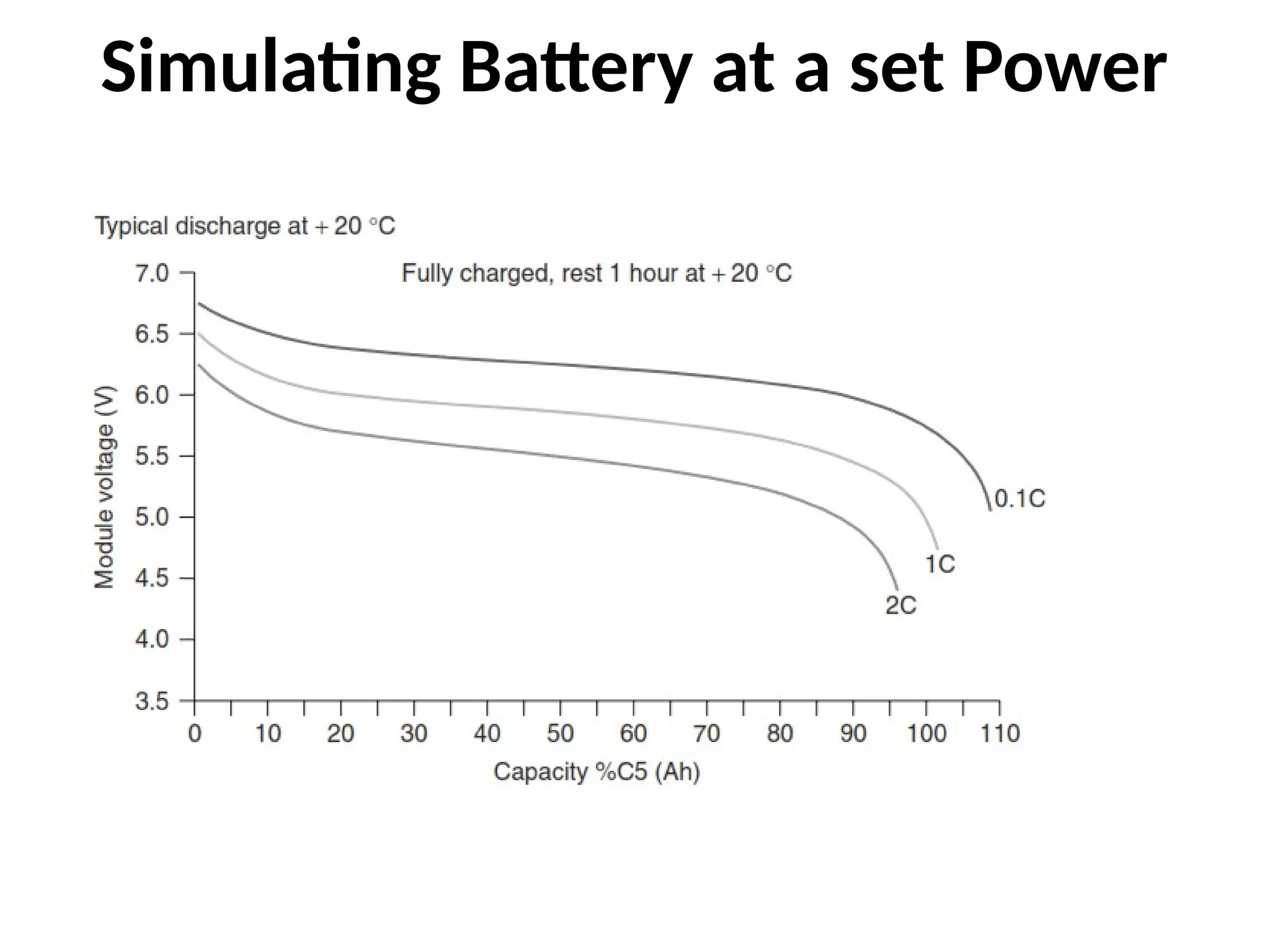
Battery Parameters
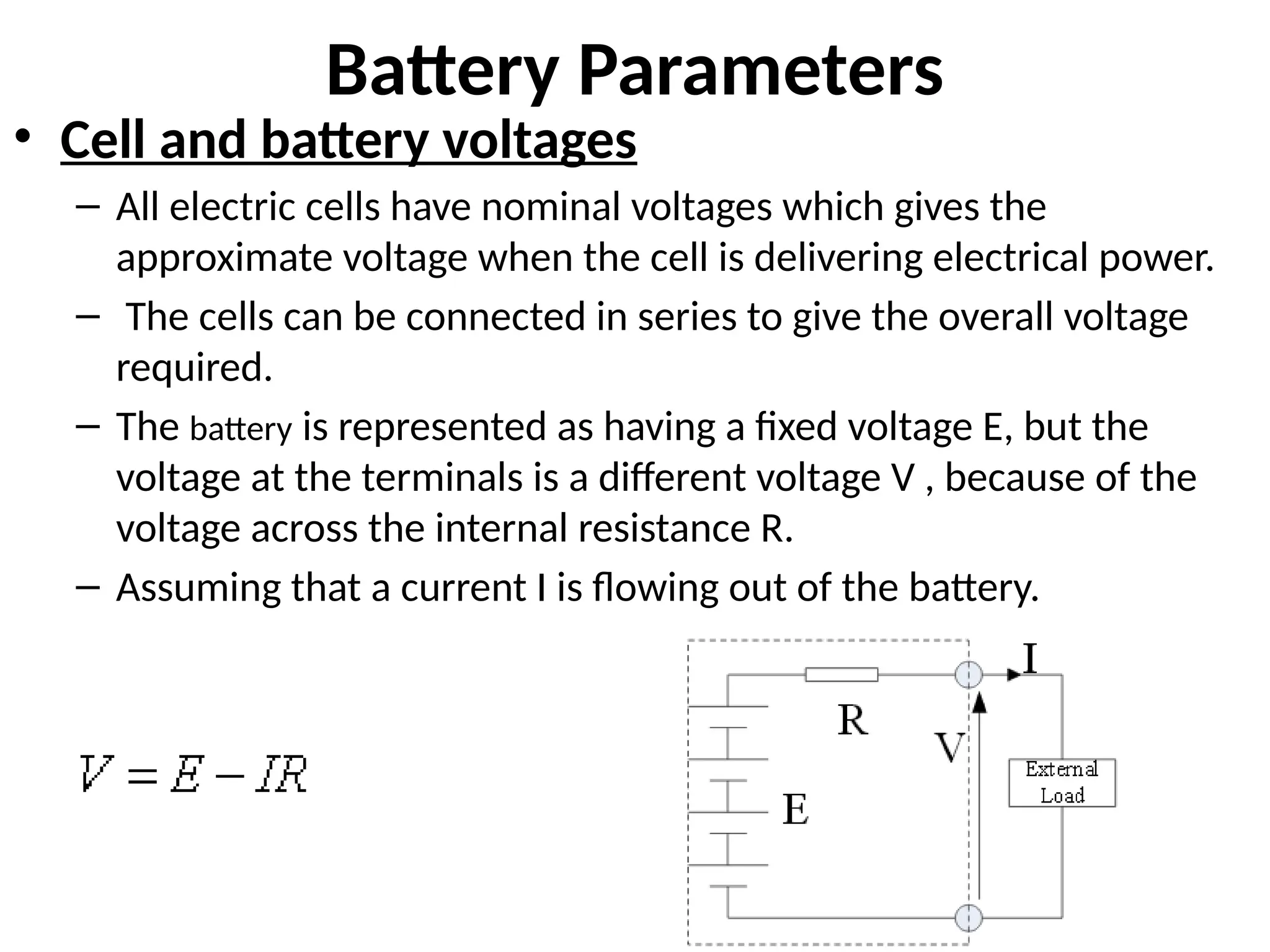
• Celland battery voltages
– All electric cells have nominal voltages which gives the
approximate voltage when the cell is delivering electrical power.
– The cells can be connected in series to give the overall voltage
required.
– The battery is represented as having a fixed voltage E, but the
voltage at the terminals is a different voltage V , because of the
voltage across the internal resistance R.
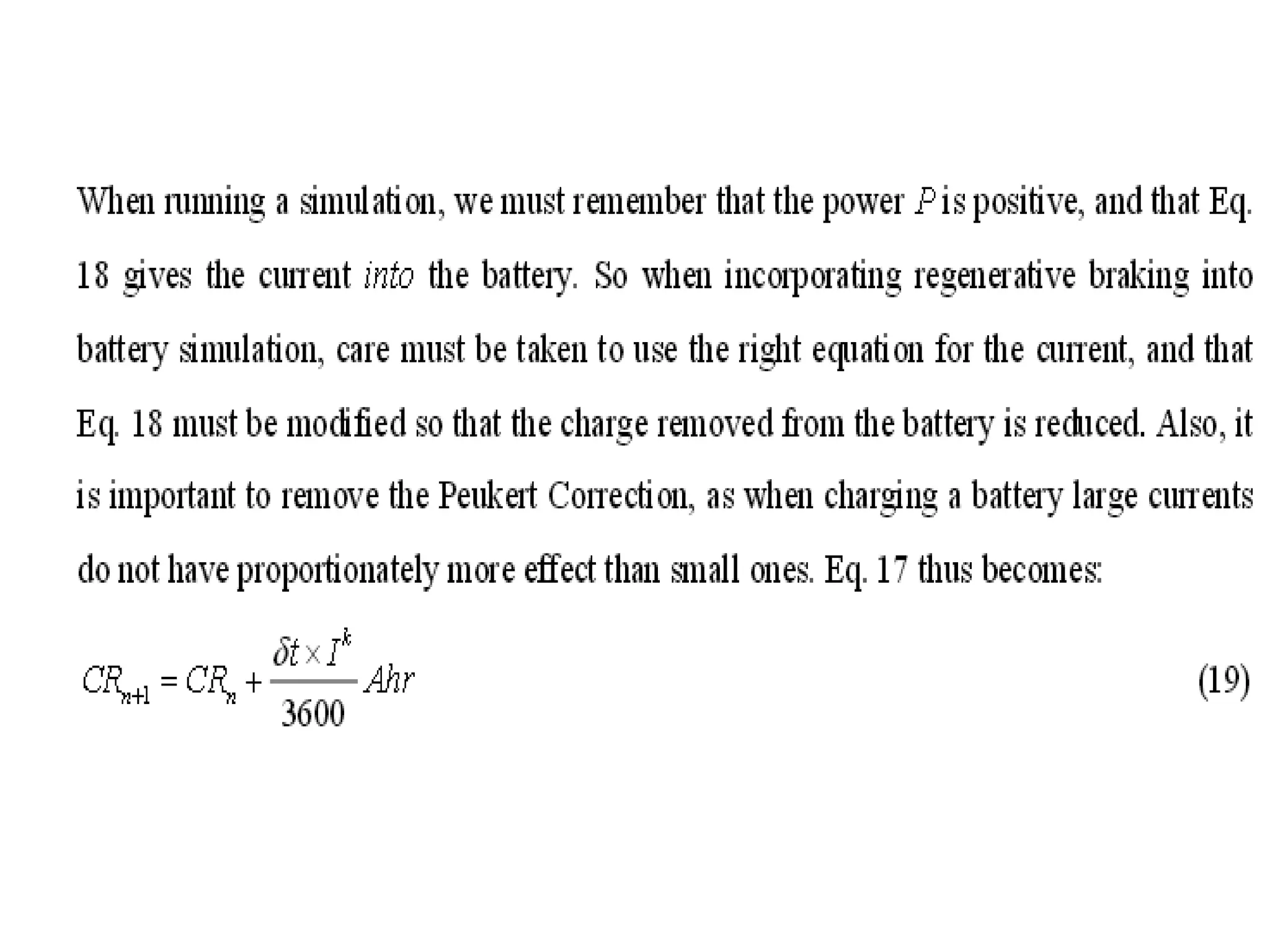
– Assuming that a current I is flowing out of the battery.
12.
Battery Parameters
• Charge(or Ahr) capacity
– The electric charge that a battery can supply is
clearly a most crucial parameter.
– The SI unit for this is the Coulomb, the charge
when one Amp flows for one second.
– The capacity of a battery might be, say,
10Amphours. This means it can provide 1Amp for
10 hours.
13.
Battery Parameters
• Energystored
– The energy stored in a battery depends on its voltage, and the charge stored.
The SI unit is the Joule, but this is an inconveniently small unit, and so we use
the Whr instead.
• Specific energy
– Specific energy is the amount of electrical energy stored for every kilogram
of battery mass. It has units of Wh.k1
• Power Density
– Power density measures how quickly a battery can deliver energy. It's
important for acceleration, regenerative braking, and fast charging.
– Batteries with high power density can provide rapid bursts of energy,
improving vehicle performance
• Energy density
– Energy density is a critical parameter for EV batteries. It refers to the amount
of energy a battery can store per unit of weight or volume.
– High energy density batteries enable longer driving ranges for EVs without
significantly increasing their weight or size.
– −3
14.
Battery Parameters
• Specificpower
– Specific power is the amount of power obtained per kilogram of
battery. It is a highly variable and rather anomalous quantity, since the
power given out by the battery depends far more upon the load
connected to it than the battery itself.
• Ahr (or charge) efficiency
– In an ideal world a battery would return the entire charge put into it, in
which case the amp hour efficiency is 100%. However, no battery does;
its charging efficiency is less than 100%. The precise value will vary
with different types of battery, temperature and rate of charge. It will
also vary with the state of charge.
• Energy efficiency
– This is another very important parameter and it is defined as the ratio
of electrical energy supplied by a battery to the amount of electrical
energy required to return it to the state before discharge.
15.
Battery Parameters
• Self-dischargerates
– Most batteries discharge when left unused, and this is known as
self-discharge. This is important as it means some batteries cannot
be left for long periods without recharging.
– The rate varies with battery type, and with other factors such as
temperature; higher temperatures greatly increase self-discharge.
• Battery temperature, heating and cooling needs
– Although most batteries run at ambient temperature, some run at
higher temperatures and need heating to start with and then
cooling when in use.
– In others, battery performance drops off at low temperatures,
which is undesirable, but this problem could be overcome by
heating the battery.
– When choosing a battery the designer needs to be aware of
battery temperature, heating and cooling needs, and has to take
these into consideration during the vehicle design process.
16.
Battery Parameters
• Batterylife and number of deep cycles
– Most rechargeable batteries will only undergo a few
hundred deep cycles to 20% of the battery charge.
– However, the exact number depends on the battery
type, and also on the details of the battery design,
and on how the battery is used.
– This is a very important figure in a battery
specification, as it reflects in the lifetime of the
battery, which in turn reflects in electric vehicle
running costs.
17.
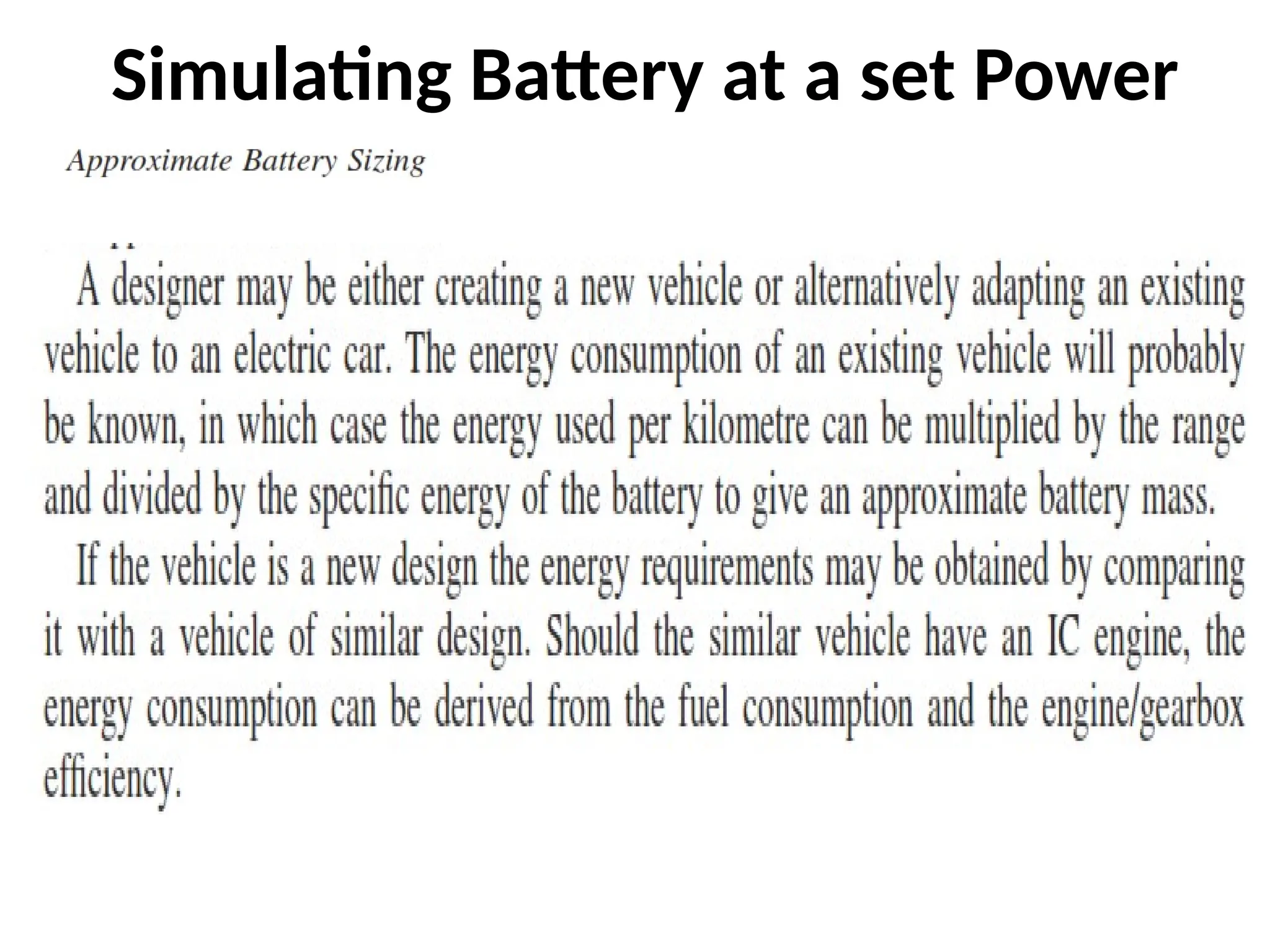
• Range vs.Cost Trade-off:
– Battery capacity directly affects an EV's driving range. However, larger
batteries are costlier.
– Analyzing the balance between range and cost is essential for optimizing
the EV's value proposition.
• Battery Chemistry:
– Different battery chemistries, such as lithium-ion, lithium-polymer, and
solid-state batteries, offer varying performance characteristics.
– Analyzing the pros and cons of each chemistry is crucial for selecting the
right battery for EVs.
• Cycle Life:
– Battery cycle life refers to the number of charge-discharge cycles a
battery can undergo before its capacity significantly degrades.
– Long cycle life is essential to ensure the longevity of an EV's battery pack.
• Charging Infrastructure:
• The availability and capacity of charging infrastructure impact the practicality of
EVs.
• Fast-charging technology and widespread charging networks are
essential for the convenience of EV owners.
18.
• Cost-Benefit Analysis:- Evaluating the total cost of
ownership (TCO) of an EV, including the battery,
maintenance, and electricity costs, is essential for
consumers and fleet operators.
• Second-Life Use: - Investigating potential second-life
applications for EV batteries, such as energy storage for
homes or grid stabilization, can extend their usefulness.
• Recycling and Disposal: - Analyzing end-of-life strategies for
batteries, including recycling and proper disposal, is crucial
for minimizing environmental impact.
• Regulatory Compliance: - Compliance with safety and
environmental regulations is essential for battery
manufacturing and EV operation.
19.
• Thermal Management:
–EV batteries generate heat during charging and discharging, affecting
performance and longevity.
– Effective thermal management systems are essential to maintain battery
health.
• Environmental Impact:
– Assessing the environmental impact of battery production, usage, and disposal
is vital.
– Analyzing the life cycle emissions and sustainability of battery materials helps
make informed decisions.
• Energy Storage Management:
– Advanced battery management systems (BMS) optimize charging and
discharging to maximize battery life and performance.
– Analyzing BMS data can provide insights into battery health and usage patterns.
20.
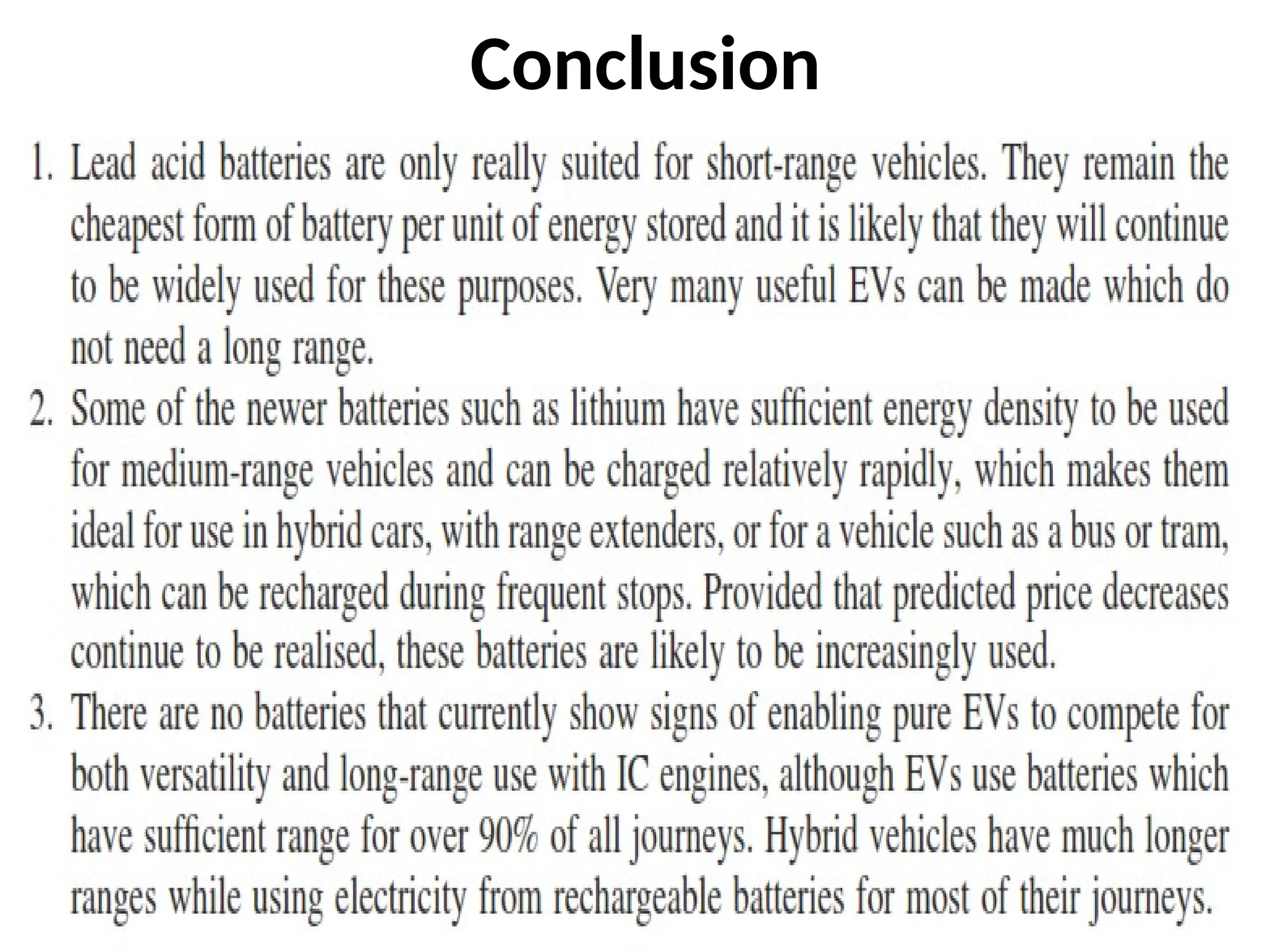
• The choiceof battery type for an electric
vehicle depends on factors like cost,
performance requirements, safety, and
availability of materials. As technology
continues to advance, the EV industry is likely
to see ongoing improvements in battery
technology, including higher energy density,
faster charging, and increased sustainability.
21.
• The rangeof electric two-wheelers, such as scooters
and motorcycles, varies depending on factors like
battery capacity, motor efficiency, and riding
conditions. Here's a general overview:
• 1. Entry-Level Electric Two-Wheelers
– Range: 30 to 60 km (18 to 37 miles) per charge.
– Battery Capacity: Typically 1 kWh to 2 kWh.
– Use Case: Ideal for short commutes and city riding.
– Examples: Hero Electric Optima, Ampere Reo.
• 2. Mid-Range Electric Two-Wheelers
– Range: 60 to 100 km (37 to 62 miles) per charge.
– Battery Capacity: Around 2 kWh to 3.5 kWh.
– Use Case: Suitable for moderate commutes and urban
areas.
– Examples: Ather 450X, Bajaj Chetak, TVS iQube.
22.
• 3. High-EndElectric Two-Wheelers
– Range: 100 to 150 km (62 to 93 miles) or more per charge.
– Battery Capacity: Typically 4 kWh to 6 kWh or higher.
– Use Case: Longer commutes, touring, or high-performance needs.
– Examples: Revolt RV400, Ola S1 Pro.
• 4. Performance Electric Motorcycles
– Range: 150 to 250 km (93 to 155 miles) per charge.
– Battery Capacity: Higher capacity, usually 6 kWh to 10 kWh or more.
– Use Case: High-speed performance, longer rides, and touring.
– Examples: Zero SR/F, Harley-Davidson LiveWire.
• Factors Affecting Range:
– Speed: Higher speeds consume more energy, reducing range.
– Riding Mode: Eco modes extend range, while Sport modes reduce it.
– Terrain: Hilly or rough terrain requires more power, decreasing range.
– Weight: Additional rider or cargo weight can reduce range.
– Weather Conditions: Extreme temperatures can affect battery
efficiency.
24.
Types of Battery
•Electric vehicles (EVs) use a variety of battery
types, but the most common and widely used
battery chemistry for EVs is lithium-ion (Li-
ion). Li-ion batteries offer a good balance of
energy density, power density, and overall
performance for electric vehicles. However,
there are other battery types and emerging
technologies being explored for EV
applications.
25.
•
• Lithium-Ion (Li-ion)Batteries:
– Li-ion batteries are the most prevalent battery technology in electric
vehicles today.
– They offer high energy density, providing a good balance between
range and weight.
– Li-ion batteries have a relatively long cycle life and can be fast-
charged, making them suitable for various EV applications.
• Lithium-Polymer (LiPo) Batteries:
– LiPo batteries are similar to Li-ion batteries but use a solid or gel-like
electrolyte.
– They offer flexibility in terms of packaging and can be shaped to fit
specific vehicle designs.
– LiPo batteries are less common in passenger EVs but are used in
some niche applications.
26.
• Lithium-Iron-Phosphate (LiFePO4)Batteries:
– LiFePO4 batteries are known for their safety, stability, and long
cycle life.
– They have a lower energy density compared to traditional Li-
ion batteries but are less prone to thermal runaway.
– LiFePO4 batteries are used in some electric buses and
commercial vehicles.
• Solid-State Batteries:
– Solid-state batteries are an emerging technology that replaces
the liquid electrolyte in Li-ion batteries with a solid electrolyte.
– They offer the potential for higher energy density, faster
charging, and improved safety.
– Solid-state batteries are still in the development and early
adoption stages but hold promise for future EVs.
27.
• Nickel-Metal Hydride(NiMH) Batteries:
– NiMH batteries were once commonly used in hybrid
electric vehicles (HEVs) like the Toyota Prius.
– They offer good durability and reliability but have
lower energy density compared to Li-ion batteries.
– NiMH batteries have been largely replaced by Li-ion
technology in modern EVs.
• Nickel-Cadmium (NiCd) Batteries:
– NiCd batteries were used in some early electric
vehicles but are now rarely used due to environmental
concerns associated with cadmium.
– They have been largely replaced by NiMH and Li-ion
technologies.
28.
• Sodium-Ion Batteries:
–Sodium-ion batteries are being explored as a potential alternative to Li-ion
batteries.
– They use sodium as the charge carrier instead of lithium and have the
advantage of using more abundant materials.
– Sodium-ion batteries are still in the research and development stage for EV
applications.
• Hydrogen Fuel Cells:
– While not technically batteries, hydrogen fuel cells are an alternative to
battery-electric vehicles.
– They use hydrogen gas to generate electricity through a chemical reaction
with oxygen, emitting only water as a byproduct.
– Fuel cell vehicles (FCVs) are considered electric vehicles but rely on fuel cells
instead of batteries for electricity generation.
• The choice of battery type for an electric vehicle depends on factors like cost,
performance requirements, safety, and availability of materials. As technology
continues to advance, the EV industry is likely to see ongoing improvements in
battery technology, including higher energy density, faster charging, and
increased sustainability.
29.
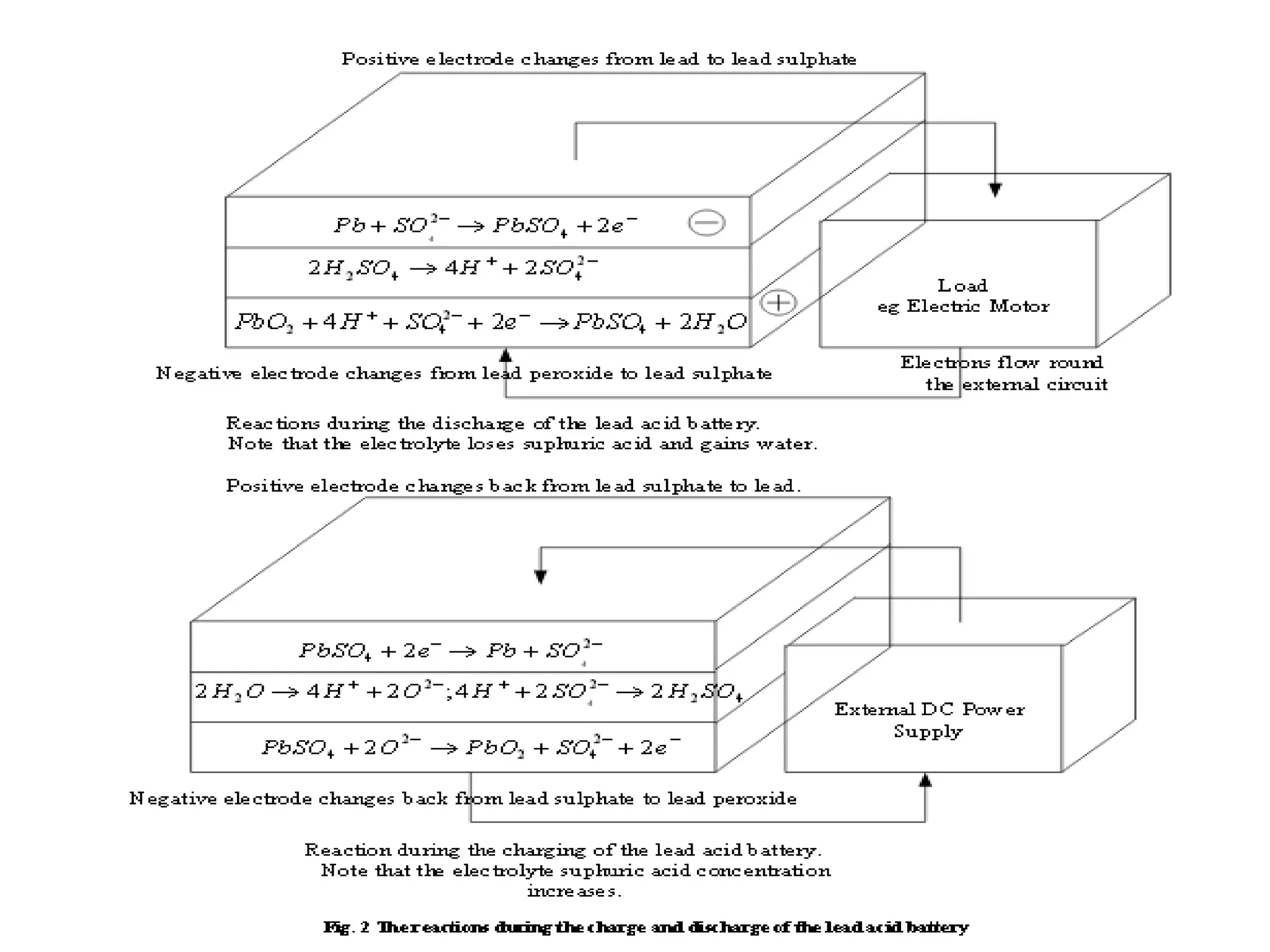
Lead Acid Batteries
•Chemical Reactions:
– During Discharge (when the battery is providing power):
• At the positive plate (PbO2), lead dioxide (PbO2) reacts with
sulfuric acid (H2SO4) to form lead sulfate (PbSO4) and water
(H2O) while releasing electrons.
• PbO2 + H2SO4 → PbSO4 + H2O + 2e-
• At the negative plate (Pb), sponge lead (Pb) reacts with sulfuric
acid to form lead sulfate and release electrons.
• Pb + H2SO4 → PbSO4 + 2e-
– Electrons flow from the negative plate through an external
circuit to the positive plate, creating an electric current that
can power devices connected to the battery.
33.
Lead Acid Batteries
•A lead-acid battery is a type of rechargeable battery commonly used in
various applications, including automotive vehicles, uninterruptible power
supplies (UPS), and backup power systems. It operates based on chemical
reactions that occur between lead dioxide (PbO2) and sponge lead (Pb)
electrodes immersed in a sulfuric acid (H2SO4) electrolyte solution. Here's
a simplified explanation of how a lead-acid battery works:
• Basic Components: A lead-acid battery consists of several key
components:
– Positive Plate (PbO2): This is typically made of lead dioxide.
– Negative Plate (Pb): This is usually made of sponge lead.
– Separator: It's a porous material that keeps the positive and negative plates from
coming into direct contact.
– Electrolyte: A diluted sulfuric acid solution that serves as the medium for ion
exchange between the plates.
34.
Lead Acid Batteries
•Charge and Reversal:
– When the battery is being charged, an external voltage source is
applied across the battery terminals.
– This reverses the chemical reactions: lead sulfate at the positive and
negative plates converts back into lead dioxide and sponge lead,
respectively, while consuming electrical energy from the charger.
– The sulfuric acid concentration in the electrolyte increases during
charging.
• Electrolyte Concentration:
– Over time, as the battery is discharged and recharged, the sulfuric acid
in the electrolyte is consumed and the concentration decreases.
– A decrease in sulfuric acid concentration can reduce the battery's
capacity and performance.
35.
Lead Acid Batteries
•Maintenance:
– To ensure the longevity and performance of lead-acid batteries, they may
require periodic maintenance, including topping off with distilled water to
maintain the proper electrolyte level and specific gravity.
• Safety Considerations:
– Lead-acid batteries can produce hydrogen gas during charging, which can
be flammable and pose safety risks. Adequate ventilation is necessary
when using or charging these batteries.
• Lead-acid batteries are known for their reliability and ability to
deliver high current, which makes them suitable for applications
requiring a burst of power, such as starting a car engine. However,
they have certain limitations, including relatively low energy density
and sensitivity to deep discharges, which can reduce their lifespan.
36.
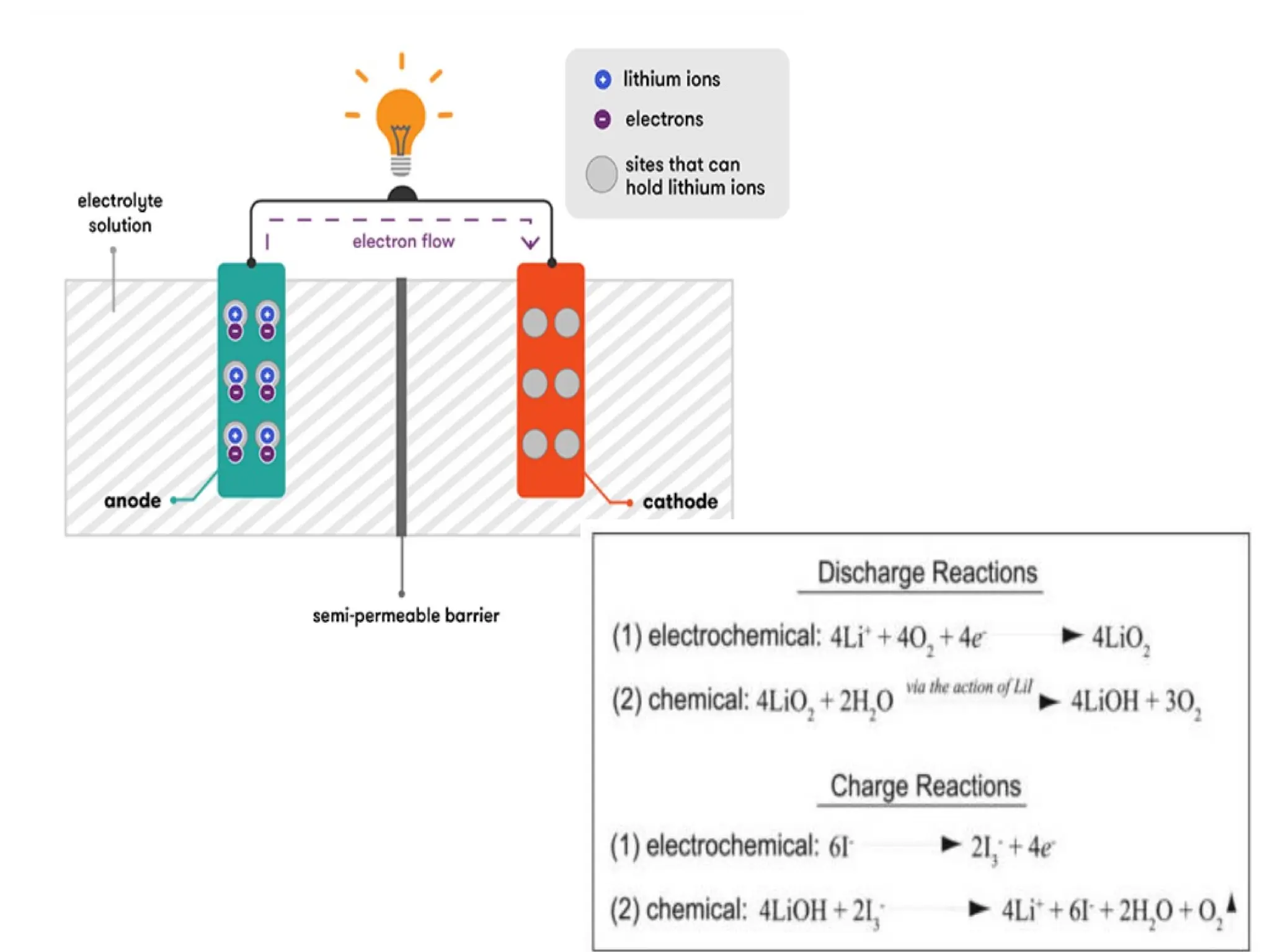
Lithium-ion batteries
• Lithium-ionbatteries, often abbreviated as Li-ion
batteries, are widely used in various applications,
from portable electronics like smartphones and
laptops to electric vehicles and renewable energy
storage systems. These batteries work based on the
movement of lithium ions between the battery's
positive and negative electrodes during charging
and discharging cycles. Here's how a typical lithium-
ion battery works:
37.
Lithium-ion batteries
• 1.Anode (Negative Electrode): The anode of a lithium-ion battery
is typically made of a carbon-based material, such as graphite.
When the battery is in a discharged state, the anode is host to
lithium ions. During charging, lithium ions are stored in the anode
as the battery takes in electrical energy.
• 2. Cathode (Positive Electrode): The cathode is typically composed
of a lithium-containing compound, which can vary depending on
the specific type of lithium-ion battery. Common cathode
materials include lithium cobalt oxide (LiCoO2), lithium iron
phosphate (LiFePO4), and others. When the battery is charged, the
cathode undergoes a chemical reaction that involves the
movement of lithium ions from the anode to the cathode.
38.
Lithium-ion batteries
• involvesthe movement of lithium ions from the anode to the
cathode.
• 3. Electrolyte: A lithium-ion battery uses a lithium-ion-conductive
electrolyte, which is typically a lithium salt dissolved in a solvent.
This electrolyte allows lithium ions to move from the anode to the
cathode and vice versa while maintaining electrical neutrality within
the battery.
• 4. Separator: A separator material is placed between the anode and
cathode to prevent them from coming into direct contact with each
other. If the anode and cathode were to touch, it could result in a
short circuit and potentially lead to a safety hazard. The separator is
porous and allows the passage of lithium ions while blocking the
flow of electrons.
39.
Lithium-ion batteries
• Charging:
•When you connect the battery to a charger, an external voltage is applied across the
battery terminals.
• Lithium ions from the anode move through the electrolyte and separator to the cathode
due to the voltage difference. These ions are stored in the cathode material.
• The process continues until the cathode is fully saturated with lithium ions, indicating that
the battery is fully charged.
• Discharging:
• When you use the battery to power a device, an external circuit is connected to the
battery terminals.
• Lithium ions stored in the cathode start moving back to the anode through the electrolyte
and separator.
• This flow of lithium ions generates an electric current, which can be used to power your
device.
• As the lithium ions return to the anode, the battery discharges, and its stored energy is
used to provide electrical power.
40.
Lithium-ion batteries
• Thechemical reactions that take place during
charging and discharging are reversible,
allowing lithium-ion batteries to be recharged
and discharged multiple times before their
capacity starts to degrade significantly. The
specific materials used in the anode, cathode,
and electrolyte can vary, leading to different
types of lithium-ion batteries with varying
performance characteristics.
41.
Lithium-ion batteries
• Lithium-ionbatteries (Li-ion batteries) are known for several key
characteristics that have made them a popular choice for various
applications. Here are some of the key characteristics of lithium-ion
batteries:
• High Energy Density: Li-ion batteries have a high energy density,
meaning they can store a significant amount of energy in a relatively
small and lightweight package. This characteristic makes them ideal
for portable electronics, electric vehicles (EVs), and other applications
where size and weight are crucial factors.
• Rechargeable: Li-ion batteries are rechargeable, allowing them to be
used multiple times. They can go through hundreds to thousands of
charge-discharge cycles before their capacity starts to significantly
degrade. This makes them cost-effective in the long run.
42.
Lithium-ion batteries
• LowSelf-Discharge Rate: Li-ion batteries have a relatively low self-discharge
rate, which means they can hold their charge for an extended period when
not in use. This makes them suitable for devices that are not used regularly,
such as emergency backup systems.
• Wide Range of Applications: Li-ion batteries are versatile and used in a wide
range of applications, including smartphones, laptops, digital cameras,
power tools, electric vehicles, renewable energy storage systems, and more.
• Fast Charging: Li-ion batteries can support fast-charging technologies,
allowing users to charge their devices quickly. However, the charging speed
may vary depending on the specific battery chemistry and design.
• Reliable Voltage: Li-ion batteries provide a relatively stable voltage
throughout most of their discharge cycle. This feature ensures that
electronic devices receive a consistent power supply, maintaining
performance until the battery is depleted.
43.
Lithium-ion batteries
• Lightweight:Li-ion batteries are lightweight compared to many
other battery chemistries, which is important for portable devices
and electric vehicles where weight is a critical factor.
• Low Maintenance: Li-ion batteries require minimal maintenance
compared to some other battery types. They do not need
periodic discharge and recharge cycles (as required by some older
battery technologies), and they have no memory effect.
• High Cycle Life: Depending on the specific chemistry and usage,
Li-ion batteries can have a relatively high cycle life, which is the
number of charge-discharge cycles a battery can endure before
capacity significantly diminishes.
• Environmental Considerations: Li-ion batteries are generally
considered more environmentally friendly than some other
battery chemistries, like nickel-cadmium (NiCd), due to the
absence of toxic heavy metals in their composition. However,
recycling and disposal of Li-ion batteries should still be done
44.
Lithium-ion batteries
• It'simportant to note that there are different types
of Li-ion batteries, each with slightly different
characteristics and trade-offs. The choice of Li-ion
chemistry depends on the specific requirements of
the application. For example, lithium iron
phosphate (LiFePO4) batteries are known for their
safety and long cycle life, while lithium cobalt
oxide (LiCoO2) batteries offer high energy density
but may have somewhat shorter cycle lives.
45.
Battery voltage
• Thevoltage of battery cells in an electric vehicle (EV)
battery pack can vary depending on the specific chemistry
and design of the battery.
• Lithium-Ion Batteries: These are the most common type
of batteries used in EVs. A single lithium-ion cell typically
has a nominal voltage of around 3.6 to 3.7 volts. When
fully charged, it can have a voltage of around 4.2 to 4.35
volts. In an EV battery pack, multiple cells are connected
in series to achieve the desired voltage level. Common
voltages for EV battery packs can range from 200 to 800
volts or more, depending on the manufacturer and model.
46.
• Lithium IronPhosphate (LiFePO4) Batteries: LiFePO4 batteries
are another type of lithium-ion battery, known for their stability
and safety. They typically have a nominal voltage of around 3.2 to
3.3 volts per cell. In an EV battery pack, multiple cells are
connected in series to achieve the desired pack voltage.
• Other Chemistries: There are other battery chemistries used in
EVs, such as solid-state batteries and advanced lithium-ion
variants. Each may have its own voltage characteristics.
• It's important to note that the total voltage of an EV battery pack
is determined by the number of cells connected in series. For
example, if you have 100 lithium-ion cells each with a nominal
voltage of 3.6 volts connected in series, the total pack voltage
would be 360 volts (100 cells * 3.6 volts). This pack voltage is
what powers the electric motor and other vehicle systems.
• Additionally, battery management systems (BMS) are used in EVs
to monitor and manage the individual cell voltages within the
pack to ensure safe operation and to prevent overcharging or
over-discharging of the cells
Battery Equivalent Circuit
•Although the equivalent circuit is simple, we do
need to understand that the values of the circuit
parameters (E and R) are not constant. The open-
circuit voltage of the battery E is the most
important to establish first. This changes with the
state of charge of the battery.
Super Capacitor
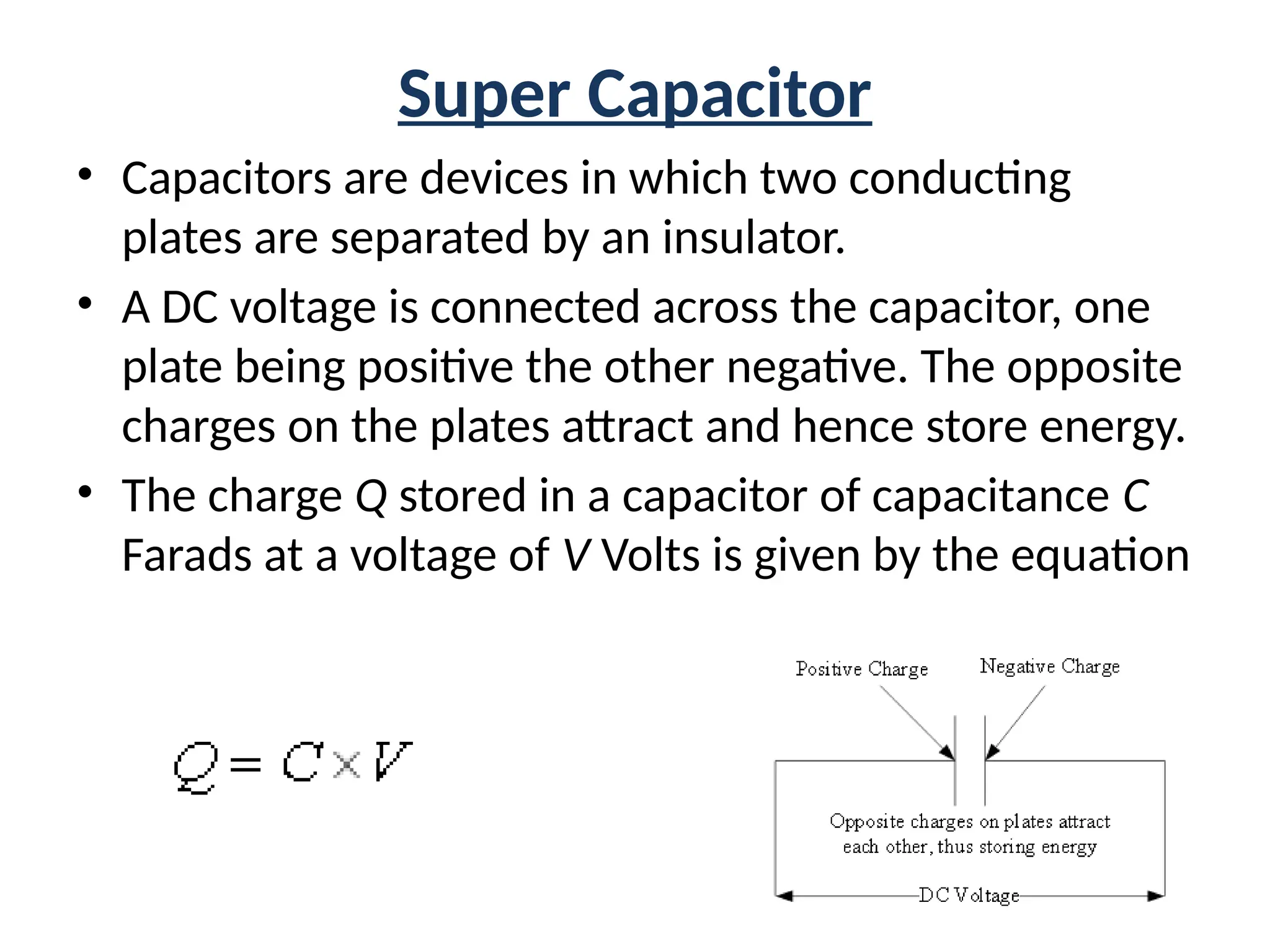
• Capacitorsare devices in which two conducting
plates are separated by an insulator.
• A DC voltage is connected across the capacitor, one
plate being positive the other negative. The opposite
charges on the plates attract and hence store energy.
• The charge Q stored in a capacitor of capacitance C
Farads at a voltage of V Volts is given by the equation
77.
Supercapacitors
• Supercapacitors andtraditional capacitors, while sharing similarities in their
basic function of storing electrical charge, have several key differences in
terms of their construction, energy storage mechanisms, and applications:
• Energy Storage Mechanism:
– Capacitors: Traditional capacitors store electrical energy by accumulating electric
charge on two conductive plates, separated by an insulating material (dielectric).
They store energy in an electric field between the plates. Capacitors are typically
designed for low energy storage and provide rapid discharge but have limited
energy capacity.
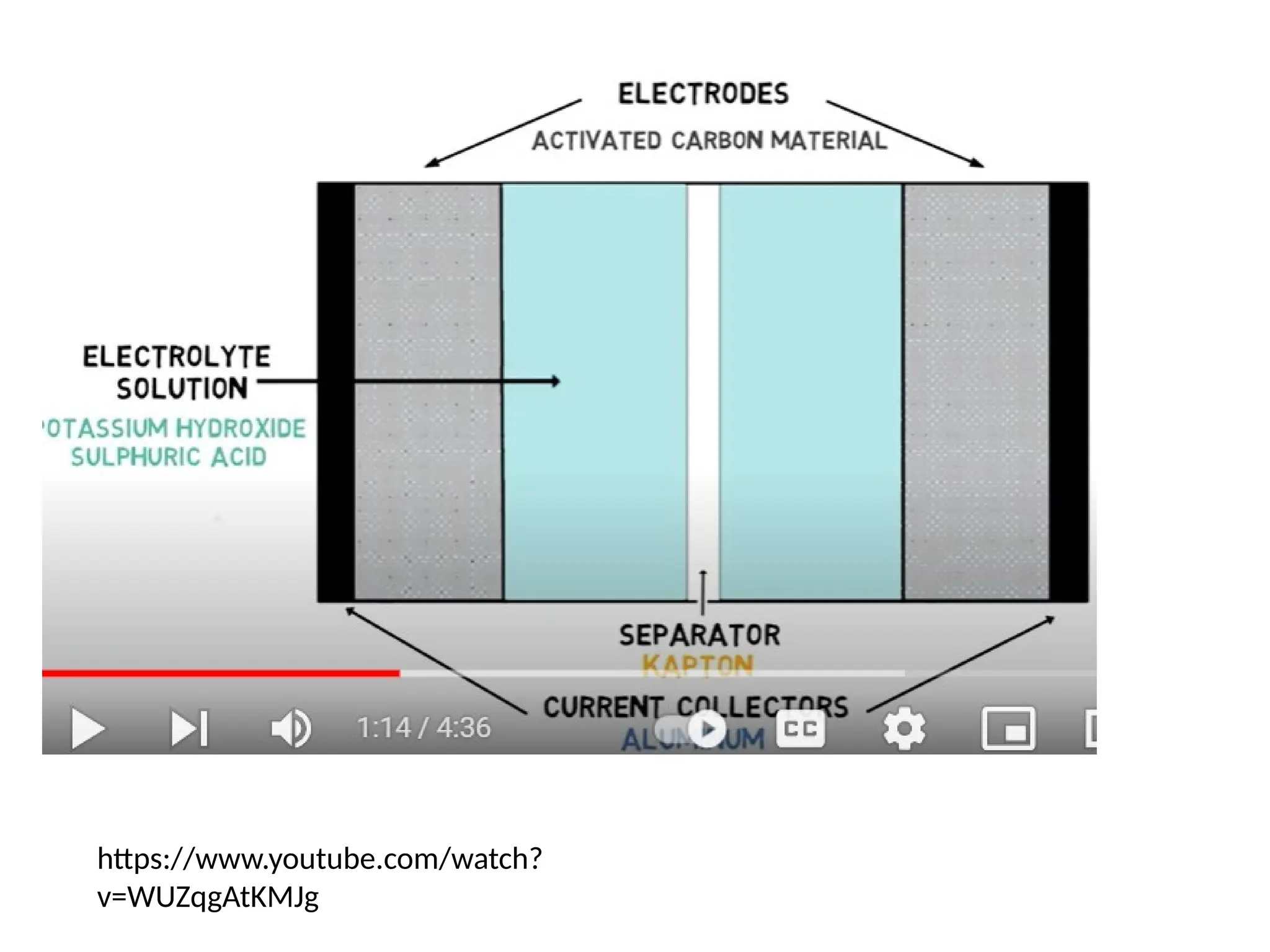
• Supercapacitors: Supercapacitors, on the other hand, store energy
primarily through two mechanisms: double-layer capacitance and, in some
cases, pseudocapacitance. Double-layer capacitance occurs at the interface
between the electrode and electrolyte, storing energy electrostatically.
Pseudocapacitance involves reversible redox reactions at the electrode-
electrolyte interface. Supercapacitors can store significantly more energy
compared to traditional capacitors and offer high power density.
78.
• Energy Density:
–Capacitors: Traditional capacitors have relatively low energy density,
which means they can store a small amount of energy per unit volume
or mass. They are suitable for applications requiring rapid energy
discharge.
– Supercapacitors: Supercapacitors have higher energy density
compared to traditional capacitors. While they still have lower energy
density compared to batteries, they can store more energy than
capacitors and deliver it quickly. This makes them valuable for
applications that require both high power and moderate energy
storage.
• Voltage Ratings:
– Capacitors: Traditional capacitors can handle relatively high voltage
ratings, often in the range of tens to hundreds of volts.
– Supercapacitors: Supercapacitors typically have lower voltage ratings
compared to traditional capacitors. They are commonly used in low-
voltage applications, often below 3 volts per cell. To achieve higher
voltage ratings, multiple supercapacitor cells must be connected in
series
79.
• Charge/Discharge Rate:
–Capacitors: Traditional capacitors can charge and discharge
very quickly, often in a matter of microseconds.
– Supercapacitors: Supercapacitors excel at rapid charge and
discharge, with even faster response times than traditional
capacitors. They are ideal for applications that require
high-power bursts.
• Cycle Life:
– Capacitors: Traditional capacitors have virtually unlimited
cycle life because their energy storage mechanism does
not involve chemical reactions.
– Supercapacitors: Supercapacitors also have a high cycle
life, but it is typically limited compared to traditional
capacitors due to potential electrode degradation over
time. Nevertheless, they can still withstand hundreds of
thousands of charge/discharge cycles.
80.
• Applications:
– Capacitors:Traditional capacitors are commonly used for
tasks like filtering and energy storage in electronic circuits,
but they are not suitable for applications requiring high
energy storage or rapid energy release.
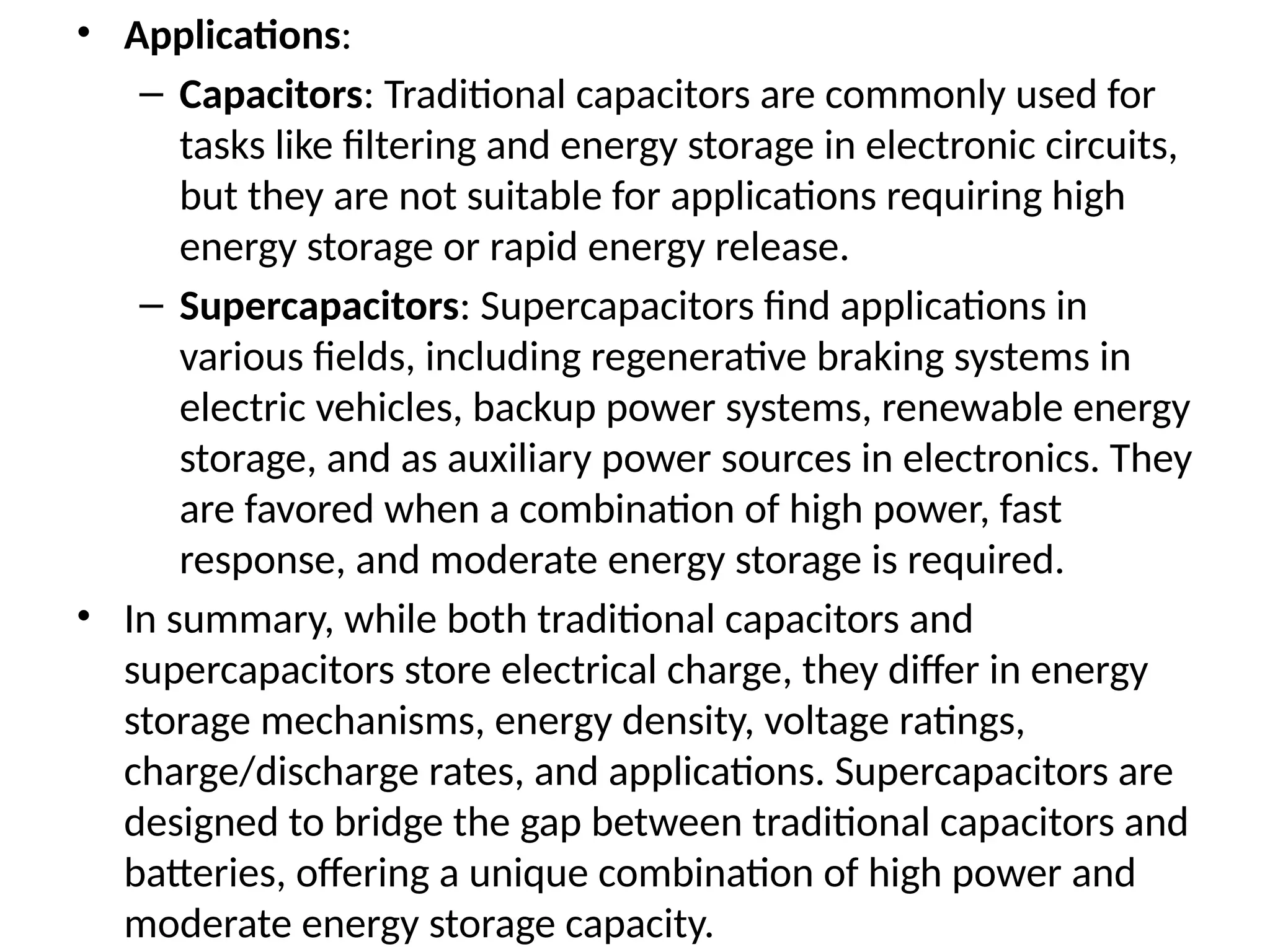
– Supercapacitors: Supercapacitors find applications in
various fields, including regenerative braking systems in
electric vehicles, backup power systems, renewable energy
storage, and as auxiliary power sources in electronics. They
are favored when a combination of high power, fast
response, and moderate energy storage is required.
• In summary, while both traditional capacitors and
supercapacitors store electrical charge, they differ in energy
storage mechanisms, energy density, voltage ratings,
charge/discharge rates, and applications. Supercapacitors are
designed to bridge the gap between traditional capacitors and
batteries, offering a unique combination of high power and
moderate energy storage capacity.
Super Capacitor
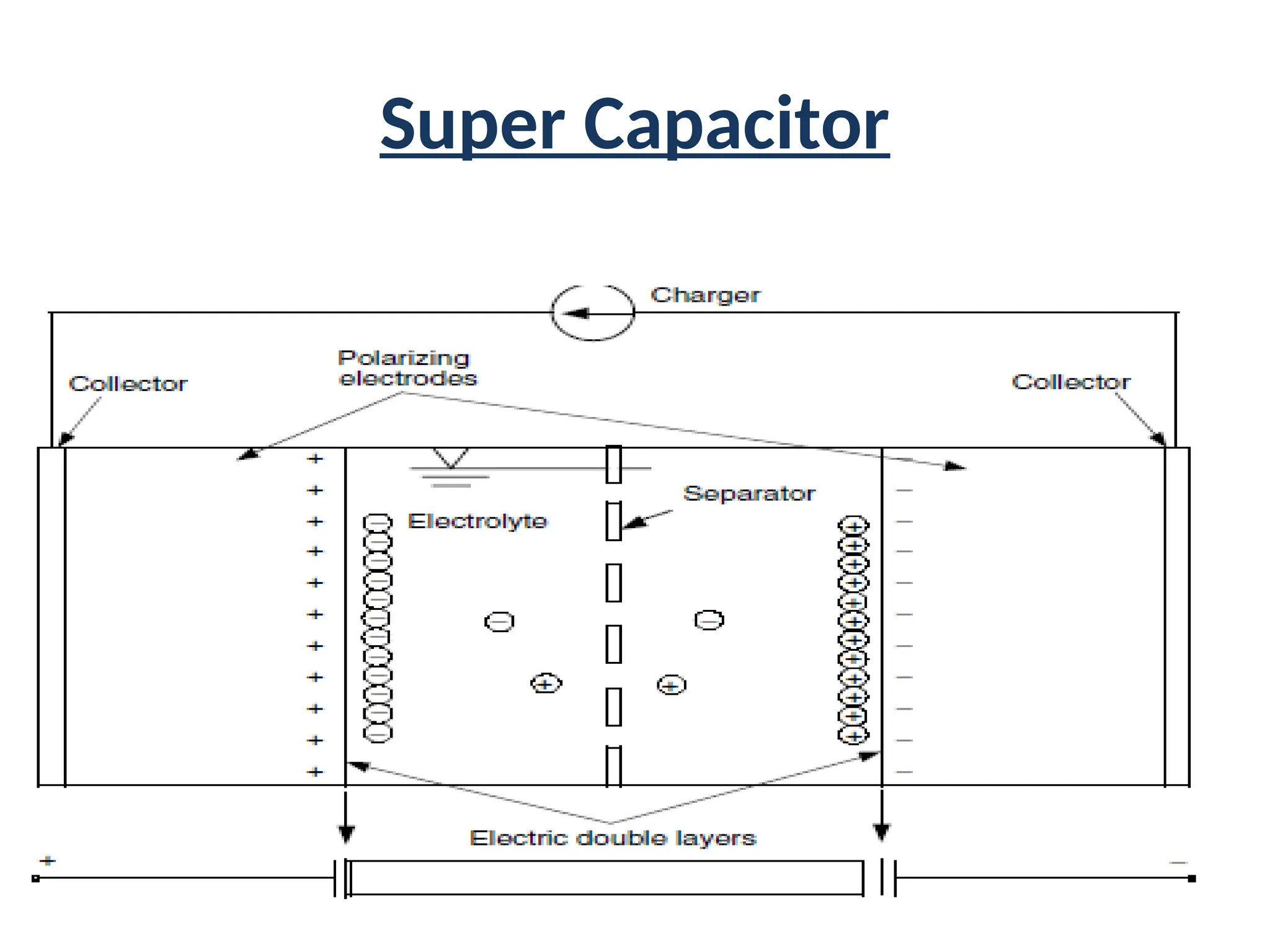
⚫ Double-layercapacitor technology is the major approach to achieving the
ultracapacitor concept.
⚫ The basic principle of a double-layer capacitor is illustrated .
⚫ When two carbon rods are immersed in a thin sulfuric acid solution, separated from
each other and charged with voltage increasing from zero to 1.5 V, almost nothing
happens up to 1 V; then at a little over 1.2 V, a small bubble will appear on the
surface of both the electrodes.
⚫ Those bubbles at a voltage above 1 V indicate electrical decomposition of water.
Below the decomposition voltage, while the current does not flow, an “electric
double layer” then occurs at the boundary of electrode and electrolyte.
⚫ The electrons are charged across the double layer and for a capacitor.An electrical
double layer works as an insulator only below the decomposing voltage. The stored
energy,
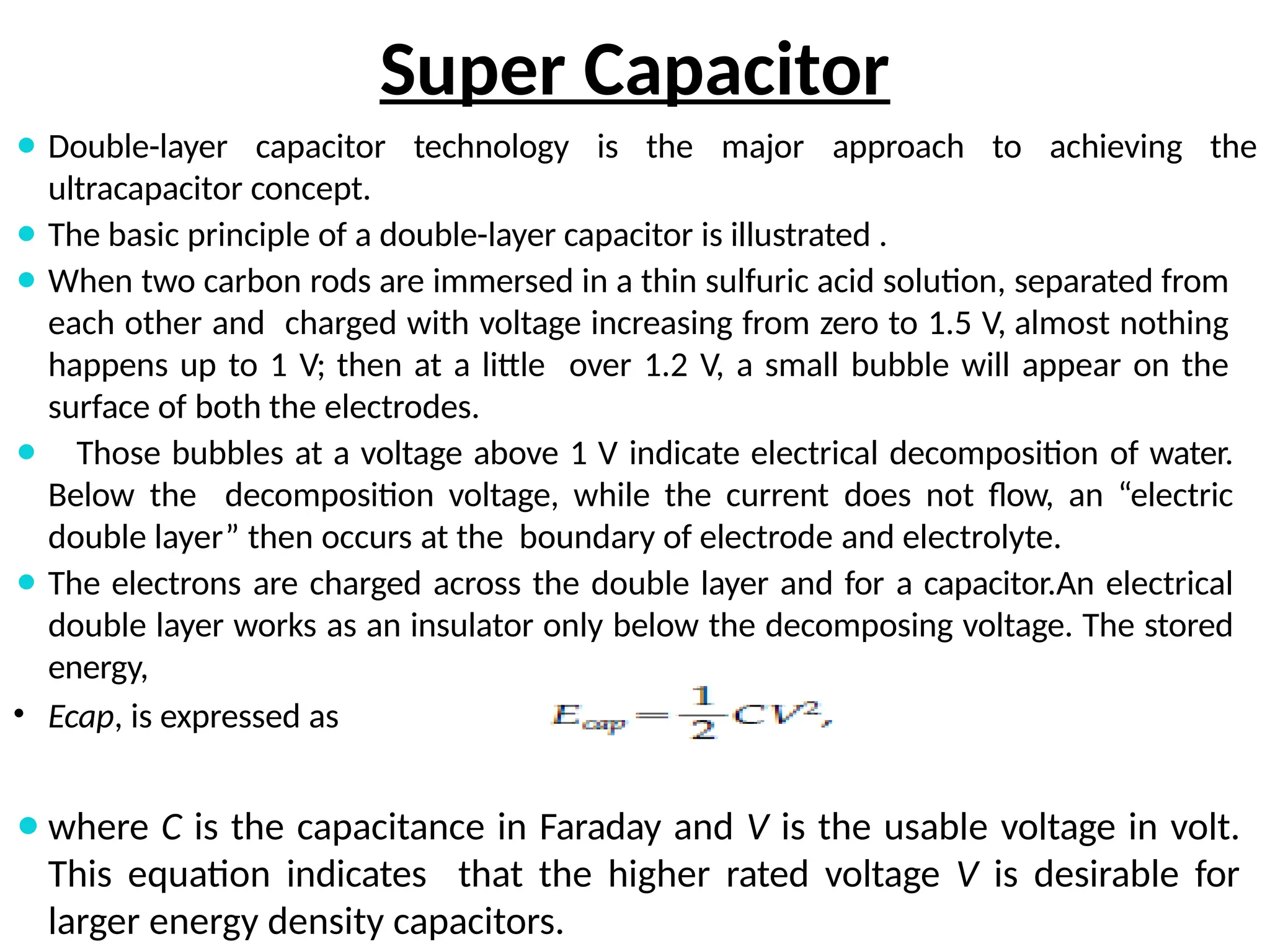
• Ecap, is expressed as
⚫where C is the capacitance in Faraday and V is the usable voltage in volt.
This equation indicates that the higher rated voltage V is desirable for
larger energy density capacitors.
Super Capacitor
⚫ Thereis great merit in using an electric double layer in place of plastic or aluminium oxide
films in a capacitor, since the double layer is very thin — as thin as one molecule with no
pin holes — and the capacity per area is quite large, at 2.5 to 5 μF/cm2.Even if a few μF/cm2
are obtainable, the energy density of capacitors is not large when using aluminium foil.
⚫ For increasing capacitance, electrodes are made from specific materials that have a very large
area, such as activated carbons, which are famous for their surface areas of 1,000 to 3,000
m2/g. To those surfaces, ions are adsorbed and result in 50 F/g (1,000 m2/g_5F/cm2_10,000
cm2/m2_50 F/g).
⚫ Assuming that the same weight of electrolyte is added, 25 F/g is quite a large capacity
density. Nevertheless, the energy density of these capacitors is far smaller than secondary
batteries.
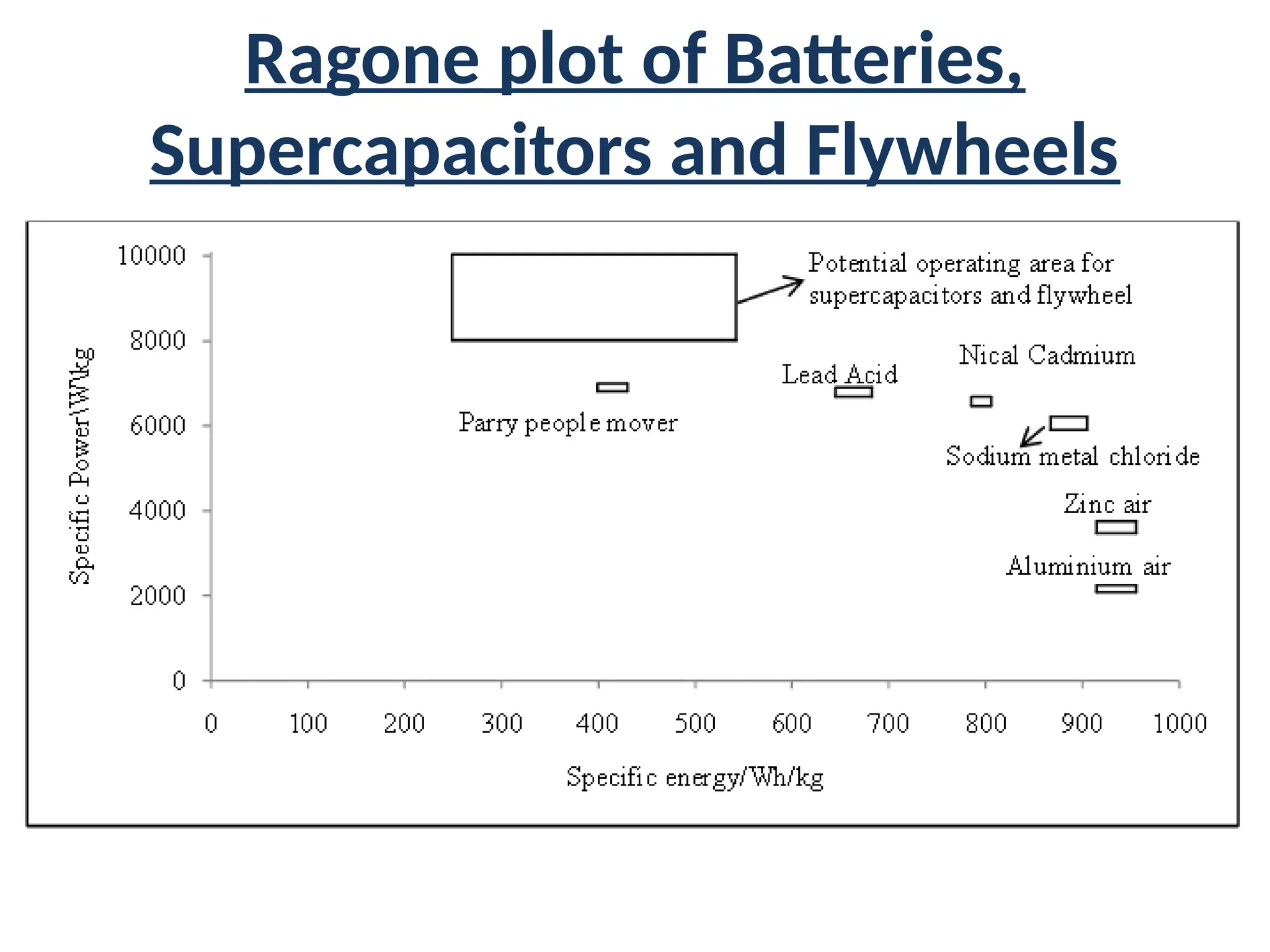
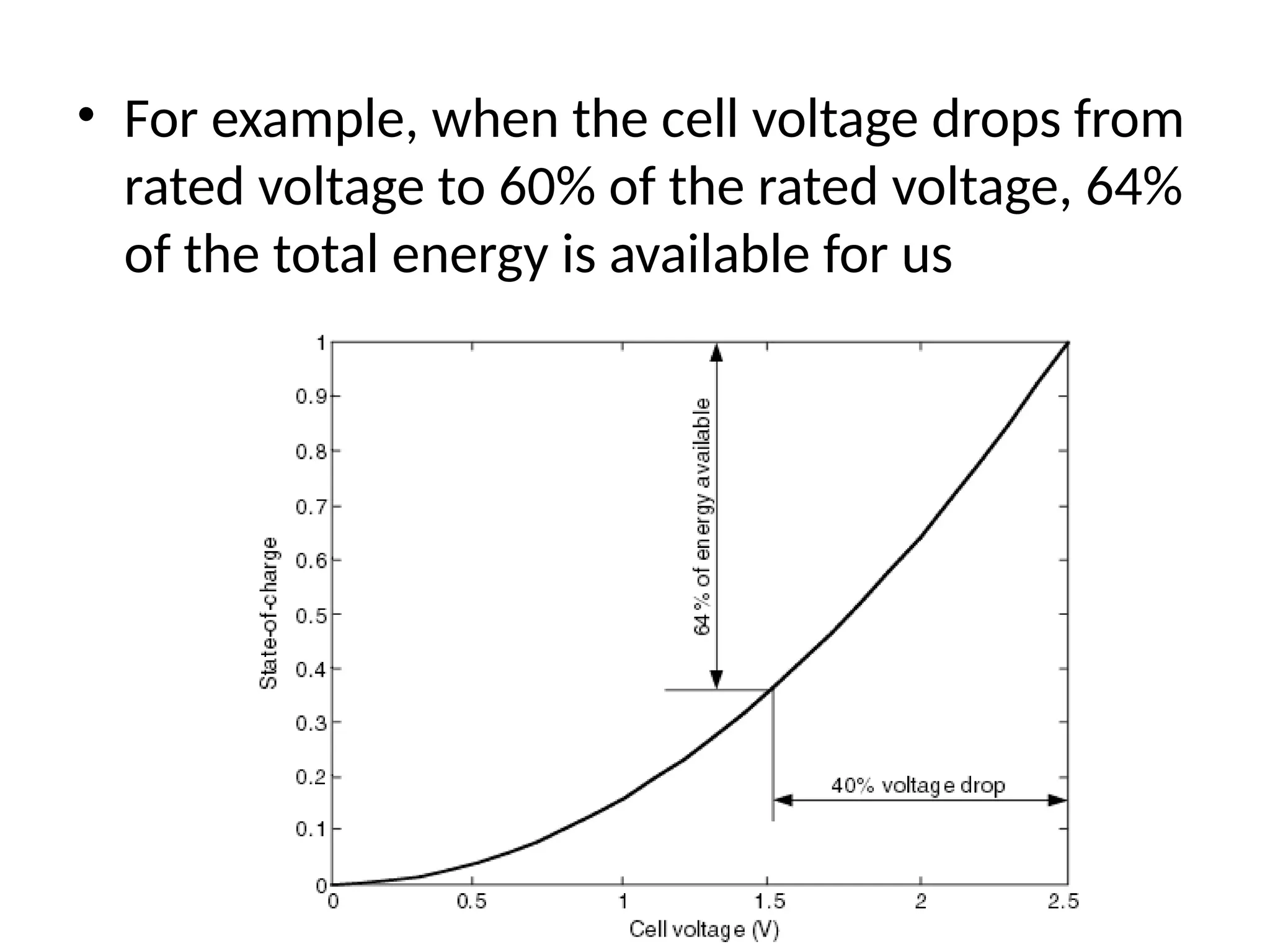
⚫ the typical specific energy of ultracapacitors at present is about 2 Wh/kg, only1/20 of 40
Wh/kg, which is the available value of typical lead-acid batteries.
Where i isthe discharge
current, which is a function of
time in real operation.
At different discharge current
rates, the voltage decreases
linearly with discharge time.
At a large discharge current
rate, the voltage decreases
much faster than at a small
current rate.
Block diagram of the ultracapacitor model
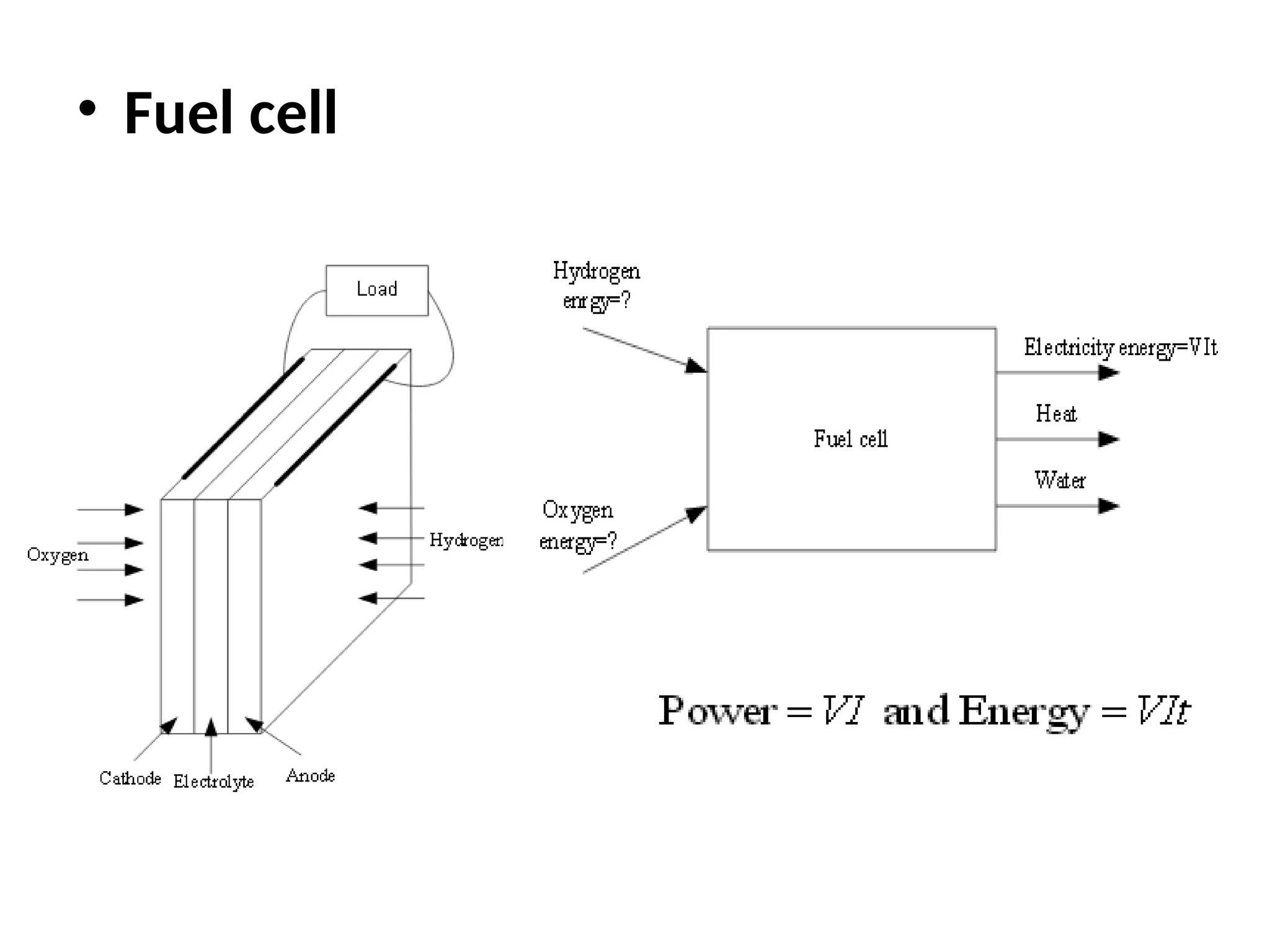
Fuel Cell
• Inrecent decades, the application of fuel cells in vehicles has
been the focus of increased attention.
• In contrast to a chemical battery, the fuel cell generates
electric energy rather than storing it and continues to do so as
long as a fuel supply is maintained.
• Compared with the battery-powered electric vehicles (EVs),
the fuel cell-powered vehicle has the advantages of a longer
driving range without a long battery charging time.
• Compared with the internal combustion engine (ICE) vehicles,
it has the advantages of high energy efficiency and much
lower emissions due to the direct conversion of free energy in
the fuel into electric energy, without undergoing combustion.
109.
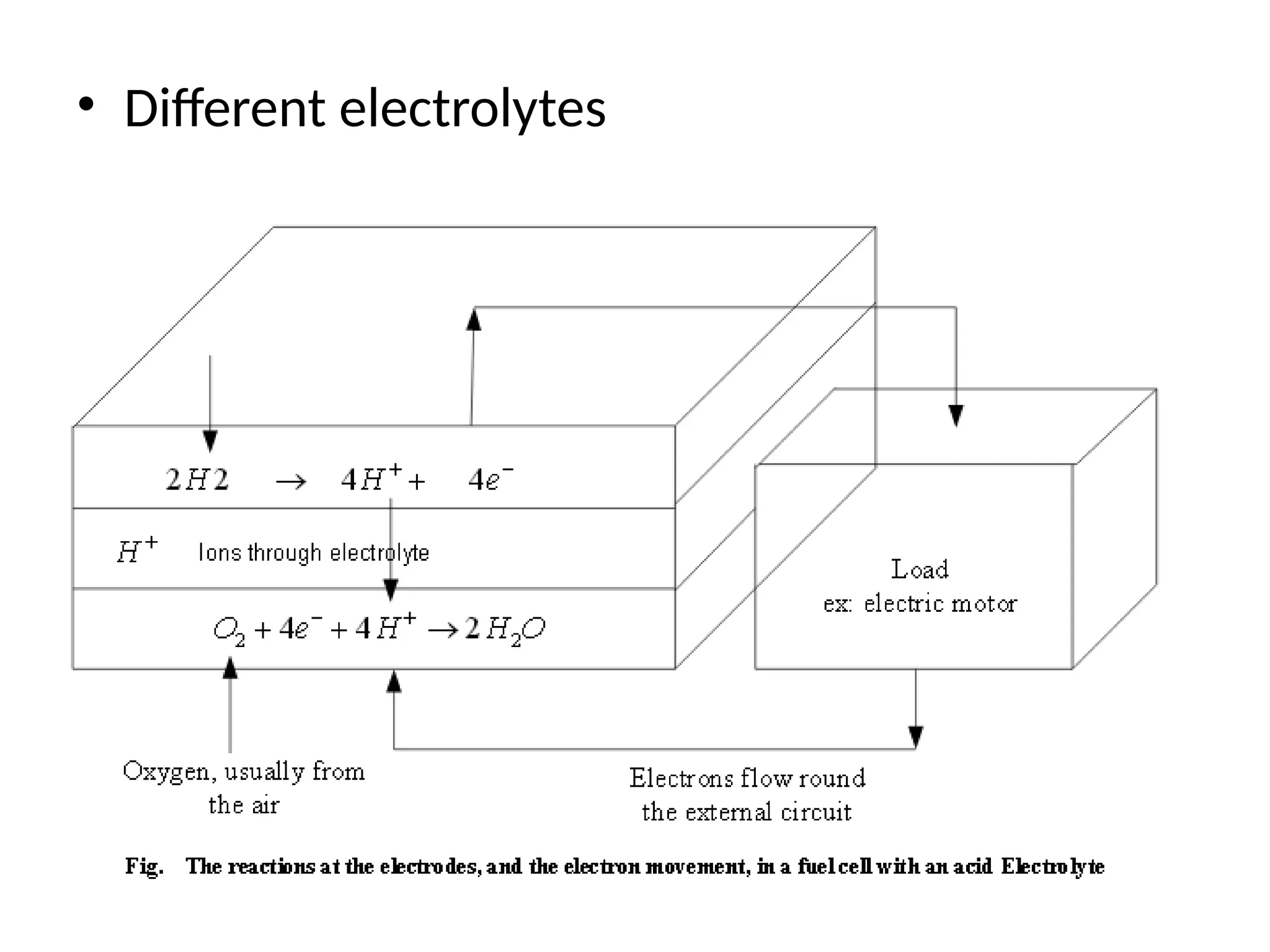
Operating Principles ofFuel Cells
• A fuel cell is a galvanic cell in which the chemical energy of a fuel is converted directly
into electrical energy by means of electrochemical processes.
• The fuel and oxidizing agents are continuously and separately supplied to the two
electrodes of the cell, where they undergo a reaction.
• An electrolyte is necessary to conduct the ions from one electrode to the other.
• The fuel is supplied to the anode or positive electrode, where electrons are released
from the fuel under catalyst.
• The electrons, under the potential difference between these two electrodes, flow
through the external circuit to the cathode electrode or negative electrode, where, in
combination with positive ions and oxygen, reaction products, or exhaust, are produced
Hybridization of differentEnergy Storage
devices
• The hybridization of energy storage is to combine two
or more energy storages together so that the
advantages of each one can be brought out and the
disadvantages can be compensated by others.
• For instance, the hybridization of a chemical battery
with an ultracapacitor can overcome such problems
as low specific power of electrochemical batteries and
low specific energy of ultracapacitors, therefore
achieving high specific energy and high specific power.
120.
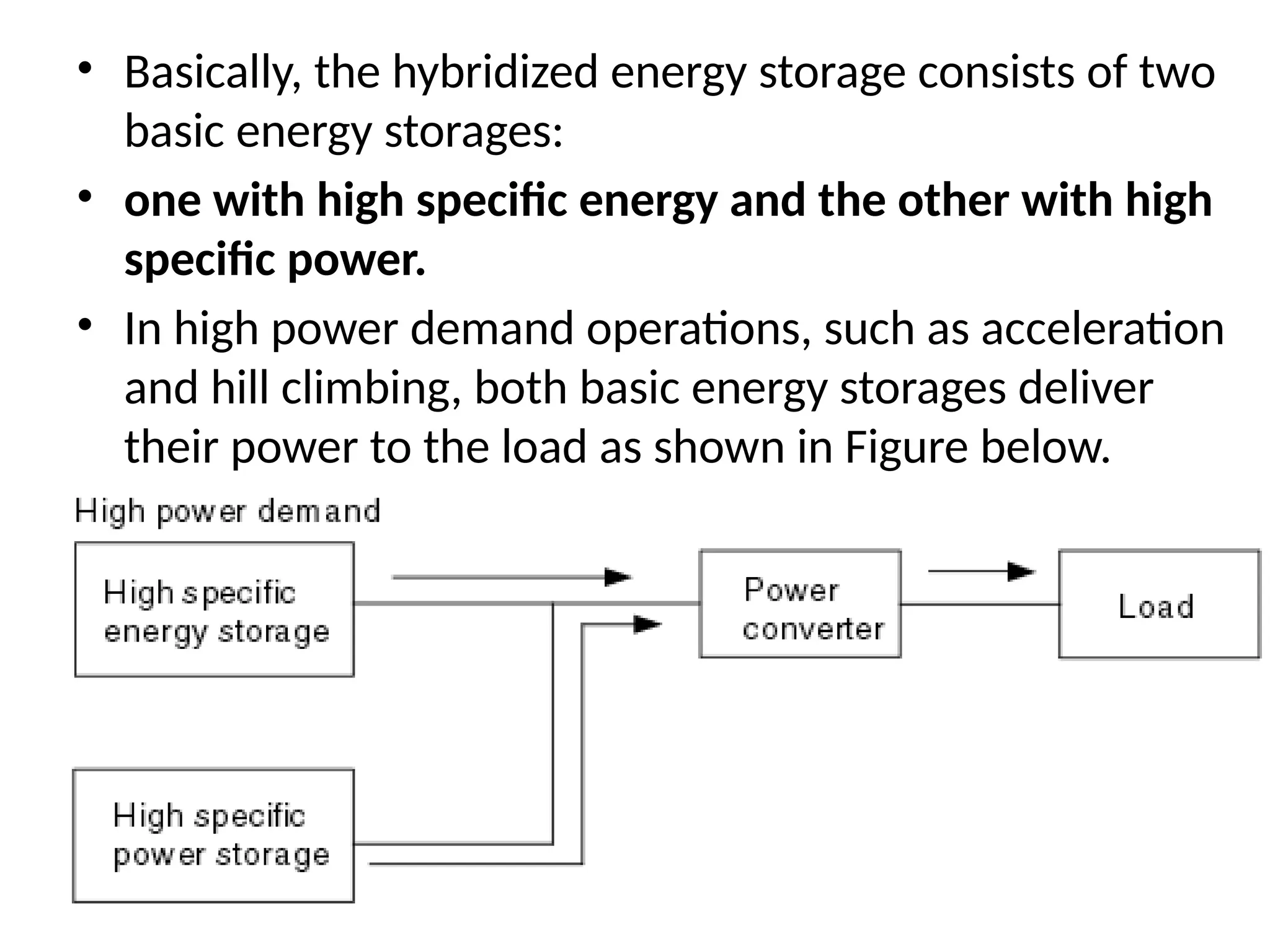
• Basically, thehybridized energy storage consists of two
basic energy storages:
• one with high specific energy and the other with high
specific power.
• In high power demand operations, such as acceleration
and hill climbing, both basic energy storages deliver
their power to the load as shown in Figure below.
121.
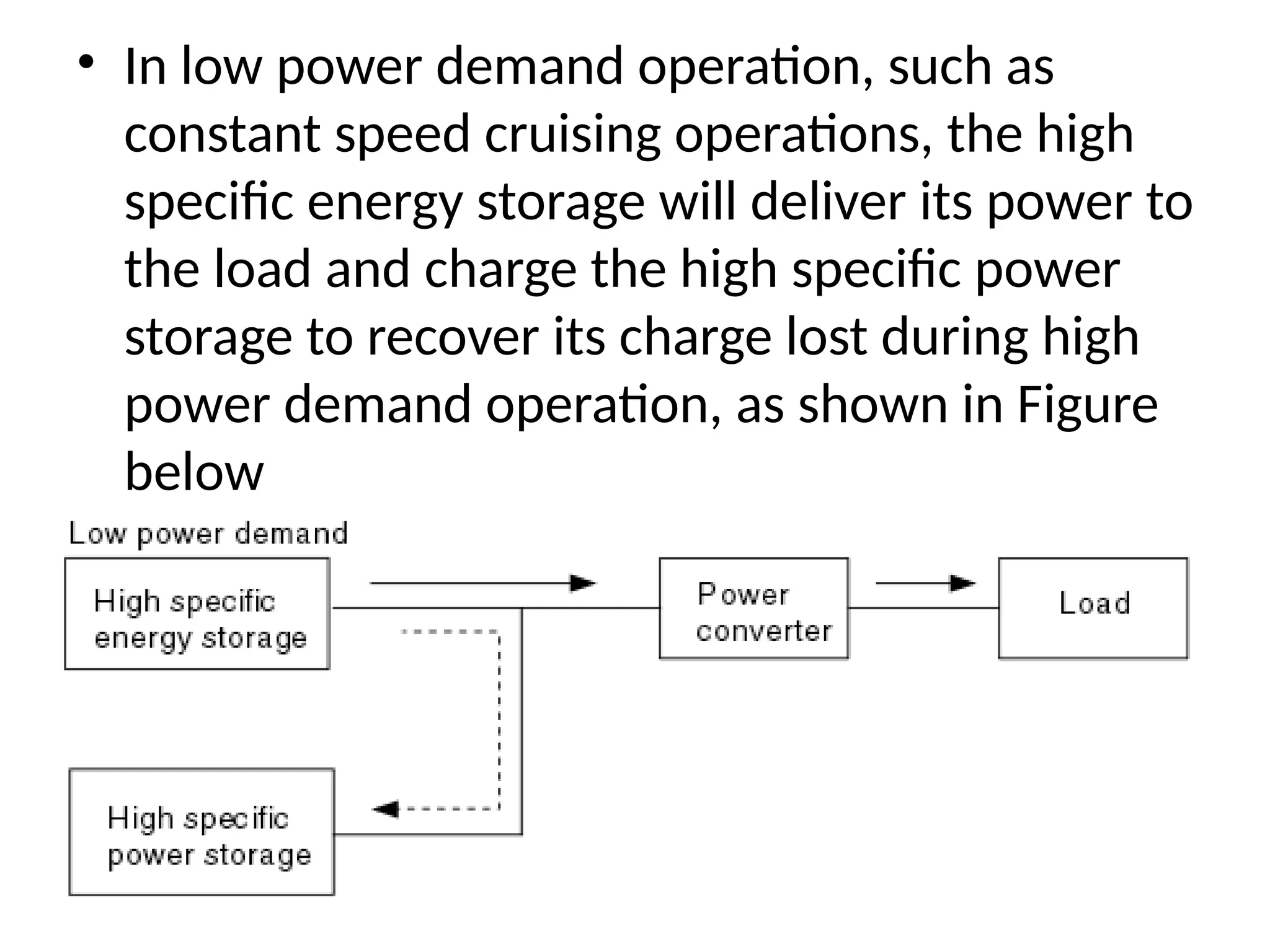
• In lowpower demand operation, such as
constant speed cruising operations, the high
specific energy storage will deliver its power to
the load and charge the high specific power
storage to recover its charge lost during high
power demand operation, as shown in Figure
below
122.
• In regenerativebraking operations, the peak
power will be absorbed by the high specific
power storage, and only a limited part is
absorbed by the high specific energy storage.
123.
Battery and UltracapacitorHybrids
• Ultracapacitor can offer much
higher power than batteries,
and it collaborates with various
batteries to form the battery and
ultracapacitor hybrids.
• The major disadvantages of this
configuration are that the power flow
cannot be actively controlled and the
ultracapacitor energy cannot be fully
used.
125.
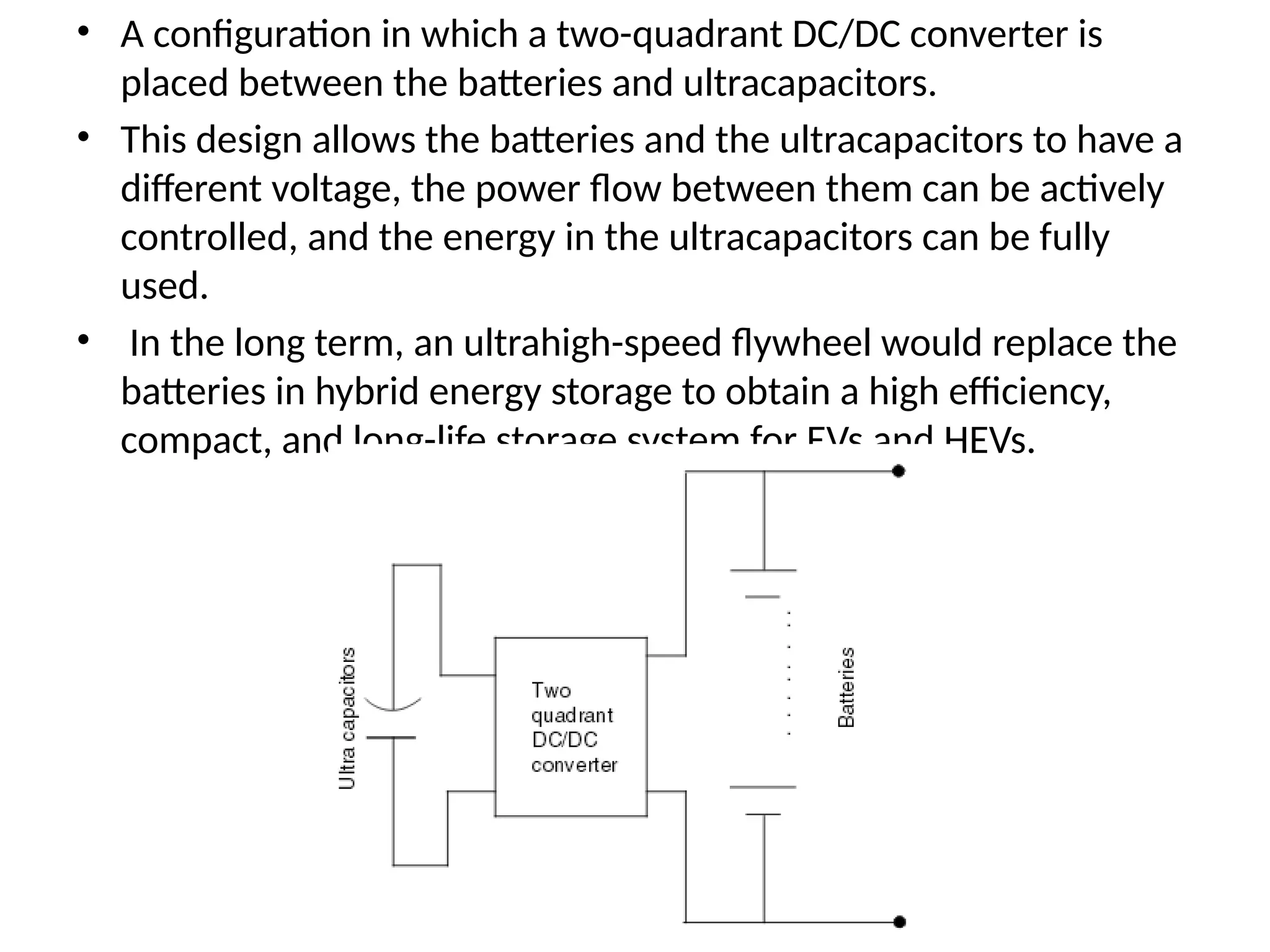
• A configurationin which a two-quadrant DC/DC converter is
placed between the batteries and ultracapacitors.
• This design allows the batteries and the ultracapacitors to have a
different voltage, the power flow between them can be actively
controlled, and the energy in the ultracapacitors can be fully
used.
• In the long term, an ultrahigh-speed flywheel would replace the
batteries in hybrid energy storage to obtain a high efficiency,
compact, and long-life storage system for EVs and HEVs.
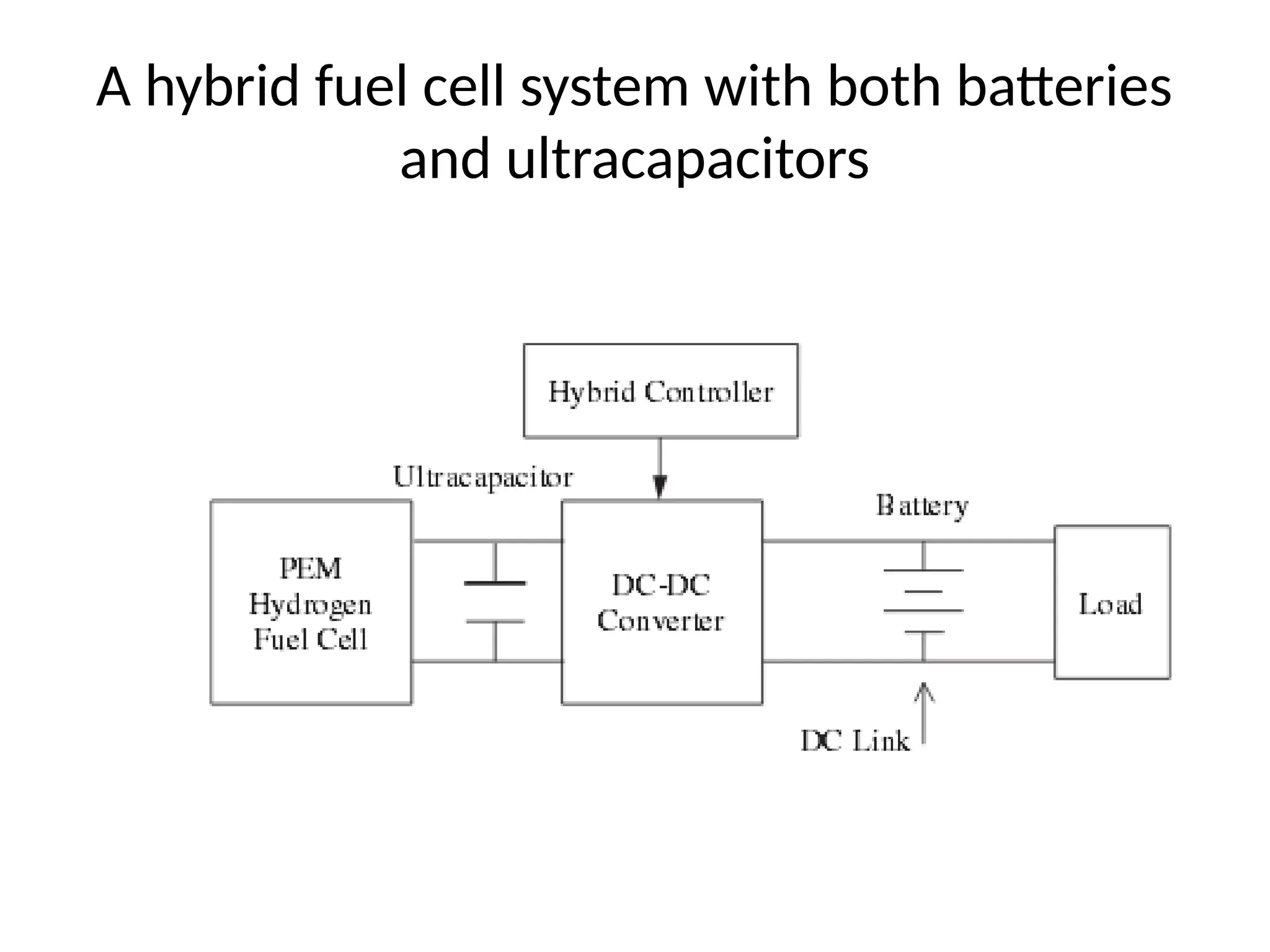
A hybrid fuelcell system with both batteries
and ultracapacitors
128.
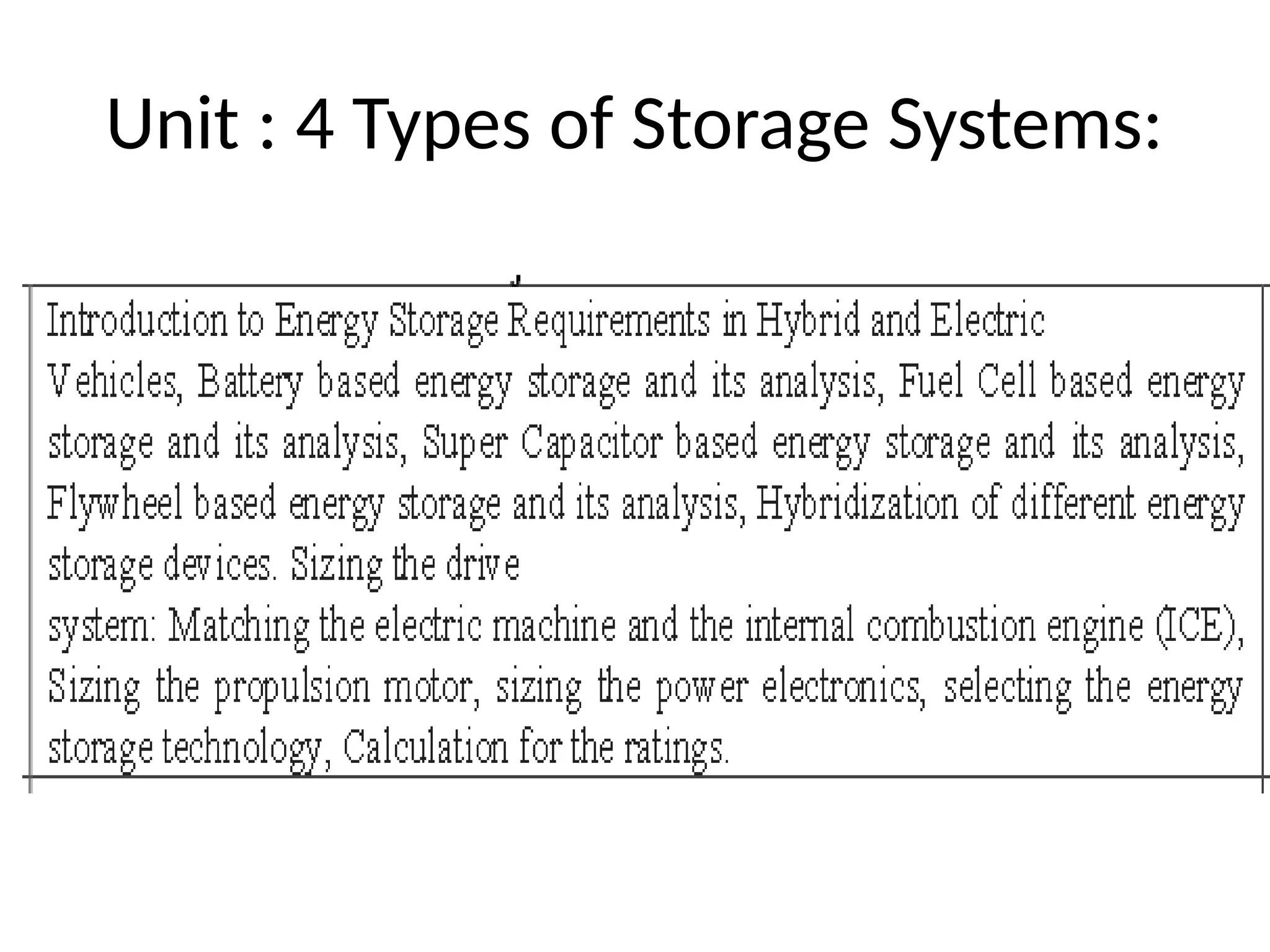
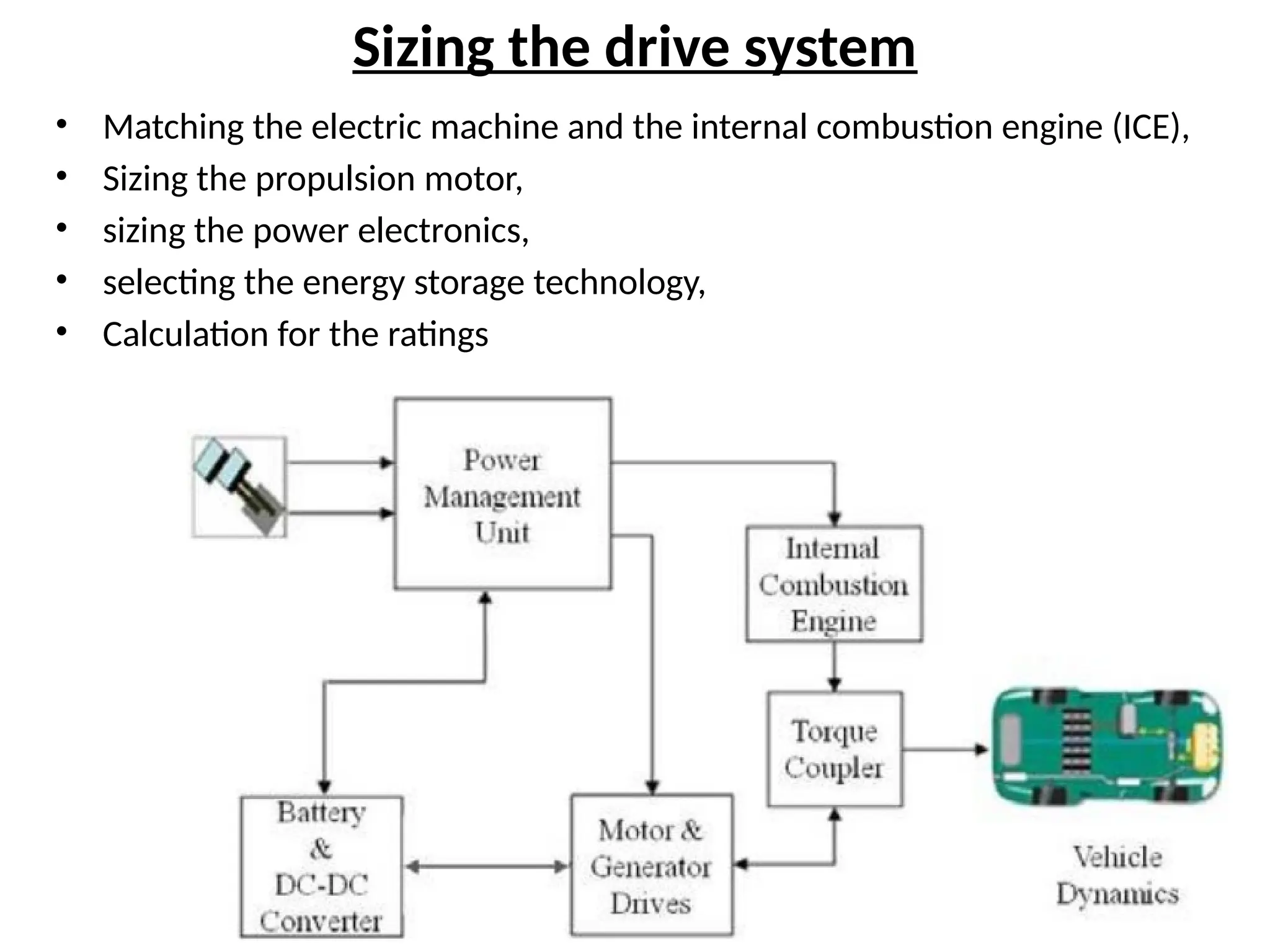
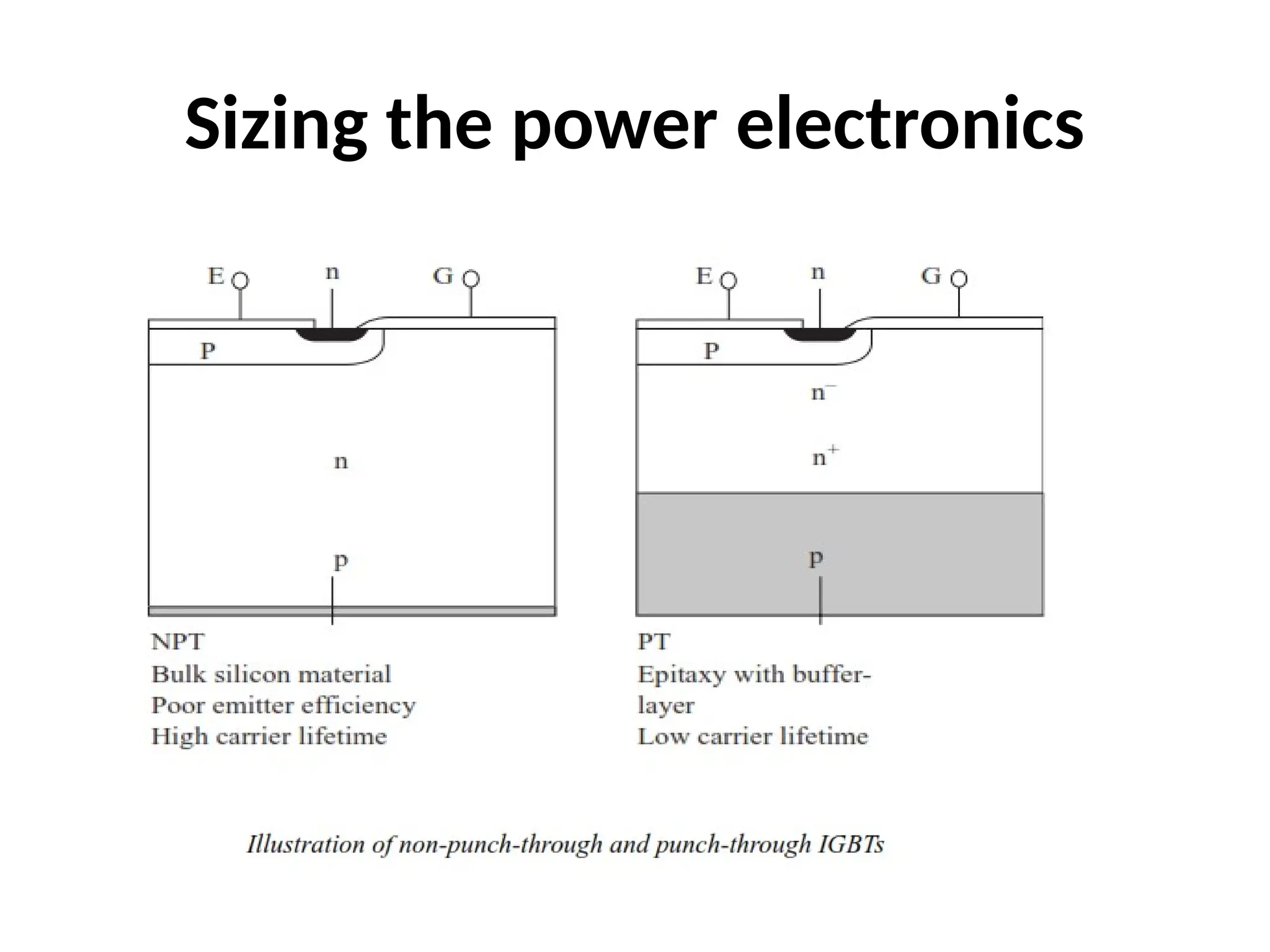
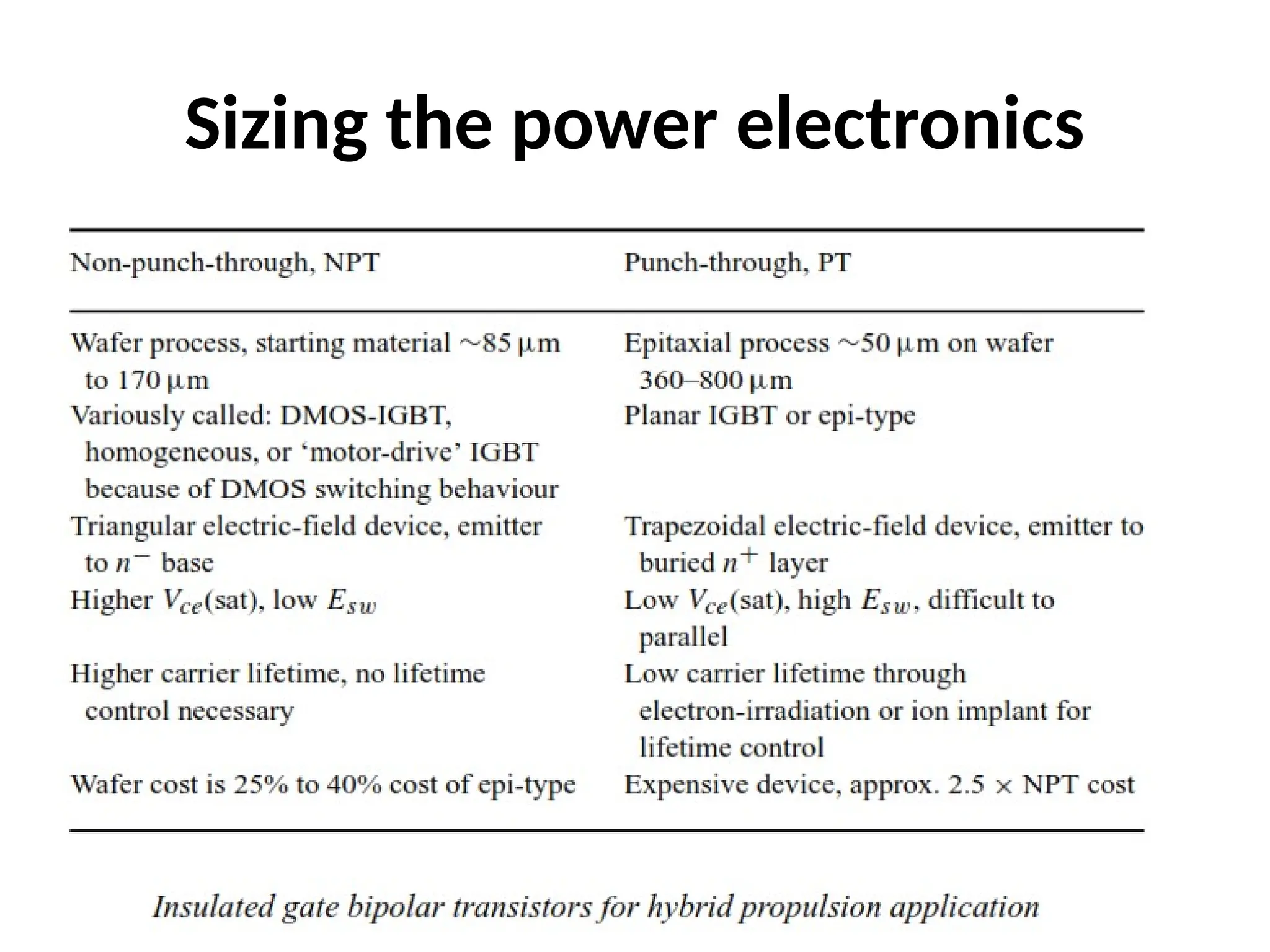
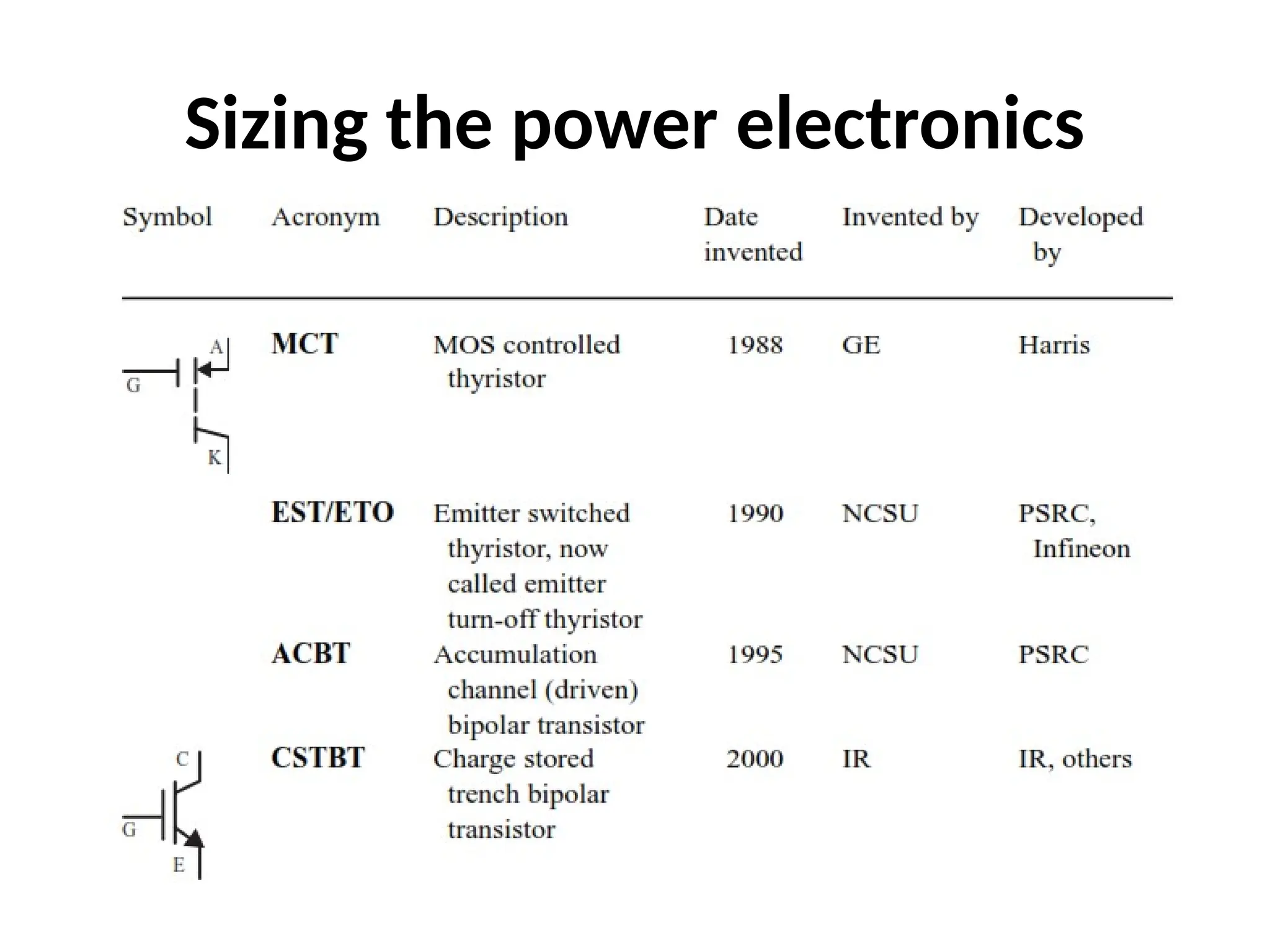
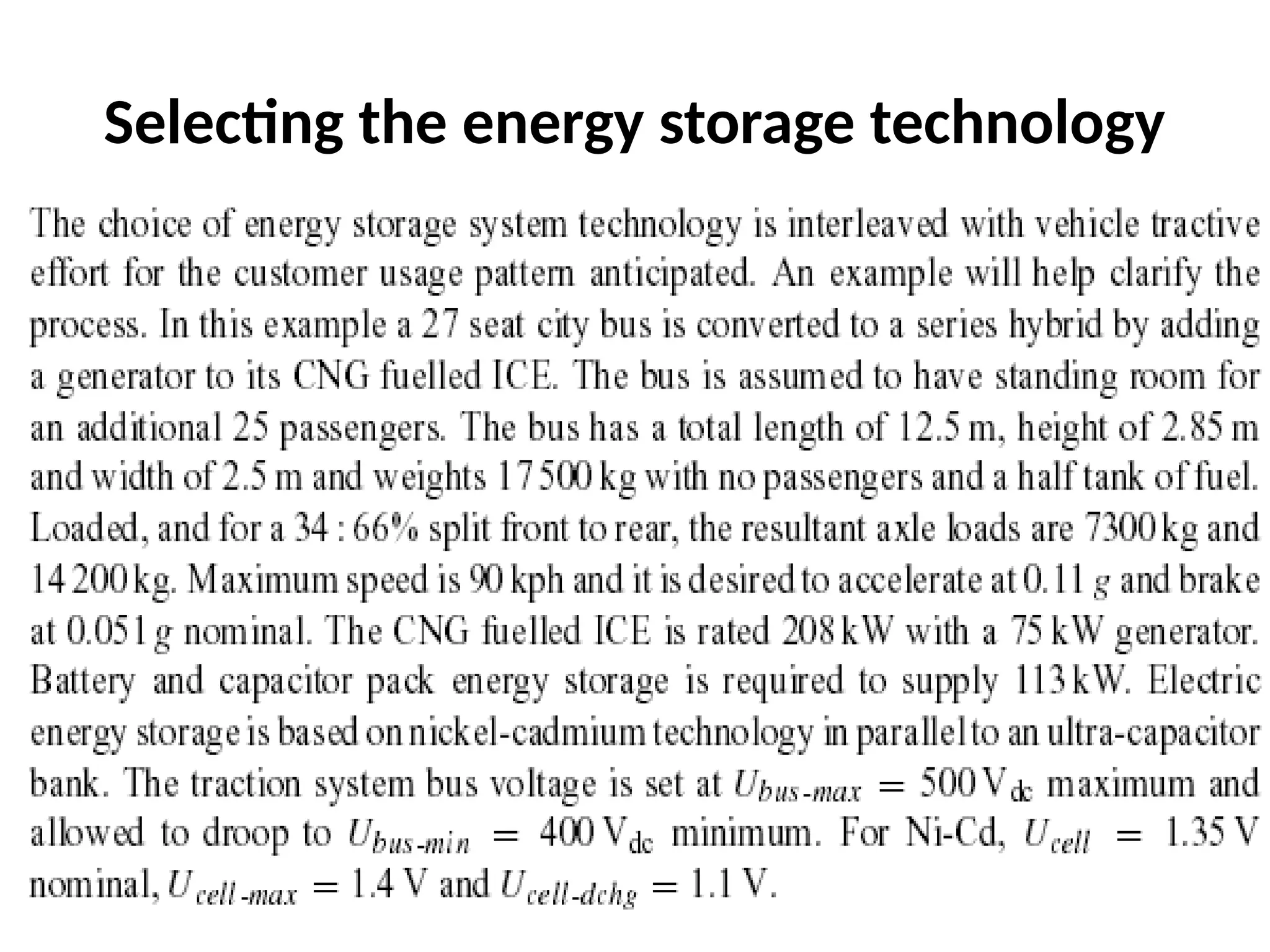
Sizing the drivesystem
• Matching the electric machine and the internal combustion engine (ICE),
• Sizing the propulsion motor,
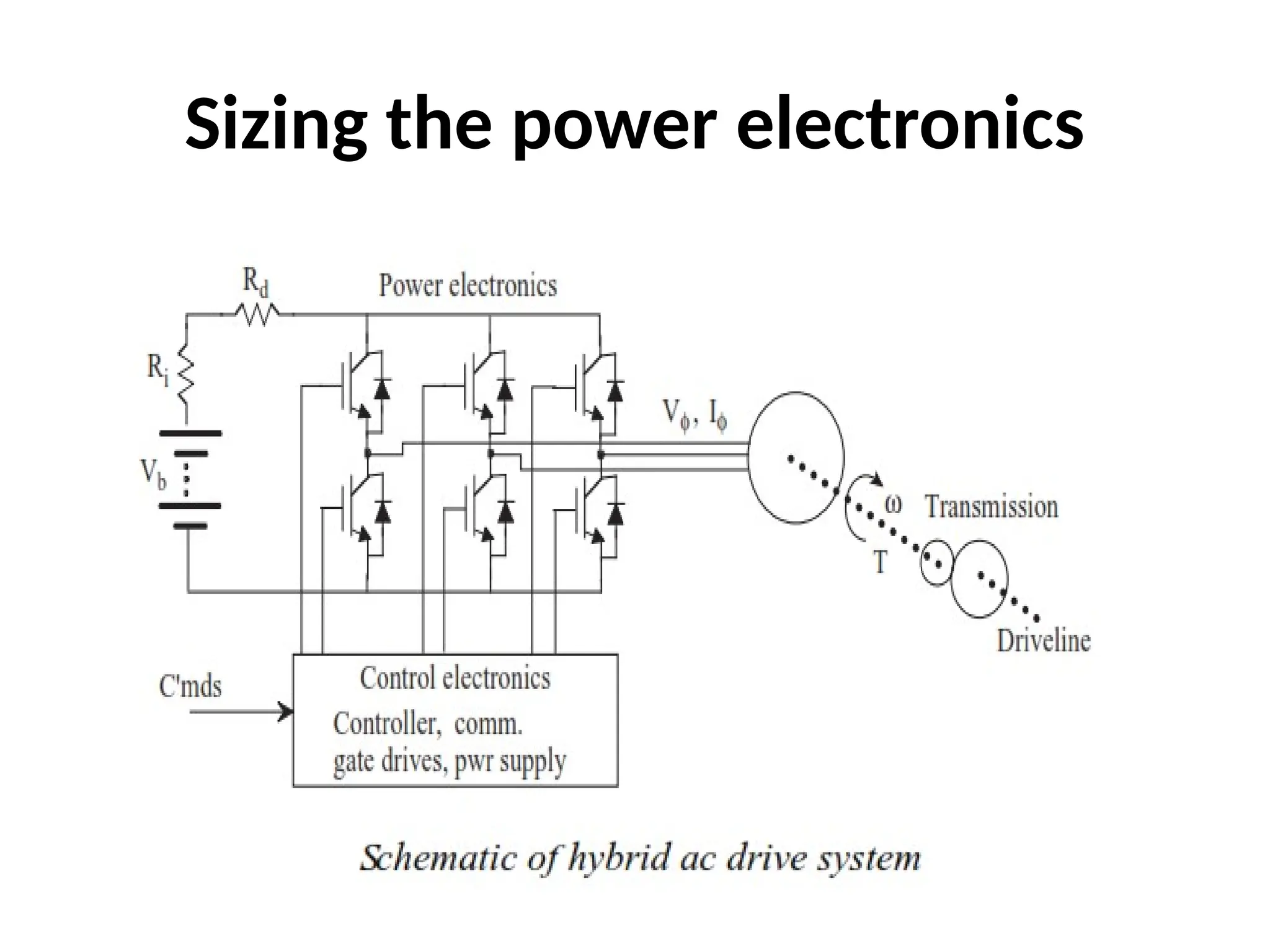
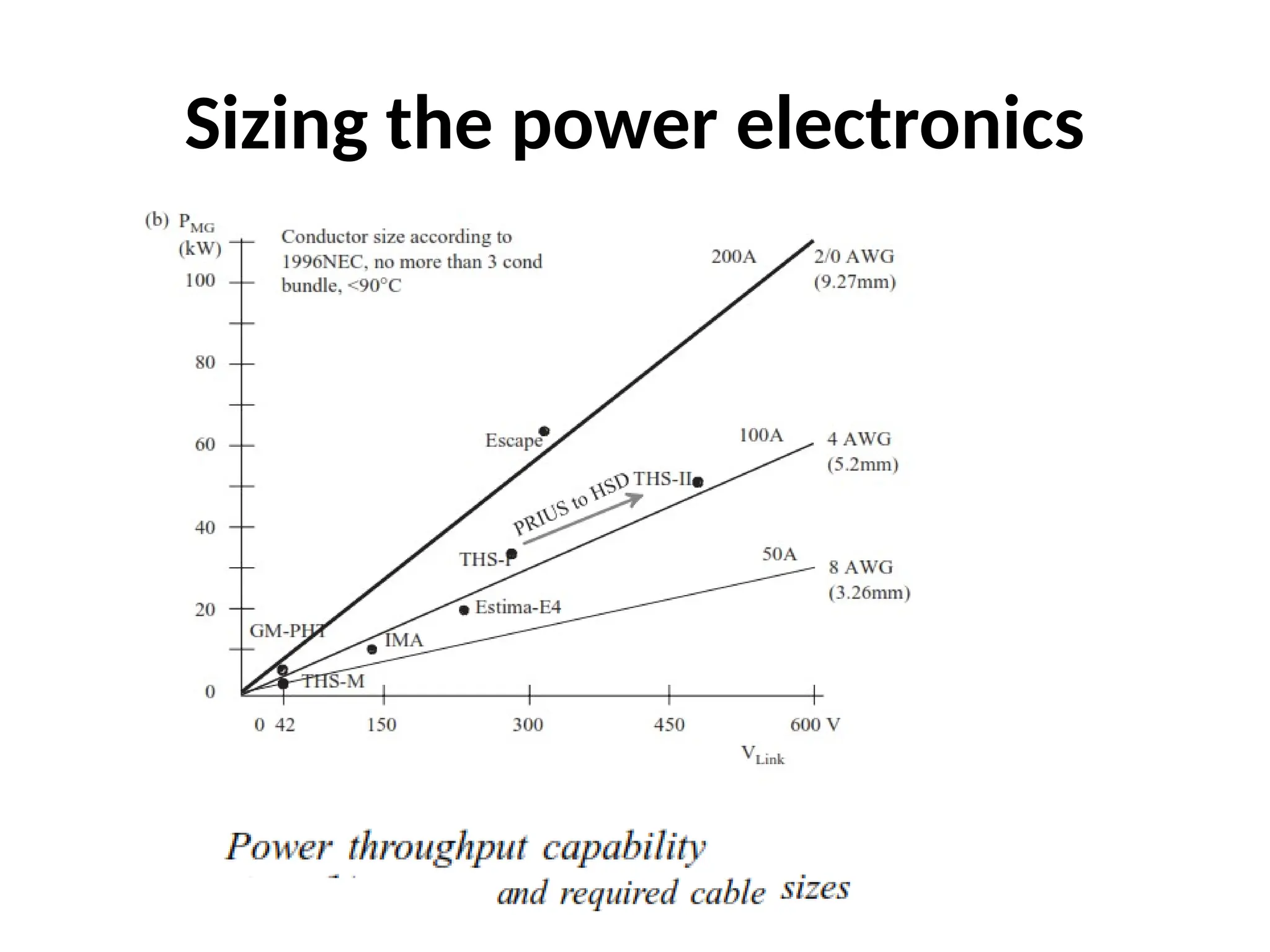
• sizing the power electronics,
• selecting the energy storage technology,
• Calculation for the ratings
Sizing the drivesystem
• The vehicle power plant must be sized for the
target vehicle mass, load requirements and
performance goals.
• Vehicle propulsion system traction is set by
the vehicle design mass and acceleration
performance according to Newton’s law,
• F = ma
132.
Matching the electricdrive and ICE
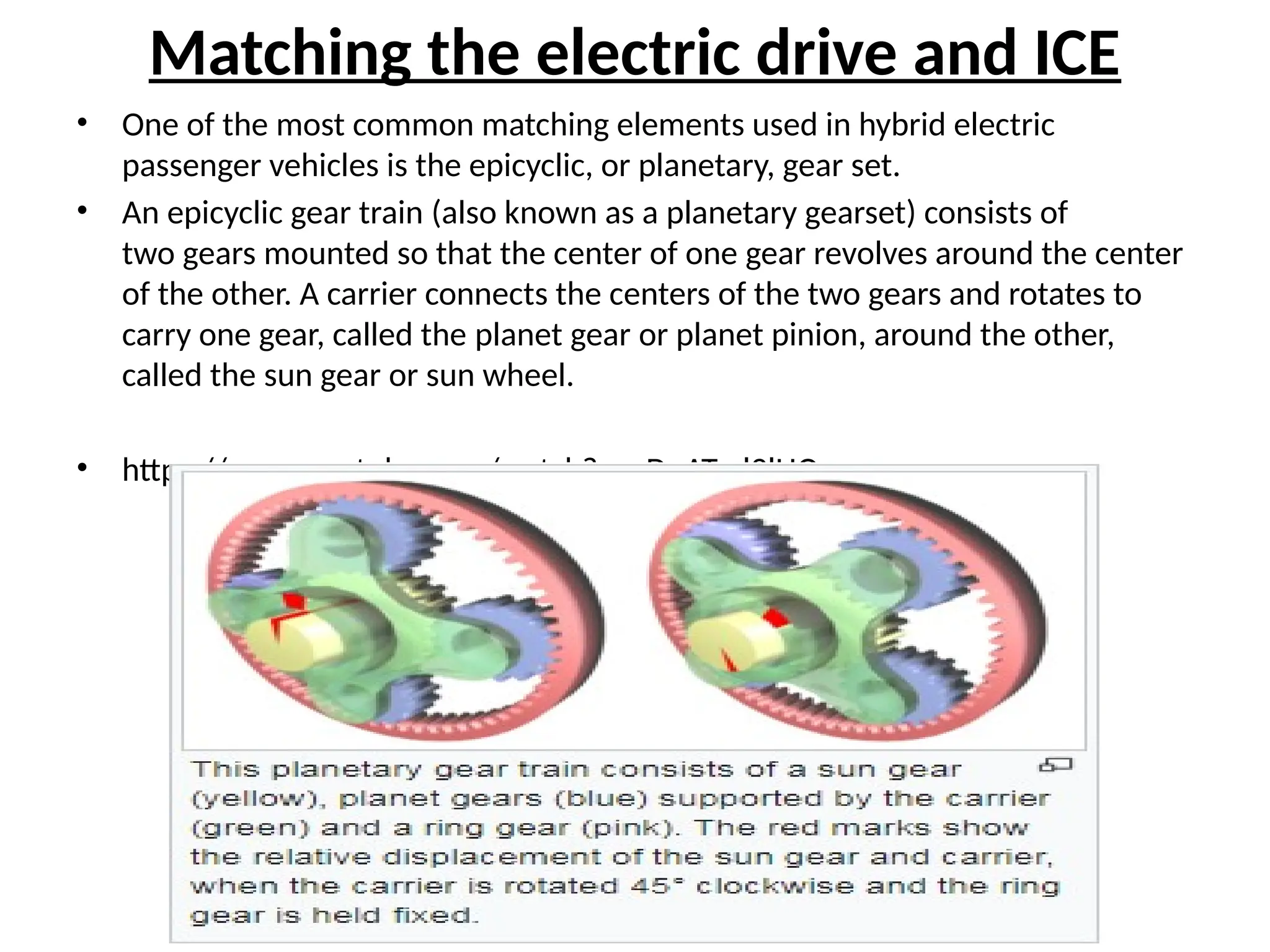
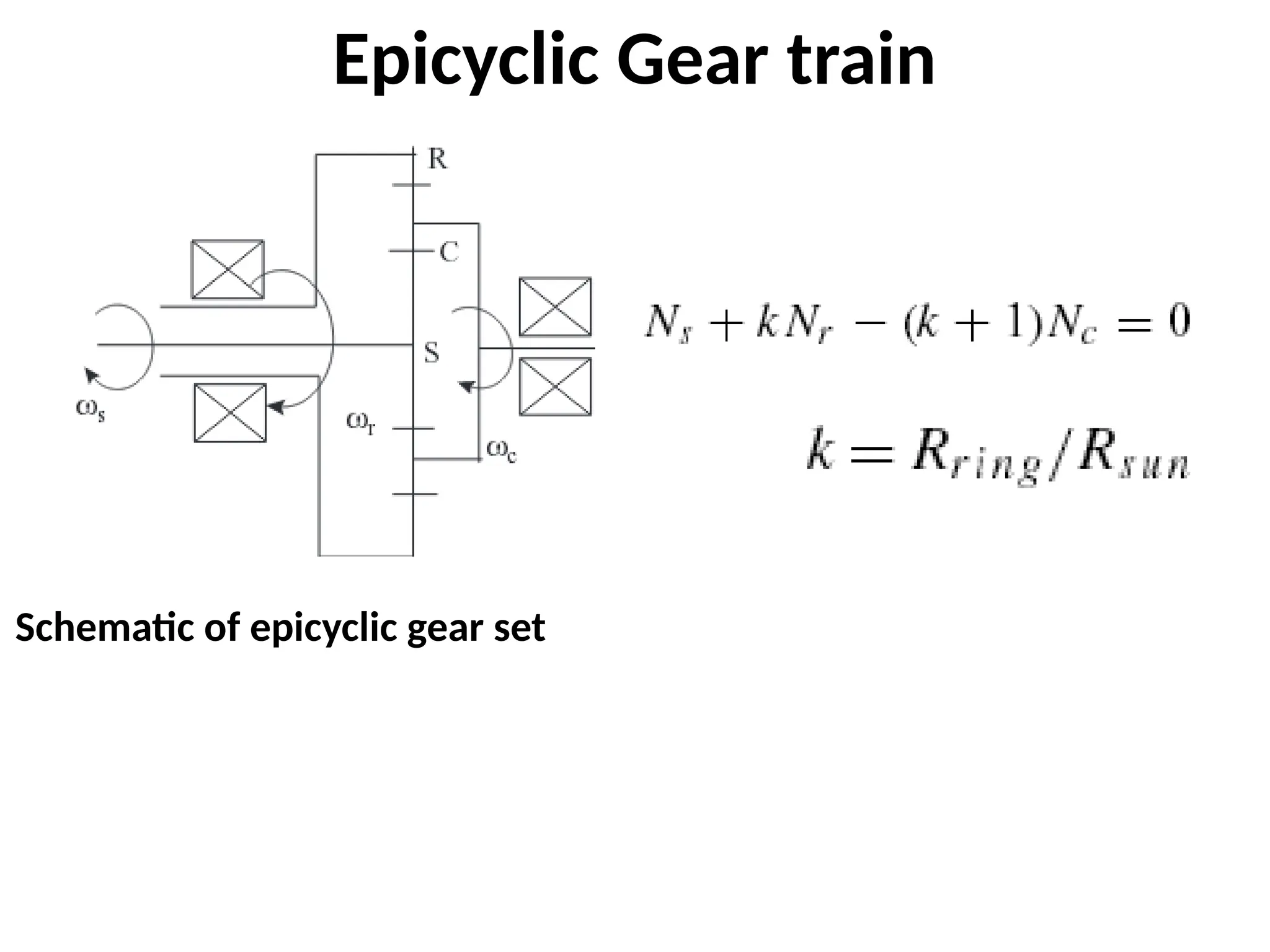
• One of the most common matching elements used in hybrid electric
passenger vehicles is the epicyclic, or planetary, gear set.
• An epicyclic gear train (also known as a planetary gearset) consists of
two gears mounted so that the center of one gear revolves around the center
of the other. A carrier connects the centers of the two gears and rotates to
carry one gear, called the planet gear or planet pinion, around the other,
called the sun gear or sun wheel.
• https://www.youtube.com/watch?v=gDnATml2lHQ
Sizing the propulsionmotor
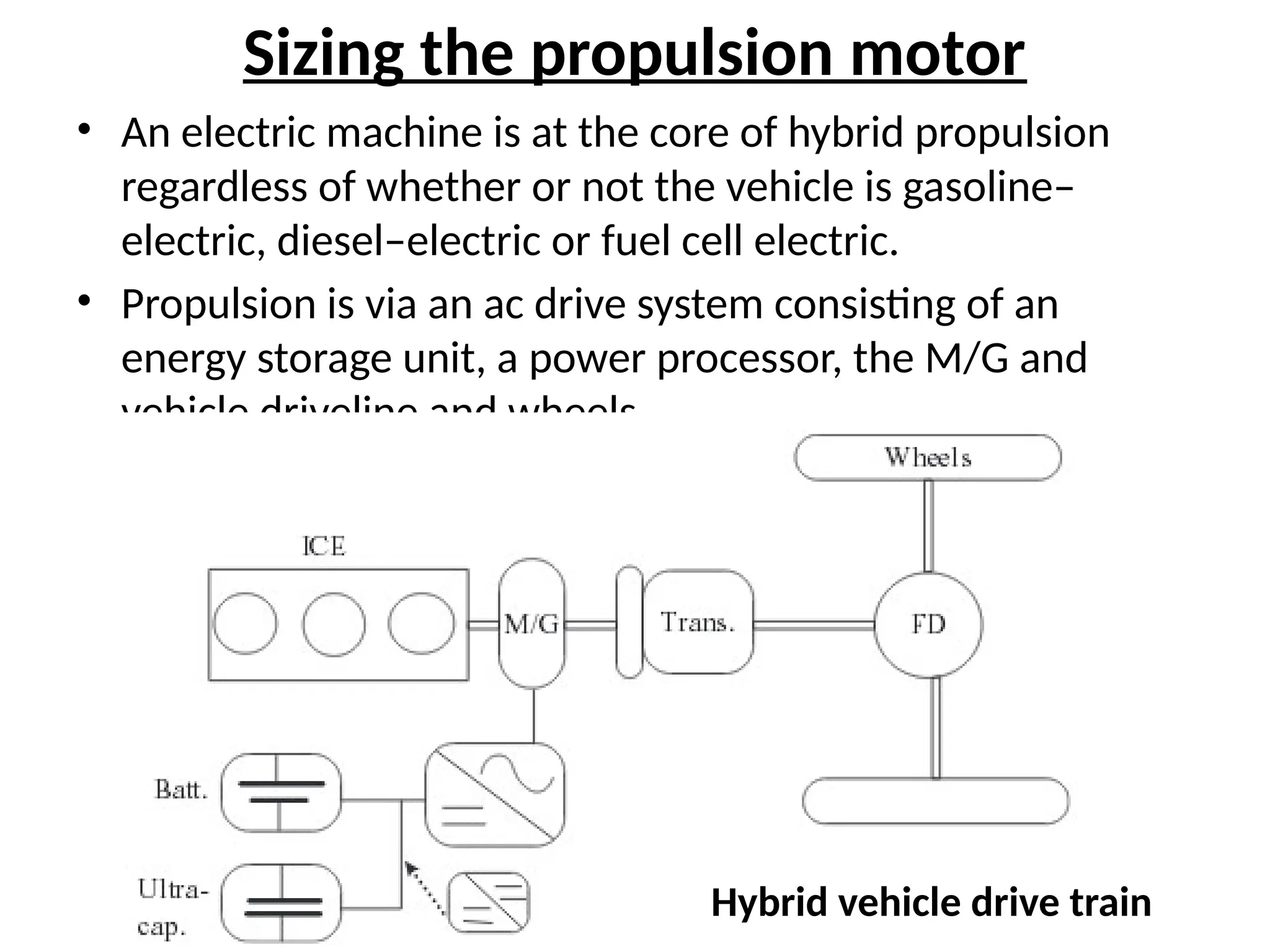
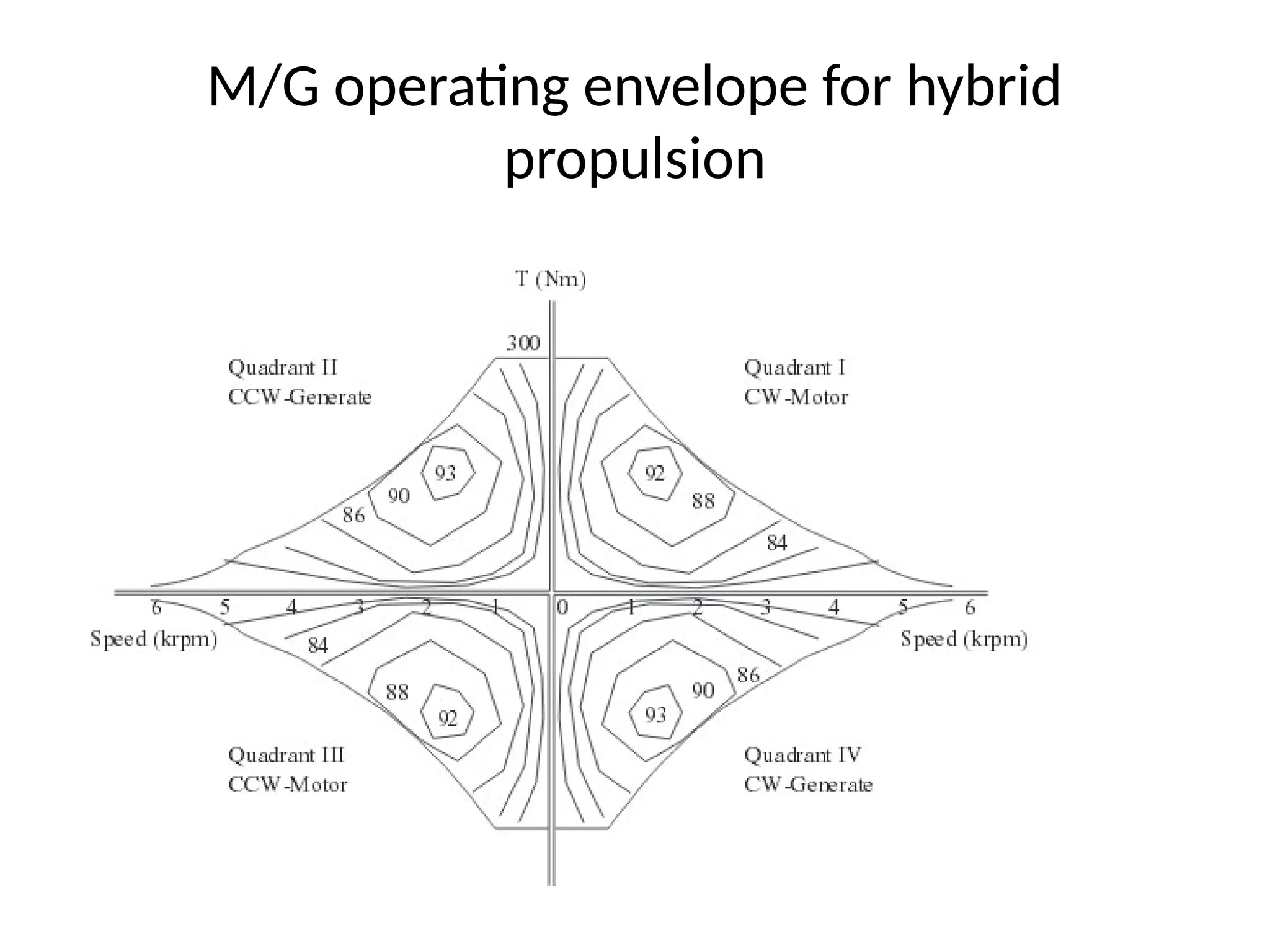
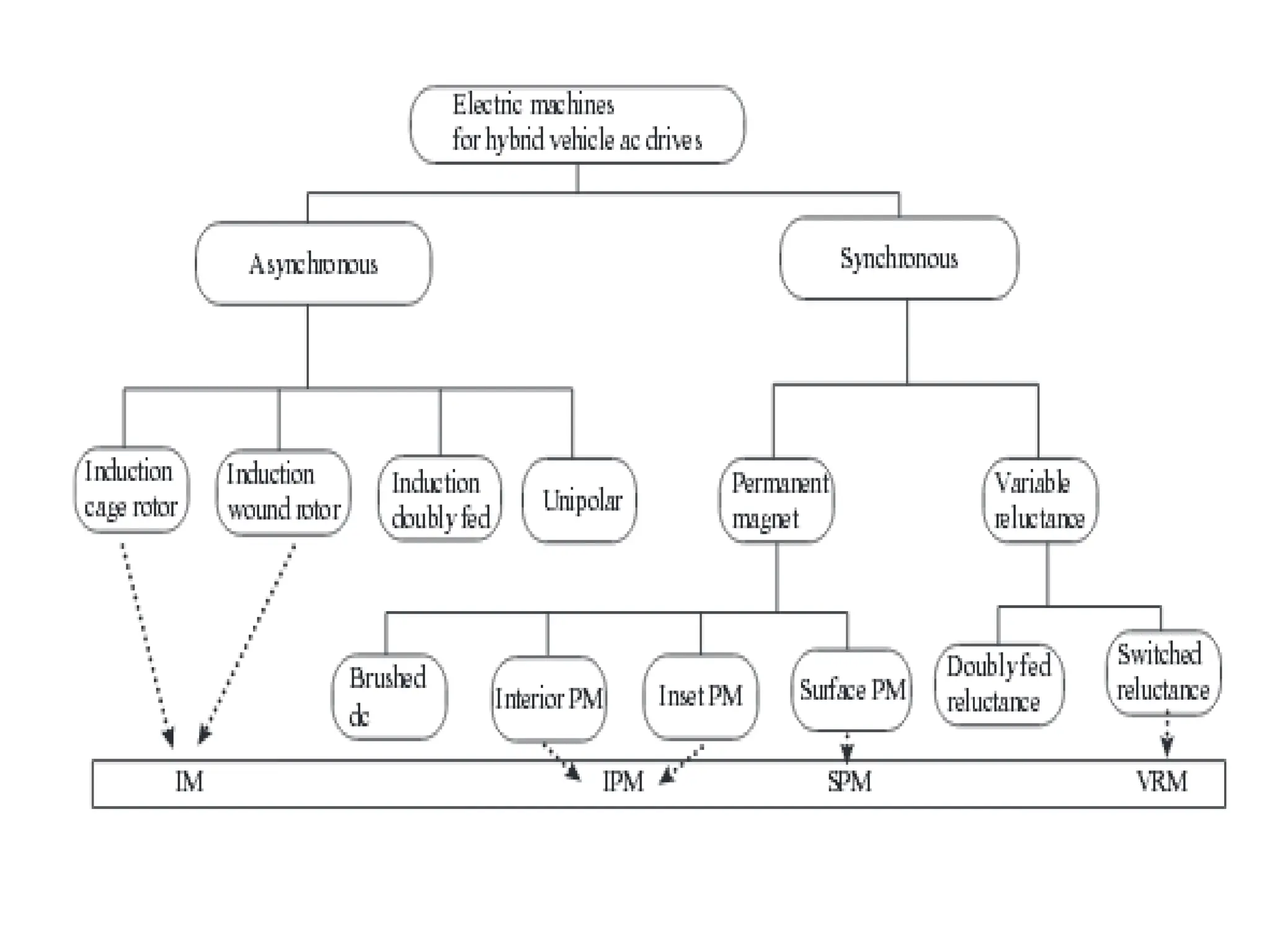
• An electric machine is at the core of hybrid propulsion
regardless of whether or not the vehicle is gasoline–
electric, diesel–electric or fuel cell electric.
• Propulsion is via an ac drive system consisting of an
energy storage unit, a power processor, the M/G and
vehicle driveline and wheels.
Hybrid vehicle drive train
136.
• Most electricmachines rated for vehicle
traction applications are limited to 12 000 rpm
for several inherent reasons:
– rotor burst limits,
– rotor position sensing encoders and their
attendant digital interface,
– bearing system,
– critical speeds of the M/G geometry.
Machine sizing
• Theelectric machine is physically sized by its torque
specification.
• Electric machine torque is determined by the amount
of flux the iron can carry and the amount of current
the conductors can carry plus the physical geometry
of the machine.
• Machine torque =
where
k = constant that includes geometry variables
= The product of electric and magnetic loading (volumetric shear
force)
= stator bore volume