Aldel Education Trust’s
ST. JOHN COLLEGE OF ENGINEERING AND MANAGEMENT, PALGHAR
(ST. JOHN POLYTECHNIC)
DEPARTMENT OF MECHANICAL ENGINEERING
SUB: THERMAL ENGINEERING (TEN)
22337
TOPIC:BASIC CONCEPTS OF
THERMODYNAMICS
PREPARED BY:-
Prof. Pranit Mehata
Lecturer, SJCEM
7972064172 1
WHAT IS THERMODYNAMICS ?????
● Thermodynamics is derived from the greek words therme means heat and
dynamics means motion/force.
● Thermodynamics is the science that deals with interactions between energy
and heat.
● Heat can be converted into mechanical work e.g. heat engine similarly work
can be converted into heat.e.g friction.
● Thermodynamics basically entails four laws known as Zeroth law, First law,
Second law and Third Law.
2
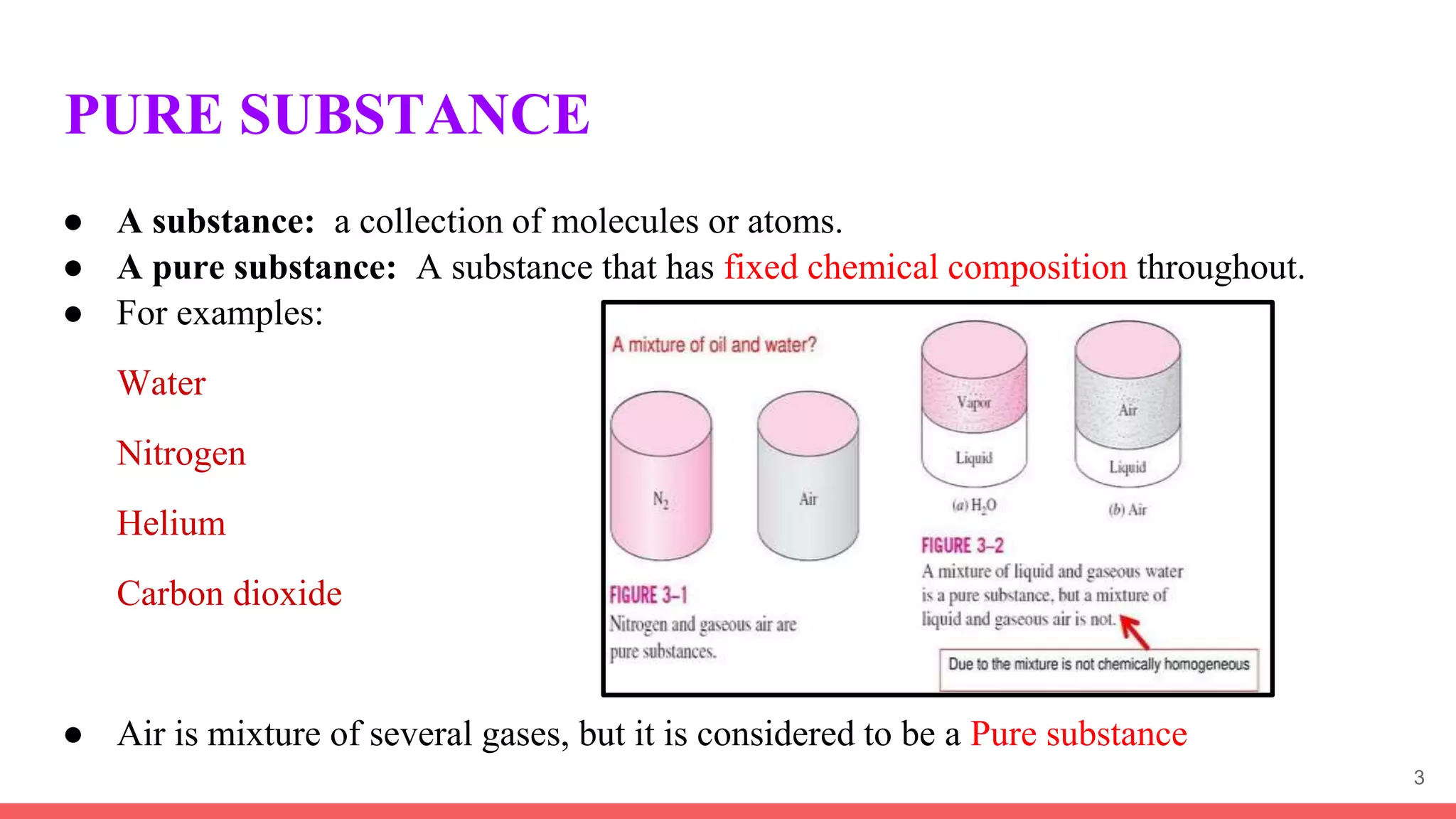
PURE SUBSTANCE
● A substance: a collection of molecules or atoms.
● A pure substance: A substance that has fixed chemical composition throughout.
● For examples:
Water
Nitrogen
Helium
Carbon dioxide
● Air is mixture of several gases, but it is considered to be a Pure substance
3
THERMODYNAMIC SYSTEM
● System: Anything which are kept in
consideration is called as System.
● Surrounding: Everything which is external to
the system is called as Surrounding.
● Boundary: The envelope (real or imaginary)
which separates the thermodynamic system
and surrounding is called as boundary.
● Universe: Thermodynamics system +
surrounding= Universe.
4
TYPES OF THERMODYNAMIC SYSTEM
5
Thermodynamic
System
Open System Closed System Isolated System
OPEN SYSTEM
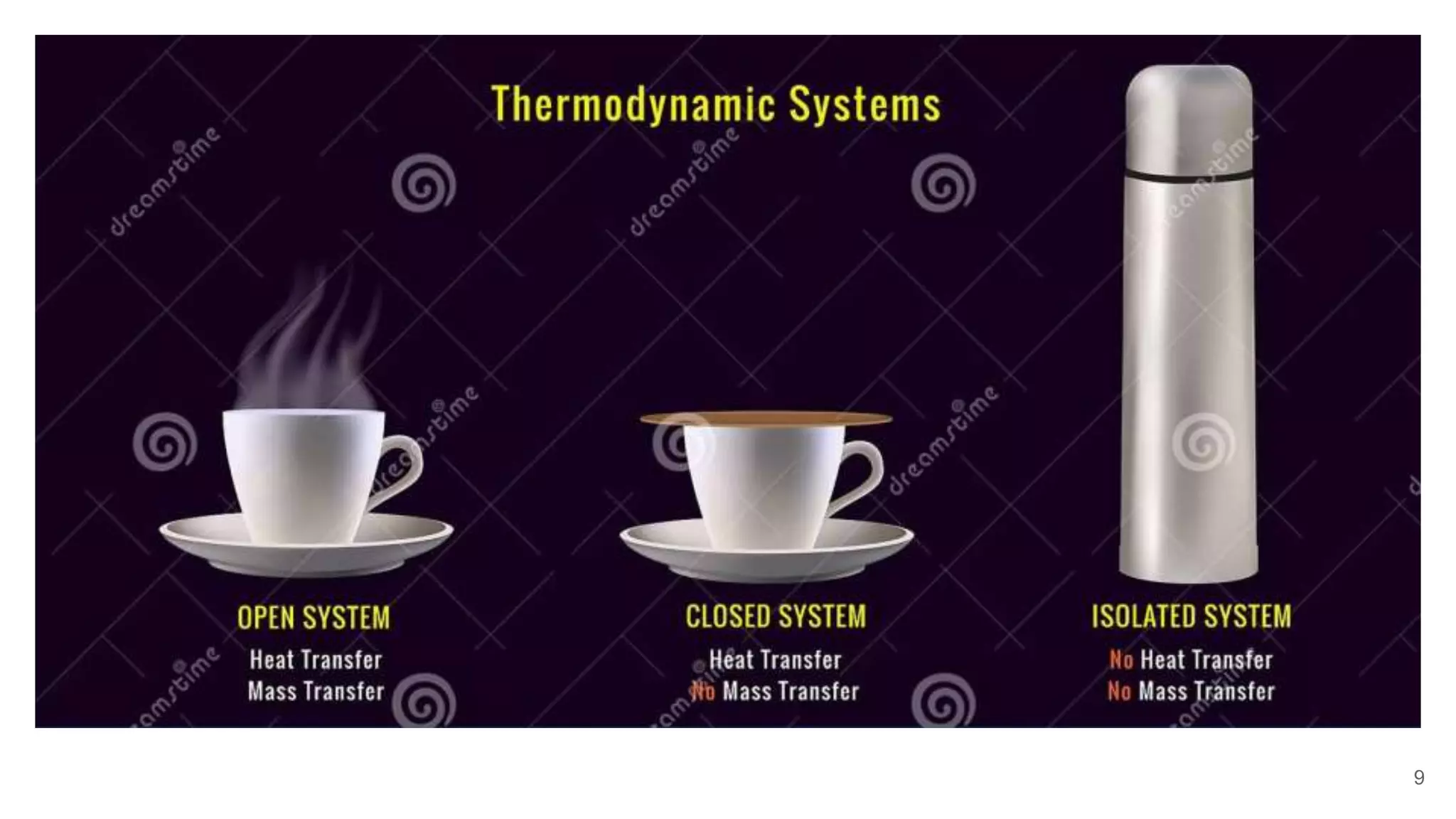
● In this system mass as well as energy transfer take place between system and
surrounding.
● Most of engineering devices are open system.
● For Example
1. A fountain pen while writing
2. Candle flame while burning
3. Air Conditioned Railway Coach
4. Internal Combustion engine
5. Steam turbine
6
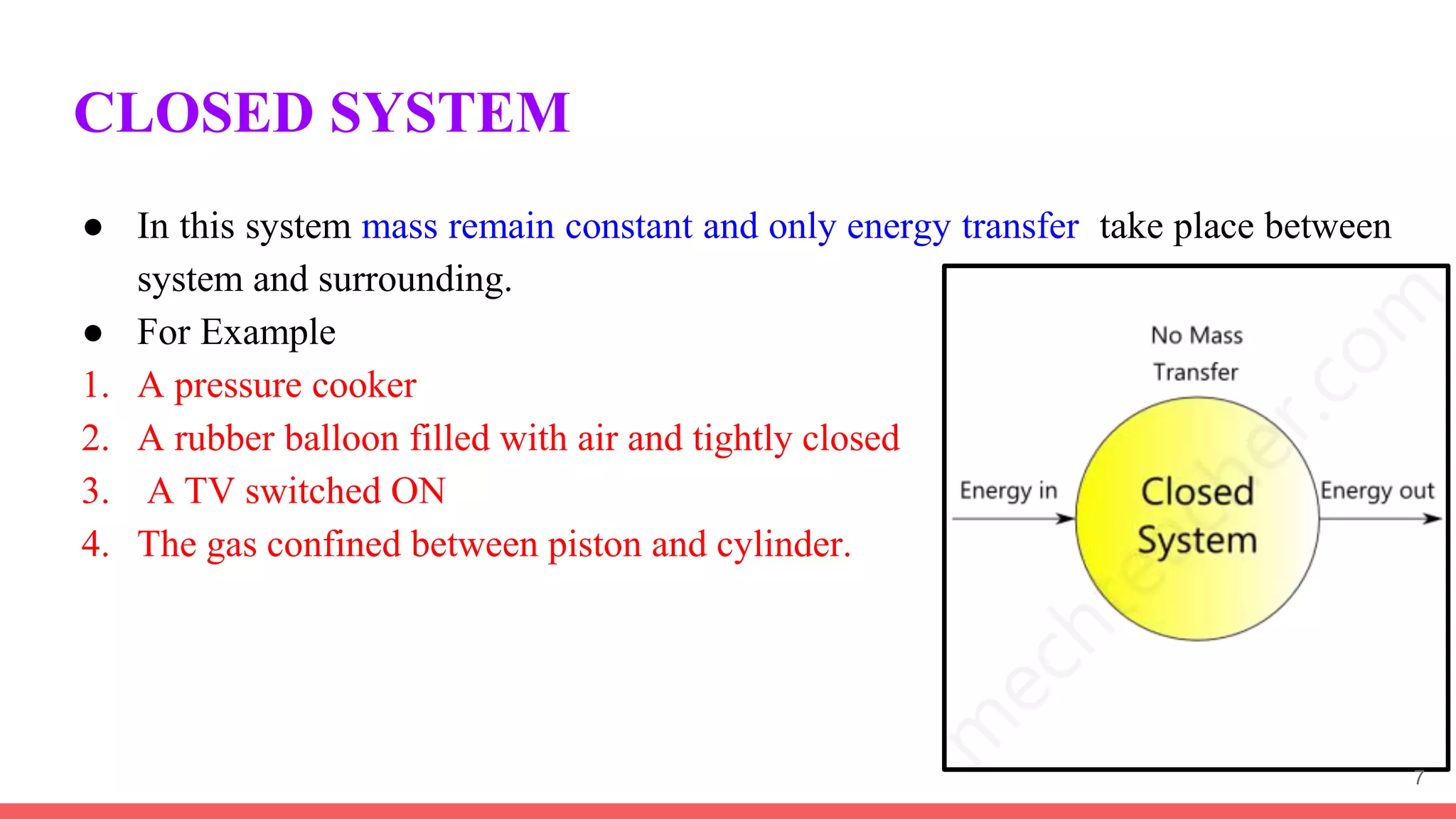
CLOSED SYSTEM
● In this system mass remain constant and only energy transfer take place between
system and surrounding.
● For Example
1. A pressure cooker
2. A rubber balloon filled with air and tightly closed
3. A TV switched ON
4. The gas confined between piston and cylinder.
7
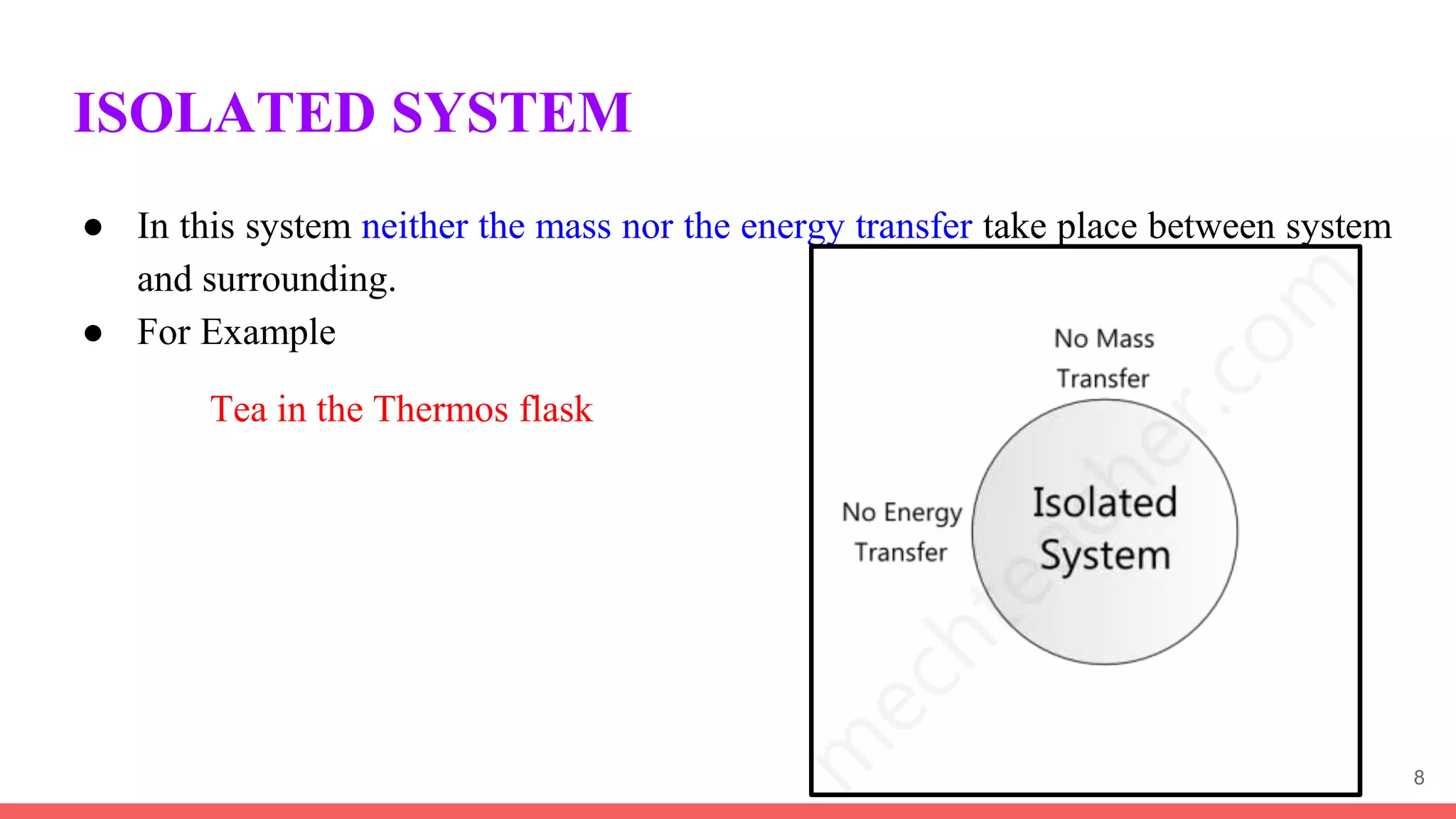
ISOLATED SYSTEM
● In this system neither the mass nor the energy transfer take place between system
and surrounding.
● For Example
Tea in the Thermos flask
8
9
PROPERTIES OF SYSTEMS
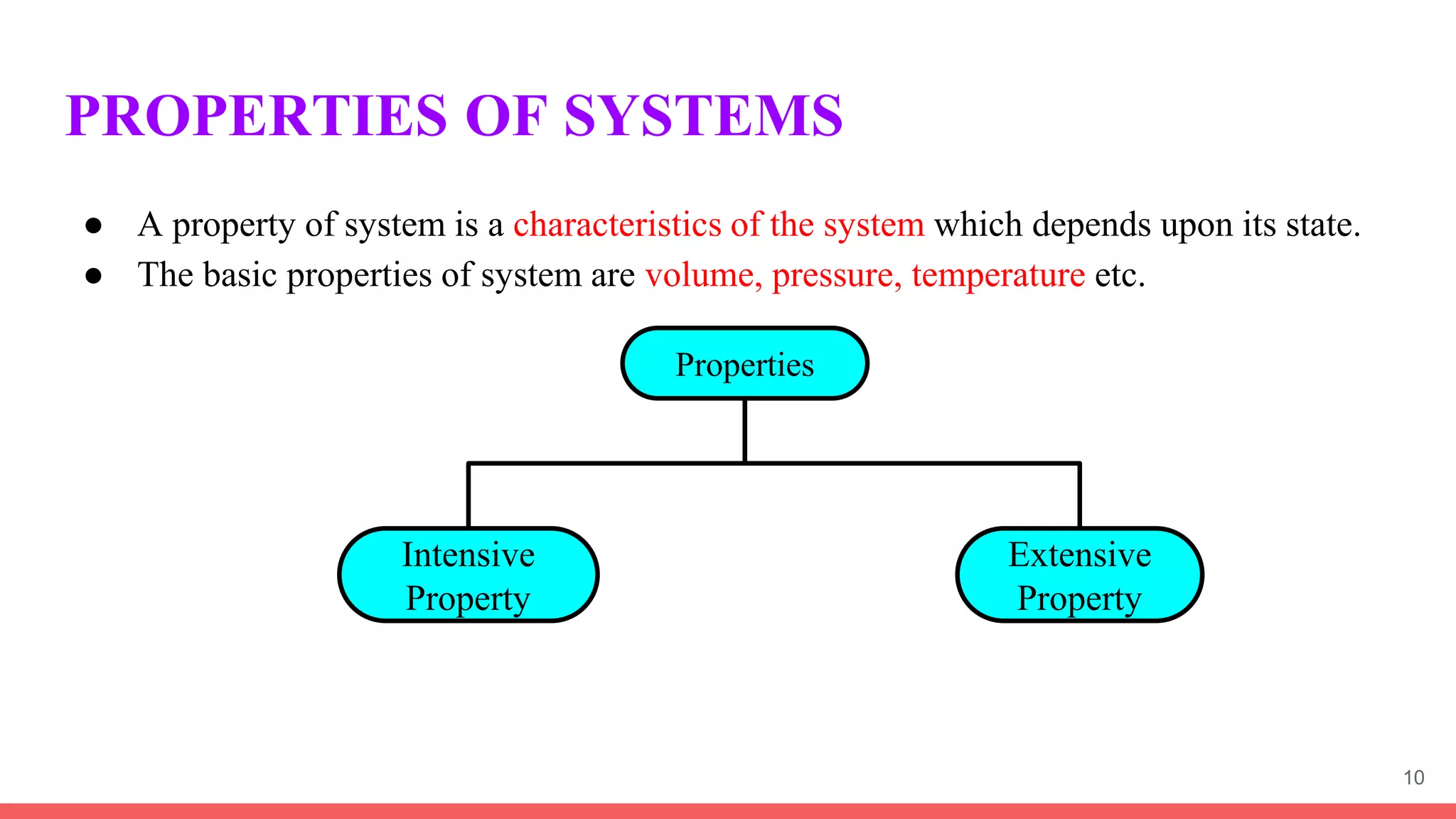
● A property of system is a characteristics of the system which depends upon its state.
● The basic properties of system are volume, pressure, temperature etc.
Properties
Intensive
Property
Extensive
Property
10
INTENSIVE PROPERTY
● It is defined as the property which is does not depend upon the mass of the system.
OR
● Intensive properties are those whose values are independent of the mass possessed by
the system.
● For Example
Pressure, Temperature, Density, Specific volume, specific Enthalpy, etc.
11
EXTENSIVE PROPERTY
● It is defined as the property which depends upon the mass of the system.
OR
● Extensive properties are those whose values are dependent of the mass possessed by the system.
● For Example
volume, enthalpy, and entropy etc.
● Extensive properties are denoted by uppercase letters, such as volume (V), enthalpy (H) and entropy
(S).
12
THERMODYNAMIC STATE
● It is the condition of the system (when the system is in thermodynamic equilibrium) at any particular
moment which can be identified by the statement of its properties such as pressure, temperature,
volume, etc.
● To define the state at least two thermodynamic properties are necessary.
● Even if one property is changed the state will change.
13
THERMODYNAMIC PROCESS
● A process occurs when the system undergoes a change in
state .
OR
● When a system changes its state from one equilibrium state to
another equilibrium state, then the path of successive states
through which the system has passed is known as process or
thermodynamic process.
1-2 represents a thermodynamic process
14
FLOW PROCESS
● A process in which mass is entering
and leaving through the boundary of
an open system is called as flow
process.
● Flow process may be steady and
non-steady
15
NON FLOW PROCESS
● A process in which there is no mass interaction across the system boundaries
during the process.
● Closed system undergoes non flow processes.
16
THERMODYNAMIC CYCLE
● A thermodynamic cycle is defined as a series of processes (changes of state)
such that final state is identical with initial state.
17
POINT FUNCTION
● The properties of system which are depends upon state of the system are called
as Point function.
● Point function are Exact Differentials.
● For example : Temperature, Pressure, Density, Mass, Volume, Enthalpy, Entropy,
Internal energy etc.
18
PATH FUNCTION
● There are certain quantities which cannot be located on a graph by a point but are
given by the area
● Then these quantities are dependent on the path by which system arrived at a
given state are called as Path Function.
● Path function are Inexact Differentials.
● For example : Heat and work
19
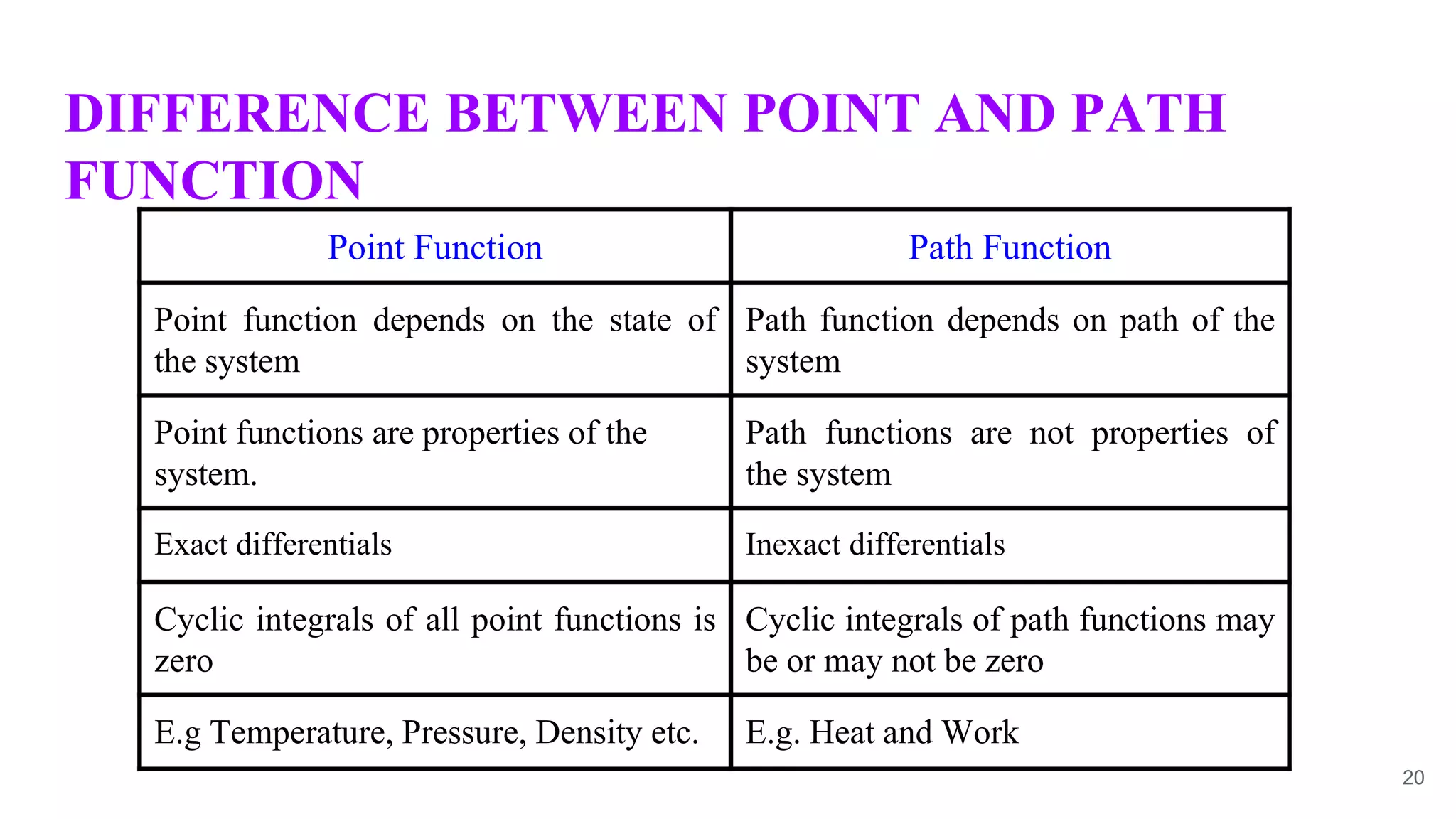
DIFFERENCE BETWEEN POINT AND PATH
FUNCTION
20
Point Function Path Function
Point function depends on the state of
the system
Path function depends on path of the
system
Point functions are properties of the
system.
Path functions are not properties of
the system
Exact differentials Inexact differentials
Cyclic integrals of all point functions is
zero
Cyclic integrals of path functions may
be or may not be zero
E.g Temperature, Pressure, Density etc. E.g. Heat and Work
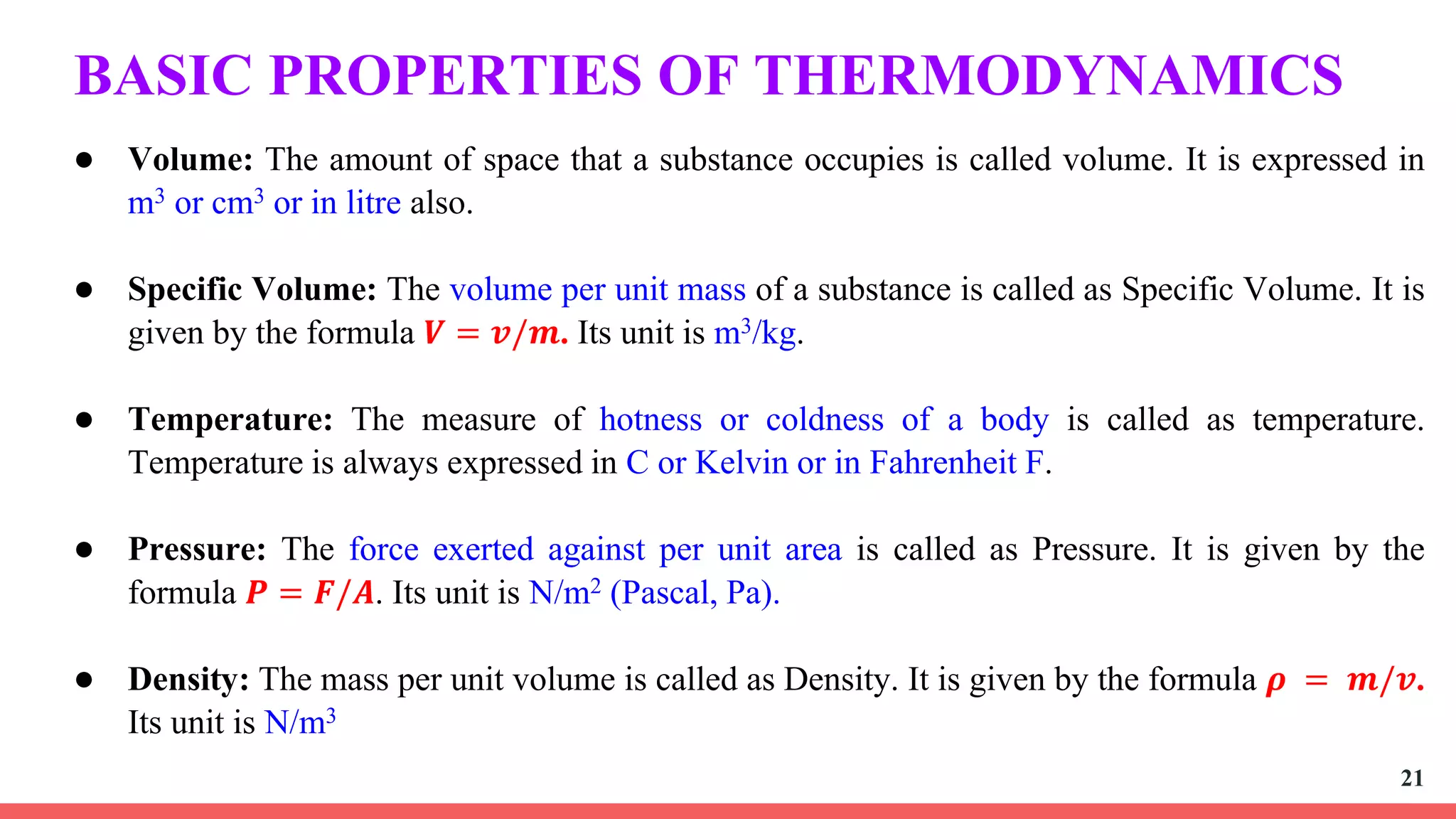
BASIC PROPERTIES OF THERMODYNAMICS
● Volume: The amount of space that a substance occupies is called volume. It is expressed in
m3 or cm3 or in litre also.
● Specific Volume: The volume per unit mass of a substance is called as Specific Volume. It is
given by the formula 𝑽 = 𝒗/𝒎. Its unit is m3/kg.
● Temperature: The measure of hotness or coldness of a body is called as temperature.
Temperature is always expressed in C or Kelvin or in Fahrenheit F.
● Pressure: The force exerted against per unit area is called as Pressure. It is given by the
formula 𝑷 = 𝑭/𝑨. Its unit is N/m2 (Pascal, Pa).
● Density: The mass per unit volume is called as Density. It is given by the formula 𝝆 = 𝒎/𝒗.
Its unit is N/m3
21
THANK YOU
Stay Home
Stay Safe!

Basics of thermodynamics

  • 1.
    Aldel Education Trust’s ST.JOHN COLLEGE OF ENGINEERING AND MANAGEMENT, PALGHAR (ST. JOHN POLYTECHNIC) DEPARTMENT OF MECHANICAL ENGINEERING SUB: THERMAL ENGINEERING (TEN) 22337 TOPIC:BASIC CONCEPTS OF THERMODYNAMICS PREPARED BY:- Prof. Pranit Mehata Lecturer, SJCEM 7972064172 1
  • 2.
    WHAT IS THERMODYNAMICS????? ● Thermodynamics is derived from the greek words therme means heat and dynamics means motion/force. ● Thermodynamics is the science that deals with interactions between energy and heat. ● Heat can be converted into mechanical work e.g. heat engine similarly work can be converted into heat.e.g friction. ● Thermodynamics basically entails four laws known as Zeroth law, First law, Second law and Third Law. 2
  • 3.
    PURE SUBSTANCE ● Asubstance: a collection of molecules or atoms. ● A pure substance: A substance that has fixed chemical composition throughout. ● For examples: Water Nitrogen Helium Carbon dioxide ● Air is mixture of several gases, but it is considered to be a Pure substance 3
  • 4.
    THERMODYNAMIC SYSTEM ● System:Anything which are kept in consideration is called as System. ● Surrounding: Everything which is external to the system is called as Surrounding. ● Boundary: The envelope (real or imaginary) which separates the thermodynamic system and surrounding is called as boundary. ● Universe: Thermodynamics system + surrounding= Universe. 4
  • 5.
    TYPES OF THERMODYNAMICSYSTEM 5 Thermodynamic System Open System Closed System Isolated System
  • 6.
    OPEN SYSTEM ● Inthis system mass as well as energy transfer take place between system and surrounding. ● Most of engineering devices are open system. ● For Example 1. A fountain pen while writing 2. Candle flame while burning 3. Air Conditioned Railway Coach 4. Internal Combustion engine 5. Steam turbine 6
  • 7.
    CLOSED SYSTEM ● Inthis system mass remain constant and only energy transfer take place between system and surrounding. ● For Example 1. A pressure cooker 2. A rubber balloon filled with air and tightly closed 3. A TV switched ON 4. The gas confined between piston and cylinder. 7
  • 8.
    ISOLATED SYSTEM ● Inthis system neither the mass nor the energy transfer take place between system and surrounding. ● For Example Tea in the Thermos flask 8
  • 9.
  • 10.
    PROPERTIES OF SYSTEMS ●A property of system is a characteristics of the system which depends upon its state. ● The basic properties of system are volume, pressure, temperature etc. Properties Intensive Property Extensive Property 10
  • 11.
    INTENSIVE PROPERTY ● Itis defined as the property which is does not depend upon the mass of the system. OR ● Intensive properties are those whose values are independent of the mass possessed by the system. ● For Example Pressure, Temperature, Density, Specific volume, specific Enthalpy, etc. 11
  • 12.
    EXTENSIVE PROPERTY ● Itis defined as the property which depends upon the mass of the system. OR ● Extensive properties are those whose values are dependent of the mass possessed by the system. ● For Example volume, enthalpy, and entropy etc. ● Extensive properties are denoted by uppercase letters, such as volume (V), enthalpy (H) and entropy (S). 12
  • 13.
    THERMODYNAMIC STATE ● Itis the condition of the system (when the system is in thermodynamic equilibrium) at any particular moment which can be identified by the statement of its properties such as pressure, temperature, volume, etc. ● To define the state at least two thermodynamic properties are necessary. ● Even if one property is changed the state will change. 13
  • 14.
    THERMODYNAMIC PROCESS ● Aprocess occurs when the system undergoes a change in state . OR ● When a system changes its state from one equilibrium state to another equilibrium state, then the path of successive states through which the system has passed is known as process or thermodynamic process. 1-2 represents a thermodynamic process 14
  • 15.
    FLOW PROCESS ● Aprocess in which mass is entering and leaving through the boundary of an open system is called as flow process. ● Flow process may be steady and non-steady 15
  • 16.
    NON FLOW PROCESS ●A process in which there is no mass interaction across the system boundaries during the process. ● Closed system undergoes non flow processes. 16
  • 17.
    THERMODYNAMIC CYCLE ● Athermodynamic cycle is defined as a series of processes (changes of state) such that final state is identical with initial state. 17
  • 18.
    POINT FUNCTION ● Theproperties of system which are depends upon state of the system are called as Point function. ● Point function are Exact Differentials. ● For example : Temperature, Pressure, Density, Mass, Volume, Enthalpy, Entropy, Internal energy etc. 18
  • 19.
    PATH FUNCTION ● Thereare certain quantities which cannot be located on a graph by a point but are given by the area ● Then these quantities are dependent on the path by which system arrived at a given state are called as Path Function. ● Path function are Inexact Differentials. ● For example : Heat and work 19
  • 20.
    DIFFERENCE BETWEEN POINTAND PATH FUNCTION 20 Point Function Path Function Point function depends on the state of the system Path function depends on path of the system Point functions are properties of the system. Path functions are not properties of the system Exact differentials Inexact differentials Cyclic integrals of all point functions is zero Cyclic integrals of path functions may be or may not be zero E.g Temperature, Pressure, Density etc. E.g. Heat and Work
  • 21.
    BASIC PROPERTIES OFTHERMODYNAMICS ● Volume: The amount of space that a substance occupies is called volume. It is expressed in m3 or cm3 or in litre also. ● Specific Volume: The volume per unit mass of a substance is called as Specific Volume. It is given by the formula 𝑽 = 𝒗/𝒎. Its unit is m3/kg. ● Temperature: The measure of hotness or coldness of a body is called as temperature. Temperature is always expressed in C or Kelvin or in Fahrenheit F. ● Pressure: The force exerted against per unit area is called as Pressure. It is given by the formula 𝑷 = 𝑭/𝑨. Its unit is N/m2 (Pascal, Pa). ● Density: The mass per unit volume is called as Density. It is given by the formula 𝝆 = 𝒎/𝒗. Its unit is N/m3 21
  • 22.
  • 23.