Basic Mechanical Engineering
BMET 102/BMEP 102
Session: 2020-21
UNIT-1
THERMODYNAMICS
NOTES
By
Mr. V
arun Pratap Singh
Assistant Professor
Department of Mechanical Engineering
College of Engineering Roorkee
Disclaimer
This document does not claim any originality and cannot be used as a substitute for
prescribed textbooks. The information presented here is merely a collection by the
subject faculty members for their respective teaching assignments. Various sources
as mentioned at the end of the document as well as freely available material from the
internet were consulted for preparing this document. The ownership of the
information lies with the respective authors or institutions. Further, this document is
not intended to be used for commercial purpose and the subject faculty members are
not accountable for any issues, legal or otherwise, arising out of the use of this
document. The subject faculty members make no representations or warranties
concerning the accuracy or completeness of the contents of this document and
specifically disclaim any implied warranties of merchantability or fitness for a
particular purpose. The subject faculty members shall be liable for any loss of profit
or any other commercial damages, including but not limited to special, incidental,
consequential, or other damages.
Syllabus
UNIT-1: Fundamental Concepts and Definitions
Definition of thermodynamics, System, Surrounding and universe, Phase, Concept of continuum,
Macroscopic & microscopic point of view. Density, Specific volume, Pressure, temperature.
Thermodynamic equilibrium, Property, State, Path, Process, Cyclic and non-cyclic processes,
Reversible and irreversible processes, Quasi-static process, Energy and its forms, Enthalpy.
Video Reference:
1. YouTube Channel, BEST MECHANICAL ENGINEERING
https://www.youtube.com/channel/UC4vN8jWyjDlyRfryqQ3izsQ/featured
Introduction
The field of science, which deals with energies possessed and exchanged by a system of gases and
vapours, their conversion in terms of heat and work and their relationship with properties of the
system is called thermodynamics. Thus in thermodynamics, we deal with the conversion of energy
from one form to the other, mainly heat into work or vice versa. In this context, we must know the
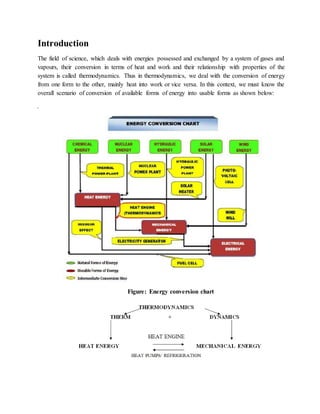
overall scenario of conversion of available forms of energy into usable forms as shown below:
Figure: Energy conversion chart
Application of Thermodynamics
https://www.youtube.com/watch?v=kL2p5yD2bVk&list=PLdoIhVhbPQV6nSJ-jhlsJ9b6gwfd4tsGx&index=3
 Power Generation (Thermal/Nuclear Power plants)
 Automobiles (Petrol/ Diesel/LPG/CNG engines)
 Processing Industries (Steam generation, Refrigeration systems)
 Gas Compressors (Air compressors)
Thermodynamics Definition:
https://www.youtube.com/watch?v=RIV1aejnG6s&list=PLdoIhVhbPQV6nSJ-jhlsJ9b6gwfd4tsGx&index=1
Is the science of energy transfer and its effect on the physical properties of the substance.
Thermodynamics is primarily concerned with two forms of energy i.e. "Heat & Work". It is based
on four laws of thermodynamics known as zeroth, first, second and third law. Thermodynamic
principles are used in the designing of energy converting devices, such as steam engines, IC.
engines, steam and gas turbines, refrigerators, air conditioners, fuel cells etc.
Thermodynamic System:
https://www.youtube.com/watch?v=KdT_6Ssb7w4&list=PLdoIhVhbPQV45qPpCDHaMm5FRMy9BvdWo&
index=2
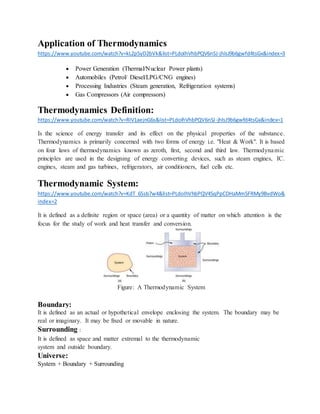
It is defined as a definite region or space (area) or a quantity of matter on which attention is the
focus for the study of work and heat transfer and conversion.
Figure: A Thermodynamic System
Boundary:
It is defined as an actual or hypothetical envelope enclosing the system. The boundary may be
real or imaginary. It may be fixed or movable in nature.
Surrounding :
It is defined as space and matter extremal to the thermodynamic
system and outside boundary.
Universe:
System + Boundary + Surrounding
Types of System:
https://www.youtube.com/watch?v=vThUEuGTgFQ&list=PLdoIhVhbPQV45qPpCDHaMm5FRMy9BvdWo
1. Open System:
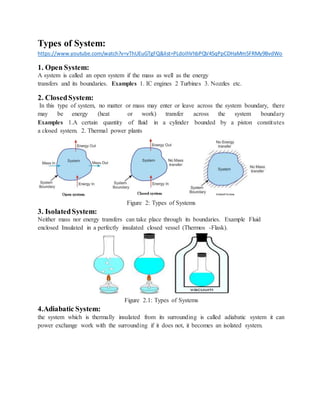
A system is called an open system if the mass as well as the energy
transfers and its boundaries. Examples 1. IC engines 2 Turbines 3. Nozzles etc.
2. ClosedSystem:
In this type of system, no matter or mass may enter or leave across the system boundary, there
may be energy (heat or work) transfer across the system boundary
Examples 1.A certain quantity of fluid in a cylinder bounded by a piston constitutes
a closed system. 2. Thermal power plants
Figure 2: Types of Systems
3. IsolatedSystem:
Neither mass nor energy transfers can take place through its boundaries. Example Fluid
enclosed Insulated in a perfectly insulated closed vessel (Thermos -Flask).
Figure 2.1: Types of Systems
4.Adiabatic System:
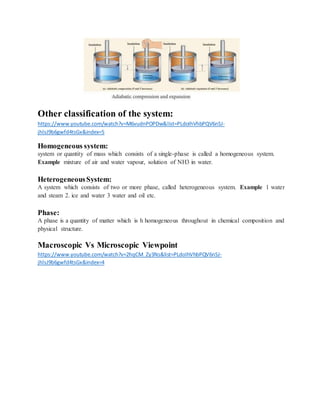
the system which is thermally insulated from its surrounding is called adiabatic system it can
power exchange work with the surrounding if it does not, it becomes an isolated system.
Other classification of the system:
https://www.youtube.com/watch?v=M6vudnPOPDw&list=PLdoIhVhbPQV6nSJ-
jhlsJ9b6gwfd4tsGx&index=5
Homogeneous system:
system or quantity of mass which consists of a single-phase is called a homogeneous system.
Example mixture of air and water vapour, solution of NH3 in water.
HeterogeneousSystem:
A system which consists of two or more phase, called heterogeneous system. Example 1 water
and steam 2. ice and water 3 water and oil etc.
Phase:
A phase is a quantity of matter which is h homogeneous throughout in chemical composition and
physical structure.
Macroscopic Vs Microscopic Viewpoint
https://www.youtube.com/watch?v=2hqCM_Zy3Ns&list=PLdoIhVhbPQV6nSJ-
jhlsJ9b6gwfd4tsGx&index=4
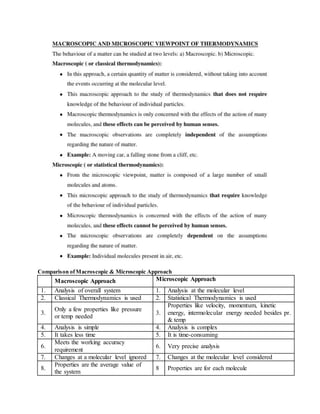
Comparison ofMacroscopic & Microscopic Approach
Macroscopic Approach Microscopic Approach
1. Analysis of overall system 1. Analysis at the molecular level
2. Classical Thermodynamics is used 2. Statistical Thermodynamics is used
3.
Only a few properties like pressure
or temp needed
3.
Properties like velocity, momentum, kinetic
energy, intermolecular energy needed besides pr.
& temp
4. Analysis is simple 4. Analysis is complex
5. It takes less time 5. It is time-consuming
6.
Meets the working accuracy
requirement
6. Very precise analysis
7. Changes at a molecular level ignored 7. Changes at the molecular level considered
8.
Properties are the average value of
the system
8 Properties are for each molecule
Conceptof the continuum - thermodynamics, MechanicalEngineering
Even the simplification of matter into molecules, atoms, electrons, etc. is too complex a picture for
many problems of thermodynamics. Thermodynamics doesn't make any hypotheses about the
structure of the matter of the system. The volumes of a system considered are quite large as
compared to molecular dimensions. The system can be regarded as a continuum. The system is
supposed to contain a continuous distribution of matter. There are no voids and cavities present.
The pressure, temperature, density and other properties are average values of action of several
molecules and atoms. This kind of idealization is a must for solving most of the problems. The laws
and concepts of thermodynamics are not dependent on the structure of matter.
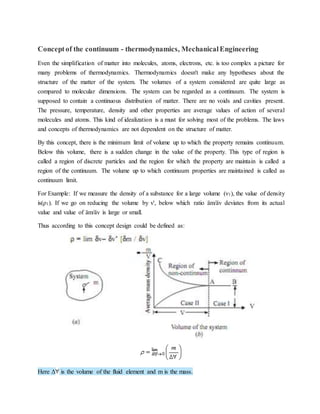
By this concept, there is the minimum limit of volume up to which the property remains continuum.
Below this volume, there is a sudden change in the value of the property. This type of region is
called a region of discrete particles and the region for which the property are maintain is called a
region of the continuum. The volume up to which continuum properties are maintained is called as
continuum limit.
For Example: If we measure the density of a substance for a large volume (ν1), the value of density
is(ρ1). If we go on reducing the volume by v', below which ratio äm/äv deviates from its actual
value and value of äm/äv is large or small.
Thus according to this concept design could be defined as:
Here Δ is the volume of the fluid element and m is the mass.
Thermodynamic equilibrium:
https://www.youtube.com/watch?v=TTjZlU1CSrQ&list=PLdoIhVhbPQV6nSJ-jhlsJ9b6gwfd4tsGx&index=8
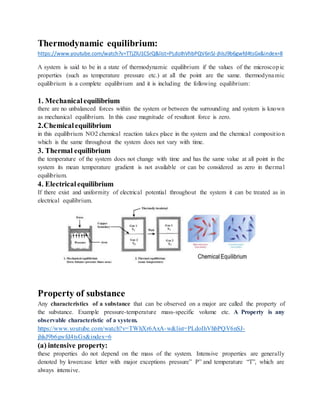
A system is said to be in a state of thermodynamic equilibrium if the values of the microscopic
properties (such as temperature pressure etc.) at all the point are the same. thermodynamic
equilibrium is a complete equilibrium and it is including the following equilibrium:
1. Mechanicalequilibrium
there are no unbalanced forces within the system or between the surrounding and system is known
as mechanical equilibrium. In this case magnitude of resultant force is zero.
2.Chemicalequilibrium
in this equilibrium NO2 chemical reaction takes place in the system and the chemical composition
which is the same throughout the system does not vary with time.
3. Thermal equilibrium
the temperature of the system does not change with time and has the same value at all point in the
system its mean temperature gradient is not available or can be considered as zero in thermal
equilibrium.
4. Electricalequilibrium
If there exist and uniformity of electrical potential throughout the system it can be treated as in
electrical equilibrium.
Property of substance
Any characteristics of a substance that can be observed on a major are called the property of
the substance. Example pressure-temperature mass-specific volume etc. A Property is any
observable characteristic of a system.
https://www.youtube.com/watch?v=TWhXr6AxA-w&list=PLdoIhVhbPQV6nSJ-
jhlsJ9b6gwfd4tsGx&index=6
(a) intensive property:
these properties do not depend on the mass of the system. Intensive properties are generally
denoted by lowercase letter with major exceptions pressure” P” and temperature “T”, which are
always intensive.
Example temperature (T), pressure (P), specific volume (v), density (ρ) etc.
(b) extensive property:
these properties depend on the mass of the system. If mass changes, their value also changes.
These are generally denoted by upper case letter with major exceptions like mass “m”, the number
of moles “n”.
Examples volume (V), energy (E), total enthalpy (H), entropy (S), potential energy (PE), kinetic
energy (KE) etc.
The ratio of two extensive property of a homogeneous system is an intensive property. Like ratio
of mass and volume is the density which is an intensive property. when an extensive property is
divided by the mass or number of moles of a substance forming the system, the resulting intensive
property is called a specific property. Example: specific volume, specific energy etc.
State, Change of State, Path, Process, Cycle
https://www.youtube.com/watch?v=v0IdjFPGcQI&list=PLdoIhVhbPQV6nSJ-jhlsJ9b6gwfd4tsGx&index=7
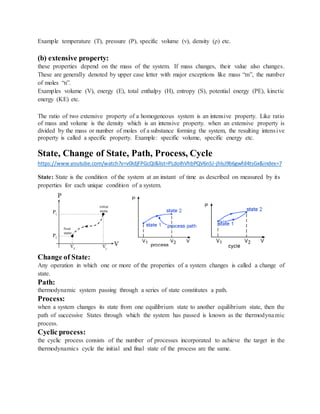
State: State is the condition of the system at an instant of time as described on measured by its
properties for each unique condition of a system.
Change of State:
Any operation in which one or more of the properties of a system changes is called a change of
state.
Path:
thermodynamic system passing through a series of state constitutes a path.
Process:
when a system changes its state from one equilibrium state to another equilibrium state, then the
path of successive States through which the system has passed is known as the thermodynamic
process.
Cyclic process:
the cyclic process consists of the number of processes incorporated to achieve the target in the
thermodynamics cycle the initial and final state of the process are the same.
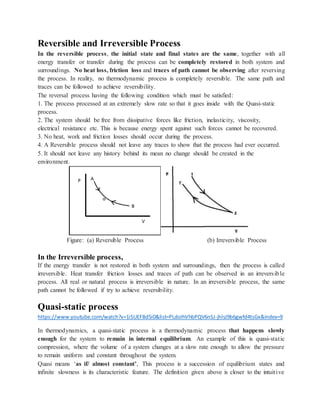
Reversible and Irreversible Process
In the reversible process, the initial state and final states are the same, together with all
energy transfer or transfer during the process can be completely restored in both system and
surroundings. No heat loss, friction loss and traces of path cannot be observing after reversing
the process. In reality, no thermodynamic process is completely reversible. The same path and
traces can be followed to achieve reversibility.
The reversal process having the following condition which must be satisfied:
1. The process processed at an extremely slow rate so that it goes inside with the Quasi-static
process.
2. The system should be free from dissipative forces like friction, inelasticity, viscosity,
electrical resistance etc. This is because energy spent against such forces cannot be recovered.
3. No heat, work and friction losses should occur during the process.
4. A Reversible process should not leave any traces to show that the process had ever occurred.
5. It should not leave any history behind its mean no change should be created in the
environment.
Figure: (a) Reversible Process (b) Irreversible Process
In the Irreversible process,
If the energy transfer is not restored in both system and surroundings, then the process is called
irreversible. Heat transfer friction losses and traces of path can be observed in an irreversible
process. All real or natural process is irreversible in nature. In an irreversible process, the same
path cannot be followed if try to achieve reversibility.
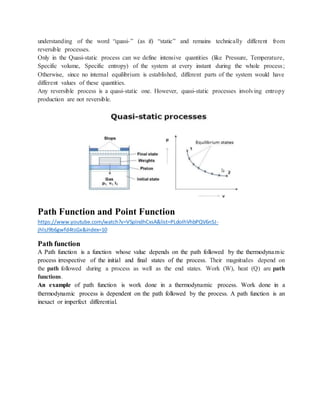
Quasi-static process
https://www.youtube.com/watch?v=1iSUEFBd5i0&list=PLdoIhVhbPQV6nSJ-jhlsJ9b6gwfd4tsGx&index=9
In thermodynamics, a quasi-static process is a thermodynamic process that happens slowly
enough for the system to remain in internal equilibrium. An example of this is quasi-static
compression, where the volume of a system changes at a slow rate enough to allow the pressure
to remain uniform and constant throughout the system.
Quasi means ‘as if/ almost constant’, This process is a succession of equilibrium states and
infinite slowness is its characteristic feature. The definition given above is closer to the intuitive
understanding of the word “quasi-” (as if) “static” and remains technically different from
reversible processes.
Only in the Quasi-static process can we define intensive quantities (like Pressure, Temperature,
Specific volume, Specific entropy) of the system at every instant during the whole process;
Otherwise, since no internal equilibrium is established, different parts of the system would have
different values of these quantities.
Any reversible process is a quasi-static one. However, quasi-static processes involving entropy
production are not reversible.
Path Function and Point Function
https://www.youtube.com/watch?v=VSpIndhCxsA&list=PLdoIhVhbPQV6nSJ-
jhlsJ9b6gwfd4tsGx&index=10
Path function
A Path function is a function whose value depends on the path followed by the thermodynamic
process irrespective of the initial and final states of the process. Their magnitudes depend on
the path followed during a process as well as the end states. Work (W), heat (Q) are path
functions.
An example of path function is work done in a thermodynamic process. Work done in a
thermodynamic process is dependent on the path followed by the process. A path function is an
inexact or imperfect differential.
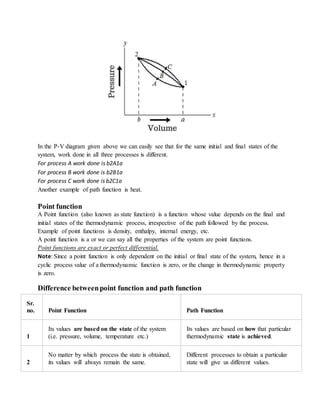
In the P-V diagram given above we can easily see that for the same initial and final states of the
system, work done in all three processes is different.
For process A work done is b2A1a
For process B work done is b2B1a
For process C work done is b2C1a
Another example of path function is heat.
Point function
A Point function (also known as state function) is a function whose value depends on the final and
initial states of the thermodynamic process, irrespective of the path followed by the process.
Example of point functions is density, enthalpy, internal energy, etc.
A point function is a or we can say all the properties of the system are point functions.
Point functions are exact or perfect differential.
Note: Since a point function is only dependent on the initial or final state of the system, hence in a
cyclic process value of a thermodynamic function is zero, or the change in thermodynamic property
is zero.
Difference betweenpoint function and path function
Sr.
no. Point Function Path Function
1
Its values are based on the state of the system
(i.e. pressure, volume, temperature etc.)
Its values are based on how that particular
thermodynamic state is achieved.
2
No matter by which process the state is obtained,
its values will always remain the same.
Different processes to obtain a particular
state will give us different values.
3
Only initial and final states of the process are
sufficient
We need to know the exact path followed
by the process
4 Its values are independent of the path followed
Its values are dependent on the path
followed
5 It is an exact or perfect differential It is an inexact or imperfect differential.
6 Its cyclic integral is always zero It's cyclic integral may or may not be zero
7 It is property of the system It is not the property of the system
8
Its examples are density, enthalpy, internal
energy, entropy etc. Its examples are Heat, work etc.
Work, Heat, and Heat Capacity
Work in Thermodynamics
https://www.youtube.com/watch?v=rscU1w8YsKw&list=PLdoIhVhbPQV6nSJ-
jhlsJ9b6gwfd4tsGx&index=11
In thermodynamics, work performed by a system is the energy transferred by the system to its
surroundings. Kinetic energy, potential energy and internal energy are forms of energy that are
properties of a system. Work is a form of energy, but it is energy in transit. A system contains
no work; work is a process done by or on a system. In general, work is defined for mechanical
systems as the action of a force on an object through a distance.
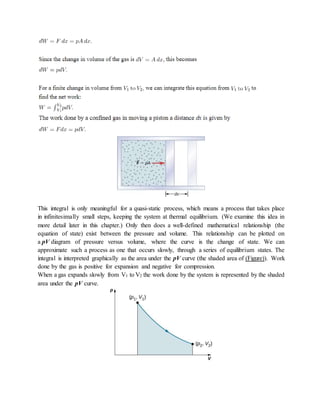
Below mentioned figure shows a gas confined to a cylinder that has a movable piston at one end. If
the gas expands against the piston, it exerts a force through a distance and does work on the piston.
If the piston compresses the gas as it is moved inward, work is also done—in this case, on the gas.
The work associated with such volume changes can be determined as follows: Let the gas pressure
on the piston face be p. Then the force on the piston due to the gas is pA, where A is the area of the
face. When the piston is pushed outward an infinitesimal distance dx, the magnitude of the work
done by the gas is:
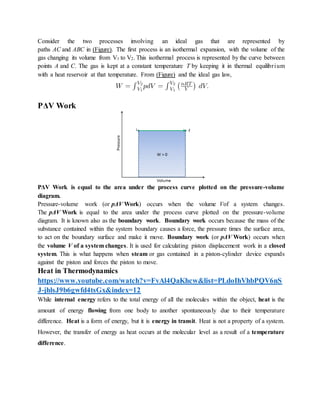
This integral is only meaningful for a quasi-static process, which means a process that takes place
in infinitesimally small steps, keeping the system at thermal equilibrium. (We examine this idea in
more detail later in this chapter.) Only then does a well-defined mathematical relationship (the
equation of state) exist between the pressure and volume. This relationship can be plotted on
a pV diagram of pressure versus volume, where the curve is the change of state. We can
approximate such a process as one that occurs slowly, through a series of equilibrium states. The
integral is interpreted graphically as the area under the pV curve (the shaded area of (Figure)). Work
done by the gas is positive for expansion and negative for compression.
When a gas expands slowly from V1 to V2 the work done by the system is represented by the shaded
area under the pV curve.
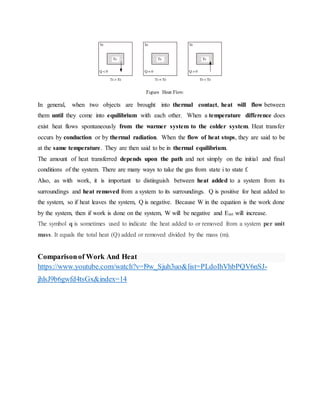
Consider the two processes involving an ideal gas that are represented by
paths AC and ABC in (Figure). The first process is an isothermal expansion, with the volume of the
gas changing its volume from V1 to V2. This isothermal process is represented by the curve between
points A and C. The gas is kept at a constant temperature T by keeping it in thermal equilibrium
with a heat reservoir at that temperature. From (Figure) and the ideal gas law,
PΔV Work
PΔV Work is equal to the area under the process curve plotted on the pressure-volume
diagram.
Pressure-volume work (or pΔV Work) occurs when the volume Vof a system changes.
The pΔV Work is equal to the area under the process curve plotted on the pressure-volume
diagram. It is known also as the boundary work. Boundary work occurs because the mass of the
substance contained within the system boundary causes a force, the pressure times the surface area,
to act on the boundary surface and make it move. Boundary work (or pΔV Work) occurs when
the volume V of a system changes. It is used for calculating piston displacement work in a closed
system. This is what happens when steam or gas contained in a piston-cylinder device expands
against the piston and forces the piston to move.
Heat in Thermodynamics
https://www.youtube.com/watch?v=FvAl4QaKhcw&list=PLdoIhVhbPQV6nS
J-jhlsJ9b6gwfd4tsGx&index=12
While internal energy refers to the total energy of all the molecules within the object, heat is the
amount of energy flowing from one body to another spontaneously due to their temperature
difference. Heat is a form of energy, but it is energy in transit. Heat is not a property of a system.
However, the transfer of energy as heat occurs at the molecular level as a result of a temperature
difference.
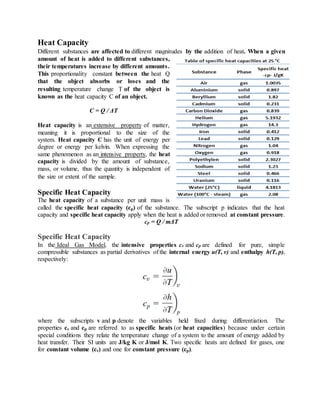
In general, when two objects are brought into thermal contact, heat will flow between
them until they come into equilibrium with each other. When a temperature difference does
exist heat flows spontaneously from the warmer system to the colder system. Heat transfer
occurs by conduction or by thermal radiation. When the flow of heat stops, they are said to be
at the same temperature. They are then said to be in thermal equilibrium.
The amount of heat transferred depends upon the path and not simply on the initial and final
conditions of the system. There are many ways to take the gas from state i to state f.
Also, as with work, it is important to distinguish between heat added to a system from its
surroundings and heat removed from a system to its surroundings. Q is positive for heat added to
the system, so if heat leaves the system, Q is negative. Because W in the equation is the work done
by the system, then if work is done on the system, W will be negative and Eint will increase.
The symbol q is sometimes used to indicate the heat added to or removed from a system per unit
mass. It equals the total heat (Q) added or removed divided by the mass (m).
Comparisonof Work And Heat
https://www.youtube.com/watch?v=l9w_Sjuh3uo&list=PLdoIhVhbPQV6nSJ-
jhlsJ9b6gwfd4tsGx&index=14
Heat Capacity
Different substances are affected to different magnitudes by the addition of heat. When a given
amount of heat is added to different substances,
their temperatures increase by different amounts.
This proportionality constant between the heat Q
that the object absorbs or loses and the
resulting temperature change T of the object is
known as the heat capacity C of an object.
C = Q / ΔT
Heat capacity is an extensive property of matter,
meaning it is proportional to the size of the
system. Heat capacity C has the unit of energy per
degree or energy per kelvin. When expressing the
same phenomenon as an intensive property, the heat
capacity is divided by the amount of substance,
mass, or volume, thus the quantity is independent of
the size or extent of the sample.
Specific Heat Capacity
The heat capacity of a substance per unit mass is
called the specific heat capacity (cp) of the substance. The subscript p indicates that the heat
capacity and specific heat capacity apply when the heat is added or removed at constant pressure.
cp = Q / mΔT
Specific Heat Capacity
In the Ideal Gas Model, the intensive properties cv and cp are defined for pure, simple
compressible substances as partial derivatives of the internal energy u(T, v) and enthalpy h(T, p),
respectively:
where the subscripts v and p denote the variables held fixed during differentiation. The
properties cv and cp are referred to as specific heats (or heat capacities) because under certain
special conditions they relate the temperature change of a system to the amount of energy added by
heat transfer. Their SI units are J/kg K or J/mol K. Two specific heats are defined for gases, one
for constant volume (cv) and one for constant pressure (cp).
Pressure
Pressure is the force applied perpendicular to the surface of an object per unit area over which
that force is distributed. Gauge pressure is the pressure relative to the ambient pressure.
Mathematically:
P=F/A
where: P is the pressure,
F is the magnitude of the normal force,
A is the area of the surface on contact.
Pressure is a scalar quantity. It relates the vector area element (a vector normal to the surface)
with the normal force acting on it. The pressure is the scalar proportionality constant that
relates the two normal vectors:
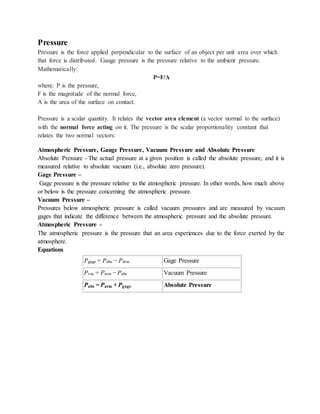
Atmospheric Pressure, Gauge Pressure, Vacuum Pressure and Absolute Pressure
Absolute Pressure - The actual pressure at a given position is called the absolute pressure, and it is
measured relative to absolute vacuum (i.e., absolute zero pressure).
Gage Pressure –
Gage pressure is the pressure relative to the atmospheric pressure. In other words, how much above
or below is the pressure concerning the atmospheric pressure.
Vacuum Pressure –
Pressures below atmospheric pressure is called vacuum pressures and are measured by vacuum
gages that indicate the difference between the atmospheric pressure and the absolute pressure.
Atmospheric Pressure –
The atmospheric pressure is the pressure that an area experiences due to the force exerted by the
atmosphere.
Equations
Pgage = Pabs − Patm Gage Pressure
Pvac = Patm − Pabs Vacuum Pressure
Pabs = Patm + Pgage Absolute Pressure
Manometer, Barometer and Anemometers
Barometers, manometers and anemometers are all scientific instruments. Scientists use
barometers and manometers to measure atmospheric pressure, while anemometers measure wind
speed.
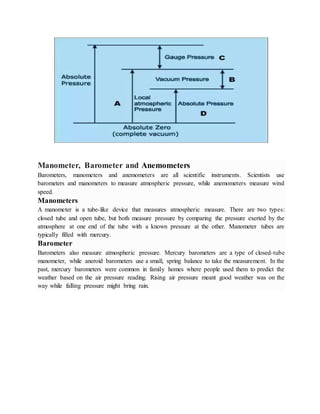
Manometers
A manometer is a tube-like device that measures atmospheric measure. There are two types:
closed tube and open tube, but both measure pressure by comparing the pressure exerted by the
atmosphere at one end of the tube with a known pressure at the other. Manometer tubes are
typically filled with mercury.
Barometer
Barometers also measure atmospheric pressure. Mercury barometers are a type of closed-tube
manometer, while aneroid barometers use a small, spring balance to take the measurement. In the
past, mercury barometers were common in family homes where people used them to predict the
weather based on the air pressure reading. Rising air pressure meant good weather was on the
way while falling pressure might bring rain.
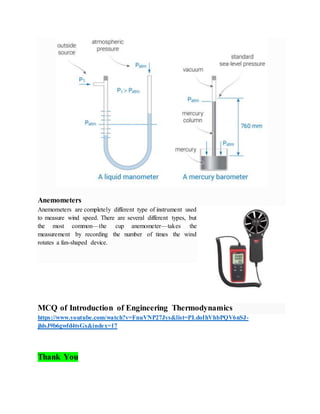
Anemometers
Anemometers are completely different type of instrument used
to measure wind speed. There are several different types, but
the most common—the cup anemometer—takes the
measurement by recording the number of times the wind
rotates a fan-shaped device.
MCQ of Introduction of Engineering Thermodynamics
https://www.youtube.com/watch?v=FnuVNP27Jys&list=PLdoIhVhbPQV6nSJ-
jhlsJ9b6gwfd4tsGx&index=17
Thank You

Basic mechanical engineering unit 1 thermodynamics by varun pratap singh (2020-21)

  • 1.
    Basic Mechanical Engineering BMET102/BMEP 102 Session: 2020-21 UNIT-1 THERMODYNAMICS NOTES By Mr. V arun Pratap Singh Assistant Professor Department of Mechanical Engineering College of Engineering Roorkee
  • 2.
    Disclaimer This document doesnot claim any originality and cannot be used as a substitute for prescribed textbooks. The information presented here is merely a collection by the subject faculty members for their respective teaching assignments. Various sources as mentioned at the end of the document as well as freely available material from the internet were consulted for preparing this document. The ownership of the information lies with the respective authors or institutions. Further, this document is not intended to be used for commercial purpose and the subject faculty members are not accountable for any issues, legal or otherwise, arising out of the use of this document. The subject faculty members make no representations or warranties concerning the accuracy or completeness of the contents of this document and specifically disclaim any implied warranties of merchantability or fitness for a particular purpose. The subject faculty members shall be liable for any loss of profit or any other commercial damages, including but not limited to special, incidental, consequential, or other damages.
  • 3.
    Syllabus UNIT-1: Fundamental Conceptsand Definitions Definition of thermodynamics, System, Surrounding and universe, Phase, Concept of continuum, Macroscopic & microscopic point of view. Density, Specific volume, Pressure, temperature. Thermodynamic equilibrium, Property, State, Path, Process, Cyclic and non-cyclic processes, Reversible and irreversible processes, Quasi-static process, Energy and its forms, Enthalpy. Video Reference: 1. YouTube Channel, BEST MECHANICAL ENGINEERING https://www.youtube.com/channel/UC4vN8jWyjDlyRfryqQ3izsQ/featured
  • 4.
    Introduction The field ofscience, which deals with energies possessed and exchanged by a system of gases and vapours, their conversion in terms of heat and work and their relationship with properties of the system is called thermodynamics. Thus in thermodynamics, we deal with the conversion of energy from one form to the other, mainly heat into work or vice versa. In this context, we must know the overall scenario of conversion of available forms of energy into usable forms as shown below: Figure: Energy conversion chart
  • 5.
    Application of Thermodynamics https://www.youtube.com/watch?v=kL2p5yD2bVk&list=PLdoIhVhbPQV6nSJ-jhlsJ9b6gwfd4tsGx&index=3 Power Generation (Thermal/Nuclear Power plants)  Automobiles (Petrol/ Diesel/LPG/CNG engines)  Processing Industries (Steam generation, Refrigeration systems)  Gas Compressors (Air compressors) Thermodynamics Definition: https://www.youtube.com/watch?v=RIV1aejnG6s&list=PLdoIhVhbPQV6nSJ-jhlsJ9b6gwfd4tsGx&index=1 Is the science of energy transfer and its effect on the physical properties of the substance. Thermodynamics is primarily concerned with two forms of energy i.e. "Heat & Work". It is based on four laws of thermodynamics known as zeroth, first, second and third law. Thermodynamic principles are used in the designing of energy converting devices, such as steam engines, IC. engines, steam and gas turbines, refrigerators, air conditioners, fuel cells etc. Thermodynamic System: https://www.youtube.com/watch?v=KdT_6Ssb7w4&list=PLdoIhVhbPQV45qPpCDHaMm5FRMy9BvdWo& index=2 It is defined as a definite region or space (area) or a quantity of matter on which attention is the focus for the study of work and heat transfer and conversion. Figure: A Thermodynamic System Boundary: It is defined as an actual or hypothetical envelope enclosing the system. The boundary may be real or imaginary. It may be fixed or movable in nature. Surrounding : It is defined as space and matter extremal to the thermodynamic system and outside boundary. Universe: System + Boundary + Surrounding
  • 6.
    Types of System: https://www.youtube.com/watch?v=vThUEuGTgFQ&list=PLdoIhVhbPQV45qPpCDHaMm5FRMy9BvdWo 1.Open System: A system is called an open system if the mass as well as the energy transfers and its boundaries. Examples 1. IC engines 2 Turbines 3. Nozzles etc. 2. ClosedSystem: In this type of system, no matter or mass may enter or leave across the system boundary, there may be energy (heat or work) transfer across the system boundary Examples 1.A certain quantity of fluid in a cylinder bounded by a piston constitutes a closed system. 2. Thermal power plants Figure 2: Types of Systems 3. IsolatedSystem: Neither mass nor energy transfers can take place through its boundaries. Example Fluid enclosed Insulated in a perfectly insulated closed vessel (Thermos -Flask). Figure 2.1: Types of Systems 4.Adiabatic System: the system which is thermally insulated from its surrounding is called adiabatic system it can power exchange work with the surrounding if it does not, it becomes an isolated system.
  • 7.
    Other classification ofthe system: https://www.youtube.com/watch?v=M6vudnPOPDw&list=PLdoIhVhbPQV6nSJ- jhlsJ9b6gwfd4tsGx&index=5 Homogeneous system: system or quantity of mass which consists of a single-phase is called a homogeneous system. Example mixture of air and water vapour, solution of NH3 in water. HeterogeneousSystem: A system which consists of two or more phase, called heterogeneous system. Example 1 water and steam 2. ice and water 3 water and oil etc. Phase: A phase is a quantity of matter which is h homogeneous throughout in chemical composition and physical structure. Macroscopic Vs Microscopic Viewpoint https://www.youtube.com/watch?v=2hqCM_Zy3Ns&list=PLdoIhVhbPQV6nSJ- jhlsJ9b6gwfd4tsGx&index=4
  • 8.
    Comparison ofMacroscopic &Microscopic Approach Macroscopic Approach Microscopic Approach 1. Analysis of overall system 1. Analysis at the molecular level 2. Classical Thermodynamics is used 2. Statistical Thermodynamics is used 3. Only a few properties like pressure or temp needed 3. Properties like velocity, momentum, kinetic energy, intermolecular energy needed besides pr. & temp 4. Analysis is simple 4. Analysis is complex 5. It takes less time 5. It is time-consuming 6. Meets the working accuracy requirement 6. Very precise analysis 7. Changes at a molecular level ignored 7. Changes at the molecular level considered 8. Properties are the average value of the system 8 Properties are for each molecule
  • 9.
    Conceptof the continuum- thermodynamics, MechanicalEngineering Even the simplification of matter into molecules, atoms, electrons, etc. is too complex a picture for many problems of thermodynamics. Thermodynamics doesn't make any hypotheses about the structure of the matter of the system. The volumes of a system considered are quite large as compared to molecular dimensions. The system can be regarded as a continuum. The system is supposed to contain a continuous distribution of matter. There are no voids and cavities present. The pressure, temperature, density and other properties are average values of action of several molecules and atoms. This kind of idealization is a must for solving most of the problems. The laws and concepts of thermodynamics are not dependent on the structure of matter. By this concept, there is the minimum limit of volume up to which the property remains continuum. Below this volume, there is a sudden change in the value of the property. This type of region is called a region of discrete particles and the region for which the property are maintain is called a region of the continuum. The volume up to which continuum properties are maintained is called as continuum limit. For Example: If we measure the density of a substance for a large volume (ν1), the value of density is(ρ1). If we go on reducing the volume by v', below which ratio äm/äv deviates from its actual value and value of äm/äv is large or small. Thus according to this concept design could be defined as: Here Δ is the volume of the fluid element and m is the mass.
  • 10.
    Thermodynamic equilibrium: https://www.youtube.com/watch?v=TTjZlU1CSrQ&list=PLdoIhVhbPQV6nSJ-jhlsJ9b6gwfd4tsGx&index=8 A systemis said to be in a state of thermodynamic equilibrium if the values of the microscopic properties (such as temperature pressure etc.) at all the point are the same. thermodynamic equilibrium is a complete equilibrium and it is including the following equilibrium: 1. Mechanicalequilibrium there are no unbalanced forces within the system or between the surrounding and system is known as mechanical equilibrium. In this case magnitude of resultant force is zero. 2.Chemicalequilibrium in this equilibrium NO2 chemical reaction takes place in the system and the chemical composition which is the same throughout the system does not vary with time. 3. Thermal equilibrium the temperature of the system does not change with time and has the same value at all point in the system its mean temperature gradient is not available or can be considered as zero in thermal equilibrium. 4. Electricalequilibrium If there exist and uniformity of electrical potential throughout the system it can be treated as in electrical equilibrium. Property of substance Any characteristics of a substance that can be observed on a major are called the property of the substance. Example pressure-temperature mass-specific volume etc. A Property is any observable characteristic of a system. https://www.youtube.com/watch?v=TWhXr6AxA-w&list=PLdoIhVhbPQV6nSJ- jhlsJ9b6gwfd4tsGx&index=6 (a) intensive property: these properties do not depend on the mass of the system. Intensive properties are generally denoted by lowercase letter with major exceptions pressure” P” and temperature “T”, which are always intensive.
  • 11.
    Example temperature (T),pressure (P), specific volume (v), density (ρ) etc. (b) extensive property: these properties depend on the mass of the system. If mass changes, their value also changes. These are generally denoted by upper case letter with major exceptions like mass “m”, the number of moles “n”. Examples volume (V), energy (E), total enthalpy (H), entropy (S), potential energy (PE), kinetic energy (KE) etc. The ratio of two extensive property of a homogeneous system is an intensive property. Like ratio of mass and volume is the density which is an intensive property. when an extensive property is divided by the mass or number of moles of a substance forming the system, the resulting intensive property is called a specific property. Example: specific volume, specific energy etc. State, Change of State, Path, Process, Cycle https://www.youtube.com/watch?v=v0IdjFPGcQI&list=PLdoIhVhbPQV6nSJ-jhlsJ9b6gwfd4tsGx&index=7 State: State is the condition of the system at an instant of time as described on measured by its properties for each unique condition of a system. Change of State: Any operation in which one or more of the properties of a system changes is called a change of state. Path: thermodynamic system passing through a series of state constitutes a path. Process: when a system changes its state from one equilibrium state to another equilibrium state, then the path of successive States through which the system has passed is known as the thermodynamic process. Cyclic process: the cyclic process consists of the number of processes incorporated to achieve the target in the thermodynamics cycle the initial and final state of the process are the same.
  • 12.
    Reversible and IrreversibleProcess In the reversible process, the initial state and final states are the same, together with all energy transfer or transfer during the process can be completely restored in both system and surroundings. No heat loss, friction loss and traces of path cannot be observing after reversing the process. In reality, no thermodynamic process is completely reversible. The same path and traces can be followed to achieve reversibility. The reversal process having the following condition which must be satisfied: 1. The process processed at an extremely slow rate so that it goes inside with the Quasi-static process. 2. The system should be free from dissipative forces like friction, inelasticity, viscosity, electrical resistance etc. This is because energy spent against such forces cannot be recovered. 3. No heat, work and friction losses should occur during the process. 4. A Reversible process should not leave any traces to show that the process had ever occurred. 5. It should not leave any history behind its mean no change should be created in the environment. Figure: (a) Reversible Process (b) Irreversible Process In the Irreversible process, If the energy transfer is not restored in both system and surroundings, then the process is called irreversible. Heat transfer friction losses and traces of path can be observed in an irreversible process. All real or natural process is irreversible in nature. In an irreversible process, the same path cannot be followed if try to achieve reversibility. Quasi-static process https://www.youtube.com/watch?v=1iSUEFBd5i0&list=PLdoIhVhbPQV6nSJ-jhlsJ9b6gwfd4tsGx&index=9 In thermodynamics, a quasi-static process is a thermodynamic process that happens slowly enough for the system to remain in internal equilibrium. An example of this is quasi-static compression, where the volume of a system changes at a slow rate enough to allow the pressure to remain uniform and constant throughout the system. Quasi means ‘as if/ almost constant’, This process is a succession of equilibrium states and infinite slowness is its characteristic feature. The definition given above is closer to the intuitive
  • 13.
    understanding of theword “quasi-” (as if) “static” and remains technically different from reversible processes. Only in the Quasi-static process can we define intensive quantities (like Pressure, Temperature, Specific volume, Specific entropy) of the system at every instant during the whole process; Otherwise, since no internal equilibrium is established, different parts of the system would have different values of these quantities. Any reversible process is a quasi-static one. However, quasi-static processes involving entropy production are not reversible. Path Function and Point Function https://www.youtube.com/watch?v=VSpIndhCxsA&list=PLdoIhVhbPQV6nSJ- jhlsJ9b6gwfd4tsGx&index=10 Path function A Path function is a function whose value depends on the path followed by the thermodynamic process irrespective of the initial and final states of the process. Their magnitudes depend on the path followed during a process as well as the end states. Work (W), heat (Q) are path functions. An example of path function is work done in a thermodynamic process. Work done in a thermodynamic process is dependent on the path followed by the process. A path function is an inexact or imperfect differential.
  • 14.
    In the P-Vdiagram given above we can easily see that for the same initial and final states of the system, work done in all three processes is different. For process A work done is b2A1a For process B work done is b2B1a For process C work done is b2C1a Another example of path function is heat. Point function A Point function (also known as state function) is a function whose value depends on the final and initial states of the thermodynamic process, irrespective of the path followed by the process. Example of point functions is density, enthalpy, internal energy, etc. A point function is a or we can say all the properties of the system are point functions. Point functions are exact or perfect differential. Note: Since a point function is only dependent on the initial or final state of the system, hence in a cyclic process value of a thermodynamic function is zero, or the change in thermodynamic property is zero. Difference betweenpoint function and path function Sr. no. Point Function Path Function 1 Its values are based on the state of the system (i.e. pressure, volume, temperature etc.) Its values are based on how that particular thermodynamic state is achieved. 2 No matter by which process the state is obtained, its values will always remain the same. Different processes to obtain a particular state will give us different values.
  • 15.
    3 Only initial andfinal states of the process are sufficient We need to know the exact path followed by the process 4 Its values are independent of the path followed Its values are dependent on the path followed 5 It is an exact or perfect differential It is an inexact or imperfect differential. 6 Its cyclic integral is always zero It's cyclic integral may or may not be zero 7 It is property of the system It is not the property of the system 8 Its examples are density, enthalpy, internal energy, entropy etc. Its examples are Heat, work etc. Work, Heat, and Heat Capacity Work in Thermodynamics https://www.youtube.com/watch?v=rscU1w8YsKw&list=PLdoIhVhbPQV6nSJ- jhlsJ9b6gwfd4tsGx&index=11 In thermodynamics, work performed by a system is the energy transferred by the system to its surroundings. Kinetic energy, potential energy and internal energy are forms of energy that are properties of a system. Work is a form of energy, but it is energy in transit. A system contains no work; work is a process done by or on a system. In general, work is defined for mechanical systems as the action of a force on an object through a distance. Below mentioned figure shows a gas confined to a cylinder that has a movable piston at one end. If the gas expands against the piston, it exerts a force through a distance and does work on the piston. If the piston compresses the gas as it is moved inward, work is also done—in this case, on the gas. The work associated with such volume changes can be determined as follows: Let the gas pressure on the piston face be p. Then the force on the piston due to the gas is pA, where A is the area of the face. When the piston is pushed outward an infinitesimal distance dx, the magnitude of the work done by the gas is:
  • 16.
    This integral isonly meaningful for a quasi-static process, which means a process that takes place in infinitesimally small steps, keeping the system at thermal equilibrium. (We examine this idea in more detail later in this chapter.) Only then does a well-defined mathematical relationship (the equation of state) exist between the pressure and volume. This relationship can be plotted on a pV diagram of pressure versus volume, where the curve is the change of state. We can approximate such a process as one that occurs slowly, through a series of equilibrium states. The integral is interpreted graphically as the area under the pV curve (the shaded area of (Figure)). Work done by the gas is positive for expansion and negative for compression. When a gas expands slowly from V1 to V2 the work done by the system is represented by the shaded area under the pV curve.
  • 17.
    Consider the twoprocesses involving an ideal gas that are represented by paths AC and ABC in (Figure). The first process is an isothermal expansion, with the volume of the gas changing its volume from V1 to V2. This isothermal process is represented by the curve between points A and C. The gas is kept at a constant temperature T by keeping it in thermal equilibrium with a heat reservoir at that temperature. From (Figure) and the ideal gas law, PΔV Work PΔV Work is equal to the area under the process curve plotted on the pressure-volume diagram. Pressure-volume work (or pΔV Work) occurs when the volume Vof a system changes. The pΔV Work is equal to the area under the process curve plotted on the pressure-volume diagram. It is known also as the boundary work. Boundary work occurs because the mass of the substance contained within the system boundary causes a force, the pressure times the surface area, to act on the boundary surface and make it move. Boundary work (or pΔV Work) occurs when the volume V of a system changes. It is used for calculating piston displacement work in a closed system. This is what happens when steam or gas contained in a piston-cylinder device expands against the piston and forces the piston to move. Heat in Thermodynamics https://www.youtube.com/watch?v=FvAl4QaKhcw&list=PLdoIhVhbPQV6nS J-jhlsJ9b6gwfd4tsGx&index=12 While internal energy refers to the total energy of all the molecules within the object, heat is the amount of energy flowing from one body to another spontaneously due to their temperature difference. Heat is a form of energy, but it is energy in transit. Heat is not a property of a system. However, the transfer of energy as heat occurs at the molecular level as a result of a temperature difference.
  • 18.
    In general, whentwo objects are brought into thermal contact, heat will flow between them until they come into equilibrium with each other. When a temperature difference does exist heat flows spontaneously from the warmer system to the colder system. Heat transfer occurs by conduction or by thermal radiation. When the flow of heat stops, they are said to be at the same temperature. They are then said to be in thermal equilibrium. The amount of heat transferred depends upon the path and not simply on the initial and final conditions of the system. There are many ways to take the gas from state i to state f. Also, as with work, it is important to distinguish between heat added to a system from its surroundings and heat removed from a system to its surroundings. Q is positive for heat added to the system, so if heat leaves the system, Q is negative. Because W in the equation is the work done by the system, then if work is done on the system, W will be negative and Eint will increase. The symbol q is sometimes used to indicate the heat added to or removed from a system per unit mass. It equals the total heat (Q) added or removed divided by the mass (m). Comparisonof Work And Heat https://www.youtube.com/watch?v=l9w_Sjuh3uo&list=PLdoIhVhbPQV6nSJ- jhlsJ9b6gwfd4tsGx&index=14
  • 19.
    Heat Capacity Different substancesare affected to different magnitudes by the addition of heat. When a given amount of heat is added to different substances, their temperatures increase by different amounts. This proportionality constant between the heat Q that the object absorbs or loses and the resulting temperature change T of the object is known as the heat capacity C of an object. C = Q / ΔT Heat capacity is an extensive property of matter, meaning it is proportional to the size of the system. Heat capacity C has the unit of energy per degree or energy per kelvin. When expressing the same phenomenon as an intensive property, the heat capacity is divided by the amount of substance, mass, or volume, thus the quantity is independent of the size or extent of the sample. Specific Heat Capacity The heat capacity of a substance per unit mass is called the specific heat capacity (cp) of the substance. The subscript p indicates that the heat capacity and specific heat capacity apply when the heat is added or removed at constant pressure. cp = Q / mΔT Specific Heat Capacity In the Ideal Gas Model, the intensive properties cv and cp are defined for pure, simple compressible substances as partial derivatives of the internal energy u(T, v) and enthalpy h(T, p), respectively: where the subscripts v and p denote the variables held fixed during differentiation. The properties cv and cp are referred to as specific heats (or heat capacities) because under certain special conditions they relate the temperature change of a system to the amount of energy added by heat transfer. Their SI units are J/kg K or J/mol K. Two specific heats are defined for gases, one for constant volume (cv) and one for constant pressure (cp).
  • 20.
    Pressure Pressure is theforce applied perpendicular to the surface of an object per unit area over which that force is distributed. Gauge pressure is the pressure relative to the ambient pressure. Mathematically: P=F/A where: P is the pressure, F is the magnitude of the normal force, A is the area of the surface on contact. Pressure is a scalar quantity. It relates the vector area element (a vector normal to the surface) with the normal force acting on it. The pressure is the scalar proportionality constant that relates the two normal vectors: Atmospheric Pressure, Gauge Pressure, Vacuum Pressure and Absolute Pressure Absolute Pressure - The actual pressure at a given position is called the absolute pressure, and it is measured relative to absolute vacuum (i.e., absolute zero pressure). Gage Pressure – Gage pressure is the pressure relative to the atmospheric pressure. In other words, how much above or below is the pressure concerning the atmospheric pressure. Vacuum Pressure – Pressures below atmospheric pressure is called vacuum pressures and are measured by vacuum gages that indicate the difference between the atmospheric pressure and the absolute pressure. Atmospheric Pressure – The atmospheric pressure is the pressure that an area experiences due to the force exerted by the atmosphere. Equations Pgage = Pabs − Patm Gage Pressure Pvac = Patm − Pabs Vacuum Pressure Pabs = Patm + Pgage Absolute Pressure
  • 21.
    Manometer, Barometer andAnemometers Barometers, manometers and anemometers are all scientific instruments. Scientists use barometers and manometers to measure atmospheric pressure, while anemometers measure wind speed. Manometers A manometer is a tube-like device that measures atmospheric measure. There are two types: closed tube and open tube, but both measure pressure by comparing the pressure exerted by the atmosphere at one end of the tube with a known pressure at the other. Manometer tubes are typically filled with mercury. Barometer Barometers also measure atmospheric pressure. Mercury barometers are a type of closed-tube manometer, while aneroid barometers use a small, spring balance to take the measurement. In the past, mercury barometers were common in family homes where people used them to predict the weather based on the air pressure reading. Rising air pressure meant good weather was on the way while falling pressure might bring rain.
  • 22.
    Anemometers Anemometers are completelydifferent type of instrument used to measure wind speed. There are several different types, but the most common—the cup anemometer—takes the measurement by recording the number of times the wind rotates a fan-shaped device. MCQ of Introduction of Engineering Thermodynamics https://www.youtube.com/watch?v=FnuVNP27Jys&list=PLdoIhVhbPQV6nSJ- jhlsJ9b6gwfd4tsGx&index=17 Thank You