ASE 4341
Thermodynamics
Lecturer Md. Toufiq Islam Noor
BSc. In Aeronautical Engineering (Aircraft Design & Engineering), NCHU, China
MSc. In Aerospace Propulsion Theory and Engineering, BUAA, China
2 October 2023 ASE 4341 | Thermodynamics | Lecturer Md. Toufiq Islam Noor 1
2
What is THERMODYNAMICS?
• Thermodynamics can be defined as the science of energy.
2 October 2023 ASE 4341 | Thermodynamics | Lecturer Md. Toufiq Islam Noor 2
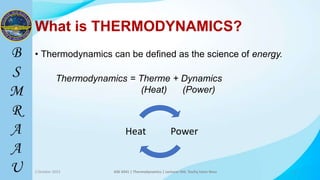
Thermodynamics = Therme + Dynamics
(Heat) (Power)
Power
Heat
3
Definition of Thermodynamics
• Thermodynamics can be defined as the science of energy
interaction and its effect on the physical properties of
materials.
• Today the same name is broadly interpreted to include all
aspects of energy and energy transformations including
power generation, refrigeration, and relationships among the
properties of matter.
2 October 2023 ASE 4341 | Thermodynamics | Lecturer Md. Toufiq Islam Noor 3
4
Keep in mind the 3 E’s
• 3E’s
• Energy
• Entropy
• Equilibrium
 Mechanical
 Chemical
 Thermal
2 October 2023 ASE 4341 | Thermodynamics | Lecturer Md. Toufiq Islam Noor 4
6
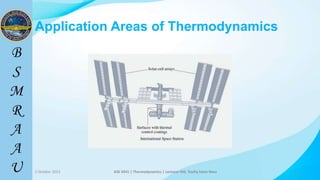
Application Areas of Thermodynamics
2 October 2023 ASE 4341 | Thermodynamics | Lecturer Md. Toufiq Islam Noor 6
7
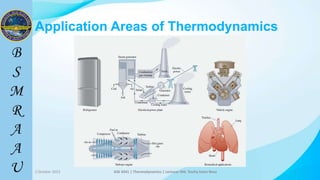
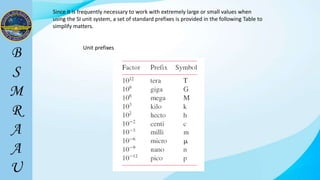
Application Areas of Thermodynamics
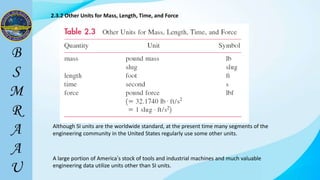
2 October 2023 ASE 4341 | Thermodynamics | Lecturer Md. Toufiq Islam Noor 7
8
Thermodynamic System
• The system is whatever we want to study.
• Thermodynamic system is defined as the quantity of matter or a region in space on which our
study is focused. (control mass) (control volume)
• It may be as simple as a free body or as complex as an entire chemical refinery. We may want
to study a quantity of matter contained within a closed, rigid-walled tank, or we may want to
consider something such as a pipeline through which natural gas flows. The composition of the
matter inside the system may be fixed or may be changing through chemical or nuclear
reactions. The shape or volume of the system being analyzed is not necessarily constant, as
when a gas in a cylinder is compressed by a piston or a balloon is inflated.
• Everything external to the system is considered to be part of the system’s surroundings.
• The system is distinguished from its surroundings by a specified boundary, which may be at
rest or in motion.
2 October 2023 ASE 4341 | Thermodynamics | Lecturer Md. Toufiq Islam Noor 8
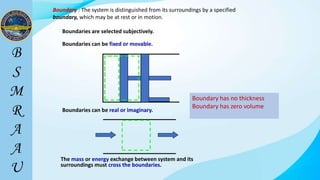
Boundary : The system is distinguished from its surroundings by a specified
boundary, which may be at rest or in motion.
Boundaries are selected subjectively.
Boundaries can be fixed or movable.
Boundaries can be real or imaginary.
The mass or energy exchange between system and its
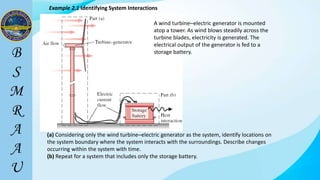
surroundings must cross the boundaries.
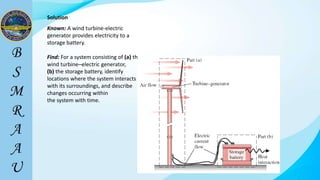
Boundary has no thickness
Boundary has zero volume
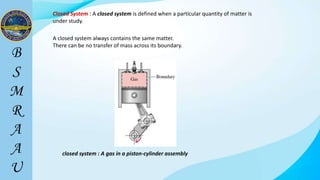
Closed System : A closed system is defined when a particular quantity of matter is
under study.
closed system : A gas in a piston-cylinder assembly
A closed system always contains the same matter.
There can be no transfer of mass across its boundary.
Isolated System : A special type of closed system that does not interact in any
way with its surroundings is called an isolated system.
Adiabatic system is that no heat cross the boundary or heat is negligible
compared with work cross the boundary
Control Volume : a region within a prescribed boundary is studied. The region is
called a control volume.
Attention: Mass may cross the
boundary of a control volume.
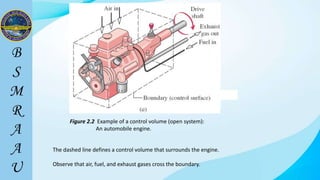
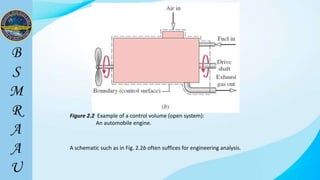
The dashed line defines a control volume that surrounds the engine.
Observe that air, fuel, and exhaust gases cross the boundary.
Figure 2.2 Example of a control volume (open system):
An automobile engine.
1
Figure 2.2 Example of a control volume (open system):
An automobile engine.
A schematic such as in Fig. 2.2b often suffices for engineering analysis.
15
The term control mass is sometimes used in place of closed system, and the term
open system is used interchangeably with control volume.
In general, the choice of system boundary is governed by two
considerations:
(1) what is known about a possible system, particularly at its
boundaries,
(2) the objective of the analysis.
When the terms control mass and control volume are used, the system boundary is
often referred to as a control surface.
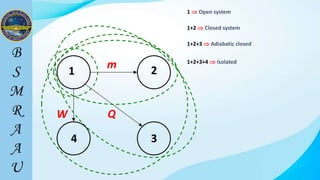
1 2
3
4
m
Q
W
1  Open system
1+2  Closed system
1+2+3  Adiabatic closed
1+2+3+4  Isolated
17
2.2 Describing Systems and Their Behavior
The macroscopic approach is concerned with the gross or overall behavior of matter.
No model of the structure of matter at the molecular, atomic, and subatomic levels is
directly used.
The microscopic approach is concerned directly with the structure of matter.
The objective is to characterize by statistical means the average behavior of the
particles making up a system of interest and relate this information to the observed
macroscopic behavior of the system.
For the great majority of thermal systems applications, the macroscopic approach not
only provides a more direct means for analysis and design but also requires far fewer
mathematical complications.
18
Property : A property is a macroscopic characteristic of a system such as mass, volume,
energy, pressure, and temperature to which a numerical value can be assigned at a given
time without knowledge of the previous behavior (history) of the system.
State :The word state refers to the condition of a system as described by its properties.
Since there are normally relations among the properties of a system, the state often
can be specified by providing the values of a subset of the properties.
Process : When any of the properties of a system change, the state changes and
the system is said to have undergone a process. A process is a transformation from
one state to another.
Two types of process: 1) Reversible, 2) Irreversible
Steady State : A system is said to be at steady state if none of its properties
changes with time.
19
A thermodynamic cycle is a sequence of processes that begins and ends at the same state.
At the conclusion of a cycle all properties have the same values they had at the
beginning.
Consequently, over the cycle the system experiences no net change of state.
Cycles that are repeated periodically play prominent roles in many areas of application.
For example, steam circulating through an electrical power plant executes a cycle.
The change in value of a property is independent of the details of the process. It follows that
if the value of a particular quantity depends on the details of the process, and not solely on
the end states, that quantity cannot be a property.
20
Extensive property: A property is called extensive if its value for an overall system is the
sum of its values for the parts into which the system is divided.
Mass, volume, energy, and several other properties introduced later are extensive.
Extensive properties depend on the size or extent of a system. The extensive properties
of a system can change with time.
21
Intensive properties are not additive in the sense previously considered.
Specific volume (Sec. 2.4.1), pressure, and temperature are
important intensive properties
Their values are independent of the size or extent of a system and may vary
from place to place within the system
at any moment.
Thus, intensive properties may be functions of both position and time, whereas
extensive properties vary at most with time.
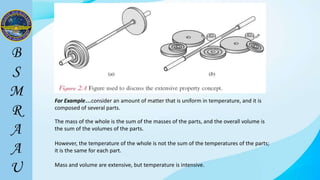
For Example…consider an amount of matter that is uniform in temperature, and it is
composed of several parts.
The mass of the whole is the sum of the masses of the parts, and the overall volume is
the sum of the volumes of the parts.
However, the temperature of the whole is not the sum of the temperatures of the parts;
it is the same for each part.
Mass and volume are extensive, but temperature is intensive.
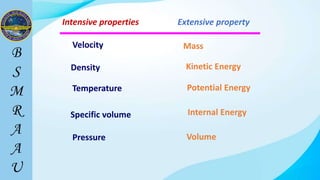
Velocity
Kinetic Energy
Density
Potential Energy
Temperature
Internal Energy
Intensive properties Extensive property
Specific volume
Pressure
Mass
Volume
Phase: The term phase refers to a quantity of matter that is homogeneous throughout in
both chemical composition and physical structure.
Homogeneity in physical structure means that the matter is all solid, or all liquid, or all
vapor (or equivalently all gas).
A system can contain one or more phases.
For example, a system of liquid water and water vapor (steam) contains two phases. When
more than one phase is present, the phases are separated by phase boundaries.
Pure substance : A pure substance is one that is uniform and invariable in chemical
composition.
A pure substance can exist in more than one phase, but its chemical composition must
be the same in each phase.
For example, if liquid water and water vapor form a system with two phases, the system
can be regarded as a pure substance because each phase has the same composition.
A uniform mixture of gases can be regarded as a pure substance provided it remains a
gas and does not react chemically.
Equilibrium
Thermodynamics places primary emphasis on equilibrium states and changes from one
equilibrium state to another. Thus, the concept of equilibrium is fundamental.
In mechanics, equilibrium means a condition of balance maintained by an equality of
opposing forces.
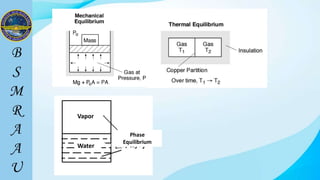
In thermodynamics, several types of equilibrium must exist individually to fulfill the
condition of complete equilibrium; among these are mechanical, thermal, phase, and
chemical equilibrium.
Vapor
Water
Phase
Equilibrium
Equilibrium State
Isolate the system from its surroundings and watch for changes in its observable
properties. If there are no changes, we conclude that the system was in equilibrium at
the moment it was isolated. The system can be said to be at an equilibrium state.
When a system is isolated, it cannot interact with its surroundings;
A consequence of spontaneous events occurring internally as its intensive properties,
such as temperature and pressure, can tend toward uniform values. When all such
changes cease, the system is in equilibrium.
Hence, for a system to be in equilibrium it must be a single phase or consist of a
number of phases that have no tendency to change their conditions when the overall
system is isolated from its surroundings.
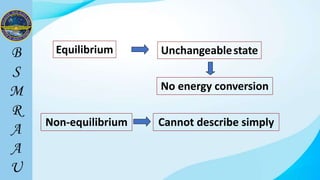
Equilibrium Unchangeablestate
No energy conversion
Non-equilibrium Cannot describe simply
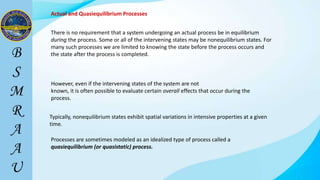
Actual and Quasiequilibrium Processes
There is no requirement that a system undergoing an actual process be in equilibrium
during the process. Some or all of the intervening states may be nonequilibrium states. For
many such processes we are limited to knowing the state before the process occurs and
the state after the process is completed.
Processes are sometimes modeled as an idealized type of process called a
quasiequilibrium (or quasistatic) process.
However, even if the intervening states of the system are not
known, it is often possible to evaluate certain overall effects that occur during the
process.
Typically, nonequilibrium states exhibit spatial variations in intensive properties at a given
time.
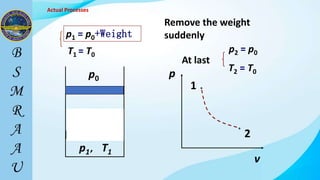
p1 = p0+Weight
p1,T1
p0
T1 = T0
Remove the weight
suddenly
At last
p2 = p0
T2 = T0
p
v
1
2
.
.
Actual Processes
Actual and Quasiequilibrium Processes
A quasiequilibrium process is one in which the departure from thermodynamic
equilibrium is at most infinitesimal.
All states through which the system passes in a quasiequilibrium process may be
considered equilibrium states.
Because nonequilibrium effects are inevitably present during actual processes,
systems of engineering interest can at best approach, but never realize, a
quasiequilibrium process.
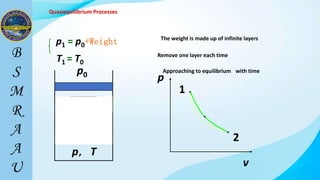
Quasiequilibrium Processes
p1 = p0+Weight
p,T
p0
T1 = T0
The weight is made up of infinite layers
Remove one layer each time
p
v
1
2
.
.
.
Approaching to equilibrium with time
Actual and Quasiequilibrium Processes
Our interest in the quasiequilibrium process concept stems mainly
from two considerations:
(1) Simple thermodynamic models giving at least qualitative
information about the behavior of actual systems of interest often
can be developed using the quasiequilibrium process concept.
(2) The quasiequilibrium process concept is instrumental in deducing
relationships that exist among the properties of systems at
equilibrium.
This is akin to the use of idealizations such as the point mass or
the frictionless pulley in mechanics for the purpose of
simplifying an analysis.
35
1–2 ■ IMPORTANCE OF DIMENSIONS
AND UNITS
• Any physical quantity can be characterized by dimensions.
• The magnitudes assigned to the dimensions are called units.

• Some basic dimensions such as mass m, length L, time t, and temperature T are selected as
primary or fundamental dimensions, while others such as velocity V, energy E, and volume V
are expressed in terms of the primary dimensions and are called secondary dimensions, or
derived dimensions.
2 October 2023 ASE 4341 | Thermodynamics | Lecturer Md. Toufiq Islam Noor 35
2.3 Units and Dimensions
Because physical quantities are related by definitions and laws, a relatively
small number of them suffice to conceive of and measure all others. These may
be called primary (or basic) dimensions. The others may be measured in terms
of the primary dimensions and are called secondary.
Four primary dimensions suffice in thermodynamics, fluid mechanics, and heat
transfer. They are mass (M), length (L), time (t), and temperature (T). Alternatively,
force (F) can be
used in place of mass (M). These are known, respectively, as the MLtT and FLtT
dimensional systems.
Once a set of primary dimensions is adopted, a base unit for each primary
dimension is specified. Units for all other quantities are then derived in terms of
the base units.
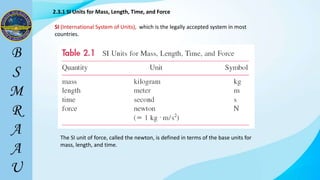
2.3.1 SI Units for Mass, Length, Time, and Force
SI (International System of Units), which is the legally accepted system in most
countries.
The SI unit of force, called the newton, is defined in terms of the base units for
mass, length, and time.
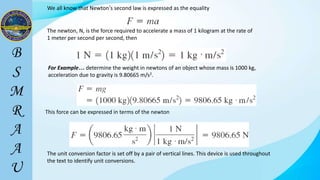
We all know that Newton’s second law is expressed as the equality
The newton, N, is the force required to accelerate a mass of 1 kilogram at the rate of
1 meter per second per second, then
For Example… determine the weight in newtons of an object whose mass is 1000 kg,
acceleration due to gravity is 9.80665 m/s2.
This force can be expressed in terms of the newton
The unit conversion factor is set off by a pair of vertical lines. This device is used throughout
the text to identify unit conversions.
Since it is frequently necessary to work with extremely large or small values when
using the SI unit system, a set of standard prefixes is provided in the following Table to
simplify matters.
Unit prefixes
2.3.2 Other Units for Mass, Length, Time, and Force
Although SI units are the worldwide standard, at the present time many segments of the
engineering community in the United States regularly use some other units.
A large portion of America’s stock of tools and industrial machines and much valuable
engineering data utilize units other than SI units.
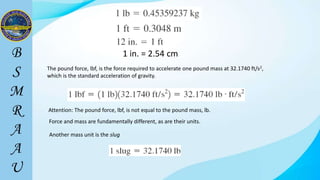
1 in. = 2.54 cm
The pound force, lbf, is the force required to accelerate one pound mass at 32.1740 ft/s2,
which is the standard acceleration of gravity.
Attention: The pound force, lbf, is not equal to the pound mass, lb.
Force and mass are fundamentally different, as are their units.
Another mass unit is the slug
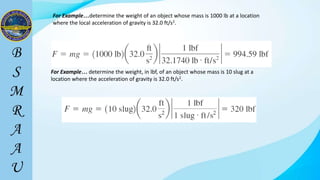
For Example…determine the weight of an object whose mass is 1000 lb at a location
where the local acceleration of gravity is 32.0 ft/s2.
For Example… determine the weight, in lbf, of an object whose mass is 10 slug at a
location where the acceleration of gravity is 32.0 ft/s2.
2.4 Two Measurable Properties: Specific Volume and Pressure
Three intensive properties that are particularly important in thermal systems engineering
are specific volume, pressure, and temperature.
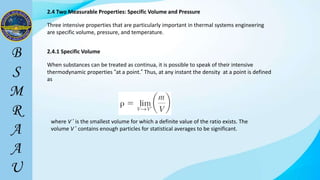
When substances can be treated as continua, it is possible to speak of their intensive
thermodynamic properties “at a point.” Thus, at any instant the density at a point is defined
as
where V ’ is the smallest volume for which a definite value of the ratio exists. The
volume V ’ contains enough particles for statistical averages to be significant.
2.4.1 Specific Volume
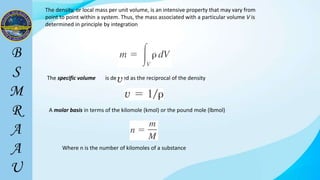
The density, or local mass per unit volume, is an intensive property that may vary from
point to point within a system. Thus, the mass associated with a particular volume V is
determined in principle by integration
A molar basis in terms of the kilomole (kmol) or the pound mole (lbmol)
Where n is the number of kilomoles of a substance
The specific volume is defined as the reciprocal of the density
Volume on a molar basis
Where, signifies the volume per kmol or lbmol,
2.4.2 Pressure
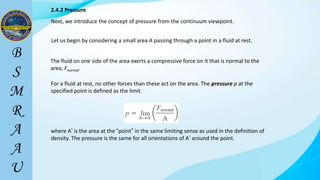
Next, we introduce the concept of pressure from the continuum viewpoint.
where A’ is the area at the “point” in the same limiting sense as used in the definition of
density. The pressure is the same for all orientations of A’ around the point.
Let us begin by considering a small area A passing through a point in a fluid at rest.
The fluid on one side of the area exerts a compressive force on it that is normal to the
area, Fnormal.
For a fluid at rest, no other forces than these act on the area. The pressure p at the
specified point is defined as the limit.
However, the pressure can vary from point to point within a fluid at rest.
Examples are the variation of atmospheric pressure with elevation and the pressure
variation with depth in oceans, lakes, and other bodies of water.
2.4.2 Pressure
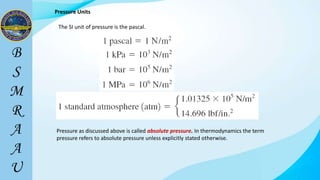
Pressure Units
The SI unit of pressure is the pascal.
Pressure as discussed above is called absolute pressure. In thermodynamics the term
pressure refers to absolute pressure unless explicitly stated otherwise.
2.5 Measuring Temperature
2.5.1 Thermal Equilibrium and Temperature
When all changes in such observable properties with the two contacting blocks cease,
the interaction is at an end. The two blocks are then in thermal equilibrium.
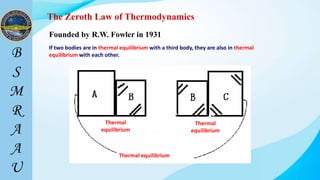
The Zeroth Law of Thermodynamics
Founded by R.W. Fowler in 1931
If two bodies are in thermal equilibrium with a third body, they are also in thermal
equilibrium with each other.
Thermal
equilibrium
Thermal
equilibrium
Thermal equilibrium
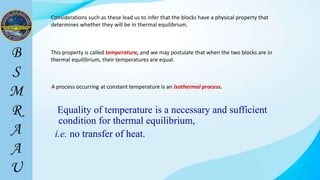
Considerations such as these lead us to infer that the blocks have a physical property that
determines whether they will be in thermal equilibrium.
A process occurring at constant temperature is an isothermal process.
This property is called temperature, and we may postulate that when the two blocks are in
thermal equilibrium, their temperatures are equal.
Equality of temperature is a necessary and sufficient
condition for thermal equilibrium,
i.e. no transfer of heat.
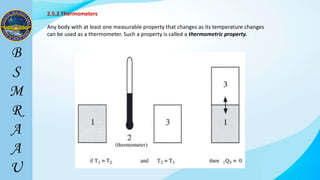
2.5.2 Thermometers
Any body with at least one measurable property that changes as its temperature changes
can be used as a thermometer. Such a property is called a thermometric property.
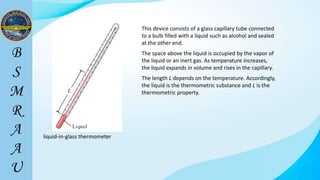
liquid-in-glass thermometer
This device consists of a glass capillary tube connected
to a bulb filled with a liquid such as alcohol and sealed
at the other end.
The space above the liquid is occupied by the vapor of
the liquid or an inert gas. As temperature increases,
the liquid expands in volume and rises in the capillary.
The length L depends on the temperature. Accordingly,
the liquid is the thermometric substance and L is the
thermometric property.
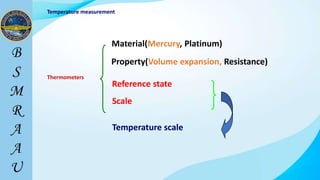
Thermometers
Material(Mercury, Platinum)
Property(Volume expansion, Resistance)
Scale
Temperature scale
Reference state
Temperature measurement
2.5.3 Kelvin Scale
In view of the limitations of empirical means for measuring temperature, it is desirable
to have a procedure for assigning temperature values that does not depend on the
properties of any particular substance or class of substances. Such a scale is called a
thermodynamic temperature scale.
The Kelvin scale is an absolute thermodynamic temperature scale that provides a
continuous definition of temperature, valid over all ranges of temperature.
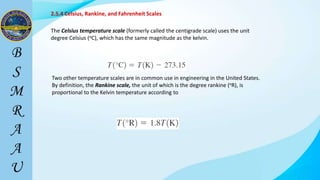
2.5.4 Celsius, Rankine, and Fahrenheit Scales
The Celsius temperature scale (formerly called the centigrade scale) uses the unit
degree Celsius (oC), which has the same magnitude as the kelvin.
Two other temperature scales are in common use in engineering in the United States.
By definition, the Rankine scale, the unit of which is the degree rankine (oR), is
proportional to the Kelvin temperature according to
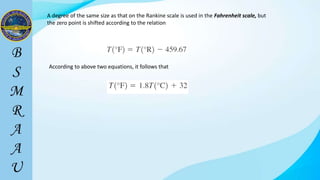
A degree of the same size as that on the Rankine scale is used in the Fahrenheit scale, but
the zero point is shifted according to the relation
According to above two equations, it follows that
2.6 Methodology for Solving Problems
Known: State briefly in your own words what is known. This requires that you read the
problem carefully and think about it.
Find: State concisely in your own words what is to be determined.
To maximize the results of your efforts, it is necessary to develop a systematic approach.
We strongly recommend that problem solutions be organized using the steps in the box
below, as appropriate.
2.6 Methodology for Solving Problems
Schematic and Given Data:
Draw a sketch of the system to be considered.
Decide whether a closed system or control volume is appropriate for the analysis, and then
carefully identify the boundary.
Label the diagram with relevant information from the problem statement.
Record all property values you are given.
When appropriate, sketch property diagrams, locating key state points and indicating, if
possible, the processes executed by the system.
2.6 Methodology for Solving Problems
Assumptions:
To form a record of how you model the problem, list all simplifying assumptions and
idealizations made to reduce it to one that is manageable.
Sometimes this information also can be noted on the sketches of the previous step.
Properties:
Compile property values you anticipate will be needed for subsequent calculations and
identify the source from which they are obtained.
Analysis:
Using your assumptions and idealizations, reduce the appropriate governing equations
and relationships to forms that will produce the desired results.
The importance of following these steps should not be underestimated. They
provide a useful guide to thinking about a problem before effecting its solution.
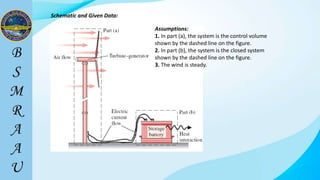
Example 2.1 Identifying System Interactions
(a) Considering only the wind turbine–electric generator as the system, identify locations on
the system boundary where the system interacts with the surroundings. Describe changes
occurring within the system with time.
(b) Repeat for a system that includes only the storage battery.
A wind turbine–electric generator is mounted
atop a tower. As wind blows steadily across the
turbine blades, electricity is generated. The
electrical output of the generator is fed to a
storage battery.
Solution
Known: A wind turbine-electric
generator provides electricity to a
storage battery.
Find: For a system consisting of (a) the
wind turbine–electric generator,
(b) the storage battery, identify
locations where the system interacts
with its surroundings, and describe
changes occurring within
the system with time.
Schematic and Given Data:
Assumptions:
1. In part (a), the system is the control volume
shown by the dashed line on the figure.
2. In part (b), the system is the closed system
shown by the dashed line on the figure.
3. The wind is steady.
Analysis:
(a) In this case, there is air flowing across the boundary of the control volume.
Another principal interaction between the system and surroundings is the electric
current passing through the wires. From the macroscopic perspective, such an
interaction is not considered a mass transfer, however.
With a steady wind, the turbine–generator is likely to reach steady state operation,
where the rotational speed of the blades is constant and a steady electric current is
generated.
An interaction also occurs between the turbine-generator tower and the ground: a
force and moment are required to keep the tower upright.
Analysis:
(b) The principal interaction between the system and its surroundings is the electric
current passing into the battery through the wires.
As noted in part (a), this interaction is not considered a mass transfer. The system is a
closed system.
As the battery is charged and chemical reactions occur within it, the temperature of the
battery surface may become somewhat elevated and a heat interaction might occur
between the battery and its surroundings.
This interaction is likely to be of secondary importance.
2.7 Chapter Summary and Study Guide
An important aspect of engineering analysis is to identify appropriate closed systems and
control volumes, and to describe system behavior in terms of properties and processes.
Three important properties discussed in this chapter are specific volume, pressure, and
temperature.
In this book, we consider systems at equilibrium states and systems undergoing
processes. We study processes during which the intervening states are not equilibrium
states as well as quasiequilibrium processes during which the departure from
equilibrium is negligible.
We have introduced both SI and other units for mass, length, time, and force. You
will need to be familiar with such units as you use this book.
The chapter concludes with a discussion of how to solve problems systematically.
closed system
control volume
boundary
surroundings
property
extensive property
intensive property
state
process
thermodynamic cycle
phase
pure substance
equilibrium
pressure
specific volume
temperature
isothermal process
Kelvin scale
Rankine scale
Concepts

ASE 4341 L01.pptx

  • 1.
    ASE 4341 Thermodynamics Lecturer Md.Toufiq Islam Noor BSc. In Aeronautical Engineering (Aircraft Design & Engineering), NCHU, China MSc. In Aerospace Propulsion Theory and Engineering, BUAA, China 2 October 2023 ASE 4341 | Thermodynamics | Lecturer Md. Toufiq Islam Noor 1
  • 2.
    2 What is THERMODYNAMICS? •Thermodynamics can be defined as the science of energy. 2 October 2023 ASE 4341 | Thermodynamics | Lecturer Md. Toufiq Islam Noor 2 Thermodynamics = Therme + Dynamics (Heat) (Power) Power Heat
  • 3.
    3 Definition of Thermodynamics •Thermodynamics can be defined as the science of energy interaction and its effect on the physical properties of materials. • Today the same name is broadly interpreted to include all aspects of energy and energy transformations including power generation, refrigeration, and relationships among the properties of matter. 2 October 2023 ASE 4341 | Thermodynamics | Lecturer Md. Toufiq Islam Noor 3
  • 4.
    4 Keep in mindthe 3 E’s • 3E’s • Energy • Entropy • Equilibrium  Mechanical  Chemical  Thermal 2 October 2023 ASE 4341 | Thermodynamics | Lecturer Md. Toufiq Islam Noor 4
  • 5.
    6 Application Areas ofThermodynamics 2 October 2023 ASE 4341 | Thermodynamics | Lecturer Md. Toufiq Islam Noor 6
  • 6.
    7 Application Areas ofThermodynamics 2 October 2023 ASE 4341 | Thermodynamics | Lecturer Md. Toufiq Islam Noor 7
  • 7.
    8 Thermodynamic System • Thesystem is whatever we want to study. • Thermodynamic system is defined as the quantity of matter or a region in space on which our study is focused. (control mass) (control volume) • It may be as simple as a free body or as complex as an entire chemical refinery. We may want to study a quantity of matter contained within a closed, rigid-walled tank, or we may want to consider something such as a pipeline through which natural gas flows. The composition of the matter inside the system may be fixed or may be changing through chemical or nuclear reactions. The shape or volume of the system being analyzed is not necessarily constant, as when a gas in a cylinder is compressed by a piston or a balloon is inflated. • Everything external to the system is considered to be part of the system’s surroundings. • The system is distinguished from its surroundings by a specified boundary, which may be at rest or in motion. 2 October 2023 ASE 4341 | Thermodynamics | Lecturer Md. Toufiq Islam Noor 8
  • 8.
    Boundary : Thesystem is distinguished from its surroundings by a specified boundary, which may be at rest or in motion. Boundaries are selected subjectively. Boundaries can be fixed or movable. Boundaries can be real or imaginary. The mass or energy exchange between system and its surroundings must cross the boundaries. Boundary has no thickness Boundary has zero volume
  • 9.
    Closed System :A closed system is defined when a particular quantity of matter is under study. closed system : A gas in a piston-cylinder assembly A closed system always contains the same matter. There can be no transfer of mass across its boundary.
  • 10.
    Isolated System :A special type of closed system that does not interact in any way with its surroundings is called an isolated system. Adiabatic system is that no heat cross the boundary or heat is negligible compared with work cross the boundary
  • 11.
    Control Volume :a region within a prescribed boundary is studied. The region is called a control volume. Attention: Mass may cross the boundary of a control volume.
  • 12.
    The dashed linedefines a control volume that surrounds the engine. Observe that air, fuel, and exhaust gases cross the boundary. Figure 2.2 Example of a control volume (open system): An automobile engine. 1
  • 13.
    Figure 2.2 Exampleof a control volume (open system): An automobile engine. A schematic such as in Fig. 2.2b often suffices for engineering analysis.
  • 14.
    15 The term controlmass is sometimes used in place of closed system, and the term open system is used interchangeably with control volume. In general, the choice of system boundary is governed by two considerations: (1) what is known about a possible system, particularly at its boundaries, (2) the objective of the analysis. When the terms control mass and control volume are used, the system boundary is often referred to as a control surface.
  • 15.
    1 2 3 4 m Q W 1 Open system 1+2  Closed system 1+2+3  Adiabatic closed 1+2+3+4  Isolated
  • 16.
    17 2.2 Describing Systemsand Their Behavior The macroscopic approach is concerned with the gross or overall behavior of matter. No model of the structure of matter at the molecular, atomic, and subatomic levels is directly used. The microscopic approach is concerned directly with the structure of matter. The objective is to characterize by statistical means the average behavior of the particles making up a system of interest and relate this information to the observed macroscopic behavior of the system. For the great majority of thermal systems applications, the macroscopic approach not only provides a more direct means for analysis and design but also requires far fewer mathematical complications.
  • 17.
    18 Property : Aproperty is a macroscopic characteristic of a system such as mass, volume, energy, pressure, and temperature to which a numerical value can be assigned at a given time without knowledge of the previous behavior (history) of the system. State :The word state refers to the condition of a system as described by its properties. Since there are normally relations among the properties of a system, the state often can be specified by providing the values of a subset of the properties. Process : When any of the properties of a system change, the state changes and the system is said to have undergone a process. A process is a transformation from one state to another. Two types of process: 1) Reversible, 2) Irreversible Steady State : A system is said to be at steady state if none of its properties changes with time.
  • 18.
    19 A thermodynamic cycleis a sequence of processes that begins and ends at the same state. At the conclusion of a cycle all properties have the same values they had at the beginning. Consequently, over the cycle the system experiences no net change of state. Cycles that are repeated periodically play prominent roles in many areas of application. For example, steam circulating through an electrical power plant executes a cycle. The change in value of a property is independent of the details of the process. It follows that if the value of a particular quantity depends on the details of the process, and not solely on the end states, that quantity cannot be a property.
  • 19.
    20 Extensive property: Aproperty is called extensive if its value for an overall system is the sum of its values for the parts into which the system is divided. Mass, volume, energy, and several other properties introduced later are extensive. Extensive properties depend on the size or extent of a system. The extensive properties of a system can change with time.
  • 20.
    21 Intensive properties arenot additive in the sense previously considered. Specific volume (Sec. 2.4.1), pressure, and temperature are important intensive properties Their values are independent of the size or extent of a system and may vary from place to place within the system at any moment. Thus, intensive properties may be functions of both position and time, whereas extensive properties vary at most with time.
  • 21.
    For Example…consider anamount of matter that is uniform in temperature, and it is composed of several parts. The mass of the whole is the sum of the masses of the parts, and the overall volume is the sum of the volumes of the parts. However, the temperature of the whole is not the sum of the temperatures of the parts; it is the same for each part. Mass and volume are extensive, but temperature is intensive.
  • 22.
    Velocity Kinetic Energy Density Potential Energy Temperature InternalEnergy Intensive properties Extensive property Specific volume Pressure Mass Volume
  • 23.
    Phase: The termphase refers to a quantity of matter that is homogeneous throughout in both chemical composition and physical structure. Homogeneity in physical structure means that the matter is all solid, or all liquid, or all vapor (or equivalently all gas). A system can contain one or more phases. For example, a system of liquid water and water vapor (steam) contains two phases. When more than one phase is present, the phases are separated by phase boundaries.
  • 24.
    Pure substance :A pure substance is one that is uniform and invariable in chemical composition. A pure substance can exist in more than one phase, but its chemical composition must be the same in each phase. For example, if liquid water and water vapor form a system with two phases, the system can be regarded as a pure substance because each phase has the same composition. A uniform mixture of gases can be regarded as a pure substance provided it remains a gas and does not react chemically.
  • 25.
    Equilibrium Thermodynamics places primaryemphasis on equilibrium states and changes from one equilibrium state to another. Thus, the concept of equilibrium is fundamental. In mechanics, equilibrium means a condition of balance maintained by an equality of opposing forces. In thermodynamics, several types of equilibrium must exist individually to fulfill the condition of complete equilibrium; among these are mechanical, thermal, phase, and chemical equilibrium.
  • 26.
  • 27.
    Equilibrium State Isolate thesystem from its surroundings and watch for changes in its observable properties. If there are no changes, we conclude that the system was in equilibrium at the moment it was isolated. The system can be said to be at an equilibrium state. When a system is isolated, it cannot interact with its surroundings; A consequence of spontaneous events occurring internally as its intensive properties, such as temperature and pressure, can tend toward uniform values. When all such changes cease, the system is in equilibrium. Hence, for a system to be in equilibrium it must be a single phase or consist of a number of phases that have no tendency to change their conditions when the overall system is isolated from its surroundings.
  • 28.
    Equilibrium Unchangeablestate No energyconversion Non-equilibrium Cannot describe simply
  • 29.
    Actual and QuasiequilibriumProcesses There is no requirement that a system undergoing an actual process be in equilibrium during the process. Some or all of the intervening states may be nonequilibrium states. For many such processes we are limited to knowing the state before the process occurs and the state after the process is completed. Processes are sometimes modeled as an idealized type of process called a quasiequilibrium (or quasistatic) process. However, even if the intervening states of the system are not known, it is often possible to evaluate certain overall effects that occur during the process. Typically, nonequilibrium states exhibit spatial variations in intensive properties at a given time.
  • 30.
    p1 = p0+Weight p1,T1 p0 T1= T0 Remove the weight suddenly At last p2 = p0 T2 = T0 p v 1 2 . . Actual Processes
  • 31.
    Actual and QuasiequilibriumProcesses A quasiequilibrium process is one in which the departure from thermodynamic equilibrium is at most infinitesimal. All states through which the system passes in a quasiequilibrium process may be considered equilibrium states. Because nonequilibrium effects are inevitably present during actual processes, systems of engineering interest can at best approach, but never realize, a quasiequilibrium process.
  • 32.
    Quasiequilibrium Processes p1 =p0+Weight p,T p0 T1 = T0 The weight is made up of infinite layers Remove one layer each time p v 1 2 . . . Approaching to equilibrium with time
  • 33.
    Actual and QuasiequilibriumProcesses Our interest in the quasiequilibrium process concept stems mainly from two considerations: (1) Simple thermodynamic models giving at least qualitative information about the behavior of actual systems of interest often can be developed using the quasiequilibrium process concept. (2) The quasiequilibrium process concept is instrumental in deducing relationships that exist among the properties of systems at equilibrium. This is akin to the use of idealizations such as the point mass or the frictionless pulley in mechanics for the purpose of simplifying an analysis.
  • 34.
    35 1–2 ■ IMPORTANCEOF DIMENSIONS AND UNITS • Any physical quantity can be characterized by dimensions. • The magnitudes assigned to the dimensions are called units. • Some basic dimensions such as mass m, length L, time t, and temperature T are selected as primary or fundamental dimensions, while others such as velocity V, energy E, and volume V are expressed in terms of the primary dimensions and are called secondary dimensions, or derived dimensions. 2 October 2023 ASE 4341 | Thermodynamics | Lecturer Md. Toufiq Islam Noor 35
  • 35.
    2.3 Units andDimensions Because physical quantities are related by definitions and laws, a relatively small number of them suffice to conceive of and measure all others. These may be called primary (or basic) dimensions. The others may be measured in terms of the primary dimensions and are called secondary. Four primary dimensions suffice in thermodynamics, fluid mechanics, and heat transfer. They are mass (M), length (L), time (t), and temperature (T). Alternatively, force (F) can be used in place of mass (M). These are known, respectively, as the MLtT and FLtT dimensional systems. Once a set of primary dimensions is adopted, a base unit for each primary dimension is specified. Units for all other quantities are then derived in terms of the base units.
  • 36.
    2.3.1 SI Unitsfor Mass, Length, Time, and Force SI (International System of Units), which is the legally accepted system in most countries. The SI unit of force, called the newton, is defined in terms of the base units for mass, length, and time.
  • 37.
    We all knowthat Newton’s second law is expressed as the equality The newton, N, is the force required to accelerate a mass of 1 kilogram at the rate of 1 meter per second per second, then For Example… determine the weight in newtons of an object whose mass is 1000 kg, acceleration due to gravity is 9.80665 m/s2. This force can be expressed in terms of the newton The unit conversion factor is set off by a pair of vertical lines. This device is used throughout the text to identify unit conversions.
  • 38.
    Since it isfrequently necessary to work with extremely large or small values when using the SI unit system, a set of standard prefixes is provided in the following Table to simplify matters. Unit prefixes
  • 39.
    2.3.2 Other Unitsfor Mass, Length, Time, and Force Although SI units are the worldwide standard, at the present time many segments of the engineering community in the United States regularly use some other units. A large portion of America’s stock of tools and industrial machines and much valuable engineering data utilize units other than SI units.
  • 40.
    1 in. =2.54 cm The pound force, lbf, is the force required to accelerate one pound mass at 32.1740 ft/s2, which is the standard acceleration of gravity. Attention: The pound force, lbf, is not equal to the pound mass, lb. Force and mass are fundamentally different, as are their units. Another mass unit is the slug
  • 41.
    For Example…determine theweight of an object whose mass is 1000 lb at a location where the local acceleration of gravity is 32.0 ft/s2. For Example… determine the weight, in lbf, of an object whose mass is 10 slug at a location where the acceleration of gravity is 32.0 ft/s2.
  • 42.
    2.4 Two MeasurableProperties: Specific Volume and Pressure Three intensive properties that are particularly important in thermal systems engineering are specific volume, pressure, and temperature. When substances can be treated as continua, it is possible to speak of their intensive thermodynamic properties “at a point.” Thus, at any instant the density at a point is defined as where V ’ is the smallest volume for which a definite value of the ratio exists. The volume V ’ contains enough particles for statistical averages to be significant. 2.4.1 Specific Volume
  • 43.
    The density, orlocal mass per unit volume, is an intensive property that may vary from point to point within a system. Thus, the mass associated with a particular volume V is determined in principle by integration A molar basis in terms of the kilomole (kmol) or the pound mole (lbmol) Where n is the number of kilomoles of a substance The specific volume is defined as the reciprocal of the density
  • 44.
    Volume on amolar basis Where, signifies the volume per kmol or lbmol,
  • 45.
    2.4.2 Pressure Next, weintroduce the concept of pressure from the continuum viewpoint. where A’ is the area at the “point” in the same limiting sense as used in the definition of density. The pressure is the same for all orientations of A’ around the point. Let us begin by considering a small area A passing through a point in a fluid at rest. The fluid on one side of the area exerts a compressive force on it that is normal to the area, Fnormal. For a fluid at rest, no other forces than these act on the area. The pressure p at the specified point is defined as the limit.
  • 46.
    However, the pressurecan vary from point to point within a fluid at rest. Examples are the variation of atmospheric pressure with elevation and the pressure variation with depth in oceans, lakes, and other bodies of water. 2.4.2 Pressure
  • 47.
    Pressure Units The SIunit of pressure is the pascal. Pressure as discussed above is called absolute pressure. In thermodynamics the term pressure refers to absolute pressure unless explicitly stated otherwise.
  • 48.
    2.5 Measuring Temperature 2.5.1Thermal Equilibrium and Temperature When all changes in such observable properties with the two contacting blocks cease, the interaction is at an end. The two blocks are then in thermal equilibrium.
  • 49.
    The Zeroth Lawof Thermodynamics Founded by R.W. Fowler in 1931 If two bodies are in thermal equilibrium with a third body, they are also in thermal equilibrium with each other. Thermal equilibrium Thermal equilibrium Thermal equilibrium
  • 50.
    Considerations such asthese lead us to infer that the blocks have a physical property that determines whether they will be in thermal equilibrium. A process occurring at constant temperature is an isothermal process. This property is called temperature, and we may postulate that when the two blocks are in thermal equilibrium, their temperatures are equal. Equality of temperature is a necessary and sufficient condition for thermal equilibrium, i.e. no transfer of heat.
  • 51.
    2.5.2 Thermometers Any bodywith at least one measurable property that changes as its temperature changes can be used as a thermometer. Such a property is called a thermometric property.
  • 52.
    liquid-in-glass thermometer This deviceconsists of a glass capillary tube connected to a bulb filled with a liquid such as alcohol and sealed at the other end. The space above the liquid is occupied by the vapor of the liquid or an inert gas. As temperature increases, the liquid expands in volume and rises in the capillary. The length L depends on the temperature. Accordingly, the liquid is the thermometric substance and L is the thermometric property.
  • 53.
    Thermometers Material(Mercury, Platinum) Property(Volume expansion,Resistance) Scale Temperature scale Reference state Temperature measurement
  • 54.
    2.5.3 Kelvin Scale Inview of the limitations of empirical means for measuring temperature, it is desirable to have a procedure for assigning temperature values that does not depend on the properties of any particular substance or class of substances. Such a scale is called a thermodynamic temperature scale. The Kelvin scale is an absolute thermodynamic temperature scale that provides a continuous definition of temperature, valid over all ranges of temperature.
  • 55.
    2.5.4 Celsius, Rankine,and Fahrenheit Scales The Celsius temperature scale (formerly called the centigrade scale) uses the unit degree Celsius (oC), which has the same magnitude as the kelvin. Two other temperature scales are in common use in engineering in the United States. By definition, the Rankine scale, the unit of which is the degree rankine (oR), is proportional to the Kelvin temperature according to
  • 56.
    A degree ofthe same size as that on the Rankine scale is used in the Fahrenheit scale, but the zero point is shifted according to the relation According to above two equations, it follows that
  • 57.
    2.6 Methodology forSolving Problems Known: State briefly in your own words what is known. This requires that you read the problem carefully and think about it. Find: State concisely in your own words what is to be determined. To maximize the results of your efforts, it is necessary to develop a systematic approach. We strongly recommend that problem solutions be organized using the steps in the box below, as appropriate.
  • 58.
    2.6 Methodology forSolving Problems Schematic and Given Data: Draw a sketch of the system to be considered. Decide whether a closed system or control volume is appropriate for the analysis, and then carefully identify the boundary. Label the diagram with relevant information from the problem statement. Record all property values you are given. When appropriate, sketch property diagrams, locating key state points and indicating, if possible, the processes executed by the system.
  • 59.
    2.6 Methodology forSolving Problems Assumptions: To form a record of how you model the problem, list all simplifying assumptions and idealizations made to reduce it to one that is manageable. Sometimes this information also can be noted on the sketches of the previous step.
  • 60.
    Properties: Compile property valuesyou anticipate will be needed for subsequent calculations and identify the source from which they are obtained. Analysis: Using your assumptions and idealizations, reduce the appropriate governing equations and relationships to forms that will produce the desired results. The importance of following these steps should not be underestimated. They provide a useful guide to thinking about a problem before effecting its solution.
  • 61.
    Example 2.1 IdentifyingSystem Interactions (a) Considering only the wind turbine–electric generator as the system, identify locations on the system boundary where the system interacts with the surroundings. Describe changes occurring within the system with time. (b) Repeat for a system that includes only the storage battery. A wind turbine–electric generator is mounted atop a tower. As wind blows steadily across the turbine blades, electricity is generated. The electrical output of the generator is fed to a storage battery.
  • 62.
    Solution Known: A windturbine-electric generator provides electricity to a storage battery. Find: For a system consisting of (a) the wind turbine–electric generator, (b) the storage battery, identify locations where the system interacts with its surroundings, and describe changes occurring within the system with time.
  • 63.
    Schematic and GivenData: Assumptions: 1. In part (a), the system is the control volume shown by the dashed line on the figure. 2. In part (b), the system is the closed system shown by the dashed line on the figure. 3. The wind is steady.
  • 64.
    Analysis: (a) In thiscase, there is air flowing across the boundary of the control volume. Another principal interaction between the system and surroundings is the electric current passing through the wires. From the macroscopic perspective, such an interaction is not considered a mass transfer, however. With a steady wind, the turbine–generator is likely to reach steady state operation, where the rotational speed of the blades is constant and a steady electric current is generated. An interaction also occurs between the turbine-generator tower and the ground: a force and moment are required to keep the tower upright.
  • 65.
    Analysis: (b) The principalinteraction between the system and its surroundings is the electric current passing into the battery through the wires. As noted in part (a), this interaction is not considered a mass transfer. The system is a closed system. As the battery is charged and chemical reactions occur within it, the temperature of the battery surface may become somewhat elevated and a heat interaction might occur between the battery and its surroundings. This interaction is likely to be of secondary importance.
  • 66.
    2.7 Chapter Summaryand Study Guide An important aspect of engineering analysis is to identify appropriate closed systems and control volumes, and to describe system behavior in terms of properties and processes. Three important properties discussed in this chapter are specific volume, pressure, and temperature. In this book, we consider systems at equilibrium states and systems undergoing processes. We study processes during which the intervening states are not equilibrium states as well as quasiequilibrium processes during which the departure from equilibrium is negligible. We have introduced both SI and other units for mass, length, time, and force. You will need to be familiar with such units as you use this book. The chapter concludes with a discussion of how to solve problems systematically.
  • 67.
    closed system control volume boundary surroundings property extensiveproperty intensive property state process thermodynamic cycle phase pure substance equilibrium pressure specific volume temperature isothermal process Kelvin scale Rankine scale Concepts