Cancer Hospital
N.S.C.B. Medical College, Jabalpur
Ionizing radiation is radiation that has enough energy
to remove electrons from atoms or molecules (groups
of atoms) when it passes through or collides with
some material. The loss of an electron with its
negative charge causes the atom (or molecule) to
become positively charged. The loss (or gain) of an
electron is called ionization and a charged atom (or
molecule) is called an ion.
IN early day, SED unit was used.
-it has many drawbacks
In 1928, the International Commission on Radiation
Units and Measurements (ICRU) adopted the
roentgen as the unit of measuring x and y radiation
exposure.
1
-The roentgen is a unit of exposure.
-The quantity exposure is a measure of ionization
produced in air by photons.
1.The ICRU defines exposure (X)
as the quotient of dQ by dm where dQ is the
absolute value of the total charge of the ions of
one sign produced in air when all the electrons
(negatrons and positrons) liberated by photons in
air of mass dm are completely stopped in air.
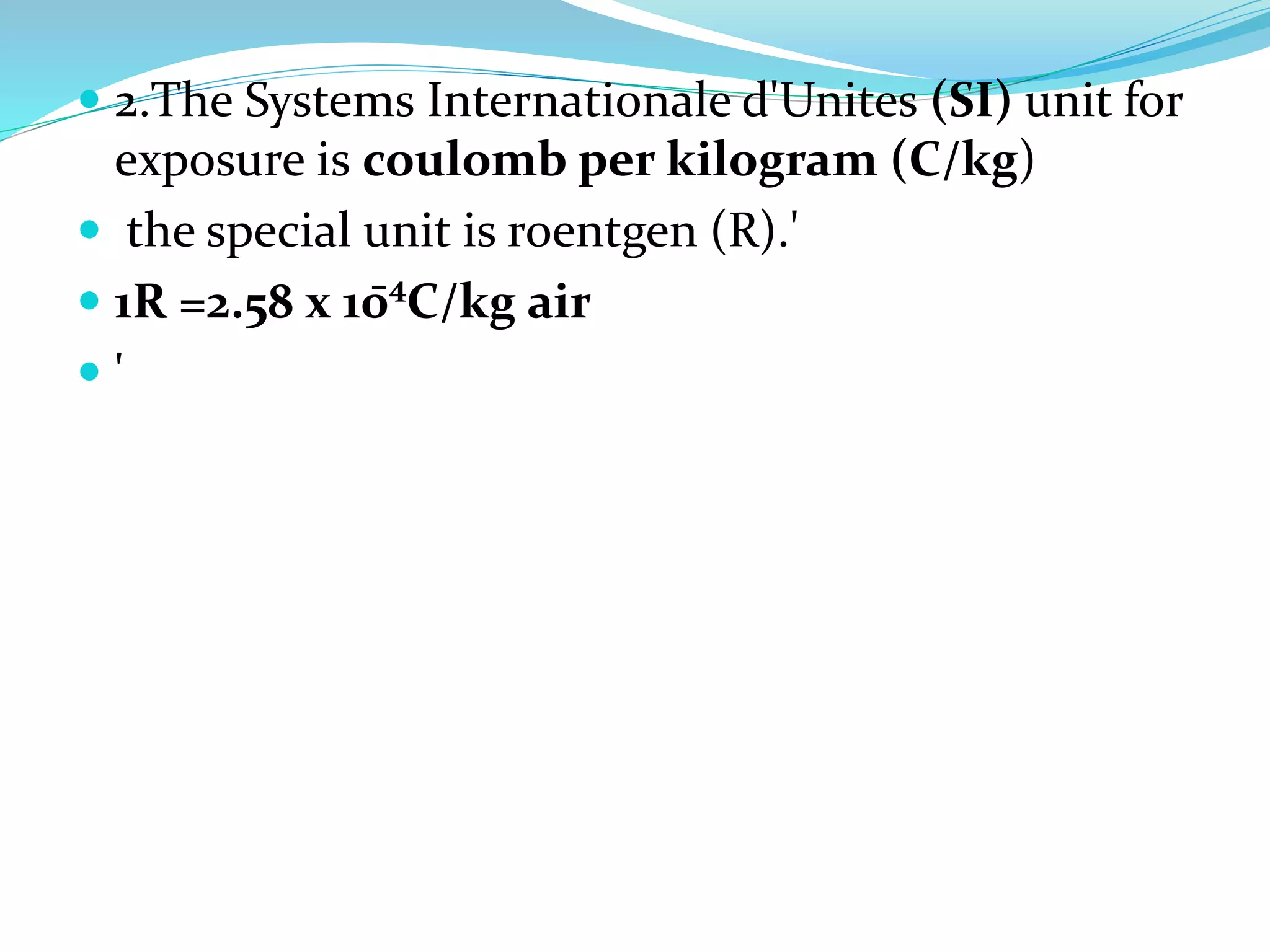
 2.The Systems Internationale d'Unites (SI) unit for
exposure is coulomb per kilogram (C/kg)
 the special unit is roentgen (R).'
 1R =2.58 x 10̄⁴C/kg air
 '
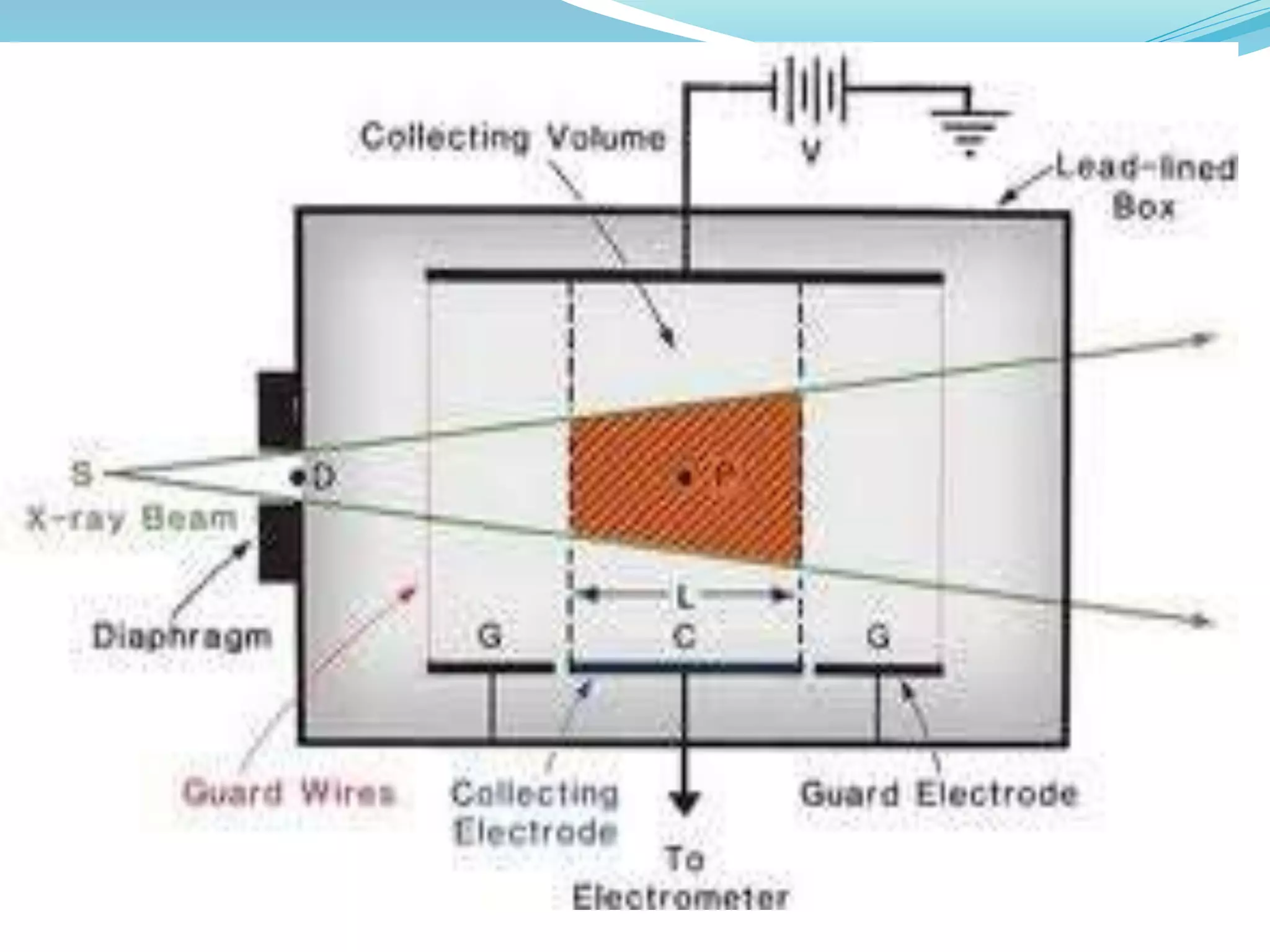
A.Standard or Free Air Ionization
Chamber
 Used in measurement of roentgen acc to its definition
.
 Only used in national labs to calibrate other ionization
chambers
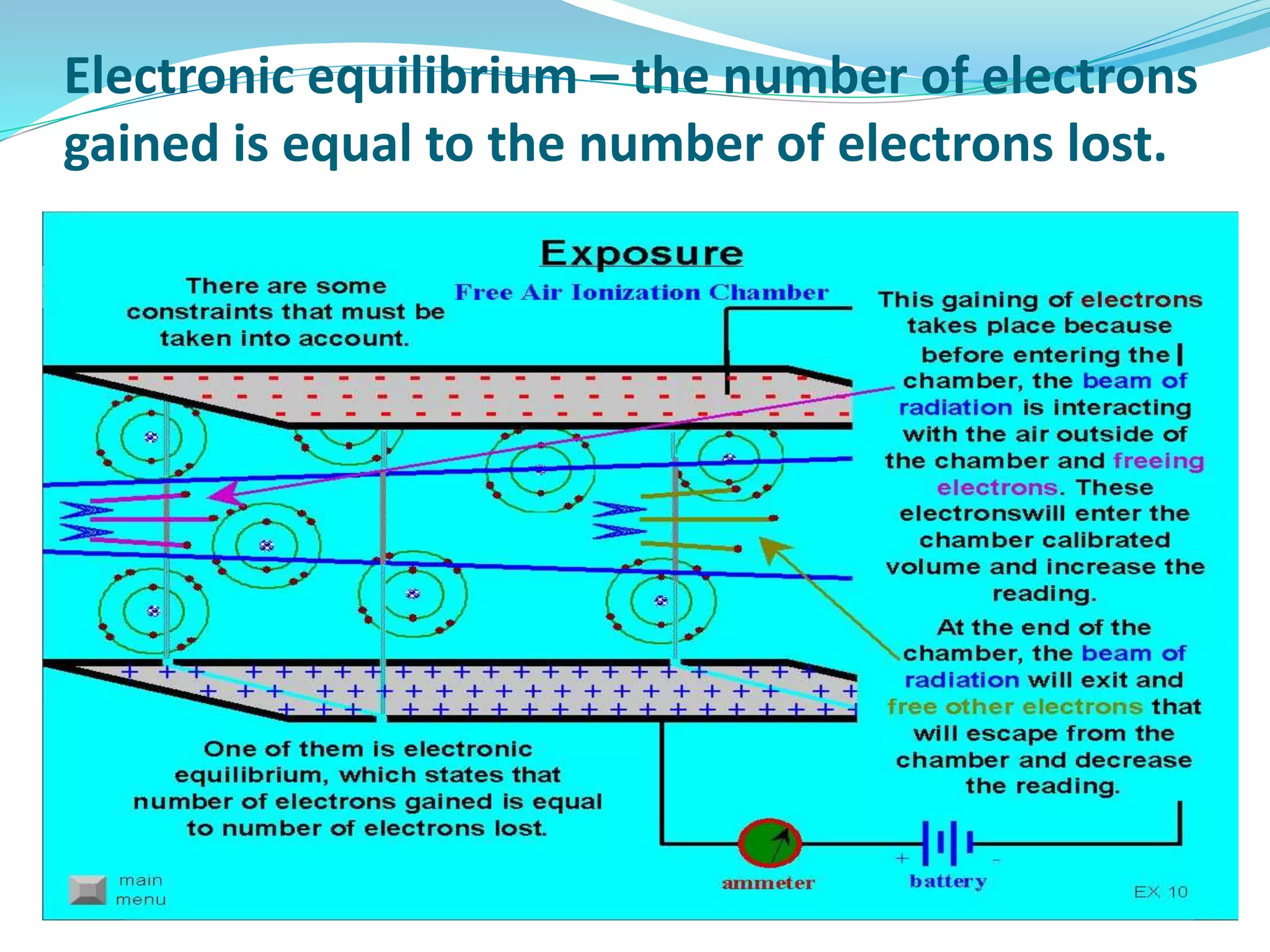
Electronic equilibrium – the number of electrons
gained is equal to the number of electrons lost.
B.Thimble chamber
 Free-air ionization chambers are too delicate and
bulky for routine use.
 Their main function is in the standardizing
laboratories where they can be used to calibrate
field instruments
 such as a thimble chamber.
 . The principle - spherical volume of air is shown
with an air cavity at the centre.
 This sphere of air is irradiated uniformly with a photon
beam. The distance between the outer sphere and the
inner cavity is --equal to the maximum range of
electrons generated in air, the electronic equilibrium
exists.
 - Suppose that we are able to measure the ionization
charge produced in the cavity by the electrons
liberated in the air surrounding the cavity.
 -Then by knowing the volume or mass of air inside the
cavity, we can calculate the charge per unit mass or the
 beam exposure at the centre of the cavity.
 -if the air wall is compressed into a solid shell we get
a thimble chamber
Although the thimble wall is solid,it is air equivalent,
i.e., its effective atomic number is the same as that of
air.
the thickness of the thimble wall is such that the
electronic equilibrium occurs inside the cavity.
Limitations on measuring the
Roentgen :
 For x-rays(photons) and gamma rays only
 Electrons liberated must give up all their energy
before being collected
 Need electronic equilibrium
 Air must be dry
 Photon energy must be less than 3 MeV
PRACTICAL THIMBLE CHAMBER

A. Condenser chamber
 1.thimble ionization chamber connected to a condenser.
 2.has approximately air equivalent wall (Bakelite,
 nylon, or other composition) with a layer of carbon coated
on the inside to make it electrically conducting.
 3. The conducting layer makes contact with the metal stem.
The central electrode (aluminium rod) is connected to a
conducting layer of carbon coated on the inside of a hollow
polystyrene insulator.
 4. This arrangement of an outer metal shield and
 an inner conducting layer with an insulator in between
constitutes an electrical condenser capable of storing
charge.
 5.The central wire and the thimble's inner conducting
surface
 Together also act as a condenser.
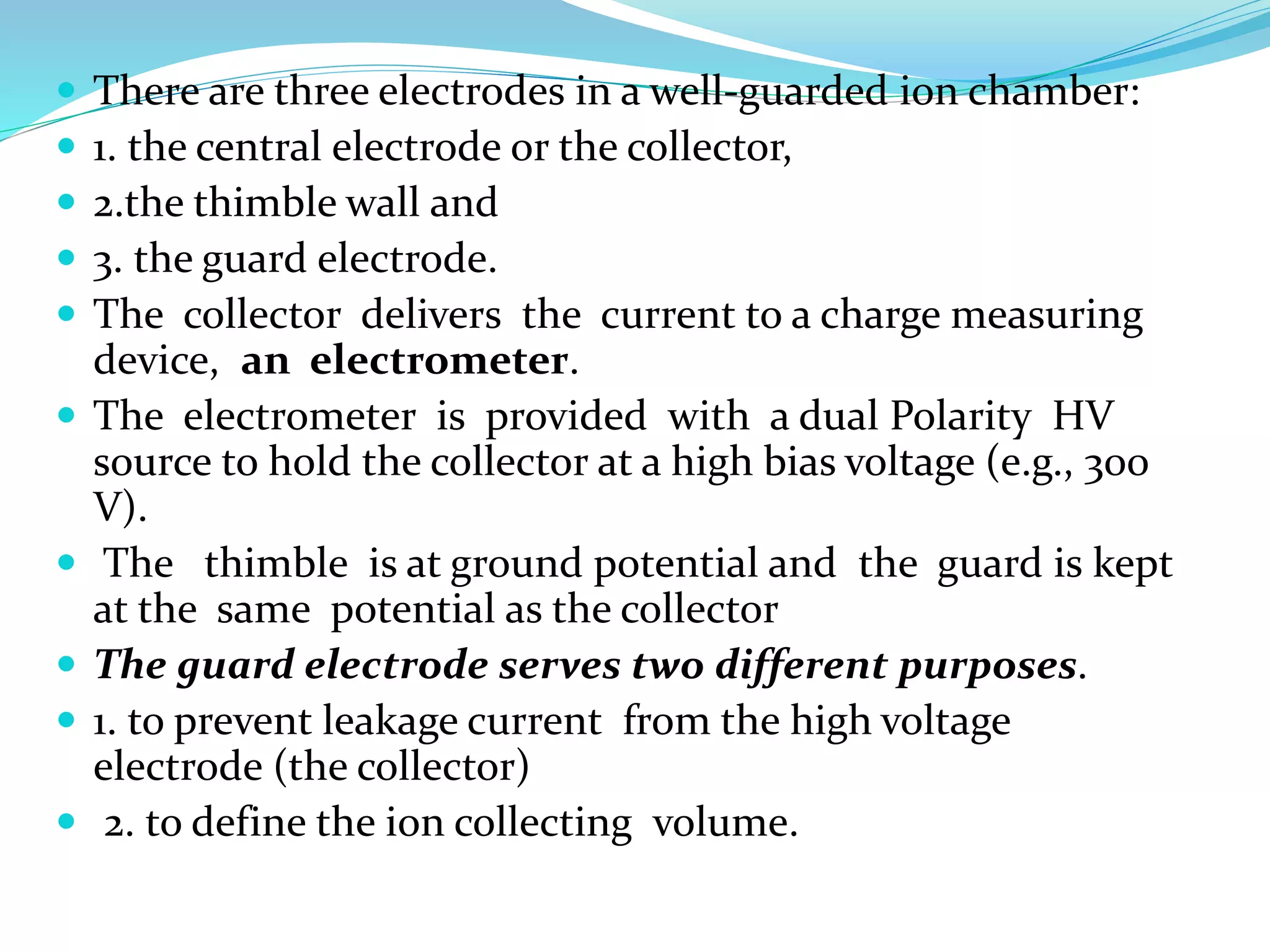
B.Farmer chamber
 There are three electrodes in a well-guarded ion chamber:
 1. the central electrode or the collector,
 2.the thimble wall and
 3. the guard electrode.
 The collector delivers the current to a charge measuring
device, an electrometer.
 The electrometer is provided with a dual Polarity HV
source to hold the collector at a high bias voltage (e.g., 300
V).
 The thimble is at ground potential and the guard is kept
at the same potential as the collector
 The guard electrode serves two different purposes.
 1. to prevent leakage current from the high voltage
electrode (the collector)
 2. to define the ion collecting volume.
. Environmental Conditions Affecting Chamber
 If the ion chamber is not sealed, its response is affected by
air temperature and pressure.
 - most chambers are unsealed and communicate to the
outside atmosphere.
 -Because the density of air depends on the temperature and
pressure, in accordance with the gas laws, the density of air
in the chamber volume will likewise depend on these
atmospheric conditions.
 -The density or the mass of air in the chamber volume will
increase as the temperature decreases or pressure
increases. Since exposure is given by the ionization charge
collected per unit mass of air , the chamber reading for a
given exposure will increase as the temperature decreases
or as the pressure
What units are used for measuring radiation
energy?
 1.The energy of ionizing radiation is measured in
electronvolts (eV).
 One electronvolt is an extremely small amount of
energy.
 Commonly used multiple units are kiloelectron
(keV) and megaelectronvolt (MeV).
 6,200 billion MeV = 1 joule
 1 keV = 1000 eV, 1 MeV = 1000 keV
What units are used for measuring radiation
exposure?
 -X-ray and gamma-ray exposure is often expressed in
units of roentgen (R).
 -The roentgen (R) unit refers to the amount of
ionization present in the air.
 - One roentgen of gamma- or x-ray exposure produces
approximately 1 rad (0.01 gray) tissue dose .
 Another unit of measuring gamma ray intensity in the
air is "air dose or absorbed dose rate in the air" in
grays per hour (Gy/h) units.
 This unit is used to express gamma ray intensity in the
air from radioactive materials in the earth and in the
atmosphere.
What units are used for measuring radiation dose?
 When ionizing radiation interacts with the human body, it gives
its energy to the body tissues.
 The amount of energy absorbed per unit weight of the organ or
tissue is called absorbed dose and is expressed in units of gray
(Gy).
 One gray dose is equivalent to one joule radiation energy
absorbed per kilogram of organ or tissue weight.
 Rad is the old and still used unit of absorbed dose.
 One gray is equivalent to 100 rads.
 1 Gy = 100 rads
 Equal doses of all types of ionizing radiation are not equally
harmful.
 Alpha particles produce greater harm than do beta particles,
gamma rays and x rays for a given absorbed dose.
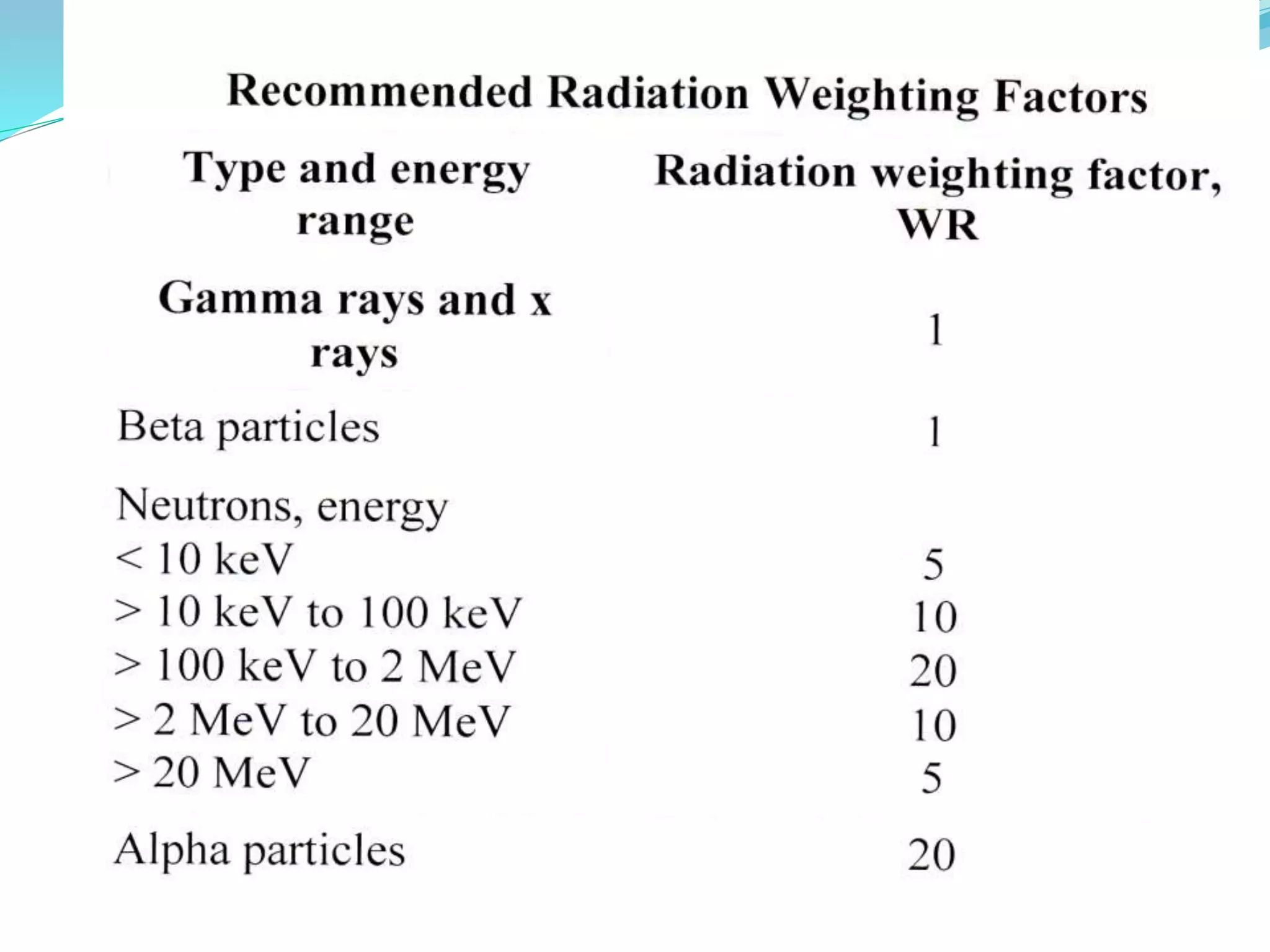
 To account for this difference, radiation dose is expressed as
equivalent dose in units of sievert (Sv).
 -The dose in Sv is equal to "absorbed dose" multiplied by a
"radiation weighting factor"
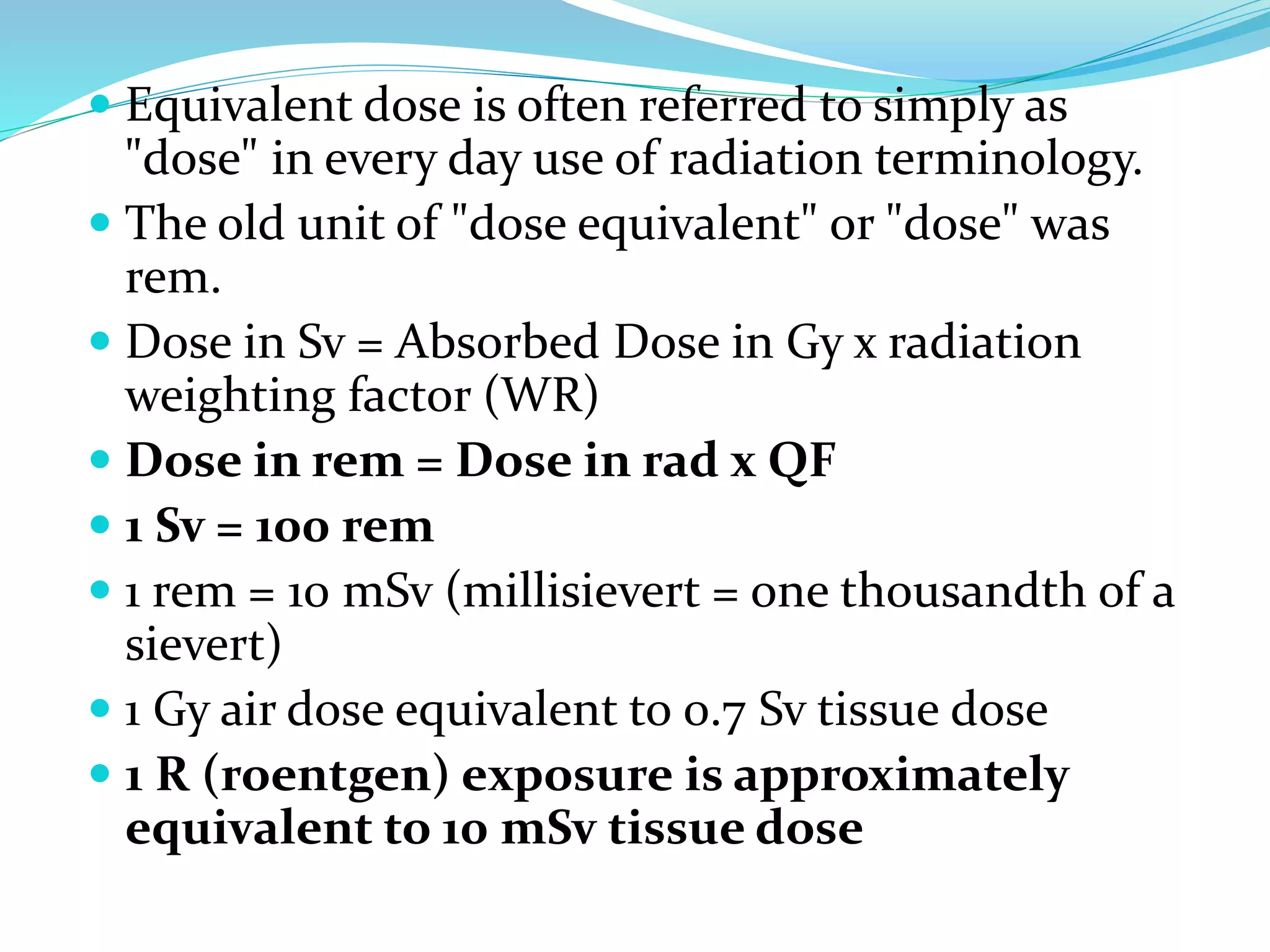
 Equivalent dose is often referred to simply as
"dose" in every day use of radiation terminology.
 The old unit of "dose equivalent" or "dose" was
rem.
 Dose in Sv = Absorbed Dose in Gy x radiation
weighting factor (WR)
 Dose in rem = Dose in rad x QF
 1 Sv = 100 rem
 1 rem = 10 mSv (millisievert = one thousandth of a
sievert)
 1 Gy air dose equivalent to 0.7 Sv tissue dose
 1 R (roentgen) exposure is approximately
equivalent to 10 mSv tissue dose
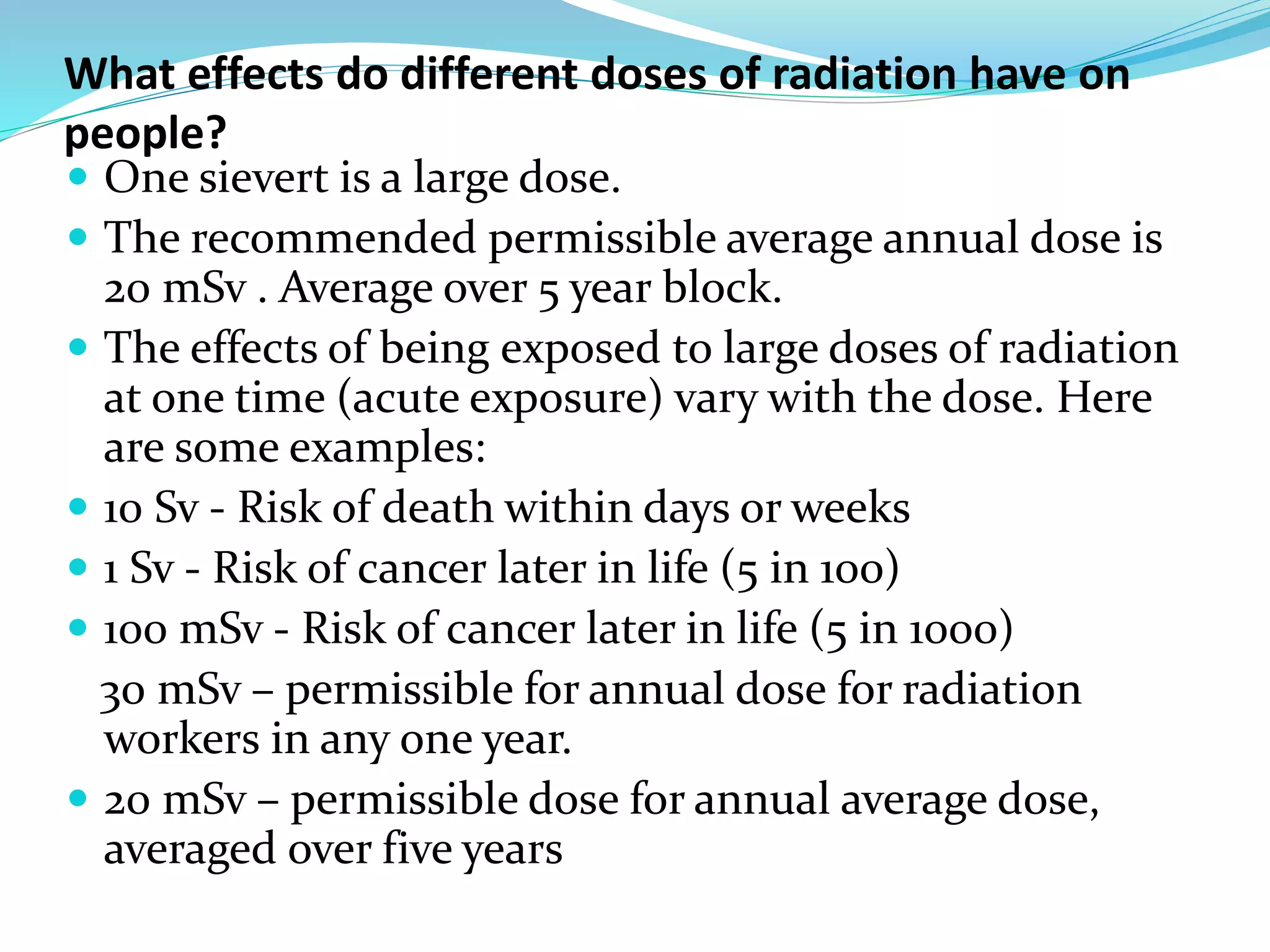
What effects do different doses of radiation have on
people?
 One sievert is a large dose.
 The recommended permissible average annual dose is
20 mSv . Average over 5 year block.
 The effects of being exposed to large doses of radiation
at one time (acute exposure) vary with the dose. Here
are some examples:
 10 Sv - Risk of death within days or weeks
 1 Sv - Risk of cancer later in life (5 in 100)
 100 mSv - Risk of cancer later in life (5 in 1000)
30 mSv – permissible for annual dose for radiation
workers in any one year.
 20 mSv – permissible dose for annual average dose,
averaged over five years
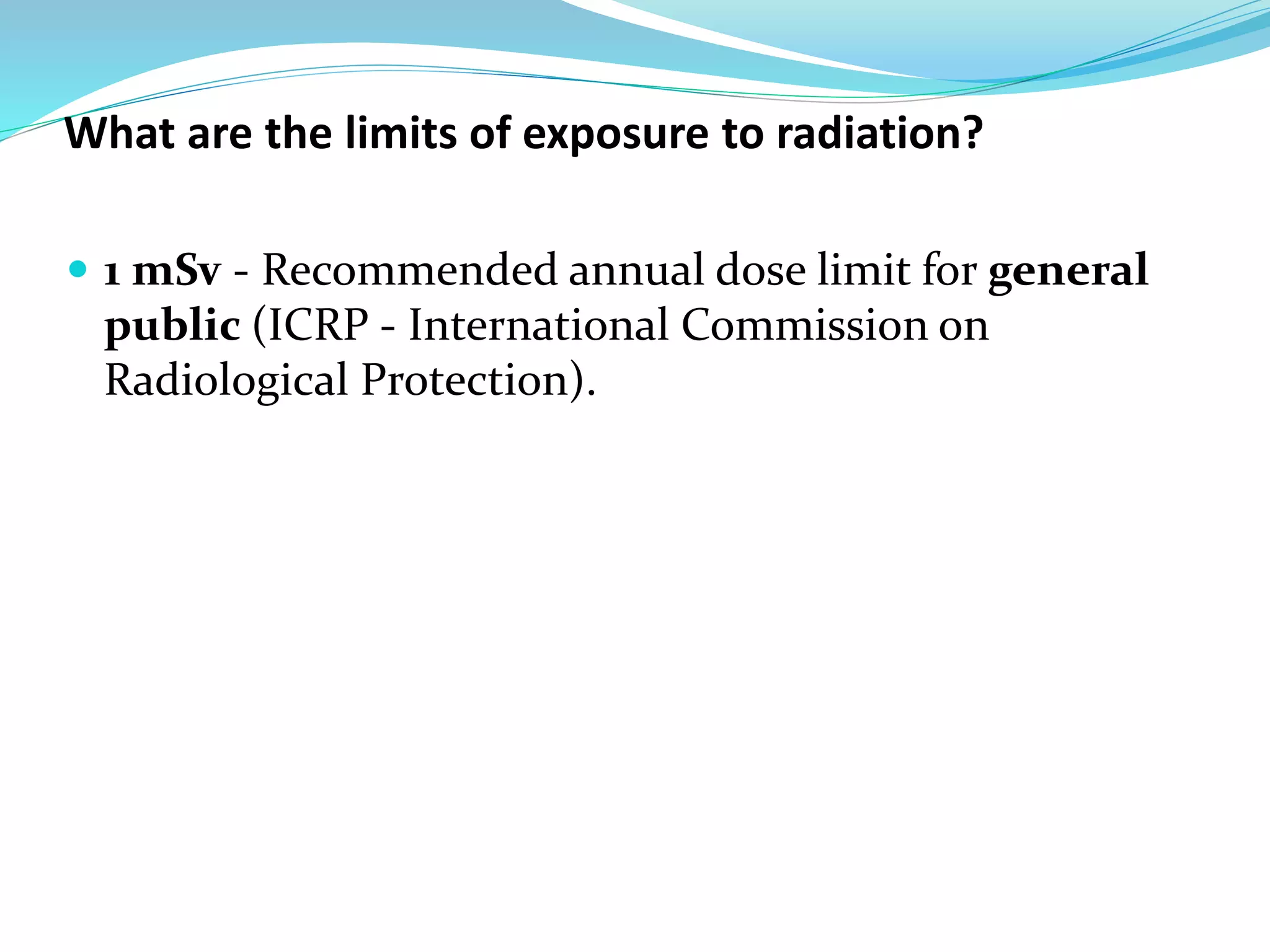
What are the limits of exposure to radiation?
 1 mSv - Recommended annual dose limit for general
public (ICRP - International Commission on
Radiological Protection).
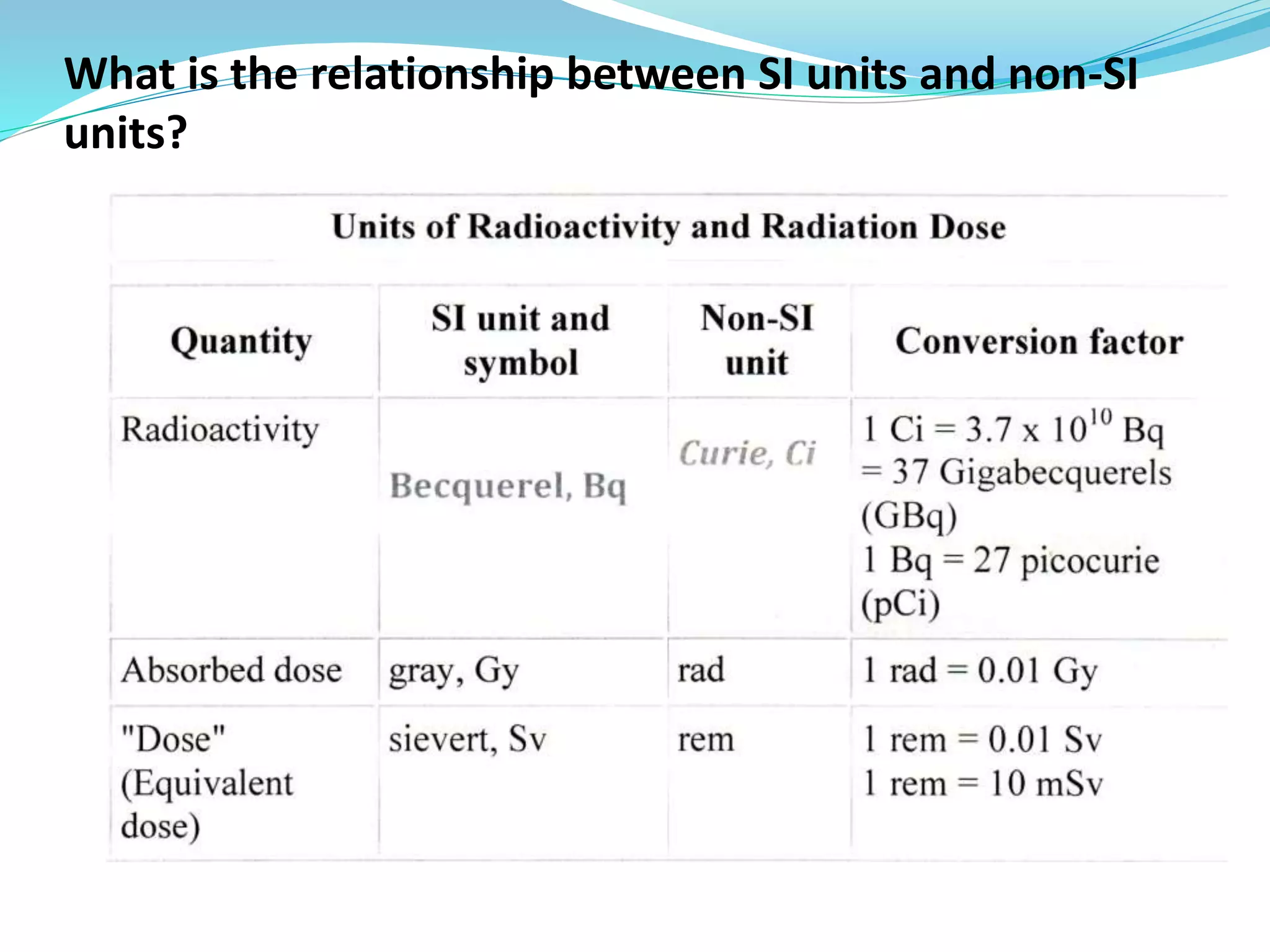
What is the relationship between SI units and non-SI
units?
PERMISSIBLE DOSE=1oo mSv in 5 year block.
i.e 20 mSv / year.
In a particular year 30 mSv is permissible,limiting to 5
YR block dose remain 100mSv.
THANK YOU

MEASUREMENT OF IONIZING RADIATION AND UNITS

  • 1.
  • 2.
    Ionizing radiation isradiation that has enough energy to remove electrons from atoms or molecules (groups of atoms) when it passes through or collides with some material. The loss of an electron with its negative charge causes the atom (or molecule) to become positively charged. The loss (or gain) of an electron is called ionization and a charged atom (or molecule) is called an ion. IN early day, SED unit was used. -it has many drawbacks In 1928, the International Commission on Radiation Units and Measurements (ICRU) adopted the roentgen as the unit of measuring x and y radiation exposure. 1
  • 3.
    -The roentgen isa unit of exposure. -The quantity exposure is a measure of ionization produced in air by photons. 1.The ICRU defines exposure (X) as the quotient of dQ by dm where dQ is the absolute value of the total charge of the ions of one sign produced in air when all the electrons (negatrons and positrons) liberated by photons in air of mass dm are completely stopped in air.
  • 4.
     2.The SystemsInternationale d'Unites (SI) unit for exposure is coulomb per kilogram (C/kg)  the special unit is roentgen (R).'  1R =2.58 x 10̄⁴C/kg air  '
  • 5.
    A.Standard or FreeAir Ionization Chamber  Used in measurement of roentgen acc to its definition .  Only used in national labs to calibrate other ionization chambers
  • 7.
    Electronic equilibrium –the number of electrons gained is equal to the number of electrons lost.
  • 8.
    B.Thimble chamber  Free-airionization chambers are too delicate and bulky for routine use.  Their main function is in the standardizing laboratories where they can be used to calibrate field instruments  such as a thimble chamber.  . The principle - spherical volume of air is shown with an air cavity at the centre.
  • 9.
     This sphereof air is irradiated uniformly with a photon beam. The distance between the outer sphere and the inner cavity is --equal to the maximum range of electrons generated in air, the electronic equilibrium exists.  - Suppose that we are able to measure the ionization charge produced in the cavity by the electrons liberated in the air surrounding the cavity.  -Then by knowing the volume or mass of air inside the cavity, we can calculate the charge per unit mass or the  beam exposure at the centre of the cavity.  -if the air wall is compressed into a solid shell we get a thimble chamber
  • 10.
    Although the thimblewall is solid,it is air equivalent, i.e., its effective atomic number is the same as that of air. the thickness of the thimble wall is such that the electronic equilibrium occurs inside the cavity.
  • 11.
    Limitations on measuringthe Roentgen :  For x-rays(photons) and gamma rays only  Electrons liberated must give up all their energy before being collected  Need electronic equilibrium  Air must be dry  Photon energy must be less than 3 MeV
  • 12.
  • 13.
     1.thimble ionizationchamber connected to a condenser.  2.has approximately air equivalent wall (Bakelite,  nylon, or other composition) with a layer of carbon coated on the inside to make it electrically conducting.  3. The conducting layer makes contact with the metal stem. The central electrode (aluminium rod) is connected to a conducting layer of carbon coated on the inside of a hollow polystyrene insulator.  4. This arrangement of an outer metal shield and  an inner conducting layer with an insulator in between constitutes an electrical condenser capable of storing charge.  5.The central wire and the thimble's inner conducting surface  Together also act as a condenser.
  • 14.
  • 15.
     There arethree electrodes in a well-guarded ion chamber:  1. the central electrode or the collector,  2.the thimble wall and  3. the guard electrode.  The collector delivers the current to a charge measuring device, an electrometer.  The electrometer is provided with a dual Polarity HV source to hold the collector at a high bias voltage (e.g., 300 V).  The thimble is at ground potential and the guard is kept at the same potential as the collector  The guard electrode serves two different purposes.  1. to prevent leakage current from the high voltage electrode (the collector)  2. to define the ion collecting volume.
  • 16.
    . Environmental ConditionsAffecting Chamber  If the ion chamber is not sealed, its response is affected by air temperature and pressure.  - most chambers are unsealed and communicate to the outside atmosphere.  -Because the density of air depends on the temperature and pressure, in accordance with the gas laws, the density of air in the chamber volume will likewise depend on these atmospheric conditions.  -The density or the mass of air in the chamber volume will increase as the temperature decreases or pressure increases. Since exposure is given by the ionization charge collected per unit mass of air , the chamber reading for a given exposure will increase as the temperature decreases or as the pressure
  • 17.
    What units areused for measuring radiation energy?  1.The energy of ionizing radiation is measured in electronvolts (eV).  One electronvolt is an extremely small amount of energy.  Commonly used multiple units are kiloelectron (keV) and megaelectronvolt (MeV).  6,200 billion MeV = 1 joule  1 keV = 1000 eV, 1 MeV = 1000 keV
  • 18.
    What units areused for measuring radiation exposure?  -X-ray and gamma-ray exposure is often expressed in units of roentgen (R).  -The roentgen (R) unit refers to the amount of ionization present in the air.  - One roentgen of gamma- or x-ray exposure produces approximately 1 rad (0.01 gray) tissue dose .  Another unit of measuring gamma ray intensity in the air is "air dose or absorbed dose rate in the air" in grays per hour (Gy/h) units.  This unit is used to express gamma ray intensity in the air from radioactive materials in the earth and in the atmosphere.
  • 19.
    What units areused for measuring radiation dose?  When ionizing radiation interacts with the human body, it gives its energy to the body tissues.  The amount of energy absorbed per unit weight of the organ or tissue is called absorbed dose and is expressed in units of gray (Gy).  One gray dose is equivalent to one joule radiation energy absorbed per kilogram of organ or tissue weight.  Rad is the old and still used unit of absorbed dose.  One gray is equivalent to 100 rads.  1 Gy = 100 rads  Equal doses of all types of ionizing radiation are not equally harmful.  Alpha particles produce greater harm than do beta particles, gamma rays and x rays for a given absorbed dose.  To account for this difference, radiation dose is expressed as equivalent dose in units of sievert (Sv).  -The dose in Sv is equal to "absorbed dose" multiplied by a "radiation weighting factor"
  • 21.
     Equivalent doseis often referred to simply as "dose" in every day use of radiation terminology.  The old unit of "dose equivalent" or "dose" was rem.  Dose in Sv = Absorbed Dose in Gy x radiation weighting factor (WR)  Dose in rem = Dose in rad x QF  1 Sv = 100 rem  1 rem = 10 mSv (millisievert = one thousandth of a sievert)  1 Gy air dose equivalent to 0.7 Sv tissue dose  1 R (roentgen) exposure is approximately equivalent to 10 mSv tissue dose
  • 22.
    What effects dodifferent doses of radiation have on people?  One sievert is a large dose.  The recommended permissible average annual dose is 20 mSv . Average over 5 year block.  The effects of being exposed to large doses of radiation at one time (acute exposure) vary with the dose. Here are some examples:  10 Sv - Risk of death within days or weeks  1 Sv - Risk of cancer later in life (5 in 100)  100 mSv - Risk of cancer later in life (5 in 1000) 30 mSv – permissible for annual dose for radiation workers in any one year.  20 mSv – permissible dose for annual average dose, averaged over five years
  • 23.
    What are thelimits of exposure to radiation?  1 mSv - Recommended annual dose limit for general public (ICRP - International Commission on Radiological Protection).
  • 24.
    What is therelationship between SI units and non-SI units?
  • 25.
    PERMISSIBLE DOSE=1oo mSvin 5 year block. i.e 20 mSv / year. In a particular year 30 mSv is permissible,limiting to 5 YR block dose remain 100mSv.
  • 26.