1
Supply Chain Overview
Dickson Chiu 2006 SCM-2
CR (2004) Prentice Hall, Inc. 1-2
Warehousing
Warehousing
Transportation
Transportation
Vendors/plants/ports
Transportation
Factory
Transportation Customers
Information
flows
Logistics vs Supply Chain Management
Council of Logistics Management
 “Logistics is the process of planning, implementing and
controlling the efficient, cost-effective flow and storage
of raw materials, in-process inventory, finished goods
and related information from the point of origin to
point of consumption for the purpose of conforming to
customer requirements.”
Handfield and Nichols
 SCM is the integration of all activities associated with
the flow and transformation of goods from raw
materials through to end user, as well as information
flows, through improved supply chain relationships, to
achieve a sustainable competitive advantage.
Dickson Chiu 2006 SCM-3
CR (2004) Prentice Hall, Inc.
Common Contemporary Logistics Terms
 Value stream/logistics process
 Quick response and flexible manufacturing
 Mass customization
 Supply chain management/ collaborative logistics
 Reverse logistics
 Service logistics
 Continuous replenishment
 Lean logistics
 Integrated logistics
=> IT people have to deal with any related automation anyway

Dickson Chiu 2006 SCM-4
The Logistics/SCM Mission
 Getting the right goods or services to the right place, at the
right time, and in the desired condition at the lowest cost
and highest return on investment.
 Product / Service Utility
 Possession Utility - the value or usefulness that comes from a
customer being able to take possession of a product
 Form Utility - in a form that can be used by the customer and is of
value to the customer
 Place Utility - available where they are needed by customers
 Time Utility - available when they are needed by customers
 Logistics obviously help time and place utility
Dickson Chiu 2006 SCM-5
Evolution of Supply Chain Management
Dickson Chiu 2006 SCM-6
Demand forecasting
Purchasing
Requirements planning
Production planning
Manufacturing inventory
Warehousing
Material handling
Packaging
Finished goods inventory
Distribution planning
Order processing
Transportation
Customer service
Strategic planning
Information services
Marketing/sales
Finance
Supply Chain
Management
Supply Chain
Management
Logistics
Purchasing/
Materials
Management
Physical
Distribution
Activity fragmentation to 1960 Activity Integration 1960 to 2000 2000+
Demand forecasting
Purchasing
Requirements planning
Production planning
Manufacturing inventory
Warehousing
Material handling
Packaging
Finished goods inventory
Distribution planning
Order processing
Transportation
Customer service
Strategic planning
Information services
Marketing/sales
Finance
Supply Chain
Management
Supply Chain
Management
Logistics
Purchasing/
Materials
Management
Physical
Distribution
Activity fragmentation to 1960 Activity Integration 1960 to 2000 2000+
CR (2004) Prentice Hall, Inc.
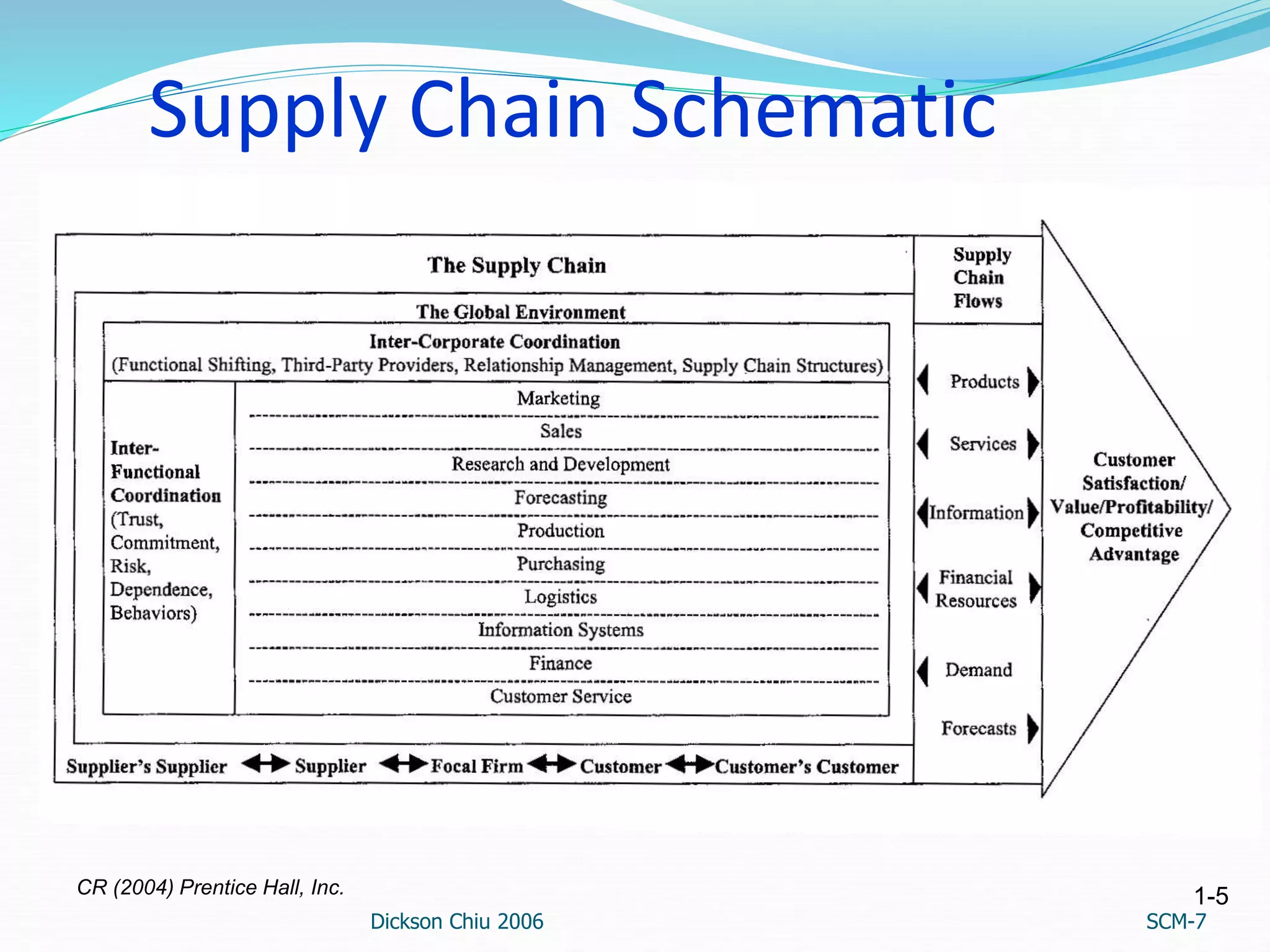
Supply Chain Schematic
Dickson Chiu 2006 SCM-7
CR (2004) Prentice Hall, Inc. 1-5
A Revised Strategy is Generating Great Top
Management Interest
 Historical perspective of distribution
(Peter Drucker, 1962):
“The last frontier of cost economies”
 The contemporary view:
Distribution is a new frontier for demand generation—
a competitive weapon.
 Both views are important!
Dickson Chiu 2006 SCM-8
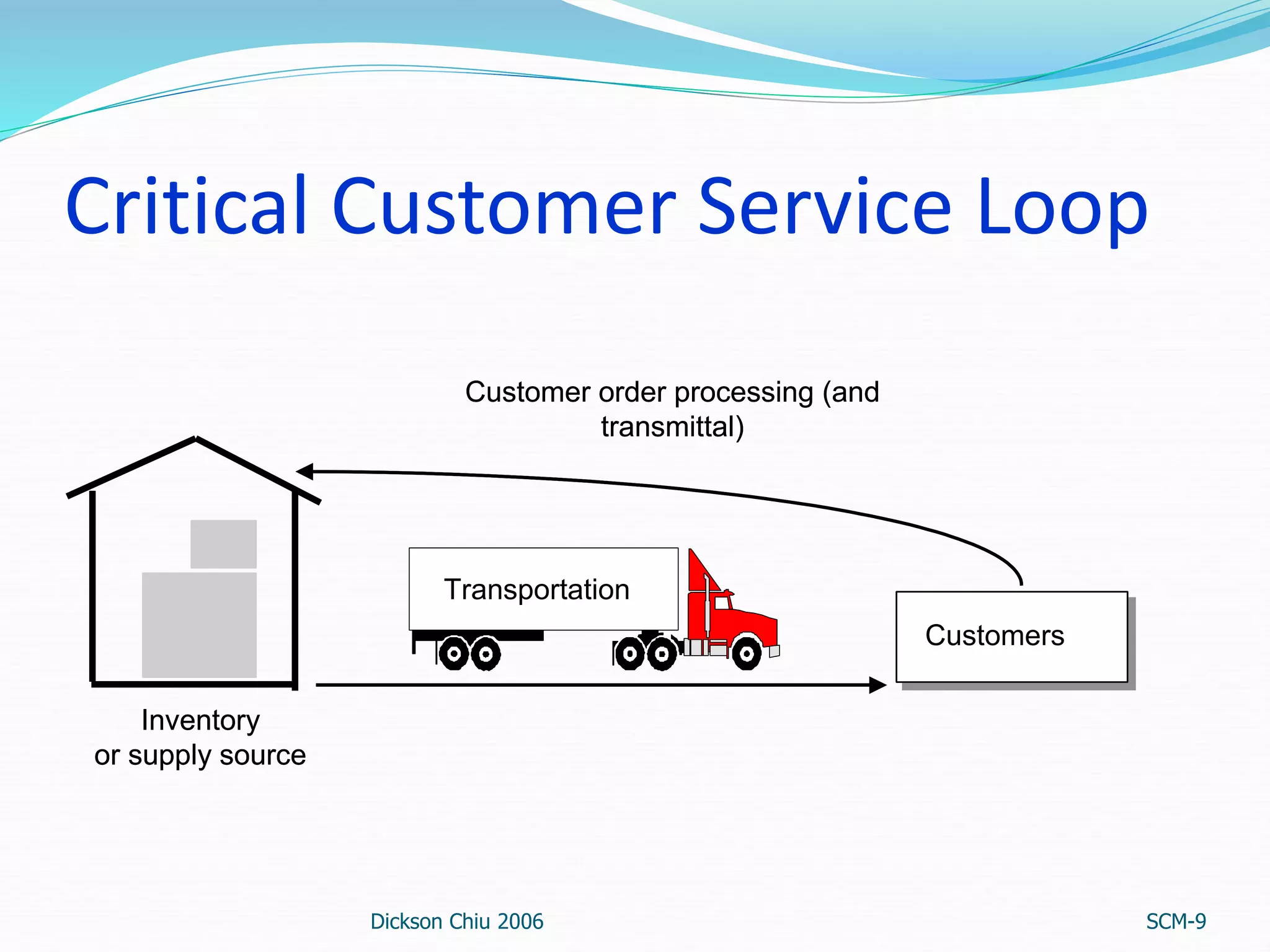
Critical Customer Service Loop
Customers
Transportation
Inventory
or supply source
Customer order processing (and
transmittal)
Customers
Transportation
Inventory
or supply source
Customer order processing (and
transmittal)
Dickson Chiu 2006 SCM-9
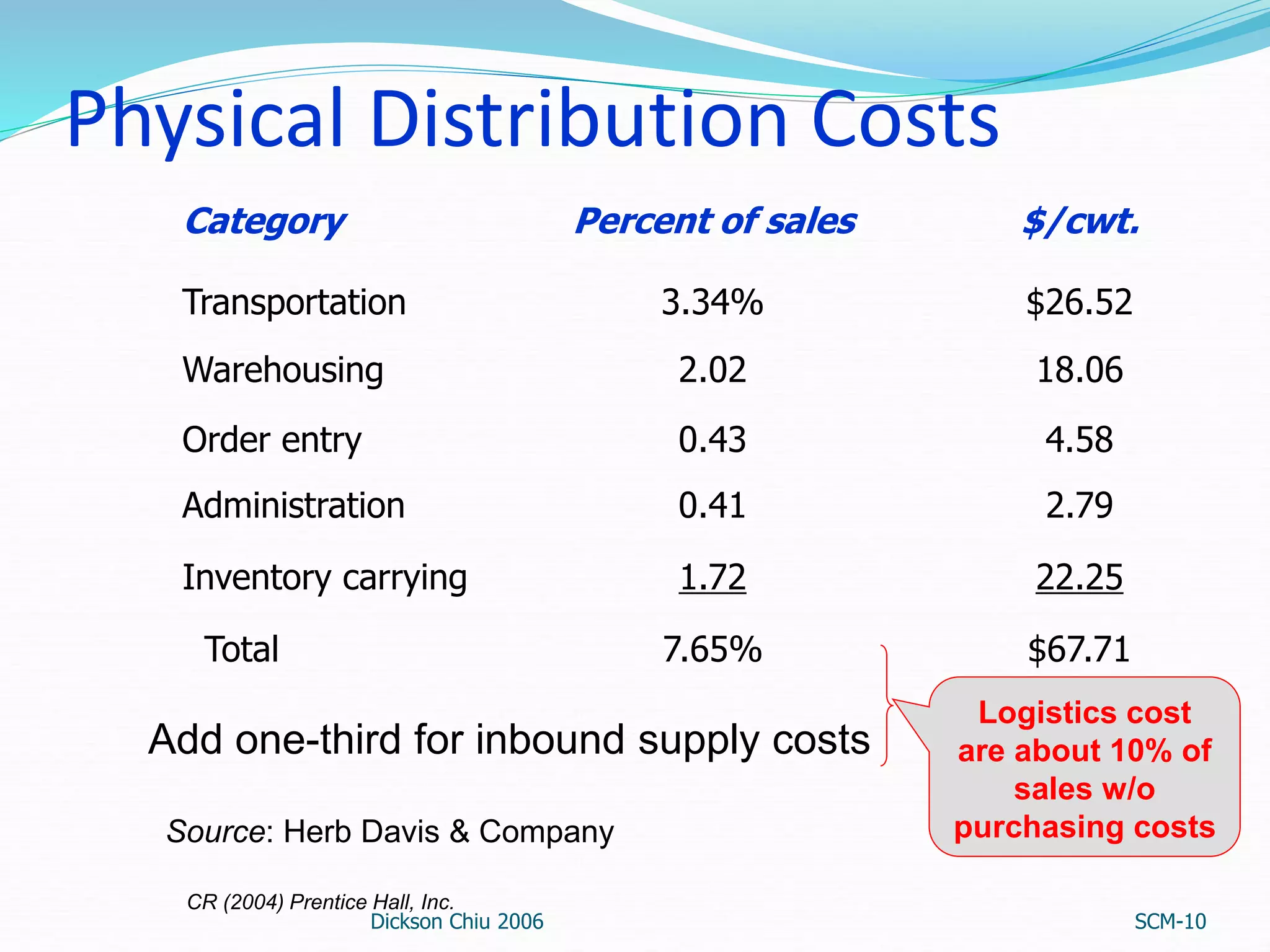
Physical Distribution Costs
Dickson Chiu 2006 SCM-10
Category Percent of sales $/cwt.
Transportation 3.34% $26.52
Warehousing 2.02 18.06
Order entry 0.43 4.58
Administration 0.41 2.79
Inventory carrying 1.72 22.25
Total 7.65% $67.71
Add one-third for inbound supply costs
Source: Herb Davis & Company
Logistics cost
are about 10% of
sales w/o
purchasing costs
CR (2004) Prentice Hall, Inc.
Customer Service Performance
4
5
6
7
8
9
10
1
9
9
2
1
9
9
4
1
9
9
6
1
9
9
8
2
0
0
0
2
0
0
2
Year
Days
82
84
86
88
90
92
94
96
%
Order Cycle Time,
Days
Product
Availability--%
orders
Product
Availability--%
line items
Dickson Chiu 2006 SCM-11
Source: Herb Davis & Company
Traditional Scope of the Supply
Chain
Dickson Chiu 2006 SCM-12
Physical distribution
Physical supply
(Materials management)
Business logistics
Sources of
supply
Plants/
operations
Customers
• Transportation
• Inventory maintenance
• Order processing
• Acquisition
• Protective packaging
• Warehousing
• Materials handling
• Information maintenance
• Transportation
• Inventory maintenance
• Order processing
• Product scheduling
• Protective packaging
• Warehousing
• Materials handling
• Information maintenance
Internal supply chain
CR (2004) Prentice Hall, Inc. 1-14
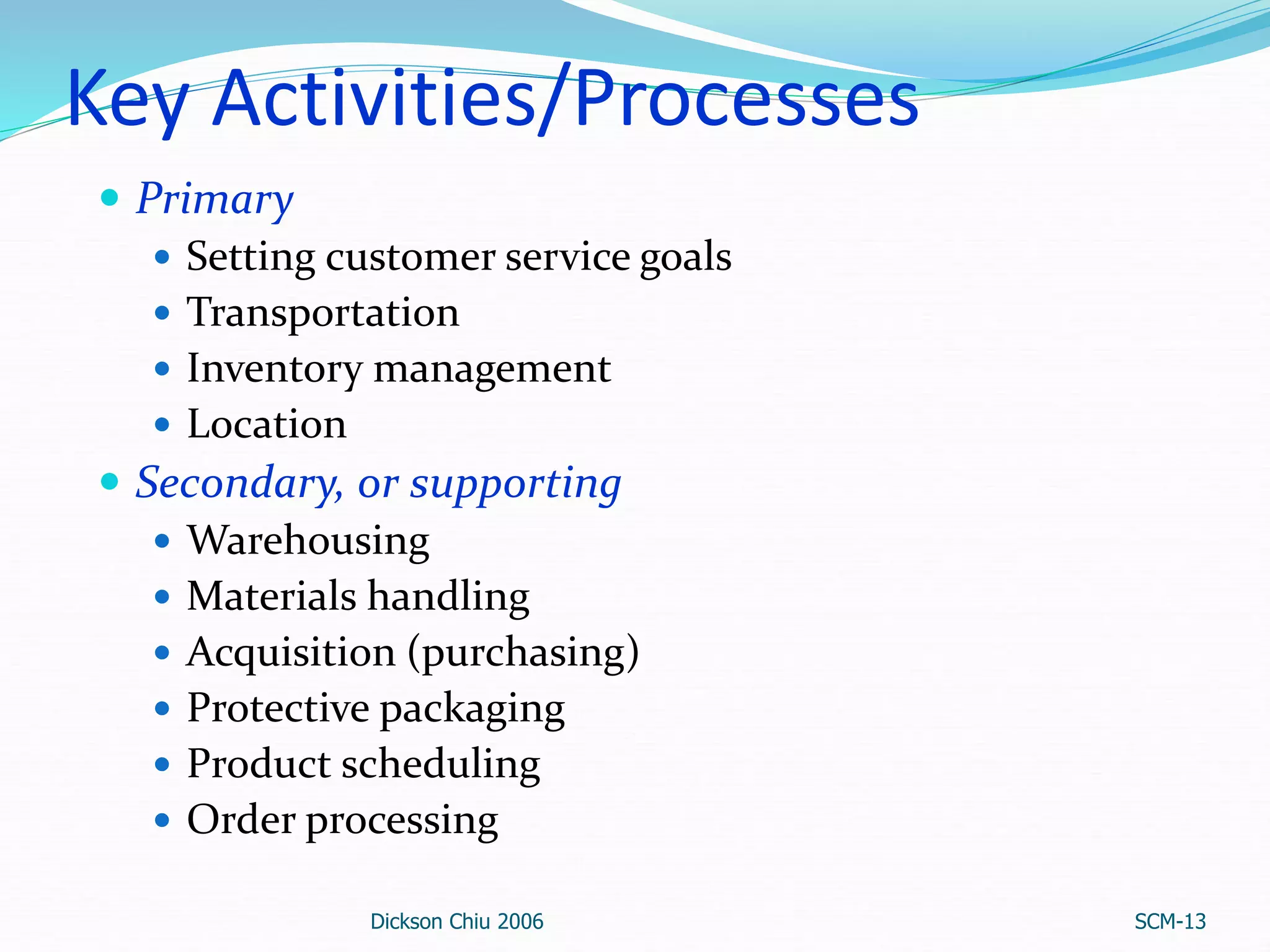
Key Activities/Processes
 Primary
 Setting customer service goals
 Transportation
 Inventory management
 Location
 Secondary, or supporting
 Warehousing
 Materials handling
 Acquisition (purchasing)
 Protective packaging
 Product scheduling
 Order processing
Dickson Chiu 2006 SCM-13
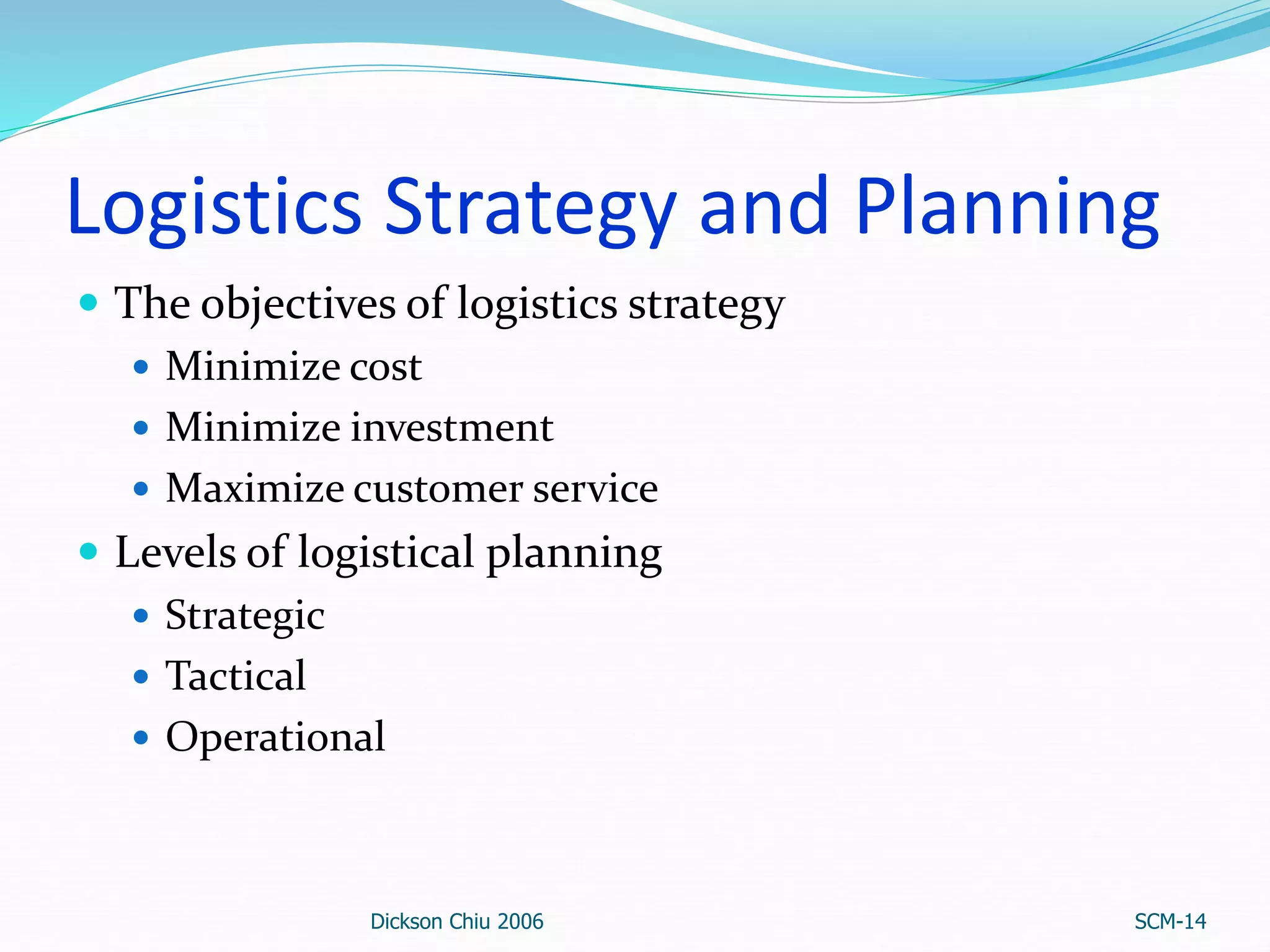
Logistics Strategy and Planning
 The objectives of logistics strategy
 Minimize cost
 Minimize investment
 Maximize customer service
 Levels of logistical planning
 Strategic
 Tactical
 Operational
Dickson Chiu 2006 SCM-14
The Logistics Strategy Triangle
(4 problem areas)
Dickson Chiu 2006 SCM-15
Customer
service goals
 The product
 Logistics service
 Information sys.
Inventory Strategy
 Forecasting
 Storage fundamentals
 Inventory decisions
 Purchasing and supply
scheduling decisions
 Storage decisions
Transport Strategy
 Transport fundamentals
 Transport decisions
Location Strategy
 Location decisions
 The network planning process
CR (2004) Prentice Hall, Inc.
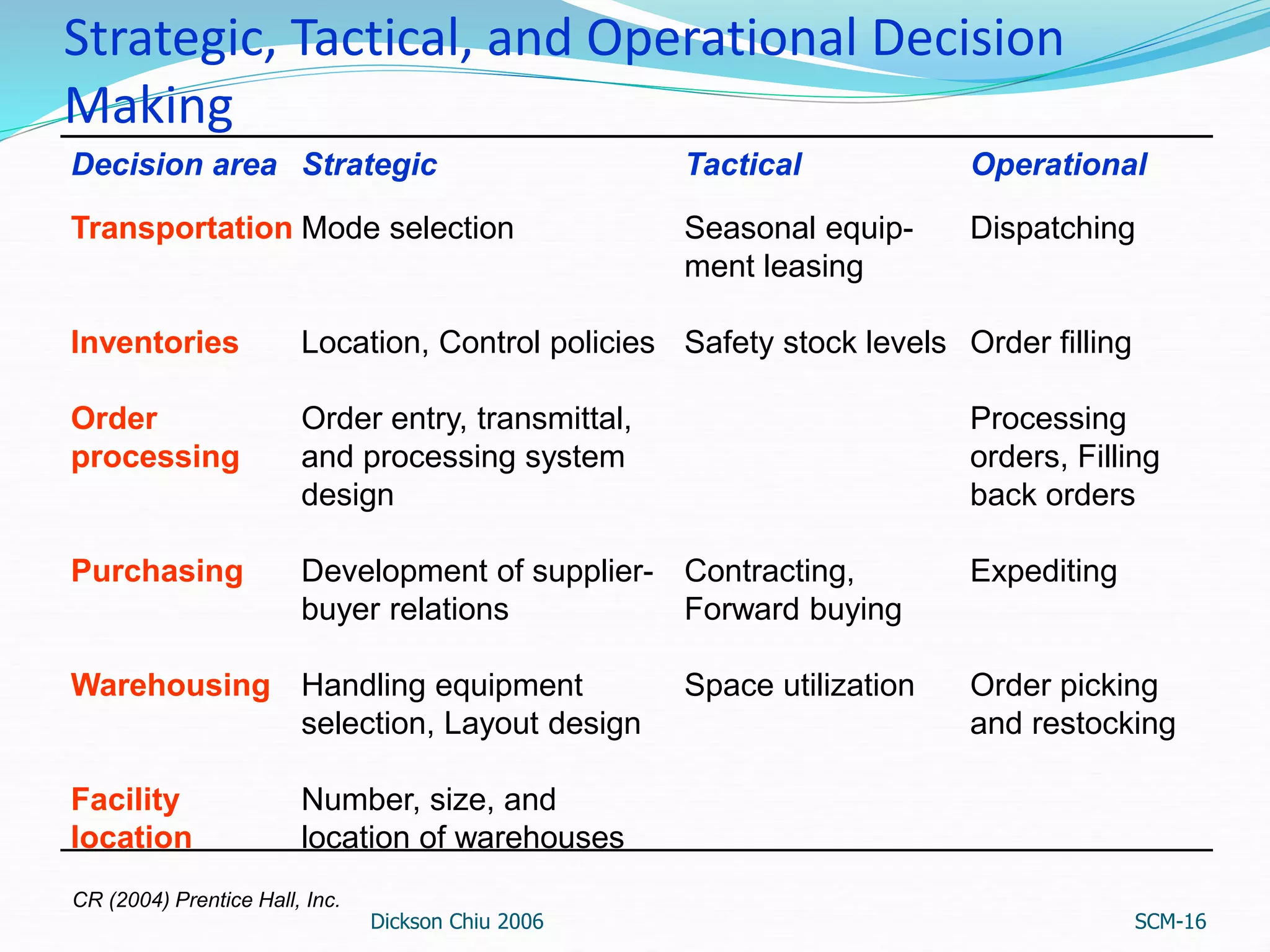
Strategic, Tactical, and Operational Decision
Making
Dickson Chiu 2006 SCM-16
Decision area Strategic Tactical Operational
Transportation Mode selection Seasonal equip-
ment leasing
Dispatching
Inventories Location, Control policies Safety stock levels Order filling
Order
processing
Order entry, transmittal,
and processing system
design
Processing
orders, Filling
back orders
Purchasing Development of supplier-
buyer relations
Contracting,
Forward buying
Expediting
Warehousing Handling equipment
selection, Layout design
Space utilization Order picking
and restocking
Facility
location
Number, size, and
location of warehouses
CR (2004) Prentice Hall, Inc.
Relationship of Logistics to
Marketing and Production
Dickson Chiu 2006 SCM-17
PRODUCTION/
OPERATIONS
Sample activities:
 Quality control
 Detailed production
scheduling
 Equipment maint.
 Capacity planning
 Work measurement
& standards
LOGISTICS
Sample
activities:
Transport
 Inventory
 Order
processing
 Materials
handling
Interface
activities:
 Product
scheduling
 Plant
location
 Purchasing
MARKETING
Sample
activities:
 Promotion
 Market
research
 Product
mix
 Sales force
management
Interface
activities:
 Customer
service
standards
 Pricing
 Packaging
 Retail
location
Production-
logistics
interface
Marketing-
logistics
interface
Internal Supply Chain
CR (2004) Prentice Hall, Inc.
Relationship of Logistics to
Marketing
Dickson Chiu 2006 SCM-18
Product
Price
Promotion
Place-Customer
service levels
Inventory
carrying costs
Lot quantity
costs Order processing
and information
costs
Transport
costs
Warehousing
costs
Logistics
CR (2004) Prentice Hall, Inc.
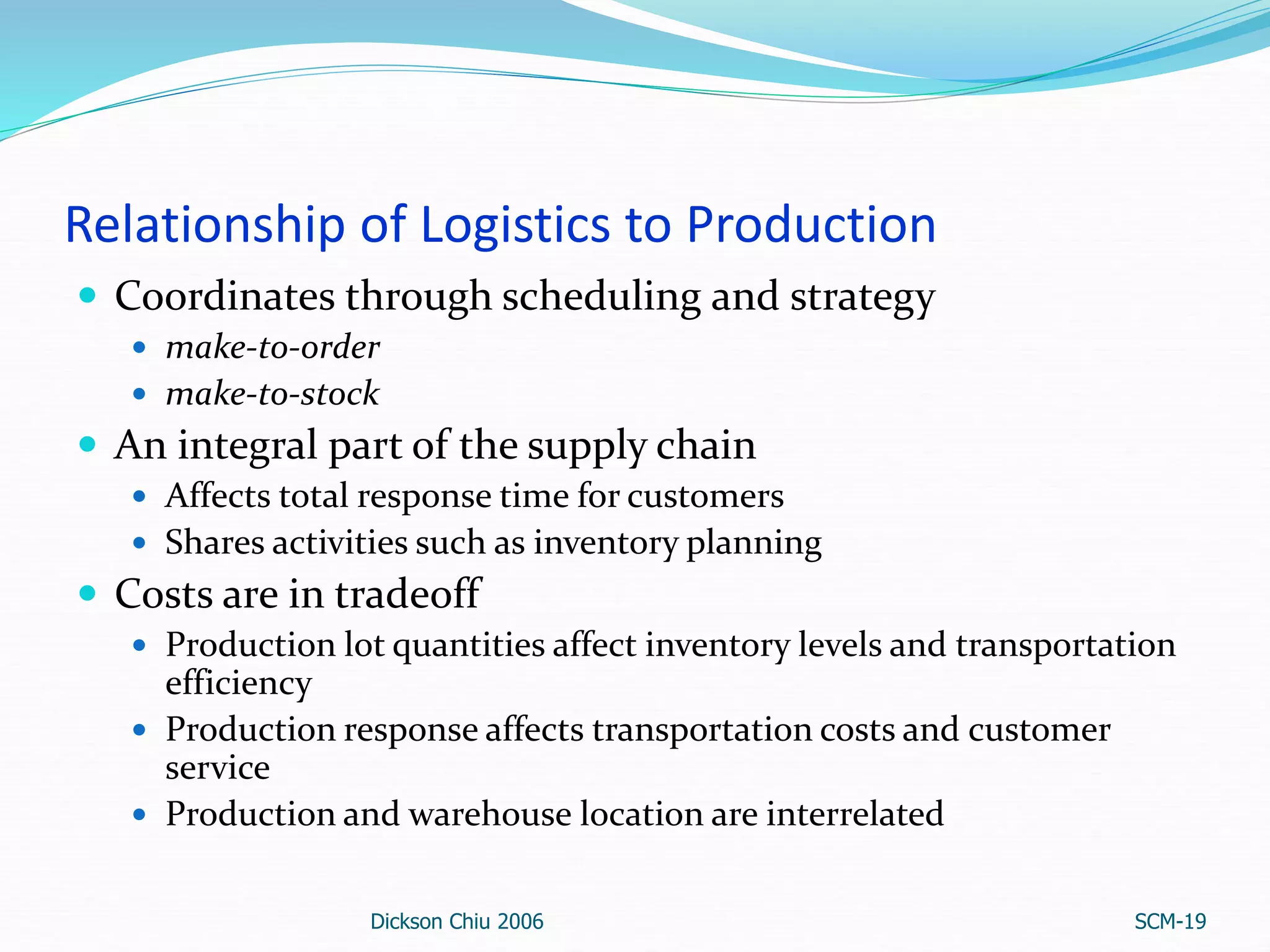
Relationship of Logistics to Production
 Coordinates through scheduling and strategy
 make-to-order
 make-to-stock
 An integral part of the supply chain
 Affects total response time for customers
 Shares activities such as inventory planning
 Costs are in tradeoff
 Production lot quantities affect inventory levels and transportation
efficiency
 Production response affects transportation costs and customer
service
 Production and warehouse location are interrelated
Dickson Chiu 2006 SCM-19
20
Wal-Mart Wins with Logistics
 Costs are lower than K-Mart or Target Stores
 CEO is a former logistician
 Wal-Mart is the largest retailer in the world!
Dickson Chiu 2006 SCM-21
Logistics/SCM in Diverse Areas
 Manufacturing - most common
 Service - emerging opportunities
 Environment - causing restrictions
 Non-profits / Government - little explored
 Military - long history
Note the global evolvement into a
service-oriented economy!
Dickson Chiu 2006 SCM-22
Supply Chain is Multi-Enterprise
Dickson Chiu 2006 SCM-23
Focus
Company
Suppliers
Supplier’s
suppliers
Customers
Customers/
End users
Acquire Convert Distribute
Product and information flow
Conventional
Scope
CR (2004) Prentice Hall, Inc.
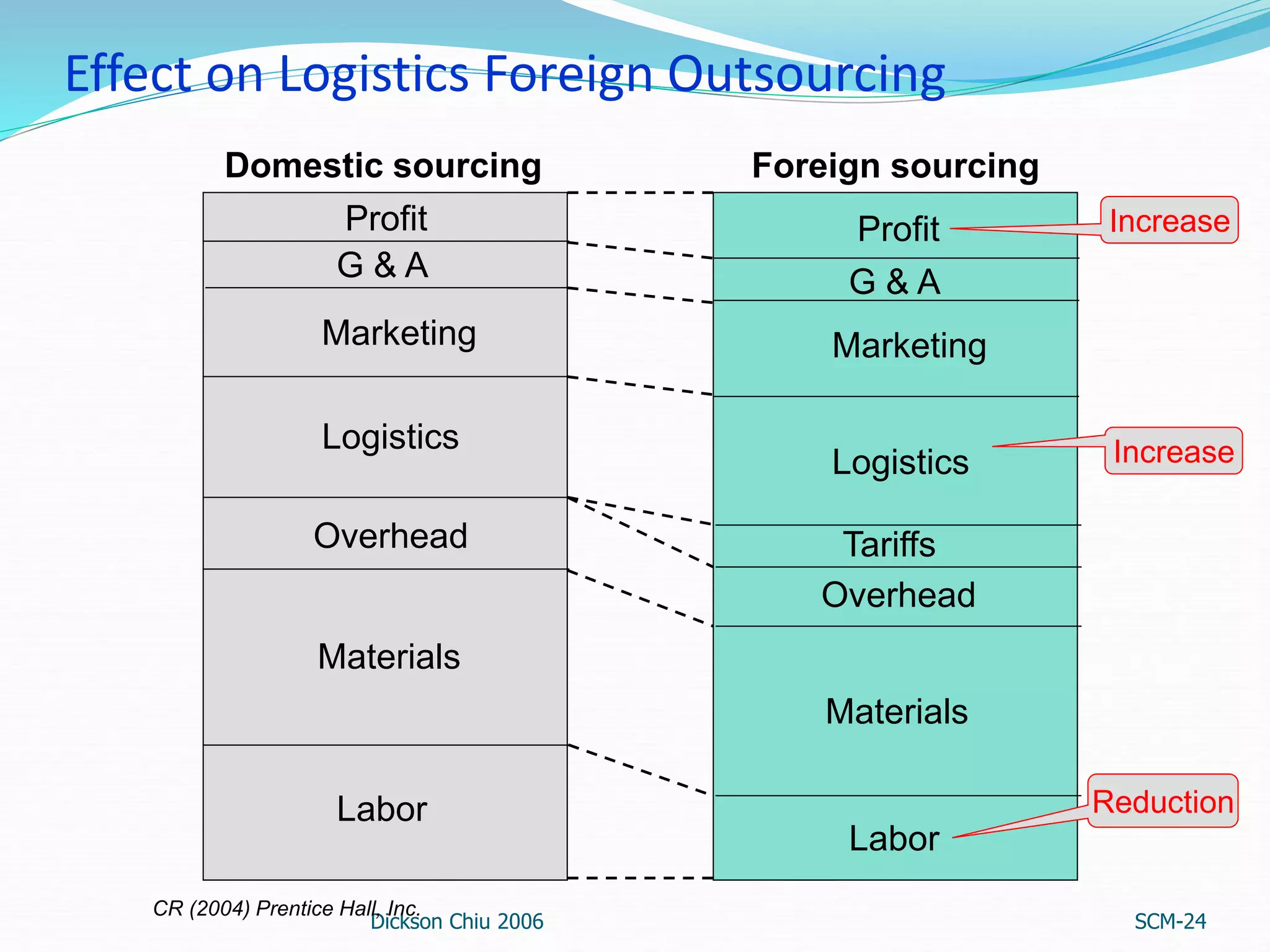
Effect on Logistics Foreign Outsourcing
Dickson Chiu 2006 SCM-24
Profit
G & A
Marketing
Logistics
Overhead
Materials
Labor
Profit
G & A
Marketing
Logistics
Overhead
Materials
Labor
Tariffs
Increase
Reduction
Increase
Domestic sourcing Foreign sourcing
CR (2004) Prentice Hall, Inc.
Reality of SCM Scope
Dickson Chiu 2006 SCM-25
CR (2004) Prentice Hall, Inc.
The Multi-Dimensions of SCM
Dickson Chiu 2006 SCM-26
SUPPLY
CHAIN
MANAGEMENT
Activity and process
administration
CR (2004) Prentice Hall, Inc.
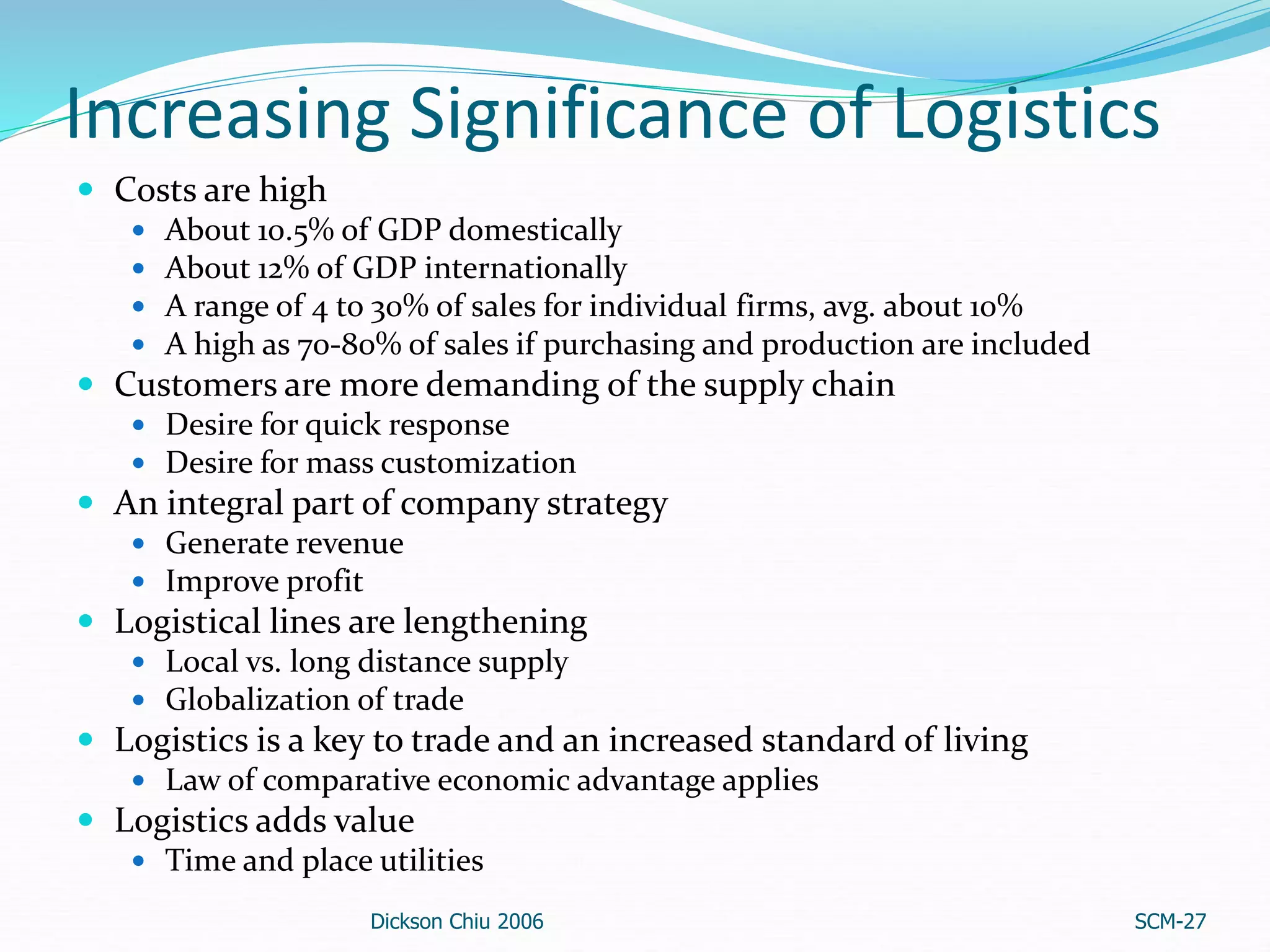
Increasing Significance of Logistics
 Costs are high
 About 10.5% of GDP domestically
 About 12% of GDP internationally
 A range of 4 to 30% of sales for individual firms, avg. about 10%
 A high as 70-80% of sales if purchasing and production are included
 Customers are more demanding of the supply chain
 Desire for quick response
 Desire for mass customization
 An integral part of company strategy
 Generate revenue
 Improve profit
 Logistical lines are lengthening
 Local vs. long distance supply
 Globalization of trade
 Logistics is a key to trade and an increased standard of living
 Law of comparative economic advantage applies
 Logistics adds value
 Time and place utilities
Dickson Chiu 2006 SCM-27
Contemporary IT Applications in Logistics – Focus
of this Course
 Tremendous technological advances in past decades
 Logistics management relies on analysis over massive
information from heterogeneous sources
 Disparate business functions in service-oriented economy
 Internet and mobile technologies has further improved
logistical effectiveness and efficiency
 Enabled logisticians and management to make timely, informed, and
accurate decisions
 but create new dimensions of complexity
 IT people work closely with logistician and management
 Understand complex requirements
 Choose the right technology and design appropriate IT
infrastructures, architectures, and systems
 Explain how contemporary IT can help to others
Dickson Chiu 2006 SCM-28
Some Useful Contemporary IT in Logistics
 eXtended Markup Language (XML)
 Service-oriented architecture
 Process integration and interaction management
 Exceptions, alerts, and relationship management in logistics
 Information integration
 Facilitating decision support
 Mobile technologies
 Radio Frequency Identification (RFID)
=> The key is to achieve information and process integration
for efficient and effective decision support.
Dickson Chiu 2006 SCM-29
30
Summary
 The logistic process plans, implements, controls the flow
and storage of goods, services, and related information
between the point of origin and the point of consumption
to satisfy customer requirements
 Logistics addresses the time utility & place utility out of
the four economic utilities
 Logistics becomes more important and complex because
of new requirements of the service-oriented economy,
disparate business functions, and the impact of various
contemporary IT
 Logistics involves the interaction with multiple
departments within a company as well as now also across
business partner organizations and customers
 Application of contemporary IT, especially information
and process integration for efficient and effective decision
support, is a critical success factor and therefore the focus
of this course.
Dickson Chiu 2006 SCM-31

Basics of logistics and supply chain.ppt

  • 1.
  • 2.
    Supply Chain Overview DicksonChiu 2006 SCM-2 CR (2004) Prentice Hall, Inc. 1-2 Warehousing Warehousing Transportation Transportation Vendors/plants/ports Transportation Factory Transportation Customers Information flows
  • 3.
    Logistics vs SupplyChain Management Council of Logistics Management  “Logistics is the process of planning, implementing and controlling the efficient, cost-effective flow and storage of raw materials, in-process inventory, finished goods and related information from the point of origin to point of consumption for the purpose of conforming to customer requirements.” Handfield and Nichols  SCM is the integration of all activities associated with the flow and transformation of goods from raw materials through to end user, as well as information flows, through improved supply chain relationships, to achieve a sustainable competitive advantage. Dickson Chiu 2006 SCM-3 CR (2004) Prentice Hall, Inc.
  • 4.
    Common Contemporary LogisticsTerms  Value stream/logistics process  Quick response and flexible manufacturing  Mass customization  Supply chain management/ collaborative logistics  Reverse logistics  Service logistics  Continuous replenishment  Lean logistics  Integrated logistics => IT people have to deal with any related automation anyway  Dickson Chiu 2006 SCM-4
  • 5.
    The Logistics/SCM Mission Getting the right goods or services to the right place, at the right time, and in the desired condition at the lowest cost and highest return on investment.  Product / Service Utility  Possession Utility - the value or usefulness that comes from a customer being able to take possession of a product  Form Utility - in a form that can be used by the customer and is of value to the customer  Place Utility - available where they are needed by customers  Time Utility - available when they are needed by customers  Logistics obviously help time and place utility Dickson Chiu 2006 SCM-5
  • 6.
    Evolution of SupplyChain Management Dickson Chiu 2006 SCM-6 Demand forecasting Purchasing Requirements planning Production planning Manufacturing inventory Warehousing Material handling Packaging Finished goods inventory Distribution planning Order processing Transportation Customer service Strategic planning Information services Marketing/sales Finance Supply Chain Management Supply Chain Management Logistics Purchasing/ Materials Management Physical Distribution Activity fragmentation to 1960 Activity Integration 1960 to 2000 2000+ Demand forecasting Purchasing Requirements planning Production planning Manufacturing inventory Warehousing Material handling Packaging Finished goods inventory Distribution planning Order processing Transportation Customer service Strategic planning Information services Marketing/sales Finance Supply Chain Management Supply Chain Management Logistics Purchasing/ Materials Management Physical Distribution Activity fragmentation to 1960 Activity Integration 1960 to 2000 2000+ CR (2004) Prentice Hall, Inc.
  • 7.
    Supply Chain Schematic DicksonChiu 2006 SCM-7 CR (2004) Prentice Hall, Inc. 1-5
  • 8.
    A Revised Strategyis Generating Great Top Management Interest  Historical perspective of distribution (Peter Drucker, 1962): “The last frontier of cost economies”  The contemporary view: Distribution is a new frontier for demand generation— a competitive weapon.  Both views are important! Dickson Chiu 2006 SCM-8
  • 9.
    Critical Customer ServiceLoop Customers Transportation Inventory or supply source Customer order processing (and transmittal) Customers Transportation Inventory or supply source Customer order processing (and transmittal) Dickson Chiu 2006 SCM-9
  • 10.
    Physical Distribution Costs DicksonChiu 2006 SCM-10 Category Percent of sales $/cwt. Transportation 3.34% $26.52 Warehousing 2.02 18.06 Order entry 0.43 4.58 Administration 0.41 2.79 Inventory carrying 1.72 22.25 Total 7.65% $67.71 Add one-third for inbound supply costs Source: Herb Davis & Company Logistics cost are about 10% of sales w/o purchasing costs CR (2004) Prentice Hall, Inc.
  • 11.
    Customer Service Performance 4 5 6 7 8 9 10 1 9 9 2 1 9 9 4 1 9 9 6 1 9 9 8 2 0 0 0 2 0 0 2 Year Days 82 84 86 88 90 92 94 96 % OrderCycle Time, Days Product Availability--% orders Product Availability--% line items Dickson Chiu 2006 SCM-11 Source: Herb Davis & Company
  • 12.
    Traditional Scope ofthe Supply Chain Dickson Chiu 2006 SCM-12 Physical distribution Physical supply (Materials management) Business logistics Sources of supply Plants/ operations Customers • Transportation • Inventory maintenance • Order processing • Acquisition • Protective packaging • Warehousing • Materials handling • Information maintenance • Transportation • Inventory maintenance • Order processing • Product scheduling • Protective packaging • Warehousing • Materials handling • Information maintenance Internal supply chain CR (2004) Prentice Hall, Inc. 1-14
  • 13.
    Key Activities/Processes  Primary Setting customer service goals  Transportation  Inventory management  Location  Secondary, or supporting  Warehousing  Materials handling  Acquisition (purchasing)  Protective packaging  Product scheduling  Order processing Dickson Chiu 2006 SCM-13
  • 14.
    Logistics Strategy andPlanning  The objectives of logistics strategy  Minimize cost  Minimize investment  Maximize customer service  Levels of logistical planning  Strategic  Tactical  Operational Dickson Chiu 2006 SCM-14
  • 15.
    The Logistics StrategyTriangle (4 problem areas) Dickson Chiu 2006 SCM-15 Customer service goals  The product  Logistics service  Information sys. Inventory Strategy  Forecasting  Storage fundamentals  Inventory decisions  Purchasing and supply scheduling decisions  Storage decisions Transport Strategy  Transport fundamentals  Transport decisions Location Strategy  Location decisions  The network planning process CR (2004) Prentice Hall, Inc.
  • 16.
    Strategic, Tactical, andOperational Decision Making Dickson Chiu 2006 SCM-16 Decision area Strategic Tactical Operational Transportation Mode selection Seasonal equip- ment leasing Dispatching Inventories Location, Control policies Safety stock levels Order filling Order processing Order entry, transmittal, and processing system design Processing orders, Filling back orders Purchasing Development of supplier- buyer relations Contracting, Forward buying Expediting Warehousing Handling equipment selection, Layout design Space utilization Order picking and restocking Facility location Number, size, and location of warehouses CR (2004) Prentice Hall, Inc.
  • 17.
    Relationship of Logisticsto Marketing and Production Dickson Chiu 2006 SCM-17 PRODUCTION/ OPERATIONS Sample activities:  Quality control  Detailed production scheduling  Equipment maint.  Capacity planning  Work measurement & standards LOGISTICS Sample activities: Transport  Inventory  Order processing  Materials handling Interface activities:  Product scheduling  Plant location  Purchasing MARKETING Sample activities:  Promotion  Market research  Product mix  Sales force management Interface activities:  Customer service standards  Pricing  Packaging  Retail location Production- logistics interface Marketing- logistics interface Internal Supply Chain CR (2004) Prentice Hall, Inc.
  • 18.
    Relationship of Logisticsto Marketing Dickson Chiu 2006 SCM-18 Product Price Promotion Place-Customer service levels Inventory carrying costs Lot quantity costs Order processing and information costs Transport costs Warehousing costs Logistics CR (2004) Prentice Hall, Inc.
  • 19.
    Relationship of Logisticsto Production  Coordinates through scheduling and strategy  make-to-order  make-to-stock  An integral part of the supply chain  Affects total response time for customers  Shares activities such as inventory planning  Costs are in tradeoff  Production lot quantities affect inventory levels and transportation efficiency  Production response affects transportation costs and customer service  Production and warehouse location are interrelated Dickson Chiu 2006 SCM-19
  • 20.
  • 21.
    Wal-Mart Wins withLogistics  Costs are lower than K-Mart or Target Stores  CEO is a former logistician  Wal-Mart is the largest retailer in the world! Dickson Chiu 2006 SCM-21
  • 22.
    Logistics/SCM in DiverseAreas  Manufacturing - most common  Service - emerging opportunities  Environment - causing restrictions  Non-profits / Government - little explored  Military - long history Note the global evolvement into a service-oriented economy! Dickson Chiu 2006 SCM-22
  • 23.
    Supply Chain isMulti-Enterprise Dickson Chiu 2006 SCM-23 Focus Company Suppliers Supplier’s suppliers Customers Customers/ End users Acquire Convert Distribute Product and information flow Conventional Scope CR (2004) Prentice Hall, Inc.
  • 24.
    Effect on LogisticsForeign Outsourcing Dickson Chiu 2006 SCM-24 Profit G & A Marketing Logistics Overhead Materials Labor Profit G & A Marketing Logistics Overhead Materials Labor Tariffs Increase Reduction Increase Domestic sourcing Foreign sourcing CR (2004) Prentice Hall, Inc.
  • 25.
    Reality of SCMScope Dickson Chiu 2006 SCM-25 CR (2004) Prentice Hall, Inc.
  • 26.
    The Multi-Dimensions ofSCM Dickson Chiu 2006 SCM-26 SUPPLY CHAIN MANAGEMENT Activity and process administration CR (2004) Prentice Hall, Inc.
  • 27.
    Increasing Significance ofLogistics  Costs are high  About 10.5% of GDP domestically  About 12% of GDP internationally  A range of 4 to 30% of sales for individual firms, avg. about 10%  A high as 70-80% of sales if purchasing and production are included  Customers are more demanding of the supply chain  Desire for quick response  Desire for mass customization  An integral part of company strategy  Generate revenue  Improve profit  Logistical lines are lengthening  Local vs. long distance supply  Globalization of trade  Logistics is a key to trade and an increased standard of living  Law of comparative economic advantage applies  Logistics adds value  Time and place utilities Dickson Chiu 2006 SCM-27
  • 28.
    Contemporary IT Applicationsin Logistics – Focus of this Course  Tremendous technological advances in past decades  Logistics management relies on analysis over massive information from heterogeneous sources  Disparate business functions in service-oriented economy  Internet and mobile technologies has further improved logistical effectiveness and efficiency  Enabled logisticians and management to make timely, informed, and accurate decisions  but create new dimensions of complexity  IT people work closely with logistician and management  Understand complex requirements  Choose the right technology and design appropriate IT infrastructures, architectures, and systems  Explain how contemporary IT can help to others Dickson Chiu 2006 SCM-28
  • 29.
    Some Useful ContemporaryIT in Logistics  eXtended Markup Language (XML)  Service-oriented architecture  Process integration and interaction management  Exceptions, alerts, and relationship management in logistics  Information integration  Facilitating decision support  Mobile technologies  Radio Frequency Identification (RFID) => The key is to achieve information and process integration for efficient and effective decision support. Dickson Chiu 2006 SCM-29
  • 30.
  • 31.
    Summary  The logisticprocess plans, implements, controls the flow and storage of goods, services, and related information between the point of origin and the point of consumption to satisfy customer requirements  Logistics addresses the time utility & place utility out of the four economic utilities  Logistics becomes more important and complex because of new requirements of the service-oriented economy, disparate business functions, and the impact of various contemporary IT  Logistics involves the interaction with multiple departments within a company as well as now also across business partner organizations and customers  Application of contemporary IT, especially information and process integration for efficient and effective decision support, is a critical success factor and therefore the focus of this course. Dickson Chiu 2006 SCM-31