SADIQ ALMAKTARI 2
RESPIRATORY THERAPY A
Life and Breath Career for You!
By.
RT/ SADIQ ALMAKTARI
Sup. Of R.T.U.IN MEH
Gas Flow and Pressure
Gradients During Ventilation
 For air to flow through a tube or airway, a
pressure gradient must exist (i.e., pressure at
one end of the tube must be higher than
pressure at the other end of the tube).
 Air will always flow from the high-pressure
point to the low-pressure point.
SADIQ ALMAKTARI 3
Definition of Pressures and
Gradients in the Lungs
 Airway opening pressure (Pawo), is most
often called mouth pressure (PM) or airway
pressure (Paw) .
 Other terms that are often used to describe
the airway opening pressure include upper
airway pressure, mask pressure, or proximal
airway pressure.
SADIQ ALMAKTARI 4
 Unless pressure is applied at the airway
opening, Pawo is zero or atmospheric
pressure.
 A similar measurement is the pressure at the
body surface (Pbs).
 This is equal to zero (atmospheric pressure)
unless the person is placed in a pressurized
chamber (e.g., hyperbaric chamber) or a
negative pressure ventilator (e.g., iron lung).
SADIQ ALMAKTARI 5
Intrapleural pressure
 Intrapleural pressure (Ppl) is the pressure
in the potential space between the parietal
and visceral pleurae.
 Ppl is normally about −5 cm H2O at the
end of expiration during spontaneous
breathing.
 It is about −10 cm H2O at the end of
inspiration
SADIQ ALMAKTARI 6
 alveolar pressure (PA or Palv). This
pressure is also called intrapulmonary
pressure or lung pressure.
 Alveolar pressure normally changes as the
intrapleural pressure changes.
 During spontaneous inspiration, PA is about
−1 cm H2O.
 during exhalation it is about +1 cm H2O.
SADIQ ALMAKTARI 7
 Four basic pressure gradients are used to
describe normal ventilation:
 transairway pressure.
 transthoracic pressure.
 transpulmonary pressure.
 transrespiratory pressure.
SADIQ ALMAKTARI 8
Transairway Pressure
 Transairway pressure (PTA) is the pressure
difference between the airway opening and the
alveolus: PTA = Paw − Palv. It is therefore the
pressure gradient required to produce airflow in
the conductive airways.
 It represents the pressure that must be generated
to overcome resistance to gas flow in the airways
(i.e., airway resistance).
SADIQ ALMAKTARI 9
Transthoracic Pressure
 Transthoracic pressure (PW) is the pressure
difference between the alveolar space or
lung and the body’s surface (Pbs):
 PW = Palv − Pbs.
 It represents the pressure required to
expand or contract the lungs and the chest
wall at the same time.
 It is sometimes abbreviated to PTT,
meaning transthoracic).
SADIQ ALMAKTARI 10
Trans pulmonary pressure
 Trans pulmonary pressure (PL or PTP), or
trans alveolar pressure, is the pressure
difference between the alveolar space and
the pleural space (Ppl):
 PL = Palv − Ppl.2-4 PL
 is the pressure required to maintain alveolar
inflation and is therefore sometimes called
the alveolar distending pressure.
SADIQ ALMAKTARI 11
 All modes of ventilation increase PL during
inspiration, either by
 decreasing Ppl (negative pressure
ventilators).
 increasing Palv by increasing pressure at
the upper airway (positive pressure
ventilators).
SADIQ ALMAKTARI 12
Transrespiratory Pressure
 Transrespiratory pressure (PTR) is the
pressure difference between the airway
opening and the body surface:
 PTR = Pawo − Pbs.
 Trans respiratory pressure is used to
describe the pressure required to inflate the
lungs and airways during positive pressure
ventilation.
SADIQ ALMAKTARI 13
 Transrespiratory pressure has two
components:
 transthoracic pressure (the pressure
required to overcome elastic recoil of the
lungs and chest wall)
 transairway pressure (the pressure
required to overcome airway resistance).
Transrespiratory pressure can therefore be
described by the equations
 PTR = PTT + PTA or (Pawo − Pbs) = (Palv
− Pbs) + (Paw − Palv).
SADIQ ALMAKTARI 14
COMMON TERMS
SADIQ ALMAKTARI 15
16
DEFINITIONS :
1. Respiratory Rate (RR) :-
 This refers to the number of breaths per minute taken by the
patient or delivered by the ventilator.
 It is important to distinguish the number of spontaneous
breaths from the number of machine-delivered breaths to
determine the patient’s underlying respiratory effort.
 Normal spontaneous respiratory rate is 12 to 20 breaths per
minute.
 Ventilator-delivered respiratory rate can vary from 10 to 50
breaths per minute (except during weaning when the rate may
be less than 10)
SADIQ ALMAKTARI 17
DEFINITIONS :
2. TIDAL VOLUME (VT):-
 The volume delivered by the ventilator per breath . In
measurement of compliance using VT, it is important to use
the exhaled VT rather than the set VT .
OR.
 Volume of gas inspired or expired during each respiratory
cycle .
OR.
 Is the volume of gas inhaled or exhaled during normal
breathing .
 8 to 10 mL/kg - (6–8 mL/kg) in pts. with noncompliant lungs
SADIQ ALMAKTARI. 18
DEFINITIONS :
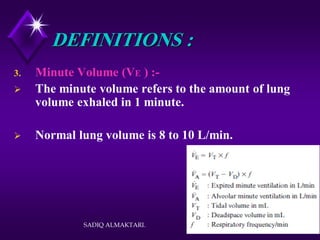
3. Minute Volume (VE ) :-
 The minute volume refers to the amount of lung
volume exhaled in 1 minute.
 Normal lung volume is 8 to 10 L/min.
19
DEFINITIONS :
4. PEAK AIRWAY PRESSURE (Ppk) (PIP):-
 The maximal airway pressure at any time during
inspiration .
 It is function of the inflation volume, airways
resistance , and the compliance of the lungs and
chest wall .
 Increases in (Ppk) are an indication of decreased
lung compliance, increased airways resistance , or
both .
( in the major airways.)
SADIQ ALMAKTARI.
20
DEFINITIONS :
5. PLATEAU PRESSURE (STATIC AIRWAY
PRESSURE ) Pplat:-
 The airway pressure that is measured when the VT is held in the
lungs after end –inspiration, preventing the lungs from deflating. I
reflects the elastic recoil pressure of the lungs and thoracic cage.
 If the Pplat. is high, elastic recoil of the lung is great, i.e; low
compliance such as seen in ARDS or fibrotic lung disease, (at
alveolar level).
OR.
 The plate. pressure is the pressure applied (in positive pressure
ventilation ) to the small airways and alveoli .
SADIQ ALMAKTARI.
21
DEFINITIONS :
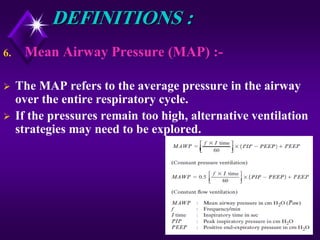
6. Mean Airway Pressure (MAP) :-
 The MAP refers to the average pressure in the airway
over the entire respiratory cycle.
 If the pressures remain too high, alternative ventilation
strategies may need to be explored.
SADIQ ALMAKTARI 22
DEFINITIONS :
7. Positive end expiratory pressure (PEEP):-
 Pressure exerted by the ventilator at the end of
expiration that increases the volume and pressure within
the alveoli resulting in improved oxygenation.
 May be dialed in by the ventilator or spontaneously by
the patient known as auto-PEEP; auto-PEEP is caused
by obstruction to airflow.
23
DEFINITIONS :
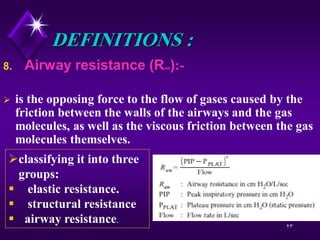
8. Airway resistance (RAW):-
 is the opposing force to the flow of gases caused by the
friction between the walls of the airways and the gas
molecules, as well as the viscous friction between the gas
molecules themselves.
classifying it into three
groups:
 elastic resistance.
 structural resistance
 airway resistance.
24
DEFINITIONS :
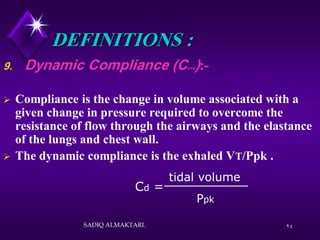
9. Dynamic Compliance (CDYN):-
 Compliance is the change in volume associated with a
given change in pressure required to overcome the
resistance of flow through the airways and the elastance
of the lungs and chest wall.
 The dynamic compliance is the exhaled VT/Ppk .
Cd =
Ppk
tidal volume
SADIQ ALMAKTARI.
25
DEFINITIONS :
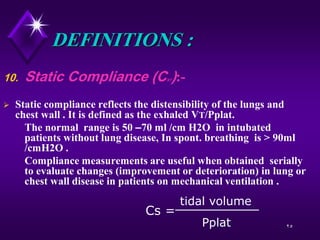
10. Static Compliance (CST):-
 Static compliance reflects the distensibility of the lungs and
chest wall . It is defined as the exhaled VT/Pplat.
The normal range is 50 –70 ml /cm H2O in intubated
patients without lung disease, In spont. breathing is > 90ml
/cmH2O .
Compliance measurements are useful when obtained serially
to evaluate changes (improvement or deterioration) in lung or
chest wall disease in patients on mechanical ventilation .
Cs =
Pplat
tidal volume
26
DEFINITIONS :
11. flow rate (V) :-
 Peak flow during the inspiratory phase. It determines how fast
the tidal volume is delivered to the patient.
OR.
 The flow rate is the method and rate for the tidal volume to be
delivered by the mechanical ventilator with each breath.
 Normal is 40 to 100 L/min.
 The flow rate may be manipulated to change time spent in
inspiration or expiration.
27
DEFINITIONS :
12. Trigger :-
 The trigger variable is the variable that determines the start of
inspiration.
 Pressure, volume, flow, or time may be measured by the
ventilator and used as a variable to initiate inspiration. Many
ventilators may use time or pressure as trigger variables.
28
DEFINITIONS :
13. Sensitivity :-
 This setting adjusts how much effort the patient must generate
(negative inspiratory force) before the ventilator delivers a
breath.
 This setting is only activated in the assist/control or SIMV
(synchronized intermittent mandatory ventilation) modes
SADIQ ALMAKTARI.
29
DEFINITIONS :
14. Cycle :-
 The “cycle” is the opposite of a trigger. Cycle refers to what
stops the inspiratory flow or stops the breath delivery by the
ventilator.
SADIQ ALMAKTARI.
30
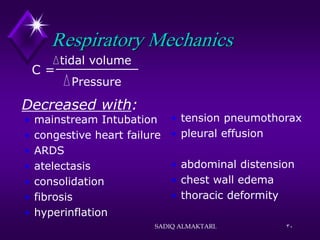
Respiratory Mechanics
 mainstream Intubation
 congestive heart failure
 ARDS
 atelectasis
 consolidation
 fibrosis
 hyperinflation
 tension pneumothorax
 pleural effusion
 abdominal distension
 chest wall edema
 thoracic deformity
:
Decreased with
C =
Pressure
tidal volume
SADIQ ALMAKTARI.
31
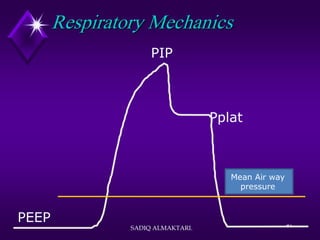
Respiratory Mechanics
PEEP
PIP
Pplat
Mean Air way
pressure
SADIQ ALMAKTARI.
32
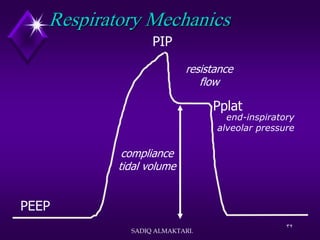
Respiratory Mechanics
PEEP
Pplat
resistance
flow
compliance
tidal volume
end-inspiratory
alveolar pressure
PIP
SADIQ ALMAKTARI.
33
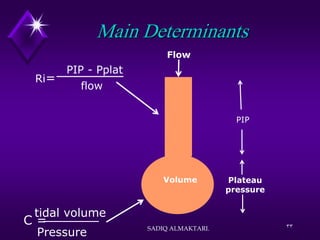
Main Determinants
Flow
Volume Plateau
pressure
PIP
Ri=
PIP - Pplat
flow
C =
Pressure
tidal volume
SADIQ ALMAKTARI.
34
MECHANICAL VENTILATOR
CLASSIFICATION
1) Control: How the ventilator knows how much flow
to deliver
 Volume Controlled
 Pressure Controlled
 Dual Control
2) Cycling: how the ventilator switches from
inspiration to expiration
 Time
 Flow
 Volume
3) Triggering: what causes the ventilator to cycle to
inspiration
 Time
 Pressure
 Flow
SADIQ ALMAKTARI.
35
MECHANICAL VENTILATOR
CLASSIFICATION
4) Breaths are either:
 Mandatory (controlled)
 Assisted
 Spontaneous
5) Mode or Breath Pattern
 Controlled Mechanical Ventilation CMV
 Assisted Controlled A/C
 Intermittent Mandatory Ventilation IMV
 Pressure Support PS
SADIQ ALMAKTARI.
36
TYPE OF VENTILATOR,S
CYCLES
1. TIME CYCLE:-
Time cycle ventilator terminates the
inspiratory phase when a preset inspiratory
time has been reached.
2. PRESSURE CYCLE:-
End inspiration when the pressure selected
is reached .
SADIQ ALMAKTARI.
37
TYPE OF VENTILATOR,S
CYCLES
3. VOLUME CYCLE :-
Volume cycle ventilator terminates the inspiratory
phase when a preset tidal volume has been
delivered within the limited time & peak pressure
limit.
4. FLOW CYCLE :-
Flow cycle ventilator mode terminates the
inspiratory phase when the inspiratory flow
reaches a predetermined minimum level (seen in
pressure support ventilation ).
SADIQ ALMAKTARI.
38
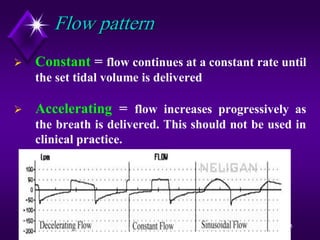
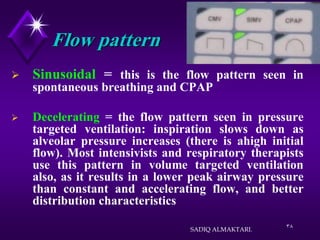
Flow pattern
 Sinusoidal = this is the flow pattern seen in
spontaneous breathing and CPAP
 Decelerating = the flow pattern seen in pressure
targeted ventilation: inspiration slows down as
alveolar pressure increases (there is ahigh initial
flow). Most intensivists and respiratory therapists
use this pattern in volume targeted ventilation
also, as it results in a lower peak airway pressure
than constant and accelerating flow, and better
distribution characteristics
SADIQ ALMAKTARI.
Mansoor Abubaker 39
Flow pattern
 Constant = flow continues at a constant rate until
the set tidal volume is delivered
 Accelerating = flow increases progressively as
the breath is delivered. This should not be used in
clinical practice.
40
SADIQ ALMAKTARI.

Mechanical ventilator basics and terms 2023

  • 2.
    SADIQ ALMAKTARI 2 RESPIRATORYTHERAPY A Life and Breath Career for You! By. RT/ SADIQ ALMAKTARI Sup. Of R.T.U.IN MEH
  • 3.
    Gas Flow andPressure Gradients During Ventilation  For air to flow through a tube or airway, a pressure gradient must exist (i.e., pressure at one end of the tube must be higher than pressure at the other end of the tube).  Air will always flow from the high-pressure point to the low-pressure point. SADIQ ALMAKTARI 3
  • 4.
    Definition of Pressuresand Gradients in the Lungs  Airway opening pressure (Pawo), is most often called mouth pressure (PM) or airway pressure (Paw) .  Other terms that are often used to describe the airway opening pressure include upper airway pressure, mask pressure, or proximal airway pressure. SADIQ ALMAKTARI 4
  • 5.
     Unless pressureis applied at the airway opening, Pawo is zero or atmospheric pressure.  A similar measurement is the pressure at the body surface (Pbs).  This is equal to zero (atmospheric pressure) unless the person is placed in a pressurized chamber (e.g., hyperbaric chamber) or a negative pressure ventilator (e.g., iron lung). SADIQ ALMAKTARI 5
  • 6.
    Intrapleural pressure  Intrapleuralpressure (Ppl) is the pressure in the potential space between the parietal and visceral pleurae.  Ppl is normally about −5 cm H2O at the end of expiration during spontaneous breathing.  It is about −10 cm H2O at the end of inspiration SADIQ ALMAKTARI 6
  • 7.
     alveolar pressure(PA or Palv). This pressure is also called intrapulmonary pressure or lung pressure.  Alveolar pressure normally changes as the intrapleural pressure changes.  During spontaneous inspiration, PA is about −1 cm H2O.  during exhalation it is about +1 cm H2O. SADIQ ALMAKTARI 7
  • 8.
     Four basicpressure gradients are used to describe normal ventilation:  transairway pressure.  transthoracic pressure.  transpulmonary pressure.  transrespiratory pressure. SADIQ ALMAKTARI 8
  • 9.
    Transairway Pressure  Transairwaypressure (PTA) is the pressure difference between the airway opening and the alveolus: PTA = Paw − Palv. It is therefore the pressure gradient required to produce airflow in the conductive airways.  It represents the pressure that must be generated to overcome resistance to gas flow in the airways (i.e., airway resistance). SADIQ ALMAKTARI 9
  • 10.
    Transthoracic Pressure  Transthoracicpressure (PW) is the pressure difference between the alveolar space or lung and the body’s surface (Pbs):  PW = Palv − Pbs.  It represents the pressure required to expand or contract the lungs and the chest wall at the same time.  It is sometimes abbreviated to PTT, meaning transthoracic). SADIQ ALMAKTARI 10
  • 11.
    Trans pulmonary pressure Trans pulmonary pressure (PL or PTP), or trans alveolar pressure, is the pressure difference between the alveolar space and the pleural space (Ppl):  PL = Palv − Ppl.2-4 PL  is the pressure required to maintain alveolar inflation and is therefore sometimes called the alveolar distending pressure. SADIQ ALMAKTARI 11
  • 12.
     All modesof ventilation increase PL during inspiration, either by  decreasing Ppl (negative pressure ventilators).  increasing Palv by increasing pressure at the upper airway (positive pressure ventilators). SADIQ ALMAKTARI 12
  • 13.
    Transrespiratory Pressure  Transrespiratorypressure (PTR) is the pressure difference between the airway opening and the body surface:  PTR = Pawo − Pbs.  Trans respiratory pressure is used to describe the pressure required to inflate the lungs and airways during positive pressure ventilation. SADIQ ALMAKTARI 13
  • 14.
     Transrespiratory pressurehas two components:  transthoracic pressure (the pressure required to overcome elastic recoil of the lungs and chest wall)  transairway pressure (the pressure required to overcome airway resistance). Transrespiratory pressure can therefore be described by the equations  PTR = PTT + PTA or (Pawo − Pbs) = (Palv − Pbs) + (Paw − Palv). SADIQ ALMAKTARI 14
  • 15.
  • 16.
    16 DEFINITIONS : 1. RespiratoryRate (RR) :-  This refers to the number of breaths per minute taken by the patient or delivered by the ventilator.  It is important to distinguish the number of spontaneous breaths from the number of machine-delivered breaths to determine the patient’s underlying respiratory effort.  Normal spontaneous respiratory rate is 12 to 20 breaths per minute.  Ventilator-delivered respiratory rate can vary from 10 to 50 breaths per minute (except during weaning when the rate may be less than 10)
  • 17.
    SADIQ ALMAKTARI 17 DEFINITIONS: 2. TIDAL VOLUME (VT):-  The volume delivered by the ventilator per breath . In measurement of compliance using VT, it is important to use the exhaled VT rather than the set VT . OR.  Volume of gas inspired or expired during each respiratory cycle . OR.  Is the volume of gas inhaled or exhaled during normal breathing .  8 to 10 mL/kg - (6–8 mL/kg) in pts. with noncompliant lungs
  • 18.
    SADIQ ALMAKTARI. 18 DEFINITIONS: 3. Minute Volume (VE ) :-  The minute volume refers to the amount of lung volume exhaled in 1 minute.  Normal lung volume is 8 to 10 L/min.
  • 19.
    19 DEFINITIONS : 4. PEAKAIRWAY PRESSURE (Ppk) (PIP):-  The maximal airway pressure at any time during inspiration .  It is function of the inflation volume, airways resistance , and the compliance of the lungs and chest wall .  Increases in (Ppk) are an indication of decreased lung compliance, increased airways resistance , or both . ( in the major airways.) SADIQ ALMAKTARI.
  • 20.
    20 DEFINITIONS : 5. PLATEAUPRESSURE (STATIC AIRWAY PRESSURE ) Pplat:-  The airway pressure that is measured when the VT is held in the lungs after end –inspiration, preventing the lungs from deflating. I reflects the elastic recoil pressure of the lungs and thoracic cage.  If the Pplat. is high, elastic recoil of the lung is great, i.e; low compliance such as seen in ARDS or fibrotic lung disease, (at alveolar level). OR.  The plate. pressure is the pressure applied (in positive pressure ventilation ) to the small airways and alveoli . SADIQ ALMAKTARI.
  • 21.
    21 DEFINITIONS : 6. MeanAirway Pressure (MAP) :-  The MAP refers to the average pressure in the airway over the entire respiratory cycle.  If the pressures remain too high, alternative ventilation strategies may need to be explored.
  • 22.
    SADIQ ALMAKTARI 22 DEFINITIONS: 7. Positive end expiratory pressure (PEEP):-  Pressure exerted by the ventilator at the end of expiration that increases the volume and pressure within the alveoli resulting in improved oxygenation.  May be dialed in by the ventilator or spontaneously by the patient known as auto-PEEP; auto-PEEP is caused by obstruction to airflow.
  • 23.
    23 DEFINITIONS : 8. Airwayresistance (RAW):-  is the opposing force to the flow of gases caused by the friction between the walls of the airways and the gas molecules, as well as the viscous friction between the gas molecules themselves. classifying it into three groups:  elastic resistance.  structural resistance  airway resistance.
  • 24.
    24 DEFINITIONS : 9. DynamicCompliance (CDYN):-  Compliance is the change in volume associated with a given change in pressure required to overcome the resistance of flow through the airways and the elastance of the lungs and chest wall.  The dynamic compliance is the exhaled VT/Ppk . Cd = Ppk tidal volume SADIQ ALMAKTARI.
  • 25.
    25 DEFINITIONS : 10. StaticCompliance (CST):-  Static compliance reflects the distensibility of the lungs and chest wall . It is defined as the exhaled VT/Pplat. The normal range is 50 –70 ml /cm H2O in intubated patients without lung disease, In spont. breathing is > 90ml /cmH2O . Compliance measurements are useful when obtained serially to evaluate changes (improvement or deterioration) in lung or chest wall disease in patients on mechanical ventilation . Cs = Pplat tidal volume
  • 26.
    26 DEFINITIONS : 11. flowrate (V) :-  Peak flow during the inspiratory phase. It determines how fast the tidal volume is delivered to the patient. OR.  The flow rate is the method and rate for the tidal volume to be delivered by the mechanical ventilator with each breath.  Normal is 40 to 100 L/min.  The flow rate may be manipulated to change time spent in inspiration or expiration.
  • 27.
    27 DEFINITIONS : 12. Trigger:-  The trigger variable is the variable that determines the start of inspiration.  Pressure, volume, flow, or time may be measured by the ventilator and used as a variable to initiate inspiration. Many ventilators may use time or pressure as trigger variables.
  • 28.
    28 DEFINITIONS : 13. Sensitivity:-  This setting adjusts how much effort the patient must generate (negative inspiratory force) before the ventilator delivers a breath.  This setting is only activated in the assist/control or SIMV (synchronized intermittent mandatory ventilation) modes SADIQ ALMAKTARI.
  • 29.
    29 DEFINITIONS : 14. Cycle:-  The “cycle” is the opposite of a trigger. Cycle refers to what stops the inspiratory flow or stops the breath delivery by the ventilator. SADIQ ALMAKTARI.
  • 30.
    30 Respiratory Mechanics  mainstreamIntubation  congestive heart failure  ARDS  atelectasis  consolidation  fibrosis  hyperinflation  tension pneumothorax  pleural effusion  abdominal distension  chest wall edema  thoracic deformity : Decreased with C = Pressure tidal volume SADIQ ALMAKTARI.
  • 31.
  • 32.
  • 33.
    33 Main Determinants Flow Volume Plateau pressure PIP Ri= PIP- Pplat flow C = Pressure tidal volume SADIQ ALMAKTARI.
  • 34.
    34 MECHANICAL VENTILATOR CLASSIFICATION 1) Control:How the ventilator knows how much flow to deliver  Volume Controlled  Pressure Controlled  Dual Control 2) Cycling: how the ventilator switches from inspiration to expiration  Time  Flow  Volume 3) Triggering: what causes the ventilator to cycle to inspiration  Time  Pressure  Flow SADIQ ALMAKTARI.
  • 35.
    35 MECHANICAL VENTILATOR CLASSIFICATION 4) Breathsare either:  Mandatory (controlled)  Assisted  Spontaneous 5) Mode or Breath Pattern  Controlled Mechanical Ventilation CMV  Assisted Controlled A/C  Intermittent Mandatory Ventilation IMV  Pressure Support PS SADIQ ALMAKTARI.
  • 36.
    36 TYPE OF VENTILATOR,S CYCLES 1.TIME CYCLE:- Time cycle ventilator terminates the inspiratory phase when a preset inspiratory time has been reached. 2. PRESSURE CYCLE:- End inspiration when the pressure selected is reached . SADIQ ALMAKTARI.
  • 37.
    37 TYPE OF VENTILATOR,S CYCLES 3.VOLUME CYCLE :- Volume cycle ventilator terminates the inspiratory phase when a preset tidal volume has been delivered within the limited time & peak pressure limit. 4. FLOW CYCLE :- Flow cycle ventilator mode terminates the inspiratory phase when the inspiratory flow reaches a predetermined minimum level (seen in pressure support ventilation ). SADIQ ALMAKTARI.
  • 38.
    38 Flow pattern  Sinusoidal= this is the flow pattern seen in spontaneous breathing and CPAP  Decelerating = the flow pattern seen in pressure targeted ventilation: inspiration slows down as alveolar pressure increases (there is ahigh initial flow). Most intensivists and respiratory therapists use this pattern in volume targeted ventilation also, as it results in a lower peak airway pressure than constant and accelerating flow, and better distribution characteristics SADIQ ALMAKTARI.
  • 39.
    Mansoor Abubaker 39 Flowpattern  Constant = flow continues at a constant rate until the set tidal volume is delivered  Accelerating = flow increases progressively as the breath is delivered. This should not be used in clinical practice.
  • 40.