Basic Trauma
Presented By
Basic Trauma During a tactical operation, or even training, the risk of injury is high.  Rapid Assessment  can be used by team members to recognize life threatening injuries based on CPR and First Responder training. This process is an easy to follow outline used to evaluate the officers condition and provide basic medical care, if the team medic not immediately present, prior to transfer to EMS.  The objective is to enhance survivability.
Basic Trauma Trauma, what is it? A serious injury or shock to the body by violence or accident. The leading cause of death in 1-44 year age group. The 3 rd  leading cause of death in all age groups. 60 million injuries each year in the U.S. alone.  Remember, Only Surgeons  Fix  Trauma!
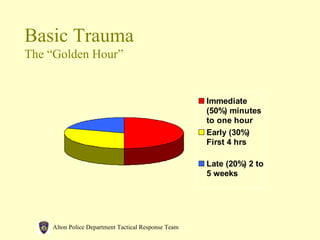
Basic Trauma  The “Golden Hour”
Vest Medical Pouch Every officer the same contents, same placement. When treating use theirs, not yours. Contents: (1) Pair Latex or vinyl gloves. (1) Blood Stopper Dressing.  (2) Rolls of Kerlix gauze (1) 3”x9” Petroleum gauze dressing (1) Triangular bandage (1) Double roll Flexwrap (1) CPR Shield (1) Trauma Scissors
Officer Medical Information Form Officer Medical History Name   DSN DOB SSN Blood Type Jones, James A.  9003 1/21/1967 000-00-0000 AB- Drug/Food Allergies  Medical History    Sulfa  Drugs  Triple By-pass Medications Physician Additional Information Nitro-as needed Smith Has Narcolepsy
Rapid Assessment First course of action is to eliminate the threat and/or move downed officer to safety/cover. Only move in necessary for safety. Always suspect spinal injuries. Maintain as much in-line spinal immobilization as possible during movement.  If threat is still present need cover officer while conducting assessment.
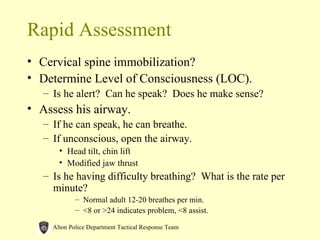
Rapid Assessment Cervical spine immobilization? Determine Level of Consciousness (LOC). Is he alert?  Can he speak?  Does he make sense? Assess his airway. If he can speak, he can breathe. If unconscious, open the airway. Head tilt, chin lift Modified jaw thrust Is he having difficulty breathing?  What is the rate per minute? Normal adult 12-20 breathes per min. <8 or >24 indicates problem, <8 assist.
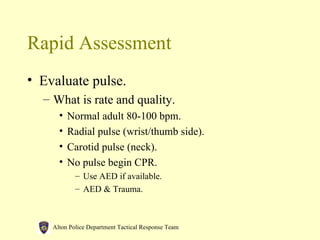
Rapid Assessment Evaluate pulse. What is rate and quality. Normal adult 80-100 bpm. Radial pulse (wrist/thumb side). Carotid pulse (neck). No pulse begin CPR. Use AED if available. AED & Trauma.
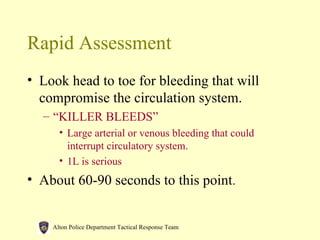
Rapid Assessment Look head to toe for bleeding that will compromise the circulation system. “ KILLER BLEEDS” Large arterial or venous bleeding that could interrupt circulatory system. 1L is serious About 60-90 seconds to this point .
First Aid Stop the bleeding  Determine origin of injury. Expose the injury. Remove and/or cut away clothing and equipment. Determine severity-entrance and exit wounds? Apply concentrated or diffused pressure w/dressing. Cover largest/biggest bleeder 1 st . Head trauma with possible fractures. Cover lightly with no pressure. Includes bleeding and fluid from ears and nose.
First Aid Nose bleeds (no trauma) Ensure airway. Lean forward to avoid swallowing blood. Pinch fleshy portion. If trauma, immobilize and prepare for nausea/vomiting.  GSW  Check for exit wound, if large may need to pack w/gauze. If chest wound, cover with occlusive dressing and tape on three sides. Lay on wounded side. May need to “vent” dressing.
First Aid Impaled objects DO NOT REMOVE! Stabilize, dress and bandage. Evisceration Abdominal injury with internal organs protruding. Cover with sterile wet dressing to keep moist. Do not attempt to push back in. No Food or Drink. Prepare for vomiting.
First Aid Blunt Trauma to Chest Look for deformity/bruising If one portion moves independently (flail chest), pad and secure w/gauze. Place on affected side Amputation Bag and keep cool. No direct contact with water or ice. Do not remove partial amputation. Large open neck injury Cover with occlusive dressing
First Aid Burns If head or face, think airway! Stop the burning.  Nothing but water! Remove smoldering clothing and jewelry. DO NOT REMOVE CLOTHING IF STUCK!  Cover with  dry  sterile dressing. Prepare for hypothermia.
Communicate Extract the injured to or establish a safe zone where EMS can initiate additional emergency care and prepare for transport. Remember spinal immobilization! Use radio to communicate with medical support elements. EMS FD
Head to Toe Secondary survey While waiting for support/transport (EMS, FD) conduct secondary survey. Re-evaluate ABC’s. Re-evaluate for additional injuries. Re-evaluate treatment already done. Give a brief history of injuries and what you’ve done when passing patient to higher level of medical treatment (”K.I.S.S.” is the rule here).
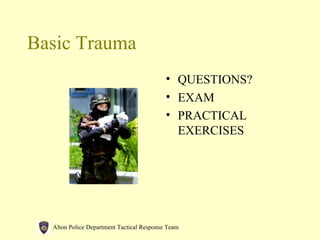
Basic Trauma QUESTIONS? EXAM PRACTICAL EXERCISES

Basic Rapid Trauma Assessment

  • 1.
  • 2.
  • 3.
    Basic Trauma Duringa tactical operation, or even training, the risk of injury is high. Rapid Assessment can be used by team members to recognize life threatening injuries based on CPR and First Responder training. This process is an easy to follow outline used to evaluate the officers condition and provide basic medical care, if the team medic not immediately present, prior to transfer to EMS. The objective is to enhance survivability.
  • 4.
    Basic Trauma Trauma,what is it? A serious injury or shock to the body by violence or accident. The leading cause of death in 1-44 year age group. The 3 rd leading cause of death in all age groups. 60 million injuries each year in the U.S. alone. Remember, Only Surgeons Fix Trauma!
  • 5.
    Basic Trauma The “Golden Hour”
  • 6.
    Vest Medical PouchEvery officer the same contents, same placement. When treating use theirs, not yours. Contents: (1) Pair Latex or vinyl gloves. (1) Blood Stopper Dressing. (2) Rolls of Kerlix gauze (1) 3”x9” Petroleum gauze dressing (1) Triangular bandage (1) Double roll Flexwrap (1) CPR Shield (1) Trauma Scissors
  • 7.
    Officer Medical InformationForm Officer Medical History Name DSN DOB SSN Blood Type Jones, James A. 9003 1/21/1967 000-00-0000 AB- Drug/Food Allergies Medical History Sulfa Drugs Triple By-pass Medications Physician Additional Information Nitro-as needed Smith Has Narcolepsy
  • 8.
    Rapid Assessment Firstcourse of action is to eliminate the threat and/or move downed officer to safety/cover. Only move in necessary for safety. Always suspect spinal injuries. Maintain as much in-line spinal immobilization as possible during movement. If threat is still present need cover officer while conducting assessment.
  • 9.
    Rapid Assessment Cervicalspine immobilization? Determine Level of Consciousness (LOC). Is he alert? Can he speak? Does he make sense? Assess his airway. If he can speak, he can breathe. If unconscious, open the airway. Head tilt, chin lift Modified jaw thrust Is he having difficulty breathing? What is the rate per minute? Normal adult 12-20 breathes per min. <8 or >24 indicates problem, <8 assist.
  • 10.
    Rapid Assessment Evaluatepulse. What is rate and quality. Normal adult 80-100 bpm. Radial pulse (wrist/thumb side). Carotid pulse (neck). No pulse begin CPR. Use AED if available. AED & Trauma.
  • 11.
    Rapid Assessment Lookhead to toe for bleeding that will compromise the circulation system. “ KILLER BLEEDS” Large arterial or venous bleeding that could interrupt circulatory system. 1L is serious About 60-90 seconds to this point .
  • 12.
    First Aid Stopthe bleeding Determine origin of injury. Expose the injury. Remove and/or cut away clothing and equipment. Determine severity-entrance and exit wounds? Apply concentrated or diffused pressure w/dressing. Cover largest/biggest bleeder 1 st . Head trauma with possible fractures. Cover lightly with no pressure. Includes bleeding and fluid from ears and nose.
  • 13.
    First Aid Nosebleeds (no trauma) Ensure airway. Lean forward to avoid swallowing blood. Pinch fleshy portion. If trauma, immobilize and prepare for nausea/vomiting. GSW Check for exit wound, if large may need to pack w/gauze. If chest wound, cover with occlusive dressing and tape on three sides. Lay on wounded side. May need to “vent” dressing.
  • 14.
    First Aid Impaledobjects DO NOT REMOVE! Stabilize, dress and bandage. Evisceration Abdominal injury with internal organs protruding. Cover with sterile wet dressing to keep moist. Do not attempt to push back in. No Food or Drink. Prepare for vomiting.
  • 15.
    First Aid BluntTrauma to Chest Look for deformity/bruising If one portion moves independently (flail chest), pad and secure w/gauze. Place on affected side Amputation Bag and keep cool. No direct contact with water or ice. Do not remove partial amputation. Large open neck injury Cover with occlusive dressing
  • 16.
    First Aid BurnsIf head or face, think airway! Stop the burning. Nothing but water! Remove smoldering clothing and jewelry. DO NOT REMOVE CLOTHING IF STUCK! Cover with dry sterile dressing. Prepare for hypothermia.
  • 17.
    Communicate Extract theinjured to or establish a safe zone where EMS can initiate additional emergency care and prepare for transport. Remember spinal immobilization! Use radio to communicate with medical support elements. EMS FD
  • 18.
    Head to ToeSecondary survey While waiting for support/transport (EMS, FD) conduct secondary survey. Re-evaluate ABC’s. Re-evaluate for additional injuries. Re-evaluate treatment already done. Give a brief history of injuries and what you’ve done when passing patient to higher level of medical treatment (”K.I.S.S.” is the rule here).
  • 19.
    Basic Trauma QUESTIONS?EXAM PRACTICAL EXERCISES

Editor's Notes

  • #7 Blood stopper, petroleum dressing and gauze are sterile
  • #9 Discuss concept of “Scene Safety” and EMS Priority Methods of rescue- drag, shield rescue, mobile rescue, adhoc Practical exercises
  • #10 AIRWAY is always #1- If no oxygen nothing else will matter Suspect trauma- modified jaw thrust ALWAYS! Your exhaled breathe contains 16-17% oxygen, you breathe in 21%. Airway adjuncts.
  • #12 Attempting to determine amount lost visually is difficult at best
  • #13 Concentrated-diffused pressure- Combination of 1 st three will usually stop any bleeding Elevate- if no pain swelling or deformity Pressure point Splinting Tourniquet- Usually not necessary is a last resort- discuss Quickclot-Traumadex Dressings stop bleeding-bandages secure dressing(s).
  • #14 Sucking chest wound-pnuemothorax-tension pnuemothorax
  • #16 Flail Chest Amputation may not bleed excessively
  • #17 Burn Jel or similar products
  • #18 Remember scene safety Remember spinal immobilization