Advanced Trauma Life
Support (ATLS)
Dr Sharew Delelegn
Orthopedics & Trauma Surgery Resident
Adama Hospital Medical College
Oct 14,2023
1
10/14/2023
Contents
1. Introduction to ATLS
2. Initial Assessment & Management of trauma pt
 Preparation
 Triage
 Primary survey & Adjunct of primary survey
 Secondary survey & Adjunct of Secondary Survey
 Definitive care
3.Musculoskeletal Trauma
4.Pelvic trauma
5.Damage control resuscitation & surgery
6. References
Introduction to ATLS
Epidemiology
Current data from World Health Organization (WHO) and the Centers
for Disease Control (CDC) shows, more than nine people die every minute, and
5.8 million people of all ages and economic groups die every year from
unintentional injuries and violence.
It accounts for 18% of the world’s total diseases.
Motor vehicle crashes alone cause more than 1 million deaths annually and
an estimated 20 to 50 million significant injuries;
Trauma remains the leading cause of death in persons 1 through 44 years of age.
Road traffic injuries are the leading cause of injury-related deaths worldwide.
3
10/14/2023
Cont.
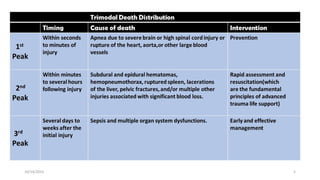
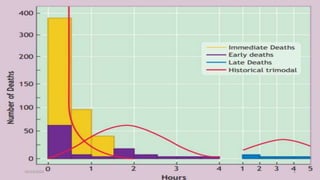
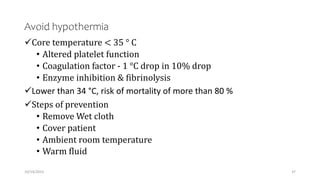
Trimodal death distribution
 First described in 1982, the trimodal distribution of
deaths implies that death due to injury occurs in one
of three periods, or peaks.
4
10/14/2023
10/14/2023 5
6
10/14/2023
Concepts of the ATLS
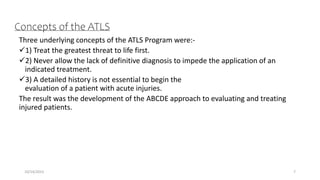
Three underlying concepts of the ATLS Program were:-
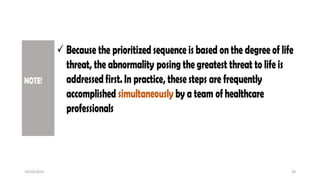
1) Treat the greatest threat to life first.
2) Never allow the lack of definitive diagnosis to impede the application of an
indicated treatment.
3) A detailed history is not essential to begin the
evaluation of a patient with acute injuries.
The result was the development of the ABCDE approach to evaluating and treating
injured patients.
10/14/2023 7
Cont.
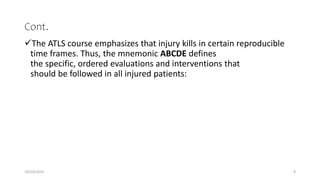
The ATLS course emphasizes that injury kills in certain reproducible
time frames. Thus, the mnemonic ABCDE defines
the specific, ordered evaluations and interventions that
should be followed in all injured patients:
10/14/2023 8
Preparation
A, Prehospital
-Notifying the receiving hospital
-Airway maintenance
-Control of external bleeding & shock
-Immobilization of the patient, and
-Immediate transport to the closest appropriate facility
10/14/2023 9
B, Hospital phase
 A resuscitation area is available for trauma patients.
 Properly functioning airway equipment is
organized, tested, and strategically placed to be
easily accessible.
Warmed intravenous crystalloid solutions
are immediately available
Means to ensure prompt responses by laboratory and
radiology personnel.
Transfer agreements with verified trauma
centers are established and operational
10/14/2023 10
Triage
Triage involves the sorting of patients based on the resources required for
treatment and the resources that are actually available.
The order of treatment is based on the ABC priorities
Other factors that can affect triage and treatment priority include the severity of
injury, ability to survive, and available resources.
Triage situations are categorized as multiple casualties or mass casualties.
11
10/14/2023
Primary Survey
• Patients are assessed and their treatment priorities established
based on their injuries, vital signs, and injury mechanisms
The primary survey encompasses the ABCDEs of
trauma care.
 A - Airway and c-spine protection
 B - Breathing and ventilation
 C - Circulation with hemorrhage control
 D - Disability/Neurologic status
 E - Exposure/Environmental control
12
10/14/2023
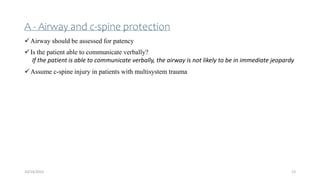
A - Airway and c-spine protection
Airway should be assessed for patency
Is the patient able to communicate verbally?
If the patient is able to communicate verbally, the airway is not likely to be in immediate jeopardy
Assume c-spine injury in patients with multisystem trauma
13
10/14/2023
10/14/2023 14
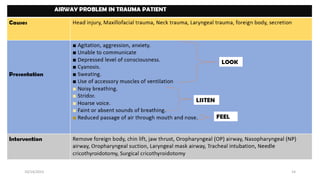
LOOK
LISTEN
FEEL
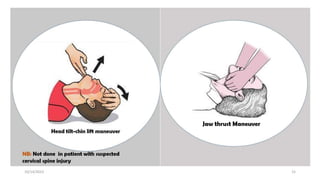
10/14/2023 15
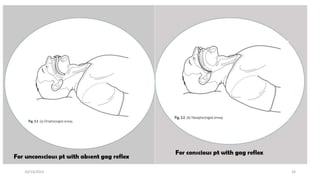
10/14/2023 16
Definitive airway
Reduced conscious level(GCS<8).
Obstructed airway.
Prevent potential obstruction (e.g. from burns or airway injury).
Risk of aspiration.
Apnoea.
Inadequate oxygenation or ventilation, e.g. chest injury.
Any doubt about the patient’s ability to maintain airway integrity
Orotracheal intubation is the gold standard for providing a definitive airway.ted or
cannot be accomplished.
17
10/14/2023
10/14/2023 18
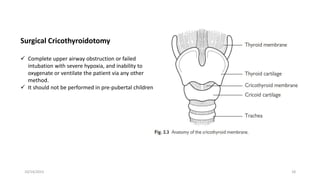
Surgical Cricothyroidotomy
 Complete upper airway obstruction or failed
intubation with severe hypoxia, and inability to
oxygenate or ventilate the patient via any other
method.
 It should not be performed in pre-pubertal children
Cont.
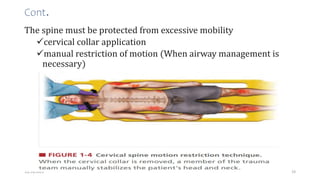
The spine must be protected from excessive mobility
cervical collar application
manual restriction of motion (When airway management is
necessary)
19
10/14/2023
Cont.
How to maintain cervical immobility
During securing definitive airway(e.g endotracheal tube)?
When there is need to remove cervical collar?
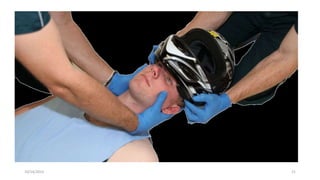
To remove helmet from traumatic patient?
When there is need for posterior examination of patient?
10/14/2023 20
10/14/2023 21
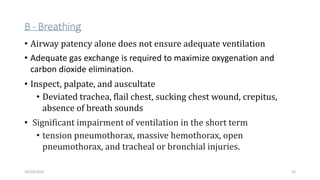
B - Breathing
• Airway patency alone does not ensure adequate ventilation
• Adequate gas exchange is required to maximize oxygenation and
carbon dioxide elimination.
• Inspect, palpate, and auscultate
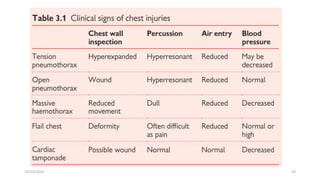
• Deviated trachea, flail chest, sucking chest wound, crepitus,
absence of breath sounds
• Significant impairment of ventilation in the short term
• tension pneumothorax, massive hemothorax, open
pneumothorax, and tracheal or bronchial injuries.
22
10/14/2023
10/14/2023 23
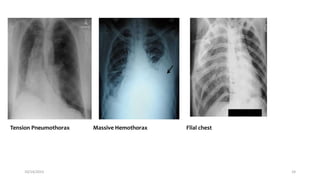
Tension Pneumothorax Massive Hemothorax Flial chest
10/14/2023 24
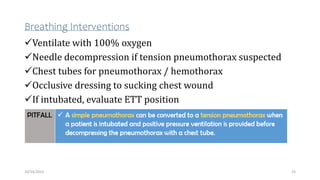
Breathing Interventions
Ventilate with 100% oxygen
Needle decompression if tension pneumothorax suspected
Chest tubes for pneumothorax / hemothorax
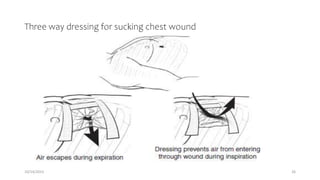
Occlusive dressing to sucking chest wound
If intubated, evaluate ETT position
25
10/14/2023
Three way dressing for sucking chest wound
10/14/2023 26
C - Circulation
Hemorrhage is the predominant cause of preventable
deaths after injury.
Once tension pneumothorax has been excluded as a
cause of shock, consider that hypotension following
injury is due to blood loss until proven otherwise.
Rapid and accurate assessment of an injured patient’s
hemodynamic status is essential. So, rapidly assess
 Level of consciousness
 Skin color
 Pulses in four extremities
 Blood pressure and pulse pressure
27
10/14/2023
Cont.
 Identify any external bleeding.
 Inspect the abdomen for any pattern bruising or distension, and
palpate for tenderness.
 Inspect the pelvis for any bruising, deformity, or swelling, and any
perineal wounds or genital bleeding.
 Inspect and palpate both femurs for deformity, swelling, tenderness,
or wounds.
10/14/2023 28
Circulation Interventions
Apply pressure to sites of external hemorrhage
Tourniquets - in massive exsanguination from an extremity(if direct pressure
is ineffective)
Blind clamping can result in damage to nerves and veins
Establish IV access (2 large bore IVs)
Cardiac tamponade decompression if indicated
Volume resuscitation
Have blood ready
29
10/14/2023
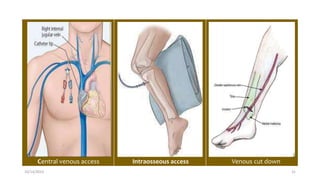
When peripheral sites cannot be accessed
 Intraosseous infusion,
 Central venous access,or
 venous cutdown
30
10/14/2023
NOTE!
 Aggressive and continued volume resuscitation is
not a substitute for definitive control of hemorrhage.
 Definitive bleeding control is essential, along with
appropriate replacement of intravascular volume.
Central venous access Intraosseous access Venous cut down
10/14/2023 31
Tranexamic acid
• An antifibrinolytic drug
• Reduces risk of mortality from bleeding in both blunt and
penetrating trauma
• Should be given to all trauma patients suspected to have
significant haemorrhage,
• Needs to be administered within 3 hours of injury
32
10/14/2023
D - Disability
• Neurological exam
• Level of consciousness
• Pupil size and reaction
• Presence of lateralizing signs
• Determines spinal cord injury level
• Check anal tone & sensation.
• Test random blood sugar
33
10/14/2023
Disability Interventions
ICP monitor- Neurosurgical consultation
Elevated ICP
• Head of bed elevated
• Mannitol
• Hyperventilation
• Emergent decompression
34
10/14/2023
NOTE!
 Prevention of secondary brain injury by maintaining
adequate oxygenation and perfusion are the main
goals of initial management.
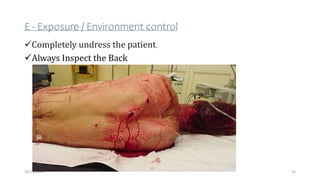
E - Exposure / Environment control
Completely undress the patient,
Always Inspect the Back
35
10/14/2023
Logroll technique
10/14/2023 36
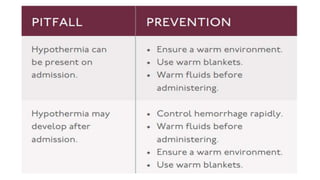
Avoid hypothermia
Core temperature < 35 ° C
• Altered platelet function
• Coagulation factor - 1 °C drop in 10% drop
• Enzyme inhibition & fibrinolysis
Lower than 34 °C, risk of mortality of more than 80 %
Steps of prevention
• Remove Wet cloth
• Cover patient
• Ambient room temperature
• Warm fluid
10/14/2023 37
10/14/2023 38
10/14/2023 39
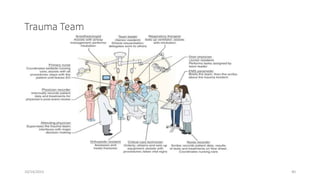
Trauma Team
10/14/2023 40
Adjunct To
Primary
Survey
 Obtain ABG analysis and ventilatory rate.
 Determine CBC, serum lactate, PT, APTT, Fibrinogen
 Attach an ECG monitor to the patient.
 Insert urinary and gastric catheters unless contraindicated,
and monitor the patient’s hourly output of urine.
 Consider the need for and obtain AP chest and AP pelvic x-rays.
 Consider the need for and perform FAST or DPL.
10/14/2023 41
Secondary survey
• Does not begin until
• ABCDE completed
• Resuscitation underway
• Normalization of vital functions has been demonstrated
• Allergies
• Medications currently used
• Past illnesses/Pregnancy
• Last meal
• Events/Environment related to the injury
42
10/14/2023
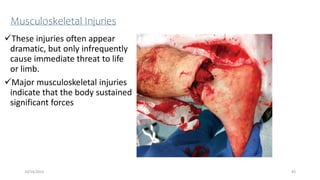
Musculoskeletal Injuries
These injuries often appear
dramatic, but only infrequently
cause immediate threat to life
or limb.
Major musculoskeletal injuries
indicate that the body sustained
significant forces
43
10/14/2023
Cont.
Three goals for the assessment of trauma patients’ extremities:
1. Identification of life-threatening injuries (primary survey)
2. Identification of limb-threatening injuries (secondary survey)
3. Systematic review to avoid missing any other musculoskeletal
injury (continuous reevaluation)
Look/Feel/Move/Measure
44
10/14/2023
Cont.
Potentially life-threatening extremity injuries
Major arterial hemorrhage,
Bilateral femoral fractures,and
Crush syndrome.
45
10/14/2023
Major Arterial Hemorrhage and Traumatic Amputation
Penetrating extremity wounds
Blunt trauma in close proximity to an artery
Significant haemorrhage through the open wound or into the soft
tissues.
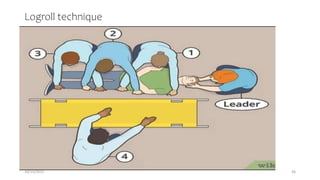
Traumatic amputation are at high risk of life-threatening
hemorrhage
• May require application of a tourniquet.
46
10/14/2023
Management
A stepwise approach
Manual pressure to the wound
A pressure dressing is then applied
Manual pressure to the artery proximal to the injury
Consider applying a manual tourniquet
A properly applied tourniquet must occlude arterial inflow,
Patients with traumatic amputation may benefit from tourniquet
application.
47
10/14/2023
Bilateral femur fractures
• Indicate the patient has been subjected to significant force
• High possibility of associated injuries and complication
• significant blood loss,
• pulmonary complications,
• Multiple organ failure, and death.
48
10/14/2023
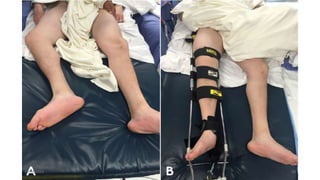
Management
Fracture reduction and immobilization
• Realign the injured extremity in as close to anatomic position as
possible
• Prevent excessive motion at the fracture site.
• Accomplished by applying inline traction
 Proper application of a splint
• control blood loss, reduces pain, and prevents further
neurovascular compromise and soft-tissue injury.
49
10/14/2023
50
10/14/2023
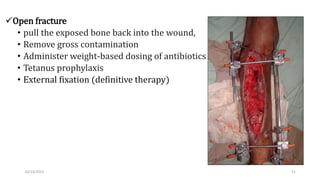
Open fracture
• pull the exposed bone back into the wound,
• Remove gross contamination
• Administer weight-based dosing of antibiotics
• Tetanus prophylaxis
• External fixation (definitive therapy)
51
10/14/2023
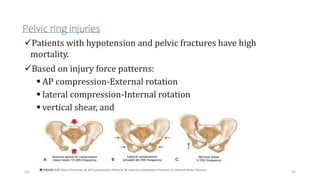
Pelvic ring injuries
Patients with hypotension and pelvic fractures have high
mortality.
Based on injury force patterns:
 AP compression-External rotation
 lateral compression-Internal rotation
 vertical shear, and
 combined mechanism
52
10/14/2023
Cont.
• Stability testing
• Rectal & Vaginal examination
• Associated urethral injury(Suprapubic catheter)
53
10/14/2023
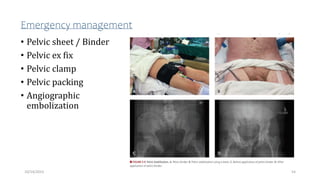
Emergency management
• Pelvic sheet / Binder
• Pelvic ex fix
• Pelvic clamp
• Pelvic packing
• Angiographic
embolization
54
10/14/2023
Damage control surgery and resuscitation
• Term "damage control" was borrowed from the US Navy
• Severely injured patients often do not have the physiologic reserve
to tolerate definitive repair.
• Serves to attend to immediately life-threatening conditions
• Definitive management are delayed until after appropriate
resuscitation.
55
10/14/2023
Indications
• Severe degree of physiologic insult
• Inability to control bleeding using conventional methods
• Large-volume resuscitation required
• Injury pattern identified during surgery
• Need for staged abdominal or thoracic wall reconstruction
56
10/14/2023
Damage control resuscitation (DCR)
• Applied throughout all phases of damage control.
• Intravenous fluid therapy is administered to achieve euvolemia
using a balanced approach.
• Permissive hypotension
• Transfusion of Plasma, Platelets, and Red Blood Cells in a 1:1:1
ratio
• Further testing or imaging that may be needed to better define the
full extent of injuries
57
10/14/2023
10/14/2023 58
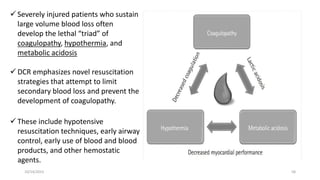
 Severely injured patients who sustain
large volume blood loss often
develop the lethal “triad” of
coagulopathy, hypothermia, and
metabolic acidosis
 DCR emphasizes novel resuscitation
strategies that attempt to limit
secondary blood loss and prevent the
development of coagulopathy.
 These include hypotensive
resuscitation techniques, early airway
control, early use of blood and blood
products, and other hemostatic
agents.
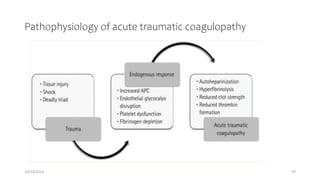
Pathophysiology of acute traumatic coagulopathy
10/14/2023 59
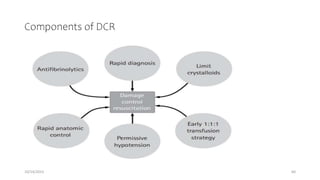
Components of DCR
10/14/2023 60
Damage control surgery
• The goals are to first arrest hemorrhage and then to limit
contamination
• Maintain blood flow to the vital organs and extremities
• Performed in a diligent and expeditious fashion to minimize
additional physiologic insult.
• Operative times should be approximately 90 minutes or less
• Definitive repair is deferred until the patient has stabilized
61
10/14/2023
Reference
1. ATLS student course manual, 10th Ed.
2. Tintinalli’s Emergency medicine 9th Ed.
3. Uptodate 2018
4. Apley's and Solomon's Concise System of Orthopedics and
Trauma 4th Ed.
5. Emergency in trauma Aneel Bhangu et al.Oxford 2010
6. Baily and love’s short practice of surgery, 27th edition
62
10/14/2023
Thanks
63
10/14/2023

Advanced Truama Life Support.pptx

  • 1.
    Advanced Trauma Life Support(ATLS) Dr Sharew Delelegn Orthopedics & Trauma Surgery Resident Adama Hospital Medical College Oct 14,2023 1 10/14/2023
  • 2.
    Contents 1. Introduction toATLS 2. Initial Assessment & Management of trauma pt  Preparation  Triage  Primary survey & Adjunct of primary survey  Secondary survey & Adjunct of Secondary Survey  Definitive care 3.Musculoskeletal Trauma 4.Pelvic trauma 5.Damage control resuscitation & surgery 6. References
  • 3.
    Introduction to ATLS Epidemiology Currentdata from World Health Organization (WHO) and the Centers for Disease Control (CDC) shows, more than nine people die every minute, and 5.8 million people of all ages and economic groups die every year from unintentional injuries and violence. It accounts for 18% of the world’s total diseases. Motor vehicle crashes alone cause more than 1 million deaths annually and an estimated 20 to 50 million significant injuries; Trauma remains the leading cause of death in persons 1 through 44 years of age. Road traffic injuries are the leading cause of injury-related deaths worldwide. 3 10/14/2023
  • 4.
    Cont. Trimodal death distribution First described in 1982, the trimodal distribution of deaths implies that death due to injury occurs in one of three periods, or peaks. 4 10/14/2023
  • 5.
  • 6.
  • 7.
    Concepts of theATLS Three underlying concepts of the ATLS Program were:- 1) Treat the greatest threat to life first. 2) Never allow the lack of definitive diagnosis to impede the application of an indicated treatment. 3) A detailed history is not essential to begin the evaluation of a patient with acute injuries. The result was the development of the ABCDE approach to evaluating and treating injured patients. 10/14/2023 7
  • 8.
    Cont. The ATLS courseemphasizes that injury kills in certain reproducible time frames. Thus, the mnemonic ABCDE defines the specific, ordered evaluations and interventions that should be followed in all injured patients: 10/14/2023 8
  • 9.
    Preparation A, Prehospital -Notifying thereceiving hospital -Airway maintenance -Control of external bleeding & shock -Immobilization of the patient, and -Immediate transport to the closest appropriate facility 10/14/2023 9
  • 10.
    B, Hospital phase A resuscitation area is available for trauma patients.  Properly functioning airway equipment is organized, tested, and strategically placed to be easily accessible. Warmed intravenous crystalloid solutions are immediately available Means to ensure prompt responses by laboratory and radiology personnel. Transfer agreements with verified trauma centers are established and operational 10/14/2023 10
  • 11.
    Triage Triage involves thesorting of patients based on the resources required for treatment and the resources that are actually available. The order of treatment is based on the ABC priorities Other factors that can affect triage and treatment priority include the severity of injury, ability to survive, and available resources. Triage situations are categorized as multiple casualties or mass casualties. 11 10/14/2023
  • 12.
    Primary Survey • Patientsare assessed and their treatment priorities established based on their injuries, vital signs, and injury mechanisms The primary survey encompasses the ABCDEs of trauma care.  A - Airway and c-spine protection  B - Breathing and ventilation  C - Circulation with hemorrhage control  D - Disability/Neurologic status  E - Exposure/Environmental control 12 10/14/2023
  • 13.
    A - Airwayand c-spine protection Airway should be assessed for patency Is the patient able to communicate verbally? If the patient is able to communicate verbally, the airway is not likely to be in immediate jeopardy Assume c-spine injury in patients with multisystem trauma 13 10/14/2023
  • 14.
  • 15.
  • 16.
  • 17.
    Definitive airway Reduced consciouslevel(GCS<8). Obstructed airway. Prevent potential obstruction (e.g. from burns or airway injury). Risk of aspiration. Apnoea. Inadequate oxygenation or ventilation, e.g. chest injury. Any doubt about the patient’s ability to maintain airway integrity Orotracheal intubation is the gold standard for providing a definitive airway.ted or cannot be accomplished. 17 10/14/2023
  • 18.
    10/14/2023 18 Surgical Cricothyroidotomy Complete upper airway obstruction or failed intubation with severe hypoxia, and inability to oxygenate or ventilate the patient via any other method.  It should not be performed in pre-pubertal children
  • 19.
    Cont. The spine mustbe protected from excessive mobility cervical collar application manual restriction of motion (When airway management is necessary) 19 10/14/2023
  • 20.
    Cont. How to maintaincervical immobility During securing definitive airway(e.g endotracheal tube)? When there is need to remove cervical collar? To remove helmet from traumatic patient? When there is need for posterior examination of patient? 10/14/2023 20
  • 21.
  • 22.
    B - Breathing •Airway patency alone does not ensure adequate ventilation • Adequate gas exchange is required to maximize oxygenation and carbon dioxide elimination. • Inspect, palpate, and auscultate • Deviated trachea, flail chest, sucking chest wound, crepitus, absence of breath sounds • Significant impairment of ventilation in the short term • tension pneumothorax, massive hemothorax, open pneumothorax, and tracheal or bronchial injuries. 22 10/14/2023
  • 23.
  • 24.
    Tension Pneumothorax MassiveHemothorax Flial chest 10/14/2023 24
  • 25.
    Breathing Interventions Ventilate with100% oxygen Needle decompression if tension pneumothorax suspected Chest tubes for pneumothorax / hemothorax Occlusive dressing to sucking chest wound If intubated, evaluate ETT position 25 10/14/2023
  • 26.
    Three way dressingfor sucking chest wound 10/14/2023 26
  • 27.
    C - Circulation Hemorrhageis the predominant cause of preventable deaths after injury. Once tension pneumothorax has been excluded as a cause of shock, consider that hypotension following injury is due to blood loss until proven otherwise. Rapid and accurate assessment of an injured patient’s hemodynamic status is essential. So, rapidly assess  Level of consciousness  Skin color  Pulses in four extremities  Blood pressure and pulse pressure 27 10/14/2023
  • 28.
    Cont.  Identify anyexternal bleeding.  Inspect the abdomen for any pattern bruising or distension, and palpate for tenderness.  Inspect the pelvis for any bruising, deformity, or swelling, and any perineal wounds or genital bleeding.  Inspect and palpate both femurs for deformity, swelling, tenderness, or wounds. 10/14/2023 28
  • 29.
    Circulation Interventions Apply pressureto sites of external hemorrhage Tourniquets - in massive exsanguination from an extremity(if direct pressure is ineffective) Blind clamping can result in damage to nerves and veins Establish IV access (2 large bore IVs) Cardiac tamponade decompression if indicated Volume resuscitation Have blood ready 29 10/14/2023
  • 30.
    When peripheral sitescannot be accessed  Intraosseous infusion,  Central venous access,or  venous cutdown 30 10/14/2023 NOTE!  Aggressive and continued volume resuscitation is not a substitute for definitive control of hemorrhage.  Definitive bleeding control is essential, along with appropriate replacement of intravascular volume.
  • 31.
    Central venous accessIntraosseous access Venous cut down 10/14/2023 31
  • 32.
    Tranexamic acid • Anantifibrinolytic drug • Reduces risk of mortality from bleeding in both blunt and penetrating trauma • Should be given to all trauma patients suspected to have significant haemorrhage, • Needs to be administered within 3 hours of injury 32 10/14/2023
  • 33.
    D - Disability •Neurological exam • Level of consciousness • Pupil size and reaction • Presence of lateralizing signs • Determines spinal cord injury level • Check anal tone & sensation. • Test random blood sugar 33 10/14/2023
  • 34.
    Disability Interventions ICP monitor-Neurosurgical consultation Elevated ICP • Head of bed elevated • Mannitol • Hyperventilation • Emergent decompression 34 10/14/2023 NOTE!  Prevention of secondary brain injury by maintaining adequate oxygenation and perfusion are the main goals of initial management.
  • 35.
    E - Exposure/ Environment control Completely undress the patient, Always Inspect the Back 35 10/14/2023
  • 36.
  • 37.
    Avoid hypothermia Core temperature< 35 ° C • Altered platelet function • Coagulation factor - 1 °C drop in 10% drop • Enzyme inhibition & fibrinolysis Lower than 34 °C, risk of mortality of more than 80 % Steps of prevention • Remove Wet cloth • Cover patient • Ambient room temperature • Warm fluid 10/14/2023 37
  • 38.
  • 39.
  • 40.
  • 41.
    Adjunct To Primary Survey  ObtainABG analysis and ventilatory rate.  Determine CBC, serum lactate, PT, APTT, Fibrinogen  Attach an ECG monitor to the patient.  Insert urinary and gastric catheters unless contraindicated, and monitor the patient’s hourly output of urine.  Consider the need for and obtain AP chest and AP pelvic x-rays.  Consider the need for and perform FAST or DPL. 10/14/2023 41
  • 42.
    Secondary survey • Doesnot begin until • ABCDE completed • Resuscitation underway • Normalization of vital functions has been demonstrated • Allergies • Medications currently used • Past illnesses/Pregnancy • Last meal • Events/Environment related to the injury 42 10/14/2023
  • 43.
    Musculoskeletal Injuries These injuriesoften appear dramatic, but only infrequently cause immediate threat to life or limb. Major musculoskeletal injuries indicate that the body sustained significant forces 43 10/14/2023
  • 44.
    Cont. Three goals forthe assessment of trauma patients’ extremities: 1. Identification of life-threatening injuries (primary survey) 2. Identification of limb-threatening injuries (secondary survey) 3. Systematic review to avoid missing any other musculoskeletal injury (continuous reevaluation) Look/Feel/Move/Measure 44 10/14/2023
  • 45.
    Cont. Potentially life-threatening extremityinjuries Major arterial hemorrhage, Bilateral femoral fractures,and Crush syndrome. 45 10/14/2023
  • 46.
    Major Arterial Hemorrhageand Traumatic Amputation Penetrating extremity wounds Blunt trauma in close proximity to an artery Significant haemorrhage through the open wound or into the soft tissues. Traumatic amputation are at high risk of life-threatening hemorrhage • May require application of a tourniquet. 46 10/14/2023
  • 47.
    Management A stepwise approach Manualpressure to the wound A pressure dressing is then applied Manual pressure to the artery proximal to the injury Consider applying a manual tourniquet A properly applied tourniquet must occlude arterial inflow, Patients with traumatic amputation may benefit from tourniquet application. 47 10/14/2023
  • 48.
    Bilateral femur fractures •Indicate the patient has been subjected to significant force • High possibility of associated injuries and complication • significant blood loss, • pulmonary complications, • Multiple organ failure, and death. 48 10/14/2023
  • 49.
    Management Fracture reduction andimmobilization • Realign the injured extremity in as close to anatomic position as possible • Prevent excessive motion at the fracture site. • Accomplished by applying inline traction  Proper application of a splint • control blood loss, reduces pain, and prevents further neurovascular compromise and soft-tissue injury. 49 10/14/2023
  • 50.
  • 51.
    Open fracture • pullthe exposed bone back into the wound, • Remove gross contamination • Administer weight-based dosing of antibiotics • Tetanus prophylaxis • External fixation (definitive therapy) 51 10/14/2023
  • 52.
    Pelvic ring injuries Patientswith hypotension and pelvic fractures have high mortality. Based on injury force patterns:  AP compression-External rotation  lateral compression-Internal rotation  vertical shear, and  combined mechanism 52 10/14/2023
  • 53.
    Cont. • Stability testing •Rectal & Vaginal examination • Associated urethral injury(Suprapubic catheter) 53 10/14/2023
  • 54.
    Emergency management • Pelvicsheet / Binder • Pelvic ex fix • Pelvic clamp • Pelvic packing • Angiographic embolization 54 10/14/2023
  • 55.
    Damage control surgeryand resuscitation • Term "damage control" was borrowed from the US Navy • Severely injured patients often do not have the physiologic reserve to tolerate definitive repair. • Serves to attend to immediately life-threatening conditions • Definitive management are delayed until after appropriate resuscitation. 55 10/14/2023
  • 56.
    Indications • Severe degreeof physiologic insult • Inability to control bleeding using conventional methods • Large-volume resuscitation required • Injury pattern identified during surgery • Need for staged abdominal or thoracic wall reconstruction 56 10/14/2023
  • 57.
    Damage control resuscitation(DCR) • Applied throughout all phases of damage control. • Intravenous fluid therapy is administered to achieve euvolemia using a balanced approach. • Permissive hypotension • Transfusion of Plasma, Platelets, and Red Blood Cells in a 1:1:1 ratio • Further testing or imaging that may be needed to better define the full extent of injuries 57 10/14/2023
  • 58.
    10/14/2023 58  Severelyinjured patients who sustain large volume blood loss often develop the lethal “triad” of coagulopathy, hypothermia, and metabolic acidosis  DCR emphasizes novel resuscitation strategies that attempt to limit secondary blood loss and prevent the development of coagulopathy.  These include hypotensive resuscitation techniques, early airway control, early use of blood and blood products, and other hemostatic agents.
  • 59.
    Pathophysiology of acutetraumatic coagulopathy 10/14/2023 59
  • 60.
  • 61.
    Damage control surgery •The goals are to first arrest hemorrhage and then to limit contamination • Maintain blood flow to the vital organs and extremities • Performed in a diligent and expeditious fashion to minimize additional physiologic insult. • Operative times should be approximately 90 minutes or less • Definitive repair is deferred until the patient has stabilized 61 10/14/2023
  • 62.
    Reference 1. ATLS studentcourse manual, 10th Ed. 2. Tintinalli’s Emergency medicine 9th Ed. 3. Uptodate 2018 4. Apley's and Solomon's Concise System of Orthopedics and Trauma 4th Ed. 5. Emergency in trauma Aneel Bhangu et al.Oxford 2010 6. Baily and love’s short practice of surgery, 27th edition 62 10/14/2023
  • 63.