The Evolution of Tactical Combat Casualty Care
The hard lessons learned over centuries of battlefield healthcare were all but ignored until a
landmark paper appeared in a 1996 issue of Military Medicine. Previously, military guidelines
for trauma management mirrored tactics used in the civilian sector. Initiated by the elements
of the Special Operations Command, the new strategies outlined in 1996 were collectively
referred to as Tactical Combat Casualty Care (TCCC).
TCCC launched a total reassessment of practices … with one overarching goal:
Decrease Preventable Combat Death at the point of wounding.
Instead of the civilian-based approaches of the past, integrated strategies specific to combat
realities were emerging. But old habits were hard to break. Specifically, the notion that airway
management was the initial response to virtually any combat trauma. After all, it held true in
the civilian sector.
Today, TCCC is becoming the standard of care for the tactical management of combat
casualties within the Department of Defense.
“The hemorrhage that takes place when a
main artery is divided is usually so rapid
and so copious that the wounded man dies
before help can reach him.”
— Col. H.M. Gray, 1919
The Target: Preventable Combat Death
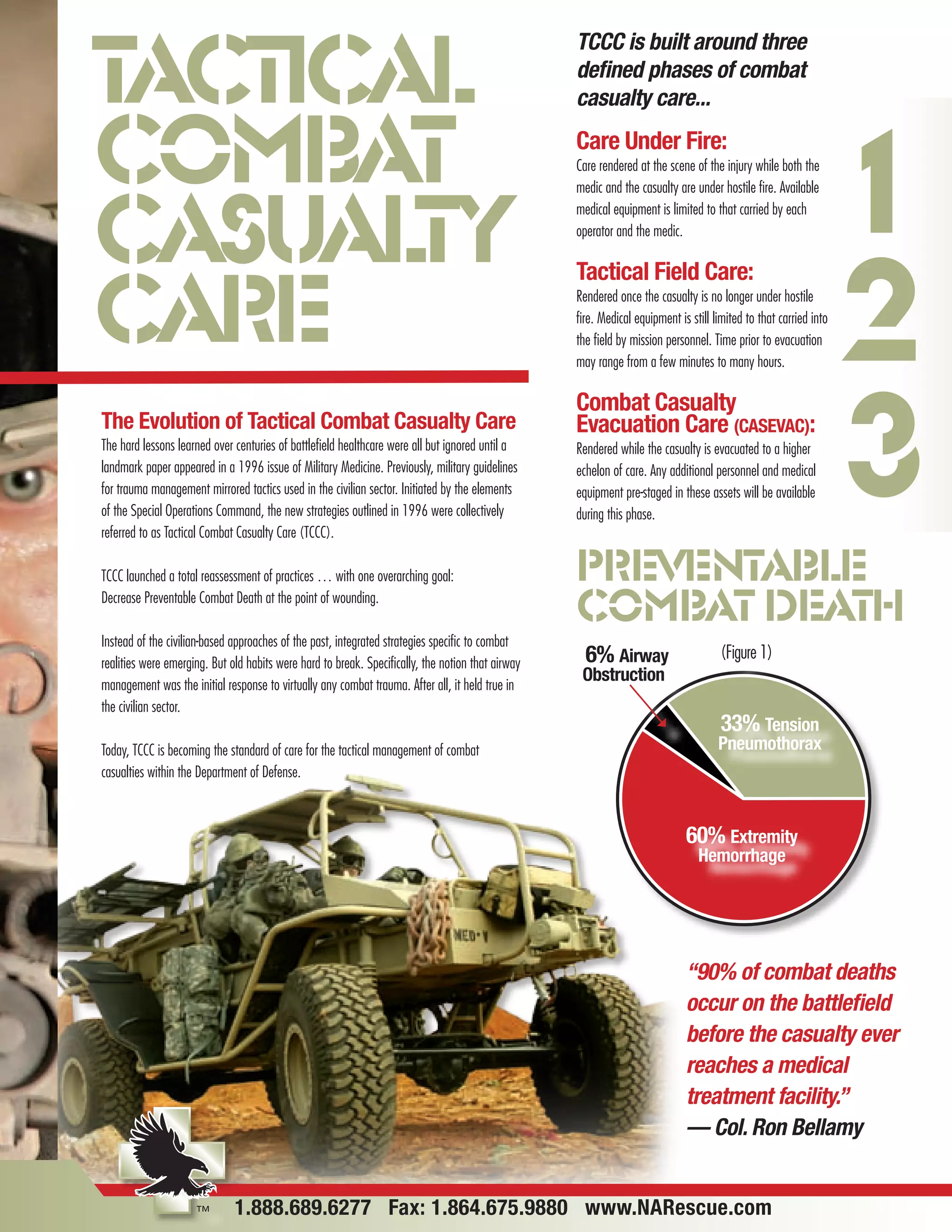
Col. Gray hit the nail on the head 85 years ago. Empirical research using data from
World War II until today elicited the same conclusion. The overwhelming cause of
preventable combat death was extremity hemorrhage (see Figure 1). However,
until recently, warfighters were not trained or equipped to control life threatening
hemorrhage. Today, TCCC is becoming the standard of care for the tactical
management of combat casualties within the Department of Defense.
A Tiered System for Medical Equipment
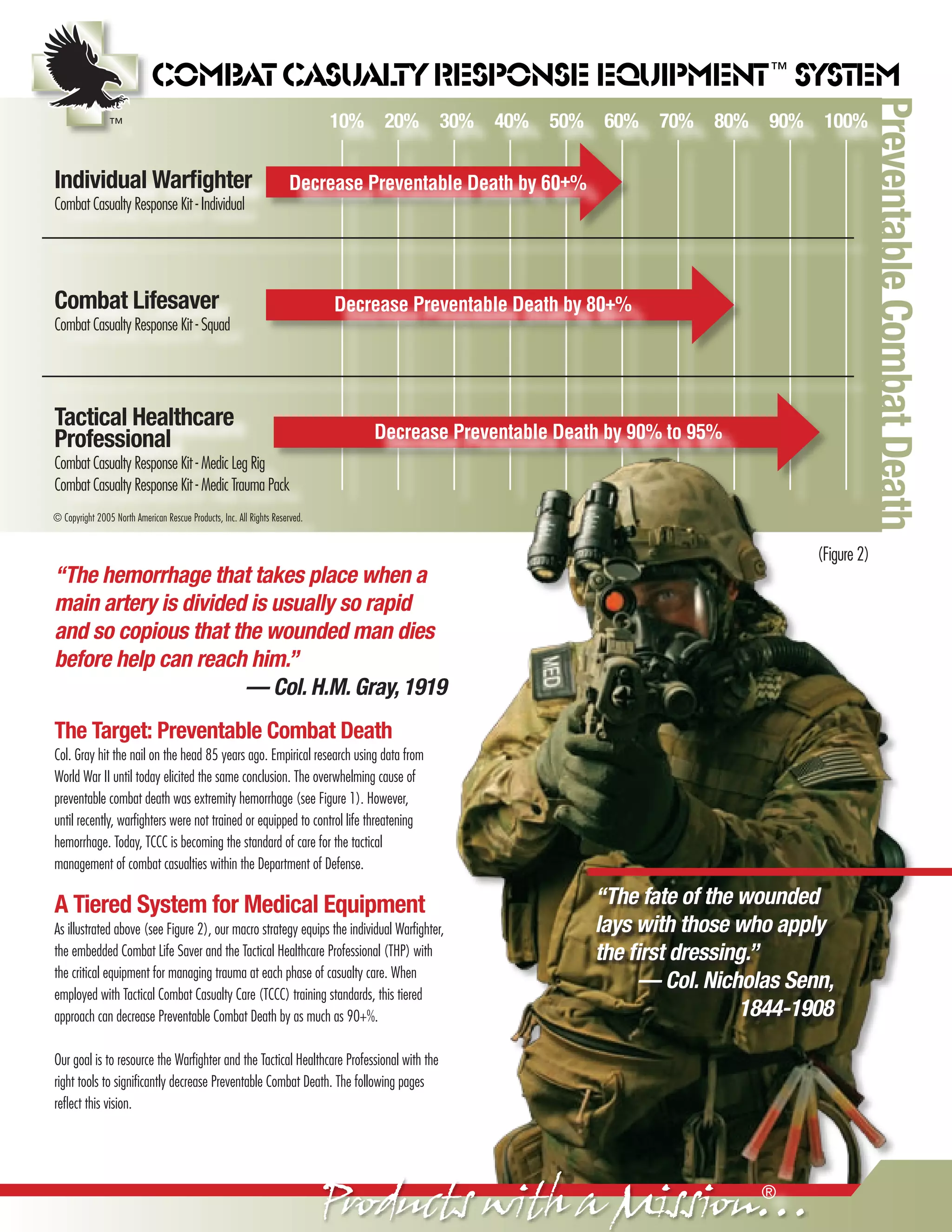
As illustrated above (see Figure 2), our macro strategy equips the individual Warfighter,
the embedded Combat Life Saver and the Tactical Healthcare Professional (THP) with
the critical equipment for managing trauma at each phase of casualty care. When
employed with Tactical Combat Casualty Care (TCCC) training standards, this tiered
approach can decrease Preventable Combat Death by as much as 90+%.
Our goal is to resource the Warfighter and the Tactical Healthcare Professional with the
right tools to significantly decrease Preventable Combat Death. The following pages
reflect this vision.
1
2
3
Individual Warfighter
Combat Casualty Response Kit - Individual
Combat Lifesaver
Combat Casualty Response Kit - Squad
Tactical Healthcare
Professional
Combat Casualty Response Kit - Medic Leg Rig
Combat Casualty Response Kit - Medic Trauma Pack
Tactical
Combat
Casualty
Care
combat casualty response equipment™
system
TCCC is built around three
defined phases of combat
casualty care...
Care Under Fire:
Care rendered at the scene of the injury while both the
medic and the casualty are under hostile fire. Available
medical equipment is limited to that carried by each
operator and the medic.
Tactical Field Care:
Rendered once the casualty is no longer under hostile
fire. Medical equipment is still limited to that carried into
the field by mission personnel. Time prior to evacuation
may range from a few minutes to many hours.
Combat Casualty
Evacuation Care (CASEVAC):
Rendered while the casualty is evacuated to a higher
echelon of care. Any additional personnel and medical
equipment pre-staged in these assets will be available
during this phase.
PreventableCombatDeath
10% 20% 30% 40% 50% 60% 70% 80% 90% 100%
Decrease Preventable Death by 60+%
Decrease Preventable Death by 80+%
Decrease Preventable Death by 90% to 95%
Preventable
Combat Death
33% Tension
Pneumothorax
(Figure 1)
60% Extremity
Hemorrhage
6% Airway
Obstruction
“90% of combat deaths
occur on the battlefield
before the casualty ever
reaches a medical
treatment facility.”
— Col. Ron Bellamy
(Figure 2)
“The fate of the wounded
lays with those who apply
the first dressing.”
— Col. Nicholas Senn,
1844-1908
© Copyright 2005 North American Rescue Products, Inc. All Rights Reserved.
1.888.689.6277 Fax: 1.864.675.9880 www.NARescue.com™
®
™
The Evolution of Tactical Combat Casualty Care
The hard lessons learned over centuries of battlefield healthcare were all but ignored until a
landmark paper appeared in a 1996 issue of Military Medicine. Previously, military guidelines
for trauma management mirrored tactics used in the civilian sector. Initiated by the elements
of the Special Operations Command, the new strategies outlined in 1996 were collectively
referred to as Tactical Combat Casualty Care (TCCC).
TCCC launched a total reassessment of practices … with one overarching goal:
Decrease Preventable Combat Death at the point of wounding.
Instead of the civilian-based approaches of the past, integrated strategies specific to combat
realities were emerging. But old habits were hard to break. Specifically, the notion that airway
management was the initial response to virtually any combat trauma. After all, it held true in
the civilian sector.
Today, TCCC is becoming the standard of care for the tactical management of combat
casualties within the Department of Defense.
“The hemorrhage that takes place when a
main artery is divided is usually so rapid
and so copious that the wounded man dies
before help can reach him.”
— Col. H.M. Gray, 1919
The Target: Preventable Combat Death
Col. Gray hit the nail on the head 85 years ago. Empirical research using data from
World War II until today elicited the same conclusion. The overwhelming cause of
preventable combat death was extremity hemorrhage (see Figure 1). However,
until recently, warfighters were not trained or equipped to control life threatening
hemorrhage. Today, TCCC is becoming the standard of care for the tactical
management of combat casualties within the Department of Defense.
A Tiered System for Medical Equipment
As illustrated above (see Figure 2), our macro strategy equips the individual Warfighter,
the embedded Combat Life Saver and the Tactical Healthcare Professional (THP) with
the critical equipment for managing trauma at each phase of casualty care. When
employed with Tactical Combat Casualty Care (TCCC) training standards, this tiered
approach can decrease Preventable Combat Death by as much as 90+%.
Our goal is to resource the Warfighter and the Tactical Healthcare Professional with the
right tools to significantly decrease Preventable Combat Death. The following pages
reflect this vision.
1
2
3
Individual Warfighter
Combat Casualty Response Kit - Individual
Combat Lifesaver
Combat Casualty Response Kit - Squad
Tactical Healthcare
Professional
Combat Casualty Response Kit - Medic Leg Rig
Combat Casualty Response Kit - Medic Trauma Pack
Tactical
Combat
Casualty
Care
combat casualty response equipment™
system
TCCC is built around three
defined phases of combat
casualty care...
Care Under Fire:
Care rendered at the scene of the injury while both the
medic and the casualty are under hostile fire. Available
medical equipment is limited to that carried by each
operator and the medic.
Tactical Field Care:
Rendered once the casualty is no longer under hostile
fire. Medical equipment is still limited to that carried into
the field by mission personnel. Time prior to evacuation
may range from a few minutes to many hours.
Combat Casualty
Evacuation Care (CASEVAC):
Rendered while the casualty is evacuated to a higher
echelon of care. Any additional personnel and medical
equipment pre-staged in these assets will be available
during this phase.
PreventableCombatDeath
10% 20% 30% 40% 50% 60% 70% 80% 90% 100%
Decrease Preventable Death by 60+%
Decrease Preventable Death by 80+%
Decrease Preventable Death by 90% to 95%
Preventable
Combat Death
33% Tension
Pneumothorax
(Figure 1)
60% Extremity
Hemorrhage
6% Airway
Obstruction
“90% of combat deaths
occur on the battlefield
before the casualty ever
reaches a medical
treatment facility.”
— Col. Ron Bellamy
(Figure 2)
“The fate of the wounded
lays with those who apply
the first dressing.”
— Col. Nicholas Senn,
1844-1908
© Copyright 2005 North American Rescue Products, Inc. All Rights Reserved.
1.888.689.6277 Fax: 1.864.675.9880 www.NARescue.com™
®
™

Tactical care

  • 1.
    The Evolution ofTactical Combat Casualty Care The hard lessons learned over centuries of battlefield healthcare were all but ignored until a landmark paper appeared in a 1996 issue of Military Medicine. Previously, military guidelines for trauma management mirrored tactics used in the civilian sector. Initiated by the elements of the Special Operations Command, the new strategies outlined in 1996 were collectively referred to as Tactical Combat Casualty Care (TCCC). TCCC launched a total reassessment of practices … with one overarching goal: Decrease Preventable Combat Death at the point of wounding. Instead of the civilian-based approaches of the past, integrated strategies specific to combat realities were emerging. But old habits were hard to break. Specifically, the notion that airway management was the initial response to virtually any combat trauma. After all, it held true in the civilian sector. Today, TCCC is becoming the standard of care for the tactical management of combat casualties within the Department of Defense. “The hemorrhage that takes place when a main artery is divided is usually so rapid and so copious that the wounded man dies before help can reach him.” — Col. H.M. Gray, 1919 The Target: Preventable Combat Death Col. Gray hit the nail on the head 85 years ago. Empirical research using data from World War II until today elicited the same conclusion. The overwhelming cause of preventable combat death was extremity hemorrhage (see Figure 1). However, until recently, warfighters were not trained or equipped to control life threatening hemorrhage. Today, TCCC is becoming the standard of care for the tactical management of combat casualties within the Department of Defense. A Tiered System for Medical Equipment As illustrated above (see Figure 2), our macro strategy equips the individual Warfighter, the embedded Combat Life Saver and the Tactical Healthcare Professional (THP) with the critical equipment for managing trauma at each phase of casualty care. When employed with Tactical Combat Casualty Care (TCCC) training standards, this tiered approach can decrease Preventable Combat Death by as much as 90+%. Our goal is to resource the Warfighter and the Tactical Healthcare Professional with the right tools to significantly decrease Preventable Combat Death. The following pages reflect this vision. 1 2 3 Individual Warfighter Combat Casualty Response Kit - Individual Combat Lifesaver Combat Casualty Response Kit - Squad Tactical Healthcare Professional Combat Casualty Response Kit - Medic Leg Rig Combat Casualty Response Kit - Medic Trauma Pack Tactical Combat Casualty Care combat casualty response equipment™ system TCCC is built around three defined phases of combat casualty care... Care Under Fire: Care rendered at the scene of the injury while both the medic and the casualty are under hostile fire. Available medical equipment is limited to that carried by each operator and the medic. Tactical Field Care: Rendered once the casualty is no longer under hostile fire. Medical equipment is still limited to that carried into the field by mission personnel. Time prior to evacuation may range from a few minutes to many hours. Combat Casualty Evacuation Care (CASEVAC): Rendered while the casualty is evacuated to a higher echelon of care. Any additional personnel and medical equipment pre-staged in these assets will be available during this phase. PreventableCombatDeath 10% 20% 30% 40% 50% 60% 70% 80% 90% 100% Decrease Preventable Death by 60+% Decrease Preventable Death by 80+% Decrease Preventable Death by 90% to 95% Preventable Combat Death 33% Tension Pneumothorax (Figure 1) 60% Extremity Hemorrhage 6% Airway Obstruction “90% of combat deaths occur on the battlefield before the casualty ever reaches a medical treatment facility.” — Col. Ron Bellamy (Figure 2) “The fate of the wounded lays with those who apply the first dressing.” — Col. Nicholas Senn, 1844-1908 © Copyright 2005 North American Rescue Products, Inc. All Rights Reserved. 1.888.689.6277 Fax: 1.864.675.9880 www.NARescue.com™ ® ™
  • 2.
    The Evolution ofTactical Combat Casualty Care The hard lessons learned over centuries of battlefield healthcare were all but ignored until a landmark paper appeared in a 1996 issue of Military Medicine. Previously, military guidelines for trauma management mirrored tactics used in the civilian sector. Initiated by the elements of the Special Operations Command, the new strategies outlined in 1996 were collectively referred to as Tactical Combat Casualty Care (TCCC). TCCC launched a total reassessment of practices … with one overarching goal: Decrease Preventable Combat Death at the point of wounding. Instead of the civilian-based approaches of the past, integrated strategies specific to combat realities were emerging. But old habits were hard to break. Specifically, the notion that airway management was the initial response to virtually any combat trauma. After all, it held true in the civilian sector. Today, TCCC is becoming the standard of care for the tactical management of combat casualties within the Department of Defense. “The hemorrhage that takes place when a main artery is divided is usually so rapid and so copious that the wounded man dies before help can reach him.” — Col. H.M. Gray, 1919 The Target: Preventable Combat Death Col. Gray hit the nail on the head 85 years ago. Empirical research using data from World War II until today elicited the same conclusion. The overwhelming cause of preventable combat death was extremity hemorrhage (see Figure 1). However, until recently, warfighters were not trained or equipped to control life threatening hemorrhage. Today, TCCC is becoming the standard of care for the tactical management of combat casualties within the Department of Defense. A Tiered System for Medical Equipment As illustrated above (see Figure 2), our macro strategy equips the individual Warfighter, the embedded Combat Life Saver and the Tactical Healthcare Professional (THP) with the critical equipment for managing trauma at each phase of casualty care. When employed with Tactical Combat Casualty Care (TCCC) training standards, this tiered approach can decrease Preventable Combat Death by as much as 90+%. Our goal is to resource the Warfighter and the Tactical Healthcare Professional with the right tools to significantly decrease Preventable Combat Death. The following pages reflect this vision. 1 2 3 Individual Warfighter Combat Casualty Response Kit - Individual Combat Lifesaver Combat Casualty Response Kit - Squad Tactical Healthcare Professional Combat Casualty Response Kit - Medic Leg Rig Combat Casualty Response Kit - Medic Trauma Pack Tactical Combat Casualty Care combat casualty response equipment™ system TCCC is built around three defined phases of combat casualty care... Care Under Fire: Care rendered at the scene of the injury while both the medic and the casualty are under hostile fire. Available medical equipment is limited to that carried by each operator and the medic. Tactical Field Care: Rendered once the casualty is no longer under hostile fire. Medical equipment is still limited to that carried into the field by mission personnel. Time prior to evacuation may range from a few minutes to many hours. Combat Casualty Evacuation Care (CASEVAC): Rendered while the casualty is evacuated to a higher echelon of care. Any additional personnel and medical equipment pre-staged in these assets will be available during this phase. PreventableCombatDeath 10% 20% 30% 40% 50% 60% 70% 80% 90% 100% Decrease Preventable Death by 60+% Decrease Preventable Death by 80+% Decrease Preventable Death by 90% to 95% Preventable Combat Death 33% Tension Pneumothorax (Figure 1) 60% Extremity Hemorrhage 6% Airway Obstruction “90% of combat deaths occur on the battlefield before the casualty ever reaches a medical treatment facility.” — Col. Ron Bellamy (Figure 2) “The fate of the wounded lays with those who apply the first dressing.” — Col. Nicholas Senn, 1844-1908 © Copyright 2005 North American Rescue Products, Inc. All Rights Reserved. 1.888.689.6277 Fax: 1.864.675.9880 www.NARescue.com™ ® ™