Gigabit-capable Passive Optical
 Networks (GPON): General
        characteristics

 SERIES G: TRANSMISSION SYSTEMS AND
       MEDIA, DIGITAL SYSTEMS AND
                   NETWORKS
 Digital sections and digital line system – Optical
    line systems for local and access networks

             ITU-TG.984.1 (03/2003)
                                                      1
Outline
•   Object
•   Scope
•   Definitions
•   Architecture of the optical access network
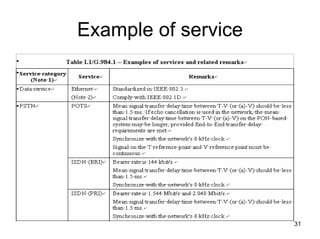
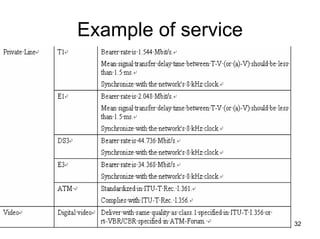
•   Services, user network interface and service
    node interface


                                                   2
Object
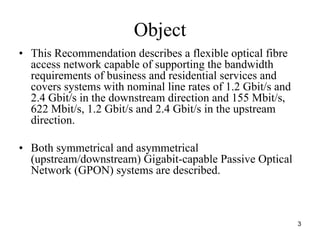
• This Recommendation describes a flexible optical fibre
  access network capable of supporting the bandwidth
  requirements of business and residential services and
  covers systems with nominal line rates of 1.2 Gbit/s and
  2.4 Gbit/s in the downstream direction and 155 Mbit/s,
  622 Mbit/s, 1.2 Gbit/s and 2.4 Gbit/s in the upstream
  direction.

• Both symmetrical and asymmetrical
  (upstream/downstream) Gigabit-capable Passive Optical
  Network (GPON) systems are described.


                                                             3
Object (cont.)
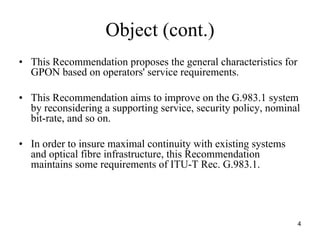
• This Recommendation proposes the general characteristics for
  GPON based on operators' service requirements.

• This Recommendation aims to improve on the G.983.1 system
  by reconsidering a supporting service, security policy, nominal
  bit-rate, and so on.

• In order to insure maximal continuity with existing systems
  and optical fibre infrastructure, this Recommendation
  maintains some requirements of ITU-T Rec. G.983.1.


                                                                 4
Scope
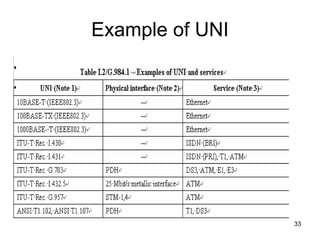
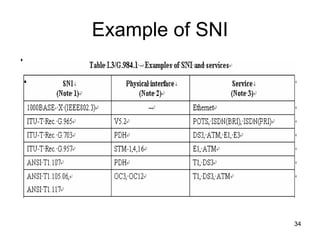
• The general characteristics include examples of services,
  User Network Interfaces (UNI) and Service Node
  Interfaces (SNI) that are requested by network operators.

• As much as possible, this Recommendation maintains
  characteristics from ITU-T Rec. G.982 and G.983.x series
  of Recommendations.

• This is to promote backward compatibility with existing
  Optical Distribution Networks (ODN) that complies with
  those Recommendations.
                                                              5
Scope
• GPON systems are characterized, in general, by an
  Optical Line Termination (OLT) system and an Optical
  Network Unit (ONU) or Optical Network Termination
  (ONT) with a passive Optical Distribution Network
  (ODN) interconnecting them.

• There is, in general, a one-to-many relationship between
  the OLT and the ONU/ONTs respectively


                                                             6
Definitions
• Adaptation Function (AF):

   – AF is additional equipment to change an ONT/ONU subscriber
     interface into the UNI interface that is required by an operator or to
     change a UNI interface into an ONT/ONU subscriber interface
   – Functions of AF depend on the ONT/ONU subscriber interface and
     UNI interface.
   – AF is also used to change an OLT network interface into the SNI
     interface that is required by an operator or to change a SNI interface
     into an OLT network interface.

• logical reach:
   – Logical reach is defined as the maximum distance that can be achieved
     for a particular transmission system.
                                                                              7
Definitions
• Differential fibre distance:
   – The differential fibre distance is the difference in the distance between
     the nearest and furthest ONU/ONT from the OLT.
   – An OLT is connected to several ONU/ONTs.


• Mean signal transfer delay:
   – The mean signal transfer delay is the average of the upstream
     and downstream delay values between reference points; this
     value is determined by measuring round-trip delay and then
     dividing by 2..


                                                                                 8
Definitions
•   Distribution Network (ODN):
     – An ODN realizes the optical transmission from the OLT towards the
        users and vice versa. It utilizes passive optical components.

•   Optical Line Termination (OLT):
     – An OLT provides the network-side interface of the OAN and is
       connected to one or more ODNs.

•   Optical Network Termination (ONT):
     – An ONT is an ONU used for FTTH that includes the User Port function.

•   Optical Network Unit (ONU):
     – An ONU provides (directly or remotely) the user-side interface of the
       OAN and is connected to the ODN.
•   physical reach:
     – Physical reach is defined as the maximum physical distance that can be
       achieved for a particular transmission system.
                                                                                9
Definitions
• service:
   – Service is defined as a network service required by operators..

• Service Node Interface (SNI):
   – See ITU-T Rec. G.902.

• User Network Interface (UNI):
   – See ITU-T Rec. I.112.Optical


                                                                       10
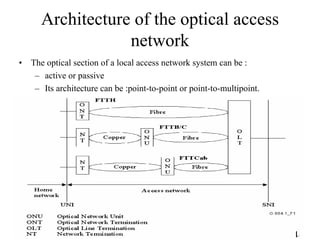
Architecture of the optical access
                  network
•   The optical section of a local access network system can be :
     – active or passive
     – Its architecture can be :point-to-point or point-to-multipoint.

•


                                                                         11
Architecture of the optical access
            network (cont.)
• FTTB scenario : FTTB for MDU and FTTB for business
   – FTTB for MDU (Multi Dwelling Unit)

      • Asymmetric broadband services (e.g., digital broadcast services,
        VOD, file download, etc.).

      • Symmetric broadband services (e.g., content broadcast, e-mail, file
        exchange, distance learning, telemedicine, online-game, etc.).

      • POTS and ISDN. The access network must be able to provide, in a
        flexible way, narrow-band telephone services with appropriate
        timing for the introduction.


                                                                           12
Architecture of the optical access
            network (cont.)
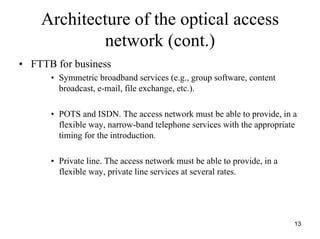
• FTTB for business
      • Symmetric broadband services (e.g., group software, content
        broadcast, e-mail, file exchange, etc.).

      • POTS and ISDN. The access network must be able to provide, in a
        flexible way, narrow-band telephone services with the appropriate
        timing for the introduction.

      • Private line. The access network must be able to provide, in a
        flexible way, private line services at several rates.


                                                                         13
Architecture of the optical access
            network (cont.)
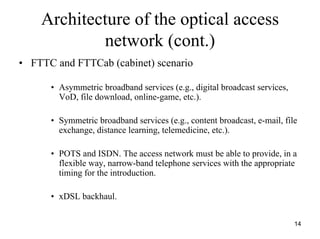
• FTTC and FTTCab (cabinet) scenario

      • Asymmetric broadband services (e.g., digital broadcast services,
        VoD, file download, online-game, etc.).

      • Symmetric broadband services (e.g., content broadcast, e-mail, file
        exchange, distance learning, telemedicine, etc.).

      • POTS and ISDN. The access network must be able to provide, in a
        flexible way, narrow-band telephone services with the appropriate
        timing for the introduction.

      • xDSL backhaul.


                                                                           14
Architecture of the optical access
            network (cont.)
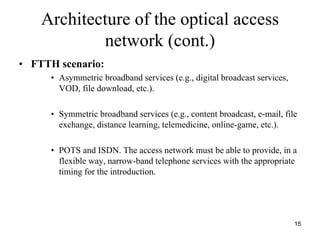
• FTTH scenario:
      • Asymmetric broadband services (e.g., digital broadcast services,
        VOD, file download, etc.).

      • Symmetric broadband services (e.g., content broadcast, e-mail, file
        exchange, distance learning, telemedicine, online-game, etc.).

      • POTS and ISDN. The access network must be able to provide, in a
        flexible way, narrow-band telephone services with the appropriate
        timing for the introduction.


                                                                           15
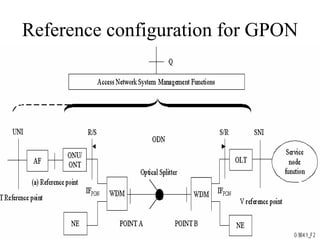
Reference configuration for GPON


                               16
Reference configuration for GPON
• Interface at the reference points S/R and R/S
   – The interface at reference points S/R and R/S is defined as IFPON.
     This is a PON-specific interface that supports all the protocol elements
     necessary to allow transmission between OLT and ONUs.


• User Network Interface (UNI) and Service Node Interface
  (SNI)
   – ONU/ONT has UNI, as well as OLT, has SNI as described in Figure 2.
     UNI/SNI depends on which services are provided by the service
     operator.


                                                                            17
Reference configuration for GPON
• Bit rate
   – Basically, GPON aims at transmission speeds greater than
     or equal to 1.2 Gbit/s. .GPON identifies 7 transmission
     speed combinations as follows:
      •   155 Mbit/s up, 1.2 Gbit/s down;
      •   622 Mbit/s up, 1.2 Gbit/s down;
      •   1.2 Gbit/s up, 1.2 Gbit/s down;
      •   155 Mbit/s up, 2.4 Gbit/s down;
      •   622 Mbit/s up, 2.4 Gbit/s down;
      •   1.2 Gbit/s up, 2.4 Gbit/s down;
      •   2.4 Gbit/s up, 2.4 Gbit/s down.

                                                                18
Reference configuration for GPON
• Logical reach
  – Logical reach is the maximum distance between
    ONU/ONT and OLT.
  – In GPON, the maximum logical reach is defined as 60 km.


• Physical reach
  – Physical reach is the maximum physical distance between
    the ONU/ONT and the OLT.
  – In GPON, two options are defined for the physical reach:
    10 km and 20 km.

                                                               19
Reference configuration for GPON
• Differential fibre distance
   – In GPON, the maximum differential fibre distance is 20 km.
• Maximum mean signal transfer delay
   – GPON must accommodate services that require a maximum mean
     signal transfer delay of 1.5 ms.
   – Specifically, GPON system must have a maximum mean signal transfer
     delay time of less than 1.5 ms between T-V (or (a)-V, depending on
     operator's preference).
   – Although a section of the delay measurement is T-V for FTTH system
     or (a)-V for the other application in ITU-T Rec. G.982, in a GPON
     system the reference points are not restricted by the system
     configuration.

                                                                     20
Reference configuration for GPON
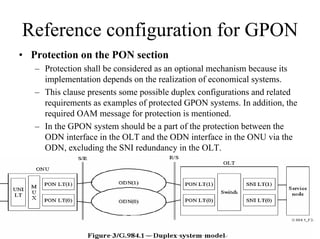
• Protection on the PON section
   – Protection shall be considered as an optional mechanism because its
     implementation depends on the realization of economical systems.
   – This clause presents some possible duplex configurations and related
     requirements as examples of protected GPON systems. In addition, the
     required OAM message for protection is mentioned.
   – In the GPON system should be a part of the protection between the
     ODN interface in the OLT and the ODN interface in the ONU via the
     ODN, excluding the SNI redundancy in the OLT.


                                                                        21
Reference configuration for GPON
•    Possible switching types
      – There are two types of protection switching both of which are
         analogous to those of SDH systems:
         (i) automatic switching; and
         (ii) forced switching.
•    The first one is triggered by fault detection, such as loss of signal, loss of
     frame, signal degrade (BER becomes worse than the predetermined
     threshold), and so on.

•    The second one is activated by administrative events, such as fibre
     rerouting, fibre replacement, etc.

•    Both types should be possible in the GPON system, if required, even
     though they are optional functions.

•    The switching mechanism is generally realized by the OAM function,
     therefore, the required OAM information field should be reserved in the
                                                                                      22
     OAM frame.
Reference configuration for GPON
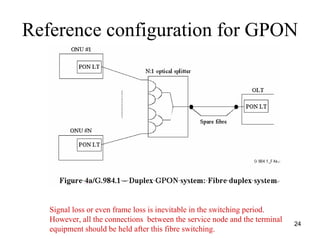
• Possible duplex GPON configurations and
  characteristics
  – There can be several types of duplex GPON systems, as
    shown in Figures 4a to d.
  – For example, no switching protocol is required for the
    OLT/ONU in Figure 4a, since the switching is only applied
    for the optical fibres. Also, in Figure 4b, no switching
    protocol is required since the switching is carried out only
    in the OLT.


                                                              23
Reference configuration for GPON


   Signal loss or even frame loss is inevitable in the switching period.
   However, all the connections between the service node and the terminal
                                                                            24
   equipment should be held after this fibre switching.
Reference configuration for GPON


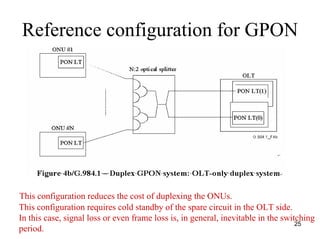
This configuration reduces the cost of duplexing the ONUs.
This configuration requires cold standby of the spare circuit in the OLT side.
In this case, signal loss or even frame loss is, in general, inevitable in the switching
                                                                                   25
period.
Reference configuration for GPON


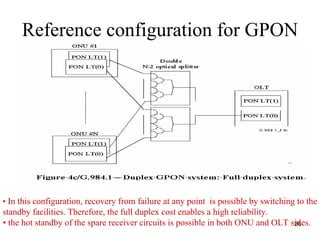
• In this configuration, recovery from failure at any point is possible by switching to the
standby facilities. Therefore, the full duplex cost enables a high reliability.
• the hot standby of the spare receiver circuits is possible in both ONU and OLT sides.
                                                                                  26
Reference configuration for GPON


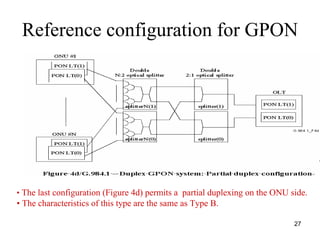
• The last configuration (Figure 4d) permits a partial duplexing on the ONU side.
• The characteristics of this type are the same as Type B.

                                                                             27
Reference configuration for GPON
•   Requirements
    (i) The protection switching function should be optional.
    (ii) Both automatic protection switching and forced switching are possible
    in the GPON system, if required, even though they are optional functions.
    (iii). The switching mechanism is generally realized by the OAM function,
    therefore, the required OAM information field must be reserved in the
    OAM frame.
    (iv) All the connections supported between the service node and the
    terminal equipment should be held after switching.

•    Regarding the last requirement, one implementation of the POTS service
     node (exchange) requires the frame loss period to be less than 120 ms. If
     the frame loss period becomes longer than that, the service node
     disconnects the call, and the call set-up is required again after the
     protection switching.
•    Since GPON supports the emulation of conventional services, such as         28
     POTS and ISDN, this value should be taken into consideration.
Reference configuration for GPON
• Required information fields for OAM frame
   – The field mapping of the OAM frame for the protection
     will be required to be defined.


                                                             29
Reference configuration for GPON
• Security
   – Due to the multicast nature of the PON, GPON needs a
     security mechanism adapting the following requirements:
       • To prevent other users from easily decoding the downstream data;
       • To prevent other users from masquerading as another ONU/ONT or
         user;
       • To allow cost-effective implementation.


                                                                       30
Example of service


                     31
Example of service


                     32
Example of UNI


                 33
Example of SNI


                 34

Gpon

  • 1.
    Gigabit-capable Passive Optical Networks (GPON): General characteristics SERIES G: TRANSMISSION SYSTEMS AND MEDIA, DIGITAL SYSTEMS AND NETWORKS Digital sections and digital line system – Optical line systems for local and access networks ITU-TG.984.1 (03/2003) 1
  • 2.
    Outline • Object • Scope • Definitions • Architecture of the optical access network • Services, user network interface and service node interface 2
  • 3.
    Object • This Recommendationdescribes a flexible optical fibre access network capable of supporting the bandwidth requirements of business and residential services and covers systems with nominal line rates of 1.2 Gbit/s and 2.4 Gbit/s in the downstream direction and 155 Mbit/s, 622 Mbit/s, 1.2 Gbit/s and 2.4 Gbit/s in the upstream direction. • Both symmetrical and asymmetrical (upstream/downstream) Gigabit-capable Passive Optical Network (GPON) systems are described. 3
  • 4.
    Object (cont.) • ThisRecommendation proposes the general characteristics for GPON based on operators' service requirements. • This Recommendation aims to improve on the G.983.1 system by reconsidering a supporting service, security policy, nominal bit-rate, and so on. • In order to insure maximal continuity with existing systems and optical fibre infrastructure, this Recommendation maintains some requirements of ITU-T Rec. G.983.1. 4
  • 5.
    Scope • The generalcharacteristics include examples of services, User Network Interfaces (UNI) and Service Node Interfaces (SNI) that are requested by network operators. • As much as possible, this Recommendation maintains characteristics from ITU-T Rec. G.982 and G.983.x series of Recommendations. • This is to promote backward compatibility with existing Optical Distribution Networks (ODN) that complies with those Recommendations. 5
  • 6.
    Scope • GPON systemsare characterized, in general, by an Optical Line Termination (OLT) system and an Optical Network Unit (ONU) or Optical Network Termination (ONT) with a passive Optical Distribution Network (ODN) interconnecting them. • There is, in general, a one-to-many relationship between the OLT and the ONU/ONTs respectively 6
  • 7.
    Definitions • Adaptation Function(AF): – AF is additional equipment to change an ONT/ONU subscriber interface into the UNI interface that is required by an operator or to change a UNI interface into an ONT/ONU subscriber interface – Functions of AF depend on the ONT/ONU subscriber interface and UNI interface. – AF is also used to change an OLT network interface into the SNI interface that is required by an operator or to change a SNI interface into an OLT network interface. • logical reach: – Logical reach is defined as the maximum distance that can be achieved for a particular transmission system. 7
  • 8.
    Definitions • Differential fibredistance: – The differential fibre distance is the difference in the distance between the nearest and furthest ONU/ONT from the OLT. – An OLT is connected to several ONU/ONTs. • Mean signal transfer delay: – The mean signal transfer delay is the average of the upstream and downstream delay values between reference points; this value is determined by measuring round-trip delay and then dividing by 2.. 8
  • 9.
    Definitions • Distribution Network (ODN): – An ODN realizes the optical transmission from the OLT towards the users and vice versa. It utilizes passive optical components. • Optical Line Termination (OLT): – An OLT provides the network-side interface of the OAN and is connected to one or more ODNs. • Optical Network Termination (ONT): – An ONT is an ONU used for FTTH that includes the User Port function. • Optical Network Unit (ONU): – An ONU provides (directly or remotely) the user-side interface of the OAN and is connected to the ODN. • physical reach: – Physical reach is defined as the maximum physical distance that can be achieved for a particular transmission system. 9
  • 10.
    Definitions • service: – Service is defined as a network service required by operators.. • Service Node Interface (SNI): – See ITU-T Rec. G.902. • User Network Interface (UNI): – See ITU-T Rec. I.112.Optical 10
  • 11.
    Architecture of theoptical access network • The optical section of a local access network system can be : – active or passive – Its architecture can be :point-to-point or point-to-multipoint. • 11
  • 12.
    Architecture of theoptical access network (cont.) • FTTB scenario : FTTB for MDU and FTTB for business – FTTB for MDU (Multi Dwelling Unit) • Asymmetric broadband services (e.g., digital broadcast services, VOD, file download, etc.). • Symmetric broadband services (e.g., content broadcast, e-mail, file exchange, distance learning, telemedicine, online-game, etc.). • POTS and ISDN. The access network must be able to provide, in a flexible way, narrow-band telephone services with appropriate timing for the introduction. 12
  • 13.
    Architecture of theoptical access network (cont.) • FTTB for business • Symmetric broadband services (e.g., group software, content broadcast, e-mail, file exchange, etc.). • POTS and ISDN. The access network must be able to provide, in a flexible way, narrow-band telephone services with the appropriate timing for the introduction. • Private line. The access network must be able to provide, in a flexible way, private line services at several rates. 13
  • 14.
    Architecture of theoptical access network (cont.) • FTTC and FTTCab (cabinet) scenario • Asymmetric broadband services (e.g., digital broadcast services, VoD, file download, online-game, etc.). • Symmetric broadband services (e.g., content broadcast, e-mail, file exchange, distance learning, telemedicine, etc.). • POTS and ISDN. The access network must be able to provide, in a flexible way, narrow-band telephone services with the appropriate timing for the introduction. • xDSL backhaul. 14
  • 15.
    Architecture of theoptical access network (cont.) • FTTH scenario: • Asymmetric broadband services (e.g., digital broadcast services, VOD, file download, etc.). • Symmetric broadband services (e.g., content broadcast, e-mail, file exchange, distance learning, telemedicine, online-game, etc.). • POTS and ISDN. The access network must be able to provide, in a flexible way, narrow-band telephone services with the appropriate timing for the introduction. 15
  • 16.
  • 17.
    Reference configuration forGPON • Interface at the reference points S/R and R/S – The interface at reference points S/R and R/S is defined as IFPON. This is a PON-specific interface that supports all the protocol elements necessary to allow transmission between OLT and ONUs. • User Network Interface (UNI) and Service Node Interface (SNI) – ONU/ONT has UNI, as well as OLT, has SNI as described in Figure 2. UNI/SNI depends on which services are provided by the service operator. 17
  • 18.
    Reference configuration forGPON • Bit rate – Basically, GPON aims at transmission speeds greater than or equal to 1.2 Gbit/s. .GPON identifies 7 transmission speed combinations as follows: • 155 Mbit/s up, 1.2 Gbit/s down; • 622 Mbit/s up, 1.2 Gbit/s down; • 1.2 Gbit/s up, 1.2 Gbit/s down; • 155 Mbit/s up, 2.4 Gbit/s down; • 622 Mbit/s up, 2.4 Gbit/s down; • 1.2 Gbit/s up, 2.4 Gbit/s down; • 2.4 Gbit/s up, 2.4 Gbit/s down. 18
  • 19.
    Reference configuration forGPON • Logical reach – Logical reach is the maximum distance between ONU/ONT and OLT. – In GPON, the maximum logical reach is defined as 60 km. • Physical reach – Physical reach is the maximum physical distance between the ONU/ONT and the OLT. – In GPON, two options are defined for the physical reach: 10 km and 20 km. 19
  • 20.
    Reference configuration forGPON • Differential fibre distance – In GPON, the maximum differential fibre distance is 20 km. • Maximum mean signal transfer delay – GPON must accommodate services that require a maximum mean signal transfer delay of 1.5 ms. – Specifically, GPON system must have a maximum mean signal transfer delay time of less than 1.5 ms between T-V (or (a)-V, depending on operator's preference). – Although a section of the delay measurement is T-V for FTTH system or (a)-V for the other application in ITU-T Rec. G.982, in a GPON system the reference points are not restricted by the system configuration. 20
  • 21.
    Reference configuration forGPON • Protection on the PON section – Protection shall be considered as an optional mechanism because its implementation depends on the realization of economical systems. – This clause presents some possible duplex configurations and related requirements as examples of protected GPON systems. In addition, the required OAM message for protection is mentioned. – In the GPON system should be a part of the protection between the ODN interface in the OLT and the ODN interface in the ONU via the ODN, excluding the SNI redundancy in the OLT. 21
  • 22.
    Reference configuration forGPON • Possible switching types – There are two types of protection switching both of which are analogous to those of SDH systems: (i) automatic switching; and (ii) forced switching. • The first one is triggered by fault detection, such as loss of signal, loss of frame, signal degrade (BER becomes worse than the predetermined threshold), and so on. • The second one is activated by administrative events, such as fibre rerouting, fibre replacement, etc. • Both types should be possible in the GPON system, if required, even though they are optional functions. • The switching mechanism is generally realized by the OAM function, therefore, the required OAM information field should be reserved in the 22 OAM frame.
  • 23.
    Reference configuration forGPON • Possible duplex GPON configurations and characteristics – There can be several types of duplex GPON systems, as shown in Figures 4a to d. – For example, no switching protocol is required for the OLT/ONU in Figure 4a, since the switching is only applied for the optical fibres. Also, in Figure 4b, no switching protocol is required since the switching is carried out only in the OLT. 23
  • 24.
    Reference configuration forGPON Signal loss or even frame loss is inevitable in the switching period. However, all the connections between the service node and the terminal 24 equipment should be held after this fibre switching.
  • 25.
    Reference configuration forGPON This configuration reduces the cost of duplexing the ONUs. This configuration requires cold standby of the spare circuit in the OLT side. In this case, signal loss or even frame loss is, in general, inevitable in the switching 25 period.
  • 26.
    Reference configuration forGPON • In this configuration, recovery from failure at any point is possible by switching to the standby facilities. Therefore, the full duplex cost enables a high reliability. • the hot standby of the spare receiver circuits is possible in both ONU and OLT sides. 26
  • 27.
    Reference configuration forGPON • The last configuration (Figure 4d) permits a partial duplexing on the ONU side. • The characteristics of this type are the same as Type B. 27
  • 28.
    Reference configuration forGPON • Requirements (i) The protection switching function should be optional. (ii) Both automatic protection switching and forced switching are possible in the GPON system, if required, even though they are optional functions. (iii). The switching mechanism is generally realized by the OAM function, therefore, the required OAM information field must be reserved in the OAM frame. (iv) All the connections supported between the service node and the terminal equipment should be held after switching. • Regarding the last requirement, one implementation of the POTS service node (exchange) requires the frame loss period to be less than 120 ms. If the frame loss period becomes longer than that, the service node disconnects the call, and the call set-up is required again after the protection switching. • Since GPON supports the emulation of conventional services, such as 28 POTS and ISDN, this value should be taken into consideration.
  • 29.
    Reference configuration forGPON • Required information fields for OAM frame – The field mapping of the OAM frame for the protection will be required to be defined. 29
  • 30.
    Reference configuration forGPON • Security – Due to the multicast nature of the PON, GPON needs a security mechanism adapting the following requirements: • To prevent other users from easily decoding the downstream data; • To prevent other users from masquerading as another ONU/ONT or user; • To allow cost-effective implementation. 30
  • 31.
  • 32.
  • 33.
  • 34.