Understanding FTTH Architecture
TOPOLOGY AND COMPONENTS
TODD M. CORCORAN, RTPM, CFHP
T E C H N I C A L P R O G R A M M A N A G E R
Q: What is topology?
Q: What is meant by a Central Office or a Hut?
A: In a FTTH system, the word “topology” in is most often used
with the physical fiber plant or Outside Plant (OSP).
A: The location where all major electronics for the system are
housed for a given town.
Q: What is meant by an OLT, ONT, and splitter?
A: OLT - Optical Line Terminal, located in the CO or hut, is the
interface to the customer and provides the subscribed services.
ONT – Optical Line Terminal, located at the customer/subscribers
location, converts the optical media being sent by the OLT.
Splitter - A passive device that splits the light source in separate
paths.
Q: What is a PON?
A: A Passive Optical Network that distributes an optical signal
from the CO to the customer.
Q: What is Active Ethernet?
A: A technique that uses Ethernet (a data communications
protocol) as the main transmission method over fiber optics with
data rates up to 1 Gb/s.
Understanding
GeneralTerms
Q: What is meant by G-PON?
A: Gigabit PON is a system that handles data rates up to 2.5
Gb/s.
Q: What is splice closure or case?
A: A fiber management product that protects and houses optical
splices.
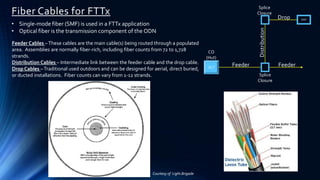
Fiber Cables for FTTx
• Single-mode fiber (SMF) is used in a FTTx application
• Optical fiber is the transmission component of the ODN
Feeder Cables –These cables are the main cable(s) being routed through a populated
area. Assemblies are normally fiber-rich, including fiber counts from 72 to 1,728
strands.
Distribution Cables – Intermediate link between the feeder cable and the drop cable.
Drop Cables –Traditional used outdoors and can be designed for aerial, direct buried,
or ducted installations. Fiber counts can vary from 1-12 strands.
OLT
ONT
Feeder Feeder
Distribution
Drop
Splice
Closure
Splice
Closure
CO
(Hut)
Courtesy of Light Brigade
Core
Cladding
CLEAN
LightTransmitted
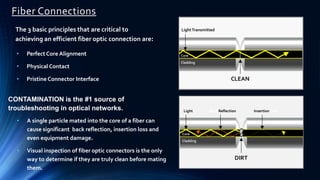
The 3 basic principles that are critical to
achieving an efficient fiber optic connection are:
Fiber Connections
• Perfect Core Alignment
• Physical Contact
• Pristine Connector Interface
DIRT
Core
Cladding
Back Reflection Insertion Loss
Light
CONTAMINATION is the #1 source of
troubleshooting in optical networks.
• A single particle mated into the core of a fiber can
cause significant back reflection, insertion loss and
even equipment damage.
• Visual inspection of fiber optic connectors is the only
way to determine if they are truly clean before mating
them.
Fiber Optic Network Architectures
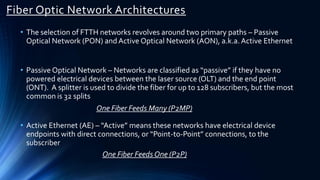
• The selection of FTTH networks revolves around two primary paths – Passive
Optical Network (PON) and Active Optical Network (AON), a.k.a. Active Ethernet
• Passive Optical Network – Networks are classified as “passive” if they have no
powered electrical devices between the laser source (OLT) and the end point
(ONT). A splitter is used to divide the fiber for up to 128 subscribers, but the most
common is 32 splits
• Active Ethernet (AE) – “Active” means these networks have electrical device
endpoints with direct connections, or “Point-to-Point” connections, to the
subscriber
One Fiber Feeds Many (P2MP)
One Fiber Feeds One (P2P)
Network Topology
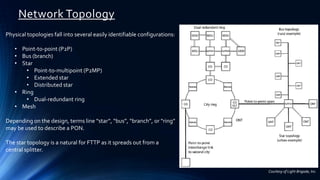
Physical topologies fall into several easily identifiable configurations:
• Point-to-point (P2P)
• Bus (branch)
• Star
• Point-to-multipoint (P2MP)
• Extended star
• Distributed star
• Ring
• Dual-redundant ring
• Mesh
Depending on the design, terms line “star”, “bus”, “branch”, or “ring”
may be used to describe a PON.
The star topology is a natural for FTTP as it spreads out from a
central splitter.
Courtesy of Light Brigade, Inc.
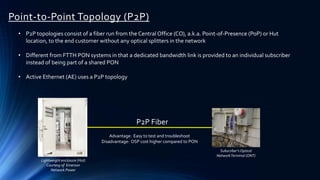
Point-to-Point Topology (P2P)
• P2P topologies consist of a fiber run from the Central Office (CO), a.k.a. Point-of-Presence (PoP) or Hut
location, to the end customer without any optical splitters in the network
• Different from FTTH PON systems in that a dedicated bandwidth link is provided to an individual subscriber
instead of being part of a shared PON
• Active Ethernet (AE) uses a P2P topology
Lightweight enclosure (Hut)
Courtesy of Emerson
Network Power
P2P Fiber
Subscriber’s Optical
NetworkTerminal (ONT)
Advantage: Easy to test and troubleshoot
Disadvantage: OSP cost higher compared to PON
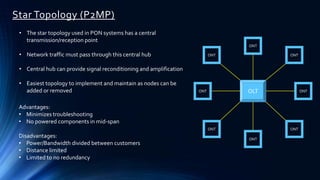
Star Topology (P2MP)
ONT
OLT
ONT
ONT
ONT
ONT
ONT
ONT
ONT
• The star topology used in PON systems has a central
transmission/reception point
• Network traffic must pass through this central hub
• Central hub can provide signal reconditioning and amplification
• Easiest topology to implement and maintain as nodes can be
added or removed
Advantages:
• Minimizes troubleshooting
• No powered components in mid-span
Disadvantages:
• Power/Bandwidth divided between customers
• Distance limited
• Limited to no redundancy
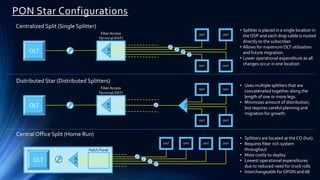
PON Star Configurations
Central Office Split (Home Run)
Centralized Split (Single Splitter)
Distributed Star (Distributed Splitters)
ONT
OLT
Patch Panel
1:32
ONT ONT ONT
OLT
FiberAccess
Terminal (FAT)
1:32
ONT ONT
ONT ONT
• Splitter is placed in a single location in
theOSP and each drop cable is routed
directly to the subscriber.
• Allows for maximum OLT utilization
and future migration.
• Lower operational expenditure as all
changes occur in one location
• Uses multiple splitters that are
concatenated together along the
length of one or more legs.
• Minimizes amount of distribution,
but requires careful planning and
migration for growth.
• Splitters are located at the CO (hut).
• Requires fiber rich system
throughout
• Most costly to deploy
• Lowest operational expenditures
due to reduced need for truck rolls
• Interchangeable for GPON andAE
OLT
FiberAccess
Terminal (FAT)
1:8
ONT ONT
ONT ONT
1:4
Patch Panel
Service shell Core shell
Common
shell
Service
port
function
Cross-
connect
function
Media access
control (MAC)
ODN
interface
function
OAM Power
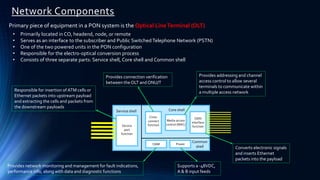
Network Components
Primary piece of equipment in a PON system is the Optical LineTerminal (OLT)
• Primarily located in CO, headend, node, or remote
• Serves as an interface to the subscriber and Public SwitchedTelephone Network (PSTN)
• One of the two powered units in the PON configuration
• Responsible for the electro-optical conversion process
• Consists of three separate parts: Service shell, Core shell and Common shell
Responsible for insertion of ATM cells or
Ethernet packets into upstream payload
and extracting the cells and packets from
the downstream payloads
Provides connection verification
between the OLT andONU/T
Converts electronic signals
and inserts Ethernet
packets into the payload
Provides network monitoring and management for fault indications,
performance info, along with data and diagnostic functions
Provides addressing and channel
access control to allow several
terminals to communicate within
a multiple access network
Supports a -48VDC,
A & B input feeds
Patch Panel
Service shell
Core shell
Common
shell
Service
port
function
Customer
and
services
mux/
demux
function
Media access
control (MAC)
ODN
interface
function
OAM
Power
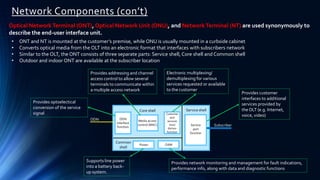
Network Components (con’t)
Optical NetworkTerminal (ONT), Optical Network Unit (ONU), and NetworkTerminal (NT) are used synonymously to
describe the end-user interface unit.
• ONT and NT is mounted at the customer’s premise, while ONU is usually mounted in a curbside cabinet
• Converts optical media from the OLT into an electronic format that interfaces with subscribers network
• Similar to the OLT, the ONT consists of three separate parts: Service shell, Core shell and Common shell
• Outdoor and indoor ONT are available at the subscriber location
Provides optoelectical
conversion of the service
signal
Electronic multiplexing/
demultiplexing for various
services requested or available
to the customer
Provides customer
interfaces to additional
services provided by
theOLT (e.g. Internet,
voice, video)
Provides network monitoring and management for fault indications,
performance info, along with data and diagnostic functions
Provides addressing and channel
access control to allow several
terminals to communicate within
a multiple access network
Supports line power
into a battery back-
up system.
Subscriber
ODN
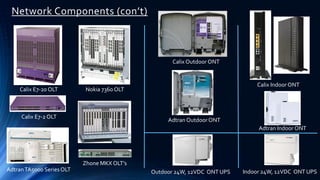
Network Components (con’t)
Calix Indoor ONT
AdtranTA5000 SeriesOLT
Calix E7-2 OLT
Calix Outdoor ONT
Adtran Outdoor ONT
Calix E7-20 OLT Nokia 7360 OLT
Zhone MKX OLT’s
Adtran Indoor ONT
Indoor 24W, 12VDC ONT UPS
Outdoor 24W, 12VDC ONT UPS
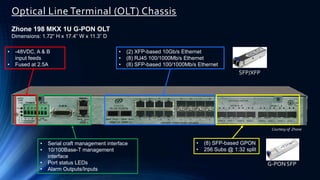
Optical Line Terminal (OLT) Chassis
Courtesy of Zhone
Zhone 198 MKX 1U G-PON OLT
Dimensions: 1.72” H x 17.4” W x 11.3” D
• -48VDC, A & B
input feeds
• Fused at 2.5A
• Serial craft management interface
• 10/100Base-T management
interface
• Port status LEDs
• Alarm Outputs/Inputs
G-PON SFP
SFP/XFP
• (2) XFP-based 10Gb/s Ethernet
• (8) RJ45 100/1000Mb/s Ethernet
• (8) SFP-based 100/1000Mb/s Ethernet
• (8) SFP-based GPON
• 256 Subs @ 1:32 split
Patch Panel
Network Components (con’t)
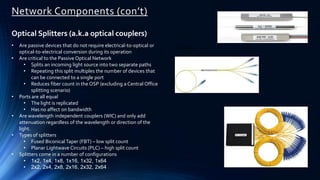
Optical Splitters (a.k.a optical couplers)
• Are passive devices that do not require electrical-to-optical or
optical-to-electrical conversion during its operation
• Are critical to the Passive Optical Network
• Splits an incoming light source into two separate paths
• Repeating this split multiples the number of devices that
can be connected to a single port
• Reduces fiber count in the OSP (excluding a Central Office
splitting scenario)
• Ports are all equal
• The light is replicated
• Has no affect on bandwidth
• Are wavelength independent couplers (WIC) and only add
attenuation regardless of the wavelength or direction of the
light.
• Types of splitters
• Fused Biconical Taper (FBT) – low split count
• Planar Lightwave Circuits (PLC) – high split count
• Splitters come in a number of configurations
• 1x2, 1x4, 1x8, 1x16, 1x32, 1x64
• 2x2, 2x4, 2x8, 2x16, 2x32, 2x64
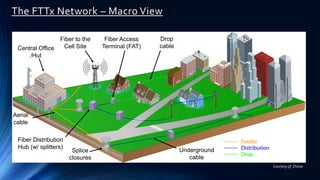
High level picture of where things go
Aerial
cable
Underground
cable
Central Office
/Hut
Fiber to the
Cell Site
Fiber Access
Terminal (FAT)
Fiber Distribution
Hub (w/ splitters)
Drop
cable
Splice
closures
Courtesy of Zhone
The FTTx Network – Macro View
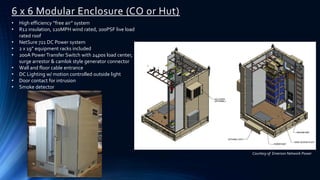
6 x 6 Modular Enclosure (CO or Hut)
• High efficiency “free air” system
• R12 insulation, 120MPH wind rated, 200PSF live load
rated roof
• NetSure 721 DC Power system
• 2 x 19” equipment racks included
• 200A PowerTransfer Switch with 24pos load center,
surge arrestor & camlok style generator connector
• Wall and floor cable entrance
• DC Lighting w/ motion controlled outside light
• Door contact for intrusion
• Smoke detector
Courtesy of Emerson Network Power
Enclosures and Cable Management Products
Calix ODC-200 showing service
and management compartments
Fiber Distribution Hub (FDH)
Aerial SpliceClosure
FiberAccessTerminal
(FAT) or Pedestal
Vault or Handhole
FiberTransition
Terminal (FTT)
ONT housing w/o
ONT installed
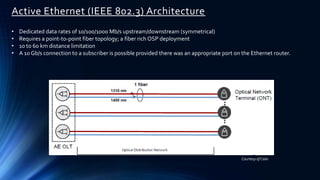
Active Ethernet (IEEE 802.3) Architecture
• Dedicated data rates of 10/100/1000 Mb/s upstream/downstream (symmetrical)
• Requires a point-to-point fiber topology; a fiber rich OSP deployment
• 10 to 60 km distance limitation
• A 10 Gb/s connection to a subscriber is possible provided there was an appropriate port on the Ethernet router.
Courtesy of Calix
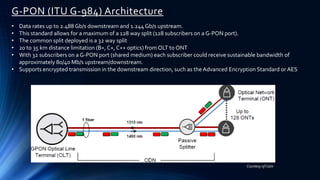
G-PON (ITU G-984) Architecture
• Data rates up to 2.488 Gb/s downstream and 1.244 Gb/s upstream.
• This standard allows for a maximum of a 128 way split (128 subscribers on a G-PON port).
• The common split deployed is a 32 way split
• 20 to 35 km distance limitation (B+, C+, C++ optics) from OLT to ONT
• With 32 subscribers on a G-PON port (shared medium) each subscriber could receive sustainable bandwidth of
approximately 80/40 Mb/s upstream/downstream.
• Supports encrypted transmission in the downstream direction, such as the Advanced Encryption Standard or AES
Courtesy of Calix
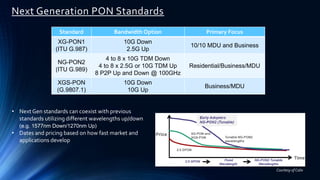
Next Generation PON Standards
Standard Bandwidth Option Primary Focus
XG-PON1
(ITU G.987)
10G Down
2.5G Up
10/10 MDU and Business
NG-PON2
(ITU G.989)
4 to 8 x 10G TDM Down
4 to 8 x 2.5G or 10G TDM Up
8 P2P Up and Down @ 100GHz
Residential/Business/MDU
XGS-PON
(G.9807.1)
10G Down
10G Up
Business/MDU
• Next Gen standards can coexist with previous
standards utilizing different wavelengths up/down
(e.g. 1577nm Down/1270nm Up)
• Dates and pricing based on how fast market and
applications develop
Courtesy of Calix
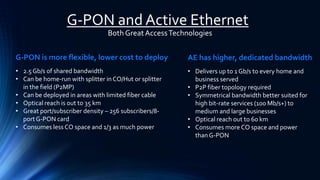
G-PON and Active Ethernet
Both GreatAccessTechnologies
G-PON is more flexible, lower cost to deploy AE has higher, dedicated bandwidth
• 2.5 Gb/s of shared bandwidth
• Can be home-run with splitter in CO/Hut or splitter
in the field (P2MP)
• Can be deployed in areas with limited fiber cable
• Optical reach is out to 35 km
• Great port/subscriber density – 256 subscribers/8-
portG-PON card
• Consumes less CO space and 1/3 as much power
• Delivers up to 1 Gb/s to every home and
business served
• P2P fiber topology required
• Symmetrical bandwidth better suited for
high bit-rate services (100 Mb/s+) to
medium and large businesses
• Optical reach out to 60 km
• Consumes more CO space and power
thanG-PON
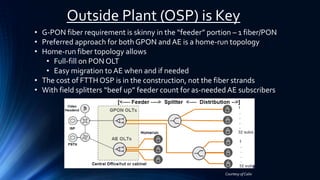
Outside Plant (OSP) is Key
• G-PON fiber requirement is skinny in the “feeder” portion – 1 fiber/PON
• Preferred approach for both GPON and AE is a home-run topology
• Home-run fiber topology allows
• Full-fill on PON OLT
• Easy migration to AE when and if needed
• The cost of FTTH OSP is in the construction, not the fiber strands
• With field splitters “beef up” feeder count for as-needed AE subscribers
Courtesy of Calix
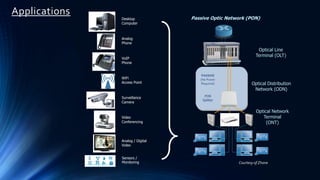
Passive Optic Network (PON)
Optical Line
Terminal (OLT)
Optical Network
Terminal
(ONT)
PASSIVE
(No Power
Required)
PON
Splitter
Analog
Phone
VoIP
Phone
WiFi
Access Point
Surveillance
Camera
Video
Conferencing
Desktop
Computer
Analog / Digital
Video
Sensors /
Monitoring
Applications
Courtesy of Zhone
Optical Distribution
Network (ODN)
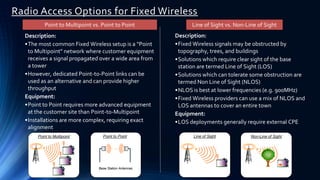
Point to Multipoint vs. Point to Point Line of Sight vs. Non-Line of Sight
Description:
•Fixed Wireless signals may be obstructed by
topography, trees, and buildings
•Solutions which require clear sight of the base
station are termed Line of Sight (LOS)
•Solutions which can tolerate some obstruction are
termed Non Line of Sight (NLOS)
•NLOS is best at lower frequencies (e.g. 900MHz)
•Fixed Wireless providers can use a mix of NLOS and
LOS antennas to cover an entire town
Equipment:
•LOS deployments generally require external CPE
Description:
•The most common Fixed Wireless setup is a “Point
to Multipoint” network where customer equipment
receives a signal propagated over a wide area from
a tower
•However, dedicated Point-to-Point links can be
used as an alternative and can provide higher
throughput
Equipment:
•Point to Point requires more advanced equipment
at the customer site than Point-to-Multipoint
•Installations are more complex, requiring exact
alignment
Point to Multipoint Point to Point
Base Station Antennas
Line of Sight Non-Line of Sight
Radio Access Options for Fixed Wireless
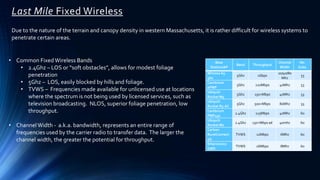
Last Mile Fixed Wireless
Base
Station/AP
Band Throughput
Channel
Width
No.
Subs.
Mimosa A5-
360
5Ghz 1Gbps
20/40/80
Mhz
53
Cambrium
ePMP
5Ghz 220Mbps 40Mhz 53
Ubiquiti
Rocket M5
5Ghz 150+Mbps 40Mhz 53
Ubiquiti
Rocket R5-AC
5Ghz 500+Mbps 80Mhz 53
Cambrium
PMP450
2.4Ghz 125Mbps 40Mhz 60
Ubiquiti
Rocket M2
2.4Ghz 150+Mbps ad 40mhz 60
Carlson
RuralConnect
3G
TVWS 12Mbps 6Mhz 60
6Harmonics
GWS
TVWS 26Mbps 8Mhz 60
• Common Fixed Wireless Bands
• 2.4Ghz – LOS or “soft obstacles”, allows for modest foliage
penetration
• 5Ghz – LOS, easily blocked by hills and foliage.
• TVWS – Frequencies made available for unlicensed use at locations
where the spectrum is not being used by licensed services, such as
television broadcasting. NLOS, superior foliage penetration, low
throughput.
• Channel Width - a.k.a. bandwidth, represents an entire range of
frequencies used by the carrier radio to transfer data. The larger the
channel width, the greater the potential for throughput.
Due to the nature of the terrain and canopy density in western Massachusetts, it is rather difficult for wireless systems to
penetrate certain areas.

understanding_ftth_architecture_to plan a fiber optic network

  • 1.
    Understanding FTTH Architecture TOPOLOGYAND COMPONENTS TODD M. CORCORAN, RTPM, CFHP T E C H N I C A L P R O G R A M M A N A G E R
  • 2.
    Q: What istopology? Q: What is meant by a Central Office or a Hut? A: In a FTTH system, the word “topology” in is most often used with the physical fiber plant or Outside Plant (OSP). A: The location where all major electronics for the system are housed for a given town. Q: What is meant by an OLT, ONT, and splitter? A: OLT - Optical Line Terminal, located in the CO or hut, is the interface to the customer and provides the subscribed services. ONT – Optical Line Terminal, located at the customer/subscribers location, converts the optical media being sent by the OLT. Splitter - A passive device that splits the light source in separate paths. Q: What is a PON? A: A Passive Optical Network that distributes an optical signal from the CO to the customer. Q: What is Active Ethernet? A: A technique that uses Ethernet (a data communications protocol) as the main transmission method over fiber optics with data rates up to 1 Gb/s. Understanding GeneralTerms Q: What is meant by G-PON? A: Gigabit PON is a system that handles data rates up to 2.5 Gb/s. Q: What is splice closure or case? A: A fiber management product that protects and houses optical splices.
  • 3.
    Fiber Cables forFTTx • Single-mode fiber (SMF) is used in a FTTx application • Optical fiber is the transmission component of the ODN Feeder Cables –These cables are the main cable(s) being routed through a populated area. Assemblies are normally fiber-rich, including fiber counts from 72 to 1,728 strands. Distribution Cables – Intermediate link between the feeder cable and the drop cable. Drop Cables –Traditional used outdoors and can be designed for aerial, direct buried, or ducted installations. Fiber counts can vary from 1-12 strands. OLT ONT Feeder Feeder Distribution Drop Splice Closure Splice Closure CO (Hut) Courtesy of Light Brigade
  • 4.
    Core Cladding CLEAN LightTransmitted The 3 basicprinciples that are critical to achieving an efficient fiber optic connection are: Fiber Connections • Perfect Core Alignment • Physical Contact • Pristine Connector Interface DIRT Core Cladding Back Reflection Insertion Loss Light CONTAMINATION is the #1 source of troubleshooting in optical networks. • A single particle mated into the core of a fiber can cause significant back reflection, insertion loss and even equipment damage. • Visual inspection of fiber optic connectors is the only way to determine if they are truly clean before mating them.
  • 5.
    Fiber Optic NetworkArchitectures • The selection of FTTH networks revolves around two primary paths – Passive Optical Network (PON) and Active Optical Network (AON), a.k.a. Active Ethernet • Passive Optical Network – Networks are classified as “passive” if they have no powered electrical devices between the laser source (OLT) and the end point (ONT). A splitter is used to divide the fiber for up to 128 subscribers, but the most common is 32 splits • Active Ethernet (AE) – “Active” means these networks have electrical device endpoints with direct connections, or “Point-to-Point” connections, to the subscriber One Fiber Feeds Many (P2MP) One Fiber Feeds One (P2P)
  • 6.
    Network Topology Physical topologiesfall into several easily identifiable configurations: • Point-to-point (P2P) • Bus (branch) • Star • Point-to-multipoint (P2MP) • Extended star • Distributed star • Ring • Dual-redundant ring • Mesh Depending on the design, terms line “star”, “bus”, “branch”, or “ring” may be used to describe a PON. The star topology is a natural for FTTP as it spreads out from a central splitter. Courtesy of Light Brigade, Inc.
  • 7.
    Point-to-Point Topology (P2P) •P2P topologies consist of a fiber run from the Central Office (CO), a.k.a. Point-of-Presence (PoP) or Hut location, to the end customer without any optical splitters in the network • Different from FTTH PON systems in that a dedicated bandwidth link is provided to an individual subscriber instead of being part of a shared PON • Active Ethernet (AE) uses a P2P topology Lightweight enclosure (Hut) Courtesy of Emerson Network Power P2P Fiber Subscriber’s Optical NetworkTerminal (ONT) Advantage: Easy to test and troubleshoot Disadvantage: OSP cost higher compared to PON
  • 8.
    Star Topology (P2MP) ONT OLT ONT ONT ONT ONT ONT ONT ONT •The star topology used in PON systems has a central transmission/reception point • Network traffic must pass through this central hub • Central hub can provide signal reconditioning and amplification • Easiest topology to implement and maintain as nodes can be added or removed Advantages: • Minimizes troubleshooting • No powered components in mid-span Disadvantages: • Power/Bandwidth divided between customers • Distance limited • Limited to no redundancy
  • 9.
    PON Star Configurations CentralOffice Split (Home Run) Centralized Split (Single Splitter) Distributed Star (Distributed Splitters) ONT OLT Patch Panel 1:32 ONT ONT ONT OLT FiberAccess Terminal (FAT) 1:32 ONT ONT ONT ONT • Splitter is placed in a single location in theOSP and each drop cable is routed directly to the subscriber. • Allows for maximum OLT utilization and future migration. • Lower operational expenditure as all changes occur in one location • Uses multiple splitters that are concatenated together along the length of one or more legs. • Minimizes amount of distribution, but requires careful planning and migration for growth. • Splitters are located at the CO (hut). • Requires fiber rich system throughout • Most costly to deploy • Lowest operational expenditures due to reduced need for truck rolls • Interchangeable for GPON andAE OLT FiberAccess Terminal (FAT) 1:8 ONT ONT ONT ONT 1:4
  • 10.
    Patch Panel Service shellCore shell Common shell Service port function Cross- connect function Media access control (MAC) ODN interface function OAM Power Network Components Primary piece of equipment in a PON system is the Optical LineTerminal (OLT) • Primarily located in CO, headend, node, or remote • Serves as an interface to the subscriber and Public SwitchedTelephone Network (PSTN) • One of the two powered units in the PON configuration • Responsible for the electro-optical conversion process • Consists of three separate parts: Service shell, Core shell and Common shell Responsible for insertion of ATM cells or Ethernet packets into upstream payload and extracting the cells and packets from the downstream payloads Provides connection verification between the OLT andONU/T Converts electronic signals and inserts Ethernet packets into the payload Provides network monitoring and management for fault indications, performance info, along with data and diagnostic functions Provides addressing and channel access control to allow several terminals to communicate within a multiple access network Supports a -48VDC, A & B input feeds
  • 11.
    Patch Panel Service shell Coreshell Common shell Service port function Customer and services mux/ demux function Media access control (MAC) ODN interface function OAM Power Network Components (con’t) Optical NetworkTerminal (ONT), Optical Network Unit (ONU), and NetworkTerminal (NT) are used synonymously to describe the end-user interface unit. • ONT and NT is mounted at the customer’s premise, while ONU is usually mounted in a curbside cabinet • Converts optical media from the OLT into an electronic format that interfaces with subscribers network • Similar to the OLT, the ONT consists of three separate parts: Service shell, Core shell and Common shell • Outdoor and indoor ONT are available at the subscriber location Provides optoelectical conversion of the service signal Electronic multiplexing/ demultiplexing for various services requested or available to the customer Provides customer interfaces to additional services provided by theOLT (e.g. Internet, voice, video) Provides network monitoring and management for fault indications, performance info, along with data and diagnostic functions Provides addressing and channel access control to allow several terminals to communicate within a multiple access network Supports line power into a battery back- up system. Subscriber ODN
  • 12.
    Network Components (con’t) CalixIndoor ONT AdtranTA5000 SeriesOLT Calix E7-2 OLT Calix Outdoor ONT Adtran Outdoor ONT Calix E7-20 OLT Nokia 7360 OLT Zhone MKX OLT’s Adtran Indoor ONT Indoor 24W, 12VDC ONT UPS Outdoor 24W, 12VDC ONT UPS
  • 13.
    Optical Line Terminal(OLT) Chassis Courtesy of Zhone Zhone 198 MKX 1U G-PON OLT Dimensions: 1.72” H x 17.4” W x 11.3” D • -48VDC, A & B input feeds • Fused at 2.5A • Serial craft management interface • 10/100Base-T management interface • Port status LEDs • Alarm Outputs/Inputs G-PON SFP SFP/XFP • (2) XFP-based 10Gb/s Ethernet • (8) RJ45 100/1000Mb/s Ethernet • (8) SFP-based 100/1000Mb/s Ethernet • (8) SFP-based GPON • 256 Subs @ 1:32 split
  • 14.
    Patch Panel Network Components(con’t) Optical Splitters (a.k.a optical couplers) • Are passive devices that do not require electrical-to-optical or optical-to-electrical conversion during its operation • Are critical to the Passive Optical Network • Splits an incoming light source into two separate paths • Repeating this split multiples the number of devices that can be connected to a single port • Reduces fiber count in the OSP (excluding a Central Office splitting scenario) • Ports are all equal • The light is replicated • Has no affect on bandwidth • Are wavelength independent couplers (WIC) and only add attenuation regardless of the wavelength or direction of the light. • Types of splitters • Fused Biconical Taper (FBT) – low split count • Planar Lightwave Circuits (PLC) – high split count • Splitters come in a number of configurations • 1x2, 1x4, 1x8, 1x16, 1x32, 1x64 • 2x2, 2x4, 2x8, 2x16, 2x32, 2x64
  • 15.
    High level pictureof where things go Aerial cable Underground cable Central Office /Hut Fiber to the Cell Site Fiber Access Terminal (FAT) Fiber Distribution Hub (w/ splitters) Drop cable Splice closures Courtesy of Zhone The FTTx Network – Macro View
  • 16.
    6 x 6Modular Enclosure (CO or Hut) • High efficiency “free air” system • R12 insulation, 120MPH wind rated, 200PSF live load rated roof • NetSure 721 DC Power system • 2 x 19” equipment racks included • 200A PowerTransfer Switch with 24pos load center, surge arrestor & camlok style generator connector • Wall and floor cable entrance • DC Lighting w/ motion controlled outside light • Door contact for intrusion • Smoke detector Courtesy of Emerson Network Power
  • 17.
    Enclosures and CableManagement Products Calix ODC-200 showing service and management compartments Fiber Distribution Hub (FDH) Aerial SpliceClosure FiberAccessTerminal (FAT) or Pedestal Vault or Handhole FiberTransition Terminal (FTT) ONT housing w/o ONT installed
  • 18.
    Active Ethernet (IEEE802.3) Architecture • Dedicated data rates of 10/100/1000 Mb/s upstream/downstream (symmetrical) • Requires a point-to-point fiber topology; a fiber rich OSP deployment • 10 to 60 km distance limitation • A 10 Gb/s connection to a subscriber is possible provided there was an appropriate port on the Ethernet router. Courtesy of Calix
  • 19.
    G-PON (ITU G-984)Architecture • Data rates up to 2.488 Gb/s downstream and 1.244 Gb/s upstream. • This standard allows for a maximum of a 128 way split (128 subscribers on a G-PON port). • The common split deployed is a 32 way split • 20 to 35 km distance limitation (B+, C+, C++ optics) from OLT to ONT • With 32 subscribers on a G-PON port (shared medium) each subscriber could receive sustainable bandwidth of approximately 80/40 Mb/s upstream/downstream. • Supports encrypted transmission in the downstream direction, such as the Advanced Encryption Standard or AES Courtesy of Calix
  • 20.
    Next Generation PONStandards Standard Bandwidth Option Primary Focus XG-PON1 (ITU G.987) 10G Down 2.5G Up 10/10 MDU and Business NG-PON2 (ITU G.989) 4 to 8 x 10G TDM Down 4 to 8 x 2.5G or 10G TDM Up 8 P2P Up and Down @ 100GHz Residential/Business/MDU XGS-PON (G.9807.1) 10G Down 10G Up Business/MDU • Next Gen standards can coexist with previous standards utilizing different wavelengths up/down (e.g. 1577nm Down/1270nm Up) • Dates and pricing based on how fast market and applications develop Courtesy of Calix
  • 21.
    G-PON and ActiveEthernet Both GreatAccessTechnologies G-PON is more flexible, lower cost to deploy AE has higher, dedicated bandwidth • 2.5 Gb/s of shared bandwidth • Can be home-run with splitter in CO/Hut or splitter in the field (P2MP) • Can be deployed in areas with limited fiber cable • Optical reach is out to 35 km • Great port/subscriber density – 256 subscribers/8- portG-PON card • Consumes less CO space and 1/3 as much power • Delivers up to 1 Gb/s to every home and business served • P2P fiber topology required • Symmetrical bandwidth better suited for high bit-rate services (100 Mb/s+) to medium and large businesses • Optical reach out to 60 km • Consumes more CO space and power thanG-PON
  • 22.
    Outside Plant (OSP)is Key • G-PON fiber requirement is skinny in the “feeder” portion – 1 fiber/PON • Preferred approach for both GPON and AE is a home-run topology • Home-run fiber topology allows • Full-fill on PON OLT • Easy migration to AE when and if needed • The cost of FTTH OSP is in the construction, not the fiber strands • With field splitters “beef up” feeder count for as-needed AE subscribers Courtesy of Calix
  • 23.
    Passive Optic Network(PON) Optical Line Terminal (OLT) Optical Network Terminal (ONT) PASSIVE (No Power Required) PON Splitter Analog Phone VoIP Phone WiFi Access Point Surveillance Camera Video Conferencing Desktop Computer Analog / Digital Video Sensors / Monitoring Applications Courtesy of Zhone Optical Distribution Network (ODN)
  • 24.
    Point to Multipointvs. Point to Point Line of Sight vs. Non-Line of Sight Description: •Fixed Wireless signals may be obstructed by topography, trees, and buildings •Solutions which require clear sight of the base station are termed Line of Sight (LOS) •Solutions which can tolerate some obstruction are termed Non Line of Sight (NLOS) •NLOS is best at lower frequencies (e.g. 900MHz) •Fixed Wireless providers can use a mix of NLOS and LOS antennas to cover an entire town Equipment: •LOS deployments generally require external CPE Description: •The most common Fixed Wireless setup is a “Point to Multipoint” network where customer equipment receives a signal propagated over a wide area from a tower •However, dedicated Point-to-Point links can be used as an alternative and can provide higher throughput Equipment: •Point to Point requires more advanced equipment at the customer site than Point-to-Multipoint •Installations are more complex, requiring exact alignment Point to Multipoint Point to Point Base Station Antennas Line of Sight Non-Line of Sight Radio Access Options for Fixed Wireless
  • 25.
    Last Mile FixedWireless Base Station/AP Band Throughput Channel Width No. Subs. Mimosa A5- 360 5Ghz 1Gbps 20/40/80 Mhz 53 Cambrium ePMP 5Ghz 220Mbps 40Mhz 53 Ubiquiti Rocket M5 5Ghz 150+Mbps 40Mhz 53 Ubiquiti Rocket R5-AC 5Ghz 500+Mbps 80Mhz 53 Cambrium PMP450 2.4Ghz 125Mbps 40Mhz 60 Ubiquiti Rocket M2 2.4Ghz 150+Mbps ad 40mhz 60 Carlson RuralConnect 3G TVWS 12Mbps 6Mhz 60 6Harmonics GWS TVWS 26Mbps 8Mhz 60 • Common Fixed Wireless Bands • 2.4Ghz – LOS or “soft obstacles”, allows for modest foliage penetration • 5Ghz – LOS, easily blocked by hills and foliage. • TVWS – Frequencies made available for unlicensed use at locations where the spectrum is not being used by licensed services, such as television broadcasting. NLOS, superior foliage penetration, low throughput. • Channel Width - a.k.a. bandwidth, represents an entire range of frequencies used by the carrier radio to transfer data. The larger the channel width, the greater the potential for throughput. Due to the nature of the terrain and canopy density in western Massachusetts, it is rather difficult for wireless systems to penetrate certain areas.