BASIC NUTRITION
NUTRITION
• science of food, the nutrients and other
substances therein, their action, interaction
and balance in relation to health and disease
and the process through which food is used to
sustain life and growth
• combination of processes by which a living
organism receives and utilizes substances
needed for the maintenance of its functions,
for growth and renewal of its components
FOOD
• any substance which when ingested,
nourishes the body by building and repairing
of tissues, supplying heat and energy, and
regulating body processes
• has nutritional and non-nutritional
components
NUTRIENT
• a chemical component needed by the body for
the following functions:
• to provide energy
• to build and repair tissues
• to regulate life processes
• Six Nutrients: protein, carbohydrate, fat,
minerals, vitamins, water
NUTRIENT CLASSIFICATION
I. According to Function
body-building: water, protein, fat, carbohydrate
and minerals
regulatory: all nutrients maintain homeostasis of
body fluids and expedite metabolic processes
energy-giving: carbohydrate, fat and protein →
“caloric or fuel nutrients”
NOTE: Water, vitamins and minerals do not yield
energy. → “non-caloric nutrients”
II. According to Chemical Nature
• organic - carbon-containing compounds;
carbohydrate, protein, fat and vitamins
• inorganic – water and minerals
III. According to Essentiality
• dietary essentials – nutrients that should be
supplied from food because the body does not
synthesize them
IV. According to Concentration
• macronutrients – nutrients that are present in
relatively large amounts in the body
- carbohydrate, protein, fat, water and major
minerals
• micronutrients – nutrients that are present in
the body in small amounts only
- vitamins and trace minerals
• NUTRITIONAL STATUS – the condition of the
body resulting from the utilization of essential
nutrients
- also known as nutriture
• NOTE: A person may be classified as having
good, fair or poor nutriture.
Categories of Nutriture:
• Optimum or Good Nutrition – means that the
body has adequate supply of essential
nutrients that are efficiently utilized such that
growth and good health are maintained at the
highest possible level
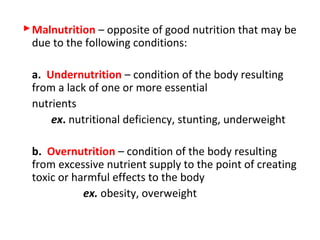
Malnutrition – opposite of good nutrition that may be
due to the following conditions:
a. Undernutrition – condition of the body resulting
from a lack of one or more essential
nutrients
ex. nutritional deficiency, stunting, underweight
b. Overnutrition – condition of the body resulting
from excessive nutrient supply to the point of creating
toxic or harmful effects to the body
ex. obesity, overweight
Factors that causes malnutrition:
1. Primary factor – refers to a faulty diet
2. Secondary factor – all conditions within the
body that reduces the ultimate of nutrients to
the cells after the food goes beyond the mouth
– Factors that interfere with normal digestion : ex. lack
of appetite, poor teeth
– Factors that affect metabolism: ex. malignancy,
alcoholism, diabetes
– Factors that increase excretion: ex. excessive
perspiration

Basic nutrition

  • 1.
  • 2.
    NUTRITION • science offood, the nutrients and other substances therein, their action, interaction and balance in relation to health and disease and the process through which food is used to sustain life and growth • combination of processes by which a living organism receives and utilizes substances needed for the maintenance of its functions, for growth and renewal of its components
  • 3.
    FOOD • any substancewhich when ingested, nourishes the body by building and repairing of tissues, supplying heat and energy, and regulating body processes • has nutritional and non-nutritional components
  • 4.
    NUTRIENT • a chemicalcomponent needed by the body for the following functions: • to provide energy • to build and repair tissues • to regulate life processes • Six Nutrients: protein, carbohydrate, fat, minerals, vitamins, water
  • 5.
    NUTRIENT CLASSIFICATION I. Accordingto Function body-building: water, protein, fat, carbohydrate and minerals regulatory: all nutrients maintain homeostasis of body fluids and expedite metabolic processes energy-giving: carbohydrate, fat and protein → “caloric or fuel nutrients” NOTE: Water, vitamins and minerals do not yield energy. → “non-caloric nutrients”
  • 6.
    II. According toChemical Nature • organic - carbon-containing compounds; carbohydrate, protein, fat and vitamins • inorganic – water and minerals
  • 7.
    III. According toEssentiality • dietary essentials – nutrients that should be supplied from food because the body does not synthesize them
  • 8.
    IV. According toConcentration • macronutrients – nutrients that are present in relatively large amounts in the body - carbohydrate, protein, fat, water and major minerals • micronutrients – nutrients that are present in the body in small amounts only - vitamins and trace minerals
  • 9.
    • NUTRITIONAL STATUS– the condition of the body resulting from the utilization of essential nutrients - also known as nutriture • NOTE: A person may be classified as having good, fair or poor nutriture.
  • 10.
    Categories of Nutriture: •Optimum or Good Nutrition – means that the body has adequate supply of essential nutrients that are efficiently utilized such that growth and good health are maintained at the highest possible level
  • 11.
    Malnutrition – oppositeof good nutrition that may be due to the following conditions: a. Undernutrition – condition of the body resulting from a lack of one or more essential nutrients ex. nutritional deficiency, stunting, underweight b. Overnutrition – condition of the body resulting from excessive nutrient supply to the point of creating toxic or harmful effects to the body ex. obesity, overweight
  • 12.
    Factors that causesmalnutrition: 1. Primary factor – refers to a faulty diet 2. Secondary factor – all conditions within the body that reduces the ultimate of nutrients to the cells after the food goes beyond the mouth – Factors that interfere with normal digestion : ex. lack of appetite, poor teeth – Factors that affect metabolism: ex. malignancy, alcoholism, diabetes – Factors that increase excretion: ex. excessive perspiration