PRESENTED BY,
MRS. SANAMBI SHAIKH
MSC NURSING (OBG)
INTRODUCTION
Nutrition is a basic human need & a prerequisite for healthy life. A proper diet
is essential from very early age of life for growth, development and active
life. The word nutrition derived from Latin word “Nutrious” which means
“To nourish” or “ To cherish.”
• Father of nutrition – Antoine Lavoisier
• National institute of nutrition – Hyderabad
 Nutrition – it may be defined as the science of food and its relationship to
health.
 Nutrition is “The science of foods, the nutrients and other substances there
in, their action, interaction and balance in relationship to health and
disease, the process by which the organism ingests, digests, absorbs,
transports and utilizes nutrients and disposes of their end products.”
 Health – according to WHO health is defined as the “ state of complete
physical, mental, social well being and not merely an absence of disease or
infirmity.”
 Dietetics – dietetics is the practical application of the principles of
nutrition. It includes the planning of meals for well and the sick.
 Nutrient – a substance essential for the growth, maintenance, function and
reproduction of a cell or of an organism.
 Macronutrient – required in large quantity and form the bulk of our food
e.g. proteins, fats, carbohydrates.
 Micronutrients – required in small amounts but play an important role in
the regulation of metabolic activities e.g. vitamins and minerals.
 Malnutrition – impairment of health resulting from a deficiency, excess or
imbalance of nutrients.
 Under nutrition - is the deficiency of calories and of one or more
essential nutrients.
 Over nutrition – is an excess of one or more nutrients and usually of
calories.
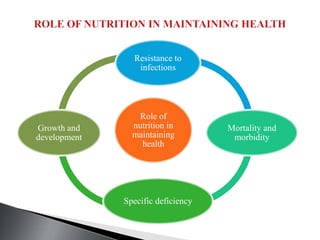
Role of
nutrition in
maintaining
health
Resistance to
infections
Mortality and
morbidity
Specific deficiency
Growth and
development
 Basal metabolic rate
 Weight
 Age
 Sex
 Climate and environment
 Physical activities
 Physiological state
 Socio economic factors
 Cultural factors
 Life style and food habits
 Food fads
 Cooking practices
 Child rearing practices
 Religion
 Traditional factors
 Nutrients are chemical substances found in food that are required by the
body to provide energy, give the body structure and help regulate chemical
processes.
 There are 6 classes of nutrients :
1. Carbohydrates
2. Lipids
3. Proteins
4. Water
5. Vitamins
6. Minerals
Nutrients can be further classified as either macronutrients or micronutrients
and either organic or inorganic.
 Nutrients that are needed in large amounts are called macronutrients.
 There are 3 classes of macronutrients : carbohydrates, lipid and proteins,
water.
MICRONUTRIENTS
 Micronutrients are nutrients required by the body in smaller amounts, but
they are still essential for carrying out bodily functions.
 Micronutrients include all the essential minerals, vitamins.
 Minerals are inorganic nutrients and vitamins are organic nutrients.
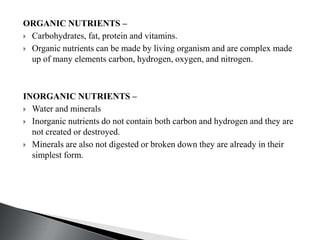
ORGANIC NUTRIENTS –
 Carbohydrates, fat, protein and vitamins.
 Organic nutrients can be made by living organism and are complex made
up of many elements carbon, hydrogen, oxygen, and nitrogen.
INORGANIC NUTRIENTS –
 Water and minerals
 Inorganic nutrients do not contain both carbon and hydrogen and they are
not created or destroyed.
 Minerals are also not digested or broken down they are already in their
simplest form.
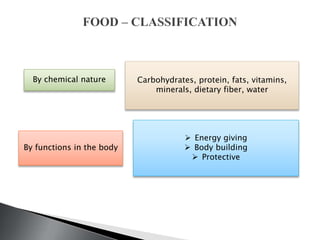
By chemical nature Carbohydrates, protein, fats, vitamins,
minerals, dietary fiber, water
By functions in the body
 Energy giving
 Body building
 Protective
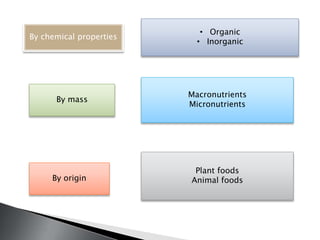
By chemical properties
• Organic
• Inorganic
By mass
Macronutrients
Micronutrients
By origin
Plant foods
Animal foods
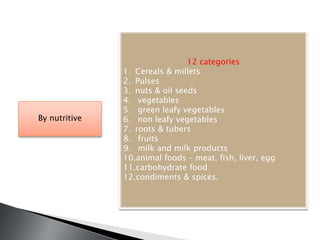
By nutritive
12 categories
1. Cereals & millets
2. Pulses
3. nuts & oil seeds
4. vegetables
5. green leafy vegetables
6. non leafy vegetables
7. roots & tubers
8. fruits
9. milk and milk products
10.animal foods – meat, fish, liver, egg
11.carbohydrate food
12.condiments & spices.
1. Shubhangi Joshi, Nutrition and Dietetics 2 nd edition, Tata McGraw –
Hill publishing company Limited, New Delhi, 2002.
2. Darshan sohi, A text book of Nutrition 5 th edition, S. Vikas & company
(Medical Publishers) India.