Dr. Vir Vikram
M.Pharm. PhD
E-mail ID - virvikram76@gmail.com
DEFINITION
 The existence of confusing drug names is one of
the most common causes of medication error and is
of concern worldwide
 Some proprietary (brand name) and non-proprietary
names (generic name) sound or appear to be
similar to other drugs when written or spoken.
 These confusing drug names are one of the main causes
of medication error. There are many sound and look alike
drugs that would result in medication error. These errors
may cause harm or even death to patients.
 According to the results from United States
Pharmacopoeia, around 1400 commonly used
medications were involved in such errors.
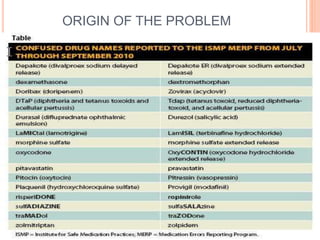
ORIGIN OF THE PROBLEM
SOURCE OF ERROR
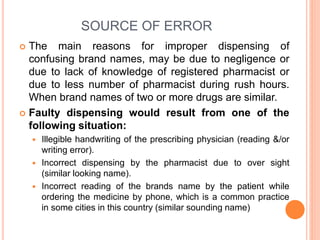
 The main reasons for improper dispensing of
confusing brand names, may be due to negligence or
due to lack of knowledge of registered pharmacist or
due to less number of pharmacist during rush hours.
When brand names of two or more drugs are similar.
 Faulty dispensing would result from one of the
following situation:
 Illegible handwriting of the prescribing physician (reading &/or
writing error).
 Incorrect dispensing by the pharmacist due to over sight
(similar looking name).
 Incorrect reading of the brands name by the patient while
ordering the medicine by phone, which is a common practice
in some cities in this country (similar sounding name)
ERROR PRONE DRUG PAIRS
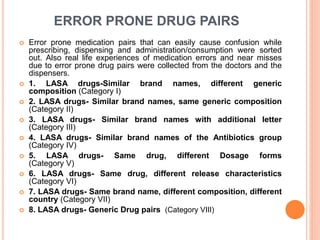
 Error prone medication pairs that can easily cause confusion while
prescribing, dispensing and administration/consumption were sorted
out. Also real life experiences of medication errors and near misses
due to error prone drug pairs were collected from the doctors and the
dispensers.
 1. LASA drugs-Similar brand names, different generic
composition (Category I)
 2. LASA drugs- Similar brand names, same generic composition
(Category II)
 3. LASA drugs- Similar brand names with additional letter
(Category III)
 4. LASA drugs- Similar brand names of the Antibiotics group
(Category IV)
 5. LASA drugs- Same drug, different Dosage forms
(Category V)
 6. LASA drugs- Same drug, different release characteristics
(Category VI)
 7. LASA drugs- Same brand name, different composition, different
country (Category VII)
 8. LASA drugs- Generic Drug pairs (Category VIII)
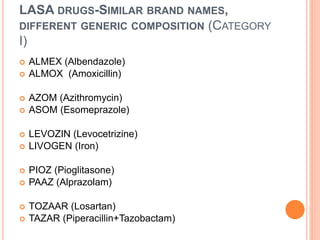
LASA DRUGS-SIMILAR BRAND NAMES,
DIFFERENT GENERIC COMPOSITION (CATEGORY
I)
 ALMEX (Albendazole)
 ALMOX (Amoxicillin)
 AZOM (Azithromycin)
 ASOM (Esomeprazole)
 LEVOZIN (Levocetrizine)
 LIVOGEN (Iron)
 PIOZ (Pioglitasone)
 PAAZ (Alprazolam)
 TOZAAR (Losartan)
 TAZAR (Piperacillin+Tazobactam)
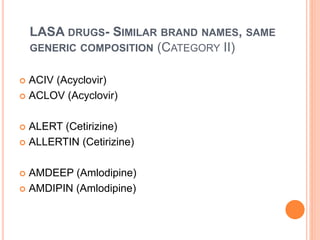
LASA DRUGS- SIMILAR BRAND NAMES, SAME
GENERIC COMPOSITION (CATEGORY II)
 ACIV (Acyclovir)
 ACLOV (Acyclovir)
 ALERT (Cetirizine)
 ALLERTIN (Cetirizine)
 AMDEEP (Amlodipine)
 AMDIPIN (Amlodipine)
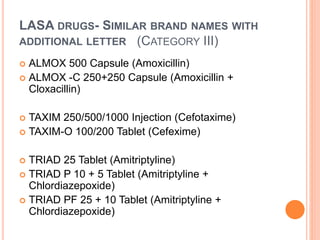
LASA DRUGS- SIMILAR BRAND NAMES WITH
ADDITIONAL LETTER (CATEGORY III)
 ALMOX 500 Capsule (Amoxicillin)
 ALMOX -C 250+250 Capsule (Amoxicillin +
Cloxacillin)
 TAXIM 250/500/1000 Injection (Cefotaxime)
 TAXIM-O 100/200 Tablet (Cefexime)
 TRIAD 25 Tablet (Amitriptyline)
 TRIAD P 10 + 5 Tablet (Amitriptyline +
Chlordiazepoxide)
 TRIAD PF 25 + 10 Tablet (Amitriptyline +
Chlordiazepoxide)
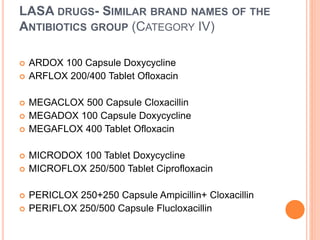
LASA DRUGS- SIMILAR BRAND NAMES OF THE
ANTIBIOTICS GROUP (CATEGORY IV)
 ARDOX 100 Capsule Doxycycline
 ARFLOX 200/400 Tablet Ofloxacin
 MEGACLOX 500 Capsule Cloxacillin
 MEGADOX 100 Capsule Doxycycline
 MEGAFLOX 400 Tablet Ofloxacin
 MICRODOX 100 Tablet Doxycycline
 MICROFLOX 250/500 Tablet Ciprofloxacin
 PERICLOX 250+250 Capsule Ampicillin+ Cloxacillin
 PERIFLOX 250/500 Capsule Flucloxacillin
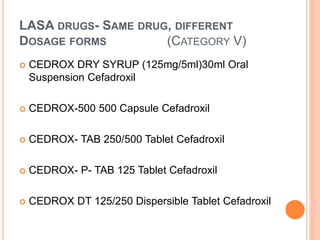
LASA DRUGS- SAME DRUG, DIFFERENT
DOSAGE FORMS (CATEGORY V)
 CEDROX DRY SYRUP (125mg/5ml)30ml Oral
Suspension Cefadroxil
 CEDROX-500 500 Capsule Cefadroxil
 CEDROX- TAB 250/500 Tablet Cefadroxil
 CEDROX- P- TAB 125 Tablet Cefadroxil
 CEDROX DT 125/250 Dispersible Tablet Cefadroxil
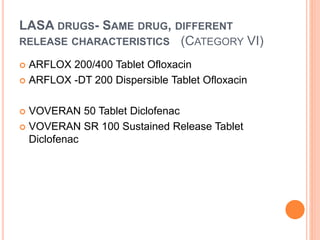
LASA DRUGS- SAME DRUG, DIFFERENT
RELEASE CHARACTERISTICS (CATEGORY VI)
 ARFLOX 200/400 Tablet Ofloxacin
 ARFLOX -DT 200 Dispersible Tablet Ofloxacin
 VOVERAN 50 Tablet Diclofenac
 VOVERAN SR 100 Sustained Release Tablet
Diclofenac
LASA DRUGS- SAME BRAND NAME, DIFFERENT
COMPOSITION, DIFFERENT COUNTRY
(CATEGORY VII)
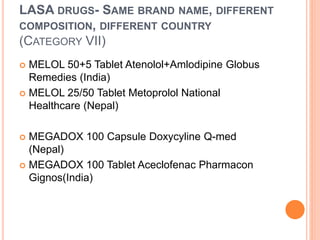
 MELOL 50+5 Tablet Atenolol+Amlodipine Globus
Remedies (India)
 MELOL 25/50 Tablet Metoprolol National
Healthcare (Nepal)
 MEGADOX 100 Capsule Doxycyline Q-med
(Nepal)
 MEGADOX 100 Tablet Aceclofenac Pharmacon
Gignos(India)
LASA DRUGS- GENERIC DRUG PAIRS
(CATEGORY VIII)
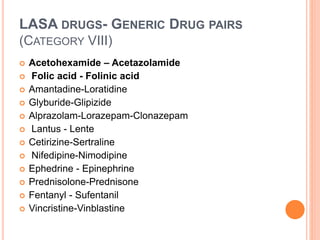
 Acetohexamide – Acetazolamide
 Folic acid - Folinic acid
 Amantadine-Loratidine
 Glyburide-Glipizide
 Alprazolam-Lorazepam-Clonazepam
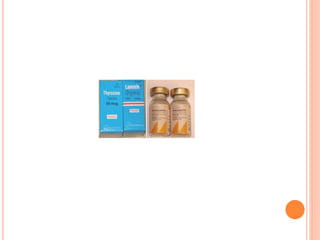
 Lantus - Lente
 Cetirizine-Sertraline
 Nifedipine-Nimodipine
 Ephedrine - Epinephrine
 Prednisolone-Prednisone
 Fentanyl - Sufentanil
 Vincristine-Vinblastine
RISK FOR ERROR AND ADE
 Error producing conditions
 Likelihood of error occurring
 Environment and processes of care
 Drug(s) involved
 Patient characteristic(s)
 Nature and type of error
ANY OR ALL CHARACTERISTICS OF A DRUG
PRODUCT CAN INCREASE OR DECREASE RISK, AND
MUST BE CONSIDERED IN RISK ASSESSMENT:
 Generic name, brand name
 Dose, strength(s), dose form, packaging
 Route, frequency, instructions
 Storage requirements
 Indications, patient population
 Likely care environment
 Other
PREDICTABLE PROBLEMS:
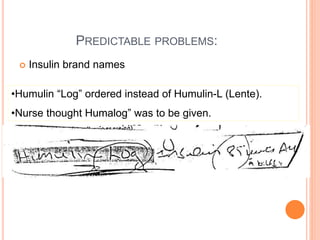
 Insulin brand names
•Humulin “Log” ordered instead of Humulin-L (Lente).
•Nurse thought Humalog” was to be given.
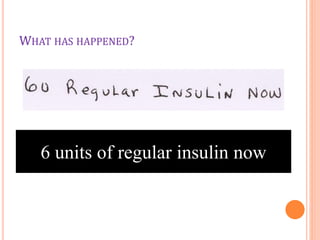
WHAT HAS HAPPENED?
6 units of regular insulin now
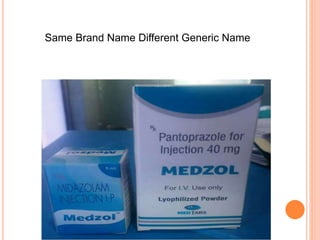
Same Brand Name Different Generic Name
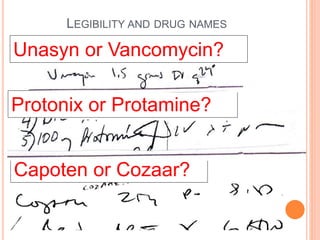
LEGIBILITY AND DRUG NAMES
Capoten or Cozaar?
Protonix or Protamine?
Unasyn or Vancomycin?
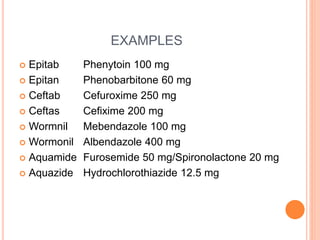
EXAMPLES
 Epitab Phenytoin 100 mg
 Epitan Phenobarbitone 60 mg
 Ceftab Cefuroxime 250 mg
 Ceftas Cefixime 200 mg
 Wormnil Mebendazole 100 mg
 Wormonil Albendazole 400 mg
 Aquamide Furosemide 50 mg/Spironolactone 20 mg
 Aquazide Hydrochlorothiazide 12.5 mg
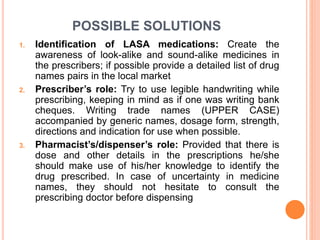
POSSIBLE SOLUTIONS
1. Identification of LASA medications: Create the
awareness of look-alike and sound-alike medicines in
the prescribers; if possible provide a detailed list of drug
names pairs in the local market
2. Prescriber’s role: Try to use legible handwriting while
prescribing, keeping in mind as if one was writing bank
cheques. Writing trade names (UPPER CASE)
accompanied by generic names, dosage form, strength,
directions and indication for use when possible.
3. Pharmacist’s/dispenser’s role: Provided that there is
dose and other details in the prescriptions he/she
should make use of his/her knowledge to identify the
drug prescribed. In case of uncertainty in medicine
names, they should not hesitate to consult the
prescribing doctor before dispensing
4. Patient’s role: Literate patients can themselves check if
the dispensed product is the same as prescribed. Patients
who cannot read and write should better consult other
sources for verification before taking the medicines.
5. Hospital’s or institution’s role: Provide education on
potential LASA medicines. continuing professional
development for health-care professionals and annually
review the list of LASA medicines used in the institution.
Try and reduce the medical transcription by the nursing
staff and rather initiate dispensing only against a proper
prescription by a licensed doctor. Use of printed order or
electronic prescribing. the less important drug in the LASA
pair can be removed.
6. Manufacturer’s and regulatory agency’s role: The
manufacturers and regulatory agencies both should work
together hand in hand to avoid confusion right at the time
of naming their products.
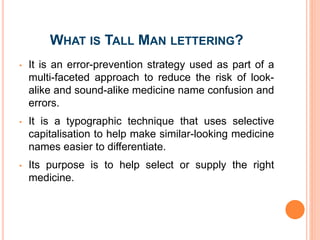
WHAT IS TALL MAN LETTERING?
• It is an error-prevention strategy used as part of a
multi-faceted approach to reduce the risk of look-
alike and sound-alike medicine name confusion and
errors.
• It is a typographic technique that uses selective
capitalisation to help make similar-looking medicine
names easier to differentiate.
• Its purpose is to help select or supply the right
medicine.
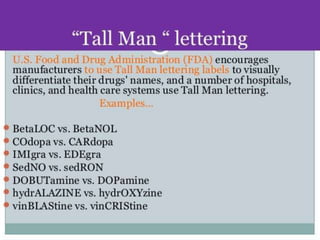
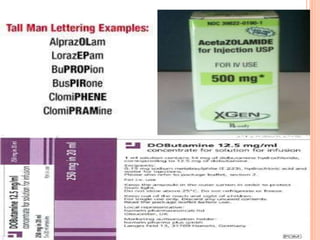
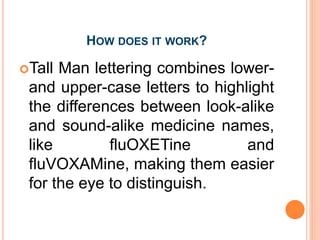
HOW DOES IT WORK?
Tall Man lettering combines lower-
and upper-case letters to highlight
the differences between look-alike
and sound-alike medicine names,
like fluOXETine and
fluVOXAMine, making them easier
for the eye to distinguish.
PATIENT SAFETY SOLUTION.
Pharmacist/nurses
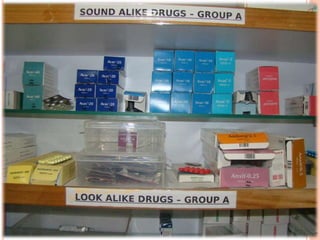
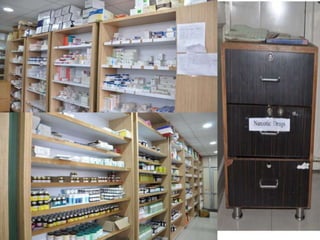
 Keeping LASA drugs separated from one another
 Double checking of drugs
 Contacting the physician in case of any clarification
regarding the prescription
 Becoming familiar with LASA drugs
 Minimize the use of verbal and telephone orders.
ON THE CLOSING NOTE
 It is very important that we circulate the list of confusing brand
names among the practicing doctors, pharmacists and also to the
drug manufacturers. Preventing confusion between already
marketed products typically involves collecting voluntary reports
of names involved in confusion errors, posting warnings and
alerts both electronically and in areas where drugs are used.
 The fear of malpractice lawsuits and public embarrassment has
made the physicians and nurses reluctant to report medication
errors. It is more important to create the open environment that
encourages the reporting of errors than to develop less
meaningful comparative error rates.
 One possible approach to improving medical error reporting
involves the use of anonymous standardized reporting systems.
This type of system should also enable internal tracking, trending
and comparative analyses. We need to have such systems in
India.
36
37
38
39
Lecture on youtube about LASA (look alike sound alike) Drugs
https://www.youtube.com/watch?v=YJ5LfFyee70 my lecture on
youtube VTS 01 1
look alike and sound alike drugs
YOUTUBE.COM
QUESTIONS & QUERIES ?????
LASA  drugs

LASA drugs

  • 1.
    Dr. Vir Vikram M.Pharm.PhD E-mail ID - virvikram76@gmail.com
  • 2.
    DEFINITION  The existenceof confusing drug names is one of the most common causes of medication error and is of concern worldwide  Some proprietary (brand name) and non-proprietary names (generic name) sound or appear to be similar to other drugs when written or spoken.
  • 3.
     These confusingdrug names are one of the main causes of medication error. There are many sound and look alike drugs that would result in medication error. These errors may cause harm or even death to patients.  According to the results from United States Pharmacopoeia, around 1400 commonly used medications were involved in such errors.
  • 5.
  • 6.
    SOURCE OF ERROR The main reasons for improper dispensing of confusing brand names, may be due to negligence or due to lack of knowledge of registered pharmacist or due to less number of pharmacist during rush hours. When brand names of two or more drugs are similar.  Faulty dispensing would result from one of the following situation:  Illegible handwriting of the prescribing physician (reading &/or writing error).  Incorrect dispensing by the pharmacist due to over sight (similar looking name).  Incorrect reading of the brands name by the patient while ordering the medicine by phone, which is a common practice in some cities in this country (similar sounding name)
  • 7.
    ERROR PRONE DRUGPAIRS  Error prone medication pairs that can easily cause confusion while prescribing, dispensing and administration/consumption were sorted out. Also real life experiences of medication errors and near misses due to error prone drug pairs were collected from the doctors and the dispensers.  1. LASA drugs-Similar brand names, different generic composition (Category I)  2. LASA drugs- Similar brand names, same generic composition (Category II)  3. LASA drugs- Similar brand names with additional letter (Category III)  4. LASA drugs- Similar brand names of the Antibiotics group (Category IV)  5. LASA drugs- Same drug, different Dosage forms (Category V)  6. LASA drugs- Same drug, different release characteristics (Category VI)  7. LASA drugs- Same brand name, different composition, different country (Category VII)  8. LASA drugs- Generic Drug pairs (Category VIII)
  • 8.
    LASA DRUGS-SIMILAR BRANDNAMES, DIFFERENT GENERIC COMPOSITION (CATEGORY I)  ALMEX (Albendazole)  ALMOX (Amoxicillin)  AZOM (Azithromycin)  ASOM (Esomeprazole)  LEVOZIN (Levocetrizine)  LIVOGEN (Iron)  PIOZ (Pioglitasone)  PAAZ (Alprazolam)  TOZAAR (Losartan)  TAZAR (Piperacillin+Tazobactam)
  • 9.
    LASA DRUGS- SIMILARBRAND NAMES, SAME GENERIC COMPOSITION (CATEGORY II)  ACIV (Acyclovir)  ACLOV (Acyclovir)  ALERT (Cetirizine)  ALLERTIN (Cetirizine)  AMDEEP (Amlodipine)  AMDIPIN (Amlodipine)
  • 10.
    LASA DRUGS- SIMILARBRAND NAMES WITH ADDITIONAL LETTER (CATEGORY III)  ALMOX 500 Capsule (Amoxicillin)  ALMOX -C 250+250 Capsule (Amoxicillin + Cloxacillin)  TAXIM 250/500/1000 Injection (Cefotaxime)  TAXIM-O 100/200 Tablet (Cefexime)  TRIAD 25 Tablet (Amitriptyline)  TRIAD P 10 + 5 Tablet (Amitriptyline + Chlordiazepoxide)  TRIAD PF 25 + 10 Tablet (Amitriptyline + Chlordiazepoxide)
  • 11.
    LASA DRUGS- SIMILARBRAND NAMES OF THE ANTIBIOTICS GROUP (CATEGORY IV)  ARDOX 100 Capsule Doxycycline  ARFLOX 200/400 Tablet Ofloxacin  MEGACLOX 500 Capsule Cloxacillin  MEGADOX 100 Capsule Doxycycline  MEGAFLOX 400 Tablet Ofloxacin  MICRODOX 100 Tablet Doxycycline  MICROFLOX 250/500 Tablet Ciprofloxacin  PERICLOX 250+250 Capsule Ampicillin+ Cloxacillin  PERIFLOX 250/500 Capsule Flucloxacillin
  • 12.
    LASA DRUGS- SAMEDRUG, DIFFERENT DOSAGE FORMS (CATEGORY V)  CEDROX DRY SYRUP (125mg/5ml)30ml Oral Suspension Cefadroxil  CEDROX-500 500 Capsule Cefadroxil  CEDROX- TAB 250/500 Tablet Cefadroxil  CEDROX- P- TAB 125 Tablet Cefadroxil  CEDROX DT 125/250 Dispersible Tablet Cefadroxil
  • 13.
    LASA DRUGS- SAMEDRUG, DIFFERENT RELEASE CHARACTERISTICS (CATEGORY VI)  ARFLOX 200/400 Tablet Ofloxacin  ARFLOX -DT 200 Dispersible Tablet Ofloxacin  VOVERAN 50 Tablet Diclofenac  VOVERAN SR 100 Sustained Release Tablet Diclofenac
  • 14.
    LASA DRUGS- SAMEBRAND NAME, DIFFERENT COMPOSITION, DIFFERENT COUNTRY (CATEGORY VII)  MELOL 50+5 Tablet Atenolol+Amlodipine Globus Remedies (India)  MELOL 25/50 Tablet Metoprolol National Healthcare (Nepal)  MEGADOX 100 Capsule Doxycyline Q-med (Nepal)  MEGADOX 100 Tablet Aceclofenac Pharmacon Gignos(India)
  • 15.
    LASA DRUGS- GENERICDRUG PAIRS (CATEGORY VIII)  Acetohexamide – Acetazolamide  Folic acid - Folinic acid  Amantadine-Loratidine  Glyburide-Glipizide  Alprazolam-Lorazepam-Clonazepam  Lantus - Lente  Cetirizine-Sertraline  Nifedipine-Nimodipine  Ephedrine - Epinephrine  Prednisolone-Prednisone  Fentanyl - Sufentanil  Vincristine-Vinblastine
  • 16.
    RISK FOR ERRORAND ADE  Error producing conditions  Likelihood of error occurring  Environment and processes of care  Drug(s) involved  Patient characteristic(s)  Nature and type of error
  • 17.
    ANY OR ALLCHARACTERISTICS OF A DRUG PRODUCT CAN INCREASE OR DECREASE RISK, AND MUST BE CONSIDERED IN RISK ASSESSMENT:  Generic name, brand name  Dose, strength(s), dose form, packaging  Route, frequency, instructions  Storage requirements  Indications, patient population  Likely care environment  Other
  • 18.
    PREDICTABLE PROBLEMS:  Insulinbrand names •Humulin “Log” ordered instead of Humulin-L (Lente). •Nurse thought Humalog” was to be given.
  • 19.
    WHAT HAS HAPPENED? 6units of regular insulin now
  • 20.
    Same Brand NameDifferent Generic Name
  • 21.
    LEGIBILITY AND DRUGNAMES Capoten or Cozaar? Protonix or Protamine? Unasyn or Vancomycin?
  • 22.
    EXAMPLES  Epitab Phenytoin100 mg  Epitan Phenobarbitone 60 mg  Ceftab Cefuroxime 250 mg  Ceftas Cefixime 200 mg  Wormnil Mebendazole 100 mg  Wormonil Albendazole 400 mg  Aquamide Furosemide 50 mg/Spironolactone 20 mg  Aquazide Hydrochlorothiazide 12.5 mg
  • 23.
    POSSIBLE SOLUTIONS 1. Identificationof LASA medications: Create the awareness of look-alike and sound-alike medicines in the prescribers; if possible provide a detailed list of drug names pairs in the local market 2. Prescriber’s role: Try to use legible handwriting while prescribing, keeping in mind as if one was writing bank cheques. Writing trade names (UPPER CASE) accompanied by generic names, dosage form, strength, directions and indication for use when possible. 3. Pharmacist’s/dispenser’s role: Provided that there is dose and other details in the prescriptions he/she should make use of his/her knowledge to identify the drug prescribed. In case of uncertainty in medicine names, they should not hesitate to consult the prescribing doctor before dispensing
  • 24.
    4. Patient’s role:Literate patients can themselves check if the dispensed product is the same as prescribed. Patients who cannot read and write should better consult other sources for verification before taking the medicines. 5. Hospital’s or institution’s role: Provide education on potential LASA medicines. continuing professional development for health-care professionals and annually review the list of LASA medicines used in the institution. Try and reduce the medical transcription by the nursing staff and rather initiate dispensing only against a proper prescription by a licensed doctor. Use of printed order or electronic prescribing. the less important drug in the LASA pair can be removed. 6. Manufacturer’s and regulatory agency’s role: The manufacturers and regulatory agencies both should work together hand in hand to avoid confusion right at the time of naming their products.
  • 25.
    WHAT IS TALLMAN LETTERING? • It is an error-prevention strategy used as part of a multi-faceted approach to reduce the risk of look- alike and sound-alike medicine name confusion and errors. • It is a typographic technique that uses selective capitalisation to help make similar-looking medicine names easier to differentiate. • Its purpose is to help select or supply the right medicine.
  • 28.
    HOW DOES ITWORK? Tall Man lettering combines lower- and upper-case letters to highlight the differences between look-alike and sound-alike medicine names, like fluOXETine and fluVOXAMine, making them easier for the eye to distinguish.
  • 29.
    PATIENT SAFETY SOLUTION. Pharmacist/nurses Keeping LASA drugs separated from one another  Double checking of drugs  Contacting the physician in case of any clarification regarding the prescription  Becoming familiar with LASA drugs  Minimize the use of verbal and telephone orders.
  • 30.
    ON THE CLOSINGNOTE  It is very important that we circulate the list of confusing brand names among the practicing doctors, pharmacists and also to the drug manufacturers. Preventing confusion between already marketed products typically involves collecting voluntary reports of names involved in confusion errors, posting warnings and alerts both electronically and in areas where drugs are used.  The fear of malpractice lawsuits and public embarrassment has made the physicians and nurses reluctant to report medication errors. It is more important to create the open environment that encourages the reporting of errors than to develop less meaningful comparative error rates.  One possible approach to improving medical error reporting involves the use of anonymous standardized reporting systems. This type of system should also enable internal tracking, trending and comparative analyses. We need to have such systems in India.


  • 36.
  • 37.
  • 38.
  • 39.
  • 40.
    Lecture on youtubeabout LASA (look alike sound alike) Drugs https://www.youtube.com/watch?v=YJ5LfFyee70 my lecture on youtube VTS 01 1 look alike and sound alike drugs YOUTUBE.COM
  • 41.