1
Hole’s Human Anatomy
and Physiology
Twelfth Edition
Shier  Butler  Lewis
Chapter 1
Introduction to Human
Anatomy & Physiology
Copyright © The McGraw-Hill Companies, Inc. Permission required for reproduction or display.
2
1.1: Introduction
• Questions and observations that have led to
knowledge.
• Knowledge about structure and function of the
human body.
3
1.2: Anatomy & Physiology
• Anatomy – the study of the structure of the human body
• Physiology – the study of the function of the human body
“The complementarity of structure and function.”
4
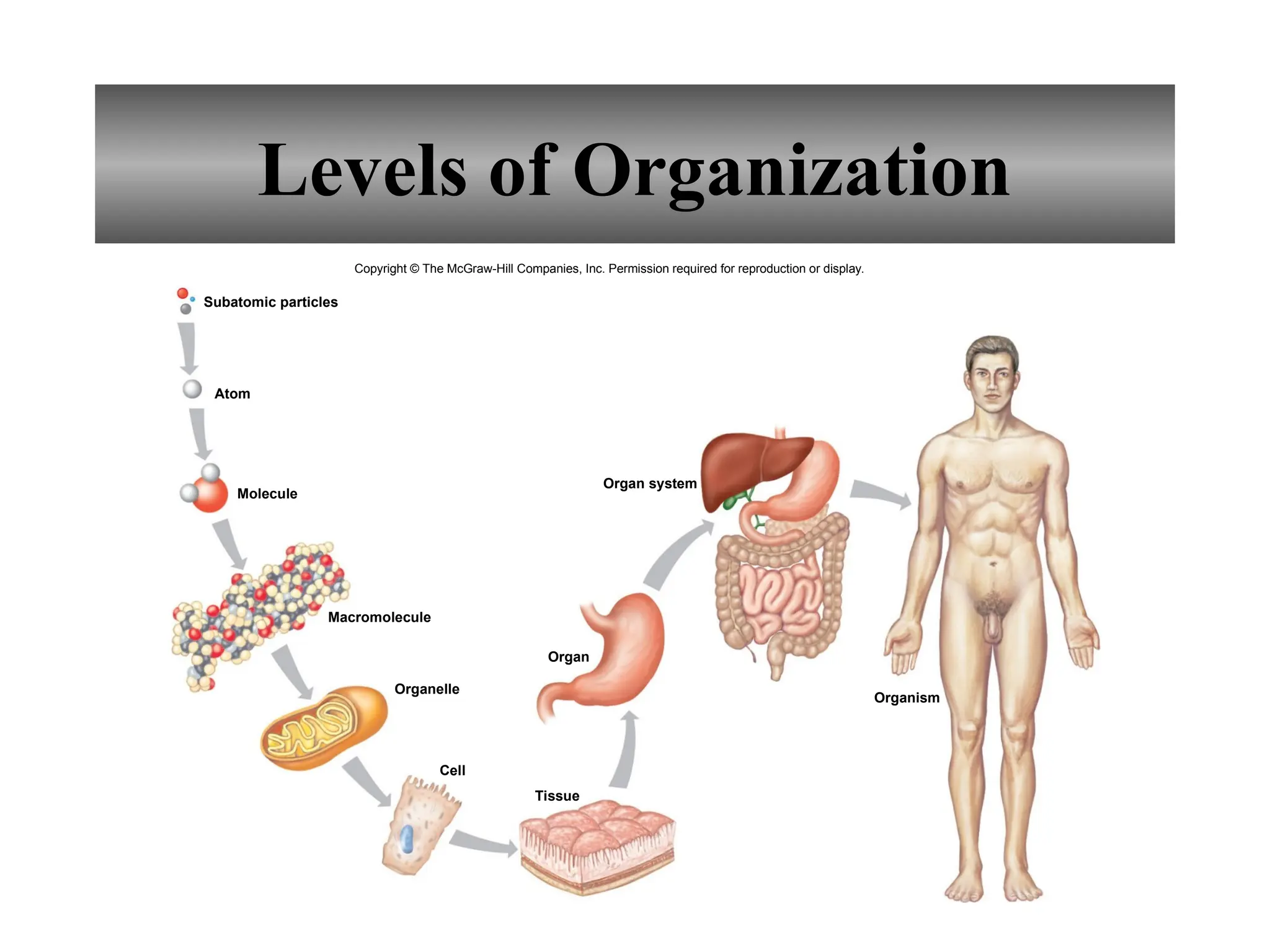
1.3: Levels of Organization
• Subatomic Particles – electrons, protons, and neutrons
• Atom – hydrogen atom, lithium atom, etc.
• Molecule – water molecule, glucose molecule, etc.
• Macromolecule – protein molecule, DNA molecule, etc.
• Organelle – mitochondrion, Golgi apparatus, nucleus, etc.
• Cell – muscle cell, nerve cell, etc.
• Tissue – epithelia, connective, muscle and nerve
• Organ – skin, femur, heart, kidney, etc.
• Organ System – skeletal system, digestive system, etc.
• Organism – the human
Levels of Organization
Subatomic particles
Atom
Molecule
Macromolecule
Organelle
Cell
Tissue
Organ
Organ system
Organism
Copyright © The McGraw-Hill Companies, Inc. Permission required for reproduction or display.
6
Organ Systems
Skeletal system Muscular system
Copyright © The McGraw-Hill Companies, Inc. Permission required for reproduction or display.
Integumentary system
7
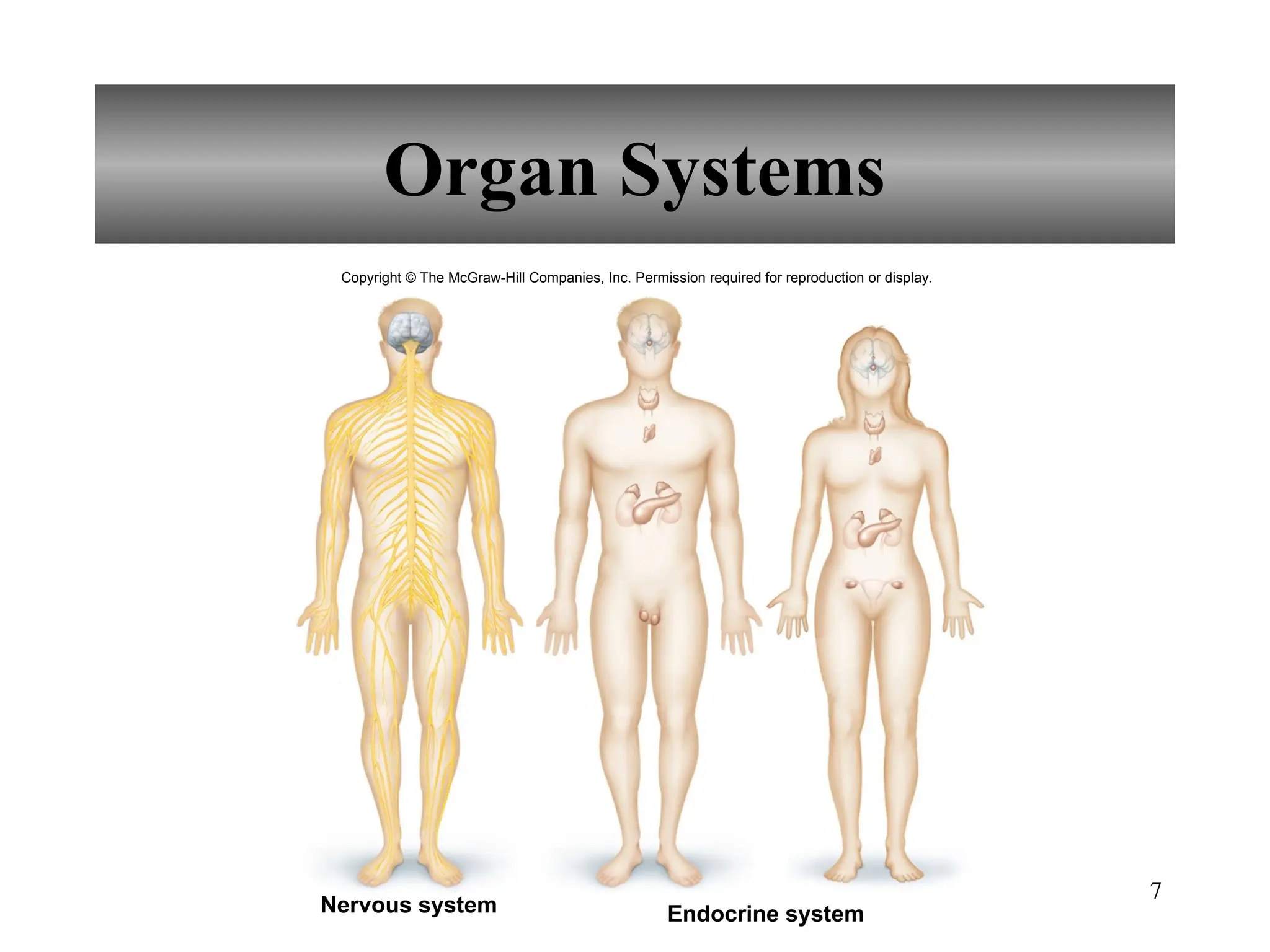
Organ Systems
Nervous system Endocrine system
Copyright © The McGraw-Hill Companies, Inc. Permission required for reproduction or display.
8
Organ Systems
Cardiovascular system
Lymphatic system
Copyright © The McGraw-Hill Companies, Inc. Permission required for reproduction or display.
9
Organ Systems
Digestive system Respiratory system Urinary system
Copyright © The McGraw-Hill Companies, Inc. Permission required for reproduction or display.
10
Organ Systems
Male reproductive system Female reproductive system
Copyright © The McGraw-Hill Companies, Inc. Permission required for reproduction or display.
11
1.1 Clinical Application
• Ultrasound (US)
• Magnetic Resonance Imaging (MRI)
12
1.4: Characteristics of Life (10)
• Movement – change in position; motion
• Responsiveness – reaction to a change
• Growth – increase in body size; no change in shape
• Respiration – obtaining oxygen; removing carbon dioxide;
releasing energy from foods
• Reproduction – production of new organisms and new cells
13
Characteristics of Life Continued
• Absorption – passage of substances through membranes and
into body fluids
• Circulation – movement of substances in body fluids
• Assimilation – changing of absorbed substances into
chemically different forms
• Excretion – removal of wastes produced by metabolic
reactions
• Digestion – breakdown of food substances into simpler
forms
14
1.5: Maintenance of Life
• Life depends on five (5) environmental factors:
• Water
• Food
• Oxygen
• Heat
• Pressure
15
Requirements of Organisms
• Water
- most abundant substance in body
- required for metabolic processes
- required for transport of substances
- regulates body temperature
• Food
- provides necessary nutrients
- supplies energy
- supplies raw materials
16
Requirements of Organisms
• Oxygen (gas)
- one-fifth of air
- used to release energy from nutrients
• Heat
- form of energy
- partly controls rate of metabolic reactions
• Pressure
- application of force on an object
- atmospheric pressure – important for breathing
- hydrostatic pressure – keeps blood flowing
17
Homeostasis*
* Maintaining of a stable internal environment
• Homeostatic Control Mechanisms – monitors aspects of the
internal environment and corrects as needed. Variations are within
limits. There are three (3) parts:
• Receptor - provides information about the stimuli
• Control Center - tells what a particular value should be
(called the set point)
• Effector - elicits responses that change conditions in the
internal environment
Homeostatic Control Mechanisms
Stimulus
(Change occurs
in internal
environment.) Response
(Change is corrected.)
Receptors Effectors
(muscles or glands)
Control center
(set point)
(Change is compared
to the set point.)
Copyright © The McGraw-Hill Companies, Inc. Permission required for reproduction or display.
18
19
Homeostatic Control Mechanisms
Receptors
Thermoreceptors
send signals to the
control center.
too high
too low
Normal body
temperature
37°C (98.6°F)
Control center
The hypothalamus
detects the deviation
from the set point and
signals effector organs.
Control center
The hypothalamus
detects the deviation
from the set point and
signals effector organs. If body temperature
continues to drop,
control center signals
muscles to contract
Involuntarily.
Stimulus
Body temperature
rises above normal.
Effectors
Skin blood vessels
dilate and sweat glands
secrete.
Response
Body heat is lost to
surroundings, temperature
drops toward normal.
Receptors
Thermoreceptors
send signals to the
control center.
Effectors
Skin blood
vessels constrict
and sweat glands
remain inactive.
Stimulus
Body temperature
drops below normal.
Effectors
Muscle
activity
generates
body heat.
Response
Body heat is conserved,
temperature rises toward normal.
Copyright © The McGraw-Hill Companies, Inc. Permission required for reproduction or display.
20
• There are two (2) types:
• Negative feedback mechanisms
• Positive feedback mechanisms
Homeostatic Control Mechanisms
21
Negative feedback summary:
• Prevents sudden, severe changes in the body
• Corrects the set point
• Causes opposite of bodily disruption to occur, i.e. the ‘negative’
• Most common type of feedback loop
• Examples: body temperature, blood pressure & glucose regulation
Homeostatic Control Mechanisms
22
Positive feedback summary:
• Increases (accelerates) the actions of the body
• short-lived
• do not require continuous adjustments
• Examples: blood clotting and child birth
Homeostatic Control Mechanisms
23
1.6: Organization
of the Human Body
Thoracic cavity
Abdominal
cavity
Diaphragm
Pelvic cavity
Cranial cavity
Vertebral canal
(a)
Abdominopelvic
cavity
Abdominal
cavity
Pelvic cavity
Right pleural
cavity
Mediastinum
Left pleural cavity
Pericardial
cavity
Diaphragm
Vertebral canal
Cranial cavity
Thoracic
cavity
(b)
24
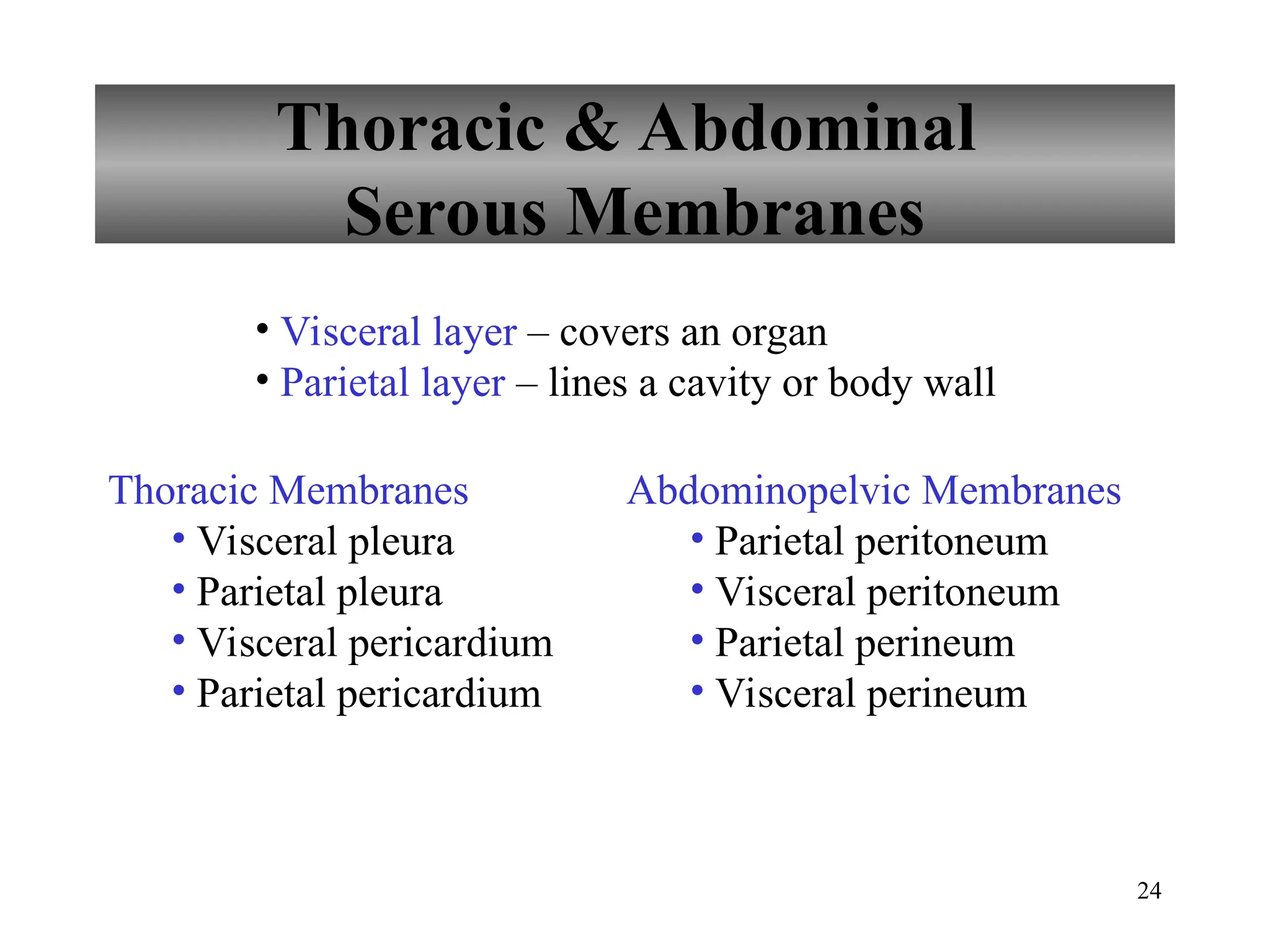
Thoracic & Abdominal
Serous Membranes
Thoracic Membranes
• Visceral pleura
• Parietal pleura
• Visceral pericardium
• Parietal pericardium
• Visceral layer – covers an organ
• Parietal layer – lines a cavity or body wall
Abdominopelvic Membranes
• Parietal peritoneum
• Visceral peritoneum
• Parietal perineum
• Visceral perineum
25
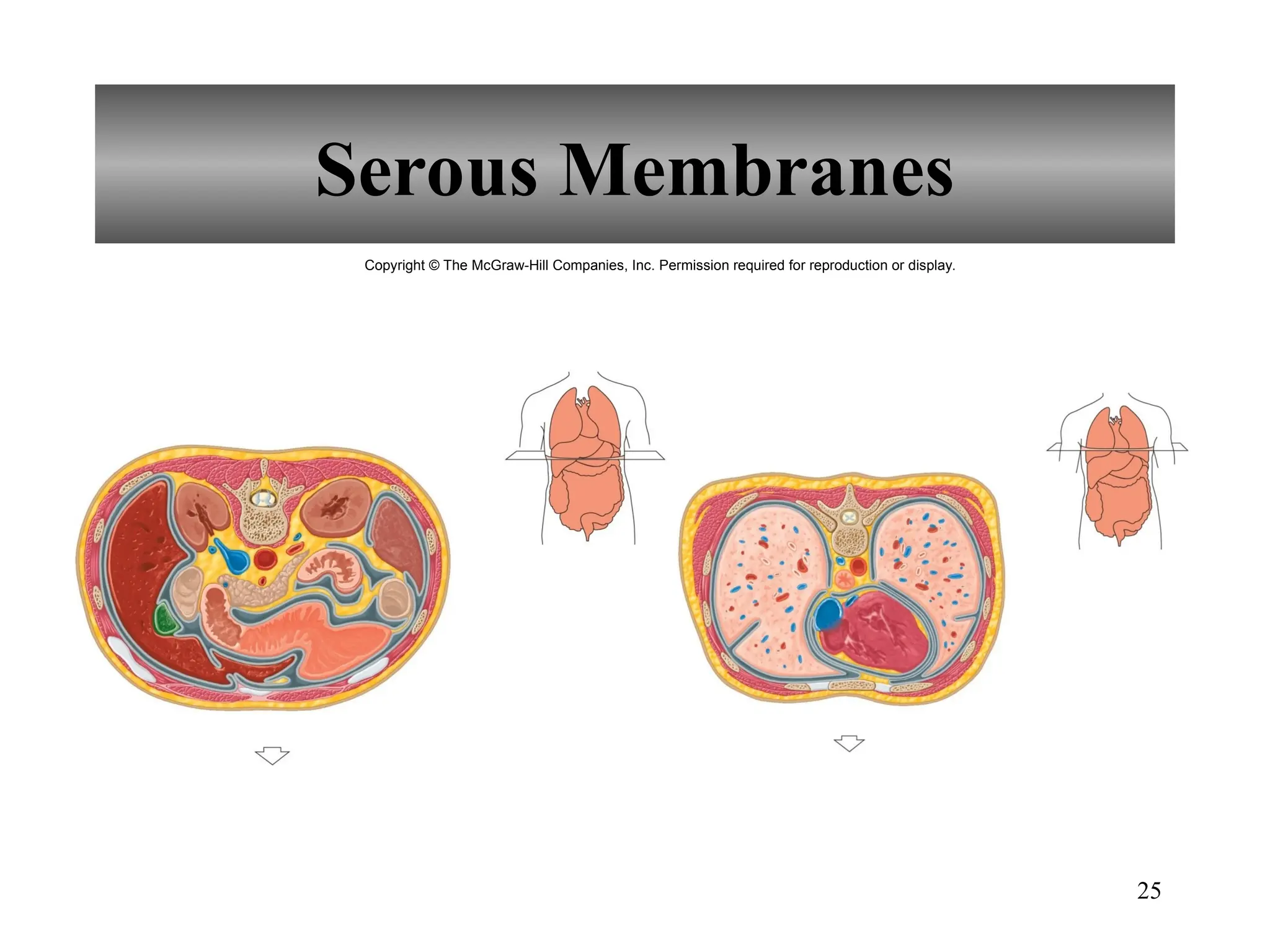
Serous Membranes
Copyright © The McGraw-Hill Companies, Inc. Permission required for reproduction or display.
26
1.7: Lifespan Changes
Aging occurs from the microscopic level to the
whole-body level.
Can you think of some examples?
27
1.8: Anatomical Terminology
Anatomical Position – standing
erect, facing forward, upper limbs
at the sides, palms facing forward
and thumbs out
Integumentary system
Copyright © The McGraw-Hill Companies, Inc. Permission required for reproduction or display.
28
Anatomical Terminology:
Orientation and Directional Terms
• Terms of Relative Position (based on anatomical position):
• Superior versus Inferior (Cranial vs. Caudal)
• Anterior versus Posterior (Ventral vs. Dorsal)
• Medial versus Lateral
• Ipsi-lateral versus Contra-lateral
• Proximal versus Distal
• Superficial versus Deep
• Internal versus External
29
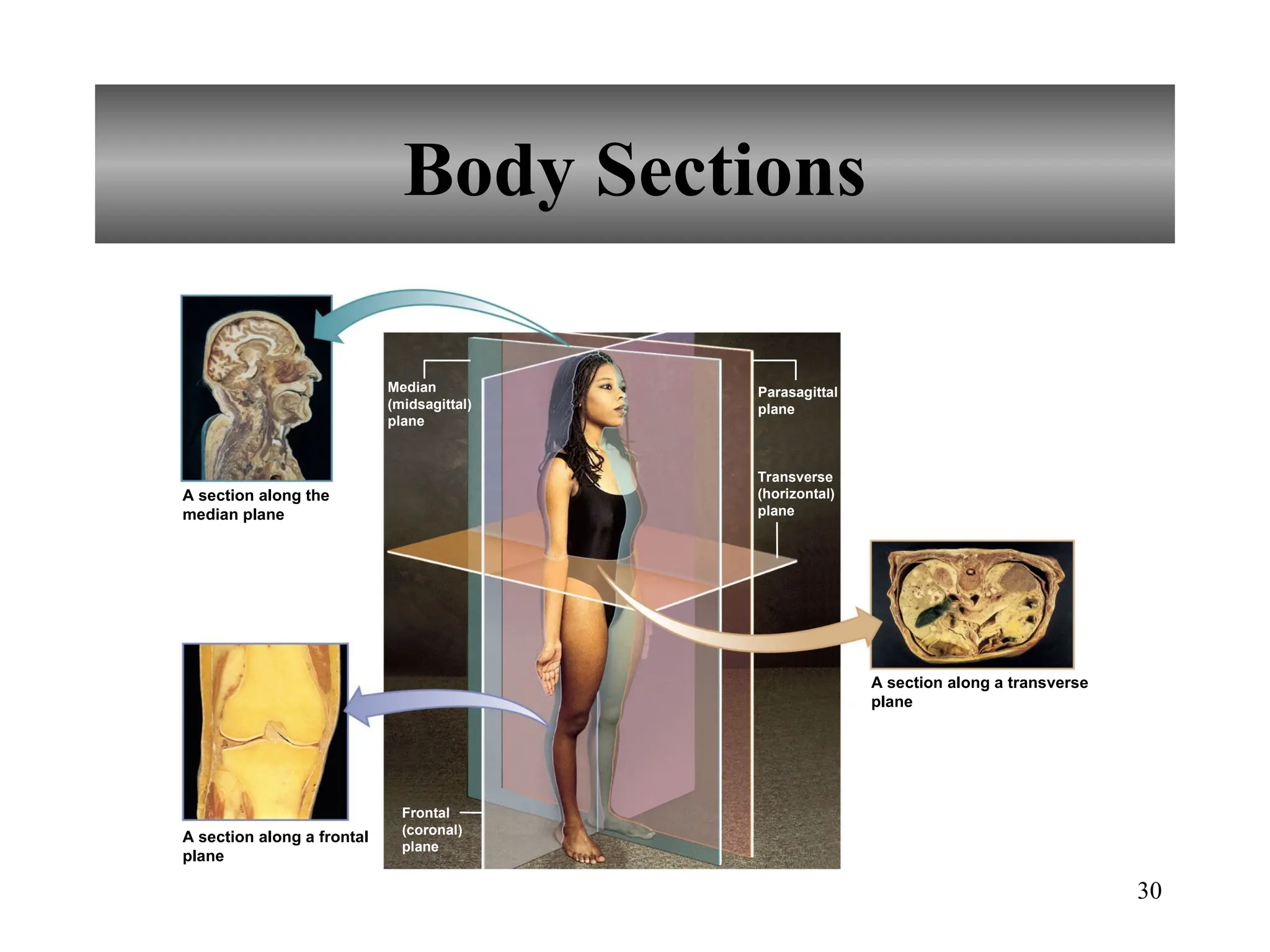
Body Sections or Planes
• Sagittal or Median – divides body into left and right portions
• Mid-sagittal – divides body into equal left and right
portions
• Transverse or Horizontal – divides body into superior and
inferior portions
• Coronal or Frontal – divides body into anterior and posterior
portions
30
Body Sections
A section along a frontal
plane
A section along a transverse
plane
A section along the
median plane
Transverse
(horizontal)
plane
Frontal
(coronal)
plane
Parasagittal
plane
Median
(midsagittal)
plane
Body Sections
31
(a) (b) (c)
32
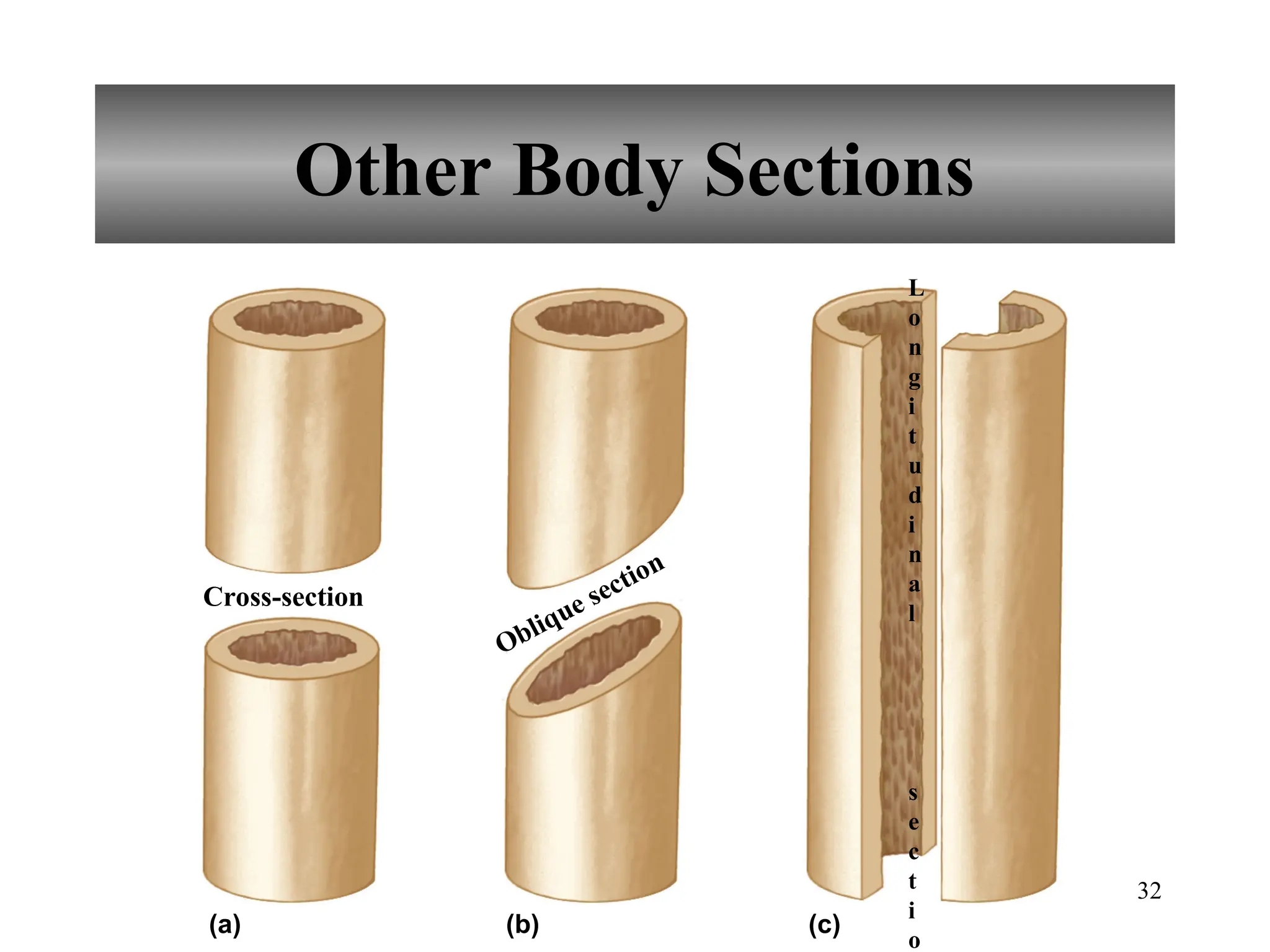
Other Body Sections
(a) (b) (c)
Cross-section
Oblique section
L
o
n
g
i
t
u
d
i
n
a
l
s
e
c
t
i
o
33
Abdominal Subdivisions
Right
hypochondriac
region
Right
lumbar
region
Right
iliac
region
Epigastric
region
Umbilical
region
Hypogastric
region
Left
hypochondriac
region
Left
lumbar
region
Left
iliac
region
Right upper
quadrant
(RUQ)
Left upper
quadrant
(LUQ)
Right lower
quadrant
(RLQ)
Left lower
quadrant
(LLQ)
34
Body Regions
Otic (ear)
Cervical (neck)
Acromial
(point of shoulder)
Mammary (breast)
Brachial
(arm)
Antecubital
(front of elbow)
Antebrachial
(forearm)
Genital
(reproductive organs)
Cephalic (head)
Orbital (eye cavity)
Mental (chin)
Sternal
Pectoral
(chest)
Inguinal
(groin)
Coxal
(hip)
Umbilical
(navel)
Pedal (foot)
Occipital
(back of head)
Acromial
(point of shoulder)
Brachial (arm)
Dorsum (back)
Cubital (elbow)
Gluteal (buttocks)
Perineal
Femoral (thigh)
Popliteal (back of knee)
Plantar (sole)
(a) (b)
Patellar
(front of knee)
Vertebral
(spinal column)
Sacral (between hips)
Lumbar
(lower back)
Abdominal
(abdomen)
Carpal (wrist)
Palmar (palm)
Digital (finger)
Nasal (nose)
Oral (mouth)
Frontal (forehead)
Buccal (cheek)
Tarsal (instep)
Digital (toe)
Axillary (armpit)
Crural (leg)
Sural (calf)
Copyright © The McGraw-Hill Companies, Inc. Permission required for reproduction or display.

1 Introduction to Human Anatomy & Physiology.ppt

  • 1.
    1 Hole’s Human Anatomy andPhysiology Twelfth Edition Shier  Butler  Lewis Chapter 1 Introduction to Human Anatomy & Physiology Copyright © The McGraw-Hill Companies, Inc. Permission required for reproduction or display.
  • 2.
    2 1.1: Introduction • Questionsand observations that have led to knowledge. • Knowledge about structure and function of the human body.
  • 3.
    3 1.2: Anatomy &Physiology • Anatomy – the study of the structure of the human body • Physiology – the study of the function of the human body “The complementarity of structure and function.”
  • 4.
    4 1.3: Levels ofOrganization • Subatomic Particles – electrons, protons, and neutrons • Atom – hydrogen atom, lithium atom, etc. • Molecule – water molecule, glucose molecule, etc. • Macromolecule – protein molecule, DNA molecule, etc. • Organelle – mitochondrion, Golgi apparatus, nucleus, etc. • Cell – muscle cell, nerve cell, etc. • Tissue – epithelia, connective, muscle and nerve • Organ – skin, femur, heart, kidney, etc. • Organ System – skeletal system, digestive system, etc. • Organism – the human
  • 5.
    Levels of Organization Subatomicparticles Atom Molecule Macromolecule Organelle Cell Tissue Organ Organ system Organism Copyright © The McGraw-Hill Companies, Inc. Permission required for reproduction or display.
  • 6.
    6 Organ Systems Skeletal systemMuscular system Copyright © The McGraw-Hill Companies, Inc. Permission required for reproduction or display. Integumentary system
  • 7.
    7 Organ Systems Nervous systemEndocrine system Copyright © The McGraw-Hill Companies, Inc. Permission required for reproduction or display.
  • 8.
    8 Organ Systems Cardiovascular system Lymphaticsystem Copyright © The McGraw-Hill Companies, Inc. Permission required for reproduction or display.
  • 9.
    9 Organ Systems Digestive systemRespiratory system Urinary system Copyright © The McGraw-Hill Companies, Inc. Permission required for reproduction or display.
  • 10.
    10 Organ Systems Male reproductivesystem Female reproductive system Copyright © The McGraw-Hill Companies, Inc. Permission required for reproduction or display.
  • 11.
    11 1.1 Clinical Application •Ultrasound (US) • Magnetic Resonance Imaging (MRI)
  • 12.
    12 1.4: Characteristics ofLife (10) • Movement – change in position; motion • Responsiveness – reaction to a change • Growth – increase in body size; no change in shape • Respiration – obtaining oxygen; removing carbon dioxide; releasing energy from foods • Reproduction – production of new organisms and new cells
  • 13.
    13 Characteristics of LifeContinued • Absorption – passage of substances through membranes and into body fluids • Circulation – movement of substances in body fluids • Assimilation – changing of absorbed substances into chemically different forms • Excretion – removal of wastes produced by metabolic reactions • Digestion – breakdown of food substances into simpler forms
  • 14.
    14 1.5: Maintenance ofLife • Life depends on five (5) environmental factors: • Water • Food • Oxygen • Heat • Pressure
  • 15.
    15 Requirements of Organisms •Water - most abundant substance in body - required for metabolic processes - required for transport of substances - regulates body temperature • Food - provides necessary nutrients - supplies energy - supplies raw materials
  • 16.
    16 Requirements of Organisms •Oxygen (gas) - one-fifth of air - used to release energy from nutrients • Heat - form of energy - partly controls rate of metabolic reactions • Pressure - application of force on an object - atmospheric pressure – important for breathing - hydrostatic pressure – keeps blood flowing
  • 17.
    17 Homeostasis* * Maintaining ofa stable internal environment • Homeostatic Control Mechanisms – monitors aspects of the internal environment and corrects as needed. Variations are within limits. There are three (3) parts: • Receptor - provides information about the stimuli • Control Center - tells what a particular value should be (called the set point) • Effector - elicits responses that change conditions in the internal environment
  • 18.
    Homeostatic Control Mechanisms Stimulus (Changeoccurs in internal environment.) Response (Change is corrected.) Receptors Effectors (muscles or glands) Control center (set point) (Change is compared to the set point.) Copyright © The McGraw-Hill Companies, Inc. Permission required for reproduction or display. 18
  • 19.
    19 Homeostatic Control Mechanisms Receptors Thermoreceptors sendsignals to the control center. too high too low Normal body temperature 37°C (98.6°F) Control center The hypothalamus detects the deviation from the set point and signals effector organs. Control center The hypothalamus detects the deviation from the set point and signals effector organs. If body temperature continues to drop, control center signals muscles to contract Involuntarily. Stimulus Body temperature rises above normal. Effectors Skin blood vessels dilate and sweat glands secrete. Response Body heat is lost to surroundings, temperature drops toward normal. Receptors Thermoreceptors send signals to the control center. Effectors Skin blood vessels constrict and sweat glands remain inactive. Stimulus Body temperature drops below normal. Effectors Muscle activity generates body heat. Response Body heat is conserved, temperature rises toward normal. Copyright © The McGraw-Hill Companies, Inc. Permission required for reproduction or display.
  • 20.
    20 • There aretwo (2) types: • Negative feedback mechanisms • Positive feedback mechanisms Homeostatic Control Mechanisms
  • 21.
    21 Negative feedback summary: •Prevents sudden, severe changes in the body • Corrects the set point • Causes opposite of bodily disruption to occur, i.e. the ‘negative’ • Most common type of feedback loop • Examples: body temperature, blood pressure & glucose regulation Homeostatic Control Mechanisms
  • 22.
    22 Positive feedback summary: •Increases (accelerates) the actions of the body • short-lived • do not require continuous adjustments • Examples: blood clotting and child birth Homeostatic Control Mechanisms
  • 23.
    23 1.6: Organization of theHuman Body Thoracic cavity Abdominal cavity Diaphragm Pelvic cavity Cranial cavity Vertebral canal (a) Abdominopelvic cavity Abdominal cavity Pelvic cavity Right pleural cavity Mediastinum Left pleural cavity Pericardial cavity Diaphragm Vertebral canal Cranial cavity Thoracic cavity (b)
  • 24.
    24 Thoracic & Abdominal SerousMembranes Thoracic Membranes • Visceral pleura • Parietal pleura • Visceral pericardium • Parietal pericardium • Visceral layer – covers an organ • Parietal layer – lines a cavity or body wall Abdominopelvic Membranes • Parietal peritoneum • Visceral peritoneum • Parietal perineum • Visceral perineum
  • 25.
    25 Serous Membranes Copyright ©The McGraw-Hill Companies, Inc. Permission required for reproduction or display.
  • 26.
    26 1.7: Lifespan Changes Agingoccurs from the microscopic level to the whole-body level. Can you think of some examples?
  • 27.
    27 1.8: Anatomical Terminology AnatomicalPosition – standing erect, facing forward, upper limbs at the sides, palms facing forward and thumbs out Integumentary system Copyright © The McGraw-Hill Companies, Inc. Permission required for reproduction or display.
  • 28.
    28 Anatomical Terminology: Orientation andDirectional Terms • Terms of Relative Position (based on anatomical position): • Superior versus Inferior (Cranial vs. Caudal) • Anterior versus Posterior (Ventral vs. Dorsal) • Medial versus Lateral • Ipsi-lateral versus Contra-lateral • Proximal versus Distal • Superficial versus Deep • Internal versus External
  • 29.
    29 Body Sections orPlanes • Sagittal or Median – divides body into left and right portions • Mid-sagittal – divides body into equal left and right portions • Transverse or Horizontal – divides body into superior and inferior portions • Coronal or Frontal – divides body into anterior and posterior portions
  • 30.
    30 Body Sections A sectionalong a frontal plane A section along a transverse plane A section along the median plane Transverse (horizontal) plane Frontal (coronal) plane Parasagittal plane Median (midsagittal) plane
  • 31.
  • 32.
    32 Other Body Sections (a)(b) (c) Cross-section Oblique section L o n g i t u d i n a l s e c t i o
  • 33.
  • 34.
    34 Body Regions Otic (ear) Cervical(neck) Acromial (point of shoulder) Mammary (breast) Brachial (arm) Antecubital (front of elbow) Antebrachial (forearm) Genital (reproductive organs) Cephalic (head) Orbital (eye cavity) Mental (chin) Sternal Pectoral (chest) Inguinal (groin) Coxal (hip) Umbilical (navel) Pedal (foot) Occipital (back of head) Acromial (point of shoulder) Brachial (arm) Dorsum (back) Cubital (elbow) Gluteal (buttocks) Perineal Femoral (thigh) Popliteal (back of knee) Plantar (sole) (a) (b) Patellar (front of knee) Vertebral (spinal column) Sacral (between hips) Lumbar (lower back) Abdominal (abdomen) Carpal (wrist) Palmar (palm) Digital (finger) Nasal (nose) Oral (mouth) Frontal (forehead) Buccal (cheek) Tarsal (instep) Digital (toe) Axillary (armpit) Crural (leg) Sural (calf) Copyright © The McGraw-Hill Companies, Inc. Permission required for reproduction or display.

Editor's Notes