
Nervous System
Unit – 1 HAP - 2
B. Pharmacy (Credit system-
Syllabus wise)
Contents
1. Organization of Nervous System
2. Neuron
3. Neurolgia
4. Classification and properties of Nerve Fiber
5. Electrophysiology
6. Action Potential
7. Nerve Impulse
8. Receptors
9. Synapse
10. Neurotransmitters
2
PHARMA EXPRESS
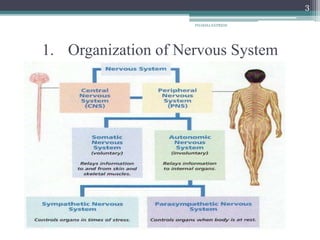
1. Organization of Nervous System
3
PHARMA EXPRESS
Functions of the Nervous System
a) Gathers information from both inside and outside the body - Sensory
Function
b) Transmits information to the processing areas of the brain and
spineProcesses the information in the brain and spine – Integration
Function
c) Sends information to the muscles, glands, and organs so they can
respond appropriately – Motor Function
d) It controls and coordinates all essential functions of the body
including all other body systems
e) allowing the body to maintain homeostasis or its delicate balance.
f) The Nervous System is divided into Two Main Divisions: Central
Nervous System (CNS) and the Peripheral Nervous System (PNS)
4
PHARMA EXPRESS
2. Neurons
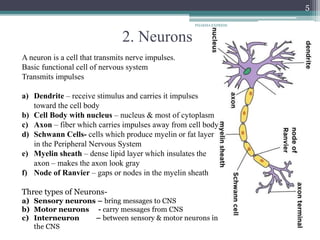
A neuron is a cell that transmits nerve impulses.
Basic functional cell of nervous system
Transmits impulses
a) Dendrite – receive stimulus and carries it impulses
toward the cell body
b) Cell Body with nucleus – nucleus & most of cytoplasm
c) Axon – fiber which carries impulses away from cell body
d) Schwann Cells- cells which produce myelin or fat layer
in the Peripheral Nervous System
e) Myelin sheath – dense lipid layer which insulates the
axon – makes the axon look gray
f) Node of Ranvier – gaps or nodes in the myelin sheath
Three types of Neurons-
a) Sensory neurons – bring messages to CNS
b) Motor neurons - carry messages from CNS
c) Interneuron – between sensory & motor neurons in
the CNS
5
PHARMA EXPRESS
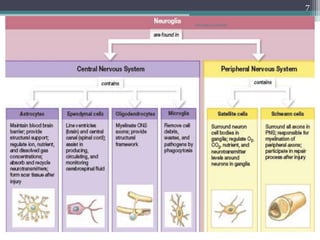
3. Neurolgia
The Neuroglia are a group of supportive cells for the
neurons. Further, they maintain the myelin sheath,
provide nutrient support
Function-
a) It offers essential nutrients. It includes oxygen to
neurons.
b) Next, it also helps create the myelin sheath. The
sheath is important in the functioning of the nervous
system. It promotes and speeds up the electrical
impulse conduction. It does so by wrapping around
the axons.
c) Further, it also helps to maintain homeostasis within
the neurons. Homeostasis is how a cell maintains a
stable internal environment despite disturbances.
d) It destroys pathogens. It helps protect the neurons
 Neuroglia, can be broadly categorised into two
variants: 1) Microglia 2) Macroglia
6
PHARMA EXPRESS
7
PHARMA EXPRESS
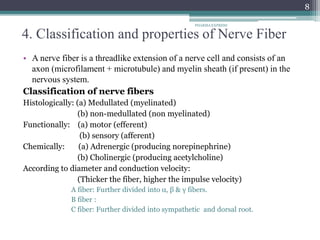
4. Classification and properties of Nerve Fiber
• A nerve fiber is a threadlike extension of a nerve cell and consists of an
axon (microfilament + microtubule) and myelin sheath (if present) in the
nervous system.
Classification of nerve fibers
Histologically: (a) Medullated (myelinated)
(b) non-medullated (non myelinated)
Functionally: (a) motor (efferent)
(b) sensory (afferent)
Chemically: (a) Adrenergic (producing norepinephrine)
(b) Cholinergic (producing acetylcholine)
According to diameter and conduction velocity:
(Thicker the fiber, higher the impulse velocity)
A fiber: Further divided into α, β & γ fibers.
B fiber :
C fiber: Further divided into sympathetic and dorsal root.
8
PHARMA EXPRESS
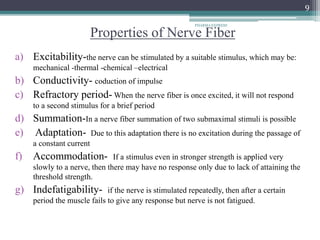
a) Excitability-the nerve can be stimulated by a suitable stimulus, which may be:
mechanical -thermal -chemical –electrical
b) Conductivity- coduction of impulse
c) Refractory period- When the nerve fiber is once excited, it will not respond
to a second stimulus for a brief period
d) Summation-In a nerve fiber summation of two submaximal stimuli is possible
e) Adaptation- Due to this adaptation there is no excitation during the passage of
a constant current
f) Accommodation- If a stimulus even in stronger strength is applied very
slowly to a nerve, then there may have no response only due to lack of attaining the
threshold strength.
g) Indefatigability- if the nerve is stimulated repeatedly, then after a certain
period the muscle fails to give any response but nerve is not fatigued.
PHARMA EXPRESS
9
Properties of Nerve Fiber
5. Action potential
PHARMA EXPRESS
10
PHARMA EXPRESS
11
6. Nerve Impulse
• A stimulus is a change in the environment with sufficient
strength to initiate a response.
• Excitability is the ability of a neuron to respond to the
stimulus and convert it into a nerve impulse
• All of Nothing Rule – The stimulus is either strong
enough to start and impulse or nothing happens
• Impulses are always the same strength along a given
neuron and they are self-propagation – once it starts it
continues to the end of the neuron in only one direction-
from dendrite to cell body to axon
• The nerve impulse causes a movement of ions across the
cell membrane of the nerve cell.
PHARMA EXPRESS
12
7. Receptors
• Receptors are biological transducers that convert
energy from both external and
internal environments into electrical impulses.
They may be massed together to form a sense
organ, such as the eye or ear, or they may be
scattered, as are those of the skin and viscera.
Receptors are connected to the central nervous
system by afferent nerve fibres. The region or
area in the periphery from which a neuron
within the central nervous system receives input
is called its receptive field.
PHARMA EXPRESS
13
8. Synapse
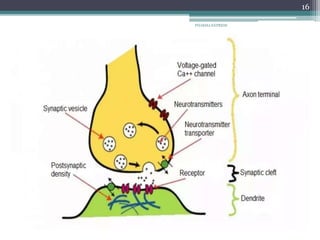
• Synapse - small gap or space between the
axon of one neuron and the dendrite of
another – the neurons do not actually
tough at the synapse
• It is junction between neurons which uses
neurotransmitters to start the impulse in the
second neuron or an effector (muscle or gland)
• The synapse insures one-way transmission of
impulses
PHARMA EXPRESS
14
Neurotransmitters
• Neurotransmitters are chemical messengers that transmit a signal from
a neuron across the synapse to a target cell, which can be a different
neuron, muscle cell, or gland cell. Neurotransmitters are chemical
substances made by the neuron specifically to transmit a message
• Acetylcholine (ACh) is commonly secreted at neuromuscular
junctions, the gaps between motor neurons and skeletal muscle cells,
where it stimulates muscles to contract by opening gated positive ion
channels.
• Epinephrine, norepinephrine (NE), dopamine, and serotonin are
derived from amino acids and are secreted mostly between neurons of
the CNS. Norepinephrine is also found in the peripheral nervous system
(PNS).
• Gamma aminobutyric acid (GABA) is usually an inhibitory
neurotransmitter (opening gated Cl – channels) among neurons in the
brain
PHARMA EXPRESS
15
PHARMA EXPRESS
16
Thank You
PHARMA EXPRESS
17

Nervous system ppt

  • 1.
    Nervous System Unit –1 HAP - 2 B. Pharmacy (Credit system- Syllabus wise)
  • 2.
    Contents 1. Organization ofNervous System 2. Neuron 3. Neurolgia 4. Classification and properties of Nerve Fiber 5. Electrophysiology 6. Action Potential 7. Nerve Impulse 8. Receptors 9. Synapse 10. Neurotransmitters 2 PHARMA EXPRESS
  • 3.
    1. Organization ofNervous System 3 PHARMA EXPRESS
  • 4.
    Functions of theNervous System a) Gathers information from both inside and outside the body - Sensory Function b) Transmits information to the processing areas of the brain and spineProcesses the information in the brain and spine – Integration Function c) Sends information to the muscles, glands, and organs so they can respond appropriately – Motor Function d) It controls and coordinates all essential functions of the body including all other body systems e) allowing the body to maintain homeostasis or its delicate balance. f) The Nervous System is divided into Two Main Divisions: Central Nervous System (CNS) and the Peripheral Nervous System (PNS) 4 PHARMA EXPRESS
  • 5.
    2. Neurons A neuronis a cell that transmits nerve impulses. Basic functional cell of nervous system Transmits impulses a) Dendrite – receive stimulus and carries it impulses toward the cell body b) Cell Body with nucleus – nucleus & most of cytoplasm c) Axon – fiber which carries impulses away from cell body d) Schwann Cells- cells which produce myelin or fat layer in the Peripheral Nervous System e) Myelin sheath – dense lipid layer which insulates the axon – makes the axon look gray f) Node of Ranvier – gaps or nodes in the myelin sheath Three types of Neurons- a) Sensory neurons – bring messages to CNS b) Motor neurons - carry messages from CNS c) Interneuron – between sensory & motor neurons in the CNS 5 PHARMA EXPRESS
  • 6.
    3. Neurolgia The Neurogliaare a group of supportive cells for the neurons. Further, they maintain the myelin sheath, provide nutrient support Function- a) It offers essential nutrients. It includes oxygen to neurons. b) Next, it also helps create the myelin sheath. The sheath is important in the functioning of the nervous system. It promotes and speeds up the electrical impulse conduction. It does so by wrapping around the axons. c) Further, it also helps to maintain homeostasis within the neurons. Homeostasis is how a cell maintains a stable internal environment despite disturbances. d) It destroys pathogens. It helps protect the neurons  Neuroglia, can be broadly categorised into two variants: 1) Microglia 2) Macroglia 6 PHARMA EXPRESS
  • 7.
  • 8.
    4. Classification andproperties of Nerve Fiber • A nerve fiber is a threadlike extension of a nerve cell and consists of an axon (microfilament + microtubule) and myelin sheath (if present) in the nervous system. Classification of nerve fibers Histologically: (a) Medullated (myelinated) (b) non-medullated (non myelinated) Functionally: (a) motor (efferent) (b) sensory (afferent) Chemically: (a) Adrenergic (producing norepinephrine) (b) Cholinergic (producing acetylcholine) According to diameter and conduction velocity: (Thicker the fiber, higher the impulse velocity) A fiber: Further divided into α, β & γ fibers. B fiber : C fiber: Further divided into sympathetic and dorsal root. 8 PHARMA EXPRESS
  • 9.
    a) Excitability-the nervecan be stimulated by a suitable stimulus, which may be: mechanical -thermal -chemical –electrical b) Conductivity- coduction of impulse c) Refractory period- When the nerve fiber is once excited, it will not respond to a second stimulus for a brief period d) Summation-In a nerve fiber summation of two submaximal stimuli is possible e) Adaptation- Due to this adaptation there is no excitation during the passage of a constant current f) Accommodation- If a stimulus even in stronger strength is applied very slowly to a nerve, then there may have no response only due to lack of attaining the threshold strength. g) Indefatigability- if the nerve is stimulated repeatedly, then after a certain period the muscle fails to give any response but nerve is not fatigued. PHARMA EXPRESS 9 Properties of Nerve Fiber
  • 10.
  • 11.
  • 12.
    6. Nerve Impulse •A stimulus is a change in the environment with sufficient strength to initiate a response. • Excitability is the ability of a neuron to respond to the stimulus and convert it into a nerve impulse • All of Nothing Rule – The stimulus is either strong enough to start and impulse or nothing happens • Impulses are always the same strength along a given neuron and they are self-propagation – once it starts it continues to the end of the neuron in only one direction- from dendrite to cell body to axon • The nerve impulse causes a movement of ions across the cell membrane of the nerve cell. PHARMA EXPRESS 12
  • 13.
    7. Receptors • Receptorsare biological transducers that convert energy from both external and internal environments into electrical impulses. They may be massed together to form a sense organ, such as the eye or ear, or they may be scattered, as are those of the skin and viscera. Receptors are connected to the central nervous system by afferent nerve fibres. The region or area in the periphery from which a neuron within the central nervous system receives input is called its receptive field. PHARMA EXPRESS 13
  • 14.
    8. Synapse • Synapse- small gap or space between the axon of one neuron and the dendrite of another – the neurons do not actually tough at the synapse • It is junction between neurons which uses neurotransmitters to start the impulse in the second neuron or an effector (muscle or gland) • The synapse insures one-way transmission of impulses PHARMA EXPRESS 14
  • 15.
    Neurotransmitters • Neurotransmitters arechemical messengers that transmit a signal from a neuron across the synapse to a target cell, which can be a different neuron, muscle cell, or gland cell. Neurotransmitters are chemical substances made by the neuron specifically to transmit a message • Acetylcholine (ACh) is commonly secreted at neuromuscular junctions, the gaps between motor neurons and skeletal muscle cells, where it stimulates muscles to contract by opening gated positive ion channels. • Epinephrine, norepinephrine (NE), dopamine, and serotonin are derived from amino acids and are secreted mostly between neurons of the CNS. Norepinephrine is also found in the peripheral nervous system (PNS). • Gamma aminobutyric acid (GABA) is usually an inhibitory neurotransmitter (opening gated Cl – channels) among neurons in the brain PHARMA EXPRESS 15
  • 16.
  • 17.